Full public teaching and readers are free without an account. A free learner account is required for saved LMS progress and recorded assessment. Completion and any course-completion certificate depend on the configured LMS conditions. Full course outline and access routes.
Lesson 1
Make the safe cut possible before lifting the knife
Check tool, support, movement path and storage against the actual trimming task.
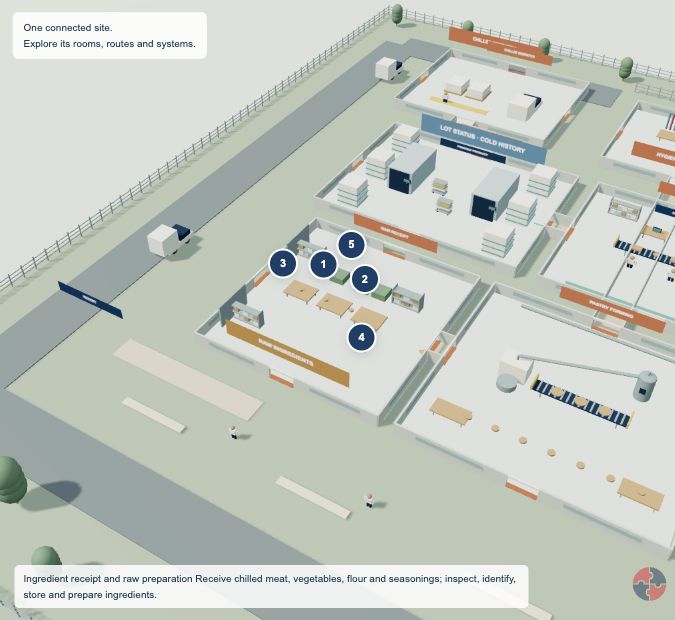
Actual SHAREsimulate FOOD-Z01 model zone. The fictional case supplies the facts; the picture does not establish live plant or product conditions.
Make the safe cut possible before lifting the knife
Knife safety begins with the work that the blade must do. Consider the food, its shape and stability, the force needed, the cutting direction and where the blade would go if it slipped. In raw trimming, a wet handle or a moving board can make a familiar action unpredictable. The supporting hand and another person's clearing movement may enter the same path. A reminder to concentrate cannot compensate for a workstation that does not support the food securely.
In the fictional receipt area, a knife is partly hidden under scraps beside an unstable board. Stop and restore the approved arrangement before cutting or clearing the bench. Use the correct serviceable tool, stable support, sufficient space and a trained method for that task. Suitable protective equipment may be specified, particularly where the supporting hand is exposed, but it must fit the actual operation. A cut-resistant glove does not make a moving board acceptable or eliminate all injury routes.
The whole knife cycle matters: obtaining the tool, use, temporary placement, cleaning, replacement and storage. Do not leave a blade hidden in a sink, amongst food waste or loose at an edge. Use the specified secure holder and keep other people out of the cutting path. Sharpening and maintenance need suitable instruction and arrangements; a learner should not improvise a sharpening method from this course. Never try to catch a falling knife, and do not use it as a general-purpose tool for an unsuitable job.
Verification should examine the real batch and pace safely, including clearing and changeover. Ask whether workers can reach the holder without crossing another person's space, whether a replacement is available when a tool is defective and whether food or waste obscures the blade. If conditions change, pause and resolve them rather than treating experience as protection. Report cuts and near misses through the agreed route, with factual information about the task and condition, so the cause can be corrected.
What must be ready before a cut?
Use the approved tool for this material and cut. Confirm that the blade, handle and guard work; the material is stable; the supporting hand, body and others are outside the likely slip path; and storage, waste and first aid are accessible.
The task assessment should name the material, thickness and variation, frequency, cut direction and endpoint, bench or fixture, blade setting, PPE and stop rule. Test difficult batches and peak pace, not only a tidy demonstration. Workers need a replacement knife at the point of work so a defect does not become an incentive to improvise. Sources: HSE PPIS12 How to reduce hand knife injuries, HSENI PUWER (Northern Ireland) 1999.
A culinary task needs the right knife and stable board. A wet food line must also control slippery floors and handles. A mobile construction cut needs light, stable support and enough space so another person cannot enter the path. Never use the hand, thigh or knee as a cutting board. Sources: HSE safe use of knives in the kitchen, HSE hand knives, HSE food and drink safety hazards.
The pre-use check looks for a secure blade, undamaged point and handle, working lock or retraction, clean grip and a clear support surface. Do not test sharpness with a finger. A failed mechanism, unknown material, missing fixture or absent replacement is a hold point. Sources: HSE PPIS12 How to reduce hand knife injuries, HSE work equipment maintenance.
Applied case
A worker is asked to trim quickly on a rocking board while a colleague clears scraps from the same blade path.
Decision and explanation
Provide the approved stable support, suitable knife and separation of the cutting and clearing movements.
Tool, support and movement paths must work together. Experience or PPE alone cannot remove the unstable cutting arrangement.
Lesson 2
Contain the hot filling before opening the route
Compare engineered transfer control with relying on somebody to catch a spill.
Actual whole-site SHAREsimulate pie factory model. This overview supplies layout context; inspect the lesson schematic and stated case for this zone.
Contain the hot filling before opening the route
Hot filling can cause a burn by contact even when it is not visibly boiling. During kettle discharge, the harm pathway depends on where the material can go if the receiver is misaligned, overfilled or moved. Splash, overflow and a contaminated slippery floor can expose operators and nearby workers. The model's colour does not indicate a measured temperature or prove that a vessel has cooled. Treat the fictional evidence about the task as separate from what the picture can show.
Before transfer, the approved arrangement needs a suitable receiver, sufficient capacity, stable positioning and control of the discharge path. A contained or mechanically assisted system may reduce open handling where suitable. Any modification must be assessed for pressure, guarding, cleaning, access and food safety rather than improvised at the line. Protective clothing and gloves may reduce residual exposure, but do not make a receiving vessel stable or prevent an overflow reaching someone else's legs.
In the exercise, the receiver has moved while another worker approaches with packaging. Stop or keep the transfer in its agreed safe condition through the authorised method and keep people clear. Do not put hands beneath the outlet, catch escaping filling or move a vessel through the hot discharge path. A person who is not trained for the equipment should summon the designated operator rather than improvise control movements. Response to a burn or other injury follows the site's first-aid and emergency arrangements.
Safe restart requires the actual transfer arrangement to be restored and checked: correct equipment, secure position, clear access, receiving readiness and usable communication. Consider what happens if the discharge does not stop as expected and who can intervene safely. Observe the corrected method under authorised controlled conditions, not by exposing a worker to a deliberate overflow. Record the defect and the evidence for correction so the next shift does not repeat a misalignment that was temporarily hidden by a cleaner floor.
What controls should be considered before relying on behaviour?
Thermal risk is best managed by changing the environment, source, task and recovery before relying on personal coping.
Telling workers to drink more or wear a coat is not enough if the job design creates excessive heat or cold exposure. Controls should remove or reduce the thermal load wherever practicable.
Personal adaptation still matters, but only within a system that gives people real choices: access to water, shade, warm areas, dry clothing, recovery time, suitable PPE and the authority to stop.
For heat, remove the hot operation where possible, then insulate or shield radiant surfaces and verify ventilation at the work position. For cold, move a task out of the freezer when practicable, or use heated, enclosed workstations and insulated access doors without compromising escape. Changing the shift pattern or asking people to drink water supports these source controls but cannot replace them.
Protective clothing must be assessed alongside the task: a suit may worsen heat load, while wet gloves can sharply reduce cold protection. The supervisor checks the real work rate, recovery space and worker feedback, then holds the task if a physical control fails or symptoms appear. The worked five-level and ERICPD example sets out feasibility, owners, evidence and stop points for a hot plant room and chilled loading area.
Applied case
The receiving vessel is off-centre and a worker suggests holding a tray under the hot outlet to catch the spill.
Decision and explanation
Hold the discharge through the authorised method and restore the suitable contained receiving arrangement.
Restore the physical transfer arrangement and protect nearby people; a person or PPE cannot replace containment and stability.
Lesson 3
Give a hot rack an unambiguous place and status
Explain why appearance and gloves cannot replace a reliable hot-rack handling system.
Actual whole-site SHAREsimulate pie factory model. This overview supplies layout context; inspect the lesson schematic and stated case for this zone.
Give a hot rack an unambiguous place and status
Metal can remain hot after leaving an oven, even when it looks identical to a rack that has cooled. A person reaching for it cannot reliably judge temperature from a polished surface or from the absence of steam. Direct contact is not a safe test. In the fictional bake area, identical racks share one unmarked parking bay and different teams move them through the shift. The failure is a missing status and handling system, not simply a worker forgetting to be cautious.
Follow the rack through loading, heating, unloading, parking, cooling and return. Define suitable locations, routes and methods so people do not have to guess which stage it has reached. Separation and clear identification can support a controlled status system, but a removable label has limitations if it is lost or not updated. The actual arrangement must include who changes status, what evidence permits it and how another shift understands it. Do not invent a universal cooling time from this lesson.
Handling equipment and protective measures need to suit heat, grip, load stability and movement. Damaged wheels, a narrow turning space or a blocked bay can make workers grasp an unintended surface or push from an awkward position. A heat-resistant glove does not stabilise a top-heavy rack or remove a pinch point. Keep the affected movement on hold if suitable handling equipment or a safe route is unavailable. Workers should not improvise a pull using clothing or a loose towel.
For verification, use a safely planned representative rack cycle and observe how people from both teams recognise and handle it. Check communication at shift change, a missing status marker and the response to a rack parked in the wrong bay. Ensure the system remains compatible with cleaning, fire routes and food protection. Record recurrent congestion and equipment defects, not just the final parked position. A useful briefing asks the worker to explain the uncertain-status decision rather than recite that racks may be hot.
What controls should be considered before relying on behaviour?
Thermal risk is best managed by changing the environment, source, task and recovery before relying on personal coping.
Telling workers to drink more or wear a coat is not enough if the job design creates excessive heat or cold exposure. Controls should remove or reduce the thermal load wherever practicable.
Personal adaptation still matters, but only within a system that gives people real choices: access to water, shade, warm areas, dry clothing, recovery time, suitable PPE and the authority to stop.
For heat, remove the hot operation where possible, then insulate or shield radiant surfaces and verify ventilation at the work position. For cold, move a task out of the freezer when practicable, or use heated, enclosed workstations and insulated access doors without compromising escape. Changing the shift pattern or asking people to drink water supports these source controls but cannot replace them.
Protective clothing must be assessed alongside the task: a suit may worsen heat load, while wet gloves can sharply reduce cold protection. The supervisor checks the real work rate, recovery space and worker feedback, then holds the task if a physical control fails or symptoms appear. The worked five-level and ERICPD example sets out feasibility, owners, evidence and stop points for a hot plant room and chilled loading area.
Applied case
An unmarked rack is found in a shared bay after a shift change, and its last oven movement is unknown.
Decision and explanation
Treat the status as unconfirmed and use the approved verification and handling process.
Unknown status needs the specified safe process. Appearance, location and touch cannot substitute for reliable status information.
Lesson 4
Dizziness beside the oven is a stop signal
Connect heat exposure, clothing, workload and appropriate support.
A worker and a separate enlarged skin section introduce sweating and the skin’s blood supply. Connect these structures to the work and environment described in the lesson.
Locate the sweat gland and skin vessels in the enlarged view. How should conditions, workload, clothing and recovery be managed together?
educational illustration · healthy anatomy; enlarged details and teaching colours.
Actual whole-site SHAREsimulate pie factory model. This overview supplies layout context; inspect the lesson schematic and stated case for this zone.
Dizziness beside the oven is a stop signal
Heat exposure is influenced by more than the air temperature on a wall display. Radiant heat from ovens, humidity, physical effort, duration and clothing affect the body's ability to lose heat. Required hygiene or protective clothing can restrict cooling. Individual needs and unfamiliarity with the work can also matter. A production target or a colleague who feels comfortable does not establish that another person can safely continue the same task.
In the fictional case, a worker becomes dizzy while moving racks beside the oven. Stop the affected activity safely and arrange the site's appropriate support or first-aid response. Do not ask the person to finish one more hot transfer, drive equipment or diagnose the cause themselves. Serious or worsening symptoms require the emergency response appropriate to the situation. The course teaches recognition and escalation, not a clinical test or treatment protocol. A buddy should be able to report changes without blaming the worker.
Compare controls at source with individual coping. Suitable heat shielding, process separation, ventilation and mechanisation can reduce the load before it reaches the worker. Planned workload, recovery in a suitable cooler place, access to drinking water and assessed clothing arrangements support those measures. Simply issuing a water bottle while the person cannot leave the line is not a workable plan. Nor should a worker remove essential hygiene or protective equipment independently; coordinate a suitable alternative through the responsible team.
Review actual conditions before resuming work, including what caused the symptoms and whether the proposed controls can be used during a busy shift. Appropriate health advice may be needed for an individual's return. Check whether relief cover, water access, communication and recovery are available in practice, and record the action owner for any gap. Keep personal health information confidential. Production readiness and a person's fitness to return are related but separate decisions; neither follows automatically from resetting the line or completing an online course.
What are practical thermal stop triggers?
Thermal work should stop or change when symptoms, control failure or environmental change makes the plan unsafe.
Stop triggers are useful because heat and cold impairment can affect judgement. Workers may not recognise deterioration in themselves.
Briefings should make it acceptable to pause work for dizziness, shivering, numbness, failed ventilation, lack of water, soaked clothing, broken heating or unexpected weather. Provide first aid for symptoms; confusion or poor coordination during hot work, or confusion, slurred speech or slow breathing after cold exposure, means call 999 immediately before any task review.
Trigger
Immediate action
Review
Dizziness, confusion or collapse
Stop, give first aid and stay with the person. Confusion, poor coordination or collapse in heat: call 999 immediately; do not wait 30 minutes.
Care first; account for crew, then investigate heat controls before restart.
Shivering, numbness or poor dexterity
Move to shelter, remove wet clothing and get first aid. Suspected frostbite needs medical help; confusion, slurred speech or slow breathing after cold exposure: call 999 now.
Do not wait for a thermometer; review cold controls only after care is underway.
PPE being removed unsafely
Stop and reassess heat/PPE compatibility.
PPE and task redesign.
Ventilation/cooling failure
Pause heat-generating work.
Engineering repair.
No water or warm recovery area
Stop until welfare is restored.
Welfare assurance.
Weather shift
Re-brief and revise controls.
Dynamic review.
Applied case
A dizzy rack handler is told to finish the oven clearance because water is available in a distant room.
Decision and explanation
Stop the affected work safely, arrange appropriate assistance and review heat controls and usable recovery.
Symptoms need prompt protection and appropriate support. Controls must be usable; remote water or unassessed PPE removal does not resolve the work design.
Lesson 5
Redesign the repetitive packing task
Assess force, posture, pace, recovery and worker fit as a connected system.
The palm-side cutaway reveals tendons, a nerve and the band across the wrist. The enlarged detail helps distinguish the structures discussed in this lesson.
Locate the tendons and nerve at the wrist. Which force, repetition, reach or recovery demand should the task assessment examine?
educational illustration · healthy anatomy; enlarged details and teaching colours.
Actual SHAREsimulate FOOD-Z05 model zone. The fictional case supplies the facts; the picture does not establish live plant or product conditions.
Redesign the repetitive packing task
A repetitive packing station can impose repeated load on muscles, tendons and joints even when each item is light. Long reaches, bent wrists, forceful pinching, static shoulder posture and insufficient recovery can combine. A fixed bench height may suit one worker and disadvantage another. Cold, gloves, slippery packaging and line pace can increase the force or effort needed. Counting only the weight of a single pie misses much of the exposure.
Observe the complete task with workers: receiving the product, placing it, sealing, rejecting defects, replenishing materials and dealing with stoppages. Ask about discomfort, variation and peak demand. Do not wait for a formal diagnosis before reviewing a difficult task. HSE's repetitive-task tools can support a competent assessment, but a score is not a universal clearance and cannot replace considering relevant individual needs or hazards outside that tool's scope. Use the appropriate assessment for lifting or pushing as well.
Source improvements might bring materials within comfortable reach, support the product, adjust workstation height and orientation, reduce force or automate a suitable step. Check proposed changes against guarding, food hygiene, access and differing worker needs. Rotation only helps if it changes the relevant exposure; swapping between two stations with the same wrist movement may provide little recovery. Brief breaks can support a better design but should not be used to excuse avoidable force or a persistently awkward reach.
In the fictional exercise, a packer reports tingling after moving between two identical chilled sealing stations. Arrange appropriate reporting and support, review the exposure and provide suitable task adjustment through the responsible process. Verify improvement with worker feedback and representative observation at normal and busy pace. Do not demonstrate success by asking someone with symptoms to repeat the old task. Document whether the revised arrangement reduces reach, grip and repetition and permits real recovery, then review whether the improvement is sustained.
How should a non-DSE workstation be designed?
Bring work within comfortable reach, set usable height and orientation for the task and range of workers, support workpieces and reduce grip, twist and repeated movement at source.
Trial adjustable height, jigs, fixtures, alternative tools or automated presentation before relying on posture reminders. Check seated and standing options, leg room, visibility, lighting and safe access. A dimension from GEIS4 is conveyor-specific guidance, not a universal desk or person measurement.
Design choice
Risk removed
Verify
Adjust height
Less shoulder lift or stoop.
Several worker statures.
Jig or fixture
Less pinch force and static holding.
Task quality and safe release.
Move supply
Less repetitive reach.
Normal and peak cycle.
Improve light
Less leaning to see.
No glare or shadow.
What makes a conveyor workstation unsafe for the upper limbs?
A belt that is too high, wide, fast or obstructed can force repeated reach, twisting, grip and poor recovery; redesign the presentation and pace for real workers.
GEIS4 gives conveyor-specific design considerations, including a repetitive reach zone within 450 mm of the operator's front. Treat this as design guidance for this setting, not a legal clearance or a safe limit for every task. For a jam, the worker holds the task, keeps hands out and calls an authorised maintainer. A normal stop does not verify a safe state. The maintainer uses the approved procedure for this machine to isolate and verify as required, clears the fault and restores guarding and function; the named equipment owner records release before the supervisor reviews presentation and pace.
Fault
Control
Hold
Long reach
Move items closer or change belt width/presentation.
Cannot reach without leaning.
Pace too fast
Adjust flow or staffing.
Worker chases passing items.
Jam or blockage
Hold; authorised maintainer uses approved machine isolation and verification, then restores guards and function.
No reaching in; no restart before named release and task review.
How should tools and materials be chosen?
Choose tools and materials that fit the task and users, reducing trigger or grip force, weight, wrist bend, contact pressure and vibration; trial them in real work before buying.
Consider left-handed use, glove effects, maintenance and workpiece support. A lighter tool that takes longer or requires a stronger grip may not reduce total risk. Where vibrating tools are used, assess hand-arm vibration separately.
Handle and trigger. Trial question: Can different users grip without forceful pinch?; Record: Worker trial.
Weight and support. Trial question: Can jig or balancer carry load?; Record: Task observation.
Workpiece. Trial question: Can it be held without static hand effort?; Record: Fixture test.
Can rotation and breaks solve poor task design?
Rotation and breaks support recovery only when the alternative task uses different muscles and demand; first remove or reduce force, repetition and awkward posture in the original work.
Moving a worker from one high-force or repetitive hand task to another does not create recovery. Check targets, staffing, overtime and whether breaks are genuinely taken without pace compensation. Consult workers on feasible variation and trial the schedule.
Rotate from packing to scanning. Test: Do both load the same arm and hand?; Stop: Do not credit false recovery.
Add a short break. Test: Does the work rate then rise?; Stop: Redesign pace.
Automate a step. Test: Does a new loading task create risk?; Stop: Reassess whole job.
Assess the height where the hands meet the work item, not only the belt or bench surface. A tall product, raised jig or fixture changes that effective height and the shoulder/reach demand. Trial the real product range with users, adjust the fixture or supply arrangement and reassess the task; do not impose one dimension for everyone.
Applied case
Rotation swaps workers between identical sealing stations, but the same wrist movement and tingling complaints continue.
Decision and explanation
Whether task redesign and genuinely different exposure/recovery reduce the actual repetitive load.
A schedule can leave the same exposure unchanged. Review posture, force, repetition, pace and recovery with the workers.
Lesson 6
Keep hands effective and warnings usable in cold noisy work
Recognise interacting cold, handling and noise risks without inventing exposure readings.
Actual whole-site SHAREsimulate pie factory model. This overview supplies layout context; inspect the lesson schematic and stated case for this zone.
Keep hands effective and warnings usable in cold noisy work
Cold can reduce comfort, grip and dexterity, making a case harder to hold or a control harder to operate. A numb hand is a task warning, not proof of a particular medical diagnosis. At the same time, refrigeration and pneumatic equipment can create noise that masks speech and warnings. These exposures can interact: a worker wearing cold protection and hearing protection still needs to communicate and perform the job safely. The model provides no measured noise dose or body-temperature reading.
Ask whether part of the work can move out of the cold environment or use suitable local protection and handling assistance. Where cold work remains, the assessed arrangement needs suitable clothing and gloves, accessible recovery, dry replacement items and a workable pattern of exposure. Gloves must preserve enough grip and dexterity for the actual case and controls. A sign telling workers to keep warm is ineffective if the warming area is inaccessible or the line has no relief cover.
Noise control should first consider source reduction, maintenance, suitable silencers, enclosure or separation as appropriate. Workers must not modify pneumatic equipment or acoustic guards independently. A representative assessment covers the person's real tasks and exposure pattern, including short noisy activities and time away from the main station. A phone reading or the ability to tolerate noise does not establish compliance. Hearing protection supports the assessed controls where required; check its compatibility with clothing, communication and warning arrangements.
In the fictional case, a picker has numb fingers and cannot hear a shouted instruction near the chiller. Pause the affected handling safely and use the agreed support and reporting routes. Review cold exposure and communication before resuming, rather than increasing speed to leave sooner. Verify the revised task with representative workers under controlled conditions: effective grip, usable controls, reliable warning recognition and actual recovery access. Persistent symptoms or hearing concerns need appropriate qualified advice, not an informal fitness judgement by colleagues.
How can the ISO 45001 hierarchy of controls reduce workplace noise at source and protect hearing?
Remove an unnecessary noisy task, buy quieter equipment, enclose or damp the source, then limit residual exposure and fit hearing protection.
HSE prioritises eliminating and substituting hazards before engineering controls, administrative controls and PPE, as explained in its five-level hierarchy of controls. SHARE uses ERICPD as a task-planning prompt: Eliminate; Reduce, including substitution; Isolate through engineered separation; Control with other engineered or administrative measures; PPE; and Discipline, meaning continued verification and maintenance. ERICPD is not a sixth HSE level or a separate legal duty. The example below is a feasibility test for this work, not a universal prescription.
How can the ERICPD hierarchy of controls reduce workplace noise at source and protect hearing?
ERICPD is a planning crossmap. Its prompts do not add a sixth rung or rank Isolate above engineering. Discipline verifies and sustains every control level.
Worked activity: Task application for Noise at Work
Activity and release context
A site plan should state who installs each source measure, where measurements will be repeated and what stops operation. Protectors support the plan; they do not turn an untreated noisy machine into acceptable source control. Sources: HSE noise construction controls , HSE noise hearing protection .
Remove an unnecessary compressed-air cleaning step and use a non-air cleaning method; process owner confirms product quality and other hazards.
Observe the task and verify the compressor is not used; hold a reintroduced blow-off job. Sources: HSE; HSENI.
Reduce
Procure a lower-noise saw or nozzle for the same output; buyer and engineer compare supplier data under the intended load.
Acceptance measurement at the operator position; reject an unverified noisy replacement. Sources: HSE; HSENI.
Engineering
Enclose the saw, fit damping and place the compressor away from occupied work; engineer checks guarding, access and heat.
Measure outside the enclosure and check door seals; failed enclosure or new rattling stops use. Sources: HSE; HSENI.
Administrative
Supervisor limits time in the remaining noisy area and marks access; exposure assessor calculates actual full-shift exposure.
Observe access and repeat exposure estimate after changed shifts; duration alone is not source control. Sources: HSE; HSENI.
PPE
Fit suitable hearing protection for residual noise and teach seal checks.
Inspect fit and use; surveillance trend or defect restarts the source-control review. Sources: HSE; HSENI.
Discipline / continuing assurance
Continuing checks mean maintenance, supervision and learning after the stronger controls.
How can the ISO 45001 hierarchy of controls reduce workplace noise at source and protect hearing?
The hierarchy of controls in ISO 45001:2018 comes under Clause 8.1.2 (Eliminating hazards and reducing OH&S risks), which is located within Clause 8 ("Operation").
Worked activity: Task application for Noise at Work
Activity and release context
A site plan should state who installs each source measure, where measurements will be repeated and what stops operation. Protectors support the plan; they do not turn an untreated noisy machine into acceptable source control. Sources: HSE noise construction controls , HSE noise hearing protection .
Remove an unnecessary compressed-air cleaning step and use a non-air cleaning method; process owner confirms product quality and other hazards.
Observe the task and verify the compressor is not used; hold a reintroduced blow-off job. Sources: HSE; HSENI.
Substitution
Procure a lower-noise saw or nozzle for the same output; buyer and engineer compare supplier data under the intended load.
Acceptance measurement at the operator position; reject an unverified noisy replacement. Sources: HSE; HSENI.
Engineering
Enclose the saw, fit damping and place the compressor away from occupied work; engineer checks guarding, access and heat.
Measure outside the enclosure and check door seals; failed enclosure or new rattling stops use. Sources: HSE; HSENI.
Administrative
Supervisor limits time in the remaining noisy area and marks access; exposure assessor calculates actual full-shift exposure.
Observe access and repeat exposure estimate after changed shifts; duration alone is not source control. Sources: HSE; HSENI.
PPE
Fit suitable hearing protection for residual noise and teach seal checks.
Inspect fit and use; surveillance trend or defect restarts the source-control review. Sources: HSE; HSENI.
Administrative controls / continuing assurance
Continuing checks mean maintenance, supervision and learning after the stronger controls.
A site plan should state who installs each source measure, where measurements will be repeated and what stops operation. Protectors support the plan; they do not turn an untreated noisy machine into acceptable source control. Sources: HSE noise construction controls, HSE noise hearing protection.
Match the control to the path. Damping reduces vibration of a resonant panel; a silencer reduces air-flow or exhaust noise; insulation and a sealed enclosure block sound transmission; absorptive lining reduces reflected sound in a room but may do little to the direct path beside a saw. The engineer tests the actual frequency and operating mode, then confirms the reduction at the worker position. HSE source-control methods
Read the practical categories separately: elimination removes the hazardous task/source; substitution replaces it with a suitable safer alternative; physical separation, containment and capture are engineering decisions. Duration/access/briefing are administrative measures, PPE covers residual exposure, and continued inspection, maintenance and verified action closure sustain the controls. Exposure monitoring or dosimetry measures exposure rather than protecting a person. The detailed text and records below distinguish these decisions; an overview illustration is not task authorisation.
Applied case
A cold-store worker drops a case after numb fingers and misses a shouted warning beside noisy refrigeration equipment.
Decision and explanation
Assess cold protection, task/handling design, recovery and the noise/communication controls together.
Cold, handling and warning recognition interact. A suitable whole-task arrangement is needed; improvised exposure or protection changes can add harm.
Lesson 7
Knife injury during raw meat trimming
Explain the decision using the observed condition, the harm route and the evidence needed for release.
Actual SHAREsimulate FOOD-Z01 model zone. The fictional case supplies the facts; the picture does not establish live plant or product conditions.
Understand the activity and how harm develops
A trimming knife can cut the hand holding the meat if the cutting path, grip or work surface is unsafe.
Inspect blade condition, work height and the route of the blade beyond the cut. Review knife cleaning, storage and passing as well as cutting, and select any cut protection for the actual task without moving fingers into the blade path.
Choose the right maintained knife, stable surface, secure work and a method keeping hands outside the blade path. Design the pace and space so the method remains possible. Cleaning and passing knives are separate tasks that also need a safe arrangement.
Compare a thick-walled artery, a thinner-walled vein with a valve example, and the small-vessel network behind them. Colours separate the vessels; blood is red in both.
Compare the vessel structures. Apply this lesson’s prevention and emergency-response arrangements; the illustration does not teach a practical procedure.
educational illustration · healthy anatomy; enlarged details and teaching colours.
Recognise the evidence boundary
Question
Case evidence
What is observed?
A trimming knife lies beneath meat scraps beside an unstable cutting board.
How can harm occur?
A slipping blade can cut the operator or another person clearing the bench.
What information is needed?
Check the task method, knife condition, board stability and protected storage.
Protect, manage and verify
Purpose
Practical application
Immediate protection
Use the approved stable workstation, suitable knife and trained cutting method.
Accountable work arrangement
The supervisor and trained knife user review the actual task, blade and workstation. First aid and incident response address an injury; equipment and work design still need correction. If the described protection is absent, defective or cannot be verified, keep the affected activity restricted while the responsible person resolves it. Use the current inspection evidence; the title alone is not the verdict.
Release verification
Observe the task and confirm safe knife placement before work continues.
Apply this at work
Explain the decision using the observed condition, the harm route and the evidence needed for release.
What must be ready before a cut?
Use the approved tool for this material and cut. Confirm that the blade, handle and guard work; the material is stable; the supporting hand, body and others are outside the likely slip path; and storage, waste and first aid are accessible.
The task assessment should name the material, thickness and variation, frequency, cut direction and endpoint, bench or fixture, blade setting, PPE and stop rule. Test difficult batches and peak pace, not only a tidy demonstration. Workers need a replacement knife at the point of work so a defect does not become an incentive to improvise. Sources: HSE PPIS12 How to reduce hand knife injuries, HSENI PUWER (Northern Ireland) 1999.
A culinary task needs the right knife and stable board. A wet food line must also control slippery floors and handles. A mobile construction cut needs light, stable support and enough space so another person cannot enter the path. Never use the hand, thigh or knee as a cutting board. Sources: HSE safe use of knives in the kitchen, HSE hand knives, HSE food and drink safety hazards.
The pre-use check looks for a secure blade, undamaged point and handle, working lock or retraction, clean grip and a clear support surface. Do not test sharpness with a finger. A failed mechanism, unknown material, missing fixture or absent replacement is a hold point. Sources: HSE PPIS12 How to reduce hand knife injuries, HSE work equipment maintenance.
Applied case
A trimming knife lies beneath meat scraps beside an unstable cutting board. The next production or dispatch step is waiting for a decision.
Decision and explanation
Use the approved stable workstation, suitable knife and trained cutting method.
This retains control of the affected work or product while the required evidence is established. Observe the task and confirm safe knife placement before work continues. Speed pressure makes a weak method harder to follow and does not protect the supporting hand. Recording alone leaves this harm route active: A slipping blade can cut the operator or another person clearing the bench.
Lesson 8
Hot filling spills during kettle discharge
Explain the decision using the observed condition, the harm route and the evidence needed for release.
Actual whole-site SHAREsimulate pie factory model. This overview supplies layout context; inspect the lesson schematic and stated case for this zone.
Understand the activity and how harm develops
Hot filling can splash or spill during discharge and burn people in its path.
Prefer contained transfer and suitable receiving equipment. Plan fill height, vessel stability, safe access and the response to a blockage. Hygiene clothing may trap hot material against skin and is not automatically thermal protection.
Air temperature alone cannot describe exposure. Assess radiant heat, air movement, humidity, work rate and clothing as well as temperature. Control the task and environment, provide suitable recovery and respond to symptoms; do not invent one universal safe working temperature.
Recognise the evidence boundary
Question
Case evidence
What is observed?
A receiving vessel is misaligned under the kettle discharge.
How can harm occur?
Hot filling can splash or overflow and burn nearby workers.
What information is needed?
Check transfer equipment, capacity, positioning and the approved discharge method.
Protect, manage and verify
Purpose
Practical application
Immediate protection
Stop transfer and restore a suitable guarded or contained transfer arrangement.
Accountable work arrangement
The manager adjusts the task and environment with workers and competent advice. Trained first aid or urgent medical assistance is used when symptoms indicate illness. If the described protection is absent, defective or cannot be verified, keep the affected activity restricted while the responsible person resolves it. Use the current inspection evidence; the title alone is not the verdict.
Release verification
Observe a controlled transfer with clear access and verified equipment readiness.
Apply this at work
Explain the decision using the observed condition, the harm route and the evidence needed for release.
What controls should be considered before relying on behaviour?
Thermal risk is best managed by changing the environment, source, task and recovery before relying on personal coping.
Telling workers to drink more or wear a coat is not enough if the job design creates excessive heat or cold exposure. Controls should remove or reduce the thermal load wherever practicable.
Personal adaptation still matters, but only within a system that gives people real choices: access to water, shade, warm areas, dry clothing, recovery time, suitable PPE and the authority to stop.
For heat, remove the hot operation where possible, then insulate or shield radiant surfaces and verify ventilation at the work position. For cold, move a task out of the freezer when practicable, or use heated, enclosed workstations and insulated access doors without compromising escape. Changing the shift pattern or asking people to drink water supports these source controls but cannot replace them.
Protective clothing must be assessed alongside the task: a suit may worsen heat load, while wet gloves can sharply reduce cold protection. The supervisor checks the real work rate, recovery space and worker feedback, then holds the task if a physical control fails or symptoms appear. The worked five-level and ERICPD example sets out feasibility, owners, evidence and stop points for a hot plant room and chilled loading area.
Applied case
A receiving vessel is misaligned under the kettle discharge. The next production or dispatch step is waiting for a decision.
Decision and explanation
Stop transfer and restore a suitable guarded or contained transfer arrangement.
It puts the worker close to uncontrolled hot liquid and can create an unstable overfilled load. Recording alone leaves this harm route active: Hot filling can splash or overflow and burn nearby workers. This retains control of the affected work or product while the required evidence is established. Observe a controlled transfer with clear access and verified equipment readiness.
Lesson 9
Hot racks mistaken for cool racks
Explain the decision using the observed condition, the harm route and the evidence needed for release.
Actual whole-site SHAREsimulate pie factory model. This overview supplies layout context; inspect the lesson schematic and stated case for this zone.
Understand the activity and how harm develops
A rack that looks cool may still carry enough heat to burn a hand or another worker.
Make hot and released-to-handle status clear in the workflow. Use suitable routes, stable racks and assessed handling protection. Colour or appearance alone cannot establish temperature, and a verbal warning may be lost at shift change.
Air temperature alone cannot describe exposure. Assess radiant heat, air movement, humidity, work rate and clothing as well as temperature. Control the task and environment, provide suitable recovery and respond to symptoms; do not invent one universal safe working temperature.
Recognise the evidence boundary
Question
Case evidence
What is observed?
Identical oven racks share one parking bay without status identification.
How can harm occur?
A worker can grasp hot metal and sustain burns.
What information is needed?
Ask how rack temperature status is communicated through the handling cycle.
Protect, manage and verify
Purpose
Practical application
Immediate protection
Separate and clearly identify hot racks and use the specified handling equipment.
Accountable work arrangement
The manager adjusts the task and environment with workers and competent advice. Trained first aid or urgent medical assistance is used when symptoms indicate illness. If the described protection is absent, defective or cannot be verified, keep the affected activity restricted while the responsible person resolves it. Use the current inspection evidence; the title alone is not the verdict.
Release verification
Confirm the actual parking route and handling method prevent unplanned contact.
Apply this at work
Explain the decision using the observed condition, the harm route and the evidence needed for release.
What controls should be considered before relying on behaviour?
Thermal risk is best managed by changing the environment, source, task and recovery before relying on personal coping.
Telling workers to drink more or wear a coat is not enough if the job design creates excessive heat or cold exposure. Controls should remove or reduce the thermal load wherever practicable.
Personal adaptation still matters, but only within a system that gives people real choices: access to water, shade, warm areas, dry clothing, recovery time, suitable PPE and the authority to stop.
For heat, remove the hot operation where possible, then insulate or shield radiant surfaces and verify ventilation at the work position. For cold, move a task out of the freezer when practicable, or use heated, enclosed workstations and insulated access doors without compromising escape. Changing the shift pattern or asking people to drink water supports these source controls but cannot replace them.
Protective clothing must be assessed alongside the task: a suit may worsen heat load, while wet gloves can sharply reduce cold protection. The supervisor checks the real work rate, recovery space and worker feedback, then holds the task if a physical control fails or symptoms appear. The worked five-level and ERICPD example sets out feasibility, owners, evidence and stop points for a hot plant room and chilled loading area.
Applied case
Identical oven racks share one parking bay without status identification. The next production or dispatch step is waiting for a decision.
Decision and explanation
Separate and clearly identify hot racks and use the specified handling equipment.
Recording alone leaves this harm route active: A worker can grasp hot metal and sustain burns. The person is being exposed to the hazard to obtain information that should come from a safe method. This retains control of the affected work or product while the required evidence is established. Confirm the actual parking route and handling method prevent unplanned contact.
Lesson 10
Heat strain beneath hygiene clothing
Explain the decision using the observed condition, the harm route and the evidence needed for release.
Actual whole-site SHAREsimulate pie factory model. This overview supplies layout context; inspect the lesson schematic and stated case for this zone.
Understand the activity and how harm develops
Physical work near ovens can overheat someone even when hygiene clothing covers most of their skin.
Assess radiant heat, work rate, humidity, clothing and recovery alongside air temperature. Improve the source and task conditions, provide suitable recovery and respond to symptoms. Water alone cannot make an excessive heat load safe.
Air temperature alone cannot describe exposure. Assess radiant heat, air movement, humidity, work rate and clothing as well as temperature. Control the task and environment, provide suitable recovery and respond to symptoms; do not invent one universal safe working temperature.
Recognise the evidence boundary
Question
Case evidence
What is observed?
A worker in required hygiene clothing reports dizziness beside the ovens.
How can harm occur?
Heat strain can cause illness and loss of concentration around hot equipment.
What information is needed?
Assess heat exposure, workload, clothing, breaks and symptoms through the agreed process.
Protect, manage and verify
Purpose
Practical application
Immediate protection
Stop the affected work and arrange support while managing heat exposure and recovery.
Accountable work arrangement
The manager adjusts the task and environment with workers and competent advice. Trained first aid or urgent medical assistance is used when symptoms indicate illness. If the described protection is absent, defective or cannot be verified, keep the affected activity restricted while the responsible person resolves it. Use the current inspection evidence; the title alone is not the verdict.
Release verification
Verify a workable heat-control plan and the person's safe return through appropriate advice.
Apply this at work
Explain the decision using the observed condition, the harm route and the evidence needed for release.
What are practical thermal stop triggers?
Thermal work should stop or change when symptoms, control failure or environmental change makes the plan unsafe.
Stop triggers are useful because heat and cold impairment can affect judgement. Workers may not recognise deterioration in themselves.
Briefings should make it acceptable to pause work for dizziness, shivering, numbness, failed ventilation, lack of water, soaked clothing, broken heating or unexpected weather. Provide first aid for symptoms; confusion or poor coordination during hot work, or confusion, slurred speech or slow breathing after cold exposure, means call 999 immediately before any task review.
Trigger
Immediate action
Review
Dizziness, confusion or collapse
Stop, give first aid and stay with the person. Confusion, poor coordination or collapse in heat: call 999 immediately; do not wait 30 minutes.
Care first; account for crew, then investigate heat controls before restart.
Shivering, numbness or poor dexterity
Move to shelter, remove wet clothing and get first aid. Suspected frostbite needs medical help; confusion, slurred speech or slow breathing after cold exposure: call 999 now.
Do not wait for a thermometer; review cold controls only after care is underway.
PPE being removed unsafely
Stop and reassess heat/PPE compatibility.
PPE and task redesign.
Ventilation/cooling failure
Pause heat-generating work.
Engineering repair.
No water or warm recovery area
Stop until welfare is restored.
Welfare assurance.
Weather shift
Re-brief and revise controls.
Dynamic review.
Applied case
A worker in required hygiene clothing reports dizziness beside the ovens. The next production or dispatch step is waiting for a decision.
Decision and explanation
Stop the affected work and arrange support while managing heat exposure and recovery.
This retains control of the affected work or product while the required evidence is established. Verify a workable heat-control plan and the person's safe return through appropriate advice. Hydration supports protection but does not remove excessive heat, unsuitable clothing or lack of recovery. Recording alone leaves this harm route active: Heat strain can cause illness and loss of concentration around hot equipment.
Lesson 11
Repetitive hand packing in a cold line
Explain the decision using the observed condition, the harm route and the evidence needed for release.
Actual SHAREsimulate FOOD-Z05 model zone. The fictional case supplies the facts; the picture does not establish live plant or product conditions.
Understand the activity and how harm develops
Fast repeated packing at a cold line can strain hands and shoulders without any heavy lift.
Review reach, workstation height, hand force, repetition, cold conditions and recovery together. Rotation only helps if it changes the relevant exposure. Test redesigned work with the actual pace rather than an empty line.
Avoid unnecessary handling and redesign load, height, distance, reach and frequency before relying on technique. Include the actual route, damaged wheels, clothing, pace and individual needs. A light load repeated many times can still cause harm.
Recognise the evidence boundary
Question
Case evidence
What is observed?
Workers repeat the same wrist movement at a fixed-height chilled packing station.
How can harm occur?
Repetition, force and cold can contribute to upper-limb disorders.
What information is needed?
Assess reach, pace, force, recovery, workstation height and reported discomfort.
Protect, manage and verify
Purpose
Practical application
Immediate protection
Improve the task and workstation and provide assessed variation and recovery.
Accountable work arrangement
The supervisor reviews the actual task with workers and a competent assessor; equipment or work-design changes need verification under real use. If the described protection is absent, defective or cannot be verified, keep the affected activity restricted while the responsible person resolves it. Use the current inspection evidence; the title alone is not the verdict.
Release verification
Observe the revised work and review symptoms and exposure with workers.
Apply this at work
Explain the decision using the observed condition, the harm route and the evidence needed for release.
What can a manual-handling weight or tool score actually tell us?
The law has no fixed safe lifting weight. Observe the full task and the person doing it; a filter or coloured tool score is a screening aid, not permission to continue a harmful lift.
Manual handling includes lifting, lowering, carrying, pushing, pulling and supporting a load. If the task cannot be avoided, consider frequency, reach, vertical travel, twisting, grip, load stability, route, pace and the individual. The same carton can present different risk at floor level and waist height. HSE manual handling at work and HSE L23 Manual handling guidance on regulations.
V-MAC is for work meeting HSE’s full eligibility conditions, including regular single-person handling with substantially variable loads/frequency over a substantial part of the shift. Variable box weights alone do not make the two-person archive example eligible. Assess relevant lift/carry and trolley push/pull elements separately with MAC/RAPP as appropriate; do not combine scores into a pass mark. HSE: V-MAC criteria and toolkit limitations.
Applied case
Workers repeat the same wrist movement at a fixed-height chilled packing station. The next production or dispatch step is waiting for a decision.
Decision and explanation
Improve the task and workstation and provide assessed variation and recovery.
Recording alone leaves this harm route active: Repetition, force and cold can contribute to upper-limb disorders. This retains control of the affected work or product while the required evidence is established. Observe the revised work and review symptoms and exposure with workers. The same body parts may retain a similar cumulative exposure.
Use the appropriate manual handling assessment
This additional teaching takes about 2–5 minutes, in addition to the course estimate. Optional reading and workplace assessment take additional time.
Start by asking whether the hazardous handling can be removed or redesigned. Where handling remains, observe the whole operation with the people who do it and choose an assessment that fits the work.
These aids support the activity assessment. Repetitive upper-limb work may need ART; variable or complex tasks may need other HSE tools or a fuller competent assessment. Mechanical lifting, stored energy, equipment safety and health decisions retain their separate controls. A low factor score, a downloaded report or completion of this course does not approve the work.
TILEO: Task, Individual, Load, Environment and Other factors. MAC: Manual Handling Assessment Charts for appropriate lifting, carrying and team handling. RAPP: Risk Assessment of Pushing and Pulling for appropriate manual pushing and pulling.
Read the portable guide to understand selection, limitations, the mixed-task example and company-branded Word/PDF records. Your existing course checks and completion requirements remain separate.
Explain the decision using the observed condition, the harm route and the evidence needed for release.
Actual whole-site SHAREsimulate pie factory model. This overview supplies layout context; inspect the lesson schematic and stated case for this zone.
Understand the activity and how harm develops
Cold work can reduce hand control and make packing or handling equipment harder to use safely.
Assess temperature, airflow, contact surfaces, clothing, workload and duration. Provide compatible protection and recovery without creating entanglement or hygiene problems. Loss of dexterity is a warning that can also undermine other controls.
Air temperature alone cannot describe exposure. Assess radiant heat, air movement, humidity, work rate and clothing as well as temperature. Control the task and environment, provide suitable recovery and respond to symptoms; do not invent one universal safe working temperature.
Recognise the evidence boundary
Question
Case evidence
What is observed?
A cold-store picker struggles to grip a case and reports numb fingers.
How can harm occur?
Cold stress and reduced dexterity can cause ill health or dropped loads.
What information is needed?
Assess time in cold areas, clothing, work pattern and reported symptoms.
Protect, manage and verify
Purpose
Practical application
Immediate protection
Provide suitable cold protection and recovery arrangements and revise the task.
Accountable work arrangement
The manager adjusts the task and environment with workers and competent advice. Trained first aid or urgent medical assistance is used when symptoms indicate illness. If the described protection is absent, defective or cannot be verified, keep the affected activity restricted while the responsible person resolves it. Use the current inspection evidence; the title alone is not the verdict.
Release verification
Confirm the worker can perform the task safely under the assessed arrangements.
Apply this at work
Explain the decision using the observed condition, the harm route and the evidence needed for release.
What are practical thermal stop triggers?
Thermal work should stop or change when symptoms, control failure or environmental change makes the plan unsafe.
Stop triggers are useful because heat and cold impairment can affect judgement. Workers may not recognise deterioration in themselves.
Briefings should make it acceptable to pause work for dizziness, shivering, numbness, failed ventilation, lack of water, soaked clothing, broken heating or unexpected weather. Provide first aid for symptoms; confusion or poor coordination during hot work, or confusion, slurred speech or slow breathing after cold exposure, means call 999 immediately before any task review.
Trigger
Immediate action
Review
Dizziness, confusion or collapse
Stop, give first aid and stay with the person. Confusion, poor coordination or collapse in heat: call 999 immediately; do not wait 30 minutes.
Care first; account for crew, then investigate heat controls before restart.
Shivering, numbness or poor dexterity
Move to shelter, remove wet clothing and get first aid. Suspected frostbite needs medical help; confusion, slurred speech or slow breathing after cold exposure: call 999 now.
Do not wait for a thermometer; review cold controls only after care is underway.
PPE being removed unsafely
Stop and reassess heat/PPE compatibility.
PPE and task redesign.
Ventilation/cooling failure
Pause heat-generating work.
Engineering repair.
No water or warm recovery area
Stop until welfare is restored.
Welfare assurance.
Weather shift
Re-brief and revise controls.
Dynamic review.
Applied case
A cold-store picker struggles to grip a case and reports numb fingers. The next production or dispatch step is waiting for a decision.
Decision and explanation
Provide suitable cold protection and recovery arrangements and revise the task.
Recording alone leaves this harm route active: Cold stress and reduced dexterity can cause ill health or dropped loads. The symptom and impaired control require timely action, not an end-of-shift assumption. This retains control of the affected work or product while the required evidence is established. Confirm the worker can perform the task safely under the assessed arrangements.
Lesson 13
Pneumatic and chiller noise accumulates
Explain the decision using the observed condition, the harm route and the evidence needed for release.
Actual whole-site SHAREsimulate pie factory model. This overview supplies layout context; inspect the lesson schematic and stated case for this zone.
Understand the activity and how harm develops
Pneumatic exhausts and refrigeration equipment can combine into a worker's cumulative noise exposure.
Assess representative tasks, duration and peaks, including cleaning and maintenance. Reduce source noise through suitable equipment, exhaust treatment and maintenance without creating contamination or process problems. A quiet corridor reading does not represent a noisy workstation.
Choose quieter methods and equipment, maintain them and separate or enclose the source where practicable. Assess actual tasks and peaks. A brief visit cannot establish daily exposure, and hearing tests do not prevent the damaging noise.
Locate the visible outer ear before considering the hearing pathway and the lesson’s noise-control decisions.
Locate the outer ear, then connect the lesson to the hearing pathway. What would reduce noise exposure at source?
educational illustration · healthy anatomy; enlarged details and teaching colours.
Recognise the evidence boundary
Question
Case evidence
What is observed?
Air exhausts and refrigeration noise make normal conversation difficult.
How can harm occur?
Repeated exposure can damage hearing and mask warnings.
What information is needed?
Request a representative noise assessment covering the worker's whole shift.
Protect, manage and verify
Purpose
Practical application
Immediate protection
Reduce noise at source and implement the assessed exposure and hearing-protection arrangements.
Accountable work arrangement
The manager obtains competent noise assessment and implements source controls; workers report communication problems and health concerns through the agreed route. If the described protection is absent, defective or cannot be verified, keep the affected activity restricted while the responsible person resolves it. Use the current inspection evidence; the title alone is not the verdict.
Release verification
Confirm controls are effective and alarms and communication remain usable.
Apply this at work
Explain the decision using the observed condition, the harm route and the evidence needed for release.
How do daily and peak exposure differ?
Estimate representative personal exposure across all tasks and compare the separate C-weighted peak, using competent measurements when the decision is uncertain.
Record machine mode, position, operating time, other noise sources, nearby workers and variation across days. A supplier emission figure is a starting point, not personal exposure at this workstation. Weekly averaging may be relevant where daily exposure varies; it does not erase a high peak. HSE sets the representative-estimate requirement. Sources: HSE noise employer duties.
Applied case
Air exhausts and refrigeration noise make normal conversation difficult. The next production or dispatch step is waiting for a decision.
Decision and explanation
Reduce noise at source and implement the assessed exposure and hearing-protection arrangements.
Protection needs selection and verification, and does not replace practicable source control. This retains control of the affected work or product while the required evidence is established. Confirm controls are effective and alarms and communication remain usable. Recording alone leaves this harm route active: Repeated exposure can damage hearing and mask warnings.
Lesson 14
A busy shift is not a different safety standard
Coordinate decisions across preparation, hot work areas and chilled packing.
Actual whole-site SHAREsimulate pie factory model. This overview supplies layout context; inspect the lesson schematic and stated case for this zone.
A busy shift is not a different safety standard
The fictional factory has accepted a late order. At receipt, a knife is hidden under meat scraps and the board moves during trimming. Beside the kettle, a receiving vessel is out of position. An unmarked oven rack is parked across the normal route, and a rack handler reports dizziness. At chilled packing, two people have swapped stations but continue the same forceful wrist movement. A cold-store picker reports numb fingers, while pneumatic and chiller noise makes spoken warnings hard to understand. These are supplied exercise facts, not defects inferred from a decorative image.
The first decision is to make each affected activity safe through the agreed local controls. Do not ask someone to catch a hot spill, touch a rack to establish temperature or complete a cut while another person clears the blade path. Obtain appropriate assistance for the dizzy worker and protect the numb-handed picker from further unsafe handling. Immediate protection is not a diagnosis. Supervisors should arrange first-aid, occupational-health or other qualified support as appropriate while keeping responsibility for reviewing the work conditions themselves.
Now compare work design with quick fixes. A glove may be necessary for a particular cutting or hot-handling task but cannot stabilise a board or a receiving vessel. A label can communicate rack status only within a system that keeps it reliable through loading, cooling and shift change. Water access is meaningful only when people can use it alongside suitable workload and recovery. Rotation cannot be credited as effective if both tasks impose substantially the same exposure. Hearing protectors cannot be removed casually to compensate for an unworkable communication system.
Assign the relevant evidence questions. Preparation needs a suitable knife, stable support, safe storage and a trained method demonstrated at the actual task. The kettle and rack routes need suitable equipment, controlled positioning, status and safe access. Heat work needs workable source controls, relief and recovery, with appropriate individual advice. Packing needs a whole-task ergonomic review and changes that reduce force, reach and repetition. Cold work needs suitable protection and recovery, and noise needs representative assessment, effective source controls and usable warnings. None of these is measured by the animation or a production target.
For the exercise, create a fictional shift plan showing which activities remain on hold, who coordinates each correction and what evidence would support the authorised restart. Distinguish a worker's return from the release of equipment or a process. Verify changes safely with worker involvement, including peak demand, differing body sizes, shift handover and the ability to stop when conditions deteriorate. Record any remaining restriction in usable language for the next team. The result should be a practical plan for controlled work, not a demand that individuals endure symptoms to protect output. Real work authority and clinical judgements remain with the appropriate site and health professionals.
How should a non-DSE workstation be designed?
Bring work within comfortable reach, set usable height and orientation for the task and range of workers, support workpieces and reduce grip, twist and repeated movement at source.
Trial adjustable height, jigs, fixtures, alternative tools or automated presentation before relying on posture reminders. Check seated and standing options, leg room, visibility, lighting and safe access. A dimension from GEIS4 is conveyor-specific guidance, not a universal desk or person measurement.
Design choice
Risk removed
Verify
Adjust height
Less shoulder lift or stoop.
Several worker statures.
Jig or fixture
Less pinch force and static holding.
Task quality and safe release.
Move supply
Less repetitive reach.
Normal and peak cycle.
Improve light
Less leaning to see.
No glare or shadow.
What makes a conveyor workstation unsafe for the upper limbs?
A belt that is too high, wide, fast or obstructed can force repeated reach, twisting, grip and poor recovery; redesign the presentation and pace for real workers.
GEIS4 gives conveyor-specific design considerations, including a repetitive reach zone within 450 mm of the operator's front. Treat this as design guidance for this setting, not a legal clearance or a safe limit for every task. For a jam, the worker holds the task, keeps hands out and calls an authorised maintainer. A normal stop does not verify a safe state. The maintainer uses the approved procedure for this machine to isolate and verify as required, clears the fault and restores guarding and function; the named equipment owner records release before the supervisor reviews presentation and pace.
Fault
Control
Hold
Long reach
Move items closer or change belt width/presentation.
Cannot reach without leaning.
Pace too fast
Adjust flow or staffing.
Worker chases passing items.
Jam or blockage
Hold; authorised maintainer uses approved machine isolation and verification, then restores guards and function.
No reaching in; no restart before named release and task review.
How should tools and materials be chosen?
Choose tools and materials that fit the task and users, reducing trigger or grip force, weight, wrist bend, contact pressure and vibration; trial them in real work before buying.
Consider left-handed use, glove effects, maintenance and workpiece support. A lighter tool that takes longer or requires a stronger grip may not reduce total risk. Where vibrating tools are used, assess hand-arm vibration separately.
Handle and trigger. Trial question: Can different users grip without forceful pinch?; Record: Worker trial.
Weight and support. Trial question: Can jig or balancer carry load?; Record: Task observation.
Workpiece. Trial question: Can it be held without static hand effort?; Record: Fixture test.
Can rotation and breaks solve poor task design?
Rotation and breaks support recovery only when the alternative task uses different muscles and demand; first remove or reduce force, repetition and awkward posture in the original work.
Moving a worker from one high-force or repetitive hand task to another does not create recovery. Check targets, staffing, overtime and whether breaks are genuinely taken without pace compensation. Consult workers on feasible variation and trial the schedule.
Rotate from packing to scanning. Test: Do both load the same arm and hand?; Stop: Do not credit false recovery.
Add a short break. Test: Does the work rate then rise?; Stop: Redesign pace.
Automate a step. Test: Does a new loading task create risk?; Stop: Reassess whole job.
Assess the height where the hands meet the work item, not only the belt or bench surface. A tall product, raised jig or fixture changes that effective height and the shoulder/reach demand. Trial the real product range with users, adjust the fixture or supply arrangement and reassess the task; do not impose one dimension for everyone.
Applied case
The production lead proposes gloves, extra water and a reminder to concentrate as a single answer to all seven task concerns.
Decision and explanation
Hold the affected activities and resolve their distinct physical, exposure and support needs with task-specific verification.
The proposed reminders do not stabilise equipment, resolve symptoms or reduce the actual task exposures. Relevant controls and evidence are needed for each affected activity.
Lesson 15
Take a verified action into the workplace
Connect one actual task to an owner, evidence and a clear release or escalation decision.
Actual whole-site SHAREsimulate pie factory model. This overview supplies layout context; inspect the lesson schematic and stated case for this zone.
Turn awareness into a practical question
Great Britain awareness for raw preparation, cooking, packing and cold-store staff. Recognise and control ordinary task hazards, report symptoms and request suitable help. No clinical diagnosis, first-aid certification, equipment modification or permission to undertake specialist work.
Choose one relevant operation from the course. Describe the person or product at risk, the mechanism of harm and the exact condition that needs controlling. Separate an observation from a conclusion. A display, signature, badge or clean appearance answers only a limited question.
Use the included practice resources to prepare a fictional task brief, risk review or verification question. Decide which competent role owns the decision and which evidence must be available before work or product is released. Keep food disposition and worker protection as distinct decisions where both apply.
At work, use your actual approved arrangements. Report uncertainty and preserve the relevant hold, restriction or safe state while it is resolved. Confirm that the action addressed the original harm route and check whether another shift, product, cleaning task or maintenance change could reintroduce it.
Course completion records awareness learning. It does not establish practical competence, certify a food business, validate a recipe, extend shelf life or authorise maintenance, chemical work or emergency entry.
How should a non-DSE workstation be designed?
Bring work within comfortable reach, set usable height and orientation for the task and range of workers, support workpieces and reduce grip, twist and repeated movement at source.
Trial adjustable height, jigs, fixtures, alternative tools or automated presentation before relying on posture reminders. Check seated and standing options, leg room, visibility, lighting and safe access. A dimension from GEIS4 is conveyor-specific guidance, not a universal desk or person measurement.
Design choice
Risk removed
Verify
Adjust height
Less shoulder lift or stoop.
Several worker statures.
Jig or fixture
Less pinch force and static holding.
Task quality and safe release.
Move supply
Less repetitive reach.
Normal and peak cycle.
Improve light
Less leaning to see.
No glare or shadow.
What makes a conveyor workstation unsafe for the upper limbs?
A belt that is too high, wide, fast or obstructed can force repeated reach, twisting, grip and poor recovery; redesign the presentation and pace for real workers.
GEIS4 gives conveyor-specific design considerations, including a repetitive reach zone within 450 mm of the operator's front. Treat this as design guidance for this setting, not a legal clearance or a safe limit for every task. For a jam, the worker holds the task, keeps hands out and calls an authorised maintainer. A normal stop does not verify a safe state. The maintainer uses the approved procedure for this machine to isolate and verify as required, clears the fault and restores guarding and function; the named equipment owner records release before the supervisor reviews presentation and pace.
Fault
Control
Hold
Long reach
Move items closer or change belt width/presentation.
Cannot reach without leaning.
Pace too fast
Adjust flow or staffing.
Worker chases passing items.
Jam or blockage
Hold; authorised maintainer uses approved machine isolation and verification, then restores guards and function.
No reaching in; no restart before named release and task review.
How should tools and materials be chosen?
Choose tools and materials that fit the task and users, reducing trigger or grip force, weight, wrist bend, contact pressure and vibration; trial them in real work before buying.
Consider left-handed use, glove effects, maintenance and workpiece support. A lighter tool that takes longer or requires a stronger grip may not reduce total risk. Where vibrating tools are used, assess hand-arm vibration separately.
Handle and trigger. Trial question: Can different users grip without forceful pinch?; Record: Worker trial.
Weight and support. Trial question: Can jig or balancer carry load?; Record: Task observation.
Workpiece. Trial question: Can it be held without static hand effort?; Record: Fixture test.
Can rotation and breaks solve poor task design?
Rotation and breaks support recovery only when the alternative task uses different muscles and demand; first remove or reduce force, repetition and awkward posture in the original work.
Moving a worker from one high-force or repetitive hand task to another does not create recovery. Check targets, staffing, overtime and whether breaks are genuinely taken without pace compensation. Consult workers on feasible variation and trial the schedule.
Rotate from packing to scanning. Test: Do both load the same arm and hand?; Stop: Do not credit false recovery.
Add a short break. Test: Does the work rate then rise?; Stop: Redesign pace.
Automate a step. Test: Does a new loading task create risk?; Stop: Reassess whole job.
Assess the height where the hands meet the work item, not only the belt or bench surface. A tall product, raised jig or fixture changes that effective height and the shoulder/reach demand. Trial the real product range with users, adjust the fixture or supply arrangement and reassess the task; do not impose one dimension for everyone.
Applied case
The shift action log says “training completed, issue closed”. It records no condition check, product disposition or task owner.
Decision and explanation
The accountable person verifies the task-specific control and records the justified decision.
Learning supports the decision; evidence that the relevant control works is needed before the responsible person closes the action.