SHARE Knowledge Hub
Noise-Induced Hearing Loss
Noise-induced hearing loss is permanent inner-ear hearing damage caused by harmful sound exposure. Prevent it through source noise reduction, representative exposure assessment and appropriate surveillance; respond promptly to tinnitus, muffled hearing or a measured threshold change.
Understanding Noise-Induced Hearing Loss
Noise-induced hearing loss is preventable damage to hearing associated with harmful sound exposure.
Why this matters at work
Do not decide coverage from the issue of PPE. Under the applicable national noise rules, the risk assessment determines whether suitable surveillance is required. HSE’s detailed guidance includes regular exposure at or above the upper action values and people at particular risk, including some lower or occasional exposures. Assess personal exposure and peaks, work pattern and individual susceptibility with competent advice. Establish an understandable programme with appropriately controlled baseline and follow-up testing, trained staff and OH oversight. Explain that hearing checks seek early change and inform prevention; they do not make harmful exposure acceptable. Keep a route for symptoms between appointments. Record who is covered, the exposure basis and review triggers, and check agency or changing-role workers are not missed. Protect confidential clinical records and act on relevant work restrictions and group signals. A quiet room average or nominal protector attenuation cannot, by itself, justify excluding someone from surveillance.
Retain the testing date, equipment and calibration details, environment, recent exposure and any exceptions through the proper clinical process. Do not circulate the raw audiogram to everyone supervising the worker. Give the provider an accurate work history and ask for functional restrictions and the need for further clinical review. Where a change may indicate harm, improve or restrict the exposure while investigation proceeds; uncertain test quality is not a reason to ignore a known noise hazard. Confirm that any repeat or referral actually happens and that the resulting control actions are verified during real work.
How organisations manage this in practice
Act on functional advice about continuing exposure, communication and safety-critical tasks while maintaining fair work support. Review source controls, the suitability and actual use of protection, and whether other similarly exposed workers need attention. Keep a distinction between completion of the appointment, receipt of necessary work advice and completion of preventive actions. Record dates, ownership and review without putting unnecessary medical details in the action log. Confirm the worker understands what happens next. An electronic referral marked sent does not demonstrate assessment or effective prevention if nobody checks the outcome.
A hearing test taken soon after a noisy shift may be influenced by temporary threshold shift. The competent programme should document recent exposure and test conditions and interpret any change against a reliable baseline. Managers should receive functional advice and necessary action, rather than diagnose injury from the screen. Check engineering controls under representative production, verify the selected protection in use and follow the referral through to an outcome. Tell the worker what changed and how to report recurrence; a symptom that disappeared still justifies a control review.
Operators report that a press sounds louder after a tooling change. The supervisor asks engineering to check the source and a competent assessor to review exposure. The team checks the engineering change during production and confirms remaining protection is suitable.
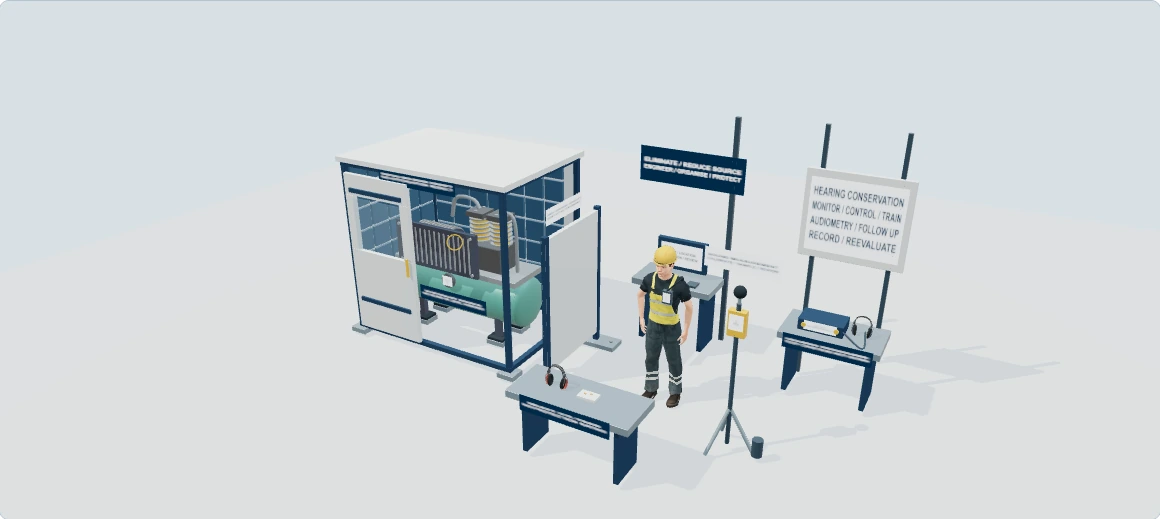

Noise: source, transmission path and the worker’s hearing
Explore how this equipment can harm its users and other people, then follow the practical measures that interrupt each pathway. This is a hazards and good-practice lesson; the separate checklist remains the pre-use/safety-check activity.
Checksheets and risk assessments
Equipment checksheets
Risk assessment forms
Risk assessment examples
Forms and tools
Full written walkthrough — all 8 steps
1. Identify the source and exposed people
What is happening: The machine is one possible sound source; the observer, adjacent stations and other tasks also matter.
How harm can occur: Noise can damage hearing, cause tinnitus and mask warnings or communication.
Best practice to apply: Observe the real work and affected people and identify the sources that dominate their exposure.
Why this works: Treating a minor source while a dominant one remains may give little benefit to the worker.
Noise at Work · Why is noise harmful?2. Reduce the source before relying on PPE
What is happening: The enclosure illustrates one engineering approach; source process and equipment choices come first.
How harm can occur: Unnecessary noisy work continues to expose people even if they carry hearing protection.
Best practice to apply: Consider quieter processes, equipment, maintenance and suitable source treatments before lower-order measures.
Why this works: Source reduction benefits everyone exposed and does not depend solely on individual wearing behaviour.
Noise at Work · How can the ISO 45001 hierarchy of controls reduce workplace noise at source and protect hearing?3. Understand openings and transmission paths
What is happening: A barrier or enclosure changes a path but sound can still travel through gaps and other routes.
How harm can occur: An opening, reflection or untreated path can leave the worker exposed despite a visible screen.
Best practice to apply: Use competent acoustic design and verify the actual arrangement, including access and necessary ventilation.
Why this works: A screen's appearance does not show attenuation at the person; the complete route matters.
Noise at Work · What failure chains cause avoidable exposure?4. Include the person and the full work pattern
What is happening: A person's exposure changes with tasks, location and duration.
How harm can occur: A short loud event or several jobs can be missed by a single convenient reading.
Best practice to apply: Assess representative daily/weekly and peak exposure where appropriate and include all relevant work.
Why this works: The assessment must describe the person's work, not only one machine's catalogue number.
Noise at Work · How do daily and peak exposure differ?5. Measure for a decision, not a decorative number
What is happening: The meter and dosimeter show that method, placement and interpretation are part of measurement.
How harm can occur: An unrepresentative or poorly interpreted result can lead to ineffective protection and continued harm.
Best practice to apply: Use suitable competent measurement and compare with the applicable GB or NI framework; no reading is supplied here.
Why this works: A valid result needs an appropriate method and context, not merely an instrument on site.
Noise at Work · What should be checked before and after a noisy task?6. Plan hearing protection for residual risk
What is happening: The protection station is separate from the source and path controls.
How harm can occur: Unsuitable fit, selection or use can leave hearing unprotected; overprotection can also hinder essential awareness.
Best practice to apply: Select suitable protection, fit, instruction and use arrangements while continuing practicable source reduction.
Why this works: Residual protection complements engineering and must work for the actual person and task.
Noise at Work · Who must be able to do what?7. Use surveillance to prevent further harm
What is happening: Health surveillance and symptom reports support prevention rather than making exposure acceptable.
How harm can occur: Progressive hearing change may be unnoticed while exposure continues.
Best practice to apply: Use the required competent health-surveillance arrangements and act on findings and reported symptoms.
Why this works: Finding harm should drive review and control, not be treated as an acceptable cost of work.
Noise at Work · What record and review cycle makes the programme accountable?8. Verify changes at the worker
What is happening: New machinery, layout, open doors or altered production can change the noise reaching people.
How harm can occur: A nominal treatment can lose effectiveness during real work or transfer exposure to someone else.
Best practice to apply: Verify actual improvement, keep controls maintained and review changed work and affected groups.
Why this works: A successful intervention improves exposure during use rather than only completing a purchase or record.
Noise at Work · How could a workshop replace a noisy blow-off step?
Illustrative awareness learning. Geometry, colours and movement do not establish safe distances, capacity, exposure, isolation or work permission. Use the actual assessment, equipment information and competent arrangements.
The wider workplace has its own account and subscription access. Exploring this lesson does not grant access, record course completion or authorise work.
UK guidance for further reading
HSE: NoiseWhat should happen at the first sign?
Report tinnitus, muffled hearing or difficulty understanding speech, obtain appropriate hearing assessment and review exposure controls promptly.
Best-practice guide: Noise-Induced Hearing Loss

What should happen at the first sign?
Report tinnitus, muffled hearing or difficulty understanding speech, obtain appropriate hearing assessment and review exposure controls promptly. Noise-induced hearing loss is permanent inner-ear hearing damage caused by harmful sound exposure.
Turn noise-induced hearing loss knowledge into a decision
Noise-induced hearing loss is permanent inner-ear hearing damage caused by harmful sound exposure. Prevent it through source noise reduction, representative exposure assessment and appropriate surveillance; respond promptly to tinnitus, muffled hearing or a measured threshold change. After: the manager verifies exposure reduction under normal load, updates the assessment and checks the rest of the exposed group without sharing individual medical records.
What should happen after a threshold shift?
The engineer repairs the panel and tests a quieter blade. After: the manager verifies exposure reduction under normal load, updates the assessment and checks the rest of the exposed group without sharing individual medical records.
What is damaged in NIHL?
Excessive sound can injure inner-ear sensory hair cells and related auditory structures, producing sensorineural loss that cannot be reversed by ordinary rest.
Choose controls for noise-induced hearing loss
Eliminate: Avoid a noisy cartridge-tool task where a safer non-impulsive method meets the job need; designer assesses added risks. Substitution: Use a validated quieter fixing or cutting tool; purchaser and engineer check performance, not a catalogue dB figure alone. Engineering: Enclose an automatic press and separate operators from its impact path; engineer verifies guarding and acoustic seals. Administrative: Schedule unavoidable loud tasks with access limits and worker symptom reporting; assess full-day and peak exposure. PPE plus upkeep: Provide fitted protection for residual exposure and train on correct wear. Read the full control table for qualifications, ownership and verification. Use the actual task and applicable jurisdiction; existing technical approval remains unchanged.
Use the full noise-induced hearing loss lesson
Use the full topic for the decision points, practical examples, detailed control tables and source scope. HSE guidance applies to Great Britain; use HSENI for the Northern Ireland route and the source’s stated jurisdiction. A simplified guide does not change the page’s technical-review or approval status.

Read all six steps as text
1. What should happen at the first sign?
Report tinnitus, muffled hearing or difficulty understanding speech, obtain appropriate hearing assessment and review exposure controls promptly.
- Avoid / redesign: Avoid a noisy cartridge-tool task where a safer non-impulsive method meets the job need; designer assesses added risks.
- Control the task: Enclose an automatic press and separate operators from its impact path; engineer verifies guarding and acoustic seals.
- Verify before release: Approved changed method and observed use; unreviewed return to impulse tool stops work.
Report tinnitus, muffled hearing or difficulty understanding speech, obtain appropriate hearing assessment and review exposure controls promptly. Noise-induced hearing loss is permanent inner-ear hearing damage caused by harmful sound exposure.
Apply it: Which part of this plan would you check at the workface before authorising the task?
2. Turn noise-induced hearing loss knowledge into a decision
Use the evidence to improve the actual work arrangement.
- Change at source: Avoid a noisy cartridge-tool task where a safer non-impulsive method meets the job need; designer assesses added risks.
- Make it observable: Approved changed method and observed use; unreviewed return to impulse tool stops work.
- Keep useful evidence: After: the manager verifies exposure reduction under normal load, updates the assessment and checks the rest of the exposed group without sharing individual medical records.
Noise-induced hearing loss is permanent inner-ear hearing damage caused by harmful sound exposure. Prevent it through source noise reduction, representative exposure assessment and appropriate surveillance; respond promptly to tinnitus, muffled hearing or a measured threshold change. After: the manager verifies exposure reduction under normal load, updates the assessment and checks the rest of the exposed group without sharing individual medical records.
Apply it: What evidence would show that the change improves this task, rather than only completing a record?
3. What should happen after a threshold shift?
Example: a practical application of the existing topic lesson.
- Situation: In a fabrication shop, an occupational-health flag leads to confidential follow-up and a new survey of the cutting task.
- Decision: Before: the assessor’s last reading predates a new blade and longer shift.
- Follow through: During: occupational health explains the result to the worker and advises the employer on work risk; the supervisor checks fit and halts use of an open enclosure.
The engineer repairs the panel and tests a quieter blade. After: the manager verifies exposure reduction under normal load, updates the assessment and checks the rest of the exposed group without sharing individual medical records.
Apply it: At which point would you hold this example, and what evidence would allow it to proceed?
4. What is damaged in NIHL?
Connect the task, the route to the person and the control that can fail.
- Source / exposure: Excessive sound can injure inner-ear sensory hair cells and related auditory structures, producing sensorineural loss that cannot be reversed by ordinary rest.
- Possible consequence: The pattern is often gradual with repeated exposure, especially trouble hearing speech in background noise; a very intense impulse may cause acute injury.
- Control failure: Tinnitus can occur with or without an obvious audiometric loss.
Excessive sound can injure inner-ear sensory hair cells and related auditory structures, producing sensorineural loss that cannot be reversed by ordinary rest.
Apply it: Who could be exposed, including other trades, cleaners, maintainers and people nearby?
5. Choose controls for noise-induced hearing loss
Start with the stronger practicable options and verify their effect.
- Eliminate: Avoid a noisy cartridge-tool task where a safer non-impulsive method meets the job need; designer assesses added risks.
- Substitution: Use a validated quieter fixing or cutting tool; purchaser and engineer check performance, not a catalogue dB figure alone.
- Engineering: Enclose an automatic press and separate operators from its impact path; engineer verifies guarding and acoustic seals.
- Administrative: Schedule unavoidable loud tasks with access limits and worker symptom reporting; assess full-day and peak exposure.
- PPE plus upkeep: Provide fitted protection for residual exposure and train on correct wear.
Eliminate: Avoid a noisy cartridge-tool task where a safer non-impulsive method meets the job need; designer assesses added risks. Substitution: Use a validated quieter fixing or cutting tool; purchaser and engineer check performance, not a catalogue dB figure alone. Engineering: Enclose an automatic press and separate operators from its impact path; engineer verifies guarding and acoustic seals. Administrative: Schedule unavoidable loud tasks with access limits and worker symptom reporting; assess full-day and peak exposure. PPE plus upkeep: Provide fitted protection for residual exposure and train on correct wear. Read the full control table for qualifications, ownership and verification. Use the actual task and applicable jurisdiction; existing technical approval remains unchanged.
Apply it: Which stronger option can be used here, and who will verify it before accepting the remaining risk?
6. Use the full noise-induced hearing loss lesson
Follow the official sources below and retain the task-specific evidence.
- Official guidance: HSE surveillance guidance
- Official guidance: nidirect hearing-loss guidance
- Task decision: After: the manager verifies exposure reduction under normal load, updates the assessment and checks the rest of the exposed group without sharing individual medical records.
Use the full topic for the decision points, practical examples, detailed control tables and source scope. HSE guidance applies to Great Britain; use HSENI for the Northern Ireland route and the source’s stated jurisdiction. A simplified guide does not change the page’s technical-review or approval status.
Apply it: Which official source and full-topic section will you use to resolve the next decision?
A temporary change after a shift is a warning, not proof of recovery. Persistent hearing symptoms need clinical assessment; sudden loss in one or both ears needs urgent medical assessment. nidirect hearing-loss guidance advises prompt GP attention for sudden loss in either or both ears; do not wait for the next routine occupational hearing check. The supervisor separately checks occupational noise exposure.
Contact an urgent GP service now for sudden hearing loss, hearing rapidly worsening over days/weeks, or loss with earache/discharge. In England, NHS 111 is also the urgent advice route described by NHS hearing loss: urgent contact; elsewhere use the local urgent-care service. In NI retain nidirect’s GP route. Do not wait for routine workplace audiometry or ask a supervisor to decide the cause. The employer’s exposure investigation proceeds separately.
A hearing concern starts two separate reviews
A hearing concern needs confidential clinical follow-up and a review of workplace exposure controls. One test result cannot establish an individual cause or prove the workplace is adequately controlled.

Hearing concern
Use the appropriate hearing-assessment route. The simplified ear inset illustrates the location of hearing structures, rather than a diagnosis.
Confidential assessment
Keep individual results and clinical interpretation with the appropriate health provider; share only necessary functional advice.
Check changed exposure
Review the actual blade/process, duration, shift pattern and other changes since the last exposure assessment.
Repair source control
Investigate defects such as an enclosure gap and restore the assessed control through the competent route.
Review the exposed group
Consider others with similar exposure and the relevant surveillance arrangements without sharing an individual’s audiogram.
Verify
Remeasure or otherwise verify the revised control under representative conditions; check that actions remain effective.
Clinical assessment and exposure investigation can proceed alongside each other. Neither lane should wait for the other to prove a single cause.
What is damaged in NIHL?
Excessive sound can injure inner-ear sensory hair cells and related auditory structures, producing sensorineural loss that cannot be reversed by ordinary rest.
2 related visuals


Sound moves the eardrum and middle-ear bones, then produces fluid motion in the cochlea. Sensory hair cells convert movement into electrical signalling carried by the auditory nerve. The inset distinguishes movement from the nerve signal.
Where does mechanical movement become an electrical signal?
At the cochlear sensory hair cells, before signalling travels along the auditory nerve.
Simplified anatomy; this is not a diagnostic illustration or hearing test.
Source guidance: nidcd.nih.gov guidance


The cochlear locator links the magnified organised stereocilia bundles with a simplified example of disruption associated with damaging noise. Hair cells convert movement into electrical signalling; the auditory nerve carries the resulting signals towards the brain. The three control prompts prioritise reducing the noise source and exposure, with suitable protection for remaining exposure.
Can temporary improvement in hearing prove no lasting damage?
No. Review the noise exposure and controls and obtain suitable hearing advice when symptoms arise.
Original simplified illustration, not a micrograph, individual diagnosis or quantified damage model.
Source guidance: nidcd.nih.gov guidance · nidcd.nih.gov guidance
The pattern is often gradual with repeated exposure, especially trouble hearing speech in background noise; a very intense impulse may cause acute injury. Tinnitus can occur with or without an obvious audiometric loss. Other conditions, medication and age can contribute to hearing difficulty, so a clinician interprets an individual result. nidirect hearing-loss guidance explains the hair-cell mechanism and other possible causes. Sources: HSE noise worker advice.
How is a suspected work contribution assessed?
Combine a clinical history and audiometry with task exposure history, day/peak data and control performance; do not diagnose from a noise figure alone.
A qualified professional asks about symptoms, onset, other noise exposures and medical causes. The employer checks the affected worker’s actual tasks, duration, impulses, nearby sources and historical changes. Group surveillance trends can reveal a process problem without exposing private diagnoses. A single hearing test does not prove causation, and a low daily average can hide a peak. Sources: HSE noise health surveillance, HSE noise risk assessment.
What pathway creates preventable hearing damage?
Repeated unrecognised exposure or a high impulse reaches the inner ear when source control, exposure assessment or protection fails.
An old press gains a faster cycle and an enclosure panel is left open. The assessment is not updated; workers remove uncomfortable earplugs to hear instructions. A gradual threshold change is filed without investigating the machine. Break the chain by repairing the source, reassessing exposure and involving occupational health. Do not wait for a compensation claim to act. Sources: HSE noise risk assessment, HSE noise hearing protection, HSE noise health surveillance.
How can the hierarchy of controls reduce noise exposure and prevent hearing loss?
Remove or quiet the source and engineer separation before relying on exposure time or hearing protection; use surveillance to test the prevention system.
HSE prioritises eliminating and substituting hazards before engineering controls, administrative controls and PPE, as explained in its five-level hierarchy of controls. SHARE uses ERICPD as a task-planning prompt: Eliminate; Reduce, including substitution; Isolate through engineered separation; Control with other engineered or administrative measures; PPE; and Discipline, meaning continued verification and maintenance. ERICPD is not a sixth HSE level or a separate legal duty. The example below is a feasibility test for this work, not a universal prescription.
How can the ERICPD hierarchy of controls reduce noise exposure and prevent hearing loss?

| Five-level hierarchy | Task-specific measure, feasibility and owner | Verification and stop point |
|---|---|---|
| Eliminate | Avoid a noisy cartridge-tool task where a safer non-impulsive method meets the job need; designer assesses added risks. | Approved changed method and observed use; unreviewed return to impulse tool stops work. Sources: HSE; HSENI. |
| Reduce | Use a validated quieter fixing or cutting tool; purchaser and engineer check performance, not a catalogue dB figure alone. | At-ear task measurement in actual conditions; reject a substitute that leaves hazardous peaks. Sources: HSE; HSENI. |
| Engineering | Enclose an automatic press and separate operators from its impact path; engineer verifies guarding and acoustic seals. | Check peak and average levels outside enclosure; open guards or failed seal stop operation. Sources: HSE; HSENI. |
| Administrative | Schedule unavoidable loud tasks with access limits and worker symptom reporting; assess full-day and peak exposure. | Task observation, exposure record and trend review; tinnitus or changed work triggers prompt review. Sources: HSE; HSENI. |
| PPE | Provide fitted protection for residual exposure and train on correct wear. | Fit observation and occupational-health follow-up; a threshold shift prompts source-control reassessment. Sources: HSE; HSENI. |
| Discipline / continuing assurance | Continuing checks mean checking use and acting on audiometry, not accepting loss as inevitable. |
How can the ISO 45001 hierarchy of controls reduce noise exposure and prevent hearing loss?

| Five-level hierarchy | Task-specific measure, feasibility and owner | Verification and stop point |
|---|---|---|
| Elimination | Avoid a noisy cartridge-tool task where a safer non-impulsive method meets the job need; designer assesses added risks. | Approved changed method and observed use; unreviewed return to impulse tool stops work. Sources: HSE; HSENI. |
| Substitution | Use a validated quieter fixing or cutting tool; purchaser and engineer check performance, not a catalogue dB figure alone. | At-ear task measurement in actual conditions; reject a substitute that leaves hazardous peaks. Sources: HSE; HSENI. |
| Engineering | Enclose an automatic press and separate operators from its impact path; engineer verifies guarding and acoustic seals. | Check peak and average levels outside enclosure; open guards or failed seal stop operation. Sources: HSE; HSENI. |
| Administrative | Schedule unavoidable loud tasks with access limits and worker symptom reporting; assess full-day and peak exposure. | Task observation, exposure record and trend review; tinnitus or changed work triggers prompt review. Sources: HSE; HSENI. |
| PPE | Provide fitted protection for residual exposure and train on correct wear. | Fit observation and occupational-health follow-up; a threshold shift prompts source-control reassessment. Sources: HSE; HSENI. |
| Administrative controls / continuing assurance | Continuing checks mean checking use and acting on audiometry, not accepting loss as inevitable. |
A fitted protector is useful for residual noise, but it may be removed or lose its seal. Choose a model that permits necessary warnings and communication. Health surveillance does not repair damaged hearing; a concerning result triggers investigation and further prevention. Sources: HSE noise hearing protection, HSE noise health surveillance.
Read the practical categories separately: elimination removes the hazardous task/source; substitution replaces it with a suitable safer alternative; physical separation, containment and capture are engineering decisions. Duration/access/briefing are administrative measures, PPE covers residual exposure, and continued inspection, maintenance and verified action closure sustain the controls. Exposure monitoring or dosimetry measures exposure rather than protecting a person. The detailed text and records below distinguish these decisions; an overview illustration is not task authorisation.
Which GB and NI duties matter for NIHL prevention?
GB and NI have separate noise regulations; employers assess and reduce exposure, provide appropriate protection, train workers and arrange indicated hearing surveillance.
HSE lists lower action values 80 dB(A) daily/weekly and 135 dB(C) peak; upper 85/137; limits 87/140. The values trigger different duties and do not define a biological safe threshold for every person. Compare the worker’s actual exposure and follow the GB legal guidance or NI guidance as applicable. A clinician’s diagnosis and any reportability decision require the relevant facts, not a generic webpage label.
At the lower action value (80 dB(A) daily or weekly, or 135 dB(C) peak), assess the risk, give information and training, and make suitable hearing protection available on request where exposure is between lower and upper values. At the upper action value (85 dB(A), or 137 dB(C) peak), implement a planned programme of technical and organisational source reduction, provide protection, mark hearing-protection zones where needed and ensure correct use; arrange hearing surveillance for workers regularly above the upper value or otherwise at particular risk. The exposure limit (87 dB(A), or 140 dB(C) peak) must not be exceeded. Protector attenuation can be considered for the limit, not for deciding whether action values are met. Check the task, exposure basis and jurisdiction with HSE action-value duties and HSENI noise duties.
What does hearing surveillance show?
Baseline and periodic audiometry can reveal early change; the employer then reviews noise controls and acts on professional advice.
HSE advises checks for workers regularly above the upper action value or otherwise at risk. Trained staff test under an occupational-health programme, tell workers the result and arrange doctor examination when damage is identified. Employers use fitness and trend advice, not confidential medical details, to improve controls. NI guidance likewise stresses that surveillance is not a substitute for source control. Sources: HSE noise health surveillance, HSENI health surveillance.
What should happen after a threshold shift?
In a fabrication shop, an occupational-health flag leads to confidential follow-up and a new survey of the cutting task.
Before: the assessor’s last reading predates a new blade and longer shift. During: occupational health explains the result to the worker and advises the employer on work risk; the supervisor checks fit and halts use of an open enclosure. The engineer repairs the panel and tests a quieter blade. After: the manager verifies exposure reduction under normal load, updates the assessment and checks the rest of the exposed group without sharing individual medical records. Sources: HSE noise health surveillance, HSE buy quiet guidance.
Transfer to construction breaking: A worker reports ringing after a concrete-breaking shift and colleagues shared the noisy area. The worker seeks clinical advice for symptoms; the supervisor stops use with a missing enclosure or failed source control, while the manager commissions an exposure and peak review for the group. The engineer tests a quieter method and separation before the task resumes; the employer records group control actions without placing private audiology detail in the site log. HSE hearing-surveillance guidance and nidirect hearing-loss guidance separate clinical and workplace decisions.
Who must be able to do what?
A worker, supervisor, engineer, competent noise assessor and occupational-health professional have different decisions; a course certificate alone does not prove task competence.
Train for the actual machine, protection fit, hold point and reporting route. Observe the task and refresh after changed equipment or a failed control. The assessor needs sound and exposure competence; the occupational-health provider interprets audiometry and preserves medical confidentiality. The manager checks that a reported loss changes the control plan. Sources: HSE noise risk assessment, HSE noise health surveillance.
The occupational-health professional owns clinical interpretation and confidential records. The manager owns the group exposure and source-control response, even when a single audiogram cannot establish the cause of one person’s loss.
| Role | Practical responsibility | Evidence and boundary | Training and assessor check | Reassess when |
|---|---|---|---|---|
| Noise-exposed worker | Report tinnitus or changed hearing promptly and use the assessed protection without waiting for a scheduled test. | Observed reporting route and protection fit; clinical details remain with the professional. | Supervisor checks recognition and directs urgent/sudden loss to clinical care. | New symptom, tool or poor fit |
| Supervisor | Check method, enclosure and access before work; stop failed controls. | Observed check and restart record. | Operations manager assesses: Task briefing, enclosure check and stop/restart demonstration | Changed shift or failed control |
| Engineer / buyer | Reduce sound at source, validate quiet procurement and enclosure. | Acceptance and maintenance measurements. | Engineering lead assesses: Acoustic design review, quieter-equipment acceptance and maintenance check | New plant, material or wear |
| Noise assessor | Estimate representative daily/weekly and peak exposure with uncertainty. | Assessment and remeasurement after change. | Technical lead assesses: Measurement method, calibration and logarithmic-exposure calculation | Changed process or uncertain estimate |
| Occupational-health professional | Interpret audiometry with clinical history, advise the worker, and give the employer only work-relevant conclusions. | Confidential clinical record and appropriate anonymised trend or fitness advice. | Clinical lead reviews interpretation, referral and confidentiality practice. | Threshold shift, sudden symptom or programme change |
| Manager | Treat a concerning result as a prompt to check the exposed group and source controls, without inferring individual causation. | Updated group exposure review, engineering action and checked hand-back; no private diagnosis in site log. | Senior dutyholder reviews action closure and consultation with workers. | Further trend, changed process or failed control |
What record and review cycle makes the programme accountable?
Keep a source and exposure register, named action owners, verification results and triggers for reassessment.
HSE explains that a formal health and safety management system is optional. The employer must still plan, control, check and improve the measures for this task. After a hearing-surveillance concern, record the occupational-health advice separately from confidential clinical notes, then verify the source-control repairs and exposure reassessment before closing the action.
What should a manager do with a hearing-surveillance concern?
Obtain occupational-health advice and review exposure controls without diagnosing the cause or circulating confidential clinical notes.
Consider a worker whose hearing-surveillance result prompts further review. Occupational health interprets the finding and advises on individual work, while the manager supplies the relevant noise tasks and exposure history. The manager should not infer a diagnosis from one audiogram or ask the worker to establish occupational causation alone. See HSE noise health surveillance.
Review whether the noise assessment represents the person's real tasks, whether source controls have deteriorated and whether protection is suitable and used effectively. Consider others with similar exposure without disclosing the individual's clinical record to the team. A health concern may reveal a control gap even when the original survey was properly completed. See HSE noise risk assessment.
Document the necessary work advice, control actions and owners in the operational system; retain clinical detail through the confidential health process. Clinical follow-up and source-control repair should both be tracked. A completed hearing test is not evidence that an enclosure, machine or work method now controls exposure. See HSE noise risk assessment. Also see HSE noise health surveillance.
Decision basis: HSE noise health surveillance. HSE noise risk assessment. The scenario and suggested records are illustrative; apply the source within its stated jurisdiction and the assessed work.
Illustrative closure record: record work-relevant clinical restrictions/advice received, the faulty enclosure seal, the engineering owner, representative remeasurement after repair, a warning/communication check and the next confidential clinical-review route. Keep individual audiograms out of the operational action log. Repairing the seal does not close the clinical follow-up; a hearing test does not close the engineering action. Use exposure calculation and source-control planning for those separate decisions.
What changes after a noise-control repair?
Verify the installed control and representative exposure, then review protection and communication with the affected people.
In an illustrative workshop repair, a damaged enclosure seal is replaced. Check the relevant operating conditions and access arrangement, and obtain suitable assessment of the resulting exposure. The repair record must identify what was fixed and how its performance was accepted; a purchase receipt for the seal is not sufficient evidence. See HSE noise risk assessment.
Talk to the worker about alarms, instructions and hearing-protector compatibility within the assessed method. Individual hearing needs do not justify abandoning protection or excluding a person by assumption. Seek suitable professional advice and design communication so essential warnings can be acted on while exposure remains controlled. See HSE noise hearing protection.
Decision basis: HSE noise risk assessment. HSE noise hearing protection. The scenario and suggested records are illustrative; apply the source within its stated jurisdiction and the assessed work.
Which hearing changes should not wait for routine surveillance?
Sudden loss or rapidly worsening hearing needs an urgent GP/local urgent-care contact now; routine occupational hearing checks are not an emergency assessment service.
Learning check: a worker notices sudden loss in one ear and is told their next workplace test is months away. Follow the local clinical route promptly, using nidirect's hearing-loss guidance rather than waiting for the routine appointment. Occupational records can help clinicians understand the work but do not determine the diagnosis. See nidirect hearing-loss guidance.
Learning check: ringing or difficulty following speech is accepted as an unavoidable part of a noisy job. The team should encourage reporting and appropriate assessment and review the exposure controls. Symptoms can have different causes; the employer must neither dismiss the concern nor diagnose NIHL from a short conversation. See HSE noise health surveillance. Also see nidirect hearing-loss guidance.
Ask the supervisor to describe immediate clinical escalation separately from the engineering response, and ask the manager how completed controls are verified for the actual work. Preserve confidential health information and make it possible to report changes between planned assessments. A worker's quieter symptoms do not prove that harmful exposure has been removed. See HSE noise risk assessment.
Decision basis: nidirect hearing-loss guidance. HSE noise health surveillance. HSE noise risk assessment. The scenario and suggested records are illustrative; apply the source within its stated jurisdiction and the assessed work.
Which terms carry the key decisions?
Do not confuse a momentary sound level, full-day exposure and a peak value.
| Term | Meaning | Use in this lesson |
|---|---|---|
| dB(A) | A-weighted decibels | Used for daily/weekly exposure. |
| dB(C) | C-weighted decibels | Used for peak sound pressure. |
| L_EX,8h | Daily personal noise exposure | Energy-equivalent exposure normalised to eight hours. |
| EAV | Exposure action value | Triggers specified employer action. |
| ELV | Exposure limit value | Must not be exceeded; protection effect may be considered. |
| NIHL | Noise-induced hearing loss | Sensorineural hearing impairment from harmful noise. |
| HSE | Health and Safety Executive | Great Britain workplace regulator; use its guidance within scope. |
| HSENI | Health and Safety Executive for Northern Ireland | Northern Ireland workplace regulator; NI duties have separate instruments. |
| GB | Great Britain | England, Scotland and Wales; distinguish the NI legal route. |
| NI | Northern Ireland | Use the Northern Ireland legislation and regulator route. |
| PPE | Personal protective equipment | Residual personal protection supporting stronger source controls. |
| ERICPD | Eliminate; Reduce; Isolate; Control; PPE; Discipline | SHARE planning prompt; Discipline means maintaining controls, not blame. |
| ACOP | Approved Code of Practice | Official code with its own scope and legal context; distinguish it from legislation. |