
Crown Fuels and process safety / Pipeline receipt, routing and transfer
Crown Fuels and process safety · SH-FUEL-03Pipeline receipt, routing and transfer
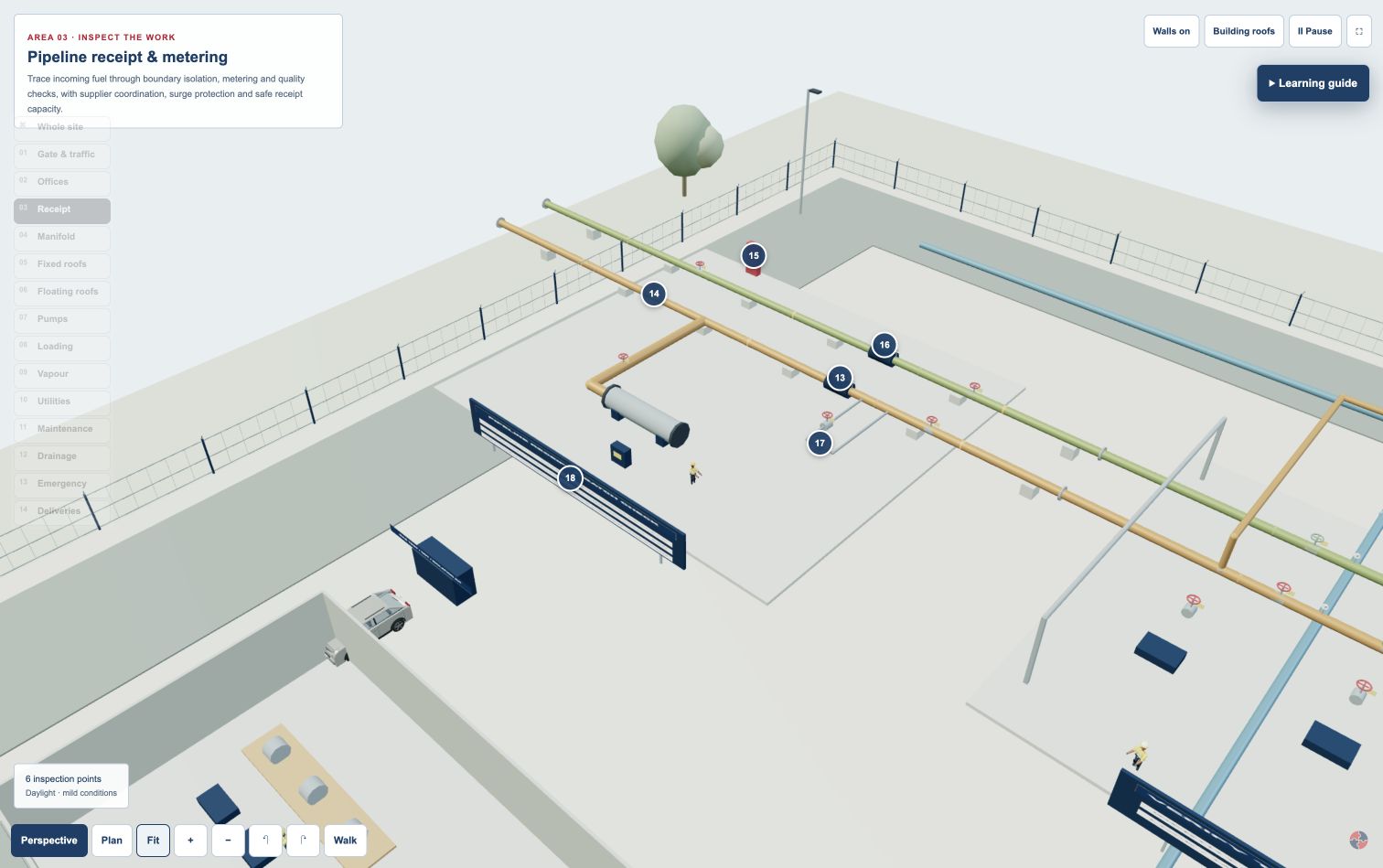
Free online training · Approximate learning time: 130–210 minutes · Self-paced
Trace the destination, boundaries and changing evidence before accepting or moving a fuel inventory.
Full public teaching and readers are free without an account. A free learner account is required for saved LMS progress and recorded assessment. Completion and any course-completion certificate depend on the configured LMS conditions.
Who this course is for
Terminal receipt operators, transfer supervisors, control-room teams, maintenance planners and advisers.
Pipeline and manifold decisions connect equipment and people who may be far apart. This course builds a clear mental picture of the system boundary, product route, receiving conditions, pressure and inventory behaviour, sampling exposure and shift information. Crown Fuels provides the fictional cases; actual operating limits, valve actions and shutdown behaviour require competent site procedures.
Bulk fuel-terminal receipt and manifold operations, not retail forecourt operating instructions or engineering design.
Learning outcomes
- Trace the intended product route and reconcile it with actual receiving conditions and live work restrictions.
- Recognise how pressure, trapped liquid, sampling exposure and inventory discrepancies can signal loss of control.
- Use scenario analysis, communication and handover to hold and resolve an uncertain transfer safely.
Course outline
Understand the connected transfer system
- Draw the transfer boundary before choosing an actionIdentify the connected source, receiving system and responsibilities in a pipeline transfer.
- Resolve the route before trusting the labelDistinguish correct route identification from plausible tags, mimics and past practice.
Establish the route and receiving conditions
- Understand pressure, trapped liquid and sampling exposureRecognise why ordinary transfer changes can create energy or exposure hazards requiring assessed methods.
- Treat inventory balance and handover as active controlsUse discrepancies and cross-checks to keep shared understanding current during a transfer.
- Prove the complete destination before pipeline receiptA transfer is ready when its complete physical route, receiving capacity and stop arrangements agree with reliable current information.
- Review shutdown as a dynamic pipeline eventFaster action is not automatically safer action; shutdown performance must be judged against all hazards of the connected process.
- Use unexplained inventory differences as an abnormal signalA discrepancy is a question to investigate against the real process, not a number to remove from the report.
Manage pressure, inventory and exposure
- Contain the product during quality samplingControl the source and method of release before selecting protection for the person taking the sample.
- Transfer a shared understanding of the live receiptHandover succeeds when the incoming person can act safely on the real situation, not when a document has merely been transmitted.
- Resolve product identity through the full manifold routeThe correct connection is established by reliable identity and a complete route check; familiarity and colour cannot resolve an evidence conflict.
Control handovers and route changes
- Protect liquid trapped between closed valvesStopping flow removes one energy source; it does not remove temperature-driven pressure in trapped liquid.
- Make the permit, isolation and operating display agreeShared plant status must describe the real physical and work-control condition, with restoration controlled across both operations and maintenance.
- Match the process-risk study to the design decisionA sound risk conclusion depends on complete scenarios and real protection evidence, not the familiarity of a checklist or a convenient score.
Verify a complete transfer decision
- An uncertain receipt at shift changeCombine route, receiving capacity, energy and handover evidence into a coordinated hold decision.
- Turn the learning into a verified workplace actionChoose a bounded action, owner, task-specific evidence and escalation trigger within your role.
Activities, model practice and assessment
Work through 4 required applied activities and 3 model-practice pauses, with explanatory feedback and independent lesson decisions. Complete 9 distinct model mission sequences across those pauses. Use the actual fictional Crown Fuels model or its equivalent accessible route to complete the required decision sequences; launching the model alone does not complete practice.
The 20-question assessment requires at least 80% plus every designated critical safety answer. Complete the required activities, practice and lesson checks. Points and badges cannot offset a critical safety error.
Use the LMS for confirmed save/resume and recorded results. Any certificate follows its configured passed-completion and grade conditions.
Open the public interactive practice copy; public practice is separate from the LMS record.
Sources and learning provenance
Original fictional cases are paired with public SHAREhub teaching and structured topic records. Use the applicable jurisdiction and primary guidance for live work.
Topic sections, source identities and versions
| Public topic | Chunk and version | Jurisdiction and sources |
|---|---|---|
| process-safety-information-and-process-knowledge · model | process-safety-information-and-process-knowledge--model 2.0 | source-hse_comah_2015_guidance |
| loading-unloading-and-transfer-operations · receiver-discrepancy | loading-unloading-and-transfer-operations--receiver-discrepancy 2026-10-02-additive-1 | Great Britain loading-unloading-and-transfer-operations-src-01, loading-unloading-and-transfer-operations-src-04, loading-unloading-and-transfer-operations-src-11 |
| pressure-relief-venting-and-emergency-depressurisation · scenario-basis | pressure-relief-venting-and-emergency-depressurisation--scenario-basis 2.0 | source-hse_relief_and_vent_systems_technical_measures |
| safe-shift-handover · minimum-handover-content | safe-shift-handover--minimum-handover-content 2.2 | Great Britain, Northern Ireland safe-shift-handover--handover, safe-shift-handover--permits, safe-shift-handover--ni-maintenance |
| loading-unloading-and-transfer-operations · barriers | loading-unloading-and-transfer-operations--barriers 2026-10-02-additive-1 | Great Britain, Northern Ireland loading-unloading-and-transfer-operations-src-01, loading-unloading-and-transfer-operations-src-02 |
| safe-operating-envelope · excursion-response | safe-operating-envelope--excursion-response 2.2 | Great Britain, Northern Ireland safe-operating-envelope--operating, safe-operating-envelope--controls, safe-operating-envelope--comahgb, safe-operating-envelope--comahni |
| process-safety-information-and-process-knowledge · assurance | process-safety-information-and-process-knowledge--assurance 2.0 | source-hse_comah_2015_guidance |
| dangerous-substances-and-hazardous-properties · forms-routes | dangerous-substances-and-hazardous-properties--forms-routes 20261016-letter-review-1 | Great Britain, Northern Ireland hsg97, ni-coshh |
| safe-shift-handover · handover-quality-check | safe-shift-handover--handover-quality-check 2.2 | Great Britain, Northern Ireland safe-shift-handover--handover, safe-shift-handover--permits, safe-shift-handover--ni-maintenance |
| hazop-studies · worked-node | hazop-studies--worked-node | Great Britain, Northern Ireland source-hse-study, source-hse-comah, source-hseni-comah, source-hse-hazop-method, source-hse-mod |
Course SH-FUEL-03 · version 2026.10.20.1. .
Questions about this course
Is this training free?
Full public teaching and readers are free without an account. A free learner account is required for saved LMS progress and recorded assessment. Completion and any course-completion certificate depend on the configured LMS conditions.
How long should I allow?
Approximately 130–210 minutes, including teaching, lesson checks, required activities, model or accessible practice and one assessment attempt. Individual pace, review and retries vary. Save and resume in the LMS.
Can I learn without a 3D-capable browser?
Yes. The complete HTML reader provides the teaching. Required model practice has an equivalent accessible decision route in the interactive course. Use the LMS route for recorded learning.
What is required to pass?
Complete the required learning, activities, practice and lesson decisions. The 20-question final assessment requires at least 80% plus every designated critical safety answer. Points cannot compensate for a critical safety error. Follow the feedback before retrying.
Does this authorise fuel operations?
Bulk fuel-terminal receipt and manifold operations, not retail forecourt operating instructions or engineering design. This independent course does not award a NEBOSH qualification or replace competent task assessment, practical training or site authorisation.