SHARE Knowledge Hub
Safe Shift Handover
Safe shift handover transfers the current state of plant or work, unresolved hazards and responsibility between outgoing and incoming people. A missed isolation, impaired barrier or abnormal condition can leave the next team acting on a false assumption and expose people to a release, fire, injury or other serious event. Preparation, two-way communication and incoming cross-checking keep critical decisions tied to the actual work state.
Understanding Safe Shift Handover
Safe shift handover transfers the current state of plant or work, unresolved hazards and responsibility between outgoing and incoming people. A missed isolation, impaired barrier or abnormal condition can leave the next team acting on a false assumption and expose people to a release, fire, injury or other serious event. Preparation, two-way communication and incoming cross-checking keep critical decisions tied to the actual work state.
Why this matters at work
Electricity, instrument air, cooling, steam, nitrogen, water, fuel, communications, firewater and drainage may support multiple barriers. Loss, contamination or instability can initiate an event and disable protection simultaneously. Map utility consumers, minimum quality, demand, autonomy, priority and failure mode.
A plant has tripped after loss of instrument air. The supply has returned, but one shutdown valve remains in manual mode and a reactor temperature trend is not yet stable. The outgoing team writes "air restored" and expects restart. A safe handover instead describes each affected protective function, current valve state, abnormal trend, outstanding test and restart authority.
How organisations manage this in practice
Unsafe shortcut: conducting separate handovers that never reconcile their accounts. Escalate when field and control-room teams describe different plant state, priorities or ownership. Delay transfer, restrict work, add competent support or move to the approved safer state while the gap is resolved, and record the authorised acceptance or restart. Another competent reviewer should be able to reconstruct what was known, what was uncertain, who accepted control and why continued work was authorised.
Psychosocial conditions can impair communication and decision making and should be managed through work design and the HSE Management Standards. Define the undertaking, plant or work boundary, roles, shift and transfer point, operating context, communication standard and accountable owner. Use the three stages of outgoing preparation, two-way exchange and incoming cross-check and acceptance; each stage needs time, competence and a defined owner.
Make each exception actionable: equipment or task identifier, current state and operating mode, time, reason, credible consequence, action already taken, present safeguards or restrictions, next action and owner. Include required review or expiry, decision authority and relevant linked permit, isolation, impairment or change record. A note such as pump problem or watch level leaves the next person to reconstruct the hazard. Use consistent names and units that match field labels and control displays.
Reconcile the record with the actual pump state
Two-way handover connects the outgoing record, incoming questions and field/register status. Acceptance of a handover is separate from permission to remove an isolation or restart equipment.

Prepare
Use the same actual plant identifier across the record, permit, isolation register and field tag. The pump shown is and does not identify live equipment.
Exchange and question
Discuss current condition, open work, impairments, unusual readings and what changed. Include contractors and interfaces that the incoming team must manage.
Isolation remains
State the assessed isolation boundary and protections that remain in place. Do not change their status merely because the shift changed or a permit was handed over.
Incoming cross-check
Check the record against the applicable field and register evidence through the authorised method. Identify unresolved differences explicitly rather than signing a general all-clear.
Owner, action and time
Record who owns each open issue, what action is next and when it must be followed up. Identify the separate authority required for later reinstatement or restart.
Mismatch: hold and resolve
Hold affected operation or handback while the discrepancy is made safe and resolved. Preserve accurate status and pass the resolution to everyone whose work depends on it.
Read the complete controls: ERICPD planning prompts
Discipline verifies and sustains all the controls; it is not a separate substitute for them.
| Prompt or level | Complete task-specific example |
|---|---|
| Eliminate | Complete and safely close an unnecessary intervention before the shift boundary where feasible, without rushing testing or hand-back. shift handover · Official task guidance: www.hse.gov.uk. |
| Reduce | Use a suitable standby duty or planned outage arrangement that avoids pressure to return the impaired pump to service before work is complete. shift handover · Official task guidance: www.hse.gov.uk. |
| Isolate | Maintain verified process and energy isolations, control keys and access and prevent reconnection while the maintenance boundary remains open. shift handover · Official task guidance: www.hse.gov.uk. |
| Control | Keep required physical separation, blanking, restraint, containment and any remaining protective functions in the defined safe configuration. shift handover · Official task guidance: www.hse.gov.uk Incoming and outgoing operators reconcile the pump identity, permits, isolation register, open work, bypasses and restart owner using a structured two-way handover. shift handover · Official task guidance: www.hse.gov.uk. |
| PPE | Communicate PPE and personal-detection needs for authorised remaining work; personal protection does not permit an uncertain plant state. shift handover · Official task guidance: www.hse.gov.uk. |
| Discipline | Check the field state against records after handover; only the authorised operations and maintenance owners may release isolations after accepted reinstatement tests. shift handover · Official task guidance: www.hse.gov.uk Read the accompanying source table for the framework distinctions. |
Read the complete controls: ESEAP effectiveness order
Compare stronger feasible controls while preserving the actual task, checks and release requirements.
| Prompt or level | Complete task-specific example |
|---|---|
| Elimination | Complete and safely close an unnecessary intervention before the shift boundary where feasible, without rushing testing or hand-back. shift handover · Official task guidance: www.hse.gov.uk. |
| Substitution | No separate measure is specified in this example. |
| Engineering controls | Use a suitable standby duty or planned outage arrangement that avoids pressure to return the impaired pump to service before work is complete. shift handover · Official task guidance: www.hse.gov.uk Maintain verified process and energy isolations, control keys and access and prevent reconnection while the maintenance boundary remains open. shift handover · Official task guidance: www.hse.gov.uk Keep required physical separation, blanking, restraint, containment and any remaining protective functions in the defined safe configuration. shift handover · Official task guidance: www.hse.gov.uk. |
| Administrative controls | Incoming and outgoing operators reconcile the pump identity, permits, isolation register, open work, bypasses and restart owner using a structured two-way handover. shift handover · Official task guidance: www.hse.gov.uk Check the field state against records after handover; only the authorised operations and maintenance owners may release isolations after accepted reinstatement tests. shift handover · Official task guidance: www.hse.gov.uk. |
| PPE | Communicate PPE and personal-detection needs for authorised remaining work; personal protection does not permit an uncertain plant state. shift handover · Official task guidance: www.hse.gov.uk Read the accompanying source table for the framework distinctions. |
This is a handover structure, not an isolation-removal or pump-start procedure. An incoming signature cannot establish an unverified plant state.
Further source background retained from this topic
How can I practise this topic in 3D?


An in-progress receipt is lost between shifts

Shift handover loses a critical restriction

Engineering handback leaves contamination in the line
All related inspection points 5 across 3 locations
Crown Fuels terminal 2 inspection points
Riverside Leisure 2 inspection points
From flour to chilled despatch 1 inspection point
Practice in the SHAREhub environment. Browser practice is separate from workplace competence and formal learning records.
What is safe shift handover?
A handover is a safety-critical transfer of current work and barrier status, not a signature or end-of-shift conversation.
Best-practice guide: Safe Shift Handover

What is safe shift handover?
A handover is a safety-critical transfer of current work and barrier status, not a signature or end-of-shift conversation. Safe shift handover transfers the current state of plant or work, unresolved hazards and responsibility between outgoing and incoming people.
Turn safe shift handover knowledge into a decision
Safe shift handover transfers the current state of plant or work, unresolved hazards and responsibility between outgoing and incoming people. A missed isolation, impaired barrier or abnormal condition can leave the next team acting on a false assumption and expose people to a release, fire, injury or other serious event. Review permit board, isolations, abnormal conditions and open actions. (HSE)
Safe Shift Handover worked example
Outgoing preparation: Review permit board, isolations, abnormal conditions and open actions. (HSE) Verbal handover: Explains what is isolated, what is open, what is impaired and what must not happen. (HSE)
Handover failure routes
Exposure route 1: Open permit or unproven isolation; intrusive work can release hazardous material or energy and injure workers. Exposure route 2: Disabled alarm, bypassed trip or temporary repair; loss of detection may allow fire, explosion or toxic exposure. Exposure route 3: Abnormal level, pressure or leak trend not passed on; incoming actions may drive a process beyond its limit.
Choose controls for safe shift handover
Elimination: Complete and safely close an unnecessary intervention before the shift boundary where feasible, without rushing testing or hand-back. Engineering controls: Use a suitable standby duty or planned outage arrangement that avoids pressure to return the impaired pump to service before work is complete. Engineering controls: Maintain verified process and energy isolations, control keys and access and prevent reconnection while the maintenance boundary remains open. Engineering controls: Keep required physical separation, blanking, restraint, containment and any remaining protective functions in the defined safe configuration. Administrative controls: Incoming and outgoing operators reconcile the pump identity, permits, isolation register, open work, bypasses and restart owner using a structured two-way handover. Read the full control table for qualifications, ownership and verification. Use the actual task and applicable jurisdiction; existing technical approval remains unchanged.
Use the full safe shift handover lesson
Use the full topic for the decision points, practical examples, detailed control tables and source scope. HSE guidance applies to Great Britain; use HSENI for the Northern Ireland route and the source’s stated jurisdiction. A simplified guide does not change the page’s technical-review or approval status.

Read all six steps as text
1. What is safe shift handover?
A handover is a safety-critical transfer of current work and barrier status, not a signature or end-of-shift conversation.
- Avoid / redesign: Complete and safely close an unnecessary intervention before the shift boundary where feasible, without rushing testing or hand-back.
- Control the task: Maintain verified process and energy isolations, control keys and access and prevent reconnection while the maintenance boundary remains open.
- Verify before release: If the hazardous step remains, keep it within the task assessment and select the stronger feasible remaining controls.
A handover is a safety-critical transfer of current work and barrier status, not a signature or end-of-shift conversation. Safe shift handover transfers the current state of plant or work, unresolved hazards and responsibility between outgoing and incoming people.
Apply it: Which part of this plan would you check at the workface before authorising the task?
2. Turn safe shift handover knowledge into a decision
Use the evidence to improve the actual work arrangement.
- Change at source: Complete and safely close an unnecessary intervention before the shift boundary where feasible, without rushing testing or hand-back.
- Make it observable: If the hazardous step remains, keep it within the task assessment and select the stronger feasible remaining controls.
- Keep useful evidence: Review permit board, isolations, abnormal conditions and open actions. (HSE)
Safe shift handover transfers the current state of plant or work, unresolved hazards and responsibility between outgoing and incoming people. A missed isolation, impaired barrier or abnormal condition can leave the next team acting on a false assumption and expose people to a release, fire, injury or other serious event. Review permit board, isolations, abnormal conditions and open actions. (HSE)
Apply it: What evidence would show that the change improves this task, rather than only completing a record?
3. Safe Shift Handover worked example
Example: a practical application of the existing topic lesson.
- Outgoing preparation: Review permit board, isolations, abnormal conditions and open actions. (HSE)
- Verbal handover: Explains what is isolated, what is open, what is impaired and what must not happen. (HSE)
- Written log: Structured log with plant, permit, barrier and decision status. (HSE)
Outgoing preparation: Review permit board, isolations, abnormal conditions and open actions. (HSE) Verbal handover: Explains what is isolated, what is open, what is impaired and what must not happen. (HSE)
Apply it: At which point would you hold this example, and what evidence would allow it to proceed?
4. Handover failure routes
Connect the task, the route to the person and the control that can fail.
- Exposure route 1: Open permit or unproven isolation; intrusive work can release hazardous material or energy and injure workers.
- Exposure route 2: Disabled alarm, bypassed trip or temporary repair; loss of detection may allow fire, explosion or toxic exposure.
- Exposure route 3: Abnormal level, pressure or leak trend not passed on; incoming actions may drive a process beyond its limit.
Exposure route 1: Open permit or unproven isolation; intrusive work can release hazardous material or energy and injure workers. Exposure route 2: Disabled alarm, bypassed trip or temporary repair; loss of detection may allow fire, explosion or toxic exposure. Exposure route 3: Abnormal level, pressure or leak trend not passed on; incoming actions may drive a process beyond its limit.
Apply it: Who could be exposed, including other trades, cleaners, maintainers and people nearby?
5. Choose controls for safe shift handover
Start with the stronger practicable options and verify their effect.
- Elimination: Complete and safely close an unnecessary intervention before the shift boundary where feasible, without rushing testing or hand-back.
- Engineering controls: Use a suitable standby duty or planned outage arrangement that avoids pressure to return the impaired pump to service before work is complete.
- Engineering controls: Maintain verified process and energy isolations, control keys and access and prevent reconnection while the maintenance boundary remains open.
- Engineering controls: Keep required physical separation, blanking, restraint, containment and any remaining protective functions in the defined safe configuration.
- Administrative controls: Incoming and outgoing operators reconcile the pump identity, permits, isolation register, open work, bypasses and restart owner using a structured two-way handover.
Elimination: Complete and safely close an unnecessary intervention before the shift boundary where feasible, without rushing testing or hand-back. Engineering controls: Use a suitable standby duty or planned outage arrangement that avoids pressure to return the impaired pump to service before work is complete. Engineering controls: Maintain verified process and energy isolations, control keys and access and prevent reconnection while the maintenance boundary remains open. Engineering controls: Keep required physical separation, blanking, restraint, containment and any remaining protective functions in the defined safe configuration. Administrative controls: Incoming and outgoing operators reconcile the pump identity, permits, isolation register, open work, bypasses and restart owner using a structured two-way handover. Read the full control table for qualifications, ownership and verification. Use the actual task and applicable jurisdiction; existing technical approval remains unchanged.
Apply it: Which stronger option can be used here, and who will verify it before accepting the remaining risk?
6. Use the full safe shift handover lesson
Follow the official sources below and retain the task-specific evidence.
- Official guidance: HSE shift handover
- Official guidance: HSE permit-to-work systems
- Task decision: Review permit board, isolations, abnormal conditions and open actions. (HSE)
Use the full topic for the decision points, practical examples, detailed control tables and source scope. HSE guidance applies to Great Britain; use HSENI for the Northern Ireland route and the source’s stated jurisdiction. A simplified guide does not change the page’s technical-review or approval status.
Apply it: Which official source and full-topic section will you use to resolve the next decision?
Handover is not a courtesy conversation at the end of a shift. It is a safety-critical control whenever the incoming person needs accurate information to keep work, plant or people safe. The higher the hazard, the more structured the handover needs to be. See HSE shift handover for the relevant source and scope.
The strongest handovers combine preparation, face-to-face discussion where practicable, written records, questions by the incoming person, confirmation of plant or task status and clear transfer of responsibility. The goal is not to say everything; it is to communicate the information the next person needs to make safe decisions.
| Topic area | What it means | Professional test |
|---|---|---|
| Preparation | Outgoing person reviews status, logs, permits, alarms, defects and abnormal conditions. | Is the handover based on current facts, not memory? (HSE) |
| Verbal exchange | Two-way discussion of task-relevant information. | Can the incoming person ask questions and challenge assumptions? (HSE) |
| Written support | Logs, permit boards, status sheets and control-room systems support memory. | Does the written record match the verbal message? (HSE) |
| Cross-check | Incoming person checks key information while assuming responsibility. | Are critical items verified rather than passively accepted? (HSE) |
| Responsibility transfer | The point of handover is clear. | Who owns the plant, permit, task or decision after handover? (HSE) |
| Escalation | Uncertainty, impaired barriers or abnormal status trigger pause or manager review. | Is unclear handover treated as a stop condition? (HSE) |
How can a missed handover injure people?
The hazard is hazardous energy or material and a false work-state assumption, not the incoming person. Missing status can let the next action remove a barrier or start work on live plant.
If an open drain, incomplete isolation or bypass is not transferred, an incoming team may open equipment, introduce ignition or restart a system believing it is safe. Release can expose lungs and skin to toxic material; fire, explosion or uncontrolled energy can cause burns, blast injury and death. The exact consequence depends on the inventory and plant, so the local hazard assessment and emergency plan determine the response. See HSE shift handover for the relevant source and scope.
| Missed fact and likely harm | Warning and stop decision |
|---|---|
| Open permit or unproven isolation; intrusive work can release hazardous material or energy and injure workers. | Permit board, isolation record or field status disagrees with the log: pause work and verify with permit authority. (HSE) |
| Disabled alarm, bypassed trip or temporary repair; loss of detection may allow fire, explosion or toxic exposure. | Bypass age, owner or restriction is unclear: hold the affected operation and escalate barrier impairment. (HSE) |
| Abnormal level, pressure or leak trend not passed on; incoming actions may drive a process beyond its limit. | Trend or alarm cannot be explained: stabilise or stop under the site procedure before taking responsibility. (HSE) |
A missed handover can have no immediate injury and still be a serious precursor. Cross-checking is especially important where maintenance extends across a shift, safety systems are overridden or operation is abnormal.
How should safe shift handover be structured?
Prepare the facts, exchange the significant information, question it, cross-check the live status and make responsibility explicit before work continues.
A reliable handover model is: prepare -> communicate -> question -> cross-check -> accept responsibility -> monitor early. This model applies to process plant, construction shifts, care settings, security, maintenance and any work where risk carries over between people. See HSE shift handover for the relevant source and scope.
HSE highlights higher-risk handovers and the importance of face-to-face, two-way, verbal and written communication. For major hazard work, handover must also include barrier status: permits, isolations, bypasses, alarms, temporary repairs, overrides, defects and work that must not restart.
| Model step | What to define | Evidence or decision point |
|---|---|---|
| Prepare | Outgoing person organises facts before the conversation. | Shift log, alarm list, permit status and plant/task status. (HSE) |
| Communicate | Outgoing and incoming people exchange task-relevant information. | Face-to-face or structured remote handover. (HSE) |
| Question | Incoming person challenges unclear or high-risk items. | Clarification notes and supervisor involvement if needed. (HSE) |
| Cross-check | Incoming person verifies critical status. | Permit board, control screen, isolation status or site walkdown. (HSE) |
| Accept | Responsibility transfer is explicit. | Named handover acceptance or log sign-off. (HSE) |
| Monitor | Incoming person watches high-risk items after handover. | Early-shift review of abnormal or temporary conditions. (HSE) |
How can the hierarchy of controls reduce risks while handing over a pump that remains isolated?
Remove or reduce the hazard before relying on procedures or personal protection.
For safe shift handover, assess the actual task and first look for a way to remove the hazard. Where that is not possible, consider a safer substitute, engineered separation and then clear work procedures. PPE protects against remaining exposure; it does not make an uncontrolled task safe. HSE hierarchy of controls
The selected measures need a named owner, a usable stop point and a check that they still work when the task or conditions change. In Northern Ireland, verify the separate legal route and site instructions.
How can the ERICPD hierarchy of controls reduce risks while handing over a pump that remains isolated?

| Control level | Control for this activity | Owner and verification | Stop / restart decision |
|---|---|---|---|
| Eliminate | Complete and safely close an unnecessary intervention before the shift boundary where feasible, without rushing testing or hand-back. | Task owner verifies that the proposed change removes the named hazardous step, including foreseeable cleaning, maintenance and work transferred elsewhere. | If the hazardous step remains, keep it within the task assessment and select the stronger feasible remaining controls. |
| Reduce, including substitution | Use a suitable standby duty or planned outage arrangement that avoids pressure to return the impaired pump to service before work is complete. | Competent task/process owner validates suitability, compatibility and new hazards against the actual operating requirements before the alternative is adopted. | Reject an alternative if its performance is unproved or its new hazards are unresolved. |
| Isolate | Maintain verified process and energy isolations, control keys and access and prevent reconnection while the maintenance boundary remains open. | Supervisor checks the actual boundary, affected people and connected work; verify separation or isolation before allowing access. | Hold or stop for unreconciled isolation, unknown contents, conflicting permit or unclear restart authority. |
| Control: physical safeguards | Keep required physical separation, blanking, restraint, containment and any remaining protective functions in the defined safe configuration. | Competent equipment/process owner checks equipment identity, isolation/permit status, open work, field configuration and incoming-owner understanding. | Hold or stop for unreconciled isolation, unknown contents, conflicting permit or unclear restart authority. |
| Control: work method and response | Incoming and outgoing operators reconcile the pump identity, permits, isolation register, open work, bypasses and restart owner using a structured two-way handover. | Supervisor confirms the work limits, competent cover, communication and stop/restart authority with the people doing this activity. | Hold work when the agreed limits, competent cover or effective communication cannot be maintained. |
| PPE | Communicate PPE and personal-detection needs for authorised remaining work; personal protection does not permit an uncertain plant state. | Assessor confirms whether personal protection is needed and checks suitability, condition, compatibility and any required fit evidence. | Do not use unsuitable protection or rely on PPE to continue after an essential source control fails. |
| Discipline | Check the field state against records after handover; only the authorised operations and maintenance owners may release isolations after accepted reinstatement tests. | Release only after incoming shift accepts a verified safe state and explicit restrictions; later restart follows formal hand-back. Retain verification and unresolved restrictions at handover. | Keep the task on hold until required reinstatement evidence and unresolved defects are accepted by the responsible owner. |
How can the ISO 45001 hierarchy of controls reduce risks while handing over a pump that remains isolated?

| Five-level control stage(s) | Control for this activity | Owner and verification | Stop / restart decision |
|---|---|---|---|
| Elimination | Complete and safely close an unnecessary intervention before the shift boundary where feasible, without rushing testing or hand-back. | Task owner verifies that the proposed change removes the named hazardous step, including foreseeable cleaning, maintenance and work transferred elsewhere. | If the hazardous step remains, keep it within the task assessment and select the stronger feasible remaining controls. |
| Engineering controls | Use a suitable standby duty or planned outage arrangement that avoids pressure to return the impaired pump to service before work is complete. | Competent task/process owner validates suitability, compatibility and new hazards against the actual operating requirements before the alternative is adopted. | Reject an alternative if its performance is unproved or its new hazards are unresolved. |
| Engineering controls | Maintain verified process and energy isolations, control keys and access and prevent reconnection while the maintenance boundary remains open. | Supervisor checks the actual boundary, affected people and connected work; verify separation or isolation before allowing access. | Hold or stop for unreconciled isolation, unknown contents, conflicting permit or unclear restart authority. |
| Engineering controls | Keep required physical separation, blanking, restraint, containment and any remaining protective functions in the defined safe configuration. | Competent equipment/process owner checks equipment identity, isolation/permit status, open work, field configuration and incoming-owner understanding. | Hold or stop for unreconciled isolation, unknown contents, conflicting permit or unclear restart authority. |
| Administrative controls | Incoming and outgoing operators reconcile the pump identity, permits, isolation register, open work, bypasses and restart owner using a structured two-way handover. | Supervisor confirms the work limits, competent cover, communication and stop/restart authority with the people doing this activity. | Hold work when the agreed limits, competent cover or effective communication cannot be maintained. |
| PPE | Communicate PPE and personal-detection needs for authorised remaining work; personal protection does not permit an uncertain plant state. | Assessor confirms whether personal protection is needed and checks suitability, condition, compatibility and any required fit evidence. | Do not use unsuitable protection or rely on PPE to continue after an essential source control fails. |
| Administrative controls | Check the field state against records after handover; only the authorised operations and maintenance owners may release isolations after accepted reinstatement tests. | Release only after incoming shift accepts a verified safe state and explicit restrictions; later restart follows formal hand-back. Retain verification and unresolved restrictions at handover. | Keep the task on hold until required reinstatement evidence and unresolved defects are accepted by the responsible owner. |
Where reasonably practicable, plan maintenance to finish within one shift without rushing or creating deadline pressure. If a shift crossing is necessary, first establish and verify the safe plant state and retain physical isolation/access controls; the information handover supports those controls and cannot repair an unproven isolation.
How would handover fail during maintenance across shifts?
A worked example shows why permit status, isolation and abnormal conditions must be transferred clearly.
A pump has been isolated for seal maintenance. The outgoing shift records 'pump work ongoing' but does not explain that a drain valve is open, one isolation point was difficult to prove, and a temporary bypass was agreed to maintain supply through a parallel line. The incoming supervisor assumes the job is routine and authorises nearby hot work. See HSE permit-to-work systems for the relevant source and scope.
A stronger handover identifies the pump, isolation state, open drain, permit status, bypass, parallel-line operating limit, prohibited work, responsible person and next verification point. The incoming supervisor cross-checks the permit board and plant status before accepting the shift.
In this example, the open drain could expose the maintenance team to released product, while the parallel-line bypass changes the hazard of nearby hot work. The incoming supervisor holds hot work, checks the isolation and bypass with the permit issuer, and records the restriction. Only after the plant owner resolves the discrepancy and reauthorises the permit should the task continue.
| Stage | Weak handling | Stronger standard |
|---|---|---|
| Outgoing preparation | Relies on memory at shift end. | Review permit board, isolations, abnormal conditions and open actions. (HSE) |
| Verbal handover | Says maintenance is ongoing. | Explains what is isolated, what is open, what is impaired and what must not happen. (HSE) |
| Written log | Short note with little safety detail. | Structured log with plant, permit, barrier and decision status. (HSE) |
| Incoming check | Incoming person listens and moves on. | Incoming person cross-checks high-risk items and asks questions. (HSE) |
| Responsibility | Assumed transfer. | Explicit acceptance by incoming supervisor/operator. (HSE) |
| Follow-up | No early-shift review. | First-hour check of abnormal and temporary conditions. (HSE) |
Any intrusive maintenance relying on the uncertain pump isolation is held, as is the conflicting hot work, until the authorised competent person verifies effectiveness. If the outgoing person is absent or cannot continue, the designated supervisor retains or assigns operational control, secures affected work and reconstructs the critical state from controlled records and competent checks. The first-hour follow-up is illustrative: critical verification precedes acceptance or work, and later checks follow the actual risk.
Illustrative completed handover entry: Pump P-14; permit and isolation references checked against the controlled register; drain still open; isolation effectiveness not yet demonstrated; intrusive work and conflicting hot work HELD; designated shift supervisor retains operational ownership; competent isolation owner resolves the discrepancy before incoming confirmation. Next check is tied to that evidence and any changed state, not an automatic one-hour permission to start.
What minimum content should a high-risk handover include?
Minimum content should cover current state, abnormal conditions, risk controls, decisions and next actions.
The content should be based on the information needs of the incoming person, not the habits of the outgoing person. Handover should be brief enough to use but complete enough to prevent wrong assumptions. See HSE shift handover for the relevant source and scope.
The more hazardous the work, the more explicit the handover should be about what is not normal.
| Content area | What to include | Why it matters |
|---|---|---|
| Plant or task state | Running, stopped, isolated, depressurised, open, energised, occupied or restricted. | Prevents wrong starting assumptions. (HSE) |
| Permits and isolations | Open permits, transferred permits, isolation quality and handback restrictions. | Prevents work starting against a hidden hazard. (HSE) |
| Abnormal conditions | Alarms, trips, excursions, defects, spills, incomplete work or temporary arrangements. | Makes weak signals visible. (HSE) |
| Impaired barriers | Bypassed alarms, unavailable equipment, degraded fire protection or temporary controls. | Defines operating restrictions. (HSE) |
| People and contractors | Who is on site, who is new, who is working alone and who owns open work. | Controls interfaces and rescue/escalation. (HSE) |
| Next decisions | What must be checked, stopped, escalated or reviewed. | Turns handover into action. (HSE) |
How should handover quality be checked?
Quality should be sampled through observation, record review and incoming-person understanding.
A signed handover sheet does not prove understanding. Assurance should watch the handover, ask incoming people what they understood and compare the message with live plant or task status. See HSE shift handover for the relevant source and scope.
Where remote or digital handover is used, the standard should still require two-way communication and cross-checking of safety-critical information.
| Check | Good standard | Weak signal |
|---|---|---|
| Observation | Handover is structured, two-way and not rushed. | Outgoing person reads a list while incoming person is passive. (HSE) |
| Record quality | Logs identify abnormal conditions, permits, barriers and decisions. | Logs are vague, late or copied. (HSE) |
| Incoming understanding | Incoming person can explain critical risks and next actions. | Incoming person knows tasks but not barrier status. (HSE) |
| Permit transfer | Open permits and isolations are verified. | Permits are handed over administratively. (HSE) |
| Supervisor review | High-risk handovers are sampled. | No one checks handover unless incident occurs. (HSE) |
| Learning | Handover issues are trended and improved. | Same missed information appears repeatedly. (HSE) |
What is the handover quality test?
A practical quality test checks whether preparation, communication, cross-checking and acceptance all happened.
This is the simple test a supervisor can use after watching a handover. If any step is missing, the handover should be repeated or supplemented before high-risk work continues. See HSE shift handover for the relevant source and scope.
For major hazard, maintenance, permit or abnormal-operation handovers, the test should be evidence-based. The written log, permit board, field status and incoming person's explanation should tell the same story.
| Test point | What good looks like | What to do if weak |
|---|---|---|
| Outgoing prepared | Outgoing person reviewed logs, permits, isolations, alarms, abnormal conditions and open actions before handover. | Pause and allow preparation before responsibility transfers. (HSE) |
| Incoming questions | Incoming person challenges unclear items and asks what has changed, what is abnormal and what must not happen. | Use prompts or repeat the handover. (HSE) |
| Written log matches verbal message | Key conditions, decisions, restrictions and owners appear in both the written and verbal handover. | Correct the log and confirm the verbal understanding. (HSE) |
| Verbal check completed | Both people confirm the critical points in plain language, not just signatures. | Repeat the critical-risk part of handover. (HSE) |
| Site walk or board check where needed | High-risk work, permits, isolations or abnormal plant status are physically cross-checked. | Walk down the job, permit board or plant status before work continues. (HSE) |
| Responsibility accepted | Incoming person or supervisor explicitly accepts control and knows next actions. | Do not allow ambiguous ownership. (HSE) |
Where else does the handover decision matter?
The same transfer failure appears wherever a later team inherits a hazardous or restricted state.
The strongest safeguard is the actual control of energy or access, supported by a handover matched to the job. The examples below require local assessment rather than a copied checklist. See HSE shift handover for the relevant source and scope.
| Task, people and harm route | Control and stop check |
|---|---|
| Manufacturing: a maintenance shift leaves a guarded machine isolated; an incoming operator could restart into an open work zone and cause crushing. | Keep isolation and access control under the permit authority; incoming supervisor checks machine, permit and workers before release. Hold on mismatch. (HSE) |
| Construction: a night crew leaves a temporary excavation and altered route; morning workers could enter an unsupported edge and fall. | Protect and mark the edge physically; shift lead walks the changed route and briefs affected trades. Close access if protection is uncertain. (HSE) |
| Hospitality: an evening team leaves a cleaning chemical in a restricted kitchen area; morning staff could inhale or contact it. | Store and segregate the material; incoming duty manager checks the room and instructions. Keep the area closed if identity or clearance is unknown. (HSE) |
| Logistics: an outgoing team leaves a trailer restrained at a loading bay; the next team could release it while a loader is inside. | Retain physical restraint and agreed hand-back; incoming supervisor checks bay status and driver communication. Hold departure until all-clear is confirmed. (HSE) |
The sectors differ in hazard source, but each requires an explicit owner, current written status and a check of the live barrier before responsibility transfers.
When should safe shift handover be paused or escalated?
Pause transfer of responsibility when a permit, isolation, bypass or abnormal plant condition cannot be reconciled between the outgoing account and the live records.
Before the exchange, the outgoing person checks permits, isolations, overrides and outstanding actions. During the two-way handover, the incoming person asks what is unsafe to start, what must be monitored, and who owns each restriction. If a discrepancy remains, the incoming supervisor holds the affected job and verifies it with the permit issuer and plant owner before work resumes. See HSE shift handover for the relevant source and scope.
| Trigger or question | Decision route | Escalate if |
|---|---|---|
| Is plant or task status unclear? | Pause and verify before accepting responsibility. | Work could continue on wrong assumptions. (HSE) |
| Are permits, isolations or bypasses open? | Cross-check with boards, logs and responsible people. | Status differs between verbal and written records. (HSE) |
| Is there an abnormal condition? | Define restriction, owner and next action. | Incoming team does not understand risk. (HSE) |
| Was handover interrupted or rushed? | Repeat or supplement handover. | Safety-critical information may have been missed. (HSE) |
| Is handover remote? | Use structured written and verbal confirmation. | No opportunity for questions or cross-check. (HSE) |
| Is responsibility unclear? | Do not proceed until ownership is explicit. | Two teams assume the other owns the risk. (HSE) |
Where does safe shift handover commonly fail?
Handover fails when incoming people inherit a task but miss the condition that makes it hazardous.
“Pump work ongoing” does not reveal an open drain, uncertain isolation or temporary bypass. A written status board can also be wrong if it is not reconciled with the plant. The incoming person should repeat the critical restriction in their own words and check the permit and isolation record; a rushed one-way briefing is a reason to pause, not a completed transfer. See HSE shift handover for the relevant source and scope.
Memory-only handover: Important detail depends on one person's recall. Use structured logs and status prompts.
One-way communication: Incoming person receives information without challenge. Make handover two-way and question-led.
Permit status gap: Open permits or isolations are not transferred clearly. Cross-check permit boards and isolation status.
Abnormal condition hidden: Faults or temporary controls are normalised. Highlight abnormal status and restrictions.
What evidence should safe shift handover hold?
Keep a concise handover record that identifies the plant state, open work, impaired safeguards, restrictions and the person accepting each action.
For a maintenance job crossing shifts, compare the signed handover with the permit board, isolation certificate, override log and field status. Record what was cross-checked, any discrepancy, its owner and the decision to hold or release work. Attendance at a handover meeting does not prove the incoming team understood the safety-critical state. See HSE permit-to-work systems for the relevant source and scope.
Handover log: Current plant and task state, abnormal conditions, restrictions, next action, named owner and explicit incoming acceptance. Compare it with what both people say they understood.
Permit and isolation status: Open permits, isolation certificates, hand-back conditions and field checks. A mismatch between the log and the live board holds the affected work.
Barrier and defect status: Bypasses, disabled alarms, temporary repairs, outstanding actions and operating restrictions with their owner and review point. Check the display and actual plant before release.
Quality observations: Supervisor samples of preparation, two-way exchange, incoming cross-check and correction of missed facts. Trend repeated omissions and check that changes improve the next handover.
How should safe shift handover be assured?
Observe the preparation, two-way exchange and incoming cross-check for one high-risk shift change.
The supervisor samples an open permit and asks the incoming operator to locate its isolation and explain any bypass or prohibited work. The permit issuer resolves mismatches before authorising continuation. Managers trend missed information and delayed actions, then test whether revised prompts or staffing actually improve the next handover. See HSE shift handover for the relevant source and scope.
Handover observation: Good evidence: Preparation, verbal exchange and cross-checking are visible. Warning sign: Handover is rushed or one-way.
Incoming interview: Good evidence: Incoming person can explain critical status. Warning sign: They repeat vague statements only.
Permit sample: Good evidence: Permit status transfers correctly. Warning sign: Open permits are missed.
Abnormal-condition trend: Good evidence: Repeated handover issues drive improvement. Warning sign: Missed information recurs.
Which legal route applies in Great Britain or Northern Ireland?
The general safety framework differs between GB and NI, and COMAH is an additional site-specific regime only where its scope is met.
A safe operating limit or handover rule is a site control derived from the hazard assessment and technical basis; it is not a universal statutory number. Check the applicable instrument and amendments for the actual location, substance and operation. HSE technical guidance is not itself legislation. See GB Management Regulations 1999 for the relevant source and scope.
| Location | Duty and scope | Source route and decision |
|---|---|---|
| Great Britain | General work-risk assessment and safe systems: Management Regulations 1999 with the 1974 Act framework. | Check the official GB instrument route and current amendments before a compliance determination. (Legislation) (1974 Act) |
| Northern Ireland | Separate Management Regulations (Northern Ireland) 2000 and 1978 Order framework. | Check the official NI instrument route and current amendments before a compliance determination. (Legislation) (1978 Order) |
| Great Britain | COMAH 2015 applies when dangerous-substance threshold and activity rules bring the establishment into scope. | HSE COMAH guidance explains prevention, mitigation, safety management and reports as applicable. (HSE) |
| Northern Ireland | COMAH (Northern Ireland) 2015 is a separate NI regime for establishments within scope. | HSENI explains the NI competent authority and legal route. (HSENI) |
Product conformity and workplace operation are separate decisions. Use manufacturer and design information for the equipment, then verify that operating, maintenance and emergency controls remain suitable.
How should management check this work?
Use a defined plan, carry out the controls, check performance and correct what does not work.
For safe shift handover, assign a competent owner to set the work controls, check their use and review them after change, failure or new evidence. HSE managing health and safety
A management-system label or certificate is not approval of a site limit, procedure or individual work decision. Apply GB and NI duties to the correct location.
How is competence demonstrated at each level?
Learning must match the decisions a person actually makes, and practical demonstration matters more than attendance.
Awareness of a form is insufficient: the incoming person must demonstrate that they can identify the critical status and know when to pause. A supervisor should observe a real handover, compare its log with the plant and permit board, and retain the scope of authorisation. See HSE shift handover for the relevant source and scope.
| Role | Learning, assessment, record and reassessment |
|---|---|
| Incoming/outgoing workers | Practise concise verbal and written transfer; incoming worker explains critical restrictions and checks live status. Supervisor observes and records assessment; repeat after a missed fact or changed process. (HSE) |
| Permit issuers and maintainers | Demonstrate isolation, permit and hand-back transfer on the actual system. Permit authority assesses and records scope; reassess after modification or permit error. (HSE) |
| Supervisors | Run a high-risk handover, challenge conflicts and decide hold or restart. Manager samples an observed handover and defect closure; reassess after near miss or recurring omission. (HSE) |
| Managers and designers | Provide time, usable logs and workload that allow two-way exchange. Process safety lead samples design and trend evidence; revisit on staffing or system change. (HSE) |
| Advisers and auditors | Trace one handover from log to permit and field state. Competent lead reviews a sample and action close-out; refresh when legal or hazard context changes. (HSE) |
There is no universal certificate or fixed refresher period for every role. Set reassessment from changes, unsafe practice, incidents and evidence that the control is not working.
How could Crownway Fuels Ltd manage this in practice?

Crownway Fuels Ltd would prepare, exchange and cross-check information so the incoming shift takes over the actual operating condition.
Crownway Fuels Ltd · practical example
Transfer an unfinished maintenance job without losing its restrictions
The key lesson Handover transfers responsibility as well as information; the incoming team must actively check what it is accepting.
The situation: A pump repair remains unfinished at the end of a depot shift. Another team expects to use connected equipment during the night.
Why this matters: An omitted restriction can make an incomplete repair appear to be available plant.
How Crownway Fuels Ltd would manage it
- Prepare the status — Outgoing Shift Supervisor. List equipment unavailable, open permits, relevant isolations, alarms, temporary arrangements, contractor status and unresolved decisions using current records.
- Discuss the unusual items — Outgoing and incoming Shift Supervisors. Use the agreed handover period to explain the unfinished repair and dependent activities. Invite questions rather than relying on a hurried signature.
- Cross-check the work — Incoming Shift Supervisor. Compare the handover with the relevant operating and work-control records and confirm the restriction at the workface where required by the site system.
- Resolve inconsistency — Site Manager. Keep dependent work restricted if the log, permit or equipment status disagrees. Obtain clarification from the authorised operating and maintenance people before changing the accepted status.
- Record acceptance — Incoming Shift Supervisor. Confirm who owns each outstanding action and when further review is needed. Communicate subsequent hand-back through the controlled system so later shifts receive the same position.
When the conditions change
- Recognise the trigger
- The maintenance record and shift log disagree about whether the pump is available.
- Make the immediate decision
- The incoming Shift Supervisor keeps use of the pump and identified dependent equipment restricted.
- Verify the next step
- The incoming supervisor cross-checks the authorised repair or hand-back status and records the accepted restriction and outstanding responsibilities.
What good looks like
The incoming shift can explain the repair, the equipment that remains unavailable and the evidence required for its return, without relying on memory.
Evidence to look for: Prepared handover, questions and cross-checks, current work-control records and named outstanding actions.
Common mistake to avoid: Signing a log that says “maintenance ongoing” without identifying what that means for operations.
Apply this to your work: Which unusual condition would be lost if the outgoing supervisor were unexpectedly unavailable?
Guidance behind the management approach: HSE: shift handover. Use the topic's legal and technical guidance for the applicable work and location.
Crownway would use safe handover during tanker deliveries, fuel transfer, alarm response, contractor maintenance, night work, lone working and site opening/closing. The key is that incoming staff understand abnormal conditions, customer/public interface, fuel inventory, alarms, permits, defects and emergency arrangements.
This company example illustrates how the cited HSE control principle could be applied; its particular tasks, records and decisions require the organisation’s own hazard assessment and authorisation.
| Management element | How the business would manage it | Evidence to review |
|---|---|---|
| Fuel transfer | Transfer status and stop point passed between shifts. | Transfer handover record. (HSE principle) |
| Contractor maintenance | Open work and isolations communicated. | Permit/contractor board. (HSE principle) |
| Night work | Lone working, violence risk and emergency issues transferred. | Night handover log. (HSE principle) |
| Defects | Alarms, pumps, lighting or spill controls identified. | Defect and restriction list. (HSE principle) |
| Assurance | Managers sample handover quality. | Handover audit and action tracker. (HSE principle) |
How does this topic align with ISO 45001?
Use these examples to connect the relevant clauses to your own occupational health and safety management system. For each clause, identify the person responsible, the control in use and the evidence that it works.
Scroll across the table to read all four columns.
| ISO 45001 clause | How it applies | What to put in place | How to verify it works |
|---|---|---|---|
| 7.4.2 Internal communication | Internal communication needs to get relevant safety information to the people who will act on it. | For Crownway’s unfinished pump repair, have the outgoing and incoming supervisors confirm the equipment, current restrictions and outstanding actions together. Give them a route to resolve any disagreement before dependent work proceeds. | Sample a handover across shifts and ask both supervisors to describe what can operate, what remains restricted and who owns the next decision. |
| 8.1.1 Operational planning and control | Operating controls need to stay effective when responsibility moves between teams. | Define what the incoming team checks against the current permit and operating records. Retain the affected restrictions while the authorised people resolve any mismatch. | Compare the handover and permit status with the restriction in the operating record and a field check. Trace any later return to service to the authorised decision. |
| 7.5.3 Control of documents and records | Controlled records help teams find the current information and protect it from unauthorised change. | Keep one approved shift record for current plant status. Set who can update it and preserve access to earlier entries so unresolved actions remain traceable. | Check that the incoming team used the current record and can reconstruct who changed the status, when and on what evidence. |
Selected applications of ISO 45001:2018 with Amendment 1:2024. Use the current standard for a full assessment and check the legal duties that apply to the work and location.
ISO 45001:2018 · 2024 climate action amendment · ISO 45002 implementation guidance · ISO technical committee clause FAQ
What fuel-system information should a shift handover make explicit?
Connect the current activity, changed equipment and protection status to the receiving team’s decisions. The visual example is not a completed handover record.
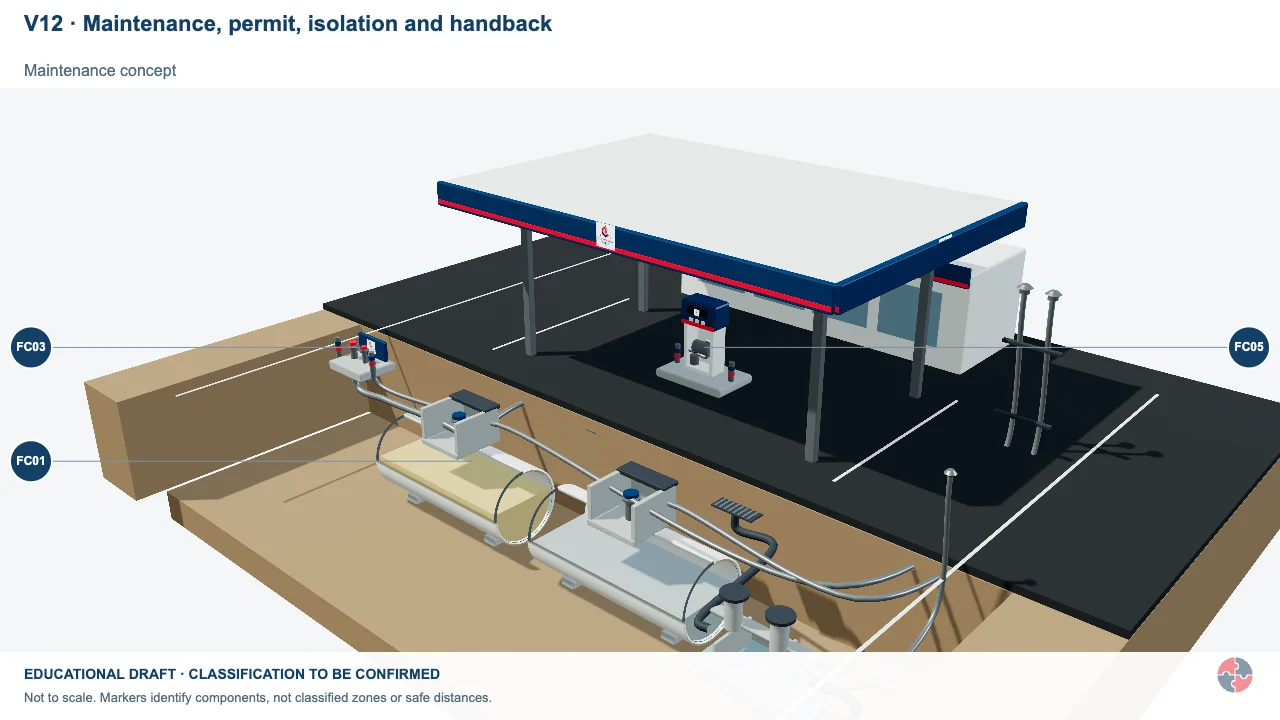
Maintenance, permit, isolation and handback
Maintenance changes the task and may open systems that are closed during normal use.
Activity focus: Inspect the work boundary, nearby live activities and responsibility for restoring the installation.
Contextual workplace scene. Use the task, control and evidence checks in this section; appearance alone does not establish safe conditions, individual health or approval.
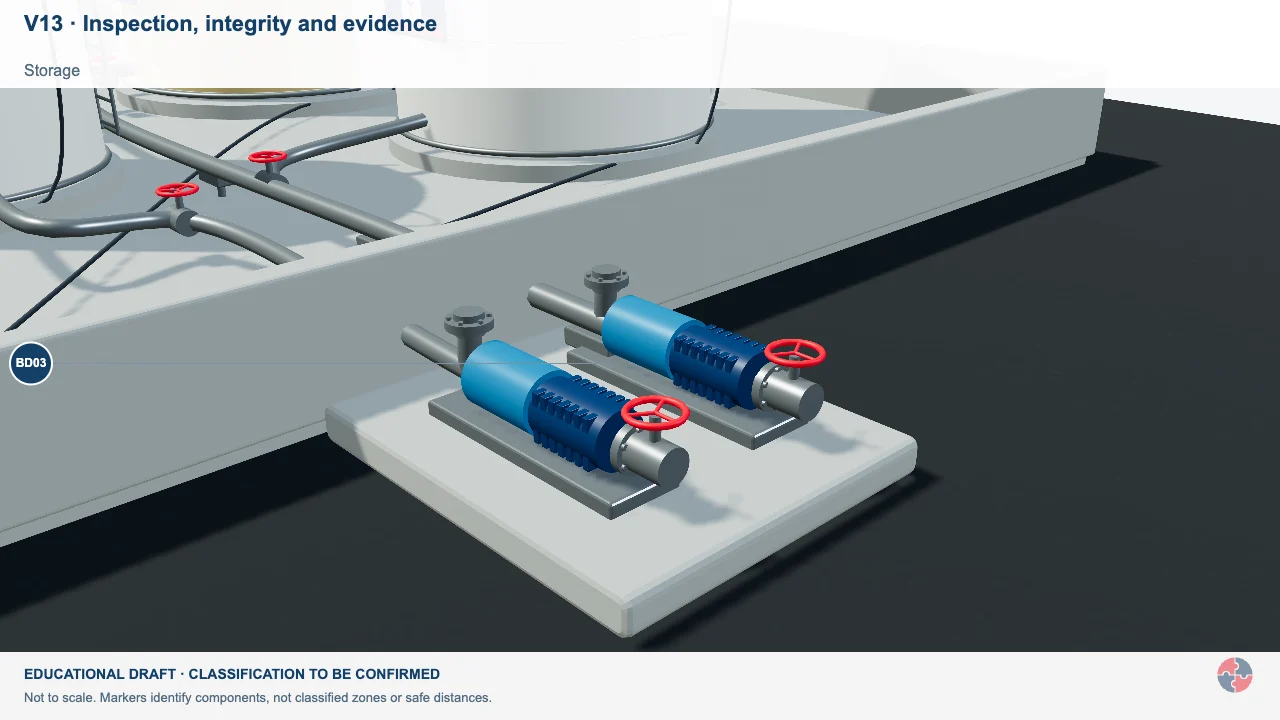
Inspection, integrity and evidence
A hose, tank or protective device has a safety purpose which depends on its condition and supporting checks.
Activity focus: Connect each identified defect to the responsible owner and appropriate operational decision.
Contextual workplace scene. Use the task, control and evidence checks in this section; appearance alone does not establish safe conditions, individual health or approval.
Educational illustration, not to scale. Coloured zones are teaching examples, not a site-specific hazardous-area classification.
Acronyms and terms used in this topic
The terms below distinguish legal regimes, management methods and operating decisions.
| Letters or term | Full expansion | Meaning here |
|---|---|---|
| HSE | Health and Safety Executive | GB workplace safety regulator. |
| HSENI | Health and Safety Executive for Northern Ireland | NI workplace safety regulator. |
| COMAH | Control of Major Accident Hazards | GB and NI have separate 2015 instruments for sites within scope. |
| PTW | Permit to work | Formal control of specified high-risk work and its handover. |
| PPE | Personal protective equipment | Residual individual protection, not a cure for missed isolation information. |
| Cross-check | Not an acronym | Incoming person checks critical facts against a current record or field state. |
Unlock another resource
You have used this month’s two free downloads. Publish a post in your own words to unlock one more resource, or choose SHARE Individual for 10 downloads per month.
You decide whether to share. If you do, use the relevant platform disclosure tools and do not make claims you do not genuinely hold.