
SHARE Knowledge Hub
Loading, Unloading and Transfer Operations
Loading, unloading and transfer need controls for the actual load and interface. For hazardous-liquid transfer, identify the product, route and receiver, immobilise the vehicle, verify hoses/couplings, level or overfill protection and emergency isolation, then supervise start, steady transfer and shutdown. For general freight, segregate people, stabilise the vehicle and secure the load. A single generic checklist cannot cover every substance or mode.
Understanding Loading, Unloading and Transfer Operations
Loading, unloading and transfer need controls for the actual load and interface. For hazardous-liquid transfer, identify the product, route and receiver, immobilise the vehicle, verify hoses/couplings, level or overfill protection and emergency isolation, then supervise start, steady transfer and shutdown. For general freight, segregate people, stabilise the vehicle and secure the load. A single generic checklist cannot cover every substance or mode.
Why this matters at work
Paper controls fail when forms are copied, independent checks are performed from the same information, or procedures do not match equipment. Assurance should ask a person to demonstrate the task, point to the physical barrier and explain what would make them stop.
Interface failures recur: the supplier assumes the site checks capacity, the site assumes the driver knows the connection, and the driver assumes the load was secured by competent staff. A robust system names each decision and requires evidence at the boundary.
How organisations manage this in practice
Position the vehicle on firm, suitably level ground with clearance from structures, overhead hazards, drains and ignition or public interfaces. Apply the parking brake, select the required transmission state and shut down or control the engine according to the operation. Stabilise trailers and vehicles where load shift or handling equipment can affect stability. Prevent premature departure by a risk-based system such as controlled keys, wheel chocks, trailer restraints, dock locks, air-line lockout or interlocked traffic lights. The system must suit the vehicle fleet and not create a false safe signal. Define who applies, verifies, controls and removes it. A key-control process alone may fail where spare keys exist or the vehicle remains movable; chocks may be ineffective on unsuitable gradients or surfaces.
Where required, connect to the designated verified earthing system before hazardous transfer and retain it through transfer and the required draining/residue steps until the designed safe removal point. Inspect clamps, cables, reels and connections and verify the competent continuity/proving programme. Do not copy historical numerical resistance or transfer-rate examples as universal design limits.
Identify the employer, site operator, consignor, carrier, vehicle operator, driver, loader, unloader, consignee, equipment owner and contractor. More than one party may owe duties. Allocate who supplies product and load information, selects equipment, secures and verifies the load, controls the site, authorises connection, monitors transfer and releases the vehicle.
How can I practise this topic in 3D?


An exhausted driver returns to the road
An arriving tanker crosses a pedestrian route
All related inspection points 20 across 2 locations
Construction site 3 inspection points
Crown Fuels terminal 17 inspection points
Practice in the SHAREhub environment. Browser practice is separate from workplace competence and formal learning records.
Why are loading, unloading and transfer operations high risk?
Transfers combine hazardous inventory, temporary connections, human line-up decisions, vehicles, pressure, static, movement and changing conditions.
Best-practice guide: Loading, Unloading and Transfer Operations
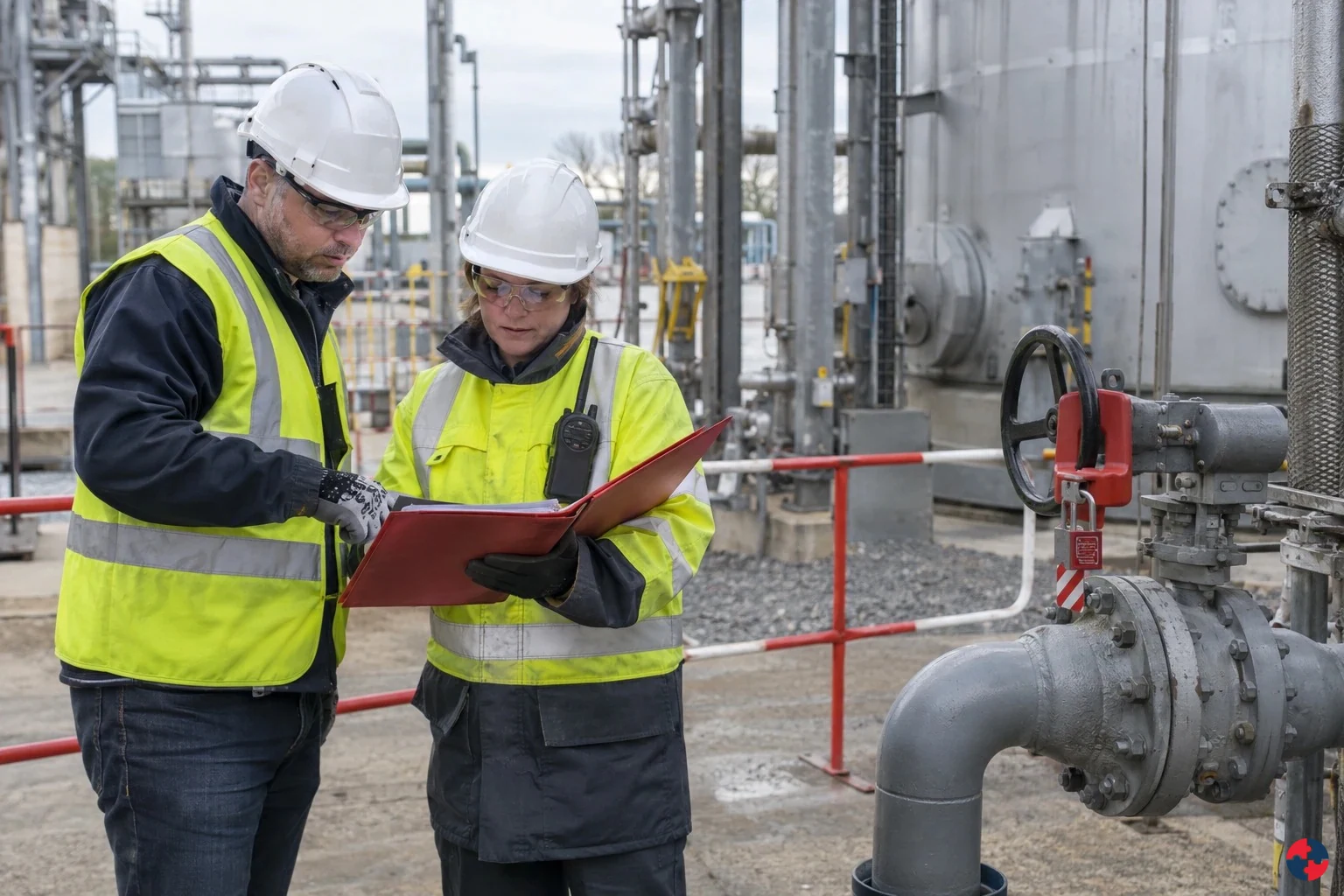
Why are loading, unloading and transfer operations high risk?
Transfers combine hazardous inventory, temporary connections, human line-up decisions, vehicles, pressure, static, movement and changing conditions. Loading, unloading and transfer need controls for the actual load and interface.
Turn loading, unloading and transfer operations knowledge into a decision
Loading, unloading and transfer need controls for the actual load and interface. For hazardous-liquid transfer, identify the product, route and receiver, immobilise the vehicle, verify hoses/couplings, level or overfill protection and emergency isolation, then supervise start, steady transfer and shutdown. Process owner reviews feasibility; unassessed change held.
Hold an incomplete unloading interface
The host and driver coordinate the delivery rather than leaving the driver to improvise. Check the load, ground, vehicle, equipment, pedestrian separation and responsibilities before release. Review a changed load or route through the actual task plan.
A changing load creates moving interfaces
Unplanned movement can trap or strike people at the loading area. An unstable or unsecured load can shift, fall or overturn equipment. A failed connection or incompatible product can create a separate substance exposure. Use the full topic for the detailed mechanism, task limits and source scope.
Choose controls for loading, unloading and transfer operations
Eliminate: Avoid unnecessary transfer or redesign to a closed fixed connection. Reduce: Use a less hazardous compatible product or smaller batch where possible. Isolate: Closed hose, correct coupling, earthing/overfill and emergency stop. Control: Product/route cross-check, driver coordination, exclusion and supervised line-up. PPE: Product-compatible gloves, eye and other residual splash protection. Read the full control table for qualifications, ownership and verification. Use the actual task and applicable jurisdiction; existing technical approval remains unchanged.
Use the full loading, unloading and transfer operations lesson
Use the full topic for the decision points, practical examples, detailed control tables and source scope. HSE guidance applies to Great Britain; use HSENI for the Northern Ireland route and the source’s stated jurisdiction. A simplified guide does not change the page’s technical-review or approval status.

Read all six steps as text
1. Why are loading, unloading and transfer operations high risk?
Transfers combine hazardous inventory, temporary connections, human line-up decisions, vehicles, pressure, static, movement and changing conditions.
- Avoid / redesign: Avoid unnecessary transfer or redesign to a closed fixed connection.
- Control the task: Closed hose, correct coupling, earthing/overfill and emergency stop.
- Verify before release: Process owner reviews feasibility; unassessed change held.
Transfers combine hazardous inventory, temporary connections, human line-up decisions, vehicles, pressure, static, movement and changing conditions. Loading, unloading and transfer need controls for the actual load and interface.
Apply it: Which part of this plan would you check at the workface before authorising the task?
2. Turn loading, unloading and transfer operations knowledge into a decision
Use the evidence to improve the actual work arrangement.
- Change at source: Avoid unnecessary transfer or redesign to a closed fixed connection.
- Make it observable: Process owner reviews feasibility; unassessed change held.
- Keep useful evidence: Process owner reviews feasibility; unassessed change held.
Loading, unloading and transfer need controls for the actual load and interface. For hazardous-liquid transfer, identify the product, route and receiver, immobilise the vehicle, verify hoses/couplings, level or overfill protection and emergency isolation, then supervise start, steady transfer and shutdown. Process owner reviews feasibility; unassessed change held.
Apply it: What evidence would show that the change improves this task, rather than only completing a record?
3. Hold an incomplete unloading interface
Example: a delivery arrives while the unloading bay is occupied.
- Find: Pedestrians and vehicles would share the proposed unloading area.
- Hold: Keep the load secured while host and driver agree a protected arrangement.
- Release: Use the planned unloading method and restore access after hand-back.
The host and driver coordinate the delivery rather than leaving the driver to improvise. Check the load, ground, vehicle, equipment, pedestrian separation and responsibilities before release. Review a changed load or route through the actual task plan.
Apply it: Who controls the unloading area, and what proves pedestrians are separated before the load moves?
4. A changing load creates moving interfaces
Connect the task, the route to the person and the control that can fail.
- Vehicle: Unplanned movement can trap or strike people at the loading area.
- Load: An unstable or unsecured load can shift, fall or overturn equipment.
- Transfer: A failed connection or incompatible product can create a separate substance exposure.
Unplanned movement can trap or strike people at the loading area. An unstable or unsecured load can shift, fall or overturn equipment. A failed connection or incompatible product can create a separate substance exposure. Use the full topic for the detailed mechanism, task limits and source scope.
Apply it: Where is this harm route present in the actual work, and which control breaks it before anyone is exposed?
5. Choose controls for loading, unloading and transfer operations
Start with the stronger practicable options and verify their effect.
- Eliminate: Avoid unnecessary transfer or redesign to a closed fixed connection.
- Reduce: Use a less hazardous compatible product or smaller batch where possible.
- Isolate: Closed hose, correct coupling, earthing/overfill and emergency stop.
- Control: Product/route cross-check, driver coordination, exclusion and supervised line-up.
- PPE: Product-compatible gloves, eye and other residual splash protection.
Eliminate: Avoid unnecessary transfer or redesign to a closed fixed connection. Reduce: Use a less hazardous compatible product or smaller batch where possible. Isolate: Closed hose, correct coupling, earthing/overfill and emergency stop. Control: Product/route cross-check, driver coordination, exclusion and supervised line-up. PPE: Product-compatible gloves, eye and other residual splash protection. Read the full control table for qualifications, ownership and verification. Use the actual task and applicable jurisdiction; existing technical approval remains unchanged.
Apply it: Which stronger option can be used here, and who will verify it before accepting the remaining risk?
6. Use the full loading, unloading and transfer operations lesson
Follow the official sources below and retain the task-specific evidence.
- Official guidance: Storage of flammable liquids in tanks (HSG176, 2nd edition, 2015)
- Official guidance: Visiting drivers
- Task decision: Process owner reviews feasibility; unassessed change held.
Use the full topic for the decision points, practical examples, detailed control tables and source scope. HSE guidance applies to Great Britain; use HSENI for the Northern Ireland route and the source’s stated jurisdiction. A simplified guide does not change the page’s technical-review or approval status.
Apply it: Which official source and full-topic section will you use to resolve the next decision?
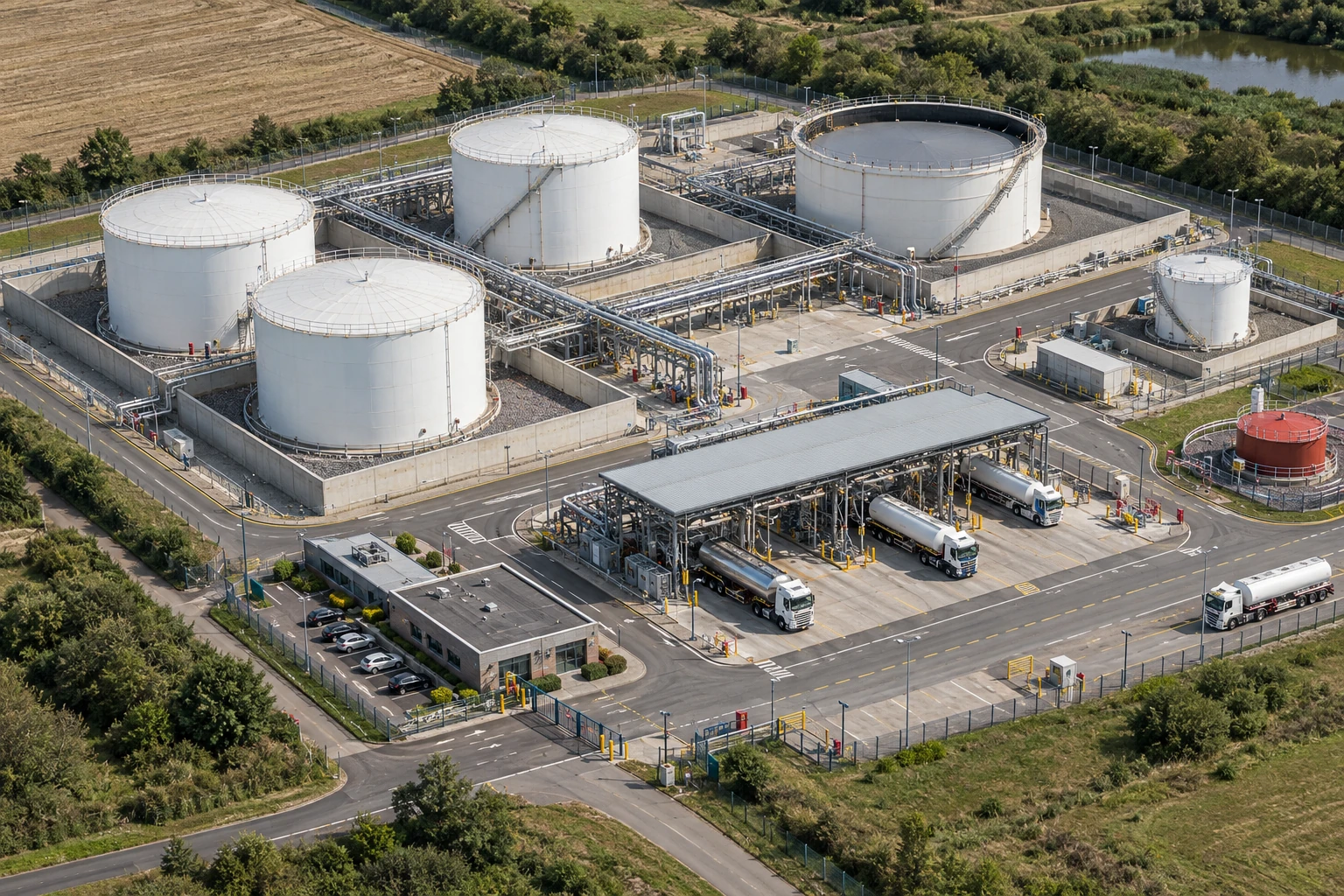
A storage tank, process vessel or pipeline may have fixed safeguards, but transfer operations often depend on temporary hoses, couplings, valves, tanker drivers, loading racks, gantries, paperwork and timing. That makes them vulnerable to wrong connection, overfill, reverse flow, static ignition, hose failure, incompatible materials, vehicle movement, spill spread, vapour cloud formation and delayed emergency response.
For process safety, the question is not only whether someone could be injured during the task. The deeper question is whether a transfer could cause a major accident: loss of containment, flammable vapour cloud, toxic release, fire, explosion, environmental release or escalation to nearby plant. Routine transfers can become dangerous because people become familiar with them and weak signals are normalised.
Before a hazardous transfer, the operator confirms the substance and receiving tank, verifies the line-up, starts flow under supervision, watches level and leak indications, stops on an abnormal signal, then isolates, disconnects and hands back the bay. Each stage has a named owner and a hold point. For ordinary freight, vehicle restraint, stable load and pedestrian segregation are the principal checks.
In this page, LPG means liquefied petroleum gas, IBC means intermediate bulk container, ESD means emergency shutdown, SDS means safety data sheet, MOC means management of change, and SIMOPS means simultaneous operations. Product-specific controls must be chosen from the actual substance and task.
| Mode | Typical examples | Major control focus |
|---|---|---|
| Road tanker | Fuel, chemicals, LPG, acids, waste liquids. | Vehicle positioning, brake/drive-away prevention, earthing, hose compatibility, overfill prevention and emergency shutdown. |
| Rail transfer | Bulk flammable, toxic or environmental hazard materials. | Interface control, routing, securement, emergency planning, isolation and communication. |
| Marine transfer | Ship-to-shore, bunkering, cargo transfer, jetty operations. | Mooring, weather, hose movement, spill containment, emergency communication and environmental response. |
| Drum or IBC transfer | Decanting, blending, waste movement, solvent transfer. | Compatibility, ventilation, static, manual handling, spill control and labelling. |
| Internal process transfer | Pump-around, vessel-to-vessel, batch charging, loading arms. | Line-up, isolation, safe operating envelope, alarms, interlocks and procedure usability. |
What barriers should be healthy before transfer starts?
A transfer starts only when the product, route, connection, receiver and stop system are independently confirmed.
HSE HSG176 gives specific guidance for flammable liquid tank transfer, including earthing, overfill protection and preventing movement while connected. HSE loading guidance applies to vehicle stability, exclusion and safe load movement. Select the barriers for the product and facility; marine, gas and general pallet handling may require different controls.
At a road-tanker bay, one person verifies the delivery note against tank identity and capacity, another confirms line-up as the method requires, and the operator tests the emergency stop path. Any leak, unexpected level trend, lost earth connection or driver movement attempt stops transfer and triggers the site response.
| Hold point | Proof before transfer | Stop condition | Direct source |
|---|---|---|---|
| Vehicle and people | Brake/restraint, safe stance and exclusion of non-essential people. | Vehicle moves or pedestrian enters danger zone. | HSE loading |
| Product and route | Correct product, receiver, line-up and spare capacity. | Uncertain tank identity or valve position. | HSG176 |
| Connection and barrier | Compatible hose/coupling, earthing where relevant, overfill and ESD available. | Leak, alarm or failed functional check. | HSG176 |
How can the hierarchy of controls prevent releases and injuries during loading, unloading and transfer?
A fuel-tanker unloading plan should define the owner and proof for every start, stop and hand-back decision.
Eliminate, Reduce, Isolate, Control, Personal protective equipment (PPE) and Discipline (ERICPD) below maps the five-level hierarchy to a fuel-transfer loss-of-containment scenario. HSE HSG176 supports the liquid-transfer controls; HSE visiting-driver guidance supports coordinating site and haulier responsibilities. “Discipline” means reviewing actual failures and sustaining barriers.
Before opening valves, the team confirms connection and receiving tank. During transfer it watches level, leaks and alarms. At completion a named responsible person confirms transfer has stopped, the assessed isolation/depressurisation is achieved, residual product is recovered to the approved containment/discharge route and the connection is safe to break under the approved method. Hold disconnection if trapped pressure or product state cannot be demonstrated. Check the area and release the vehicle only after verified hand-back and disconnection; do not improvise a hose-opening test or use an ordinary surface-water drain.
How can the ERICPD hierarchy of controls prevent releases and injuries during loading, unloading and transfer?

| ERICPD source label | ESEAP control level | Fuel-transfer choice | Owner, proof and stop |
|---|---|---|---|
| Eliminate | Elimination / Engineering controls | Avoid unnecessary transfer or redesign to a closed fixed connection. | Process owner reviews feasibility; unassessed change held. |
| Reduce | Substitution / Administrative controls | Use a less hazardous compatible product or smaller batch where possible. | Process engineer verifies compatibility. |
| Isolate / Control | Engineering controls | Closed hose, correct coupling, earthing/overfill and emergency stop. | Bay lead tests barrier; leak or alarm stops flow. |
| Control | Administrative controls | Product/route cross-check, driver coordination, exclusion and supervised line-up. | Supervisor signs hold points; ambiguity stops start. |
| PPE | PPE | Product-compatible gloves, eye and other residual splash protection. | Selector checks SDS and condition; damage stops handling. |
| Discipline | Administrative controls | Trend hose defects, near misses and alarms; repair and verify hand-back. | Operations manager closes actions and reviews repeat failure. |
How can the ISO 45001 hierarchy of controls prevent releases and injuries during loading, unloading and transfer?

| ERICPD source label | ESEAP control level | Fuel-transfer choice | Owner, proof and stop |
|---|---|---|---|
| Eliminate | Elimination / Engineering controls | Avoid unnecessary transfer or redesign to a closed fixed connection. | Process owner reviews feasibility; unassessed change held. |
| Reduce | Substitution / Administrative controls | Use a less hazardous compatible product or smaller batch where possible. | Process engineer verifies compatibility. |
| Isolate / Control | Engineering controls | Closed hose, correct coupling, earthing/overfill and emergency stop. | Bay lead tests barrier; leak or alarm stops flow. |
| Control | Administrative controls | Product/route cross-check, driver coordination, exclusion and supervised line-up. | Supervisor signs hold points; ambiguity stops start. |
| PPE | PPE | Product-compatible gloves, eye and other residual splash protection. | Selector checks SDS and condition; damage stops handling. |
| Discipline | Administrative controls | Trend hose defects, near misses and alarms; repair and verify hand-back. | Operations manager closes actions and reviews repeat failure. |
Keep the shutdown decision record specific to the installation: who verifies stopped flow, which isolation and residual-energy evidence is needed, where product is recovered and who authorises uncoupling and vehicle release. HSG176 and HSG253 support containment and safe-isolation principles; this is a hold-point record rather than a universal valve sequence. Sources: HSE HSG253 safe isolation.
What should happen when the delivery note and receiver identity disagree?
A discrepancy in product, receiver or available capacity is a hold point before flow. A familiar bay, compatible-looking coupling or verbal assurance cannot settle a conflicting identity. Establish the intended material, destination and route with the people authorised to verify them. Related guidance: Storage of flammable liquids in tanks (HSG176, 2nd edition, 2015).
In an illustrative flammable-liquid delivery, the driver’s paperwork names Tank A while the current site schedule says Tank B. A connection nearby carries an old label. The operator holds connection/start and the supervisor secures the affected bay. They reconcile the delivery, tank identity, pipe route and operating state with competent site information; no small test quantity is transferred to discover the destination. Related guidance: Storage of flammable liquids in tanks (HSG176, 2nd edition, 2015).
The competent operating team verifies capacity using reliable current stock/level information and the planned delivered quantity, with the system’s required allowance. It checks that the intended overfill and shutdown barriers are available, suitable and supported by the specified functional evidence. This page supplies no universal percentage fill limit or permission to bypass an unreliable gauge or protection device. Related guidance: Storage of flammable liquids in tanks (HSG176, 2nd edition, 2015).
Before restart, the site and driver confirm the resolved receiver/product, compatible hose/coupling, applicable bonding/earthing and ignition controls, prevention of vehicle movement, monitoring and the emergency stop route. The technical details must follow the actual system and assessed procedure. HSG176 concerns flammable-liquid tank storage; it is not a universal procedure for every chemical, gas or marine/rail transfer. Related guidance: Storage of flammable liquids in tanks (HSG176, 2nd edition, 2015).
If the discrepancy cannot be resolved, keep the delivery held and communicate the safe waiting or rescheduling decision. Hand-back records the actual transfer state, disconnected/secured interfaces within the site method, remaining restrictions and corrected identification. The manager investigates why obsolete information reached the bay and verifies that the next shift and haulier receive the corrected instruction. Related guidance: Storage of flammable liquids in tanks (HSG176, 2nd edition, 2015).
Guidance for these decisions: Storage of flammable liquids in tanks (HSG176, 2nd edition, 2015); Visiting drivers; Bulk-tank high-level safety alert. Apply the legal route for the work location; illustrative scenarios are SHARE teaching examples.
Where do transfer operations commonly fail?
Common failures are rarely one-person mistakes; they usually reflect unclear design, weak procedure, poor supervision or degraded barriers.
Wrong connection, overfill and delayed response often happen because the system makes error too easy: similar couplings, unclear line labels, poor lighting, noisy alarms, pressure to unload quickly, driver/operator role confusion, unclear ownership of emergency stop, or procedures that do not match the equipment in the field.
Human factors controls should make the safe action obvious and the unsafe action difficult. That means unique or keyed couplings where practicable, clear labels, physical barriers, independent checks for critical steps, usable transfer logs, realistic staffing, clear alarm response logic and handover standards for interrupted transfers.
| Failure route | How it can show up | Better control |
|---|---|---|
| Similarity error | Two lines or couplings look alike and the wrong route is selected. | Unique fittings, colour coding, physical segregation and independent check. |
| Time pressure | Driver or operator rushes line-up, earthing or level checks. | Realistic unloading windows, supervisor challenge and stop-work authority. |
| Alarm without action | Detector or level alarm sounds but response is delayed or unclear. | Alarm response instruction, training, drills and escalation rules. |
| Poor handover | Transfer paused and restarted by another person without understanding status. | Handover log, lock/hold point and restart verification. |
| Procedure drift | People use shortcuts because the written process is too slow or impractical. | Field-verify procedure and redesign the control, not just retrain people. |
What major accident learning matters?
Transfer learning should be used to challenge local barrier health, not simply to remember incident names.
The HSE Buncefield investigation collection documents the 2005 fuel-depot overfill and explosion. Its learning for a local bulk-fuel transfer is to prove level indication and independent overfill protection work, that operators will act on an alarm, and that release and vapour behaviour have been assessed. HSE’s later tank-level safety alert shows why the installation and test method for a high-level device matter.
Other transfer events, including rail, marine and offshore examples, show the same pattern: interfaces are fragile. A transfer links organisations, equipment, people, documents, vehicles, communications and emergency plans. If nobody owns the whole interface, small assumptions can align into a large release.
| Learning theme | Question to ask locally | Evidence to review |
|---|---|---|
| Overfill | Could a receiving tank be overfilled if one level device fails or is ignored? | Alarm tests, independent high-high protection and response drills. |
| Wrong route | Can product enter the wrong tank, line, drain or process? | Line-up checks, isolation standard and valve tagging. |
| Static ignition | Is flammable transfer protected from static and other ignition sources? | dangerous-substances fire/explosion assessment, bonding checks and area controls. |
| Emergency isolation | Can flow be stopped quickly from a safe location? | ESD proof tests, drill records and operator interviews. |
| Interface ownership | Who owns the risk when driver, contractor and site operator all affect the transfer? | Contractor rules, induction, supervision and permit/transfer agreement. |
How does a shifted packaged load change an unloading decision?
Packaged loading and unloading have different hazards from a liquid transfer. Vehicle movement, a falling or unstable load, people in the equipment route and a mismatch between host and driver instructions can cause crushing or impact injury. A liquid-transfer checklist cannot demonstrate control of those routes. Related guidance: Safe loading and unloading.
In an illustrative depot delivery, the driver reports that palletised packs moved in transit and the vehicle is parked beside an active pedestrian route. The receiving supervisor holds unloading and keeps people clear of the potential falling-load area. The host and haulier establish the load condition and a safe unloading method before releasing restraints or opening the affected side. Related guidance: Safe loading and unloading.
Check the loading area, vehicle stability and prevention of unintended movement, safe driver waiting position, pedestrians, suitable handling equipment and the receiving route. The responsible people agree what the driver and site operator each do and how they communicate. Do not improvise a driver climb onto an unstable load or ask someone to catch a shifting package. Related guidance: Safe loading and unloading.
If load stability or equipment suitability is uncertain, obtain competent recovery support and retain the boundary. At completion, verify the remaining load and vehicle state, equipment clear, people clear and the agreed departure release. Record the changed-load event and follow up securing/loading arrangements with the haulier; a completed delivery count says nothing about that control. Related guidance: Safe loading and unloading.
Guidance for these decisions: Safe loading and unloading; Visiting drivers; Loading areas. Apply the legal route for the work location; illustrative scenarios are SHARE teaching examples.
What evidence should be available for transfer operations?
Evidence should prove the transfer system is safe today, not just that a procedure exists.
Assurance follows one actual transfer: product and tank identity, vehicle immobilisation, hose test, barrier functional check, start authorisation, level trend, stop event and hand-back. Sample records and observe the bay; a signed form alone does not prove the connection was right.
| Evidence | What it should show | Failure to challenge |
|---|---|---|
| Transfer procedure | Correct sequence for line-up, transfer, monitoring, abnormal response and handback. | Procedure differs from field equipment. |
| Barrier register | Critical safeguards, owners, tests, impairments and performance standards. | No owner for overfill or ESD protection. |
| Hose/coupling register | Compatibility, inspection, testing, service life and defect control. | Hoses stored badly or used beyond inspection date. |
| dangerous-substances fire/explosion assessment | Explosive atmosphere formation, ignition control and emergency mitigation. | Area classification not matched to actual transfer conditions. |
| Training and authorisation | Operators, drivers, supervisors and contractors know critical steps. | Generic induction with no transfer-specific assessment. |
| Incident and weak-signal review | Leaks, drips, alarms, near misses and aborted transfers are trended. | Small leaks normalised as housekeeping problems. |
Which legal duties apply to transfer operations?
Use the instrument for the work location and verify the actual task, people and equipment.
Great Britain and Northern Ireland have distinct primary and management law. Equipment-specific rules apply only when the equipment and activity fall within their scope; guidance helps make the practical decision.
The Dangerous Substances and Explosive Atmospheres Regulations (DSEAR) deal with dangerous-substance fire/explosion and related risks; HSE explains that toxic or irritant health exposure is covered separately by the Control of Substances Hazardous to Health Regulations (COSHH). Assess chemical exposure for acid, solvent and similar transfers where relevant. HSE’s Control of Major Accident Hazards (COMAH) overview says COMAH applies to establishments with specified dangerous substances at or above Schedule 1 thresholds. A tanker transfer alone does not establish COMAH applicability; check the establishment inventory and the separate Great Britain or Northern Ireland instrument.
| Jurisdiction | Direct instrument or guidance | Operational decision supported |
|---|---|---|
| Great Britain | Health and Safety at Work etc. Act 1974 | General duties. |
| Northern Ireland | Health and Safety at Work (NI) Order 1978 | Separate NI general duties. |
| Great Britain | Management Regulations 1999 | Risk assessment and arrangements. |
| Northern Ireland | Management Regulations (NI) 2000 | Separate NI risk and management route. |
| Great Britain | DSEAR 2002 | Fire/explosion risk where dangerous substances apply. |
| Northern Ireland | DSEAR (NI) 2003 | Separate NI fire/explosion route. |
| Great Britain | PUWER 1998 | Work-equipment suitability and maintenance. |
| Northern Ireland | PUWER (NI) 1999 | Separate NI work-equipment route. |
| Great Britain | COSHH 2002 | Exposure to substances hazardous to health. |
| Northern Ireland | COSHH (NI) 2003 | Separate NI hazardous-health-substance route. |
| Great Britain | COMAH 2015 | Applies where Schedule 1 threshold inventory is reached. |
| Northern Ireland | COMAH (NI) 2015 | Separate NI threshold-based major-accident route. |
How should controls be owned and reviewed?
Assign a competent owner, check that task controls work, involve workers and act when evidence changes.
For Loading, unloading and transfer operations, record the actual hazard and task, the chosen control, the person responsible, the evidence that it works and the point at which work must stop or be reassessed. HSE management guidance for Great Britain describes planning, worker consultation, checking and action. HSENI guidance for Northern Ireland describes competent help, risk control and review. These management steps do not prove that a particular task control is suitable; use the topic-specific evidence and the applicable GB or NI law elsewhere on this page.
Where ISO 45001 is adopted, connect the transfer owner, visiting-driver coordination, impaired barriers and verified hand-back to management arrangements. Product compatibility, overfill protection, ignition control and emergency design remain task-specific technical matters. Certification is not evidence that a receiver is correctly identified or that the transfer barriers work. HSE: ISO 45001 management standard.
How should transfer and unloading competence be tested by role?
Assess the actual product, transfer system or packaged-load method and interface responsibilities. A visiting driver’s experience elsewhere does not establish familiarity with this bay, receiver identification, waiting area or alarm. Site instruction and supervised practice must address those differences. Related guidance: Storage of flammable liquids in tanks (HSG176, 2nd edition, 2015).
Use the receiver-label conflict and shifted-load cases as safe simulated exercises. Observe the hold before connection or restraint release, communication between host and driver and the evidence requested for recovery. Emergency learning should demonstrate the assigned alarm/stop and withdrawal decisions without deliberately releasing material or defeating a barrier. Related guidance: Storage of flammable liquids in tanks (HSG176, 2nd edition, 2015).
The assessor needs competence in the operation being judged. Record system/product or load type, observed role, limits, assessor and corrective learning. Reassess after a new product, connection, equipment, driver/site interface, changed protection or failed exercise; training cannot compensate for unreliable identity or an unstable load. Related guidance: Storage of flammable liquids in tanks (HSG176, 2nd edition, 2015).
| Role and assessor | Observed decision | Limits and failure response | Record and reassessment |
|---|---|---|---|
| Driver — competent haulier/site assessor | Explain local receiver/vehicle rules, waiting area, communications and a discrepancy stop. | Do not accept an unverified destination, move while connected or enter an active unloading route. | Site-specific instruction and observed interface; review changed site, product or procedure. Related guidance: Storage of flammable liquids in tanks (HSG176, 2nd edition, 2015); Safe loading and unloading; Visiting drivers. |
| Operator — competent task assessor | Cross-check product/receiver or load condition and verify assigned barriers before starting. | Hold conflicting identity, failed barrier, unstable load or lost communication. | Actual task/system demonstration and stop response; review configuration or method change. Related guidance: Storage of flammable liquids in tanks (HSG176, 2nd edition, 2015); Safe loading and unloading; Visiting drivers. |
| Supervisor — competent operational assessor | Coordinate site/haulier roles, protect the held bay and define recovery evidence. | Cannot waive a discrepancy or protection failure to meet delivery time. | Hold/release reasoning and communications; review failure or interface change. Related guidance: Storage of flammable liquids in tanks (HSG176, 2nd edition, 2015); Safe loading and unloading; Visiting drivers. |
| Process/equipment specialist — competent discipline reviewer | Explain compatibility, capacity, shutdown or handling constraints within own scope. | State limits; do not apply flammable-liquid advice to an unassessed gas/chemical system. | Scoped technical evidence and exclusions; reassess material/system change. Related guidance: Storage of flammable liquids in tanks (HSG176, 2nd edition, 2015); Safe loading and unloading; Visiting drivers. |
| Manager — competent operations/safety reviewer | Resource defect recovery and verify corrected information reaches later shifts and hauliers. | An invoice or delivery completion does not demonstrate effective barriers. | Owner, resources and sampled recovery evidence; review repeat discrepancies or restructuring. Related guidance: Storage of flammable liquids in tanks (HSG176, 2nd edition, 2015); Safe loading and unloading; Visiting drivers. |
| Emergency responder/worker — competent emergency assessor | Demonstrate assigned alarm, safe withdrawal, communication and access for help. | No unplanned leak interception, fire fighting or rescue beyond training and site plan. | Safe exercise, role limits and improvements; review alarm/site or scenario change. Related guidance: Storage of flammable liquids in tanks (HSG176, 2nd edition, 2015); Safe loading and unloading; Visiting drivers. |
Guidance for these decisions: Storage of flammable liquids in tanks (HSG176, 2nd edition, 2015); Safe loading and unloading; Visiting drivers. Apply the legal route for the work location; illustrative scenarios are SHARE teaching examples.
What training is needed for transfer operations?
Training should be scenario-based because a person may only face abnormal transfer conditions rarely.
Competence is checked against the actual task, equipment, abnormal event and role. Briefing alone is insufficient when a person must make a stop or rescue decision.
| Level | Who it is for | What it should cover |
|---|---|---|
| General awareness | Drivers, bay workers and nearby staff | Know vehicle restraint, exclusion, alarms, leak reporting and the immediate stop route. |
| Task-specific practical training | Transfer operators and drivers | Demonstrate product/receiver cross-check, hose and earth checks, controlled start, monitoring, emergency stop and hand-back. |
| Supervisor and line manager training | Bay supervisors | Authorise hold points, coordinate site and haulier roles, stop on uncertain line-up and rehearse abnormal scenarios. |
| HSE, HR, OH or technical adviser coordination | Process safety and equipment advisers | Verify transfer design, DSEAR/COSHH scope, barrier proof tests, hose defects and action close-out. |
| Specialist competence | Process/chemical and emergency specialists | Assess overfill, static, compatibility, release consequences and COMAH duties where threshold inventory applies. |
How could Crownway Fuels Ltd manage this in practice?

Crownway Fuels Ltd would coordinate the visiting driver and receiving site so the product, destination, transfer conditions and emergency responsibilities agree before a delivery proceeds.
Crownway Fuels Ltd · practical example
Resolve a delivery mismatch before connecting the transfer
The key lesson A booked delivery does not establish the correct receiving capacity, equipment condition or safe work area.
The situation: A tanker arrives with delivery details that do not match the receiving site's planned tank. At the same time, a maintenance activity affects part of the normal route. Crownway would hold the transfer and resolve both interfaces.
Why this matters: A destination or coordination error can lead to loss of containment, vehicle conflict or demands on safeguards that were assumed available.
How Crownway Fuels Ltd would manage it
- Confirm the delivery facts — Shift Supervisor. Reconcile the product, destination and receiving information with the authorised driver and site records. Refer a mismatch to the responsible planner and operating authority rather than choosing a convenient alternative.
- Check the receiving conditions — Site Manager. Confirm the applicable acceptance conditions and protection status using the site's approved arrangements. Resolve any defect, restriction or uncertainty before authorising the receipt.
- Coordinate people and traffic — Shift Supervisor. Agree the delivery area, pedestrian restrictions and interface with maintenance. Provide the assessed place and instructions for the driver and keep uninvolved people clear.
- Agree control and communication — Authorised driver and site representative. Use the approved transfer procedure to establish responsibilities, communications and emergency actions. Do not improvise connections or bypass an unresolved condition to recover a late schedule.
- Close the delivery properly — Site Manager. Confirm completion and accepted equipment status through the required checks. Record discrepancies and near misses, hand over any continuing restrictions and review recurrent planning or supplier problems.
When the conditions change
- Recognise the trigger
- Delivery details, receiving conditions or adjacent work do not match.
- Make the immediate decision
- Do not connect or transfer to an uncertain destination or through an area conflicting with maintenance.
- Verify the next step
- The authorised driver and receiving representative reconcile the intended product, receiving tank, capacity and protective status; the Shift Supervisor verifies the agreed route and maintenance separation before receipt.
What good looks like
The driver and receiving team agree the same product, destination and control arrangements. A mismatch prevents transfer until resolved, and the completion record reflects what actually happened.
Evidence to look for: Delivery instructions, receiving checks, area restrictions, agreed responsibilities, transfer record and discrepancy response.
Common mistake to avoid: Changing the receiving tank informally because the intended one is unavailable.
Apply this to your work: Could your team show how it resolved the last delivery discrepancy before transfer?
Guidance behind the management approach: HSE: safe loading and unloading. Use the topic's legal and technical guidance for the applicable work and location.
At a fuel terminal, road tanker loading, tank filling and product transfer look routine, but the consequences of error can be severe. Crownway would manage transfer through a defined operating envelope, line-up checks, overfill safeguards, earthing, ignition control, driver rules, emergency shutdown, contractor interfaces and barrier assurance reviewed by operations and leadership.
| Management element | How the business would manage it | Evidence to review |
|---|---|---|
| Assess | Identify credible overfill, wrong product, hose rupture, static ignition, vapour cloud and drain release scenarios. | Scenario register and DSEAR/COMAH assessment. |
| Control | Use verified line-up, interlocks, high-level protection, bonding, supervised transfer and stop criteria. | Procedure, permit/transfer checklist and field verification. |
| Maintain | Inspect hoses, couplings, loading arms, alarms, detectors, ESD and valves. | Maintenance, test and impairment records. |
| Train | Train operators and drivers in normal transfer, abnormal response, emergency stop, spills and vapour behaviour. | Competence assessment and drill record. |
| Assure | Trend weak signals and audit live transfers, not just paperwork. | Barrier dashboard and action tracker. |
What changes when fuel loading or unloading begins?
Compare the transfer connection, product path and separate vapour-management concept with the storage or dispensing state. The view identifies interfaces to review, not a coupling procedure.
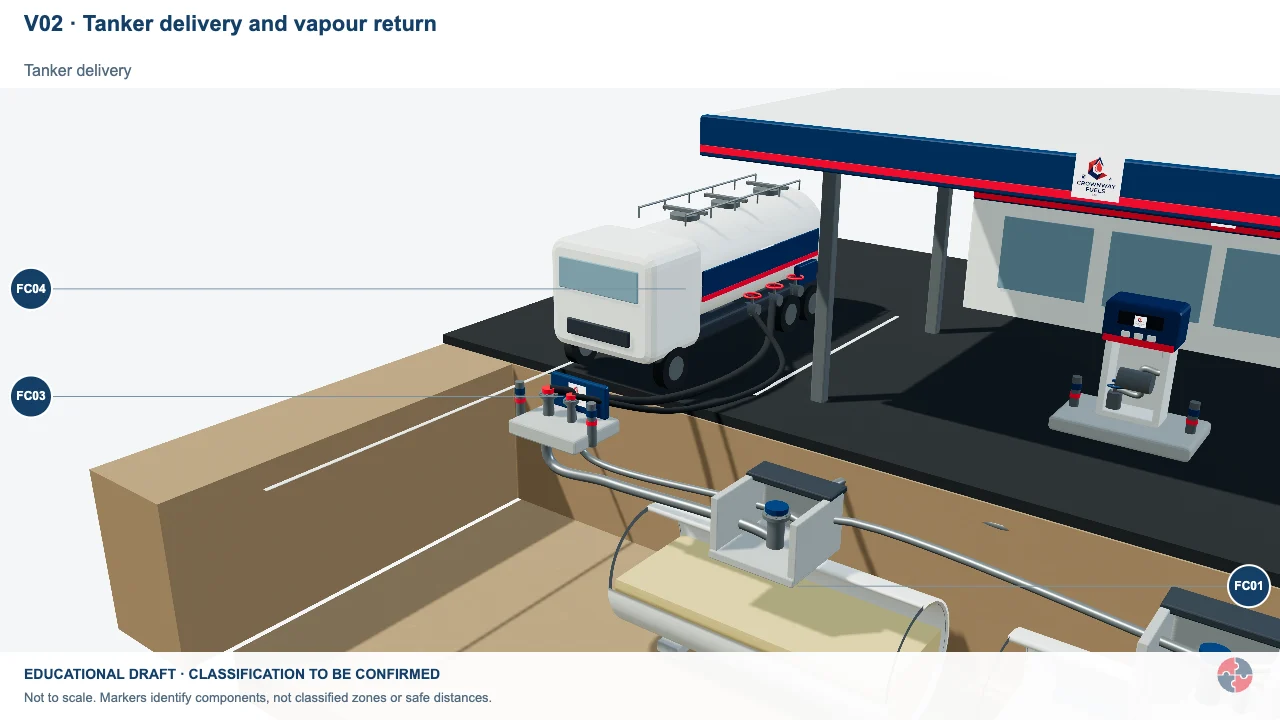
Tanker delivery and vapour return
During the proposed tanker delivery, product enters the receiving tank and displaced vapour returns to the tanker by a separate path. The delivery-hose teaching envelope follows the connected hose route.
Activity focus: Trace the tanker connection, product hose and receiving fill before following the Stage 1b vapour-return path. Inspect the whole delivery working area, including nearby traffic, dispensers and drainage.
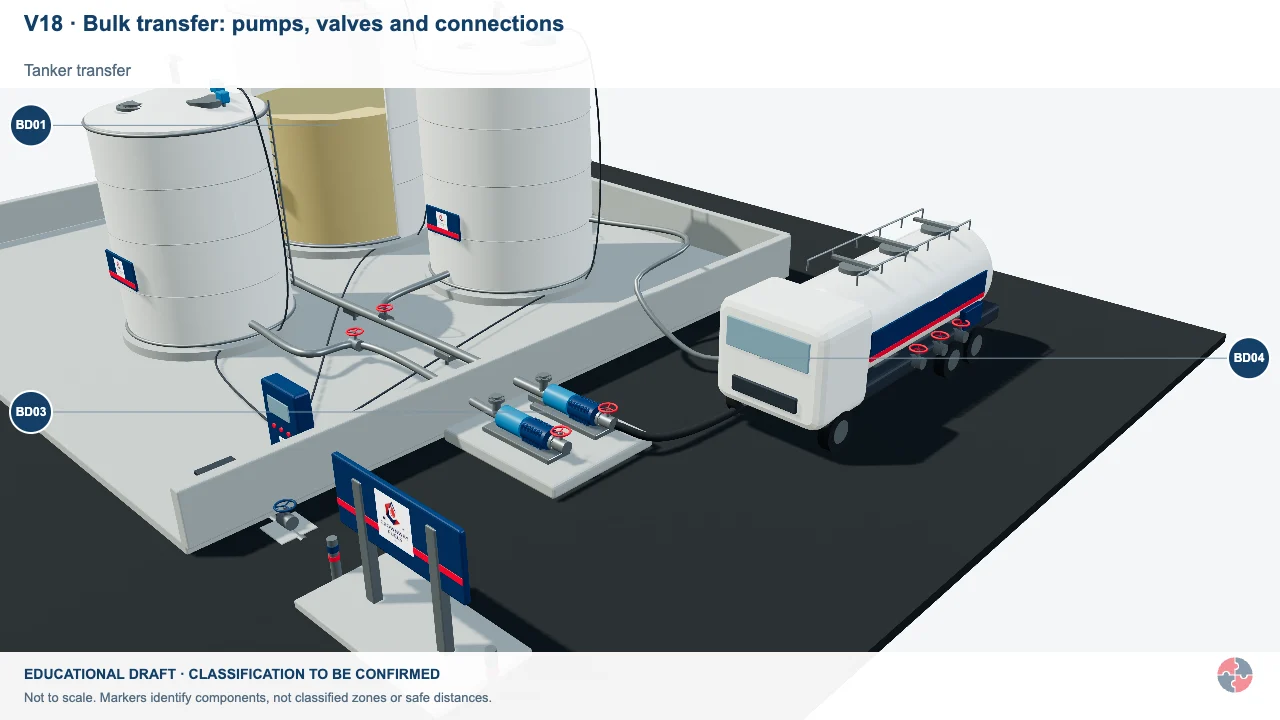
Tanker loading: liquid out, vapour back
Follow petrol from bulk storage into the tanker and the separate displaced-vapour route from the tanker to the terminal VRU.
Activity focus: Distinguish the product line, vapour collection line and tanker-loading protective controls.
Educational illustration, not to scale. Coloured zones are teaching examples, not a site-specific hazardous-area classification.
Chemical hazard symbols: what do they mean?

Exploding bomb
Explosive, self-reactive or organic peroxide hazards.
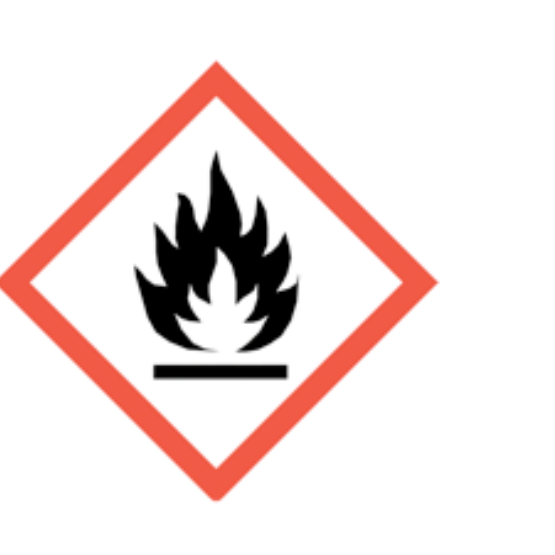
Flame
Flammable, self-heating or pyrophoric substances.

Flame over circle
Oxidising substances that can intensify fire.

Gas cylinder
Gas under pressure.
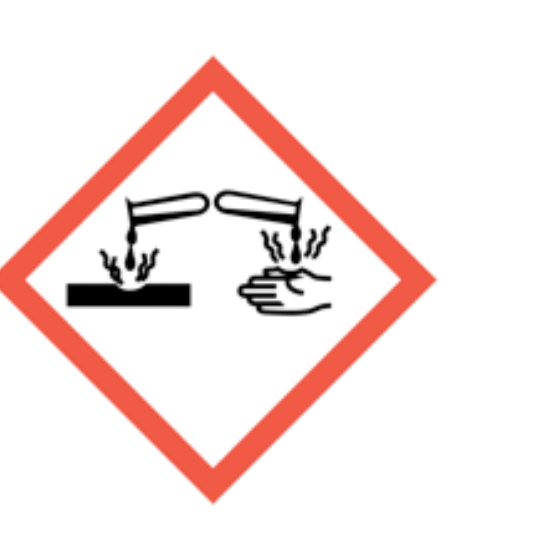
Corrosion
Skin burns, eye damage or corrosive to metals.
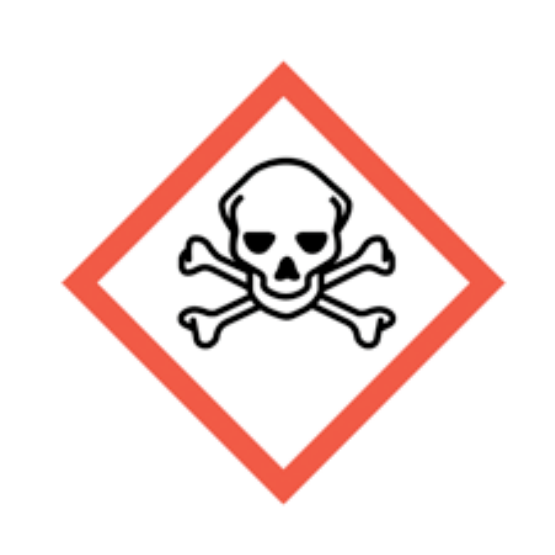
Skull and crossbones
Acute toxicity.

Exclamation mark
Irritation, harmful effects or skin sensitisation; some classifications cover drowsiness, dizziness or ozone-layer hazard. Read the actual hazard statements. Skin sensitisation differs from respiratory sensitisation.

Health hazard
Serious health hazards, including organ damage, aspiration hazard, respiratory sensitisation, cancer and reproductive effects; some can follow a single exposure.
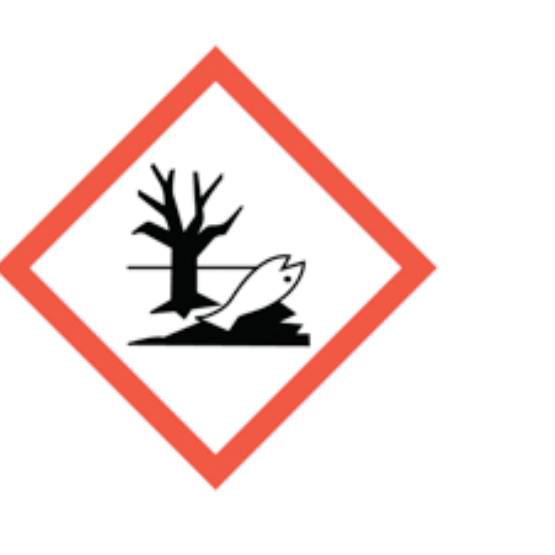
Environment
Hazardous to the aquatic environment.
Which acronyms and terms are useful for loading, unloading and transfer operations?
These terms name the product and barrier decisions at a transfer point.
| Term | Meaning | Use here |
|---|---|---|
| ESD | Emergency shutdown | Stops transfer when a defined danger occurs. |
| DSEAR | Dangerous Substances and Explosive Atmospheres Regulations | Separate GB/NI fire and explosion laws. |
| SIMOPS | Simultaneous operations | Other work that can interfere with a transfer. |
| SDS | Safety data sheet | Product hazards and compatible controls. |
| LOLER | Lifting Operations and Lifting Equipment Regulations | Applies if lifting equipment is used. |
| ERICPD | Eliminate, Reduce, Isolate, Control, PPE, Discipline | Control selection and sustaining checks. |
| MOC | Management of change | Review changed product, route, hardware or procedure. |
| LPG | Liquefied petroleum gas | Example of a product with distinct transfer hazards. |
| IBC | Intermediate bulk container | Packaged-liquid transfer mode. |
| COMAH | Control of Major Accident Hazards | Threshold-based establishment regime. |
| PPE | Personal protective equipment | Residual splash protection after higher-level controls. |
Which BuildOut documents support this topic?
Download individual editable BuildOut documents for this topic. Procedures and plans contain completed arrangements; forms, checklists, assessments, RAMS and permits are blank masters. Registers include separate worked examples.
| Document | Purpose and content | Editable download |
|---|---|---|
| Traffic planning, delivery and public-interface procedure BOUK-PRO-TRAF · Completed worked example · v1.0 | Set routes and exclusion zones, coordinate deliveries, safe reversing and changing public interfaces. | Download DOCX Read preview |
| Traffic management and delivery logistics plan BOUK-PLN-TRAF-01 · Completed worked example · v1.0 | Separate pedestrians/vehicles, control reversing, loading and route changes. | Download DOCX Read preview |
| Vehicle-pedestrian and public-interface assessment BOUK-RA-TRAF-01 · Blank editable master · v1.0 | Assess blind spots, vehicle movements, unloading and vulnerable users. | Download DOCX Read preview |
| Delivery, loading/unloading and reversing check BOUK-CHK-TRAF-01 · Blank editable master · v1.0 | Verify space, driver instructions, restraint, exclusion and competent assistance. | Download DOCX Read preview |
| Traffic-route change and briefing record BOUK-FRM-TRAF-01 · Blank editable master · v1.0 | Approve changed routes and communicate them to all affected parties. | Download DOCX Read preview |
| Boundary, public protection and neighbour-interface inspection BOUK-CHK-TRAF-02 · Blank editable master · v1.0 | Check hoarding, overhead protection, dust/noise controls and access. | Download DOCX Read preview |
| Delivery unloading and materials distribution RAMS BOUK-RAMS-TRAF-01 · Blank editable master · v1.0 | Vehicle positioning, stability, exclusion, lifting and pedestrian interfaces. | Download DOCX Read preview |
Review and adapt the documents for your organisation, activities and jurisdiction before approval and issue. Open the SHAREms management-system hierarchy to find each document under its parent policy.
Explore the Crownway Fuels hierarchy
Start at the tanker delivery policy. Open the delivery procedure to see its assessment, checklist and expected record.
Choose a document to see why it is used, who owns it, which duties it supports and what evidence it should produce. Switch to Text hierarchy for a list of expandable branches.
Fictional Crownway Fuels examples for English forecourts, with a separate illustrative bulk terminal. Check site applicability, permissions and actual controls before adapting any document for use.
Loading the Crownway register…
Which Crownway Fuels documents support this topic?
Open an editable document, read the preview, or find its place in the Crownway hierarchy. 16 resources relate to this page.
Fictional Crownway Fuels examples for English forecourts, with a separate illustrative bulk terminal. Check site applicability, permissions and actual controls before adapting any document for use.
Petrol tanker delivery and forecourt unloading policy (8)
- Petrol tanker delivery and forecourt unloading policy (CWF-POL-DEL · Completed fictional example)
Set company expectations, responsibilities and resources for petrol tanker delivery and forecourt unloading.
Read preview · Download DOCX · Show in hierarchy - Petrol tanker delivery and forecourt unloading procedure (CWF-PRO-DEL · Completed fictional example)
Explain who does what, in what sequence, the control rationale, evidence, escalation and safe restart conditions.
Read preview · Download DOCX · Show in hierarchy - Site specific tanker unloading assessment (CWF-RA-DEL-01 · Blank editable master)
Provide the site/task-specific site specific tanker unloading assessment and retain its controlled output.
Read preview · Download DOCX · Show in hierarchy - Tanker operator and site interface agreement (CWF-PLN-DEL-01 · Completed fictional example)
Provide the site/task-specific tanker operator and site interface agreement and retain its controlled output.
Read preview · Download DOCX · Show in hierarchy - Pre delivery tank product and ullage check (CWF-CHK-DEL-01 · Blank editable master)
Provide the site/task-specific pre delivery tank product and ullage check and retain its controlled output.
Read preview · Download DOCX · Download PDF · Show in hierarchy - Unloading connection monitoring and completion check (CWF-CHK-DEL-02 · Blank editable master)
Provide the site/task-specific unloading connection monitoring and completion check and retain its controlled output.
Read preview · Download DOCX · Download PDF · Show in hierarchy - Rejected or aborted delivery record (CWF-FRM-DEL-01 · Blank editable master)
Provide the site/task-specific rejected or aborted delivery record and retain its controlled output.
Read preview · Download DOCX · Show in hierarchy - Delivery discrepancy and overfill near miss report (CWF-FRM-DEL-02 · Blank editable master)
Provide the site/task-specific delivery discrepancy and overfill near miss report and retain its controlled output.
Read preview · Download DOCX · Show in hierarchy
Bulk fuel receipt loading and internal transfer policy (8)
- Bulk fuel receipt loading and internal transfer policy (CWF-POL-TRANSFER · Completed fictional example)
Set company expectations, responsibilities and resources for bulk fuel receipt loading and internal transfer.
Read preview · Download DOCX · Show in hierarchy - Bulk fuel receipt loading and internal transfer procedure (CWF-PRO-TRANSFER · Completed fictional example)
Explain who does what, in what sequence, the control rationale, evidence, escalation and safe restart conditions.
Read preview · Download DOCX · Show in hierarchy - Bulk receipt loading and transfer assessment (CWF-RA-TRANSFER-01 · Blank editable master)
Provide the site/task-specific bulk receipt loading and transfer assessment and retain its controlled output.
Read preview · Download DOCX · Show in hierarchy - Transfer authorisation and valve line up check (CWF-CHK-TRANSFER-01 · Blank editable master)
Provide the site/task-specific transfer authorisation and valve line up check and retain its controlled output.
Read preview · Download DOCX · Download PDF · Show in hierarchy - Road tanker loading and drive away prevention check (CWF-CHK-TRANSFER-02 · Blank editable master)
Provide the site/task-specific road tanker loading and drive away prevention check and retain its controlled output.
Read preview · Download DOCX · Download PDF · Show in hierarchy - Transfer monitoring and shift handover log (CWF-FRM-TRANSFER-01 · Blank editable master)
Provide the site/task-specific transfer monitoring and shift handover log and retain its controlled output.
Read preview · Download DOCX · Show in hierarchy - Alarm trip bypass and override authorisation (CWF-FRM-TRANSFER-02 · Blank editable master)
Provide the site/task-specific alarm trip bypass and override authorisation and retain its controlled output.
Read preview · Download DOCX · Show in hierarchy - Abnormal transfer safe shutdown and restart check (CWF-CHK-TRANSFER-03 · Blank editable master)
Provide the site/task-specific abnormal transfer safe shutdown and restart check and retain its controlled output.
Read preview · Download DOCX · Download PDF · Show in hierarchy
Unlock another resource
You have used this month’s two free downloads. Publish a post in your own words to unlock one more resource, or choose SHARE Individual for 10 downloads per month.
You decide whether to share. If you do, use the relevant platform disclosure tools and do not make claims you do not genuinely hold.