SHARE Knowledge Hub
HAZOP Studies
HAZOP studies are structured process hazard reviews that examine whether deviations from design intent could lead to loss of containment, fire, explosion, toxic release, environmental harm, equipment damage or operability failure. A good HAZOP uses defined nodes, guidewords, credible causes, consequences, safeguards, action quality, competent facilitation and disciplined close-out. The value is not the workshop itself; it is the quality of the challenge and whether findings are converted into safer design, operating limits, procedures, maintenance, alarms, trips, emergency controls and verified risk reduction.
Understanding HAZOP Studies
HAZOP studies are structured process hazard reviews that examine whether deviations from design intent could lead to loss of containment, fire, explosion, toxic release, environmental harm, equipment damage or operability failure. A good HAZOP uses defined nodes, guidewords, credible causes, consequences, safeguards, action quality, competent facilitation and disciplined close-out. The value is not the workshop itself; it is the quality of the challenge and whether findings are converted into safer design, operating limits, procedures, maintenance, alarms, trips, emergency controls and verified risk reduction.
Why this matters at work
Ask whether the response depends on the same sensor, power, display, procedure or person already affected by the initiating failure. Clarify the indication available, action required and conditions under which it could be completed reliably. The team should record the safeguard’s actual role and evidence rather than count repeated labels. Route questions about probability, independence or protection-layer credit to the appropriate competent analysis. Keep limitations and resulting actions attached to each scenario so later reviewers can see the basis for the study’s conclusions.
The analysis should consider credible causes, including equipment failure, loss of utility, instrument or control malfunction, isolation or valve line-up error, human action, procedural weakness, maintenance activity, external influence, construction defect, impairment of a safety function and management-of-change failure. It should not force every theoretical combination into an action. Conversely, it should not dismiss a high-consequence possibility merely because it is inconvenient, unfamiliar or rare.
How organisations manage this in practice
The evidence pack should be current, controlled and comprehensible to participants. Depending on the study, it can include process descriptions, drawings, design basis, hazardous-substance information, inventories, operating limits, control narratives, relevant calculations, equipment data, layout, procedures, maintenance and inspection history, incident or near-miss learning, action registers, previous studies, contractor information, staffing and shift arrangements, emergency plans and open changes. A document should not be assumed correct simply because it has a reference number.
Actions should be specific enough to implement and test. They should identify the scenario, required result, action owner, accountable approver, due point, affected drawings or procedures, dependencies, interim controls, evidence of completion and any trigger for revalidation. An action such as 'improve safety' or 'review controls' is too vague unless it is broken into an observable decision and outcome.
Preparation determines whether the workshop will be an evidence-led review or a recollection exercise. The sponsor and facilitator should agree the decision question, system boundary, included and excluded equipment or activities, lifecycle stage, interfaces, expected output, assumptions, decision authority, action process and stop or escalation criteria. Scope should include normal, start-up, shutdown, abnormal, maintenance, cleaning, testing, temporary and emergency-relevant conditions where they can affect the decision.
How can I practise this topic in 3D?


A new transfer branch has only a generic risk score
All related inspection points 2 across 1 location
Crown Fuels terminal 2 inspection points
Practice in the SHAREhub environment. Browser practice is separate from workplace competence and formal learning records.
What are the key points for HAZOP studies?
A good HAZOP systematically challenges process intent and turns credible deviations into verified risk reduction.
What are the key points for HAZOP studies? — part 1 of 2


Read the complete visual as text
- A good HAZOP systematically challenges process intent and turns…: A good HAZOP systematically challenges process intent and turns credible deviations into verified risk reduction.
- Intent comes first: The team must know what the node is meant to do before it can challenge deviations.
- Guidewords create discipline: Guidewords reduce random brainstorming and help avoid missing common deviation types.
What are the key points for HAZOP studies? — part 2 of 2


Read the complete visual as text
- Causes and consequences must be credible: A cause should be realistic, and a consequence should describe what harm or escalation could follow.
- Safeguards need evidence: A safeguard should not be credited because it exists on a drawing; its performance and availability matter.
- Close-out is part of the study: A HAZOP is unfinished if actions are not implemented, verified and transferred into the basis of safety.
Best-practice guide: HAZOP Studies

What are the key points for HAZOP studies?
A good HAZOP systematically challenges process intent and turns credible deviations into verified risk reduction. HAZOP studies are structured process hazard reviews that examine whether deviations from design intent could lead to loss of containment, fire, explosion, toxic release, environmental harm, equipment damage or operability failure.
Turn hazop studies knowledge into a decision
HAZOP studies are structured process hazard reviews that examine whether deviations from design intent could lead to loss of containment, fire, explosion, toxic release, environmental harm, equipment damage or operability failure. A good HAZOP uses defined nodes, guidewords, credible causes, consequences, safeguards, action quality, competent facilitation and disciplined close-out. MOC form and study decision record.
the process operator worked example
Assessing: Screen each process change to decide whether full HAZOP, coarse HAZOP or another review method is required. Evidence / response: MOC form and study decision record. Analysing: Define nodes, design intent, guidewords, deviations, causes, consequences and safeguards. Evidence / response: HAZOP worksheet and current P&IDs.
HAZOP warning signs and risk
Out-of-date drawings: The team studies a plant that no longer exists in that form. No operator or maintainer input: Practical abnormal and maintenance scenarios are missed. Safeguards listed as generic alarms: Weak or non-independent barriers are credited.
Choose controls for hazop studies
Eliminate HSE five-level hierarchy: Remove the bulk solvent transfer where a closed supplied module or no-transfer design meets production needs. Reduce: Trial a less-flammable compatible material where product performance and process safety permit. Isolate HSE five-level hierarchy: Separate the transfer route from occupied areas and protect drains and ignition sources. Control: Fit independently tested high-level shutdown for tank overfill or suitably engineered relief/interlock for pump overpressure. Control: Use positive line-up verification, controlled change and a pre-transfer hold point after engineered controls. Read the full control table for qualifications, ownership and verification. Use the actual task and applicable jurisdiction; existing technical approval remains unchanged.
Use the full hazop studies lesson
Use the full topic for the decision points, practical examples, detailed control tables and source scope. HSE guidance applies to Great Britain; use HSENI for the Northern Ireland route and the source’s stated jurisdiction. A simplified guide does not change the page’s technical-review or approval status.

Read all six steps as text
1. What are the key points for HAZOP studies?
A good HAZOP systematically challenges process intent and turns credible deviations into verified risk reduction.
- Avoid / redesign: Remove the bulk solvent transfer where a closed supplied module or no-transfer design meets production needs.
- Control the task: Separate the transfer route from occupied areas and protect drains and ignition sources.
- Verify before release: Unproven throughput or displaced hazard holds redesign.
A good HAZOP systematically challenges process intent and turns credible deviations into verified risk reduction. HAZOP studies are structured process hazard reviews that examine whether deviations from design intent could lead to loss of containment, fire, explosion, toxic release, environmental harm, equipment damage or operability failure.
Apply it: Which part of this plan would you check at the workface before authorising the task?
2. Turn hazop studies knowledge into a decision
Use the evidence to improve the actual work arrangement.
- Change at source: Remove the bulk solvent transfer where a closed supplied module or no-transfer design meets production needs.
- Make it observable: Unproven throughput or displaced hazard holds redesign.
- Keep useful evidence: MOC form and study decision record.
HAZOP studies are structured process hazard reviews that examine whether deviations from design intent could lead to loss of containment, fire, explosion, toxic release, environmental harm, equipment damage or operability failure. A good HAZOP uses defined nodes, guidewords, credible causes, consequences, safeguards, action quality, competent facilitation and disciplined close-out. MOC form and study decision record.
Apply it: What evidence would show that the change improves this task, rather than only completing a record?
3. the process operator worked example
Example: a practical application of the existing topic lesson.
- Assessing: Screen each process change to decide whether full HAZOP, coarse HAZOP or another review method is required.
- Analysing: Define nodes, design intent, guidewords, deviations, causes, consequences and safeguards.
- Implementing: Translate actions into design changes, alarm testing, operating procedures, maintenance tasks and training.
Assessing: Screen each process change to decide whether full HAZOP, coarse HAZOP or another review method is required. Evidence / response: MOC form and study decision record. Analysing: Define nodes, design intent, guidewords, deviations, causes, consequences and safeguards. Evidence / response: HAZOP worksheet and current P&IDs.
Apply it: At which point would you hold this example, and what evidence would allow it to proceed?
4. HAZOP warning signs and risk
Connect the task, the route to the person and the control that can fail.
- Out-of-date drawings: The team studies a plant that no longer exists in that form.
- No operator or maintainer input: Practical abnormal and maintenance scenarios are missed.
- Safeguards listed as generic alarms: Weak or non-independent barriers are credited.
Out-of-date drawings: The team studies a plant that no longer exists in that form. No operator or maintainer input: Practical abnormal and maintenance scenarios are missed. Safeguards listed as generic alarms: Weak or non-independent barriers are credited.
Apply it: Who could be exposed, including other trades, cleaners, maintainers and people nearby?
5. Choose controls for hazop studies
Start with the stronger practicable options and verify their effect.
- Eliminate HSE five-level hierarchy: Remove the bulk solvent transfer where a closed supplied module or no-transfer design meets production needs.
- Reduce: Trial a less-flammable compatible material where product performance and process safety permit.
- Isolate HSE five-level hierarchy: Separate the transfer route from occupied areas and protect drains and ignition sources.
- Control: Fit independently tested high-level shutdown for tank overfill or suitably engineered relief/interlock for pump overpressure.
- Control: Use positive line-up verification, controlled change and a pre-transfer hold point after engineered controls.
Eliminate HSE five-level hierarchy: Remove the bulk solvent transfer where a closed supplied module or no-transfer design meets production needs. Reduce: Trial a less-flammable compatible material where product performance and process safety permit. Isolate HSE five-level hierarchy: Separate the transfer route from occupied areas and protect drains and ignition sources. Control: Fit independently tested high-level shutdown for tank overfill or suitably engineered relief/interlock for pump overpressure. Control: Use positive line-up verification, controlled change and a pre-transfer hold point after engineered controls. Read the full control table for qualifications, ownership and verification. Use the actual task and applicable jurisdiction; existing technical approval remains unchanged.
Apply it: Which stronger option can be used here, and who will verify it before accepting the remaining risk?
6. Use the full hazop studies lesson
Follow the official sources below and retain the task-specific evidence.
- Official guidance: HSE COMAH process-safety assessment guidance
- Official guidance: HSE COMAH 2015 overview
- Task decision: MOC form and study decision record.
Use the full topic for the decision points, practical examples, detailed control tables and source scope. HSE guidance applies to Great Britain; use HSENI for the Northern Ireland route and the source’s stated jurisdiction. A simplified guide does not change the page’s technical-review or approval status.
Apply it: Which official source and full-topic section will you use to resolve the next decision?
Intent comes first
The team must know what the node is meant to do before it can challenge deviations.
Guidewords create discipline
Guidewords reduce random brainstorming and help avoid missing common deviation types.
Causes and consequences must be credible
A cause should be realistic, and a consequence should describe what harm or escalation could follow.
Safeguards need evidence
A safeguard should not be credited because it exists on a drawing; its performance and availability matter.
Close-out is part of the study
A HAZOP is unfinished if actions are not implemented, verified and transferred into the basis of safety.
What does a HAZOP study do?
A HAZOP study asks how deviations from design or operating intent could create hazardous or operability consequences.
SHARE method illustration: The cited HSE material supports the broad method and its selection; the prompts and worked entries below are SHARE teaching examples, not a formal study or a claim about an unseen standard. HSE Corus investigation: HAZOP method
HAZOP is most often used for process systems where flow, pressure, temperature, level, composition, reaction, containment or sequence can change the risk. It is systematic because the team reviews one node at a time, applies guidewords and records causes, consequences, safeguards and actions.
The method is not reserved for new plants. It is also valuable for modifications, restart after change, batch operations, procedural sequences, decommissioning and parts of operations where previous studies are old, incomplete or no longer reflect how the plant works.
| Building block | Meaning | Good practice |
|---|---|---|
| Node | A defined process section, vessel, line, operation or step. | Keep it small enough for clear intent and meaningful deviations. SHARE example—verify for the actual process. |
| Design intent | What the node is meant to achieve. | State flow, pressure, temperature, level, composition or sequence clearly. SHARE example—verify for the actual process. |
| Guideword | A structured prompt such as no, more, less or reverse. | Apply consistently without forcing irrelevant deviations. SHARE example—verify for the actual process. |
| Deviation | The difference from intent. | Write it in process language: no flow, high pressure, reverse flow. SHARE example—verify for the actual process. |
| Cause | How the deviation could happen. | Use credible equipment, human, utility, material or control failure. SHARE example—verify for the actual process. |
| Consequence | What could happen if the deviation occurs. | Describe loss of containment, fire, exposure, environmental harm or operability impact. SHARE example—verify for the actual process. |
| Safeguard and action | Existing barriers and further risk reduction needed. | Challenge independence, reliability, ownership and evidence. SHARE example—verify for the actual process. |
The guide-word method asks how each defined process part could depart from its intended state. HSE HAZOP and plant-change guidance
How should HAZOP nodes and design intent be defined?
Nodes should be defined so the team can understand the intended operation and challenge deviations without confusion.
SHARE method illustration: The cited HSE material supports the broad method and its selection; the prompts and worked entries below are SHARE teaching examples, not a formal study or a claim about an unseen standard. HSE Corus investigation: HAZOP method
Poor node definition makes the study vague. A node that covers a whole plant may hide detail; a node that is too small may waste effort and lose system interactions. The facilitator should choose nodes that reflect process purpose, equipment boundaries and the decision being made.
Design intent should be practical, not decorative. It should say what the line, vessel, transfer, reaction or step is supposed to do and the conditions needed for it to remain safe.
| Item | Weak example | Stronger example |
|---|---|---|
| Node | Solvent system. | Line from Tank T-101 outlet to Reactor R-201 charging nozzle. SHARE example—verify for the actual process. |
| Intent | Transfer solvent. | Transfer solvent at controlled flow to R-201 within temperature, pressure and nitrogen blanket limits. SHARE example—verify for the actual process. |
| Boundary | Whole charging process. | From tank isolation valve to reactor inlet valve, excluding reactor agitation sequence. SHARE example—verify for the actual process. |
| Information | Drawing reviewed. | Current P&ID, cause and effect, operating procedure, alarm list and relief basis available. SHARE example—verify for the actual process. |
| Scope note | Normal operation. | Normal charging, start-up, shutdown, low-flow, blocked-line and maintenance handback conditions considered. SHARE example—verify for the actual process. |
A node needs a clear design intent and boundary so causes and consequences do not vanish between study sections. HSE HAZOP and plant-change guidance
How do HAZOP guidewords help the team think?
Guidewords provide a disciplined way to challenge deviations such as no flow, more pressure, less cooling, reverse flow or other material.
SHARE method illustration: The cited HSE material supports the broad method and its selection; the prompts and worked entries below are SHARE teaching examples, not a formal study or a claim about an unseen standard. HSE Corus investigation: HAZOP method
Guidewords are not magic words. They are prompts that help a competent team challenge the process from different angles. The chair should use judgement: some guidewords will be highly relevant to a node, while others may be quickly dismissed with a reason.
The team should avoid jumping from guideword to solution. First understand the deviation, then credible causes, then consequences, then whether safeguards are adequate.
| Guideword | Plain-English question | Example deviation |
|---|---|---|
| No or not | What if the intended action, flow, utility or protection is absent? | No cooling water to reactor jacket. SHARE example—verify for the actual process. |
| More | What if there is too much flow, pressure, temperature, level or reaction? | High pressure in transfer line. SHARE example—verify for the actual process. |
| Less | What if there is too little flow, cooling, agitation or concentration? | Low nitrogen purge flow. SHARE example—verify for the actual process. |
| Reverse | What if flow, sequence or movement reverses? | Reverse flow from reactor to storage tank. SHARE example—verify for the actual process. |
| As well as | What else could be present or occur at the same time? | Water contamination as well as solvent charge. SHARE example—verify for the actual process. |
| Other than | What if the wrong material, route, valve, source or destination is used? | Wrong chemical charged to batch reactor. SHARE example—verify for the actual process. |
| Early or late | What if the step happens too soon or too late? | Heating starts before purge is complete. SHARE example—verify for the actual process. |
Apply guide words to parameters such as flow and pressure; record why a deviation is credible or screened out. HSE HAZOP and plant-change guidance
How does a worked HAZOP node example help learning?
A worked node shows how guidewords become real deviation, safeguard and action decisions.
Worked HAZOP node example — part 1 of 2


Read the complete visual as text
- No flow: Credible cause: Pump trip, closed valve, blocked strainer or wrong line-up. Consequence: Batch delay, operator intervention, possible restart error or manual bypass. Safeguard/action: Alarm and procedure may be enough for operability; investigate if manual workaround creates safety risk. SHARE example—verify for the actual process.
- More flow: Credible cause: Control valve fails open or pump speed set wrong. Consequence: Overfill, reaction rate change, pressure rise or high vapour generation. Safeguard/action: Verify high-level trip, flow control, operator response and whether LOPA is required. SHARE example—verify for the actual process.
- Reverse flow: Credible cause: Pressure imbalance or failed non-return valve. Consequence: Contamination of storage tank, incompatible mixture or loss of containment. Safeguard/action: Check non-return valve inspection, isolation philosophy and sampling controls. SHARE example—verify for the actual process.
Worked HAZOP node example — part 2 of 2


Read the complete visual as text
- Other than solvent: Credible cause: Wrong tanker, wrong connection or labelling error. Consequence: Incompatible reaction, off-spec product, heat release or toxic vapour. Safeguard/action: Independent material verification and locked connection system. SHARE example—verify for the actual process.
- As well as water: Credible cause: Water ingress from cleaning or condensation. Consequence: Reaction upset, pressure generation or corrosion. Safeguard/action: Drying standard, sample test and operating hold point. SHARE example—verify for the actual process.
- Less nitrogen: Credible cause: Purge valve closed, low supply pressure or blocked filter. Consequence: Flammable atmosphere in reactor headspace. Safeguard/action: Purge monitoring, low-flow alarm and defined no-start condition. SHARE example—verify for the actual process.
SHARE method illustration: The cited HSE material supports the broad method and its selection; the prompts and worked entries below are SHARE teaching examples, not a formal study or a claim about an unseen standard. HSE Corus investigation: HAZOP method
Consider a solvent transfer line from a bulk tank to a reactor. The design intent is to transfer the correct solvent at a controlled rate into a reactor under a nitrogen blanket. The HAZOP team applies guidewords such as no flow, more flow, reverse flow, other than and as well as.
A strong learner should be able to see how each line of the HAZOP record supports a decision. If a safeguard is claimed, the team should know whether it is independent, tested, alarmed, maintained and usable under pressure.
| Deviation | Credible cause | Consequence | Safeguard/action |
|---|---|---|---|
| No flow | Pump trip, closed valve, blocked strainer or wrong line-up. | Batch delay, operator intervention, possible restart error or manual bypass. | Alarm and procedure may be enough for operability; investigate if manual workaround creates safety risk. SHARE example—verify for the actual process. |
| More flow | Control valve fails open or pump speed set wrong. | Overfill, reaction rate change, pressure rise or high vapour generation. | Verify high-level trip, flow control, operator response and whether LOPA is required. SHARE example—verify for the actual process. |
| Reverse flow | Pressure imbalance or failed non-return valve. | Contamination of storage tank, incompatible mixture or loss of containment. | Check non-return valve inspection, isolation philosophy and sampling controls. SHARE example—verify for the actual process. |
| Other than solvent | Wrong tanker, wrong connection or labelling error. | Incompatible reaction, off-spec product, heat release or toxic vapour. | Independent material verification and locked connection system. SHARE example—verify for the actual process. |
| As well as water | Water ingress from cleaning or condensation. | Reaction upset, pressure generation or corrosion. | Drying standard, sample test and operating hold point. SHARE example—verify for the actual process. |
| Less nitrogen | Purge valve closed, low supply pressure or blocked filter. | Flammable atmosphere in reactor headspace. | Purge monitoring, low-flow alarm and defined no-start condition. SHARE example—verify for the actual process. |
| Node/design intent | Deviation | Credible cause | Consequence | Existing safeguard | Action, owner and close-out evidence |
|---|---|---|---|---|---|
| Solvent transfer line: transfer correct solvent from bulk tank to reactor R-201 at controlled flow under nitrogen blanket. | More flow to reactor. | Control valve fails open after maintenance or pump speed is set above the approved recipe value. | Reactor overfill, increased vapour generation, pressure rise and possible flammable release through vent or manway. | Flow controller, high-level alarm, high-high level trip and operator response procedure. | Process engineer owns verification that high-high trip is independent of the control transmitter. Close-out evidence: cause-and-effect review, proof-test record, P&ID mark-up and technical authority approval before start-up. SHARE example—verify for the actual process. |
| Same node and design intent. | Other than correct solvent. | Tanker connected to wrong unloading point, incorrect line-up after cleaning or poor labelling of temporary hose. | Incompatible material charged, heat release, toxic vapour or off-spec batch requiring emergency response. | Delivery paperwork, operator line-up check and labelled connection points. | Operations manager owns independent material verification and locked connection standard. Close-out evidence: revised unloading procedure, physical connection control, operator assessment and first transfer field verification. SHARE example—verify for the actual process. |
| Same node and design intent. | Less nitrogen purge. | Low nitrogen supply pressure, blocked filter, purge valve left closed or temporary bypass after maintenance. | Flammable atmosphere in reactor headspace during charging, with ignition risk during agitation, sampling or static discharge. | Nitrogen pressure indicator, low-flow alarm and start-up procedure. | Control systems engineer owns no-start interlock or hard hold point where purge flow is below limit. Close-out evidence: alarm/interlock test, updated operating limit, simulator or tabletop drill and supervisor sign-off. SHARE example—verify for the actual process. |
| Same node and design intent. | Reverse flow from reactor to bulk tank. | Failed non-return valve combined with pressure imbalance during shutdown or blocked transfer route. | Contamination of bulk tank, uncontrolled reaction potential and exposure during later unloading or sampling. | Non-return valve, isolation procedure and batch records. | Maintenance manager owns inspection regime for non-return valve and handback verification after intrusive work. Close-out evidence: inspection record, maintenance task added to CMMS, permit handback checklist and later audit sample. SHARE example—verify for the actual process. |
A pump deviation can expose wrong destination or overpressure, but the worksheet does not prove relief or interlock performance. HSE HAZOP and plant-change guidance HSE plant modification guidance
Who should be in the HAZOP team?
The HAZOP team should combine method competence, process knowledge, operating reality, maintenance experience and decision authority.
A HAZOP can fail quietly if the right people are missing. A design team may understand intended operation but miss maintenance access and start-up realities. Operators may understand alarms and procedures but need engineering support on relief, control logic and chemistry. The facilitator should make sure challenge is balanced.
The scribe or recorder also matters. Poor recording loses the reasoning behind actions and makes later close-out hard to verify.
SHARE example scope: HSE guidance supports a proportionate hazard study and the broad method; the specific rows below are editorial prompts to test against the actual process, evidence and competent study. HSE method context.
| Role | Contribution | Evidence of competence |
|---|---|---|
| Chair or facilitator | Applies method, controls bias, manages pace and challenges assumptions. | Facilitation training, experience and independence. SHARE example—verify for the actual process. |
| Scribe | Records deviations, causes, consequences, safeguards, actions and reasoning. | Clear record standard and familiarity with terminology. SHARE example—verify for the actual process. |
| Process engineer | Explains design intent, process data, chemistry and operating envelope. | Current drawings, design basis and process knowledge. SHARE example—verify for the actual process. |
| Operations representative | Explains actual operation, alarms, procedures, handover and workarounds. | Experience with normal and abnormal operation. SHARE example—verify for the actual process. |
| Maintenance representative | Explains access, isolation, repair, inspection and equipment failure modes. | Maintenance history and practical plant knowledge. SHARE example—verify for the actual process. |
| Process safety/HSE specialist | Challenges major accident scenarios, barriers, DSEAR, human factors and follow-on studies. | Relevant technical competence and authority to escalate. SHARE example—verify for the actual process. |
How should HAZOP safeguards be challenged?
Safeguards should be challenged for relevance, effectiveness, independence, availability and evidence.
Teams often over-credit safeguards because they recognise the name. A high-level alarm, relief valve, interlock, operator round, permit or procedure may be useful, but only if it can actually prevent, detect, control or mitigate the deviation being discussed.
The study should avoid counting several safeguards that share the same failure cause. If the same level transmitter feeds the display, alarm and trip, the protection may not be independent.
SHARE example scope: HSE guidance supports a proportionate hazard study and the broad method; the specific rows below are editorial prompts to test against the actual process, evidence and competent study. HSE method context.
| Question | Why it matters | Evidence |
|---|---|---|
| Does it act on this scenario? | A general control may not affect the specific deviation. | Cause and effect, procedure or design proof. SHARE example—verify for the actual process. |
| Is it independent? | Common-cause failures can defeat several apparent layers. | Independence review, LOPA or design analysis. SHARE example—verify for the actual process. |
| Is it available? | Bypass, maintenance, impairment or overdue testing may remove protection. | Inspection, proof-test and bypass records. SHARE example—verify for the actual process. |
| Can people respond in time? | Operator response depends on alarm clarity, workload and time available. | Alarm response standard and human factors review. SHARE example—verify for the actual process. |
| Is it maintained? | A physical safeguard degrades unless inspected and tested. | Maintenance and calibration records. SHARE example—verify for the actual process. |
| Is emergency mitigation enough? | Emergency response should not compensate for weak prevention. | Scenario-based drills and prevention review. SHARE example—verify for the actual process. |
Challenge independence, availability, testing and bypass status for every credited barrier. HSE COMAH process-safety assessment guidance HSG254 Developing process safety indicators
How can the hierarchy of controls turn HAZOP findings into stronger process-risk controls?
ERICPD is used here as a planning mnemonic. The linked HSE five-level hierarchy is the official source for the order and relative reliability of controls; the two labels are not identical.
Remove or redesign the hazardous transfer or fume-generating task first; the study or audit verifies decisions and evidence, not the barrier by itself.
How do ERICPD and the five-level hierarchy change the real control? — part 1 of 2


Read the complete visual as text
- ERICPD is used here as a planning mnemonic. The…: ERICPD is used here as a planning mnemonic. The linked HSE five-level hierarchy is the official source for the order and relative reliability of controls; the two labels are not identical.
- Remove or redesign the hazardous transfer or fume-generating task…: Remove or redesign the hazardous transfer or fume-generating task first; the study or audit verifies decisions and evidence, not the barrier by itself.
How do ERICPD and the five-level hierarchy change the real control? — part 2 of 2


Read the complete visual as text
- A solvent-transfer HAZOP tests no flow, more pressure and…: A solvent-transfer HAZOP tests no flow, more pressure and wrong destination at a defined pump node. The study exposes credible fire or release routes; engineering review must prove the selected barriers before commissioning. HSE COMAH process-safety assessment guidance
- ERICPD is a six-stage planning aid; the HSE five…: ERICPD is a six-stage planning aid; the HSE five levels separate substitution, engineering, administration and residual PPE. Isolate normally maps to engineered separation, Control can include physical or administrative measures, and Discipline sustains controls through maintenance and learning. HSE five-level hierarchy HSE five-level hierarchy
A solvent-transfer HAZOP tests no flow, more pressure and wrong destination at a defined pump node. The study exposes credible fire or release routes; engineering review must prove the selected barriers before commissioning. HSE COMAH process-safety assessment guidance
ERICPD is a six-stage planning aid; the HSE five levels separate substitution, engineering, administration and residual PPE. Isolate normally maps to engineered separation, Control can include physical or administrative measures, and Discipline sustains controls through maintenance and learning. HSE five-level hierarchy HSE five-level hierarchy
How can the ERICPD hierarchy of controls turn HAZOP findings into stronger process-risk controls?

| ERICPD stage | HSE / IOSH level | Task intervention and harm-chain break | Owner and effectiveness evidence | Failure or stop condition |
|---|---|---|---|---|
| Eliminate HSE five-level hierarchy | Elimination HSE five-level hierarchy | Remove the bulk solvent transfer where a closed supplied module or no-transfer design meets production needs. HSE COMAH process-safety assessment guidance | Designer tests capacity, process and delivery constraints; owner signs design decision. | Unproven throughput or displaced hazard holds redesign. |
| Reduce / substitute HSE five-level hierarchy | Substitution HSE five-level hierarchy | Trial a less-flammable compatible material where product performance and process safety permit. Consider lower-pressure batch transfer as a separate design reduction, not a substitution. HSE COMAH process-safety assessment guidance | Process engineer checks compatibility, ignition risk, pressure limits and new exposure. | Failed product or process validation rejects the option. |
| Isolate HSE five-level hierarchy | Engineering control HSE five-level hierarchy | Separate the transfer route from occupied areas and protect drains and ignition sources. HSE COMAH process-safety assessment guidance | Site manager inspects route, containment and interfaces before transfer. | Barrier breach or uncontained drain route stops transfer. |
| Control: physical HSE five-level hierarchy | Engineering control HSE five-level hierarchy | Fit independently tested high-level shutdown for tank overfill or suitably engineered relief/interlock for pump overpressure. HSE COMAH process-safety assessment guidance | Engineer commissions function and proof-test interval; operator verifies status. | Failed trip, relief path or unknown bypass status stops operation. |
| Control: method HSE five-level hierarchy | Administrative control HSE five-level hierarchy | Use positive line-up verification, controlled change and a pre-transfer hold point after engineered controls. HSE COMAH process-safety assessment guidance | Supervisor witnesses first use and checks controlled drawing. | Wrong connection, stale drawing or unresolved study action holds start. |
| PPE HSE five-level hierarchy | PPE HSE five-level hierarchy | Select splash and chemical protection for residual contact, using product-specific compatibility; it cannot prevent tank overfill. HSE COMAH process-safety assessment guidance | Assessor checks material and wearer fit; user checks before task. | Damaged or incompatible protection stops contact work. |
| Discipline HSE five-level hierarchy | Sustains controls HSE five-level hierarchy | Trend alarm demands, bypasses and overdue actions and verify barriers in the field. HSE COMAH process-safety assessment guidance | Manager reviews HSG254 indicators and funds corrective action. | Repeated demands or overdue safety-critical action triggers escalation. |
How can the ISO 45001 hierarchy of controls turn HAZOP findings into stronger process-risk controls?

| ESEAP control level | HSE / IOSH level | Task intervention and harm-chain break | Owner and effectiveness evidence | Failure or stop condition |
|---|---|---|---|---|
| Elimination HSE five-level hierarchy | Elimination HSE five-level hierarchy | Remove the bulk solvent transfer where a closed supplied module or no-transfer design meets production needs. HSE COMAH process-safety assessment guidance | Designer tests capacity, process and delivery constraints; owner signs design decision. | Unproven throughput or displaced hazard holds redesign. |
| Substitution HSE five-level hierarchy | Substitution HSE five-level hierarchy | Trial a less-flammable compatible material where product performance and process safety permit. Consider lower-pressure batch transfer as a separate design reduction, not a substitution. HSE COMAH process-safety assessment guidance | Process engineer checks compatibility, ignition risk, pressure limits and new exposure. | Failed product or process validation rejects the option. |
| Engineering controls HSE five-level hierarchy | Engineering control HSE five-level hierarchy | Separate the transfer route from occupied areas and protect drains and ignition sources. HSE COMAH process-safety assessment guidance | Site manager inspects route, containment and interfaces before transfer. | Barrier breach or uncontained drain route stops transfer. |
| Engineering controls HSE five-level hierarchy | Engineering control HSE five-level hierarchy | Fit independently tested high-level shutdown for tank overfill or suitably engineered relief/interlock for pump overpressure. HSE COMAH process-safety assessment guidance | Engineer commissions function and proof-test interval; operator verifies status. | Failed trip, relief path or unknown bypass status stops operation. |
| Administrative controls HSE five-level hierarchy | Administrative control HSE five-level hierarchy | Use positive line-up verification, controlled change and a pre-transfer hold point after engineered controls. HSE COMAH process-safety assessment guidance | Supervisor witnesses first use and checks controlled drawing. | Wrong connection, stale drawing or unresolved study action holds start. |
| PPE HSE five-level hierarchy | PPE HSE five-level hierarchy | Select splash and chemical protection for residual contact, using product-specific compatibility; it cannot prevent tank overfill. HSE COMAH process-safety assessment guidance | Assessor checks material and wearer fit; user checks before task. | Damaged or incompatible protection stops contact work. |
| Administrative controls HSE five-level hierarchy | Sustains controls HSE five-level hierarchy | Trend alarm demands, bypasses and overdue actions and verify barriers in the field. HSE COMAH process-safety assessment guidance | Manager reviews HSG254 indicators and funds corrective action. | Repeated demands or overdue safety-critical action triggers escalation. |
How should management verify controls for this task?
For solvent transfer pump wrong line-up and overpressure, the management check should start with a real control decision: Remove the bulk solvent transfer where a closed supplied module or no-transfer design meets production needs. Name the person who will test it, keep evidence from the actual work, and reopen the assessment when the failure condition in the hierarchy table occurs. HSE management-system guidance.
A review should compare the planned control with what workers and supervisors can use in practice. Record the defect, owner, interim protection, verification and next review trigger so that a policy statement or certificate does not stand in for a working control.
What makes a HAZOP action high quality?
Define the protective function before closing an action
In this illustrative record, distinguish level indication, an alarm requiring operator action, and an automatic high-high protective trip. Verify the complete claimed function—sensor, logic and final action—and its dependencies. A tag name or separate transmitter alone does not demonstrate whole-function independence.
A high-quality HAZOP action states the risk issue, required decision, owner, timescale and evidence needed for closure.
HAZOP action wording should be strong enough that someone who was not in the room can understand what risk is being reduced. Weak actions create future uncertainty and allow risk to be accepted by drift rather than decision.
Action priority should be driven by potential consequence and safeguard weakness, not by how easy the action is to complete.
SHARE example scope: HSE guidance supports a proportionate hazard study and the broad method; the specific rows below are editorial prompts to test against the actual process, evidence and competent study. HSE method context.
| Weak action | Better action | Close-out proof |
|---|---|---|
| Check alarm. | Define LSHH-201 here as the high-high level automatic protective trip. Verify the complete sensor, logic and final action and its independence from control transmitter LT-201 before solvent charging duty. | Cause and effect review, test record and approval. SHARE example—verify for the actual process. |
| Review procedure. | Revise solvent charging procedure to include nitrogen purge no-start criterion and operator response to low-flow alarm. | Controlled procedure, briefing and field verification. SHARE example—verify for the actual process. |
| Consider relief. | Process engineer to confirm blocked outlet relief basis for R-201 during maximum pump flow. | Calculation, relief review and technical authority sign-off. SHARE example—verify for the actual process. |
| Train operators. | Assess operators on abnormal response to high reactor level and nitrogen purge failure using scenario exercise. | Assessment record and refresher plan. SHARE example—verify for the actual process. |
| Do LOPA. | Complete LOPA for high-flow solvent overcharge where HAZOP cannot justify safeguard adequacy qualitatively. | LOPA report and risk reduction decision. SHARE example—verify for the actual process. |
Assign each recommendation a technical owner, design decision and evidence required before start-up. HSE HAZOP and plant-change guidance
How should HAZOP records be written?
HAZOP records should preserve the reasoning well enough for later audit, modification, investigation and training.
A good record is not a transcript. It is a structured decision record. It should capture why a deviation was credible or not credible, what consequence was considered, which safeguards were credited, what assumptions were made and why actions were raised or not raised.
Recording quality matters years later. Investigators, auditors, engineers and new operators may need to understand why a safeguard was accepted or why no action was taken.
SHARE example scope: HSE guidance supports a proportionate hazard study and the broad method; the specific rows below are editorial prompts to test against the actual process, evidence and competent study. HSE method context.
| Record field | Good record | Poor record |
|---|---|---|
| Deviation | High pressure in transfer line during blocked outlet. | Pressure issue. SHARE example—verify for the actual process. |
| Cause | Downstream isolation valve closed after maintenance handback error. | Valve problem. SHARE example—verify for the actual process. |
| Consequence | Line rupture with flammable solvent release inside process building. | Leak. SHARE example—verify for the actual process. |
| Safeguard | Pressure transmitter alarm to control room with operator response within defined time. | Alarm. SHARE example—verify for the actual process. |
| Assumption | Relief route adequate for maximum pump flow; calculation to be confirmed. | Relief OK. SHARE example—verify for the actual process. |
| Action | Named engineer to verify relief calculation before start-up. | Review. SHARE example—verify for the actual process. |
Record cause, consequence, existing safeguard, assumption and action so another team can reconstruct the decision. HSE HAZOP and plant-change guidance
How should HAZOP actions be closed out?
HAZOP actions should be closed only when the required risk reduction has been implemented, checked and accepted by a competent person.
Closing a HAZOP action because a meeting agreed it is acceptable is not enough where the action was safety critical. Closure evidence should show physical change, calculation, procedure update, competence assessment, alarm test, design review or authorised risk acceptance.
Pre-start-up or pre-commissioning checks should confirm that intended actions have been implemented, including hardware and software where relevant. This aligns with HSE's staged approach to hazard review during plant modification.
SHARE example scope: HSE guidance supports a proportionate hazard study and the broad method; the specific rows below are editorial prompts to test against the actual process, evidence and competent study. HSE method context.
| Close-out element | What good looks like | Failure mode |
|---|---|---|
| Action ownership | Named person with authority and competence owns the action. | Action assigned to a department with no owner. SHARE example—verify for the actual process. |
| Risk priority | High-consequence actions are escalated and not lost in admin queues. | Easy actions close first while critical actions drift. SHARE example—verify for the actual process. |
| Verification | Closure evidence is checked by competent reviewer. | Email response accepted without proof. SHARE example—verify for the actual process. |
| Transfer to operations | Changes enter procedures, training, maintenance and operating limits. | Engineering action closes but operators never see the change. SHARE example—verify for the actual process. |
| Start-up gate | Safety-critical actions are closed or formally risk-accepted before start. | Plant starts with unresolved basis-of-safety assumptions. SHARE example—verify for the actual process. |
| Effectiveness review | Field checks confirm controls work after implementation. | Action changes paperwork but not actual risk. SHARE example—verify for the actual process. |
Verify installation and functional performance of study actions during change and pre-commissioning checks. HSE plant modification guidance
When should HAZOP be used across the plant lifecycle?
HAZOP should be timed so it informs design, modification and start-up decisions before risk is accepted.
SHARE example scope: HSE guidance supports a proportionate hazard study and the broad method; the specific rows below are editorial prompts to test against the actual process, evidence and competent study. HSE method context.
| Stage | HAZOP role | Practical output |
|---|---|---|
| Concept/preliminary design | Identify major hazards and whether key data is available. | Study plan, missing data list and inherent safety options. SHARE example—verify for the actual process. |
| Flowsheet or block diagram | Coarse HAZOP or preliminary hazard review. | Scenario list and design risk decisions. SHARE example—verify for the actual process. |
| Frozen P&ID | Full HAZOP on mature design. | Detailed deviations, safeguards and action list. SHARE example—verify for the actual process. |
| Modification | Assess whether the change needs HAZOP and what level is proportionate. | MOC decision and hazard review record. SHARE example—verify for the actual process. |
| Pre-commissioning | Check intended actions, statutory requirements, hardware and software. | Pre-start-up safety review evidence. SHARE example—verify for the actual process. |
| Early operation | Review after a few months where assumptions or commissioning findings need testing. | Audit, action review and procedure improvements. SHARE example—verify for the actual process. |
Set the study depth for the change and repeat relevant review when design or operating conditions shift. HSE plant modification guidance
When is HAZOP not enough on its own?
HAZOP is not enough where the team needs quantified risk, safeguard independence proof, SIL determination or specialist consequence analysis.
A HAZOP identifies deviations and challenges safeguards. It does not automatically prove that risk is ALARP, that a safety instrumented function has the right integrity, that a relief system is adequate, that a vapour cloud consequence is acceptable or that operator response can be credited.
The HAZOP chair should recognise when to recommend LOPA, SIL determination, QRA, relief review, DSEAR assessment, human factors analysis or specialist engineering study.
SHARE example scope: HSE guidance supports a proportionate hazard study and the broad method; the specific rows below are editorial prompts to test against the actual process, evidence and competent study. HSE method context.
| Question | Likely follow-on | Why |
|---|---|---|
| Is this layer independent enough? | LOPA | Protection layers need independence and risk reduction review. SHARE example—verify for the actual process. |
| What SIL is needed? | SIL determination and functional safety lifecycle. | A defined safety instrumented function needs integrity requirements. SHARE example—verify for the actual process. |
| What is the consequence range? | Consequence modelling or QRA. | Toxic, fire, explosion or off-site consequences need specialist modelling. SHARE example—verify for the actual process. |
| Is relief adequate? | Relief and vent design review. | HAZOP cannot replace sizing calculations. SHARE example—verify for the actual process. |
| Can the operator act in time? | Human factors analysis. | Alarm, workload, interface and procedure usability need evidence. SHARE example—verify for the actual process. |
| Is ignition control adequate? | DSEAR assessment and hazardous area classification. | Fire and explosion risks need specific controls. SHARE example—verify for the actual process. |
HAZOP identifies deviations; separate competent analysis may be needed for likelihood, relief capacity and safety integrity. HSE HAZOP and plant-change guidance HSE COMAH process-safety assessment guidance
Which duties apply in Great Britain and Northern Ireland?
The organisation must meet the applicable risk-management duties; no single audit or hazard-study label is a universal legal requirement.
Select the instrument for the actual jurisdiction, activity and dangerous-substance inventory. A HAZID, HAZOP or audit record can support evidence, but completion of a form does not demonstrate an effective physical safeguard. HSE risk-assessment steps HSENI five steps to risk assessment HSE COMAH 2015 overview HSENI COMAH site information
| Decision | Great Britain | Northern Ireland |
|---|---|---|
| General work duties | GB Health and Safety at Work etc. Act 1974; protect workers and affected others. Instrument | NI Health and Safety at Work Order 1978; apply the separate NI duty. Instrument |
| Risk assessment and management | GB Management Regulations 1999 require suitable assessment and effective arrangements. Instrument | NI Management Regulations 2000 set the corresponding NI assessment and arrangements route. Instrument |
| Major-accident establishments | GB COMAH 2015 applies only if dangerous-substance thresholds and conditions are met. Instrument | NI COMAH 2015 is the separate threshold-based NI instrument. Instrument |
| Fire and explosion from dangerous substances | GB DSEAR 2002 route where the material and operation bring it into scope. Instrument | NI DSEAR 2003 route where the material and operation bring it into scope. Instrument |
| Pressure systems where in scope | GB PSSR 2000 may require safe limits, a written examination scheme and maintenance for a qualifying pressure system. Instrument | NI PSSR 2004 provides a separate route for qualifying NI pressure systems. Instrument |
Which major accidents show why HAZOP quality matters?
Major accidents show that poor modification review, weak abnormal-operation control and degraded safeguards can defeat process safety systems.
Flixborough remains one of the clearest HAZOP and change-control lessons. A temporary bypass was installed after reactor problems so production could continue. The catastrophic release and explosion show why modifications and temporary arrangements need competent engineering review, hazard study and formal approval before operation.
Milford Haven shows how plant upset, control-system indication, alarms, modification and attempts to continue operation can combine. HAZOP learning should therefore include abnormal conditions, alarm response, control-room information and when operators should shut down rather than recover production.
| Incident | HAZOP learning | What to check locally |
|---|---|---|
| Flixborough, 1974 | Temporary modification and inadequate engineering hazard review can create catastrophic loss of containment. | Do all temporary plant changes pass competent MOC and HAZOP screening? HSE: Flixborough explosion, 1 June 1974 |
| Milford Haven, 1994 | Abnormal operation, alarms, control systems and modifications need credible deviation challenge. | Do operators have usable alarms, clear shutdown criteria and updated procedures? HSE: Texaco Milford Haven explosion and fires, 24 July 1994 |
| Buncefield, 2005 | Overfill scenarios require independent, reliable and tested safeguards. | Does HAZOP challenge common-cause failure between level control, alarms and trips? HSE: Buncefield investigation and learning |
Buncefield gives a real overfill and vapour-cloud lesson for testing tank-transfer safeguards and leadership assumptions. HSE Buncefield learning
How could Crownway Fuels Ltd test process hazards?

Crownway Fuels Ltd would use HAZOP studies to test detailed process deviations before fuel storage, transfer, blending or protection systems are changed.
In this worked example, Crownway Fuels Ltd uses HAZOP when tank farm modifications, new transfer routes, additive systems, vapour recovery, pumps, alarms, trips or control logic could affect loss of containment, overfill, ignition or emergency response.
| Management element | How the business would manage it | Evidence to review |
|---|---|---|
| Assessing | Screen each process change to decide whether full HAZOP, coarse HAZOP or another review method is required. | MOC form and study decision record. HSE COMAH process-safety assessment guidance |
| Analysing | Define nodes, design intent, guidewords, deviations, causes, consequences and safeguards. | HAZOP worksheet and current P&IDs. HSE COMAH process-safety assessment guidance |
| Implementing | Translate actions into design changes, alarm testing, operating procedures, maintenance tasks and training. | Action tracker and controlled document updates. HSE COMAH process-safety assessment guidance |
| Checking | Verify that credited safeguards are installed, tested, labelled, maintained and understood. | Proof-test records, commissioning checklist and operator assessment. HSE COMAH process-safety assessment guidance |
| Learning | Use Buncefield, Milford Haven, local near misses and alarm trends to challenge old assumptions. | Study review notes and management review pack. HSE COMAH process-safety assessment guidance |
| Improving | Revise HAZOP standards when audits find weak action wording, poor attendance or repeated overdue actions. | Procedure revision and facilitator coaching. HSE COMAH process-safety assessment guidance |
What should a fuel-transfer HAZOP establish before reviewing deviations?
Trace the intended transfer path and protection functions from an agreed design basis. This illustrative arrangement does not replace the required process information or study records.
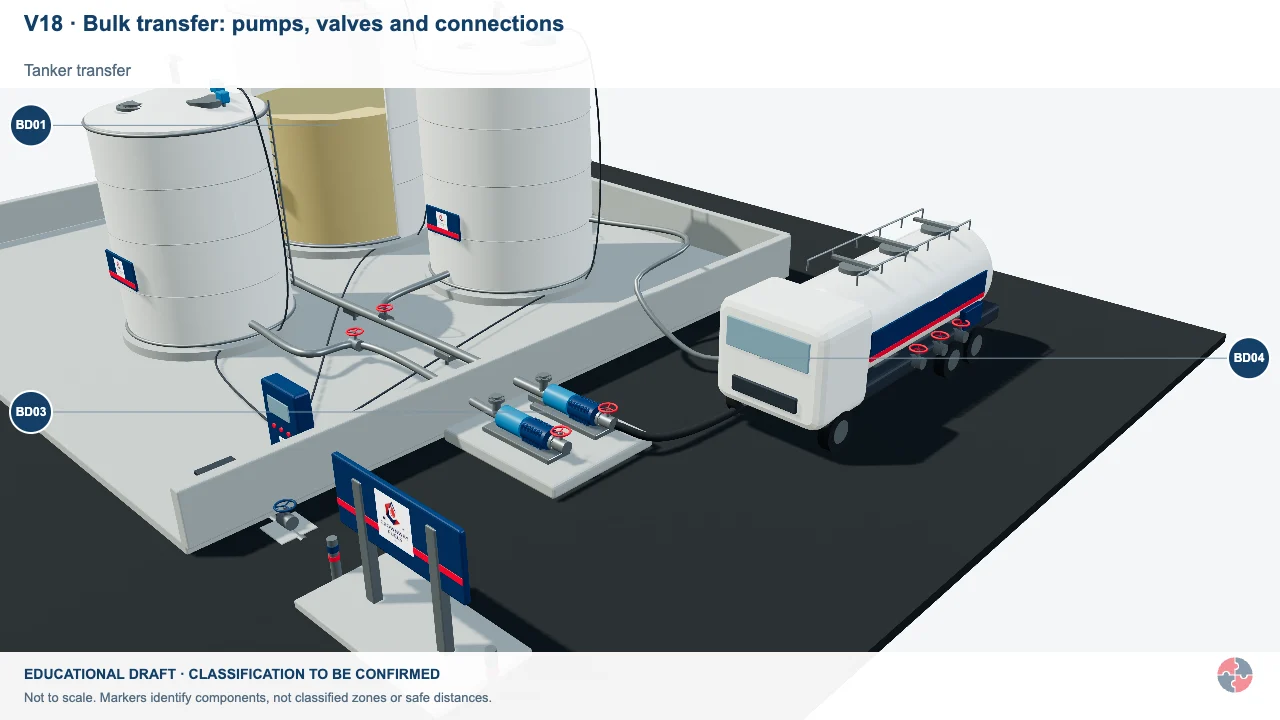
Tanker loading: liquid out, vapour back
Follow petrol from bulk storage into the tanker and the separate displaced-vapour route from the tanker to the terminal VRU.
Activity focus: Distinguish the product line, vapour collection line and tanker-loading protective controls.
Educational illustration, not to scale. Coloured zones are teaching examples, not a site-specific hazardous-area classification.
How does the method transfer to other work?
The method asks what could fail and who is exposed; the strongest feasible physical control changes with the task.
A sector label alone cannot choose a study method, audit sample or safeguard. Define design intent, people, material, route and stop condition with the local owner. HSE risk-assessment steps HSENI five steps to risk assessment
| Sector | Task and harm route | Strongest feasible control and check | Hold point |
|---|---|---|---|
| Manufacturing | Solvent transfer through a modified line can reach a wrong destination or overpressure. | Check fixed routing, independent protection and commissioning evidence. | Hold on stale drawing or failed trip. HSE plant modification guidance HSE COMAH process-safety assessment guidance |
| Construction | Temporary fuel storage and refill can release vapour to an ignition source. | Check lower inventory, physical separation and controlled refill. | Hold on unassessed layout or vapour release. HSE DSEAR guidance HSE COMAH process-safety assessment guidance |
| Logistics | Bulk-fuel tanker unloading can overfill a tank and form a vapour cloud. | Check independent high-level protection and field-tested shutdown. | Hold on alarm fault or bypass. HSE Buncefield learning HSE COMAH process-safety assessment guidance |
How does HAZOP support NEBOSH Process Safety Management study?
Learners should be able to describe nodes, guidewords, deviations, causes, consequences, safeguards, action quality and close-out.
For a process-safety study answer, HAZOP should be understood as a disciplined process hazard analysis method, not a general safety meeting. A strong answer explains why the team starts with design intent, how guidewords create deviations, and how safeguards are challenged before actions are raised.
In scenario-based questions, use a simple node example. State the intent, choose a guideword, describe the deviation, give a credible cause, describe the consequence, name safeguards and explain whether further action or follow-on study is required.
| Prompt | Strong answer includes | Common weakness |
|---|---|---|
| Define HAZOP | Structured guideword study of deviations from process intent. | Says it is just hazard spotting. HSE COMAH process-safety assessment guidance |
| Explain nodes | Defined process sections with clear intent. | Uses whole plant as one node. HSE COMAH process-safety assessment guidance |
| Use guidewords | No, more, less, reverse, as well as, other than and timing deviations. | Lists guidewords without applying them. HSE COMAH process-safety assessment guidance |
| Challenge safeguards | Relevance, independence, availability, testing and human response. | Assumes every alarm is a strong barrier. HSE COMAH process-safety assessment guidance |
| Close actions | Risk-ranked, owned, verified and transferred into operations. | Ends at workshop minutes. HSE COMAH process-safety assessment guidance |
What can each role demonstrate before making decisions?
Competence is shown by observed scenario or evidence decisions, a named assessor and a record; attendance alone does not authorise a hazardous task.
Use awareness, supervised practice, specialist review and reassessment in proportion to the role. A workshop or audit finding must be translated into a working control with a named owner. HSE COMAH process-safety assessment guidance HSG65 Managing for health and safety
| Role | Learning and practical demonstration | Assessor and record | Reassess when |
|---|---|---|---|
| Operator or frontline worker | Identify wrong line-up, alarm bypass or poor capture; demonstrate stop and report. | Supervisor observes live task and records understanding. | Change, near miss or failed barrier. HSE COMAH process-safety assessment guidance |
| Supervisor and action owner | Test pre-start hold, action wording and field close-out. | Manager samples decision and signed hand-back. | Overdue action or changed conditions. HSE COMAH process-safety assessment guidance |
| Study participant or auditor | Apply method to a realistic deviation or evidence sample. | Facilitator or lead auditor observes contribution and records scope. | New method or topic beyond competence. HSE COMAH process-safety assessment guidance |
| Facilitator, lead auditor or technical specialist | Lead scenario challenge, independence and limits; refer relief, SIL or exposure issues to specialists. | Peer review of study or audit record and technical decision. | Weak findings, missed scenario or technical change. HSE COMAH process-safety assessment guidance |
| Manager or designer | Fund source controls and accept only documented, justified residual decisions. | Director or accountable owner reviews design, resources and field evidence. | Repeated control failure or major change. HSE COMAH process-safety assessment guidance |
What warning signs show a HAZOP system is weak?
Warning signs include poor preparation, missing expertise, vague records, over-credited safeguards and action close-out without evidence.
| Warning sign | How harm can develop | Action |
|---|---|---|
| Out-of-date drawings | The team studies a plant that no longer exists in that form. | Stop and update process safety information. HSE COMAH process-safety assessment guidance |
| No operator or maintainer input | Practical abnormal and maintenance scenarios are missed. | Reform the team before relying on the study. HSE COMAH process-safety assessment guidance |
| Safeguards listed as generic alarms | Weak or non-independent barriers are credited. | Define alarm, response, independence and proof testing. HSE COMAH process-safety assessment guidance |
| Actions closed by explanation only | Risk reduction is assumed without verification. | Require physical or technical closure evidence. HSE COMAH process-safety assessment guidance |
| No link to MOC | Changes bypass the study basis. | Integrate HAZOP actions into MOC and pre-start-up review. HSE COMAH process-safety assessment guidance |
| Workshop pressure to finish | Guidewords are rushed and deviations missed. | Rescope, extend or prioritise high-consequence nodes. HSE COMAH process-safety assessment guidance |
What do the acronyms and key terms mean?
Acronyms should be understood before they are used in assessments, briefings, audits or learning answers.
| Acronym | Meaning | Plain-English use |
|---|---|---|
| HAZOP | Hazard and Operability Study | Structured guideword review of process deviations from design intent. |
| P&ID | Piping and Instrumentation Diagram | Drawing showing process equipment, pipework, valves and instrumentation. |
| LOPA | Layer of Protection Analysis | Semi-quantitative review of independent protection layers. |
| SIL | Safety Integrity Level | Integrity target for a defined safety instrumented function. |
| MOC | Management of Change | Formal control of permanent and temporary changes. |
| SIF | Safety Instrumented Function | Instrumented function designed to achieve or maintain a safe state. |
| ERICPD | Eliminate, Reduce, Isolate, Control, PPE, Discipline | Six-stage control planning aid, not legislation. HSE five-level hierarchy |
| COMAH | Control of Major Accident Hazards | Threshold-based major-accident regime with separate GB and NI instruments. HSE COMAH 2015 overview |
| PSSR | Pressure Systems Safety Regulations | Pressure-system duties apply only when a system falls in scope. Pressure Systems Safety Regulations 2000 |
Unlock another resource
You have used this month’s two free downloads. Publish a post in your own words to unlock one more resource, or choose SHARE Individual for 10 downloads per month.
You decide whether to share. If you do, use the relevant platform disclosure tools and do not make claims you do not genuinely hold.