
Crown Fuels and process safety / Tanker loading, traffic and road dispatch
Crown Fuels and process safety · SH-FUEL-02Tanker loading, traffic and road dispatch
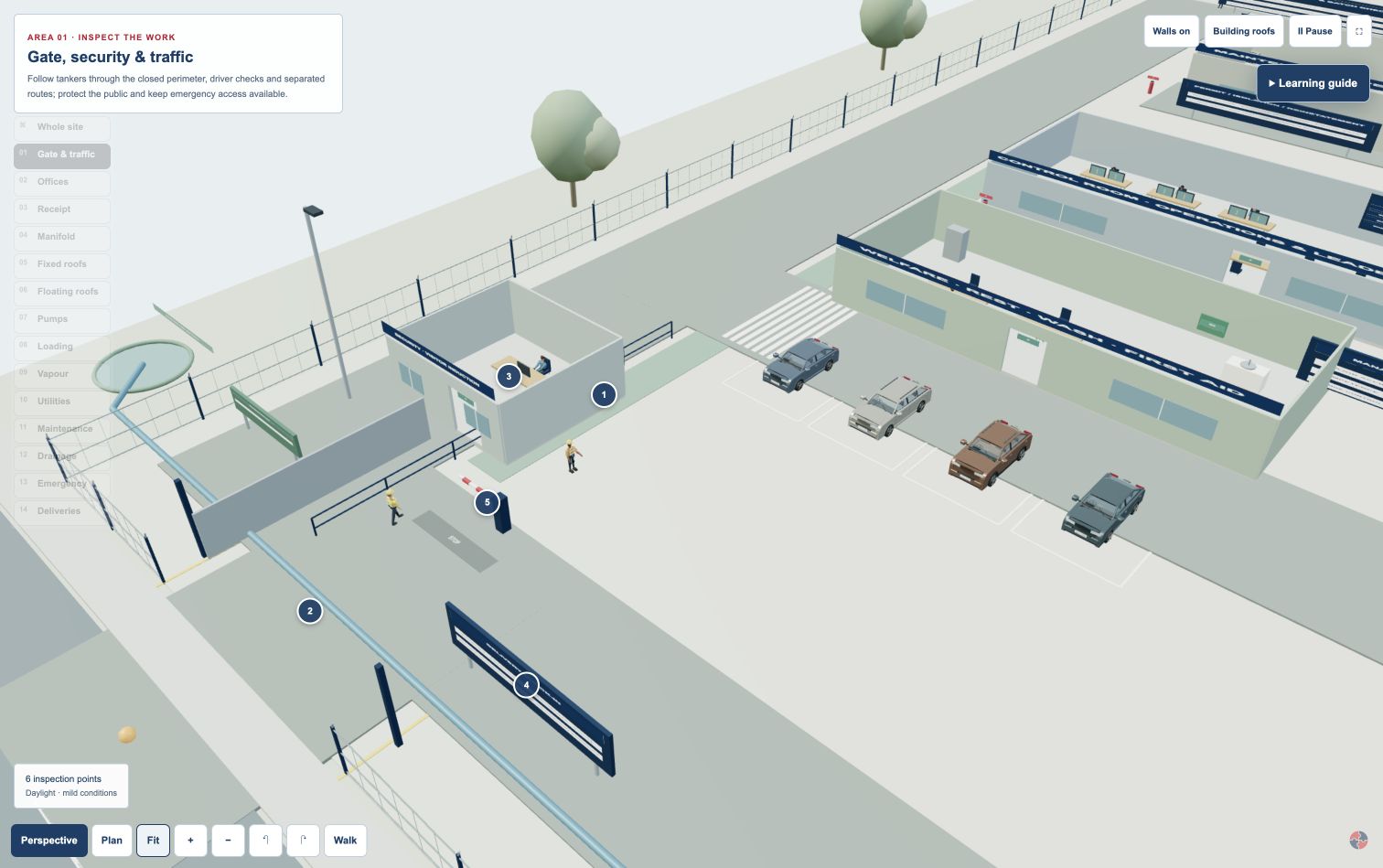
Free online training · Approximate learning time: 140–210 minutes · Self-paced
Protect people, connections and the road journey before fuel moves and before the tanker departs.
Full public teaching and readers are free without an account. A free learner account is required for saved LMS progress and recorded assessment. Completion and any course-completion certificate depend on the configured LMS conditions.
Who this course is for
Tanker drivers, gantry operators, terminal supervisors, traffic coordinators and dispatch teams.
A safe loading operation starts before the tanker reaches the gantry and continues through release onto the road. Follow the fictional vehicle through pedestrian conflicts, receiving-compartment checks, ignition controls, connections, access and departure decisions. This course develops awareness and coordinated decisions rather than a replacement loading procedure or dangerous-goods qualification.
Terminal tanker-loading and dispatch operations; site-specific delivery and dangerous-goods responsibilities depend on actual products and roles.
Learning outcomes
- Identify traffic, loading and departure interfaces across the complete tanker journey.
- Recognise the distinct purposes of capacity, bonding, vapour, access and drive-away controls.
- Hold and escalate abnormal conditions while maintaining a safe vehicle, people and emergency-access arrangement.
Course outline
Understand the tanker journey
- Read the whole tanker routeIdentify where people, vehicles and loading equipment can occupy the same space.
- Establish a ready receiver and a correct transferExplain why product, compartment, capacity and connection evidence must agree before loading.
Protect people and loading interfaces
- Keep ignition, vapour and access controls distinctDescribe why different safeguards cannot be substituted for one another during tanker loading.
- Treat departure as a controlled transitionIdentify the evidence needed to move from connected loading to a safe vehicle and road journey.
- Protect people at the tanker entranceManage space and timing before authorising movement; visibility aids cannot replace a safe relationship between people and vehicles.
- Make dispatch a safe handover to the road journeyThe transfer of fuel to a tanker is also a transfer of information and control responsibilities into a different risk environment.
- Tanker bonding: a verified path, not incidental metal contactBonding evidence must match its defined electrostatic duty. A green light must represent a working control, not a bypass.
Verify transfer readiness
- Compartment capacity: verify the receiver behind the orderVerify capacity at the actual receiving boundary, then assure the separate protection against control failure.
- Vapour return: the transfer has a second flow pathFollow the displaced material as carefully as the delivered material. Correct liquid flow alone does not prove safe transfer.
- Departure control: flow complete is not vehicle releasedMake vehicle release a verified state with a named decision maker, not an assumption inferred from a meter or ticket.
Respond to abnormal conditions
- Tanker-top checks: avoid the climb before selecting protectionThe safest tanker-top task is often the one redesigned to avoid access. Where access remains, assess the complete system.
- Emergency stop: accessible, effective and matched to the scenarioAvailability means a person can reach and use the control and the system achieves the required protective result.
- Loaded tanker journeys: manage the driver, vehicle and real routeDelivery promises must fit a safe real journey, not force the driver to compensate for a flawed schedule.
Release a safe vehicle and journey
- From gate queue to safe dispatchIntegrate traffic, receiving-system readiness, loading safeguards and controlled departure.
- Turn the learning into a verified workplace actionChoose a bounded action, owner, task-specific evidence and escalation trigger within your role.
Activities, model practice and assessment
Work through 4 required applied activities and 3 model-practice pauses, with explanatory feedback and independent lesson decisions. Complete 9 distinct model mission sequences across those pauses. Use the actual fictional Crown Fuels model or its equivalent accessible route to complete the required decision sequences; launching the model alone does not complete practice.
The 20-question assessment requires at least 80% plus every designated critical safety answer. Complete the required activities, practice and lesson checks. Points and badges cannot offset a critical safety error.
Use the LMS for confirmed save/resume and recorded results. Any certificate follows its configured passed-completion and grade conditions.
Open the public interactive practice copy; public practice is separate from the LMS record.
Sources and learning provenance
Original fictional cases are paired with public SHAREhub teaching and structured topic records. Use the applicable jurisdiction and primary guidance for live work.
Topic sections, source identities and versions
| Public topic | Chunk and version | Jurisdiction and sources |
|---|---|---|
| workplace-transport-and-work-related-driving · safe-site-vehicle-driver-journey | workplace-transport-and-work-related-driving--safe-site-vehicle-driver-journey 4.1 | Great Britain, Northern Ireland source-hse_transport, source-hse_road, source-hse_reversing, source-hse_safeplace, source-ni_driving_at_work, source-hse_journey_scope |
| loading-unloading-and-transfer-operations · barriers | loading-unloading-and-transfer-operations--barriers 2026-10-02-additive-1 | Great Britain, Northern Ireland loading-unloading-and-transfer-operations-src-01, loading-unloading-and-transfer-operations-src-02 |
| static-electricity-and-electrostatic-ignition · bonding-vs-earthing | static-electricity-and-electrostatic-ignition--bonding-vs-earthing | Great Britain static-electricity-and-electrostatic-ignition--earthing, static-electricity-and-electrostatic-ignition--hsg140, static-electricity-and-electrostatic-ignition--iec-electrostatic |
| workplace-transport-and-work-related-driving · role-actions | workplace-transport-and-work-related-driving--role-actions 4.1 | Great Britain, Northern Ireland source-hse_safedriver, source-hse_safeplace, source-hse_reversing, source-hse_road |
| workplace-transport-and-work-related-driving · technical-model | workplace-transport-and-work-related-driving--technical-model 4.1 | Great Britain, Northern Ireland source-hse_safeplace, source-hse_transport, source-hse_reversing, source-hse_loading |
| dangerous-substances-process-safety-and-chemical-transport · transport | dangerous-substances-process-safety-and-chemical-transport--transport 20261016-letter-review-1 | Great Britain, Northern Ireland adr, cdg, ni-cdg |
| loading-unloading-and-transfer-operations · human-factors | loading-unloading-and-transfer-operations--human-factors 2026-10-02-additive-1 | Great Britain, Northern Ireland loading-unloading-and-transfer-operations-src-01 |
| working-at-height · planning | working-at-height--planning 4.0 | Great Britain, Northern Ireland source-gb_law, source-ni_law, source-hse_assess, source-indg401, source-l153, source-hse_ladder, source-hse_mewp, source-hse_scaffold |
| fire-and-gas-detection-alarms-and-shutdown · cause-effect | fire-and-gas-detection-alarms-and-shutdown--cause-effect 20261016-letter-review-1 | Great Britain, Northern Ireland hse-sragtech-techmeasleakgas-htm, legislation-2015-325 |
| loading-unloading-and-transfer-operations · evidence | loading-unloading-and-transfer-operations--evidence 2026-10-02-additive-1 | Great Britain, Northern Ireland loading-unloading-and-transfer-operations-src-01 |
| workplace-transport-and-work-related-driving · assurance | workplace-transport-and-work-related-driving--assurance 4.1 | Great Britain, Northern Ireland source-hse_transport, source-ni_transport |
Course SH-FUEL-02 · version 2026.10.20.1. .
Questions about this course
Is this training free?
Full public teaching and readers are free without an account. A free learner account is required for saved LMS progress and recorded assessment. Completion and any course-completion certificate depend on the configured LMS conditions.
How long should I allow?
Approximately 140–210 minutes, including teaching, lesson checks, required activities, model or accessible practice and one assessment attempt. Individual pace, review and retries vary. Save and resume in the LMS.
Can I learn without a 3D-capable browser?
Yes. The complete HTML reader provides the teaching. Required model practice has an equivalent accessible decision route in the interactive course. Use the LMS route for recorded learning.
What is required to pass?
Complete the required learning, activities, practice and lesson decisions. The 20-question final assessment requires at least 80% plus every designated critical safety answer. Points cannot compensate for a critical safety error. Follow the feedback before retrying.
Does this authorise fuel operations?
Terminal tanker-loading and dispatch operations; site-specific delivery and dangerous-goods responsibilities depend on actual products and roles. This independent course does not award a NEBOSH qualification or replace competent task assessment, practical training or site authorisation.