
SHARE Knowledge Hub
Caffeine and Energy Drink Use
Caffeine and energy drink use at work means consuming a stimulant through drinks, foods or supplements while work demands may also affect sleep and alertness. Caffeine can briefly reduce sleepiness but cannot repay lost sleep or establish fitness for driving, machinery or other safety-critical work. Excess or poorly measured intake can cause symptoms, while long shifts and missed breaks increase fatigue-related error, so employers should control the work pattern and workers should use labels and report concerns.
Understanding Caffeine and Energy Drink Use
Caffeine is a stimulant found in coffee, tea, cola, energy drinks, energy shots, chocolate, some medicines and food or sports supplements
Why this matters at work
Use findings to test specific changes. For example, if a missed meal break is common, verify staffing and cover after a revised roster rather than merely issuing a hydration poster. Record the issue, affected work, action owner, intended benefit and review date. Consider errors, near misses and worker experience together, since improved reporting can initially increase recorded concerns. Check that one improvement has not transferred workload to another shift. Seek competent occupational health or human-factors advice where patterns persist, while retaining management responsibility for the work system.
Review the work system with the worker: actual hours, consecutive nights, overtime, missed breaks, workload, monotony and recovery opportunities. Working-time compliance alone does not prove fatigue is controlled. Agree practical changes such as relief cover, protected breaks, altered workload and a reviewed roster, with an owner and follow-up. Record hours and the safety pause without attaching blame or unnecessary health detail. Check whether other drivers face the same conditions. Any return to driving needs a task-specific decision based on restored capability and risk control, not a caffeine receipt or promise to stay awake.
How organisations manage this in practice
Build the policy around safe work, reliable breaks, fatigue reporting and proportionate action when capability is impaired. Identify safety-critical tasks and tell supervisors how to arrange relief and escalate symptoms. Provide accurate product information and suitable drink choices. Do not describe a caffeine quantity as an automatic fitness pass or require workers to consume stimulants to complete a roster. A universal ban can also miss fatigue arising from hours, workload and sleep disruption. Consult workers on nights, remote sites and contractor teams about actual access to water, meals and breaks. Monitor hours, overtime, shift swaps, missed breaks, safety pauses and incidents, using only the personal information needed for a legitimate purpose. Anonymous themes can reveal a work-system problem without tracking individual purchases. Assign owners to roster or welfare changes, check implementation and revisit the policy after incidents or significant work changes. Confidential health advice should remain with the proper service; managers need relevant restrictions and support actions rather than diagnoses or detailed consumption histories.
At work, examine why the person needs repeated stimulants: shift timing, inadequate breaks, excessive demands, inaccessible water, food availability or poor recovery. Provide lower-caffeine choices and make breaks achievable. Review actual tasks and pregnancy-related work risks using the appropriate GB or NI process, with individual advice where necessary. The worker should not have to disclose pregnancy to a whole team or justify personal purchases. Record agreed functional measures and review them as circumstances change. Practical support helps the person follow clinical advice; it does not make the employer responsible for prescribing or monitoring a personal diet.
Compare planned work with what people actually do. Review hours, overtime, call-outs, shift swaps and breaks over a representative period, including peaks and nights. Ask whether workers can report dangerous sleepiness without penalty and whether supervisors have relief arrangements they can use. Check consequences as well as frequency: a rare lapse during lifting or driving may matter more than many low-consequence reports. Energy-drink sales can provide context but cannot measure individual alertness or diagnose dependence.
Caffeine sensitivity, pregnancy, anxiety, palpitations, sleep problems, medication effects, high-dose supplement use and possible impairment should be handled through qualified advice and fair workplace processes. Managers should not diagnose or police private lifestyle choices; they should manage fatigue, safety-critical risk, confidentiality, facilities, workload and support.
What does caffeine do, and why does it matter at work?
Caffeine is a stimulant in drinks, foods and supplements. It can make someone feel more awake for a time, but it does not repay lost sleep or establish that they can work safely.
Coffee, tea, cola, chocolate, energy drinks, tablets and some pre-workout products contribute to intake. “Energy drink” is a marketing category: sugar content and caffeine strength vary, and a sugar-free drink can still contain substantial caffeine. Guarana and other ingredients may supply caffeine too. Check the total declared caffeine and portion size instead of judging the can, brand or taste.
Fatigue is a decline in mental or physical performance associated with exertion, inadequate sleep or disruption of the body clock. Someone may feel temporarily brighter after a drink while still carrying a sleep deficit. In driving, plant operation or control-room work, a lapse can affect colleagues, contractors and the public. Repeated reliance on stimulants is a reason to examine the work pattern, not evidence of misconduct.
The workplace response starts with manageable hours, adequate staffing, protected breaks and an environment that supports recovery. Individuals need clear information and a confidential route for support. Supervisors need a way to pause unsafe work without attempting a medical diagnosis.
Basis: HSE fatigue, FSA caffeine supplement advice and Food Standards Scotland caffeine supplements.
How can caffeine affect sleep, symptoms and recovery?
Effects vary with the person, amount and timing. Caffeine can disturb sleep and cause unwanted symptoms even when intake is below a general population guidance value.
The immediate effects may include restlessness, agitation, anxiety, nausea or palpitations—a noticeably racing, pounding or irregular heartbeat. These symptoms have other possible causes, so a manager must not decide that an energy drink explains them. People with an underlying health condition, pregnancy, medicines or caffeine sensitivity should discuss individual advice with a clinician or pharmacist.
A common cycle is short sleep, caffeine to cope with the shift, difficulty sleeping after work, then greater tiredness at the next shift. Repeated use can also lead to tolerance, meaning the same amount has less noticeable effect. For some habitual users, missing caffeine produces headache or tiredness. This is a support issue; abrupt workplace restrictions need to consider individual needs rather than prescribe a withdrawal regime.
HSE advises avoiding caffeine for a few hours before planned sleep, including daytime sleep after a night shift. There is no universal waiting time after a drink that proves readiness to drive, operate equipment or sleep. Persistent sleep difficulty, recurrent palpitations or a rising need for caffeine warrants qualified advice.
See HSE hints and tips for shift-workers and NHS heart palpitations; urgent action is explained below.
How should workers read labels and interpret caffeine amounts?
Count caffeine from all sources and calculate the amount in the whole portion. General adult and pregnancy advice is health guidance, not an exposure limit, consumption target or permission to continue a safety-critical task.
Government guidance on caffeine supplements summarises advice for the general healthy adult population: single doses up to 200 mg and total daily intake up to 400 mg are not expected to raise safety concerns. These values do not guarantee an individual will be symptom-free. They must not be applied to children or used to override medical advice. NHS foods to avoid in pregnancy advises no more than 200 mg per day during pregnancy, from all sources.
The following example uses an illustrative label, not a real product recommendation. Milligrams (mg) measure caffeine mass; millilitres (ml) measure drink volume.
| Check | Calculation or evidence | What it changes |
|---|---|---|
| Whole can | Label: 32 mg per 100 ml. Can: 500 ml. 32 × (500 ÷ 100) = 160 mg. | The whole can contains 160 mg, not 32 mg. Check whether you drink all or part of it. |
| Two cans | 2 × 160 = 320 mg. A separately labelled 100 mg supplement would bring the combined amount to 420 mg, before other food or drink. | That exceeds the general healthy-adult daily guidance value. Do not present this combination as a fatigue-control method. |
| Pregnancy | One illustrative 160 mg can leaves only 40 mg within the 200 mg daily pregnancy guidance; coffee, tea, chocolate and other sources still count. | Read the product warning and use pregnancy advice. This arithmetic does not recommend an energy drink in pregnancy. |
| Unknown strength | No reliable label, decanted powder, unclear serving size or contradictory information. | Do not guess a caffeine amount or recommend a dose. Obtain reliable product information or professional advice. |
Pure or concentrated caffeine powders present a particular dosing risk. Do not use household estimates or a workplace “recipe”; follow the exact product instructions and seek advice if these are unclear. A scoop from another product is not evidence of the correct measure. FSA caffeine supplement advice describes serious harm from dosing errors.
For relevant drinks, a caffeine concentration above 150 mg/l triggers additional labelling; this is a concentration, not a person's daily allowance. Exceptions include certain tea or coffee drinks identified as such. Read the warning and caffeine amount; the food operator should check the applicable GB or NI legal text before printing or approving labels. See Government caffeine food information.
How can caffeine use and fatigue lead to harm at work?
The hazards are excessive or uncertain caffeine intake and work patterns that leave too little recovery before demanding tasks. Neither a person nor their health condition is the hazard.
Trace two different routes. Caffeine is swallowed from drinks, food or supplements and acts on the nervous system; a large or poorly measured amount can cause acute symptoms, while late use can disturb sleep. Long hours, night work and missed breaks reduce sleep and alertness, so a lapse can reach a driver, machine operator, colleague or member of the public through the task. Repeated sleep disruption can sustain fatigue and ill health, but this page does not infer a long-latency disease from an individual’s caffeine use. Severity depends on the actual dose, timing, individual sensitivity, work duration, breaks and task consequences.
| Source, route and affected function | Plausible acute or continuing harm | Warning, hold and clinical escalation |
|---|---|---|
| An extended or night shift with missed relief reduces sleep and disrupts the body clock; attention, reaction and coordination fall during driving, plant or process work. | An immediate lapse can cause a collision, equipment error or injury to the worker or others. Repeated disrupted sleep can sustain fatigue and ill health; no individual outcome is presumed. | Difficulty staying awake, a significant error, missed break or uncertain safe performance: put the task in its safe state and arrange competent relief. |
| A high or late combined caffeine intake from drinks, food and supplements reaches the nervous system after ingestion; it may also disturb later sleep. | Acute restlessness, anxiety, nausea or palpitations are possible. Disturbed sleep can increase next-shift fatigue. Symptoms have other causes and a general dose figure is not a fitness test. | Stop a critical task if symptoms affect control. Persistent or worsening palpitations need clinical advice; chest pain, breathlessness or fainting with palpitations triggers 999. |
| A concentrated powder or supplement with unclear strength or serving size can be swallowed in an unexpectedly large amount. | A dosing mistake can cause serious acute harm. Do not invent a safe scoop, recipe or waiting period. | Do not guess or use an unclear product. Suspected excessive intake needs prompt medical advice; emergency symptoms use 999. |
Basis: HSE fatigue, HSE Managing shift work HSG256, FSA caffeine supplement advice and NHS heart palpitations. A manager acts on the task and obtains clinical advice; they do not diagnose a worker.
How should a shift be planned so caffeine is not the safety control?
Address the causes of fatigue before relying on personal coping strategies. Remove avoidable extended work, reduce excessive demands, provide relief and recovery, and check whether the arrangements work on every shift.
Apply prevention to the work system. First remove unnecessary night work or overtime where practicable; redesign timing and workload where it cannot be removed. Provide suitable staffing, handovers and relief, and schedule demanding tasks with regard to alertness. Protect rest, meals, drinking-water access and a usable rest area. PPE does not prevent fatigue, and a drinks ban does not correct a poorly designed rota.
Before work: the supervisor reviews hours actually worked, last-minute shift swaps, planned breaks, cover and safety-critical duties. Workers can raise tiredness or symptoms privately. Confirm who can authorise a task change and how contractors obtain relief.
During work: take the agreed breaks and report missed relief, repeated errors or difficulty staying awake. The supervisor reassesses an overrun or an absent colleague before extending duties. Do not direct someone to take caffeine to finish the job. If safe performance is uncertain, use the hold process below.
After work: complete a proper handover, record failed controls and consider safe travel if someone is too tired to drive. Review recurring problems with workers and their representatives; changing a rota on paper is insufficient if overtime or interrupted breaks recreate the risk.
These are SHARE applications of HSE Managing shift work HSG256 and HSE good practice guidelines for shift design. Use sector-specific working-time and drivers’ hours rules where applicable.
How can the hierarchy of controls reduce fatigue risks during an extended night shift?
Start with the work pattern that creates fatigue, then protect any safety-critical task when performance is uncertain. Drinks rules, personal protective equipment and training cannot replace adequate staffing, recovery and safe task design.
Use the HSE hierarchy of controls for the actual exposure: remove or substitute the hazard where possible, use physical or engineering controls, organise work to limit residual risk, and use suitable PPE only where it helps. Assign an owner, check that each control works, and stop the task if a critical control fails. In Northern Ireland, check the applicable local duty and assessment.
How can the ERICPD hierarchy of controls reduce fatigue risks during an extended night shift?

| Control level | Control for this activity | Owner and verification | Stop / restart decision |
|---|---|---|---|
| Eliminate | Remove unnecessary night operations and duplicated out-of-hours work from the service plan. | Task owner verifies that the proposed change removes the named hazardous step, including foreseeable cleaning, maintenance and work transferred elsewhere. | If the hazardous step remains, keep it within the task assessment and select the stronger feasible remaining controls. |
| Reduce, including substitution | Use a lower-fatigue service or staffing arrangement after assessing the shift pattern with workers. | Competent task/process owner validates suitability, compatibility and new hazards against the actual operating requirements before the alternative is adopted. | Reject an alternative if its performance is unproved or its new hazards are unresolved. |
| Isolate | Keep safety-critical work away from periods when staffing or fatigue prevents safe performance. | Supervisor checks the actual boundary, affected people and connected work; verify separation or isolation before allowing access. | Hold or stop for insufficient recovery, repeated overtime or inability to staff a critical task safely. |
| Control: physical safeguards | Provide automation, safe plant states and reliable work equipment so foreseeable human lapses do not initiate major harm. | Competent equipment/process owner checks actual hours, recovery periods, task demand and available staffing. | Hold or stop for insufficient recovery, repeated overtime or inability to staff a critical task safely. |
| Control: work method and response | Set workable shift, overtime, break, call-out and recovery arrangements; review actual hours and staffing shortfalls. | Supervisor confirms the work limits, competent cover, communication and stop/restart authority with the people doing this activity. | Hold work when the agreed limits, competent cover or effective communication cannot be maintained. |
| PPE | No PPE corrects an unsafe roster; control task exposures and fatigue at source. | Assessor confirms whether personal protection is needed and checks suitability, condition, compatibility and any required fit evidence. | Do not use unsuitable protection or rely on PPE to continue after an essential source control fails. |
| Discipline | Review overtime, fatigue reports and incidents with workers; adjust staffing and schedules when the controls cannot be followed. | Release only after operations approves a workable roster and contingencies. Retain verification and unresolved restrictions at handover. | Keep the task on hold until required reinstatement evidence and unresolved defects are accepted by the responsible owner. |
How can the ISO 45001 hierarchy of controls reduce fatigue risks during an extended night shift?

| Control level | Control for this activity | Owner and verification | Stop / restart decision |
|---|---|---|---|
| Elimination | Remove unnecessary night operations and duplicated out-of-hours work from the service plan. | Task owner verifies that the proposed change removes the named hazardous step, including foreseeable cleaning, maintenance and work transferred elsewhere. | If the hazardous step remains, keep it within the task assessment and select the stronger feasible remaining controls. |
| Administrative controls | Use a lower-fatigue service or staffing arrangement after assessing the shift pattern with workers. | Competent task/process owner validates suitability, compatibility and new hazards against the actual operating requirements before the alternative is adopted. | Reject an alternative if its performance is unproved or its new hazards are unresolved. |
| Administrative controls | Keep safety-critical work away from periods when staffing or fatigue prevents safe performance. | Supervisor checks the actual boundary, affected people and connected work; verify separation or isolation before allowing access. | Hold or stop for insufficient recovery, repeated overtime or inability to staff a critical task safely. |
| Engineering controls | Provide automation, safe plant states and reliable work equipment so foreseeable human lapses do not initiate major harm. | Competent equipment/process owner checks actual hours, recovery periods, task demand and available staffing. | Hold or stop for insufficient recovery, repeated overtime or inability to staff a critical task safely. |
| Administrative controls | Set workable shift, overtime, break, call-out and recovery arrangements; review actual hours and staffing shortfalls. | Supervisor confirms the work limits, competent cover, communication and stop/restart authority with the people doing this activity. | Hold work when the agreed limits, competent cover or effective communication cannot be maintained. |
| PPE | No PPE corrects an unsafe roster; control task exposures and fatigue at source. | Assessor confirms whether personal protection is needed and checks suitability, condition, compatibility and any required fit evidence. | Do not use unsuitable protection or rely on PPE to continue after an essential source control fails. |
| Administrative controls | Review overtime, fatigue reports and incidents with workers; adjust staffing and schedules when the controls cannot be followed. | Release only after operations approves a workable roster and contingencies. Retain verification and unresolved restrictions at handover. | Keep the task on hold until required reinstatement evidence and unresolved defects are accepted by the responsible owner. |
How does the fatigue decision change across sectors?
The same fatigue-to-error route can arise in manufacturing, construction, hospitality and logistics, but the task, affected people and safest hold point differ.
Plan the early-start journey around actual recovery
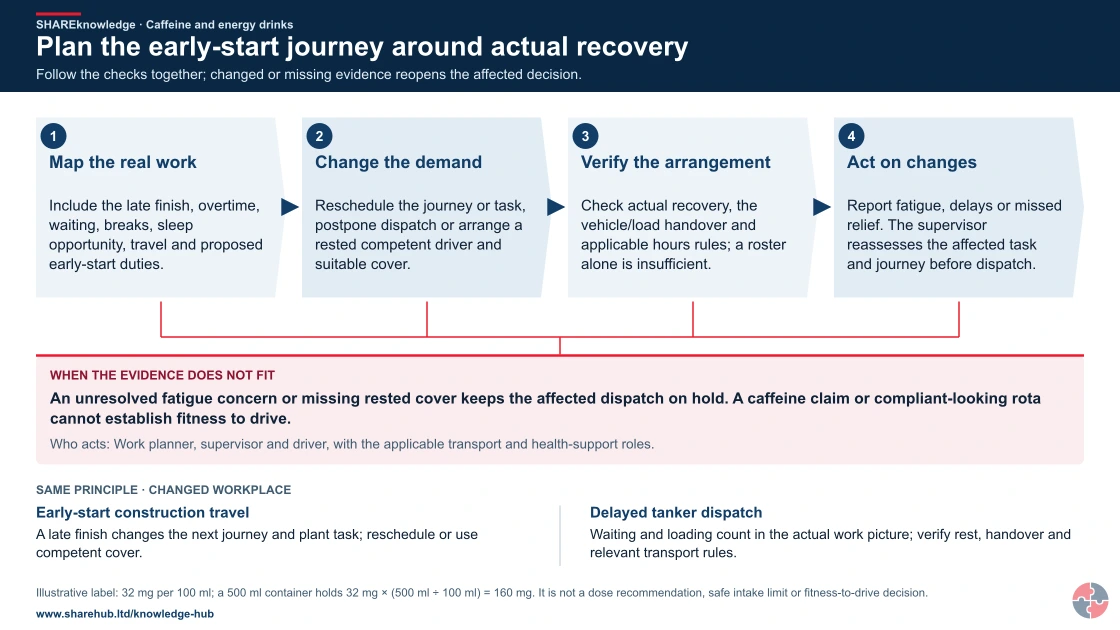
Full written explanation
- Map the real work. Include the late finish, overtime, waiting, breaks, sleep opportunity, travel and proposed early-start duties.
- Change the demand. Reschedule the journey or task, postpone dispatch or arrange a rested competent driver and suitable cover.
- Verify the arrangement. Check actual recovery, the vehicle/load handover and applicable hours rules; a roster alone is insufficient.
- Act on changes. Report fatigue, delays or missed relief. The supervisor reassesses the affected task and journey before dispatch.
When the evidence does not fit: An unresolved fatigue concern or missing rested cover keeps the affected dispatch on hold. A caffeine claim or compliant-looking rota cannot establish fitness to drive.
Who acts: Work planner, supervisor and driver, with the applicable transport and health-support roles.
Changed workplace
Early-start construction travel: A late finish changes the next journey and plant task; reschedule or use competent cover.
Delayed tanker dispatch: Waiting and loading count in the actual work picture; verify rest, handover and relevant transport rules.
Evidence check: Illustrative label: 32 mg per 100 ml; a 500 ml container holds 32 mg × (500 ml ÷ 100 ml) = 160 mg. It is not a dose recommendation, safe intake limit or fitness-to-drive decision.
Full sector-specific fatigue holds and applicable-hours context
Primary references: HSE: fatigue and actual work arrangements · HSE: Managing shift work (HSG256)
Open the complete HD image (new tab)Download image

Full sector-specific fatigue holds and applicable-hours context
Primary references: HSE: fatigue and actual work arrangements · HSE: Managing shift work (HSG256)
Use each example to locate the strongest feasible control and the moment a supervisor must change the task. A caffeine drink or a general daily-intake number never certifies fitness. These examples transfer HSE fatigue principles; a site must still apply its own procedure, competence and applicable hours rules.
| Sector, task and people | Route and plausible harm | Source control, residual safeguard and hold point |
|---|---|---|
| Manufacturing — a night-shift machine operator, relief worker and nearby staff. | Overlong machine-paced work and a missed break reduce attention; a set-up or guarding error can injure the operator or others. | Reduce the late workload and staff real relief. Use authorised machine safe-state and handover; hold the next run if the relief or critical check is missing. |
| Construction — an early-start plant operator, ground workers and people near the site. | A long shift followed by travel and another early start creates sleep loss; a lapse during plant movement can cause a collision or crush injury. | Reschedule the demanding lift or plant movement and use competent cover. Verify actual rest and a journey plan; stop movement if alertness or banksman cover is uncertain. |
| Hospitality — late-event kitchen staff, customers and colleagues on a following early service. | A late finish, short recovery and high service pace can cause a lapse near hot surfaces, knives or food-service controls. | Avoid the late-to-early turn and plan relief. Make hot equipment safe and hand over service; pause the task when errors or missed breaks show the plan has failed. |
| Logistics — a delayed tanker driver, depot staff, contractor and road users. | Overrun and missed rest reduce driving attention; a road or depot incident can harm several people. | Hold dispatch, arrange a rested competent driver or postpone, and complete vehicle/load handover. Check actual hours and legal drivers’ hours; do not release on a caffeine claim. |
Sector basis: HSE fatigue, HSE Managing shift work HSG256, HSE good practice guidelines for shift design and HSE human factors in risk assessment. These are task examples, not instructions for operating equipment or a substitute for GB/NI and transport rules.
When should work stop, and when is medical help needed?
Pause a safety-critical task when tiredness, symptoms or uncertainty make safe performance doubtful. Seek urgent medical help for emergency symptoms; do not wait to calculate caffeine intake or assume that coffee explains the problem.
Difficulty staying awake, a lapse while driving or operating plant, repeated significant errors, or symptoms affecting control are reasons to stop and tell the supervisor. Put the equipment or process into its safe state using the established procedure. For continuous processes, arrange competent relief and a controlled handover—do not abandon a live control position. A worker's request for help deserves action even without visible symptoms.
Call 999 for current palpitations that do not go away, or palpitations with chest pain, shortness of breath, feeling faint or fainting. Follow the call handler and local first-aid arrangements. Do not let the person drive themselves to emergency care. Suspected heart attack is also a 999 emergency in Northern Ireland. If serious symptoms have stopped, obtain urgent clinical advice; use the local urgent-care route rather than assuming one telephone pathway applies everywhere.
In England, Scotland and Wales use the relevant local NHS urgent-care route; in Northern Ireland contact the GP or GP out-of-hours service for urgent non-emergency advice. Recurrent or worsening palpitations need medical review even if the person otherwise feels well. A suspected excessive dose or dosing mistake with concentrated caffeine needs prompt medical advice; tell clinicians what product and amount may have been taken and keep the packaging available.
Restart is a separate decision. The duty manager confirms relief, staffing and task controls, and obtains occupational-health or medical advice where necessary. Feeling more awake after caffeine, a normal-looking worker, or a number below 400 mg cannot certify fitness. Record the decision and restrictions without unnecessary medical detail.
Clinical basis: NHS heart palpitations and nidirect heart attack. Work-control basis: HSE fatigue.
How would Crownway Fuels handle a tired tanker driver and a delayed shift?

Crownway Fuels Ltd, the fuel storage and distribution business used throughout SHARE, would hold the driving task, arrange competent cover and correct the fatigue controls before authorising a restart.
Crownway Fuels Ltd
a fuel storage and distribution business with tanker drivers, terminal operators, control room staff, maintenance teams and 24-hour shift patterns
This worked example is a SHARE management scenario, not a tanker operating method. It applies the same fatigue principle to routine dispatch and an unplanned overrun.
Hold a departure when the driver reports struggling to stay awake
Task, material and setting: Dispatch a loaded fuel tanker safely from a terminal before dawn. A late delivery has extended the previous duty and the next route involves public roads. The driver says they need another energy drink to keep going. The desired outcome is safe delivery by a fit, authorised driver, or a safely delayed load.
People and prerequisites: The driver, loaders, other road users, dispatch staff and a visiting haulage contractor may be affected. The supervisor understands the local fatigue process, drivers’ hours arrangements and emergency contacts. Only competent, authorised staff may operate or move the tanker; the product, vehicle and terminal procedures remain controlling.
Before: Hold departure in the designated safe location. Check actual working and driving hours, rest, the overrun, available relief and the driver's current concerns in private. Confirm the loaded vehicle remains secured under terminal procedures. Obtain the transport manager's decision on postponement or an authorised replacement; caffeine intake is not a fitness test.
During: If competent cover is arranged, give a complete handover of vehicle, load, route, restrictions and outstanding checks. Monitor further delays and protect the replacement driver's breaks and hours. A contractor must use the same reporting and release route; changing employer does not remove the terminal interface risk.
Hold or stop: Do not release the original driver while fitness remains uncertain. Stop for difficulty staying awake, a driving lapse, symptoms affecting performance, no competent relief, or a defect in the vehicle or essential welfare arrangements. Call 999 for current palpitations that do not go away, or palpitations with chest pain, shortness of breath, feeling faint or fainting, and for suspected heart attack. Follow emergency arrangements and do not allow self-driving to emergency care. Do not manage these symptoms by offering another drink.
Completion and hand back: The duty manager confirms who is fit and authorised for the task and that vehicle, load and route checks remain valid after the delay. Arrange safe travel for the tired worker if needed. Brief the next shift on operational restrictions only and assign an owner to the roster or relief failure.
Evidence: Retain the factual fatigue concern, actual hours and breaks, dispatch hold and release decision, relief and handover record, any defect action and the rota-review owner. Keep health detail in restricted records under the organisation's retention arrangements.
What changes in other settings?
Control-room or emergency overrun: the priority is a safe process state and competent relief. Escalate inadequate cover to the duty manager; do not leave an essential station unattended or treat emergency pressure as permission for unlimited work.
Office or customer-service work: discuss missed breaks, late working and sleep problems, agree practical changes and review them. A can on the desk alone is not evidence of unsafe behaviour. Seek health advice for symptoms rather than diagnosing them.
Failed welfare equipment or unknown products: arrange an alternative when water, meal facilities or rest areas are unavailable. Do not substitute stimulant drinks for welfare provision, or estimate a dose from an unlabelled container. Procurement or a competent adviser resolves unclear product information.
How can managers support someone without judging or diagnosing them?
Use a private, factual conversation about work impact and what needs to change. Agree practical support, an owner and a review point, while protecting health information.
A useful opening is: “You said you are struggling to stay awake and missed your break. Let us make the task safe, then look at cover, hours and support.” Ask what the worker finds difficult, whether work contributes and what has helped. Do not demand a personal consumption diary or medical history without a necessary, lawful purpose.
Occupational health can advise on the relationship between health and task demands, including restrictions and review. The GP, pharmacist or maternity team can advise on individual caffeine or medicine questions. Explain a referral and how its result will be used. An employee assistance programme, where available, offers support but does not authorise safety-critical work.
Across the UK, health information needs an appropriate lawful basis and a special-category condition under data protection law. Consent is not automatically suitable in employment. Collect what is needed, tell the worker why, limit access and use the retention schedule. A supervisor usually needs the agreed restriction and review date, not the diagnosis. Do not put identifiable symptoms, pregnancy information or medical details in an open fatigue dashboard.
Use ICO worker health information for information handling, Acas reasonable adjustments for GB disability adjustments and nidirect disability employment rights for the NI route.
Which duties apply in Great Britain and Northern Ireland?
Employers must assess and control relevant work risks under the law that applies to their location. The main workplace regimes differ between Great Britain and Northern Ireland; caffeine health guidance is not a legal workplace intake limit.
Use this comparison to choose the correct route. A competent adviser should resolve sector exceptions or a disputed legal interpretation before a policy is issued.
| Issue | Great Britain | Northern Ireland |
|---|---|---|
| Risk assessment and safe work | Health and Safety at Work etc. Act 1974 and Management of Health and Safety at Work Regulations 1999. Assess fatigue in the actual task and control foreseeable risks. | Health and Safety at Work (Northern Ireland) Order 1978 and Management of Health and Safety at Work Regulations (Northern Ireland) 2000. Use HSENI guidance and NI legislation. |
| Working time and night work | Working Time Regulations 1998, with relevant sector arrangements. Night-worker assessment must be offered before night work and regularly afterwards. | Working Time Regulations (Northern Ireland) 2016, with sector-specific provisions. Use HSENI guidance; do not copy a GB rota calculation without checking NI applicability. |
| Disability and pregnancy | Equality Act 2010 disability adjustment duties may apply. Pregnancy work-risk assessment is a separate route under HSE new and expectant mother guidance; pregnancy is not automatically a disability. | Disability Discrimination Act 1995 as applicable in NI provides the disability route. HSENI pregnancy and new-mother guidance gives the separate NI risk-assessment route. |
| Worker health information | UK GDPR and Data Protection Act 2018 safeguards apply. Identify the lawful basis and health-data condition before processing. | The same UK data protection framework applies; restrict records to their necessary purpose. |
Workplace sources: HSE fatigue, HSENI risk assessment, HSENI working time directive, Working Time Regulations (Northern Ireland) 2016, GOV.UK night-worker health assessments, HSE pregnant workers and new mothers, HSENI protecting pregnant workers and new mothers, Acas reasonable adjustments, nidirect disability employment rights and ICO worker health information. Direct legislation routes: GB 1974 Act, GB Management Regulations 1999, NI 1978 Order and NI Management Regulations 2000. Use the current legislation and competent advice before issuing a policy.
What if the organisation sells or supplies drinks?
Food supply and labelling obligations are separate from the employer's fatigue duties. Suppliers should check the applicable food-information regime with the Food Standards Agency, Food Standards Scotland or local food authority, including Northern Ireland arrangements. An England-only enforcement regulation must not be described as UK-wide. CE or UKCA marking is not the conformity route for an ordinary energy drink.
As checked on 25 September 2026, the England consultation outcome intends an under-16 high-caffeine energy-drink sales ban from April 2027, subject to parliamentary scrutiny. It covers proposed vending and other sales arrangements. Treat it as forthcoming policy and recheck the legislation before implementation; do not apply it as a current UK-wide ban or assume the same rule in Scotland, Wales or Northern Ireland.
Company rules: an organisation may set justified rules for particular areas or activities. Label these as local rules, consult appropriately and explain the reason. A blanket restriction must not replace fatigue assessment, individual support or adequate welfare.
General-duty instruments: Health and Safety at Work etc. Act 1974 (GB); Management of Health and Safety at Work Regulations 1999 (GB); Health and Safety at Work (Northern Ireland) Order 1978; Management of Health and Safety at Work Regulations (Northern Ireland) 2000;
What should each role do and learn?
Workers need to recognise concerns and report them; supervisors need to control the task; managers need to remove recurring causes and provide competent support.
| Role | Action and competence | Evidence of an effective response |
|---|---|---|
| Worker or contractor | Know the fatigue reporting route, follow task procedures, read product labels and seek health advice where needed. Report difficulty staying awake before driving or operating plant. | Can explain who to contact and when to stop; reports missed breaks and uncertain fitness. |
| Supervisor or duty manager | Recognise work-performance concerns, arrange safe state and relief, protect breaks and conduct a private conversation. Obtain specialist help where the decision exceeds competence. | Task decision, handover, named action owner and review point. |
| Operations manager and purchaser | Assess rosters and workload with workers; provide water, food and rest access on nights; review vending suppliers and changing sales rules. | Actual hours, relief coverage, facilities checks and supplier information. |
| Maintainer and facilities lead | Restore defective welfare equipment safely and provide temporary alternatives with operations. Do not carry out high-risk repairs while unfit. | Defect record, alternative provision and verified return to service. |
| HR, occupational health and safety adviser | Separate health advice, legal duties and local policy; review adjustments and protect information. | Proportionate referral, functional advice, policy review and closed actions. |
| Auditor or leader | Sample real shifts and contractor interfaces, then verify that action changed working conditions. | Worker feedback and evidence that missed breaks or unsafe overruns were reduced. |
Use induction and short briefings for labels, fatigue reporting and emergency routes. Supervisors need scenario practice in relief, respectful conversations and restart decisions. Review understanding after rota changes, incidents or repeated concerns. There is no generic statutory caffeine-awareness certificate or fixed refresher expiry; training should match the risk and role. For qualification study and professional development, the useful lesson is the connection between human performance, work design, support and assurance.
Read the label, then make a separate safe-work decision
Use this hypothetical label comparison to practise arithmetic, not to set a fitness threshold. A 250 ml can labelled 32 mg per 100 ml contains 80 mg: 32 × 2.5. A 500 ml container at the same concentration contains 160 mg; drinking half does not make the label a statement about the whole day.
A supplement labelled 100 mg per serving gives 200 mg for two servings only if the serving measure and total caffeine declaration are reliable. Guarana or an unclear scoop adds uncertainty: do not invent a precise total. Record what is known, include other sources if discussing intake, and keep the operational fatigue decision separate. Feeling brighter after a drink does not resolve lost sleep, a lapse or unsafe working hours.
Crownway: the drink does not release dispatch
Illustrative example. A driver reports struggling to stay awake after an overrun, then says an energy drink has helped.
Decision. The dispatch supervisor keeps departure on hold, secures the load under terminal rules and asks the transport manager to arrange fit, authorised cover or delay.
Evidence to check. Actual duty, rest and overtime; the driver’s concern; safe vehicle status and competent handover.
Hold or escalation point. Do not use the calculated caffeine total or the driver feeling better as clearance.
Follow-up. Review the delayed delivery, staffing and recovery arrangements before another shift repeats the same problem.
Read the container label, then assess the task
The caffeine amount in a container and whether a person can safely undertake a task are different questions. Label arithmetic cannot release an unsafe dispatch.
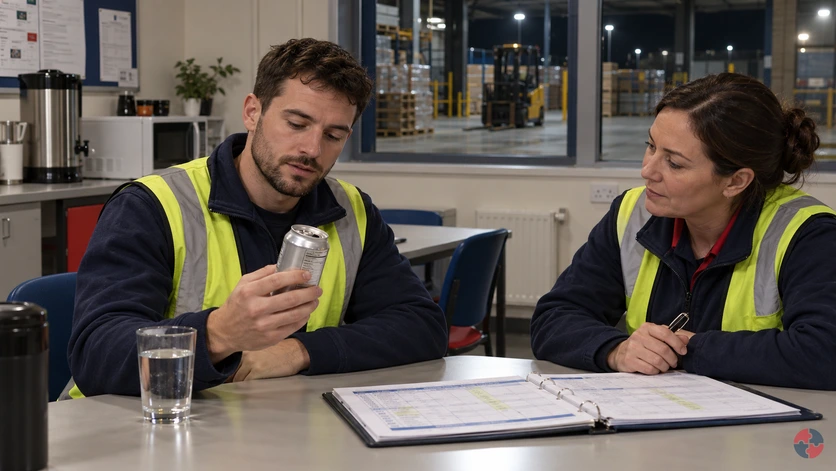
Calculate the amount; assess the work separately
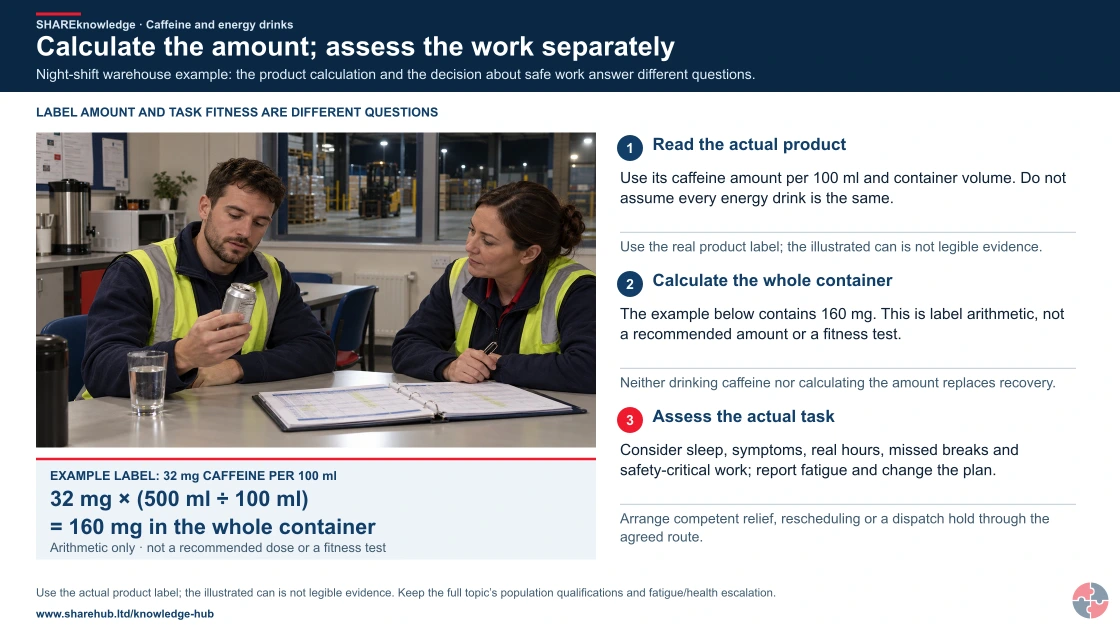
Full written explanation
Night-shift warehouse example: the product calculation and the decision about safe work answer different questions.
- Read the actual product. Use its caffeine amount per 100 ml and container volume. Do not assume every energy drink is the same.
- Calculate the whole container. The example below contains 160 mg. This is label arithmetic, not a recommended amount or a fitness test.
- Assess the actual task. Consider sleep, symptoms, real hours, missed breaks and safety-critical work; report fatigue and change the plan.
Change the pathway
- Product evidence. Use the real product label; the illustrated can is not legible evidence.
- Do not turn an amount into clearance. Neither drinking caffeine nor calculating the amount replaces recovery.
- Make the change practical. Arrange competent relief, rescheduling or a dispatch hold through the agreed route.
Evidence check: Illustrative label: 32 mg per 100 ml; a 500 ml container holds 32 mg × (500 ml ÷ 100 ml) = 160 mg. It is not a dose recommendation, safe intake limit or fitness-to-drive decision.
Full sector-specific fatigue holds and applicable-hours context
Primary references: HSE: fatigue and actual work arrangements · HSE: Managing shift work (HSG256)
Open the complete HD image (new tab)Download image

Full sector-specific fatigue holds and applicable-hours context
Primary references: HSE: fatigue and actual work arrangements · HSE: Managing shift work (HSG256)

Label amount
Use the amount per 100 ml printed on the actual product, not an assumed amount for an energy drink.
Container volume
Multiply the per-100 ml amount by the container volume divided by 100. A 32 mg/100 ml drink in a 500 ml container contains 160 mg; this is arithmetic, not a recommended dose.
Task decision
Consider symptoms, sleep, actual hours and the safety-critical work. Report fatigue and hold dispatch for the agreed reassessment and cover arrangements.
Neither a calculated amount nor consuming caffeine proves fitness to drive. Keep the population qualifications and fatigue escalation on this page.
How is fatigue competence demonstrated at each level?
A briefing can teach warning signs, but the person who holds or releases a critical task must demonstrate the actual decision and handover. Competence needs checking again when shifts, tasks, products or controls change.
Start with the task: a driver needs to report sleepiness and use the safe stop route; a supervisor needs to arrange cover and challenge a failed break; a planner needs to show that the roster works in practice. Practise scenarios using real local decision points without collecting unnecessary personal caffeine or medical details. Keep proportionate records of the skill checked, assessor, scope and review trigger rather than inventing a universal caffeine certificate.
| Role or level | Learning and practical test | Assessor, record and reassessment trigger |
|---|---|---|
| General staff and nearby people | Recognise tiredness, unknown product strength and emergency symptoms; show how to raise a concern without diagnosing a colleague. | Supervisor checks understanding at induction; retain briefing and reporting route. Revisit after an incident or changed product. |
| Driver, operator or other critical-task worker | Demonstrate task safe-state, early fatigue report, label/portion calculation and handover on the actual work. | Authorised supervisor observes practice and records task scope; reassess after a new duty, shift pattern or significant lapse. |
| Relief worker and maintainer | Demonstrate competent takeover or safe welfare-equipment repair without assuming a tired person can finish a live task. | Task lead checks authorisation and handover/defect record; reassess when plant, cover or facilities change. |
| Supervisor and contractor coordinator | Work through a delayed shift: hold dispatch, secure the task, obtain competent relief, protect privacy and decide what evidence is needed for restart. | Operations manager tests a scenario and samples handovers; reassess after a failed relief, near miss or roster change. |
| Manager, planner and purchaser | Show how actual hours, workload, staffing, breaks, welfare and product information shape the plan; fund source controls. | Senior leader reviews roster/cover evidence and supplier checks; repeat after a trend, policy or legal change. |
| Safety adviser, occupational health and auditor | Separate work-risk, clinical and GB/NI legal questions; test control performance and escalate beyond their competence. | Relevant specialist reviews a documented case and audit sample; reassess when guidance or the task changes. |
Use HSE Managing shift work HSG256, HSE fatigue and FSA caffeine supplement advice for the content. Training and supervision sustain the controls; neither makes an unsafe roster or an unknown dose acceptable.
How should managers know the controls are working?
Record the fatigue hazard, affected tasks, control owners and evidence of effectiveness. Review patterns in work arrangements without turning personal caffeine use into a surveillance measure.
For Crownway, a useful entry is “Reduced alertness during early tanker departures following late finishes”, with drivers, loaders and the public as affected people. Controls include planned recovery, relief staffing, dispatch holds, handover and safe travel. The transport manager owns the entry; supervisors record failures and a review follows a significant overrun, incident or change.
Compare planned and actual hours, missed breaks, shift swaps, fatigue reports, near misses and worker feedback. A fall in reports alone may mean people stopped speaking up. Check that the replacement arrangements are achievable and that actions remain effective on nights and for contractors. Store only anonymised themes in general reporting.
HSE management guidance supports planned controls, worker participation, checking and improvement. It does not specify a caffeine dose or certify a person fit for a safety-critical task. Use the actual fatigue, work-design and product evidence for this risk assessment.
Basis: HSE Managing shift work HSG256, ICO worker health information and HSE Managing for health and safety (HSG65).
What do workers and managers commonly ask?
These answers give the general boundary; a safety-critical decision still needs the actual task, jurisdiction, hours, symptoms and product information.
Is caffeine automatically unsafe at work?
No. The relevant questions are the task, sleep and fatigue, symptoms, timing, individual health and product information. A drink alone does not establish impairment.
Can caffeine make me safe to drive after a night shift?
It may make you feel more alert briefly, but it cannot demonstrate fitness or replace sleep. If you are sleepy, do not start driving; if already driving, stop in a safe place and follow appropriate fatigue advice. Arrange an alternative journey where needed.
Is 400 mg a workplace limit?
No. It is general daily health guidance for healthy adults, counting all sources. It is not a target, a guarantee of no symptoms or permission to do a safety-critical task. The single-dose guidance is 200 mg; pregnancy advice is no more than 200 mg daily.
Does sugar-free mean caffeine-free?
No. Check the actual caffeine declaration and container volume. Sugar content does not establish stimulant strength.
What should I do with an unlabelled powder?
Do not guess a dose or use another product’s scoop. Obtain reliable product information or qualified advice. Seek prompt medical help if an excessive dose may already have been taken.
Are energy drinks banned for under-16s throughout the UK?
Do not assume that. The checked England policy intends restrictions from April 2027 subject to parliamentary scrutiny; it is not a current UK-wide ban. Check the country and current legal position before setting vending rules.
Should a manager record my diagnosis?
Only necessary information should be processed for a lawful purpose with the required health-data safeguards. Managers usually need functional restrictions and actions rather than clinical detail.
Do pregnancy needs use the disability adjustment test?
No. Pregnancy work-risk assessment is separate from disability-related reasonable adjustments. Use HSE guidance in GB or HSENI guidance in NI, plus individual clinical advice; pregnancy is not automatically a disability.
Acronyms and terms: what do the key words mean?
These short forms distinguish a caffeine amount from a work-risk control, a clinical decision and the GB or Northern Ireland authority.
Milligrams are the amount of caffeine; millilitres are the volume of a drink. A concentration on a label must be multiplied by the volume consumed. Fatigue is reduced mental or physical performance; a safety-critical task is one where a lapse could seriously harm someone.
| Term | Full expansion | Meaning here |
|---|---|---|
| mg / ml | milligram / millilitre | Caffeine mass / drink volume; 32 mg per 100 ml in a 500 ml can means 160 mg. |
| control hierarchy | Eliminate, Reduce, Isolate, Control, Personal Protective Equipment, Discipline | A control-planning order, not a separate statute or a worker-blame process. |
| PPE | Personal Protective Equipment | Task PPE protects against its own hazard; it cannot prevent fatigue or swallowed caffeine. |
| HSE / HSENI | Health and Safety Executive / Health and Safety Executive for Northern Ireland | Workplace regulator routes for GB / NI. |
| FSA / FSS | Food Standards Agency / Food Standards Scotland | Official food and caffeine advice routes; check territorial application. |
| OH / EAP | Occupational health / employee assistance programme | Specialist health-and-work advice / an employer support service if provided. |
| ICO / UK GDPR | Information Commissioner’s Office / UK General Data Protection Regulation | Privacy regulator / rules for necessary, protected worker-health information. |
| ISO | International Organization for Standardization | Issuer of voluntary ISO 45001:2018 management-system standard; it sets no caffeine fitness dose. |
| WTR / CPD | Working Time Regulations / continuing professional development | Working-time duties with applicable GB/NI route / learning record, not a caffeine certificate. |