
SHARE Knowledge Hub
What is coccidioidomycosis and how is Valley fever managed at work?
Valley fever follows inhalation of airborne Coccidioides spores from disturbed soil in endemic regions. A UK employer planning such work should assess the overseas location and task, prevent dusty exposure at source, set a dust-storm stop rule and give workers a clear medical-reporting route. UK laboratories handling cultures require a separate biological-agent assessment.
Understanding What is coccidioidomycosis and how is Valley fever managed at work?
Valley fever follows inhalation of airborne Coccidioides spores from disturbed soil in endemic regions. A UK employer planning such work should assess the overseas location and task, prevent dusty exposure at source, set a dust-storm stop rule and give workers a clear medical-reporting route. UK laboratories handling cultures require a separate biological-agent assessment.
Why this matters at work
Treat provenance and the actual handling as assessment inputs. Incidental scenarios can include imported environmental material, dusty returned equipment and initial clinical specimens before the organism is recognised. Do not assume every imported item contains Coccidioides, or that absence of a label removes the need to assess credible exposure. Identify source location, material, intended handling, dust or aerosol generation, people and foreseeable cleaning or maintenance.
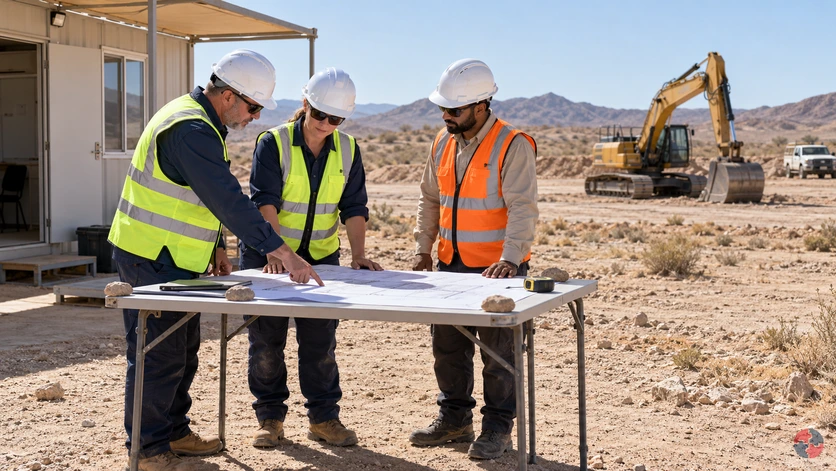
Before sending a team to a remote civil-engineering project, the contractor checks the local task, environment and access to appropriate help. Technical and occupational health advisers resolve uncertainties about exposure and fitness. The project manager verifies the agreed arrangements before mobilisation.
How organisations manage this in practice
Pre-deployment assessment can identify people needing confidential advice or adjustments, but it cannot replace dust prevention or become discriminatory selection. Explain the purpose and information handling and provide managers with functional restrictions or control needs rather than unnecessary diagnoses or demographic details. Ensure workers know what symptoms and exposure history to report and how to access care during and after travel. Review the assessment after incidents, illness or changed conditions and consider similarly exposed work through competent advice. Keep national and host-country requirements distinct. A negative result or absence of symptoms must not be used to approve a dusty task whose prevention controls are inadequate.
Define the source and conditions: extent and depth of disturbance, dryness, wind, routes, work rate, duration and who can be exposed outside protected equipment. Prefer avoiding or redesigning unnecessary disturbance, then suitable wetting, stabilised routes, lower drop heights or speeds, reduced handling and separation of people from the source. Short tasks outside a cab can be important even when most of the shift is protected.
Review host-country law and the territorial reach of UK duties with competent advisers; a UK-managed project is not automatically wholly within GB COSHH. Consider avoiding or redesigning dusty work, suitable suppression and isolation, protected equipment and cabs, task planning and residual RPE through the applicable competent programme. Establish medical access, travel information and worker reporting before deployment. Use confidential occupational health advice for individual vulnerabilities without discriminatory assumptions. Record evidence, uncertainties, owners and stop or change criteria. This Q&A does not authorise an overseas task or export US respirator rules as UK law.
Check the overseas location before mobilising a dusty-work team
Pre-mobilisation review establishes the destination, local evidence and soil-disturbing activities before the team travels. Fieldwork controls must fit local law and conditions and be checked when the method changes. Deliberate laboratory handling is a different route with specialist containment and authorisation; outdoor dust guidance is not a laboratory method.
Check the destination before the soil task
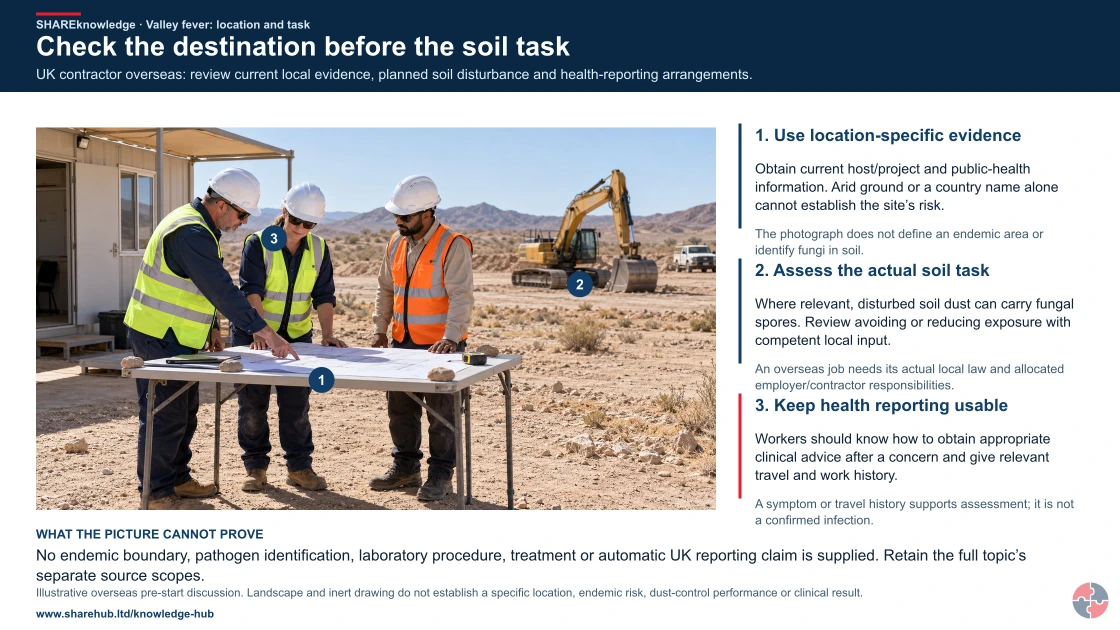
Full written explanation
UK contractor overseas: review current local evidence, planned soil disturbance and health-reporting arrangements.
- Use location-specific evidence. Obtain current host/project and public-health information. Arid ground or a country name alone cannot establish the site’s risk.
- Assess the actual soil task. Where relevant, disturbed soil dust can carry fungal spores. Review avoiding or reducing exposure with competent local input.
- Keep health reporting usable. Workers should know how to obtain appropriate clinical advice after a concern and give relevant travel and work history.
Change the pathway
- Record uncertainty before mobilisation. The photograph does not define an endemic area or identify fungi in soil.
- Use the applicable work route. An overseas job needs its actual local law and allocated employer/contractor responsibilities.
- Do not diagnose from the setting. A symptom or travel history supports assessment; it is not a confirmed infection.
Evidence check: No endemic boundary, pathogen identification, laboratory procedure, treatment or automatic UK reporting claim is supplied. Retain the full topic’s separate source scopes.
Full specialist laboratory boundary and separate legal context
Primary references: CDC/NIOSH: Valley fever worker prevention, US technical context · CDC: Valley fever clinical and location context · HSE: specialist deliberate-work assessment boundary (GB)
Open the complete HD image (new tab)Download image

Full specialist laboratory boundary and separate legal context
Primary references: CDC/NIOSH: Valley fever worker prevention, US technical context · CDC: Valley fever clinical and location context · HSE: specialist deliberate-work assessment boundary (GB)
After return, a worker seeking clinical help should be able to describe where and when they worked, what soil-disturbing tasks occurred and any control failure. Provide a factual exposure history without diagnosing the illness or assuming ordinary UK soil work gives the same risk. Do not let the end of the overseas contract erase access to relevant task and location records.
BuildOut: the overseas earthworks method changes
Illustrative example. A project in an identified endemic region changes from enclosed machine work to more manual soil disturbance.
Decision. The project manager pauses the changed method for local competent review, contractor briefing and verified dust controls.
Evidence to check. Destination and task history, conditions, method, actual controls and pre-travel and post-travel support information.
Hold or escalation point. Do not mobilise or change the method while the location-specific assessment and control capability are incomplete.
Follow-up. Review changed conditions during the project and ensure returning workers can obtain their factual exposure information.
Check location-specific evidence before disturbing soil
A project location, soil-disturbing task and local evidence all matter. Avoid turning a general globe illustration into a claimed disease boundary.
Separate overseas field work from UK laboratory review
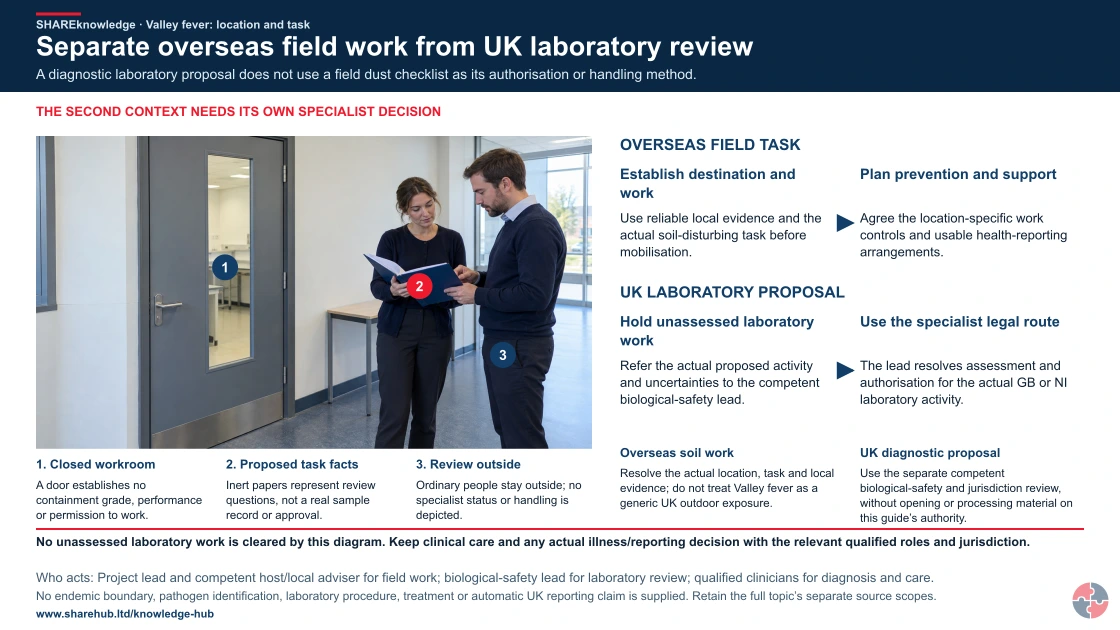
Full written explanation
An illustrative inactive laboratory-facility planning area shows a closed workroom door with a vision panel and ordinary uninjured people reviewing an inert folder outside. Only empty stationary benches are visible through the glass; there is no equipment detail, biological material, specimen, package or activity. Picture key: 1 identifies the closed workroom; 2 identifies proposed task facts; 3 identifies review outside. The door and room establish no containment grade, design, performance, authorised access or permission to handle material. The people are not identified as biological-safety specialists or patients, and the papers are not a real sample, clinical or approval record. The complete analytical comparison retains two independent tracks. OVERSEAS FIELD TASK links destination/work evidence to location-specific prevention and support. UK LABORATORY PROPOSAL links holding unassessed work to the separate specialist assessment and actual GB or NI legal route. Arrows stay within each track; field dust guidance is not laboratory authorisation or a handling method. All four complete check headings are unnumbered. The full unassessed-laboratory-work hold, responsible roles, evidence limits and both original cases remain. Clinical care and actual illness/reporting decisions remain independent of work papers or proposal status. No pathogen, fungus, spore, culture, biological handling, testing, inactivation, containment-equipment selection, clinical image, treatment, notification grant or operating method is shown. Use the complete topic for its actual location, overseas local-law, GB/NI, specialist, source and confidentiality qualifications.
A diagnostic laboratory proposal does not use a field dust checklist as its authorisation or handling method.
- Establish destination and work. Use reliable local evidence and the actual soil-disturbing task before mobilisation.
- Plan prevention and support. Agree the location-specific work controls and usable health-reporting arrangements.
- Hold unassessed laboratory work. Refer the actual proposed activity and uncertainties to the competent biological-safety lead.
- Use the specialist legal route. The lead resolves assessment and authorisation for the actual GB or NI laboratory activity.
When the evidence does not fit: No unassessed laboratory work is cleared by this diagram. Keep clinical care and any actual illness/reporting decision with the relevant qualified roles and jurisdiction.
Who acts: Project lead and competent host/local adviser for field work; biological-safety lead for laboratory review; qualified clinicians for diagnosis and care.
Changed workplace
Overseas soil work: Resolve the actual location, task and local evidence; do not treat Valley fever as a generic UK outdoor exposure.
UK diagnostic proposal: Use the separate competent biological-safety and jurisdiction review, without opening or processing material on this guide’s authority.
Evidence check: No endemic boundary, pathogen identification, laboratory procedure, treatment or automatic UK reporting claim is supplied. Retain the full topic’s separate source scopes.
Full specialist laboratory boundary and separate legal context
Primary references: CDC/NIOSH: Valley fever worker prevention, US technical context · CDC: Valley fever clinical and location context · HSE: specialist deliberate-work assessment boundary (GB)
Open the complete HD image (new tab)Download image

Full specialist laboratory boundary and separate legal context
Primary references: CDC/NIOSH: Valley fever worker prevention, US technical context · CDC: Valley fever clinical and location context · HSE: specialist deliberate-work assessment boundary (GB)

Location and evidence
Check current local public-health and project information for the actual destination; record uncertainty.
Task and prevention
Assess how soil disturbance can release dust and how work can avoid or reduce exposure. Laboratory work needs its separate specialist route.
Health information
Give healthcare professionals relevant travel and work history after a concern, without diagnosing from a map or symptom comparison.
This schematic does not define endemic borders, prescribe a soil treatment or confirm a pathogen from appearance.
What are the key facts about Valley fever?
The key facts are that Valley fever is inhaled from endemic soil dust, is not normally passed person to person and needs location-specific work planning.
This page is workplace guidance, not medical, legal, travel-health or HR advice. Fever, cough, chest symptoms, severe tiredness or pneumonia-like illness after dusty work or travel in an endemic region should be reported and assessed through GP, occupational health, travel-health or infectious-disease routes.
What signs matter first?
- Flu-like or pneumonia-like symptoms after dusty soil work in the south-western United States, northern Mexico or parts of Central and South America.
- Fatigue, cough, fever, headache, shortness of breath, night sweats, muscle or joint pain, rash or chest discomfort.
- Symptoms beginning around one to three weeks after relevant dust exposure, especially where ordinary treatment is not improving the illness.
What should happen at work?
- Record the work and travel history, including location, dates, soil disturbance, dust storms, excavation, vehicles and respiratory protection.
- Review whether the task should have had dust suppression, enclosed filtered cabs, worker information and respiratory protective equipment.
- Check whether other exposed workers need information, symptom prompts, occupational health advice or a review of the travel-risk assessment.
When is medical assessment needed?
- Promptly when compatible symptoms appear after relevant travel or dusty work exposure; tell the clinician the location and dust history, especially if the person may be at higher risk; CDC/NIOSH advises prompt medical evaluation.
- When the person is pregnant, immunocompromised, diabetic, older, frail or has significant existing lung disease.
- When there are signs of severe, prolonged, spreading or recurrent illness, or a clinician asks for occupational exposure details.
It is fungal, not bacterial
Coccidioides is an environmental fungus that can become airborne when soil is disturbed.
Location matters
The main risk is not ordinary UK soil; it is dusty work or travel in endemic arid and semi-arid regions.
The route is inhalation
Workers breathe in microscopic spores from dust, especially during excavation, grading, driving or wind events.
Symptoms can mimic common illness
Valley fever may look like flu, COVID-like illness or ordinary pneumonia unless travel and work history are considered.
Some people are more vulnerable
Pregnancy, immune suppression, diabetes, older age and some other factors can increase the risk of severe disease.
Laboratory work is different
Deliberate work with Coccidioides or suspect material must follow biological-agent containment and notification duties.
What is coccidioidomycosis or Valley fever?
Coccidioidomycosis is an infection caused by breathing airborne Coccidioides spores, with the acute lung illness commonly called Valley fever.
The fungus lives in soil in certain dry regions. When soil is disturbed, tiny spores can become airborne and be inhaled. In many people infection is mild or unnoticed, but symptomatic disease can produce a pneumonia-like illness with cough, fever, fatigue and chest symptoms.
A small proportion of cases become more serious. Some people develop longer-term lung problems, and in rare cases the infection spreads beyond the lungs to the skin, bones, joints or central nervous system. That is why the work and travel history matters: a clinician may not consider Valley fever unless the person explains where they have been and what dusty activities they undertook.
For UK workplace management, Valley fever is best treated as a specialist biological and travel-health risk. The controls are not about isolating an infected colleague; they are about preventing inhalation of endemic soil dust and managing deliberate laboratory exposure safely.
| Element | Explanation | Workplace meaning |
|---|---|---|
| Disease name | Coccidioidomycosis, commonly called Valley fever. | Use both names in travel and occupational-health records. |
| Agent | Coccidioides fungi that live in soil in endemic regions. | Check location before dusty field deployment. |
| Main route | Inhalation of airborne spores from disturbed soil or dust. | Control dust and respiratory exposure. |
| Transmission | Not normally spread from person to person. | Focus on environmental or laboratory exposure. |
| Severity | Often mild, but can cause chronic lung disease or disseminated infection. | Consider vulnerable workers and symptom escalation. |
Why does Valley fever matter to UK employers?
Valley fever matters to UK employers when they send people to endemic regions, manage overseas projects, handle samples or run laboratories involving Coccidioides.
A UK office, warehouse or construction site is not normally a Valley fever exposure setting. The risk emerges when the organisation sends employees or contractors to places where Coccidioides is present in soil, especially where work disturbs dry ground. Examples include overseas construction, renewables, mining, environmental surveys, archaeology, military-style field exercises and emergency response.
The UK management task is therefore to ask the right questions before deployment: where is the work, what soil will be disturbed, what dust controls exist locally, what worker groups may be more vulnerable, how will symptoms be reported, and what clinical support is available if someone becomes ill after returning.
| Scenario | Why it matters | Management response |
|---|---|---|
| Overseas construction | Earthworks in endemic dusty areas can aerosolise spores. | Pre-travel risk assessment, dust control and worker briefing. |
| Field science or archaeology | Excavation and sampling can disturb dry soil repeatedly. | Fieldwork controls, upwind working and symptom prompts. |
| Mining, oil, gas or renewables | Large-scale land disturbance can create heavy dust exposure. | Contractor requirements, enclosed cabs and dust suppression. |
| Laboratory work | Cultures or suspect clinical samples may present deliberate biological-agent risk. | Approved List check, containment and incident procedures. |
| Returned worker illness | Symptoms may be misattributed if work or travel history is missing. | Occupational-health referral and exposure history. |
How does a worker encounter Valley fever?
The usual occupational route is breathing airborne spores when endemic soil is disturbed; routine UK office contact is not the same hazard.
The CDC clinical overview identifies construction, agriculture and archaeology in endemic regions and explains that dust disturbance releases inhalable spores. Inspecting a dusty excavation, driving behind earth-moving plant and cleaning dusty equipment can expose people beyond the digger. The risk is tied to location and conditions, not simply to a job title. Person-to-person spread is not the ordinary mechanism. Laboratory manipulation of cultures is a distinct high-consequence route that needs its own controls.
How does Valley fever affect the body?
Valley fever starts when inhaled spores transform in the lungs and trigger infection and inflammation.
In the environment, the organism exists in soil as a mould form. Disturbance can release tiny infectious spores. Once inhaled, the spores enter lung tissue and transform, causing local infection. Many infections settle, but some progress to more persistent pulmonary disease.
Severe disease is not only about the exposure level. Individual susceptibility matters. Workers who are immunocompromised, pregnant, diabetic, older or have significant existing health conditions may need additional assessment before high-dust endemic work. That should be handled sensitively and confidentially through occupational health or travel-health advice.
| Stage | What happens | Control lesson |
|---|---|---|
| Environmental phase | Coccidioides lives in soil in endemic areas. | Location screening is the first control. |
| Aerosolisation | Dusty work or wind releases spores into air. | Suppress dust and avoid high-wind work. |
| Inhalation | Spores are breathed into the lungs. | Reduce breathing-zone exposure. |
| Pulmonary infection | Symptoms may resemble flu or pneumonia. | Make work and travel history visible to clinicians. |
| Complication | Some infections become chronic or spread beyond the lungs. | Consider vulnerability and medical assessment routes. |
What symptoms can suggest Valley fever?
Symptoms can include fatigue, cough, fever, headache, shortness of breath, night sweats, muscle or joint pain, rash and chest discomfort.
Symptoms commonly start one to three weeks after exposure, although many people do not become ill. The illness can be missed because it resembles influenza, COVID-like illness, bacterial pneumonia or tuberculosis. In non-endemic countries, delayed recognition is more likely if the worker does not volunteer their travel and dust-exposure history.
Workplaces should not diagnose. Their role is to make sure workers know what to report, managers capture the exposure history, occupational health is involved where appropriate and further dusty exposure is reviewed while assessment takes place.
| Symptom pattern | What it may mean | Workplace response |
|---|---|---|
| Flu-like illness | Fever, fatigue, headache and aches after travel or dusty work. | Prompt symptom reporting and exposure-history record. |
| Respiratory symptoms | Cough, chest discomfort or breathlessness. | GP/OH route and review dusty duties. |
| Night sweats or prolonged fatigue | Possible persistent infection or prolonged recovery. | Occupational health and return-to-work planning. |
| Rash or joint pain | Can occur with Valley fever and may be overlooked. | Include in symptom prompts. |
| Severe or spreading illness | Possible complicated or disseminated disease. | Medical assessment route and work restriction advice. |
Which work activities are higher risk?
Higher-risk activities are dusty outdoor tasks in endemic regions, especially where soil is disturbed or workers are near earthmoving.
Risk is task-specific. A traveller passing through an endemic region may have low exposure, while a worker trenching, grading or driving on dry unsealed ground may inhale dust all day. Weather and ground conditions matter: dust storms, drought, high winds and dry surface soils can increase exposure.
Employers should also consider accommodation, transport and welfare. Workers can take dust into vehicles, changing areas and sleeping accommodation if clothing and equipment controls are weak.
| Work | Why risk increases | Controls to plan |
|---|---|---|
| Construction and trenching | Excavation and grading disturb dry soil. | Wetting, scheduling, enclosed cabs and RPE where needed. |
| Agriculture and land clearing | Ploughing, grading and harvesting can raise dust. | Dust planning, cab filtration and weather triggers. |
| Archaeology and geology | Hand digging and sampling disturb soil close to the breathing zone. | Minimise hand digging, stay upwind and brief field teams. |
| Mining, oil, gas and renewables | Large-scale earthworks can create persistent site dust. | Contractor standards, monitoring and dust action levels. |
| Firefighting and emergency response | Post-fire disturbance and wind can raise contaminated dust. | Dynamic risk assessment and exposure reduction. |
What should be decided before an overseas soil task?
Confirm whether the site is in an endemic region, the work that disturbs soil, exposed people, weather and local legal requirements before mobilising.
The UK project lead should obtain a location-specific assessment from the host employer or competent local adviser. Walk the sequence from excavation and haulage through cleanup, identify nearby trades and drivers, check whether water supply and filtered cabs are feasible, and plan a dust-storm/high-wind stop. Ask an occupational-health adviser how workers will report fever, cough or fatigue after travel. The CDC clinical source notes that symptoms often begin one to three weeks after exposure, but diagnosis belongs to a clinician. Do not imply that GB COSHH automatically governs an overseas host site; apply the actual local law and the UK employer’s relevant duties to its people.
On a small screen, scroll this table sideways to read all columns.
| Decision | Who checks | Failure and response |
|---|---|---|
| Endemic location and season | Project lead and local adviser | No reliable location assessment: hold dusty work. |
| Dust-producing method | Site engineer and contractor | Uncontrolled hand digging or dry haulage: redesign and suppress. |
| Weather and neighbours | Supervisor | High wind or dust plume across workers: stop and reassess. |
| Health reporting | Occupational health and manager | Compatible symptoms after exposure: prompt clinical assessment and exposure history. |
How can the hierarchy of controls reduce soil-dust exposure and occupational Valley fever risk?
Control the dust-generating task and airborne route before relying on respirators; verify each barrier at the job.
The CDC/NIOSH worker guidance supports wetting soil continuously, reducing hand digging, using enclosed HEPA-filtered cabs and stopping in high winds. Apply the five-level hierarchy (elimination, substitution, engineering, administration, PPE) alongside ERICPD (eliminate, reduce, isolate, control, PPE, discipline); the frameworks overlap but are not identical. A wet method must not create electrical, ground-stability or vehicle hazards. The project engineer should trial the method and supervisor should observe dust at the worker and boundary, not just confirm a water truck exists.
On a small screen, scroll this table sideways to read all columns.
How can the ERICPD hierarchy of controls reduce soil-dust exposure and occupational Valley fever risk?

| Hierarchy / ERICPD | Specific method and feasibility | Owner, check, failure and stop |
|---|---|---|
| Eliminate / eliminate | Move inspection off the active dig and use remote survey where technically adequate; defer avoidable soil disturbance. | Project lead approves method; hold work if the exposure cannot be assessed. |
| Substitute / reduce | Use prefabrication or mechanical excavation instead of prolonged hand digging where ground conditions allow. | Engineer compares exposure and new plant risks; reject a change that creates uncontrolled hazards. |
| Engineering / isolate and control | Continuously wet the cut and haul route; use enclosed, maintained HEPA-filtered cabs and physically separate bystanders. | Plant lead checks water, cab seals and filter; stop if suppression fails or a plume reaches people. |
| Administrative / discipline | Schedule for calmer conditions, set exclusion/upwind routes, clean equipment before leaving and prohibit dry brushing. | Supervisor records checks; high wind, dry plume or breached exclusion triggers stop and reassessment. |
| PPE / PPE | Select suitable respiratory protection for residual dust under the applicable local programme; fit-test tight-fitting equipment and train users. | Competent assessor documents choice; stop entry if fit or supply fails. |
How can the ISO 45001 hierarchy of controls reduce soil-dust exposure and occupational Valley fever risk?

| Hierarchy / ERICPD | Specific method and feasibility | Owner, check, failure and stop |
|---|---|---|
| Eliminate / eliminate | Move inspection off the active dig and use remote survey where technically adequate; defer avoidable soil disturbance. | Project lead approves method; hold work if the exposure cannot be assessed. |
| Substitute / reduce | Use prefabrication or mechanical excavation instead of prolonged hand digging where ground conditions allow. | Engineer compares exposure and new plant risks; reject a change that creates uncontrolled hazards. |
| Engineering / isolate and control | Continuously wet the cut and haul route; use enclosed, maintained HEPA-filtered cabs and physically separate bystanders. | Plant lead checks water, cab seals and filter; stop if suppression fails or a plume reaches people. |
| Administrative / discipline | Schedule for calmer conditions, set exclusion/upwind routes, clean equipment before leaving and prohibit dry brushing. | Supervisor records checks; high wind, dry plume or breached exclusion triggers stop and reassessment. |
| PPE / PPE | Select suitable respiratory protection for residual dust under the applicable local programme; fit-test tight-fitting equipment and train users. | Competent assessor documents choice; stop entry if fit or supply fails. |
HSE’s five-level hierarchy is the GB teaching framework for elimination, substitution, engineering, administrative controls and PPE. ERICPD is a complementary mnemonic. Select controls for the actual task and applicable work location, then check that they remain effective.
For the excavation example, the engineer should commission the combined wetting, cab filtration and traffic-separation arrangement during the actual cut and haul cycle. Record the design basis, filter/seal condition, maintenance schedule and any competent exposure evaluation; visible dust checks alone cannot prove that spores are absent. The operator checks the controls before use, and the supervisor verifies them during changing ground/weather conditions. A failed water supply, cab seal/filter, exclusion or high-wind condition holds the affected work. Restart follows repair, a repeated task check and recorded authorisation. CDC/NIOSH’s US guidance supplies the field-control principles; local law and the site assessment govern their application.
What changes when a UK laboratory handles Coccidioides?
Both C. immitis and C. posadasii are Hazard Group 3 in the 2026 Approved List; a competent biological-safety lead must design and authorise the actual containment and handling.
The HSE sixth-edition Approved List lists both species as Hazard Group 3. The HSENI sixth-edition publication approves the list for NI COSHH. Deliberate culture, specimen processing and inactivation are different activities; assess aerosol generation, containment, equipment, competence, transport and incident response for each. HSE’s deliberate-work guidance and notification notes guide GB decisions. Do not culture or open a suspected isolate in an unassessed routine laboratory. Isolate the material and escalate to the biological-safety lead for containment and notification checks before proceeding.
Which duties and jurisdictions apply?
Separate an overseas field job from work in a GB or NI laboratory; the work location determines the applicable statutory route.
For GB laboratory or other in-scope work, use COSHH 2002, HSE’s 2026 Approved List and deliberate-work guidance. Northern Ireland uses COSHH (NI) 2003 and HSENI’s approved sixth-edition list. An overseas excavation needs a local law check and a clear allocation of UK employer, host and contractor responsibilities. CDC/NIOSH is useful technical guidance for endemic soil work, not UK law. A clinician decides illness diagnosis, and a competent adviser checks any reporting duty from the actual diagnosis, activity and jurisdiction. There is no automatic UK Valley fever reporting claim on this page. Check the direct source: HSE approved biological-agent list, HSENI approved biological-agent list.
On a small screen, scroll this table sideways to read all columns.
| Location | Primary decision | Escalation |
|---|---|---|
| Overseas endemic field site | Host-country law and location-specific exposure plan | Local adviser and UK employer project lead |
| Great Britain laboratory | GB COSHH and HSE 2026 Approved List | Biological-safety lead checks containment/notification |
| Northern Ireland laboratory | NI COSHH and HSENI 2026 Approved List | NI biological-safety lead checks local obligations |
How should Valley fever risk appear in the risk register?
Valley fever should appear in the risk register where the organisation undertakes dusty work in endemic regions or deliberate laboratory work with relevant biological agents.
A good entry describes location, task, exposed group and control barrier. It should not say only 'Valley fever'. It should say, for example, 'excavation in southern Arizona with visible dust exposure to field workers' or 'laboratory culture of suspect Coccidioides isolate'.
The register should identify review triggers: new destination, changed work method, dust complaint, high-wind condition, worker illness, laboratory incident, vulnerable worker declaration or updated official guidance.
| Scenario | Risk route | Controls | Assurance |
|---|---|---|---|
| Overseas excavation | Spores inhaled from dusty endemic soil. | Wet methods, weather triggers, cabs and RPE. | Pre-travel assessment and site inspection. |
| Archaeological fieldwork | Hand digging near breathing zone. | Minimise disturbance, upwind working and briefing. | Fieldwork plan and symptom reporting records. |
| Vehicle dust exposure | Dry road traffic re-suspends dust. | Speed control, wetting and cab filtration. | Route inspection and maintenance records. |
| Vulnerable worker deployment | Higher risk of severe disease after exposure. | Confidential OH/travel-health advice and alternative duties. | Fitness advice and adjustment record. |
| Laboratory incident | Aerosol or spill from suspect culture. | Containment, spill response and medical route. | Incident report and RIDDOR review. |
How could BuildOut Ltd manage Valley fever risk on an overseas project?

BuildOut Ltd would manage Valley fever by treating it as a location-specific soil-dust and travel-health risk before mobilising workers to an endemic region.
BuildOut Ltd
A construction and infrastructure business that occasionally sends project teams and contractors to overseas sites for earthworks, renewables and civil engineering support.
BuildOut screens project locations before mobilisation. When a planned solar-farm enabling works package is located in a dry endemic region, the project risk register identifies Valley fever alongside heat stress, silica dust, plant movement and welfare. Procurement requires local contractors to provide dust-control capability, water supply, enclosed cabs where practicable and worker briefings in language the team understands.
The controls are layered. The project manager schedules dusty tasks away from high-wind periods where possible, sets dust stop-work triggers, uses water suppression, limits hand digging, keeps workers upwind, checks cab filtration, provides suitable RPE where residual exposure remains and requires change-out arrangements so dusty clothing is not taken into accommodation. Occupational health gives pre-travel advice and confidential review for vulnerable workers.
Assurance is practical. Supervisors use short checks on water, wind, dust clouds, RPE, welfare and symptom reporting. The H&S adviser reviews evidence weekly: dust complaints, weather pauses, training attendance, contractor compliance and any reported illness. If a worker develops pneumonia-like symptoms after return, BuildOut records the exposure history and supports the person to provide it to their clinician.
| Management area | How BuildOut applies it | Evidence and improvement |
|---|---|---|
| Assess and analyse | Checks endemic-region risk, dusty work, climate, local controls and vulnerable-worker considerations. | Travel-risk assessment, project risk register and OH referral route. |
| Implement controls | Uses wet methods, weather triggers, cab filtration, upwind working, RPE and clean welfare arrangements. | Site dust-control plan and supervisor checks. |
| Train and brief | Explains symptoms, reporting route, dust controls, RPE and the need to tell clinicians about exposure history. | Briefing records and knowledge checks. |
| Contractor management | Sets minimum controls for local subcontractors and verifies them during mobilisation. | Contractor standards, inspections and nonconformance records. |
| Health support | Provides travel-health and occupational-health advice without requiring managers to hold clinical details. | Confidential OH advice and fit-for-work recommendations. |
| Learn and improve | Reviews illness reports, dust events and control failures after each deployment. | Lessons learned and revised mobilisation pack. |
What should each role learn and demonstrate?
Learning must match the decisions people make, from recognising danger to checking that controls work.
Briefings should tell people how to act, but attendance alone does not show competence. Assess the real decision or task, record who assessed it and revisit after a material change, failed control or incident. A local authorisation is task-specific; no universal external certificate is implied.
On a small screen, scroll this table sideways to read all columns.
| Role and learning | Demonstration and assessor | Record and reassessment trigger |
|---|---|---|
| Field supervisor: dust stop. | Practise a high-wind excavation pause, people count and restart check. | Observed drill and corrected dust plan. |
| Plant operator: suppression and cab. | Inspect water supply, cab seals and cleaning method before work. | Pre-use log; repair before restart. |
| Worker: symptoms and travel history. | Explain prompt clinical contact and exposure-history handover. | Briefing check and reporting route. |
| Laboratory lead: agent classification. | Use both species in the current Approved List to set containment and notification decisions. | Signed biological-agent assessment. |
How does Valley fever support NEBOSH study and professional development?
Valley fever supports study by showing how biological-agent risk depends on geography, route of exposure, work activity, vulnerable workers and control reliability.
For general learners, the useful concept is that biological hazards are not only blood or waste. They can be environmental fungi, and inhalation can be the main route. A good answer would identify the agent, source, transmission route, exposed people, controls, PPE limitations and reporting route.
For higher-level learners and professionals, the value is in the nuance: ordinary UK exposure is unlikely, but overseas work and laboratories can create foreseeable risk. That requires travel-risk assessment, occupational-health input, contractor control, containment decisions and evidence that official guidance has been translated into the work method.
| Learning area | What to understand | Scenario application |
|---|---|---|
| Biological-agent route | Inhalation of environmental fungal spores from dust. | Explain why soil disturbance is the exposure route. |
| Geographical risk | The hazard is region-specific. | Check destination before fieldwork. |
| Hierarchy of control | Dust control comes before respirators. | Apply ERICPD to an excavation scenario. |
| Vulnerable workers | Some people may face higher severe-disease risk. | Use confidential OH advice before deployment. |
| Laboratory containment | Deliberate work needs classification and containment. | Apply COSHH biological-agent duties. |
How can a management system sustain effective decisions?
Give each hazard or support route an owner, a control, a check and a response to failure.
The free GB regulator guide HSE Managing for health and safety (HSG65) explains a plan–do–check–act approach: assign controls and owners, involve workers, check work as done, and correct failures. For Northern Ireland, use HSENI risk assessment guidance for the local duty. A certificate alone does not demonstrate that a control works.
The free GB regulator guide HSE Managing for health and safety (HSG65) explains a plan–do–check–act approach: assign controls and owners, involve workers, check work as done, and correct failures. For Northern Ireland, use HSENI risk assessment guidance for the local duty. A certificate alone does not demonstrate that a control works.
What warning signs show Valley fever controls are weak?
Warning signs include dusty endemic work with no location assessment, no worker briefing, poor dust suppression, weak RPE arrangements and delayed symptom recognition.
The most common failure is treating overseas dusty work as if location does not matter. If a project plan says 'dust nuisance' but does not identify endemic fungal-disease risk, workers may not know what symptoms to report or what to tell their clinician.
Control weaknesses can also show up in the field: work continues through dust storms, water bowsers cannot keep up, workers stand downwind of excavation, cabs are not filtered, masks are handed out without fit testing, or dusty boots and clothing are taken into accommodation.
| Warning sign | How harm can develop | What to do |
|---|---|---|
| No endemic-area check | The hazard is not recognised before deployment. | Add location screening to travel and project risk assessment. |
| Visible dust clouds | Spores may be inhaled with airborne dust. | Pause, wet, isolate or redesign the task. |
| Work continues in high winds | Exposure can rise quickly and affect non-essential workers. | Use weather triggers and stop-work authority. |
| Generic masks issued | Respiratory protection may not fit or protect adequately. | Implement proper RPE selection, fit testing and training. |
| Symptoms not linked to work history | Diagnosis may be delayed or missed. | Brief workers to tell clinicians about location and dust exposure. |
| No laboratory containment review | Deliberate work may expose staff or release the agent. | Review Approved List, containment and notification duties. |
What acronyms and terms are used on this Valley fever page?
These terms help readers distinguish the organism, UK laboratory duties and field controls.
On a small screen, scroll this table sideways to read all columns.
| Term | Meaning | Use on this page |
|---|---|---|
| ACDP | Advisory Committee on Dangerous Pathogens | Prepares the UK Approved List. |
| COSHH | Control of Substances Hazardous to Health | GB or NI workplace biological-agent rules, by location. |
| HG3 | Hazard Group 3 | Current classification of both named Coccidioides species. |
| HEPA | High-efficiency particulate air | Suitable maintained cab filtration in dusty work. |
| OH | Occupational health | Work-related clinical advice and referral. |
| RPE | Respiratory protective equipment | Residual inhalation control with appropriate selection and fit. |