SHARE Knowledge Hub
Dust at Work
Dust at work is a major occupational health and safety hazard because fine particles can be inhaled deep into the lungs, irritate the eyes and skin, contaminate clothing and surfaces, poison the body, trigger asthma or allergic disease, cause incurable lung conditions and, for some materials, form explosive atmospheres. Dust risk is not controlled by whether the cloud looks dramatic; harmful respirable particles can be invisible, settle on ledges, escape poor extraction and expose workers during short tasks such as cutting, sanding, grinding, drilling, pouring powders, sweeping or emptying bags. A strong UK dust-control system identifies the material, particle size, task, exposure route and workers at risk, then applies COSHH and DSEAR controls such as elimination, wet methods, enclosure, local exhaust ventilation, on-tool extraction, housekeeping, RPE, exposure monitoring, health surveillance, maintenance and worker training.
Understanding Dust at Work
Dust at work is a major occupational health and safety hazard because fine particles can be inhaled deep into the lungs, irritate the eyes and skin, contaminate clothing and surfaces, poison the body, trigger asthma or allergic disease, cause incurable lung conditions and, for some materials, form explosive atmospheres. Dust risk is not controlled by whether the cloud looks dramatic; harmful respirable particles can be invisible, settle on ledges, escape poor extraction and expose workers during short tasks such as cutting, sanding, grinding, drilling, pouring powders, sweeping or emptying bags. A strong UK dust-control system identifies the material, particle size, task, exposure route and workers at risk, then applies COSHH and DSEAR controls such as elimination, wet methods, enclosure, local exhaust ventilation, on-tool extraction, housekeeping, RPE, exposure monitoring, health surveillance, maintenance and worker training.
Why this matters at work
RCS can cause silicosis, a permanent scarring or fibrosis of lung tissue. HSE also identifies chronic obstructive pulmonary disease and lung cancer risks, particularly with heavy and prolonged exposure. Disease often develops over years and can remain symptom-free until irreversible damage has occurred. This makes prevention, reliable controls and appropriate health surveillance much more valuable than waiting for symptoms or relying on a worker to notice a dust cloud.
Health surveillance is required under COSHH where there is an identifiable disease or adverse health effect linked to exposure, a reasonable likelihood that the disease or effect may occur under the workplace conditions, and valid techniques exist to detect early signs. It is not a substitute for controlling exposure. It is a safety net that can identify early ill health, check whether controls are working in practice and trigger support, task review and prevention before more serious harm develops.
How organisations manage this in practice
Identify the material, task, exposure route and people affected before selecting a mask or accepting a sample. Mixed residue can contain hazardous components even when a general mass result looks low. Consider inhalable and respirable fractions, representative breathing-zone exposure and relevant averaging periods. Pause uncertain disturbance and obtain competent assessment. Under the appropriate GB or NI COSHH route, prevent exposure where reasonably practicable or achieve adequate control where prevention is not reasonably practicable, with review and supporting arrangements. General dust-definition figures are not a safe-exposure permission below them. Compare relevant component limits with the correct fraction and period, while retaining additional prevention and reduction requirements for carcinogens, mutagens or asthmagens. An unlabelled process residue is not necessarily harmless. The assessment should explain uncertainty and what information or specialist work resolves it. Keep cleaning and maintenance within the scope, and address fire or explosion separately if combustible material is involved; one health sample cannot answer every hazard question.
The occupational-health professional determines suitable surveillance where required, including the role of questionnaires, lung-function tests or clinical imaging. Managers must not invent a fixed X-ray calendar or demand full clinical notes. Operational records need the functional restrictions and control actions relevant to work. Examine whether capture, maintenance and safe cleaning prevent exposure before accepting the filter task. Keep the reported health concern and technical action connected through lawful limited information, with named owners and review of the actual preventive change.
Visitors, contractors and temporary workers may be at risk without carrying out the dusty activity. Give them proportionate induction and access restrictions. Coordinate with contractors so a principal employer, client, occupier or contractor does not assume another party is managing the dust. Specify control standards in procurement and permit arrangements, verify them before work begins and review the interface during the work.
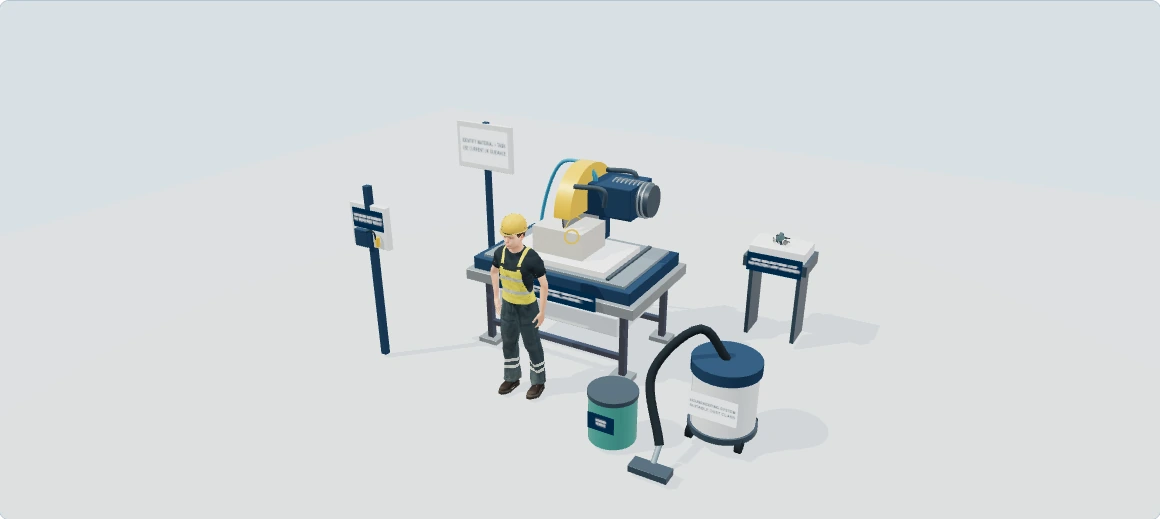

Silica: stop fine dust travelling from the task to the lungs
Explore how this equipment can harm its users and other people, then follow the practical measures that interrupt each pathway. This is a hazards and good-practice lesson; the separate checklist remains the pre-use/safety-check activity.
Checksheets and risk assessments
Equipment checksheets
- Abrasive wheel tools and cut off saws — 3D checks · Word · PDF
- Local exhaust ventilation: user and condition check — 3D checks · Word · PDF
Risk assessment forms
Risk assessment examples
Forms and tools
Full written walkthrough — all 8 steps
1. Identify the material and complete task
What is happening: The saw and drill are separate teaching examples, not a design for every stone product.
How harm can occur: Cutting, drilling or disturbing residues can release invisible respirable particles that reach the deep lung.
Best practice to apply: Identify the actual material, task and other exposed people; consider avoiding processing or using a safer product/method.
Why this works: Bulk silica percentage and visible appearance do not establish breathing-zone exposure.
Silica Dust · What is silica dust and why is it so harmful?2. Choose source control for the process
What is happening: The workpiece and tool define where dust is released and how it can be controlled.
How harm can occur: An unsuitable control can leave a fine airborne fraction even when coarse dust is reduced.
Best practice to apply: Plan suitable source controls and current task-specific guidance; engineered-stone controls need their own specific assessment.
Why this works: Control selection must follow the material and process, rather than treating all dusty tasks as identical.
Silica Dust · How can the hierarchy of controls reduce respirable crystalline silica exposure at source?3. Follow water to the cutting point
What is happening: In the wet-saw example water is directed towards the cutting interface.
How harm can occur: A lost, unsuitable or ineffective supply can allow dust to escape while cutting continues.
Best practice to apply: Use the specified functioning suppression and relevant mist/slurry controls; stop and resolve control failure.
Why this works: Water present somewhere on site does not prove that it reaches and controls the point of release.
Silica Dust · What does a controlled silica workflow look like?4. Follow dust into on-tool extraction
What is happening: The shrouded-drill example connects the tool's release point, hose and collector.
How harm can occur: A poor shroud, leak, restriction or unsuitable collection arrangement can allow dust towards people.
Best practice to apply: Match the complete on-tool system to the task and contaminant and verify its function; compare the separate example explicitly.
Why this works: A connected collector alone does not prove capture at the tool.
Silica Dust · How should a concrete cutting task be controlled?5. Keep collector and residues controlled
What is happening: The filter and collection container retain material that remains hazardous.
How harm can occur: Opening, servicing or poorly sealed equipment can release concentrated residue to workers.
Best practice to apply: Use suitable filter/collection equipment and the actual contained servicing, isolation and waste method.
Why this works: Moving dust out of the cutting area does not remove its hazard during maintenance or disposal.
Silica Dust · Where do silica dust controls commonly fail?6. Prevent a second release during clean-up
What is happening: Settled dust and slurry can become a later source when dried or disturbed.
How harm can occur: Dry sweeping, compressed-air cleaning or uncontrolled residue handling can re-expose workers and others.
Best practice to apply: Use suitable dust-controlled cleaning and contained waste/wet-residue arrangements; avoid creating another airborne release.
Why this works: Clean-up belongs in the exposure plan, not after the control system has been removed.
Silica Dust · What does a controlled silica workflow look like?7. Provide suitable residual protection for the person
What is happening: Respiratory protection must be selected and managed for the actual process and person.
How harm can occur: Incorrect type, fit or use can leave inhalation risk; a generic mask is not a universal control.
Best practice to apply: Follow the task-specific assessment and current guidance for suitable RPE and fit/use arrangements while retaining source controls.
Why this works: RPE selection cannot be inferred from the unassigned teaching facepiece shown here.
Silica Dust · How do WELs, monitoring and health surveillance fit together?8. Verify performance and respond to change
What is happening: Exposure assessment, symptoms and changes in material or work test whether the method remains suitable.
How harm can occur: A visually tidy task can still create harmful exposure and long-latency disease.
Best practice to apply: Use competent verification and required monitoring/surveillance, act on defects and symptoms and re-plan changed work.
Why this works: Absence of visible dust or illness does not demonstrate adequate control.
Silica Dust · How do WELs, monitoring and health surveillance fit together?
Illustrative awareness learning. Geometry, colours and movement do not establish safe distances, capacity, exposure, isolation or work permission. Use the actual assessment, equipment information and competent arrangements.
The wider workplace has its own account and subscription access. Exploring this lesson does not grant access, record course completion or authorise work.
UK guidance for further reading
HSE: SilicaHow can I practise this topic in 3D?

Sanding dust escapes from the repair bay

Composite dust at trimming and sanding
All related inspection points 2 across 2 locations
Garage workshop 1 inspection point
Aerosystems Engineering 1 inspection point
Practice in the SHAREhub environment. Browser practice is separate from workplace competence and formal learning records.
Select the material and task before choosing controls
Dust is not one substance. Separate silica-bearing cutting, wood sanding and a genuinely combustible-powder process; the exposure and physical-risk questions need their own evidence.
An extraction defect appears during sanding
Illustrative example. A crew proposes finishing the task and cleaning visible deposits afterwards.
Decision. Hold the affected activity and verify the cause, correction and suitable cleaning method.
Evidence to check. Material identity, generated form, extraction performance and the applicable assessment.
Hold or escalation point. Visible cleanliness or no symptoms does not establish exposure control.
Follow-up. Confirm restoration during use and revisit maintenance and cleaning arrangements.
Remove the cut where possible, then control the source
Pre-cut supply can remove one dust-generating task. Where cutting remains, source capture and the worker’s breathing-zone evidence still need assessment.
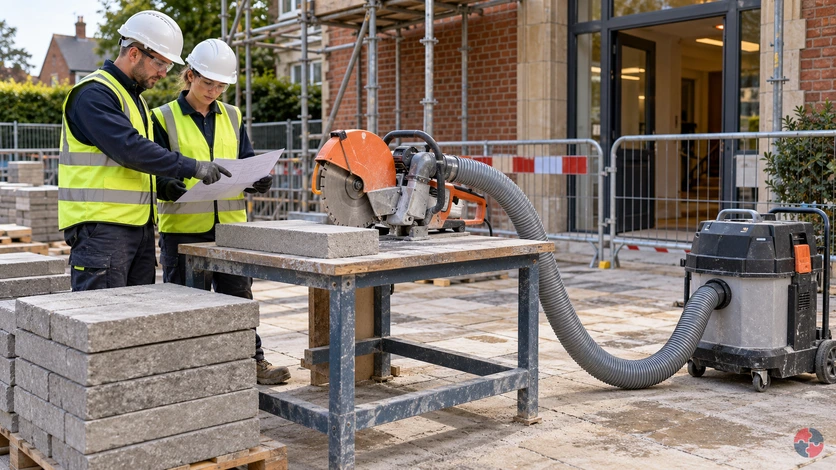
Remove the cut where possible; then control the source
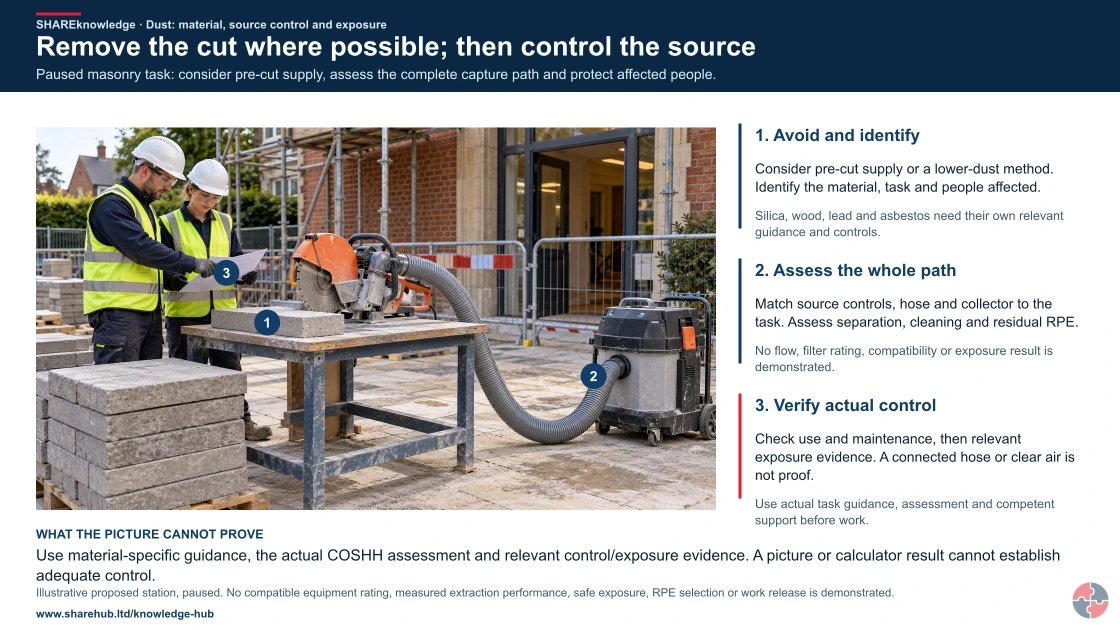
Full written explanation
Paused masonry task: consider pre-cut supply, assess the complete capture path and protect affected people.
- Avoid and identify. Consider pre-cut supply or a lower-dust method. Identify the material, task and people affected.
- Assess the whole path. Match source controls, hose and collector to the task. Assess separation, cleaning and residual RPE.
- Verify actual control. Check use and maintenance, then relevant exposure evidence. A connected hose or clear air is not proof.
Change the pathway
- Different dusts differ. Silica, wood, lead and asbestos need their own relevant guidance and controls.
- No rating inferred. No flow, filter rating, compatibility or exposure result is demonstrated.
- Do not start from appearance. Use actual task guidance, assessment and competent support before work.
Evidence check: Use material-specific guidance, the actual COSHH assessment and relevant control/exposure evidence. A picture or calculator result cannot establish adequate control.
Avoid the task, assess source controls and verify material-specific exposure
Primary references: HSE: construction-dust task guidance (GB) · HSE: cutting paving blocks, kerbs and flags (GB)
Open the complete HD image (new tab)Download image

Avoid the task, assess source controls and verify material-specific exposure
Primary references: HSE: construction-dust task guidance (GB) · HSE: cutting paving blocks, kerbs and flags (GB)

Avoid and identify
Assess pre-cut or other methods and identify the actual material and dust-producing task.
Control the path
Match source capture/suppression, duct/collector and clean-up to the process; protect others and assess residual RPE.
Verify exposure
Use relevant control/exposure evidence. Particle size/fraction affects where particles can reach, without an exact deposition boundary in this sketch.
Visible dust is not a measurement. A connected hose or a clear-looking room cannot certify exposure control.
What key facts should people know first about dust?
Dust is not a nuisance by-product; it is often the exposure route that causes serious long-latency disease.
The most dangerous dust is not always the dust you can see. Respirable particles are small enough to bypass the upper airways and reach the gas-exchange region of the lungs. A work area can look only mildly dusty and still expose workers to harmful respirable crystalline silica, wood dust, flour dust or other hazardous particles.
Dust control is task-specific. Cutting blocks, sanding hardwood, clearing rubble, emptying powder sacks, grinding metal, sweeping floors and handling grain all create different dust clouds, particle sizes, health effects and explosion risks. A generic dust risk assessment rarely controls the job properly.
Settled dust is a warning sign. It can be re-suspended by movement, compressed air, dry sweeping or vibration, and combustible dust on ledges or beams can feed secondary explosions. Good housekeeping means removing dust safely, not just moving it around.
Use the source matching the material and claim: HSE - COSHH; HSE HSG103: Safe handling of combustible dusts; HSE - Suspected asbestos: stop work; HSE - Construction hazardous substances: lead. EH44 does not cover explosion, asbestos or lead.
| Key fact | Practical meaning |
|---|---|
| Invisible dust can be harmful | Respirable particles may be too fine to see but still enter the deep lung. Sources: HSE - Dust in the workplace: General principles of protection. |
| Material matters | Silica, asbestos, wood, flour, grain, cement, lead and metal dusts have different health effects and limits. Sources: HSE - CN COSHH essentials in construction: Silica; HSE - Wood dust; HSE - Baker: flour dust and asthma; HSE - Grain dust; HSE - Suspected asbestos: stop work; HSE - Construction hazardous substances: lead. |
| Dust can enter by more than breathing | Skin, eyes and ingestion can matter, especially for cement, lead, irritant or toxic dusts. Sources: HSE - COSHH; HSE - Construction hazardous substances: lead. |
| Controls must start at source | Wet cutting, enclosure and LEV are stronger than trying to protect a worker after the dust cloud forms. Sources: HSE - Dust in the workplace: General principles of protection. |
| Cleaning can create exposure | Dry sweeping and compressed air can re-suspend fine particles. Sources: HSE - Dust in the workplace: General principles of protection. |
| Some dusts can explode | Combustible dusts need DSEAR assessment, ignition control and housekeeping. Sources: HSE HSG103: Safe handling of combustible dusts; Dangerous Substances and Explosive Atmospheres Regulations 2002. |
What is dust at work?
Dust at work is airborne or settled particulate matter generated by work activities, materials or processes.
Dust is created when solid materials are broken down, handled, poured, cut, crushed, drilled, ground, sanded, mixed, machined, transported or cleaned. It may be mineral, organic, metallic, chemical, biological or mixed. It may come from raw materials, workpieces, coatings, fillers, contaminants, waste or settled deposits disturbed during cleaning.
The same word covers very different hazards. Asbestos fibres, respirable crystalline silica, flour dust, hardwood dust, cement dust, lead dust, grain dust, plastic powder and aluminium powder should never be treated as one generic substance. Each has its own health profile, exposure limit, control standard and emergency implications.
A good dust assessment starts with substance identity. What material is being worked? What is in it? How fine is the dust? How much is generated? Who is close to the source? How long does the task last? What controls are fitted to the tool or process? What happens to settled dust afterwards? See HSE - Dust in the workplace: General principles of protection.
| Activity | Dust source | Typical concern |
|---|---|---|
| Cutting, chasing and drilling | Concrete, brick, stone, mortar, plasterboard and tile. | Respirable crystalline silica, nuisance dust and poor visibility. Sources: HSE - Dust in the workplace: General principles of protection. |
| Sanding and woodworking | Hardwood, softwood, MDF, coatings and adhesives. | Occupational asthma, dermatitis, nasal cancer risk and combustible dust. Sources: HSE - Wood dust; HSE HSG103: Safe handling of combustible dusts. |
| Pouring and mixing powders | Flour, cement, chemicals, pigments, additives or pharmaceuticals. | Inhalation, skin contact, sensitisation, toxicity or explosion. Sources: HSE - Baker: flour dust and asthma; HSE - COSHH; HSE HSG103: Safe handling of combustible dusts. |
| Agricultural handling | Grain, feed, bedding, mould spores and organic debris. | Farmer's lung, asthma, irritation and combustible dust. Sources: HSE - Grain dust; HSE HSG103: Safe handling of combustible dusts. |
| Metal grinding or polishing | Steel, aluminium, titanium, magnesium or alloy dust. | Irritation, metal toxicity, fire or reactive metal explosion. Sources: HSE - COSHH; HSE HSG103: Safe handling of combustible dusts. |
| Cleaning and maintenance | Settled dust on floors, ledges, filters, ducting and plant. | Re-suspension, hidden exposure, filter failure or secondary explosion risk. Sources: Construction dust: dry sweeping; HSE HSG103: Safe handling of combustible dusts. |
Why does particle size matter?
Particle size determines where dust deposits in the body and what kind of harm it can cause.
Inhalable dust is the fraction that can enter the nose and mouth during breathing. It may deposit in the nose, throat and upper airways, causing irritation, rhinitis, dermatitis after contact, or diseases such as nasal cancer from some hardwood dusts.
Respirable dust is smaller and more dangerous for many lung diseases because it can travel deep into the alveoli. Respirable crystalline silica is a classic example: it can cause silicosis, lung cancer and COPD even when the dust cloud is not obvious.
Dust may also be thoracic, fibrous, ultrafine or biologically active. The practical lesson is simple: do not judge risk by how visible the dust looks. Use the material data, task evidence, exposure monitoring and professional judgement. See HSE - Dust in the workplace: General principles of protection.
| Dust fraction | Where it can reach | Why it matters |
|---|---|---|
| Inhalable dust | Nose and mouth into the upper respiratory tract. | Can irritate airways and expose the nose, throat and skin to hazardous substances. Sources: HSE - Dust in the workplace: General principles of protection. |
| Thoracic dust | Can pass beyond the larynx into the chest airways. | Relevant to bronchial irritation and some respiratory disease mechanisms. Sources: HSE - Dust in the workplace: General principles of protection. |
| Respirable dust | Can reach the deep lung and alveoli. | Linked to silicosis, COPD, pneumoconiosis and deep-lung inflammation. Sources: HSE - Dust in the workplace: General principles of protection. |
| Fibres | Can behave differently depending on length, width and durability. | Asbestos fibres need specific legal controls and specialist management. Sources: HSE - Suspected asbestos: stop work; Control of Asbestos Regulations 2012; Control of Asbestos Regulations (Northern Ireland) 2012. |
| Combustible fine dust | Can disperse into explosive clouds. | Needs DSEAR assessment, ignition control and housekeeping. Sources: HSE HSG103: Safe handling of combustible dusts; Dangerous Substances and Explosive Atmospheres Regulations 2002. |
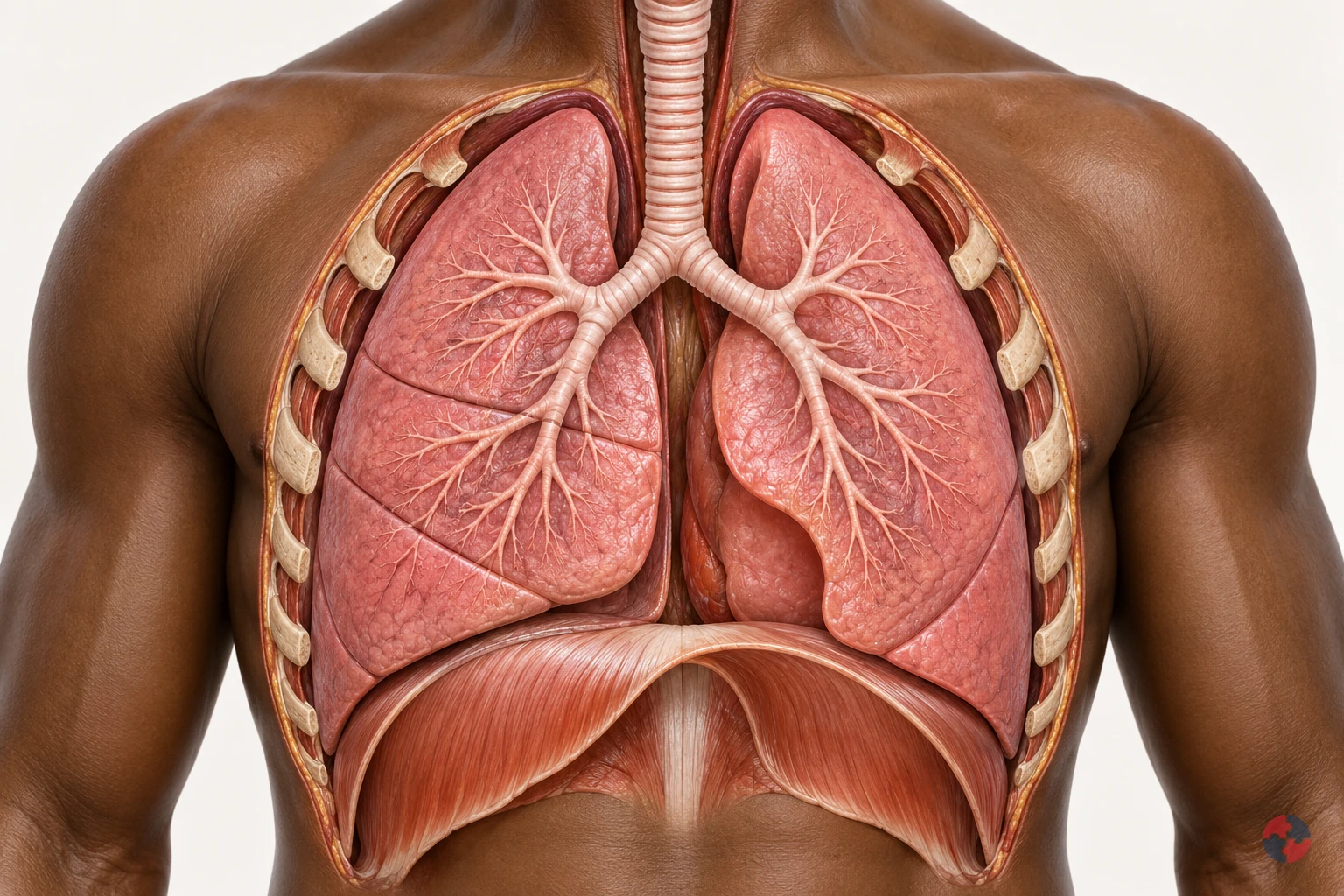
How do the lungs work, and how can workplace exposures affect breathing?
Interactive anatomy · Respiratory tract and lungs · Updated 2026-10-23
Read all anatomy and process explanations without the viewer
Simplified education, not diagnosis, a lung-function or oxygen-saturation test, an exposure calculator or a fitness-to-work assessment. No breath-holding challenge, breathing-rate score or personal health-data collection. Ordinary particle filters do not protect against every gas or oxygen deficiency. COPD and coal-dust topics may reuse normal anatomy only until separate mechanisms are reviewed.
Nose and mouth
Air enters and leaves here. The nose and mouth connect the outside air with the respiratory passages. Air moves through these openings on both the inward and outward breath. Follow the route towards the windpipe before looking at the smaller branches. The illustrated flow is air, a mixture of gases, rather than pure oxygen passing directly into blood. Frimley Health NHS Foundation Trust: How your lungs work · Central and North West London NHS Foundation Trust: How do we breathe?
Trachea
The windpipe carries air into the chest. The trachea, commonly called the windpipe, carries air down towards the chest. It divides into the two main bronchi that supply the lungs. Locate this shared passage before following either branch. Its role is to conduct air towards the gas-exchange regions and provide an outward route for the next exhalation. Frimley Health NHS Foundation Trust: How your lungs work
Bronchi
A main branch carries air into each lung. The two main bronchi take air from the windpipe into the right and left lungs. They divide into progressively smaller branches, distributing the breath through the lungs. Use the split as a landmark before following one highlighted route. These are air passages, distinct from the blood vessels that run through the same organs. Frimley Health NHS Foundation Trust: How your lungs work · University Hospitals of North Midlands NHS Trust: My lung surgery: about your lungs
Bronchioles
Smaller branches distribute air. Bronchioles are smaller branches of the airway system inside the lungs. Their branching routes lead towards clusters of alveoli, where the breath reaches the gas-exchange surface. Follow one branch to its end, using the others as context. This simplified route represents part of a much larger network supplying the lungs together. Frimley Health NHS Foundation Trust: How your lungs work
Alveoli
Tiny air sacs provide a gas-exchange surface. Alveoli are tiny air sacs at the ends of the small airway routes. Their close relationship with surrounding capillaries allows oxygen to pass towards blood and carbon dioxide towards alveolar air. Connect the highlighted cluster with the enlarged gas-exchange view. The enlargement changes the scale so the air space and neighbouring blood vessel can be distinguished. Frimley Health NHS Foundation Trust: How your lungs work · Central and North West London NHS Foundation Trust: How do we breathe?
Air–blood barrier
A thin boundary separates air from blood. The thin alveolar and capillary walls separate air in the sac from blood in its neighbouring vessel. Oxygen and carbon dioxide cross this boundary in opposite directions. Locate the tissue between the two spaces in the enlarged view. Blood cells remain in the vessel; the model does not represent an open connection through which air and blood mix. Central and North West London NHS Foundation Trust: How do we breathe?
Pulmonary capillaries
Small blood vessels pass beside the air sacs. Pulmonary capillaries are small blood vessels beside the alveoli. Blood moving through them receives oxygen and releases carbon dioxide across the thin exchange boundary, then continues through the circulation. Follow the labelled gas routes separately from the blood cells. These cells stay inside the capillary rather than moving into the air sac. Central and North West London NHS Foundation Trust: How do we breathe?
Diaphragm
This muscle helps make room for a breath. The diaphragm is a broad, dome-shaped breathing muscle beneath the lungs. It contracts and flattens downwards during inhalation, helping increase the space in the chest. During a quiet exhalation it relaxes towards its dome shape. Compare it with the rib cage: their changing positions help move air without the lung tissue acting as a contracting muscle. Cambridge University Hospitals NHS Foundation Trust: Breathing techniques to ease breathlessness: muscles involved
Rib cage and breathing muscles
Chest movement changes the space around the lungs. The rib cage protects the chest organs and moves with the breathing muscles. Expansion upwards and outwards helps increase chest space during inhalation; relaxation reduces that space during a quiet exhalation. Compare this movement with the diaphragm below the lungs. Together these structures provide the mechanics that allow air to move through the airways. Central and North West London NHS Foundation Trust: How do we breathe? · Cambridge University Hospitals NHS Foundation Trust: Breathing techniques to ease breathlessness: muscles involved
Pleura
Two thin layers surround the lungs and line the chest. The pleura has two thin layers around the lungs and inside the chest wall. A small amount of fluid between them allows the surfaces to slide with less friction as breathing changes the chest space. Locate this outer covering separately from the internal air sacs; it is not the thin air–blood exchange boundary. Blackpool Teaching Hospitals NHS Foundation Trust: Pleural clinic
Open the complete process transcript
The process, step by step
1 · Make space
Breathing in begins with a change in the space inside the chest. The diaphragm, a dome-shaped muscle beneath the lungs, contracts and moves downwards. Muscles around the ribs help lift the chest upwards and outwards. As the lungs expand with this changing space, air can enter through the airways. Locate the diaphragm and rib cage together rather than treating the lungs as muscles that pull themselves open. The model separates the movement into a teaching step so you can follow its purpose. In the body, chest movement, airflow and blood circulation are connected parts of a continuing process. Central and North West London NHS Foundation Trust: How do we breathe? · Cambridge University Hospitals NHS Foundation Trust: Breathing techniques to ease breathlessness: muscles involved
What to watch: Locate the diaphragm beneath the lungs and the rib cage around them; compare their positions with the space occupied by the lungs.
Why it matters: Changing the chest space draws air into the lung passages. The breathing muscles supply the movement, while the lungs expand with the chest to receive the next breath.
Explore this step: Select the diaphragm and rib cage in turn, then explain how their movement helps air enter without the lungs contracting like muscles.
2 · Move air
Air entering through the nose or mouth travels down the trachea, or windpipe, towards the chest. The trachea divides into the two main bronchi, with one route supplying each lung. Follow this continuous passage in the whole-chest view before moving into the smaller branches. The moving air is a mixture of gases, including oxygen; it is not a stream of pure oxygen travelling straight into the blood. These larger airways carry the breath towards the places where gas exchange happens. The same connected passages also provide the outward route when air is breathed out. Frimley Health NHS Foundation Trust: How your lungs work
What to watch: Start at the nose and mouth, follow the trachea downwards and find the split into the right and left main bronchi.
Why it matters: The larger passages distribute air to both lungs and connect the outside air with the smaller branches inside. Gas exchange takes place further along the route, rather than within the windpipe.
Explore this step: Trace the route to each lung and distinguish the tubes carrying air from the separate vessels carrying blood.
3 · Reach the air sacs
Inside each lung, the bronchi divide into smaller branches called bronchioles. These passages distribute air towards clusters of tiny air sacs, the alveoli. Follow one branch in the close-up and connect its end with an air-sac cluster, using the other branches as surrounding context. These routes distribute the breath throughout the lungs rather than supplying only one working air sac. A real lung contains many branching routes and air sacs operating together. This distribution brings air close to a large network of small blood vessels, preparing for the exchange shown in the next view. Frimley Health NHS Foundation Trust: How your lungs work
What to watch: Follow one smaller airway to the cluster of air sacs at its end, keeping the other branches as surrounding context.
Why it matters: Branching delivers air throughout the lungs instead of to one large chamber. The many air sacs bring the inhaled gases close to blood vessels where oxygen and carbon dioxide can cross.
Explore this step: Trace one complete branch to its air sacs, then explain how the many branches distribute air throughout the lungs.
4 · Change scale
The lesson now changes from a branching airway to an enlarged air–blood interface. An alveolus contains air; beside it runs a capillary containing blood. Their very thin walls form the boundary across which gases can move. Locate the air space, the separating tissue and the inside of the vessel before following any gas symbols. The magnified view represents a tiny part of the same lung, not a separate organ or a hole that joins air and blood into one space. The enlargement helps explain how the two systems can exchange gases while keeping their contents separate. Central and North West London NHS Foundation Trust: How do we breathe?
What to watch: Find the air inside the enlarged alveolus, the thin separating boundary and the neighbouring capillary with blood cells inside it.
Why it matters: A close boundary allows gases to cross between alveolar air and capillary blood. Keeping the two spaces separate lets ventilation and circulation cooperate without blood cells entering the air sac.
Explore this step: Identify the air space and blood-vessel space, then point to the boundary each gas must cross between them.
5 · Exchange gases
At the air–blood boundary, oxygen moves from the alveolar air into the capillary blood. At the same time, carbon dioxide carried back from the body moves from the blood into the air sac. The two gases cross in opposite directions; blood cells stay within the vessel. Follow each labelled symbol separately so that exchanging gases is not confused with mixing the air and blood together. Blood then carries oxygen onwards towards the heart and the body’s tissues. The teaching symbols simplify continuous gas movement, and their size, colour and speed do not represent a measurement. Central and North West London NHS Foundation Trust: How do we breathe?
What to watch: Follow the O₂ symbol towards the capillary and the CO₂ symbol towards the air sac, while locating the blood cells within the vessel.
Why it matters: Oxygen can be carried onwards for use by the body, while carbon dioxide returns to the airways for removal. Both transfers connect the breath with the continuing circulation of blood.
Explore this step: Trace the two gas routes in opposite directions and explain why a blood cell should remain inside the capillary.
6 · Breathe out
During a quiet breath out, the diaphragm and other breathing muscles relax. The diaphragm returns towards its dome shape, chest space decreases and air moves back along the airways to the nose or mouth. This outgoing air carries carbon dioxide that crossed from the blood into the alveoli. Trace the route in reverse without reversing the direction of blood circulation: oxygen-carrying blood continues towards the heart while another breath prepares to enter. The model presents a single cycle to explain the relationship. It does not show breathing as a series of separate events in which circulation stops between steps. Central and North West London NHS Foundation Trust: How do we breathe? · Cambridge University Hospitals NHS Foundation Trust: Breathing techniques to ease breathlessness: muscles involved
What to watch: Compare the diaphragm and chest with the inhalation step, then follow the outward airway route from the lungs to the nose or mouth.
Why it matters: Exhalation removes air containing carbon dioxide from gas exchange. Meanwhile, blood circulation continues carrying oxygen onwards, linking this breathing cycle with the needs of the rest of the body.
Explore this step: Trace the outward air route and the onward blood route separately, then describe why they are connected processes with different pathways.
Mechanisms and their limits
Sensitiser-related asthma Some people become sensitised to workplace substances such as flour or wood dust. Later exposure may trigger inflamed, narrowed airways, sometimes at low levels. Compare the airway opening, not the size of the whole lung. Sensitisation and later triggering are different phases, shown without a fixed clock. Work can also worsen existing asthma. Not all work-related asthma is an allergic reaction. A symptom pattern can prompt investigation but cannot establish a diagnosis from this model. HSE: Asthma: an overview · NHS: Asthma · HSE: Flour dust and risks to bakers
Assess sensitisers and maintain exposure controls
Get clinical advice about asthma symptoms
Dust-related fibrosis · silica Fine respirable crystalline silica can reach deep into the lungs, causing inflammation and areas of scarring. Scarred tissue does not work normally. Established silicosis damage cannot be reversed and may progress after exposure ends. Disease often develops over years, but very heavy exposure can cause much faster disease. No animation time represents a number of shifts or a safe dose. Show selected scarred regions, not every air sac filling with sand. This example does not diagnose the cause of breathlessness or show every effect of silica. NHS: Silicosis
Plan and control silica-generating cutting
Understand silicosis and seek assessment
Dust-related fibrosis · asbestos Inhaled asbestos fibres can cause asbestosis: scarring of lung tissue, usually after heavy exposure over many years. Mesothelioma is a separate cancer involving linings such as the pleura; it is not another name or a later stage of asbestosis. Lung scarring and the separate pleural annotation show different disease concepts. Other asbestos diseases also exist. Do not show one exposure causing immediate fibrosis or cancer. The sequence is illustrative and timing varies. The illustration cannot establish whether material contains asbestos or whether a person has an asbestos-related disease. HSE: Why is asbestos dangerous?
Understand the separate asbestos diseases
Sensitiser-related asthma — follow the anatomy
Look at: The airway opening, its muscle and swollen lining.
What changes: In asthma, narrowing, swelling and mucus can restrict the route for air.
Why it matters: Breathing may become difficult, with wheeze, cough or chest tightness.
What to do: Prevent exposure to the cause and report breathing symptoms for medical assessment.
Flour handling and later occupational asthma
Bakery: flour is tipped and benches are dusted repeatedly during production. Time jump: sensitisation may develop over a variable period; a later exposure may trigger symptoms. This is not asthma developing in 32 seconds. Not every exposed or sensitised person develops asthma. Wheeze or timing alone does not establish the cause or diagnosis.
A dusty bakery task Flour is tipped into a mixer and used to dust the bench. Review low-dust ingredients and careful handling before relying on the worker to avoid a visible cloud. HSE: Flour dust and risks to bakers
Repeated exposure, then a time jump Breathing flour dust can lead to sensitisation in some people over time. The timeline now jumps to a later contact after a hypersensitive state has developed in this chosen example. HSE: Asthma: an overview · HSE: Flour dust and risks to bakers
A later contact can narrow airways The airway wall becomes inflamed and the breathing passage narrows in the illustrative asthma episode. Symptoms may occur during the task or later; this is not the same as identifying asthma by a short animation. HSE: Asthma: an overview · NHS: Asthma
Report patterns and reduce exposure Report work-related breathing problems promptly and obtain clinical advice. Review low-dust flour, transfer/handling and the full control assessment; use the emergency panel immediately for severe breathing difficulty. HSE: Advice for employers: occupational asthma · HSE: Flour dust and risks to bakers · NHS: Shortness of breath
Dust-related fibrosis · silica — follow the anatomy
Look at: The thin walls of the air sacs and their nearby blood vessels.
What changes: Respirable silica can reach deep into the lung and cause scarring over time.
Why it matters: Scarred tissue makes gas exchange harder; established silicosis cannot be reversed by simply stopping exposure.
What to do: Prevent dust at source using suitable wet methods or extraction and correctly selected respiratory protection.
Repeated uncontrolled cutting of paving materials
A paving crew uses a cut-off saw on kerbs without effective dust suppression. Explicit time jump: silicosis usually develops after prolonged exposure, sometimes faster after very heavy exposure. Scarring does not appear during the 32-second clip. The dust route and later fibrosis are explanatory stages. No single cut, visible cloud or symptom predicts an individual’s disease.
A silica-generating activity Cutting paving blocks or kerbs can create very fine silica-containing dust near the operator and nearby workers. Plan cuts and material choices before work starts. HSE: Construction dust: cutting paving blocks, kerbs and flags · NHS: Silicosis
Fine dust reaches deeper lung regions Some inhaled fine particles reach the alveolar region. Repeated uncontrolled exposure across separate tasks and days is represented by a clearly labelled time jump. NHS: Silicosis
Later inflammation and fibrosis The chosen long-term example marks inflammation and scarred lung tissue that cannot function normally. This is not a real-time scan, exposure calculator or inevitable outcome after one task. NHS: Silicosis
Control dust at the task Reduce cutting where possible, use suitable water suppression or on-tool extraction with the required RPE, and check controls. Report symptoms and exposure history to a healthcare professional; controls do not erase existing scarring. HSE: Construction dust: cutting paving blocks, kerbs and flags · NHS: Silicosis
Dust-related fibrosis · asbestos — follow the anatomy
Look at: The deep lung tissue around the air sacs.
What changes: Inhaled asbestos fibres can cause scarring after a long delay.
Why it matters: Asbestosis reduces lung function; this fibrosis example is separate from mesothelioma and other asbestos diseases.
What to do: Identify asbestos before work and prevent disturbance through competent controls.
Disturbing asbestos-containing material during maintenance
A worker pulls down an older ceiling or roof-lining panel and dust falls beside their face. This shows an uncontrolled disturbance to avoid, not a safe removal method. Explicit time jump: asbestos-related disease can emerge many years after exposure. Asbestosis is a later scarring example, not a seconds-long transformation. Asbestosis, pleural disease and mesothelioma are different conditions. The visible dust is an illustrative cue, not a way to identify asbestos or judge whether air is safe. This example does not predict illness after one disturbance.
Pulling down a ceiling panel The worker pulls an overhead panel away from its frame and dust falls into the work area. This is a hazardous example, not a removal method. Check the asbestos information before disturbance; stop if the material or work arrangements are unclear. Health and Safety Executive: Asbestos essentials
What a failed control could allow In the counterfactual exposure example, disturbing asbestos-containing material releases fibres that may be inhaled. The timeline then jumps forward; no new disturbance is instructed. HSE: Why is asbestos dangerous? · Health and Safety Executive: Asbestos essentials
One possible later asbestos effect A separate asbestosis view illustrates scarring within lung tissue after substantial exposure over time. The outside pleural layer remains distinct; it is not a cancer or a generic asbestos-disease patch. HSE: Why is asbestos dangerous?
Prevent further disturbance Stop and follow competent asbestos-management arrangements, with suitable classification, planning and specialist work where needed. Seek appropriate advice about exposure concerns; neither a clear-looking room nor a normal diagram gives clearance. Health and Safety Executive: Asbestos essentials · HSE: Why is asbestos dangerous?
Read the practice situations and all answer explanations
LU-Q1: Which plan best addresses the hazard?
A team plans repeated concrete cuts with a handheld cut-off saw. Dust can enter the operator’s and nearby workers’ breathing zones.
Open a window and use the same dry-cutting method. — A window alone does not control dust generated beside the face. Choose task controls that prevent or capture it at source.
First reduce the need to cut, then assess source suppression or extraction and any required suitable RPE. — This addresses the task before exposure occurs. Check that suppression or extraction works and that required RPE is suitable, fitted and used.
Continue while nobody is coughing. — Symptoms are not an exposure monitor. Harmful respirable dust may be invisible, and a worker can feel well during exposure.
HSE: Construction dust: cutting paving blocks, kerbs and flagsLU-Q2: What is the most useful next action?
A bakery worker notices repeated wheeze after dusty flour tasks, including some symptoms later in the evening.
Report the pattern and seek medical and workplace assessment. — Reporting the pattern allows exposure controls and clinical assessment to be reviewed. Symptoms can be delayed; a clinician may need further investigation.
Use this model to diagnose occupational asthma. — The model explains a mechanism. It cannot diagnose asthma or establish that work caused it.
Assume the task is safe if breathing improves away from work. — Improvement away from work may be useful information for investigation, but it does not show that returning to the same exposure is safe.
HSE: Asthma: an overview · HSE: Advice for employers: occupational asthma · NHS: Asthma · HSE: Flour dust and risks to bakersLU-Q3: What is the important distinction?
One diagram shows a narrowed airway at LUN03–04. A second shows scarred gas-exchange tissue around LUN05–07.
They show the same disease at successive stages. — Narrowed airways and scarred lung tissue are different changes. One is not automatically the next stage of the other.
Both effects disappear when airborne dust settles. — Removing airborne dust does not reverse established fibrosis. Controlling further exposure remains important.
Airway narrowing and tissue fibrosis are different mechanisms. — Correct. Airway narrowing affects the passage for air; fibrosis affects lung tissue and its function. Neither picture supplies an individual diagnosis.
NHS: Silicosis · NHS: AsthmaSources and how the model is made
The opening images are AI-generated anatomical illustrations. The interactive 3D models and labelled SVG diagrams use original procedural artwork. These teaching images are not medical scans or diagnostic tools. Source references support the learner explanations and do not grant artwork rights.
- Frimley Health NHS Foundation Trust: How your lungs work — Normal airway branching, air sacs and capillary gas exchange; factual text only.
- Central and North West London NHS Foundation Trust: How do we breathe? — Thin alveolar/capillary walls, opposing gas transfer, circulation and chest mechanics. No illustrations or exercises copied.
- Cambridge University Hospitals NHS Foundation Trust: Breathing techniques to ease breathlessness: muscles involved — Diaphragm movement and breathing-muscle context only; this module does not prescribe breathing exercises.
- HSE: Health risks from welding — Welding-related airway irritation, possible deeper injury and irritant asthma; not a universal pattern for every gas.
- HSE: Asthma: an overview — Sensitisation, later triggering and work aggravation. Legacy labelling language and statistics are not reused.
- HSE: Advice for employers: occupational asthma — Exposure prevention, controls and health surveillance only; legacy legislation wording is not reused.
- NHS: Silicosis — Silica-associated inflammation/fibrosis, varying latency, irreversible damage and possible progression after exposure stops.
- HSE: Why is asbestos dangerous? — Asbestosis, mesothelioma and pleural disease are distinct; long disease latency.
- HSE: Construction dust: cutting paving blocks, kerbs and flags — Task design, source suppression/extraction, suitable RPE and checking controls; not a generic dust safe-dose rule.
- NHS: Shortness of breath — Emergency recognition of severe breathing difficulty and 999; emergency advice is outside the activity.
- NHS: Asthma — Narrowed/swollen airways, symptoms and clinical diagnosis; no medication doses or treatment plan reproduced.
- University Hospitals of North Midlands NHS Trust: My lung surgery: about your lungs — Right/left lung lobe counts and airway anatomy; no source image copied.
- Blackpool Teaching Hospitals NHS Foundation Trust: Pleural clinic — Pleural layers and the small lubricating fluid layer outside lung tissue; no procedural teaching included.
- HSE: Asphyxiation hazards in welding and allied processes — Oxygen-deficient spaces and need for independent air supply; no unprotected entry or rescue.
- HSE: Respiratory protective equipment at work — RPE selection must match the contaminant and conditions; filtering protection is not a supply of oxygen.
- HSE: Flour dust and risks to bakers — Flour sensitisation and practical reduction of dusty handling; exposure-limit numbers are not reused.
- Health and Safety Executive: Asbestos essentials — Task planning, training and competent asbestos work arrangements for the maintenance exposure example; not permission to disturb unknown material or a licence/classification decision.
- Health and Safety Executive: Welding fume: protect your workers — Alternative joining, fume reduction, LEV, suitable RPE and maintained controls for the welding-fume example. No unprotected exposure or rescue procedure.
Which dust types need their own specific controls?
Different dust types need different controls because the health and safety outcomes are different.
A general dust page can explain the principles, but the detailed assessment must name the dust. Silica needs controls for deep-lung disease and cancer. Suspected asbestos requires an immediate stop and a separate asbestos-law decision; whether licensing or clearance is needed depends on the work and material. Cement needs controls for alkaline burns, dermatitis and silica-containing dust. Wood dust needs extraction, cleaning and health surveillance for asthma and cancer risk. Lead dust needs toxic exposure control and biological monitoring where relevant.
Use the table as a routing guide to more specific topics. Each material needs its own assessment and source. See HSE - COSHH.
| Dust type | What it is | Specific SHARE page |
|---|---|---|
| Construction dust | Mixed dust from cutting, drilling, grinding, sanding, demolition, rubble clearing and construction materials. | Construction Dust Sources: HSE - COSHH. |
| Silica dust | Respirable crystalline silica from stone, concrete, brick, mortar, tiles and engineered stone. | Silica Dust Sources: HSE - CN COSHH essentials in construction: Silica. |
| Asbestos dust or fibres | Airborne asbestos fibres released when asbestos-containing materials are disturbed. | Asbestos Dust Sources: Control of Asbestos Regulations 2012; Control of Asbestos Regulations (Northern Ireland) 2012; HSE - Suspected asbestos: stop work. |
| Cement dust | Alkaline dust from cement, mortar, concrete and dry or wet cement products. | Cement Dust Sources: HSE - COSHH. |
| Wood dust | Hardwood, softwood, MDF and wood-composite dust from cutting, machining and sanding. | Wood Dust Sources: HSE - Wood dust. |
| Lead dust | Dust or fume from lead-containing materials, old paint, shot, solder, battery work or contaminated surfaces. | Lead Dust Sources: Control of Lead at Work Regulations 2002; Control of Lead at Work Regulations (Northern Ireland) 2003; HSE - Construction hazardous substances: lead. |
| Plasterboard and drywall dust | Gypsum and additive dust from cutting, sanding and finishing plasterboard joints. | Plasterboard and Drywall Dust Sources: HSE - COSHH. |
| Combustible dust | Dusts such as flour, grain, sugar, wood and metals that can form explosive atmospheres. | Dust Explosion Hazards Sources: Dangerous Substances and Explosive Atmospheres Regulations 2002. |
How can dust harm health?
Dust can harm health through inhalation, skin contact, eye contact and ingestion.
Inhalation is usually the most serious route. Dust can irritate the airways, trigger asthma, sensitise the immune system, scar lung tissue, cause COPD, contribute to cancer or carry toxic substances into the body. Diseases may appear years after exposure, which is why today's poor control can become tomorrow's fatal illness.
Skin contact matters where dust is alkaline, abrasive, allergenic or chemically active. Cement dust can cause serious dermatitis and burns, especially when mixed with sweat or water. Wood, resins, chemicals and some metals can cause irritation or allergic skin disease.
Eye contact can cause irritation, conjunctivitis or corneal injury. Ingestion can happen when contaminated hands, food, cigarettes or facial hair transfer dust into the mouth, and it matters especially for toxic dusts such as lead or pesticides. See HSE - Dust in the workplace: General principles of protection.
| Health outcome | Dust examples | What to control |
|---|---|---|
| Irritation | General dust, cement, plaster, paper dust and some metal dusts. | Source control, cleaning, eye protection and hygiene. Sources: HSE - Dust in the workplace: General principles of protection. |
| Occupational asthma | Flour, wood, grain, enzymes, animal and some chemical dusts. | LEV, exposure reduction, health surveillance and symptom reporting. Sources: HSE - Baker: flour dust and asthma; HSE - Wood dust; HSE - Grain dust. |
| Silicosis and pneumoconiosis | Respirable crystalline silica, coal and mineral dusts. | Wet methods, on-tool extraction, monitoring and strict control of respirable dust. Sources: HSE - Dust in the workplace: General principles of protection. |
| COPD | Long-term exposure to construction, mineral, grain or industrial dusts. | Prevent chronic inhalation exposure and review health trends. Sources: HSE - Dust in the workplace: General principles of protection. |
| Cancer | Asbestos, respirable crystalline silica and hardwood dust. | Specific legal controls, exposure reduction and health surveillance where required. Sources: Control of Asbestos Regulations 2012; HSE - CN COSHH essentials in construction: Silica; HSE - Wood dust. |
| Dermatitis and burns | Cement, wood, resins, chemicals and irritant dusts. | Skin protection, hygiene, washing facilities and exposure control. Sources: HSE - Dust in the workplace: General principles of protection. |
| Toxic systemic effects | Lead, cadmium, some pesticides and pharmaceutical powders. | Containment, hygiene, monitoring and specialist health surveillance. Sources: HSE - Construction hazardous substances: lead; HSE - COSHH. |
When can dust become a fire or explosion hazard?
Dust can become explosive when a combustible material is dispersed in air and meets an ignition source.
Combustible dust explosions need fuel, oxygen, dispersion, confinement and ignition. Fine dust settled on floors, beams, ducting and equipment can be thrown into the air by a small primary event and produce a much larger secondary explosion. This is why housekeeping is an explosion-control measure, not just tidiness.
Common combustible dusts include flour, grain, sugar, starch, wood, plastics and some metal powders such as aluminium, magnesium and titanium. Reactive metal dusts can require specialist collection systems because ordinary dry extraction or unsuitable vacuums can create a severe fire or explosion hazard.
DSEAR assessment should consider hazardous-area classification, ignition sources, static, hot surfaces, bearings, electrical equipment, extraction systems, explosion relief, isolation, cleaning methods and emergency response. See Dangerous Substances and Explosive Atmospheres Regulations 2002.
| Control area | What good looks like | Why it matters |
|---|---|---|
| Dust generation | Reduce or enclose processes and capture dust at source. | Prevents explosive clouds forming. Sources: Dangerous Substances and Explosive Atmospheres Regulations 2002. |
| Housekeeping | Remove settled dust safely using suitable vacuum systems, not dry sweeping or compressed air. | Reduces fuel for secondary explosions. Sources: Dangerous Substances and Explosive Atmospheres Regulations 2002. |
| Ignition control | Control hot surfaces, sparks, static, electrical equipment and friction heat. | Prevents ignition of dust clouds. Sources: Dangerous Substances and Explosive Atmospheres Regulations 2002. |
| Equipment selection | Use suitable ATEX-rated equipment where hazardous zones exist. | Prevents electrical or mechanical ignition sources. Sources: Dangerous Substances and Explosive Atmospheres Regulations 2002. |
| Extraction and collection | Design collectors, ducting and filters for the dust type and explosion risk. | Prevents collectors becoming ignition or explosion points. Sources: Dangerous Substances and Explosive Atmospheres Regulations 2002. |
| Emergency arrangements | Plan isolation, evacuation, firefighting information and recovery. | Reduces escalation after an event. Sources: Dangerous Substances and Explosive Atmospheres Regulations 2002. |
How should dust risk be assessed?
Dust risk should be assessed by material, task, exposure route, particle size, control effectiveness and worker health risk.
A suitable COSHH assessment names the substance and task. It should not simply state 'dust present'. It should identify whether the dust contains silica, wood, flour, cement, metals, biological material, toxic additives or combustible material, and separately identify suspected asbestos or lead for their own legal routes.
The assessment should describe who is exposed, how close they are to the source, how long the task lasts, whether the task is indoors or outdoors, what extraction is used, whether water suppression is effective, how cleaning is done and whether other workers nearby are exposed.
If there is uncertainty, exposure monitoring or specialist occupational hygiene advice may be needed. Monitoring should answer a management question: are controls adequate, which task is worst, who is exposed, is the WEL exceeded, or does a control improvement work? See HSE - COSHH.
| Question | Why it matters | Evidence |
|---|---|---|
| What is the material? | Hazard depends on composition, not just dust quantity. | Safety data sheet, material specification or survey. Sources: HSE - COSHH. |
| What creates the dust? | Controls should target the source task. | Task observation and method statement. Sources: HSE - COSHH. |
| Which fraction matters? | Respirable and inhalable dust affect different body areas. | Sampling strategy or professional judgement. Sources: HSE - COSHH. |
| Who is exposed? | Bystanders, cleaners and maintenance workers may be exposed too. | Exposure group map. Sources: HSE - COSHH. |
| Are controls effective? | LEV, water and RPE often fail through poor selection or maintenance. | Inspection, testing, monitoring and worker feedback. Sources: HSE - COSHH. |
| What happens to settled dust? | Poor cleaning can re-suspend dust or create explosion risk. | Cleaning method and housekeeping inspection. Sources: HSE - COSHH. |
How can the hierarchy of controls reduce workplace dust exposure at source?
Dust controls should prevent the dust being created or inhaled before relying on respiratory protection.
The best dust controls are upstream. Order pre-cut materials, use lower-dust products, change the process, isolate the work or use wet methods. Once a dust cloud has formed around the worker's breathing zone, the control battle is already harder.
Engineering controls include enclosure, local exhaust ventilation, on-tool extraction, water suppression, automated transfer, sealed conveyors and suitable industrial vacuum systems. They need design, commissioning, user checks, maintenance and thorough examination.
The same source-control decision transfers to a woodworking shop sanding MDF: capture at the sander, segregate bystanders, maintain extraction and stop on a blocked collector. In a bakery, flour tipping needs enclosure and capture, with combustible-dust assessment as well as inhalation control; a silica RPE choice or monitoring result cannot be copied across materials.
RPE can be important, but it is a final layer. It must be suitable for the dust, provide enough assigned protection factor, be face-fit tested where tight-fitting, worn correctly, maintained, stored properly and supported by clean-shaven requirements where needed. See HSE - COSHH.
How can the ERICPD hierarchy of controls reduce workplace dust exposure at source?

| Control priority | Dust control examples | Evidence | HSE hierarchy level | Design and use for this task | Owner, checks, failure and stop |
|---|---|---|---|---|---|
| Eliminate | Avoid dusty work by using pre-cut materials, wet delivery, enclosed systems or alternative materials. | Design review, procurement standard and task planning. | Elimination | Order pre-cut concrete units so the corridor-side saw cut is removed. Designer and buyer verify dimensions against the drawing; a late unplanned cut needs a new method, not silent improvisation. | Procurement and site supervisor compare delivered units with design before work; stop if wrong units make uncontrolled cutting necessary. Sources: HSE - Construction dust; HSE - COSHH. |
| Reduce | Use lower-dust methods, lower-silica materials, smaller quantities and less aggressive tools. | Method selection record and material substitution review. | Substitution / source reduction | If pre-cut supply is unavailable, ask the designer whether a lower-silica material or less dusty cutting process meets the actual structural specification. Do not substitute a structural material on site without approval. | Designer signs the alternative and supervisor checks material identity before cutting; if equivalence is unknown, hold the task. Sources: HSE - Construction dust specific tasks; HSE - CN COSHH essentials in construction: Silica. |
| Isolate | Segregate dusty work, enclose processes, use barriers or dedicated rooms. | Work area plan and access control. | Engineering separation | Move the cut to a controlled station away from the occupied corridor, with physical boundary and capture or containment designed for the task. Isolation prevents bystanders entering the release path. | Site supervisor verifies boundary, access and airflow before use and during shift; stop on dust escape or a breached boundary. Sources: HSE - Construction dust; HSE - Local exhaust ventilation. |
| Control | Use wet cutting, LEV, on-tool extraction, M/H class vacuums, cleaning regimes and exposure monitoring. | LEV tests, inspection records, monitoring results and cleaning logs. | Engineering capture plus administrative control | Use compatible wet suppression or tool-mounted extraction at the blade and a suitable collector. A competent supplier commissions the setup; the operator checks water/airflow, hoses, filters and capture each use. The work method and access rule support the hardware. | Keep commissioning and LEV examination records, pre-use checks and observation or sampling where needed. Stop on failed flow, visible escape, damaged hose or unresolved exposure result. Sources: HSE - Construction dust specific tasks; HSE - Local exhaust ventilation; LEV thorough examination and test FAQ; Construction dust: dry sweeping. |
| PPE | Use suitable RPE, eye protection, gloves and protective clothing for residual exposure. | RPE selection, face-fit record and maintenance checks. | PPE after higher controls | Select RPE for assessed silica exposure and wearer, with correct assigned protection, face-fit test for tight-fitting models, seal check, clean storage and replacement. Eye and skin PPE address separate exposure routes; masks do not protect bystanders. | Supervisor checks fit and use; stop if the chosen RPE is unavailable, damaged, incompatible with other PPE, or cannot seal on the wearer. Sources: HSE - Respiratory protective equipment; HSE - CN COSHH essentials in construction: Silica. |
| Supervision and review (administrative) | Train workers, supervise use, stop dry sweeping and review failures. | Training records, observations and corrective actions. | Administrative assurance, not a substitute | Supervisor checks the task each shift, maintains extraction and wet equipment, reviews cleaning and worker feedback, and escalates drift. Repeated dust is a control failure rather than a worker-blame issue. | Review defect, exposure and training records; suspend the method after repeated release or overdue repair until engineered control is restored. Sources: HSE - Construction dust specific tasks; LEV thorough examination and test FAQ. |
How can the ISO 45001 hierarchy of controls reduce workplace dust exposure at source?

| Control priority | Dust control examples | Evidence | HSE hierarchy level | Design and use for this task | Owner, checks, failure and stop |
|---|---|---|---|---|---|
| Eliminate | Avoid dusty work by using pre-cut materials, wet delivery, enclosed systems or alternative materials. | Design review, procurement standard and task planning. | Elimination | Order pre-cut concrete units so the corridor-side saw cut is removed. Designer and buyer verify dimensions against the drawing; a late unplanned cut needs a new method, not silent improvisation. | Procurement and site supervisor compare delivered units with design before work; stop if wrong units make uncontrolled cutting necessary. Sources: HSE - Construction dust; HSE - COSHH. |
| Reduce | Use lower-dust methods, lower-silica materials, smaller quantities and less aggressive tools. | Method selection record and material substitution review. | Substitution / source reduction | If pre-cut supply is unavailable, ask the designer whether a lower-silica material or less dusty cutting process meets the actual structural specification. Do not substitute a structural material on site without approval. | Designer signs the alternative and supervisor checks material identity before cutting; if equivalence is unknown, hold the task. Sources: HSE - Construction dust specific tasks; HSE - CN COSHH essentials in construction: Silica. |
| Isolate | Segregate dusty work, enclose processes, use barriers or dedicated rooms. | Work area plan and access control. | Engineering separation | Move the cut to a controlled station away from the occupied corridor, with physical boundary and capture or containment designed for the task. Isolation prevents bystanders entering the release path. | Site supervisor verifies boundary, access and airflow before use and during shift; stop on dust escape or a breached boundary. Sources: HSE - Construction dust; HSE - Local exhaust ventilation. |
| Control | Use wet cutting, LEV, on-tool extraction, M/H class vacuums, cleaning regimes and exposure monitoring. | LEV tests, inspection records, monitoring results and cleaning logs. | Engineering capture plus administrative control | Use compatible wet suppression or tool-mounted extraction at the blade and a suitable collector. A competent supplier commissions the setup; the operator checks water/airflow, hoses, filters and capture each use. The work method and access rule support the hardware. | Keep commissioning and LEV examination records, pre-use checks and observation or sampling where needed. Stop on failed flow, visible escape, damaged hose or unresolved exposure result. Sources: HSE - Construction dust specific tasks; HSE - Local exhaust ventilation; LEV thorough examination and test FAQ; Construction dust: dry sweeping. |
| PPE | Use suitable RPE, eye protection, gloves and protective clothing for residual exposure. | RPE selection, face-fit record and maintenance checks. | PPE after higher controls | Select RPE for assessed silica exposure and wearer, with correct assigned protection, face-fit test for tight-fitting models, seal check, clean storage and replacement. Eye and skin PPE address separate exposure routes; masks do not protect bystanders. | Supervisor checks fit and use; stop if the chosen RPE is unavailable, damaged, incompatible with other PPE, or cannot seal on the wearer. Sources: HSE - Respiratory protective equipment; HSE - CN COSHH essentials in construction: Silica. |
| Supervision and review (administrative) | Train workers, supervise use, stop dry sweeping and review failures. | Training records, observations and corrective actions. | Administrative assurance, not a substitute | Supervisor checks the task each shift, maintains extraction and wet equipment, reviews cleaning and worker feedback, and escalates drift. Repeated dust is a control failure rather than a worker-blame issue. | Review defect, exposure and training records; suspend the method after repeated release or overdue repair until engineered control is restored. Sources: HSE - Construction dust specific tasks; LEV thorough examination and test FAQ. |
How should dust exposure and controls be monitored?
Dust monitoring should show whether exposure is controlled and whether controls are working in real tasks.
Monitoring can include personal exposure sampling, static sampling, real-time dust monitoring, dust-lamp visualisation, smoke tests, LEV performance checks, airflow indicators and housekeeping inspections. Each method has a purpose; none should be used as decorative evidence.
Personal sampling helps understand worker exposure. Static monitoring helps understand area conditions. Dust lamps can show otherwise invisible airborne particles and help workers see why a task or control matters. LEV checks confirm whether airflow, capture and filters are still effective.
A workplace exposure limit is a legal control benchmark over its stated averaging period, not proof that a substance is harmless below the limit. Sampling must represent the worker and task, and a failed LEV or visible dust release needs action even before a new sample result arrives.
Results should be reviewed with workers and managers. If a monitoring report sits in a folder while the same dusty task continues unchanged, it has not improved control. See HSE - MDHS guidance.
The GB HSE LEV commissioning guidance requires the system’s suitability for the actual process and substances to be checked before use, and explains how commissioning establishes benchmarks for later examination and performance management. For example, if an additional hood changes a dust-extraction system, obtain competent review of the changed operating conditions and balance at each hood before relying on the old results. An airflow indication alone is not the commissioning demonstration that emissions are adequately controlled. Retain an understandable report identifying the system, conditions, methods, results and performance benchmarks, with suitable worker instruction. This is an illustrative change-review example, not a design calculation or a universal sampling schedule. Follow the separate NI duties where applicable.
| Method | What it tells you | How to use the result |
|---|---|---|
| Personal sampling | Individual exposure during the work period. | Compare with WELs and decide whether controls are adequate. Sources: HSE - MDHS guidance. |
| Static sampling | Dust level in an area or near a process. | Check spread and bystander exposure. Sources: HSE - MDHS guidance. |
| Dust lamp | Visualises airborne particles and control effectiveness. | Train workers and compare controlled vs uncontrolled methods. Sources: HSE - MDHS guidance. |
| LEV examination and testing | Whether extraction performs as intended. | Repair, rebalance or redesign faulty systems. Sources: LEV thorough examination and test FAQ. |
| Airflow indicators | Whether extraction airflow is present at point of use. | Give workers a simple check before work starts. Sources: HSE - MDHS guidance. |
| Housekeeping inspection | Whether settled dust is accumulating. | Improve cleaning, containment or extraction. Sources: HSE - MDHS guidance. |
When is health surveillance needed for dust?
Health surveillance is needed when dust can cause an identifiable disease or health effect and there is a reasonable likelihood of exposure.
Health surveillance is not the same as exposure monitoring. Exposure monitoring checks the environment or breathing zone; health surveillance looks for early signs of harm in people. For dusts that can cause occupational asthma, dermatitis, silicosis, COPD or other identifiable conditions, health surveillance may be required under COSHH.
Good health surveillance starts before or soon after exposure begins where possible, so there is a baseline. Workers should know what symptoms to report between formal checks, such as coughing, wheezing, chest tightness, breathlessness, rhinitis, skin irritation or eye problems.
Health surveillance findings should feed back into risk control. If workers show symptoms, the organisation should review exposure, task controls, RPE, LEV, cleaning, training and supervision rather than treating surveillance as a medical exercise separate from management. See HSE - COSHH.
| Dust or effect | What to look for | Management response |
|---|---|---|
| Wood or flour dust | Asthma symptoms, rhinitis and sensitisation. | Review LEV, RPE, cleaning and exposure levels. Sources: HSE - COSHH. |
| Respirable crystalline silica | Respiratory symptoms and lung-function concerns. | Review task controls, monitoring and occupational-health advice. Sources: HSE - COSHH. |
| Cement dust | Dermatitis, burns, eye irritation and respiratory irritation. | Review wet cement contact, hygiene, gloves and dust control. Sources: HSE - COSHH. |
| Lead dust | Possible systemic absorption and symptoms. | Use specialist biological monitoring and strict hygiene controls. Sources: Control of Lead at Work Regulations 2002; Control of Lead at Work Regulations (Northern Ireland) 2003; HSE - Construction hazardous substances: lead. |
| General dusty work | Cough, breathlessness, eye irritation and skin effects. | Investigate exposure and control effectiveness. Sources: HSE - COSHH. |
Which legal duties apply to dust at work?
COSHH normally drives dust health control, while DSEAR applies where combustible dust can create fire or explosion risk.
COSHH requires employers to prevent exposure to substances hazardous to health where reasonably practicable, or adequately control exposure where prevention is not reasonably practicable. Dust can be a substance hazardous to health because of its composition or because excessive airborne concentration can affect health.
The first table gives Great Britain sources. Northern Ireland has separate instruments for the same broad safety decision, shown in the second table. Apply the route for the workplace location and actual task.
Asbestos and lead are not treated as ordinary COSHH dust in this overview. Suspected asbestos means stop work and determine the applicable GB or NI asbestos controls. Lead dust requires the separate Control of Lead at Work route for the workplace jurisdiction. Do not use a generic dust assessment to authorise either task.
Reporting rules also differ by location. GB RIDDOR 2013 does not govern a Northern Ireland event; use the NI 1997 regulations as amended and HSENI reporting guidance for the actual disease or occurrence.
DSEAR applies where dust is a dangerous substance capable of creating explosive atmospheres. Many organic and metal dusts need a DSEAR assessment alongside COSHH because they present both chronic health risk and acute fire or explosion risk. See Control of Substances Hazardous to Health Regulations 2002; Control of Substances Hazardous to Health Regulations (Northern Ireland) 2003.
| Duty or regulation | Jurisdiction | How it applies | Practical evidence |
|---|---|---|---|
| Control of Substances Hazardous to Health Regulations 2002 | Great Britain | Requires assessment, prevention or adequate control, maintenance, monitoring, health surveillance and information/training. | COSHH assessment, control records, LEV testing, monitoring and health surveillance. Sources: Control of Substances Hazardous to Health Regulations 2002. |
| Dangerous Substances and Explosive Atmospheres Regulations 2002 | Great Britain | Applies to combustible dust fire and explosion risks. | DSEAR assessment, hazardous-area controls, ignition control and housekeeping. Sources: Dangerous Substances and Explosive Atmospheres Regulations 2002. |
| Health and Safety at Work etc. Act 1974 | Great Britain | General duty to protect workers and others from health and safety risks. | Management arrangements, training, supervision and resources. Sources: Health and Safety at Work etc. Act 1974. |
| Management of Health and Safety at Work Regulations 1999 | Great Britain | Requires suitable risk assessment, competent assistance and preventive arrangements. | Risk assessment, competent advice and review records. Sources: Management of Health and Safety at Work Regulations 1999. |
| Reporting of Injuries, Diseases and Dangerous Occurrences Regulations 2013 | Great Britain | May require reporting of certain diagnosed occupational diseases and dangerous occurrences. | RIDDOR review, occupational-health information and incident reporting route. Sources: Reporting of Injuries, Diseases and Dangerous Occurrences Regulations 2013. |
| Control of Asbestos Regulations 2012 | Great Britain | Suspect asbestos stops ordinary work; determine survey, competency and work category before disturbance. | Material identification, authorised method and controls. |
| Control of Lead at Work Regulations 2002 | Great Britain | Lead dust and fume have their own assessment, control and surveillance route. | Lead assessment, hygiene, control and monitoring records. |
| Duty | Jurisdiction | Application | Decision record |
|---|---|---|---|
| Health and Safety at Work (Northern Ireland) Order 1978 | Northern Ireland | NI general worker safety duties. | Keep the assessment, control decision and competent review record. |
| Management of Health and Safety at Work Regulations (Northern Ireland) 2000 | Northern Ireland | NI risk assessment and arrangements. | Keep the assessment, control decision and competent review record. |
| Control of Substances Hazardous to Health Regulations (Northern Ireland) 2003 | Northern Ireland | NI dust health assessment and controls. | Keep the assessment, control decision and competent review record. |
| Dangerous Substances and Explosive Atmospheres Regulations (Northern Ireland) 2003 | Northern Ireland | NI combustible-dust fire/explosion route. | Keep the assessment, control decision and competent review record. |
| Control of Asbestos Regulations (Northern Ireland) 2012 | Northern Ireland | Stop suspect disturbance and use the NI asbestos route. | Keep material identification, assessment, competent control decision and review record. |
| Control of Lead at Work Regulations (Northern Ireland) 2003 | Northern Ireland | Assess and control lead dust under the NI lead route. | Keep material identification, assessment, competent control decision and review record. |
| Reporting of Injuries, Diseases and Dangerous Occurrences Regulations (Northern Ireland) 1997; Report an incident in Northern Ireland. | Northern Ireland | Check whether the occupational disease, fire, explosion or dangerous occurrence is reportable under NI rules. | Record the event facts, reporting decision, notification and investigation. |
What should a dust risk register include?
A dust risk register should identify the specific dust, task, exposure route, controls and evidence that exposure is controlled.
The register should be practical enough to drive work planning. It should not say only 'dust'. It should say silica dust from cutting concrete kerbs with a cut-off saw, wood dust from belt sanding hardwood, cement dust from dry mixing, or flour dust from bag tipping into mixers.
For each entry, the register should identify prevention controls, engineering controls, residual RPE, health surveillance, monitoring, maintenance and the trigger for review.
Use the source matching the material and claim: HSE - COSHH; HSE HSG103: Safe handling of combustible dusts. EH44 does not cover explosion, asbestos or lead.
| Risk | Possible harm | Controls | Evidence |
|---|---|---|---|
| Respirable silica from cutting concrete | Silicosis, COPD and lung cancer. | Wet cutting, on-tool extraction, reduced cutting, RPE and exclusion. | Task assessment, monitoring, RPE face fit and supervision checks. Sources: HSE - Dust in the workplace: General principles of protection. |
| Wood dust from sanding | Asthma, dermatitis and nasal cancer risk for hardwood. | LEV, M/H class vacuum, tool extraction, cleaning and health surveillance. | LEV test, airflow checks, health records and inspection findings. Sources: HSE - Wood dust. |
| Cement dust during mixing | Skin burns, dermatitis, eye injury and respiratory irritation. | Pre-mixed products, wet methods, gloves, eye protection and hygiene. | COSHH assessment, training, welfare checks and first-aid arrangements. Sources: HSE - Dust in the workplace: General principles of protection. |
| Combustible flour or grain dust | Fire, deflagration or secondary explosion. | Enclosure, extraction, ignition control, cleaning and DSEAR zoning. | DSEAR assessment, cleaning log and maintenance records. Sources: HSE HSG103: Safe handling of combustible dusts; Dangerous Substances and Explosive Atmospheres Regulations 2002. |
| Settled dust during cleaning | Re-suspended inhalation exposure and spread to other workers. | Suitable vacuum, no dry sweeping or compressed air, planned cleaning. | Cleaning procedure, observation and housekeeping audit. Sources: HSE - Dust in the workplace: General principles of protection. |
How could BuildOut Ltd manage dust?

BuildOut Ltd would manage dust by planning out dusty work before site activity starts and checking controls at the point of use.
Do not turn settled dust back into breathing-zone dust
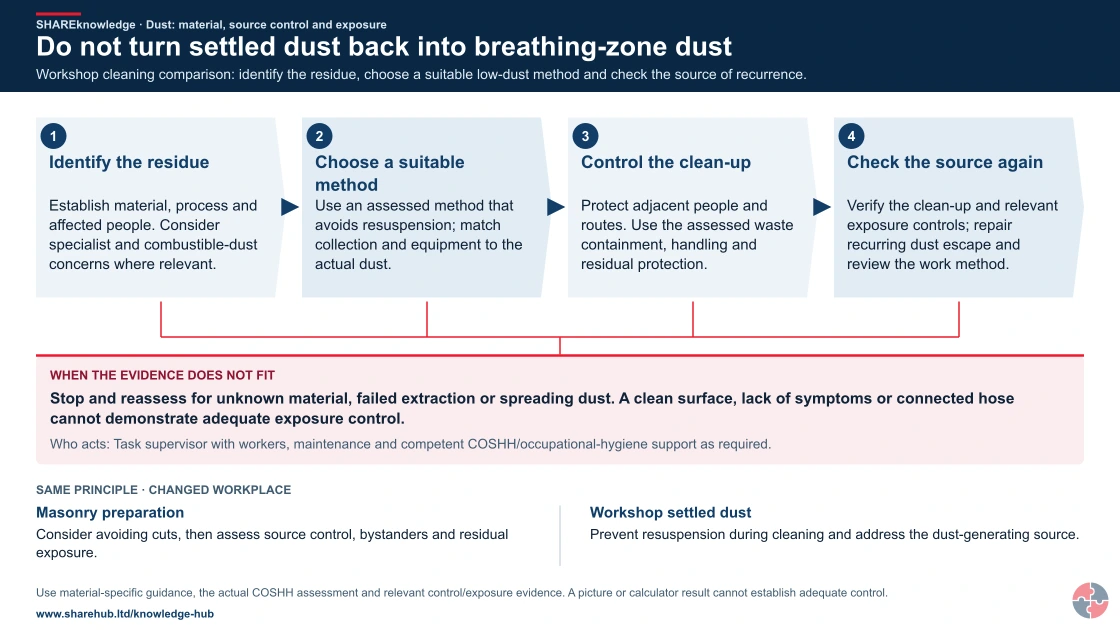
Full written explanation
Workshop cleaning comparison: identify the residue, choose a suitable low-dust method and check the source of recurrence.
- Identify the residue. Establish material, process and affected people. Consider specialist and combustible-dust concerns where relevant.
- Choose a suitable method. Use an assessed method that avoids resuspension; match collection and equipment to the actual dust.
- Control the clean-up. Protect adjacent people and routes. Use the assessed waste containment, handling and residual protection.
- Check the source again. Verify the clean-up and relevant exposure controls; repair recurring dust escape and review the work method.
When the evidence does not fit: Stop and reassess for unknown material, failed extraction or spreading dust. A clean surface, lack of symptoms or connected hose cannot demonstrate adequate exposure control.
Who acts: Task supervisor with workers, maintenance and competent COSHH/occupational-hygiene support as required.
Changed workplace
Masonry preparation: Consider avoiding cuts, then assess source control, bystanders and residual exposure.
Workshop settled dust: Prevent resuspension during cleaning and address the dust-generating source.
Evidence check: Use material-specific guidance, the actual COSHH assessment and relevant control/exposure evidence. A picture or calculator result cannot establish adequate control.
Avoid the task, assess source controls and verify material-specific exposure
Primary references: HSE: construction-dust task guidance (GB) · HSE: cutting paving blocks, kerbs and flags (GB)
Open the complete HD image (new tab)Download image

Avoid the task, assess source controls and verify material-specific exposure
Primary references: HSE: construction-dust task guidance (GB) · HSE: cutting paving blocks, kerbs and flags (GB)
BuildOut Ltd
BuildOut Ltd is a construction and refurbishment business with cutting, drilling, demolition, sanding, plasterboard, cement, wood and subcontractor activities across multiple sites.
BuildOut starts at pre-construction planning. Designers and planners identify high-dust work, order pre-cut materials where possible, plan wet methods, specify on-tool extraction, separate dusty tasks from occupied areas and check whether asbestos surveys or specialist dust controls are required before work starts.
The risk register separates dust types: silica from concrete and masonry, wood dust from carpentry, cement dust from mixing, plasterboard dust from sanding, lead dust from old paint and asbestos fibres from suspect materials. Each entry has a method statement, controls, RPE standard, cleaning method, health-surveillance trigger and supervisor check.
Supervisors use active monitoring at the workface. They check water flow, extraction hoses, filter class, airflow indicators, RPE fit, clean-shaven status, exclusion, housekeeping and whether workers understand why dry sweeping and compressed air are prohibited.
Use the source matching the material and claim: HSE - Construction dust specific tasks; HSE - Suspected asbestos: stop work; HSE - Construction hazardous substances: lead. EH44 does not cover explosion, asbestos or lead.
| Element | How BuildOut manages it | Evidence |
|---|---|---|
| Assess and plan | Identifies dust tasks before work starts and separates silica, wood, cement, plasterboard, lead and asbestos risks. | Dust risk register, surveys, COSHH assessments and method statements. Sources: HSE - Construction dust specific tasks; HSE - Suspected asbestos: stop work; HSE - Construction hazardous substances: lead. |
| Procure controls | Buys tools with compatible on-tool extraction, M/H class vacuums, water-suppression equipment and suitable RPE. | Procurement standard, equipment register and inspection records. Sources: HSE - Dust in the workplace: General principles of protection. |
| Train and brief | Gives general dust awareness plus task-specific training for silica, wood, cement, asbestos awareness and RPE use. | Training matrix, toolbox talks and face-fit records. Sources: HSE - Construction dust specific tasks; HSE - Suspected asbestos: stop work; HSE - Respiratory protective equipment. |
| Implement and supervise | Checks water, LEV, extraction, exclusion, cleaning and RPE at the point of work. | Supervisor check sheets, observations and stop-work records. Sources: HSE - Dust in the workplace: General principles of protection. |
| Monitor and maintain | Reviews exposure monitoring, dust-lamp demonstrations, LEV tests, vacuum condition and health-surveillance outcomes. | Monitoring reports, 14-month LEV test records and health-surveillance trend review. Sources: HSE - Dust in the workplace: General principles of protection. |
| Learn and improve | Investigates dust complaints, failed controls, visible dust clouds, RPE non-use and health symptoms. | Corrective actions, design changes and subcontractor reviews. Sources: HSE - Dust in the workplace: General principles of protection. |
Worked task decision
A refurbishment team is about to cut concrete blocks beside an occupied corridor. This illustrative decision must be adapted to the real workplace and competent assessment.
| Decision stage | Worked example |
|---|---|
| Task and people | Block cutting may release respirable crystalline silica; cutters, helpers, corridor users and cleaners can be exposed. |
| Before work | Confirm material and asbestos information; select pre-cut supply or a lower-dust method before specifying wet cutting or extraction. |
| Decision owner | Site supervisor signs off task method and segregation; competent occupational hygienist advises if exposure/control is uncertain. |
| During work | Separate the occupied corridor, use suitable source capture or wet suppression, inspect controls and prevent dust migration. |
| Hold or stop | Stop if material identity is uncertain, water or extraction fails, visible escape reaches others, or RPE cannot be worn as selected. |
| Hand-back | Clean by a safe method, check no residual contamination and reopen the corridor only after the boundary is safe. |
| Evidence and change | Keep material check, COSHH assessment, method and equipment checks, worker training, observation and any exposure-monitoring decision. |
What training should support dust management?
Dust training should be tiered so everyone understands the basics and high-risk workers receive task-specific control training.
General awareness should explain that dust can cause serious disease even when exposure feels ordinary. Workers need to understand visible versus respirable dust, common dust types, symptoms, cleaning rules, RPE limits and why controls must be used before the dust cloud forms.
Task-specific training should be practical: how to connect on-tool extraction, check water flow, inspect hoses, choose the right vacuum class, fit and wear RPE, clean safely, report failed controls and stop work where asbestos or uncontrolled dust is suspected.
Supervisors and managers need deeper training on COSHH assessment, DSEAR, control selection, monitoring, health surveillance, LEV examination, contractor standards and how to interpret warning signs. See HSE - COSHH.
| Level | Audience | Content | Observed demonstration | Record and recheck | Who assesses |
|---|---|---|---|---|---|
| General dust awareness | All workers who may create or be near dust. | Dust health effects, routes of entry, reporting symptoms and basic controls. Sources: HSE - COSHH. | Identify task dust, affected bystanders and a failed extraction or cleaning trigger. | Induction observation; refresh when materials or tasks change. | Supervisor or HSE adviser |
| Task-specific control training | Cutting, drilling, sanding, mixing, cleaning and maintenance workers. | Wet methods, LEV, on-tool extraction, RPE, cleaning and stop-work triggers. Sources: HSE - COSHH. | Connect and check on-tool extraction or wet suppression, segregate others and stop a failed setup. | Practical task observation and equipment pre-use record. | Competent task supervisor |
| RPE training | Workers issued with respiratory protection. | Selection, assigned protection factor, face fit, clean-shaven rule, storage and maintenance. Sources: HSE - COSHH. | Select and wear task-appropriate RPE and show a seal check where applicable. | Selection and face-fit evidence; repeat when mask, wearer or task changes. | Competent RPE fit tester and supervisor |
| Supervisor training | Supervisors and site managers. | COSHH, DSEAR, monitoring, inspection, control failure and worker coaching. Sources: HSE - COSHH. | Read the COSHH task assessment and respond to a failed LEV test or uncontrolled release. | Supervisor scenario and corrective-action record. | HSE adviser or occupational hygienist |
| Specialist training | HSE advisers, LEV responsible persons and occupational-health coordinators. | Exposure monitoring, health surveillance, LEV testing and data review. Sources: HSE - COSHH. | Interpret exposure sampling, control performance and health-surveillance signals without using a WEL as a safe/no-effect boundary. | Competent technical review, recommendations and follow-up monitoring decision. | Competent occupational hygienist or occupational health lead |
How should the controls be managed and reviewed?
Assign owners to the significant risks, put the chosen controls into the work plan, check that they work in practice and change them when conditions or evidence change.
HSE describes this as a continuing plan, do, check and act process. For dust, record who checks the controls, what evidence shows they are working, and which failure stops the work or triggers review. A formal management system is a choice, not a substitute for the applicable legal duties. Read HSE management guidance.
What are the warning signs that dust is not being controlled?
Warning signs are visible dust, failed controls, poor cleaning, symptoms and evidence that exposure is not understood.
A dusty workplace often gives warnings before serious disease is recognised. Dust on ledges, workers brushing off clothing, coughing, blocked filters, missing airflow indicators, masks worn with stubble, dry sweeping, uncontrolled cutting and complaints from nearby workers all suggest the system is weak.
These warning signs can lead to harm because they allow repeated inhalation exposure, spread contamination into welfare areas, hide failed extraction, weaken trust and normalise poor practice. They should trigger review, not reassurance.
Use the source matching the material and claim: HSE - COSHH; HSE HSG103: Safe handling of combustible dusts. EH44 does not cover explosion, asbestos or lead.
| Warning sign | How harm can manifest | What to check |
|---|---|---|
| Visible dust cloud | High exposure to workers and bystanders. | Source control, wet method, extraction and task planning. Sources: HSE - Dust in the workplace: General principles of protection. |
| Settled dust on ledges | Re-suspension and combustible dust accumulation. | Housekeeping, extraction and DSEAR review. Sources: Construction dust: dry sweeping; HSE HSG103: Safe handling of combustible dusts. |
| Dry sweeping or compressed air | Fine particles become airborne again. | Cleaning procedure, vacuums and supervision. Sources: HSE - Dust in the workplace: General principles of protection. |
| Workers coughing or reporting symptoms | Possible respiratory irritation, asthma or early disease. | Health surveillance, exposure monitoring and task controls. Sources: HSE - Dust in the workplace: General principles of protection. |
| LEV airflow low or untested | Dust is not captured at source. | LEV examination, filters, ducting and user checks. Sources: HSE - Dust in the workplace: General principles of protection. |
| RPE used as main control | Workers remain exposed if fit, wear or maintenance is poor. | Hierarchy of controls and RPE programme. Sources: HSE - Dust in the workplace: General principles of protection. |
| Dusty clothing in welfare areas | Exposure spreads to clean areas and ingestion risk increases. | Changing, laundry, hygiene and zoning. Sources: HSE - Dust in the workplace: General principles of protection. |
Chemical hazard symbols: what do they mean?
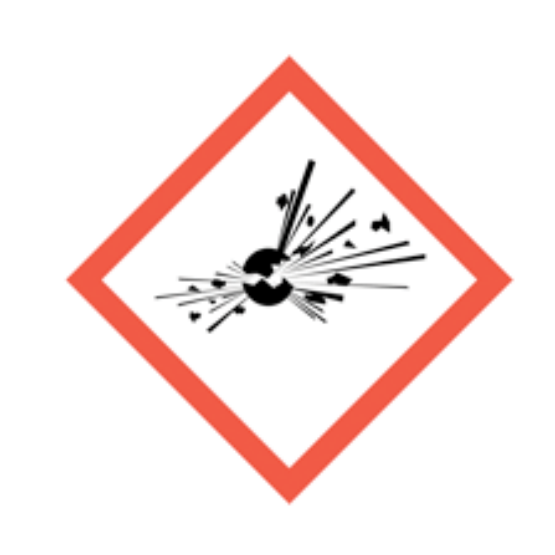
Exploding bomb
Explosive, self-reactive or organic peroxide hazards.
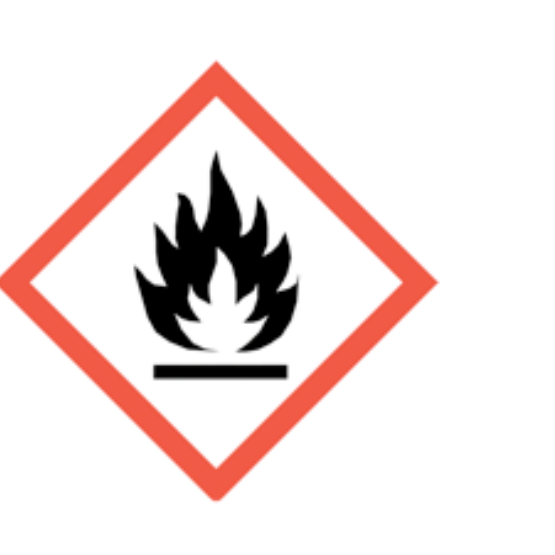
Flame
Flammable, self-heating or pyrophoric substances.
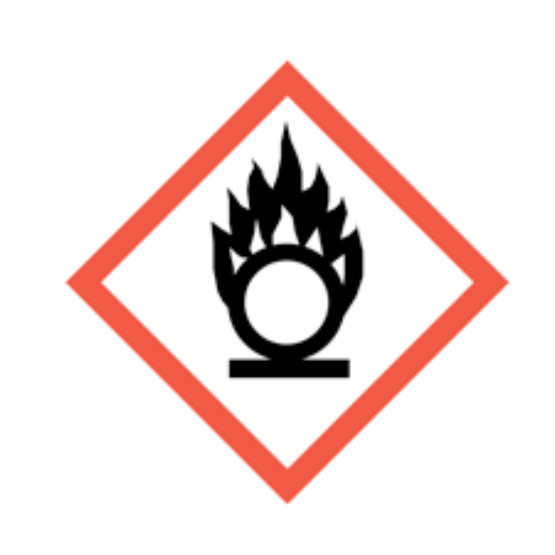
Flame over circle
Oxidising substances that can intensify fire.

Gas cylinder
Gas under pressure.
Corrosion
Skin burns, eye damage or corrosive to metals.
Skull and crossbones
Acute toxicity.

Exclamation mark
Irritation, harmful effects or skin sensitisation; some classifications cover drowsiness, dizziness or ozone-layer hazard. Read the actual hazard statements. Skin sensitisation differs from respiratory sensitisation.
Health hazard
Serious health hazards, including organ damage, aspiration hazard, respiratory sensitisation, cancer and reproductive effects; some can follow a single exposure.
Environment
Hazardous to the aquatic environment.
What do the acronyms and key terms mean?
Acronyms should be clear before they are used in risk assessments, monitoring reports or training.
| Acronym or term | Meaning | Meaning in this task |
|---|---|---|
| COSHH | Control of Substances Hazardous to Health Regulations. Source: Control of Substances Hazardous to Health Regulations 2002. | Health-exposure assessment and control route for hazardous dust; NI has its own COSHH instrument. |
| DSEAR | Dangerous Substances and Explosive Atmospheres Regulations. Source: Dangerous Substances and Explosive Atmospheres Regulations 2002. | Fire and explosion route when a dust can form an explosive atmosphere; NI has a separate instrument. |
| LEV | Local Exhaust Ventilation. Source: HSE - Local exhaust ventilation. | Source extraction that must capture dust at release and be maintained and examined. |
| RPE | Respiratory Protective Equipment. Source: HSE - Respiratory protective equipment. | Breathing protection for residual exposure, chosen for the dust and wearer. |
| PPE | Personal Protective Equipment. Source: HSE - Respiratory protective equipment. | Personal equipment remains a final layer after reducing dust at source. |
| WEL | Workplace Exposure Limit. Source: Control of Substances Hazardous to Health Regulations 2002. | Airborne exposure benchmark for a stated substance and averaging period; it is not a safe/no-effect line. |
| RCS | Respirable Crystalline Silica. Source: HSE - CN COSHH essentials in construction: Silica. | Fine crystalline silica fraction that can reach deep lung during concrete or stone work. |
| TWA | Time-Weighted Average. Source: HSE - MDHS guidance. | Averaging method for measured airborne concentration over the specified reference time. |
| MDHS | Methods for the Determination of Hazardous Substances. Source: HSE - MDHS guidance. | HSE measurement-method series; choose a method for the actual substance and sampling purpose. |
| APF | Assigned Protection Factor for RPE. Source: HSE - Respiratory protective equipment. | The assigned protection factor is one input to choosing suitable RPE for the assessed dust and exposure. |
| ATEX | Equipment and protective systems intended for potentially explosive atmospheres. Source: Dangerous Substances and Explosive Atmospheres Regulations 2002. | Equipment and protective-system suitability for assessed explosive atmospheres; not a substitute for DSEAR risk control. |