
SHARE Knowledge Hub
How should contractor safety be managed?
Start contractor control before appointment: define the work and site hazards, select capability, agree a safe method, coordinate interfaces, check the live job and record safe hand-back.
Understanding How should contractor safety be managed?
Start contractor control before appointment: define the work and site hazards, select capability, agree a safe method, coordinate interfaces, check the live job and record safe hand-back.
Why this matters at work
Agree who provides induction, welfare, competent supervision, emergency information, isolations, permits where justified and handback verification. Check the real people, equipment and method before exposure and monitor implementation. Construction work can add CDM duties, with separate GB and NI instruments. Keep proportionate records of scope, responsibilities, evidence, restrictions and changes. The degree of enquiry and oversight should reflect the hazard and complexity; a low-risk service visit and intrusive high-hazard maintenance should not receive identical treatment.
Act on deviations promptly, including stopping the affected work safely where a critical condition is unproven. Record significant findings, owners and correction evidence, and verify effectiveness rather than accepting a promise. Avoid taking over specialist supervision informally and creating unclear responsibility. Coordinate other work and handovers. The contractor still manages its work and people, while the host retains duties within its influence. Good monitoring examines physical controls and decisions, not merely whether documents are present.
How organisations manage this in practice
The physical precautions must be implemented and verified separately: a permit cannot isolate energy, prevent flooding, remove flammable vapour or supply rescue capability. Check conditions at the workface, coordinate simultaneous tasks and suspend affected permits when conditions change. Communicate restrictions clearly to contractors and host staff. Retain relevant evidence and ensure handback establishes the resulting plant state. Applicable specific legal duties and local procedures must be checked for the actual GB or NI setting.
Agree monitoring arrangements before work starts, proportionate to the risk and each party’s control. Check whether people, method, equipment and site conditions match the agreed arrangements. Look at effective guarding, exclusion, extraction, isolation boundaries, welfare and emergency access where relevant. Speak with workers about changes and uncertainties. The host should retain enough competence to recognise concerns and seek specialist help where it cannot judge a critical technical matter.
Review the assessment and task information, including public exclusion, falling objects, isolation and emergency arrangements as relevant. Confirm technical suitability and required checks through competent people before releasing the changed scope. Record the change and brief those affected. Check why the original specification or arrival process missed the work and improve future mobilisation. A familiar contractor or an unexpired training card does not establish readiness for a different task on unfamiliar premises.
Use the quick route from scope to safe hand-back
For a small employer, start with a named host job owner and contractor supervisor. Agree the work and boundaries, exchange relevant hazards, verify capability and equipment, brief site arrangements and check the method at the workface. Then monitor the job and agree how the area or equipment is handed back safely.
Best-practice guide: Contractor Safety
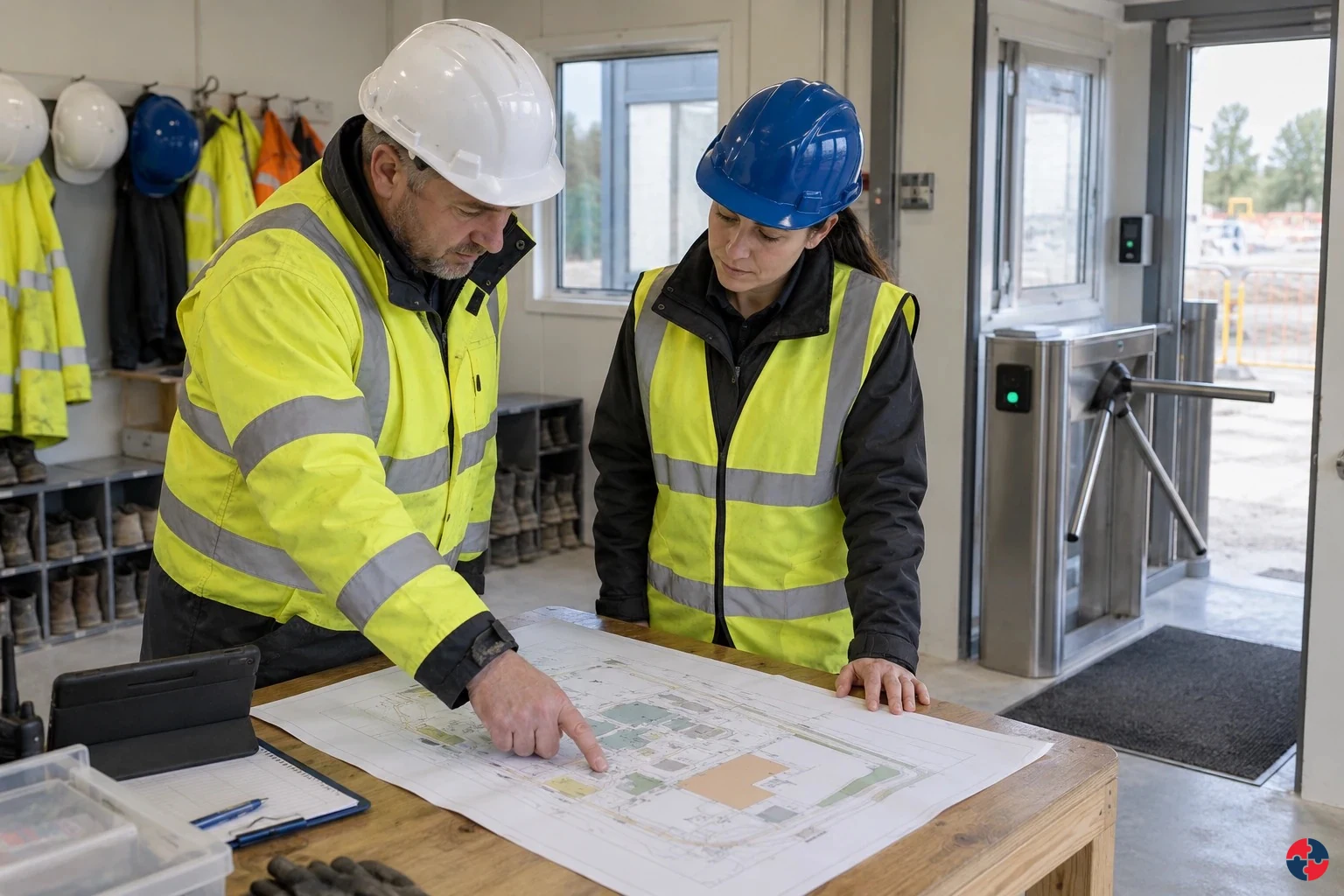
Use the quick route from scope to safe hand-back
For a small employer, start with a named host job owner and contractor supervisor. Agree the work and boundaries, exchange relevant hazards, verify capability and equipment, brief site arrangements and check the method at the workface. Start contractor control before appointment: define the work and site hazards, select capability, agree a safe method, coordinate interfaces, check the live job and record safe hand-back.
Turn contractor safety knowledge into a decision
Start contractor control before appointment: define the work and site hazards, select capability, agree a safe method, coordinate interfaces, check the live job and record safe hand-back. Contract plan and risk register.
the site team contractor management system
Assessing: Defines scope, hazards, CDM role, interface risks and competence requirements. Evidence / response: Contract plan and risk register. Analysing: Uses risk category to decide pre-qualification depth and supervision level. Evidence / response: Contractor approval matrix.
Warning signs and how harm can develop
Contractor appointed before scope is clear: Wrong competence, tools or method arrive on site. Generic RAMS: Controls do not fit the actual job. No site-specific induction: Contractors miss local hazards and emergency rules.
Choose controls for contractor safety
Eliminate: Ground-level or off-site repair if technically possible. Substitute: Prefabricate to shorten exposure after compatibility check. Engineering: Guardrails and physical loading-bay segregation. Administrative: Access check, shared schedule, traffic briefing and change log. PPE: Residual fall protection and rescue capability. Read the full control table for qualifications, ownership and verification. Use the actual task and applicable jurisdiction; existing technical approval remains unchanged.
Use the full contractor safety lesson
Use the full topic for the decision points, practical examples, detailed control tables and source scope. HSE guidance applies to Great Britain; use HSENI for the Northern Ireland route and the source’s stated jurisdiction. A simplified guide does not change the page’s technical-review or approval status.

Read all six steps as text
1. Use the quick route from scope to safe hand-back
For a small employer, start with a named host job owner and contractor supervisor.
- Avoid / redesign: Ground-level or off-site repair if technically possible.
- Control the task: Guardrails and physical loading-bay segregation.
- Verify before release: Host designer records decision; hold roof work when no-height route works.
For a small employer, start with a named host job owner and contractor supervisor. Agree the work and boundaries, exchange relevant hazards, verify capability and equipment, brief site arrangements and check the method at the workface. Start contractor control before appointment: define the work and site hazards, select capability, agree a safe method, coordinate interfaces, check the live job and record safe hand-back.
Apply it: Which part of this plan would you check at the workface before authorising the task?
2. Turn contractor safety knowledge into a decision
Use the evidence to improve the actual work arrangement.
- Change at source: Ground-level or off-site repair if technically possible.
- Make it observable: Host designer records decision; hold roof work when no-height route works.
- Keep useful evidence: Contract plan and risk register.
Start contractor control before appointment: define the work and site hazards, select capability, agree a safe method, coordinate interfaces, check the live job and record safe hand-back. Contract plan and risk register.
Apply it: What evidence would show that the change improves this task, rather than only completing a record?
3. the site team contractor management system
Example: a practical application of the existing topic lesson.
- Assessing: Defines scope, hazards, CDM role, interface risks and competence requirements.
- Analysing: Uses risk category to decide pre-qualification depth and supervision level.
- Implementing: Uses pre-start meetings, induction, RAMS review, permits and bridging documents.
Assessing: Defines scope, hazards, CDM role, interface risks and competence requirements. Evidence / response: Contract plan and risk register. Analysing: Uses risk category to decide pre-qualification depth and supervision level. Evidence / response: Contractor approval matrix.
Apply it: At which point would you hold this example, and what evidence would allow it to proceed?
4. Warning signs and how harm can develop
Connect the task, the route to the person and the control that can fail.
- Contractor appointed before scope is clear: Wrong competence, tools or method arrive on site.
- Generic RAMS: Controls do not fit the actual job.
- No site-specific induction: Contractors miss local hazards and emergency rules.
Contractor appointed before scope is clear: Wrong competence, tools or method arrive on site. Generic RAMS: Controls do not fit the actual job. No site-specific induction: Contractors miss local hazards and emergency rules.
Apply it: Who could be exposed, including other trades, cleaners, maintainers and people nearby?
5. Choose controls for contractor safety
Start with the stronger practicable options and verify their effect.
- Eliminate: Ground-level or off-site repair if technically possible.
- Substitute: Prefabricate to shorten exposure after compatibility check.
- Engineering: Guardrails and physical loading-bay segregation.
- Administrative: Access check, shared schedule, traffic briefing and change log.
- PPE: Residual fall protection and rescue capability.
Eliminate: Ground-level or off-site repair if technically possible. Substitute: Prefabricate to shorten exposure after compatibility check. Engineering: Guardrails and physical loading-bay segregation. Administrative: Access check, shared schedule, traffic briefing and change log. PPE: Residual fall protection and rescue capability. Read the full control table for qualifications, ownership and verification. Use the actual task and applicable jurisdiction; existing technical approval remains unchanged.
Apply it: Which stronger option can be used here, and who will verify it before accepting the remaining risk?
6. Use the full contractor safety lesson
Follow the official sources below and retain the task-specific evidence.
- Official guidance: HSE work at height
- Official guidance: HSENI working at height
- Task decision: Contract plan and risk register.
Use the full topic for the decision points, practical examples, detailed control tables and source scope. HSE guidance applies to Great Britain; use HSENI for the Northern Ireland route and the source’s stated jurisdiction. A simplified guide does not change the page’s technical-review or approval status.
Apply it: Which official source and full-topic section will you use to resolve the next decision?
An induction explains the site but does not authorise a new task. If routine maintenance turns into cutting, high-level access or opening equipment, the contractor supervisor stops and tells the host owner. They reassess introduced hazards and interfaces before release. Use the broader supply-chain guide for organisational selection and oversight, and the process-industry guide for hazardous-plant and barrier work.
BuildOut: the routine repair needs an unplanned cut
Illustrative example. A maintenance contractor discovers that replacing a fitting requires cutting beyond the agreed scope.
Decision. The contractor supervisor stops the added work and asks the host job owner to agree a safe assessed method and required authorisation.
Evidence to check. Actual scope, exchanged hazards, relevant capability, suitable equipment, site controls and agreed hand-back conditions.
Hold or escalation point. A visitor induction or approval for the original repair cannot release the changed task.
Follow-up. Check the completed area or equipment with both parties and record what future job planning should include.
Keep both job owners visible from scope to hand-back
The host job owner and contractor supervisor need shared understanding of the task and its interfaces. Site changes require a new conversation and control check.

Define and exchange
Name both owners, agree scope and exchange site/introduced hazards.
Check understanding
Verify the method, competence, interfaces and pre-start understanding with the people doing the work.
Monitor and hand back
Check actual conditions, stop/review change and verify safe hand-back through the agreed route.
Neither familiarity with a contractor nor a method statement alone proves the live task is safe.
What are the key points for contractor safety?
The key points are to plan early, choose contractors carefully, define responsibilities, share information, coordinate the work, monitor performance and learn after completion.
Contractor safety starts before procurement
The scope, risk, competence and resources should be understood before a contractor is selected.
Selection must be risk-based
A low-risk office service does not need the same scrutiny as asbestos removal, confined-space work, roof work, hot work or electrical isolation.
The client retains duties
Using a contractor does not remove the client or host organisation’s legal and practical responsibilities.
Interfaces are often where failure happens
Contractor work can affect operations, visitors, employees, other contractors, services, traffic, fire precautions and emergency routes.
RAMS must be job-specific
Generic RAMS give false confidence and rarely control the real task.
Supervision and assurance must be visible
The work has to be checked at the point of risk, not only approved from a desk.


How should contractor safety be managed? in a working scene
Try 1 scenario with images, explanations and decisions that develop into follow-on situations. Trace how a hazard can cause harm, compare work arrangements and choose controls.
What is contractor safety?
Contractor safety is the end-to-end control of risks linked to contracted work, from need definition through to post-job learning.
A contractor is an individual or organisation engaged to carry out work or provide a service. Contractors may work on site, remotely, in a shared workplace, on construction projects, on plant and equipment, in customer-facing environments, or as part of specialist services such as cleaning, security, asbestos, electrical work, scaffolding, transport, maintenance or design.
Contractor safety is wider than checking insurance and collecting a risk assessment. It asks whether the work is needed, what can go wrong, who controls the work area, what information the contractor needs, whether the contractor is competent for this specific work, how interfaces will be managed, who supervises, and what evidence proves the controls are working.
The standard should be proportionate. A small supplier delivering stationery does not need the same system as a contractor carrying out hot work in a live plant room. The discipline is matching the management effort to the credible risk.
| Element | What it means | Why it matters |
|---|---|---|
| Planning | Define the work, risks, site constraints and expected standard. | Prevents poor scope and unsafe assumptions. |
| Selection | Check capability, competence, resources and experience. | Avoids appointing contractors who cannot manage the risk. |
| Coordination | Agree who does what, when and how. | Controls interfaces and simultaneous activities. |
| Communication | Share site hazards, emergency arrangements and rules. | Prevents unfamiliarity becoming risk. |
| Monitoring | Check workface controls and contractor performance. | Finds drift before harm occurs. |
| Review | Capture learning, defects and performance after completion. | Improves future appointments and standards. |
What is the contractor safety lifecycle?
Plan the job, select and brief the contractor, check the work and hand-back, then review performance.
The HSENI five-step guide begins when the need for work is known. The host specifies hazards; the contractor explains capability, people and method; both agree supervision and changes. On site, test the actual workface and nearby activities. After completion, verify equipment, guards, services and permits before normal use. HSE HSG159 gives a parallel GB lifecycle.
HSG159 second edition 2011 provides a contractor lifecycle for the chemical industry that can inform proportionate practice elsewhere. Check its older law references against the current GB or NI legal route; construction duties use CDM 2015 in GB and the separate CDM 2016 rules in NI.
How should contractors be pre-qualified and selected?
Contractors should be selected by checking whether they have the competence, resources, systems and experience to manage the risks of the proposed work.
Pre-qualification is not a one-size-fits-all questionnaire. It should reflect the work category. A contractor doing high-voltage electrical work, roof work, confined-space rescue, asbestos removal or heavy lifting needs deeper checks than a low-risk service provider.
Good selection checks organisational capability, named competent people, previous experience, accident and enforcement history, training, plant and equipment, supervision arrangements, subcontractor control, insurance, health surveillance where relevant, and whether the contractor understands the hazards of the host site.
Price and availability should not override safety capability. If a contractor cannot explain how they will control the task, how they supervise workers or how they manage subcontractors, they are not yet ready to be appointed for higher-risk work.
| Check | What good looks like | Evidence |
|---|---|---|
| Work category | Contractor approved for the specific type and risk of work. | Approved contractor register with scope limits. |
| Competence | Named competent people, qualifications and experience. | Training, cards, certificates and CVs. |
| Management system | Risk assessment, supervision, incident reporting and audit arrangements. | Policies, procedures and sample records. |
| Performance history | Relevant safety performance, enforcement and learning history reviewed. | Performance review and references. |
| Resources | Suitable people, plant, equipment, PPE/RPE and supervision. | Plant records and staffing plan. |
| Subcontractor control | Rules for appointing and supervising subcontractors. | Supply-chain procedure and approvals. |
How should scope, RAMS and work planning be managed?
Scope, RAMS and planning should translate the job into a safe sequence that fits the actual site, people, plant and interfaces.
Poor contractor safety often begins with a vague scope: “fix the roof”, “service the tank”, “remove old pipework”, “install new cabling”. A good scope defines the area, equipment, standards, exclusions, known hazards, operational constraints, services, access, waste, emergency requirements and handback expectations.
RAMS should then show how the contractor will do that specific work. They should not be generic documents with copied hazards. A useful RAMS review checks sequence, tools, materials, substances, isolations, permits, lifting, work at height, traffic, fire, electrical safety, occupational health risks, welfare and emergency arrangements.
The review should involve people who understand the work, not only an administrator. Where the contractor’s method is unclear, the job should not start until the method is clarified and agreed.
| Item | Questions to ask | Weak signal |
|---|---|---|
| Scope | What exactly is included, excluded and handed back? | Contractor arrives with a different understanding. |
| Site hazards | What does the contractor need to know about the workplace? | RAMS ignore live operations or hidden services. |
| Task sequence | Does the method follow a logical safe order? | Controls appear after exposure occurs. |
| Interfaces | Who else is affected by the work? | No coordination with operations or other contractors. |
| Emergency arrangements | What happens if something goes wrong? | Emergency plan is generic or unknown. |
| Change control | What happens if the job changes? | Contractor improvises outside the approved method. |
How should contractor rules and bridging documents work?
Contractor rules and bridging documents explain the standards that apply and how the client and contractor systems fit together.
Many contractors arrive with their own procedures. The client or host organisation also has rules. A bridging document is useful where both sets of arrangements need to join: permit systems, isolation rules, emergency procedures, welfare, reporting, PPE, driving, lifting, hot work, confined spaces, lone working, environmental controls and stop-work authority.
The key principle is clarity. If there is a conflict between the contractor method and host rule, the higher or agreed standard should be defined before work starts. Contractors should not discover critical rules at the gate or during an incident.
For recurring contractors, the rules can become a contractor handbook or framework standard. For high-risk projects, the bridge should be reviewed at pre-start meetings and toolbox talks so it is understood by supervisors and workers.
| Area | What to define | Evidence |
|---|---|---|
| Site rules | Access, welfare, PPE, housekeeping, smoking and reporting. | Contractor handbook and induction. |
| High-risk work | Permit, isolation, hot work, lifting, confined spaces and roof work standards. | Bridge document and work permits. |
| Emergency arrangements | Alarms, muster, rescue, first aid and spill response. | Briefings and drills where relevant. |
| Supervision | Who supervises contractor workers and who monitors from client side. | Supervision plan. |
| Subcontractors | Whether subcontracting is allowed and how it is approved. | Subcontractor approval process. |
| Stop-work authority | Who can stop unsafe work and how work restarts. | Stop-work rule and escalation route. |
How should contractor onboarding and induction be managed?
Onboarding and induction should make contractors ready for the real site and the real work, not just logged into an access system.
A good induction is site-specific and risk-based. It should explain hazards contractors may not know: traffic routes, fire alarms, asbestos information, fragile roofs, buried services, plant rooms, hazardous substances, restricted areas, customer interfaces, security, lone working, emergency routes and reporting expectations.
Induction should not be the only control. Workers also need task briefings, permit briefings, supervisor contact, welfare information, competence checks and confirmation that they understand the method. For long projects, induction should be refreshed when the site changes.
Language, literacy, experience and employment status matter. Agency workers, subcontractors, overseas workers and short-notice specialists may need additional support to make sure information is understood.
| Control | What good looks like | Evidence |
|---|---|---|
| Pre-start meeting | Client and contractor agree hazards, method, programme and responsibilities. | Meeting record and actions. |
| Site induction | Specific hazards, rules, emergency and reporting arrangements. | Induction records. |
| Task briefing | Workers understand the RAMS and local controls. | Briefing signatures and supervisor check. |
| Competence verification | Critical workers have required authorisations and skills. | Cards, certificates and authorisation records. |
| Permit briefing | Permit receiver understands scope, limits and stop triggers. | Permit sign-on and field verification. |
| Access control | Only authorised people enter controlled work areas. | Access list and sign-in records. |
How can the hierarchy of controls reduce risks during contractor activities?
A named host contact and contractor lead share changing hazards, protect adjacent people and stop when the agreed boundary fails.
For roof repair above a loading bay, eliminate work at height through ground repair if feasible; otherwise reduce exposure by prefabrication. Engineer edge protection and physical vehicle segregation, then schedule work, inspect access and brief drivers. Personal fall equipment is residual protection with rescue, never the loading-bay barrier. Stop for a delivery entering the zone or missing guardrail. The HSE work-at-height guide and HSENI work-at-height guide support the fall-control order. The HSE contractor guide says resolve doubts before work.
On a small screen, scroll this table sideways to read all columns.
How can the ERICPD hierarchy of controls reduce risks during contractor activities?

| Five-level / ERICPD | Control choice | Owner, evidence, failure and stop |
|---|---|---|
| Eliminate / eliminate | Ground-level or off-site repair if technically possible. | Host designer records decision; hold roof work when no-height route works. |
| Substitute / reduce | Prefabricate to shorten exposure after compatibility check. | Contractor lead approves; stop if fit or lifting method fails. |
| Engineering / isolate and control | Guardrails and physical loading-bay segregation. | Host supervisor inspects; stop on barrier breach. |
| Administrative / discipline | Access check, shared schedule, traffic briefing and change log. | Host contact checks each shift; stop on uncoordinated deliveries. |
| PPE / PPE | Residual fall protection and rescue capability. | Contractor supervisor checks; no work on failed PPE or rescue. |
How can the ISO 45001 hierarchy of controls reduce risks during contractor activities?

| Five-level / ERICPD | Control choice | Owner, evidence, failure and stop |
|---|---|---|
| Eliminate / eliminate | Ground-level or off-site repair if technically possible. | Host designer records decision; hold roof work when no-height route works. |
| Substitute / reduce | Prefabricate to shorten exposure after compatibility check. | Contractor lead approves; stop if fit or lifting method fails. |
| Engineering / isolate and control | Guardrails and physical loading-bay segregation. | Host supervisor inspects; stop on barrier breach. |
| Administrative / discipline | Access check, shared schedule, traffic briefing and change log. | Host contact checks each shift; stop on uncoordinated deliveries. |
| PPE / PPE | Residual fall protection and rescue capability. | Contractor supervisor checks; no work on failed PPE or rescue. |
The HSE five-level hierarchy supports the general order in this example; ERICPD is a complementary planning aid. For falls, retain the specific avoid, prevent, minimise sequence and choose collective protection before individual protection.
Before roof work above the bay, the host and contractor establish the actual roof condition and fragility, access route, loads, edge geometry and vehicle movements. A competent person selects compatible guardrails and supports, safe access and physical traffic segregation; check installation and handover against the design or manufacturer requirements before use. Maintain the protection and access equipment, with repair and inspection records. The contractor supervisor checks them before use and as work progresses; the host checks the bay boundary and deliveries each shift and after weather, impact, alteration or a changed work sequence. A missing guardrail, damaged support, uncontrolled roof opening or vehicle entering the exclusion area stops affected work. Correct the defect or interface, have the relevant protection rechecked and agree the revised work boundary before restart. These physical checks supplement the schedule and briefing. HSE work-at-height selection and inspection and HSENI height guidance support the height route; HSE contractor transport coordination supports the shared bay interface.
How should contractor performance be monitored and assured?
Contractor performance should be monitored through planned checks that test whether controls are working at the point of risk.
Follow the refurbishment through verified hand-back
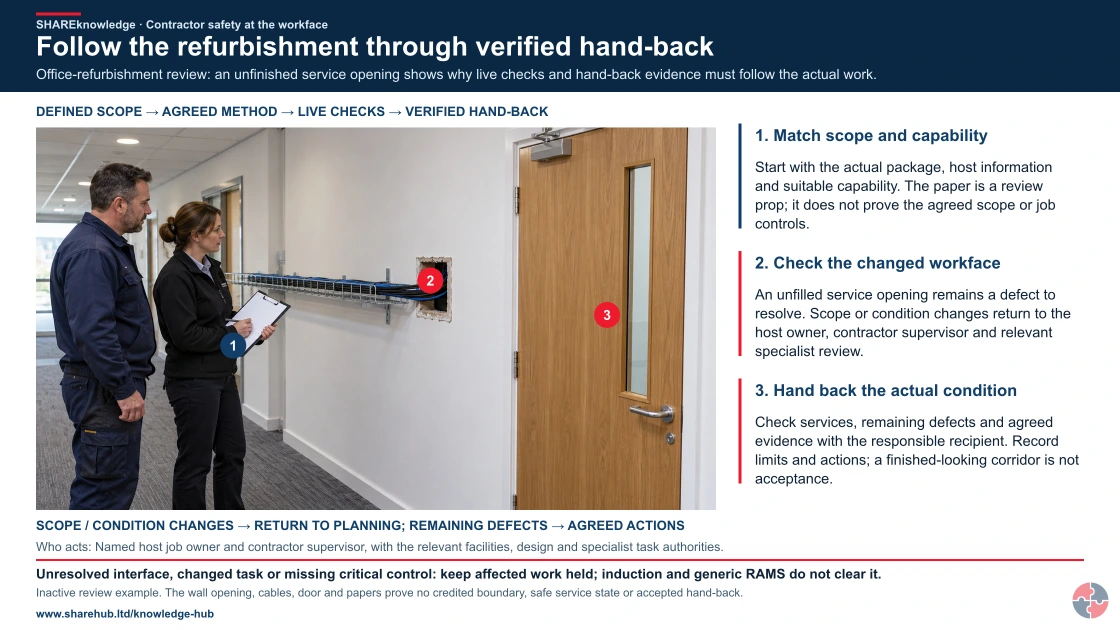
Full written explanation
A realistic UK office-refurbishment inspection places the unfinished work and its recipient in one view: supported service cables pass through a rough unfilled wall opening beside a closed timber door, while a contractor and host reviewer examine the work and a blank record. The reused physical scene makes the difference between a tidy-looking corridor and an unresolved hand-back condition visible. Three new native markers connect the actual work package/capability, changed workface and service opening, and the receiving area/remaining defects. A complete native lifecycle route links defined scope, agreed method, live checks and verified hand-back; a second native relationship returns changed scope or conditions to planning and remaining defects to agreed actions. The four original complete lifecycle steps, ownership, hold conditions, monitoring levels and records remain in the written alternative and current topic. The opening is a visible unresolved condition, not a specified fire-stop installation or a diagnosis of a wall or door rating. The depicted papers are inert review props. No cable energy state, credited fire boundary, compatible repair system, successful test, approval or accepted hand-back can be inferred. Nobody is carrying out electrical, drilling, hot-work or height work. Contractor selection and induction remain distinct from a job-specific safe method and ongoing coordination; construction dutyholder requirements and the separate GB/NI source routes stay in the current topic. No operating or installation recipe or release permission is introduced.
Office-refurbishment review: an unfinished service opening shows why live checks and hand-back evidence must follow the actual work.
- Set the work package. Define scope, occupied areas, host information, capability needs and any specialist task or design responsibilities.
- Agree the actual method. Exchange site and introduced risks, brief affected people and resolve the required controls before the relevant work.
- Check and respond. Use proportionate workface checks; changed scope or conditions return to the responsible planning and control review.
- Verify hand-back. Check the work area, services, remaining defects and agreed evidence with the responsible recipient; record limits and actions.
When the evidence does not fit: An unresolved interface, changed task or missing critical control keeps the affected work held. A completed induction or generic RAMS does not clear the new arrangement.
Who acts: Named host job owner and contractor supervisor, with the relevant facilities, design and specialist task authorities.
Changed workplace
Food-factory maintenance: Coordinate the host process with the contractor’s actual intervention and introduced risks.
Office refurbishment: Follow occupied-area changes and services through to a verified hand-back, including unresolved defects.
Evidence check: Use actual workface and hand-back evidence; neither the photograph nor a contractor approval establishes a safe method or permission to start.
Complete proportionate monitoring and assurance context
Primary references: HSE HSG159: managing contractors (GB) · HSENI: safe maintenance and contractor lifecycle (Northern Ireland)
Open the complete HD image (new tab)Download image

Complete proportionate monitoring and assurance context
Primary references: HSE HSG159: managing contractors (GB) · HSENI: safe maintenance and contractor lifecycle (Northern Ireland)
Monitoring is not hovering over competent contractors. It is proportionate assurance. Low-risk work may need occasional checks. High-risk work needs frequent field verification, permit checks, supervisor engagement and sometimes independent audit.
A strong system uses three levels. First-line checks are done by supervisors and work owners at the workface. Second-line checks are done by health and safety, facilities or operational leaders reviewing the quality of controls and records. Third-line assurance may include internal audit, external specialists, CDM audits, ISO audits or topic-specific reviews for high-risk work.
Findings should be ranked and assigned to named owners with due dates. Repeated minor findings, such as poor housekeeping, missing inductions or vague RAMS, are signals of management weakness and should affect contractor approval status.
| Level | Typical activity | Top tip |
|---|---|---|
| First line | Workface checks by supervisors, permit issuers and contract owners. | Use short binary checks for critical controls so trends can be compared across teams and sites. |
| Second line | HSSE, facilities or operational inspections and document reviews. | Use experienced reviewers, rank findings and assign verifiable actions. |
| Third line | Internal audit, external consultant, ISO, CDM or specialist topic audit. | Use a planned evidence-based audit sampling work, records, training and management-system data. |
| Performance review | Review incidents, near misses, defects, delays and quality issues. | Look for weak signals, not only injury statistics. |
| Contractor review | Assess contractor before reapproval or future work. | Use results to change status, scope limits or supervision level. |
| Leadership review | Senior managers review significant contractor risk and repeat findings. | Escalate systemic issues and resource needs. |
Which legal route applies to contractor work?
Host and contractor have work-health-and-safety duties; construction activity adds the applicable GB or NI CDM regime.
Use HSE HSG159 for GB contractor coordination and HSENI for NI. For construction, check GB CDM 2015 or NI CDM 2016 by location and work definition.
How should contractor safety appear in the risk register?
The risk register should describe contractor work categories, credible interface failures, controls and assurance evidence.

Induction and live-job coordination answer different questions
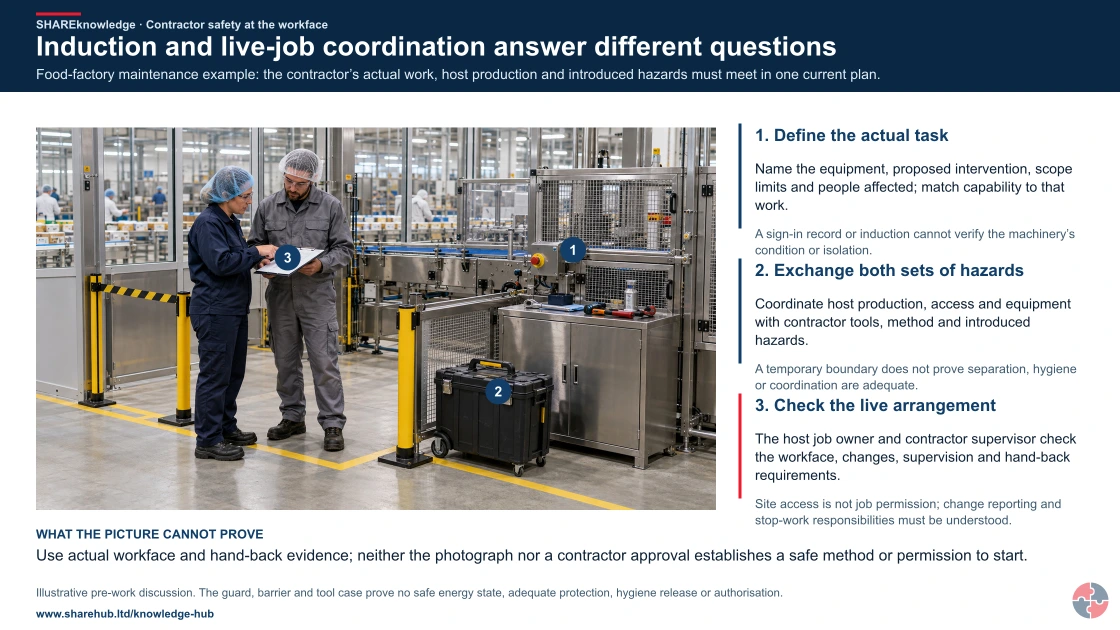
Full written explanation
Food-factory maintenance example: the contractor’s actual work, host production and introduced hazards must meet in one current plan.
- Define the actual task. Name the equipment, proposed intervention, scope limits and people affected; match capability to that work.
- Exchange both sets of hazards. Coordinate host production, access and equipment with contractor tools, method and introduced hazards.
- Check the live arrangement. The host job owner and contractor supervisor check the workface, changes, supervision and hand-back requirements.
Change the pathway
- Check the actual equipment. A sign-in record or induction cannot verify the machinery’s condition or isolation.
- Check the interface in use. A temporary boundary does not prove separation, hygiene or coordination are adequate.
- Keep ownership explicit. Site access is not job permission; change reporting and stop-work responsibilities must be understood.
Evidence check: Use actual workface and hand-back evidence; neither the photograph nor a contractor approval establishes a safe method or permission to start.
Complete proportionate monitoring and assurance context
Primary references: HSE HSG159: managing contractors (GB) · HSENI: safe maintenance and contractor lifecycle (Northern Ireland)
Open the complete HD image (new tab)Download image

Complete proportionate monitoring and assurance context
Primary references: HSE HSG159: managing contractors (GB) · HSENI: safe maintenance and contractor lifecycle (Northern Ireland)
A generic entry saying contractor risk is weak. A good register separates high-risk contractor activities: roof work, live electrical work, lifting, hot work, confined spaces, asbestos, excavation, traffic, cleaning chemicals, lone working, public interface and maintenance on safety-critical systems.
The register should also define escalation: which work needs permit control, which needs pre-start meeting, which needs site-specific induction, which needs daily supervision and which contractors have restricted approval.
| Scenario | Critical controls | Evidence |
|---|---|---|
| Roofing contractor works near fragile roof lights | Prequalification, RAMS, edge protection, fragile-roof controls and supervision. | Approved contractor record and inspection. |
| Electrical contractor isolates plant | Competence, isolation procedure, permit and handback test. | Authorisation and certificate. |
| Cleaning contractor uses hazardous chemicals | COSHH information, training, PPE and storage rules. | SDS, COSHH and induction. |
| Delivery contractor enters yard | Traffic plan, banksman rules and pedestrian segregation. | Site rules and observation. |
| Maintenance contractor creates hot work | Permit, fire watch, isolation and housekeeping. | PTW and close-out. |
| Subcontractor attends without approval | Access control and subcontractor approval. | Sign-in and contractor register. |
How could BuildOut Ltd manage contractor safety?

BuildOut Ltd could manage contractor safety through a lifecycle system that links procurement, CDM duties, competence, site control, supervision, assurance and learning.
BuildOut Ltd
BuildOut Ltd is a construction and refurbishment contractor used by SHARE to show how contractor safety can be managed across projects and facilities work.
BuildOut starts before appointment. The contract owner defines the scope, expected outputs, known hazards, work location, CDM role, competence requirements, access needs, welfare, permit triggers and interface risks. Procurement cannot appoint a contractor until the work category and safety-critical requirements are defined.
Pre-qualification is risk based. Roofing, scaffolding, electrical, asbestos, lifting, excavation, hot-work and confined-space contractors need deeper checks than low-risk suppliers. BuildOut reviews experience, supervision, training, equipment, insurance, enforcement history, sample RAMS, subcontractor control and evidence of previous similar work. Approved contractors are given scope limits, so a contractor approved for minor plumbing is not automatically approved for roof work or live plant isolation.
Before work starts, BuildOut runs a pre-start meeting, checks RAMS against the actual site, agrees welfare and emergency arrangements, confirms contractor rules, briefs affected workers and completes site-specific induction. For higher-risk work, a bridging document explains BuildOut standards for permits, isolation, work at height, hot work, traffic, waste, reporting and stop-work authority.
During the job, site managers complete first-line checks, HSSE advisers carry out second-line assurance, and selected projects receive third-line audits by internal or external specialists. Findings are ranked, assigned to owners and tracked. At handback, BuildOut checks the work area, close-out documents, certificates, defects, waste, fire protection, services and lessons learned. Contractor performance affects future approval and supervision level.
| Management element | How BuildOut applies it | Evidence |
|---|---|---|
| Assessing | Defines scope, hazards, CDM role, interface risks and competence requirements. | Contract plan and risk register. |
| Analysing | Uses risk category to decide pre-qualification depth and supervision level. | Contractor approval matrix. |
| Implementing | Uses pre-start meetings, induction, RAMS review, permits and bridging documents. | Pre-start packs and permit records. |
| Training | Provides induction, task briefings and supervisor contractor-management training. | Training matrix and briefing records. |
| Checking | Uses first-line checks, HSSE inspections and third-line audits. | Inspection and audit reports. |
| Learning | Links incidents, defects and contractor reviews to approval status and standards. | Performance scorecards and action tracker. |
What should each role learn and demonstrate?
Learning must match the decisions people make, from recognising danger to checking that controls work.
Briefings should tell people how to act, but attendance alone does not show competence. Assess the real decision or task, record who assessed it and revisit after a material change, failed control or incident. A local authorisation is task-specific; no universal external certificate is implied.
On a small screen, scroll this table sideways to read all columns.
| Role and learning | Demonstration and assessor | Record and reassessment trigger |
|---|---|---|
| Buyer | Define risk and competence evidence; safety lead assesses. | Selection file; revisit on scope change. |
| Host contact | Verify workface barriers and change communication; site manager observes. | Inspection; repeat after breach. |
| Contractor lead | Demonstrate task control and supervision; host observes. | Briefing and observation; repeat on crew change. |
How should NEBOSH and Diploma learners understand contractor safety?
NEBOSH and Diploma learners should understand contractor safety as a management-system lifecycle that controls legal, operational, human and interface risk.
For NEBOSH National General Certificate learners, contractor safety links to legal duties, risk assessment, competence, communication, consultation, cooperation, supervision, monitoring and emergency arrangements. Scenario answers should explain what the client or host should do before, during and after contractor work, not simply say “check RAMS”.
For NEBOSH Diploma learners, the expected depth is higher. Learners should evaluate contractor selection systems, contractorisation, intelligent customer capability, procurement influence, organisational competence, CDM dutyholder roles, health-risk management, permit systems, subcontractor control, performance indicators, audit evidence and how contractor failures can reveal wider management-system weaknesses.
In case-study style answers, stronger responses distinguish organisational controls from workface controls. Organisational controls include approved contractor registers, contract specifications, bridging documents, competence matrices, procurement rules and assurance programmes. Workface controls include induction, toolbox talks, permits, barriers, isolation, supervision and stop-work authority.
| Learning route | What to know | How to apply it |
|---|---|---|
| NEBOSH National General Certificate | Contractor duties, risk assessment, competence, information and supervision. | Describe client and contractor actions in realistic workplace scenarios. |
| NEBOSH Diploma | Contractorisation, intelligent customer capability, audit and management-system evaluation. | Critically evaluate whether contractor arrangements are effective and evidenced. |
| Construction Certificate/CDM study | Client, principal designer, principal contractor and contractor roles. | Apply CDM appointments, CPP and site coordination. |
| PSM study | Contractor work can affect major accident barriers. | Link permits, isolations, SIMOPS and handback to barrier assurance. |
| Professional CPD | Contract owner, auditor and supervisor competence. | Build better procurement, monitoring and review systems. |
How can a management system sustain effective decisions?
Give each hazard or support route an owner, a control, a check and a response to failure.
Join procurement, briefing, workface assurance, incident response and hand-back. An owner should sample actual work and corrective actions, not accept a policy or certificate as evidence that the controls work.
The free GB regulator guide HSE Managing for health and safety (HSG65) explains a plan–do–check–act approach: assign controls and owners, involve workers, check work as done, and correct failures. For Northern Ireland, use HSENI risk assessment guidance for the local duty. A certificate alone does not demonstrate that a control works.
What warning signs show contractor safety is failing?
Warning signs include late involvement, vague scope, generic RAMS, weak supervision, uncontrolled subcontracting, poor induction and repeat findings.
Warning signs matter because they show how control is being lost. A contractor who arrives without knowing the site rules is not just an admin problem; they may not know about asbestos, traffic routes, fire alarms or permits. A generic RAMS is not just poor paperwork; it may mean no one has thought through the real work.
The strongest organisations act on weak signals before injuries occur. Repeat minor defects should affect contractor status, contract owner performance and management review.
| Warning sign | How harm can arise | Response |
|---|---|---|
| Contractor appointed before scope is clear | Wrong competence, tools or method arrive on site. | Stop and define scope/risk before work starts. |
| Generic RAMS | Controls do not fit the actual job. | Reject and require job-specific planning. |
| No site-specific induction | Contractors miss local hazards and emergency rules. | Induct and verify understanding. |
| Unapproved subcontractors | Unknown competence and supervision gaps. | Apply subcontractor approval rule. |
| No workface monitoring | Poor controls drift unnoticed. | Use planned supervision and checks. |
| Repeated small findings | System weakness is normalised. | Escalate, review approval and improve standards. |
What acronyms are used on this page?
Acronyms should be explained so contractor safety is accessible to non-specialists.
| Acronym | Meaning | Why it matters |
|---|---|---|
| CDM | Construction (Design and Management) Regulations | Defines construction dutyholder roles and arrangements. |
| CPP | Construction Phase Plan | Plans construction phase health and safety arrangements. |
| COSHH | Control of Substances Hazardous to Health | Relevant where contractor work involves hazardous substances. |
| HSSE | Health, Safety, Security and Environment | Common management function covering contractor assurance. |
| PPE | Personal Protective Equipment | May be required but should not replace stronger controls. |
| PTW | Permit to Work | Formal authorisation for high-risk work. |
| RAMS | Risk Assessments and Method Statements | Job-specific documents describing hazards, sequence and controls. |
| SKEOC | Skills, Knowledge, Experience and Organisational Capability | CDM-style competence/capability concept. |