SHARE Knowledge Hub
Enforcement powers, notices and regulator action
A health and safety inspector may use advice, an improvement notice, a prohibition notice or prosecution according to the law and risk. In Great Britain and Northern Ireland, different statutes supply the powers. A dutyholder should make danger safe, preserve evidence, read the notice and its deadline, assign a competent owner, obtain legal advice on any appeal and verify the correction before restart.
Understanding Enforcement powers, notices and regulator action
Enforcement is the regulator response to failures to comply with health and safety law, or to a risk that must be stopped. It is not a substitute for managing risk. The general expectation is that an organisation fulfils the applicable national health-and-safety duties by planning, resourcing, implementing, checking and improving controls before an inspector becomes involved. HSG65 provides the practical Plan, Do, Check, Act management framework for this.
Why this matters at work
Better practice is calm, factual and evidence-led. Prepare before a visit, make risk safe immediately, be transparent about what is known and not yet known, involve competent specialists and workers, fix root and contributing causes, verify implementation, communicate changes and review for recurrence. A respectful challenge to an unclear point is compatible with cooperation; obstruction is not.
Common failures include treating the inspector as the problem; relying on incomplete documents; saying a control exists without checking it; treating an improvement deadline as permission to accept present risk; restarting after a prohibition without verification; blaming a worker; failing to involve contractors; and closing actions when a purchase order is raised rather than when risk is controlled.
How organisations manage this in practice
HSG65 frames effective management as Plan, Do, Check, Act. Enforcement contact should test every part of that cycle. Plan: understand legal duties, risks and resources. Do: provide competent people, controls and worker involvement. Check: monitor active controls and investigate failures. Act: learn, correct systemic weakness and review leadership arrangements.
Verify closure through appropriate inspection, testing, observation and competent acceptance. Review similar tasks and assets, contractor interfaces and management pressures that may reproduce the problem. Brief affected workers and representatives, keeping confidential or legally sensitive information appropriately controlled without suppressing legitimate concerns. Record remaining restrictions and who controls restart. Senior review should check sustained implementation and resourcing, not only that a response letter was sent. Regulator action can expose a wider system weakness; an absence of further visits or a public-register delay does not establish compliance or erase the underlying duty to protect people.
Verify the physical repair, protective function, operating method and affected tasks against appropriate criteria, including maintenance or foreseeable access where relevant. Record evidence, outstanding restrictions and accountable acceptance, and communicate clearly to all shifts and contractors. Do not broaden the release beyond the checked scope or treat business pressure as a reason to resume. Review why the unsafe state arose, including procurement, supervision and defect control, and verify wider actions on similar equipment. A notice response must achieve sustained control, not only a short-lived change for a follow-up visit.
Respond to the notice before planning restart
The receiving manager controls immediate danger and preserves the original notice and relevant records. A legal owner checks the operative terms, service and response requirements in the correct jurisdiction; a competent technical owner plans and verifies compliance. Make responsibilities and review dates explicit without rewriting the notice.
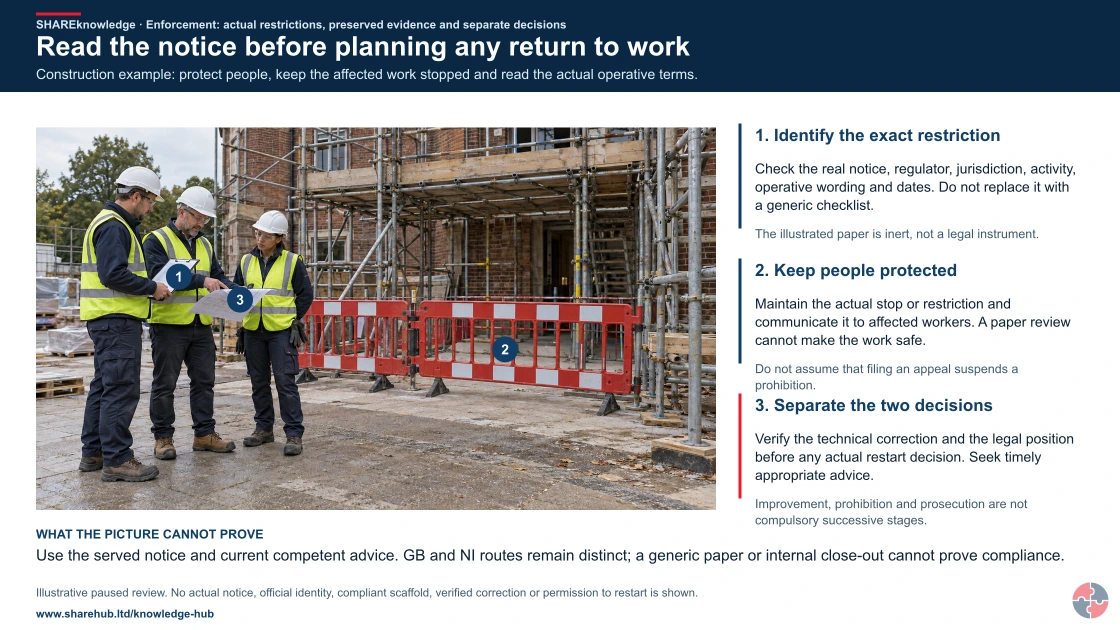
Read the notice before planning any return to work
Full written explanation
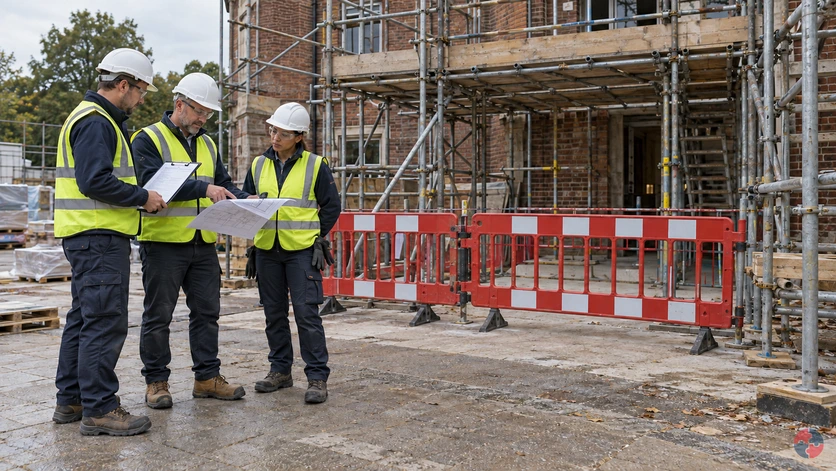
Construction example: protect people, keep the affected work stopped and read the actual operative terms.
- Identify the exact restriction. Check the real notice, regulator, jurisdiction, activity, operative wording and dates. Do not replace it with a generic checklist.
- Keep people protected. Maintain the actual stop or restriction and communicate it to affected workers. A paper review cannot make the work safe.
- Separate the two decisions. Verify the technical correction and the legal position before any actual restart decision. Seek timely appropriate advice.
Change the pathway
- No universal notice form. The illustrated paper is inert, not a legal instrument.
- An appeal is not clearance. Do not assume that filing an appeal suspends a prohibition.
- No automatic escalation ladder. Improvement, prohibition and prosecution are not compulsory successive stages.
Evidence check: Use the served notice and current competent advice. GB and NI routes remain distinct; a generic paper or internal close-out cannot prove compliance.
Read the actual notice; keep technical correction and legal restrictions separate
Primary references: HSE: proportionate enforcement and dutyholder response · HSE: formal notice challenges and prompt advice · GB: HSWA section 24 — actual notice-appeal route
Open the complete HD image (new tab)Download image

Read the actual notice; keep technical correction and legal restrictions separate
Primary references: HSE: proportionate enforcement and dutyholder response · HSE: formal notice challenges and prompt advice · GB: HSWA section 24 — actual notice-appeal route
- Identify the regulator and jurisdiction — Use the actual premises, activity, regulator and GB or NI route.
- Read the notice and operative terms — Distinguish improvement and prohibition, scope, dates and restrictions.
- Assign response and compliance owners — Preserve evidence, control danger and verify the technical correction.
- Appeal and changing charges — Obtain the local legal route; an appeal is not automatic restart authority.
Before restart, confirm the correction, test evidence, applicable notice restrictions and any regulator or legal interface. Communicate the authorised limits to those doing the work. Use the linked current Fee for Intervention information for changing rates; this route supplies neither a rate nor a procedural deadline.
Content amended 19 October 2026 by the SHARE Knowledge Hub editorial team. This records an editorial content change; the existing technical-review and approval status still applies.
Read the actual notice before planning a restart
The jurisdiction, statutory power, wording and relevant dates matter. A technical correction and satisfaction of a legal restriction are connected but separate questions.
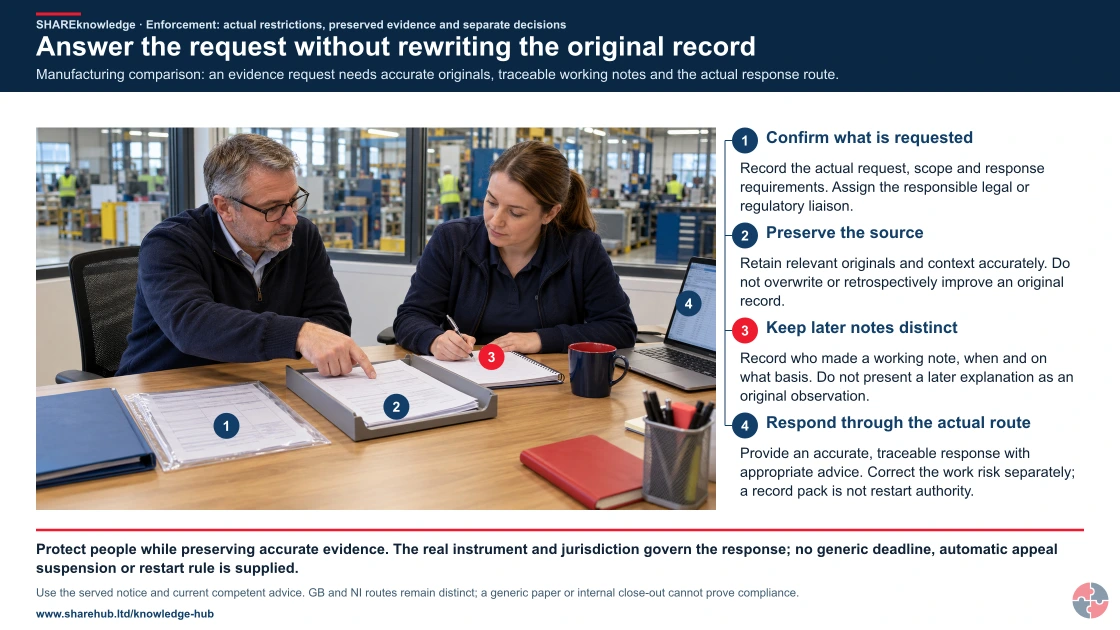
Answer the request without rewriting the original record
Full written explanation
The retained factory records scene is newly annotated at a retained-document sleeve, document tray, separate working notebook and electronic record context. These are illustrative record categories, not proof of authenticity, completeness, a legal disclosure duty or an actual incident. Safe corrective action and accurate evidence preservation remain distinct responsibilities.
Manufacturing comparison: an evidence request needs accurate originals, traceable working notes and the actual response route.
- Confirm what is requested. Record the actual request, scope and response requirements. Assign the responsible legal or regulatory liaison.
- Preserve the source. Retain relevant originals and context accurately. Do not overwrite or retrospectively improve an original record.
- Keep later notes distinct. Record who made a working note, when and on what basis. Do not present a later explanation as an original observation.
- Respond through the actual route. Provide an accurate, traceable response with appropriate advice. Correct the work risk separately; a record pack is not restart authority.
When the evidence does not fit: Protect people while preserving accurate evidence. The real instrument and jurisdiction govern the response; no generic deadline, automatic appeal suspension or restart rule is supplied.
Who acts: Responsible manager, technical verifier and appropriate legal or regulatory liaison.
Changed workplace
Construction restriction: Keep prohibited work controlled while checking the actual notice.
Manufacturing evidence request: Preserve sources, distinguish later notes and answer accurately.
Evidence check: Use the served notice and current competent advice. GB and NI routes remain distinct; a generic paper or internal close-out cannot prove compliance.
Read the actual notice; keep technical correction and legal restrictions separate
Primary references: HSE: proportionate enforcement and dutyholder response · HSE: formal notice challenges and prompt advice · GB: HSWA section 24 — actual notice-appeal route
Open the complete HD image (new tab)Download image

Read the actual notice; keep technical correction and legal restrictions separate
Primary references: HSE: proportionate enforcement and dutyholder response · HSE: formal notice challenges and prompt advice · GB: HSWA section 24 — actual notice-appeal route

Establish the facts
Preserve the notice and identify the regulator, jurisdiction, activity, restriction and relevant requirements/deadlines.
Control and evidence
Make the activity safe and assign competent corrective work and verification, keeping records of what was actually done.
Confirm the legal position
Obtain appropriate advice and confirmation of the applicable route before restart; do not infer permission from an internal close-out alone.
No generic appeal period, automatic suspension or universal restart rule is provided.
What is the advice boundary for enforcement powers and regulator action?
This page gives general UK workplace information and is not legal advice.
What is the advice boundary for enforcement powers and regulator action?


Read the complete visual as text
- This page gives general UK workplace information and is…: This page gives general UK workplace information and is not legal advice.
- Enforcement decisions, notices, appeals, prosecutions and Fee for Intervention…: Enforcement decisions, notices, appeals, prosecutions and Fee for Intervention disputes can have serious legal and financial consequences. Organisations should obtain competent legal, technical or regulatory advice where they are dealing with an actual inspection, notice, investigation, prosecution, appeal or dispute.
- The purpose of this page is to explain the…: The purpose of this page is to explain the system in practical terms so managers, learners and safety professionals understand what regulators may do and what good organisational response looks like.
Best-practice guide: Enforcement powers, notices and regulator action

What is the advice boundary for enforcement powers and regulator action?
This page gives general UK workplace information and is not legal advice. A health and safety inspector may use advice, an improvement notice, a prohibition notice or prosecution according to the law and risk.
Turn enforcement powers, notices and regulator action knowledge into a decision
A health and safety inspector may use advice, an improvement notice, a prohibition notice or prosecution according to the law and risk. In Great Britain and Northern Ireland, different statutes supply the powers. Notice, risk assessment, engineering validation, training and closure record.
A field decision from start to hand-back
Analyse the defect, install and test a suitable guard, and track each notice requirement to an owner. Competent verifier confirms the fix and legal lead checks the notice terms before any restart decision.
Warning signs and consequences
Repeated audit findings: Shows failure to learn and sustain control. Actions closed without evidence: Creates false assurance. Supervisors cannot stop work: Serious risks remain active.
Choose controls for enforcement powers, notices and regulator action
Eliminate: Remove the need to open the guard through external inspection or redesigned access where feasible. Reduce, including substitution: Use an approved off-line test rig or replaceable module where it safely removes hazardous live diagnosis. Isolate: Securely isolate hazardous motion and stored energy before repair; restrict access to the test zone. Control: Repair and function-test the guard interlock and stopping behaviour using the approved machine procedure. Control: Agree test authority, restart communication and any controlled diagnostic mode; never improvise a bypass to continue production. Read the full control table for qualifications, ownership and verification. Use the actual task and applicable jurisdiction; existing technical approval remains unchanged.
Use the full enforcement powers, notices and regulator action lesson
Use the full topic for the decision points, practical examples, detailed control tables and source scope. HSE guidance applies to Great Britain; use HSENI for the Northern Ireland route and the source’s stated jurisdiction. A simplified guide does not change the page’s technical-review or approval status.

Read all six steps as text
1. What is the advice boundary for enforcement powers and regulator action?
This page gives general UK workplace information and is not legal advice.
- Avoid / redesign: Remove the need to open the guard through external inspection or redesigned access where feasible.
- Control the task: Securely isolate hazardous motion and stored energy before repair; restrict access to the test zone.
- Verify before release: If the hazardous step remains, keep it within the task assessment and select the stronger feasible remaining controls.
This page gives general UK workplace information and is not legal advice. A health and safety inspector may use advice, an improvement notice, a prohibition notice or prosecution according to the law and risk.
Apply it: Which part of this plan would you check at the workface before authorising the task?
2. Turn enforcement powers, notices and regulator action knowledge into a decision
Use the evidence to improve the actual work arrangement.
- Change at source: Remove the need to open the guard through external inspection or redesigned access where feasible.
- Make it observable: If the hazardous step remains, keep it within the task assessment and select the stronger feasible remaining controls.
- Keep useful evidence: Notice, risk assessment, engineering validation, training and closure record.
A health and safety inspector may use advice, an improvement notice, a prohibition notice or prosecution according to the law and risk. In Great Britain and Northern Ireland, different statutes supply the powers. Notice, risk assessment, engineering validation, training and closure record.
Apply it: What evidence would show that the change improves this task, rather than only completing a record?
3. A field decision from start to hand-back
Example: a practical application of the existing topic lesson.
- Setting: An inspector serves a prohibition notice after finding an accessible press trapping point.
- Act: Stop the prohibited activity, protect workers and preserve guard and maintenance evidence.
- Hold / review: Do not restart merely because an appeal was filed; a prohibition notice remains in effect unless the tribunal directs suspension.
Analyse the defect, install and test a suitable guard, and track each notice requirement to an owner. Competent verifier confirms the fix and legal lead checks the notice terms before any restart decision.
Apply it: At which point would you hold this example, and what evidence would allow it to proceed?
4. Warning signs and consequences
Connect the task, the route to the person and the control that can fail.
- Repeated audit findings: Shows failure to learn and sustain control.
- Actions closed without evidence: Creates false assurance.
- Supervisors cannot stop work: Serious risks remain active.
Repeated audit findings: Shows failure to learn and sustain control. Actions closed without evidence: Creates false assurance. Supervisors cannot stop work: Serious risks remain active.
Apply it: Who could be exposed, including other trades, cleaners, maintainers and people nearby?
5. Choose controls for enforcement powers, notices and regulator action
Start with the stronger practicable options and verify their effect.
- Eliminate: Remove the need to open the guard through external inspection or redesigned access where feasible.
- Reduce, including substitution: Use an approved off-line test rig or replaceable module where it safely removes hazardous live diagnosis.
- Isolate: Securely isolate hazardous motion and stored energy before repair; restrict access to the test zone.
- Control: Repair and function-test the guard interlock and stopping behaviour using the approved machine procedure.
- Control: Agree test authority, restart communication and any controlled diagnostic mode; never improvise a bypass to continue production.
Eliminate: Remove the need to open the guard through external inspection or redesigned access where feasible. Reduce, including substitution: Use an approved off-line test rig or replaceable module where it safely removes hazardous live diagnosis. Isolate: Securely isolate hazardous motion and stored energy before repair; restrict access to the test zone. Control: Repair and function-test the guard interlock and stopping behaviour using the approved machine procedure. Control: Agree test authority, restart communication and any controlled diagnostic mode; never improvise a bypass to continue production. Read the full control table for qualifications, ownership and verification. Use the actual task and applicable jurisdiction; existing technical approval remains unchanged.
Apply it: Which stronger option can be used here, and who will verify it before accepting the remaining risk?
6. Use the full enforcement powers, notices and regulator action lesson
Follow the official sources below and retain the task-specific evidence.
- Official guidance: HSE role as regulator
- Official guidance: HSE public register of enforcement notices
- Task decision: Notice, risk assessment, engineering validation, training and closure record.
Use the full topic for the decision points, practical examples, detailed control tables and source scope. HSE guidance applies to Great Britain; use HSENI for the Northern Ireland route and the source’s stated jurisdiction. A simplified guide does not change the page’s technical-review or approval status.
Apply it: Which official source and full-topic section will you use to resolve the next decision?
Enforcement decisions, notices, appeals, prosecutions and Fee for Intervention disputes can have serious legal and financial consequences. Organisations should obtain competent legal, technical or regulatory advice where they are dealing with an actual inspection, notice, investigation, prosecution, appeal or dispute.
The purpose of this page is to explain the system in practical terms so managers, learners and safety professionals understand what regulators may do and what good organisational response looks like.
What should a dutyholder do when an inspector identifies a serious risk?
Make people safe and stop any prohibited activity, then secure the notice, facts and evidence. Confirm the site jurisdiction, exact duty, effective date and appeal route; assign correction and verification owners before considering restart.
What should a dutyholder do when an inspector identifies a serious risk?


Read the complete visual as text
- Make people safe and stop any prohibited activity, then…: Make people safe and stop any prohibited activity, then secure the notice, facts and evidence. Confirm the site jurisdiction, exact duty, effective date and appeal route; assign correction and verification owners before considering restart.
- A machine guard is removed during production. The manager…: A machine guard is removed during production. The manager stops access, preserves the inspector’s notice and machine evidence, has a competent engineer redesign and test the guard, and checks the precise notice terms with legal advice. Filing an appeal does not by itself suspend a prohibition notice.
A machine guard is removed during production. The manager stops access, preserves the inspector’s notice and machine evidence, has a competent engineer redesign and test the guard, and checks the precise notice terms with legal advice. Filing an appeal does not by itself suspend a prohibition notice.
How can I practise this topic in 3D?


Zero reported injuries masks weak critical controls
All related inspection points 1 across 1 location
Construction site 1 inspection point
Practice in the SHAREhub environment. Browser practice is separate from workplace competence and formal learning records.
What are the key facts about health and safety enforcement?
The key facts are that enforcement is risk-based, evidence-led and can move from advice to notices, FFI and prosecution.
Risk drives action
Regulators focus on serious risks, legal breaches, poor control and dutyholder response.
Inspectors have strong powers
Inspectors can enter premises, inspect, require information and preserve evidence under HSWA.
Notices are formal legal tools
Improvement notices require remedial action; prohibition notices stop serious-risk activities.
FFI is cost recovery
HSE charges dutyholders where it identifies a material breach and formally notifies them.
Appeal routes exist
Notices and FFI invoices have challenge routes, but timing and procedure matter.
Paperwork is not enough
Regulators look for real control, competence, maintenance, monitoring and action closure.
What are enforcement powers, notices and regulator action?
They are the legal tools and regulatory decisions used to secure compliance, prevent harm and hold dutyholders to account.
Enforcement can be informal or formal. Informal action may include verbal advice or written advice. Formal action may include improvement notices, prohibition notices, withdrawal or variation of licences or permissions, FFI invoices, prosecution or, for Crown bodies, Crown notices or Crown censures.
The regulator's choice depends on the seriousness of the risk, the gap between actual control and legal standard, dutyholder history, evidence, public interest and whether immediate action is needed to protect people.
| Action | What it means | Typical evidence |
|---|---|---|
| Advice | Inspector explains what needs improvement. | Visit note, email or letter. |
| Notification of contravention | Written notification of a material breach for FFI purposes. | NoC letter and invoice evidence. |
| Improvement notice | Formal notice requiring legal breach to be remedied. | Notice, action plan and compliance evidence. |
| Prohibition notice | Formal notice stopping an activity involving serious personal injury risk. | Notice, stop-work control and remedial verification. |
| Prosecution | Criminal proceedings for serious offences or non-compliance. | Investigation evidence and court outcome. |
| Public register entry | Published notice information after process controls. | HSE enforcement register record. |
Which regulators may enforce health and safety law?
HSE and local authorities enforce most GB workplace health and safety law, with specialist regulators covering sectors such as rail, nuclear, fire and transport.
The enforcing authority depends on the work activity and premises. HSE commonly enforces higher-risk sectors such as construction, manufacturing, agriculture, healthcare, offshore, mines and major hazards. Local authorities commonly enforce many offices, retail, warehousing, hospitality and leisure premises, depending on the main activity.
Specialist regulators also matter. Fire and rescue authorities enforce much non-domestic fire safety. ORR regulates rail safety. ONR regulates nuclear safety and security. Northern Ireland has separate health and safety enforcement arrangements through HSENI.
| Regulator | Typical scope | Practical implication |
|---|---|---|
| HSE | Many industrial, construction, agriculture, healthcare, offshore and major hazard activities. | Expect HSE inspection, enforcement and FFI where HSE is the enforcing authority. |
| Local authorities | Many retail, hospitality, leisure, offices and warehousing activities. | May inspect and enforce under health and safety law. |
| Fire and rescue authorities | Fire safety in many non-domestic premises in England. | Separate England fire safety notices and enforcement may apply. |
| Office of Rail and Road | Railway and guided transport safety. | Sector-specific enforcement and improvement notices. |
| Office for Nuclear Regulation | Nuclear licensed sites and nuclear-related safety/security. | Specialist nuclear enforcement regime. |
| HSENI | Health and safety enforcement in Northern Ireland. | Different regulator and jurisdictional route. |
What powers do health and safety inspectors have?
Inspectors have broad powers to inspect, investigate, secure evidence and require cooperation.
In Great Britain, HSWA section 20 gives inspectors powers to enter, examine work, take evidence and require relevant documents and answers. In Northern Ireland, the parallel powers are in the 1978 Order Article 22. Managers should check the inspector’s authority and cooperate with lawful requests.
Organisations should train managers not to obstruct inspectors, conceal evidence or speculate. Respond with calm cooperation, accurate information, clear document control and early escalation. The powers are set out in GB HSWA section 20 and NI Order Article 22.
| Power | What it allows | Good response |
|---|---|---|
| Entry | Entering premises at reasonable times or during dangerous conditions. | Verify identity and notify responsible managers. |
| Examination | Inspecting activities, plant, articles and substances. | Provide safe access and competent escort. |
| Evidence gathering | Taking photos, measurements, recordings and samples. | Preserve scene and maintain records. |
| Document production | Requiring relevant records and copies. | Provide controlled, accurate documents. |
| Questions | Requiring relevant people to answer questions. | Answer truthfully and seek advice where appropriate. |
| Assistance | Requiring facilities and assistance. | Provide workspace, contacts and site information. |
What is the difference between informal and formal enforcement action?
Informal action advises or records concerns, while formal action creates legal requirements or criminal consequences.
Informal action still matters. A written letter may not be a statutory notice, but it records the regulator's view and can become powerful evidence if the organisation ignores it. Formal action carries clearer legal status and may require immediate action, statutory compliance, cost recovery or court proceedings.
Managers should treat all regulator findings as serious business information. The practical response should be to understand the risk, assign owners, control immediate harm, document the action plan and verify effectiveness.
| Action type | Status | Management response |
|---|---|---|
| Verbal advice | Informal but important. | Record, assess and act where needed. |
| Written advice | Informal written regulator expectation. | Log actions and close with evidence. |
| Notification of contravention | Formal FFI trigger where material breach exists. | Review breach, action and invoice route. |
| Improvement notice | Formal statutory notice. | Comply by deadline or appeal properly. |
| Prohibition notice | Formal statutory stop/control action. | Stop activity until risk is controlled. |
| Prosecution | Criminal enforcement. | Use legal advice and preserve evidence. |
How do improvement and prohibition notices differ?
Improvement notices require legal breaches to be fixed, while prohibition notices stop activities involving serious personal injury risk.
An improvement notice normally gives time to remedy a contravention and must specify what the inspector believes has been breached. A prohibition notice can take effect immediately where serious personal injury risk exists, even if no injury has happened.
The business response should be disciplined: read the notice, identify the legal provisions, stop prohibited work where required, appoint an owner, communicate internally, create an action plan, collect evidence and confirm compliance through verification rather than assumption. See GB HSWA sections 21–24. NI 1978 Order Articles 23–26
| Feature | Improvement notice | Prohibition notice |
|---|---|---|
| Legal basis | HSWA section 21. | HSWA section 22. |
| Trigger | Contravention has occurred and is likely to continue or be repeated. | Activity involves or will involve risk of serious personal injury. |
| Timing | Stated compliance date under the applicable law; verify the served notice and appeal period. | Can take effect immediately or at a stated time. |
| Purpose | Secure compliance with legal requirements. | Stop or prevent serious-risk activity. |
| Appeal effect | Appeal normally suspends the notice until determined. | Appeal does not automatically suspend unless tribunal directs. |
| Failure to comply | Criminal offence. | Criminal offence. |
| NI legal basis | 1978 Order Article 23. | 1978 Order Article 24. |
In Great Britain, HSWA sections 21–24 govern these notices and appeals. In Northern Ireland, the parallel route is the 1978 Order Articles 23–26. An appeal normally suspends an improvement notice; a prohibition notice continues unless the tribunal directs otherwise. Check the served notice and seek timely legal advice. See GB HSWA sections 21–24. NI 1978 Order Articles 23–26
What is Fee for Intervention and material breach?
Fee for Intervention is HSE cost recovery when HSE identifies a material breach and formally notifies the dutyholder.
HSE explains that if it visits a workplace and finds a material breach of health and safety law, the dutyholder must pay for the time HSE takes to identify what is wrong and help put it right. If there is no material breach, FFI does not apply.
A material breach is serious enough for the inspector to write formally requiring action. The HSE current rates page states that from 1 April 2026 the FFI rate is £188 an hour. The cost can include visit time, reports, specialist advice, discussions and investigation work connected with the breach.
| Issue | What it means | Business control |
|---|---|---|
| Material breach | Contravention serious enough for written notification. | Maintain legal compliance evidence. |
| Notification of contravention | Explains law breached, reasons and fee payable. | Review facts and action plan. |
| Hourly rate | HSE current rate is £188 per hour from 1 April 2026. | Budget risk reinforces prevention. |
| Invoice query | Dutyholders can query or dispute invoices through HSE routes. | Keep records of visit, time and scope. |
| Prevention | No material breach means no FFI for the visit. | Proactive inspection, audit and close-out. |
The £188 rate is from the HSE page updated 1 April 2026; check the live rate before budgeting or explaining a current invoice. Fee for Intervention applies where HSE is the enforcing authority, not simply because a UK regulator visited. HSE current rates
When can prosecution follow health and safety enforcement?
Prosecution may follow serious breach, harm, risk of harm, failure to comply or wider public interest factors.
HSE may prosecute in England and Wales where there is evidence of a material breach and prosecution is in the public interest. In Scotland, HSE reports matters to the Crown Office and Procurator Fiscal Service, which decides whether to prosecute.
Prosecution can follow fatal incidents, serious injury, repeated non-compliance, failure to comply with notices, deliberate breach, poor management history, serious public risk or offences where deterrence is needed. Organisations should remember that health and safety offences can exist because of risk, not only after injury.
| Factor | Why it matters | Evidence likely to be reviewed |
|---|---|---|
| Serious risk or harm | Shows gravity of breach. | Risk assessments, incident evidence and controls. |
| Compliance history | Repeated warnings increase seriousness. | Previous letters, notices and audits. |
| Failure to comply with notice | Separate criminal offence. | Notice, deadline and action records. |
| Management failure | Shows systemic weakness. | Policies, training, supervision and leadership records. |
| Public interest | Supports deterrence and accountability. | Sector risk and seriousness of breach. |
How do appeals and disputes work?
A notice appeal uses the tribunal and time limit for the site nation; control the underlying risk while the appeal is considered.
In Great Britain, HSWA section 24 routes notice appeals to an Employment Tribunal. In Northern Ireland, the 1978 Order Article 26 and HSENI procedure route appeals to an Industrial Tribunal through the Office of the Tribunals. An improvement notice is normally suspended on a timely appeal; a prohibition notice is not automatically suspended unless the tribunal directs otherwise.
An HSE Fee for Intervention invoice has a separate GB query and dispute process; it is not a notice appeal. Keep the served notice, dates, evidence and legal advice together.
| Issue | Route | Practical caution |
|---|---|---|
| GB improvement notice | Employment Tribunal under HSWA section 24. | A timely appeal normally suspends the notice, not the underlying risk. |
| GB prohibition notice | Employment Tribunal under HSWA section 24. | Activity remains stopped unless tribunal directs suspension. |
| NI improvement notice | Industrial Tribunal under 1978 Order Article 26. | Check HSENI procedure and deadline; appeal normally suspends the notice. |
| NI prohibition notice | Industrial Tribunal under 1978 Order Article 26. | Activity remains stopped unless tribunal directs suspension. |
| HSE FFI invoice | HSE query or dispute process, separate from a notice appeal. | GB HSE scheme only where it is the enforcing authority. |
| Prosecution | Criminal court process under the applicable nation’s law. | Use legal representation and preserve evidence. |
Read the actual notice and seek timely legal advice. Do not restart prohibited activity because an appeal has been filed. HSENI NI appeal procedure
How can the hierarchy of controls prevent machinery injury when responding to a reported interlock defect?
Use source and work-design controls first; support and procedures cannot replace prevention.
A good response is calm, factual and organised. The first priority is immediate safety: stop dangerous work, isolate equipment, protect people and preserve evidence. The second priority is governance: notify senior leaders, legal/HR where needed, competent advisers and insurers if appropriate.
The action plan should be more than a list of promises. It should include the breach or finding, legal duty, immediate control, root cause, owner, due date, resources, communication, verification evidence and whether wider sites or tasks may have the same weakness.
How can the ERICPD hierarchy of controls prevent machinery injury when responding to a reported interlock defect?

| Control level | Control for this activity | Owner and verification | Stop / restart decision |
|---|---|---|---|
| Eliminate | Remove the need to open the guard through external inspection or redesigned access where feasible. | Task owner verifies that the proposed change removes the named hazardous step, including foreseeable cleaning, maintenance and work transferred elsewhere. | If the hazardous step remains, keep it within the task assessment and select the stronger feasible remaining controls. |
| Reduce, including substitution | Use an approved off-line test rig or replaceable module where it safely removes hazardous live diagnosis. | Competent task/process owner validates suitability, compatibility and new hazards against the actual operating requirements before the alternative is adopted. | Reject an alternative if its performance is unproved or its new hazards are unresolved. |
| Isolate | Securely isolate hazardous motion and stored energy before repair; restrict access to the test zone. | Supervisor checks the actual boundary, affected people and connected work; verify separation or isolation before allowing access. | Hold or stop for unexpected motion, a defeated safeguard or an incomplete function test. |
| Control: physical safeguards | Repair and function-test the guard interlock and stopping behaviour using the approved machine procedure. | Competent equipment/process owner checks guard alignment, interlock function, stopping response and removal of temporary test arrangements. | Hold or stop for unexpected motion, a defeated safeguard or an incomplete function test. |
| Control: work method and response | Agree test authority, restart communication and any controlled diagnostic mode; never improvise a bypass to continue production. | Supervisor confirms the work limits, competent cover, communication and stop/restart authority with the people doing this activity. | Hold work when the agreed limits, competent cover or effective communication cannot be maintained. |
| PPE | Use protection for assessed maintenance contact hazards; PPE cannot compensate for a defective interlock. | Assessor confirms whether personal protection is needed and checks suitability, condition, compatibility and any required fit evidence. | Do not use unsuitable protection or rely on PPE to continue after an essential source control fails. |
| Discipline | Retain the test result and defect closure evidence; escalate overdue tests and repeated failures to the equipment owner. | Release only after competent maintainer and operations sign the tested return to service. Retain verification and unresolved restrictions at handover. | Keep the task on hold until required reinstatement evidence and unresolved defects are accepted by the responsible owner. |
How can the ISO 45001 hierarchy of controls prevent machinery injury when responding to a reported interlock defect?

| Control level | Control for this activity | Owner and verification | Stop / restart decision |
|---|---|---|---|
| Elimination | Remove the need to open the guard through external inspection or redesigned access where feasible. | Task owner verifies that the proposed change removes the named hazardous step, including foreseeable cleaning, maintenance and work transferred elsewhere. | If the hazardous step remains, keep it within the task assessment and select the stronger feasible remaining controls. |
| Engineering controls | Use an approved off-line test rig or replaceable module where it safely removes hazardous live diagnosis. | Competent task/process owner validates suitability, compatibility and new hazards against the actual operating requirements before the alternative is adopted. | Reject an alternative if its performance is unproved or its new hazards are unresolved. |
| Engineering controls | Securely isolate hazardous motion and stored energy before repair; restrict access to the test zone. | Supervisor checks the actual boundary, affected people and connected work; verify separation or isolation before allowing access. | Hold or stop for unexpected motion, a defeated safeguard or an incomplete function test. |
| Engineering controls | Repair and function-test the guard interlock and stopping behaviour using the approved machine procedure. | Competent equipment/process owner checks guard alignment, interlock function, stopping response and removal of temporary test arrangements. | Hold or stop for unexpected motion, a defeated safeguard or an incomplete function test. |
| Administrative controls | Agree test authority, restart communication and any controlled diagnostic mode; never improvise a bypass to continue production. | Supervisor confirms the work limits, competent cover, communication and stop/restart authority with the people doing this activity. | Hold work when the agreed limits, competent cover or effective communication cannot be maintained. |
| PPE | Use protection for assessed maintenance contact hazards; PPE cannot compensate for a defective interlock. | Assessor confirms whether personal protection is needed and checks suitability, condition, compatibility and any required fit evidence. | Do not use unsuitable protection or rely on PPE to continue after an essential source control fails. |
| Administrative controls | Retain the test result and defect closure evidence; escalate overdue tests and repeated failures to the equipment owner. | Release only after competent maintainer and operations sign the tested return to service. Retain verification and unresolved restrictions at handover. | Keep the task on hold until required reinstatement evidence and unresolved defects are accepted by the responsible owner. |
Illustrative machine-guard enforcement case: an inspector finds a running press with an accessible trapping point. Control the actual exposure before preparing a response or appeal. See HSE role as regulator.
Which legal duties underpin enforcement powers and notices?
Select the law by site nation, activity and duty. The Great Britain instruments in this table do not automatically apply in Northern Ireland.
| Where | Instrument | Practical boundary |
|---|---|---|
| Great Britain | Health and Safety at Work etc. Act 1974 | GB general work-safety duties |
| Northern Ireland | Health and Safety at Work (Northern Ireland) Order 1978 | NI general work-safety duties |
| Great Britain | Management of Health and Safety at Work Regulations 1999 | GB risk assessment and prevention arrangements |
| Northern Ireland | Management of Health and Safety at Work Regulations (Northern Ireland) 2000 | NI risk assessment and prevention arrangements |
| Great Britain | Health and Safety (Enforcing Authority) Regulations 1998 | GB allocation between HSE and local authorities |
| Great Britain | Health and Safety and Nuclear (Fees) Regulations 2022 | GB HSE fee framework |
This page explains the process; the served notice, site jurisdiction and legal advice govern an appeal or restart decision. Make the risk safe while those questions are resolved.
How should enforcement risk appear in a risk register?
Enforcement risk should be linked to real legal non-compliance, control weakness and evidence gaps, not fear of regulators alone.
A mature organisation does not manage enforcement risk by hiding problems. It manages the underlying risk: uncontrolled work at height, poor asbestos management, failed guarding, missing health surveillance, weak contractor control, fire safety failings or unclosed audit actions.
The risk register should identify legal duties, control owners, inspection evidence, action status, leadership review and whether similar weaknesses may exist elsewhere.
| Enforcement exposure | Underlying risk | Assurance evidence |
|---|---|---|
| Improvement notice | Repeated legal breach or inadequate management arrangements. | Audit findings, action closure and management review. |
| Prohibition notice | Serious personal injury risk in live activity. | Stop-work controls and verification. |
| FFI invoice | Material breach found by HSE. | Inspection records and legal compliance evidence. |
| Prosecution | Serious breach, harm, repeated warnings or non-compliance. | Investigation and board-level action tracking. |
| Public register record | Formal notice becomes visible to stakeholders. | Notice response and communication plan. |
How could BuildOut Ltd manage enforcement risk and regulator action?

BuildOut Ltd could manage enforcement risk by building strong legal compliance evidence before an inspector arrives.
A field decision from start to hand-back — part 1 of 3


Read the complete visual as text
- 1. Task and setting: An inspector serves a prohibition notice after finding an accessible press trapping point.
- 2. People and prerequisites: Site manager, engineer, safety adviser and legal lead; obtain the exact notice and identify the site law.
- 3. Before the task: Stop the prohibited activity, protect workers and preserve guard and maintenance evidence.
A field decision from start to hand-back — part 2 of 3


Read the complete visual as text
- 1. Check during work: Analyse the defect, install and test a suitable guard, and track each notice requirement to an owner.
- 2. Stop, hold or refer: Do not restart merely because an appeal was filed; a prohibition notice remains in effect unless the tribunal directs suspension.
A field decision from start to hand-back — part 3 of 3


Read the complete visual as text
- 1. Completion and hand-back: Competent verifier confirms the fix and legal lead checks the notice terms before any restart decision.
- 2. Retained evidence: Notice, risk assessment, engineering validation, training and closure record.
BuildOut Ltd
BuildOut Ltd is a make-believe construction and refurbishment contractor working across small projects, occupied premises and subcontracted specialist trades.
BuildOut's legal register links CDM, work at height, asbestos, PUWER, electricity, welfare, RIDDOR and fire duties to named owners. Each project has a pre-start compliance check covering construction phase plan, inductions, permits, welfare, edge protection, scaffolding handover, temporary electrics, asbestos information and emergency arrangements.
Supervisors are trained on inspector visits: verify ID, cooperate, notify the contracts manager and safety adviser, preserve evidence, avoid speculation and record requests. If an inspector identifies serious risk, supervisors have authority to stop work immediately and isolate the area.
BuildOut uses an enforcement response procedure. Any written advice, notice or FFI notification is logged into the action tracker with owner, senior sponsor, legal duty, root cause, immediate control, permanent action, evidence required and verification method. The business checks whether the same issue exists across other projects and shares learning through supervisor briefings.
Leadership review looks at enforcement indicators alongside proactive assurance: repeated scaffold findings, welfare defects, missing permits, contractor competence gaps, overdue training and near misses. Actions are not closed because paperwork has been uploaded; they are closed when field verification proves the control is working.
| Management area | How BuildOut manages it | Evidence |
|---|---|---|
| Assess | Maps legal duties to project activities and risk register. | Legal register and project compliance checklist. |
| Prepare | Trains supervisors on inspection response and stop-work authority. | Training records and response procedure. |
| Implement | Controls high-risk work through plans, permits, competence and supervision. | CPP, RAMS, permits and supervisor checks. |
| Respond | Logs regulator findings with legal duty, owner, due date and evidence. | Action tracker and correspondence log. |
| Verify | Checks physical close-out and wider-site learning. | Photos, inspection records and audit samples. |
| Improve | Reviews trends at leadership level. | Management review and action closure evidence. |
A field decision from start to hand-back
Task, material and setting: An inspector serves a prohibition notice after finding an accessible press trapping point.
People and prerequisites: Site manager, engineer, safety adviser and legal lead; obtain the exact notice and identify the site law.
Before: Stop the prohibited activity, protect workers and preserve guard and maintenance evidence.
During: Analyse the defect, install and test a suitable guard, and track each notice requirement to an owner.
Hold or stop: Do not restart merely because an appeal was filed; a prohibition notice remains in effect unless the tribunal directs suspension.
Completion and hand back: Competent verifier confirms the fix and legal lead checks the notice terms before any restart decision.
Evidence: Notice, risk assessment, engineering validation, training and closure record.
What role training is needed?
Each role should demonstrate a decision in its actual work setting.
| Role | Learning | Demonstration | Assessor | Record | Reassess when |
|---|---|---|---|---|---|
| Operators | Recognise and report unsafe guard | Demonstrate stop and report | Supervisor | Observed task | Guard change |
| Supervisors | Make danger safe and preserve evidence | Run first-response scenario | Site manager | Action log | Notice or incident |
| Engineers | Design and test correction | Validate guard and isolation | Technical lead | Test record | Equipment change |
| Safety advisers | Map notice to duty and evidence | Audit action package | Competent reviewer | Evidence register | Legal change |
| Legal/appeals lead | Check terms and appeal route | Review notice-specific advice | Legal lead | Advice record | Deadline |
| Directors | Resource closure and independent verification | Review critical action | Board lead | Closure record | Repeat breach |
How does this topic support NEBOSH Diploma study?
This topic supports DN1 1.3 by requiring learners to analyse enforcement officer powers, notices, FFI, appeals and regulator response.
Diploma-level answers should not merely define an improvement notice. They should explain why the notice is served, what legal test applies, what evidence a regulator may use, how the organisation should respond and how action should be verified.
A strong scenario answer distinguishes informal advice, improvement notices, prohibition notices, FFI, prosecution, appeals and the practical duty to control risk. It also recognises that Scotland, Northern Ireland and specialist regulators may use different routes.
| Assessment area | What to know | Scenario application |
|---|---|---|
| Inspector powers | Section 20 powers and evidence gathering. | Explain what an inspector may require during a visit. |
| Notices | Difference between improvement and prohibition notices. | Advise managers after a scaffold prohibition notice. |
| FFI | Material breach and cost recovery. | Explain why a notification of contravention matters. |
| Appeals | Tribunal route and effect of appeal. | Compare appeal effects for notices. |
| Response | Immediate control, action plan and verification. | Build a defensible close-out process. |
How can management arrangements support this topic?
HSE’s Plan–Do–Check–Act guidance helps assign ownership, deliver controls, check evidence and improve weak arrangements. Apply the relevant legal duties and task-specific technical evidence separately.
Official management guidance: HSE Managing for health and safety (HSG65)
What are the warning signs that enforcement risk is increasing?
Warning signs include repeated findings, overdue actions, weak evidence, poor supervision and leadership tolerance of known breaches.
Enforcement risk rarely appears from nowhere. It builds through ignored inspection findings, repeated near misses, unclosed audit actions, weak contractor control, poor welfare, unguarded machinery, missing statutory examinations, outdated risk assessments or supervisors who feel unable to stop unsafe work.
These signs create harm because they allow legal breaches and uncontrolled risks to remain live. They also make regulator response harder because the organisation cannot show prompt, competent action when warnings were already known.
| Warning sign | Why it matters | Improvement |
|---|---|---|
| Repeated audit findings | Shows failure to learn and sustain control. | Escalate to leadership and verify close-out. |
| Actions closed without evidence | Creates false assurance. | Require physical verification. |
| Supervisors cannot stop work | Serious risks remain active. | Give authority and support. |
| Legal register is generic | Duties are not translated into controls. | Map duties to activities and owners. |
| Contractor breaches repeat | Client/contractor management may be weak. | Review selection, induction and supervision. |
| Poor regulator communication | Can damage trust and slow resolution. | Nominate competent response lead. |
What do the acronyms and key terms mean?
Acronyms and legal terms should be explained so managers and learners understand regulator language.
| Term | Full expansion | Meaning here |
|---|---|---|
| ACOP | Approved Code of Practice | Approved Code of Practice. |
| EMM | Enforcement Management Model | Enforcement Management Model. |
| EPS | Enforcement Policy Statement | Enforcement Policy Statement. |
| FFI | Fee for Intervention | Fee for Intervention. |
| HSE | Health and Safety Executive | Health and Safety Executive. |
| HSWA | Health and Safety at Work etc. Act | Health and Safety at Work etc. Act 1974. |
| NoC | Notification of Contravention | Notification of Contravention. |
| ORR | Office of Rail and Road | Office of Rail and Road. |
| SFAIRP | So far as is reasonably practicable | So far as is reasonably practicable. |