SHARE Knowledge Hub
Ethical issues in health and safety legal actions
After an incident, a safety professional should preserve accurate evidence, separate fact from opinion, disclose uncertainty and conflicts, protect personal information and treat witnesses and affected people fairly. The duty of a formally instructed expert to the court has a specific legal scope; ordinary advisers should not claim that status. Court procedure differs between England and Wales and Northern Ireland, so obtain legal advice on the applicable route.
Understanding Ethical issues in health and safety legal actions
Ethical health and safety legal action means acting truthfully, fairly, competently and with appropriate independence when evidence may affect people, risk control, regulators, courts, tribunals, injured workers, bereaved families or an organisation. The central objective remains prevention of harm. Legal action, investigation, enforcement and claim processes must never become reasons to delay urgent risk control, suppress a credible concern or treat people as obstacles to reputation management.
Why this matters at work
Ethical failures can create direct safety harm. An altered inspection record can leave a safety critical defect untreated; a misleading risk assessment can normalise exposure; a manager discouraging reports can conceal repeated near misses; an investigator blaming a worker can leave a design weakness unchanged; and inappropriate disclosure of health information can cause stigma, retaliation and loss of trust. These are management-system failures with people at the centre, not merely reputation issues.
Legislation imposes the actual duties. GB HSWA section 17 and NI Order article 19 give relevant ACOP non-observance specified criminal-evidence consequences: failure to follow an ACOP is not itself an offence, and compliance by other means can matter under the provision. Do not give ordinary guidance, policy statements, employment codes, client rules or internal colours that status. Contract and corporate expectations may add requirements but cannot replace the national law.
How organisations manage this in practice
Audit samples should trace a concern from initial report through risk control, evidence handling, escalation, decision, communication and review. Test actual practice by asking workers, supervisors and managers what happens when an uncomfortable fact emerges. A mature organisation can show that it acted on bad news, corrected records transparently, protected reporters, respected privacy and challenged leaders when harm could continue. Sources: INDG345 health and safety training publisher; GB Management Regulations 1999; NI Management Regulations 2000; HSG245 Investigating accidents and incidents.
An ethical report must lead to a credible safety decision. Define the hazardous condition, people exposed, barrier that failed or was absent, necessary interim restriction and control owner. Check the real work rather than closing an action on a purchase order, training attendance or a manager assurance. HSG245 moves from information and analysis to risk control and implementation; its 2004 reporting categories and historical statistics are not a current RIDDOR decision rule.
A practical system can be simple: named reporting route, prompt fact capture, risk-control decision, worker consultation, record retention, escalation criteria, independent check for serious cases and review of repeat signals. Avoid informal arrangements in which a manager asks people to rewrite accounts, discourages RIDDOR reporting, promises confidentiality that cannot be kept or treats a complaint as disloyal. Clear process protects people and makes good decisions easier. Sources: GB Health and Safety at Work Act 1974; NI Health and Safety at Work Order 1978; GB RIDDOR reporting gateway; GB RIDDOR 2013; NI RIDDOR 1997; L24 workplace welfare publisher; INDG244 workplace welfare publisher.
Choose the case jurisdiction and preserve the original evidence
A investigation records the wrong isolation time. The investigator preserves the original file and its access history, issues a dated correction with the basis and author, and links both versions. The legal owner determines lawful disclosure and communications to those affected; the operations owner checks whether the corrected fact changes current controls.

Keep what the witness said distinct from later notes
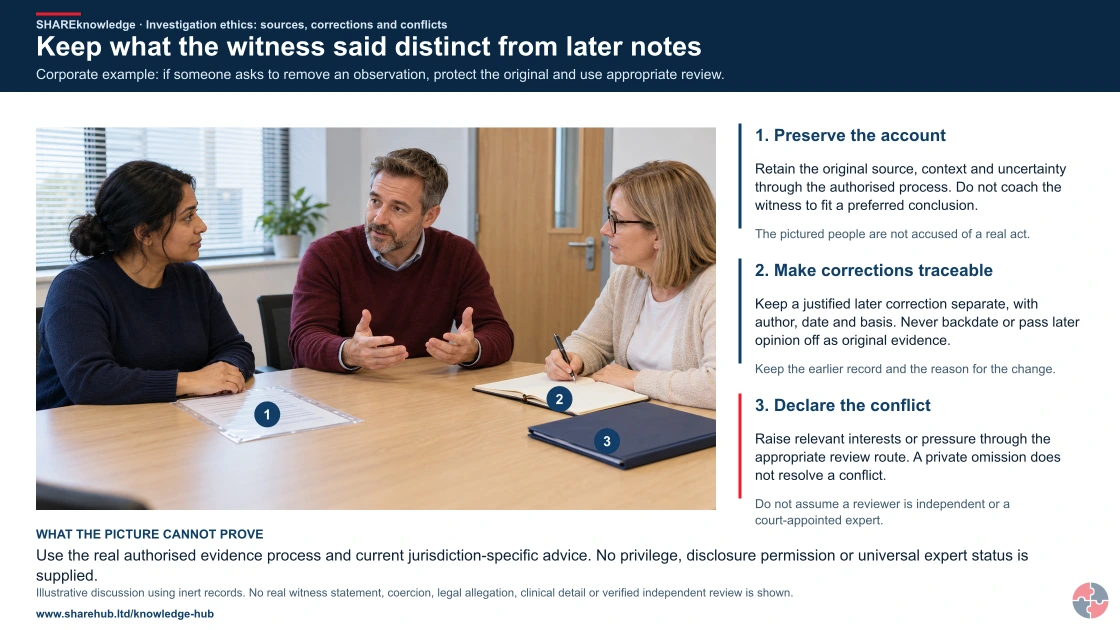
Full written explanation
Corporate example: if someone asks to remove an observation, protect the original and use appropriate review.
- Preserve the account. Retain the original source, context and uncertainty through the authorised process. Do not coach the witness to fit a preferred conclusion.
- Make corrections traceable. Keep a justified later correction separate, with author, date and basis. Never backdate or pass later opinion off as original evidence.
- Declare the conflict. Raise relevant interests or pressure through the appropriate review route. A private omission does not resolve a conflict.
Change the pathway
- No wrongdoing is inferred. The pictured people are not accused of a real act.
- A correction is not deletion. Keep the earlier record and the reason for the change.
- Advice has a defined remit. Do not assume a reviewer is independent or a court-appointed expert.
Evidence check: Use the real authorised evidence process and current jurisdiction-specific advice. No privilege, disclosure permission or universal expert status is supplied.
Preserve evidence, correct openly and retain the actual jurisdiction
Primary references: HSE: investigation information, analysis and action — HSG245 · England and Wales: CPR35 applies to its defined expert-evidence context
Open the complete HD image (new tab)Download image

Preserve evidence, correct openly and retain the actual jurisdiction
Primary references: HSE: investigation information, analysis and action — HSG245 · England and Wales: CPR35 applies to its defined expert-evidence context
- Scotland: proceedings and death investigation — Use Scottish court rules and the COPFS/FAI route.
- England and Wales or Northern Ireland — Use the jurisdiction-specific rules already linked here.
- Correct an error transparently — Keep the original, explain the correction and control continuing danger.
Do not backdate the record, coach witnesses to fit it or wait for proceedings before correcting continuing danger. A technical adviser should state the limits of their role; formally instructed expert duties depend on the actual court and instruction.
Content amended 19 October 2026 by the SHARE Knowledge Hub editorial team. This records an editorial content change; the existing technical-review and approval status still applies.
Preserve the adverse record and correct transparently
Pressure to remove an inconvenient observation is a reason to protect the original evidence and use the appropriate escalation route. A correction must remain distinguishable from the original.

Preserve provenance
Retain the original record with its date, source and uncertainty through the authorised records process.
Correct openly
Document a justified correction, author, date and reason without disguising the earlier version or presenting an opinion as fact.
Manage the conflict
Use suitable competent advice and escalation, declaring relevant conflicts and limits of competence.
This worked example gives no guaranteed legal outcome or permission to breach lawful confidentiality.
What is the first ethical decision after a serious incident?
Protect people and preserve the original evidence. Record what is known, what is uncertain and who made each decision; prevent pressure to alter a witness account or backdate a record. Then seek the appropriate legal and specialist advice.
What is the first ethical decision after a serious incident? — part 1 of 2


Read the complete visual as text
- Protect people and preserve the original evidence. Record what…: Protect people and preserve the original evidence. Record what is known, what is uncertain and who made each decision; prevent pressure to alter a witness account or backdate a record. Then seek the appropriate legal and specialist advice.
- Health and safety professionals often support legal actions by…: Health and safety professionals often support legal actions by providing technical context, investigation evidence, risk-control history and practical understanding of how work was managed. They should not act as a solicitor, determine liability, coach witnesses to give a preferred answer or make legal submissions outside competence.
- The ethical position is simple but demanding: protect the…: The ethical position is simple but demanding: protect the facts, describe what is known and unknown, separate evidence from opinion, keep records secure, treat people fairly and escalate serious concerns. Legal advice, privilege, disclosure strategy, settlement decisions and court advocacy should sit with qualified legal advisers.
What is the first ethical decision after a serious incident? — part 2 of 2


Read the complete visual as text
- This topic also involves people who may be distressed,…: This topic also involves people who may be distressed, injured, grieving, worried about blame or concerned about job security. Good ethics therefore includes humane communication as well as technical accuracy.
- A manager asks an investigator to remove a failed-inspection…: A manager asks an investigator to remove a failed-inspection finding before a regulator visit. The investigator retains the original version, corrects only demonstrable factual errors with an audit trail, records the request, and escalates the concern. Legal counsel advises on disclosure; the safety adviser does not decide privilege or witness status alone.
Health and safety professionals often support legal actions by providing technical context, investigation evidence, risk-control history and practical understanding of how work was managed. They should not act as a solicitor, determine liability, coach witnesses to give a preferred answer or make legal submissions outside competence.
The ethical position is simple but demanding: protect the facts, describe what is known and unknown, separate evidence from opinion, keep records secure, treat people fairly and escalate serious concerns. Legal advice, privilege, disclosure strategy, settlement decisions and court advocacy should sit with qualified legal advisers.
This topic also involves people who may be distressed, injured, grieving, worried about blame or concerned about job security. Good ethics therefore includes humane communication as well as technical accuracy.
A manager asks an investigator to remove a failed-inspection finding before a regulator visit. The investigator retains the original version, corrects only demonstrable factual errors with an audit trail, records the request, and escalates the concern. Legal counsel advises on disclosure; the safety adviser does not decide privilege or witness status alone.
What evidence and ethical escalation should an incident response include?
Protect people first, then preserve original records and witness accounts. Separate observed facts from opinion, limit sensitive data access, declare conflicts and escalate concealment or continuing danger. An expert-witness duty applies only when the person has that defined court role.
Decision / Ethical action — part 1 of 2


Read the complete visual as text
- Immediate protection: Ethical action: Make people safe and record necessary scene changes. Evidence: Rescue and scene-change log.
- Original evidence: Ethical action: Preserve source files, photos, alarms, permits and versions. Evidence: Evidence register and access log.
- Witness accounts: Ethical action: Let each witness give their own account without coaching. Evidence: Dated account and correction trail.
- Expert role: Ethical action: Confirm whether a person is formally instructed to give expert evidence. Evidence: Instructions, scope and independence declaration.
Decision / Ethical action — part 2 of 2


Read the complete visual as text
- Worker information: Ethical action: Restrict health and witness details to a lawful need-to-know purpose. Evidence: Access and retention decision.
- Regulator contact: Ethical action: Record questions and facts accurately; correct ongoing risk. Evidence: Visit log and action evidence.
- Serious concern: Ethical action: Escalate concealment or unresolved danger through an appropriate route. Evidence: Escalation decision and response record.
| Decision | Ethical action | Evidence |
|---|---|---|
| Immediate protection | Make people safe and record necessary scene changes. | Rescue and scene-change log. |
| Original evidence | Preserve source files, photos, alarms, permits and versions. | Evidence register and access log. |
| Witness accounts | Let each witness give their own account without coaching. | Dated account and correction trail. |
| Expert role | Confirm whether a person is formally instructed to give expert evidence. | Instructions, scope and independence declaration. |
| Worker information | Restrict health and witness details to a lawful need-to-know purpose. | Access and retention decision. |
| Regulator contact | Record questions and facts accurately; correct ongoing risk. | Visit log and action evidence. |
| Serious concern | Escalate concealment or unresolved danger through an appropriate route. | Escalation decision and response record. |
What are the key facts about ethical issues in health and safety legal actions?
The key facts are that legal-action work must be truthful, competent, fair, confidential where appropriate and properly escalated where serious risk remains.
Truth comes before convenience
Reports, statements and records must not be altered to hide weaknesses, protect reputation or fit a preferred defence.
Evidence and opinion are different
A factual record says what was seen or done; an opinion explains what it may mean and should stay within competence.
Confidentiality has limits
Personal data, legal advice and witness material need control, but regulator powers, court orders, disclosure duties and serious risk may require sharing.
Conflicts must be declared
Previous involvement, commercial pressure, personal relationships or management instructions can compromise independence.
Victims and witnesses need care
Communication should be respectful, timely and clear without making promises that the organisation cannot keep.
Learning still matters during legal action
The organisation should not freeze improvement because a claim, prosecution or inquest is possible.
What are ethical issues in health and safety legal actions?
Ethical issues are the professional judgement problems that arise when safety evidence, legal risk and human consequences meet.
A legal action can follow a fatality, serious injury, occupational disease, dangerous occurrence, enforcement notice, civil claim, inquest, insurance dispute or regulator investigation. The safety professional may be asked to find documents, reconstruct events, explain control standards, support interviews, prepare a chronology, respond to regulator questions or brief leaders. See HSE investigating accidents and incidents.
The difficulty is that the organisation may feel defensive. People may fear blame, prosecution, personal consequences, compensation exposure or reputational damage. That pressure can create requests to change wording, omit awkward information, delay corrective actions, discourage reporting or keep witnesses away from difficult facts.
Ethical competence means resisting those pressures in a calm, documented and proportionate way. It also means knowing when to involve legal advisers, occupational-health professionals, data protection leads, senior leaders, regulators or external specialists.
| Issue | Why it matters | Practical response |
|---|---|---|
| Truthfulness | Misleading evidence can damage justice, learning and credibility. | Keep factual records accurate and distinguish evidence from interpretation. |
| Professional independence | Advice may be distorted by loyalty, pressure or personal involvement. | Declare conflicts and seek peer or external review where needed. |
| Competence | Poor technical opinion can mislead proceedings. | Stay within expertise and use specialists for law, engineering, medicine or data protection. |
| Confidentiality | Personal, legal and witness information can be sensitive. | Use need-to-know controls and lawful disclosure routes. |
| Fairness | Witnesses, injured people and families should not be manipulated or ignored. | Explain process, treat people respectfully and record contact. |
| Learning | Fear of liability can delay control improvements. | Act on risk promptly without prejudging legal liability. |
Which ethical principles should guide health and safety legal-action work?
The guiding principles are honesty, objectivity, competence, fairness, confidentiality, respect and prevention.
These principles are not abstract values. They change daily decisions: whether to record a poor permit handover, whether to preserve CCTV, whether to correct a manager's inaccurate assumption, whether to tell a witness they can use their own words, whether to seek specialist advice and whether to raise a continuing risk before a legal case concludes.
A safety professional should also keep a clear audit trail of advice. Where advice is accepted, rejected or delayed, the record should show what was recommended, why it mattered and who made the decision. That protects learning and avoids later confusion.
| Principle | What it means in practice | Evidence of good practice |
|---|---|---|
| Honesty | Do not conceal, invent, exaggerate or minimise facts. | Version-controlled reports, retained original records and clear corrections. |
| Objectivity | Analyse evidence without forcing it to support a preferred outcome. | Cause analysis that includes technical, organisational and human factors. |
| Competence | Recognise the limit of personal expertise. | Specialist input, peer review and clear scope of advice. |
| Fairness | Treat injured people, families, witnesses and accused persons respectfully. | Communication logs, witness protocols and grievance routes. |
| Confidentiality | Control sensitive information without using secrecy to hide risk. | Data handling rules, legal-hold notices and access logs. |
| Prevention | Use learning to reduce risk promptly. | Action tracker, leadership review and verified close-out. |
How do ethical issues differ across civil, criminal and inquest contexts?
The ethical principles are similar, but the purpose, process and decision-makers differ across civil claims, criminal enforcement and inquests.
A civil claim is mainly about compensation and whether negligence or liability can be established. A criminal health and safety case is about alleged breach of statutory duties and the creation or control of risk. An inquest considers who died and how, when and where, and may identify matters that could prevent future deaths.
The safety professional should understand enough to work responsibly, but should avoid merging these processes together. The same document may be relevant to all three contexts, but the legal tests, disclosure processes, stakeholders and consequences are different.
Ethical practice requires a disciplined handover between operational learning and legal process. Corrective actions should not wait for the court if workers remain exposed to risk, but communications should be accurate and coordinated.
| Context | Main purpose | Ethical focus |
|---|---|---|
| Regulator investigation | Establish whether health and safety law has been breached and whether enforcement is required. | Cooperate lawfully, preserve records, avoid obstruction and act on serious risk. |
| Criminal proceedings | Determine whether offences have been committed. | Avoid misleading statements, witness pressure or unsupported technical opinions. |
| Civil claim | Determine liability and compensation. | Protect disclosure, factual accuracy and fair handling of claimant information. |
| Inquest | Establish facts about a death and possible prevention matters. | Respect bereaved families, prepare truthful evidence and learn from findings. |
| Insurance or claims review | Assess policy response and loss position. | Do not let commercial interest override factual accuracy or risk control. |
For Scotland, use the Scottish proceedings and death-investigation route; the inquest explanation above is not a description of a Scottish Fatal Accident Inquiry.
How should conflicts of interest be managed?
Conflicts should be identified, declared, recorded and managed before they compromise judgement or evidence.
A conflict can be obvious, such as investigating a serious incident where the adviser designed the original control system. It can also be subtle, such as pressure from a director, fear of damaging a client relationship, personal friendship with a supervisor, involvement in a previous audit or financial dependence on a contract.
Managing a conflict does not always mean withdrawing completely. It may mean declaring the conflict, narrowing the role, using independent review, separating evidence gathering from final judgement or appointing an external competent person.
| Conflict | How it can distort action | Control |
|---|---|---|
| Prior involvement in controls | The investigator may unconsciously defend previous advice. | Declare involvement and use independent review. |
| Employer pressure | Findings may be softened to protect reputation. | Record advice, escalate and involve legal or governance routes. |
| Client relationship | Consultant may avoid challenging a paying client. | Use contract terms that protect professional independence. |
| Personal relationship | Witness handling may become biased. | Reassign interviews or use a second interviewer. |
| Commercial settlement interest | Learning may be delayed to avoid admission fears. | Separate corrective action from legal liability wording. |
How should evidence be protected and used ethically?
Evidence should be preserved, traceable, accurate and interpreted honestly.
After an incident, evidence can disappear quickly. Equipment may be repaired, scenes cleaned, CCTV overwritten, electronic logs lost, permits misfiled, photographs deleted and witnesses' memories influenced by discussion. Ethical practice means taking early steps to preserve the record before interpretation begins. See HSE investigating accidents and incidents.
Evidence should not be cherry-picked. A balanced investigation looks for evidence that supports and challenges early assumptions. If something is uncertain, say so. If a record is missing, do not create a retrospective record that looks contemporaneous. If a correction is needed, make it transparently and keep the original.
| Evidence type | Ethical handling | Why it matters |
|---|---|---|
| Scene evidence | Secure, photograph, sketch and record changes. | Prevents later argument about what was present. |
| Documents | Retain risk assessments, permits, training, inspection, maintenance and audit records. | Shows what was planned, communicated and checked. |
| Electronic data | Preserve CCTV, access records, alarms, telemetry and emails where relevant. | Digital evidence can be overwritten or altered. |
| Witness accounts | Take accounts early, fairly and in the witness's own words. | Reduces contamination and pressure. |
| Physical items | Tag, isolate and prevent unauthorised alteration. | Protects equipment, PPE or components that may explain failure. |
| Analysis notes | Show reasoning, assumptions and uncertainties. | Allows the conclusion to be tested. |
How should witnesses be treated ethically?
Witnesses should be treated fairly, respectfully and without coaching, intimidation or pressure.
Witnesses may be injured, distressed, worried about blame or anxious about employment consequences. They should understand the purpose of the conversation, who is present, whether notes will be taken, how information may be used and that they should explain what they remember in their own words.
Interviewers should avoid leading questions that feed the answer, repeated questioning designed to change an account, group interviews that allow one person to dominate or management presence that prevents openness. Where the matter is legally sensitive, legal advice may be needed on process.
| Practice | Good approach | Poor approach |
|---|---|---|
| Preparation | Clarify purpose, roles, welfare needs and record method. | Surprise questioning without context. |
| Questioning | Use open questions first, then clarify details. | Leading witnesses to preferred wording. |
| Independence | Keep witnesses separate where accounts may influence each other. | Group discussion before statements. |
| Welfare | Pause, signpost support and consider trauma or fatigue. | Treating distressed people as evidence sources only. |
| Accuracy | Let witnesses review notes for factual accuracy. | Rewriting statements in management language. |
How should confidentiality, data protection and disclosure limits be handled?
Confidentiality should be respected, but it must be managed within lawful disclosure, regulator powers, court requirements and serious-risk escalation.
Safety information, personal data, occupational-health information, witness accounts and legal communications may all need different handling. A safety professional should not casually copy sensitive records into large distribution lists or management packs. Equally, confidentiality should not be used as a shield to hide an uncontrolled risk. See ICO employment and worker health information.
The practical rule is to define purpose and access. Who needs the information, why do they need it, what lawful basis or process applies, what version is being shared, and what controls prevent misuse? Occupational-health and worker health information require particular care because it may be special-category data.
| Information | Ethical issue | Control |
|---|---|---|
| Personal injury details | Privacy and dignity of injured person. | Share only necessary functional or investigation information. |
| Occupational-health advice | Special-category health information. | Use ICO-aligned access controls and occupational-health consent/process. |
| Witness statement | Fairness, intimidation and later disclosure. | Secure storage and controlled release through agreed process. |
| Legal advice | Potential privilege and confidentiality. | Use legal team instructions and avoid broad circulation. |
| Continuing serious risk | Confidentiality may conflict with prevention. | Escalate through senior leadership, legal and regulator routes as appropriate. |
How should victims and bereaved families be treated?
Victims and bereaved families should be treated with respect, sensitivity, clarity and honesty about process.
A serious workplace incident is not only a compliance event. It may involve bereavement, life-changing injury, trauma, uncertainty and distrust. Communication should be planned, empathetic and accurate, with clear ownership for updates. See HSE information for victims and families.
HSE's victim and bereavement information reinforces the importance of explaining investigation processes, decisions and contact routes. Employers should avoid speculation, blame, promises that cannot be kept or silence that leaves people feeling ignored.
| Need | Good practice | Evidence |
|---|---|---|
| Respect | Use sensitive language and avoid defensive tone. | Communication plan and nominated contact. |
| Clarity | Explain process, likely timing and limits on what can be shared. | Contact logs and agreed briefings. |
| Support | Signpost occupational health, employee assistance or external support where appropriate. | Referral route and welfare checks. |
| Accuracy | Do not speculate about cause before evidence is reviewed. | Reviewed statements and factual updates. |
| Learning | Explain improvement actions when it is appropriate to do so. | Action tracker and verified close-out. |
How should competence boundaries be managed?
Competence boundaries should be managed by knowing what you can say, what you cannot say and when specialist advice is needed.
A safety adviser may competently explain risk assessment, control expectations, training evidence, inspection regimes, investigation findings or HSE guidance. They may not be competent to give clinical diagnosis, structural engineering opinion, forensic fire analysis, data protection advice, legal privilege advice or court advocacy unless they hold that competence.
Good reports make this clear. They define the scope, sources, assumptions, limitations and technical basis of conclusions. They do not dress opinion as fact or use confident language where evidence is uncertain.
| Question | Who may need to advise | Safety professional role |
|---|---|---|
| Did the employer breach a legal duty? | Solicitor or court. | Provide factual evidence and relevant health and safety standards. |
| Did exposure cause an individual's illness? | Clinician or occupational physician. | Provide exposure history and control information. |
| Did equipment fail because of design? | Competent engineer or specialist. | Provide maintenance, inspection and operating evidence. |
| Can worker health data be disclosed? | Data protection lead or legal adviser. | Explain safety purpose and minimise information shared. |
| What control improvements are needed? | Competent safety/technical specialists. | Recommend proportionate risk controls and verification. |
How should ethical issues be built into investigation process?
Ethics should be built into the investigation plan from the first hour, not added after a report is drafted.
HSG245-style investigation is valuable because it pushes organisations beyond immediate blame and towards underlying causes. Ethical investigation follows the same principle. It asks what happened, why it happened, what controls failed, what organisational factors contributed and what must change.
The investigation process should define roles, authority, evidence preservation, witness arrangements, scene control, data protection, legal interface, communications, analysis method, report review and action tracking. That prevents later pressure from bending the process.
| Step | What to do | Ethical control |
|---|---|---|
| Secure and preserve | Protect scene, records, equipment and digital evidence. | Avoid alteration or loss. |
| Define scope | Set purpose, roles, independence and interfaces with legal advisers. | Prevent conflict and role confusion. |
| Gather evidence | Collect documents, photographs, statements and technical data. | Use fair, complete and traceable methods. |
| Analyse causes | Consider immediate, underlying and root causes. | Avoid blaming individuals while ignoring systems. |
| Review findings | Check factual accuracy, assumptions and competence. | Do not soften findings to protect reputation. |
| Assign actions | Set specific, owned, verified improvements. | Keep prevention active despite legal process. |
| Communicate | Brief leaders, workers, regulators and affected people appropriately. | Be accurate, respectful and lawful. |
When should unethical or unsafe conduct be escalated?
Escalation is needed where serious risk, dishonesty, intimidation, evidence interference or unlawful instruction is identified.
Most ethical issues can be managed through professional discussion, clearer scope, peer review or legal advice. Some cannot. If a person is asked to falsify records, suppress a serious risk, intimidate a witness, ignore an imminent danger or mislead a regulator, the matter should be escalated promptly and recorded carefully.
Escalation routes may include a line manager, senior leader, board committee, legal adviser, HR, data protection officer, professional body, whistleblowing route or regulator. The choice depends on seriousness, immediacy, internal arrangements and legal advice.
| Trigger | Why it matters | Possible escalation |
|---|---|---|
| Falsification of records | Destroys credibility and may obstruct justice. | Senior leadership, legal, audit or regulator route. |
| Witness intimidation | Undermines fairness and truthfulness. | HR, legal and investigation lead. |
| Continuing serious danger | People may remain exposed to harm. | Operational stop, senior leadership and regulator if appropriate. |
| Concealed reportable event | May breach reporting duties. | Legal review and RIDDOR decision record. |
| Conflict not managed | Investigation independence may be compromised. | Independent investigator or peer review. |
| Misuse of health data | May breach privacy and trust. | Data protection lead and governance route. |
Illustrative seven-step decision route; this is a SHARE teaching example, not a prescribed legal checklist.
| Step | Action | Check | Failure mode | Hold point |
|---|---|---|---|---|
| Protect | Make people safe and preserve the scene within lawful limits. | Incident lead logs what was changed for rescue. | Evidence can be lost while fixing the hazard. | Do not delay urgent rescue to preserve material. |
| Capture | Secure originals, timestamps and access records. | Custodian hashes or versions digital copies. | Retrospective edits can mislead. | Stop uncontrolled alteration of originals. |
| Separate | Mark direct observation, inference and opinion. | Reviewer checks each factual assertion to evidence. | A theory may be presented as witnessed fact. | Hold unsupported conclusions. |
| Disclose | Declare conflicts, instructions and limits of expertise. | Legal lead checks role and forum. | Adviser may be mistaken for an independent expert. | Do not give court opinion beyond competence. |
| Protect privacy | Use lawful need-to-know access for witness and health data. | Privacy lead checks recipients and retention. | Open circulation can harm witnesses. | Stop unnecessary disclosure. |
| Escalate | Raise concealment or live danger through appropriate route. | Independent lead records response and legal advice. | Pressure can silence a worker. | Escalate unresolved serious risk. |
| Learn | Correct controls and tell affected people what can be shared. | Leader verifies action and fair communication. | Case strategy can overshadow prevention. | Reopen unsafe controls before restart. |
What legal duties and formal processes shape ethical legal-action work?
Choose the current duty by site nation, activity and case. Great Britain regulations do not automatically govern Northern Ireland, and England/Wales court rules are not NI procedure.
CPR means Civil Procedure Rules; CrimPR means Criminal Procedure Rules. The linked Part 35 and 2025 criminal rules are England and Wales procedure, while Northern Ireland has separate court rules.
| Where | Instrument or rule | Practical boundary |
|---|---|---|
| Great Britain | Health and Safety at Work etc. Act 1974 | GB general work-safety duties |
| Northern Ireland | Health and Safety at Work (Northern Ireland) Order 1978 | NI general work-safety duties |
| Great Britain | Management of Health and Safety at Work Regulations 1999 | GB risk assessment and prevention arrangements |
| Northern Ireland | Management of Health and Safety at Work Regulations (Northern Ireland) 2000 | NI risk assessment and prevention arrangements |
| Great Britain | Reporting of Injuries, Diseases and Dangerous Occurrences Regulations 2013 | GB reporting of specified occupational diseases and incidents only when criteria are met. |
| Northern Ireland | Reporting of Injuries, Diseases and Dangerous Occurrences Regulations (Northern Ireland) 1997 | NI reporting route for specified occupational diseases and incidents. |
| England and Wales civil courts | Civil Procedure Rules Part 35 | Court-appointed or instructed experts have an overriding duty to the court; role-specific, not every safety adviser. |
| England and Wales criminal courts | Criminal Procedure Rules 2025 | Current criminal procedure rules, replacing the 2020 edition from October 2025. |
| Northern Ireland courts | Northern Ireland Court Rules | Use NI court rules and legal advice for NI proceedings; England/Wales Civil Procedure Rules and Criminal Procedure Rules do not govern NI cases. |
| England and Wales | Coroners and Justice Act 2009 | E&W coronial investigation framework; NI has a separate route. |
| United Kingdom | UK GDPR | Personal and special-category health data protection |
| United Kingdom | Data Protection Act 2018 | UK data protection framework |
| Scotland: civil and criminal courts | Scottish rules of court | Select the actual court and procedure with legal advice; England/Wales CPR and CrimPR are not Scottish procedure. |
| Scotland: death investigation | COPFS and Fatal Accident Inquiries | Use the Scottish investigation and FAI route; do not import an England/Wales inquest process. |
Preserve original evidence, act on continuing danger and choose the reporting, disclosure and court route for the actual jurisdiction and case. A solicitor should advise on privilege and formal proceedings; safety professionals should state their technical scope and uncertainties.
Which Scottish proceedings and death-investigation route applies?
For a Scottish case, identify the court, type of proceedings and professional role, then use the applicable Scottish rules and legal advice.
England and Wales CPR, CrimPR and coronial procedure do not govern a Scottish case. Use the Scottish Courts and Tribunals Service’s rules of court to find the relevant civil or criminal route; do not infer expert duties or deadlines from another jurisdiction.
COPFS investigates sudden, suspicious, accidental and unexplained deaths in Scotland on behalf of the Lord Advocate. A Fatal Accident Inquiry is a distinct Scottish public hearing concerned with the circumstances and prevention of deaths. Read COPFS’s death-investigation and FAI explanation; preserve evidence and use case-specific legal advice for reporting, disclosure and participation.
How should ethical legal-action risks appear in a risk register?
Ethical legal-action risks should be recorded where evidence, reporting, confidentiality or professional independence could affect harm prevention and legal integrity.
Many organisations record operational hazards but miss governance hazards. A serious incident can expose weaknesses in document control, witness handling, regulator communication, data protection, legal hold, action tracking and leadership decision-making.
The risk register should therefore include controls that protect the integrity of investigation and learning. This is especially important for organisations with high-consequence risks, vulnerable workers, contractors, public-facing work or repeated claims.
| Risk | Controls | Assurance evidence |
|---|---|---|
| Evidence loss after serious incident | Incident response checklist, legal-hold trigger and digital preservation. | Checklist completion, retained files and audit trail. |
| Investigation bias | Independent investigator criteria and peer review. | Conflict declaration and review comments. |
| Witness pressure | Interview protocol and witness welfare arrangements. | Interview records and complaints route. |
| Misuse of personal data | Access controls, privacy notice and data minimisation. | Access logs and data protection review. |
| Corrective actions delayed by legal concerns | Action tracking separated from liability wording. | Closed actions with verification evidence. |
| Professional opinion outside competence | Scope statement, specialist input and sign-off. | Report limitations and expert review. |
How could BuildOut Ltd manage ethical issues in legal actions?

BuildOut Ltd could manage legal-action ethics by treating evidence, witnesses, communication and corrective actions as controlled management-system processes.
A declared conflict needs an actual management decision
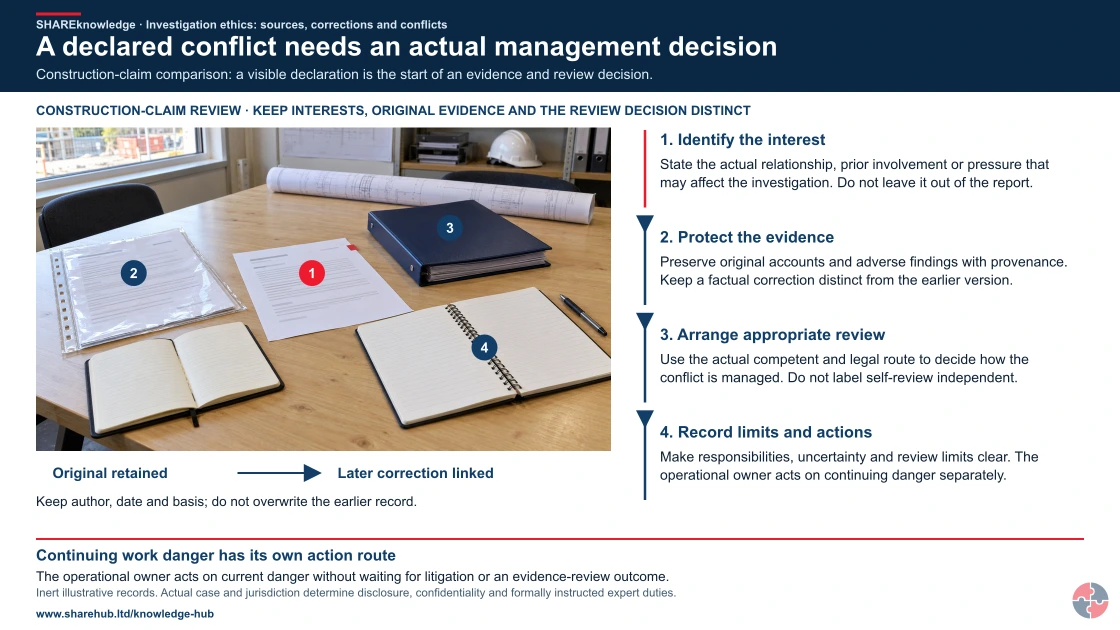
Full written explanation
A realistic HD construction-office evidence pack contains an original account preserved in a transparent sleeve, a separate notebook for later corrections, a red-tab interest sheet, a navy review folder and a separate action notebook. Four native numbered references connect physical inert records to the actual sequence: identify relevant interests, protect evidence, arrange appropriate competent/legal review, and record limits and actions. A native original-to-later-correction link retains both versions and the author/date/basis relationship; the earlier record is not overwritten. Continuing work danger has a separate operational action band and does not wait for litigation. No person is pictured or accused of wrongdoing. The documents carry no actual personal information, approval, independent-review result or legal outcome. This is a management explanation, not a universal court procedure, expert status, privilege guarantee or authority to conceal/release records. The current case, instruction and jurisdiction remain necessary.
Construction-claim comparison: a visible declaration is the start of an evidence and review decision.
- Identify the interest. State the actual relationship, prior involvement or pressure that may affect the investigation. Do not leave it out of the report.
- Protect the evidence. Preserve original accounts and adverse findings with provenance. Keep a factual correction distinct from the earlier version.
- Arrange appropriate review. Use the actual competent and legal route to decide how the conflict is managed. Do not label self-review independent.
- Record limits and actions. Make responsibilities, uncertainty and review limits clear. The operational owner acts on continuing danger separately.
When the evidence does not fit: Disclosure, confidentiality and formally instructed expert duties depend on the actual case and jurisdiction. This example guarantees no outcome or right to conceal or release a record.
Who acts: Investigation lead, accountable manager and appropriate independent or legal adviser within the actual instruction.
Changed workplace
Corporate witness account: Keep originals and later corrections distinguishable.
Construction claim: Declare interests and obtain a real review arrangement.
Evidence check: Use the real authorised evidence process and current jurisdiction-specific advice. No privilege, disclosure permission or universal expert status is supplied.
Preserve evidence, correct openly and retain the actual jurisdiction
Primary references: HSE: investigation information, analysis and action — HSG245 · England and Wales: CPR35 applies to its defined expert-evidence context
Open the complete HD image (new tab)Download image

Preserve evidence, correct openly and retain the actual jurisdiction
Primary references: HSE: investigation information, analysis and action — HSG245 · England and Wales: CPR35 applies to its defined expert-evidence context
A decision that changes work — part 1 of 3


Read the complete visual as text
- 1. Task and setting: Serious workplace incident followed by internal investigation and possible regulator or court action.
- 2. People and prerequisites: Injured person, witnesses, investigator, safety adviser, legal adviser and privacy lead; immediate danger has been controlled.
- 3. Before the task: Preserve original records and scene changes, define the investigator role, declare conflicts and agree lawful access to information.
A decision that changes work — part 2 of 3


Read the complete visual as text
- 1. Check during work: Record witnesses in their own words, distinguish fact from inference, keep versions and seek legal advice on disclosure questions.
- 2. Stop, hold or refer: Stop retrospective alteration, pressure on witnesses or an opinion beyond competence; urgent rescue always takes priority.
A decision that changes work — part 3 of 3


Read the complete visual as text
- 1. Completion and hand-back: Correct factual errors transparently, communicate fairly with affected people and assign control improvements.
- 2. Retained evidence: Original files, access and version log, witness accounts, investigation basis, advice record and verified corrective actions.
BuildOut Ltd (worked example). a construction and refurbishment contractor managing CDM dutyholder interfaces, subcontractors, temporary works, work at height, excavation, asbestos controls, lifting operations and high-risk maintenance on occupied sites.
BuildOut's main ethical pressure points would appear after serious site incidents, utility strikes, falls, asbestos disturbances, lifting failures, contractor injuries, public-interface events or enforcement visits. The business may need to cooperate with HSE, preserve site records, support witnesses, brief clients, notify insurers and keep work safe while legal facts are still emerging.
The company would build clear rules into its incident and legal-response procedure. Site managers would secure the scene, preserve permits, photographs, RAMS, inductions, toolbox-talk records, inspection sheets and subcontractor documents. The HSSE manager would appoint an investigation lead, declare conflicts, set interview rules, liaise with legal advisers where needed and keep corrective action separate from liability wording.
Senior leaders would be trained not to ask for report findings to be softened. Procurement would require subcontractors to provide accurate competence, training and maintenance evidence. HR would support witnesses and manage confidentiality. The board would review serious findings, action quality, recurring themes, claims trends and lessons learned across projects.
| Element | How BuildOut would manage it | Evidence produced |
|---|---|---|
| Assess and analyse | Identify legal-action risks in serious incident procedure, including conflicts, evidence loss, data protection and witness care. | Procedure, risk register and incident response plan. |
| Implement | Use legal-hold prompts, scene-control checklists, document registers and investigation terms of reference. | Legal-hold record, evidence index and investigation plan. |
| Train | Train managers in incident response, witness handling, escalation, RIDDOR decisions and not altering records. | Training matrix, briefings and competence checks. |
| Contractor management | Require subcontractors to preserve records, cooperate with investigations and avoid pressuring witnesses. | Contract clauses, induction records and contractor rules. |
| Check | Audit serious incident files for evidence completeness, action quality, communication and confidentiality. | Audit findings, action tracker and file review. |
| Learn and improve | Review claims, enforcement feedback, near misses and action failures at leadership meetings. | Lessons-learned bulletin and updated procedures. |
A decision that changes work
Task, material and setting: Serious workplace incident followed by internal investigation and possible regulator or court action.
People and prerequisites: Injured person, witnesses, investigator, safety adviser, legal adviser and privacy lead; immediate danger has been controlled.
Before: Preserve original records and scene changes, define the investigator role, declare conflicts and agree lawful access to information.
During: Record witnesses in their own words, distinguish fact from inference, keep versions and seek legal advice on disclosure questions.
Hold or stop: Stop retrospective alteration, pressure on witnesses or an opinion beyond competence; urgent rescue always takes priority.
Completion and hand back: Correct factual errors transparently, communicate fairly with affected people and assign control improvements.
Evidence: Original files, access and version log, witness accounts, investigation basis, advice record and verified corrective actions.
What training and competence help people manage ethical legal-action issues?
Training should be tiered so people know what to do before, during and after incidents or legal-action triggers.
General awareness should help all workers understand that incidents, near misses, unsafe conditions and concerns should be reported honestly and promptly. People should know that retaliation, witness pressure or record falsification is unacceptable.
Supervisors and managers need more practical training. They should know how to secure a scene, preserve evidence, speak to distressed people, avoid speculation, protect records, use RIDDOR escalation routes and keep corrective actions moving.
Investigators, HSSE professionals and senior leaders need deeper learning on HSG245-style investigation, evidence standards, conflict declarations, interviewing, root cause analysis, legal privilege boundaries, data protection, regulator engagement, civil claims and inquests.
| Role | Learning | Demonstration | Assessor | Record | Reassess when |
|---|---|---|---|---|---|
| Witness | Give own account without coaching | Explain observation versus inference | Investigator | Signed account | New fact |
| Investigator | Preserve versions and challenge bias | Reconstruct evidence chain | Independent lead | Evidence log | Conflict |
| Safety adviser | State scope and uncertainty | Explain technical findings | Technical lead | Opinion basis | New evidence |
| Legal adviser | Set procedure and disclosure advice | Review forum and privilege | Legal lead | Advice record | Claim/case |
| Privacy lead | Limit personal-data access | Audit recipients | DPO | Access log | New use |
| Director | Prevent pressure and fund correction | Review action and escalation | Board chair | Decision record | Serious concern |
How does this topic support NEBOSH Diploma study?
This topic supports NEBOSH Diploma DN1 legal-action criteria by testing professional judgement under pressure.
Diploma-level answers should move beyond saying 'be honest'. They should explain the conflict, identify the professional boundary, state what evidence should be preserved, describe who should be involved, protect confidentiality, and explain how serious risk or unethical instructions should be escalated.
A scenario may describe a manager asking for wording to be changed, a witness being pressured, a late RIDDOR decision, a civil claim, a regulator request, a bereaved family, missing documents or a safety adviser asked to give legal advice. A strong answer explains what is ethical, what is lawful, what is competent and what should be recorded.
| Study point | What to explain | Scenario use |
|---|---|---|
| Conflicts of interest | Competing duties can undermine independent judgement. | Declare conflict and use independent review. |
| Duty to employer | Support the employer with accurate, competent advice. | Do not become a dishonest advocate. |
| Duty to court or tribunal | Evidence and opinions must be truthful and within expertise. | Separate fact from opinion and disclose limitations. |
| Claimant and prosecution contexts | Civil and criminal processes have different purposes. | Avoid mixing compensation and enforcement analysis. |
| Confidentiality | Protect sensitive information but recognise disclosure and serious-risk limits. | Use need-to-know access and lawful process. |
| Escalation | Unethical or unsafe conduct must be raised appropriately. | Record concern and use governance or whistleblowing route if needed. |
How do management frameworks support this topic?
HSE’s Plan–Do–Check–Act guidance helps assign ownership, deliver controls, check evidence and improve weak arrangements. Apply the relevant legal duties and task-specific technical evidence separately.
Official management guidance: HSE Managing for health and safety (HSG65)
| Framework | Status and scope | Contribution | Limit |
|---|---|---|---|
| HSE HSG65 | GB regulator management guidance | Plan, do, check and act with evidence of current control | Apply to the actual incident, evidence chain and governance decision. |
What are the warning signs that ethical legal-action issues are not being managed?
Warning signs include altered records, vague reports, witness pressure, missing evidence, delayed actions and defensive leadership behaviour.
The harm is not only legal exposure. Poor ethics prevents learning. If evidence is lost, witnesses are pressured or findings are hidden, the organisation may repeat the same failure and workers remain exposed to danger.
Ethical warning signs should be treated as management-system failures. They should be investigated, corrected and reviewed like any other control failure.
| Warning sign | How it can cause harm | Action |
|---|---|---|
| Report wording repeatedly softened | Root causes may disappear and actions become weak. | Require factual review and independent sign-off. |
| Missing permits, photos or CCTV | Evidence gap may prevent learning or fair proceedings. | Use legal-hold and evidence-preservation triggers. |
| Witnesses told what to say | Evidence becomes unreliable and trust collapses. | Stop process and escalate to investigation lead or legal adviser. |
| RIDDOR decisions undocumented | Reporting may be inconsistent or late. | Create a decision log with competent review. |
| Actions delayed until claim resolves | Known risk may continue. | Separate risk reduction from liability admission. |
| Health data shared too widely | Privacy breach and loss of worker trust. | Review access controls and ICO guidance. |
| Adviser asked for legal opinion | Advice may exceed competence and mislead leaders. | Clarify scope and involve legal professionals. |
What do the acronyms and key terms mean?
Acronyms should be defined so readers can understand legal-action and evidence terminology without prior experience.
| Term | Meaning | Why it matters |
|---|---|---|
| CPR | Civil Procedure Rules. | Relevant to civil claims and court procedure. |
| CrimPR | Criminal Procedure Rules. | Relevant to criminal proceedings and court process. |
| DPA | Data Protection Act. | Relevant to personal data and records. |
| GDPR | General Data Protection Regulation. | Relevant to personal and special-category data. |
| HSG245 | HSE guidance on investigating accidents and incidents. | Useful investigation method and evidence framework. |
| PFD | Prevention of future deaths report. | A coroner may issue one where action may prevent future deaths. |
| RIDDOR | Reporting of Injuries, Diseases and Dangerous Occurrences Regulations. | Creates formal reporting duties after specified events. |
| Witness evidence | Information provided by a person about what they saw, heard, did or knew. | Must be handled fairly and accurately. |