SHARE Knowledge Hub
Fixed Fire Protection Installations
Fixed fire protection only works when the installed system, water or agent supply and interfaces match the credited fire scenario. Dutyholders need competent checks, prompt impairment restrictions and verified hand-back. Premises law differs across England and Wales, Scotland and Northern Ireland; GB and NI process and construction rules also differ.
Understanding Fixed Fire Protection Installations
Fixed fire protection only works when the installed system, water or agent supply and interfaces match the credited fire scenario. Dutyholders need competent checks, prompt impairment restrictions and verified hand-back. Premises law differs across England and Wales, Scotland and Northern Ireland; GB and NI process and construction rules also differ.
Why this matters at work
Assess actual fuel, medium, discharge, pressure, atmosphere, access, maintenance and impairment hazards. Competent evidence must cover protection and introduced harm to occupants/responders. PPE does not replace safeguards; no agent concentration, testing procedure or entry clearance.
Treat loss of a relied-on protection as a change in risk. Establish the affected area, duration, cause and dependencies, including whether detection, water supply or alarm interfaces are also lost. Avoid or defer the impairment where practicable and coordinate it with hazardous work, occupancy and other outages. Notify the appropriate dutyholders and affected people using the site's impairment arrangements.
How organisations manage this in practice
Select actual premises, activity, dutyholder and territory. England/Wales FSO, Scotland and NI premises law differ, as do GB/NI general safety, DSEAR and construction routes. Record assessment, arrangements and changes within actual scope; no automatic UK-wide legal checklist.
A gaseous system can introduce life hazards as well as suppressing fire. Establish the actual agent, enclosure, discharge characteristics and intended occupancy before planning work. Warning, evacuation, release controls, isolation for maintenance and re-entry arrangements need competent design and operating information. Do not assume that a system described as clean or inert is harmless to people, or that disappearance of smoke means an enclosure is safe to enter. Train users in the actual warnings and required actions, including contractors and people working outside normal hours. Assess how door changes, leakage, ventilation or new equipment affect both suppression and occupant safety. Control any impairment or testing with a safe plan; avoid exposing people to a live discharge as a demonstration. Define who can isolate, restore and accept the system, how alarms communicate and how emergency responders receive agent information. Re-entry after discharge needs the applicable specialist assessment and authorisation. A generic gas reading, countdown or time delay cannot be invented as a safe threshold for all agents and enclosures.
A competent assessment should decide whether work or occupancy must be restricted and which compensatory measures are effective. A fire watch is not automatically equivalent to suppression, and PPE cannot replace a missing installation. Set an owner, review triggers, communication and restoration criteria, and record the actual status at handovers. After repair, verify the installation and interfaces against suitable acceptance requirements before removing restrictions. Closing the contractor job or reopening a valve is insufficient if testing, indications or documentation remain unresolved. The appropriate controls and test regime are system-specific and cannot be prescribed by a universal checklist.
Check the physical protection and supply, not only the panel or service date
For each installation, state the scenario and function credited: limiting growth, controlling escalation, supporting escape or another defined purpose. Record the area, inventory, water or agent supply, valves, interfaces and limitations. A sprinkler, water-spray or special-suppression system is not a general guarantee against every fire or exposure at the site.
Best-practice guide: Fixed Fire Protection Installations
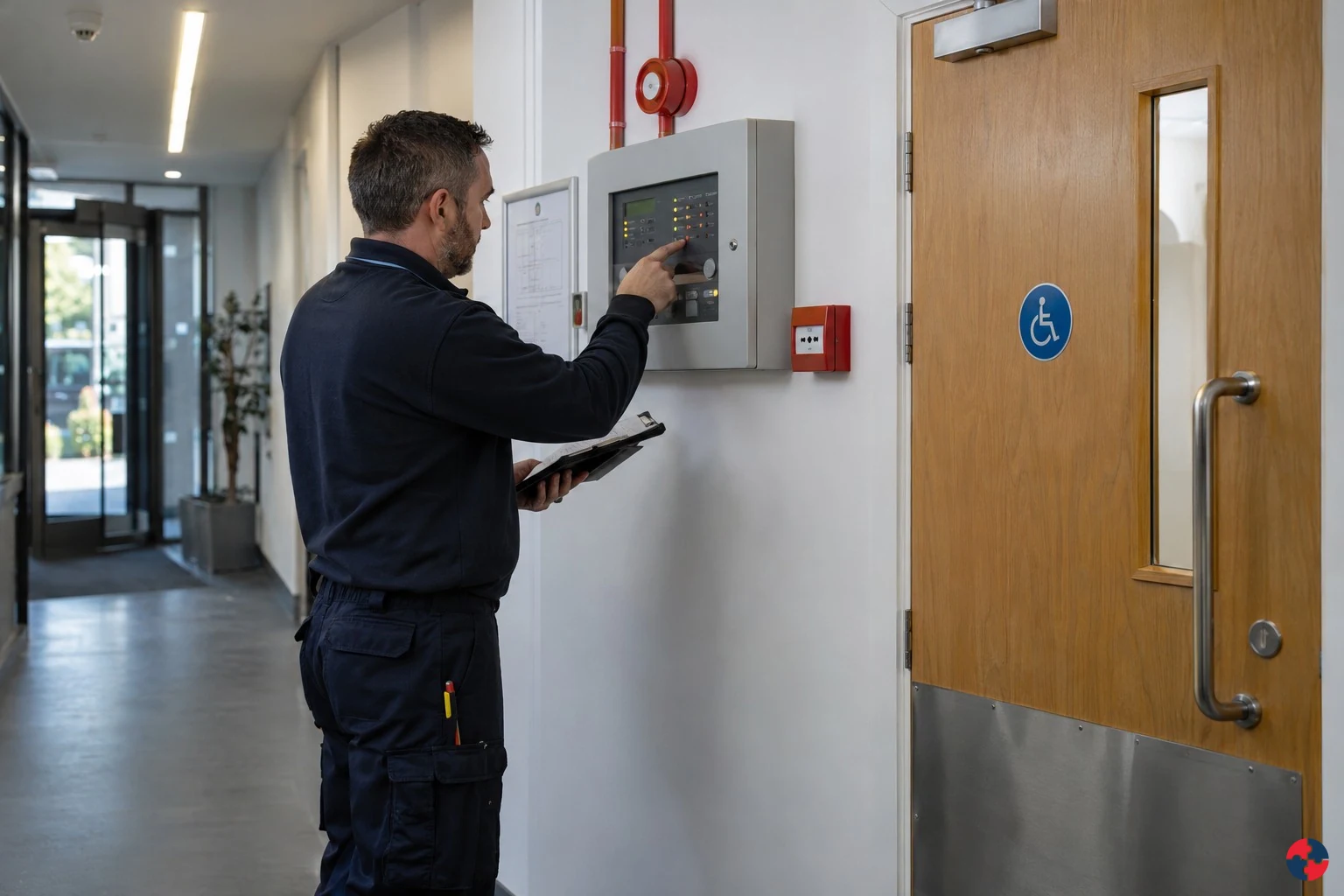
Check the physical protection and supply, not only the panel or service date
For each installation, state the scenario and function credited: limiting growth, controlling escalation, supporting escape or another defined purpose. Record the area, inventory, water or agent supply, valves, interfaces and limitations. Fixed fire protection only works when the installed system, water or agent supply and interfaces match the credited fire scenario.
Turn fixed fire protection installations knowledge into a decision
Fixed fire protection only works when the installed system, water or agent supply and interfaces match the credited fire scenario. Dutyholders need competent checks, prompt impairment restrictions and verified hand-back. Sprinklers control fire growth but still need alarm response, evacuation and water-damage recovery planning.
Worked examples for fixed fire protection
Office waste bin fire activates one sprinkler head: Sprinklers normally operate locally where heat reaches the head; the whole building does not necessarily discharge. Evidence / response: Sprinklers control fire growth but still need alarm response, evacuation and water-damage recovery planning. Warehouse racking fire grows after storage height changes: The sprinkler design may have been based on lower storage, different goods or a different racking layout. Evidence / response: Layout and commodity changes must trigger fire protection review, not just a housekeeping inspection.
Warning signs and how harm could develop
Closed or unlabelled valves: Water may not reach sprinklers, deluge systems, risers or hydrants during a fire. Blocked sprinkler heads or riser access: Water discharge or firefighter access may be delayed or ineffective. Service reports with repeated unresolved defects: Known degradation becomes normalised and the responsible person loses control.
Choose controls for the actual task
Elimination: Remove the conflicting racking work or relocate combustible stock until protection is restored. Substitution: Use a work sequence or lower-risk storage arrangement that avoids the protected area during impairment. Engineering: Restore valve position, sprinkler coverage, water supply and alarm interface to the approved design with competent repair. Administrative: Use an authorised impairment record, no hot work, stock limit and affected-person communication while competent repair proceeds. PPE: Worker fire PPE does not replace a sprinkler; task PPE for repair addresses separate maintenance exposure. Read the full control table for qualifications, ownership and verification. Use the actual task and applicable jurisdiction; existing technical approval remains unchanged.
Use the full fixed fire protection installations lesson
Use the full topic for the decision points, practical examples, detailed control tables and source scope. HSE guidance applies to Great Britain; use HSENI for the Northern Ireland route and the source’s stated jurisdiction. A simplified guide does not change the page’s technical-review or approval status.

Read all six steps as text
1. Check the physical protection and supply, not only the panel or service date
For each installation, state the scenario and function credited: limiting growth, controlling escalation, supporting escape or another defined purpose.
- Avoid / redesign: Remove the conflicting racking work or relocate combustible stock until protection is restored.
- Control the task: Restore valve position, sprinkler coverage, water supply and alarm interface to the approved design with competent repair.
- Verify before release: Fire load remains in impaired zone: restrict use.
For each installation, state the scenario and function credited: limiting growth, controlling escalation, supporting escape or another defined purpose. Record the area, inventory, water or agent supply, valves, interfaces and limitations. Fixed fire protection only works when the installed system, water or agent supply and interfaces match the credited fire scenario.
Apply it: Which part of this plan would you check at the workface before authorising the task?
2. Turn fixed fire protection installations knowledge into a decision
Use the evidence to improve the actual work arrangement.
- Change at source: Remove the conflicting racking work or relocate combustible stock until protection is restored.
- Make it observable: Fire load remains in impaired zone: restrict use.
- Keep useful evidence: Sprinklers control fire growth but still need alarm response, evacuation and water-damage recovery planning.
Fixed fire protection only works when the installed system, water or agent supply and interfaces match the credited fire scenario. Dutyholders need competent checks, prompt impairment restrictions and verified hand-back. Sprinklers control fire growth but still need alarm response, evacuation and water-damage recovery planning.
Apply it: What evidence would show that the change improves this task, rather than only completing a record?
3. Worked examples for fixed fire protection
Example: a practical application of the existing topic lesson.
- Office waste bin fire activates one sprinkler head: Sprinklers normally operate locally where heat reaches the head; the whole building does not necessarily discharge.
- Workplace finding 2: The sprinkler design may have been based on lower storage, different goods or a different racking layout.
- Kitchen suppression activates over a deep fat fryer: Nozzles, fusible links, manual release and fuel shut-off must match the cooking equipment.
Office waste bin fire activates one sprinkler head: Sprinklers normally operate locally where heat reaches the head; the whole building does not necessarily discharge. Evidence / response: Sprinklers control fire growth but still need alarm response, evacuation and water-damage recovery planning. Warehouse racking fire grows after storage height changes: The sprinkler design may have been based on lower storage, different goods or a different racking layout. Evidence / response: Layout and commodity changes must trigger fire protection review, not just a housekeeping inspection.
Apply it: At which point would you hold this example, and what evidence would allow it to proceed?
4. Warning signs and how harm could develop
Connect the task, the route to the person and the control that can fail.
- Closed or unlabelled valves: Water may not reach sprinklers, deluge systems, risers or hydrants during a fire.
- Blocked sprinkler heads or riser access: Water discharge or firefighter access may be delayed or ineffective.
- Service reports with repeated unresolved defects: Known degradation becomes normalised and the responsible person loses control.
Closed or unlabelled valves: Water may not reach sprinklers, deluge systems, risers or hydrants during a fire. Blocked sprinkler heads or riser access: Water discharge or firefighter access may be delayed or ineffective. Service reports with repeated unresolved defects: Known degradation becomes normalised and the responsible person loses control.
Apply it: Who could be exposed, including other trades, cleaners, maintainers and people nearby?
5. Choose controls for the actual task
Control summary. Read the complete task-specific controls and checks in the linked topic.
- Elimination: Remove the conflicting racking work or relocate combustible stock until protection is restored.
- Substitution: No separate substitute is specified. Compare suitable safer materials, equipment or processes; check new risks before any change.
- Engineering controls: Authorise and record impairment, affected storage or operations, temporary restrictions and restoration evidence; the operating owner accepts hand-back after technical verification.
- Administrative controls: Authorise and record impairment, affected storage or operations, temporary restrictions and restoration evidence; the operating owner accepts hand-back after technical verification.
- PPE: Worker fire PPE does not replace a sprinkler; task PPE for repair addresses separate maintenance exposure.
Elimination: Remove the conflicting racking work or relocate combustible stock until protection is restored. Substitution: Use a work sequence or lower-risk storage arrangement that avoids the protected area during impairment. Engineering: Restore valve position, sprinkler coverage, water supply and alarm interface to the approved design with competent repair. Administrative: Use an authorised impairment record, no hot work, stock limit and affected-person communication while competent repair proceeds. PPE: Worker fire PPE does not replace a sprinkler; task PPE for repair addresses separate maintenance exposure. Read the full control table for qualifications, ownership and verification. Use the actual task and applicable jurisdiction; existing technical approval remains unchanged.
Apply it: Which stronger option can be used here, and who will verify it before accepting the remaining risk?
6. Use the full fixed fire protection installations lesson
Follow the official sources below and retain the task-specific evidence.
- Official guidance: Fire Safety Order Article 17
- Official guidance: GOV.UK fire safety risk assessment: offices and shops
- Task decision: Competent verification precedes operating hand-back and communication to users. Do not operate valves or assume every system activates locally from this diagram.
Use the full topic for the decision points, practical examples, detailed control tables and source scope. HSE guidance applies to Great Britain; use HSENI for the Northern Ireland route and the source’s stated jurisdiction. A simplified guide does not change the page’s technical-review or approval status.
Apply it: Which official source and full-topic section will you use to resolve the next decision?
Follow a closed valve or lost supply through the current-use decision. The owner obtains competent advice on the affected function and restrictions, controls any interim arrangement and verifies repair through the physical installation and interfaces. A recent service certificate or normal panel cannot establish available flow, agent or effective delivery. Accept restoration only when the credited function and operational hand-back are demonstrated.
Crownway: the panel is normal but the supply is not
Illustrative example. A credited protection zone has a closed valve or unavailable supply after maintenance while the panel appears normal.
Decision. Operations holds the affected activity and the protection owner obtains competent assessment and controlled restoration.
Evidence to check. System purpose, affected inventory, valve/supply status, functional test and a witnessed hand-back.
Hold or escalation point. Do not accept service paperwork or indication as proof of the physical protection the scenario requires.
Follow-up. Review valve control, impairment authorisation and next-shift communication after restoration.
Separate water delivery, warning and restoration authority
A fixed installation needs its own design basis and verification. This conceptual water-based example does not describe every type of fire-protection system.
Water delivery and a warning signal need different evidence
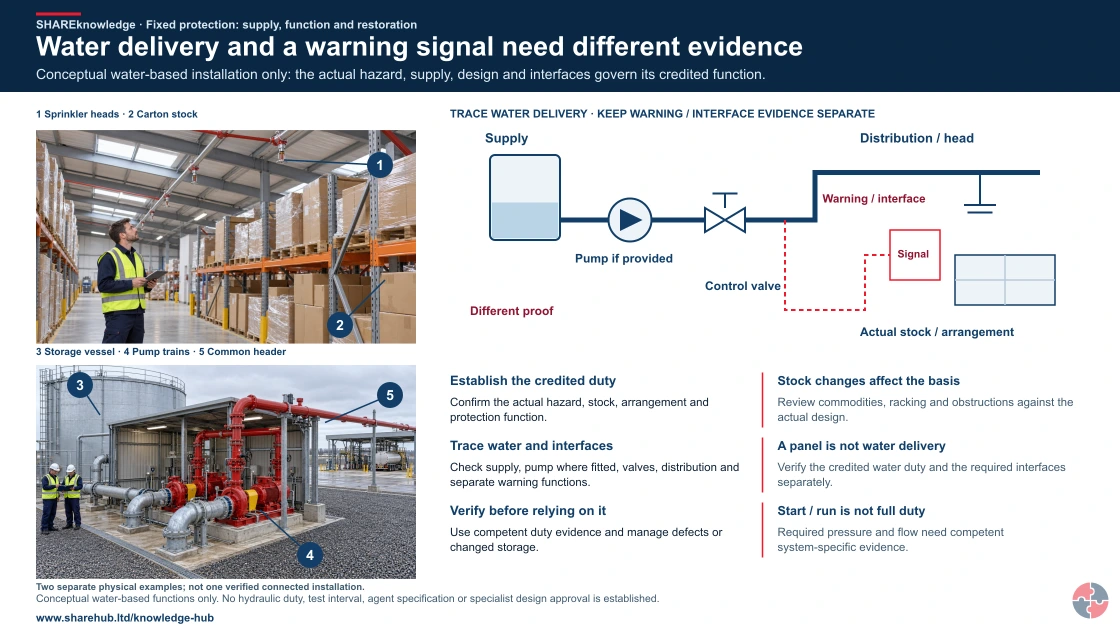
Full written explanation
Two separate normal physical examples show warehouse sprinkler heads and carton stock, and a firewater storage vessel, pump trains and common header. Picture key: 1 Sprinkler heads · 2 Carton stock · 3 Storage vessel · 4 Pump trains · 5 Common header. They are not established as one connected installation. A separate conceptual solid water dependency traces supply, pump if provided, control valve and distribution/head above the actual-stock/arrangement question. A dashed warning/interface branch leads separately to a signal; it requires different proof. Panel indication or pump start/run does not demonstrate water delivery or required duty. Three complete paired explanations establish the credited duty, trace water and interfaces, then verify before relying on it. Neither physical example establishes flow, pressure, capacity, valve state, stock compatibility, spacing, clearance, coverage, design acceptance or permission. Detailed gas, water-mist and kitchen specifications remain held.
Conceptual water-based installation only: the actual hazard, supply, design and interfaces govern its credited function.
- Establish the credited duty. Confirm the actual hazard, stock, arrangement and protection function.
- Trace water and interfaces. Check supply, pump where fitted, valves, distribution and separate warning functions.
- Verify before relying on it. Use competent duty evidence and manage defects or changed storage.
Change the pathway
- Stock changes affect the basis. Review commodities, racking and obstructions against the actual design.
- A panel is not water delivery. Verify the credited water duty and the required interfaces separately.
- Start / run is not full duty. Required pressure and flow need competent system-specific evidence.
Evidence check: Conceptual water-based functions only. No hydraulic duty, test interval, agent specification or specialist design approval is established.
Keep water delivery, warning and restoration authority separate
Primary references: HSE COMAH fire measures: scenario and system dependencies
Open the complete HD image (new tab)Download image

Keep water delivery, warning and restoration authority separate
Primary references: HSE COMAH fire measures: scenario and system dependencies

Trace the relevant path
Identify supply, pump where provided, valves, distribution and discharge devices for the actual installation.
Keep interfaces separate
An alarm indication and delivery of extinguishing media answer different questions; verify the functions actually relied upon.
Manage impairment
A closed valve or other failed function needs an assessed impairment decision, restrictions and a named owner.
Accept restoration
Competent verification precedes operating hand-back and communication to users. Do not operate valves or assume every system activates locally from this diagram.
Read the complete task-specific control examples
ERICPD is a planning cross-map: Discipline verifies and sustains every control. ESEAP compares effectiveness. A label does not authorise the task; retain the owner, evidence and stop or change decision.
Fixed Fire Protection Installations · ERICPD
- Eliminate
- Remove the conflicting racking work or relocate combustible stock until protection is restored.
- Reduce
- Authorise and record impairment, affected storage or operations, temporary restrictions and restoration evidence; the operating owner accepts hand-back after technical verification.
- Isolate
- Restore valve position, sprinkler coverage, water supply and alarm interface to the approved design with competent repair.
- Control
- Use an authorised impairment record, no hot work, stock limit and affected-person communication while competent repair proceeds.
- PPE
- Worker fire PPE does not replace a sprinkler; task PPE for repair addresses separate maintenance exposure.
- Discipline
- Audit valve status, obstruction trend, test evidence and final hand-back before normal storage resumes.
Fixed Fire Protection Installations · ESEAP
- Elimination
- Remove the conflicting racking work or relocate combustible stock until protection is restored.
- Substitution
- No separate substitute is specified. Compare suitable safer materials, equipment or processes; check new risks before any change.
- Engineering controls
- Authorise and record impairment, affected storage or operations, temporary restrictions and restoration evidence; the operating owner accepts hand-back after technical verification.
- Administrative controls
- Authorise and record impairment, affected storage or operations, temporary restrictions and restoration evidence; the operating owner accepts hand-back after technical verification.
- PPE
- Worker fire PPE does not replace a sprinkler; task PPE for repair addresses separate maintenance exposure.
What are the key points for fixed fire protection?
A fixed system only protects the people or process credited by the fire strategy when its supply, controls, interfaces and response still work. Identify the scenario, design basis, owner, inspection evidence and stop decision for each impaired function.
Fixed systems must match the hazard
A sprinkler system designed for light office fire loads may not be suitable for high-piled storage, flammable liquids, lithium-ion battery charging or process plant exposure.
The water supply is part of the system
Tanks, pumps, mains, valves, hydrants and pressure are as important as the sprinkler head or riser outlet visible in the building.
Interfaces need active management
Suppression may need to signal alarms, shut down ventilation, release doors, stop plant, isolate fuel, start pumps or alert remote monitoring.
Impairment is a live risk condition
Any isolation, fault, closed valve, drained pipework, disabled alarm zone or failed pump needs authorisation, compensating controls and prompt reinstatement.
Records should prove performance
Service certificates, inspection logs, valve checks, flow tests, defect close-out, impairment permits and cause-and-effect testing are evidence of control.
Competence matters
Design, installation, commissioning, maintenance and significant alteration need competent fire engineering, specialist contractor and responsible person oversight.
What are fixed fire protection installations?
Fixed fire protection installations are permanent or semi-permanent fire safety systems built into a building, plant, process area or site infrastructure.
The simplest way to understand them is to separate the fire protection job from the equipment name. Some systems suppress fire directly, some cool exposed plant to prevent escalation, some provide water for firefighters, some protect a special enclosure, and some create the signal that starts emergency actions.
They are different from ordinary portable extinguishers because they are part of the building or process fire strategy. If they fail, the assumptions behind evacuation, firefighting, property protection, business continuity or major accident prevention may fail with them. That is why fixed systems should appear in the fire risk assessment, maintenance plan, emergency plan and change-control process.
| Term | Plain-English meaning | Why it matters |
|---|---|---|
| Sprinkler system | A water-based system with heat-sensitive heads that discharge water locally when activated. | Controls or suppresses fire growth and can protect escape, stock, structures and continuity. |
| Deluge or drencher system | An open-nozzle water system that discharges over a defined area when activated. | Used where rapid fire spread, exposure cooling or process escalation is a credible concern. |
| Water mist system | A system using fine water droplets to cool flame, reduce heat and displace oxygen locally. | Useful in selected applications where lower water use or specific enclosure protection is needed. |
| Foam system | A fixed system applying foam to flammable liquid hazards. | Can suppress vapour release and surface fire where water alone would not be suitable. |
| Gaseous suppression | A system that floods an enclosure with an extinguishing gas or inerting agent. | Used for sensitive equipment rooms or enclosed hazards, but needs strict life-safety controls. |
| Wet or dry riser | A vertical firefighting water pipe with outlets for fire and rescue service use. | Supports firefighting in taller or complex buildings where hose deployment is difficult. |
| Firefighting main or hydrant | A water distribution system for firefighting outlets or site hydrants. | Supports internal, external or industrial firefighting operations. |
How do ordinary premises differ from higher-risk fire protection settings?
Ordinary workplace systems usually protect escape, warning and basic firefighting; higher-risk systems may also prevent escalation, domino effects and major accident consequences.
In an office, shop or small workshop, fixed protection may be limited to alarm interfaces, emergency lighting, fire doors and perhaps sprinklers or hose reels. The management focus is usually routine inspection, service records, defect repair, evacuation and keeping systems unobstructed.
In warehouses, care settings, high-rise buildings, construction projects, offshore installations, fuel sites and process plants, fixed protection can become safety-critical. The system may protect people who cannot leave quickly, cool tanks exposed to fire, suppress flammable liquid fires, maintain a temporary refuge, protect escape routes or trigger emergency shutdown. These arrangements need a stronger performance standard, impairment control and assurance regime.
| Setting | Typical fixed protection | Management emphasis |
|---|---|---|
| Ordinary offices and shops | Alarm interfaces, emergency lighting, sometimes sprinklers or hose reels. | Routine inspection, servicing, defect repair, clear evacuation and cooperation with landlords. |
| Warehouses and distribution | Sprinklers, hydrants, fire mains, smoke control, alarm interfaces and sometimes foam or special suppression. | Storage height, rack layout, fire load, water supply, obstruction control and change review. |
| Care, sleeping or public assembly | Detection, alarm interfaces, sprinklers in some premises, smoke control, risers and firefighter facilities. | Occupant vulnerability, evacuation strategy, maintenance evidence and staffing response. England residential-care fire-risk guidance supports resident vulnerability and evacuation/precaution planning. This source does not establish hospital design requirements or cover all sleeping/public-assembly premises. Other sleeping/public-assembly examples are general teaching pending fitted current government guidance and specialist review. |
| Construction and refurbishment | Temporary or existing risers, alarms, sprinklers, hydrants and compartmentation affected by works. | Phased impairment control, hot work control, occupied-building interface and handback checks. |
| DSEAR and process settings | Deluge, foam, monitors, gas detection interfaces, shutdowns, containment cooling and firefighting water. | Hazardous area links, escalation prevention, performance standards and major accident scenario evidence. |
| Offshore and major hazard sites | Detection, deluge, passive protection, firefighting systems, emergency shutdown and refuge protection. | Performance standards, safety-critical element assurance, impairment escalation and emergency response integration. |
Which fixed fire protection systems are commonly found?
Fixed fire protection should be described by what it does: suppressing fire, cooling exposures, supplying firefighters, protecting enclosures or initiating emergency actions.
The same equipment can have different purposes in different premises. A sprinkler in a retail stockroom may be primarily life-safety and property protection. A deluge system protecting process vessels may be there to prevent escalation. A dry riser does not extinguish fire on its own; it gives firefighters a practical route to deliver water at height.
Good management starts by writing down the intended function. If nobody can explain what the system protects, how it operates, what it relies on and what would happen if it failed, the organisation is managing equipment rather than fire risk.
| System | Primary role | Typical evidence |
|---|---|---|
| Automatic sprinklers | Control or suppress fire growth in the protected area. | Design basis, service reports, valve checks, flow tests, obstruction reviews and change records. |
| Deluge or drencher | Apply water over a full hazard area or exposure at once. | Cause-and-effect test, detection interface, nozzle checks, water supply test and impairment plan. |
| Foam systems | Suppress flammable liquid surface fires and reduce vapour release. | Foam concentrate records, proportioning tests, manufacturer shelf-life/condition checks and compatibility review. |
| Gaseous suppression | Protect enclosed high-value or sensitive assets where water may be unsuitable. | Room integrity test, warning delay, lock-off procedure, discharge test evidence and agent inventory. Illustrative specialist-system evidence prompt: direct current government support for the detailed gas/water-mist/kitchen specification and named fire-engineering approval remain held. Do not select an agent, warning delay, nozzle arrangement or re-entry rule from this row. |
| Kitchen suppression | Protect cooking equipment, extract hoods and grease filters. | Service certificate, nozzle alignment, fusible link checks, manual release and cleaning records. Illustrative specialist-system evidence prompt: direct current government support for the detailed gas/water-mist/kitchen specification and named fire-engineering approval remain held. Do not select an agent, warning delay, nozzle arrangement or re-entry rule from this row. |
| Wet and dry risers | Support firefighting water delivery through a building. | Pressure test, outlet checks, inlet access checks, signage, cabinet condition and defect close-out. |
| Fire mains and private hydrants | Provide water to firefighters or fixed monitors across a site. | Hydrant inspection, flow evidence, access checks, drawings and emergency plan integration. |
| Hose reels | Provide fixed first-aid firefighting where suitable and where staff are trained. | Suitability review, service records, training, signage and risk assessment justification. |
How does portable-extinguisher recognition support this topic?
Identify the fuel and additional electrical hazard, read the actual extinguisher label and follow the site fire plan. Raise the alarm and protect escape first; only trained, authorised people should consider a small initial fire within their safe response limits.
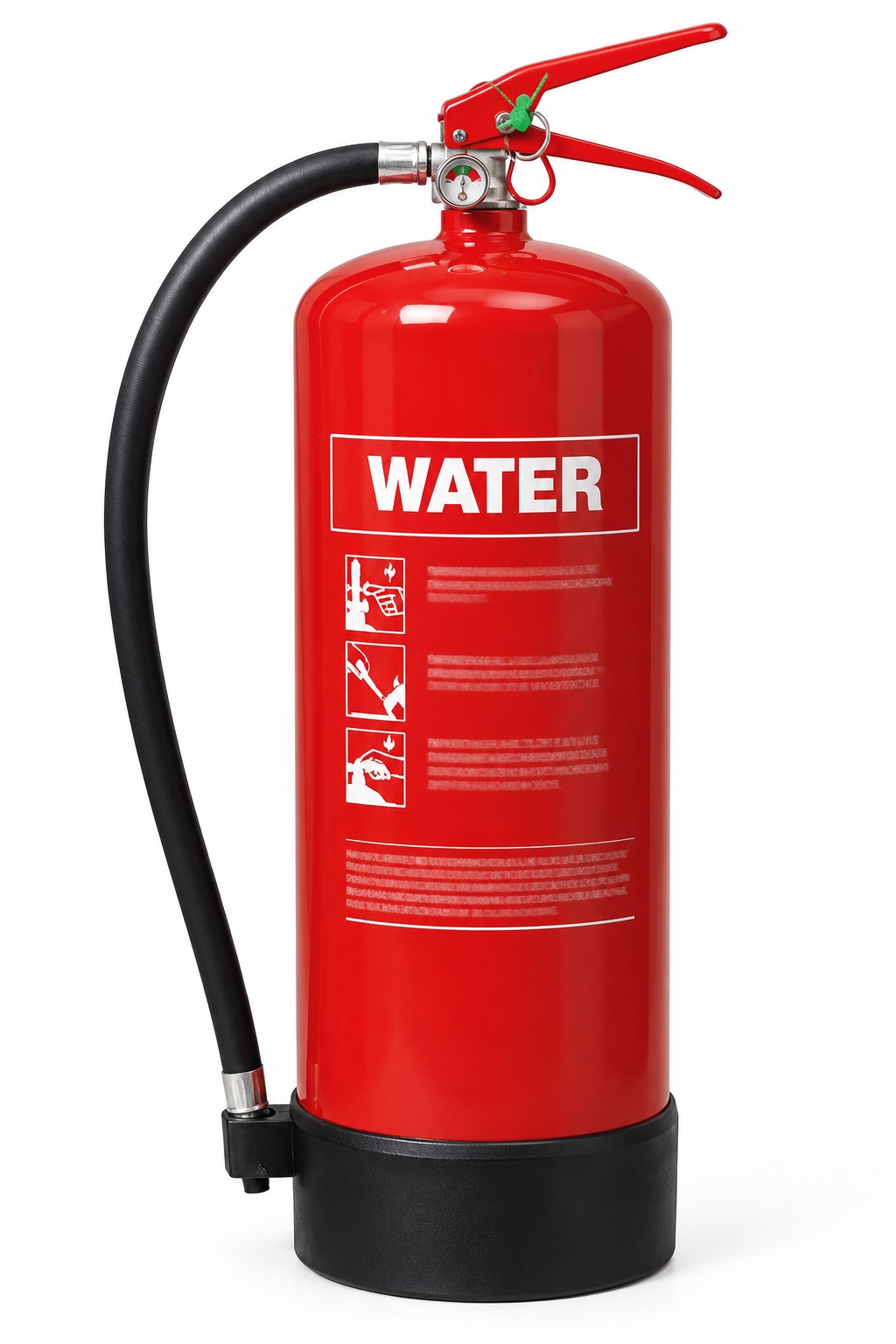

Recognise the pin, seal, pressure gauge and agent marking.
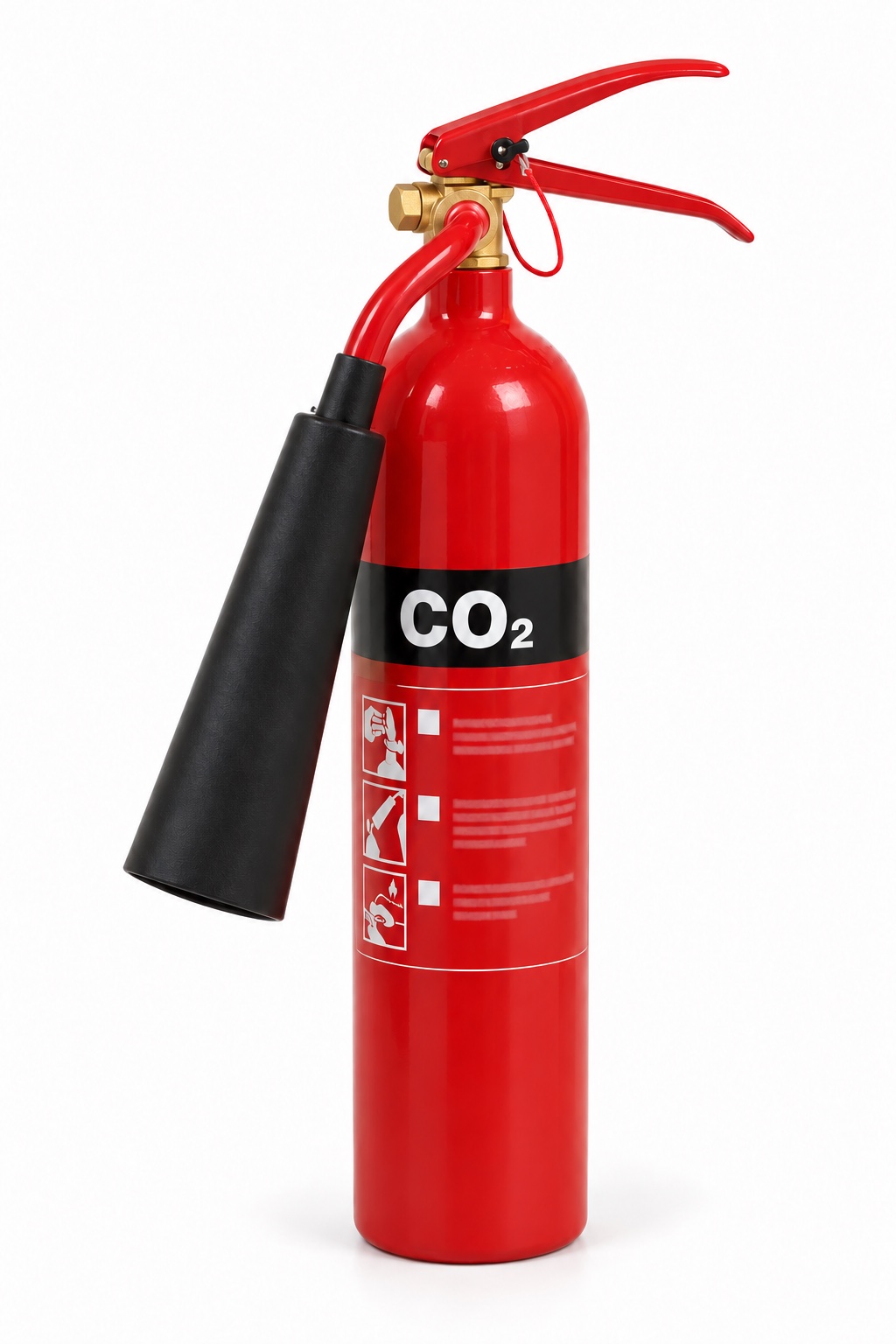
A different cylinder and discharge arrangement; cold and atmosphere hazards still matter.
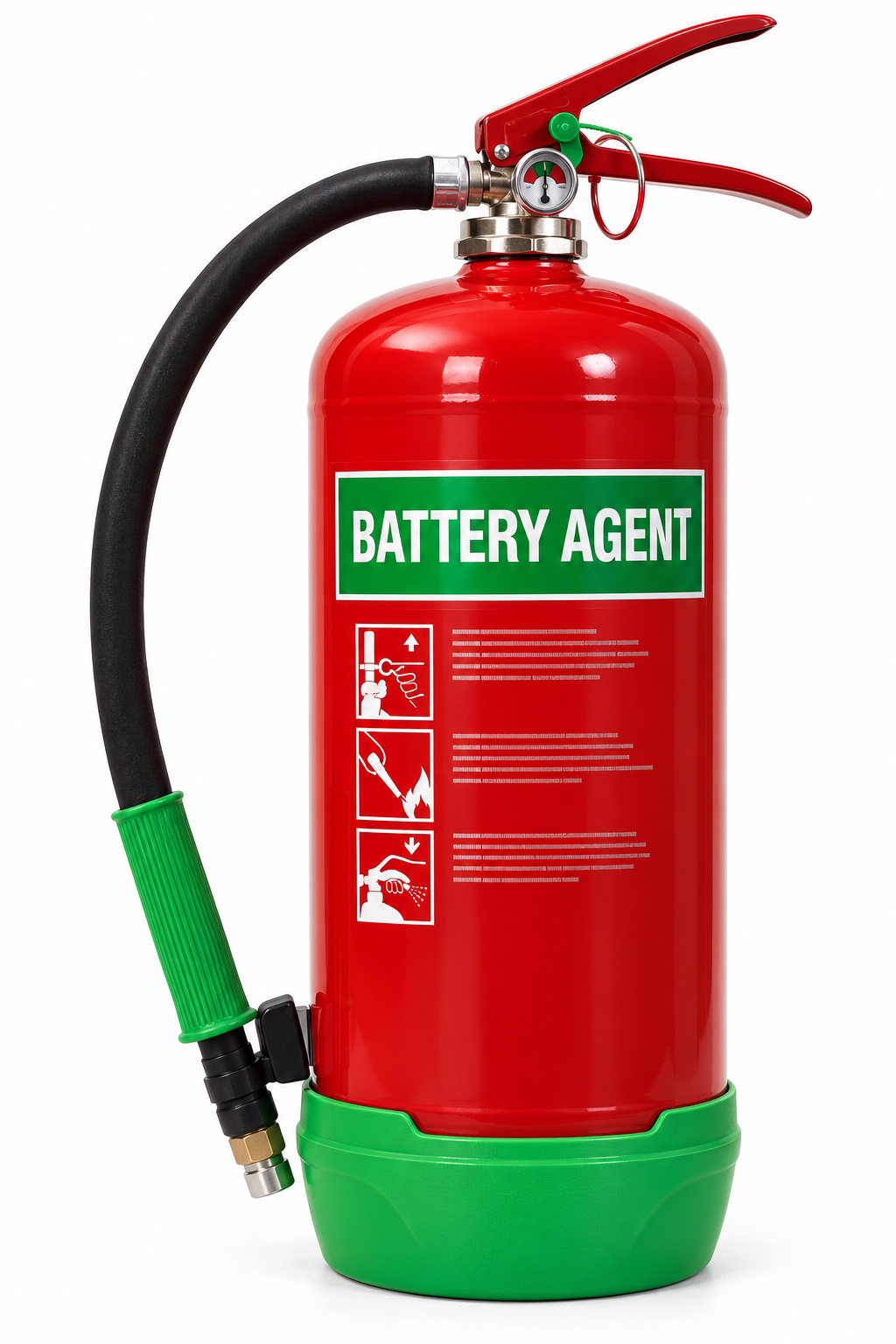
The named product and battery scope matter; green is not a universal Class L colour code.
Raise the alarm, follow the site’s evacuation plan and arrange the emergency call to 999. Only consider a small fire in its earliest stage if you are trained, authorised, have the correct equipment and a clear escape behind you. Smoke, spreading fire, uncertainty or an unsafe approach mean withdraw. Never delay escape to fetch an extinguisher.
What is each fixed fire protection system trying to achieve?
A learner should understand the purpose of each system before trying to memorise its name.
Fixed fire protection systems are easier to understand when they are grouped by purpose. Some systems attack the fire. Some protect an exposure. Some provide water for the fire and rescue service. Some protect a specific enclosure. Some create the conditions for a wider emergency response.
This is also how good fire risk assessment works. The assessor should ask what credible fire could occur, what the system is expected to do, what it relies on and how that function is proven. The answer should be practical: control fire growth locally, cool a vessel, blanket a liquid surface, protect a room, supply firefighters or trigger emergency actions.
| System | What it is trying to achieve | Simple example |
|---|---|---|
| Sprinkler | Control fire growth locally by discharging water where heat activates the sprinkler head. | A sprinkler head operates above a small office waste bin fire and slows fire growth before it spreads to furniture. |
| Deluge | Rapidly wet a whole hazard area or item of plant when a fire scenario needs immediate area coverage. | A deluge system cools a process vessel exposed to flame so heat does not weaken the vessel or escalate the incident. |
| Drencher | Protect an exposure, opening, external face, boundary or adjacent structure from radiant heat or flame impingement. | A drencher protects a loading bay wall or external face where a neighbouring fire could spread into the building. |
| Foam | Blanket a flammable liquid surface to separate fuel vapour from air and reduce reignition. | A foam system protects a bunded flammable liquid store after a spill ignites. |
| Water mist | Use fine droplets to cool flame, absorb heat and suppress selected fires with less water than conventional spray. | A water mist system protects selected plant, machinery spaces or enclosed equipment where water volume matters. |
| Gaseous suppression | Flood an enclosed space with an extinguishing or inerting agent to protect sensitive equipment. | A server room gas system protects critical IT equipment, provided doors and seals maintain enclosure integrity. |
| Wet riser | Keep a permanently charged firefighting water supply available at height. | Firefighters connect hoses to a landing valve on an upper floor without laying hose all the way from ground level. |
| Dry riser | Provide pipework that firefighters charge with water from an appliance when they arrive. | The fire and rescue service connects to the inlet at ground level and draws water from outlets on upper floors. |
| Hydrant or fire main | Provide firefighting water across a site or around a building. | A private hydrant supplies firefighters or fixed monitors during a warehouse or tank farm fire. |
| Fire pump | Deliver the pressure and flow needed for sprinklers, risers, hydrants or fire mains. | A duty fire pump starts automatically when sprinkler flow creates a demand. |
What worked examples help learners remember fixed fire protection?
Worked examples turn system names into real workplace situations, failure modes and management decisions.
An impaired process barrier changes the operating decision
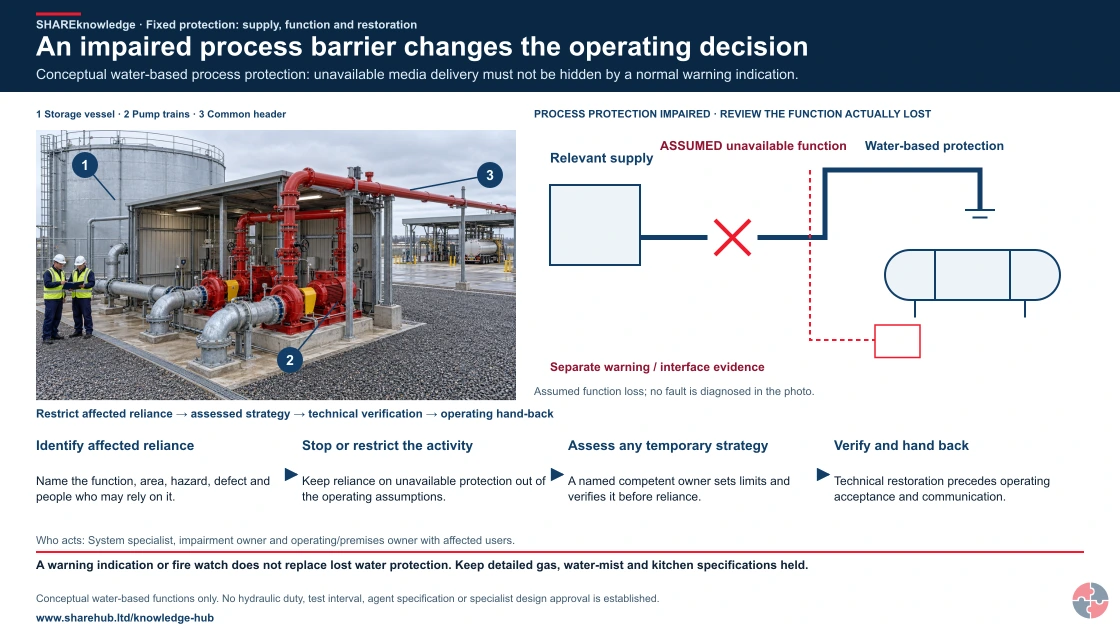
Full written explanation
A normal firewater scene shows a storage vessel, pump trains and common header. Picture key: 1 Storage vessel · 2 Pump trains · 3 Common header. No fault or protected process vessel is established by the scene. A separate conceptual process-vessel/supply-distribution sketch assumes an unavailable function, with an explicit break in the analytical water path. A separate dashed warning/interface branch remains distinct; neither function proves the other. Restricted reliance leads through an assessed strategy and technical verification before operating hand-back. Four unnumbered checks identify affected reliance, stop or restrict activity, assess any temporary strategy, then verify and hand back. Technical restoration precedes operating acceptance and communication. A warning indication, patrol or fire watch is not automatically equivalent to lost suppression. No valve sequence, temporary-control prescription, hydraulic duty, agent selection, performance or permission is supplied.
Conceptual water-based process protection: unavailable media delivery must not be hidden by a normal warning indication.
- Identify affected reliance. Name the function, area, hazard, defect and people who may rely on it.
- Stop or restrict the activity. Keep reliance on unavailable protection out of the operating assumptions.
- Assess any temporary strategy. A named competent owner sets limits and verifies it before reliance.
- Verify and hand back. Technical restoration precedes operating acceptance and communication.
When the evidence does not fit: A warning indication or fire watch does not replace lost water protection. Keep detailed gas, water-mist and kitchen specifications held.
Who acts: System specialist, impairment owner and operating/premises owner with affected users.
Changed workplace
Changed warehouse stock: Review actual commodities, storage and sprinkler design compatibility.
Process protection unavailable: Link lost duty to restricted reliance and verified restoration.
Evidence check: Conceptual water-based functions only. No hydraulic duty, test interval, agent specification or specialist design approval is established.
Keep water delivery, warning and restoration authority separate
Primary references: HSE COMAH fire measures: scenario and system dependencies
Open the complete HD image (new tab)Download image

Keep water delivery, warning and restoration authority separate
Primary references: HSE COMAH fire measures: scenario and system dependencies
In qualification study, examples make the difference between a remembered list and usable knowledge. The examples below show how the same principle appears in offices, warehouses, kitchens, server rooms, buildings, flammable liquid stores and process areas.
Each example should be read in three steps: what happened, what the fixed system was expected to do, and what management evidence would show the system was likely to work.
| Scenario | System learning point | What the learner should take away |
|---|---|---|
| Office waste bin fire activates one sprinkler head | Sprinklers normally operate locally where heat reaches the head; the whole building does not necessarily discharge. | Sprinklers control fire growth but still need alarm response, evacuation and water-damage recovery planning. |
| Warehouse racking fire grows after storage height changes | The sprinkler design may have been based on lower storage, different goods or a different racking layout. | Layout and commodity changes must trigger fire protection review, not just a housekeeping inspection. |
| Kitchen suppression activates over a deep fat fryer | Nozzles, fusible links, manual release and fuel shut-off must match the cooking equipment. | Suppression depends on cleaning, servicing, correct nozzle alignment and staff knowing what to do after discharge. Illustrative specialist-system evidence prompt: direct current government support for the detailed gas/water-mist/kitchen specification and named fire-engineering approval remain held. Do not select an agent, warning delay, nozzle arrangement or re-entry rule from this row. |
| Server room gas suppression fails because door seals are poor | Gaseous systems rely on enclosure integrity; the agent must remain long enough to control the fire. | Room integrity testing and change control matter when cable penetrations, doors or ventilation are altered. Illustrative specialist-system evidence prompt: direct current government support for the detailed gas/water-mist/kitchen specification and named fire-engineering approval remain held. Do not select an agent, warning delay, nozzle arrangement or re-entry rule from this row. |
| Dry riser outlet is blocked during fire service attendance | A dry riser helps only if inlets, outlets and cabinets are accessible and maintained. | Routine checks should be from the firefighter's viewpoint, not just from the facilities office. |
| Foam system protects a bunded flammable liquid store | Foam can blanket the liquid surface and reduce vapour release where water alone may be unsuitable. | Foam concentrate compatibility, proportioning, condition and current agent/legal suitability need specialist maintenance and review. |
| Deluge cools a process vessel exposed to fire | Deluge may be an escalation-control barrier rather than a simple building protection measure. | Process sites should link deluge to major accident scenarios, performance standards and impairment escalation. |
| Fire pump unavailable after required scheduled testing and defect control were neglected | A pump can be present but unavailable if testing, fuel, power, controllers or defects are neglected. | Start/run checks show only their tested function; separate competent demand tests must demonstrate required pressure and flow for the actual system duty. |
What do learners commonly confuse about fixed fire protection?
Common confusions usually come from mixing up detection, suppression, firefighting support and maintenance availability.
This topic often looks simple because the equipment names are familiar. The danger is assuming that a named system always performs the same job. A detector does not suppress fire. A dry riser does not contain water until firefighters charge it. A sprinkler system can be installed but unavailable if a valve is closed or the water supply is impaired.
Learners should practise explaining the difference in ordinary language. That is the quickest way to spot whether they understand the system or have only memorised the term.
| Confusion | Correct explanation | Why it matters |
|---|---|---|
| Sprinklers are the same as fire alarms | Detection and alarm warn people; sprinklers discharge water to control fire growth. | A fire strategy normally needs both warning and control measures. |
| All sprinklers go off at once | Most conventional sprinklers operate individually where heat activates the head. | Prevents exaggerated assumptions about water damage and system behaviour. |
| Dry risers contain water all the time | Dry risers are normally empty and are charged by firefighters through an inlet. | Explains why inlets, outlets and pressure tests are essential. |
| Wet risers are the same as dry risers | Wet risers are permanently charged or supplied with water and need pumps/pressure. | Highlights pump, tank, valve and maintenance dependency. |
| Suppression removes the need to evacuate | Suppression reduces fire growth but does not remove the need for alarm action and evacuation. | Keeps life safety ahead of property protection. |
| A system is reliable because it is installed | Availability depends on maintenance, testing, valves, water, power, access and defect close-out. | Shows why evidence and impairment control matter. |
| Water supply is separate from fire protection | For water-based systems the supply is part of the protection system. | A failed tank, pump or valve can defeat the whole system. |
| Portable extinguishers are fixed installations | Portable extinguishers are movable first-aid firefighting equipment, not fixed installations. | Keeps fixed-system study scope clear. |
| Gaseous suppression only needs cylinders | It also needs enclosure integrity, warning, delay, lock-off, ventilation control and safe re-entry. | Prevents unsafe assumptions about protected rooms. |
What does good evidence look like for each system?
Good evidence proves that the system is suitable, commissioned, inspected, tested, maintained, available and reviewed after change.
A certificate is useful only when it connects to the actual system and risk. Strong evidence shows what was inspected, what standard or design basis was used, what limitations were found, what defects remain open, who owns them and whether any impairment is active.
| System | Good evidence | Management review question |
|---|---|---|
| Sprinklers | Design certificate, commissioning certificate, valve checks, flow tests, service reports, obstruction inspections and defect close-out. | Does the current occupancy, storage and layout still match the sprinkler design assumptions? |
| Deluge or drencher | Cause-and-effect test, nozzle inspection, water supply test, detection interface evidence and impairment record. | Would the system operate quickly enough for the credible escalation scenario? |
| Foam | Foam concentrate type, manufacturer shelf-life/condition, compatibility, proportioning test, service report and discharge/reinstatement procedure. | Is the foam still suitable for the actual flammable liquid hazard? |
| Water mist | Design and commissioning records, nozzle checks, maintenance reports and protected enclosure review. | Have room layout, ventilation or plant changes affected effectiveness? Illustrative specialist-system evidence prompt: direct current government support for the detailed gas/water-mist/kitchen specification and named fire-engineering approval remain held. Do not select an agent, warning delay, nozzle arrangement or re-entry rule from this row. |
| Gaseous suppression | Room integrity test, cylinder weight/pressure checks, warning alarm, discharge delay, lock-off and agent inventory. | Will the agent hold in the room and are people protected before discharge? Illustrative specialist-system evidence prompt: direct current government support for the detailed gas/water-mist/kitchen specification and named fire-engineering approval remain held. Do not select an agent, warning delay, nozzle arrangement or re-entry rule from this row. |
| Wet riser | Pump test, pressure test, landing valve checks, outlet condition, signage and access inspection. | Can firefighters obtain the required water at the required floors? |
| Dry riser | Pressure test, inlet/outlet inspection, cabinet access, caps, signage and defect repair. | Can firefighters charge and use the riser quickly on arrival? |
| Hydrant or fire main | Hydrant register, flow test, access check, cover condition, drawings and emergency plan link. | Can responders find and use the water supply under emergency conditions? |
| Fire pump | Installation records, pump curve, controller checks, scheduled start/run logs, fuel/power checks, separate design-duty flow/pressure tests and defect history. | Would the pump start automatically and deliver enough pressure and flow under real demand? |
What exam-style prompts help test understanding?
Exam prompts should test purpose, suitability, failure modes, evidence and practical application rather than isolated definitions.
For Fire-safety learners, a good answer usually links the system to a workplace scenario. Name the system, explain the purpose, identify what it depends on and describe how the responsible person would keep it available.
The prompts below can also be used by trainers and supervisors as short discussion questions in a fire safety briefing.
| Prompt | What a strong answer should include | Related page |
|---|---|---|
| Explain why a sprinkler system may become unsuitable after a warehouse layout change. | Storage height, commodity type, racking, sprinkler design assumptions, obstruction and fire risk assessment review. | Fire Risk Assessment Principles and Practice |
| Describe why impairment control is needed when a fire pump is unavailable. | Dependent systems, false confidence, compensating controls, communication, authorisation and reinstatement evidence. | Active Fire Protection |
| Give three examples of fixed fire protection systems and explain their purpose. | Example systems such as sprinklers, dry risers and gas suppression, each linked to what it achieves. | Fire Alarms and Firefighting |
| Explain the difference between detection, suppression and firefighting support. | Detection warns or initiates actions, suppression controls fire, risers/hydrants support firefighter water delivery. | Fire Detection, Alarm Systems and Emergency Communication |
| Describe what records should be checked before accepting a fixed fire protection system as available. | Design, commissioning, service, inspection, test, valve, impairment, defect and responsible person review records. | Fire Safety at Work |
| Explain why gaseous suppression may fail after minor room alterations. | Door seals, penetrations, ventilation, enclosure integrity, discharge delay, warning and change control. | Fire and Gas Detection, Alarms and Shutdown Illustrative specialist-system evidence prompt: direct current government support for the detailed gas/water-mist/kitchen specification and named fire-engineering approval remain held. Do not select an agent, warning delay, nozzle arrangement or re-entry rule from this row. |
How should sprinklers and water-based suppression be managed?
Water-based systems work only when the design, hazard, water supply, valves, pipework, heads, access and maintenance arrangements remain valid.
Sprinkler heads are visible, but the real system includes design assumptions, hazard classification, storage limits, spacing, pipework, valves, pumps, tanks, alarms and maintenance. Changing storage height, pallet type, packaging, racking, mezzanines, partitioning or occupancy can make a previously suitable system less reliable.
Water-based protection should also be protected during work. Painting sprinkler heads, hanging materials from pipework, blocking heads with stock, closing valves for convenience, draining sections without permission or failing to tell the fire and rescue service can all turn a fire protection system into false confidence.
| Check area | What good looks like | Common failure route |
|---|---|---|
| Design basis | The system design and hazard assumptions match current use, storage and process conditions. | Warehouse layout, storage height or commodities change without sprinkler review. |
| Water supply | Tank level, pump availability, pressure, flow and backup arrangements are checked and recorded. | Pumps fail, tanks are low, valves are shut or mains pressure is assumed rather than tested. |
| Valves | Critical valves are secured, labelled, inspected and recorded in the correct open or shut position. | A control valve is closed after maintenance and not reinstated. |
| Sprinkler heads and nozzles | Heads are unobstructed, undamaged, clean, correctly located and not painted or loaded. | Stock, services or decorations block discharge pattern. |
| Alarm interface | Activation signals the alarm panel, monitoring centre or emergency system as intended. | Water flow alarm is disconnected, muted or not recognised. |
| Change review | Fit-out, racking, heating, ventilation, new plant and tenant changes trigger fire protection review. | The building use changes faster than the fire protection records. |
How should wet risers, dry risers and firefighting mains be managed?
Risers and firefighting mains must match the approved building strategy and remain accessible and serviceable for responders; check the actual facility rather than assuming a generic outlet spacing. Fire Safety Order Article 38
Wet and dry risers are often overlooked because they are not used during normal work. Their value appears during a fire, when firefighters need a reliable water delivery route, working inlet and outlet valves, clear cabinets, compatible fittings, signage and information about the building.
Private hydrants and firefighting mains need the same discipline. A hydrant that is buried under storage, blocked by parked vehicles, missing from drawings or not flow-tested can delay firefighting at exactly the wrong moment.
| Element | What should be controlled | Evidence to retain |
|---|---|---|
| Dry risers | Inlets, outlets, caps, valves, cabinets, signage, pressure integrity and firefighter access. | Inspection records, pressure test certificates, defect repairs and access checks. |
| Wet risers | Pumps, tanks, power supply, landing valves, pressure, alarms, outlets and maintenance regime. | Service reports, flow or pressure tests, pump checks and impairment records. |
| Private hydrants | Location, access, flow, signage, covers, maps and compatibility with emergency response. | Hydrant register, inspection logs, flow evidence and emergency plan drawings. |
| Fire mains | Isolation valves, pipe integrity, coverage, drawings, corrosion protection and drain points. | Maintenance plans, test results, drawings and change-control records. |
| Fire service information | Premises information, riser diagrams, inlet locations, hazards and access routes are current. | Premises information box contents, plans and liaison records. |
Northern Ireland has Regulation 23 for facilities/equipment for firefighters where necessary; other fixed-system duties need the wider NI premises framework.
How should gaseous, foam, water mist and kitchen suppression be managed?
Foam, gas, water-mist and other specialist systems need a substance- and scenario-specific design and competent maintenance. HSE COMAH technical guidance applies only to qualifying major-hazard establishments. HSE COMAH fire measures
Special systems are not interchangeable. Foam may be appropriate for some flammable liquid scenarios. Gaseous systems may protect electrical or data rooms but can create life-safety issues if people are exposed during discharge. Water mist may be effective in certain applications but depends heavily on enclosure, nozzle arrangement and fire type. Kitchen suppression depends on clean extract systems, correct nozzle alignment and maintained shut-offs.
The responsible person should understand the protected hazard, the system design intent, how people are warned before discharge, whether doors and dampers need to close, whether plant must shut down, how manual release works and how the system is safely reinstated after activation or maintenance.
| System | Specific management issue | Control evidence |
|---|---|---|
| Gaseous suppression | People must be protected from unsafe discharge and the enclosure must hold the agent. | Room integrity test, warning alarms, discharge delay, lock-off and evacuation instructions. Illustrative specialist-system evidence prompt: direct current government support for the detailed gas/water-mist/kitchen specification and named fire-engineering approval remain held. Do not select an agent, warning delay, nozzle arrangement or re-entry rule from this row. |
| Foam systems | Foam concentrate, proportioning and compatibility must suit the liquid hazard. | Concentrate records, proportioner tests, manufacturer shelf-life/condition checks and hazard review. |
| Water mist | Effectiveness depends on design application, nozzle location and enclosure conditions. | Commissioning records, maintenance reports, nozzle checks and change review. Illustrative specialist-system evidence prompt: direct current government support for the detailed gas/water-mist/kitchen specification and named fire-engineering approval remain held. Do not select an agent, warning delay, nozzle arrangement or re-entry rule from this row. |
| Kitchen suppression | Grease load, extract cleaning, nozzle alignment and fuel shut-off are critical. | Service tags, cleaning records, manual release checks and shut-off tests. Illustrative specialist-system evidence prompt: direct current government support for the detailed gas/water-mist/kitchen specification and named fire-engineering approval remain held. Do not select an agent, warning delay, nozzle arrangement or re-entry rule from this row. |
| Local application systems | The system must discharge at the hazard, not just somewhere near it. | Nozzle alignment checks, plant change review and commissioning evidence. |
E&W Article17 supports maintenance of credited fire precautions; England premises guidance supplies bounded practical context. HSE COMAH fire measures apply to qualifying GB major-hazard activities. Each system needs current competent design, site performance evidence and specialist approval; no licensed standard, suppression design, agent suitability or universal test interval is approved. Illustrative specialist-system evidence prompt: direct current government support for the detailed gas/water-mist/kitchen specification and named fire-engineering approval remain held. Do not select an agent, warning delay, nozzle arrangement or re-entry rule from this row.
Historic agent and standard references in the HSE major-hazard page are not approved current specifications. Confirm current legal acceptability, compatibility, environmental requirements and licensed standards with competent specialists. Discharge and re-entry require the actual current safe procedure, not a generalised delay or agent rule.
Why are pumps, tanks, valves and water supplies safety-critical?
A credited fixed system depends on a reliable supply and interfaces; at qualifying major-hazard sites, test water capacity and availability against the site fire scenario and design basis. HSE COMAH fire measures
Water supply failures can be hidden. A tank may look present but have poor level control. A pump may start during a scheduled churn test but fail under demand. A start/run test does not establish required pressure and flow; competent demand testing against the design duty is separate. A valve may be shut and chained in the wrong position. A frost-damaged pipe, untested backflow arrangement or poorly maintained diesel pump can all defeat the visible fire protection system.
For higher-risk sites, water demand should be tested against credible fire scenarios, including exposure cooling and simultaneous firefighting needs. The emergency plan should identify what water is available, where it is supplied from, what fails if power is lost and who has authority to impair or reinstate a system.
| Component | Practical question | Evidence |
|---|---|---|
| Storage tanks | Is there enough available water for the intended system duty and duration? | Level checks, tank inspection, maintenance records and design basis. |
| Fire pumps | Will the pump start, run and deliver pressure and flow under credible demand? | Risk/specification-based start/run and demand-test logs, service reports, fuel checks and fault close-out; no universal interval. |
| Valves | Are control valves in the correct position and protected from unauthorised movement? | Valve tag register, lock/seal checks and impairment permits. |
| Mains supply | Is pressure and flow assumed or verified, and what happens during abnormal demand? | Flow test records, utility information and contingency plan. |
| Power supply | Can electrically driven pumps operate when normal power is affected? | Backup power checks, generator tests or alternative pump arrangements. |
| Frost/corrosion protection | Are exposed pipework, valves and tanks protected from freezing, corrosion or damage? | Inspection records, lagging checks, heating trace tests and corrosion reviews. |
How should system interfaces and cause-and-effect logic be managed?
Fixed fire protection often relies on interfaces with detection, alarms, plant shutdown, ventilation, doors, access control and remote monitoring.
A fixed system can be technically sound but fail operationally if the interfaces are weak. For example, a suppression system may discharge but the alarm is not transmitted, a gas release may not shut down ventilation, a deluge demand may not start the correct pump, or an access-control system may not release escape doors.
Cause-and-effect testing is the practical way to prove the sequence. The site should know what input starts the response, what output should happen, who receives the alarm, what plant should stop, what doors or dampers should move, what message is displayed and how the system is reset.
| Interface | What should happen | What can fail |
|---|---|---|
| Detection to alarm | Detector, flow switch or manual trigger raises the correct alarm and zone indication. | Wrong zone, muted alarm, disabled detector or poor alarm audibility. |
| Suppression to plant shutdown | Fuel, process, ventilation or electrical systems shut down where required. | Suppression operates but the fire is fed by continuing process energy. |
| Alarm to monitoring centre | Remote monitoring receives the correct signal and follows escalation instructions. | Signal path fails or contact list is out of date. |
| Fire doors and dampers | Doors release/close and dampers operate according to the fire strategy. | Doors held open, damaged closers, failed magnets or untested dampers. |
| Access control | Escape doors release and security systems do not trap occupants. | Security overrides the evacuation assumption. |
| Emergency plan | The system response is reflected in site instructions, drills and fire service information. | Workers and responders do not know what the system has done. |
What does good inspection, testing and maintenance look like?
Set inspection and test methods from the actual design, manufacturer, applicable standard, risk and legal duty. Record expected and observed function, defects, competent repair and hand-back; no universal test interval fits every installation.
The maintenance regime should combine user checks, competent contractor servicing, periodic tests, defect escalation and management review. User checks find obvious problems such as blocked riser inlets, damaged cabinets, low tank levels, shut valves, obstructed sprinkler heads or missing signage. Specialist checks verify technical performance and compliance with the system design and relevant standards.
The responsible person should review the records, not simply collect them. Repeated defects, unresolved recommendations, out-of-date drawings, nuisance alarms, postponed service visits or frequent impairments are management signals. The risk is not only that a system has a defect; it is that the organisation normalises degraded protection.
| Layer | Typical activity | What good evidence looks like |
|---|---|---|
| Routine user check | Walk-through checks for access, obstruction, visible damage, valve position, signage and obvious faults. | Simple checklist with date, area, named checker, findings and action close-out. |
| Weekly or periodic operational check | Pump churn tests, alarm interface checks, visual valve checks or local system checks where applicable. | Test log with expected result, actual result, fault record and escalation. |
| Competent contractor service | Inspection, testing and servicing to manufacturer instructions, design basis and relevant standards. | Service report, limitations, defects, recommendations and evidence that actions are closed. |
| Functional/cause-and-effect test | Proves that activation produces the required alarm, shutdown, pump start, door release or monitoring signal. | Test script, observed results, defects, resets and change-control record. |
| Management review | Checks overdue actions, impairments, repeated failures, insurance or enforcing authority findings. | Dashboard, meeting record, risk register update and accountable owner. |
The ongoing premises routes include Fire Safety Order Article 17 in England and Wales, Scottish Regulation 16 and the relevant NI fire provisions. HSE COMAH fire-measures guidance adds a scenario-specific technical basis only at qualifying major-hazard establishments.
What should be recorded in a fixed fire protection register?
The register should show what systems exist, what they protect, who owns them, how they are maintained and whether any part is impaired.
A useful register is more than an asset list. It should connect the system to the protected area, fire risk assessment, maintenance schedule, responsible person, service provider, drawings, defects and emergency plan. For complex sites it should also identify whether the system is safety-critical for a major accident scenario.
The register should be kept current when the building changes. A new tenant, racking alteration, mezzanine, process line, battery charging area, flammable store, server room or kitchen extract change can alter what the system is expected to do.
| Register field | Why it matters | Example entry |
|---|---|---|
| System name and asset ID | Allows checks, defects and service history to be traced. | Warehouse sprinkler system SPK-01. |
| Protected area or hazard | Explains what the system is intended to protect. | High-bay pallet racking, zones A-C. |
| Design basis or standard | Keeps hazard assumptions visible. | Warehouse storage classification and maximum stack height. |
| Critical dependencies | Identifies valves, pumps, tanks, detection, power or alarm interfaces. | Pump P-01, tank T-01, valve set V-03, alarm interface AI-02. |
| Inspection and service frequency | Defines how availability is checked. | Site-specific valve, service and design-duty test schedule set by competent specification, risk and current instructions; intervals here are not universal. |
| Competent maintainer | Shows who is authorised to inspect or maintain the system. | Specialist fire protection contractor and named internal owner. |
| Open defects and impairments | Makes degraded protection visible. | Valve tamper fault open: restrict dependent use pending competent assessment; any time-limited alternative must be verified before reliance. Patrols are not automatic equivalent protection. |
| Emergency plan link | Connects the system to response arrangements. | Fire service plan drawing FSP-02. |
How should impairments, isolations and defects be controlled?
When a credited system is unavailable, stop or restrict the activity that relies on it until a competent, time-limited temporary strategy is assessed and verified before reliance. Log the affected function, area, owner, communications, compensating measures, verification and return-to-service decision.
Impairment control is one of the most important parts of this topic. A building can look protected while a sprinkler valve is closed, a pump is failed, a riser is drained, a gas system is locked off, a detector zone is isolated or a foam concentrate is outside its verified acceptable condition or shelf life. The fire risk assessment should not silently assume that protection is available when it is not.
Good impairment management uses a permit-style process. It identifies what is impaired, why, for how long, who authorised it, what area is affected, what compensating measures are in place, who has been told and what evidence is needed before reinstatement.
| Step | What should happen | Why it matters |
|---|---|---|
| Identify | Record the exact system, area, function and reason for impairment. | Prevents vague statements such as 'sprinklers off' with no risk boundary. |
| Assess | Consider people at risk, fire load, ignition sources, occupancy, DSEAR hazards, escape and business impact. | Shows whether work can continue safely and what extra controls are needed. |
| Authorise | Use a named competent owner and time limit. | Stops informal isolation by contractors or maintenance teams. |
| Communicate | Tell affected workers, contractors, security, insurers, tenants, control room and emergency responders where relevant. | Prevents people relying on a system that is unavailable. |
| Compensate | Stop or restrict affected activity first. Competently assess and verify any time-limited alternative; defer hot work, reduce hazards and use temporary measures only within that verified strategy. Fire watch, patrols or detection do not automatically replace suppression. | Reduces risk while normal protection is unavailable. |
| Reinstate and verify | Prove the system is back in service and close the record. | Avoids forgotten isolations and incomplete handback. |
Use Article 17 maintenance duty for E&W premises and HSE COMAH technical measures only where major-hazard scope and a site scenario justify the system. A fire watch or patrol is not automatically equivalent to a failed sprinkler, foam or deluge barrier.
How can the hierarchy of controls reduce fire risk before relying on fixed protection systems?
Use ERICPD and the HSE five-level hierarchy first to reduce the fire scenario, then specify and verify the installed protective barrier. A temporary patrol cannot automatically replace an impaired engineered system.
E&W Article17 supports maintenance of credited fire precautions; England premises guidance supplies bounded practical context. HSE COMAH fire measures apply to qualifying GB major-hazard activities. Each system needs current competent design, site performance evidence and specialist approval; no licensed standard, suppression design, agent suitability or universal test interval is approved.
A warehouse relies on sprinklers and alarm interfaces in its fire strategy. Racking work closes a valve and blocks heads; the original protection cannot be assumed.
At a qualifying major-hazard fuel terminal, a pump fault and uncertain foam stock may undermine a credited tank or loading-bay escalation barrier; COMAH applicability and design performance must be verified.
How can the ERICPD hierarchy of controls reduce fire risk before relying on fixed protection systems?

| Hazard and harm route | ERICPD → five-level control | Task intervention and feasibility | Owner, test and evidence | Failure and stop decision |
|---|---|---|---|---|
| Warehouse sprinkler valve closed during racking work | Eliminate → Elimination | Remove the conflicting racking work or relocate combustible stock until protection is restored. Source: official guidance. | Warehouse manager checks inventory and racking plan. | Fire load remains in impaired zone: restrict use. |
| Same scenario | Reduce → Substitution | Authorise and record impairment, affected storage or operations, temporary restrictions and restoration evidence; the operating owner accepts hand-back after technical verification. Source: official guidance. | Project lead trials actual logistics and occupancy. | Alternative only moves fire load into another impaired zone: reject. |
| Same scenario | Isolate → Engineering | Restore valve position, sprinkler coverage, water supply and alarm interface to the approved design with competent repair. Source: official guidance. | Specialist tests full affected function and records results. | Test or supply fails: keep area restricted. |
| Same scenario | Control → Administrative | Use an authorised impairment record, no hot work, stock limit and affected-person communication while competent repair proceeds. Source: official guidance. | Dutyholder checks permit each shift and expiry. | Temporary plan not demonstrably adequate: cease affected use. |
| Same scenario | PPE → PPE | Worker fire PPE does not replace a sprinkler; task PPE for repair addresses separate maintenance exposure. Source: official guidance. | Safety lead records no protection credit for PPE. | Plan relies on PPE or improvised firefighting: reject. |
| Same scenario | Discipline → Administrative assurance | Audit valve status, obstruction trend, test evidence and final hand-back before normal storage resumes. Source: official guidance. | Responsible person signs closeout against strategy. | Valve or interface re-fails: reopen impairment and restrict. |
| Fuel terminal deluge and foam protection degraded | Eliminate → Elimination | Stop fuel transfer or remove exposed inventory in the affected zone while the barrier is unavailable. Source: official guidance. | Process owner checks actual inventory and isolate state. | Transfer continues without credited barrier: stop. |
| Same scenario | Reduce → Substitution | Reduce batch/inventory or use an alternate protected loading location only if scenario review accepts it. Source: official guidance. | Process-safety lead tests credible fire consequence. | Alternative has equal unprotected escalation: reject. |
| Same scenario | Isolate → Engineering | Repair pump, supply, foam proportioning and actuation; test the complete deluge/foam function against the design basis. Source: official guidance. | Competent engineer records flow, interface and hand-back evidence. | Performance unverified: do not restart. |
| Same scenario | Control → Administrative | Authorise time-limited isolation, communicate to control room/responders and restrict ignition sources and occupancy. Source: official guidance. | Duty manager checks barrier status each shift. | Impairment expiry or communication fails: hold operations. |
| Same scenario | PPE → PPE | Fire-response PPE is for trained responders within an approved emergency strategy, not compensation for lost automatic protection. Source: official guidance. | Emergency lead checks role and withdrawal criteria. | Plan assumes unsafe manual firefighting: reject. |
| Same scenario | Discipline → Administrative assurance | Review recurrent pump and foam defects, test results and major-accident barrier performance before restart. Source: official guidance. | COMAH operator leadership signs technical closeout. | Repeat defect or uncertain design basis: maintain shutdown. |
How can the ISO 45001 hierarchy of controls reduce fire risk before relying on fixed protection systems?

| Hazard and harm route | ERICPD → five-level control | Task intervention and feasibility | Owner, test and evidence | Failure and stop decision |
|---|---|---|---|---|
| Warehouse sprinkler valve closed during racking work | Eliminate → Elimination | Remove the conflicting racking work or relocate combustible stock until protection is restored. Source: official guidance. | Warehouse manager checks inventory and racking plan. | Fire load remains in impaired zone: restrict use. |
| Same scenario | Reduce → Substitution | Authorise and record impairment, affected storage or operations, temporary restrictions and restoration evidence; the operating owner accepts hand-back after technical verification. Source: official guidance. | Project lead trials actual logistics and occupancy. | Alternative only moves fire load into another impaired zone: reject. |
| Same scenario | Isolate → Engineering | Restore valve position, sprinkler coverage, water supply and alarm interface to the approved design with competent repair. Source: official guidance. | Specialist tests full affected function and records results. | Test or supply fails: keep area restricted. |
| Same scenario | Control → Administrative | Use an authorised impairment record, no hot work, stock limit and affected-person communication while competent repair proceeds. Source: official guidance. | Dutyholder checks permit each shift and expiry. | Temporary plan not demonstrably adequate: cease affected use. |
| Same scenario | PPE → PPE | Worker fire PPE does not replace a sprinkler; task PPE for repair addresses separate maintenance exposure. Source: official guidance. | Safety lead records no protection credit for PPE. | Plan relies on PPE or improvised firefighting: reject. |
| Same scenario | Discipline → Administrative assurance | Audit valve status, obstruction trend, test evidence and final hand-back before normal storage resumes. Source: official guidance. | Responsible person signs closeout against strategy. | Valve or interface re-fails: reopen impairment and restrict. |
| Fuel terminal deluge and foam protection degraded | Eliminate → Elimination | Stop fuel transfer or remove exposed inventory in the affected zone while the barrier is unavailable. Source: official guidance. | Process owner checks actual inventory and isolate state. | Transfer continues without credited barrier: stop. |
| Same scenario | Reduce → Substitution | Reduce batch/inventory or use an alternate protected loading location only if scenario review accepts it. Source: official guidance. | Process-safety lead tests credible fire consequence. | Alternative has equal unprotected escalation: reject. |
| Same scenario | Isolate → Engineering | Repair pump, supply, foam proportioning and actuation; test the complete deluge/foam function against the design basis. Source: official guidance. | Competent engineer records flow, interface and hand-back evidence. | Performance unverified: do not restart. |
| Same scenario | Control → Administrative | Authorise time-limited isolation, communicate to control room/responders and restrict ignition sources and occupancy. Source: official guidance. | Duty manager checks barrier status each shift. | Impairment expiry or communication fails: hold operations. |
| Same scenario | PPE → PPE | Fire-response PPE is for trained responders within an approved emergency strategy, not compensation for lost automatic protection. Source: official guidance. | Emergency lead checks role and withdrawal criteria. | Plan assumes unsafe manual firefighting: reject. |
| Same scenario | Discipline → Administrative assurance | Review recurrent pump and foam defects, test results and major-accident barrier performance before restart. Source: official guidance. | COMAH operator leadership signs technical closeout. | Repeat defect or uncertain design basis: maintain shutdown. |
Which fixed-protection duties apply by location and sector?
Maintain credited fire precautions under the relevant premises law. GB dangerous-substance and construction rules have separate NI counterparts; COMAH and offshore PFEER are limited to qualifying operations.
A new or altered system needs the approved fire strategy and applicable design basis; a generic list of sprinkler, foam or gas systems does not prove one is legally required at every workplace. Qualifying process/offshore sites need their own technical performance and impairment decisions.
For E&W premises, Fire Safety Order Article 17 addresses maintenance where needed for relevant persons; Article 38 separately concerns measures for firefighter safety. Scottish Regulation 16 addresses maintenance of fire safety measures. NI Regulation 23 concerns firefighter facilities, but the full NI premises framework must be checked for other installed protection.
| Jurisdiction | Duty or regulation | When it is relevant | Practical implication for fixed systems |
|---|---|---|---|
| E&W | Fire Safety Order 2005 | E&W general premises fire framework. | FRA, strategy and system owner. |
| E&W | Fire Safety Order Article 17 | E&W maintenance of relevant fire precautions for relevant persons. | Inspection, defect and hand-back records. |
| E&W | Fire Safety Order Article 38 | E&W measures provided for firefighter safety. | Riser, access and credited responder-facility checks. |
| Scotland | Fire (Scotland) Act 2005 | Scottish non-domestic premises route. | Scottish assessment and system evidence. |
| Scotland | Fire Safety (Scotland) Regulations 2006, reg 16 | Scottish maintenance of fire safety measures. | Scottish inspection and repair evidence. |
| NI | Fire and Rescue Services (NI) Order 2006 | NI non-domestic premises route. | NI assessment and system evidence. |
| NI | Fire Safety Regulations (NI) 2010 | NI detailed fire precautions. | NI maintenance and response evidence. |
| NI | NI Fire Safety Regulations 2010, reg 23 | NI facilities/equipment for firefighters where in scope. | NI responder-facility maintenance evidence. |
| GB | DSEAR 2002 | GB work-process dangerous-substance risk. | GB release, ignition and protection analysis. |
| NI | DSEAR (NI) 2003 | Separate NI dangerous-substance route. | NI process protection analysis. |
| GB | CDM Regulations 2015 | GB construction work affecting protection. | GB construction-phase change and hand-back. |
| NI | CDM Regulations (NI) 2016 | Separate NI construction route. | NI change and hand-back record. |
| GB | COMAH Regulations 2015 | Only qualifying GB major-hazard establishments. | Scenario barrier and performance evidence. |
| NI | COMAH Regulations (NI) 2015 | Separate NI regime at qualifying major-hazard establishments. | NI inventory and barrier evidence. |
| GB | Offshore PFEER Regulations 1995 | Only in-scope offshore installations. | Offshore fire/explosion performance evidence. |
The HSE COMAH fire-measures guidance concerns major-accident barriers at qualifying sites, not every workplace.
For NI construction, HSENI CDM guidance explains the separate 2016 route.
How do UK fire safety responsibilities vary by nation?
England and Wales, Scotland and Northern Ireland have separate premises-fire frameworks. Also distinguish GB DSEAR/CDM from NI equivalents, and treat COMAH and offshore PFEER only where the establishment or installation meets their scope.
A UK-wide organisation should avoid treating fire safety law as one single document. The same practical control may be needed in every nation, but the source duty, enforcing body, guidance route and terminology may differ. This matters for policy wording, audit checklists, contractor specifications and training material.
For fixed fire protection, the practical expectation is consistent: systems provided for fire safety should be suitable for the risk, kept in working order, inspected, tested, maintained and repaired by competent people. The management system should show which legal route applies to each site.
| Nation | Main duty route | What to check locally |
|---|---|---|
| England and Wales | Responsible person duties under the Fire Safety Order, with GOV.UK guidance and local fire and rescue authority enforcement. | Check responsible person, fire risk assessment, maintenance records and Section 156-style information duties where relevant. |
| Scotland | Fire (Scotland) Act and Fire Safety (Scotland) Regulations, with Scottish guidance and enforcement arrangements. | Check dutyholder mapping, Scottish guidance expectations and inspection/testing evidence. |
| Northern Ireland | Fire and Rescue Services Order and Fire Safety Regulations Northern Ireland. | Check the applicable NI premises duties, enforcement and current system maintenance records; no universal certificate requirement is asserted. |
| Construction sites | Fire Safety Order in construction context, CDM duties and HSE construction fire guidance. | Check GB CDM 2015 or NI CDM 2016 by location; protect occupied-building fire systems during works and verify hand-back. |
| Dangerous substance sites | DSEAR, COMAH where qualifying, and relevant fire safety law. | Check GB DSEAR 2002 or NI DSEAR 2003; COMAH adds a separate major-hazard route where qualifying inventory criteria are met, including substance categories, aggregation, exclusions and quantities at thresholds. |
What competence is needed for fixed fire protection?
Competence should match the decision: user checks, fire risk assessment, design, installation, commissioning, maintenance and impairment decisions need different levels of knowledge.
A workplace does not need every manager to become a fire engineer, but it does need clear boundaries. A trained facilities person may carry out routine visual checks. A competent fire risk assessor may judge whether the system is suitable for the premises. A specialist contractor may maintain the system. A fire engineer may be needed where design assumptions, high-risk storage, complex suppression or major accident interfaces are involved.
Competence should be checked during procurement and reviewed through performance. Service reports should be understandable, defects should be prioritised, limitations should be escalated and the responsible person should know when advice is outside their competence.
| Role | What they need to understand | Evidence of competence |
|---|---|---|
| Routine checker | Visible condition, obstruction, access, signage, obvious faults and escalation route. | Briefing, checklist training, supervision and completed checks. |
| Responsible person or facilities manager | Fire risk assessment links, dutyholder responsibilities, maintenance planning, contractor control and impairment decisions. | Role description, training, procedure ownership and action tracking. |
| Fire risk assessor | How fixed protection supports the fire strategy and whether it remains suitable for the premises. | Relevant fire risk assessment competence, experience and evidence review. |
| Specialist maintenance contractor | System-specific inspection, testing, servicing, defects and standards. | Contractor competence evidence, service reports, certifications and quality review. |
| Fire engineer or specialist designer | Design basis, performance requirements, complex interfaces and engineered fire strategy. | Professional competence, design documentation and commissioning evidence. |
| Process safety or major hazard specialist | Escalation scenarios, deluge/foam duties, safety-critical elements and impairment risk. | Barrier register, performance standards, audit evidence and scenario review. |
How do fixed fire protection installations apply in different sectors?
Sector context changes what the system protects, how failure develops and what evidence the responsible person should expect.
A fixed system should not be reviewed in isolation from the workplace it protects. Offices usually need assurance that systems are maintained and people can evacuate. Warehouses need to control storage changes that defeat sprinkler assumptions. Process sites need to prove protection against escalation. Care settings need to think about people who may not self-evacuate quickly.
The table gives practical sector examples. It is not a substitute for a fire risk assessment, but it helps readers choose the right line of questioning.
| Sector | Typical issue | What good looks like |
|---|---|---|
| Office and commercial premises | Fire systems are split between landlord, tenant and managing agent responsibilities. | Clear dutyholder cooperation, maintenance records, defect ownership and tenant communication. |
| Warehouse and logistics | Storage height, racking, packaging and stock peaks can exceed sprinkler design. | Storage control rules, sprinkler design review and periodic layout inspection. |
| Manufacturing | Process changes introduce heat, dust, solvents, oils or new plant near protected areas. | MOC-style review, DSEAR link where relevant and protection system interface checks. |
| Hospitality and kitchens | Cooking equipment and grease extract systems create localised fire risk. | Kitchen suppression service, extract cleaning, shut-off checks and staff action training. |
| Construction and refurbishment | Existing sprinklers, risers, alarms or fire stopping are impaired during works. | Permit controls, temporary protection, handback checks and fire plan review. |
| Fuel, chemical and process sites | Fixed systems may prevent escalation from loss of containment, pool fire or jet fire exposure. | Scenario-based performance standards, deluge/foam testing and impairment escalation. |
| Care, education and public assembly | Occupants may need assisted evacuation or delayed movement. | Protection systems linked to evacuation strategy, drills and responsible person review. |
What should appear in a fire risk register for fixed protection?
The risk register should connect credible fire scenarios to fixed protection barriers, evidence, owners and impairment controls.
A register is valuable when it makes risk visible. It should not simply state that sprinklers exist. It should describe the scenario, exposed people, expected protection function, current evidence, open defects and what happens during impairment.
For process safety or high-risk sites, fixed fire protection may sit in the major accident hazard register as a barrier. The register should identify whether the barrier prevents escalation, controls fire growth, protects escape, supports emergency response or protects critical equipment.
| Scenario | Fixed protection barrier | Evidence and owner |
|---|---|---|
| High-bay warehouse pallet fire | Sprinkler system, water supply, alarm monitoring and storage height rules. | Facilities manager owns valve checks, service reports, obstruction inspections and stock change reviews. |
| Hot work near an impaired riser during refurbishment | Defer hot work while the credited riser is impaired; any permitted task requires competent assessment and a verified suitable temporary strategy, followed by proved riser reinstatement. | Principal contractor owns impairment permit, fire plan update and handback evidence. |
| Fuel loading bay pool fire | Foam system, deluge cooling, emergency shutdown and firefighting water supply. | Process safety manager owns performance standard, test evidence and impairment escalation. |
| Server room fire | Gaseous suppression, pre-discharge warning, ventilation shutdown and room integrity. | IT/facilities owner holds room integrity test, discharge controls and access instructions. Illustrative specialist-system evidence prompt: direct current government support for the detailed gas/water-mist/kitchen specification and named fire-engineering approval remain held. Do not select an agent, warning delay, nozzle arrangement or re-entry rule from this row. |
| Kitchen extract fire | Kitchen suppression and fuel shut-off. | Catering manager owns cleaning records, service certificates and staff briefing. Illustrative specialist-system evidence prompt: direct current government support for the detailed gas/water-mist/kitchen specification and named fire-engineering approval remain held. Do not select an agent, warning delay, nozzle arrangement or re-entry rule from this row. |
How could Crownway Fuels Ltd manage fixed fire protection installations?

Crownway Fuels Ltd would manage fixed fire protection as a live process safety and fire safety control, not as a passive asset list.
Crownway Fuels Ltd
Crownway Fuels Ltd is a fuel storage and distribution business used by SHARE to show how a higher-risk organisation could apply this topic in practice.
Crownway starts by mapping credible fire scenarios: tanker loading bay spill fire, pump-house fire, tank bund fire, LPG cylinder exposure, warehouse packaging fire, diesel generator fire and office evacuation. For each scenario the site identifies whether fixed protection prevents escalation, supports evacuation, protects emergency responders or limits environmental and business consequences.
The fire protection register lists every sprinkler, deluge zone, foam system, hydrant, monitor, fire main, pump, tank, valve, alarm interface and emergency shutdown link. Each entry has an owner, inspection frequency, design basis, drawing reference, service provider, open defects, impairment status and link to the emergency plan. The risk register shows which systems are safety-critical for tank farm escalation and which are ordinary building controls.
Contractor management is built around pre-qualification, scope control and handback. Fire protection contractors must provide competence evidence, RAMS, isolation requests, test certificates and defect priorities. Any impairment is authorised by the site manager and process safety lead, with compensating measures such as stopping hot work, reducing fuel transfer, increasing patrols, notifying security, updating the control room and informing insurers or responders where required.
Assurance is layered. Operators complete simple valve and access checks. Supervisors review weekly logs and outstanding defects. The HSSE team audits the fire protection register, test evidence, action tracker and emergency drills. An external specialist periodically reviews deluge, foam, hydrant flow and cause-and-effect testing against the site's credible fire scenarios. Learning from false alarms, defects, drills and near misses is reviewed through the management meeting and fed back into training, procurement and maintenance planning.
| Management element | How Crownway would control it | Evidence |
|---|---|---|
| Risk register | Link each credible fire scenario to fixed protection barriers and escalation controls. | Major accident hazard register, DSEAR assessment and fire risk assessment. |
| Asset register | Track every fixed system, component, dependency and protected area. | Fire protection register with drawings, owners and maintenance status. |
| Training | Brief operators, supervisors, control room staff and contractors on system purpose and impairment rules. | Training matrix, inductions, toolbox talks and drill records. |
| Oversight | Use line checks, HSSE audits and specialist verification. | Completed checks, audit findings, specialist reports and action tracker. |
| Incident learning | Review activations, near misses, defects, false alarms and impairment breaches. | Investigation records, lessons learned and management review minutes. |
| Continuous improvement | Use defect trends, drill findings and plant changes to update protection strategy. | CAPEX plan, MOC records and revised performance standards. |
What must a fuel-depot example establish before showing fixed fire protection?
Connect any proposed protection to its reviewed demand, supply and intended function. Unspecified firewater, foam or fixed installations are not added to this document.
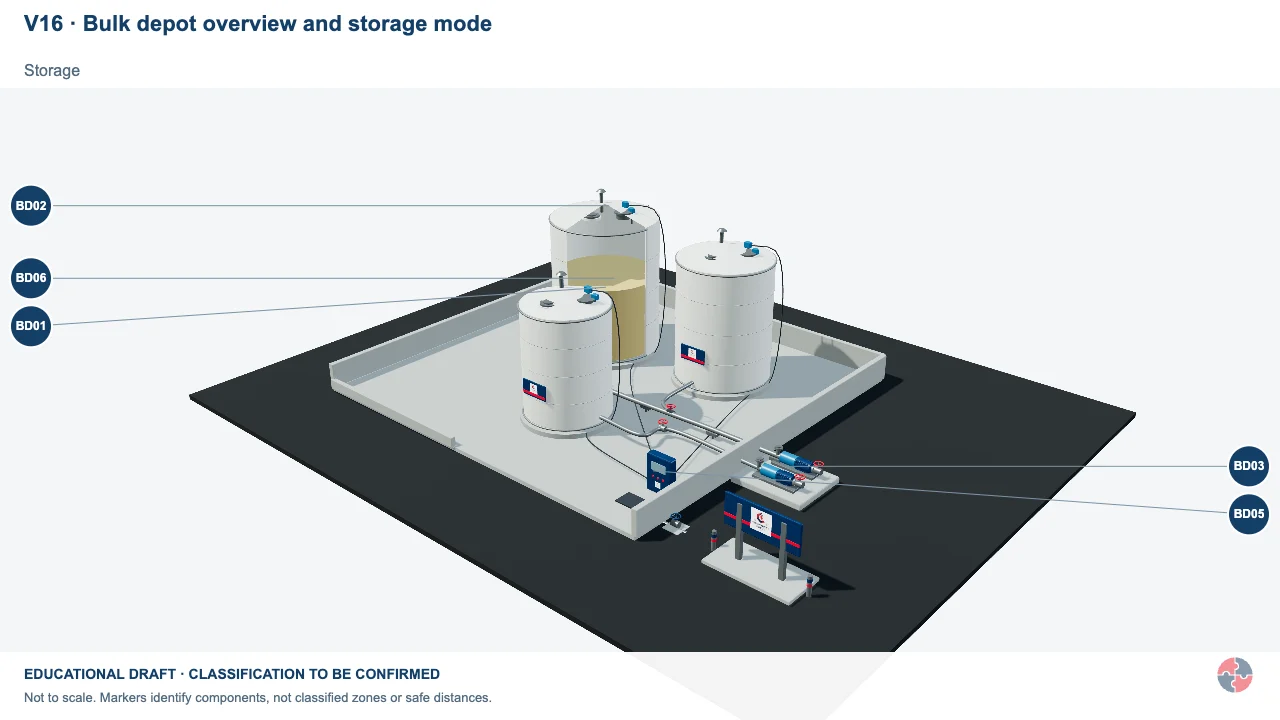

Bulk depot overview and storage mode
Explore the bulk depot system and compare selectable Zone 0, Zone 1 and Zone 2 teaching volumes around its petrol example.
Activity focus: Use cutaway for the internal vapour spaces, then compare the rounded vent, pump and mode-dependent connection envelopes.
Contextual illustration. The image alone does not establish equipment state, effective controls, individual health or authorisation; use the task-specific checks and competent evidence.
Educational illustration, not to scale. Coloured zones are teaching examples, not a site-specific hazardous-area classification.
Active fire protection only where a reviewed scenario includes it; no invented firewater/foam layout.
Who needs fixed-protection competence, and how is it shown?
Test each role against a real impairment, interface fault and hand-back decision; a service certificate without a verified system function is insufficient.
| Role | Learning to test | Competence demonstration | Assessor and record | Reassessment trigger |
|---|---|---|---|---|
| All workers and contractors | Protect heads, inlets, valves and routes; report damage. | Locate a system and demonstrate defect report. | Supervisor records induction. | Work area or layout change. |
| Facilities and security | Observe status, control access and escalate faults without unauthorised reset. | Walk pump/valve room and impairment handover. | Fire lead witnesses field test. | System fault or roster change. |
| Responsible persons and managers | Map credited system to fire strategy and decide activity restriction. | Review failed-sprinkler scenario and sign stop rule. | Competent fire lead records exercise. | Occupancy or risk change. |
| Specialist designers and maintainers | Know actual design basis, test method and cause-and-effect. | Demonstrate functional test and documented hand-back. | Independent technical authority approves. | Modification or repeated failure. |
| Process/offshore operators | Where COMAH or PFEER applies, verify major-accident barrier performance. | Trace scenario to system test and impairment response. | Operator technical authority signs record. | Inventory or barrier change. |
How does this support fire-safety study?
This topic supports practical fire-safety learning by connecting named systems with the fire scenarios, people at risk, maintenance evidence and emergency arrangements they control.
For study purposes, do not simply memorise a list of systems. A strong answer explains what the system does, where it is used, what it depends on, what failure looks like and what evidence shows it is reliable. Scenario questions may describe a warehouse, kitchen, plant room, construction project, public venue or industrial site and ask for suitable fire protection or maintenance arrangements.
Useful exam-style thinking is: What is burning? How fast could fire grow? Who is at risk? How will people be warned and escape? What fixed system helps? What must be inspected, tested or maintained? What should be done if the system is impaired?
| Syllabus area | What to know | How to apply it |
|---|---|---|
| Sprinklers | Heat-activated water discharge, design assumptions and water supply dependency. | Explain storage, obstruction, valve checks and maintenance evidence. |
| Drencher or deluge systems | Open-nozzle rapid water discharge or exposure cooling. | Use for process escalation, high hazard areas or exposure protection examples. |
| Gas flooding systems | Enclosure protection using gaseous agent with life-safety controls. | Mention warning alarms, evacuation, room integrity and lock-off procedures. Illustrative specialist-system evidence prompt: direct current government support for the detailed gas/water-mist/kitchen specification and named fire-engineering approval remain held. Do not select an agent, warning delay, nozzle arrangement or re-entry rule from this row. |
| Hose reels | Fixed first-aid firefighting equipment where suitable. | Explain training, suitability, maintenance and not delaying evacuation. |
| Wet and dry risers | Firefighter water delivery systems. | Discuss access, pressure testing, signage, cabinets and emergency plan drawings. |
| Firefighting mains and water supplies | Site-wide water for firefighting and fixed systems. | Discuss pumps, tanks, hydrants, flow tests and contingency. |
| System interfaces and impairment | Links to alarms, shutdowns and temporary loss of protection. | Use cause-and-effect testing, impairment permits and compensating controls. |
How can BS EN ISO 45001 support fixed fire protection installations management?
A voluntary occupational health and safety system can assign ownership for inspection, impairment decisions, competence, maintenance and verified hand-back of credited fixed protection.
HSE public guidance supports practical management themes in Great Britain. ISO clause mapping, conformity and certification claims remain held for current licensed-text and specialist review; this page does not establish compliance or certification.
What are the warning signs that fixed fire protection is weak?
Weak fixed fire protection usually shows itself before a fire through poor records, blocked equipment, repeated faults, informal isolations and unclear ownership.
The warning signs should be treated as leading indicators. A blocked dry riser cabinet, missing service record or repeated pump fault is not just an administrative issue; it is evidence that the fire strategy may not work when needed.
Supervisors and responsible persons should encourage people to report visible problems immediately. Fixed fire protection often fails quietly, long before any alarm sounds.
| Warning sign | How it can cause harm | Action |
|---|---|---|
| Closed or unlabelled valves | Water may not reach sprinklers, deluge systems, risers or hydrants during a fire. | Stop unauthorised work, verify position and investigate why the valve was wrong. |
| Blocked sprinkler heads or riser access | Water discharge or firefighter access may be delayed or ineffective. | Remove obstruction, brief area owner and add inspection controls. |
| Service reports with repeated unresolved defects | Known degradation becomes normalised and the responsible person loses control. | Escalate defects, risk-rank actions and set accountable close-out dates. |
| Impairments not authorised or time-limited | People continue working under false assumptions about available protection. | Introduce impairment permit, compensating controls and reinstatement verification. |
| Drawings and registers out of date | Responders and maintainers may not find systems or understand coverage. | Update plans, asset register and premises information. |
| False alarms or nuisance activations ignored | Systems may be isolated, delayed or mistrusted by occupants. | Investigate causes and fix the underlying issue rather than disabling protection. |
| No one owns fire protection actions | Defects drift between landlord, tenant, contractor and insurer. | Assign responsible person ownership and cooperation arrangements. |
What do the acronyms and key terms mean?
Acronyms should be explained so facilities, operations, fire safety and learner audiences can use the same language.
| Acronym | Meaning | Plain-English use |
|---|---|---|
| COMAH | Control of Major Accident Hazards Regulations | Major hazard regime for qualifying dangerous substance establishments. |
| DSEAR | Dangerous Substances and Explosive Atmospheres Regulations | Regulations for fire and explosion risks from dangerous substances. |
| FRA | Fire Risk Assessment | Assessment of fire hazards, people at risk and fire precautions. |
| Fire-safety study | Fire-safety learning programme | General study context; no private qualification or syllabus mapping is asserted. |
| PFEER | Prevention of Fire and Explosion, and Emergency Response | Offshore fire/explosion and emergency response regulations. |
| GB | Great Britain | GB DSEAR and CDM scope. |
| NI | Northern Ireland | Separate NI DSEAR, CDM and fire rules. |
| ERICPD | Eliminate, Reduce, Isolate, Control, PPE, Discipline | Control-selection teaching aid. |
Reader navigation, terms and proposed documents only; no linked-page evidence, instructional asset or reuse approval is implied.