SHARE Knowledge Hub
Formaldehyde Poisoning and Workplace Exposure
Formaldehyde exposure can cause acute irritation or injury, skin sensitisation and long-term cancer concern. Identify the actual task and route, substitute or enclose where feasible, verify extraction and apply GB or NI COSHH duties. Significant exposure or symptoms need prompt emergency and clinical action.
Understanding Formaldehyde Poisoning and Workplace Exposure
Formaldehyde exposure can cause acute irritation or injury, skin sensitisation and long-term cancer concern. Identify the actual task and route, substitute or enclose where feasible, verify extraction and apply GB or NI COSHH duties. Significant exposure or symptoms need prompt emergency and clinical action.
Why this matters at work
A workplace exposure limit is not a declaration of no risk and does not resolve skin or eye exposure. For relevant carcinogenic substances under the applicable COSHH provisions, exposure control includes reducing exposure as low as reasonably practicable as well as meeting any approved limit. Use the exact substance and current authoritative limit information rather than borrowing values from another country or agent. Review whether the task can be avoided or a safer process used, then reduce release through suitable containment and extraction. Assess opening, transfer, cleaning and maintenance peaks as well as routine operation. Use monitoring that represents the people, tasks and periods of concern, and explain uncertainty. Record the engineering basis, performance indicators, defects and corrective actions. Health surveillance, where appropriate, complements control and does not establish that continued exposure is safe. Communicate findings without promising an individual clinical outcome. A single satisfactory sample should not close an unresolved source-control concern or justify unnecessary exposure simply because it remains below a numerical boundary.
Identify the product or process source, concentration, form, quantity, temperature and actual work, including cleaning, maintenance and waste. Formalin solutions, resins, wood-product work and process-generated formaldehyde can create different exposure patterns and additional hazards. Obtain current product and process information rather than assuming the product name establishes exposure. Determine whether a release or symptomatic exposure is happening now and prioritise safe emergency action where necessary.
How organisations manage this in practice
Connect the assessment to actual sources, people and tasks, including transfer, opening containers, waste, cleaning and maintenance. Keep product and process information, control specifications, commissioning, user checks, examination or testing as applicable, exposure results and defect actions linked to the current configuration. A certificate or monitoring number needs context about scope and limitations. Verify whether controls work during representative high-emission activity and after changes, not only during a quiet shift. Explain monitoring periods and all-route limits; a shift average can conceal a short peak, and air sampling cannot establish skin protection. Review health concerns and surveillance advice with suitable confidentiality. Assign actions to responsible owners, check implementation and reassess similar tasks. Training should teach control indicators, safe handling and prompt defect response. Retain evidence under the applicable requirements rather than inventing a universal record period. The final decision should distinguish adequate current controls, unresolved restrictions and separate operational authorisation, without implying an individual diagnosis or complete absence of health risk.
Change control connects procurement and design to the operating evidence. Ask whether the new task fits the commissioned containment/LEV conditions, whether waste and PPE remain suitable, and whether people outside the direct task will be exposed. GB and NI COSHH assessments require review and implementation where the stated triggers apply. Decide who owns unresolved actions and which verification must be completed before changed use. A supplier approval, engineering installation and operator training record cover different questions; the acceptance record should connect them. Keep the old and new material/process information traceable and check performance after the change under the conditions for which it was accepted.
Review the task, contamination, ventilation, protection and recent changes. Offer appropriate occupational-health support and obtain functional recommendations needed to protect the worker, without requesting unnecessary clinical notes. Consider whether similar workers or tasks may be affected. Record exposure and control findings separately from confidential clinical information. Skin surveillance or other health arrangements, where indicated by assessment and law, need suitable professional input and follow-through. A normal air sample cannot resolve an observed splash or glove contamination. Corrective action should address sources and work conditions rather than treating a health report as a training failure or assuming that one person's absence of symptoms proves safety for others.
Identify the task and exposure route before allowing an unfamiliar product
An unexpected contractor product or a heated formaldehyde-releasing material changes the exposure question. Identify the substance, form, task, people, inhalation and contact pathways and current controls before use. Hold the operation for competent assessment when those facts are unresolved; familiarity with a product name or a generic SDS cannot establish control in this setting.
Keep immediate exposure response separate from the planned control programme. The former needs safe emergency action and appropriate medical help; the latter considers substitution, containment, verified extraction, competent measurement and health surveillance where indicated. Use the current applicable exposure-limit and hygiene guidance rather than copying a remembered number. Odour or absence of symptoms cannot prove that routine controls are adequate.
Riverside: a contractor introduces an unexpected product
Illustrative example. A maintenance contractor proposes a product or heated material not included in the venue’s current chemical approval.
Decision. The chemical owner holds the task, obtains identity and competent exposure assessment, and verifies controls before accepting use.
Evidence to check. Current product/process information, route and duration, extraction performance and the applicable assessment/monitoring basis.
Hold or escalation point. Do not clear the job because odour is weak, no one reports symptoms or a generic SDS is present.
Follow-up. Review procurement, contractor declarations and exposure records; keep emergency learning separate from long-term assurance.
Match controls to the material and release route
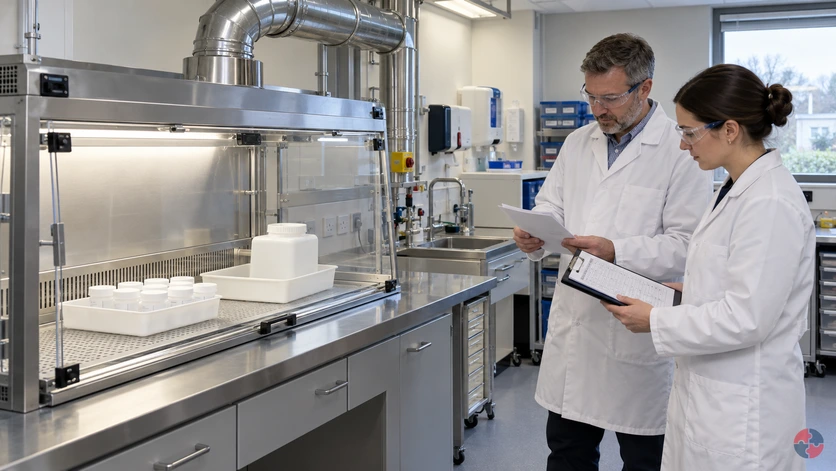
Formalin handling and machining a formaldehyde-containing panel are different tasks. Identify product, release and exposure before selecting controls.
Opening a container changes the capture and contact question
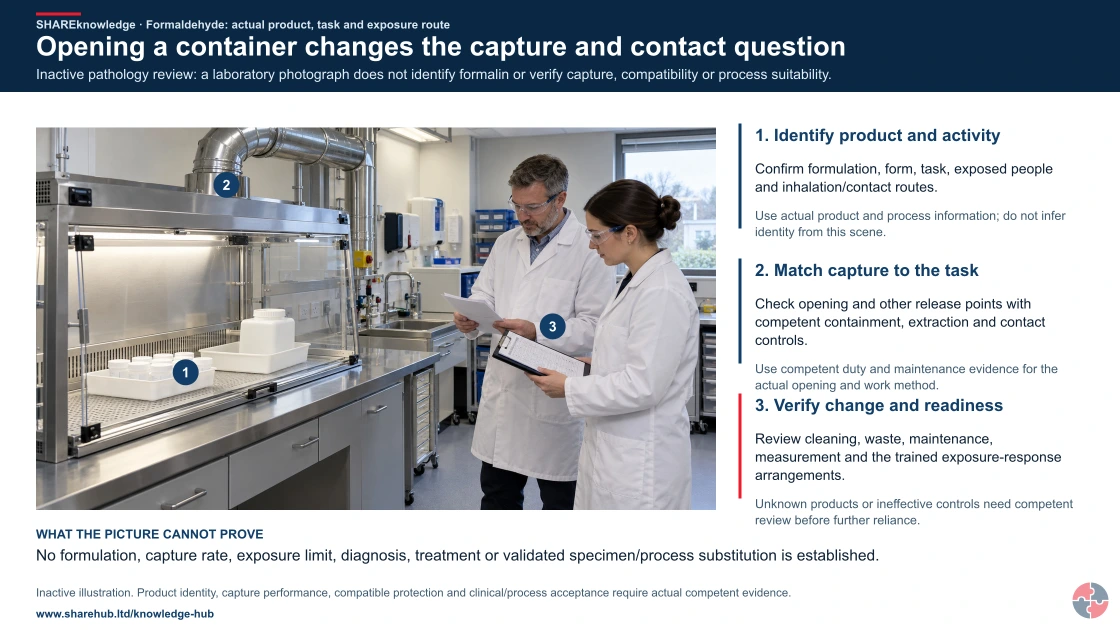
Full written explanation
A new realistic UK pathology-preparation illustration shows closed polymer pots and a larger closed container in separate trays within a transparent-fronted enclosure, connected extraction ductwork and two reviewers using inert product/task records. Three numbered questions connect actual formulation and activity, source capture/contact controls and evidence for opening, cleaning, waste and maintenance. Nothing is opened or handled. A visible enclosure, duct or ordinary protective clothing does not prove effective capture, chemical compatibility or approved fixation/analysis. A separate resin/wood-product schematic addresses changed material and task evidence without using a normal-skin model to imply vapour or cancer effects.
Inactive pathology review: a laboratory photograph does not identify formalin or verify capture, compatibility or process suitability.
- Identify product and activity. Confirm formulation, form, task, exposed people and inhalation/contact routes.
- Match capture to the task. Check opening and other release points with competent containment, extraction and contact controls.
- Verify change and readiness. Review cleaning, waste, maintenance, measurement and the trained exposure-response arrangements.
Change the pathway
- The container appearance is insufficient. Use actual product and process information; do not infer identity from this scene.
- A duct does not establish capture. Use competent duty and maintenance evidence for the actual opening and work method.
- Hold an unresolved change. Unknown products or ineffective controls need competent review before further reliance.
Evidence check: No formulation, capture rate, exposure limit, diagnosis, treatment or validated specimen/process substitution is established.
Keep actual material and release-route controls distinct from clinical response
Primary references: UKHSA formaldehyde general information · HSE COSHH assessment/control entry · HSE LEV and actual duty evidence
Open the complete HD image (new tab)Download image

Keep actual material and release-route controls distinct from clinical response
Primary references: UKHSA formaldehyde general information · HSE COSHH assessment/control entry · HSE LEV and actual duty evidence

Identify product and activity
Use actual product information and task observations; do not infer formulation from a laboratory photograph.
Control release at source
Assess contained dispensing or suitable extraction for the actual vapour or dust pathway, alongside contact prevention.
Verify the remaining task
Check capture, maintenance, compatible handling arrangements and selected PPE through competent assessment.
Review change or symptoms
Hold uncertain products or ineffective controls and obtain appropriate advice. A normal-skin model does not demonstrate vapour or cancer effects, and no exposure limit is invented.
Read the complete task-specific control examples
ERICPD is a planning cross-map: Discipline verifies and sustains every control. ESEAP compares effectiveness. A label does not authorise the task; retain the owner, evidence and stop or change decision.
Preparing formalin specimen containers · ERICPD
- Eliminate
- Use a validated formaldehyde-free process where the clinical service confirms that fixation and analysis remain suitable.
- Reduce
- Use suitable contained dispensing or effective source extraction for the identified formulation and release route; verify capture and compatible contact controls for the actual task.
- Isolate
- Separate fixation and decanting from general laboratory work and protect the clean specimen-handling area.
- Control
- Use suitable contained dispensing and verified local extraction; keep containers closed and provide compatible spill containment.
- PPE
- Specify compatible gloves, clothing, eye protection and any RPE required for the assessed work; consider chemical permeation.
- Discipline
- Check extraction and container seals and retain the clinical validation and exposure-control records.
Preparing formalin specimen containers · ESEAP
- Elimination
- Use a validated formaldehyde-free process where the clinical service confirms that fixation and analysis remain suitable.
- Substitution
- No separate approved substitution is specified; assess a genuinely safer material or process before relying on lower controls.
- Engineering controls
- Use suitable contained dispensing or effective source extraction for the identified formulation and release route; verify capture and compatible contact controls for the actual task.
- Administrative controls
- Identify the fixative, confirm labelling and quantities, and follow approved spill, waste and specimen-handling procedures.
- PPE
- Specify compatible gloves, clothing, eye protection and any RPE required for the assessed work; consider chemical permeation.
Machining formaldehyde-containing composite panels · ERICPD
- Eliminate
- Order panels to finished dimensions or use a suitable prefabricated assembly so local machining is unnecessary.
- Reduce
- Select a suitable lower-emission board or alternative material after validating performance and its other hazards.
- Isolate
- Separate machining and freshly processed stock from occupied clean work and general storage routes.
- Control
- Use effective machine extraction and suitable ventilation for the actual dust and vapour sources; keep the tool and extraction compatible.
- PPE
- Select suitable dust/RPE and other protection from the assessment; a particulate filter alone does not control formaldehyde vapour.
- Discipline
- Check extraction, ventilation and stock changes; review exposure controls when board supplier, process or throughput changes.
Machining formaldehyde-containing composite panels · ESEAP
- Elimination
- Order panels to finished dimensions or use a suitable prefabricated assembly so local machining is unnecessary.
- Substitution
- Select a suitable lower-emission board or alternative material after validating performance and its other hazards.
- Engineering controls
- Separate machining and freshly processed stock from occupied clean work and general storage routes.
- Administrative controls
- Verify board identity and assess machining, storage and cleaning exposures; avoid dry sweeping and uncontrolled compressed-air cleaning.
- PPE
- Select suitable dust/RPE and other protection from the assessment; a particulate filter alone does not control formaldehyde vapour.
What are the key facts about formaldehyde exposure?
Formaldehyde can irritate eyes, skin and airways after acute exposure, may sensitise skin, and is classified as carcinogenic to humans. Treat a significant splash, breathing problem or uncontrolled release as an emergency; plan substitution and engineering controls under the applicable GB or NI COSHH rules.
Vapour matters
Formaldehyde can be released from solutions, resins and materials, especially with poor ventilation or heating.
Symptoms should not be normalised
Eye watering, throat irritation, coughing or skin symptoms can indicate inadequate control.
Controls should prevent exposure
Open trays, decanting and poorly ventilated benches are weak arrangements.
Monitoring validates controls
Air monitoring can confirm whether WELs and local standards are being met.
Health surveillance may be needed
Where dermatitis or respiratory risk remains, competent advice should guide surveillance.
Check UKHSA toxicology.
What is formaldehyde poisoning and workplace exposure?
Formaldehyde is a reactive, volatile chemical used in some fixatives, resins and disinfectants. “Poisoning” covers exposure-related illness, but acute irritation or corrosive injury, sensitisation and long-term cancer risk are different outcomes and should not be collapsed into one diagnosis.
Formaldehyde is highly water soluble and reactive, which is why it irritates eyes and upper airways readily. It can also affect skin and, in some occupational contexts, contribute to sensitisation.
The practical risk is shaped by concentration, temperature, surface area, ventilation, duration and how the task is done. A small container used inside a fume cupboard is very different from open use in a poorly ventilated room.
Formaldehyde exposure should be understood as both a short-term irritation risk and a longer-term control issue. Because it can be released as vapour from liquids, resins and materials, a workplace may have exposure even where there is no obvious spill or visible dust.
The practical learning point is that smell is not a reliable control standard. If workers notice eye watering, throat irritation or coughing during routine work, the answer should not be to tolerate it. The task, ventilation, product choice, exposure time and monitoring evidence should be reviewed.
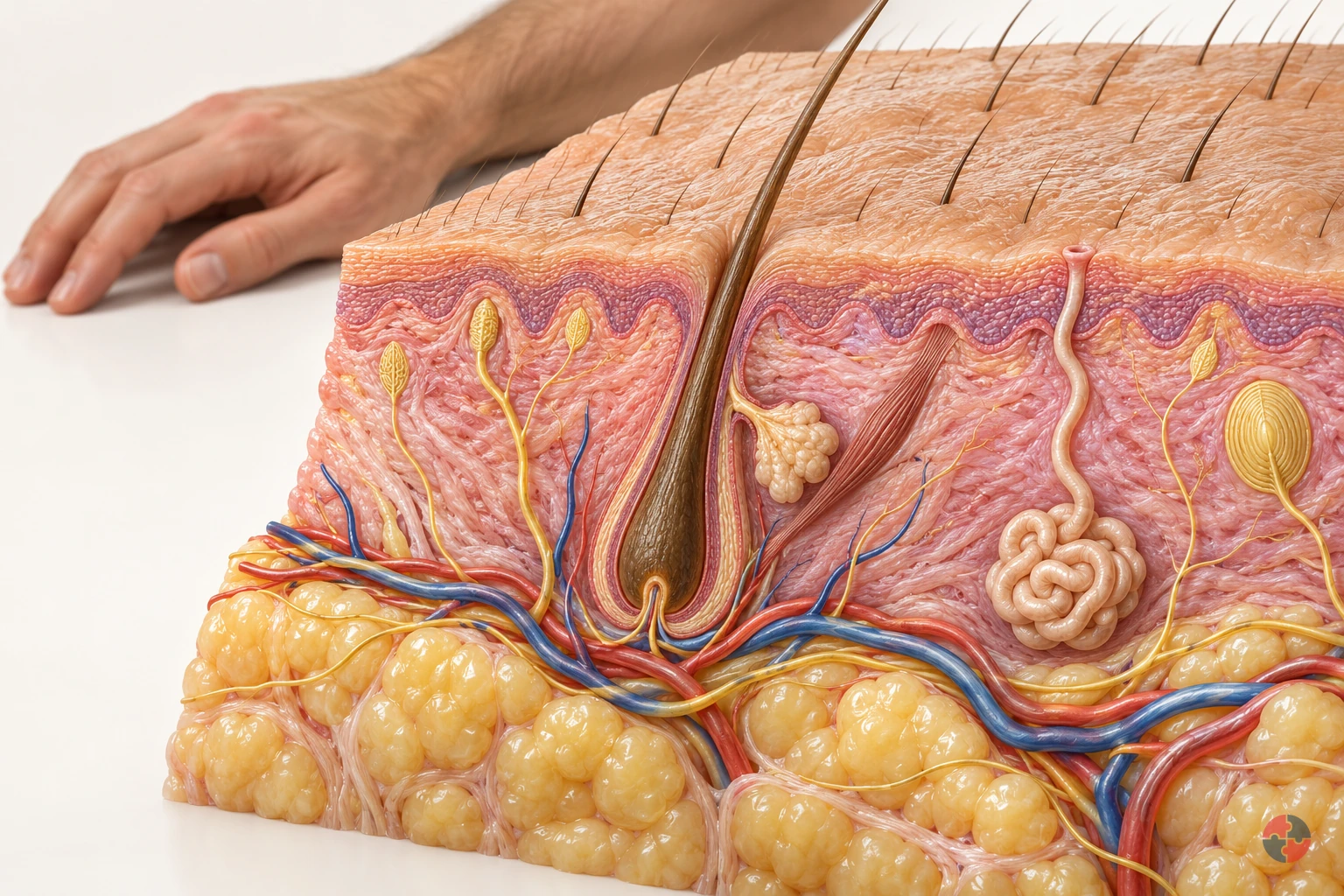

How does the skin barrier work, and how can workplace contact damage it?
Interactive anatomy · Skin barrier and injury · Updated 2026-10-23
Read all anatomy and process explanations without the viewer
General education about normal skin and example mechanisms; not diagnosis, treatment selection or a patient assessment. Hair-bearing forearm example. Vessels remain below the epidermis; the normal barrier has no large open holes. Image-based diagnosis or patch-testing simulation Treatment doses or guaranteed glove/barrier-cream protection Calculated injury depth, contact-dose thresholds or a number of safe washes Hydrofluoric-acid protocols and unreviewed named-substance injury overlays Immediate chemical-burn advice must remain readable outside the model and before any scenario answer.
Outer barrier
The outermost layer helps limit water loss and harmful contact. The outermost epidermal layer combines flattened cells with materials between them to help retain moisture and limit harmful contact. It is a selective protective barrier, rather than a waterproof coating. Use the magnified inset to locate its components. The model shows their relationship but cannot tell whether a particular substance will cross a person’s skin. Health and Safety Executive: Structure and functions of the skin
Barrier lipids
Lipids between surface cells help maintain the barrier. Repeated detergent contact can remove some of these fatty materials and overwhelm repair. Health and Safety Executive: Understanding the causes of skin disease
Epidermis
The outer skin layer continually renews. New cells form in the deeper epidermis and move towards the surface, becoming flattened as the outer layer is renewed and shed. The epidermis therefore contributes active renewal as well as surface protection. Follow its position above the dermis in the cutaway; the model enlarges a static structure rather than timing an individual’s cell renewal. Health and Safety Executive: Structure and functions of the skin
Dermis
Supporting tissue beneath the epidermis contains vessels, nerves and glands. The dermis is supporting tissue beneath the epidermis. It contains structures involved in supply, sensation and temperature regulation, including vessels, nerves and sweat glands. The cutaway enlarges selected components so their different functions can be followed. Their shared location does not mean that they form one open passage through the skin barrier. Oxford Health NHS Foundation Trust: The Skin — Community Tissue Viability Team
Subcutaneous tissue
Tissue and fat below the dermis help insulate and cushion. The lower layer supports the skin block; it is not part of the surface barrier. Health and Safety Executive: Structure and functions of the skin · Oxford Health NHS Foundation Trust: The Skin — Community Tissue Viability Team
Blood vessels
Vessels supply the deeper skin. These vessels supply the deeper skin tissues. They sit below the epidermal surface in the cutaway, alongside other supporting structures. Compare them with the nerve and sweat duct rather than interpreting every tube as the same pathway. The drawing explains location and function; its vessel size and colour are not measurements of circulation or skin temperature. Oxford Health NHS Foundation Trust: The Skin — Community Tissue Viability Team
Sensory nerves
Nerve endings help detect touch and temperature. The signalling symbol represents sensory information, not a visible electrical spark. Health and Safety Executive: Structure and functions of the skin · Oxford Health NHS Foundation Trust: The Skin — Community Tissue Viability Team
Sweat gland and duct
Sweat reaches the surface through a duct. A sweat gland produces sweat that reaches an opening at the surface through a duct. This contributes to the skin’s role in temperature regulation. Trace the coiled gland and its duct separately from the vessels and nerves. The enlarged path makes the connection visible; it does not measure sweating or represent every route by which a substance can enter skin. Health and Safety Executive: Structure and functions of the skin
Hair follicle
Hair grows from a follicle in hair-bearing skin. This forearm example includes a follicle. The palm has a different structure and must not use this site label. Health and Safety Executive: Structure and functions of the skin
Immune response inset
Skin participates in immune responses. In contact allergy, prior sensitisation can lead to an inflammatory response after later contact. Health and Safety Executive: Understanding the causes of skin disease · NHS: Contact dermatitis — causes
Open the complete process transcript
The process, step by step
Find the surface
Start with the forearm locator to establish where this sample of skin belongs. The enlarged block represents hair-bearing skin, with the epidermis on the outside, the dermis beneath it and deeper subcutaneous tissue below. The surface is only one part of this living organ. New epidermal cells are formed deeper down and move towards the outside, where flattened cells contribute to the protective layer. Use the block to connect the familiar body surface with these layers; it is an enlarged teaching section, not a standard thickness shared by every body site. Health and Safety Executive: Structure and functions of the skin
What to watch: Use the forearm locator first, then follow the enlarged block from the outer epidermis down through the dermis to the deeper tissue.
Why it matters: Locating the body site prevents the sample from being mistaken for every kind of skin. The outer layer, supporting tissues and deeper structures contribute different functions within the same organ.
Explore this step: Identify the outermost layer and the hair follicle before changing to the magnified barrier view.
Magnify the barrier
The outer barrier depends on both flattened surface cells and the fatty materials, or lipids, between them. The cells provide one part of the structure; the surrounding lipids help control the passage of water and substances through it. Look at their arrangement together rather than treating the skin as a single waterproof sheet. This is a selective barrier, not a complete seal against every material. The enlargement helps explain why a change in the material between cells can affect protection even when there is no large cut through the skin. Health and Safety Executive: Understanding the causes of skin disease
What to watch: Compare the flattened surface cells with the lipids between them, using the enlarged barrier inset rather than the whole skin block.
Why it matters: The arrangement helps limit unwanted passage through the surface while retaining moisture. Understanding both components explains why skin protection depends on more than whether the surface looks visibly broken.
Explore this step: Point out one surface cell and the surrounding lipid region, then describe how they work together.
Limit water loss
Water retention is part of healthy barrier function. The outer cells and the materials between them help limit water leaving the skin, while some water can still pass through. The labelled arrows represent that background loss; they are not streams from a wound or measurements of an individual’s hydration. Moisture matters because the outer layer needs appropriate hydration to remain flexible and function well. Read the arrows alongside the cell-and-lipid arrangement, so the explanation connects a movement across the surface with the structure that helps regulate it. Health and Safety Executive: Understanding the causes of skin disease
What to watch: Look at the labelled water-loss arrows beside the outer cells and lipids, noting their direction across the barrier surface.
Why it matters: Limiting water loss helps the outer layer retain the moisture needed for normal function. A barrier can perform this role without being impermeable, and the model cannot assess somebody’s skin hydration.
Explore this step: Compare this step with the barrier enlargement and explain why “limits water loss” is more accurate than “waterproof”.
Explore deeper structures
The deeper skin contains structures with different jobs. Blood vessels supply the deeper tissues, sensory nerves help carry information such as touch and temperature, and sweat glands connect to the surface through ducts. Follow each labelled structure separately instead of reading the cutaway as one channel running down through the skin. The enlarged vessels, nerves and gland are learning features within the supporting tissue; their positions explain relationships, not the route or speed of an absorbed substance. Notice that surface barrier function and these deeper functions are connected parts of skin health. Health and Safety Executive: Structure and functions of the skin · Oxford Health NHS Foundation Trust: The Skin — Community Tissue Viability Team
What to watch: Locate the vessels, sensory nerves and coiled sweat gland below the surface, then trace the gland’s duct towards its opening.
Why it matters: Supply, sensation and temperature regulation require different structures. Recognising those roles avoids mistaking every visible line for a chemical entry route or assuming the outer barrier carries out all skin functions.
Explore this step: Select the gland, nerve and vessel labels in turn and name a different function for each.
Connect structure and function
Return to the whole section and connect the functions you have explored. The renewing outer layer helps form a protective barrier and limit moisture loss. Deeper supporting tissues contain sensory structures, vessels and glands, while subcutaneous tissue contributes cushioning and insulation. These functions operate together rather than as a single switch that makes skin either completely protected or unprotected. Use the separate mechanism examples to explore particular changes only after locating the healthy structures. The cutaway explains relationships; its colours and enlarged components do not diagnose a skin condition or identify a safe contact time. Health and Safety Executive: Structure and functions of the skin · Oxford Health NHS Foundation Trust: The Skin — Community Tissue Viability Team
What to watch: Review the complete skin section, connecting the outer barrier with the supporting dermis, sensory structures, sweat gland and deeper tissue.
Why it matters: Skin both separates the body from its surroundings and helps it respond to them. Connecting protection, sensation and temperature functions gives a more useful picture than viewing the surface as a passive covering.
Explore this step: Choose one structure from the surface and one from deeper tissue, and explain how their jobs differ.
Read the practice situations and all answer explanations
Sources and how the model is made
The opening images are AI-generated anatomical illustrations. The interactive 3D models and labelled SVG diagrams use original procedural artwork. These teaching images are not medical scans or diagnostic tools. Source references support the learner explanations and do not grant artwork rights.
- Health and Safety Executive: Structure and functions of the skin — Three skin layers; renewal; sweat, hair, sensory, barrier and temperature functions. Factual reference only; no diagram copied.
- Oxford Health NHS Foundation Trust: The Skin — Community Tissue Viability Team — Layer and deeper vessel/nerve context, mechanical injury and skin-tone assessment considerations. No treatment regimen or illustration reused.
- Health and Safety Executive: Understanding the causes of skin disease — Barrier lipids and water retention; cumulative irritation; sensitisation, delayed contact allergy, small subsequent amounts and coexistence. Replaces the former separate dermatitis URL, which failed direct retrieval.
- NHS: Contact dermatitis — causes — Irritant versus allergic mechanisms and workplace wet work. Printed next-review date May 2026 is overdue; recheck at qualified clinical sign-off and corroborate with HSE.
- Health and Safety Executive: Construction hazardous substances: Cement — Alkaline burns from trapped cement; abrasive irritation; chromate sensitisation; task methods and suitable contact protection.
- Health and Safety Executive: How do I prevent skin problems in my business? — Avoid contact, suitable gloves, washing and drying, skin care, early checks/reporting and medical advice. No universal glove or cream claim.
- NHS: Acid and chemical burns — Immediate chemical skin-burn first aid: 999, avoid contamination, clothing and dry-chemical removal, copious water about one hour, no creams or other chemicals. Skin advice is not substituted for eye or thermal guidance.
- NHS: Cuts and grazes — General shallow-wound context and the need for professional help with serious wounds; not a visual diagnosis or full first-aid simulation.
- NHS: Contact dermatitis — symptoms — Dryness, cracking, inflammation and fluid-filled blisters can occur in contact dermatitis. Irritant and allergic appearances overlap. Original illustrative textures are not diagnostic photographs and no source artwork is copied.
Where can formaldehyde exposure occur?
Exposure can occur wherever formaldehyde solutions, resins, disinfectants, preserved specimens or formaldehyde-releasing materials are used or heated.
Formaldehyde appears in very different workplaces. Laboratories and pathology areas may use formalin for preservation; manufacturing may use resins and adhesives; maintenance workers may encounter residues or off-gassing materials; and facilities teams may be affected by products brought onto site by contractors.
Because sources are varied, procurement and contractor control matter. A formaldehyde-containing product should not arrive through a local purchase or contractor method statement without SDS review, COSHH assessment and agreement on controls.
| Source or activity | How exposure can occur | Control focus |
|---|---|---|
| Pathology and laboratories | Specimen pots, open containers, decanting and spills. | Fume cupboards, closed containers and spill response. |
| Mortuary and embalming work | Preservative fluids, aerosol and skin contact. | Ventilation, enclosed transfer, PPE and hygiene. |
| Wood products and resins | Off-gassing from pressed wood, resins or adhesives. | Material selection, ventilation and supplier information. |
| Manufacturing | Resin production, curing, heated processes or maintenance. | Closed plant, LEV, monitoring and permit controls. |
| Cleaning and disinfection | Use of formaldehyde-containing products where still present. | Substitution, dilution control and product approval. |
| Waste and spill handling | Contaminated absorbents, containers and surfaces. | Waste segregation, decontamination and trained responders. |
How can formaldehyde enter or affect the body?
Formaldehyde mainly affects workers through inhalation, eye contact and skin contact.
Routes of exposure should be explained before controls are chosen. Vapour and mist create inhalation and eye irritation risk. Liquids and contaminated surfaces create skin and eye contact risk. Poor hygiene can create ingestion risk. Waste, clothing and uncleaned work areas can expose people after the original task has ended.
A useful COSHH assessment therefore looks at the full task: opening containers, decanting, soaking, wiping, heating, cleaning, spill response, waste removal and maintenance. Each stage may need a different control.
| Route | How exposure happens | Why it matters |
|---|---|---|
| Inhalation | Breathing vapour during open handling, spills or poorly ventilated work. | Can cause irritation, coughing and respiratory symptoms. |
| Eye contact | Vapour irritation or liquid splash. | Can cause watering, pain, redness and potential injury. |
| Skin contact | Liquid contact, contaminated gloves or surfaces. | Can cause irritation, dermatitis or sensitisation. |
| Ingestion | Contaminated hands, poor hygiene or accidental contamination. | Should be prevented through hygiene and controlled work areas. |
| Secondary exposure | Contaminated clothing, waste or poorly cleaned areas. | Can expose cleaners, maintenance staff or others not doing the original task. |
What health effects can formaldehyde cause?
A strong acute exposure can cause painful eye or skin injury and breathing symptoms; repeated skin contact can sensitise. Longer-term inhalation exposure is linked to nasopharyngeal cancer; the evidence for sinonasal cancer is less certain. Stop exposure and seek urgent assessment when symptoms or the release are significant; a supervisor should not diagnose severity from odour alone.
This is workplace guidance, not medical advice. Workers with symptoms after a credible formaldehyde exposure should report promptly and use qualified occupational-health or medical support through local arrangements.
Repeated irritation should be treated as useful evidence, not as background discomfort. Eye, nose, throat, chest or skin symptoms may indicate that substitution, ventilation, work method, PPE or monitoring is not good enough.
| Health effect | Possible signs | Workplace response |
|---|---|---|
| Eye and throat irritation | Watering eyes, burning sensation, sore throat or strong odour reports. | Check ventilation, stop uncontrolled work and review exposure. |
| Respiratory symptoms | Cough, chest tightness, wheeze or breathlessness. | Stop exposure and seek prompt qualified medical assessment for acute wheeze, chest tightness or breathlessness; use emergency help for breathing difficulty or collapse. Nonacute recurring symptoms also need occupational-health follow-up. |
| Skin irritation or dermatitis | Redness, itching, cracking or rash. | Review glove selection, hygiene, skin surveillance and substitution. |
| Sensitisation | Symptoms triggered by lower exposures after repeated exposure. | Escalate to competent occupational-health support and control review. |
| Significant acute exposure | Splash, high vapour release or symptoms after a spill. | Use emergency procedure and qualified medical support. |
Check UKHSA health effects.
What immediate actions are needed by route of exposure?
For inhalation, leave the exposure area and call emergency help for breathing difficulty or collapse. For eye or skin splash, use the site’s immediate irrigation/first-aid arrangements, remove contaminated clothing when safe and seek urgent medical advice. Use the product SDS and trained responders; never delay emergency help to complete an incident form.
This page is workplace guidance, not medical advice. Significant exposure, breathing difficulty, collapse, eye splash, chemical burn, suspected ingestion or symptoms after a credible release should trigger local emergency arrangements and qualified medical assessment.
The action plan should be visible where formaldehyde is used. Workers should know how to stop the task, move away from vapour, use eyewash or washing facilities, remove contaminated clothing safely, protect responders and send the SDS with the exposed person.
| Exposure route | When to escalate urgently | What should be ready before work starts |
|---|---|---|
| Inhalation | Breathing difficulty, chest tightness, collapse, significant vapour release, or symptoms after credible exposure. | Fresh-air route, emergency communication, ventilation shutdown/escalation rule and SDS handover. |
| Eye contact | Any splash, pain, blurred vision, persistent watering or known formaldehyde liquid contact. | Accessible eyewash, trained first aiders and prompt medical route. |
| Skin contact | Liquid splash or chemical burn, unknown-strength contact or contaminated clothing needs urgent medical assessment. Recurring nonacute dermatitis needs prompt occupational-health review. | Washing facilities, spare clothing, compatible gloves and contaminated-waste procedure. |
| Ingestion | Suspected swallowing or contamination of food, drink or hands. | No eating/drinking in work areas, hand hygiene and immediate medical escalation route. |
| Secondary exposure | Cleaner, first aider or maintenance worker may contact contaminated surfaces, waste or clothing. | Exclusion, spill response, responder PPE and waste segregation. |
Check UKHSA incident guidance.
Do not expose an unprotected rescuer or spread contamination into a vehicle or care area. Alert responders to the chemical. Irrigation and emergency help must be prompt; clinical equipment, pH testing and drug instructions in the incident document are for trained clinicians. Recurrent nonacute dermatitis needs occupational-health follow-up, while a chemical burn or acute breathing problem needs urgent medical action.
How should formaldehyde be assessed under COSHH?
A GB or NI COSHH assessment should identify every product or process releasing formaldehyde, its concentration and physical form, who is exposed, the route and duration, and the controls actually working. Assess substitutes and enclosure before relying on PPE.
Changed resin and machining tasks need different release evidence
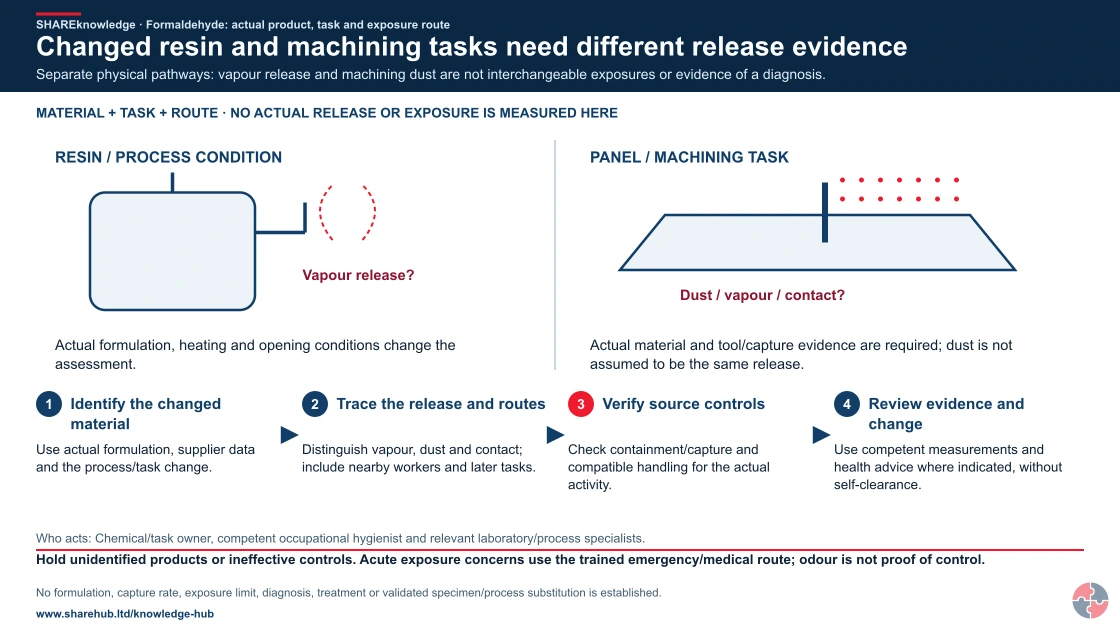
Full written explanation
A complete native comparison shows a conceptual closed resin/process vessel with a conditional vapour-release question and, separately, an inactive panel/machining outline with a conditional dust-release question. Neither pathway is assumed to represent an actual measured formaldehyde release. Material composition, heating/process conditions, tool task and actual capture determine the assessment. The connected checks identify the changed product/process, assess routes and affected people, verify suitable source controls and use competent measurement/change review. Clinical/process validation, current GB/NI legal detail and specialist chemical approval remain held; no exposure limit, diagnosis or treatment is supplied.
Separate physical pathways: vapour release and machining dust are not interchangeable exposures or evidence of a diagnosis.
- Identify the changed material. Use actual formulation, supplier data and the process/task change.
- Trace the release and routes. Distinguish vapour, dust and contact; include nearby workers and later tasks.
- Verify source controls. Check containment/capture and compatible handling for the actual activity.
- Review evidence and change. Use competent measurements and health advice where indicated, without self-clearance.
When the evidence does not fit: Hold unidentified products or ineffective controls. Acute exposure concerns use the trained emergency/medical route; odour is not proof of control.
Who acts: Chemical/task owner, competent occupational hygienist and relevant laboratory/process specialists.
Changed workplace
Pathology container task: Assess opening, contact and capture rather than assuming a closed container proves the whole task.
Resin / wood-product change: Review actual material, vapour/dust routes and process conditions independently.
Evidence check: No formulation, capture rate, exposure limit, diagnosis, treatment or validated specimen/process substitution is established.
Keep actual material and release-route controls distinct from clinical response
Primary references: UKHSA formaldehyde general information · HSE COSHH assessment/control entry · HSE LEV and actual duty evidence
Open the complete HD image (new tab)Download image

Keep actual material and release-route controls distinct from clinical response
Primary references: UKHSA formaldehyde general information · HSE COSHH assessment/control entry · HSE LEV and actual duty evidence
The COSHH assessment should begin with the product and the task together. A low concentration product used briefly in a ventilated enclosure is different from open trays, heated resins, poorly sealed specimens or spill clean-up in a small room.
The assessment should also identify who else could be exposed: cleaners, maintenance staff, waste contractors, agency workers, visitors or night-shift staff entering a room after formaldehyde has been used.
| Question | Why it matters | Evidence |
|---|---|---|
| Which products contain or release formaldehyde? | Formaldehyde may be present in solutions, resins or release from materials. | SDS, inventory and supplier information. |
| Can it be substituted? | Eliminating formaldehyde is stronger than managing exposure. | Substitution review and approval record. |
| How is it handled? | Open handling increases vapour and splash risk. | Task observation and safe method. |
| Is ventilation effective? | Poor ventilation allows vapour build-up. | Fume cupboard checks, LEV records and airflow evidence. |
| Are WELs being met? | Compliance needs evidence where inhalation exposure is credible. | Air monitoring plan and results. |
| Is health surveillance needed? | Skin and respiratory risk may require early detection. | Competent advice and surveillance programme. |
Check HSE COSHH guidance.
Use the surveillance criteria and act on competent results; employer health records and confidential clinical records have different access and purposes. A WEL-compliant sample does not settle skin risk or carcinogen control. Current substance-specific legal/clinical implementation remains held.
How can the hierarchy of controls reduce formaldehyde exposure and health risks?
First remove or replace a formaldehyde-releasing task where feasible. Enclose and extract remaining sources, restrict work, and use suitable PPE only for residual exposure. Verify capture, competence and emergency readiness.
The scenarios are reasoned task applications of the linked control principles, not a prescribed design or proof that each exact intervention appears in a source. A competent person must verify the method, local law and stop criteria.
A laboratory opens concentrated fixative and pours it at a bench.
Heated adhesive can release formaldehyde during production and maintenance.
Choose the activity
How can the ERICPD hierarchy of controls reduce risks while preparing formalin specimen containers?

| Control level | Control for this activity | Owner and verification | Stop / restart decision |
|---|---|---|---|
| Eliminate | Use a validated formaldehyde-free process where the clinical service confirms that fixation and analysis remain suitable. | Process owner verifies that the revised workflow achieves the required output and the hazardous step is genuinely removed. | If the hazardous step remains, retain a task assessment and select the stronger feasible remaining controls. |
| Reduce, including substitution | Use suitable contained dispensing or effective source extraction for the identified formulation and release route; verify capture and compatible contact controls for the actual task. The formaldehyde hazard remains: this is a handling and containment improvement, rather than chemical substitution. | Laboratory lead confirms the specified container, fixative volume, seal and specimen compatibility; observe opening, specimen insertion and disposal for remaining vapour or splash release. | Reject the alternative if suitability is unproved or its new hazards are unresolved. |
| Isolate | Separate fixation and decanting from general laboratory work and protect the clean specimen-handling area. | Supervisor verifies the task boundaries and that the separation or isolation protects affected people and connected work. | Hold or stop for uncontrolled vapour, damaged container, failed extraction or unapproved fixative change. |
| Control: physical safeguards | Use suitable contained dispensing and verified local extraction; keep containers closed and provide compatible spill containment. | Competent equipment/process owner checks clinical method approval, formulation, dispensing containment and extraction. | Hold or stop for uncontrolled vapour, damaged container, failed extraction or unapproved fixative change. |
| Control: work method and response | Identify the fixative, confirm labelling and quantities, and follow approved spill, waste and specimen-handling procedures. | Supervisor confirms the limits, response, communication and restart authority with the people doing this activity. | Stop if the agreed method, communication, competent cover or task limits cannot be maintained. |
| PPE | Specify compatible gloves, clothing, eye protection and any RPE required for the assessed work; consider chemical permeation. | Assessor confirms whether PPE is needed and checks selection, condition, compatibility and any required face-fit evidence. | Do not rely on unsuitable or defective protection, or use PPE to continue after an essential source control fails. |
| Discipline | Check extraction and container seals and retain the clinical validation and exposure-control records. | Release only after laboratory lead accepts diagnostic suitability and verified exposure controls. Retain the checks and unresolved restrictions at handover. | Keep the activity on hold while defects or required reinstatement evidence remain unresolved. |
How can the ISO 45001 hierarchy of controls reduce risks while preparing formalin specimen containers?

| Control level | Control for this activity | Owner and verification | Stop / restart decision |
|---|---|---|---|
| Elimination | Use a validated formaldehyde-free process where the clinical service confirms that fixation and analysis remain suitable. | Process owner verifies that the revised workflow achieves the required output and the hazardous step is genuinely removed. | If the hazardous step remains, retain a task assessment and select the stronger feasible remaining controls. |
| Engineering controls | Use suitable contained dispensing or effective source extraction for the identified formulation and release route; verify capture and compatible contact controls for the actual task. The formaldehyde hazard remains: this is a handling and containment improvement, rather than chemical substitution. | Laboratory lead confirms the specified container, fixative volume, seal and specimen compatibility; observe opening, specimen insertion and disposal for remaining vapour or splash release. | Reject the alternative if suitability is unproved or its new hazards are unresolved. |
| Engineering controls | Separate fixation and decanting from general laboratory work and protect the clean specimen-handling area. | Supervisor verifies the task boundaries and that the separation or isolation protects affected people and connected work. | Hold or stop for uncontrolled vapour, damaged container, failed extraction or unapproved fixative change. |
| Engineering controls | Use suitable contained dispensing and verified local extraction; keep containers closed and provide compatible spill containment. | Competent equipment/process owner checks clinical method approval, formulation, dispensing containment and extraction. | Hold or stop for uncontrolled vapour, damaged container, failed extraction or unapproved fixative change. |
| Administrative controls | Identify the fixative, confirm labelling and quantities, and follow approved spill, waste and specimen-handling procedures. | Supervisor confirms the limits, response, communication and restart authority with the people doing this activity. | Stop if the agreed method, communication, competent cover or task limits cannot be maintained. |
| PPE | Specify compatible gloves, clothing, eye protection and any RPE required for the assessed work; consider chemical permeation. | Assessor confirms whether PPE is needed and checks selection, condition, compatibility and any required face-fit evidence. | Do not rely on unsuitable or defective protection, or use PPE to continue after an essential source control fails. |
| Administrative controls | Check extraction and container seals and retain the clinical validation and exposure-control records. | Release only after laboratory lead accepts diagnostic suitability and verified exposure controls. Retain the checks and unresolved restrictions at handover. | Keep the activity on hold while defects or required reinstatement evidence remain unresolved. |
How can the ERICPD hierarchy of controls reduce risks while machining formaldehyde-containing composite panels?

| Control level | Control for this activity | Owner and verification | Stop / restart decision |
|---|---|---|---|
| Eliminate | Order panels to finished dimensions or use a suitable prefabricated assembly so local machining is unnecessary. | Process owner verifies that the revised workflow achieves the required output and the hazardous step is genuinely removed. | If the hazardous step remains, retain a task assessment and select the stronger feasible remaining controls. |
| Reduce, including substitution | Select a suitable lower-emission board or alternative material after validating performance and its other hazards. | Process/technical owner validates the alternative, its compatibility and any new risks before adoption. | Reject the alternative if suitability is unproved or its new hazards are unresolved. |
| Isolate | Separate machining and freshly processed stock from occupied clean work and general storage routes. | Supervisor verifies the task boundaries and that the separation or isolation protects affected people and connected work. | Hold or stop for unknown board, failed extraction or an unassessed emission/exposure change. |
| Control: physical safeguards | Use effective machine extraction and suitable ventilation for the actual dust and vapour sources; keep the tool and extraction compatible. | Competent equipment/process owner checks board specification, dust capture, ventilation and assessment of both dust and vapour. | Hold or stop for unknown board, failed extraction or an unassessed emission/exposure change. |
| Control: work method and response | Verify board identity and assess machining, storage and cleaning exposures; avoid dry sweeping and uncontrolled compressed-air cleaning. | Supervisor confirms the limits, response, communication and restart authority with the people doing this activity. | Stop if the agreed method, communication, competent cover or task limits cannot be maintained. |
| PPE | Select suitable dust/RPE and other protection from the assessment; a particulate filter alone does not control formaldehyde vapour. | Assessor confirms whether PPE is needed and checks selection, condition, compatibility and any required face-fit evidence. | Do not rely on unsuitable or defective protection, or use PPE to continue after an essential source control fails. |
| Discipline | Check extraction, ventilation and stock changes; review exposure controls when board supplier, process or throughput changes. | Release only after workshop owner accepts material suitability and effective exposure controls. Retain the checks and unresolved restrictions at handover. | Keep the activity on hold while defects or required reinstatement evidence remain unresolved. |
How can the ISO 45001 hierarchy of controls reduce risks while machining formaldehyde-containing composite panels?

| Control level | Control for this activity | Owner and verification | Stop / restart decision |
|---|---|---|---|
| Elimination | Order panels to finished dimensions or use a suitable prefabricated assembly so local machining is unnecessary. | Process owner verifies that the revised workflow achieves the required output and the hazardous step is genuinely removed. | If the hazardous step remains, retain a task assessment and select the stronger feasible remaining controls. |
| Substitution | Select a suitable lower-emission board or alternative material after validating performance and its other hazards. | Process/technical owner validates the alternative, its compatibility and any new risks before adoption. | Reject the alternative if suitability is unproved or its new hazards are unresolved. |
| Engineering controls | Separate machining and freshly processed stock from occupied clean work and general storage routes. | Supervisor verifies the task boundaries and that the separation or isolation protects affected people and connected work. | Hold or stop for unknown board, failed extraction or an unassessed emission/exposure change. |
| Engineering controls | Use effective machine extraction and suitable ventilation for the actual dust and vapour sources; keep the tool and extraction compatible. | Competent equipment/process owner checks board specification, dust capture, ventilation and assessment of both dust and vapour. | Hold or stop for unknown board, failed extraction or an unassessed emission/exposure change. |
| Administrative controls | Verify board identity and assess machining, storage and cleaning exposures; avoid dry sweeping and uncontrolled compressed-air cleaning. | Supervisor confirms the limits, response, communication and restart authority with the people doing this activity. | Stop if the agreed method, communication, competent cover or task limits cannot be maintained. |
| PPE | Select suitable dust/RPE and other protection from the assessment; a particulate filter alone does not control formaldehyde vapour. | Assessor confirms whether PPE is needed and checks selection, condition, compatibility and any required face-fit evidence. | Do not rely on unsuitable or defective protection, or use PPE to continue after an essential source control fails. |
| Administrative controls | Check extraction, ventilation and stock changes; review exposure controls when board supplier, process or throughput changes. | Release only after workshop owner accepts material suitability and effective exposure controls. Retain the checks and unresolved restrictions at handover. | Keep the activity on hold while defects or required reinstatement evidence remain unresolved. |
Use safe simulations and planned observations. Do not create a chemical release or unprotected chemical contact for training; required control checks and safe stop conditions still apply.
What should be in the SDS and COSHH plan before formaldehyde work starts?
The SDS and COSHH plan should translate supplier hazard information into task-specific controls, emergency actions, monitoring and health follow-up.
A safety data sheet is a starting point, not a finished assessment. It tells the business about hazards and precautions, but the workplace still has to decide how exposure could occur in the real task, whether the product can be substituted, how ventilation will be verified and what workers must do if the container spills or vapour is released.
For formaldehyde, the plan should be especially clear on concentration, quantity, open handling time, room ventilation, local exhaust ventilation, waste containers, storage segregation, symptom reporting and whether air monitoring or health surveillance is needed.
| Plan element | What it should confirm | Why it matters |
|---|---|---|
| Product identity | Product name, concentration, formaldehyde content and any formaldehyde-releasing ingredients. | Stops people treating different products and strengths as the same risk. |
| Task and exposure route | Who opens, pours, wipes, heats, cleans, disposes or maintains the source. | Connects controls to the actual way exposure happens. |
| WEL and monitoring | Relevant exposure limits, sampling need and competent interpretation route. | Provides evidence that inhalation exposure is controlled. |
| Engineering controls | Fume cupboard, LEV, enclosure, room ventilation and maintenance checks. | Prevents vapour exposure rather than relying on tolerance or smell. |
| Emergency response | Eyewash, washing, spill kit, first-aid route, medical escalation and SDS handover. | Reduces delay during the first minutes of exposure. |
| Health follow-up | Dermatitis, respiratory symptoms, surveillance triggers and occupational-health referral route. | Makes early signs visible and confidentially managed. |
Use the surveillance criteria and act on competent results; employer health records and confidential clinical records have different access and purposes. A WEL-compliant sample does not settle skin risk or carcinogen control. Current substance-specific legal/clinical implementation remains held.
How should the selected controls be checked in practice?
Control should focus on substitution, enclosed handling, ventilation and disciplined work practices before relying on PPE.
The strongest control is to remove or substitute formaldehyde where a safer product or process is suitable. Where it remains necessary, controls should keep vapour and liquid away from people through closed containers, fume cupboards, local exhaust ventilation, small quantities and disciplined storage.
PPE should not be treated as the whole answer. Gloves, goggles, aprons and respiratory protective equipment must be compatible with the substance and task, and users must know how to remove contaminated PPE without spreading exposure.
The task decision uses HSE COSHH control guidance.
Assess opening, cleaning, waste and maintenance as well as normal closed operation. Validate any alternative fixative for its clinical/process purpose before changing it; containment that fails when opened is not a complete control.
What monitoring and health surveillance may be needed?
A competent occupational hygienist should decide whether air sampling is needed and interpret results against the applicable current EH40 workplace exposure limit and task pattern. Exposure measurement does not replace prevention; health surveillance is required where the COSHH criteria and residual risk warrant it.
Monitoring should be used where it answers a real question: are workers exposed during this task, are WELs being met, is the fume cupboard controlling vapour, are symptoms linked to work, or has a change increased exposure?
Health surveillance may be needed where there is a reasonable likelihood of dermatitis or respiratory harm despite controls. Occupational-health advice is also important after symptoms, repeated irritation, a significant spill, a monitoring exceedance or uncertainty about acute exposure.
| Control check | Purpose | Evidence |
|---|---|---|
| Air monitoring | Measure inhalation exposure and compare with WELs. | Sampling results and competent interpretation. |
| LEV examination | Prove extraction remains effective. | Thorough examination, test labels and defect close-out. |
| Fume cupboard face velocity | Check containment at point of use. | Routine checks and maintenance response. |
| Skin checks | Detect dermatitis or irritation early where risk remains. | Health surveillance records and anonymised trend review. |
| Symptom reporting | Catch irritation or sensitisation before worsening. | No-blame reporting and investigation actions. |
Check HSE EH40 and exposure limits.
Use the surveillance criteria and act on competent results; employer health records and confidential clinical records have different access and purposes. A WEL-compliant sample does not settle skin risk or carcinogen control. Current substance-specific legal/clinical implementation remains held.
What should formaldehyde exposure records show?
Exposure records should connect the person or exposed group, the task, the substance, the controls, monitoring results and any follow-up actions.
Records are useful only if they tell the story of exposure. A monitoring result without the task, time, ventilation status and control condition is difficult to interpret later. A symptom report without follow-up can miss early dermatitis or respiratory sensitisation.
Occupational-health involvement is particularly important where workers report symptoms, exposure monitoring suggests poor control, work is repeated, spills occur, or managers are unsure whether health surveillance is required under COSHH.
| Record field | What good evidence includes | Review trigger |
|---|---|---|
| Task and exposed group | Who was exposed or potentially exposed, what task was underway, duration and location. | New product, changed method, contractor task or repeated complaint. |
| Substance detail | Product, concentration, SDS version, amount used and physical form. | Supplier change, substitution or concentration change. |
| Control status | LEV/fume cupboard condition, enclosure, PPE, supervision and emergency equipment availability. | Defect, bypass, failed inspection or uncontrolled open handling. |
| Monitoring result | Sampling method, result, WEL comparison and competent interpretation. | Exceedance, upward trend or uncertainty. |
| Health follow-up | Urgent/emergency medical assessment comes first for acute injury or breathing problems; confidential OH referral, surveillance and work advice cover subsequent or nonacute follow-up. | Symptoms, dermatitis, respiratory concerns or significant acute exposure. |
| Corrective action | Root cause, action owner, due date and effectiveness check. | Repeat finding, overdue action or incident review. |
Use the surveillance criteria and act on competent results; employer health records and confidential clinical records have different access and purposes. A WEL-compliant sample does not settle skin risk or carcinogen control. Current substance-specific legal/clinical implementation remains held.
Which COSHH duties apply to formaldehyde in GB and NI?
GB COSHH 2002 and NI COSHH 2003 require assessment and prevention or adequate control of formaldehyde exposure. Use the law for the workplace jurisdiction; EH40 exposure limits are part of the GB COSHH route, and current NI guidance must be checked for NI application.
The HSE EH40 list contains substance-specific workplace exposure limits; the value, averaging period and applicable form must be checked in the current source rather than copied from an old web page.
A generic risk assessment is insufficient if open transfer, spills, resin heating or cleaning releases vapour. Maintain and examine engineering controls, give workers instructions and emergency arrangements, and consider exposure monitoring and health surveillance where COSHH requires them.
| Jurisdiction | Duty or regulation | Where it applies | Practical implication |
|---|---|---|---|
| GB | GB COSHH 2002 | Assess and prevent or adequately control exposure; maintain controls, information and surveillance where required. | Task assessment, substitution record, LEV examination, monitoring decision and surveillance rationale. |
| NI | NI COSHH 2003 | Apply NI assessment and exposure-control duties to NI workplaces. | NI task assessment, engineering checks, instructions and health follow-up. |
Primary sources: HSE COSHH for GB practice; HSENI COSHH for NI; EH40 for current GB WEL status.
How can BS EN ISO 45001 support formaldehyde poisoning and workplace exposure management?
A voluntary occupational health and safety system can connect formaldehyde substitution, exposure control, worker competence, surveillance decisions and corrective action under the relevant COSHH regime.
HSE public guidance supports practical GB management themes only. Use the current authorised standard and competent advice for ISO clause mapping, conformity and certification decisions.
How could Riverside Leisure Ltd manage this in practice?

Riverside Leisure Ltd would mainly manage formaldehyde risk through procurement control, contractor control and occasional maintenance or water-treatment chemical review.
In this worked example, Riverside Leisure Ltd does not deliberately use formaldehyde in normal leisure operations, but it may encounter formaldehyde-releasing materials, specialist disinfectants, contractor products or maintenance substances. The control system should stop unapproved chemicals entering the site.
Riverside Leisure Ltd would not expect formaldehyde to be a routine operational chemical, so the strongest control is preventing uncontrolled introduction. Procurement rules, contractor declarations and COSHH approval would be more important than relying on front-line workers to recognise a specialist chemical after it arrives.
If formaldehyde-releasing materials or specialist disinfectants were proposed, Riverside would check the SDS, consider substitution, approve the method, brief affected staff, restrict access, verify ventilation, inspect storage and record any symptoms or incidents for review.
| Management element | How the business would manage it | Evidence to review |
|---|---|---|
| Assessing | Maintain an approved chemical list and require SDS review before any new product is used. | Chemical approval register and COSHH assessments. |
| Procurement | Block formaldehyde-containing products unless a safer alternative has been reviewed. | Procurement rule and substitution record. |
| Contractor management | Require contractors to declare hazardous substances and controls before work. | RAMS review, induction and contractor audit. |
| Implementation | Use ventilation, segregation, spill control and compatible PPE where exposure is possible. | Pre-task checks and supervisor sign-off. |
| Monitoring | Investigate odour, irritation reports, spills and failed storage checks. | Incident log, inspection record and action tracker. |
| Learning | Update product approvals, training and contractor rules after any near miss. | Management review and revised approved list. |
The task decision uses HSE COSHH assessment guidance.
Who needs formaldehyde task competence?
Test practical handling, control failures, emergency action and evidence for each role.
Training should give people enough confidence to recognise formaldehyde work and stop uncertainty. General awareness covers COSHH labels, routes of exposure and symptom reporting. Task training covers product handling, ventilation, spill response, PPE and waste. Supervisors need enough depth to challenge poor methods and recognise when occupational hygiene advice is needed.
People should be told not to rely on smell, not to leave open containers, not to mix products, not to ignore irritation and not to accept contractor chemicals without approval.
| Role | Learning to test | Competence demonstration | Assessor and record | Reassessment trigger |
|---|---|---|---|---|
| Users | Recognise vapour and splash routes and local stop rules. | Demonstrate closed handling and alert route. | Supervisor observes task. | Product or task changes. |
| Supervisors | Check COSHH assessment, LEV status and emergency route. | Run spill and exposure scenario. | Manager records assessment. | Release or symptom report. |
| Maintenance staff | Control exposure during opening, cleaning and repair. | Demonstrate isolation and hand-back. | Engineer observes. | Plant modification. |
| Occupational hygienists | Design sampling and interpret current WEL and controls. | Document strategy and uncertainty. | Peer review report. | Exposure profile changes. |
| Health professionals | Assess surveillance need and confidential follow-up. | Document COSHH rationale and referral. | Clinical lead reviews. | Symptoms or surveillance signal. |
The task decision uses HSE COSHH information and training guidance.
Use safe simulations and planned observations. Do not create a chemical release or unprotected chemical contact for training; required control checks and safe stop conditions still apply.
What warning signs show formaldehyde exposure is not controlled?
Warning signs include odour reliance, symptoms, uncontrolled containers, poor ventilation and weak procurement controls.
Warning signs show up in the workplace before they show up in records. Workers may prop open containers for convenience, use products in rooms without extraction, complain of eye watering, or keep formaldehyde-containing waste in ordinary bins.
The management response should be immediate and practical: pause the task, check the SDS and COSHH assessment, verify ventilation, replace poor containers, review PPE and decide whether monitoring or occupational-health input is needed.
| Warning sign | How harm can develop | Action |
|---|---|---|
| Workers report eye or throat irritation | Vapour exposure may be exceeding local control expectations. | Stop and review ventilation, handling and monitoring. |
| Open containers left out | Vapour releases continue after the task. | Close, label and store correctly; retrain users. |
| No air monitoring where exposure is credible | Managers may assume WEL compliance without evidence. | Arrange competent monitoring. |
| LEV defects overdue | Exposure increases while controls appear to exist. | Stop affected tasks; restart only after competent verification of restored controls or an assessed suitable alternative. Manager approval or temporary PPE alone does not establish safety. |
| Unapproved products | Formaldehyde enters the site without assessment. | Strengthen procurement and contractor controls. |
The task decision uses UKHSA toxicological overview.
Chemical hazard symbols: what do they mean?
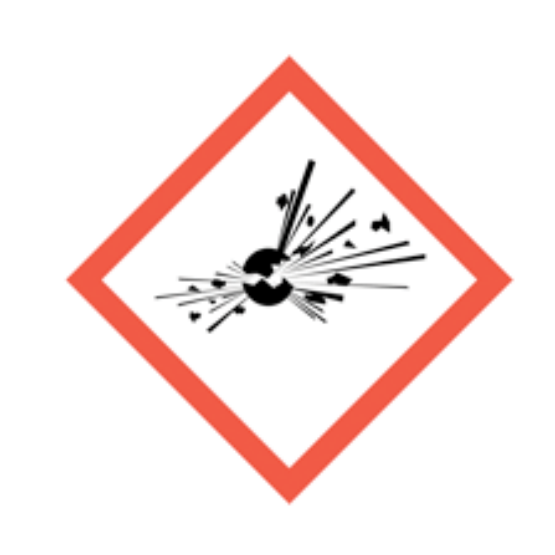
Exploding bomb
Explosive, self-reactive or organic peroxide hazards.
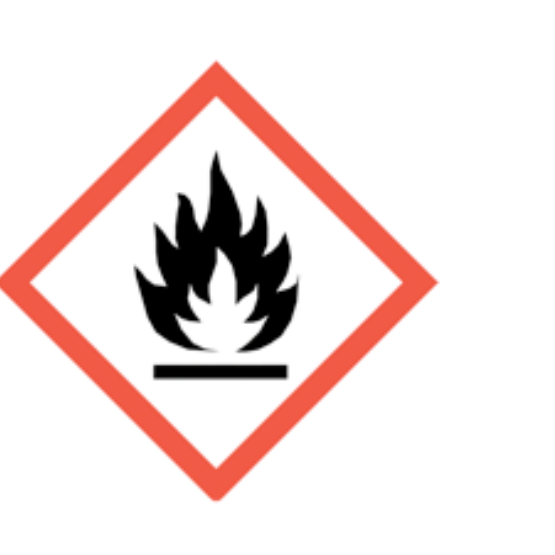
Flame
Flammable, self-heating or pyrophoric substances.
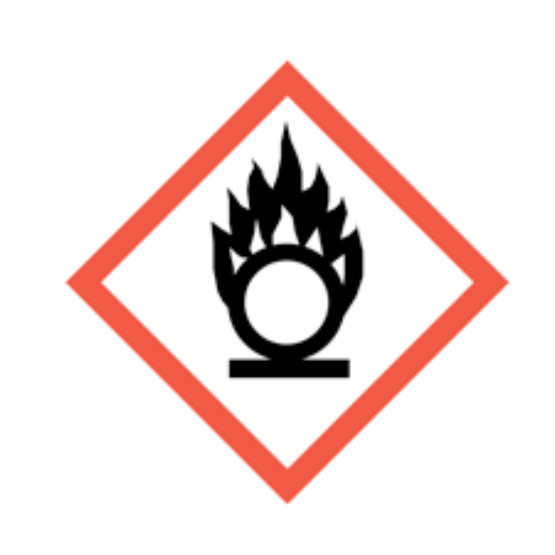
Flame over circle
Oxidising substances that can intensify fire.
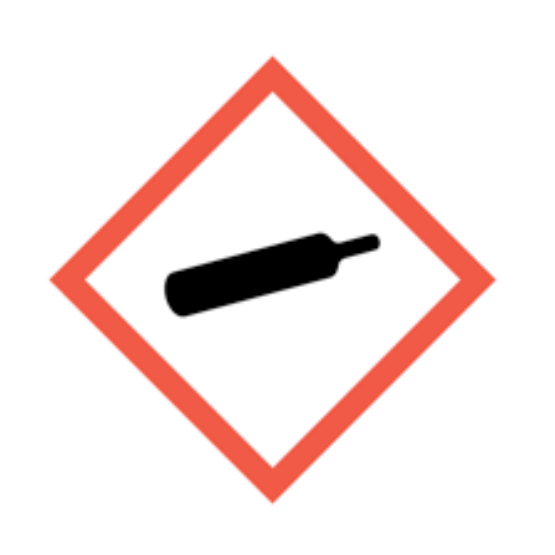
Gas cylinder
Gas under pressure.
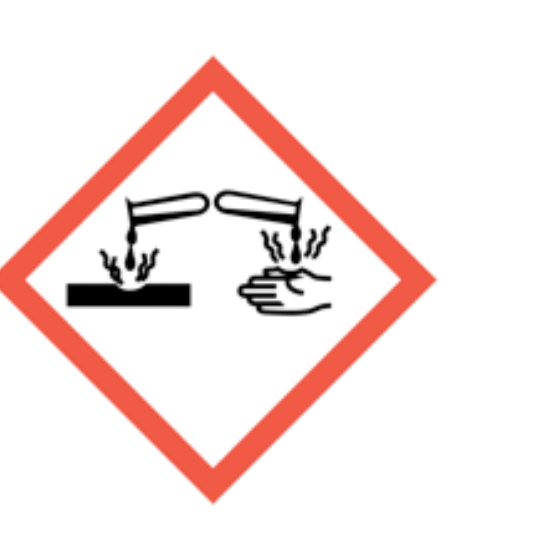
Corrosion
Skin burns, eye damage or corrosive to metals.
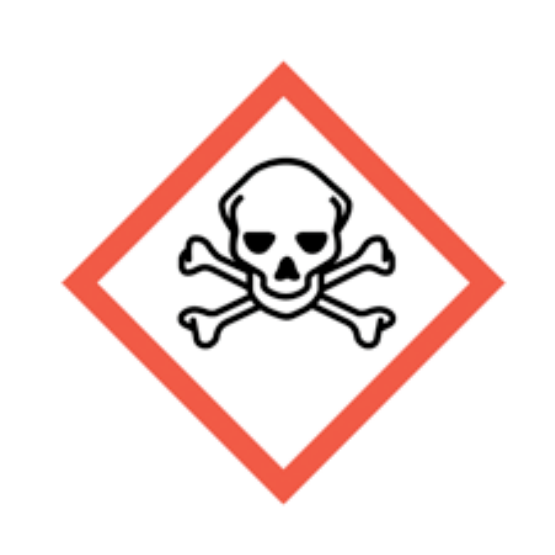
Skull and crossbones
Acute toxicity.
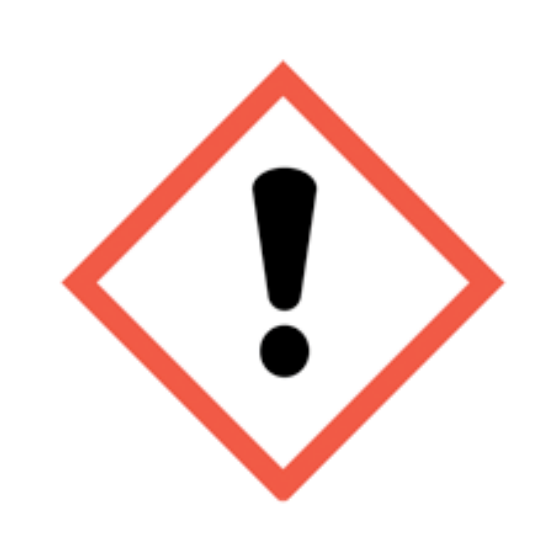
Exclamation mark
Irritation, harmful effects or skin sensitisation; some classifications cover drowsiness, dizziness or ozone-layer hazard. Read the actual hazard statements. Skin sensitisation differs from respiratory sensitisation.
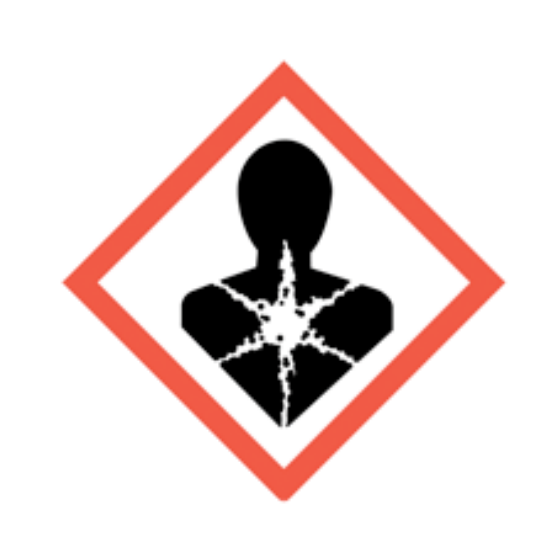
Health hazard
Serious health hazards, including organ damage, aspiration hazard, respiratory sensitisation, cancer and reproductive effects; some can follow a single exposure.
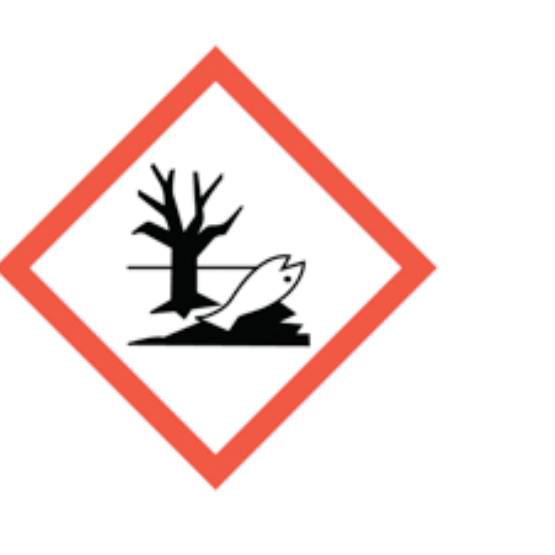
Environment
Hazardous to the aquatic environment.
What do the acronyms and key terms mean?
Acronyms should be explained so formaldehyde controls are understood by workers, supervisors and managers.
| Acronym | Meaning | Plain-English use |
|---|---|---|
| COSHH | Control of Substances Hazardous to Health | UK hazardous substance framework. |
| SDS | Safety Data Sheet | Supplier hazard and control information. |
| WEL | Workplace Exposure Limit | Exposure limit in EH40 where applicable. |
| LEV | Local Exhaust Ventilation | Extraction system controlling vapour or airborne contaminant. |
| OH | Occupational Health | Competent health advice and surveillance support. |
Unlock another resource
You have used this month’s two free downloads. Publish a post in your own words to unlock one more resource, or choose SHARE Individual for 10 downloads per month.
You decide whether to share. If you do, use the relevant platform disclosure tools and do not make claims you do not genuinely hold.