SHARE Knowledge Hub
Improving Construction Health and Safety Culture and Assessing Risk
Construction safety culture shapes whether workers can report changing site risks and whether leaders act before controls fail. Risk assessment connects those signals to the actual task, phase, people and exposure route. Poor planning can leave falls, collapse, plant movement or dust exposure uncontrolled, so GB and Northern Ireland dutyholders must verify safeguards as work changes.
Understanding Improving Construction Health and Safety Culture and Assessing Risk
Construction safety culture shapes whether workers can report changing site risks and whether leaders act before controls fail. Risk assessment connects those signals to the actual task, phase, people and exposure route. Poor planning can leave falls, collapse, plant movement or dust exposure uncontrolled, so GB and Northern Ireland dutyholders must verify safeguards as work changes.
Why this matters at work
Falls from height may result from an unprotected edge, incomplete scaffold, fragile roof, floor opening or unsuitable access. The event route is loss of support or balance followed by uncontrolled descent and impact; injuries include fatal head injury, spinal damage and fractures. Remove work at height through design where possible, use collective protection and inspected access, prevent access to fragile surfaces, select residual personal protection only in a planned system and prepare rescue that reaches a suspended person promptly.
Harm routes include fall from an edge or through a fragile surface; collapse and burial; struck-by moving plant or falling material; electric contact or arc; toxic or oxygen-deficient atmosphere; inhalation of dust or fume; skin contact; noise, vibration or repeated manual handling; heat, cold and fatigue; and psychological harm following violence or traumatic events. Outcomes may be immediate death, amputation, fracture or burn, or delayed silicosis, asthma, hearing loss, dermatitis, musculoskeletal disorder or stress-related ill health.
How organisations manage this in practice
CDM arrangements must lead to controls that work at the construction site and during later maintenance, not simply correct role names. The client provides useful information and resources; designers change inherent risk; the principal designer coordinates design risk; the principal contractor coordinates field conditions; contractors control their work; and workers contribute knowledge, report problems and cooperate. The same hazard can have controls at several points in this chain.
The temporary works register should show item, category, designer and checker, design brief, information required, inspection points, permit to load or strike, outstanding changes and status. Coordination must include lifting operations, plant routes, excavation edges, adjacent structures, utilities and emergency access. A principal contractor may use specialist contractors, but must still plan, manage, monitor and coordinate the system.
Review when there is reason to doubt validity or a significant change, such as newly discovered services, unstable ground, changed access, a substituted material or a different lifting sequence. Inspect the workface and identify what the change does to each important control. A scheduled review date is useful administration but cannot justify continuing with an invalid method. A daily briefing can confirm conditions; it does not automatically amount to a complete reassessment. Record the altered assumptions, interim restriction, responsible reviewer and the revised control. Coordinate with other contractors and relevant designers, update affected plans and brief the people who use them. Check that obsolete copies have been withdrawn at the point of work. A stop-and-replan decision should be supported by management so that identifying a change is not treated as poor productivity.
How can I practise this topic in 3D?
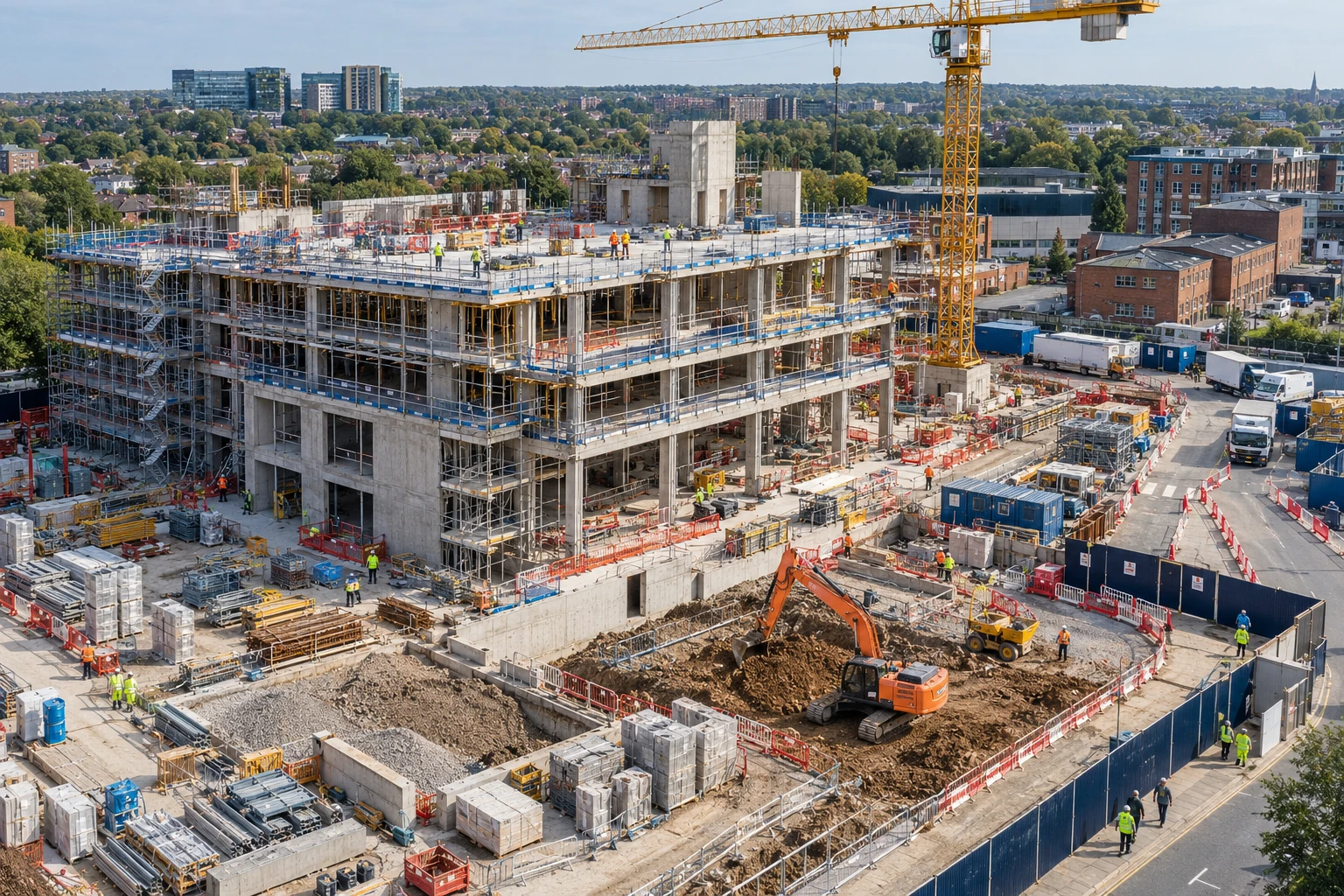

The risk assessment misses people and real controls
All related inspection points 1 across 1 location
Construction site 1 inspection point
Practice in the SHAREhub environment. Browser practice is separate from workplace competence and formal learning records.
What are the key facts for construction learners?
Construction risk assessment is dynamic because sites, people and work conditions keep changing.
Culture is visible on site
It appears in supervision, housekeeping, stop-work decisions, contractor behaviour and response to concerns.
Risk assessment must match work as done
Generic risk assessments and method statements (RAMS) do not prove control unless the site team can apply them.
Human factors explain real behaviour
Time pressure, access, weather, fatigue, competence and poor communication shape choices.
Risk profiling sets priorities
High-consequence, high-frequency or complex activities need stronger planning and assurance.
Evidence matters
Registers, inspections, briefings, permits, photos, observations and close-out records show whether controls work.
How does this map to CN1 Element 2?
Qualification references matter when they lead to observable site decisions, named owners and checks at the workface.
- CN1-02.1 — Health and safety culture. What culture means, how it affects performance and how peer influence changes behaviour.
- CN1-02.2 — Human factors and behaviour. Organisational, job and individual factors and how they combine on site.
- CN1-02.3 — Improving health and safety culture. Leadership, competence, communication, consultation, participation and committees.
- CN1-02.4 — Assessing risk. Hazards, risk profiling, suitable and sufficient assessment, controls, significant findings and review.
Qualification navigation and scope
CN1-02.1–02.4 are this SHAREhub environment page’s navigation labels for study themes, not a claim that these are official assessment criterion numbers. Check the qualification guide/version and registration route with your learning partner. The linked v1.1 guide is the stated reference; this editorial repair does not certify every syllabus mapping. For general organisational culture use the separate Improving Health and Safety Culture guide; this page concentrates on construction workface decisions.
Why must culture and risk assessment be linked?
A risk assessment can look good on paper and still fail if the culture does not support it.
Construction work is full of changing interfaces: trades overlap, access routes move, materials arrive, weather changes, temporary works are altered and contractors come and go. A healthy culture makes people pause, communicate and re-check controls when the plan no longer matches the site.
A weak culture treats RAMS as paperwork for access to site. A strong culture treats RAMS as a live control that should be briefed, challenged, observed and reviewed.
- Stop-work confidence — Workers pause when conditions change. Scaffold access altered after high wind.
- Worker involvement — Controls reflect work as done. Groundworkers identify buried-service drawing mismatch.
- Leadership commitment — High-risk actions get resources. Dust extraction provided rather than dry cutting.
- Fair reporting — Near misses reveal weak controls. Falling-object near miss leads to exclusion redesign.
- Supervisor quality — Controls are checked in the field. Lift plan reviewed before actual lift.
How do human factors affect construction risk?
Human factors explain why people behave differently from the written plan.
Organisational factors include programme pressure, coordination, procurement, resources and leadership. Job factors include access, weather, noise, plant interface, manual handling, dust, work at height and complexity. Individual factors include competence, fatigue, language, experience, confidence and risk perception.
Good construction management designs work so safe behaviour is the easiest normal behaviour.
- Programme pressure — Trades overlap and controls are skipped. Re-sequence, coordinate and protect hold points.
- Poor access — Workers climb or improvise. Provide planned access and inspect it.
- Language or literacy — Briefing not understood. Use visuals, demonstrations and checks for understanding.
- Fatigue — Long shifts reduce attention. Plan work-rest and avoid safety-critical tasks late.
- Contractor interface — Different rules and assumptions. Induction, bridging rules and supervisor coordination.
How do weak culture and poor risk assessment lead to harm?
The management failure is not the physical hazard. It permits a source of energy or exposure to reach people because the control was never selected, was removed or stopped working.
On a roof, an unplanned access change can expose a worker or contractor to an unguarded edge; a fall may cause immediate fatal or life-changing injury. At a traffic interface, a reversing vehicle can strike a pedestrian when segregation is changed without consultation. Dry cutting can release respirable crystalline silica into the breathing zone, with serious lung disease developing over time. Early warnings include missing edge protection, repeated route near misses, dust outside extraction, rushed briefings and workers saying the method no longer fits the site.
Stop the affected work when a critical safeguard is absent or conditions differ from the assessment. The supervisor should secure the area, consult the people doing the work, revise the method with the competent dutyholder and verify the physical control before hand-back.
How should construction risks be profiled?
Risk profiling helps decide where the strongest controls and assurance are needed.
A construction risk profile should look at serious harm potential, frequency of exposure, number of people affected, complexity, change, contractor interface, public interface, health risk and emergency difficulty. It should not rely only on a simple likelihood x severity score.
High-consequence low-frequency risks, such as collapse, electrocution, confined-space rescue or asbestos disturbance, need serious attention even if they are rare.
- Consequence — Fatal and major injury risks need robust controls. For example: Falls, lifting, collapse, electricity.
- Exposure — Frequent tasks create cumulative risk. For example: Repeated cutting, manual handling or vehicle interface.
- Change — Construction controls degrade when site conditions change. For example: Excavation depth, weather, access or sequencing change.
- Interface — Multiple trades create conflict. For example: Hot work near flammable materials or lifting over others.
- Health latency — Dust, noise and vibration harm may be delayed. For example: Silica, hand-arm vibration syndrome (HAVS), noise exposure and dermatitis.
Which construction examples should learners be able to apply?
Good construction risk assessment shows how culture affects real high-risk work.
Construction culture is visible in the control of ordinary high-risk work. A good site does not simply issue RAMS and hope. It checks whether the work has changed, whether contractors understand the method, whether controls are in place, and whether supervisors have the authority to stop and re-plan.
These examples are useful for learners because they show how risk assessment, culture, human factors and CDM planning combine at the workface.
| Activity | What could kill or seriously harm someone | Culture and risk-assessment focus |
|---|---|---|
| Work at height | Falls through fragile surfaces, open edges or incomplete access. | Design access properly, inspect edge protection and support stop-work after change. |
| Excavation | Collapse, buried-service strike, plant interface, water ingress or failed rescue. | Use HSG47-style planning and competent service locating for buried services. Separately design collapse prevention and support. Where inspection duties apply, a competent person checks at the start of each working shift and after events affecting stability or a fall of material. |
| Lifting operations | Dropped load, crane overturn, exclusion failure or poor communication. | Use lift plans, competent people, exclusion, ground checks and no improvisation. |
| Temporary works | Collapse from unauthorised change or poor coordination. | Use temporary works design, permit/control points and change control. |
| Traffic management | Pedestrian strike, reversing incident or public interface. | Separate routes physically and verify during each phase. |
| Construction dust | Silica, wood dust, cement dust or plasterboard dust exposure. | Use elimination, wet methods, LEV, RPE fit testing and health surveillance where needed. |
| Hot work | Ignition of combustible materials or hidden void fire. | Use permit controls, fire watch, isolation, handback and emergency readiness. |
| Contractor interface | Conflicting standards, SIMOPS or unclear supervision. | Use bridging rules, induction, coordination and field verification. |
What does suitable and sufficient risk assessment look like?
A suitable assessment identifies significant hazards and produces controls people can implement and check.
For construction, the assessment should connect drawings, surveys, site conditions, temporary works, competence, plant, materials, public interface, emergency arrangements and changing work stages. It should also say who owns the action and what evidence proves completion. See HSE steps to manage risk.
A method statement that lists hazards but does not explain sequencing, access, exclusion, supervision and stop-work triggers is unlikely to be enough for higher-risk work.
- Hazard identification — Specific to task, location and phase. Weak practice: generic 'working at height' line only.
- People at risk — Workers, contractors, visitors, public and vulnerable groups considered. Weak practice: only direct employees listed.
- Existing controls — Controls are described and assigned. Weak practice: use personal protective equipment (PPE) only.
- Further actions — Actions have owners, dates and verification. Weak practice: action says 'be careful'.
- Review — Triggered by change, incident, inspection or new information. Weak practice: annual review only.
What is the difference between good and poor RAMS?
RAMS only add value when they are specific, briefed, supervised and reviewed after change.
Poor RAMS are copied between jobs, name generic hazards, rely on PPE, and do not explain the real sequence of work. Good RAMS are tied to site conditions, drawings, surveys, plant, access, competence, interfaces, emergency arrangements and hold points.
The practical test is simple: can the supervisor and workers explain what could seriously harm them today, what control must not fail, what has changed, and who can stop the job?
- Site specificity — Weak practice: copied from a previous job with names changed. Better practice: uses current drawings, surveys, location, phase and access constraints.
- Control detail — Weak practice: says wear PPE or take care. Better practice: defines physical controls, sequencing, exclusion, supervision and rescue.
- Worker understanding — Weak practice: briefing is signature-only. Better practice: workers can explain the method and challenge gaps.
- Supervisor ownership — Weak practice: owned by the office or subcontractor administrator. Better practice: supervisor verifies controls before and during work.
- Change — Weak practice: no update when weather, layout, plant or people change. Better practice: stop-work and review triggers are clear.
- Evidence — Weak practice: a document exists in the folder. Better practice: photos, permits, inspections and action close-out show work as done.
How should a fragile-roof task be controlled?
For fragile-roof inspection, first avoid roof access if a safe remote method can achieve the task. If access is necessary, use a competent design for collective protection and verify it before work starts; a permit or briefing cannot replace the physical safeguards.
For fragile-roof work, first ask whether the task can be done from the ground. Use the five-level order: elimination, genuine substitution, engineering controls, administrative controls and PPE. Brief access still requires effective precautions. Prevent falling through the fragile surface as well as over its outer edge; reducing duration is an administrative measure. Control residual work through access planning, inspection, permit or supervision where relevant. PPE protects only against remaining risk and needs rescue arrangements if fall-arrest equipment is used. Discipline means competent briefings, challenge and verified checks that keep the earlier controls working.
| Control priority | Task-specific option and feasibility | Owner, verification, failure and stop point |
|---|---|---|
| Elimination | Inspect from ground level, drone or safe internal access if the inspection purpose can be met. | Designer/principal contractor validates coverage; stop if the method misses a critical defect. |
| Substitution | No separate substitution is assumed where fragile-roof access remains essential. Assess a genuinely less hazardous method if one exists; shorter exposure alone is an administrative measure and never removes the need for effective fall protection. | Planner assesses loading and access; reject a change that transfers fall risk to another worker. |
| Engineering | Use a designed platform or protection that prevents a fall through the fragile surface, with separate outer-edge protection where required. Safety netting is collective fall arrest, not fall prevention; select and verify it within the competent design. | Competent installer signs off and inspects before use; stop for damaged or altered protection. |
| Administrative | Use a task method, weather limits, permit/authorisation and rescue plan; consult those doing the work. | Supervisor checks conditions each shift; suspend for weather, scope or access change. |
| Personal protection | Harness equipment is residual protection only where a suitable anchor and rescue plan exist. | Competent user checks gear and anchor before use; stop for absent rescue capability. |
These are illustrative controls for the stated task, to be selected and verified by a competent local dutyholder. HSE - Fragile roofs supports the topic-specific risk route; the exact engineering design and stop decision require site approval.
What should supervisors ask before work starts?
Good supervisors use simple questions to test whether the plan still matches the site.
The best supervisor prompts are short, practical and repeated. They should be used at pre-start briefings, after breaks, after weather changes, when a new contractor arrives, before a lift, before excavation, before hot work and whenever the method no longer matches the condition on site.
These questions are also useful for auditors because they reveal whether the assessment is alive or simply filed.
- What has changed today? — Construction risk changes with weather, sequence, access, plant, deliveries and other trades. Update briefing, permit or RAMS before work continues.
- Who is new or unfamiliar with this task? — New starters, visitors and contractors may not know site-specific controls. Induction, buddying or additional supervision.
- What could kill or seriously harm someone? — Keeps focus on high-consequence controls, not minor paperwork. Check critical controls are present.
- What control must not fail? — Identifies the barrier that needs verification. Inspect scaffold, excavation support, isolation or exclusion zone.
- What do we do if the plan no longer fits? — Gives permission to stop and escalate. Stop-work route and named decision-maker.
- How will we know the job is safe to restart? — Prevents informal restart after a pause. Verification record and supervisor sign-off.
What site evidence should supervisors look for?
Supervisors should check whether controls exist at the point of risk, not just in the folder.
- Work at height — Inspected scaffold, edge protection and rescue plan. Check competent inspection, records, condition and access control. A missing tag is a local hold point where the site requires tags; it alone proves neither unsafe condition nor a breach. A green tag alone does not prove safety. Altered access needs reassessment.
- Excavation — Permit, service drawings, CAT scan, trench support and edge protection. Weak practice: people entering unsupported trench.
- Dust — Water suppression, extraction, respiratory protective equipment (RPE) fit testing and cleaning method. Weak practice: visible dust cloud.
- Plant — Segregation, banksman controls and traffic route. Weak practice: pedestrians walking through plant route.
- Consultation — Worker feedback changed the plan. Weak practice: briefing attendance only.
Changed services or ground: hold and reassess
Drawings and CAT/Genny results can be incomplete and require competent interpretation. Retain the existing trial-hole and escalation sequence. A changed spoil heap, delivery route, uncertain service or affected trench support is a hold point: identify the changed condition, exclude exposure, obtain the separate service-location and stability decisions, and record who authorises restart.
How does this work in a construction scenario?
A scenario brings culture, human factors and risk assessment together.
A groundworks team is asked to extend an excavation near a site entrance. Drawings show several services, but the CAT and Genny scan was done two days earlier before spoil and materials were moved. The permit to dig is still open, the supervisor is busy with a concrete pour, and the excavator driver is under pressure to finish before a delivery arrives.
In a weak culture, the team carries on because the permit exists. In a stronger culture, the supervisor asks what has changed, stops mechanical excavation, checks the service information, repeats locating, confirms trial holes, refreshes the briefing, controls plant/pedestrian interface and only restarts once the permit and controls match the work as done.
- Culture — Weak practice: carry on because a permit exists. Better practice: stop and re-check because site conditions changed. Evidence to retain: Stop-work record and revised permit.
- Human factors — Weak practice: blame the operative if a strike occurs. Better practice: review pressure, supervision, interface, visibility and permit usability. Evidence to retain: Worker interview and supervisor review.
- Risk assessment — Weak practice: rely on old scan and generic RAMS. Better practice: update RAMS and permit after repeat locating and trial holes. Evidence to retain: Revised RAMS, marked services and briefing.
- Control — Weak practice: use mechanical excavation close to suspected services. Better practice: use safe digging, exclusion, banksman and service-owner escalation where needed. Evidence to retain: Inspection photos and permit checks.
- Learning — Weak practice: tell the team to be more careful next time. Better practice: update permit-to-dig triggers and delivery coordination. Evidence to retain: Action tracker and audit.
Excavation beside live services
Task, material and setting: An extension to an excavation at a busy construction entrance, with buried services and moving plant.
People and prerequisites: The supervisor checks current drawings, competent locator, permit owner, exclusion and the people who may be exposed.
Before: Review service information and current site layout; repeat the scan because conditions changed after the earlier check.
During: Locate and mark services, expose by safe trial holes, refresh the task briefing and keep plant and pedestrians apart.
Hold or stop: Stop mechanical digging if a service cannot be located, the permit no longer matches, or exclusion fails.
Completion and hand back: The supervisor signs the revised permit and hands the marked service plan and controls to the next shift.
Evidence: Keep the dated scan, marked drawing, trial-hole record, revised RAMS, permit and briefing acknowledgement.
How should consultation and participation work on site?
Construction consultation must reach people doing the work, not only managers in planning meetings.
Useful consultation includes pre-start briefings, task walkdowns, supervisor conversations, safety representatives, subcontractor coordination meetings and feedback routes. It should be practical for language, literacy, shift and contractor arrangements.
Worker participation is strongest when workers can influence the method before the task starts and see that concerns lead to change.
- Pre-start briefing — Check method and worker questions before work starts. Evidence to retain: Briefing record and questions raised.
- Task walkdown — Test the method against real conditions. Evidence to retain: Walkdown findings and revised controls.
- Subcontractor coordination — Control interfaces and simultaneous operations (SIMOPS). Evidence to retain: Coordination minutes and permits.
- Safety representative input — Worker voice and inspections. Evidence to retain: Inspection reports and action tracker.
- Close-call reporting — Capture weak signals. Evidence to retain: Trend review and feedback loop.
How should contractor culture and rules be managed?
Contractor management is culture in action because site standards are tested through supply-chain behaviour.
Principal contractors should set clear site rules, prequalify contractors, check competence, align RAMS with site arrangements, brief interface risks and supervise work as done. A bridging document can help align contractor health, safety, security and environment (HSSE) standards with the site's expectations.
Do not assume a subcontractor's paperwork means the work is controlled. Observe the task and check the controls.
- Prequalification — Checks capability, competence and risk history. Evidence to retain: Approved contractor record.
- Bridging rules — Explains site standards, permits, stop-work and reporting. Evidence to retain: Contractor rules document.
- RAMS review — Method fits site conditions and interfaces. Evidence to retain: Reviewed RAMS and comments.
- Induction — Contractor understands site risks and reporting. Evidence to retain: Induction record and questions.
- Oversight — Supervisor checks work as done. Evidence to retain: Observation and action close-out.
What registers and trackers support this topic?
A construction operating system needs records that show risks are known, controlled and reviewed.
Records should prove that controls were selected, implemented, checked and improved. The table helps distinguish useful evidence from records that exist only because someone expected a document.
- Risk assessment register — Shows significant construction risks and review status. Design change, incident or new phase.
- Action tracker — Tracks controls, owners and verification. Overdue high-risk action.
- Training and competence matrix — Shows role-specific competence. New contractor, task or equipment.
- Inspection register — Shows work as done is checked. Repeat defect or trend.
- Permit register — Controls high-risk activities. SIMOPS or permit audit finding.
- Consultation log — Shows worker participation and feedback. Repeated concern or method change.
Which GB and Northern Ireland duties govern construction risk?
Construction duties use CDM 2015 in Great Britain and the CDM (NI) 2016 route in Northern Ireland. Both require planned and coordinated risk control, but the instruments and dutyholder details must be checked for the actual project.
| Jurisdiction | Duty route | Practical evidence |
|---|---|---|
| Great Britain | CDM 2015 and Management Regulations 1999. | Construction phase planning, task risk assessment, coordinated contractors, worker consultation and control checks. Official text and guidance: Construction (Design and Management) Regulations 2015; Management of Health and Safety at Work Regulations 1999 |
| Northern Ireland | CDM (NI) 2016 and Management Regulations (NI) 2000. | NI project roles, risk assessment, information exchange, consultation and supervision records. Official text and guidance: HSENI CDM (NI) 2016; Management of Health and Safety at Work Regulations (NI) 2000 |
General duties and specific work-at-height, lifting, asbestos or hazardous-substance requirements may also apply. Use the relevant regulator and competent site advice for the actual task; a RAMS form alone does not discharge a duty.
How could BuildOut Ltd manage this in practice?

BuildOut Ltd would manage CN1-02 by treating culture and risk assessment as one live construction control system.
BuildOut Ltd is a construction contractor. It runs refurbishment, civils and fit-out projects with subcontractors, plant, temporary works, dust, work at height and public interfaces. For BuildOut, culture is visible in whether site teams stop, challenge, consult and update controls when work changes.
- Assessing — BuildOut profiles each project by high-risk activities, health exposures, contractor interfaces and public risks. Project risk profile and pre-construction information review.
- Planning — RAMS, CPP, permits, welfare, emergency arrangements and inspection plans are aligned before mobilisation. Construction phase plan and risk assessment register.
- Implementing — Supervisors run pre-start briefings and walkdowns before high-risk tasks. Briefing records and field verification.
- Consulting — Worker and subcontractor feedback is used to update methods, not simply filed. Consultation log and revised RAMS.
- Checking — First-line supervisors verify controls; the company safety team audits trends; specialists review high-risk systems. Three-lines assurance plan.
- Learning — Incidents and close calls are reviewed for culture, human factors and risk-assessment weaknesses. HSG245-style reports and management review.
What should each construction role learn and demonstrate?
Role-specific competence is shown by decisions and work under changing conditions, not a course attendance record alone.
On a changing roof job, a worker must recognise an unverified fragile surface and use the stop route; a supervisor must compare the assessment with the surface, access equipment and people actually present. The construction manager tests that design and contractor decisions are coordinated, and the adviser samples the recorded hold and restart. Reassess after a layout change, near miss or new contractor, with an observed task and a signed decision as evidence. HSE fragile-roof guidance explains why assumptions about appearance are unsafe.
| Role and learning | Demonstration and assessor | Record and reassessment trigger |
|---|---|---|
| Worker or contractor: site hazards, method, exclusion and stop conditions. | Supervisor observes pre-start checks and a changed-condition challenge. | Induction and task observation; repeat after phase or method change. |
| Supervisor: review RAMS, coordinate trades and hold unsafe work. | Competent manager samples a live workface and restart decision. | Briefing, field and permit records; revisit after near miss or defect. |
| Principal contractor or manager: sequence, resources, interfaces and consultation. | Senior reviewer tests plan against actual site risk and worker feedback. | Construction phase plan and action review; reassess after design or contractor change. |
| Designer, purchaser or specialist: eliminate foreseeable risk and specify suitable systems. | Technical peer checks design assumptions and residual information. | Design risk record and specification; revisit after new information. |
| Safety adviser or auditor: jurisdiction, sampling and critical-control assurance. | Peer review traces a finding to site evidence and verified closure. | Audit trail; refresh after legal or method change. |
How should management check and improve these controls?
HSE’s Plan, Do, Check, Act approach helps an organisation plan controls, put them into use, check performance and correct failures. It is management guidance, not a substitute for the GB or Northern Ireland legal duties that apply to the task.
Link design risk decisions, workface conditions and worker challenge to the current construction assessment. Verify that a changed site method is reviewed before work resumes. HSE management guidance
How should learners use this for NEBOSH Construction?
construction-safety scenario answers should combine culture, human factors, risk assessment and evidence.
- Improve site culture — Better practice: leadership, consultation, fair discipline, competence, communication and action close-out. Weak practice: put posters up.
- Assess risk from dry cutting — Better practice: hazard, people, silica exposure, controls, hierarchy, health surveillance and review. Weak practice: wear masks.
- Explain human factors — Better practice: organisational, job and individual factors with site examples. Weak practice: workers make mistakes.
- Use risk profiling — Better practice: consequence, exposure, change, interface and health latency. Weak practice: high/medium/low only.
- Show evidence — Better practice: field checks, registers, photos, permits, briefings and verified actions. Weak practice: RAMS in folder.
What warning signs show weak culture or poor risk assessment?
Warning signs should trigger review before harm occurs.
A changed workface, fragile surface, missing edge control or worker challenge should pause the affected construction task. The site lead revisits the plan with the people doing the work, names the corrective owner and checks the physical control before release.
- RAMS are generic — Risk assessment may not match site conditions. Review with supervisors and workers.
- Workers cannot explain controls — Briefing may be poor. Re-brief and demonstrate controls.
- Controls missing at workface — Paperwork is not implemented. Stop and re-plan.
- Actions repeatedly overdue — Management commitment may be weak. Escalate and resource close-out.
- Near misses not reported — Trust or reporting route is weak. Simplify reporting and feedback learning.
What do the acronyms and key terms mean?
These terms distinguish the site plan, task assessment and control decision.
| Term | Full form | Meaning here |
|---|---|---|
| CDM | Construction (Design and Management) | Separate GB 2015 and NI 2016 project-duty regimes. |
| RAMS | Risk assessments and method statements | Task documents that must match work as done. |
| PPE | Personal protective equipment | Residual protection after stronger controls. |
| Workface | Site term | Where the actual task and its controls can be observed. |
| CN1-02 | CN1 Element 2 | Culture, human factors and assessing risk learning outcomes. |
| HSE | Health and Safety Executive | Great Britain safety regulator. |
| HSENI | Health and Safety Executive for Northern Ireland | Northern Ireland safety regulator. |
| CPP | Construction phase plan | Project arrangements under the applicable CDM regime. |
| CAT/Genny | Cable avoidance tool and signal generator | Service-location equipment; verify its limits and use. |
| LEV | Local exhaust ventilation | Engineered extraction at the source. |
| RPE | Respiratory protective equipment | Residual inhalation protection requiring suitability and fit. |
| SIMOPS | Simultaneous operations | Interacting work activities needing coordination. |
| HAVS | Hand-arm vibration syndrome | Health outcome from vibration exposure. |
| HSSE | Health, safety, security and environment | Company assurance and learning function. |
Unlock another resource
You have used this month’s two free downloads. Publish a post in your own words to unlock one more resource, or choose SHARE Individual for 10 downloads per month.
You decide whether to share. If you do, use the relevant platform disclosure tools and do not make claims you do not genuinely hold.