
SHARE Knowledge Hub
Ladder Safety
Ladder safety is the choice and controlled use of portable ladders and stepladders for work at height. A slip, tip, collapse or overreach can cause a worker to fall, while dropped tools can strike people below. A ladder is appropriate only when the task risk assessment justifies it and the equipment, ground, support, securing and user are suitable.
Understanding Ladder Safety
Ladder safety is the choice and controlled use of portable ladders and stepladders for work at height. A slip, tip, collapse or overreach can cause a worker to fall, while dropped tools can strike people below. A ladder is appropriate only when the task risk assessment justifies it and the equipment, ground, support, securing and user are suitable.
Why this matters at work
Work at height means work in any place, including at or below ground level, where a person could fall a distance liable to cause personal injury if precautions were absent. There is no general two-metre trigger. Access and egress while at work are included, except access or egress by a staircase in a permanent workplace. Ladder ascent and descent are therefore part of the planned activity.
A fall inside a hoop can still cause impact with the cage and serious injury. The hoop can also interfere with some personal fall-arrest equipment, including certain inertia-reel arrangements. Do not assume that installing a rail, cable, harness or retractable device inside an existing cage creates a compatible system.
How organisations manage this in practice
Management review should decide whether recurring ladder tasks need design change, platforms, permanent access, different procurement, improved storage or more supervision. Resource the action and verify effectiveness in real work. Refresh official HSE sources, product alerts and legal links at least annually and after a relevant update.
Control issue so the user receives the right ladder and compatible accessories. Shared fleets need a method to prevent unauthorised removal, use before inspection or return to the wrong location. Site-owned and contractor-owned ladders should be distinguishable, while both remain subject to the agreed site rules and condition checks.
Competence combines training, practical and theoretical knowledge, and experience appropriate to the task. A person using a short stepladder in a controlled office needs different depth from a roof worker, ladder inspector, supervisor or designer of a fixed fall-protection system. Training should match the equipment, environment and decisions the person is authorised to make.
This source covers the selection, provision, inspection and use of ladders and stepladders for work in Great Britain. It addresses portable leaning ladders, extension and combination ladders, telescopic ladders, stepladders, fixed ladders, roof ladders and ladder access. It is written for employers, people controlling work, managers, supervisors, users, inspectors, procurement teams and contractors.
How can I practise this topic in 3D?


A rooflight is mistaken for a safe walking surface
All related inspection points 2 across 1 location
Construction site 2 inspection points
Practice in the SHAREhub environment. Browser practice is separate from workplace competence and formal learning records.
What makes ladder work safe or unsafe?
A ladder is a temporary means of access and sometimes a place for light, brief work. It does not prevent a fall. Safety depends on choosing it for the actual task, supporting and securing it, checking its condition and stopping when conditions change.
Best-practice guide: Ladder Safety

What makes ladder work safe or unsafe?
A ladder is a temporary means of access and sometimes a place for light, brief work. It does not prevent a fall. Ladder safety is the choice and controlled use of portable ladders and stepladders for work at height.
Turn ladder safety knowledge into a decision
Ladder safety is the choice and controlled use of portable ladders and stepladders for work at height. A slip, tip, collapse or overreach can cause a worker to fall, while dropped tools can strike people below. keep the task/access decision where the site system requires it and record any defect, revised method, contractor interface or incident.
the site team warehouse sign inspection
face the task, keep the body within the stepladder, retain a handhold and make only the agreed light adjustment. The second worker keeps people clear and watches for changes in the route. descend facing the ladder, check no tool or material remains above, remove barriers only after the aisle is safe, and store the ladder correctly.
Ladder harm mechanisms and stop signs
Exposure route 1: Leaning ladder slips at feet or support; worker falls to a hard floor or structure. Exposure route 2: Stepladder tips during side reach or forceful work; worker falls sideways. Tool or material falls from ladder onto someone below.: Impact injury, including head injury.
Choose controls for ladder safety
Eliminate: Read the sign or clean the high point from ground level with a suitable tool, or lower a removable item for service; this removes the climb. Reduce: For repeated overhead maintenance, choose a guarded platform, tower or MEWP instead of a leaning ladder where space, ground and rescue arrangements permit. Isolate: Physically separate the access footprint from pedestrians and vehicles with a stable barrier, while retaining fire egress; a sign alone is not a barrier. Control: Where a ladder is justified for a low-risk short task, use firm level ground, sound feet and locks, and effective tying or stabilisation; sequence tools to preserve grip and avoid overreach. PPE: Wear task-suitable footwear and assessed head protection for residual impacts; a harness is not a generic substitute for ladder stability or a complete rescue plan. Read the full control table for qualifications, ownership and verification. Use the actual task and applicable jurisdiction; existing technical approval remains unchanged.
Use the full ladder safety lesson
Use the full topic for the decision points, practical examples, detailed control tables and source scope. HSE guidance applies to Great Britain; use HSENI for the Northern Ireland route and the source’s stated jurisdiction. A simplified guide does not change the page’s technical-review or approval status.
Read all six steps as text
1. What makes ladder work safe or unsafe?
A ladder is a temporary means of access and sometimes a place for light, brief work.
- Avoid / redesign: Read the sign or clean the high point from ground level with a suitable tool, or lower a removable item for service; this removes the climb.
- Control the task: Physically separate the access footprint from pedestrians and vehicles with a stable barrier, while retaining fire egress; a sign alone is not a barrier.
- Verify before release: HSE guidance
A ladder is a temporary means of access and sometimes a place for light, brief work. It does not prevent a fall. Ladder safety is the choice and controlled use of portable ladders and stepladders for work at height.
Apply it: Which part of this plan would you check at the workface before authorising the task?
2. Turn ladder safety knowledge into a decision
Use the evidence to improve the actual work arrangement.
- Change at source: Read the sign or clean the high point from ground level with a suitable tool, or lower a removable item for service; this removes the climb.
- Make it observable: HSE guidance
- Keep useful evidence: keep the task/access decision where the site system requires it and record any defect, revised method, contractor interface or incident.
Ladder safety is the choice and controlled use of portable ladders and stepladders for work at height. A slip, tip, collapse or overreach can cause a worker to fall, while dropped tools can strike people below. keep the task/access decision where the site system requires it and record any defect, revised method, contractor interface or incident.
Apply it: What evidence would show that the change improves this task, rather than only completing a record?
3. the site team warehouse sign inspection
Example: a practical application of the existing topic lesson.
- Setting: a competent facilities worker must read the fixing label on a high internal sign and make a light adjustment, then hand the aisle back for normal use.
- Act: isolate or segregate the aisle without blocking a fire exit.
- Hold / review: if the fixing is seized, the worker must reach sideways, the floor becomes wet, a vehicle is diverted nearby or a foot or lock moves, descend and stop.
face the task, keep the body within the stepladder, retain a handhold and make only the agreed light adjustment. The second worker keeps people clear and watches for changes in the route. descend facing the ladder, check no tool or material remains above, remove barriers only after the aisle is safe, and store the ladder correctly.
Apply it: At which point would you hold this example, and what evidence would allow it to proceed?
4. Ladder harm mechanisms and stop signs
Connect the task, the route to the person and the control that can fail.
- Exposure route 1: Leaning ladder slips at feet or support; worker falls to a hard floor or structure.
- Exposure route 2: Stepladder tips during side reach or forceful work; worker falls sideways.
- Tool or material falls from ladder onto someone below.: Impact injury, including head injury.
Exposure route 1: Leaning ladder slips at feet or support; worker falls to a hard floor or structure. Exposure route 2: Stepladder tips during side reach or forceful work; worker falls sideways. Tool or material falls from ladder onto someone below.: Impact injury, including head injury.
Apply it: Who could be exposed, including other trades, cleaners, maintainers and people nearby?
5. Choose controls for ladder safety
Start with the stronger practicable options and verify their effect.
- Eliminate: Read the sign or clean the high point from ground level with a suitable tool, or lower a removable item for service; this removes the climb.
- Reduce: For repeated overhead maintenance, choose a guarded platform, tower or MEWP instead of a leaning ladder where space, ground and rescue arrangements permit.
- Isolate: Physically separate the access footprint from pedestrians and vehicles with a stable barrier, while retaining fire egress; a sign alone is not a barrier.
- Control: Where a ladder is justified for a low-risk short task, use firm level ground, sound feet and locks, and effective tying or stabilisation; sequence tools to preserve grip and avoid overreach.
- PPE: Wear task-suitable footwear and assessed head protection for residual impacts; a harness is not a generic substitute for ladder stability or a complete rescue plan.
Eliminate: Read the sign or clean the high point from ground level with a suitable tool, or lower a removable item for service; this removes the climb. Reduce: For repeated overhead maintenance, choose a guarded platform, tower or MEWP instead of a leaning ladder where space, ground and rescue arrangements permit. Isolate: Physically separate the access footprint from pedestrians and vehicles with a stable barrier, while retaining fire egress; a sign alone is not a barrier. Control: Where a ladder is justified for a low-risk short task, use firm level ground, sound feet and locks, and effective tying or stabilisation; sequence tools to preserve grip and avoid overreach. PPE: Wear task-suitable footwear and assessed head protection for residual impacts; a harness is not a generic substitute for ladder stability or a complete rescue plan. Read the full control table for qualifications, ownership and verification. Use the actual task and applicable jurisdiction; existing technical approval remains unchanged.
Apply it: Which stronger option can be used here, and who will verify it before accepting the remaining risk?
6. Use the full ladder safety lesson
Follow the official sources below and retain the task-specific evidence.
- Official guidance: HSE when and how to use ladders safely
- Official guidance: HSE managing risk using PPE
- Task decision: keep the task/access decision where the site system requires it and record any defect, revised method, contractor interface or incident.
Use the full topic for the decision points, practical examples, detailed control tables and source scope. HSE guidance applies to Great Britain; use HSENI for the Northern Ireland route and the source’s stated jurisdiction. A simplified guide does not change the page’s technical-review or approval status.
Apply it: Which official source and full-topic section will you use to resolve the next decision?
Ladder accidents often start with an ordinary decision: reaching sideways, a dirty foot, a moving vehicle, an unlatched joint or a task that needs more force than expected. Even a short fall can cause serious injury, and dropped tools can strike people below. Workers, supervisors, facilities teams and purchasers must choose access for the real task.
Leaning, extension, stepladder, combination, telescopic, roof and fixed ladders are not interchangeable. Portable workplace ladders need a task-specific choice; roof and fixed-ladder routes also need assessment of the landing, edge, fall protection and rescue. HSE guidance explains the risk decision.
How does a ladder failure injure people?
A person above ground has gravitational energy. If the ladder slips, tips, collapses or the person loses a safe position, that energy becomes an impact with the floor or structure. Tools can fall onto others; contact with electricity can add shock, burns and a secondary fall.
The height of the work is only one factor. A hard landing, awkward body position, an edge or opening, fragile roof material, traffic, carried tools and delayed rescue can make the outcome worse. Likely injuries include bruising, sprains, fractures and head or spinal injury; a severe fall can be fatal or leave lasting disability. Electrical contact may cause burns or cardiac harm as well as a fall. A defective telescopic lock can cause sudden descent and trap fingers. These are credible routes, not a prediction of an individual outcome. HSE working at height safely and HSE types of ladder and using them safely.
| Task and route of harm | Possible injury | Warning and stop point |
|---|---|---|
| Leaning ladder slips at feet or support; worker falls to a hard floor or structure. | Sprain, fracture, head or spinal injury; potentially fatal at greater consequence. | Dirty or worn feet, weak upper rest, movement or lost tie: descend and secure or change access. |
| Stepladder tips during side reach or forceful work; worker falls sideways. | Limb, head or back injury; lasting impairment is possible after severe trauma. | Belt buckle outside stiles, side load or a lifted foot: stop and reposition or use a platform. |
| Tool or material falls from ladder onto someone below. | Impact injury, including head injury. | Uncontrolled public or coworker route, loose tools: clear and segregate before continuing. |
| Metal ladder or carried object reaches live electrical equipment or overhead line. | Electric shock or burn and a secondary fall. | Unknown line status or proximity: stop, keep clear and obtain competent electrical control. |
| Roof or fixed-ladder access leads to an unprotected edge, fragile surface or failed fall-protection interaction. | Severe fall injury or fatality; rescue may be difficult. | Unprotected route, uncertain cage/device compatibility or no rescue: hold specialist work. |
The immediate practical decision is to remove the fall route where possible, then prevent it with suitable access and secure setup. Separate people below from falling objects; PPE alone cannot make an unstable ladder safe.
When is a ladder an acceptable choice?
Choose a ladder only when the task assessment shows that equipment offering more fall protection is not justified because risk is low and use is short, or existing workplace features cannot be altered. Decide from the task and location, not from convenience or ladder availability.
Ladders are not banned. A brief inspection or light adjustment can be suitable where the ground is firm and level, the ladder can be secured, the user can work within the stiles and people below are protected. Repeated work, heavy or forceful tasks, awkward materials, poor ground, traffic, electrical danger and fragile surfaces can change the answer. The manager should be able to explain why this ladder is safe at this location today. HSE when and how to use ladders safely.
HSE uses more than 30 minutes at a time on a leaning ladder or stepladder as a guide to considering alternative equipment. It is not a statutory permission to spend 29 minutes on a high-risk task. Before climbing, assess the height, duration, frequency, surface and consequences, then record the decision to the level the risk requires. A ladder selected for access to another level needs a safe landing transition and extra securing.
| Task and conditions | Likely safer decision | Reason |
|---|---|---|
| Brief light visual check on a stable indoor floor | A suitable secured stepladder may be justified. | Reach, duration and public interface are controlled. |
| Repeated overhead fitting or side-on drilling | Use a properly selected platform, tower or MEWP. | Time, force and two-handed work weaken balance. |
| Work near an unprotected roof edge or fragile rooflight | Plan roof access and collective protection first. | An access ladder does not protect the work area. |
| Delivery bay with vehicle movements | Segregate or change access and timing. | A secure ladder can still be struck. |
The table illustrates the choice; it is not a permit or a universal equipment rule. Reassess when task, route or site conditions differ.
How should the work-at-height hierarchy be applied?
First avoid work at height where reasonably practicable. If height work remains, prevent a fall using a safe existing place or suitable work equipment; then minimise the distance and consequences of a possible fall. Prefer measures protecting everyone before those relying on one person.
An extendable tool, a lowered mast or ground-level assembly can avoid the climb. A guarded platform, suitable scaffold, tower or mobile elevating work platform can prevent a fall. Work restraint may prevent a person reaching an edge, whereas a fall-arrest system acts only after a fall and needs rescue planning. Select and use each system for its actual task. HSE working at height safely.
A ladder has no collective fall prevention at the working position. The assessment must justify why a higher level of protection is not warranted in that setting. “We own a ladder” and “it takes only a moment” are not adequate reasons. In the BuildOut Ltd example below, the supervisor checks this hierarchy before dispatching equipment.
How can the hierarchy of controls reduce work-at-height risks before selecting a ladder?
Start with removing the climb or using more protective access. Where a ladder remains justified, physical stability and separation from people below matter most. Personal equipment and disciplined use support those controls but cannot compensate for an unsafe access choice.
ERICPD means Eliminate, Reduce or substitute, Isolate, Control, PPE and Discipline. Here ERICPD is a teaching mnemonic for a changed-condition response, not a statutory hierarchy or an authorised quotation from training material. HSE’s wider hierarchy also puts elimination, substitution and engineering before administrative measures and PPE. In this table, Control distinguishes physical design from procedures, and Discipline means reliable checks and follow-through rather than blame. HSE managing risk using PPE.
ERICPD and the five-level hierarchy are related planning models, not identical ladders or separate statutes. Elimination and substitution come first; Isolate and Control may combine engineering with administrative steps; PPE is the last personal layer. Discipline means checking, maintaining and learning from the whole control system.
How can the ERICPD hierarchy of controls reduce work-at-height risks before selecting a ladder?

| ERICPD source label | ESEAP control level | Intervention and feasibility | Owner, check, failure and stop | Direct source |
|---|---|---|---|---|
| Eliminate | Elimination | Read the sign or clean the high point from ground level with a suitable tool, or lower a removable item for service; this removes the climb. | Task planner trials reach, quality and falling-object risk. If the ground method creates another uncontrolled hazard, redesign before work. | HSE guidance |
| Reduce | Substitution | For repeated overhead maintenance, choose a guarded platform, tower or MEWP instead of a leaning ladder where space, ground and rescue arrangements permit. | Access planner checks ground bearing, movement, reach and rescue before hire; supervisor verifies setup. Unstable ground or blocked route stops use. | HSE guidance |
| Isolate | Engineering controls | Physically separate the access footprint from pedestrians and vehicles with a stable barrier, while retaining fire egress; a sign alone is not a barrier. | Route controller checks the barrier before and during work. Breach, vehicle conflict or blocked exit stops the task. | HSE guidance |
| Control | Engineering controls / Administrative controls | Where a ladder is justified for a low-risk short task, use firm level ground, sound feet and locks, and effective tying or stabilisation; sequence tools to preserve grip and avoid overreach. | Competent user checks the actual ladder and setup before ascent; supervisor observes first use. Movement, damaged component, changed force or sideways reach stops work. | HSE guidance |
| PPE | PPE | Wear task-suitable footwear and assessed head protection for residual impacts; a harness is not a generic substitute for ladder stability or a complete rescue plan. | Employer selects and maintains equipment; user checks fit and condition. Stop if PPE is being used to justify an unstable ladder. | HSE guidance |
| Discipline | Administrative controls | Practise setup, check work in progress, report defects and review repeated overreach; supervision sustains physical controls rather than replacing them. | Manager samples task records, inspections and corrective action. Repeat unsafe setup or ignored defects prompts a higher-order access decision. | HSE guidance |
How can the ISO 45001 hierarchy of controls reduce work-at-height risks before selecting a ladder?

| ERICPD source label | ESEAP control level | Intervention and feasibility | Owner, check, failure and stop | Direct source |
|---|---|---|---|---|
| Eliminate | Elimination | Read the sign or clean the high point from ground level with a suitable tool, or lower a removable item for service; this removes the climb. | Task planner trials reach, quality and falling-object risk. If the ground method creates another uncontrolled hazard, redesign before work. | HSE guidance |
| Reduce | Substitution | For repeated overhead maintenance, choose a guarded platform, tower or MEWP instead of a leaning ladder where space, ground and rescue arrangements permit. | Access planner checks ground bearing, movement, reach and rescue before hire; supervisor verifies setup. Unstable ground or blocked route stops use. | HSE guidance |
| Isolate | Engineering controls | Physically separate the access footprint from pedestrians and vehicles with a stable barrier, while retaining fire egress; a sign alone is not a barrier. | Route controller checks the barrier before and during work. Breach, vehicle conflict or blocked exit stops the task. | HSE guidance |
| Control | Engineering controls / Administrative controls | Where a ladder is justified for a low-risk short task, use firm level ground, sound feet and locks, and effective tying or stabilisation; sequence tools to preserve grip and avoid overreach. | Competent user checks the actual ladder and setup before ascent; supervisor observes first use. Movement, damaged component, changed force or sideways reach stops work. | HSE guidance |
| PPE | PPE | Wear task-suitable footwear and assessed head protection for residual impacts; a harness is not a generic substitute for ladder stability or a complete rescue plan. | Employer selects and maintains equipment; user checks fit and condition. Stop if PPE is being used to justify an unstable ladder. | HSE guidance |
| Discipline | Administrative controls | Practise setup, check work in progress, report defects and review repeated overreach; supervision sustains physical controls rather than replacing them. | Manager samples task records, inspections and corrective action. Repeat unsafe setup or ignored defects prompts a higher-order access decision. | HSE guidance |
A platform may itself introduce collision, overturn or trapping risks and requires suitable ground, trained use and its own inspection. An exclusion barrier can obstruct an escape route if poorly placed. Assess those new risks rather than transferring harm elsewhere.
What should the Site Task Equipment People check cover?
Use Site, Task, Equipment and People as a short planning prompt. It exposes conditions that a generic ladder checklist may miss; it does not replace the risk assessment or manufacturer instructions.
Site: check firm, level, clean footing; a strong upper support; space to open the ladder fully; doors, traffic, public access, weather, overhead lines and people below. A shiny floor can slip even when it looks clean. Do not pack a base with bricks, pallets or timber. Keep fire exits usable. HSE where ladders should be used.
Task: consider duration and repetition, reach, force, both hands, load, tools, falling objects and the route to and from the work. Equipment: confirm the correct ladder type, usable height, configuration, total load, label, instructions and securing or stability device. People: establish practical competence, appropriate supervision, communication and ability to use this equipment for this task. Discuss any condition affecting balance or safe work confidentially through the appropriate support route rather than applying a blanket medical exclusion. HSE when and how to use ladders safely.
Which ladder type and product information matter?
Select the type for the task and follow the actual product label and instructions. Leaning, stepladder, combination and telescopic ladders have different supports, locks and working positions; one safe setup does not transfer automatically to another configuration.
A leaning or extension ladder needs a suitable upper rest and protection from base and sideways slip. A stepladder needs all feet on stable ground and its locking devices engaged. A combination ladder changes geometry, so recheck every hinge and lock whenever configuration changes. A telescopic ladder needs every extended section’s lock to operate correctly; follow its opening, closing, cleaning and storage instructions, and keep fingers clear during closing. Stop if an internal lock is uncertain. HSE types of ladder and using them safely.
Two- and three-section extension ladders have different transport and setup needs. Working length depends on the manufacturer’s designed overlap and extension limit; do not add section lengths to infer a safe height. A three-part combination ladder must stay within its product markings and instructions, especially when the top section is extended or the ground is uneven.
For procurement, HSE ladder product standards identifies EN 131 as the current portable ladder standard. Use the product label and manufacturer instructions to check the particular ladder’s intended use and total permitted load, including the user, clothing, tools and materials. Check the actual label and manufacturer instructions for the particular product; product conformity is separate from the employer’s duty to select safe equipment. Older BS 2037 or BS 1129 ladders can remain in use if suitable, safe and used as instructed; a withdrawn standard does not itself ban existing equipment.
How do you set and use a leaning ladder?
Set it on firm, level ground against a strong support, use the 1-in-4 angle guide, secure it against outward and sideways slip, and work within the stiles. The top three rungs are not a working position.
The 1-in-4 rule means placing the base about one unit out for every four units up, giving an angle of about 75 degrees. For a 4 m rise to the upper resting point, that suggests a base about 1 m from the vertical support. This is HSE practical guidance, not a separate statutory angle. Verify the real geometry, support and manufacturer instructions. A flatter setup can slip; a steeper one can tip. HSE types of ladder and using them safely.
Tie both stiles near the top where a suitable point exists. If tying is impractical, assess an effective stability device, then secure wedging; footing is the last resort and must not mask a poor setup. A ladder used to reach another level should be tied and extend at least 1 m above the landing to give a handhold. A stepladder is not a route to another level unless specifically designed for it. Do not rest a ladder on glazing or plastic gutters. HSE securing ladders used for access.
Face the ladder and grip it when climbing or descending. Carry light items in a way that leaves hands free, keep the belt buckle within the stiles, and do not move or extend the ladder while standing on it. Maintain three points of contact when climbing and wherever possible at the working position. If the task needs both hands for more than a brief action, plan other fall protection or different access.
What changes when using a stepladder?
Fully open it, engage its locks and place all four feet on firm, level ground. Face the task where practical, keep the body within the sides and avoid side loading or work that removes a stable handhold.
Do not stand and work on the top three steps, including the very top, unless there is a suitable handhold. A platform model does not make every position safe; use its design and instructions. If both hands need to be free briefly, HSE describes two feet and the body supported by the stepladder as three points of contact. A longer or forceful two-handed task usually calls for another access method. HSE types of ladder and using them safely.
In a narrow stockroom, a risk assessment may support side-on positioning where the stepladder can be fully locked and this is safer than a compromised face-on setup. Side-on drilling into solid material creates a tipping force; tie the steps where appropriate or use another access system. Reposition rather than stretch. Do not use an ordinary stepladder to step onto a higher level.
What must the user check before climbing?
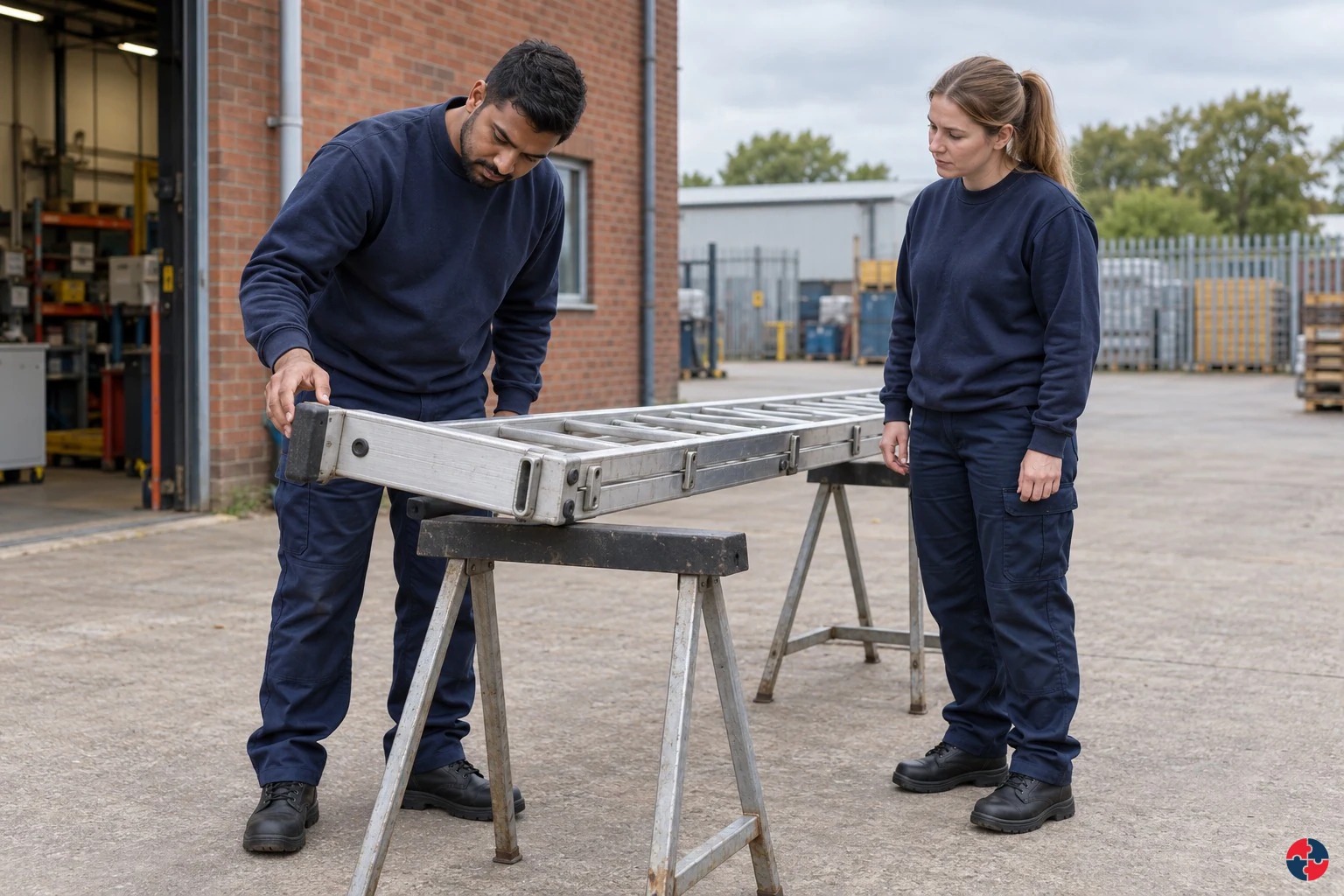
Check the ladder at the start of the working day and again after it is dropped, struck, moved from dirty to smooth ground, or otherwise changed. If a defect or uncertain mechanism is found, do not use it; report and isolate it.
Look at stiles for bends, dents or cracks; feet for damage, wear and embedded dirt; rungs and treads for looseness, damage and contamination; locking bars, hinges and pins for proper engagement; and any platform for cracking or buckling. On a telescopic ladder, check each section’s locking mechanism according to its instructions. The user needs access to those instructions. HSE how to check a ladder before use.
A simple pre-use check need not normally be recorded. The immediate goal is to keep a defective ladder out of use. Tag or otherwise segregate it under local arrangements and tell the person in charge. Do not improvise structural repairs or assume that an inspection sticker overrides a visible defect. Before every ascent, also verify the task, location and securing remain as assessed.
Download the ladder pre-use on-site checklist (PDF). Blank, printable and fillable, with 16 checks and space for defects and actions. Use for ladder work already assessed as suitable. This user pre-use check is separate from detailed inspection, practical observation and work authorisation.
How should electrical and overhead-line hazards affect the choice?
Identify live electrical systems and overhead lines before bringing a ladder or long material into the area. Keep the task outside the danger zone or arrange a competent isolation and safe system; ladder material alone does not control electrical risk.
HSE ladder guidance says not to work within 6 m horizontally of an overhead power line unless it has been made dead or protected with insulation. This is a planning rule that requires the network operator and competent electrical advice where proximity cannot be avoided. For electrical work where a ladder remains suitable, use a non-conductive ladder such as fibreglass or timber, and follow the electrical safe system and manufacturer instructions. HSE types of ladder and using them safely.
A metal ladder, tool, carried pipe or nearby plant can contact a line or create an arcing hazard. Stop if line ownership, voltage, isolation status or safe clearance is unknown. Do not approach a fallen line or move a ladder involved in an electrical incident until the emergency response and competent electrical authority make the area safe.
What needs a separate plan for roof and fixed-ladder access?
A ladder that reaches a roof does not make the roof safe. Assess edges, fragile surfaces, the route, work position and rescue separately. A fixed hooped ladder also needs its own assessment; its cage must not be assumed to arrest a fall.
For a pitched roof, use a suitable roof-access system, check the actual ridge, roof strength and any product instructions, and protect against falls through fragile coverings and from edges. HSE roof guidance should drive this plan. Do not rest access ladders on gutters. An access ladder used to reach another level should be tied with a handhold above the landing. HSE roof work and fragile surfaces and HSE securing ladders used for access.
A fixed ladder cage is not a complete fall-arrest system. HSE warns that hoops alone have no proven complete fall-arrest capability and that some personal fall-arrest devices can interact badly with a cage. Assess the route, landing and rescue, consult the equipment supplier and competent specialist, and avoid a blanket rule to remove hoops or add a harness.
Where roof or fixed-ladder work requires fall arrest, plan compatible anchorage, user competence and prompt rescue before work. A generic portable-ladder briefing cannot approve that system.
How should a short maintenance task run from plan to hand-back?
BuildOut Ltd should choose the access method for the actual location, confirm the ladder and controls before work, stop for changed conditions, and leave a record of the decision and defects that affected it.
BuildOut Ltd warehouse sign inspection
Task material and setting: a competent facilities worker must read the fixing label on a high internal sign and make a light adjustment, then hand the aisle back for normal use. The intended equipment is a suitable platform stepladder. The work is inside a warehouse on a clean, level floor away from the loading-bay vehicle route. Other workers and visitors could be affected by a fall or dropped tool.
People and prerequisites: a second worker controls the pedestrian route. The supervisor checks the work-at-height hierarchy and the short, light task; agrees the method; confirms the ladder label, instructions, load and reach; and briefs the worker. If the sign needs forceful drilling, new fixings or repeated work, a platform or other access method is selected instead.
Before: isolate or segregate the aisle without blocking a fire exit. Check stiles, feet, treads, platform and locks, then set all feet on the floor with locks engaged. Put the tool in a pouch. Confirm communication and the site first-aid route. Hold the start if a contractor is moving stock into the aisle or the floor condition cannot be confirmed.
During: face the task, keep the body within the stepladder, retain a handhold and make only the agreed light adjustment. The second worker keeps people clear and watches for changes in the route.
Hold or stop: if the fixing is seized, the worker must reach sideways, the floor becomes wet, a vehicle is diverted nearby or a foot or lock moves, descend and stop. The supervisor reviews the changed task and chooses different access before any restart.
Completion and hand back: descend facing the ladder, check no tool or material remains above, remove barriers only after the aisle is safe, and store the ladder correctly.
Evidence: keep the task/access decision where the site system requires it and record any defect, revised method, contractor interface or incident. A routine user pre-use check need not become a separate form when no issue is found.
Variation: an external contractor proposes the same sign repair from an extension ladder in the loading bay. The traffic, door, weather and securing conditions are different; hold the work until BuildOut Ltd and the contractor agree segregation, the safer access method and hand-back. If anyone falls or an electrical contact occurs, summon emergency help, make the area safe without creating another casualty and follow the site incident procedure.
What changes when a short inspection becomes a repair?
A safe inspection plan can become unsuitable when a defect turns it into a repair. Reassess the work before adding force, duration, materials or another person. Being able to reach a component does not establish that the worker can manipulate it safely from the same position. Related guidance: HSE when and how to use ladders safely.
In this illustrative depot task, a contractor arrives to inspect an external sign using a portable ladder. The fixing turns out to be seized and the sign needs two-handed removal. Before anyone climbs, the supervisor checks the actual sign, foreseeable force, falling-object route, ground, access for alternative equipment and the delivery programme. The original inspection authorisation ends at the changed task; there is no trial pull from the ladder to see whether it works. Related guidance: HSE when and how to use ladders safely.
First test whether the sign can be lowered or the inspection completed from ground level. If removal at height remains necessary, a competent access planner considers a guarded work position capable of supporting the worker, tools and removed item. Selection includes ground condition, manoeuvring space, overhead obstructions and emergency arrangements. A platform is an option to assess, not an automatic answer; unsuitable ground or uncontrolled traffic can also rule it out. Related guidance: HSE guidance.
The depot can suspend deliveries and establish an alternative pedestrian route for the planned repair. Its site supervisor owns that interface; the contractor owns equipment-specific competence and the agreed work method. Before release, both walk the work area and confirm who controls entry, where the removed sign will go and what change ends the authorisation. The worker must be able to explain those limits in their own words. Related guidance: HSE when and how to use ladders safely.
If rain changes the footing, a vehicle enters the protected area or the sign does not release as expected, stop and reassess. At completion, account for fixings and tools, verify the sign or remaining structure is secure, remove equipment and agree the route hand-back. Record the changed method and any defect; the point of the record is to explain the decision, not to turn every ordinary pre-use check into paperwork. Related guidance: HSE guidance.
- Hold the changed task. Keep people clear and describe what now needs doing.
- Compare access options. Remove the climb where practicable; otherwise choose protection for the revised task.
- Verify the real setup. Check product limits, ground, people, segregation and emergency arrangements.
- Release within clear limits. Confirm owner and stop triggers; recheck after any change.
Guidance for these decisions: HSE when and how to use ladders safely; HSE guidance; HSE guidance. Apply the legal route for the work location; illustrative scenarios are SHARE teaching examples.
How do ladder decisions transfer across sectors?
The same fall mechanism appears in different work, but the strongest feasible control changes with the task. Use the sector examples to test access choice, then assess the actual place, people and equipment.
| Sector, task and people | Mechanism and harm | Strongest controls; residual check |
|---|---|---|
| Manufacturing: maintainer checks a high machine label; operators nearby. | Access may slip; an unexpected machine movement can destabilise or strike the worker, causing fall and impact injury. | First consider a ground view or fixed guarded access; isolate the machine as the task requires. If a ladder is justified, secure it and separate operators. Stop for unknown energy status or movement.HSE task guidance. |
| Construction: roofer accesses a pitched roof; workers below. | A ladder can slip, and the roof edge or fragile surface creates a separate severe-fall route. Tools may strike people below. | Plan collective roof protection and safe access first; tie the access ladder and guard the landing. Stop for uncertain roof strength, unprotected edge or poor rescue.HSE task guidance. |
| Hospitality: facilities worker changes a high light in an open dining area; guests nearby. | A stepladder can tip during overhead two-handed work; dropped fittings can injure guests. | Consider a lowering mechanism or protected podium; schedule work outside public use and isolate the area. Stop if guests enter or the task needs force or reach.HSE task guidance. |
| Logistics: worker checks high-bay stock in a vehicle aisle; pickers and drivers nearby. | A mobile vehicle may strike a ladder; a fall or dropped stock can injure worker and bystanders. | Use suitable integrated guarded access or a planned stock-location change; segregate vehicles and pedestrians. Stop if traffic cannot be controlled or load is awkward.HSE task guidance. |
These are examples, not blanket sector rules. A platform or MEWP brings its own ground, movement and competence requirements; the supervisor must assess those before substituting it for a ladder.
How should ladders be inspected, stored and procured?
The user makes pre-use checks; the employer arranges competent, recorded detailed visual inspections at suitable intervals and after events that may have affected safety. Set the interval from use, environment and manufacturer instructions, not a generic calendar rule.
Detailed inspection checks feet, stiles, rungs, tie rods, welds, rivets, stays, accessories and moving parts. Keep a current record and remove defective equipment from use. A ladder integrated into a scaffold system is subject to the scaffold inspection requirements, including seven-day inspection; that does not make every portable ladder a seven-day item. HSE inspecting the condition of ladders.
There is no universal three-, six- or twelve-month detailed-inspection interval for every portable workplace ladder. A competent person sets a suitable interval from use, transport, storage, defects, incidents and manufacturer instructions. The user still checks the ladder before each task and after a change.
Purchase a type and professional-duty product suitable for the actual tasks, with identifiable instructions, markings and replacement parts. A load marking does not authorise a heavy task or a poor setup; check the manufacturer’s label and instructions for the user, tools and materials. Store ladders so stiles, feet and locks are not damaged, and inspect again after transport or repair. Keep product-supply claims separate from workplace use duties.
Which duties apply in Great Britain and Northern Ireland?
Great Britain and Northern Ireland have GB Work at Height Regulations 2005 and separate NI Work at Height Regulations 2005. Both require planned, supervised work by competent people, a suitable access choice and controls for falls; check the workplace’s actual jurisdiction before making a legal statement.
| Matter | Great Britain | Northern Ireland |
|---|---|---|
| Work at height | Work at Height Regulations 2005 SI 2005/735 applies in England, Scotland and Wales. Use current HSE work-at-height guidance to translate duties into decisions. | Work at Height Regulations (Northern Ireland) 2005 SR 2005/279 is the separate NI instrument. Check the current amendments and HSENI subordinate health and safety legislation register route. |
| Ladder selection and use | Apply the risk-based hierarchy, equipment selection and ladder requirements in the GB regulations. HSE’s ladder guide explains practical methods. | Apply the NI regulations and relevant HSENI advice. HSE ladder methods can inform an NI assessment but are not the NI legal text. |
| Inspection and competence | Plan suitable checks and competent work; keep inspection records where the regulations and equipment guidance require them. | Apply the corresponding NI duties and confirm local record requirements in the current NI text. |
Ladder choice is a workplace-use decision under the applicable GB or NI instrument. HSE product-standards guidance explains the EN 131 product-standard family as a procurement reference, but it does not replace the task assessment. BuildOut Ltd’s briefing and hold points illustrate a local safe system, not statutory forms.
How can managers test whether the ladder system works?
Test the condition and use of a sample of actual ladders against their records. An inventory entry, purchase specification or inspection label has value only if it refers to the equipment in front of the worker and leads to an effective decision. Related guidance: HSE inspecting the condition of ladders.
Choose samples from different conditions: a clean indoor store, a contractor vehicle and a frequently moved external ladder. Trace each asset to its instructions, competent inspection and any defect history. Ask a user to demonstrate the pre-use check and explain where doubtful equipment goes. A ladder without a readable identity or usable instructions needs a suitability decision; replacing an inventory label alone does not resolve uncertainty about the product. Related guidance: HSE inspection of work equipment.
Review repeated tasks as well as defective assets. If workers routinely climb to reach the same valve, shelf or light, ask whether relocating it, providing permanent guarded access or changing the maintenance method would remove the recurring fall exposure. A pattern of overreach may reflect poor task design or procurement, even where individual ladders pass inspection. Related guidance: HSE when and how to use ladders safely.
| Sample | Evidence to follow | Failure and action |
|---|---|---|
| Returned ladder with a reported locking fault | Asset identity, isolation location, competent disposition and check before return. | A closed ticket without a verified safe ladder leaves the asset held. Related guidance: HSE inspecting the condition of ladders. |
| Inspection interval decision | Use, transport, storage, manufacturer instructions and changing defect experience. | Copying another site's interval without considering conditions requires reassessment. Related guidance: HSE inspection of work equipment. |
| Repeated overhead task | Task observations and the reason for the chosen access method. | Repeated stretching or force prompts redesign and a more protective work position. Related guidance: HSE when and how to use ladders safely. |
| New purchase | Traceable product, actual instructions, configuration and suitability for intended work. | A conformity marking alone cannot authorise the workplace task. Related guidance: HSE ladder product standards. |
Guidance for these decisions: HSE inspecting the condition of ladders; HSE inspection of work equipment; HSE ladder product standards. Apply the legal route for the work location; illustrative scenarios are SHARE teaching examples.
How can competence be demonstrated on the real task?
Assess the worker on the equipment and task they will actually use. A competent supervisor can observe ordinary use within their own expertise; a damaged product or a complex access decision needs someone competent for that question. Attendance creates a learning record, while an observed demonstration establishes what the person can currently do. Related guidance: HSE when and how to use ladders safely.
Use the changed-sign example as a short practical exercise without exposing anyone to a fall. Present the seized fixing while the ladder is still on the ground. Ask the worker to explain why the authorised inspection has changed, how the task is held, and which alternatives need assessment. Do not assess willingness to climb or speed of completion. Related guidance: HSE when and how to use ladders safely.
Record the task and equipment configuration, assessor, demonstrated limits and any remaining restriction. After a new ladder type, changed task, failed demonstration or relevant incident, reassess the affected capability. Choose refresher learning from evidence of need; this page establishes no universal course expiry. Related guidance: HSE when and how to use ladders safely.
| Role and assessor | Observed decision | Limits and failure response | Record and reassessment |
|---|---|---|---|
| User — supervisor competent in this ladder and task | Select the access method, check feet/stiles/locks and demonstrate secure positioning before use. | Stop on a defect, unprotected edge, overreach or changed force; do not repair beyond competence. | Actual ladder/task, observed checks and agreed limit; reassess after changed configuration or failed check. Related guidance: HSE when and how to use ladders safely; HSE guidance; HSE inspecting the condition of ladders. |
| Supervisor — competent access planner or manager | Test ground and public-interface arrangements; explain why this job permits a ladder or needs another method. | Hold if suitability, segregation, support or emergency arrangements are unresolved. | Reasoned access decision and control verification; review after site or work-method change. Related guidance: HSE when and how to use ladders safely; HSE guidance; HSE inspecting the condition of ladders. |
| Inspector/maintainer — competent equipment assessor | Identify an asset, examine deterioration, apply instructions and decide quarantine or return within competence. | Do not issue a safe label when defect severity or repair permission is uncertain. | Inspection findings, disposition and repair verification; revise interval after defect or condition trend. Related guidance: HSE when and how to use ladders safely; HSE guidance; HSE inspecting the condition of ladders. |
| Manager/procurement — competent safety and operational adviser | Trace a product to instructions and task suitability; test whether recurring climbs could be designed out. | Budget or conformity marking cannot substitute for the task assessment. | Procurement decision and sampled user evidence; review repeat faults and redesigned tasks. Related guidance: HSE when and how to use ladders safely; HSE guidance; HSE inspecting the condition of ladders. |
Guidance for these decisions: HSE when and how to use ladders safely; HSE guidance; HSE inspecting the condition of ladders. Apply the legal route for the work location; illustrative scenarios are SHARE teaching examples.
How should roles and competence be demonstrated?
Match instruction, training, supervision and practice to the equipment and task. A user should know when to reject a ladder, show a safe setup and stop when conditions change; a trainee works under competent supervision.
HSE describes competence as practical and theoretical knowledge, training and experience. A course card can support an employer’s scheme, but is not a universal legal licence or substitute for observed ability on the actual task. Check any training provider’s current product and renewal terms before relying on them.
Worker: check, set up, use, report and stop. Supervisor: choose access, coordinate interfaces, verify practical ability and act on changes. Manager or purchaser: provide suitable equipment, storage, inspection and a clear emergency route. Competent inspector: examine and record the ladder’s actual condition. Contractor: agree the same site controls and hand-back before starting. Brief all relevant groups in the task they will actually perform.
BuildOut Ltd can sample observations, defects, changes of method and actions in its risk register. HSE management guidance may help organize responsibilities and review, but certification to a management standard does not prove that a particular ladder task is safe.
Test competence on the actual access method and record who assessed it, the equipment and task covered, and the reason to reassess. A change in ladder type, work method, defect pattern or observed misuse is a better trigger than assuming one fixed refresher interval fits everyone.
| Role | Learning and practical test | Assessor and record | Reassess when |
|---|---|---|---|
| New worker or person nearby | Recognise the fall and falling-object route, exclusion zone and reporting route; awareness is not permission to climb. | Supervisor observes a short scenario and records the briefing. | A task or site route changes. |
| Ladder user | Select, inspect, set and secure the actual ladder; demonstrate climb, work position and stop decision. | Competent supervisor observes the practical task and records scope of independent use. | Equipment changes, a defect occurs or unsafe practice is seen. |
| Maintainer or inspector | Identify faults, follow product instructions, quarantine defects and record detailed inspection. | Competent person reviews an inspection and defect record. | A new design, recurring defect or method change arises. |
| Supervisor or contractor coordinator | Challenge ladder choice, manage public/vehicle interfaces, arrange rescue and verify restart. | Manager reviews a task plan and observed hold/release decision. | The task or contractor method changes. |
| Manager or purchaser | Specify suitable equipment, storage, inspection and resources; review defect trends. | Senior owner checks purchase and assurance records. | A product or standards change, incident or trend appears. |
| Safety adviser or auditor | Check legal scope, risk decisions, source evidence and closure of defects. | Competent lead samples evidence and records findings. | A legal or technical change affects the method. |
Use the observed-role-assessment record as the practical decision record for users, supervisors, inspectors and purchasers. Read the role-learning table alongside it for nearby people, contractors and advisers; it adds role context rather than authorising a different equipment or task limit. Record the actual ladder and task, assessor, demonstrated limits and remaining restrictions once, then link the manager assurance sample to that record. Reassess the affected capability after a relevant equipment, method, condition or performance change; there is no universal refresher expiry.
When must the task be held or stopped?
Stop before climbing if the ladder, support, task or user is unsuitable; descend and stop if stability, reach, weather, traffic or the work method changes. A supervisor must resolve the cause and choose a safe method before restart.
| Trigger | Immediate action | Restart evidence |
|---|---|---|
| Bent stile, damaged foot, loose rung or failed lock | Do not use; isolate and report. | Safe replacement or competent repair and check under the manufacturer’s instructions. |
| Unstable ground, weak upper rest or no effective securing | Keep people clear and replan access. | Verified position and securing, or different equipment. |
| Overreach, side loading, heavier/longer work | Descend; reassess the task. | Suitable platform or revised low-risk method. |
| Vehicle, pedestrian, door or weather change | Stop and segregate or change timing. | Confirmed area control and task briefing. |
| Unknown overhead line or electrical condition | Keep clear and seek competent electrical advice. | Documented isolation or a verified safe system. |
| Roof edge, fragile surface, fixed-cage or fall-arrest uncertainty | Hold specialist work. | Task-specific system, compatibility and rescue plan. |
After a fall, call emergency help and follow local first aid and rescue arrangements. Do not move a casualty unless an immediate danger requires it, and do not create another fall or electrical exposure. Preserve the equipment and scene as the site incident procedure requires. Review the access choice and controls before similar work resumes.
Hop-up, podium and mobile tower: parts and pre-use checks
A guarded podium and a basic unguarded hop-up provide different protection. Select equipment for the task, reach, force, support and fall route. Use the actual model instructions; these illustrations identify parts and do not approve a setup.
Printable pre-use checklists
Download a check sheet with a labelled parts reference. Any No or Unsure means hold use and resolve the concern through the responsible workplace route. These are user aids, not competent-person inspection reports or permission to work.
- Hop-up and podium pre-use checklist (PDF, 2 pages)
- Mobile scaffold tower pre-use checklist (PDF, 2 pages)
Low-level platform: eight visible parts
View labelled parts and enlarge image

Read the numbered parts explanations
- Working deck. The standing surface: check condition, cleanliness and the actual load limit.
- Upper guardrails. Part of the edge protection. They are not steps or extra working height.
- Intermediate rails. Help reduce the opening below the upper rails.
- Frame and support legs. Carry the load to the floor in the manufacturer’s specified setup.
- Access steps. Use the intended access route; keep steps clean and undamaged.
- Hinges and locking points. Secure folding sections as instructed. A picture cannot confirm engagement.
- Feet and ground contacts. Check condition and firm, level support; do not pack with loose blocks.
- Transport castors. Small wheels help move the empty unit. Use its specified movement controls.
Check the actual manual for access closure, brakes or anti-movement devices, required protection, platform positions and load limits.
Mobile tower: eleven component groups
View labelled parts and enlarge image

Read the numbered parts explanations
- Guardrails. Upper and intermediate rails help prevent falls from the working platform.
- Toe boards. Edge boards help prevent small items falling from the platform.
- Fixed platform. A deck without an access hatch. Its position and use follow the actual manual.
- Trapdoor platform. A deck with a hatch for the specified internal access route.
- Ladder frame. A frame with rungs for the access arrangement specified by the manufacturer.
- Span frame. Connects the uprights across the tower width as part of the frame structure.
- Horizontal brace. Connects frames horizontally in the positions required by the actual system.
- Diagonal brace. Resists racking: the frame changing shape sideways under load.
- Adjustable leg. Allows limited levelling within the manufacturer’s instructions.
- Locking castor. A wheeled support with a brake. Secure it as instructed before use.
- Stabiliser. Extends the support footprint where the actual tower instructions require it.
Match the actual tower to its current instructions. Module sizes, quantities, stabiliser type, heights and loads are model-specific.
After a defect, impact, alteration or move, verify the checks, any competent inspection and the handback required for the actual equipment and conditions. Never move a tower with people or materials aboard. Workplace competence and authorisation remain separate from reading a diagram or ticking a checklist.
Scaffold and mobile tower awareness course · HSE tower guidance · PASMA low-level guidance
Checklist and parts section reviewed 1 November 2026. HSE guidance concerns Great Britain; apply the relevant country rules and exact-system instructions.
How should controls be owned and reviewed?
Assign a competent owner, check that task controls work, involve workers and act when evidence changes.
For Ladder Safety, record the actual hazard and task, the chosen control, the person responsible, the evidence that it works and the point at which work must stop or be reassessed. HSE management guidance for Great Britain describes planning, worker consultation, checking and action. HSENI guidance for Northern Ireland describes competent help, risk control and review. These management steps do not prove that a particular task control is suitable; use the topic-specific evidence and the applicable GB or NI law elsewhere on this page.
Where an organisation chooses ISO 45001, its management arrangements can organise the access-choice owner, worker input, equipment defects and review of recurring climbs. The practical test remains whether the actual ladder task is justified and controlled. Certification does not establish the suitability of a ladder or authorise work at height; product requirements and workplace duties remain separate. HSE: ISO 45001 management standard.
What terms should a new user know?
The terms describe the decision and equipment; none replaces an assessment of the actual task.
| Term | Meaning | Why it matters here |
|---|---|---|
| Work at height | Work with a possible fall liable to cause personal injury | The duty is risk-based, not triggered only above a fixed height. |
| ERICPD | Eliminate, Reduce or substitute, Isolate, Control, PPE, Discipline | A practical control-planning order; not a separate statute. |
| STEP | Site, Task, Equipment, People | Prompt for checking the real ladder task and conditions. |
| MEWP | Mobile elevating work platform | Guarded access option, subject to its own ground and movement risks. |
| PPE | Personal protective equipment | May protect residual risk but cannot make an unstable ladder safe. |
| EN 131 | European portable-ladder standard family | Product information; not a blanket legal permission for workplace use. |
| Stiles | The two long side members of a ladder | Both may need securing to prevent slip. |
| 1-in-4 guide | One unit out for four units up | HSE setup guide for a leaning ladder, around 75 degrees. |

Unlock another resource
You have used this month’s two free downloads. Publish a post in your own words to unlock one more resource, or choose SHARE Individual for 10 downloads per month.
You decide whether to share. If you do, use the relevant platform disclosure tools and do not make claims you do not genuinely hold.