SHARE Knowledge Hub
Machinery safety and control systems
A machinery safety function prevents or stops a specified hazardous action, or keeps access closed until danger has ended. Its sensors, logic, stopping action and installed conditions must be validated together for the real machine and task.
Owner: SHARE Knowledge Hub editorial team.
Understanding Machinery safety and control systems
A control system is safety-related when its failure could allow dangerous motion, access or release. Assess the complete chain from detection of a demand, through logic and communication, to the output device, brake and physical hazard. An apparently compliant sensor cannot compensate for a contactor welded closed or a stopping time longer than the distance available.
Why this matters at work
A failed protective function exposes a person to the original machine hazard. A welded output contact can leave a cutter moving after a gate opens; brake deterioration can let a hand reach a blade before it stops; an unrecognised person inside a cell can be struck or crushed on restart. Map the sensor, logic and final element to that harm, rather than treating a controller fault as merely lost production. Injury can include severe wounds, fractures, limb loss or death.
Investigate the demand, failure and access pathway. Organise information, analysis, control measures and an implemented action plan using the HSE investigation approach. Determine whether the problem lies in design, installation, configuration, deterioration, work method or production pressure. Have competent people repair and revalidate the affected function and its dependencies, including stop performance, fault response, clear-zone reset and reconnection. Authorised release needs evidence from the installed machine.
How organisations manage this in practice
Define defects that require immediate withdrawal: missing or damaged guard, failed interlock, unexplained stop-time increase, bypassed safety input, unreliable emergency stop, damaged isolator or repeated unexpected motion. Workers should know how to secure, label and report the machine without trying an unsafe improvised fix. The responsible manager records the defect, affected tasks, interim protection and repair priority. A warning sign, verbal instruction or PPE is rarely an adequate substitute where a dangerous part remains accessible. Prevent another shift or contractor from unknowingly restarting the machine. Competent repair must address cause, not only reset an alarm. Test the affected safety function and dependent functions after repair, including fault and restart behaviour. Update instructions or risk assessment if the defect exposed a design weakness. Formal release identifies who inspected, what was tested, results and any restrictions.
The worker returning after injury or illness needs a separate plan. Maintain supportive contact, obtain professional advice on fitness and functional restrictions where needed, and agree feasible adjustments to tasks, hours or equipment. Review the machine risk assessment and effects on other workers. Protect clinical confidentiality and review the arrangements after return. Machine handback does not demonstrate a person is fit for every task. HSE guidance informs the management method; NI employment and equality provisions require their own legal route.
After a defect, repair or change, verify the affected function before release. Review intervals when faults recur, use intensifies or conditions change. Keep maintenance logs current where provided and ensure tests can be performed without exposing the tester to the hazard.
Trace the safety function through to stopped motion
A door sensor, logic and final actuator form a chain. A shared supply, fault or coasting blade can affect the result even when the interface appears to have registered an open door.

Define the function
Establish what the protective function must achieve for the enclosed cutter and actual access.
Verify the whole chain
Use appropriate competent design and validation evidence, including dependencies, faults and the time before motion becomes safe.
Reset is not restart
Keep deliberate reset and restart distinct and verify the authorised return after a fault or intervention.
The diagram is not a wiring plan, performance-level selection or instruction to test by exposing a person.
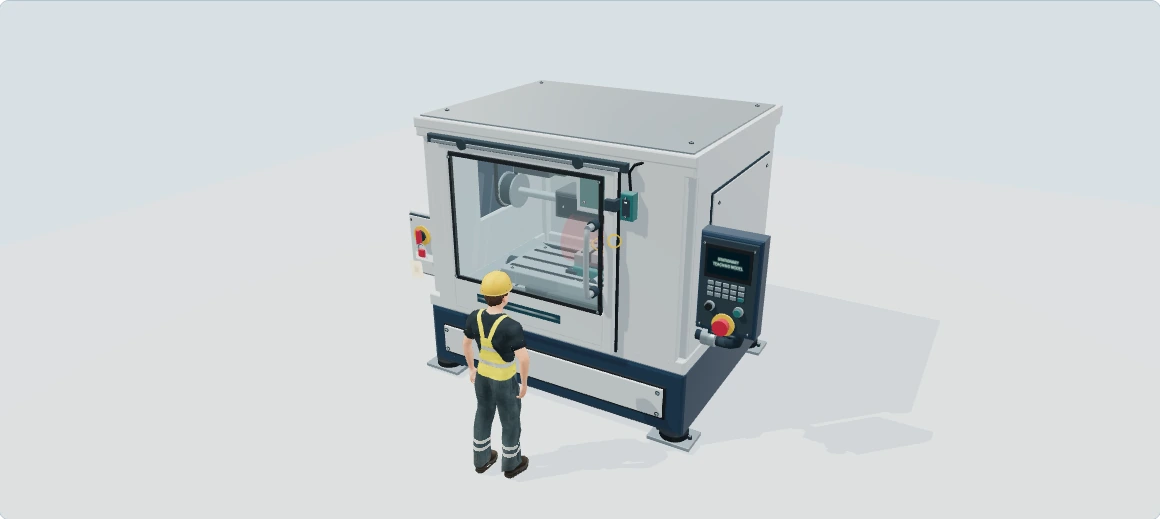

Machinery guarding: trace the energy to the harm
Explore the working zone, guards, interlock, transmission, controls and energy isolator. Compare production work, cleaning and maintenance without treating a stopped machine as safely isolated.
Checksheets and risk assessments
Risk assessment forms
Risk assessment examples
Forms and tools
Full written walkthrough — all 8 steps
1. Identify the dangerous movement
What is happening: The cutaway exposes the workholding and cutter so you can inspect where contact could occur. It does not open or enable the real machine.
How harm can occur: A cutter can sever tissue; rotating parts can wind in hair or clothing; moving workholding can crush a hand.
Best practice to apply: Identify the task, all exposed people and the machinery’s intended operating limits. Keep the actual danger zone inaccessible.
2. Inspect the enclosure and access
What is happening: Inspect the enclosure, viewing panel and access edges. The visual cutaway changes only the drawing.
How harm can occur: A missing, damaged or unsuitable guard may allow reach into dangerous movement or fail to contain an ejected item.
Best practice to apply: Check the actual guard, fixing, condition and suitability. Do not infer reach distances or containment performance from this model.
3. Understand an interlock’s role
What is happening: The access interlock is a separate protective function. Its presence does not establish the reliability or stopping performance of the actual system.
How harm can occur: Defeating an interlock can permit access while hazardous movement is possible. Run-down may continue after a stop request.
Best practice to apply: Verify required protective functions through competent assessment and maintenance. Do not bypass them or use the cutaway as a working configuration.
4. Find the transmission hazards
What is happening: Inspect the drive and the cover around it. Dangerous movement can exist beyond the obvious working point.
How harm can occur: Belts, pulleys and rotating shafts can entangle, draw in or trap people during production or servicing.
Best practice to apply: Keep appropriate transmission guarding in place. Plan access and maintenance with the equipment information and actual energy sources.
5. Separate control stops from isolation
What is happening: The control panel and emergency stop act through control functions. The energy isolator is physically separate.
How harm can occur: A stopped display may conceal live energy or allow an unexpected restart; an emergency stop does not remove every energy source.
Best practice to apply: Use the required stop arrangements for operation and the actual safe isolation procedure for intrusive access.
6. Control hazardous energy for access
What is happening: Locate the separate isolator and the points where electrical, pneumatic, hydraulic, gravitational or mechanical energy may remain.
How harm can occur: Unexpected energisation, stored pressure or a falling component can cause shock, crushing or impact.
Best practice to apply: Identify, isolate, secure and verify the relevant energies using competent task-specific arrangements. The pictured lock is not proof that a machine is safe.
7. Plan cleaning and material handling
What is happening: Consider how material is loaded, held, removed and cleaned without bringing a person into danger.
How harm can occur: An inadequately held item can be ejected; reaching to clear swarf or a blockage can expose hands and clothing.
Best practice to apply: Use suitable workholding and handling methods. Stop and follow the safe system when a blockage or abnormal condition occurs.
8. Protect the people around the machine
What is happening: The operator’s work position and surrounding access affect people other than the person at the controls.
How harm can occur: Visitors, cleaners and nearby trades may enter a danger area or be struck by an ejected item.
Best practice to apply: Check layout, access, instruction, competence and supervision. Review the machine after changes and before returning it to service.
Illustrative awareness learning. The model does not design equipment, authorise work, verify safe conditions or complete a real inspection.
The wider workplace has its own account and subscription access. Exploring this lesson does not grant access, record course completion or authorise work.
What does machinery safety and control systems mean?
A machinery safety function is a specified protective action for a machine hazard, such as preventing start, stopping motion or keeping access closed until danger has ended. Competent validation must show that the installed function controls the real task and access route.
Define a safety function
2 linked parts. Follow the question numbers and complete the applicable route.
Part 1 of 2 · Questions 1–3

Continue · Part 2 of 2 · Questions 4–6


Read the complete visual as text
- Start: A machinery hazard and risk-reduction need have been identified. Immediate danger invokes the appropriate emergency response first, without waiting for this design scan.
- Question 1: Are hazardous function, person, task, mode and access route defined? Decision owner: Supervisor and competent machinery engineer.
- YES: The named evidence is confirmed. Continue the next applicable check. Owner: Supervisor and competent machinery engineer. CONTINUE → QUESTION 2.
- NO / UNKNOWN — HOLD: Hold design; the machinery risk assessor completes the task and access basis. Owner: Supervisor and competent machinery engineer. HOLD → REPEAT QUESTION 1 AFTER CORRECTION.
- Question 2: Are the initiating demand and physical safe state stated? Decision owner: Supervisor and competent machinery engineer.
- YES: The named evidence is confirmed. Continue the next applicable check. Owner: Supervisor and competent machinery engineer. CONTINUE → QUESTION 3.
- NO / UNKNOWN — HOLD: Do not select components. The designer writes the functional requirement first. Owner: Supervisor and competent machinery engineer. HOLD → REPEAT QUESTION 2 AFTER CORRECTION.
- Question 3: Are response, run-down, stored energy, span, indication, reset and restart defined? Decision owner: Supervisor and competent machinery engineer.
- YES: The named evidence is confirmed. Continue the next applicable check. Owner: Supervisor and competent machinery engineer. CONTINUE → QUESTION 4.
- NO / UNKNOWN — HOLD: The designer obtains machine and operating evidence, including relevant measurements. Owner: Supervisor and competent machinery engineer. HOLD → REPEAT QUESTION 3 AFTER CORRECTION.
- Question 4: Are foreseeable faults, common causes, environmental limits, modes and interfaces considered? Decision owner: Supervisor and competent machinery engineer.
- YES: The named evidence is confirmed. Continue the next applicable check. Owner: Supervisor and competent machinery engineer. CONTINUE → QUESTION 5.
- NO / UNKNOWN — HOLD: Expand the requirements and failure analysis with the competent specialists. Owner: Supervisor and competent machinery engineer. HOLD → REPEAT QUESTION 4 AFTER CORRECTION.
- Question 5: Has the competent designer selected applicable standards and derived required integrity? Decision owner: Supervisor and competent machinery engineer.
- YES: The named evidence is confirmed. Continue the next applicable check. Owner: Supervisor and competent machinery engineer. CONTINUE → QUESTION 6.
- NO / UNKNOWN — HOLD: Hold implementation; obtain the machine-specific design basis. This route assigns no PLr, SIL or architecture. Owner: Supervisor and competent machinery engineer. HOLD → REPEAT QUESTION 5 AFTER CORRECTION.
- Question 6: Is a competent verification and independent-validation route available? Decision owner: Supervisor and competent machinery engineer.
- YES: Prepare traceable criteria and retain design, calculation and configuration evidence. A plan is not passed validation. Owner: Supervisor and competent machinery engineer. OUTCOME → RECORD AND HAND OVER.
- NO / UNKNOWN — HOLD: Hold implementation until an adequate validation route exists. Owner: Supervisor and competent machinery engineer. HOLD → REPEAT QUESTION 6 AFTER CORRECTION.
- Outcome: Risk assessment incomplete; requirement incomplete; competent design route; validation plan ready.
- Stop and escalation boundary: This learning route supplies no design value, operating setting, clinical diagnosis or site permission. The actual procedure, jurisdiction and competent local authority govern.
Best-practice guide: Machinery safety and control systems
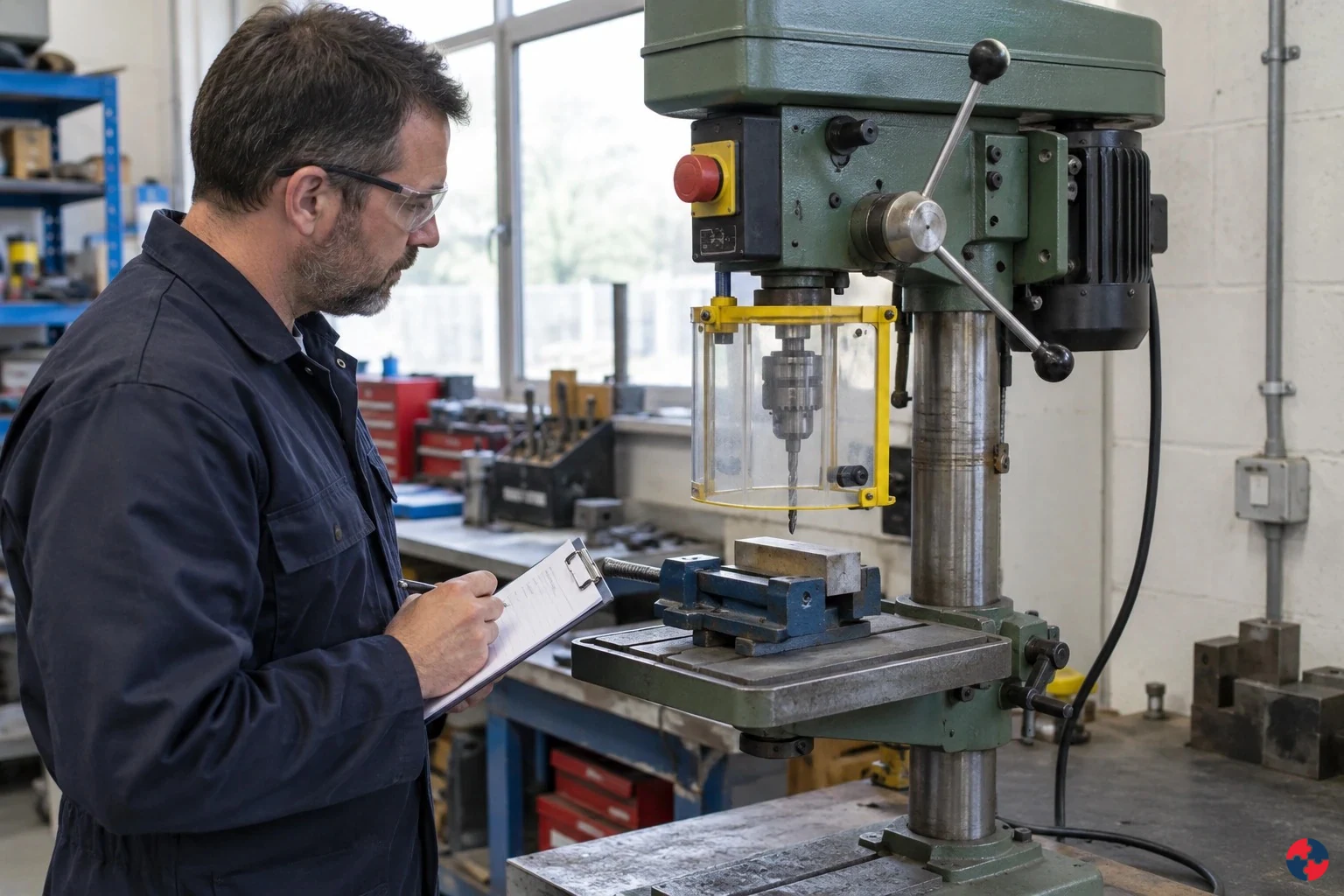
What does machinery safety and control systems mean?
A machinery safety function is a specified protective action for a machine hazard, such as preventing start, stopping motion or keeping access closed until danger has ended. Competent validation must show that the installed function controls the real task and access route. A machinery safety function prevents or stops a specified hazardous action, or keeps access closed until danger has ended.
Turn machinery safety and control systems knowledge into a decision
A machinery safety function prevents or stops a specified hazardous action, or keeps access closed until danger has ended. Its sensors, logic, stopping action and installed conditions must be validated together for the real machine and task. Keep defect, isolation, repair, protected test, named release and recurring-jam investigation records.
the site team defeated interlock and conveyor jam
Only the authorised maintainer uses the approved tools in the specified area. Keep isolation and access controls effective; no powered test while anyone is exposed. Remove tools, account for people, restore guards, test the complete stop and restart function from protected positions and authorise a controlled return.
Task harm and stop sign
Opening a door to a coasting cutter.: Blade reaches a hand before motion ends; deep cut or amputation. Clearing a conveyor nip.: Rollers draw in an arm; crush injury or amputation. Entering a robot or automated cell.: Unexpected cycle or restart crushes a person.
Choose controls for machinery safety and control systems
Eliminate: Move suitable loading, adjustment or lubrication outside the danger zone to remove routine approach to motion. Reduce: Compare a technically suitable alternative material, process or feed arrangement that reduces the assessed harm route. Isolate: Use suitable guarding and protective functions through the relevant PUWER order and competent machine assessment. Control: Provide the authorised safe task method, separate secure isolation/stored-energy arrangements for intervention, competent roles and defect escalation. PPE: Select appropriate residual eye, hearing, foot or other protection for assessed hazards, considering entanglement risk. Read the full control table for qualifications, ownership and verification. Use the actual task and applicable jurisdiction; existing technical approval remains unchanged.
Use the full machinery safety and control systems lesson
Use the full topic for the decision points, practical examples, detailed control tables and source scope. HSE guidance applies to Great Britain; use HSENI for the Northern Ireland route and the source’s stated jurisdiction. A simplified guide does not change the page’s technical-review or approval status.

Read all six steps as text
1. What does machinery safety and control systems mean?
A machinery safety function is a specified protective action for a machine hazard, such as preventing start, stopping motion or keeping access closed until danger has ended.
- Avoid / redesign: Move suitable loading, adjustment or lubrication outside the danger zone to remove routine approach to motion.
- Control the task: Use suitable guarding and protective functions through the relevant PUWER order and competent machine assessment.
- Verify before release: Check the complete machine and lifecycle tasks; remaining setup, cleaning and jam hazards still require assessed protection.
A machinery safety function is a specified protective action for a machine hazard, such as preventing start, stopping motion or keeping access closed until danger has ended. Competent validation must show that the installed function controls the real task and access route. A machinery safety function prevents or stops a specified hazardous action, or keeps access closed until danger has ended.
Apply it: Which part of this plan would you check at the workface before authorising the task?
2. Turn machinery safety and control systems knowledge into a decision
Use the evidence to improve the actual work arrangement.
- Change at source: Move suitable loading, adjustment or lubrication outside the danger zone to remove routine approach to motion.
- Make it observable: Check the complete machine and lifecycle tasks; remaining setup, cleaning and jam hazards still require assessed protection.
- Keep useful evidence: Keep defect, isolation, repair, protected test, named release and recurring-jam investigation records.
A machinery safety function prevents or stops a specified hazardous action, or keeps access closed until danger has ended. Its sensors, logic, stopping action and installed conditions must be validated together for the real machine and task. Keep defect, isolation, repair, protected test, named release and recurring-jam investigation records.
Apply it: What evidence would show that the change improves this task, rather than only completing a record?
3. the site team defeated interlock and conveyor jam
Example: a practical application of the existing topic lesson.
- Setting: Clear a torn bag at the transfer conveyor in the site team’s covered distribution bay without exposing anyone to the roller nip or pneumatic diverter.
- Act: Stop from outside danger, report the defeated interlock, restrict the whole line, identify linked drives and every energy source, then apply and verify the approved isolation.
- Hold / review: Hold for unknown energy, an unaccounted person, hidden access, unexpected movement or a failed function.
Only the authorised maintainer uses the approved tools in the specified area. Keep isolation and access controls effective; no powered test while anyone is exposed. Remove tools, account for people, restore guards, test the complete stop and restart function from protected positions and authorise a controlled return.
Apply it: At which point would you hold this example, and what evidence would allow it to proceed?
4. Task harm and stop sign
Connect the task, the route to the person and the control that can fail.
- Opening a door to a coasting cutter.: Blade reaches a hand before motion ends; deep cut or amputation.
- Clearing a conveyor nip.: Rollers draw in an arm; crush injury or amputation.
- Entering a robot or automated cell.: Unexpected cycle or restart crushes a person.
Opening a door to a coasting cutter.: Blade reaches a hand before motion ends; deep cut or amputation. Clearing a conveyor nip.: Rollers draw in an arm; crush injury or amputation. Entering a robot or automated cell.: Unexpected cycle or restart crushes a person.
Apply it: Who could be exposed, including other trades, cleaners, maintainers and people nearby?
5. Choose controls for machinery safety and control systems
Start with the stronger practicable options and verify their effect.
- Eliminate: Move suitable loading, adjustment or lubrication outside the danger zone to remove routine approach to motion.
- Reduce: Compare a technically suitable alternative material, process or feed arrangement that reduces the assessed harm route.
- Isolate: Use suitable guarding and protective functions through the relevant PUWER order and competent machine assessment.
- Control: Provide the authorised safe task method, separate secure isolation/stored-energy arrangements for intervention, competent roles and defect escalation.
- PPE: Select appropriate residual eye, hearing, foot or other protection for assessed hazards, considering entanglement risk.
Eliminate: Move suitable loading, adjustment or lubrication outside the danger zone to remove routine approach to motion. Reduce: Compare a technically suitable alternative material, process or feed arrangement that reduces the assessed harm route. Isolate: Use suitable guarding and protective functions through the relevant PUWER order and competent machine assessment. Control: Provide the authorised safe task method, separate secure isolation/stored-energy arrangements for intervention, competent roles and defect escalation. PPE: Select appropriate residual eye, hearing, foot or other protection for assessed hazards, considering entanglement risk. Read the full control table for qualifications, ownership and verification. Use the actual task and applicable jurisdiction; existing technical approval remains unchanged.
Apply it: Which stronger option can be used here, and who will verify it before accepting the remaining risk?
6. Use the full machinery safety and control systems lesson
Follow the official sources below and retain the task-specific evidence.
- Official guidance: HSE Introduction to machinery safety
- Official guidance: HSE L22 Safe use of work equipment
- Task decision: Keep defect, isolation, repair, protected test, named release and recurring-jam investigation records.
Use the full topic for the decision points, practical examples, detailed control tables and source scope. HSE guidance applies to Great Britain; use HSENI for the Northern Ireland route and the source’s stated jurisdiction. A simplified guide does not change the page’s technical-review or approval status.
Apply it: Which official source and full-topic section will you use to resolve the next decision?
A fixed guard blocks access without depending on a control signal. An interlocked door or protective device depends on sensors, logic, outputs and the machine’s stopping behaviour. A person may be drawn into a nip, cut by a tool or crushed by unexpected movement if any link fails or is bypassed. The assessment must include production, setting, cleaning, clearing blockages, fault finding and maintenance. HSE Introduction to machinery safety and HSE L22 Safe use of work equipment explain the work-equipment basis.
Decide which hazards need guarding, interlocking, emergency response, reliable stopping and safe maintenance. A competent engineer must evaluate the actual machine, manufacturer instructions and applicable standards before specifying or changing a function.
How does a failed safety function lead to injury?
The demand, sensing, decision, stopping action and final safe state all matter. A failed sensor, hidden access path or slow brake can leave a person exposed even when a control lamp says “stopped”.
Trace each task from the source of motion to the body part at risk. Run-down time, reach distance, material ejection, whole-body entry and stored energy change whether a device can prevent harm. A stop signal is not proof that motion has ceased, and a reset signal must not itself restart an ordinary safeguarded function.
| Task and route | Possible injury | Warning sign | Stop decision |
|---|---|---|---|
| Opening a door to a coasting cutter. | Blade reaches a hand before motion ends; deep cut or amputation. | Longer stop time or unlocked access during run-down. | Hold access; engineer checks stop and guard-locking need. |
| Clearing a conveyor nip. | Rollers draw in an arm; crush injury or amputation. | Interlock defeated, hidden access route or repeated jam. | Stop and isolate before intervention; investigate bypass. |
| Entering a robot or automated cell. | Unexpected cycle or restart crushes a person. | Reset from outside without whole-zone visibility. | Keep cell unavailable until presence and restart controls are validated. |
| Maintenance on a pneumatic or raised axis. | Stored pressure or gravity moves a part; crush or injection injury. | Unknown supply, pressure or support. | No access until all energy is controlled and verified. |
These are credible mechanisms, not a calculation of a particular machine’s risk. A specialist must test the installed function and residual energy rather than infer safety from a component label.
What must a safety function actually do?
It must detect a demand, decide safely, act on the hazardous output and maintain a safe state until a deliberate restart is justified. Validation covers the whole chain, not just one switch.
The complete safety function chain


Read the complete visual as text
- Input and demand: The sensor or protective device detects the defined access or hazardous condition. Its suitability depends on task, mode, environment and foreseeable faults.
- Logic and output: The safety logic, wiring, communication and switching elements must produce the specified response, including the required fault behaviour. A branded component alone is not a complete function.
- Physical safe state: The final actuator, brake or valve must actually achieve the required safe condition. Test demand, response, indication, reset and separate restart as an end-to-end function.
Interlocking and guard locking


Read the complete visual as text
- Interlocking: The protective function responds to the access guard. Its complete stopping and restart behaviour must match the hazard and actual access route.
- Guard locking: Where danger persists during run-down, access may need to remain locked until the dangerous function is safe. Determine this using the actual stopping and access evidence.
- Whole installation: Check defeat resistance, actuator mounting, faults, environmental limits and whole-body escape. The illustration supplies no stopping time, distance, performance level or device selection.
Fault, configuration and common cause


Read the complete visual as text
- A diagnostic is part of the response: Consider how a detected fault changes the physical safe state and what happens to reset and restart. A warning without the required protective action is insufficient.
- Two channels may share a weakness: Shared power, environment, routing, software or component assumptions can defeat apparent separation. Assess common causes and interfaces, not only component count.
- Keep the released baseline: Control code, firmware, parameters, wiring and substitutions. Record authorised changes, remove temporary forces and bypasses, and validate affected and regression functions before release.
For an interlocked cutter, opening the guard is the demand. The switch reports guard state, safety-related logic processes it, the output removes drive or applies a safe stopping action, and hazardous blade motion must cease before a person can reach it, or access must remain prevented until the hazard has ended. Faults in wiring, software, contactors, braking or a mechanically defeated actuator can break the chain. A reset should acknowledge the safe condition; deliberate start is a separate action for normal guarded access.
| Step | What must happen | What to check |
|---|---|---|
| Demand and sensing | A guard opens or a person enters the detection zone. | All foreseeable entry routes are detected; switch or device cannot be trivially defeated. |
| Logic and fault response | Safety-related logic interprets the demand and relevant faults. | The complete architecture and behaviour are specified and validated by competent staff. |
| Output and stopping | Actuator power or hazardous motion is controlled. | Worst-case run-down, brake and output behaviour are measured for this installation. |
| Safe state and restart | Access remains prevented while danger persists; restart is deliberate. | Guard locking or other protection covers run-down and whole-body entry; reset alone does not restart. |
A protective device such as a light curtain cannot contain a thrown workpiece. A fixed guard may be needed alongside it. The 1999 HSE HSG180 Light curtains and light beam devices is useful for principles, but current design calculations require the applicable current standards and specialist evidence.
How should safeguards be chosen?
Design out the need to approach danger first. For remaining dangerous parts, use the Provision and Use of Work Equipment Regulations (PUWER) guarding order and verify that the selected measure controls all relevant tasks.
Move loading, adjustment or lubrication outside the hazard where possible. Fixed enclosing guarding is normally the first protective option where access is unnecessary. If access is required, another suitable guard or protective device may be needed; protective appliances can supplement these. Information, instruction, training and supervision support every level. This is the regulation 11 route in the GB HSE L22 Safe use of work equipment; HSENI PUWER 1999 identifies the NI counterpart.
Do not select a light curtain solely because it makes production faster. It must stop the hazard before reach, prevent undetected access and address restart; it is unsuitable as the sole measure where ejection or other routes require physical containment. An adjustable guard also needs the correct setting for the material. For detailed safeguard selection, use Machinery control measures.
How can the hierarchy of controls guide machinery safeguards and safe control-system decisions?
Design out routine access to dangerous motion where possible. If people still need access, use physical guarding and a suitable protective function designed for the whole machine, including stopping, run-down and restart. Safe procedures and training support that function; PPE cannot prevent contact with a moving nip or blade.
At a conveyor, move loading or adjustment outside the danger zone if possible and enclose the transfer nip. If a movable guard is needed, specify the interlock or protective device against the assessed access route, stopping time, foreseeable faults and restart. A protective device does not contain ejected material. For jam clearance, use a separate authorised isolation and stored-energy method rather than treating an emergency stop or interlock as isolation. The general risk-control sequence does not supply a control-system performance level, distance or validation result. Competent designers must use the actual machine assessment, applicable current requirements and measured behaviour; NI duties follow the separate PUWER route.
ERICPD means Eliminate, Reduce (including substitution), Isolate, Control, PPE and Discipline. The five-level hierarchy groups measures as elimination, substitution, engineering controls, administrative controls and PPE. They overlap: isolation is usually an engineering measure; control can include engineered and administrative measures. Discipline means maintaining and checking the controls, supervising the method and learning from defects, rather than blaming someone or accepting weaker protection.
How can the ERICPD hierarchy of controls guide machinery safeguards and safe control-system decisions?

| ERICPD and five-level position | Intervention and owner | Verification, failure and stop point |
|---|---|---|
| Eliminate / elimination | Move suitable loading, adjustment or lubrication outside the danger zone to remove routine approach to motion. | Check the complete machine and lifecycle tasks; remaining setup, cleaning and jam hazards still require assessed protection. |
| Reduce / substitution when replacing a hazard; otherwise engineering or administrative risk reduction | Compare a technically suitable alternative material, process or feed arrangement that reduces the assessed harm route. | Assess new hazards, actual performance and transferred intervention. A slower machine or smaller load is not automatically safe. |
| Isolate / engineering | Use suitable guarding and protective functions through the relevant PUWER order and competent machine assessment. | Validate actual access, stopping/run-down, foreseeable faults and restart. Unknown safeguard performance, bypass or a defect holds the affected task; no generic distance or performance level is supplied. |
| Control / engineering and administrative | Provide the authorised safe task method, separate secure isolation/stored-energy arrangements for intervention, competent roles and defect escalation. | An emergency stop or interlock is not secure isolation. Verify the actual method and handback through authorised competent people; this example supplies no isolation procedure. |
| PPE / PPE | Select appropriate residual eye, hearing, foot or other protection for assessed hazards, considering entanglement risk. | Verify suitability and use. PPE cannot prevent contact with a moving nip/blade or contain an uncontrolled load; gloves are not assumed safe near rotating parts. |
| Discipline / sustained engineering and administrative controls | Managers maintain protective functions and competence, prevent unsupported bypass and review defects or changed tasks. | Retain original maintenance/inspection and restoration evidence. Production success or an absence of accidents does not prove safeguard effectiveness. |
How can the ISO 45001 hierarchy of controls guide machinery safeguards and safe control-system decisions?

| ERICPD and five-level position | Intervention and owner | Verification, failure and stop point |
|---|---|---|
| Eliminate / elimination | Move suitable loading, adjustment or lubrication outside the danger zone to remove routine approach to motion. | Check the complete machine and lifecycle tasks; remaining setup, cleaning and jam hazards still require assessed protection. |
| Reduce / substitution when replacing a hazard; otherwise engineering or administrative risk reduction | Compare a technically suitable alternative material, process or feed arrangement that reduces the assessed harm route. | Assess new hazards, actual performance and transferred intervention. A slower machine or smaller load is not automatically safe. |
| Isolate / engineering | Use suitable guarding and protective functions through the relevant PUWER order and competent machine assessment. | Validate actual access, stopping/run-down, foreseeable faults and restart. Unknown safeguard performance, bypass or a defect holds the affected task; no generic distance or performance level is supplied. |
| Control / engineering and administrative | Provide the authorised safe task method, separate secure isolation/stored-energy arrangements for intervention, competent roles and defect escalation. | An emergency stop or interlock is not secure isolation. Verify the actual method and handback through authorised competent people; this example supplies no isolation procedure. |
| PPE / PPE | Select appropriate residual eye, hearing, foot or other protection for assessed hazards, considering entanglement risk. | Verify suitability and use. PPE cannot prevent contact with a moving nip/blade or contain an uncontrolled load; gloves are not assumed safe near rotating parts. |
| Discipline / sustained engineering and administrative controls | Managers maintain protective functions and competence, prevent unsupported bypass and review defects or changed tasks. | Retain original maintenance/inspection and restoration evidence. Production success or an absence of accidents does not prove safeguard effectiveness. |
The comparison is an original illustrative application of the general HSE hierarchy, not a machine-specific method, permit or design approval. The employer must choose measures for the actual work and jurisdiction. Apply the separate Northern Ireland legal route where relevant; the local assessment and competent technical decision govern release.
How do an interlock, emergency stop and isolation differ?
An interlock initiates a designed protective response when its guard opens. An emergency stop is a complementary command for an emergency. Secure isolation prevents unintended energy return or release during intervention.
Reset, restart and whole-body access


Read the complete visual as text
- A reset is an acknowledgement: Reset alone must not be treated as permission for automatic dangerous movement. Guard closure, reset and restart are distinct parts of the assessed function.
- Someone may be out of sight: Whole-body access can leave a person inside after an entrance is closed. Assess unseen standing space, presence, escape and the reset operator’s view.
- Release the complete arrangement: A competent design and validation route must control access and unexpected restart, including connected machinery and stored energy. The sketch is not an approved reset location.
Integrated line zones and span of control


Read the complete visual as text
- Define the controlled zone: Identify which machine functions a stop, protective device, reset or restart affects. Include material transfer, people crossing zones and connected equipment.
- Trace the consequence across interfaces: A local stop may leave another zone moving or allow an upstream machine to feed product. Stored energy and remote restart can cross a nominal boundary.
- Validate the whole response: Test the specified demand, safe state, indication, mode, fault and restart behaviour for the integrated line. Named technical acceptance and operational hand-back govern release.
Safety device fault or suspected defeat
2 linked parts. Follow the question numbers and complete the applicable route.
Part 1 of 2 · Questions 1–3

Continue · Part 2 of 2 · Questions 4–6


Read the complete visual as text
- Start: An interlock, light curtain, scanner, mat, two-hand control, emergency stop, output or diagnostic is failed, inconsistent, bypassed or suspected defeated.
- Question 1: Is anyone in immediate danger, injured or trapped? Decision owner: Supervisor and competent machinery engineer.
- YES — EMERGENCY: Raise the alarm, use a safely accessible stop, call 999 where needed and follow the competent rescue plan. Do not enter or reverse movement without a safe method. Owner: Supervisor and competent machinery engineer. STOP / REFER → APPROPRIATE RESPONSE.
- NO: Continue the remaining checks; this does not release the task. Owner: Supervisor and competent machinery engineer. CONTINUE → QUESTION 2.
- UNKNOWN — PROTECT FIRST: Raise the alarm, use a safely accessible stop, call 999 where needed and follow the competent rescue plan. Do not enter or reverse movement without a safe method. Owner: Supervisor and competent machinery engineer. STOP / REFER → APPROPRIATE RESPONSE.
- Question 2: Can the machine be brought to and held in a safe state from a safe position? Decision owner: Supervisor and competent machinery engineer.
- YES: Stop safely and prevent restart. Isolate and control stored energy for access/repair; necessary energised tests need a separate planned assessed method. Owner: Supervisor and competent machinery engineer. CONTINUE → QUESTION 3.
- NO / UNKNOWN — HOLD: Exclude people and obtain emergency or specialist support. Do not enter or repeatedly reset. Owner: Supervisor and competent machinery engineer. HOLD → REPEAT QUESTION 2 AFTER CORRECTION.
- Question 3: Can the specified design and released configuration be identified? Decision owner: Supervisor and competent machinery engineer.
- YES: The named evidence is confirmed. Continue the next applicable check. Owner: Supervisor and competent machinery engineer. CONTINUE → QUESTION 4.
- NO / UNKNOWN — HOLD: Quarantine pending competent reconstruction and risk review. Owner: Supervisor and competent machinery engineer. HOLD → REPEAT QUESTION 3 AFTER CORRECTION.
- Question 4: Is exact or demonstrably compatible repair available, with all affected functions testable? Decision owner: Supervisor and competent machinery engineer.
- YES: Repair compatibly, remove temporary bypasses and validate demand, fault, physical state, indication, reset and restart. Owner: Supervisor and competent machinery engineer. CONTINUE → QUESTION 5.
- NO / UNKNOWN — HOLD: Keep quarantined. Training, signage, supervision and emergency stop do not substitute for the failed safeguard. Owner: Supervisor and competent machinery engineer. HOLD → REPEAT QUESTION 4 AFTER CORRECTION.
- Question 5: Did access, nuisance trips, diagnosis or production pressure encourage defeat? Decision owner: Supervisor and competent machinery engineer.
- YES: Correct the wider design or management cause and review similar machinery. Owner: Supervisor and competent machinery engineer. CONTINUE → QUESTION 6.
- NO: Record the assessment and correction evidence. Owner: Supervisor and competent machinery engineer. CONTINUE → QUESTION 6.
- UNKNOWN — HOLD: Investigate; keep use held where protection remains uncertain. Owner: Supervisor and competent machinery engineer. HOLD → REPEAT QUESTION 5 AFTER CORRECTION.
- Question 6: Are correction, passed affected-function tests and named release evidenced? Decision owner: Supervisor and competent machinery engineer.
- YES: Brief users and release the identified configuration through the authorised local process. Owner: Supervisor and competent machinery engineer. OUTCOME → RECORD AND HAND OVER.
- NO / UNKNOWN — HOLD: Engineering and operations keep use held and resolve the missing evidence. Owner: Supervisor and competent machinery engineer. HOLD → REPEAT QUESTION 6 AFTER CORRECTION.
- Outcome: Emergency managed; machine secured; quarantine; validated repair; wider improvement.
- Stop and escalation boundary: This learning route supplies no design value, operating setting, clinical diagnosis or site permission. The actual procedure, jurisdiction and competent local authority govern.
None of these can be treated as interchangeable. A machine may stop while a blade coasts, a pneumatic ram remains pressurised or another linked conveyor stays live. The operator should use the specified stop and report a fault, while the authorised maintainer follows the machine-specific isolation method, controls stored energy and verifies the safe state before access. HSE Maintenance of work equipment and HSE L22 Safe use of work equipment describe the distinction.
When guards are closed again, check the danger zone is clear. An ordinary interlocked guard closure or reset must not itself initiate hazardous restart. Whole-body access needs a method that accounts for a person still inside. A safety function is not validated by a green indicator or one successful try-start.
What should happen after a defeated conveyor interlock is found?
Stop the line and keep it unavailable. The bypass may allow a person to reach a moving nip or a linked machine to restart; a competent investigation and protected validation must precede release.
BuildOut defeated interlock and conveyor jam
Task material and setting: Clear a torn bag at the transfer conveyor in BuildOut’s covered distribution bay without exposing anyone to the roller nip or pneumatic diverter.
People and prerequisites: Operator, cleaner, contractor, supervisor and authorised maintainer may be affected. Use the correct machine identity, instructions, isolation diagram and competent scope.
Before: Stop from outside danger, report the defeated interlock, restrict the whole line, identify linked drives and every energy source, then apply and verify the approved isolation.
During: Only the authorised maintainer uses the approved tools in the specified area. Keep isolation and access controls effective; no powered test while anyone is exposed.
Hold or stop: Hold for unknown energy, an unaccounted person, hidden access, unexpected movement or a failed function. The engineer resolves and validates the defect before release.
Completion and hand back: Remove tools, account for people, restore guards, test the complete stop and restart function from protected positions and authorise a controlled return.
Evidence: Keep defect, isolation, repair, protected test, named release and recurring-jam investigation records.
Why the bypass happened and how to release the machine
At BuildOut Ltd, a bagging line carries building materials through a transfer conveyor. A torn bag jams the transfer. The operator sees tape holding a movable guard switch closed. A cleaner is due to work nearby and a contractor maintains the pneumatic diverter. The operator stops from outside danger, reports the bypass and does not clear the jam. The supervisor blocks use of the line and coordinates both teams.
The authorised maintainer identifies the correct conveyor, linked feeds, electrical and air supplies and material that could fall. The approved method securely isolates and verifies the safe state before access. If the scope or energy is uncertain, work remains on hold for an engineer. The engineer determines why the switch was defeated: perhaps access is too difficult, jams are frequent, the device has failed, or a previous line change created an unprotected route. Simply removing the tape and replacing one switch cannot establish that the complete function is effective.
After repair, competent staff inspect the guard and all access routes, validate stop and restart behaviour through a protected procedure, restore the line, account for people and tools, and authorise a controlled restart. The supervisor records the defect, isolation, repair, safety-function results, named release and action on recurrent jams. No one may enter for a test movement. This example is a decision sequence, not an isolation instruction.
Where do safety-system failures look different?
The mechanism depends on the task, but every case needs a measured safe state, usable protection and a clear hold point.
| Task and people | Failure and injury | Strongest control and residual safeguard | Check or hold |
|---|---|---|---|
| Manufacturing: setter enters a robotic packing cell. | A cycle restarts while the setter is inside; crushing injury. | Design out entry where feasible; interlocked and presence-controlled cell with deliberate reset and secure maintenance isolation. | Hold for hidden access, uncertain person location or unexpected restart. |
| Construction: joiner uses a site saw near other trades. | A failed guard or brake exposes a hand to a coasting blade; amputation or ejection injury. | Suitable fixed and adjustable guarding, workholding, verified stopping and separated bystanders. | Stop for changed run-down, missing guard or unstable stock. |
| Hospitality: kitchen worker uses and cleans a powered slicer. | A blade continues moving or restarts during cleaning; serious cut. | Use suitable guarded slicer and feed aid; secure isolation for cleaning by the approved method. | Hold for defective guard or request to wipe a moving blade. |
| Logistics: packer clears a conveyor jam. | Defeated interlock leaves a nip live; drawing-in crushes an arm. | Prevent repeat jams, enclose nip, validate the interlock and isolate linked drives for access. | Stop for bypass, unknown linked energy or failed restart check. |
These examples do not establish a universal device type, stopping time or performance level. The machine-specific assessment and current applicable standards govern the design. A stronger control that obstructs necessary cleaning may prompt bypass, so test the real task with operators before release.
Who owns design, use and release decisions?
The organisation controlling the work equipment owns safe arrangements. Users report defects, supervisors hold unsafe work, and competent engineers specify and validate safety functions.
Validate and release an installed function
2 linked parts. Follow the question numbers and complete the applicable route.
Part 1 of 2 · Questions 1–3

Continue · Part 2 of 2 · Questions 4–6


Read the complete visual as text
- Start: A new, repaired or modified machinery safety function is ready for test.
- Question 1: Are approved requirements, drawings, software, parameters, identity and criteria available? Decision owner: Supervisor and competent machinery engineer.
- YES: The named evidence is confirmed. Continue the next applicable check. Owner: Supervisor and competent machinery engineer. CONTINUE → QUESTION 2.
- NO / UNKNOWN — HOLD: Hold testing and close the evidence gap. Owner: Supervisor and competent machinery engineer. HOLD → REPEAT QUESTION 1 AFTER CORRECTION.
- Question 2: Can testing be performed without uncontrolled danger? Decision owner: Supervisor and competent machinery engineer.
- YES: The named evidence is confirmed. Continue the next applicable check. Owner: Supervisor and competent machinery engineer. CONTINUE → QUESTION 3.
- NO / UNKNOWN — HOLD: Redesign the method, use suitable simulation or controlled conditions and obtain competent support. Owner: Supervisor and competent machinery engineer. HOLD → REPEAT QUESTION 2 AFTER CORRECTION.
- Question 3: Have normal demand, every mode, power transitions, reset, restart and span been tested? Decision owner: Supervisor and competent machinery engineer.
- YES: The named evidence is confirmed. Continue the next applicable check. Owner: Supervisor and competent machinery engineer. CONTINUE → QUESTION 4.
- NO / UNKNOWN — HOLD: Complete the functional test matrix through the safe method. Owner: Supervisor and competent machinery engineer. HOLD → REPEAT QUESTION 3 AFTER CORRECTION.
- Question 4: Have specified fault, diagnostic, final-element, common-cause and interface tests passed? Decision owner: Supervisor and competent machinery engineer.
- YES: The named evidence is confirmed. Continue the next applicable check. Owner: Supervisor and competent machinery engineer. CONTINUE → QUESTION 5.
- NO / UNKNOWN — HOLD: Record failure, correct and repeat affected and regression tests; do not release. Owner: Supervisor and competent machinery engineer. HOLD → REPEAT QUESTION 4 AFTER CORRECTION.
- Question 5: Are temporary forces, bypasses, test wiring and privileged sessions removed and verified? Decision owner: Supervisor and competent machinery engineer.
- YES: The named evidence is confirmed. Continue the next applicable check. Owner: Supervisor and competent machinery engineer. CONTINUE → QUESTION 6.
- NO / UNKNOWN — HOLD: Do not return to service. Restore and verify intended automatic muting and the released state. Owner: Supervisor and competent machinery engineer. HOLD → REPEAT QUESTION 5 AFTER CORRECTION.
- Question 6: Has the competent validator accepted results with no failed safety criterion? Decision owner: Supervisor and competent machinery engineer.
- YES: Release the identified configuration, brief users and retain test, maintenance and change-control evidence. Owner: Supervisor and competent machinery engineer. OUTCOME → RECORD AND HAND OVER.
- NO / UNKNOWN — HOLD: Hold release. Obtain objective acceptance and authorised disposition of non-safety residual actions. Owner: Supervisor and competent machinery engineer. HOLD → REPEAT QUESTION 6 AFTER CORRECTION.
- Outcome: Evidence hold; unsafe test hold; incomplete matrix; failed validation; authorised release.
- Stop and escalation boundary: This learning route supplies no design value, operating setting, clinical diagnosis or site permission. The actual procedure, jurisdiction and competent local authority govern.
Purchasers and designers need the real task, material, access and maintenance requirements before choosing a machine. Operators make protected pre-use checks and stop for unexpected behaviour. Maintainers control energy and work only within their authority. Supervisors coordinate teams and decide whether the machine remains unavailable. Safety advisers and auditors sample the evidence and refer specialist calculations or legal uncertainty to the right expert.
A supplier declaration and conformity mark address the applicable product-supply route; neither proves that the installed machine, line combination or task is safe. GOV.UK Machinery supply guidance for Great Britain and GOV.UK Machinery supply guidance for Northern Ireland provide the separate GB and NI routes.
What learning proves competence at each level?
Awareness, operation, setting, engineering and management are different skills. The evidence should show what the person can do on the actual machine, who assessed it and when reassessment is needed.
Training and supervision support safe equipment, but they cannot compensate for a missing guard or unreliable stop. A course certificate is not a universal machinery authorisation. Maintain an explicit scope for operators and specialists, observe practice after changes and keep the release decision with someone competent for the function involved.
| Role | Learning | Demonstration | Assessor and record | Reassessment trigger |
|---|---|---|---|---|
| Nearby or new staff | Recognise danger zones, abnormal movement, reporting and emergency alarm; no operating authority. | Identifies a failed guard in a walkthrough. | Supervisor records awareness scope. | New machine, layout or unsafe observation. |
| Operator | Learn the exact machine, guarded modes, checks, reset and stop conditions through supervised practice. | Demonstrates operation and fault response without entering danger. | Competent supervisor assesses and records task authorisation. | New mode, incident, modification or loss of familiarity. |
| Setter or maintainer | Learn isolation, stored energy, safe modes, fault diagnosis and controlled hand-back. | Practical assessment on the relevant equipment and defined authorisation. | Engineering lead signs scope and record. | Control change, new energy or failed test. |
| Supervisor or contractor coordinator | Plan interfaces, hold a defect, challenge bypass and authorise return. | Documents the BuildOut bypass scenario, restriction, correction and release. | Manager or competent lead reviews decisions. | Repeat bypass, near miss or contractor change. |
| Manager, purchaser or designer | Specify tasks, source controls, product route and resources; review functional-safety evidence. | Approved acceptance criteria and closed corrective actions. | Responsible leader with specialist adviser assesses decisions. | New purchase, line integration or modification. |
| Engineer, safety adviser or auditor | Use relevant standards within competence; validate a function or trace sources and evidence. | Recorded tests, assumptions, conclusions and completed follow-up. | Independent competent specialist reviews technical work. | Standard change, conflicting result or unexpected failure. |
Which Great Britain and Northern Ireland duties apply?
Workplace use and machinery supply are separate legal questions. Great Britain uses PUWER 1998 for work equipment; Northern Ireland uses its own PUWER 1999 instrument.
For the workplace, identify the jurisdiction, machine, controller of use and task. Both routes require effective protection and competent use, but their instruments must be cited separately. For a new, imported, assembled or substantially modified machine, examine the correct product-supply route as well. European conformity (CE), UK Conformity Assessed (UKCA) and UK Northern Ireland (UKNI) marks have distinct market conditions; none approves the installed work task. The table separates these decisions. Use the current amended instrument for the actual workplace.
| Route | Basis and duty | Reader decision |
|---|---|---|
| Great Britain | PUWER 1998 and HSE L22 address safe workplace use, guarding, controls, isolation, training and maintenance. | Use the GB instrument and current HSE route for the actual workplace; check amendments before legal reliance. |
| Northern Ireland | PUWER (Northern Ireland) 1999 is a separate workplace-use instrument; HSENI identifies the approved L22 route. | Use the NI instrument and HSENI guidance; do not relabel GB regulation text as NI law. |
| GB product supply | Separate machinery-supply guidance concerns the applicable market, marking, documentation and economic-operator role. | Check supply date and role; a mark does not establish installed workplace safety. |
| NI product supply | Separate NI supply guidance sets the relevant product route. | Check supply date and route; do not infer the GB route applies. |
Voluntary-standard detail on hold
Specific standard editions, clauses and derived management-system detail are withheld until authorised text, rights and competent technical review are complete. Use applicable law and verified site evidence for current decisions.
For general health and safety management, see HSE managing health and safety.
How do you know a safety function remains effective?
Define the function, its owner and protected test, then compare the installed behaviour with the specification after installation, repair, modification and significant failure.
Software component or parameter change
2 linked parts. Follow the question numbers and complete the applicable route.
Part 1 of 2 · Questions 1–3

Continue · Part 2 of 2 · Questions 4–5


Read the complete visual as text
- Start: Software, firmware, library, parameter, sensor, logic unit, drive, contactor, valve or network interface is proposed for change or replacement.
- Question 1: Are released baseline, reason for change and affected function known? Decision owner: Supervisor and competent machinery engineer.
- YES: The named evidence is confirmed. Continue the next applicable check. Owner: Supervisor and competent machinery engineer. CONTINUE → QUESTION 2.
- NO / UNKNOWN — HOLD: Do not edit or substitute. Recover the configuration evidence and establish a controlled baseline. Owner: Supervisor and competent machinery engineer. HOLD → REPEAT QUESTION 1 AFTER CORRECTION.
- Question 2: Is the change demonstrably equivalent within approved design and environmental assumptions? Decision owner: Supervisor and competent machinery engineer.
- YES: Record the equivalence evidence; testing is still required. Owner: Supervisor and competent machinery engineer. CONTINUE → QUESTION 3.
- NO / UNKNOWN — ENGINEERING REVIEW: Keep implementation held until approved risk, standards and product-law decisions are obtained; only then continue configuration control. Owner: Supervisor and competent machinery engineer. HOLD → REPEAT QUESTION 2 AFTER CORRECTION.
- Question 3: Are tools, access, backups, versioning, review and rollback authorised? Decision owner: Supervisor and competent machinery engineer.
- YES: The named evidence is confirmed. Continue the next applicable check. Owner: Supervisor and competent machinery engineer. CONTINUE → QUESTION 4.
- NO / UNKNOWN — HOLD: Hold until the configuration controls are ready and owned. Owner: Supervisor and competent machinery engineer. HOLD → REPEAT QUESTION 3 AFTER CORRECTION.
- Question 4: Does verification cover code, wiring, parameters, component data and interface regression? Decision owner: Supervisor and competent machinery engineer.
- YES: Implement only through the safe authorised test method. Owner: Supervisor and competent machinery engineer. CONTINUE → QUESTION 5.
- NO / UNKNOWN — HOLD: Expand the test plan before connecting to production equipment. Owner: Supervisor and competent machinery engineer. HOLD → REPEAT QUESTION 4 AFTER CORRECTION.
- Question 5: Has installed validation passed, with temporary forces/bypasses removed and intended muting validated? Decision owner: Supervisor and competent machinery engineer.
- YES: Archive versions, checksums, results and authority; brief users and release only the exact configuration. Owner: Supervisor and competent machinery engineer. OUTCOME → RECORD AND HAND OVER.
- NO / UNKNOWN — HOLD: Keep the machine unavailable. Correct failed or uncertain criteria and repeat affected tests. Owner: Supervisor and competent machinery engineer. HOLD → REPEAT QUESTION 5 AFTER CORRECTION.
- Outcome: Change held; engineering review; controlled implementation; failed validation; released baseline.
- Stop and escalation boundary: This learning route supplies no design value, operating setting, clinical diagnosis or site permission. The actual procedure, jurisdiction and competent local authority govern.
Record the hazard, access state, required response, stop and restart behaviour, energy boundary and foreseeable faults. Confirm the guard or device is present and usable; inspect its fixings, wiring and interfaces as appropriate. A protected functional test and competent validation are different from an operator putting a hand into danger. Set inspection and maintenance intervals from risk, deterioration, manufacturer information and the applicable PUWER trigger, not a universal period. HSE Inspection of work equipment.
A manager should sample defect trends, repeated overrides, nuisance stops and the gap between planned and actual work. Keep an unsafe machine unavailable until correction, validation and named release. After a software, braking, guarding or line change, recheck the whole function, not just the replaced part.
When must the machine be held or an emergency response start?
Hold work when a guard or device is defeated, the machine restarts unexpectedly, stopping is uncertain, isolation cannot be verified or a person could remain inside the zone.
Stop from a safe place, prevent unauthorised use and tell the supervisor and engineer what changed. Do not use a reset or emergency stop as permission to enter. In an injury or entrapment emergency, raise the alarm, call emergency help and follow the machine-specific rescue plan; an improvised reverse or powered release can worsen harm. Only after people are safe should the responsible person preserve evidence and decide on reporting and investigation.
A repeated jam or bypass is a design and management warning, not simply an operator-behaviour problem. Ask whether access frequency, material, line interface, maintenance or production pressure makes the safeguard impractical. Keep the hold until a competent solution is installed and verified.
What do the acronyms and key terms mean?
Use these terms to separate a legal duty from a device function or residual risk.
| Term | Full name | Meaning here |
|---|---|---|
| PUWER | Provision and Use of Work Equipment Regulations | GB 1998 and NI 1999 are separate workplace-use instruments. |
| ACOP | Approved Code of Practice | A code with a distinct status from ordinary regulator guidance. |
| ESPE | Electro-sensitive protective equipment | Detection-based protection such as a light curtain. |
| PPE | Personal protective equipment | Residual protection, not a substitute for a guard. |
| GB | Great Britain | England, Scotland and Wales legal route. |
| NI | Northern Ireland | Separate work-equipment and product-supply route. |
| Safety function | Not an acronym | The complete detection, decision and stopping response that controls a hazard. |
| Guard locking | Not an acronym | Holds a movable guard closed while dangerous motion remains. |
| Reset | Not an acronym | Acknowledges a safe condition; not an automatic restart. |
| CE | European conformity marking | Product-supply conformity mark, not a workplace safety approval. GOV.UK Machinery supply guidance for Great Britain |
| UKCA | UK Conformity Assessed marking | Applicable GB product-supply mark in some routes. GOV.UK Machinery supply guidance for Great Britain |
| UKNI | UK Northern Ireland marking | Used with CE in the relevant NI route. GOV.UK Machinery supply guidance for Northern Ireland |
| ERICPD | Eliminate, Reduce, Isolate, Control, PPE, Discipline | An original control-selection aid used in this lesson; sustain the chosen protection through supervision, maintenance and learning. It creates no separate legal duty. |
Unlock another resource
You have used this month’s two free downloads. Publish a post in your own words to unlock one more resource, or choose SHARE Individual for 10 downloads per month.
You decide whether to share. If you do, use the relevant platform disclosure tools and do not make claims you do not genuinely hold.