SHARE Knowledge Hub
Mechanical hazards
Mechanical hazards arise when moving parts, stored energy, sharp edges or ejected material can injure a person. Trace the contact route during normal use and intervention, then remove or guard it and control unexpected movement.
Owner: SHARE Knowledge Hub editorial team.
Understanding Mechanical hazards
Mechanical hazards arise when moving parts, stored energy, sharp edges or ejected material can injure a person. Trace the contact route during normal use and intervention, then remove or guard it and control unexpected movement.
Why this matters at work
Crushing and shearing require a closing or passing interface. Drawing-in needs an in-running nip or feed. Entanglement arises when a rotating surface or projection catches clothing, hair or a body part. Cutting and puncture can occur without powered motion. Impact and ejection may reach someone outside the machine envelope.
Friction/abrasion: rough roll or moving abrasive belt can strip skin/cause friction burns and progress to draw-in,trapping or severing. Wood sanding also produces dust: asthma and hardwood-dust nasal cancer are material/exposure outcomes. Noise needs separate assessment; disease is not established by a mechanical-contact label.
How organisations manage this in practice
A machine can become unsafe after a new drive, higher speed, tool, product, guard, controller or layout. Evaluate the change before implementation, including reach, stopping, emissions, manual handling and interaction with adjacent equipment. A safety device validated for the old stop time may no longer protect after a speed increase.
Consult operators, cleaners, setters and maintainers about workable methods. Compare machines and shifts for recurring faults, observe critical tasks, and verify that corrective actions in the field actually prevent the injury route. A higher count of reported defects can initially reflect better detection rather than worse performance.
Maintenance keeps guards, brakes, sensors, cables, restraints and extraction effective. Set risk-based inspection and testing from the actual equipment, environment, use and failure history. PUWER requires equipment to be kept in an efficient state, efficient order and good repair, with inspection where deterioration can create risk.
A modification or software/control change requires reassessment of access, stopping, restart, energy and foreseeable use before release. GOV.UK machinery supply guidance separately discusses important changes that can make a new product/supply assessment necessary. Determine the actual change and territory with competent help. Hold release until engineering protection and any applicable supply obligations are verified; do not assume a mark or unchanged machine name settles either decision.
Treat changed control logic and safety interfaces as machinery changes. Establish that the safeguards remain effective in every affected operating and maintenance mode. GOV.UK machinery supply guidance separately discusses important changes that can make a new product/supply assessment necessary. Determine the actual change and territory with competent help. Hold release until engineering protection and any applicable supply obligations are verified; do not assume a mark or unchanged machine name settles either decision.
Treat a suspected injection injury as urgent
A small hydraulic leak can create a high-pressure jet. A raised component can also move under gravity after the machine stops; these hazards need separate control.

Do not search with a hand
Keep people clear of suspected pressurised leaks and unsafe raised loads and use the agreed defect route.
Control energy competently
Use task-specific pressure, stored-energy and support arrangements with appropriate verification.
Urgent medical route
A suspected injection injury needs urgent medical assessment; give available fluid/equipment information to the responders without delaying care.
A tiny wound does not establish a minor injury. This is not a leak-testing, load-support or first-aid treatment method.
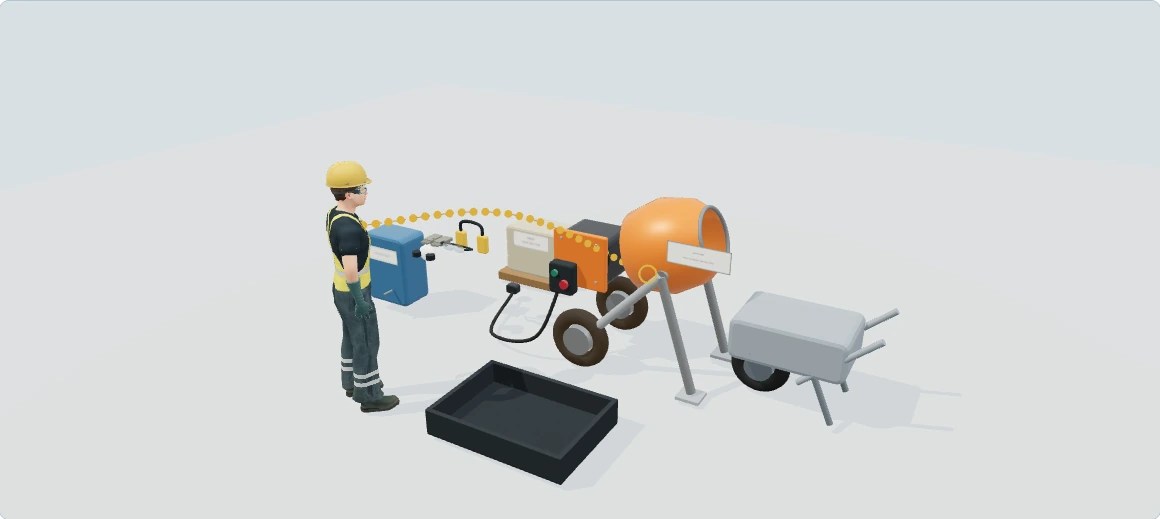

Cement mixing: rotating machinery, airborne powder and wet burns
Explore how this equipment can harm its users and other people, then follow the practical measures that interrupt each pathway. This is a hazards and good-practice lesson; the separate checklist remains the pre-use/safety-check activity.
Hazards and good practice: learn what can hurt people during use, change and maintenance. Pre-use and safety checks stay in the separate checklist.
Checksheets and risk assessments
Equipment checksheets
Risk assessment forms
Risk assessment examples
Forms and tools
Full written walkthrough — all 8 steps
1. Plan the material and mixing method
What is happening: Receiving bags, charging the mixer, placing product and cleaning are linked parts of the task.
How harm can occur: A method that controls one stage can leave others exposed to dust, strain or moving machinery.
Best practice to apply: Consider supply and ready-mixed options that remove difficult transfers and powder handling; assess the remaining task.
Why this works: Changing supply or process can remove exposure rather than simply adding PPE to each stage.
What is cement dust and why is it hazardous at work? · Choose dry powder, wet cement or hardened-material cutting2. Control dry powder at release
What is happening: Opening and emptying a bag can release fine material before mixing begins.
How harm can occur: Inhaled dust can harm airways and irritate eyes; the composition and task determine the assessment.
Best practice to apply: Identify the product and use suitable enclosed/controlled transfer and dust controls, with assessed residual protection.
Why this works: Controlling release protects the person tipping the bag and other people nearby.
What is cement dust and why is it hazardous at work? · Choose dry powder, wet cement or hardened-material cutting3. Recognise that wet cement is a different hazard
What is happening: Wet product and slurry remain hazardous even when airborne powder is reduced.
How harm can occur: Alkaline material trapped against skin can cause dermatitis or deep chemical burns without severe initial pain.
Best practice to apply: Prevent skin/eye contact through suitable work methods and protective clothing, with effective welfare and prompt response to contamination.
Why this works: Removing visible dust does not remove chemical harm from wet material held in boots, gloves or clothing.
What is cement dust and why is it hazardous at work? · Choose dry powder, wet cement or hardened-material cutting4. Keep people away from moving parts
What is happening: The drum and its drive act on material and can also act on a person's clothing or limbs.
How harm can occur: Reaching into moving equipment or exposing a transmission can entangle, draw in or crush.
Best practice to apply: Use suitable guarding and methods that keep charging and work outside dangerous movement; do not bypass protection.
Why this works: The method has to keep the person away while the machine is capable of moving.
Mechanical hazards · How can a roller nip point cause serious injury?5. Organise material movement and footing
What is happening: Bags, trolleys, the mixer and the placing route affect posture, force and access.
How harm can occur: Heavy or awkward transfers, slippery slurry and trailing equipment can cause strains, slips and secondary contact.
Best practice to apply: Redesign transfers, provide suitable handling assistance and maintain the actual work and placing routes.
Why this works: A manageable supply path reduces repeated force and prevents contamination creating a walking hazard.
What is cement dust and why is it hazardous at work? · What welfare is needed?6. Separate cleaning from operating
What is happening: Residue removal or jam clearance may require access that normal mixing does not.
How harm can occur: Unexpected start or drum movement can trap someone while they clean or reach inside.
Best practice to apply: Use the actual competent isolation, securing and cleaning procedure before intrusive access; a stop button alone is not isolation.
Why this works: Cleaning changes where people can reach, so production guarding and stop arrangements alone may not suffice.
Mechanical hazards · When should work involving mechanical hazards stop?7. Contain washout and protect helpers
What is happening: Wash water, slurry and contaminated tools can spread exposure beyond the mixer.
How harm can occur: Wet contamination can harm cleaners, waste handlers and people using the surrounding area.
Best practice to apply: Use suitable contained washout, safe waste arrangements and washing facilities; keep contaminated routes and items controlled.
Why this works: Containment prevents moving the hazard from the workpiece to the cleaner or the next user.
What is cement dust and why is it hazardous at work? · What forms can cement-related exposure take?8. Review the full task and return it safely
What is happening: Wear, damaged guarding and reported skin or breathing problems are evidence that the arrangement needs review.
How harm can occur: Repeating the same task without correcting causes can worsen health harm or lead to mechanical injury.
Best practice to apply: Stop unsafe work, report symptoms/defects and verify competent repairs and suitable task controls before return.
Why this works: A clean appearance or completed check cannot substitute for an effective work method and resolved defects.
Mechanical hazards · How should mechanical hazards be assured?
Illustrative awareness learning. Geometry, colours and movement do not establish safe distances, capacity, exposure, isolation or work permission. Use the actual assessment, equipment information and competent arrangements.
The wider workplace has its own account and subscription access. Exploring this lesson does not grant access, record course completion or authorise work.
What are mechanical hazards?
Mechanical hazards are injury mechanisms caused by moving parts, stored energy, sharp edges, ejected material or mechanical force.
A power take-off (PTO) is a rotating drive shaft that can create severe entanglement hazards. Guard it and isolate its energy before access. A mobile elevating work platform (MEWP) can also trap or crush an occupant against overhead structures.
Mechanical hazards are often described by the way the body is harmed: crushing, shearing, cutting, severing, entanglement, drawing-in, trapping, puncture, impact, abrasion, friction burn or ejection. The same machine may contain several of these hazards at once. Sources: HSE introduction to machinery safety; HSENI PUWER (NI) 1999 overview
Examples include rollers, belts, pulleys, gears, chains, conveyors, presses, compactors, mixers, saws, drills, grinders, power take-offs, robot arms, injection moulding machines, mobile plant, vehicle tail-lifts and hand-held tools. Stored energy can be just as dangerous as visible movement: gravity, springs, hydraulic pressure, pneumatic pressure, electrical energy, rotating inertia and suspended loads can all move unexpectedly. Sources: HSE introduction to machinery safety; HSENI PUWER (NI) 1999 overview
Good mechanical hazard control starts by understanding the movement and the person's access to it. The question is not just whether a guard exists; it is whether anyone can reach danger during operation, setup, cleaning, adjustment, blockage clearing, maintenance, fault finding or restart. Sources: HSE introduction to machinery safety; HSENI PUWER (NI) 1999 overview
| Hazard mechanism | How harm occurs | Examples |
|---|---|---|
| Crushing | Body part trapped between moving and fixed parts or two moving parts. | Press, closing guard, vehicle, tail-lift, scissor mechanism.Sources: HSE introduction to machinery safety; HSENI PUWER (NI) 1999 overview |
| Shearing | Parts move past each other and cut or sever. | Guillotine, shear, closing die, scissor lift mechanism.Sources: HSE introduction to machinery safety; HSENI PUWER (NI) 1999 overview |
| Entanglement | Clothing, hair, gloves or jewellery caught by rotating parts. | Shaft, drill, lathe, PTO, mixer.Sources: HSE introduction to machinery safety; HSENI PUWER (NI) 1999 overview |
| Drawing-in | Body part pulled into nip point. | Rollers, belts, conveyors, pulley drives.Sources: HSE introduction to machinery safety; HSENI PUWER (NI) 1999 overview |
| Cutting/severing | Sharp or powered edge cuts tissue. | Saw blade, knife, milling cutter, grinder disc.Sources: HSE introduction to machinery safety; HSENI PUWER (NI) 1999 overview |
| Ejection/impact | Material, broken part or tool is thrown. | Burst abrasive wheel, press ejection, failed component.Sources: HSE introduction to machinery safety; HSENI PUWER (NI) 1999 overview |
| Stored energy | Energy releases unexpectedly. | Hydraulic ram, raised load, spring, compressed air, rotating flywheel.Sources: HSE high-pressure fluid injection hazards; HSENI hydraulic injection injury alert |
How should mechanical hazards be controlled?
Controls should prevent access to dangerous movement, control energy, make intervention safe and ensure safeguards are maintained.
The safeguarding hierarchy starts with design and elimination: can the dangerous movement be removed, enclosed, slowed, automated, separated or accessed differently? Where danger remains, use fixed guards where practical, interlocked guards where access is needed, presence-sensing systems where suitable, jigs or holders where full guarding is not possible, then information, training and supervision for residual risk. Sources: HSE introduction to machinery safety; HSE L22 safe use of work equipment
Emergency stops and warning signs are not the main control. They may help after danger is recognised, but they do not prevent access, entanglement or fast trapping. Isolation and lock-off are essential for maintenance, blockage clearing and intervention where people enter danger zones. Sources: HSE introduction to machinery safety; HSE L22 safe use of work equipment
| Control level | Example | Limit |
|---|---|---|
| Eliminate/design out | Automate feed or remove need to access moving parts. | Best control but needs design/procurement input.Sources: HSE introduction to machinery safety; HSE L22 safe use of work equipment |
| Fixed guarding | Secure guard over belts, gears or blades. | Fails if removed and not replaced.Sources: HSE introduction to machinery safety; HSE L22 safe use of work equipment |
| Interlocked or guard-locked access | Machine stops before dangerous movement can be reached. | Requires correct design, testing and anti-defeat control.Sources: HSE introduction to machinery safety; HSE L22 safe use of work equipment |
| Presence sensing | Light curtain, scanner or pressure mat. | Needs stopping-time/distance validation and restart control.Sources: HSE introduction to machinery safety; HSE L22 safe use of work equipment |
| Jigs, holders or push sticks | Keep hands away from blade or cutter. | Only suitable for defined tasks.Sources: HSE introduction to machinery safety; HSE L22 safe use of work equipment |
| Isolation and lock-off | Controls energy during maintenance or clearing. | Must include stored energy and try-start.Sources: HSE introduction to machinery safety; HSE L22 safe use of work equipment |
| Training and supervision | Explains hazards, controls and stop points. | Cannot compensate for poor guarding or unsafe design.Sources: HSE introduction to machinery safety; HSE L22 safe use of work equipment |
What protection is needed before someone reaches a dangerous part?
Design out exposure where practicable, then use suitable fixed or interlocked guarding and verified safe isolation for intervention. An emergency stop or a stopped machine is not proof that every energy source is isolated.
Hydraulic lift: stop is not isolation


Read the complete visual as text
- Motion stopped: A raised part, pressurised hose and connected power can remain hazardous when the lift table is stationary.
- Energy controlled: Identify and secure relevant energy sources, support raised parts by the designed method, control pressure and prevent reconnection.
- Prove before access: Use the task-specific approved proving route. No pressure gauge, stopped movement or lock picture alone establishes the complete safe state.
Hydraulic injection needs urgent care


Read the complete visual as text
- Keep hands away: A fine high-pressure leak can penetrate skin. Never search for a leak with a hand or approach the jet.
- Treat suspected injection urgently: A small-looking wound can conceal serious injury. Use the emergency medical route and provide the fluid identity to the treating professionals.
- Control the equipment separately: Stop and secure the affected system through the competent site method. Clinical care and equipment isolation/repair remain separate decisions.
Before maintenance: prove the safe energy state
2 linked parts. Follow the question numbers and complete the applicable route.
Part 1 of 2 · Questions 1–3

Continue · Part 2 of 2 · Questions 4–6


Read the complete visual as text
- Start: Before maintenance or intervention into an energy danger zone.
- Question 1: Is the task-specific energy inventory complete? Decision owner: Competent isolation/engineering lead.
- YES: Plan each electrical, pneumatic, hydraulic, gravity and spring source. Owner: Competent isolation/engineering lead. CONTINUE → QUESTION 2.
- NO: Hold maintenance access while any connected or stored energy remains unidentified. Owner: Competent isolation/engineering lead. HOLD → REPEAT QUESTION 1 AFTER CORRECTION.
- UNKNOWN: Keep the hold. Hold maintenance access while any connected or stored energy remains unidentified. Owner: Competent isolation/engineering lead. HOLD → REPEAT QUESTION 1 AFTER CORRECTION.
- Question 2: Can every source be isolated and reconnection controlled? Decision owner: Authorised competent maintainer.
- YES: Apply the machine-specific isolation and reconnection controls. Owner: Authorised competent maintainer. CONTINUE → QUESTION 3.
- NO: Hold access and obtain competent engineering advice; a normal stop is insufficient. Owner: Authorised competent maintainer. HOLD → REPEAT QUESTION 2 AFTER CORRECTION.
- UNKNOWN: Keep the hold. Hold access and obtain competent engineering advice; a normal stop is insufficient. Owner: Authorised competent maintainer. HOLD → REPEAT QUESTION 2 AFTER CORRECTION.
- Question 3: Are raised parts supported and pressure/springs safely controlled? Decision owner: Authorised competent maintainer.
- YES: Prove the safe state for the task. Owner: Authorised competent maintainer. CONTINUE → QUESTION 4.
- NO: Hold access until the designed support and stored-energy method is established and applied. Owner: Authorised competent maintainer. HOLD → REPEAT QUESTION 3 AFTER CORRECTION.
- UNKNOWN: Keep the hold. Hold access until the designed support and stored-energy method is established and applied. Owner: Authorised competent maintainer. HOLD → REPEAT QUESTION 3 AFTER CORRECTION.
- Question 4: Has the task-specific safe state been proved? Decision owner: Competent isolation lead.
- YES: Authorised people may work only within the verified method. Owner: Competent isolation lead. CONTINUE → QUESTION 5.
- NO: Do not enter; resolve the proving gap through competent engineering support. Owner: Competent isolation lead. HOLD → REPEAT QUESTION 4 AFTER CORRECTION.
- UNKNOWN: Keep the hold. Do not enter; resolve the proving gap through competent engineering support. Owner: Competent isolation lead. HOLD → REPEAT QUESTION 4 AFTER CORRECTION.
- Question 5: Are work complete, people clear and safeguards restored? Decision owner: Maintainer and equipment owner.
- YES: Use the controlled restoration and function-test method. Owner: Maintainer and equipment owner. CONTINUE → QUESTION 6.
- NO: Keep isolation/restriction until tools, people and safeguards are accounted for. Owner: Maintainer and equipment owner. HOLD → REPEAT QUESTION 5 AFTER CORRECTION.
- UNKNOWN: Keep the hold. Keep isolation/restriction until tools, people and safeguards are accounted for. Owner: Maintainer and equipment owner. HOLD → REPEAT QUESTION 5 AFTER CORRECTION.
- Question 6: Are restoration tests accepted by the named local owner? Decision owner: Named equipment release owner.
- YES: Document hand-back and brief the operators. Owner: Named equipment release owner. OUTCOME → RECORD AND HAND OVER.
- NO: Keep the equipment held; correct and re-test the failed or uncertain function. Owner: Named equipment release owner. HOLD → REPEAT QUESTION 6 AFTER CORRECTION.
- UNKNOWN: Keep the hold. Keep the equipment held; correct and re-test the failed or uncertain function. Owner: Named equipment release owner. HOLD → REPEAT QUESTION 6 AFTER CORRECTION.
- Outcome: Verified authorised work and controlled restoration or continued isolation hold.
- Stop and escalation boundary: This is an evidence/check map, not a lockout instruction or permission for live work.
HSE describes a safeguarding order under PUWER regulation 11: fixed guards where practicable, then suitable other guards or protective devices, then jigs/holders and residual information, training and supervision. Interlocks must suit run-down and access time; a bypassed guard or hidden nip point defeats separation. For cleaning, jam clearing and repair, identify all electrical, mechanical, hydraulic, pneumatic and gravity energy, lock off, dissipate and verify before access. Provision and Use of Work Equipment Regulations 1998, HSE introduction to machinery safety, HSE L22 safe use of work equipment and HSE maintenance of work equipment.
| Situation | Required decision | Proof and stop |
|---|---|---|
| Normal running | Keep people out by suitable guards and protective devices selected for the machine. | Check guard integrity, reach and operation; stop for missing or defeated protection.Sources: HSE introduction to machinery safety; HSE L22 safe use of work equipment |
| Frequent setting or cleaning | Plan safe access; interlocking may be needed and cannot itself be assumed to isolate stored energy. | Verify run-down, reset behaviour and the task method; stop for unexpected movement.Sources: HSE introduction to machinery safety; HSE maintenance of work equipment |
| Jam clearing or repair | Stop, isolate/lock off relevant sources, release or restrain stored energy and test safe state. | Named competent person verifies before entry; stop if any source is unknown.Sources: HSE maintenance of work equipment; HSE PUWER overview |
| Hydraulic leak | Never search with bare hands; depressurise and use a safe inspection method. | Stop equipment; any suspected injection injury needs immediate medical treatment.Sources: HSE high-pressure fluid injection hazards; HSENI hydraulic injection injury alert |
How can the hierarchy of controls prevent harmful contact with moving machinery and materials?
Prevent access to moving and stored-energy hazards before an intervention. Removing the cause of recurring jams is stronger than normalising frequent hands-on clearance.
Illustrative decision: a conveyor repeatedly jams at a roller transfer. The engineer, operators and maintenance team review feeding, product alignment, guards and the protected clearance method for the actual machine.
ERICPD means Eliminate, Reduce (including substitution), Isolate, Control, PPE and Discipline. The five-level hierarchy groups measures as elimination, substitution, engineering controls, administrative controls and PPE. They overlap: isolation is usually an engineering measure; control can include engineered and administrative measures. Discipline means maintaining and checking the controls, supervising the method and learning from defects, rather than blaming someone or accepting weaker protection.
How can the ERICPD hierarchy of controls prevent harmful contact with moving machinery and materials?

| ERICPD and five-level position | Intervention and owner | Verification, failure and stop point |
|---|---|---|
| Eliminate / elimination | Engineering examines removing the nip exposure or the transfer causing the jam through a suitable redesign. | Verify the changed machine and connected equipment; transferred trapping or ejection risk must also be resolved. |
| Reduce / substitution when replacing a hazard; otherwise engineering or administrative risk reduction | Compare suitable feed or product arrangements and less hazardous mechanical methods without assuming slower movement removes the nip hazard. | Record compatibility and remaining energy/harm routes. Reduced speed alone does not authorise reaching into moving rollers. |
| Isolate / engineering | Specify suitable guarding and interlocking and maintainable energy isolation for the actual machine; control stored, gravity and connected energy. | Use competent protected verification. A missing guard, defeated interlock or unverified safe state prevents intervention and operation as applicable. |
| Control / administrative | Plan an authorised clearance method, trained roles, communication and controlled restart. Workers report repeated jams instead of improvising reach-in work. | Observe the method safely and confirm all relevant energy is controlled. An emergency stop or stationary appearance is not proof of isolation. |
| PPE / PPE | Select residual eye, foot and other protection for the assessed task, considering entanglement hazards. | Do not choose gloves or clothing as protection against a powered nip; unsuitable items may create additional entanglement risk. |
| Discipline / sustained engineering and administrative controls | Managers fund recurring-fault correction; supervisors maintain safeguards, restrict defective equipment and verify handback. | Keep fault, inspection and restoration evidence. Unresolved protective faults or an unexplained restart keeps the equipment restricted. |
How can the ISO 45001 hierarchy of controls prevent harmful contact with moving machinery and materials?

| ERICPD and five-level position | Intervention and owner | Verification, failure and stop point |
|---|---|---|
| Eliminate / elimination | Engineering examines removing the nip exposure or the transfer causing the jam through a suitable redesign. | Verify the changed machine and connected equipment; transferred trapping or ejection risk must also be resolved. |
| Reduce / substitution when replacing a hazard; otherwise engineering or administrative risk reduction | Compare suitable feed or product arrangements and less hazardous mechanical methods without assuming slower movement removes the nip hazard. | Record compatibility and remaining energy/harm routes. Reduced speed alone does not authorise reaching into moving rollers. |
| Isolate / engineering | Specify suitable guarding and interlocking and maintainable energy isolation for the actual machine; control stored, gravity and connected energy. | Use competent protected verification. A missing guard, defeated interlock or unverified safe state prevents intervention and operation as applicable. |
| Control / administrative | Plan an authorised clearance method, trained roles, communication and controlled restart. Workers report repeated jams instead of improvising reach-in work. | Observe the method safely and confirm all relevant energy is controlled. An emergency stop or stationary appearance is not proof of isolation. |
| PPE / PPE | Select residual eye, foot and other protection for the assessed task, considering entanglement hazards. | Do not choose gloves or clothing as protection against a powered nip; unsuitable items may create additional entanglement risk. |
| Discipline / sustained engineering and administrative controls | Managers fund recurring-fault correction; supervisors maintain safeguards, restrict defective equipment and verify handback. | Keep fault, inspection and restoration evidence. Unresolved protective faults or an unexplained restart keeps the equipment restricted. |
The comparison is an original illustrative application of the general HSE hierarchy, not a machine-specific method, permit or design approval. The employer must choose measures for the actual work and jurisdiction. Apply the separate Northern Ireland legal route where relevant; the local assessment and competent technical decision govern release.
How can a roller nip point cause serious injury?
A roller example shows why access, speed, clothing, guards and cleaning methods must be designed together.
A production line uses two powered rollers to feed material. Operators occasionally wipe adhesive from the roller surface during slow running because stopping the machine causes waste. A loose glove is drawn into the nip point and the worker's hand is trapped before the emergency stop can be reached. Sources: HSE introduction to machinery safety; HSE maintenance of work equipment
A mature review does not stop at 'worker put hand near rollers'. It asks why cleaning was needed during running, why slow speed still allowed drawing-in, why access to the nip point was possible, why gloves were worn near rotating parts, why the stop control was too late and why production waste made unsafe cleaning feel normal. Sources: HSE introduction to machinery safety; HSE maintenance of work equipment
| Factor | Failure route | Better control |
|---|---|---|
| Accessible nip point | Hand can reach drawing-in zone. | Fixed or interlocked guard with safe cleaning access.Sources: HSE introduction to machinery safety; HSE maintenance of work equipment |
| Cleaning during running | Intervention occurs while hazard is live. | Stop and safely isolate/lock off relevant energy, release or restrain stored energy and verify a safe state before hazardous access. A genuinely engineered protected cleaning mode requires competent task-specific validation; ordinary stop, reduced speed, improvised tools or live hand wiping do not authorise reach-in cleaning.Sources: HSE introduction to machinery safety; HSE maintenance of work equipment |
| Loose glove | Material can be caught and drawn in. | Task-specific PPE review and no-glove zone where appropriate.Sources: HSE introduction to machinery safety; HSE maintenance of work equipment |
| Slow speed assumption | Slow movement still traps body parts. | Risk assess speed, force and stopping distance.Sources: HSE introduction to machinery safety; HSE maintenance of work equipment |
| Emergency stop distance | Reaction comes after entanglement. | Prevent access rather than relying on E-stop.Sources: HSE introduction to machinery safety; HSE maintenance of work equipment |
| Production pressure | Stopping creates waste and delay. | Design cleaning schedule and address process cause.Sources: HSE introduction to machinery safety; HSE maintenance of work equipment |
How should each mechanical hazard link to a control?
Each mechanical injury mechanism should be connected to a specific control, stop point and evidence standard.
Mechanical hazard control is strongest when the assessment names the harm mechanism clearly. 'Machine hazard' is too vague. A crushing hazard may need separation and restraint; an entanglement hazard may need fixed guarding and clothing/PPE rules; an ejection hazard may need containment and inspection; stored energy may need isolation, dissipation and verification. Sources: HSE introduction to machinery safety; HSE high-pressure fluid injection hazards
This table helps learners connect hazard recognition to practical control rather than treating guarding as a single generic answer. Sources: HSE introduction to machinery safety; HSE high-pressure fluid injection hazards
| Hazard | Typical work example | Primary controls and evidence |
|---|---|---|
| Crushing | Press, scissor mechanism, vehicle tail-lift, compactor or closing guard. | Fixed/interlocked guarding, exclusion zones, safe controls, maintenance and stop-work rule for access.Sources: HSE introduction to machinery safety; HSE L22 safe use of work equipment. |
| Shearing | Guillotine, shear, closing die or sliding mechanism. | Guarding, two-hand control where suitable, interlock, safe setting mode and tool-change isolation.Sources: HSE introduction to machinery safety; HSE L22 safe use of work equipment. |
| Cutting or severing | Saw blade, grinder, milling cutter, knife or powered cutter. | Fixed/adjustable guard, workpiece support, correct tooling, inspection and competence.Sources: HSE introduction to machinery safety; HSE L22 safe use of work equipment. |
| Entanglement | Rotating shaft, drill, lathe, PTO, mixer or exposed coupling. | Enclose rotation, no loose clothing/jewellery, suitable PPE rules and emergency isolation.Sources: HSE introduction to machinery safety; HSE L22 safe use of work equipment. |
| Drawing-in | Rollers, belts, pulleys, conveyor nip points or feed rollers. | Nip guarding, fixed distance, interlock/guard locking, safe cleaning method and no live wiping.Sources: HSE introduction to machinery safety; HSE L22 safe use of work equipment. |
| Impact | Robot arm, mobile plant, moving table, ejector or swing path. | Separation, presence sensing, restricted access, marked zones and restart control.Sources: HSE introduction to machinery safety; HSE L22 safe use of work equipment. |
| Ejection | Burst abrasive wheel, failed component, press ejection or flying swarf. | Containment, correct wheel/disc, inspection, speed rating, guarding and eye/face protection.Sources: HSE introduction to machinery safety; HSE L22 safe use of work equipment. |
| Stored energy | Hydraulic ram, raised load, compressed air, spring, flywheel or gravity load. | Isolate, lock off, block, chock, drain, vent, dissipate and verify the safe energy state, including secure restraint where energy cannot be removed; a try-start alone does not prove pressure, gravity or connected equipment safe.Sources: HSE high-pressure fluid injection hazards; HSENI hydraulic injection injury alert |
| Emergency-stop reliance | Operator expected to stop after danger appears. | Use E-stop as supplementary control only; prevent access and validate stopping distance.Sources: HSE introduction to machinery safety; HSE L22 safe use of work equipment. |
| Safe intervention | Jam clearing, cleaning, adjustment, setting or maintenance. | Permit/authorisation where needed, isolation, safe tool, supervision and handback evidence.Sources: HSE L22 safe use of work equipment; HSE maintenance of work equipment. |
How should supervisors recognise mechanical hazards during walk-throughs?
A walk-through should follow movement, energy and access, not just check whether machinery looks tidy.
One machine, several injury paths


Read the complete visual as text
- Nip and closing zone: A conveyor nip can draw a person in; a closing transfer gate can crush or shear. Guard each reachable movement path.
- Ejection path: A loose workpiece can leave the process and reach someone outside the contact zone. Containment and work-holding need their own assessment.
- Stop point: Keep people outside danger. Missing, defeated or unreliable safeguarding stops use until competent correction and release.
People and mobile plant


Read the complete visual as text
- Separate routes: A loading bay needs suitable pedestrian separation, vehicle movement control and visibility for the actual operation.
- A temporary change matters: A moved work zone or blocked sight line can defeat the original arrangement even if the machine is unchanged.
- Hold then verify: The supervisor holds affected movement until the revised route, separation and sight line are verified and briefed.
Supervisors should ask: what moves, what can start, what can fall, what stores energy, what can eject, what can rotate, what can draw in, what is sharp, what gets hot or cold, and when do people need to get close? Sources: HSE introduction to machinery safety; HSE high-pressure fluid injection hazards
The most important areas are often non-routine: cleaning, clearing blockages, tool change, adjustment, setup, fault finding, maintenance and restart. These tasks reveal whether the safeguard works for real work or only for normal production. Sources: HSE introduction to machinery safety; HSE high-pressure fluid injection hazards
| Prompt | What to look for | Action |
|---|---|---|
| Movement | Rotating, reciprocating, sliding, closing or lifting parts. | Guard or separate danger zone.Sources: HSE introduction to machinery safety; HSE high-pressure fluid injection hazards |
| Access | Hands, clothing or tools near dangerous parts. | Redesign access or method.Sources: HSE introduction to machinery safety; HSE high-pressure fluid injection hazards |
| Stored energy | Raised loads, pressure, springs, flywheels or gravity. | Dissipate, block and verify.Sources: HSE introduction to machinery safety; HSE high-pressure fluid injection hazards |
| Ejection | Material or component could be thrown. | Contain, shield and inspect.Sources: HSE introduction to machinery safety; HSE high-pressure fluid injection hazards |
| Non-routine task | Cleaning, jams or setup expose people. | Assess and create safe intervention method.Sources: HSE introduction to machinery safety; HSE high-pressure fluid injection hazards |
| Defeat signal | Taped interlocks, removed guards or informal tools. | Stop, investigate and redesign.Sources: HSE introduction to machinery safety; HSE high-pressure fluid injection hazards |
How do mechanical hazards appear outside fixed machinery?
Mechanical hazards also arise from hand tools, mobile work equipment, lifting equipment and workplace vehicles.
A mechanical hazard page should not be limited to factory machinery. Drills can entangle gloves, grinders can eject fragments, compactors can crush, tail-lifts can trap, mobile elevating work platforms (MEWPs) can crush occupants, forklifts can strike or crush, and lifting operations can drop or swing loads. Sources: HSE introduction to machinery safety; HSENI PUWER (NI) 1999 overview
The same logic applies: identify the movement or energy, prevent access, control the interface, maintain equipment, train users and define stop points. Sources: HSE introduction to machinery safety; HSENI PUWER (NI) 1999 overview
| Equipment | Mechanical hazard | Control focus |
|---|---|---|
| Hand-held drill | Entanglement and torque reaction. | No loose gloves/clothing, correct bit and secure workpiece.Sources: HSE introduction to machinery safety; HSENI PUWER (NI) 1999 overview |
| Angle grinder | Cutting, kickback and wheel burst. | Guard, correct disc, inspection and face/eye protection.Sources: HSE introduction to machinery safety; HSENI PUWER (NI) 1999 overview |
| Compactor | Crushing and trapping. | Interlocks, access control and safe clearing.Sources: HSE introduction to machinery safety; HSENI PUWER (NI) 1999 overview |
| Tail-lift | Crushing, shearing and falling load. | Maintenance, edge control and loading method.Sources: HSE introduction to machinery safety; HSENI PUWER (NI) 1999 overview |
| Forklift | Crush/impact with people or structures. | Segregation, training and route design.Sources: HSE introduction to machinery safety; HSENI PUWER (NI) 1999 overview |
| MEWP | Entrapment against overhead structure. | Route assessment and secondary guarding where appropriate.Sources: HSE introduction to machinery safety; HSENI PUWER (NI) 1999 overview |
When should work involving mechanical hazards stop?
Stop when people can reach dangerous movement, safeguards are missing or defeated, stored energy is uncontrolled or safe intervention is unclear.
Before operation: verify the actual machine and task
2 linked parts. Follow the question numbers and complete the applicable route.
Part 1 of 2 · Questions 1–3

Continue · Part 2 of 2 · Questions 4–6


Read the complete visual as text
- Start: Before operating the identified machine.
- Question 1: Are the machine, mode, task and affected people identified? Decision owner: Supervisor and equipment owner.
- YES: Check the task-specific safeguards and controls. Owner: Supervisor and equipment owner. CONTINUE → QUESTION 2.
- NO: Hold use and establish the actual equipment, mode, intervention and people. Owner: Supervisor and equipment owner. HOLD → REPEAT QUESTION 1 AFTER CORRECTION.
- UNKNOWN: Keep the hold. Hold use and establish the actual equipment, mode, intervention and people. Owner: Supervisor and equipment owner. HOLD → REPEAT QUESTION 1 AFTER CORRECTION.
- Question 2: Are guards and interlocks present and effective for every approach? Decision owner: Supervisor with competent machinery support.
- YES: Check controls and work-holding. Owner: Supervisor with competent machinery support. CONTINUE → QUESTION 3.
- NO: Stop and quarantine/isolate as required; restore suitable guarding without a bypass. Owner: Supervisor with competent machinery support. HOLD → REPEAT QUESTION 2 AFTER CORRECTION.
- UNKNOWN: Keep the hold. Stop and quarantine/isolate as required; restore suitable guarding without a bypass. Owner: Supervisor with competent machinery support. HOLD → REPEAT QUESTION 2 AFTER CORRECTION.
- Question 3: Are controls and work-holding suitable and functioning? Decision owner: Competent equipment owner.
- YES: Check the area and access. Owner: Competent equipment owner. CONTINUE → QUESTION 4.
- NO: Hold use and correct the defective control or work-holding through competent support. Owner: Competent equipment owner. HOLD → REPEAT QUESTION 3 AFTER CORRECTION.
- UNKNOWN: Keep the hold. Hold use and correct the defective control or work-holding through competent support. Owner: Competent equipment owner. HOLD → REPEAT QUESTION 3 AFTER CORRECTION.
- Question 4: Are the area and danger zones clear and controlled? Decision owner: Supervisor.
- YES: Check the operator’s instruction and authority. Owner: Supervisor. CONTINUE → QUESTION 5.
- NO: Keep people clear and restore task-specific separation before use. Owner: Supervisor. HOLD → REPEAT QUESTION 4 AFTER CORRECTION.
- UNKNOWN: Keep the hold. Keep people clear and restore task-specific separation before use. Owner: Supervisor. HOLD → REPEAT QUESTION 4 AFTER CORRECTION.
- Question 5: Is the user instructed and authorised for this machine, task and mode? Decision owner: Supervisor.
- YES: Accept controlled use under the local method, with continued monitoring. Owner: Supervisor. CONTINUE → QUESTION 6.
- NO: Hold operation and provide the required task instruction/authorisation. Owner: Supervisor. HOLD → REPEAT QUESTION 5 AFTER CORRECTION.
- UNKNOWN: Keep the hold. Hold operation and provide the required task instruction/authorisation. Owner: Supervisor. HOLD → REPEAT QUESTION 5 AFTER CORRECTION.
- Question 6: Has a fault, safeguard defeat or material task change appeared? Decision owner: Supervisor.
- YES: Stop affected use; quarantine/isolate and obtain competent review. Owner: Supervisor. STOP / REFER → APPROPRIATE RESPONSE.
- NO: Continue only within the verified method and monitor change. Owner: Supervisor. OUTCOME → RECORD AND HAND OVER.
- UNKNOWN: Hold use and ask the competent machinery/electrical owner to resolve the condition. Owner: Supervisor. HOLD → REPEAT QUESTION 6 AFTER CORRECTION.
- Outcome: Controlled use or continued hold with named competent review.
- Stop and escalation boundary: No guard dimensions, performance level, stopping time or product-conformity approval is given.
Jammed material: separate external method from entry
2 linked parts. Follow the question numbers and complete the applicable route.
Part 1 of 2 · Questions 1–3

Continue · Part 2 of 2 · Questions 4–6


Read the complete visual as text
- Start: Material jams in the identified machine.
- Question 1: Can a designed external method clear it without danger-zone entry? Decision owner: Supervisor with competent equipment owner.
- YES: Use only the manufacturer-designed method and check its required conditions. Owner: Supervisor with competent equipment owner. CONTINUE → QUESTION 5.
- NO: Stop and prepare a competent isolation method for intervention. Owner: Supervisor with competent equipment owner. CONTINUE → QUESTION 2.
- UNKNOWN: Hold clearing and obtain the machine-specific safe method. Owner: Supervisor with competent equipment owner. HOLD → REPEAT QUESTION 1 AFTER CORRECTION.
- Question 2: Are all electrical, mechanical, hydraulic, pneumatic and gravity sources identified? Decision owner: Authorised competent maintainer.
- YES: Isolate and control reconnection for each source. Owner: Authorised competent maintainer. CONTINUE → QUESTION 3.
- NO: Hold access and establish the complete task-specific energy schedule. Owner: Authorised competent maintainer. HOLD → REPEAT QUESTION 2 AFTER CORRECTION.
- UNKNOWN: Keep the hold. Hold access and establish the complete task-specific energy schedule. Owner: Authorised competent maintainer. HOLD → REPEAT QUESTION 2 AFTER CORRECTION.
- Question 3: Are sources isolated, reconnection controlled and stored energy restrained? Decision owner: Authorised competent maintainer.
- YES: Verify the safe state before any access. Owner: Authorised competent maintainer. CONTINUE → QUESTION 4.
- NO: Hold access; isolate, lock as needed, dissipate pressure and support parts through the approved method. Owner: Authorised competent maintainer. HOLD → REPEAT QUESTION 3 AFTER CORRECTION.
- UNKNOWN: Keep the hold. Hold access; isolate, lock as needed, dissipate pressure and support parts through the approved method. Owner: Authorised competent maintainer. HOLD → REPEAT QUESTION 3 AFTER CORRECTION.
- Question 4: Has the task-specific safe state been proved before entry? Decision owner: Authorised competent maintainer.
- YES: Only authorised intervention follows the verified method. Owner: Authorised competent maintainer. CONTINUE → QUESTION 5.
- NO: Do not enter; obtain competent proving of the actual sources and restraint. Owner: Authorised competent maintainer. HOLD → REPEAT QUESTION 4 AFTER CORRECTION.
- UNKNOWN: Keep the hold. Do not enter; obtain competent proving of the actual sources and restraint. Owner: Authorised competent maintainer. HOLD → REPEAT QUESTION 4 AFTER CORRECTION.
- Question 5: Are people clear and safeguards restored and tested after clearing? Decision owner: Competent maintainer and supervisor.
- YES: Present the completed clearing/test evidence for local restart. Owner: Competent maintainer and supervisor. CONTINUE → QUESTION 6.
- NO: Keep the machine held and correct missing guards, people or failed function. Owner: Competent maintainer and supervisor. HOLD → REPEAT QUESTION 5 AFTER CORRECTION.
- UNKNOWN: Keep the hold. Keep the machine held and correct missing guards, people or failed function. Owner: Competent maintainer and supervisor. HOLD → REPEAT QUESTION 5 AFTER CORRECTION.
- Question 6: Has the named local owner accepted restart and briefed users? Decision owner: Named equipment release owner.
- YES: Record controlled restart and investigate repeated jams. Owner: Named equipment release owner. OUTCOME → RECORD AND HAND OVER.
- NO: Keep quarantine until hand-back and user briefing are accepted. Owner: Named equipment release owner. HOLD → REPEAT QUESTION 6 AFTER CORRECTION.
- UNKNOWN: Keep the hold. Keep quarantine until hand-back and user briefing are accepted. Owner: Named equipment release owner. HOLD → REPEAT QUESTION 6 AFTER CORRECTION.
- Outcome: External designed clearing or verified isolated intervention, followed by named restart; otherwise continued hold.
- Stop and escalation boundary: No isolation points, live intervention instructions or rescue sequence are created by this map.
Failed safeguard: repair the cause and test the function
2 linked parts. Follow the question numbers and complete the applicable route.
Part 1 of 2 · Questions 1–3

Continue · Part 2 of 2 · Questions 4–5


Read the complete visual as text
- Start: A safeguard has failed or is unreliable.
- Question 1: Has the equipment been stopped and secured against use? Decision owner: Supervisor.
- YES: Quarantine the affected equipment and assign competent repair. Owner: Supervisor. CONTINUE → QUESTION 2.
- NO: Stop use and secure the equipment through the site method. Owner: Supervisor. HOLD → REPEAT QUESTION 1 AFTER CORRECTION.
- UNKNOWN: Keep the hold. Stop use and secure the equipment through the site method. Owner: Supervisor. HOLD → REPEAT QUESTION 1 AFTER CORRECTION.
- Question 2: Has a competent person established and repaired the cause? Decision owner: Machinery/functional-safety specialist.
- YES: Check related equipment and conditions for the same defect. Owner: Machinery/functional-safety specialist. CONTINUE → QUESTION 3.
- NO: Continue quarantine while the defect or repair method is unresolved. Owner: Machinery/functional-safety specialist. HOLD → REPEAT QUESTION 2 AFTER CORRECTION.
- UNKNOWN: Keep the hold. Continue quarantine while the defect or repair method is unresolved. Owner: Machinery/functional-safety specialist. HOLD → REPEAT QUESTION 2 AFTER CORRECTION.
- Question 3: Have related machines or repeated failure conditions been checked? Decision owner: Competent equipment owner.
- YES: Test the restored complete safety function. Owner: Competent equipment owner. CONTINUE → QUESTION 4.
- NO: Keep the relevant equipment held and investigate shared causes or recurring defects. Owner: Competent equipment owner. HOLD → REPEAT QUESTION 3 AFTER CORRECTION.
- UNKNOWN: Keep the hold. Keep the relevant equipment held and investigate shared causes or recurring defects. Owner: Competent equipment owner. HOLD → REPEAT QUESTION 3 AFTER CORRECTION.
- Question 4: Has the actual safety function passed a documented competent test? Decision owner: Machinery/functional-safety specialist.
- YES: Give the result and limitations to the local release owner. Owner: Machinery/functional-safety specialist. CONTINUE → QUESTION 5.
- NO: Continue quarantine; correct and re-test. A switch repair alone is not proof of function. Owner: Machinery/functional-safety specialist. HOLD → REPEAT QUESTION 4 AFTER CORRECTION.
- UNKNOWN: Keep the hold. Continue quarantine; correct and re-test. A switch repair alone is not proof of function. Owner: Machinery/functional-safety specialist. HOLD → REPEAT QUESTION 4 AFTER CORRECTION.
- Question 5: Are users briefed and named local release recorded? Decision owner: Named equipment release owner.
- YES: Return only to the verified operating arrangement and monitor defects. Owner: Named equipment release owner. OUTCOME → RECORD AND HAND OVER.
- NO: Keep the equipment held pending accepted evidence, release and briefing. Owner: Named equipment release owner. HOLD → REPEAT QUESTION 5 AFTER CORRECTION.
- UNKNOWN: Keep the hold. Keep the equipment held pending accepted evidence, release and briefing. Owner: Named equipment release owner. HOLD → REPEAT QUESTION 5 AFTER CORRECTION.
- Outcome: Documented local release after competent repair/test, or continued quarantine.
- Stop and escalation boundary: This evidence map is not a safeguard design or permission to bypass protection.
Mechanical hazards can harm faster than people can react. If a guard, interlock, isolation, brake, restraint, access control or safe cleaning method is uncertain, the work should stop until the condition is understood and controlled. Sources: HSE introduction to machinery safety; HSE maintenance of work equipment
Supervisors should be especially alert to repeated jams, nuisance trips, informal tools, unguarded rotating shafts, damaged guards, missing emergency-stop tests, glove entanglement risks and maintenance work inside danger zones. Sources: HSE introduction to machinery safety; HSE maintenance of work equipment
| Trigger | Immediate action | Restart evidence |
|---|---|---|
| Guard missing or damaged | Stop or restrict use. | Guard repaired and checked.Sources: HSE introduction to machinery safety; HSE maintenance of work equipment |
| Interlock defeated or unreliable | Stop hazardous function. | Interlock tested and defeat cause reviewed.Sources: HSE introduction to machinery safety; HSE maintenance of work equipment |
| Stored energy not controlled | Isolate, block, drain, vent or secure. | Safe-energy-state verification, including secure restraint of retained potential energy.Sources: HSE introduction to machinery safety; HSE maintenance of work equipment |
| Blockage clearing unsafe | Pause and redesign method. | Safe intervention procedure and briefing.Sources: HSE introduction to machinery safety; HSE maintenance of work equipment |
| Ejection or breakage risk | Inspect and contain before use. | Inspection and replacement record.Sources: HSE introduction to machinery safety; HSE maintenance of work equipment |
| Repeated mechanical fault | Escalate root-cause review. | Engineering action and extent check.Sources: HSE introduction to machinery safety; HSE maintenance of work equipment |
Where do mechanical hazard controls fail?
They fail when access to movement is normalised, safeguards are defeated and non-routine tasks are not designed safely.
Failed interlock: hold the machine


Read the complete visual as text
- Report from a safe position: A failed guard switch on a hand-fed cutter means stop, prevent use and report the precise machine and defect.
- Competent correction: The maintainer controls energy and repairs the cause compatibly. A bypass, warning or extra supervision is not a substitute safeguard.
- Test then hand back: Restore and test the affected safety function, document the result and brief the user before named local release.
Common warning signs include removed guards, taped interlocks, hands near rollers, cleaning during running, loose clothing near rotating shafts, informal blockage tools, machines restarted after maintenance without handback and defects accepted because the machine still works. Sources: HSE introduction to machinery safety; HSE maintenance of work equipment
Good control treats those signs as system failures. If people are defeating safeguards, the organisation must understand the design, production, maintenance and supervision reasons behind that behaviour. Sources: HSE introduction to machinery safety; HSE maintenance of work equipment
| Failure or weak practice | How it develops | What good looks like |
|---|---|---|
| Guard defeat | Production continues with access to danger. | Investigate why and redesign safeguard/task.Sources: HSE introduction to machinery safety; HSE maintenance of work equipment |
| Non-routine work ignored | Cleaning and jams are not assessed. | Assess all intervention tasks.Sources: HSE introduction to machinery safety; HSE maintenance of work equipment |
| E-stop overreliance | Emergency stop expected to prevent injury. | Prevent access and validate stopping.Sources: HSE introduction to machinery safety; HSE maintenance of work equipment |
| Stored energy missed | Machine isolated but pressure/gravity remains. | Dissipate and verify all energy.Sources: HSE introduction to machinery safety; HSE maintenance of work equipment |
| PPE incompatibility | Gloves or clothing increase entanglement risk. | Task-specific PPE review.Sources: HSE introduction to machinery safety; HSE maintenance of work equipment |
| Maintenance handback weak | Machine returns to use with control missing. | Formal handback and function test.Sources: HSE introduction to machinery safety; HSE maintenance of work equipment |
What evidence shows mechanical hazards are controlled?
Evidence should show that mechanical injury mechanisms are understood, safeguards are suitable and intervention tasks are controlled.
Useful evidence includes machinery risk assessments, PUWER assessments, guarding standards, interlock tests, safe intervention methods, isolation procedures, maintenance records, inspection records, defect close-out, training, supervisor observations and incident learning. Sources: HSE PUWER overview; HSENI PUWER (NI) 1999 overview
The strongest evidence is physical: guards fitted, access prevented, stored energy controlled, safe cleaning methods used and workers able to explain stop points. Sources: HSE PUWER overview; HSENI PUWER (NI) 1999 overview
| Evidence item | What it should show | Assurance question |
|---|---|---|
| Hazard mechanism assessment | Crushing, shearing, entanglement, drawing-in, cutting, ejection and stored energy are assessed. | Does it cover non-routine access?Sources: HSE PUWER overview; HSENI PUWER (NI) 1999 overview |
| Safeguard inspection and test | Guards, interlocks, emergency stops and protective devices are checked. | Are defects closed before use?Sources: HSE PUWER overview; HSENI PUWER (NI) 1999 overview |
| Safe intervention controls | Cleaning, jam clearing, maintenance and setup have safe methods. | Are isolation and handback records complete?Sources: HSE PUWER overview; HSENI PUWER (NI) 1999 overview |
| Risk assessment | Assessment describes the actual task, people affected, credible harm routes, controls and review triggers. | Compare against work as done, not only the written method.Sources: HSE PUWER overview; HSENI PUWER (NI) 1999 overview |
| Control standard | The required control is defined in operational terms. | Workers and supervisors can explain what must be in place before work starts.Sources: HSE PUWER overview; HSENI PUWER (NI) 1999 overview |
| Competence and briefing | People have suitable instruction, training, supervision and authorisation where needed. | Competence is checked through observed practice, not attendance alone.Sources: HSE PUWER overview; HSENI PUWER (NI) 1999 overview |
| Monitoring and defect action | Checks find weak signals, defects and non-compliance early. | Actions are risk-ranked, owned and closed with evidence.Sources: HSE PUWER overview; HSENI PUWER (NI) 1999 overview |
| Management review | Leaders review trends, repeat findings, high-risk actions and resource needs. | Decisions and learning are recorded.Sources: HSE PUWER overview; HSENI PUWER (NI) 1999 overview |
How should mechanical hazards be assured?
Assurance should test whether dangerous movement and energy are controlled during normal and non-routine work.
First-line assurance includes operator checks and supervisor observation. Second-line assurance samples PUWER assessments, inspections, maintenance, defect trends and incident reports. Specialist assurance may involve machinery safety, engineering, control-system or OEM advice. Sources: HSE PUWER overview; HSE maintenance of work equipment
A strong assurance question is: how does the worker clear the most common jam, and can they do it without reaching into danger? Sources: HSE PUWER overview; HSE maintenance of work equipment
| Level | What to check | What good looks like |
|---|---|---|
| Frontline check | Workers and supervisors confirm that mechanical hazards controls are present, understood and suitable before work starts. | Work stops when critical controls are missing, defeated or unclear.Sources: HSE PUWER overview; HSE maintenance of work equipment |
| Manager review | Managers review open actions, repeat defects, competence gaps, incidents, health signals and work-as-done feedback. | Resources and deadlines match the seriousness of the risk.Sources: HSE PUWER overview; HSE maintenance of work equipment |
| Competent review | Specialists review technical, medical, fire, security, ergonomic or machinery complexity. | Advice is converted into practical controls and review dates.Sources: HSE PUWER overview; HSE maintenance of work equipment |
| Leadership assurance | Senior leaders review high-consequence risks, overdue actions and weak signals. | Governance tests control effectiveness, not just document completion.Sources: HSE PUWER overview; HSE maintenance of work equipment |
Which GB and NI work-equipment duties apply?
Great Britain uses PUWER 1998 and the 1974 Act; Northern Ireland has separate PUWER (NI) 1999 and the 1978 Order. Both routes require suitable work equipment, safe use, guarding, maintenance and competent people.
Identify the jurisdiction and equipment task first. PUWER’s dangerous-part measures sit alongside duties for inspection, controls and maintenance; lifting equipment may have additional rules. HSENI states HSE L22 is approved for use in NI, but cite the NI regulation for legal duties. Supply rules and marking also differ: GB can use applicable UK Conformity Assessed (UKCA) or European conformity (CE) routes, while NI uses CE and, in relevant UK-body cases, the UK Northern Ireland (UKNI) marking. Confirm the product-specific route when buying or substantially modifying equipment. A conformity mark or emergency stop does not prove safe use at the workface. Provision and Use of Work Equipment Regulations 1998, Provision and Use of Work Equipment Regulations (NI) 1999, HSENI PUWER (NI) 1999 overview and GOV.UK product safety law for manufacturers and importers.
| Decision | Great Britain | Northern Ireland | Field proof |
|---|---|---|---|
| General employer and other-person duties | Health and Safety at Work etc. Act 1974. | Separate Health and Safety at Work (NI) Order 1978. | Named owner, task risk and affected people.Sources: Health and Safety at Work etc. Act 1974; Health and Safety at Work (NI) Order 1978 |
| Work equipment and dangerous parts | PUWER 1998, including regulation 11 hierarchy. | PUWER (NI) 1999, including NI regulation 11. | Guarding, controls, isolation, inspection and competence verified.Sources: Provision and Use of Work Equipment Regulations 1998; Provision and Use of Work Equipment Regulations (NI) 1999 |
| Guidance route | HSE L22 approved code and guidance. | HSENI lists L22 approved for NI use; cite NI law separately. | Competent selection and field test for the actual machine.Sources: HSE L22 safe use of work equipment; HSENI PUWER (NI) 1999 overview |
| New machinery supply interface | Check applicable UKCA or CE route, declaration and instructions. | CE route and UKNI where relevant to UK-body assessment; check product-specific rules. | Verify supply compliance and then assess installed machine and tasks under PUWER.Sources: GOV.UK product safety law for manufacturers and importers; HSE introduction to machinery safety |
Voluntary-standard detail on hold
Specific standard editions, clauses and derived management-system detail are withheld until authorised text, rights and competent technical review are complete. Use applicable law and verified site evidence for current decisions.
For general health and safety management, see HSE managing health and safety.
What training and competence are needed?
Training should explain mechanical injury mechanisms, guards, interlocks, emergency stops, isolation, safe intervention, defect reporting and stop-work triggers.
Training should be role-based. General awareness creates a baseline, but supervisors, managers, advisers and senior leaders need different levels of decision-making, verification and escalation competence. Sources: HSE introduction to machinery safety; HSENI PUWER (NI) 1999 overview
| Level | Who it is for | What it should cover |
|---|---|---|
| Operator checks | Machine operators | Identify nip, entanglement and ejection points; demonstrate pre-use guard checks, defect reporting and quarantine. A supervisor observes the task, records authorisation and refreshes it for a new machine. Sources: HSE introduction to machinery safety; HSENI PUWER (NI) 1999 overview |
| Isolation and intervention | Authorised maintainers and jam-clearers | Lock off every energy source, verify the safe state and restore guards before handback. A competent engineer witnesses the exercise, records the isolation and reassesses after modification or unsafe practice. Sources: HSE introduction to machinery safety; HSENI PUWER (NI) 1999 overview |
| Supervision and handback | Supervisors and permit issuers | Decide when to stop work, authorise intervention and verify functional checks before release. An engineering manager assesses a scenario, records handback and repeats the check after a failed safeguard. Sources: HSE introduction to machinery safety; HSENI PUWER (NI) 1999 overview |
| Safeguard assessment | PUWER assessor and machinery engineer | Review guarding, access, stopping performance and foreseeable defeat. A senior engineer peer-reviews the validation record and repeats assessment after control-logic or machine changes. Sources: HSE introduction to machinery safety; HSENI PUWER (NI) 1999 overview |
| Specialist validation | Safety-function and machinery-design specialists | Design and validate complex interlocks or safety functions within their competence. Obtain independent technical review, retain evidence and reapprove after material machine modification. Sources: HSE introduction to machinery safety; HSENI PUWER (NI) 1999 overview |
How could BuildOut Ltd manage this in practice?

BuildOut Ltd would identify moving-part and stored-energy hazards during both routine operation and foreseeable interruptions, then provide a controlled intervention method.
BuildOut Ltd · practical example
Plan how to clear a blockage before it happens
The key lesson Stopping motion and preventing dangerous movement or energy release are different things.
The situation: A material-processing machine repeatedly jams during refurbishment waste handling. Workers are tempted to reach towards the feed area after pressing stop. BuildOut would treat blockage clearing as a distinct task requiring assessed access and energy control.
Why this matters: Trapping, drawing-in or ejection risks can appear during a short intervention even when production has apparently stopped.
How BuildOut Ltd would manage it
- Map the hazardous movements — Health and Safety Manager. Review the machine with users and competent engineering support. Consider feed, discharge, drives, moving loads and stored energy, including what can move when material is released.
- Reduce the intervention — Project Manager. Ask whether the material preparation, feed arrangement or machine choice can prevent recurrent blockages. Do not accept regular manual intervention as an unavoidable production routine.
- Establish the protected method — Site Manager. Arrange suitable guarding and a competent assessed clearing and maintenance method. Define access limits, authorised people and the approved energy-control arrangements without relying on an emergency stop.
- Check worker understanding — Trade Supervisor. Ask users what they would do when a blockage occurs. Confirm that tools, communications and competent support are available and that supervisors will support stopping the task.
- Review recurring events — Plant and Procurement Coordinator. Investigate repeated jams, defeated protection or difficult access with the supplier and technical support. Keep the machine restricted until the cause and necessary corrective work are resolved.
When the conditions change
- Recognise the trigger
- A blockage, unexpected movement or failed safeguard requires intervention.
- Make the immediate decision
- Prevent access to dangerous parts when a blockage requires intervention; do not rely on a stopped machine alone.
- Verify the next step
- The authorised competent person verifies the approved intervention boundary and energy-control condition; return to production follows the separate required checks of guards and equipment condition.
What good looks like
Routine operation prevents access to dangerous parts, and a blockage leads to a known controlled response. Workers do not have to invent a way into the machine to keep the job moving.
Evidence to look for: Hazard review, guarding checks, intervention method, authorisation and training evidence, blockage history and verified corrective work.
Common mistake to avoid: Treating the emergency stop as an isolation device or a clearing instruction.
Apply this to your work: Would your team know when a stopped machine still presents mechanical danger?
Guidance behind the management approach: HSE: introduction to machinery safety. Use the topic's legal and technical guidance for the applicable work and location.
A safe system of work (SSOW) describes the agreed isolation, access and handback steps for non-routine intervention.
This contractor uses fixed machinery, mobile work equipment and hand tools. It treats mechanical hazard control as a combination of design, maintenance, competence and supervision. Sources: HSE introduction to machinery safety; HSE maintenance of work equipment
| Management element | How the business would manage it | Evidence to review |
|---|---|---|
| Identify | Hazard mechanisms are mapped by equipment. | PUWER assessment.Sources: HSE introduction to machinery safety; HSE maintenance of work equipment |
| Guard | Access to dangerous parts is prevented. | Guard/interlock inspection.Sources: HSE introduction to machinery safety; HSE maintenance of work equipment |
| Intervene safely | Cleaning and maintenance use isolation and safe methods. | SSOW and lock-off record.Sources: HSE introduction to machinery safety; HSE maintenance of work equipment |
| Monitor | Defects, jams and guard defeats are reviewed. | Defect trend dashboard.Sources: HSE introduction to machinery safety; HSE maintenance of work equipment |
| Improve | Repeat failures drive engineering changes. | Action tracker.Sources: HSE introduction to machinery safety; HSE maintenance of work equipment |
What do the acronyms and key terms mean?
These terms distinguish legal work-equipment duties, safeguarding and emergency medical referral.
| Term | Full name | Meaning here |
|---|---|---|
| PUWER | Provision and Use of Work Equipment Regulations | Separate GB 1998 and NI 1999 instruments. Provision and Use of Work Equipment Regulations 1998; Provision and Use of Work Equipment Regulations (NI) 1999 |
| Interlock | Guard-related protective control | Designed to prevent unsafe access or movement; verify task performance. HSE introduction to machinery safety |
| Lock-off | Secured energy isolation | Requires stored-energy control and verification, not just stop-button use. HSE maintenance of work equipment |
| Injection injury | High-pressure fluid penetration of skin | Medical emergency even if entry wound appears small. HSENI hydraulic injection injury alert |
| GB | Great Britain | England, Scotland and Wales for the GB work-equipment regulations. Provision and Use of Work Equipment Regulations 1998 |
| NI | Northern Ireland | Separate work-equipment regulations apply. Provision and Use of Work Equipment Regulations (NI) 1999 |
| PTO | Power take-off | Rotating drive shaft on machinery and equipment. HSE introduction to machinery safety |
| MEWP | Mobile elevating work platform | Powered access equipment with potential crushing or trapping points. HSE introduction to machinery safety |
| SSOW | Safe system of work | Documented safe steps for tasks such as isolation, jam clearance and handback. HSE maintenance of work equipment |
| UKCA | UK Conformity Assessed | One applicable GB product marking route; check current product rules. GOV.UK product safety law for manufacturers and importers |
| CE | European conformity marking | Product marking used under applicable European and UK routes. GOV.UK product safety law for manufacturers and importers |
| UKNI | UK Northern Ireland marking | Used with CE in relevant Northern Ireland conformity-assessment cases. GOV.UK product safety law for manufacturers and importers |
| ERICPD | Eliminate, Reduce, Isolate, Control, PPE, Discipline | A control-selection aid; sustain controls through supervision, maintenance and learning. It creates no separate legal duty. |
Unlock another resource
You have used this month’s two free downloads. Publish a post in your own words to unlock one more resource, or choose SHARE Individual for 10 downloads per month.
You decide whether to share. If you do, use the relevant platform disclosure tools and do not make claims you do not genuinely hold.