SHARE Knowledge Hub
Physical Hazards at Work
Physical hazards are workplace conditions or energy sources that can injure or harm people through movement, impact, pressure, electricity, temperature, noise, vibration, radiation, gravity, stored energy, poor lighting, slips, trips, falling objects or unsafe interaction with equipment and the built environment. For each task, identify the energy source, how it could reach a person, who could be exposed and which verified barrier interrupts that pathway. Reassess when equipment, work location or surrounding activity changes.
Understanding Physical Hazards at Work
Physical hazards are workplace conditions or energy sources that can injure or harm people through movement, impact, pressure, electricity, temperature, noise, vibration, radiation, gravity, stored energy, poor lighting, slips, trips, falling objects or unsafe interaction with equipment and the built environment. For each task, identify the energy source, how it could reach a person, who could be exposed and which verified barrier interrupts that pathway. Reassess when equipment, work location or surrounding activity changes.
Why this matters at work
Begin with the energy or condition that could reach a person: gravity, a moving machine, vehicle kinetic energy, electric current, pressure, sound, vibration, heat or radiation. Record the path from source to worker and the failure that would open it. A generic label such as physical hazard does not tell a supervisor what to isolate or inspect. Different mechanisms also produce different time patterns: a fall is immediate, while hearing damage may accumulate.
HSE sets a clear order for work at height: avoid it where reasonably practicable; if it remains, prevent a fall; if prevention is not possible, minimise distance and consequences. Ground assembly, extendable tools, stable platforms and guardrails should be considered before harness reliance. A low height can still cause serious injury, so the trigger is a fall liable to cause injury, not an arbitrary floor count.
How organisations manage this in practice
Write the control as something observable at the point of work. Identify what the operator checks before use, what a specialist tests periodically and what evidence is retained. Set a stop-work trigger that a worker can recognise, such as a missing guard, unverified isolation, defective lifting accessory or lost vehicle segregation. When a control is impaired, protect people first, then correct and verify it before restart. Incident history is a lagging indicator, not permission to accept a failed barrier.
Select quieter processes, maintain tools, isolate noisy work and manage time before relying on hearing protection. Check neighbours and visitors as well as the operator. Where protection is required, ensure it fits, remains worn and does not remove critical communication. Risk-based hearing surveillance can detect harm but does not prevent it. Reassess when tasks move indoors, shifts lengthen or equipment changes. A quiet period after a noisy task does not erase an earlier dose.
Change process or schedule, provide shade or shelter, drinking water, rest and suitable clothing, and monitor whether these are usable. Avoid a fixed fluid prescription that ignores clinical circumstances. Train workers and supervisors to recognise concerning symptoms and use first aid and medical escalation. Review weather forecasts and actual workface conditions throughout the shift. A thermometer value by itself does not prove a task safe or unsafe; neither does a worker’s reluctance to complain.
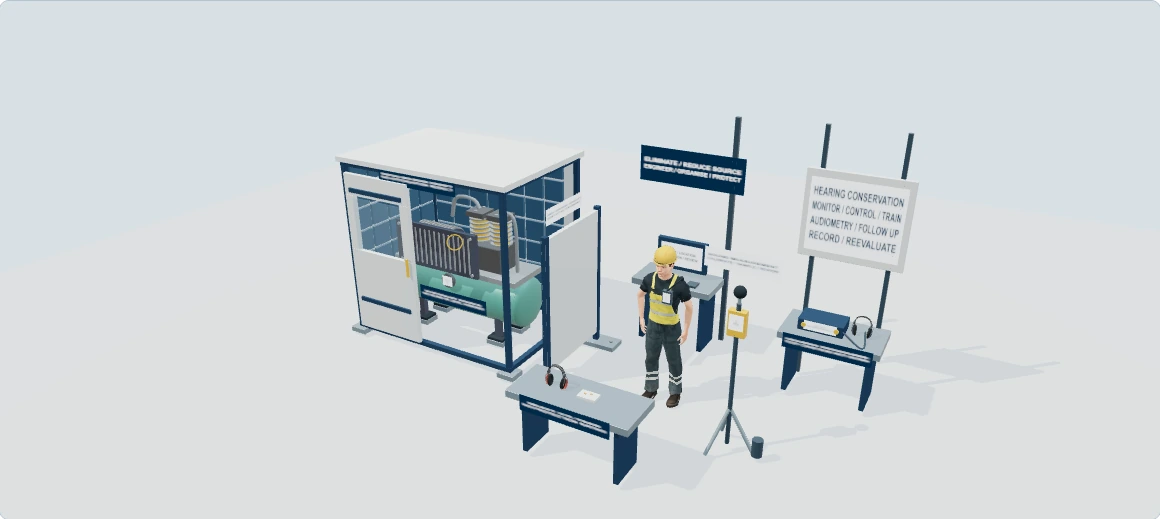

Noise: source, transmission path and the worker’s hearing
Explore how this equipment can harm its users and other people, then follow the practical measures that interrupt each pathway. This is a hazards and good-practice lesson; the separate checklist remains the pre-use/safety-check activity.
Checksheets and risk assessments
Equipment checksheets
Risk assessment forms
Risk assessment examples
Forms and tools
Full written walkthrough — all 8 steps
1. Identify the source and exposed people
What is happening: The machine is one possible sound source; the observer, adjacent stations and other tasks also matter.
How harm can occur: Noise can damage hearing, cause tinnitus and mask warnings or communication.
Best practice to apply: Observe the real work and affected people and identify the sources that dominate their exposure.
Why this works: Treating a minor source while a dominant one remains may give little benefit to the worker.
Noise at Work · Why is noise harmful?2. Reduce the source before relying on PPE
What is happening: The enclosure illustrates one engineering approach; source process and equipment choices come first.
How harm can occur: Unnecessary noisy work continues to expose people even if they carry hearing protection.
Best practice to apply: Consider quieter processes, equipment, maintenance and suitable source treatments before lower-order measures.
Why this works: Source reduction benefits everyone exposed and does not depend solely on individual wearing behaviour.
Noise at Work · How can the ISO 45001 hierarchy of controls reduce workplace noise at source and protect hearing?3. Understand openings and transmission paths
What is happening: A barrier or enclosure changes a path but sound can still travel through gaps and other routes.
How harm can occur: An opening, reflection or untreated path can leave the worker exposed despite a visible screen.
Best practice to apply: Use competent acoustic design and verify the actual arrangement, including access and necessary ventilation.
Why this works: A screen's appearance does not show attenuation at the person; the complete route matters.
Noise at Work · What failure chains cause avoidable exposure?4. Include the person and the full work pattern
What is happening: A person's exposure changes with tasks, location and duration.
How harm can occur: A short loud event or several jobs can be missed by a single convenient reading.
Best practice to apply: Assess representative daily/weekly and peak exposure where appropriate and include all relevant work.
Why this works: The assessment must describe the person's work, not only one machine's catalogue number.
Noise at Work · How do daily and peak exposure differ?5. Measure for a decision, not a decorative number
What is happening: The meter and dosimeter show that method, placement and interpretation are part of measurement.
How harm can occur: An unrepresentative or poorly interpreted result can lead to ineffective protection and continued harm.
Best practice to apply: Use suitable competent measurement and compare with the applicable GB or NI framework; no reading is supplied here.
Why this works: A valid result needs an appropriate method and context, not merely an instrument on site.
Noise at Work · What should be checked before and after a noisy task?6. Plan hearing protection for residual risk
What is happening: The protection station is separate from the source and path controls.
How harm can occur: Unsuitable fit, selection or use can leave hearing unprotected; overprotection can also hinder essential awareness.
Best practice to apply: Select suitable protection, fit, instruction and use arrangements while continuing practicable source reduction.
Why this works: Residual protection complements engineering and must work for the actual person and task.
Noise at Work · Who must be able to do what?7. Use surveillance to prevent further harm
What is happening: Health surveillance and symptom reports support prevention rather than making exposure acceptable.
How harm can occur: Progressive hearing change may be unnoticed while exposure continues.
Best practice to apply: Use the required competent health-surveillance arrangements and act on findings and reported symptoms.
Why this works: Finding harm should drive review and control, not be treated as an acceptable cost of work.
Noise at Work · What record and review cycle makes the programme accountable?8. Verify changes at the worker
What is happening: New machinery, layout, open doors or altered production can change the noise reaching people.
How harm can occur: A nominal treatment can lose effectiveness during real work or transfer exposure to someone else.
Best practice to apply: Verify actual improvement, keep controls maintained and review changed work and affected groups.
Why this works: A successful intervention improves exposure during use rather than only completing a purchase or record.
Noise at Work · How could a workshop replace a noisy blow-off step?
Illustrative awareness learning. Geometry, colours and movement do not establish safe distances, capacity, exposure, isolation or work permission. Use the actual assessment, equipment information and competent arrangements.
The wider workplace has its own account and subscription access. Exploring this lesson does not grant access, record course completion or authorise work.
UK guidance for further reading
HSE: NoiseWhat is a physical hazard?
A physical hazard is any source of energy, movement or environmental condition that can cause injury or ill health.
The most useful way to teach physical hazards is through energy. Harm occurs when energy reaches a person in an uncontrolled way: gravity causes a fall, mechanical energy traps a hand, kinetic energy strikes a pedestrian, acoustic energy damages hearing, vibration damages blood vessels and nerves, thermal energy overheats or chills the body, radiation damages tissue, and pressure or stored energy releases suddenly.
Physical hazards often combine. A worker using a vibrating tool at height in cold weather near moving plant is not exposed to one tidy hazard. The assessment must look at the task, the environment, the energy source, the people affected, the control reliability and how conditions can change during the job.
| Energy or condition | How harm occurs | Typical controls |
|---|---|---|
| Gravity | Falls from height, falling objects, collapse or slips/trips. | Avoid height, edge protection, exclusion zones, housekeeping and rescue planning. |
| Mechanical energy | Entanglement, crushing, cutting, drawing-in or impact. | Guarding, interlocks, isolation, safe tooling and maintenance. |
| Kinetic energy | Vehicles, plant, moving loads and projectiles strike people. | Segregation, traffic routes, lifting plans and speed/control limits. |
| Acoustic energy | Noise damages hearing or masks warnings. | Quieter methods, isolation, scheduling, hearing protection and surveillance. |
| Vibration | HAVS or whole-body vibration harm from tools or vehicles. | Tool choice, maintenance, exposure planning and health surveillance. |
| Thermal environment | Heat stress, burns, cold stress or reduced dexterity. | Temperature assessment, work/rest, PPE, hydration and welfare. |
| Radiation | Ionising or non-ionising radiation damages tissue or eyes. | Eliminate access, shielding, controlled areas, interlocks, dosimetry or specialist support. |
| Pressure/stored energy | Sudden release from hydraulics, pneumatics, springs, vessels or lines. | Isolation, depressurisation, lockout, permit control and proving zero energy. |
How can the hierarchy of controls reduce exposure to harmful workplace physical agents?
For a maintenance worker replacing a roof-mounted fan, the harm chain includes gravity at an open edge, electrical and rotating energy, and falling tools that could strike people below. The source-pathway-person model helps identify each pathway. HSE’s five levels are elimination, substitution, engineering, administrative controls and PPE. ERICPD adds Reduce, Isolate and Discipline as practical decision lenses.
Eliminate: engineering asks whether the fan can be serviced from ground level, lowered to a safe position or replaced with a design that removes roof access. Check function, lifting and maintenance implications before the design decision.
Substitute and reduce: use a safe access method and suitable equipment that reduce time and exposure at the edge. A lighter tool or different maintenance sequence may reduce manual effort, but cannot justify unprotected work at height.
Isolate and engineer: provide collective edge protection and a secure work platform, isolate electrical and mechanical energy, prevent restart, and establish an exclusion zone for falling objects. A competent person verifies each physical barrier on site; a missing guard, failed isolation or compromised platform stops work.
Control, PPE and Discipline: authorise the task, check weather, brief exclusion and rescue arrangements, and inspect barriers during work. Where residual risk requires harness or other PPE, verify selection, anchor and competence. The permit or checklist records decisions but cannot replace the physical barriers.
Direct source: HSE common workplace risks
Direct source: HSE working at height
Direct source: HSE hierarchy of controls
How can the ERICPD hierarchy of controls reduce exposure to harmful workplace physical agents?

| ERICPD control level | Topic-specific example | Source and full task context |
|---|---|---|
| Eliminate | Redesign maintenance so it can be done at ground level and avoid roof-edge exposure where feasible. | Read the full task example, checks and stop points on this page. open edge · HSE common workplace risks · HSE hierarchy of controls |
| Reduce | No distinct substitution is demonstrated by saying safe access alone; assess the actual replacement before claiming it. | Read the full task example, checks and stop points on this page. open edge · HSE common workplace risks · HSE hierarchy of controls |
| Isolate | Provide collective edge protection/platforms, proved energy isolation and physical falling-object exclusion. | Read the full task example, checks and stop points on this page. open edge · HSE common workplace risks · HSE hierarchy of controls |
| Control | Review weather, authorise the task, brief competent roles, verify inspection and rescue readiness. | Read the full task example, checks and stop points on this page. open edge · HSE common workplace risks · HSE hierarchy of controls |
| PPE | Use only assessed residual protection; it cannot make an unguarded edge or unproved electrical isolation acceptable. | Read the full task example, checks and stop points on this page. open edge · HSE common workplace risks · HSE hierarchy of controls |
| Discipline | Maintain boundaries and verify safe handback. Height decisions remain avoid, prevent, minimise, favouring collective protection. | Read the full task example, checks and stop points on this page. open edge · HSE common workplace risks · HSE hierarchy of controls |
How can the ISO 45001 hierarchy of controls reduce exposure to harmful workplace physical agents?

| ESEAP control level | Topic-specific example | Source and full task context |
|---|---|---|
| Elimination | Redesign maintenance so it can be done at ground level and avoid roof-edge exposure where feasible. | Read the full task example, checks and stop points on this page. open edge · HSE common workplace risks · HSE hierarchy of controls |
| Substitution | No distinct substitution is demonstrated by saying safe access alone; assess the actual replacement before claiming it. | Read the full task example, checks and stop points on this page. open edge · HSE common workplace risks · HSE hierarchy of controls |
| Engineering controls | Provide collective edge protection/platforms, proved energy isolation and physical falling-object exclusion. | Read the full task example, checks and stop points on this page. open edge · HSE common workplace risks · HSE hierarchy of controls |
| Administrative controls | Review weather, authorise the task, brief competent roles, verify inspection and rescue readiness. | Read the full task example, checks and stop points on this page. open edge · HSE common workplace risks · HSE hierarchy of controls |
| PPE | Use only assessed residual protection; it cannot make an unguarded edge or unproved electrical isolation acceptable. | Read the full task example, checks and stop points on this page. open edge · HSE common workplace risks · HSE hierarchy of controls |
What physical hazard taxonomy should learners use?
A taxonomy gives learners a structured way to identify hazards before turning them into task-specific risk scenarios.
Name the energy or condition, then describe the route from source to person. “Machinery” alone does not say whether the threat is entanglement, ejection, electrical contact or unexpected start-up, so the control cannot be selected from the label alone.
| Hazard family | Typical sources | What to assess |
|---|---|---|
| Noise | Impact tools, engines, compressors, workshops, plant rooms and manufacturing lines. | Sound level, duration, exposed people, communication effects and hearing-surveillance trigger. |
| Vibration | Breakers, grinders, compactors, sanders, vehicles and mobile plant. | Tool or vehicle vibration magnitude, exposure duration, grip force, cold and health-surveillance trigger. |
| Radiation | UV, lasers, welding arcs, radon, ionising gauges, radiography and medical/industrial sources. | Type, dose or intensity, direct/reflected exposure, shielding, controlled area and competent advice. |
| Pressure | Steam, compressed air, hydraulics, pneumatics, pressure vessels, hoses and pipelines. | Stored pressure, isolation, venting, line breaking, test pressure and emergency release. |
| Temperature | Hot processes, cold stores, weather, PPE heat load, steam, hot surfaces and cold surfaces. | Air temperature, radiant heat, humidity, workload, clothing/PPE, welfare and recovery. |
| Electricity | Fixed systems, portable tools, batteries, overhead lines, temporary supplies and live testing. | Voltage, current path, isolation, competence, earthing, environment and live-work justification. |
| Movement | Machinery, vehicles, conveyors, tools, rotating parts, moving loads and ejected material. | Contact pathway, guarding, interlocks, segregation, visibility, speed and maintenance state. |
| Gravity | Falls, falling objects, collapse, excavations, racking, stacked materials and lifting failures. | Height, edge protection, stability, exclusion, rescue and inspection. |
| Stored energy | Springs, tensioned belts, suspended loads, hydraulic accumulators, batteries and thermal energy. | How energy is released, isolated, dissipated and proved safe before intervention. |
Dust and toxic gas are interacting chemical-health hazards alongside the physical-energy pathway. A pressure release is a physical event; toxic contents create a separate chemical exposure. Simultaneous operations (SIMOPS) require both assessments. The columns organise questions rather than assigning each task to one exclusive hazard category.
How should source, pathway, person, harm, control and evidence be used?
The source-pathway-person model stops physical hazards becoming a vague list and turns them into practical risk decisions. See HSE working-at-height step guide.
A physical hazard assessment should be able to tell a short, testable story. What is the energy source? How could it travel? Who could it reach? What harm could it cause? Which control interrupts the pathway? What evidence proves the control is working today? If any part of that story is missing, the assessment is probably too generic.
This model works for both simple and complex risks. A ladder, a forklift, a noisy breaker, a pressure line, a laser, a hot surface and a suspended load can all be described through the same logic. That makes it useful for NEBOSH learners, supervisors, auditors and managers reviewing risk registers.
| Model step | Plain-English question | Example answer |
|---|---|---|
| Source | What energy or condition could harm someone? | A rotating blade, moving vehicle, pressure line, overhead load, noise source or hot surface. |
| Pathway | How could the energy reach the person? | Contact, impact, fall, airborne exposure, heat transfer, pressure release or electrical path. |
| Person | Who is in the pathway? | Operator, cleaner, maintainer, pedestrian, contractor, visitor or nearby trade. |
| Harm | What credible injury or ill health could occur? | Amputation, crush injury, fall, hearing loss, burn, shock, injection injury or fatality. |
| Control | What interrupts the pathway? | Guard, barrier, isolation, exclusion, design change, quieter method, permit or supervision. |
| Evidence | How do we know the control works? | Inspection, test, monitoring, observation, maintenance, training or action close-out. |
How does the energy-source model turn hazards into controls?
A hazard label becomes useful when it is converted into a pathway showing how energy reaches a person and what evidence proves the control works.
For a roof fan, gravity can carry a person over an edge or a tool onto someone below; electrical and stored mechanical energy can reach the maintainer through contact. Each pathway needs its own interruption and verification before work starts.
| Source | Pathway | Person | Harm | Control | Evidence |
|---|---|---|---|---|---|
| Noisy breaker | Airborne noise reaches the ear over time. | Operator and nearby trades. | Noise-induced hearing loss or missed warnings. | Quieter method, exclusion, exposure planning and hearing protection. | Noise assessment, zone check, training and surveillance record. |
| Rotating saw blade | Hand contacts blade during use, cleaning or jam clearing. | Operator, maintainer or cleaner. | Amputation, laceration or entanglement. | Guarding, interlock, push stick, isolation and supervision. | PUWER inspection, pre-use check and observation. |
| Pressurised pipe | Stored pressure releases during line breaking. | Maintenance worker and nearby team. | Injection injury, impact, burn or toxic release. | Isolation, depressurisation, drain/vent, permit and proving zero energy. | Isolation certificate, permit and test record. |
| Forklift | Vehicle movement crosses pedestrian route. | Pedestrians, drivers, visitors or contractors. | Crush, strike or fatal impact. | Segregated routes, barriers, traffic plan and visibility control. | Traffic inspection, near-miss review and route map. |
| Cold outdoor work | Cold reduces dexterity and increases fatigue. | Groundworker, roofer or maintenance team. | Cold stress, poor grip, increased tool injury or HAVS aggravation. | Weather limits, warm welfare, gloves and work/rest planning. | Weather review, briefing and welfare inspection. |
Which physical hazards should be considered?
A useful physical-hazard review covers energy sources, the environment, equipment, people and interfaces.
Use the categories as a search aid at the workface, then convert every relevant item into a credible exposure scenario. Include people outside the immediate task and changes in weather, isolation or equipment condition.
| Category | Examples | Assessment question |
|---|---|---|
| Falls and dropped objects | Ladders, roofs, scaffolds, MEWPs, openings, fragile surfaces and tools aloft. | Can the work at height be avoided, and what prevents falls or dropped objects? |
| Machinery and tools | Saws, presses, conveyors, grinders, drills, cutters, interlocks and guards. | Can moving parts contact people during use, cleaning, fault finding or maintenance? |
| Vehicles and workplace transport | Forklifts, dumpers, vans, reversing, banksmen and loading areas. | Are pedestrians separated and vehicle movements controlled? |
| Noise and vibration | Breakers, compactors, grinders, plant, vehicles and impact tools. | What is the exposure dose, and are action values or surveillance triggers reached? |
| Thermal and weather | Heat, cold, UV, rain, wind, humidity and PPE heat load. | How do weather, workload and PPE change physical tolerance and safety? |
| Radiation and optical energy | UV, lasers, welding arcs, radon, ionising sources and inspection equipment. | Is specialist radiation/laser/UV advice or controlled area needed? |
| Pressure and stored energy | Hydraulics, pneumatics, steam, compressed air, vessels, springs and tensioned systems. | Has energy been isolated, dissipated and proved safe? |
| Ergonomic physical load | Force, posture, repetition, static work and manual handling. | Can the task be redesigned before relying on training? |
How do physical hazards interact?
Physical hazards often increase each other's severity, so assess the combined scenario rather than one hazard at a time.
A physical-hazard risk assessment should ask what happens when hazards combine. Noise can hide vehicle alarms. Cold can reduce grip. Heat and PPE can increase fatigue. Poor lighting can worsen machinery or pedestrian risk. Vibration exposure can increase when workers use high force in awkward posture. These interactions are why site observation matters.
| Interaction | What can go wrong | Control response |
|---|---|---|
| Noise + vehicles | Workers do not hear reversing alarms or shouted warnings. | Segregate routes, visual controls, banksman rules and reduce noise at source. |
| Cold + hand tools | Reduced dexterity and grip increase cut, crush or vibration risk. | Warm gloves compatible with task, breaks and tool choice. |
| Heat + PPE | Fatigue, dehydration and reduced concentration increase error risk. | Work/rest, hydration, shade, task scheduling and supervision. |
| Poor lighting + machinery | Guards, controls, defects or trip hazards are missed. | Lighting standard, inspection and stop-work trigger. |
| Work at height + wind | Loss of balance, unstable materials or unsafe lifting. | Weather limits, securing materials and re-plan. |
| Pressure + maintenance | Stored energy releases during line breaking or fault finding. | Isolation, depressurisation, lockout and permit verification. |
| Pressure + line breaking | A flange is opened before trapped pressure or liquid has been proved removed. | Positive isolation, drain/vent, test points, line-break permit and face/body positioning. |
| Vibration + cold | Cold hands and high grip force can worsen HAVS exposure and tool-control risk. | Warm welfare, task rotation, lower-vibration tools and symptom reporting. |
| Electricity + wet or metallic environment | Contact resistance may be lower and shock consequence higher. | Avoid live work, isolate, use suitable equipment and control environment. |
How should physical hazards be assessed?
Assessment should identify the energy source, how it reaches people, who is exposed, what controls interrupt the pathway and how controls are verified.
Start with the work sequence and location, mark every energy source and exposed person, then choose controls at source and test them on site. A changed condition, failed isolation or missing barrier requires the task to pause and be reassessed.
| Step | Question | Output |
|---|---|---|
| Identify energy | What energy, movement or condition could harm someone? | Hazard list by task and area. |
| Map pathway | How could that energy reach a person? | Scenario description, not just hazard label. |
| Identify people | Who is exposed: users, maintainers, cleaners, contractors, visitors or public? | Affected-person list. |
| Select controls | Can release or contact be eliminated or controlled at source? | ERICPD/hierarchy control plan. |
| Verify reliability | What proves the control is present, used, maintained and effective? | Inspection, monitoring and assurance evidence. |
| Review change | What changes the risk: weather, production pressure, defects, new people or SIMOPS? | Review trigger and stop-work rule. |
How should physical hazards be controlled?
Controls should prevent the release of hazardous energy or prevent people contacting it before relying on warnings or PPE.
This section turns legal language into workplace control. The examples show how broad duties become risk assessment, competent help, consultation, maintenance and review evidence.
| Control level | Practical example | Weak practice |
|---|---|---|
| Eliminate | Design work at ground level instead of roof access. | Send workers up with instruction to be careful. |
| Reduce/substitute | Use quieter plant, lower-vibration tools or pre-assembled components. | Buy equipment without exposure review. |
| Engineering controls | Guarding, interlocks, edge protection, barriers, LEV, shielding or segregation. | Rely on signs around an uncontrolled hazard. |
| Administrative controls | Permit, exclusion, method statement, training, supervision and inspection. | Generic RAMS copied across tasks. |
| PPE | Hearing protection, eye protection, gloves, fall-arrest or thermal PPE as residual control. | PPE used as first and only control. |
| Emergency/recovery | Rescue plan, first aid, isolation response and incident command. | No plan for fall rescue or stored-energy release. |
| Assurance | Verify controls through observation, tests, maintenance and action close-out. | Count inspections without checking control quality. |
What stop-work triggers should supervisors use?
Physical hazards need clear stop rules because conditions can change quickly.
A stop trigger is an observable failed condition, such as an absent edge barrier, damaged guard, unverified isolation or people inside a drop zone. State who can stop work and how the control will be restored and checked before restarting.
| Trigger | Why it matters | Action |
|---|---|---|
| Guard, interlock or barrier missing | People can contact moving or hazardous energy. | Stop equipment or task until competent repair/control. |
| Uncontrolled work at height | Falls can be fatal. | Stop and install prevention/rescue controls. |
| Unexpected stored energy | Pressure, gravity, spring or electrical energy may release. | Isolate, prove zero energy and re-plan. |
| Noise/vibration exposure not planned | Dose may exceed action values or harm workers. | Reassess tools, duration and controls. |
| Weather affects lifting, height or thermal risk | Wind, heat, cold or rain can change the safe method. | Pause and reauthorise. |
| Pedestrian/vehicle segregation breaks down | High-energy impact risk increases. | Reinstate routes, barriers or traffic control. |
How do physical hazards apply across sectors?
Examples help translate the concept from generic hazard lists into real operational decisions.
The same source-pathway-person method applies across sectors, but the actual barrier differs. Compare the route, person exposed, owner and verification method before transferring a control from one example to another.
| Sector | Typical physical hazards | What good looks like |
|---|---|---|
| Construction | Falls, plant, dust (interacting chemical-health exposure), noise, vibration, weather and manual handling. | CDM planning, sequencing, access control, exposure management and welfare. |
| Manufacturing | Machinery, conveyors, pressure, noise, heat, lifting and maintenance energy. | PUWER guarding, isolation, planned maintenance and operator competence. |
| Laboratories | Optical radiation, cryogens, pressure systems, autoclaves, centrifuges, sharps and hot/cold surfaces. | Local rules, containment, shielding, maintenance, supervision and emergency arrangements. |
| Healthcare | Manual handling, slips, hot surfaces, lasers/radiation, workplace violence and DSE. | Task-specific assessment, patient-handling plans, competent equipment use and incident learning. |
| Logistics and warehousing | Forklifts, racking, manual handling, slips/trips, loading bays and pedestrian routes. | Traffic segregation, racking inspection, load control, dock safety and housekeeping. |
| Utilities | Excavations, pressure systems, confined spaces, overhead/underground services and weather exposure. | Permit control, isolation, service location, rescue planning and emergency response. |
| Process sites | Pressure, heat, toxic gas (interacting chemical-health exposure), rotating equipment, electricity and simultaneous operations. | Barrier management, permits, detection, isolation and emergency response. |
| Office/hybrid | DSE, sedentary posture, slips, lighting and stress-related physical effects. | DSE assessment, movement breaks, workstation setup and work-design review. |
How does this work in practice?
Operational example and hold points
Task material and setting: Replace a roof-mounted extraction fan above an occupied workshop.
People and prerequisites: Maintenance team, isolator, supervisor and people below; safe access and current electrical drawing.
Before: Check whether work can move to ground level; plan edge protection, electrical isolation, falling-object exclusion and rescue.
During: Prove zero energy, maintain collective edge protection and keep the area below segregated.
Hold or stop: Stop if isolation cannot be proved, edge protection fails, weather changes or the exclusion zone is breached.
Completion and hand back: Check guarding and safe restart, remove exclusions in sequence and communicate return to service.
Evidence: Design review, isolation certificate, platform check, exclusion inspection, restart authorisation and defect closure.
For the roof fan, identify every supply, securely isolate against reconnection, release or restrain stored energy and have a competent electrical person prove dead using suitable verified equipment. Maintain the isolation until controlled handback. This is a competence and planning gate, not user instructions: a stopped switch or signed permit is not proof of safe isolation. HSE electrical safe working practices
What evidence shows physical hazards are controlled?
Evidence should show that hazard pathways have been interrupted and controls remain effective in real work.
Evidence should be read as a chain rather than a filing exercise. A single record rarely proves good management on its own; stronger assurance comes from matching records, observations, interviews, trends and verified action closure.
| Evidence | What it should show | Weakness to challenge |
|---|---|---|
| Risk assessment | Specific energy pathway, affected people, controls and review triggers. | Hazards listed without scenarios. |
| Inspection and maintenance | Guards, barriers, tools, plant and controls remain effective. | Defects logged but not closed. |
| Exposure data | Noise, vibration, heat, radiation or ergonomic exposure assessed where relevant. | No dose or duration assessment. |
| Training and competence | People understand controls and stop-work triggers. | Training only records attendance. |
| Permit/isolation records | High-risk physical energy controlled before work starts. | Permit signed without field verification. |
| Incident and near-miss learning | Physical-control failures lead to improved design or systems. | Repeated similar near misses. |
Which legal duties apply to physical hazards?
Physical hazards are controlled through general risk-management law and hazard-specific regulations for work equipment, height, noise, vibration, radiation and workplace conditions.
The legal rows below distinguish Great Britain from Northern Ireland. Apply only the instrument in force for the workplace and task; guidance and an ISO system do not replace it.
| Duty or regulation | What it requires | How to apply it |
|---|---|---|
| Health and Safety at Work etc. Act 1974 | Requires protection from work-related injury and ill health. | Use safe plant, safe systems, supervision, information, training and maintenance. |
| Management of Health and Safety at Work Regulations 1999 | Requires risk assessment, preventive arrangements, competence and emergency procedures. | Assess physical energy sources, affected people, controls, change and emergency scenarios. |
| PUWER 1998 | Requires work equipment to be suitable, maintained and used safely. | Control machinery, tools, guarding, interlocks, defects and maintenance hazards. |
| Work at Height Regulations 2005 | Requires work at height to be avoided where possible and properly planned. | Control falls, fragile surfaces, access, rescue and dropped-object risk. |
| Control of Noise at Work Regulations 2005 | Requires noise exposure to be eliminated or reduced. | Use design, quieter plant, scheduling, hearing protection and hearing checks. |
| Control of Vibration at Work Regulations 2005 | Requires vibration risks to be controlled. | Use tool selection, exposure planning, maintenance and health surveillance. |
| Ionising Radiations Regulations 2017 | Requires ionising radiation exposure to be restricted and managed by competent arrangements. | Use RPA/RPS support, local rules, controlled areas, dose records and contingency plans where relevant. |
| Workplace Health, Safety and Welfare Regulations 1992 | Requires suitable workplace conditions. | Manage temperature, lighting, floors, traffic routes, ventilation, welfare and space. |
| Health and Safety at Work (Northern Ireland) Order 1978 | General NI employer duty. | Protect NI workers and others from work risks. |
| Management of Health and Safety at Work Regulations (NI) 2000 | NI risk assessment and preventive arrangements. | Assess work factors, assign competent controls and review. |
| PUWER (Northern Ireland) 1999 | Select, maintain and guard NI work equipment. | Verify fan isolation and guarding in NI. |
| Work at Height Regulations (Northern Ireland) 2005 | Plan, supervise and control NI height work. | Avoid roof access if practicable; provide collective protection and rescue. |
| Control of Noise at Work Regulations (Northern Ireland) 2006 | Assess and reduce occupational noise in NI. | Apply where noisy tools or plant expose workers. |
| Control of Vibration at Work Regulations (Northern Ireland) 2005 | Assess vibration exposure and eliminate or control it, with surveillance where required. | Use the NI instrument for hand-arm and whole-body vibration work. |
| Ionising Radiations Regulations (Northern Ireland) 2017 | Requires a specialist risk assessment and controls for work with ionising radiation. | Use the NI instrument and specialist radiation protection route where this source is present. |
Electrical work follows GB Electricity at Work Regulations 1989 or the separate NI 1991 Regulations. For pressure systems within PSSR scope, also verify safe operating limits and the applicable written scheme/examination status under the separate GB/NI instruments; an intervention permit does not replace ongoing examination duties. Do not impose a written scheme indiscriminately on every hydraulic line or spring.
Direct instruments for the fan/isolation and qualifying pressure-system decisions: GB Electricity at Work Regulations 1989; NI Electricity at Work Regulations 1991; GB Pressure Systems Safety Regulations 2000; NI Pressure Systems Safety Regulations 2004. The electrical competence gate and ongoing written-scheme/examination gate remain distinct; the latter applies only to systems within its scope.
How should the control be managed and reviewed?
For a GB workplace, HSE guidance supports identifying the actual risk, taking practical protective steps and reviewing whether they work. Name the decision owner, check the control during the real task and correct a failed arrangement. Apply the separate Northern Ireland duties and guidance where the work is in NI.
GB management guidance: HSE managing health and safety
What training and awareness helps?
Training should teach hazard mechanisms, control checks and stop-work decisions, not only rules.
Training should be role-based. General awareness creates a baseline, but supervisors, managers, advisers and senior leaders need different levels of decision-making, verification and escalation competence.
| Role | Demonstration | Assessor | Record and reassessment |
|---|---|---|---|
| Workers and contractors | Recognise energy source, pathway, exclusion and isolation; demonstrate stop-work trigger. | Supervisor observes a task walkdown. | Induction and task briefing; repeat after change. |
| Supervisors and isolators | Verify physical isolation, edge protection, guarding and rescue before issue. | Competent technical lead witnesses field check. | Isolation and platform inspection record; recheck each shift. |
| Designers and planners | Assess ground-level or lower-risk maintenance design. | Engineering lead reviews alternative. | Design decision and residual-risk handover. |
| Managers and advisers | Audit barriers, competence and recurring failures rather than forms alone. | Independent safety lead reviews sampling. | Barrier trends and closed corrective actions. |
How could BuildOut Ltd manage this in practice?

BuildOut would control physical hazards by mapping energy sources, designing out contact, verifying critical controls and learning from weak signals.
A construction and maintenance business faces moving plant, tools, work at height, lifting, noise, vibration, heat, cold and manual handling. BuildOut would use risk registers, procurement standards, supervisor checks, permit controls, training and audit to keep physical hazards under control.
| Management element | How the business would manage it | Evidence to review |
|---|---|---|
| Map | Identify energy sources and pathways by task. | Physical hazard register. |
| Design | Remove or reduce energy/contact before site work. | Design/procurement review. |
| Control | Use barriers, guarding, isolation, exclusion, quieter tools and safe access. | Method statement and inspection. |
| Verify | Check controls during real work. | Supervisor assurance record. |
| Improve | Use incidents, defects and exposure data to improve standards. | Action tracker. |
What do the acronyms and key terms mean?
Acronyms should be understood before they are used in assessments, briefings, audits or learning answers.
Acronyms can exclude newer readers if they are not explained. This section keeps the main terms available at the end of the page so the article stays readable while still supporting learners and audit users.
| Acronym | Meaning | Plain-English use |
|---|---|---|
| PUWER | Provision and Use of Work Equipment Regulations | Separate GB 1998 and NI 1999 work-equipment safety regulations. |
| HAVS | Hand-Arm Vibration Syndrome | Vibration-related hand and arm condition. |
| WEL | Workplace Exposure Limit | Airborne exposure limit, relevant to some physical-agent-linked substances such as dust. |
| RPE | Respiratory Protective Equipment | Protection against inhalation exposure. |
| MEWP | Mobile Elevating Work Platform | Powered access equipment used for work at height. |
Unlock another resource
You have used this month’s two free downloads. Publish a post in your own words to unlock one more resource, or choose SHARE Individual for 10 downloads per month.
You decide whether to share. If you do, use the relevant platform disclosure tools and do not make claims you do not genuinely hold.