SHARE Knowledge Hub
Pre-Start-Up Safety Review (PSSR) and Operational Readiness
A pre-start-up safety review (PSSR) is a documented decision that a new, modified or restarted process is ready before hazardous material or energy is introduced. It tests whether the plant matches its design, critical safeguards work, people understand the operating limits and open actions are controlled. A signed checklist without field evidence cannot prevent a release, fire, explosion or other start-up failure.
Understanding Pre-Start-Up Safety Review (PSSR) and Operational Readiness
A pre-start-up safety review is a decision gate before a plant or process enters a materially new hazardous state. That point may be first introduction of a dangerous substance, pressurisation, heat, rotation, electrical energisation or return after intrusive work. The trigger should be selected from the hazard and change, not from a project label such as new plant. A water trial may have its own risks but does not prove readiness for flammable feed.
Why this matters at work
Hold feed and assess the temporary supply through management of change. Test capacity under realistic simultaneous demand and verify valve failure positions and shutdown response. Provide an independently reviewed fallback and clear operating limit or commission the permanent system. Update operator instructions, alarm response and emergency plan. Only release a bounded phase after the evidence shows that loss of air cannot create an uncontrolled hazardous state.
A new reactor begins first feed with temporary instrument air because the permanent compressor is not commissioned. Air pressure dips when several valves move together; the team has not shown how the valves fail or how the reaction will be stopped. Calling the arrangement temporary does not make it low risk. The proposed operating state differs from the design basis.
How organisations manage this in practice
A pre-start-up review should not be used to bypass unfinished management of change. HSE expects traceable technical and safety review of modifications and checks that the design intent was achieved. MOC actions may relate to procedures, training, emergency plans, drawings, maintenance or adjacent plant, not only hardware. A change package marked complete while these outputs remain open creates a false readiness signal.
Reconcile the MOC scope and action list with the installed configuration. Confirm hazard-study actions are closed with evidence, not just status codes. Link deviations or new findings to a controlled change record. Assess cumulative temporary changes and their interaction with the planned operating mode. Require a competent reviewer to decide whether any residual work is genuinely non-critical and how it will be controlled.
A new line usually warrants a full readiness review, but substantial modification, changed material, control logic, relief arrangement or long outage can create equivalent uncertainty. HSE change guidance covers changes to equipment, procedures, people and substances. A like-for-like replacement may have a narrower review only after identity and installation are confirmed. The threshold must not be adjusted simply to meet a schedule.
How can I practise this topic in 3D?


A temporary bypass outlives its approved change
All related inspection points 3 across 1 location
Crown Fuels terminal 3 inspection points
Practice in the SHAREhub environment. Browser practice is separate from workplace competence and formal learning records.
What is PSSR in plain English?
PSSR is the formal check that the plant is safe and ready before hazardous operation starts or restarts.
Best-practice guide: Pre-Start-Up Safety Review (PSSR) and Operational Readiness

What is PSSR in plain English?
PSSR is the formal check that the plant is safe and ready before hazardous operation starts or restarts. A pre-start-up safety review (PSSR) is a documented decision that a new, modified or restarted process is ready before hazardous material or energy is introduced.
Turn pre-start-up safety review and operational readiness knowledge into a decision
A pre-start-up safety review (PSSR) is a documented decision that a new, modified or restarted process is ready before hazardous material or energy is introduced. It tests whether the plant matches its design, critical safeguards work, people understand the operating limits and open actions are controlled. Approved PSSR, field walkdown, function-test records, action register, start-up log and post-start-up review.
Operational example: decisions and evidence
Introduce inventory in controlled stages, compare level and flow with expected behaviour, keep a decision maker available and record deviations. Operations signs acceptance only after defects are corrected and retested; any remaining non-critical work has a named owner and review date.
Start-up and restart hazard patterns
Introducing hazardous inventory: Material enters equipment that may not yet be proven in live service. Energising equipment: Rotating, electrical, thermal or pressure energy is introduced. Temporary bypasses: Trips, alarms or interlocks may be bypassed for commissioning.
Choose controls for pre-start-up safety review and operational readiness
Eliminate: Eliminate: the project owner asks whether the hazardous commissioning trial can be replaced by an inert, representative test and whether a transfer step can be designed out. Reduce: Substitute and reduce: where a live charge is necessary, the process engineer specifies the smallest practicable inventory and a suitable lower-hazard test medium if it proves the same function. Isolate: Isolate and engineer: confirm physical segregation, closed transfer, correct valve lineup, relief route, high-level alarm and independent trip against drawings and field walkdown. Control: Control, PPE and Discipline: the operations lead uses a staged written start-up, competent operators, clear stop authority, emergency readiness and a signed decision on genuinely non-critical open work. Read the full control table for qualifications, ownership and verification. Use the actual task and applicable jurisdiction; existing technical approval remains unchanged.
Use the full pre-start-up safety review and operational readiness lesson
Use the full topic for the decision points, practical examples, detailed control tables and source scope. HSE guidance applies to Great Britain; use HSENI for the Northern Ireland route and the source’s stated jurisdiction. A simplified guide does not change the page’s technical-review or approval status.

Read all six steps as text
1. What is PSSR in plain English?
PSSR is the formal check that the plant is safe and ready before hazardous operation starts or restarts.
- Avoid / redesign: Eliminate: the project owner asks whether the hazardous commissioning trial can be replaced by an inert, representative test and whether a transfer step can be designed out.
- Control the task: Isolate and engineer: confirm physical segregation, closed transfer, correct valve lineup, relief route, high-level alarm and independent trip against drawings and field walkdown.
- Verify before release: Read the full task example, checks and stop points on this page.
PSSR is the formal check that the plant is safe and ready before hazardous operation starts or restarts. A pre-start-up safety review (PSSR) is a documented decision that a new, modified or restarted process is ready before hazardous material or energy is introduced.
Apply it: Which part of this plan would you check at the workface before authorising the task?
2. Turn pre-start-up safety review and operational readiness knowledge into a decision
Use the evidence to improve the actual work arrangement.
- Change at source: Eliminate: the project owner asks whether the hazardous commissioning trial can be replaced by an inert, representative test and whether a transfer step can be designed out.
- Make it observable: Read the full task example, checks and stop points on this page.
- Keep useful evidence: Approved PSSR, field walkdown, function-test records, action register, start-up log and post-start-up review.
A pre-start-up safety review (PSSR) is a documented decision that a new, modified or restarted process is ready before hazardous material or energy is introduced. It tests whether the plant matches its design, critical safeguards work, people understand the operating limits and open actions are controlled. Approved PSSR, field walkdown, function-test records, action register, start-up log and post-start-up review.
Apply it: What evidence would show that the change improves this task, rather than only completing a record?
3. Operational example: decisions and evidence
Example: a practical application of the existing topic lesson.
- Setting: First solvent transfer into a modified vessel on a COMAH site after a shutdown.
- Act: Walk the line against the current drawing; prove isolation, relief route, level alarm and trip; check training and emergency response; classify every open item.
- Hold / review: No hazardous charge if a credited trip is untested, a bypass is open without approved risk control, the drain route is uncertain or a critical action remains unresolved.
Introduce inventory in controlled stages, compare level and flow with expected behaviour, keep a decision maker available and record deviations. Operations signs acceptance only after defects are corrected and retested; any remaining non-critical work has a named owner and review date.
Apply it: At which point would you hold this example, and what evidence would allow it to proceed?
4. Start-up and restart hazard patterns
Connect the task, the route to the person and the control that can fail.
- Introducing hazardous inventory: Material enters equipment that may not yet be proven in live service.
- Energising equipment: Rotating, electrical, thermal or pressure energy is introduced.
- Temporary bypasses: Trips, alarms or interlocks may be bypassed for commissioning.
Introducing hazardous inventory: Material enters equipment that may not yet be proven in live service. Energising equipment: Rotating, electrical, thermal or pressure energy is introduced. Temporary bypasses: Trips, alarms or interlocks may be bypassed for commissioning.
Apply it: Who could be exposed, including other trades, cleaners, maintainers and people nearby?
5. Choose controls for pre-start-up safety review and operational readiness
Start with the stronger practicable options and verify their effect.
- Eliminate: Eliminate: the project owner asks whether the hazardous commissioning trial can be replaced by an inert, representative test and whether a transfer step can be designed out.
- Reduce: Substitute and reduce: where a live charge is necessary, the process engineer specifies the smallest practicable inventory and a suitable lower-hazard test medium if it proves the same function.
- Isolate: Isolate and engineer: confirm physical segregation, closed transfer, correct valve lineup, relief route, high-level alarm and independent trip against drawings and field walkdown.
- Control: Control, PPE and Discipline: the operations lead uses a staged written start-up, competent operators, clear stop authority, emergency readiness and a signed decision on genuinely non-critical open work.
Eliminate: Eliminate: the project owner asks whether the hazardous commissioning trial can be replaced by an inert, representative test and whether a transfer step can be designed out. Reduce: Substitute and reduce: where a live charge is necessary, the process engineer specifies the smallest practicable inventory and a suitable lower-hazard test medium if it proves the same function. Isolate: Isolate and engineer: confirm physical segregation, closed transfer, correct valve lineup, relief route, high-level alarm and independent trip against drawings and field walkdown. Control: Control, PPE and Discipline: the operations lead uses a staged written start-up, competent operators, clear stop authority, emergency readiness and a signed decision on genuinely non-critical open work. Read the full control table for qualifications, ownership and verification. Use the actual task and applicable jurisdiction; existing technical approval remains unchanged.
Apply it: Which stronger option can be used here, and who will verify it before accepting the remaining risk?
6. Use the full pre-start-up safety review and operational readiness lesson
Follow the official sources below and retain the task-specific evidence.
- Official guidance: HSE commissioning and operating procedures
- Official guidance: HSE hierarchy of controls
- Task decision: Approved PSSR, field walkdown, function-test records, action register, start-up log and post-start-up review.
Use the full topic for the decision points, practical examples, detailed control tables and source scope. HSE guidance applies to Great Britain; use HSENI for the Northern Ireland route and the source’s stated jurisdiction. A simplified guide does not change the page’s technical-review or approval status.
Apply it: Which official source and full-topic section will you use to resolve the next decision?
PSSR sits at the dangerous boundary between a project, maintenance shutdown, modification or abnormal state and live operation. Many serious events happen during start-up because the plant is changing state, people are under time pressure, safeguards may be bypassed or incomplete, operating teams may not fully own the change yet and assumptions can travel faster than evidence.
A useful PSSR asks: what hazardous inventory or stored energy will be introduced, what credible major accident scenario could occur, which safeguards prevent or mitigate it, what proof shows those safeguards are ready, who is competent to operate the plant, what has changed, and who has authority to approve start-up?
| Readiness area | What must be true | Evidence |
|---|---|---|
| Plant and equipment | Installed, inspected, tested, labelled and mechanically complete. | Mechanical completion dossier and punch-list status. |
| Process safety barriers | Trips, alarms, relief, containment, detection, isolation and emergency barriers available. | Functional tests, inspection records and barrier status. |
| People | Operators, maintainers, supervisors and emergency responders trained for the changed state. | Training, competence and shift briefing records. |
| Procedures | Start-up, shutdown, abnormal, emergency and permit procedures current and usable. | Controlled procedures and field validation. |
| MOC and PHA actions | Change hazards reviewed and actions closed before hazardous introduction where safety-critical; only non-critical items may be deferred through the blocker matrix and authorised controls. | MOC, HAZOP/PHA and action close-out evidence. |
| Handover | Project/maintenance hands over residual risks, spares, drawings, deviations and operating limits. | Handover pack and operations acceptance. |
PSSR here means pre-start-up safety review; the legal table’s Pressure Systems Safety Regulations are a different use of the acronym. Process safety information (PSI), piping and instrumentation diagrams (P&IDs), and the Control of Major Accident Hazards Regulations (COMAH) support the evidence gate.
How can the hierarchy of controls resolve process risks before authorising start-up?
A modified solvent vessel is about to receive its first hazardous charge after shutdown. A high-level trip, relief path and drain routing are credited barriers. If the trip set point is wrong and the drain remains routed to an unsuitable system, overfill can become a loss of containment and ignition event. Eliminate, Reduce, Isolate, Control, personal protective equipment (PPE) and Discipline (ERICPD) is a decision prompt alongside the five-level hierarchy of elimination, substitution, engineering controls, administrative controls and PPE. They are related frameworks, not laws or identical steps.
Eliminate: the project owner asks whether the hazardous commissioning trial can be replaced by an inert, representative test and whether a transfer step can be designed out. Engineering must verify that the test actually exercises the credited function; an inert test alone cannot prove chemical compatibility.
Substitute and reduce: where a live charge is necessary, the process engineer specifies the smallest practicable inventory and a suitable lower-hazard test medium if it proves the same function. Record design assumptions, compatibility and the point at which the real material still needs controlled verification.
Isolate and engineer: confirm physical segregation, closed transfer, correct valve lineup, relief route, high-level alarm and independent trip against drawings and field walkdown. Instrument and mechanical specialists prove set points and protective functions under the approved test plan. A missing test, failed alarm, open bypass or unexplained drawing mismatch is a start-up hold.
Control, PPE and Discipline: the operations lead uses a staged written start-up, competent operators, clear stop authority, emergency readiness and a signed decision on genuinely non-critical open work. PPE addresses residual task exposure only; it cannot compensate for missing containment or trips. Supervisors compare actual indications with expected limits and stop on deviation; action closure and post-start-up learning sustain the barriers.
Source: HSE commissioning and operating procedures
Source: HSE hierarchy of controls
How can the ERICPD hierarchy of controls resolve process risks before authorising start-up?

| ERICPD control level | Topic-specific example | Source and full task context |
|---|---|---|
| Eliminate | Avoid hazardous introduction during separately assessed inert commissioning; an inert test does not prove chemical compatibility. | Read the full task example, checks and stop points on this page. HSE commissioning and operating procedures · HSE hierarchy of controls |
| Reduce | Assess a genuinely safer material/process; minimising inventory or severity alone is reduction. | Read the full task example, checks and stop points on this page. HSE commissioning and operating procedures · HSE hierarchy of controls |
| Isolate | Prove segregation, closed transfer, relief, alarms and independent trips effective in the intended configuration. | Read the full task example, checks and stop points on this page. HSE commissioning and operating procedures · HSE hierarchy of controls |
| Control | Use staged procedures, authorisation, competence checks, bypass register and explicit stop/release rules. | Read the full task example, checks and stop points on this page. HSE commissioning and operating procedures · HSE hierarchy of controls |
| PPE | Select residual task PPE; it cannot compensate for a missing credited start-up function. | Read the full task example, checks and stop points on this page. HSE commissioning and operating procedures · HSE hierarchy of controls |
| Discipline | Verify field configuration and evidence before release; hold/retest failed critical protection. | Read the full task example, checks and stop points on this page. HSE commissioning and operating procedures · HSE hierarchy of controls |
How can the ISO 45001 hierarchy of controls resolve process risks before authorising start-up?

| ESEAP control level | Topic-specific example | Source and full task context |
|---|---|---|
| Elimination | Avoid hazardous introduction during separately assessed inert commissioning; an inert test does not prove chemical compatibility. | Read the full task example, checks and stop points on this page. HSE commissioning and operating procedures · HSE hierarchy of controls |
| Substitution | Assess a genuinely safer material/process; minimising inventory or severity alone is reduction. | Read the full task example, checks and stop points on this page. HSE commissioning and operating procedures · HSE hierarchy of controls |
| Engineering controls | Prove segregation, closed transfer, relief, alarms and independent trips effective in the intended configuration. | Read the full task example, checks and stop points on this page. HSE commissioning and operating procedures · HSE hierarchy of controls |
| Administrative controls | Use staged procedures, authorisation, competence checks, bypass register and explicit stop/release rules. | Read the full task example, checks and stop points on this page. HSE commissioning and operating procedures · HSE hierarchy of controls |
| PPE | Select residual task PPE; it cannot compensate for a missing credited start-up function. | Read the full task example, checks and stop points on this page. HSE commissioning and operating procedures · HSE hierarchy of controls |
What PSSR flow should be followed?
The flow should move from change or construction through hazard review, action close-out, verification, authority and controlled start-up.
| Stage | Practical question | Output |
|---|---|---|
| Trigger | Is this new plant, modified plant, restart after shutdown, temporary change or return from abnormal operation? | PSSR required or justified as not required. |
| Scope | What equipment, utilities, software, procedures, people and emergency arrangements are in scope? | PSSR boundary and owner. |
| Hazard basis | What scenarios could occur at start-up or restart? | Scenario and barrier list. |
| Action close-out | Are MOC, HAZOP/PHA, audit, inspection and incident actions closed before hazardous introduction where safety-critical; only non-critical items may be deferred through the blocker matrix and authorised controls? | Action evidence and exceptions register. |
| Field verification | Does the plant match the documents and intended operating envelope? | Walkdown, test and punch-list evidence. |
| People readiness | Do operators understand the change, limits, alarms, trips and abnormal responses? | Briefing, training and competence evidence. |
| Authorisation | Who has authority to start and what conditions must be met? | Signed start-up approval with open-item controls. |
| Start-up monitoring | What indicators, hold points and escalation rules apply during start-up? | Start-up plan, logs and escalation record. |
For each handover gate, name the decision owner and evidence, then walk the installed system with operations and engineering. A drawing, certificate or punch-list closure is useful only if it reflects the field condition. Transfer ownership explicitly: the team accepting operation should know unresolved restrictions and where the current procedure and emergency response instructions live.
What should the readiness gate prove before start-up?
The readiness gate should define the minimum evidence required before hazardous material, pressure, energy or operation is introduced.
A PSSR gate is strongest when it is binary on safety-critical requirements. If design is incomplete, isolations are unverified, alarms or interlocks are untested, operators are not trained, emergency arrangements are not ready or critical punch-list items remain open, start-up should not proceed. This is the point where production pressure must meet independent evidence.
For complex sites, each gate item should have an owner, acceptance standard, evidence reference and escalation rule. The gate should not ask whether a department is comfortable; it should ask whether the specific barrier, procedure, competence or document is ready for the start-up state.
| Readiness gate | Pass standard | Evidence required |
|---|---|---|
| Design complete | Design intent, operating envelope, piping and instrumentation diagrams (P&IDs), relief basis, control philosophy and hazardous-area assumptions are current. | Approved design pack, current drawings and MOC/process safety information (PSI) update. |
| Procedures approved | Start-up, shutdown, abnormal, emergency, sampling, cleaning and handback procedures are in place and field-usable. | Controlled procedures with operations acceptance. |
| Isolations verified | Construction, maintenance and commissioning isolations are removed, reinstated or controlled; line-up is correct. | Isolation certificates, valve line-up, blinds/spades status and walkdown record. |
| Alarms/interlocks tested | Cause-and-effect, set points, trips, bypasses and operator response are demonstrated effective in the intended start-up configuration; any engineered equivalent is approved through change control, tested and available before hazardous introduction. | Functional test sheets, bypass register and alarm response briefing. |
| Training complete | Operators, maintainers, supervisors and emergency responders understand changes and safety-critical tasks. | Training records with understanding checks, not attendance only. |
| Punch list closed | Safety-critical punch items are closed; non-critical open items are risk-ranked and owned. | Punch-list register with risk rank, owner, due date and verifier. |
| Temporary controls approved | Temporary utilities, bypasses, scaffolds, hoses, drains or procedures are risk assessed, time-limited and visible. | Temporary control register, approvals and expiry/review date. |
| Authorised start-up | Competent authority accepts readiness conditions and any exceptions before hazardous introduction. | Signed start-up certificate with hold points and exception register. |
What rules should apply to start-up with open actions?
Open actions should be separated into start-up blockers, controlled exceptions and post-start-up improvements.
The most dangerous phrase in PSSR is 'we will sort that after start-up' when the open item affects a safety-critical function. Some open actions may be acceptable if they are genuinely non-critical, have no effect on start-up risk, have an owner and are tracked. Others must block start-up because they affect containment, relief, detection, isolation, alarms, trips, emergency response, operator competence or legal compliance.
Exception authority should sit with a competent person who is independent enough to resist schedule pressure. The exception record should explain the risk, the compensating control, the time limit, the owner, the verification method and the trigger that would stop start-up or stop continued operation.
| Open item type | Can start-up proceed? | Authorisation and control rule |
|---|---|---|
| Safety-critical barrier unavailable or untested | No. | Start-up blocked until barrier is available, tested or replaced by formally approved equivalent protection. |
| Unknown design basis or unapproved P&ID/control change | No. | Resolve PSI/MOC before hazardous introduction. |
| Procedure missing or not understood | No. | Approve and brief procedure with understanding check before start-up. |
| Training gap for affected operators | No for affected duties. | Train, verify understanding or remove person from start-up role. |
| Non-critical housekeeping or labelling item | Possibly. | Risk rank, owner, due date and verify after start-up. |
| Temporary control needed for start-up | Only with authority. | Time-limited approval, compensating controls, visible status and review trigger. |
| Emergency arrangement gap | Usually no. | If credible scenarios are affected, start-up should be blocked until emergency controls are ready. |
| Documentation finalisation after field verification | Possibly. | Only if current field evidence is available and document update has owner/date. |
How should barrier readiness be verified?
PSSR should verify the barriers credited in the risk assessment, not simply confirm that a checklist has been signed.
Barrier thinking is the professional core of PSSR. If a release, overpressure, runaway reaction, fire, toxic exposure or ignition scenario depends on a trip, alarm, operator response, relief valve, isolation valve, detector, scrubber, bund, drain or emergency plan, the PSSR should ask what proves that barrier is available for the start-up conditions.
Weak PSSR systems check that documents exist. Strong PSSR systems check that the plant and people can deliver the safety function in the specific start-up state.
| Barrier | What to verify | Weak signal |
|---|---|---|
| Containment | Line-up, flange integrity, pressure test, leak test, drains/vents closed and materials compatible. | Temporary joint, open drain, incomplete test or unknown material. |
| Relief and venting | Relief devices installed, sized basis unchanged, discharge route clear and isolation status correct. | Relief valve gagged, isolated or not on inspection register. |
| Alarms and trips | Cause-and-effect tested, set points correct, bypasses removed or controlled. | Alarm floods, disabled trip or unclear response action. |
| Detection | Gas/fire/toxic detection available, calibrated and linked to action. | Detector fault, dead zone or alarm response not briefed. |
| Utilities | Cooling, power, instrument air, nitrogen, steam, water and emergency supplies available. | Temporary utility arrangement not hazard reviewed. |
| Emergency response | Muster, isolation, firefighting, spill, toxic release and communication arrangements ready. | Emergency plan assumes systems or access not yet available. |
| Human response | Operator has time, information, training and authority to act. | Procedure requires heroic recovery under alarm overload. |
Why is start-up a special risk condition?
Start-up is high risk because the plant is changing state and safeguards may not behave like they do in stable operation.
| Pattern | Why it matters | PSSR challenge |
|---|---|---|
| Introducing hazardous inventory | Material enters equipment that may not yet be proven in live service. | Has containment, line-up and emergency response been verified? |
| Energising equipment | Rotating, electrical, thermal or pressure energy is introduced. | Are isolation removals, guarding, trips and permits closed correctly? |
| Temporary bypasses | Trips, alarms or interlocks may be bypassed for commissioning. | Are bypasses authorised, risk assessed, visible and removed or controlled? |
| Incomplete punch-list | Open items may be accepted without understanding risk. | Which open items affect safety-critical functions? |
| Unfamiliar procedure | Operators may not have practised the new or changed start-up sequence. | Has the procedure been validated and briefed? |
| Contractor handover | Project or maintenance teams may leave residual risk with operations. | Is handover explicit and accepted by operations? |
| Production pressure | Schedule pressure may push start-up before evidence is ready. | Is stop authority clear and independent of programme pressure? |
Transient states matter because flows, temperatures, pressures and control modes are changing. A start-up alarm may appear before an operator has settled the process, while temporary bypasses and contractor work can leave protection unavailable. Compare the planned sequence against credible deviations and pause at each stage until the critical indications and protections are confirmed.
What should be in a handover and readiness pack?
The handover pack should let operations run the plant safely without relying on project memory or contractor assumptions.
| Pack item | What it should prove | Common weakness |
|---|---|---|
| Process safety information | P&IDs, cause-and-effect, relief basis, operating limits and chemical data are current. | Redline drawings not incorporated. |
| Mechanical completion | Installation, inspection, pressure/leak testing and conformity evidence complete. | Punch-list lacks risk ranking. |
| MOC record | Change scope, hazards, approvals, documents and training updated. | Temporary change not given an expiry or owner. |
| PHA/HAZOP actions | Actions closed with evidence or formally risk accepted. | Actions closed administratively without field change. |
| Procedures | Start-up, shutdown, abnormal and emergency procedures are usable. | Procedure copied from old plant or not field tested. |
| Training | Affected people understand the change and their safety-critical tasks. | Briefing attendance only; no understanding check. |
| Emergency readiness | Scenarios, muster, isolation, spill/fire/toxic response and communication checked. | Emergency assumptions not updated after layout change. |
A practical pack joins the latest drawings and process limits to inspection and test records, control-system settings, open-action register, isolation status, operating and emergency procedures, and operator training evidence. The accepting operations lead should be able to answer what is safe to start, what remains prohibited and who may approve a changed condition.
How could a weak PSSR create a major accident scenario?
A refinery restart example shows how small open items can line up into a serious event.
A vessel has been modified during a shutdown. A level transmitter was replaced, an alarm set point changed, a drain left temporarily routed to a collection system, operators received only a short handover, and a HAZOP action on high-level response remains open. Start-up begins because the project is late. The vessel overfills, hydrocarbons reach an unsafe route, alarms are unclear and the team responds too late.
The PSSR should have stopped this chain. It should have checked the level instrument, alarm action, drain route, procedure, operator training, HAZOP action status, emergency response and start-up hold points before inventory was introduced.
| Issue | Weak response | Strong response |
|---|---|---|
| Open HAZOP action | Accept as admin close-out after start-up. | Risk rank, close with evidence or formally defer with compensating controls and authority. |
| Changed alarm | Assume instrument team tested it. | Check cause-and-effect, set point, display and operator response. |
| Temporary drain | Leave for convenience during commissioning. | Hazard review, label, isolate/remove or include in start-up control. |
| Operator briefing | Tell shift the plant has changed. | Walk through procedure, limits, alarms, trips and abnormal actions. |
| Start-up pressure | Proceed because the plant is needed. | Use independent hold point and stop authority. |
Operational example: decisions and evidence
Task material and setting: First solvent transfer into a modified vessel on a Control of Major Accident Hazards (COMAH) site after a shutdown.
People and prerequisites: Operations lead owns release; process engineer, instrument technician, maintenance and contractor representatives verify their scopes. Approved risk assessment, change record and operating limits are available.
Before: Walk the line against the current drawing; prove isolation, relief route, level alarm and trip; check training and emergency response; classify every open item.
During: Introduce inventory in controlled stages, compare level and flow with expected behaviour, keep a decision maker available and record deviations.
Hold or stop: No hazardous charge if a credited trip is untested, a bypass is open without approved risk control, the drain route is uncertain or a critical action remains unresolved.
Completion and hand back: Operations signs acceptance only after defects are corrected and retested; any remaining non-critical work has a named owner and review date.
Evidence: Approved PSSR, field walkdown, function-test records, action register, start-up log and post-start-up review.
Source: HSE commissioning and operating procedures
Source: HSE plant verification evidence
What evidence shows PSSR is being managed well?
Evidence should prove readiness, authority, action closure and post-start-up learning.
| Evidence | What good looks like | Weakness to challenge |
|---|---|---|
| PSSR scope | Clear boundary, trigger, equipment and start-up conditions. | Generic PSSR used for every restart. |
| Checklist quality | Task-specific questions linked to barriers and scenarios. | Tick boxes not linked to major accident risk. |
| Action tracker | Owner, risk rank, evidence, close-out verifier and deferral authority. | Actions closed because due date passed. |
| Field walkdown | Physical verification against drawings and operating intent. | Review done from meeting room only. |
| Start-up authority | Competent person signs based on evidence and conditions. | Approval given by someone under production pressure only. |
| Post-start-up review | Lessons from alarms, trips, leaks, procedures and operator feedback captured. | PSSR ends at start-up signature. |
Which legal duties and standards support PSSR?
PSSR is not one UK regulation but is supported by major hazard, risk assessment, equipment, pressure, DSEAR and management-system duties.
| Duty or standard | Jurisdiction | What it requires | How to apply it |
|---|---|---|---|
| Health and Safety at Work etc. Act 1974 | Great Britain | Requires risks to workers and others to be managed so far as reasonably practicable. | Treat start-up and restart as high-risk work where hazardous inventory, energy and incomplete safeguards can combine. |
| Management of Health and Safety at Work Regulations 1999 | Great Britain | Requires risk assessment, preventive arrangements, competence, cooperation and review. | Use PSSR as a formal hold point that checks risk assessment, competence, procedures, emergency arrangements and action close-out. |
| COMAH Regulations 2015 | Great Britain | Requires major accident hazards to be controlled and safety management arrangements to be maintained. | Use PSSR to verify major accident barriers before hazardous operation or restart. |
| DSEAR 2002 | Great Britain | Requires dangerous substances and explosive atmosphere risks to be eliminated or controlled. | Check ignition control, hazardous-area assumptions, ventilation, detection, relief and emergency response before start-up. |
| Pressure Systems Safety Regulations 2000 | Great Britain | Requires safe design, examination and written schemes for pressure systems. | Confirm pressure systems, relief devices, inspection status and operating limits before introducing pressure. |
| PUWER 1998 | Great Britain | Requires work equipment to be suitable, maintained and used safely. | Verify guarding, interlocks, controls, trips, alarms, maintenance and commissioning evidence. |
| OSHA PSM 1910.119 | United States | US process safety regulation; comparative model only, not UK law. | Use as a useful international structure for PSSR after new or modified facilities. |
| Control of Major Accident Hazards Regulations (Northern Ireland) 2015 | Northern Ireland | NI major-accident prevention and safety-management route for in-scope establishments. | Use this Northern Ireland route for an NI worksite; verify scope and current provisions. |
| Dangerous Substances and Explosive Atmospheres Regulations (Northern Ireland) 2003 | Northern Ireland | Assess and control fire and explosion risk from dangerous substances. | Use this Northern Ireland route for an NI worksite; verify scope and current provisions. |
| Pressure Systems Safety Regulations (Northern Ireland) 2004 | Northern Ireland | Apply the NI pressure-system examination and operation route where in scope. | Use this Northern Ireland route for an NI worksite; verify scope and current provisions. |
| Provision and Use of Work Equipment Regulations (Northern Ireland) 1999 | Northern Ireland | Check work-equipment suitability, controls, inspection and maintenance. | Use this Northern Ireland route for an NI worksite; verify scope and current provisions. |
The Great Britain rows do not automatically apply in Northern Ireland. Select the instrument for the work location, then check the actual task and current text. Guidance and voluntary standards help interpret decisions but do not replace law.
Source: HSE plant verification evidence
PSSR is a useful management gate, but there is no single UK law requiring every site to use an OSHA-style PSSR checklist. The US OSHA PSM rule is a comparative reference only. HSE commissioning guidance expects written operating instructions, functional checks and handover appropriate to the plant.
How should the control be managed and reviewed?
For a GB workplace, HSE guidance supports identifying the actual risk, taking practical protective steps and reviewing whether they work. Name the decision owner, check the control during the real task and correct a failed arrangement. Apply the separate Northern Ireland duties and guidance where the work is in NI.
GB management guidance: HSE managing health and safety
What competence is needed for PSSR?
PSSR needs process safety, engineering, operations, maintenance, emergency and leadership competence.
Training should be role-based. General awareness creates a baseline, but supervisors, managers, advisers and senior leaders need different levels of decision-making, verification and escalation competence.
| Role | What to demonstrate | Who checks | Record and reassessment |
|---|---|---|---|
| Operators and nearby workers | Explain limits, alarm response and stop authority on the actual process. | Operations supervisor observes a simulated deviation. | Authorisation and scenario record; reassess after change or event. |
| Commissioning and maintenance specialists | Demonstrate isolation, set-point and protective-function tests against the design basis. | Competent engineering lead witnesses tests. | Test sheets and scope of competence; reassess after equipment change. |
| PSSR chair and operations lead | Challenge open actions, reconcile evidence and decide release or hold. | Process safety leader reviews a realistic failed-barrier case. | Signed gate and exception rationale; revisit after a failed start. |
| Managers and auditors | Recognise production-pressure conflicts and sample field evidence against records. | Independent competent reviewer samples a completed PSSR. | Assurance findings and corrective-action closure. |
How could Crownway Fuels Ltd manage this in practice?

Crownway would use PSSR as a formal barrier-readiness gate before introducing fuel, pressure, ignition potential or hazardous energy.
Before restarting a modified fuel transfer system, Crownway would verify MOC, drawings, line-up, leak testing, alarms, ESD, relief, bund/drain routes, fire and gas detection, operator training, contractor handover and emergency response before authorising start-up.
| Management element | How the business would manage it | Evidence to review |
|---|---|---|
| Scope | Define equipment, materials, energy and start-up state. | PSSR scope record. |
| Verify | Check physical plant, barriers, procedures and people. | Walkdown and test pack. |
| Control | Close or formally control open actions. | Action tracker. |
| Authorise | Require competent approval before inventory introduction. | Start-up certificate. |
| Learn | Review start-up alarms, leaks, deviations and operator feedback. | Post-start-up review. |
What should a fuel-system readiness review confirm before first use?
Connect the changed equipment, classification basis and protection evidence to the proposed operating state. A finished-looking model is not commissioning or start-up acceptance.
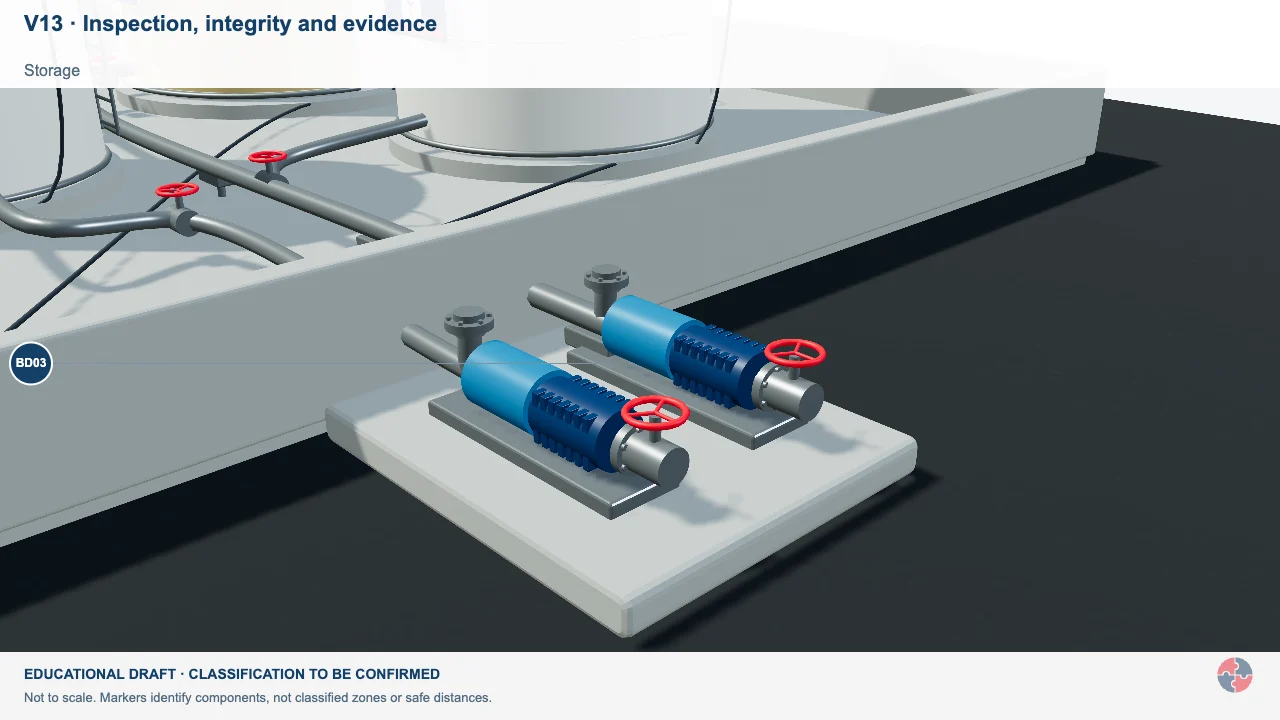
Inspection, integrity and evidence
A hose, tank or protective device has a safety purpose which depends on its condition and supporting checks.
Activity focus: Connect each identified defect to the responsible owner and appropriate operational decision.
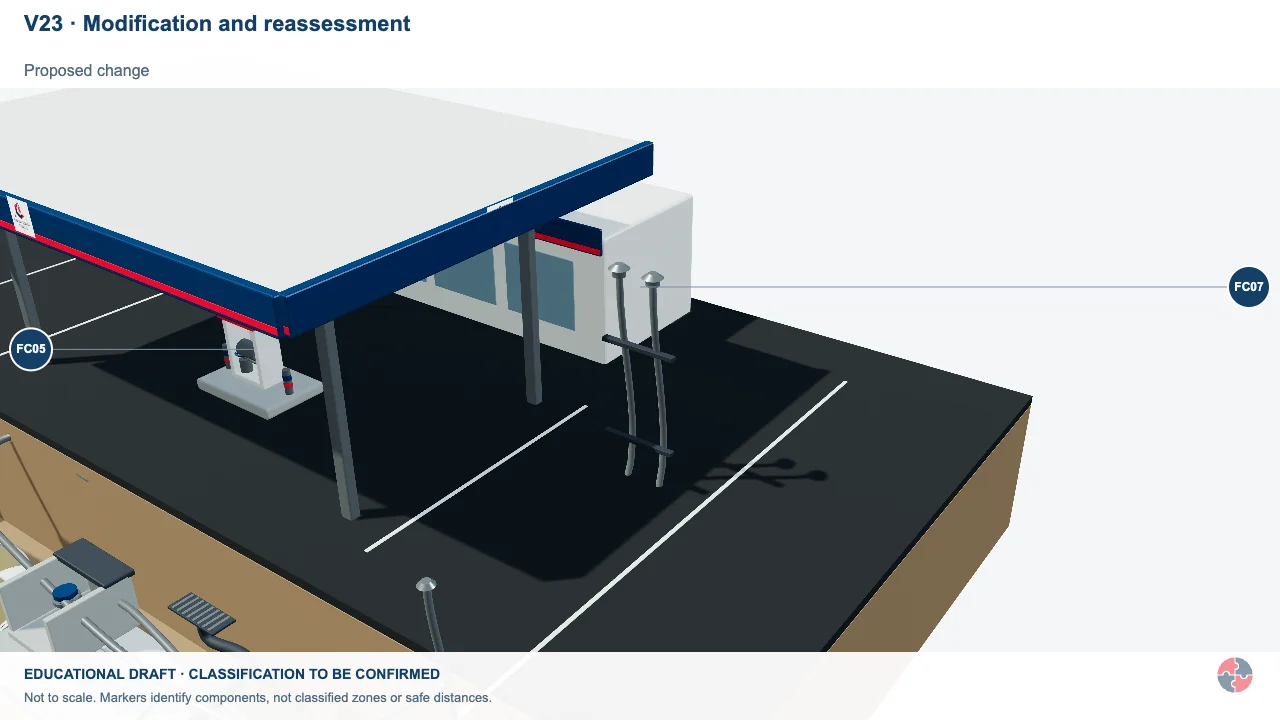
Modification and reassessment
Moving a dispenser or changing a vent can alter interfaces and the assumptions behind existing drawings.
Activity focus: Identify affected classification, equipment, drainage and operating records before accepting the proposed change.
Educational illustration, not to scale. Coloured zones are teaching examples, not a site-specific hazardous-area classification.
What do the acronyms and key terms mean?
Acronyms should be understood before they are used in assessments, briefings, audits or learning answers.
Acronyms can exclude newer readers if they are not explained. This section keeps the main terms available at the end of the page so the article stays readable while still supporting learners and audit users.
| Acronym | Meaning | Plain-English use |
|---|---|---|
| PSSR | Pre-Start-Up Safety Review | Formal readiness review before hazardous start-up or restart. |
| MOC | Management of Change | Controlled review and approval of technical, procedural or organisational change. |
| PHA | Process Hazard Analysis | Structured process hazard study such as HAZOP or what-if. |
| HAZOP | Hazard and Operability Study | Structured guideword-based hazard study. |
| ESD | Emergency Shutdown | System that brings plant to a safer state during abnormal events. |
| SCE | Safety Critical Element | Equipment or system relied upon to prevent or mitigate major accident hazards. |
| SIMOPS | Simultaneous Operations | Concurrent activities that can interact and increase risk. |
Unlock another resource
You have used this month’s two free downloads. Publish a post in your own words to unlock one more resource, or choose SHARE Individual for 10 downloads per month.
You decide whether to share. If you do, use the relevant platform disclosure tools and do not make claims you do not genuinely hold.