SHARE Knowledge Hub
Root Cause Analysis (RCA)
Root cause analysis investigates how an incident or near miss developed, which barriers failed and why the conditions existed. It starts with safe response and evidence, builds a timeline, tests multiple causal pathways and selects changes to design and management systems. “Human error” is a question to investigate, not a sufficient final cause; a completed diagram is not proof that risk has fallen.
Understanding Root Cause Analysis (RCA)
Root cause analysis investigates how an incident or near miss developed, which barriers failed and why the conditions existed. It starts with safe response and evidence, builds a timeline, tests multiple causal pathways and selects changes to design and management systems. “Human error” is a question to investigate, not a sufficient final cause; a completed diagram is not proof that risk has fallen.
Why this matters at work
Explain how the event occurred, which conditions enabled it and what changes would reduce recurrence or similar serious harm. Start with the actual energy, exposure or failure sequence and trace immediate causes into work design, maintenance, competence, supervision, planning, coordination and management decisions. There may be several interacting causal pathways. A coherent story, a single root-cause label or a completed diagram is not proof that the explanation is complete.
Use controlled meanings for accident, incident, near miss, dangerous occurrence, adverse event, evidence, finding, causal factor, cause, root cause, barrier, recommendation and action. Distinguish observed fact, witness account, measurement, calculation, inference, assumption and opinion so that the reasoning remains testable.
How organisations manage this in practice
Set a proportionate investigation scope and competent team from that potential and the uncertainties. Examine selection, connection, pressure, movement, degradation, supervision and response as evidence requires, without assuming the hose alone is the root cause. Apply interim controls to comparable equipment where warranted. Specify the required prevention outcome and verify the corrective design or method under relevant conditions. Record any unresolved questions and restrictions. Internal learning should cover high-potential events even where they do not meet a reporting threshold; reportability follows its own territory-specific legal criteria.
Unsafe shortcut: taping off a scene without controlling hazards, access, weather, cleaning, power, data or materials. Escalate when evidence is degrading, the scene is unsafe, multiple agencies need access or operations press for early release.
Write the recommendation as a required safety outcome linked to the scenario and causal deficiency. Specify scope, performance criteria, responsible owner, resources, deadline, interim protection and verification. A vague instruction to improve awareness cannot be tested. Completion evidence may include installation, testing, revised work methods and competence, but the closure question is whether the action changes the causal mechanism and sustains the intended control, not whether paperwork was issued. Define the effectiveness check before closure, using suitable observations, worker feedback and leading or lagging measures under representative conditions. Test foreseeable degraded or abnormal states where relevant and check for new risks introduced by the change. Record the verifier, evidence, limitations and decision, preserving open actions and residual uncertainty. Reopen the recommendation if the mechanism recurs or the control proves unusable. A contractor invoice, signed training sheet or clean period without an event may support part of the record but cannot alone establish effectiveness.
Test several causal paths against evidence
An investigation distinguishes known facts, reports and hypotheses. A plausible explanation must be tested before it is described as a cause.

Preserve and protect
Make the near-miss area safe and preserve relevant scene, records and reported information.
Branch the inquiry
Test layout, scheduling, maintenance and previous learning, including evidence for and against each explanation.
Keep uncertainty visible
Separate weak conclusions, open questions and evidence still needed; do not stop at did not follow procedure.
Match action to a demonstrated gap
Name the owner and representative field test, including peak deliveries where relevant. Investigation and statutory reporting are separate duties that can proceed together.
Read the complete task-specific control examples
ERICPD is a planning cross-map: Discipline verifies and sustains every control. ESEAP compares effectiveness. A label does not authorise the task; retain the owner, evidence and stop or change decision.
Root Cause Analysis (RCA) · ERICPD
- Eliminate
- Replan loading and cleaning so pedestrians never need to enter the reversing bay; feasible if delivery route and service access permit.
- Reduce
- Replace reversing with a one-way drive-through layout where site geometry permits; if not, record swept-path constraint.
- Isolate
- Install impact-rated segregation and a gated crossing away from reversing; do not treat painted lines as a physical barrier.
- Control
- Schedule cleaning outside deliveries and use a controlled crossing procedure for residual access.
- PPE
- High-visibility clothing may aid detection but cannot prevent a forklift strike; select fit/condition for site rules only.
- Discipline
- Brief drivers/cleaners, maintain barriers and review near misses; this sustains engineering, not blame or a substitute.
Root Cause Analysis (RCA) · ESEAP
- Elimination
- Replan loading and cleaning so pedestrians never need to enter the reversing bay; feasible if delivery route and service access permit.
- Substitution
- Replace reversing with a one-way drive-through layout where site geometry permits; if not, record swept-path constraint.
- Engineering controls
- Install impact-rated segregation and a gated crossing away from reversing; do not treat painted lines as a physical barrier.
- Administrative controls
- Schedule cleaning outside deliveries and use a controlled crossing procedure for residual access.
- PPE
- High-visibility clothing may aid detection but cannot prevent a forklift strike; select fit/condition for site rules only.
What is Root Cause Analysis?
Root cause analysis for a workplace incident is a structured investigation of what happened, which controls failed and why the work system allowed those conditions. Preserve evidence, test more than one causal path, change the system and verify that risk fell; do not stop at “human error” or a completed diagram.
RCA tests several causal paths


Read the complete visual as text
- IMMEDIATE CAUSE: The direct act, condition or failure closest to the event. Illustrative example to test: Pedestrian entered reversing area.
- UNDERLYING CAUSE: The workplace condition that made the immediate cause more likely. Illustrative example to test: No physical segregation and poor delivery scheduling.
- ROOT/SYSTEM CAUSE: The management-system weakness that allowed the condition to persist. Illustrative example to test: Traffic risk profile, site design standard and audit process did not identify the interface risk.
- BARRIER FAILURE: A prevention, detection, control or recovery measure was absent, weak or failed. Illustrative example to test: Reversing camera defective and supervisor check missed it.
- HUMAN FACTORS: Job, individual or organisational factors shaped performance. Illustrative example to test: Time pressure, poor visibility, unclear rules and normalised shortcuts.
- LEARNING GAP: Previous weak signals did not lead to effective action. Illustrative example to test: Near misses were recorded but not trended or escalated.
Best-practice guide: Root Cause Analysis (RCA)
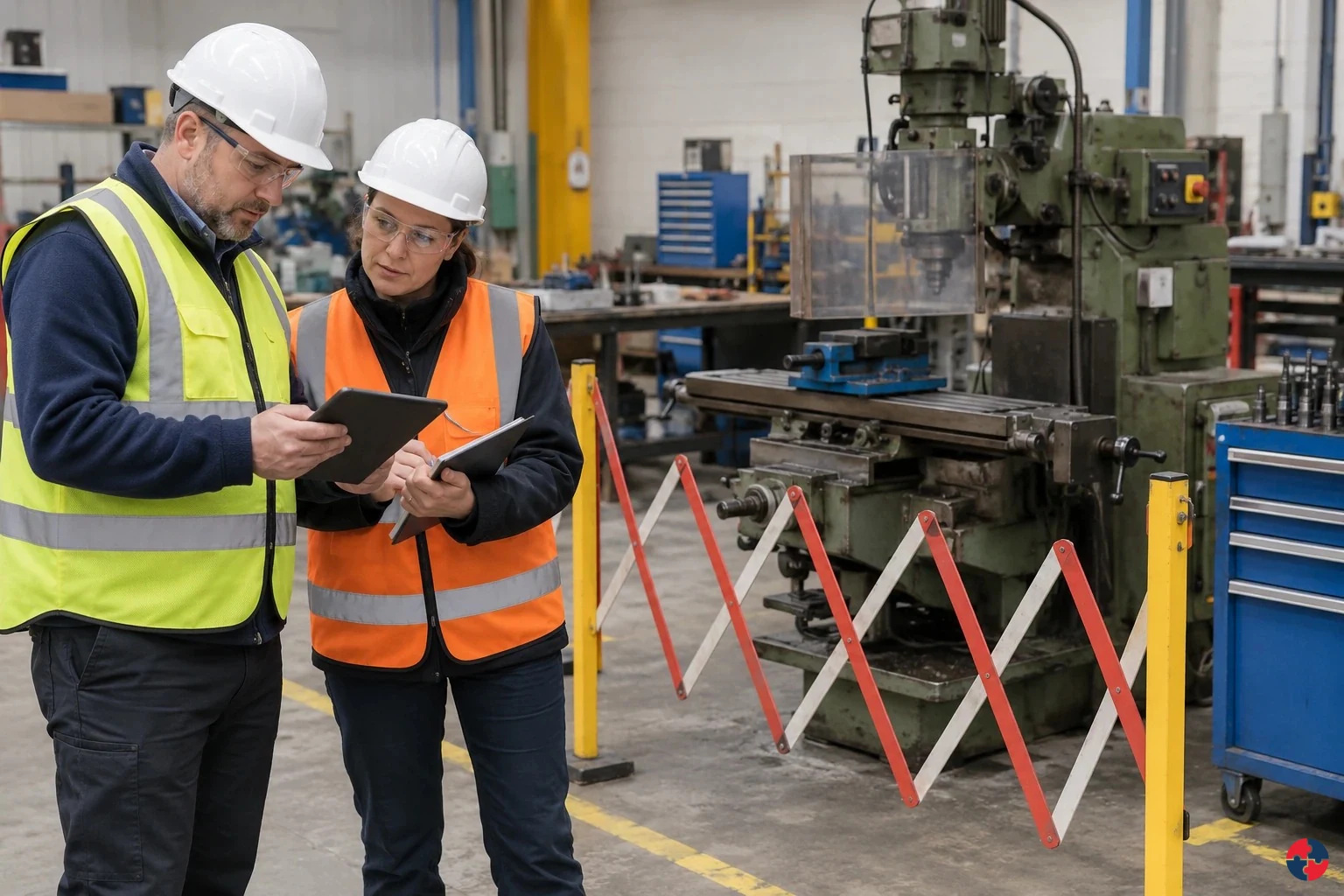
What is Root Cause Analysis?
Root cause analysis for a workplace incident is a structured investigation of what happened, which controls failed and why the work system allowed those conditions. Preserve evidence, test more than one causal path, change the system and verify that risk fell; do not stop at “human error” or a completed diagram. Root cause analysis investigates how an incident or near miss developed, which barriers failed and why the conditions existed.
Turn root cause analysis (rca) knowledge into a decision
Root cause analysis investigates how an incident or near miss developed, which barriers failed and why the conditions existed. It starts with safe response and evidence, builds a timeline, tests multiple causal pathways and selects changes to design and management systems. Keep CCTV, timeline, accounts, causal alternatives, design decision and effectiveness checks.
A forklift narrowly misses a pedestrian
Team tests segregation, layout and schedule changes; checks barriers during peak deliveries. Reopen only after competent field verification; monitor near misses and worker feedback.
Where does RCA commonly fail?
Weak conclusion: The investigation stops at did not follow procedure. Question still open: What evidence explains the conditions, barriers and work system around the event? Evidence and action needed: Test competing paths, document uncertainties and match action to a demonstrated control gap with later verification.
Choose controls for the actual task
Eliminate: Replan loading and cleaning so pedestrians never need to enter the reversing bay; feasible if delivery route and service access permit. Reduce/substitute: Replace reversing with a one-way drive-through layout where site geometry permits; if not, record swept-path constraint. Isolate: Install impact-rated segregation and a gated crossing away from reversing; do not treat painted lines as a physical barrier. Control: Schedule cleaning outside deliveries and use a controlled crossing procedure for residual access. PPE: High-visibility clothing may aid detection but cannot prevent a forklift strike; select fit/condition for site rules only. Read the full control table for qualifications, ownership and verification. Use the actual task and applicable jurisdiction; existing technical approval remains unchanged.
Use the full root cause analysis (rca) lesson
Use the full topic for the decision points, practical examples, detailed control tables and source scope. HSE guidance applies to Great Britain; use HSENI for the Northern Ireland route and the source’s stated jurisdiction. A simplified guide does not change the page’s technical-review or approval status.

Read all six steps as text
1. What is Root Cause Analysis?
Root cause analysis for a workplace incident is a structured investigation of what happened, which controls failed and why the work system allowed those conditions.
- Avoid / redesign: Replan loading and cleaning so pedestrians never need to enter the reversing bay; feasible if delivery route and service access permit.
- Control the task: Install impact-rated segregation and a gated crossing away from reversing; do not treat painted lines as a physical barrier.
- Verify before release: Operations manager trials route before release; verify zero planned crossing and observe peak delivery; stop if cleaning still requires the bay.
Root cause analysis for a workplace incident is a structured investigation of what happened, which controls failed and why the work system allowed those conditions. Preserve evidence, test more than one causal path, change the system and verify that risk fell; do not stop at “human error” or a completed diagram. Root cause analysis investigates how an incident or near miss developed, which barriers failed and why the conditions existed.
Apply it: Which part of this plan would you check at the workface before authorising the task?
2. Turn root cause analysis (rca) knowledge into a decision
Use the evidence to improve the actual work arrangement.
- Change at source: Replan loading and cleaning so pedestrians never need to enter the reversing bay; feasible if delivery route and service access permit.
- Make it observable: Operations manager trials route before release; verify zero planned crossing and observe peak delivery; stop if cleaning still requires the bay.
- Keep useful evidence: Keep CCTV, timeline, accounts, causal alternatives, design decision and effectiveness checks.
Root cause analysis investigates how an incident or near miss developed, which barriers failed and why the conditions existed. It starts with safe response and evidence, builds a timeline, tests multiple causal pathways and selects changes to design and management systems. Keep CCTV, timeline, accounts, causal alternatives, design decision and effectiveness checks.
Apply it: What evidence would show that the change improves this task, rather than only completing a record?
3. A forklift narrowly misses a pedestrian
Example: a practical application of the existing topic lesson.
- Setting: A pedestrian steps into a forklift route near a blocked sight line during a busy delivery.
- Act: Investigator maps movement, layout, deliveries, visibility, supervision and previous warnings; asks why the route was used.
- Hold / review: Keep the route closed if segregation or visibility is still uncertain.
Team tests segregation, layout and schedule changes; checks barriers during peak deliveries. Reopen only after competent field verification; monitor near misses and worker feedback.
Apply it: At which point would you hold this example, and what evidence would allow it to proceed?
4. Where does RCA commonly fail?
Connect the task, the route to the person and the control that can fail.
- Weak conclusion: The investigation stops at did not follow procedure.
- Question still open: What evidence explains the conditions, barriers and work system around the event?
- Evidence and action needed: Test competing paths, document uncertainties and match action to a demonstrated control gap with later verification.
Weak conclusion: The investigation stops at did not follow procedure. Question still open: What evidence explains the conditions, barriers and work system around the event? Evidence and action needed: Test competing paths, document uncertainties and match action to a demonstrated control gap with later verification.
Apply it: Who could be exposed, including other trades, cleaners, maintainers and people nearby?
5. Choose controls for the actual task
Control summary. Read the complete task-specific controls and checks in the linked topic.
- Elimination: Replan loading and cleaning so pedestrians never need to enter the reversing bay; feasible if delivery route and service access permit.
- Substitution: Replace reversing with a one-way drive-through layout where site geometry permits; if not, record swept-path constraint.
- Engineering controls: Install impact-rated segregation and a gated crossing away from reversing; do not treat painted lines as a physical barrier.
- Administrative controls: Schedule cleaning outside deliveries and use a controlled crossing procedure for residual access.
- PPE: High-visibility clothing may aid detection but cannot prevent a forklift strike; select fit/condition for site rules only.
Eliminate: Replan loading and cleaning so pedestrians never need to enter the reversing bay; feasible if delivery route and service access permit. Reduce/substitute: Replace reversing with a one-way drive-through layout where site geometry permits; if not, record swept-path constraint. Isolate: Install impact-rated segregation and a gated crossing away from reversing; do not treat painted lines as a physical barrier. Control: Schedule cleaning outside deliveries and use a controlled crossing procedure for residual access. PPE: High-visibility clothing may aid detection but cannot prevent a forklift strike; select fit/condition for site rules only. Read the full control table for qualifications, ownership and verification. Use the actual task and applicable jurisdiction; existing technical approval remains unchanged.
Apply it: Which stronger option can be used here, and who will verify it before accepting the remaining risk?
6. Use the full root cause analysis (rca) lesson
Follow the official sources below and retain the task-specific evidence.
- Official guidance: HSE Investigating accidents and incidents HSG245
- Official guidance: HSE human factors in accident investigations
- Task decision: Name the owner and representative field test, including peak deliveries where relevant. Investigation and statutory reporting are separate duties that can proceed together.
Use the full topic for the decision points, practical examples, detailed control tables and source scope. HSE guidance applies to Great Britain; use HSENI for the Northern Ireland route and the source’s stated jurisdiction. A simplified guide does not change the page’s technical-review or approval status.
Apply it: Which official source and full-topic section will you use to resolve the next decision?
Root cause analysis starts with the event but looks beyond the event. A worker slipped, a line leaked, a lift plan failed, a guard was bypassed or a gas alarm was ignored. RCA asks what controls were expected, which failed, why they failed, and what management system allowed the weakness to exist.
A good RCA does not assume there is one neat cause. Incidents usually have immediate causes at the workface, underlying causes in supervision, equipment, planning or communication, and deeper root causes in management arrangements, procurement, maintenance, competence, design, workload or culture.
| Cause level | Meaning | Example |
|---|---|---|
| Immediate cause | The direct act, condition or failure closest to the event. | Pedestrian entered reversing area. |
| Underlying cause | The workplace condition that made the immediate cause more likely. | No physical segregation and poor delivery scheduling. |
| Root/system cause | The management-system weakness that allowed the condition to persist. | Traffic risk profile, site design standard and audit process did not identify the interface risk. |
| Barrier failure | A prevention, detection, control or recovery measure was absent, weak or failed. | Reversing camera defective and supervisor check missed it. |
| Human factors | Job, individual or organisational factors shaped performance. | Time pressure, poor visibility, unclear rules and normalised shortcuts. |
| Learning gap | Previous weak signals did not lead to effective action. | Near misses were recorded but not trended or escalated. |
How should an RCA be carried out?
Start by making the scene safe and preserving evidence. Gather accounts and records, build a time sequence, distinguish facts from assumptions, analyse failed barriers and underlying conditions, then choose higher-order corrective actions with owners and verify them in real work.
The investigation sequence follows HSE HSG245. For a forklift/pedestrian corrective action, HSE workplace transport guidance and HSENI separation guidance support route separation; apply the right GB or NI legal route and verify the actual site layout.
HSE HSG245 sets out a simple investigation logic: gather information, analyse information, identify risk control measures, and produce an action plan. RCA adds depth by testing why the controls were not present, used, effective or sustained.
The investigator should distinguish fact, inference and opinion. Witness accounts, photos, records, equipment condition, training evidence, permits, inspections, environmental conditions and system documents should be tied to the timeline.
| Stage | Purpose | Good output |
|---|---|---|
| Triage | Decide investigation level from actual and potential harm. | Investigation scope and team. |
| Preserve evidence | Protect facts before they degrade. | Photos, physical evidence, records and witness list. |
| Build timeline | Understand sequence before assigning causes. | Time-ordered event and condition map. |
| Analyse barriers | Identify expected, missing, weak or failed controls. | Barrier table and failure analysis. |
| Explore causes | Use 5 Whys, fishbone, bowtie or task analysis as appropriate. | Immediate, underlying and system causes. |
| Define actions | Address causes with owners and due dates. | SMART action plan. |
| Verify learning | Check actions work and update risk controls. | Verification evidence and lessons learned. |
How would RCA work for a forklift near miss?
A worked example shows why RCA must move beyond 'pedestrian not paying attention'.
Forklift near miss: preserve, test causes, redesign and verify


Read the complete visual as text
- 1. SITUATION: A pedestrian steps into a forklift route near a blocked sight line during a busy delivery.
- 2. PEOPLE AND EVIDENCE: Supervisor stops traffic, checks for injury, preserves CCTV and scene conditions, and considers GB or NI reporting separately.
- 3. CHANGE THE WORK: Investigator maps movement, layout, deliveries, visibility, supervision and previous warnings; asks why the route was used.
- 4. CHECK IN REAL WORK: Team tests segregation, layout and schedule changes; checks barriers during peak deliveries.
- 5. HOLD OR REFER: Keep the route closed if segregation or visibility is still uncertain.
- 6. VERIFY AND REVIEW: Reopen only after competent field verification; monitor near misses and worker feedback.
- 7. RETAIN THE DECISION: Keep CCTV, timeline, accounts, causal alternatives, design decision and effectiveness checks.
A forklift reverses from a loading bay and narrowly misses a cleaner crossing the doorway. The weak investigation records 'cleaner walked behind forklift' and briefs staff to take care. That action leaves the same interface risk in place.
A stronger RCA asks why the pedestrian route crossed the vehicle route, why the cleaner was working during peak loading, why visibility was poor, why there was no physical segregation, why near misses had not been escalated and why the traffic management assessment did not match work as done.
| Investigation point | Weak RCA | Stronger RCA |
|---|---|---|
| Event description | Cleaner nearly hit by forklift. | Reversing forklift crossed uncontrolled pedestrian route at peak loading. |
| Immediate cause | Cleaner in wrong place. | Pedestrian and vehicle routes overlapped with poor visibility. |
| Underlying causes | Cleaner should have watched. | Cleaning schedule, doorway layout, reversing method and supervision were weak. |
| Root/system causes | None identified. | Traffic standard, contractor coordination and audit sampling missed interface risk. |
| Action | Brief everyone to be careful. | Redesign route, change schedule, add physical segregation and verify. |
| Learning | Local note only. | Update traffic risk profile and audit other sites. |
A forklift narrowly misses a pedestrian
Task, material and setting: A pedestrian steps into a forklift route near a blocked sight line during a busy delivery.
People and prerequisites: Supervisor stops traffic, checks for injury, preserves CCTV and scene conditions, and considers GB or NI reporting separately.
Before: Investigator maps movement, layout, deliveries, visibility, supervision and previous warnings; asks why the route was used.
During: Team tests segregation, layout and schedule changes; checks barriers during peak deliveries.
Hold or stop: Keep the route closed if segregation or visibility is still uncertain.
Completion and hand back: Reopen only after competent field verification; monitor near misses and worker feedback.
Evidence: Keep CCTV, timeline, accounts, causal alternatives, design decision and effectiveness checks.
A guard failure after maintenance
Task, material and setting: A machine guard is found defeated after a repair and an operator had a near hand contact.
People and prerequisites: Isolate the machine, preserve guard and maintenance records, notify responsible people and assess reportability.
Before: Compare expected interlock function, repair method, permit, hand-back and production pressure; avoid ending at operator error.
During: Engineer redesigns or repairs the guard and maintenance hand-back; workers trial the new method.
Hold or stop: Do not restart on a reminder or retraining alone if physical access remains possible.
Completion and hand back: Verify guarding under normal production and non-routine clearing, then review similar machines.
Evidence: Keep test evidence, causal map, action owner, restart authority and audit sample.
Test a causal claim against conflicting evidence
Illustrative claim: the cleaner had to cross the forklift route. Supporting evidence: the signed layout and two independent accounts show the stores route blocked. Conflicting or unknown evidence: delivery timing and the alarm state are disputed. Next test: preserve the gate/alarm records, observe the actual alternative route safely and compare shift accounts. The investigator keeps the explanation provisional; the operations owner retains restrictions while the barrier evidence is unresolved. Prefer the explanation supported by tested facts over a completed diagram or a convenient blame statement.
Which RCA methods are useful and where do they fail?
Methods help structure thinking, but they do not replace evidence, competence or judgement.
5 Whys, fishbone, timeline analysis, bowtie review and barrier analysis can all be useful. The method should match the event, complexity and potential harm.
The danger is method theatre. A neat fishbone or five-question chain is weak if it ignores evidence, human factors, management-system causes or action verification.
Choose the method for the uncertainty. A timeline can establish what happened before a forklift near miss; a barrier review asks why pedestrian separation did not work; interviews and records test whether the route, workload and supervision made the deviation likely. “Five whys” may help frame questions but a single chain can miss interacting causes. Preserve disputed facts as disputed until checked. HSE HSG245 describes evidence-led investigation.
| Method | Useful for | Limitation |
|---|---|---|
| 5 Whys | Quick exploration of cause chains. | Can become linear and simplistic if used alone. |
| Fishbone/Ishikawa | Grouping causes under people, equipment, environment, method, materials and management. | Can list causes without proving evidence or priority. |
| Timeline | Understanding sequence and changing conditions. | Needs analysis layer after chronology. |
| Barrier analysis | Testing prevention, detection, control and recovery measures. | Needs clear expectation of what barriers should exist. |
| Bowtie review | Linking threats, controls, consequences and escalation factors. | Can be too high-level if not tied to field evidence. |
| Human factors task analysis | Understanding decision points and performance influencing factors. | Needs competence and worker involvement. |
What is the difference between poor and good RCA?
Poor RCA explains who failed; good RCA explains why the system allowed failure and how controls will be improved.
A poor investigation often feels quick and decisive because it names a person. A good investigation can feel slower because it tests evidence, context and system conditions.
The goal is not to excuse reckless behaviour. It is to make sure accountability is fair and that the organisation fixes the controls that will prevent recurrence.
“The pedestrian was not paying attention” is an incomplete conclusion when the route allowed people and vehicles to meet. A stronger explanation tests sightlines, delivery timing, barrier condition, supervision and why the chosen route made sense to the worker. The action should change the crossing or separation, then be observed under normal traffic. That reasoning preserves accountability while addressing the condition that could harm the next person. HSE human-factors investigation guidance supports looking beyond individual error.
| Topic | Poor RCA | Good RCA |
|---|---|---|
| Cause statement | Operator error. | Operator selected wrong valve because labels, lighting and procedure did not support the task. |
| Evidence | Relies on memory and opinion. | Uses records, photos, interviews, equipment state and task observation. |
| Human factors | Treats behaviour as the end point. | Explores workload, competence, interface, supervision and pressure. |
| Actions | Retrain and remind. | Redesign, simplify, verify and update standards where needed. |
| Learning | Local close-out. | Extent check across similar tasks and sites. |
| Verification | Action marked complete. | Field check confirms control works. |
How can the hierarchy of controls turn root-cause findings into lasting risk reduction?
A strong action changes the conditions that allowed the event, not just the behaviour after the event.
Use ERICPD (Eliminate, Reduce including substitution, Isolate, Control, Personal Protective Equipment, Discipline) to compare proposed corrective actions against the underlying harm path. It is a teaching prompt alongside the HSE five-level hierarchy, not a statutory ladder; a feasible physical route change outranks a new warning or refresher briefing.
How can the ERICPD hierarchy of controls turn root-cause findings into lasting risk reduction?

| ERICPD level | Five-level match | Task-specific intervention and feasibility | Owner, evidence, failure and stop point |
|---|---|---|---|
| Eliminate | Elimination | Replan loading and cleaning so pedestrians never need to enter the reversing bay; feasible if delivery route and service access permit. HSE / HSENI | Operations manager trials route before release; verify zero planned crossing and observe peak delivery; stop if cleaning still requires the bay. |
| Reduce/substitute | Substitution | Replace reversing with a one-way drive-through layout where site geometry permits; if not, record swept-path constraint. HSE / HSENI | Traffic designer checks truck movement and sight lines; observe first live shifts; stop if vehicles reverse into a pedestrian path. |
| Isolate | Engineering controls | Install impact-rated segregation and a gated crossing away from reversing; do not treat painted lines as a physical barrier. HSE / HSENI | Facilities engineer specifies and commissions barriers; inspect gaps and damage daily; close route if barrier or gate fails. |
| Control | Administrative controls | Schedule cleaning outside deliveries and use a controlled crossing procedure for residual access. HSE / HSENI | Supervisor checks roster and observed work; stop simultaneous movements when the procedure breaks. |
| PPE | PPE | High-visibility clothing may aid detection but cannot prevent a forklift strike; select fit/condition for site rules only. HSE / HSENI | Supervisor checks condition and use. Stop the crossing if route separation is unsafe; PPE never authorises reopening. |
| Discipline | Administrative assurance | Brief drivers/cleaners, maintain barriers and review near misses; this sustains engineering, not blame or a substitute. HSE / HSENI | Transport lead samples shift observations, repairs and near-miss trends; suspend affected route on repeat conflict. |
How can the ISO 45001 hierarchy of controls turn root-cause findings into lasting risk reduction?

| ERICPD level | Five-level match | Task-specific intervention and feasibility | Owner, evidence, failure and stop point |
|---|---|---|---|
| Eliminate | Elimination | Replan loading and cleaning so pedestrians never need to enter the reversing bay; feasible if delivery route and service access permit. HSE / HSENI | Operations manager trials route before release; verify zero planned crossing and observe peak delivery; stop if cleaning still requires the bay. |
| Reduce/substitute | Substitution | Replace reversing with a one-way drive-through layout where site geometry permits; if not, record swept-path constraint. HSE / HSENI | Traffic designer checks truck movement and sight lines; observe first live shifts; stop if vehicles reverse into a pedestrian path. |
| Isolate | Engineering controls | Install impact-rated segregation and a gated crossing away from reversing; do not treat painted lines as a physical barrier. HSE / HSENI | Facilities engineer specifies and commissions barriers; inspect gaps and damage daily; close route if barrier or gate fails. |
| Control | Administrative controls | Schedule cleaning outside deliveries and use a controlled crossing procedure for residual access. HSE / HSENI | Supervisor checks roster and observed work; stop simultaneous movements when the procedure breaks. |
| PPE | PPE | High-visibility clothing may aid detection but cannot prevent a forklift strike; select fit/condition for site rules only. HSE / HSENI | Supervisor checks condition and use. Stop the crossing if route separation is unsafe; PPE never authorises reopening. |
| Discipline | Administrative assurance | Brief drivers/cleaners, maintain barriers and review near misses; this sustains engineering, not blame or a substitute. HSE / HSENI | Transport lead samples shift observations, repairs and near-miss trends; suspend affected route on repeat conflict. |
For the forklift near miss, compare actions using ERICPD (Eliminate, Reduce including substitution, Isolate, Control, Personal Protective Equipment, Discipline) and the HSE five-level hierarchy. The two prompts are related but not identical; the physical route change outranks a warning or refresher briefing.
Investigation value is often lost at the action stage. Weak actions are vague, training-heavy, unaudited and disconnected from the cause. Strong actions have an owner, due date, control logic, verification method and link to the management system.
For high-potential events, the action should also include an extent check: where else could the same conditions exist?
| Weak action | Why it is weak | Stronger action |
|---|---|---|
| Remind staff to take care. | Does not change the task or control. | Install physical separation and verify use during peak loading. |
| Retrain operator. | Assumes knowledge was the only cause. | Review procedure, labels, supervision and competence assessment. |
| Review risk assessment. | No output or owner defined. | Update assessment with named controls, owner, due date and briefing. |
| Fix equipment. | May miss wider maintenance weakness. | Repair, check similar assets and adjust preventive maintenance. |
| Close after toolbox talk. | No proof of control improvement. | Observe task and verify new control works. |
| Local action only. | May miss systemic repeat risk. | Run extent check across similar sites, shifts or contractors. |
What would a mini RCA pack look like?
A useful RCA pack is short enough to use, but complete enough to show the event, evidence, barriers, causes, actions and verification.
The pack should let a manager understand the learning without reading every interview note. It should also let an auditor trace each finding back to evidence and each action back to a cause.
For high-potential events, the pack should include an extent check. This asks where else the same weak control, procedure, design, supervision pattern or contractor interface could exist.
A useful pack for that near miss would include a marked route, dated photos, vehicle movements, witness accounts, barrier inspection history and any temporary traffic change. State which facts support each causal claim and which remain uncertain. Assign an owner to physical separation and a second person to verify it during a busy delivery period; close the action only when the new route works in practice. HSE workplace transport guidance gives the control context.
| Pack element | Example content | Quality test |
|---|---|---|
| Event summary | Forklift reversing near miss at loading doorway during contractor cleaning. | Does it describe the credible serious-harm scenario, not just the outcome? |
| Evidence list | Photos, CCTV, cleaning schedule, traffic plan, inspection record, interviews and near-miss history. | Can each finding be traced to evidence? |
| Timeline | Cleaner entered route; forklift reversed; alarm not heard; supervisor absent; previous near misses not escalated. | Does it show conditions and decisions over time? |
| Barrier failures | No physical segregation, poor scheduling, weak supervision and poor near-miss trend review. | Are expected controls named and tested? |
| Cause statement | The task design allowed pedestrian and vehicle routes to overlap during peak loading. | Does it avoid blaming the cleaner as the root cause? |
| Actions | Redesign route, change cleaning time, install barrier, brief both teams and update contractor induction. | Do actions remove or reduce the condition? |
| Verification | Observe peak loading after change and review one month of near-miss data. | Is effectiveness checked in the field? |
| Extent check | Review other loading bays and out-of-hours contractor tasks. | Could the same weakness exist elsewhere? |
How does the same incident look in a bad RCA and a good RCA?
The difference is whether the investigation stops at behaviour or changes the system that shaped behaviour.
Use this comparison when coaching new investigators. The same incident can produce a weak report that feels tidy but prevents little, or a stronger report that improves task design, supervision, contractor control and learning.
A good RCA should still be fair about individual accountability. Deliberate rule-breaking may need management action, but it should not stop the investigation from checking why controls were weak or drifted.
| Topic | Bad RCA | Good RCA |
|---|---|---|
| Question asked | Who caused it? | What conditions allowed it and what controls failed? |
| Evidence | Supervisor view and short witness note. | Physical evidence, task observation, records, interviews and previous weak signals. |
| Human factors | Worker should have paid attention. | Visibility, workload, route design, supervision and time pressure affected performance. |
| Control focus | Tell people to follow rules. | Improve physical controls, scheduling, briefing and verification. |
| Action test | Has everyone been reminded? | Will this action stop the same pathway elsewhere? |
| Learning | Local close-out. | Risk assessment, standard, induction and audit checklist updated. |
When should RCA be escalated?
Escalate when actual or potential harm is serious, causes are uncertain, evidence is complex or system learning is likely.
The level of RCA should match potential severity, not just actual outcome. A dropped object that misses someone by centimetres may need a deeper investigation than a minor injury with limited recurrence potential.
Escalation also helps protect independence. Where local managers own the failed system, a more independent investigator may be needed to avoid defensiveness or blind spots.
| Trigger | Escalation route | Reason |
|---|---|---|
| Fatal, major injury or high-potential near miss | Senior investigation lead and competent team. | Potential harm and organisational learning value are high. |
| RIDDOR or enforcement potential | H&S/legal/senior management. | Reporting, evidence and privilege boundaries may matter. |
| Complex technical failure | Technical specialist or authority. | Engineering, process, structural or occupational health expertise needed. |
| Human factors complexity | Human factors competent support. | Decision, workload, procedure or interface issues need deeper review. |
| Repeat event | Management-system owner. | Previous actions may have failed. |
| Cross-site implication | Functional lead or board review. | Learning may need standard or resource change. |
Choose depth using harm, recurrence and learning
Set investigation depth using credible potential harm, likelihood of recurrence and learning value alongside the facts of the event. A harmless outcome can reveal a serious barrier failure. Reporting classification and prompt protection continue on their own timelines.
Where does RCA commonly fail?
RCA fails when it becomes blame, method theatre, weak action tracking or learning that never reaches the risk controls.
The most damaging failure is stopping at 'did not follow procedure'. That may be true, but it is rarely complete. The better question is why the procedure was not followed and whether the task, environment, supervision or culture made non-compliance likely.
A second failure is weak action closure. If corrective actions are closed without verifying the control in the field, the investigation has produced paperwork rather than prevention.
| Failure or weak practice | How it develops | What good looks like |
|---|---|---|
| Blame-led conclusion | Person named as root cause. | Explore job, equipment, environment, individual and organisation factors. |
| Evidence gap | Report relies on recollection only. | Preserve physical, digital, documentary and witness evidence. |
| Single-cause thinking | One root cause selected too early. | Map immediate, underlying, root and barrier causes. |
| Weak action | Training/reminder used for every finding. | Match action to cause and control hierarchy. |
| No extent check | Similar risks elsewhere ignored. | Ask where else the same condition could exist. |
| No verification | Actions closed administratively. | Field-test whether the action prevents recurrence. |
What evidence should an RCA hold?
Evidence should show what happened, why it happened, what controls failed, what changed and how action effectiveness was verified.
RCA records should be clear enough for managers, workers, auditors and regulators to understand the learning. They should separate facts from analysis and show how findings led to actions.
Sensitive personal or medical information should be handled carefully. Investigation records should include what is needed for work-related learning and protect confidentiality where health or HR issues are involved.
| Evidence item | What it should show | Assurance question |
|---|---|---|
| Risk assessment or technical assessment | Scope, hazards, affected people, controls, residual risk, owners and review triggers. | Does it match the work as done? |
| Action tracker | Actions, owners, dates, priority, temporary controls and close-out evidence. | Are high-risk actions verified, not merely marked complete? |
| Training and briefing records | Who was briefed, on what, when and how understanding was checked. | Can workers explain the controls in practice? |
| Inspection and monitoring records | Planned checks, defects, findings, trends and corrective action. | Are checks sampling critical controls? |
| Incident and near-miss learning | Events, weak signals, investigations and improvement actions. | Are repeated signals driving system change? |
| Management review | Trend, assurance confidence, resources and decisions. | Are leaders seeing the right risk picture? |
| Timeline | Sequence of events, conditions, decisions and changes. | Does the timeline explain how the event developed? |
| Barrier analysis | Expected, failed, missing and degraded controls. | Are critical controls identified? |
| Action verification evidence | Field checks, photos, tests or observations showing action effectiveness. | Did the action actually reduce risk? |
How should RCA quality be assured?
Assurance should test investigation depth, cause logic, action quality, verification and learning transfer.
RCA assurance is not just checking whether the report was completed on time. It should ask whether the report explains the event, uses evidence, avoids unjustified blame and produces actions that reduce risk.
Senior leaders should pay particular attention to high-potential events and repeat findings. These show where weak signals may be accumulating.
| Assurance check | What good looks like | Escalate if |
|---|---|---|
| Triage quality | Investigation depth matches potential harm. | High-potential event receives local-only closure. |
| Evidence quality | Findings trace back to evidence. | Opinion or assumption drives cause statements. |
| Human factors | Performance influencing factors are considered. | Report stops at worker behaviour. |
| Action strength | Actions change controls and system conditions. | Reminders and retraining dominate. |
| Verification | Verify effectiveness in representative work before final corrective-action close-out; later checks review sustained performance and reopen on failure. | Actions close with no field evidence. |
| Learning transfer | Similar tasks/sites are checked. | Repeat events continue. |
Keep three closure states distinct
Implementation complete means the change is installed or the action delivered. Effectiveness verified means the required real-work test demonstrates that the harm route is controlled; final corrective-action close-out requires that evidence. Sustained-performance review is the later check for drift, recurrence and worker feedback. A scheduled peak-delivery test is an open effectiveness action, not completed verification.
Which Great Britain and Northern Ireland duties apply?
Great Britain has its 2013 RIDDOR reporting route; Northern Ireland retains the Reporting of Injuries, Diseases and Dangerous Occurrences Regulations (Northern Ireland) 1997 and HSENI reporting route, with different categories and thresholds. Decide reportability promptly and separately from the investigation; serious near misses may warrant RCA even if not reportable.
Investigation and statutory reporting stay separate


Read the complete visual as text
- GREAT BRITAIN: RISK-MANAGEMENT DUTY AND INVESTIGATION GUIDANCE: GB Management Regulations 1999 (risk assessment and preventive arrangements); HSE HSG245 (non-statutory investigation guidance). Decision/evidence: Use HSG245 to structure evidence, analysis, control selection and an action plan; the Management Regulations supply the separate legal risk-control duties.
- NORTHERN IRELAND: INVESTIGATION AND PREVENTION: NI Management Regulations 2000; HSENI incident route Decision/evidence: Use NI legal context and local reporting categories; retain the same evidence-and-action discipline.
- REPORTING IS A DISTINCT DECISION: HSE GB RIDDOR; HSENI NI RIDDOR Decision/evidence: A responsible person checks jurisdiction and reportability promptly; a near miss can warrant deep RCA even when not reportable.
Select the legal route for where the work takes place. Regulator guidance explains practice but does not replace legislation or competent advice.
| Issue | Primary route | Decision and evidence |
|---|---|---|
| Great Britain: risk-management duty and investigation guidance | GB Management Regulations 1999 (risk assessment and preventive arrangements); HSE HSG245 (non-statutory investigation guidance). | Use HSG245 to structure evidence, analysis, control selection and an action plan; the Management Regulations supply the separate legal risk-control duties. |
| Northern Ireland: investigation and prevention | NI Management Regulations 2000; HSENI incident route | Use NI legal context and local reporting categories; retain the same evidence-and-action discipline. |
| Reporting is a distinct decision | HSE GB RIDDOR; HSENI NI RIDDOR | A responsible person checks jurisdiction and reportability promptly; a near miss can warrant deep RCA even when not reportable. |
How should the work be managed and checked?
Use an accountable plan, practical controls, worker input and checks that show whether the controls work in real tasks.
HSE’s Plan, Do, Check, Act approach connects the risk decision to implementation, monitoring and improvement. For this topic, the duty holder should name a control owner, define the evidence that the control is effective, and change the work if that evidence fails. A management-system label or certificate is not proof that an individual exposure or task is safe. HSE managing health and safety
| Official guidance | Practical decision | Boundary |
|---|---|---|
| HSE Plan, Do, Check, Act | Assign the risk owner, implement the chosen control and review field evidence after change or failure. | This guidance does not replace the applicable GB or NI law, task assessment or named specialist decision. |
What training and competence are needed?
Match practice and assessment to the person’s decision: workers recognise concerns; managers act on controls; specialists advise within their discipline; leaders verify outcomes.
Use observed scenarios, identify the assessor and record what was demonstrated. Reassess after a changed task, failure or new legal or technical information; do not invent a universal certificate expiry.
On a narrow screen, scroll this table sideways to see every source, decision and evidence column.
An investigator should demonstrate an evidence map that separates fact, inference and unknowns, then propose a stronger control than retraining alone. A supervisor should preserve the scene and protect witnesses; a manager should authorise and verify the corrective change. Record the practical exercise, assessor and decision limits. Reassess after a high-potential event, contested finding or action that fails its effectiveness check.
| Role | Practice and assessment | Assessor | Demonstrated evidence and record | Reassessment trigger |
|---|---|---|---|---|
| Witnesses and workers | Give a factual account and explain normal work, pressures and warning signs without blame. | Supervisor or investigation lead | Witness shows a factual account and can identify evidence to preserve without speculation. Record an observed scenario, the assessor, the account and feedback in the investigation training record. | Reassess after a changed reporting route, missed evidence, a new event type or weak observed practice. |
| Supervisor | Make safe, preserve perishable evidence and escalate severity and reporting decisions. | Investigation lead or safety adviser | Supervisor demonstrates safe triage, preservation and separate GB/NI report escalation in a scenario. Record the assessor, jurisdiction, scenario, reporting decision and any gap in the competence record. | Reassess after an actual event, procedural change, reporting error or changed duty. |
| Investigation lead | Demonstrate timeline, evidence quality, alternative hypotheses and failed-barrier analysis. | Senior investigator with relevant technical specialist | Lead demonstrates an evidence-linked timeline, alternative hypotheses, failed barriers and a testable action plan. Retain the case exercise, assessor judgement, supporting evidence and action-quality feedback. | Reassess after complex/high-potential events or when verification shows actions failed. |
| Technical specialist | Test equipment, process or human-factors causes within competence. | Investigation lead and discipline lead | Specialist demonstrates a bounded test method and explains uncertainty and limitations. Record the discipline, test evidence, assessor, limits of competence and any independent escalation. | Reassess when plant, method or evidence changes or a conclusion is challenged. |
| Senior leader and auditor | Resource higher-order actions and sample effectiveness in comparable work. | Board or audit lead | Leader challenges an action for owner, due date, field verification and transfer to comparable work. Record the sampled action, assessor, decision and effectiveness result. | Reassess after repeat events, overdue actions or evidence that the barrier still fails. |
How could BuildOut Ltd manage this in practice?

BuildOut would use RCA to learn from high-potential construction events and update site standards, risk assessments, supervisor checks and leadership dashboards.
Construction near misses often involve work at height, plant interface, dropped objects, lifting, excavations, temporary works and contractor coordination. BuildOut would treat high-potential events as learning opportunities, not local paperwork.
| Management element | How the business would manage it | Evidence to review |
|---|---|---|
| Triage | Classify actual and potential severity. | Investigation level matrix. |
| Investigate | Build timeline and barrier analysis. | RCA report. |
| Act | Create hierarchy-led actions. | Action tracker. |
| Verify | Check controls in the field. | Verification photos and observations. |
| Learn | Share themes and update standards. | Lessons learned and risk register update. |
What do the acronyms and key terms mean?
Use these terms to explain a work decision, not as proof that a control is effective.
| Term | Expansion | Meaning for this topic |
|---|---|---|
| RCA | Root cause analysis | Structured investigation of correctable system conditions. |
| Immediate cause | Condition closest to the event | Does not explain why the condition existed. |
| Underlying cause | Contributing work or control condition | May connect supervision, design or maintenance. |
| Barrier | Control that should prevent or limit harm | Test its intended function and actual failure. |
| RIDDOR | Reporting of Injuries, Diseases and Dangerous Occurrences Regulations | GB and NI routes differ; reporting is separate from investigation. |
| ERICPD | Eliminate, Reduce, Isolate, Control, Personal Protective Equipment, Discipline | Compare source removal and substitution with engineered separation before work rules or PPE; Discipline means checking that stronger controls keep working. |
Unlock another resource
You have used this month’s two free downloads. Publish a post in your own words to unlock one more resource, or choose SHARE Individual for 10 downloads per month.
You decide whether to share. If you do, use the relevant platform disclosure tools and do not make claims you do not genuinely hold.