SHARE Knowledge Hub
Safe Start-Up and Shutdown
Safe start-up and shutdown move plant between isolated, transient and stable states. During those transitions an incorrect line-up, residual energy, inadequate purge or unavailable trip can release hazardous material, ignite it or expose people during maintenance. A safe sequence verifies the plant state and safeguards before energy or feed is introduced, monitors the transition, and holds or returns to a safe state when the evidence does not match the plan.
Understanding Safe Start-Up and Shutdown
Safe start-up and shutdown move plant between isolated, transient and stable states. During those transitions an incorrect line-up, residual energy, inadequate purge or unavailable trip can release hazardous material, ignite it or expose people during maintenance. A safe sequence verifies the plant state and safeguards before energy or feed is introduced, monitors the transition, and holds or returns to a safe state when the evidence does not match the plan.
Why this matters at work
A transition must pause, abort or move to the approved safer state when a required preventive or recovery barrier is unavailable, the actual response differs from the predicted response, limits or time-to-harm are uncertain, or people cannot execute the recovery within the verified window. Restart requires the cause understood, plant state reconciled, affected barriers re-proved and authorised release repeated.
Classify cold start, warm restart, commissioning, start after maintenance, planned shutdown, process trip and emergency shutdown separately. Each begins with different inventory, temperature, pressure, utility and protection conditions. A hot vessel may retain reactive residue; a cold line may suffer thermal stress; a depressurised system may admit air; a stopped pump may leave hazardous fluid trapped behind isolation.
How organisations manage this in practice
Unsafe shortcut: treating a completed step, reset, signature or control-room indication as proof without confirming the physical and protective state. Escalate when one supervisor cannot oversee simultaneous critical actions or is absorbed in hands-on tasks. Restrict work and further energy or material, preserve a known state, add competent support and record the authorised next decision. Another competent reviewer should be able to reconstruct initial state, each critical action, evidence, deviations, authority and the final verified condition.
The evidence set should include materials review, drying or inhibition basis, sealing and venting, condition monitoring, inspection and removal plan. Test source accuracy, configuration, competence, accessibility, current condition, timing, independence and performance under realistic demand. Use leading evidence on readiness and barrier health with lagging evidence on excursions, demands, omissions and recoveries, and act on deterioration before harm.
A pre-start review tests whether the as-built or as-maintained plant, documentation, safeguards and people are ready for hazardous service. It should resolve or risk-assess outstanding construction and maintenance items, verify pressure boundaries, relief routes, alarms, trips, utilities, emergency systems, operating procedures, training, permits, isolations and change records. An open punch list is not automatically harmless.
Make each start-up transition a checked state
A controlled start follows physical handback, restored safeguards and accepted checks. A failed or uncertain check returns the task to a controlled hold; shutdown requires its own plant-specific planning.

Isolated work state
Keep the assessed all-energy isolation and restraint arrangements throughout cleaning or intrusive work. Account for people, tools, temporary equipment and contractor activities.
Physical handback
Confirm the actual task is complete and the equipment is ready for the next assessed stage. Reconcile open work, access and the authorised isolation-removal process.
Prove protection
Restore guards and required interlocks/protective functions, then complete the specified competent tests. A closed guard or normal-looking panel alone does not prove function.
Authorised controlled start
The designated owner releases the start using the required evidence. Observe the test from safe positions and keep the response to unexpected behaviour ready.
Failed check: hold
Stop the affected sequence and investigate through the safe method if a check fails or its result is uncertain. Do not repeat start attempts to discover whether a defect will disappear.
Shutdown has its own method
Distinguish planned shutdown from emergency action. Residual pressure, temperature, reaction, movement and inventory can remain after stopping; shutdown is not simply start-up in reverse.
Read the complete controls: ERICPD planning prompts
Discipline verifies and sustains all the controls; it is not a separate substitute for them.
| Prompt or level | Complete task-specific example |
|---|---|
| Eliminate | Use a suitable closed cleaning system that removes routine occupied internal access where feasible and validated for the product. |
| Reduce | Choose a safer externally accessible or removable cleaning arrangement after checking contamination, access and machinery hazards. |
| Isolate | Maintain verified isolation and restraint of relevant energy until people are clear and the authorised reinstatement sequence begins. |
| Control | Restore and test guards, interlocks and required process protections; confirm no cleaning equipment or trapped material can obstruct safe operation. Reconcile cleaners, tools, permits, isolation points and plant status with operations; give one named owner authority for the controlled restart. |
| PPE | Use task-assessed cleaning and reinstatement protection. PPE cannot prevent entanglement if the mixer starts with a person inside. |
| Discipline | Record as-left state and test results, observe the planned startup from safe positions and stop on abnormal motion, leak or failed protection. Read the accompanying source table for the framework distinctions. |
Read the complete controls: ESEAP effectiveness order
Compare stronger feasible controls while preserving the actual task, checks and release requirements.
| Prompt or level | Complete task-specific example |
|---|---|
| Elimination | Use a suitable closed cleaning system that removes routine occupied internal access where feasible and validated for the product. |
| Substitution | No separate measure is specified in this example. |
| Engineering controls | Choose a safer externally accessible or removable cleaning arrangement after checking contamination, access and machinery hazards. Maintain verified isolation and restraint of relevant energy until people are clear and the authorised reinstatement sequence begins. Restore and test guards, interlocks and required process protections; confirm no cleaning equipment or trapped material can obstruct safe operation. |
| Administrative controls | Reconcile cleaners, tools, permits, isolation points and plant status with operations; give one named owner authority for the controlled restart. Record as-left state and test results, observe the planned startup from safe positions and stop on abnormal motion, leak or failed protection. |
| PPE | Use task-assessed cleaning and reinstatement protection. PPE cannot prevent entanglement if the mixer starts with a person inside. Read the accompanying source table for the framework distinctions. |
The state sequence does not replace the manufacturer’s instructions, competent assessment or the actual start-up and emergency procedures.
Further source background retained from this topic
How can I practise this topic in 3D?
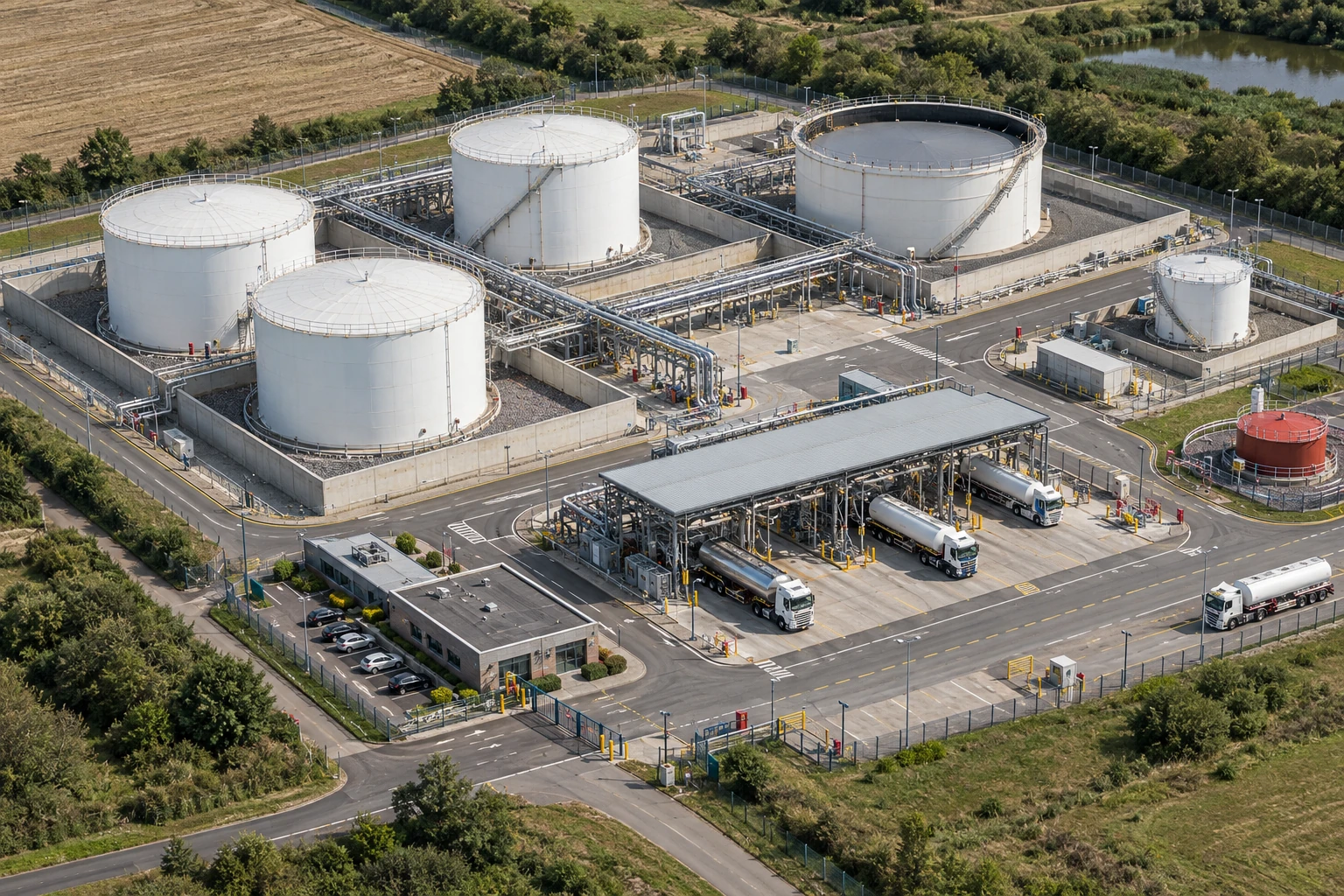

A roof-landing transition lacks a reviewed procedure
All related inspection points 5 across 1 location
Crown Fuels terminal 5 inspection points
Practice in the SHAREhub environment. Browser practice is separate from workplace competence and formal learning records.
What is safe start-up and shutdown?
Safe start-up and shutdown move plant between isolated, transient and stable states. During those transitions an incorrect line-up, residual energy, inadequate purge or unavailable trip can release hazardous material, ignite it or expose people during maintenance. A safe sequence verifies the plant state and safeguards before energy or feed is introduced, monitors the transition, and holds or returns to a safe state when the evidence does not match the plan.
Best-practice guide: Safe Start-Up and Shutdown
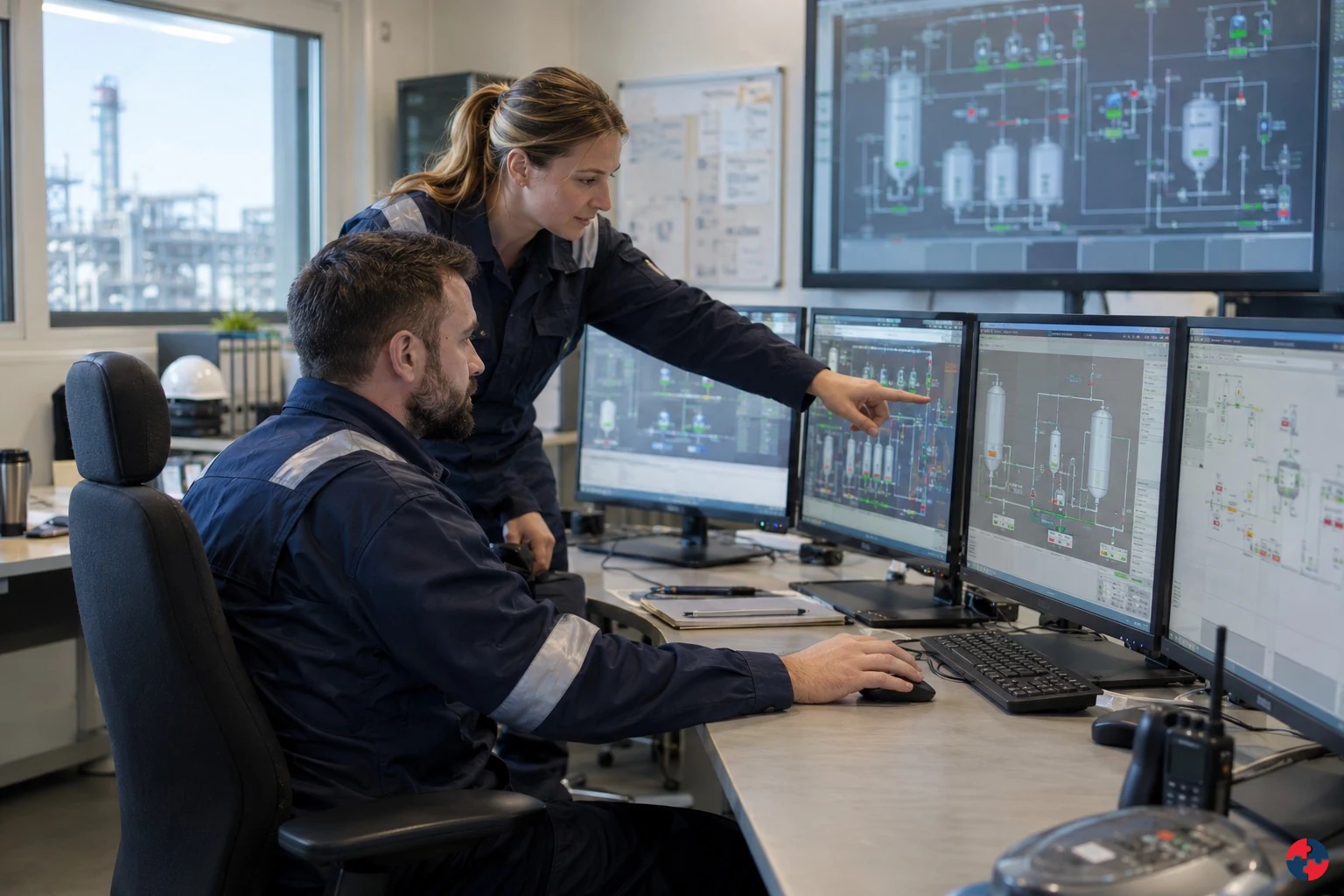
What is safe start-up and shutdown?
Safe start-up and shutdown move plant between isolated, transient and stable states. During those transitions an incorrect line-up, residual energy, inadequate purge or unavailable trip can release hazardous material, ignite it or expose people during maintenance. Safe start-up and shutdown move plant between isolated, transient and stable states.
Turn safe start-up and shutdown knowledge into a decision
Safe start-up and shutdown move plant between isolated, transient and stable states. During those transitions an incorrect line-up, residual energy, inadequate purge or unavailable trip can release hazardous material, ignite it or expose people during maintenance. Close only after physical handback and field inspection. (HSE source)
Safe Start-Up and Shutdown worked example
Permit close: Close only after physical handback and field inspection. (HSE source) Line-up: Use marked line-up sheet and independent check for critical valves. (HSE source)
Follow the exposure and harm route
Residual pressure or open drain after maintenance: Opening or energising a wrongly isolated line releases hot or toxic material onto the maintainer or nearby operator; acute burns or poisoning can follow. Incorrect purge, fuel or feed line-up: Flammable vapour or dust reaches an ignition source during an unstable start; fire or explosion can injure people beyond the unit. Unavailable alarm, trip or control loop: The process passes its safe limit without timely protection, causing overpressure, release or violent reaction.
Choose controls for safe start-up and shutdown
Elimination: Use a suitable closed cleaning system that removes routine occupied internal access where feasible and validated for the product. Engineering controls: Choose a safer externally accessible or removable cleaning arrangement after checking contamination, access and machinery hazards. Engineering controls: Maintain verified isolation and restraint of relevant energy until people are clear and the authorised reinstatement sequence begins. Engineering controls: Restore and test guards, interlocks and required process protections; confirm no cleaning equipment or trapped material can obstruct safe operation. Administrative controls: Reconcile cleaners, tools, permits, isolation points and plant status with operations; give one named owner authority for the controlled restart. Read the full control table for qualifications, ownership and verification. Use the actual task and applicable jurisdiction; existing technical approval remains unchanged.
Use the full safe start-up and shutdown lesson
Use the full topic for the decision points, practical examples, detailed control tables and source scope. HSE guidance applies to Great Britain; use HSENI for the Northern Ireland route and the source’s stated jurisdiction. A simplified guide does not change the page’s technical-review or approval status.

Read all six steps as text
1. What is safe start-up and shutdown?
Safe start-up and shutdown move plant between isolated, transient and stable states.
- Avoid / redesign: Use a suitable closed cleaning system that removes routine occupied internal access where feasible and validated for the product.
- Control the task: Maintain verified isolation and restraint of relevant energy until people are clear and the authorised reinstatement sequence begins.
- Verify before release: If the hazardous step remains, keep it within the task assessment and select the stronger feasible remaining controls.
Safe start-up and shutdown move plant between isolated, transient and stable states. During those transitions an incorrect line-up, residual energy, inadequate purge or unavailable trip can release hazardous material, ignite it or expose people during maintenance. Safe start-up and shutdown move plant between isolated, transient and stable states.
Apply it: Which part of this plan would you check at the workface before authorising the task?
2. Turn safe start-up and shutdown knowledge into a decision
Use the evidence to improve the actual work arrangement.
- Change at source: Use a suitable closed cleaning system that removes routine occupied internal access where feasible and validated for the product.
- Make it observable: If the hazardous step remains, keep it within the task assessment and select the stronger feasible remaining controls.
- Keep useful evidence: Close only after physical handback and field inspection. (HSE source)
Safe start-up and shutdown move plant between isolated, transient and stable states. During those transitions an incorrect line-up, residual energy, inadequate purge or unavailable trip can release hazardous material, ignite it or expose people during maintenance. Close only after physical handback and field inspection. (HSE source)
Apply it: What evidence would show that the change improves this task, rather than only completing a record?
3. Safe Start-Up and Shutdown worked example
Example: a practical application of the existing topic lesson.
- Permit close: Close only after physical handback and field inspection. (HSE source)
- Line-up: Use marked line-up sheet and independent check for critical valves. (HSE source)
- Safeguards: Do not start with an unavailable essential alarm or trip; competent technical authority must prove any effective alternative within defined safe limits before a specific restart decision. (HSE source)
Permit close: Close only after physical handback and field inspection. (HSE source) Line-up: Use marked line-up sheet and independent check for critical valves. (HSE source)
Apply it: At which point would you hold this example, and what evidence would allow it to proceed?
4. Follow the exposure and harm route
Connect the task, the route to the person and the control that can fail.
- Residual pressure or open drain after maintenance: Opening or energising a wrongly isolated line releases hot or toxic material onto the maintainer or nearby operator; acute burns or poisoning can follow.
- Incorrect purge, fuel or feed line-up: Flammable vapour or dust reaches an ignition source during an unstable start; fire or explosion can injure people beyond the unit.
- Unavailable alarm, trip or control loop: The process passes its safe limit without timely protection, causing overpressure, release or violent reaction.
Residual pressure or open drain after maintenance: Opening or energising a wrongly isolated line releases hot or toxic material onto the maintainer or nearby operator; acute burns or poisoning can follow. Incorrect purge, fuel or feed line-up: Flammable vapour or dust reaches an ignition source during an unstable start; fire or explosion can injure people beyond the unit. Unavailable alarm, trip or control loop: The process passes its safe limit without timely protection, causing overpressure, release or violent reaction.
Apply it: Who could be exposed, including other trades, cleaners, maintainers and people nearby?
5. Choose controls for safe start-up and shutdown
Start with the stronger practicable options and verify their effect.
- Elimination: Use a suitable closed cleaning system that removes routine occupied internal access where feasible and validated for the product.
- Engineering controls: Choose a safer externally accessible or removable cleaning arrangement after checking contamination, access and machinery hazards.
- Engineering controls: Maintain verified isolation and restraint of relevant energy until people are clear and the authorised reinstatement sequence begins.
- Engineering controls: Restore and test guards, interlocks and required process protections; confirm no cleaning equipment or trapped material can obstruct safe operation.
- Administrative controls: Reconcile cleaners, tools, permits, isolation points and plant status with operations; give one named owner authority for the controlled restart.
Elimination: Use a suitable closed cleaning system that removes routine occupied internal access where feasible and validated for the product. Engineering controls: Choose a safer externally accessible or removable cleaning arrangement after checking contamination, access and machinery hazards. Engineering controls: Maintain verified isolation and restraint of relevant energy until people are clear and the authorised reinstatement sequence begins. Engineering controls: Restore and test guards, interlocks and required process protections; confirm no cleaning equipment or trapped material can obstruct safe operation. Administrative controls: Reconcile cleaners, tools, permits, isolation points and plant status with operations; give one named owner authority for the controlled restart. Read the full control table for qualifications, ownership and verification. Use the actual task and applicable jurisdiction; existing technical approval remains unchanged.
Apply it: Which stronger option can be used here, and who will verify it before accepting the remaining risk?
6. Use the full safe start-up and shutdown lesson
Follow the official sources below and retain the task-specific evidence.
- Official guidance: HSE source
- Official guidance: Official task guidance: www.hse.gov.uk
- Task decision: Close only after physical handback and field inspection. (HSE source)
Use the full topic for the decision points, practical examples, detailed control tables and source scope. HSE guidance applies to Great Britain; use HSENI for the Northern Ireland route and the source’s stated jurisdiction. A simplified guide does not change the page’s technical-review or approval status.
Apply it: Which official source and full-topic section will you use to resolve the next decision?
Start-up and shutdown are not simply the beginning and end of normal operation. They are transition states, and transition states often invalidate routine assumptions. Lines may be empty, full, isolated, purged, hot, cold, under vacuum, under pressure or contaminated. Alarms and interlocks may be under test. Contractors may still be working. Operators may be building a mental model while the plant is changing.
HSE operating-procedure guidance identifies start-up and shutdown as areas needing specific written procedures. Examples include dryers, furnaces, vessels, tanks and reactors where delayed ignition, dust explosion, flammable vapour, oxygen control or runaway reaction can create serious consequences.
| Topic area | What it means | Professional test |
|---|---|---|
| Pre-start readiness | Plant, people, procedures, permits, isolations, safeguards and utilities are ready. | Can the accountable person prove readiness before introducing hazard? (HSE operating procedures) |
| Line-up and verification | Valves, blinds, drains, vents, instruments and routes are in the required state. | Has critical line-up been independently checked? (HSE operating procedures) |
| Purging/inerting/cleaning | Atmospheres and contamination are controlled before introducing energy or materials. | Are tests, oxygen limits or gas readings verified? (HSE operating procedures) |
| Ramp-up/ramp-down | Pressure, temperature, level, flow and composition change at controlled rates. | Are limits and hold points defined? (HSE operating procedures) |
| Alarm/trip status | Required alarms, trips and interlocks are available and verified. Any alternative protection must be technically justified and authorised for the specific operation before start-up; otherwise hold. | Has effective protection been demonstrated, including concurrent impairments, rather than merely authorising and time-limiting a bypass? HSE operating procedures |
| Handback | Work is complete, plant is safe and responsibilities transfer clearly. | Are open actions and temporary controls reviewed before operation? (HSE operating procedures) |
How can harm occur during this work?
The hazard is the source or energy; harm depends on the route to people and whether a barrier fails.
Check who is exposed, including maintainers, contractors and people nearby. A warning sign is a reason to hold the affected task and investigate, even if no injury has occurred. The examples below connect immediate injury with potential longer-term ill health where the exposure continues.
| Source and state | Route and possible harm | Early warning and stop decision |
|---|---|---|
| Residual pressure or open drain after maintenance | Opening or energising a wrongly isolated line releases hot or toxic material onto the maintainer or nearby operator; acute burns or poisoning can follow. | Isolation boundary, drain status or zero-energy proof cannot be reconciled; hold handback and verify in the field. HSE safe isolation, HSG253 |
| Incorrect purge, fuel or feed line-up | Flammable vapour or dust reaches an ignition source during an unstable start; fire or explosion can injure people beyond the unit. | Purge endpoint, valve position or atmosphere is unknown; do not introduce feed or ignition. HSE operating procedures |
| Unavailable alarm, trip or control loop | The process passes its safe limit without timely protection, causing overpressure, release or violent reaction. | Trip bypass, overdue critical test or unexpected trend remains unresolved; stop transition under the site rule. HSE control systems |
How can the hierarchy of controls reduce risks while restarting a mixer after internal cleaning?
Remove or reduce the hazard before relying on procedures or personal protection.
For safe start-up and shutdown, assess the actual task and first look for a way to remove the hazard. Where that is not possible, consider a safer substitute, engineered separation and then clear work procedures. PPE protects against remaining exposure; it does not make an uncontrolled task safe. HSE hierarchy of controls
The selected measures need a named owner, a usable stop point and a check that they still work when the task or conditions change. In Northern Ireland, verify the separate legal route and site instructions.
How can the ERICPD hierarchy of controls reduce risks while restarting a mixer after internal cleaning?

| Control level | Control for this activity | Owner and verification | Stop / restart decision |
|---|---|---|---|
| Eliminate | Use a suitable closed cleaning system that removes routine occupied internal access where feasible and validated for the product. | Task owner verifies that the proposed change removes the named hazardous step, including foreseeable cleaning, maintenance and work transferred elsewhere. | If the hazardous step remains, keep it within the task assessment and select the stronger feasible remaining controls. |
| Reduce, including substitution | Choose a safer externally accessible or removable cleaning arrangement after checking contamination, access and machinery hazards. | Competent task/process owner validates suitability, compatibility and new hazards against the actual operating requirements before the alternative is adopted. | Reject an alternative if its performance is unproved or its new hazards are unresolved. |
| Isolate | Maintain verified isolation and restraint of relevant energy until people are clear and the authorised reinstatement sequence begins. | Supervisor checks the actual boundary, affected people and connected work; verify separation or isolation before allowing access. | Hold or stop for person unaccounted for, uncertain isolation status, failed guard or unexpected movement. |
| Control: physical safeguards | Restore and test guards, interlocks and required process protections; confirm no cleaning equipment or trapped material can obstruct safe operation. | Competent equipment/process owner checks people/tool clearance, isolation reconciliation, guard/interlock tests and approved start sequence. | Hold or stop for person unaccounted for, uncertain isolation status, failed guard or unexpected movement. |
| Control: work method and response | Reconcile cleaners, tools, permits, isolation points and plant status with operations; give one named owner authority for the controlled restart. | Supervisor confirms the work limits, competent cover, communication and stop/restart authority with the people doing this activity. | Hold work when the agreed limits, competent cover or effective communication cannot be maintained. |
| PPE | Use task-assessed cleaning and reinstatement protection. PPE cannot prevent entanglement if the mixer starts with a person inside. | Assessor confirms whether personal protection is needed and checks suitability, condition, compatibility and any required fit evidence. | Do not use unsuitable protection or rely on PPE to continue after an essential source control fails. |
| Discipline | Record as-left state and test results, observe the planned startup from safe positions and stop on abnormal motion, leak or failed protection. | Release only after operations and maintenance accept the completed cleaning and verified safeguards. Retain verification and unresolved restrictions at handover. | Keep the task on hold until required reinstatement evidence and unresolved defects are accepted by the responsible owner. |
How can the ISO 45001 hierarchy of controls reduce risks while restarting a mixer after internal cleaning?

| Five-level control stage(s) | Control for this activity | Owner and verification | Stop / restart decision |
|---|---|---|---|
| Elimination | Use a suitable closed cleaning system that removes routine occupied internal access where feasible and validated for the product. | Task owner verifies that the proposed change removes the named hazardous step, including foreseeable cleaning, maintenance and work transferred elsewhere. | If the hazardous step remains, keep it within the task assessment and select the stronger feasible remaining controls. |
| Engineering controls | Choose a safer externally accessible or removable cleaning arrangement after checking contamination, access and machinery hazards. | Competent task/process owner validates suitability, compatibility and new hazards against the actual operating requirements before the alternative is adopted. | Reject an alternative if its performance is unproved or its new hazards are unresolved. |
| Engineering controls | Maintain verified isolation and restraint of relevant energy until people are clear and the authorised reinstatement sequence begins. | Supervisor checks the actual boundary, affected people and connected work; verify separation or isolation before allowing access. | Hold or stop for person unaccounted for, uncertain isolation status, failed guard or unexpected movement. |
| Engineering controls | Restore and test guards, interlocks and required process protections; confirm no cleaning equipment or trapped material can obstruct safe operation. | Competent equipment/process owner checks people/tool clearance, isolation reconciliation, guard/interlock tests and approved start sequence. | Hold or stop for person unaccounted for, uncertain isolation status, failed guard or unexpected movement. |
| Administrative controls | Reconcile cleaners, tools, permits, isolation points and plant status with operations; give one named owner authority for the controlled restart. | Supervisor confirms the work limits, competent cover, communication and stop/restart authority with the people doing this activity. | Hold work when the agreed limits, competent cover or effective communication cannot be maintained. |
| PPE | Use task-assessed cleaning and reinstatement protection. PPE cannot prevent entanglement if the mixer starts with a person inside. | Assessor confirms whether personal protection is needed and checks suitability, condition, compatibility and any required fit evidence. | Do not use unsuitable protection or rely on PPE to continue after an essential source control fails. |
| Administrative controls | Record as-left state and test results, observe the planned startup from safe positions and stop on abnormal motion, leak or failed protection. | Release only after operations and maintenance accept the completed cleaning and verified safeguards. Retain verification and unresolved restrictions at handover. | Keep the task on hold until required reinstatement evidence and unresolved defects are accepted by the responsible owner. |
How does the same principle transfer between sectors?
The route to harm changes by setting, so carry over the decision method rather than copying a procedure.
| Setting | Task, stronger control and stop check |
|---|---|
| Fuel terminal | Opening a transfer after tank maintenance can release vapour at the bay; prove isolation, purge and overfill protection before first receipt, then stop on unexpected level rise. |
| Food production | Restarting a heated dryer after cleaning can overheat dust deposits; inspect cleanliness and temperature controls, use staged heat-up and stop on abnormal temperature. |
| Building services | Restarting a pressurised hot-water loop after repair can discharge scalding water; prove venting and pressure control before handback and stop on leakage. |
How should safe start-up and shutdown be structured?
The practical sequence starts with the actual task and plant state, then identifies people, harm routes, physical barriers, decision owners and evidence. A procedure should show what to check before work, what to watch while conditions change, and the precise condition that stops or returns the task to a safe state.
A strong sequence is: define start state -> confirm work complete -> close permits -> verify isolations removed or retained -> confirm line-up -> prove utilities/safeguards -> purge or clean where needed -> introduce energy/material gradually -> monitor trends -> stabilise -> hand over to normal operation.
Shutdown needs the same discipline in reverse, but it is not simply the reverse sequence. A shutdown may create residual pressure, thermal stress, trapped material, oxygen ingress, unstable chemistry, freezing, vacuum, contamination, contractor interface or loss of utilities.
| Model step | What to define | Evidence or decision point |
|---|---|---|
| Define state | Normal shutdown, emergency shutdown, planned maintenance, commissioning or restart. | Written mode and responsible person. (HSE operating procedures) |
| Confirm readiness | Design, procedures, people, equipment, permits, isolations and safeguards. | Readiness checklist and sign-off. (HSE operating procedures) |
| Verify line-up | Valves, blinds, drains, vents, instruments and routes. | Independent check for safety-critical line-up. (HSE operating procedures) |
| Control atmosphere/material | Purge, inert, clean, dry, sample or gas test as needed. | Test record and acceptance criteria. (HSE operating procedures) |
| Introduce/remove energy | Pressure, heat, electrical, chemical, mechanical and hydraulic energy. | Sequenced procedure and hold points. (HSE operating procedures) |
| Monitor and escalate | Trends, alarms, deviations and stabilisation criteria. | Operating log and excursion review. (HSE operating procedures) |
How would start-up fail after maintenance?
A worked example shows why readiness checks and open-action rules matter before reintroducing energy or hazardous material.
A process unit is restarted after pump maintenance. The weak restart closes the permit, assumes the plant is ready and starts the pump to meet production demand. A drain valve remains cracked open, a temporary bypass is still active and an alarm test is overdue. HSE operating procedures.
The stronger restart uses a readiness gate: work complete, area inspected, line-up independently checked, drains/vents closed, capped or confirmed in their required start-up position, guards reinstated, instruments available, alarm/trip status confirmed, operators briefed, open actions classified and start-up authorised by the right person.
The cracked drain is a route for hot or hazardous process fluid to reach the maintainer; the bypass and overdue alarm test also weaken protection against an overfill or pressure excursion. The shift supervisor holds the restart, keeps the unit in its defined safe state and asks the permit issuer, field operator and instrument specialist to prove drain closure, isolation handback and the safeguard status. Only the designated start-up authority releases the staged restart after the technical owner has resolved safety-critical actions; observe first-flow pressure and level and stop on a mismatch.
| Stage | Weak handling | Stronger standard |
|---|---|---|
| Permit close | Permit closed because maintenance says job finished. | Close only after physical handback and field inspection. (HSE operating procedures) |
| Line-up | Operator follows memory. | Use marked line-up sheet and independent check for critical valves. (HSE operating procedures) |
| Safeguards | Alarm test deferred. | Do not start with an unavailable essential alarm or trip; competent technical authority must prove any effective alternative within defined safe limits before a specific restart decision. (HSE operating procedures) |
| Open actions | Punch-list left for later. | Close safety-critical actions before start; a competent authority may defer only non-critical work with documented controls and owner. (HSE operating procedures) |
| Start-up | Ramp quickly to catch production. | Use controlled ramp, hold points and trend monitoring. (HSE operating procedures) |
| Learning | Leak treated as maintenance issue. | Review readiness gate, handback, supervision and MOC. (HSE operating procedures) |
What should a start-up readiness gate include?
A readiness gate proves the plant, people, procedures and safeguards are ready before hazardous operation begins.
The readiness gate should be stronger when the consequence of wrong start-up is serious. It should be a decision point, not a paperwork ritual. HSE operating procedures.
The accountable person should be able to say which items must be closed, which may remain open under restriction, and who has authority to approve exceptions.
The punch-list categories and named release decision below are illustrative site controls. HSE describes commissioning checks, reservation lists and responsible supervision; the competent site owner must set the actual start-up criteria.
| Readiness item | What to verify | Cannot start if |
|---|---|---|
| Design and plant complete | Plant matches approved design or authorised change. | Temporary modification has no MOC. (HSE plant change) |
| Procedures approved | Start-up/shutdown procedure is current and validated. | Procedure does not match plant state. (HSE procedures) |
| Permits and isolations | Open permits closed or controlled; isolations understood. | Unknown open work or uncertain isolation. (HSE permit handback) |
| Safeguards available | Alarms, trips, interlocks, relief and emergency systems available. | Safety-critical barrier unavailable without competent technical review and an approved safe alternative. (HSE control systems) |
| Training and staffing | Competent people available for start-up phase. | New or understaffed team without support. (HSE procedures) |
| Punch list | Open actions classified by safety significance. | Safety-critical action remains open or its effect on the start-up cannot be resolved. (HSE commissioning) |
| Authorised start-up | Named person approves start-up conditions. | Pressure to start without decision owner. (HSE procedures) |
Illustrative purge evidence: the approved procedure names the medium, target atmosphere, sampling locations, selected and checked instruments, safe discharge route and acceptance record. Unknown evidence means no introduction of feed or ignition. Inerting can also create oxygen-deficient atmospheres at connected spaces and discharge points; retain the separate atmosphere and entry controls.HSE safe isolation, HSG253 HSE operating procedures
What practical readiness examples should be checked?
Readiness gates become stronger when they name the physical checks that commonly fail during handback and start-up.
Start-up decisions often fail because everyone believes the paperwork is complete while the field condition is still uncertain. The gate should force the team to check the things that can actually release energy, product, pressure or people into harm. HSE control systems.
These examples are deliberately concrete. They help operators, supervisors and learners understand what operational readiness means in the real plant, not just in a meeting.
| Example check | What good looks like | Why it matters |
|---|---|---|
| Permit closed correctly | Permit is closed only after the job is complete, area inspected, people clear and handback accepted. | A closed permit can falsely signal that the plant is ready. (HSE permit handback) |
| Isolation removed correctly | Locks, tags, blinds, spades and electrical isolations are removed in the planned sequence by authorised people. | Wrong removal can energise equipment or connect hazardous inventory unexpectedly. (HSE safe isolation) |
| Drains, vents and sample points restored | Open points are closed, capped or confirmed in their required start-up position. | Open drains or vents can create releases during pressurisation or filling. (HSE safe isolation) |
| Alarms and trips tested or confirmed available | Safety-critical alarms, interlocks and trips are available, tested where required and not left bypassed. | Start-up without safeguards removes the protection assumed by the procedure. (HSE control systems) |
| Open actions reviewed | Punch-list items are classified as must-close, may-defer with temporary control, or stop start-up. | Minor-looking open actions can hide safety-critical defects. (HSE commissioning) |
| Temporary controls approved | Any temporary control has an owner, expiry, operating restriction and review date. | Temporary fixes can become normal if not controlled. (HSE plant change) |
How do shutdown types change the control standard?
Normal, planned, emergency and maintenance shutdowns have different hazards and decision needs.
Shutdown is often treated as lower risk because production is stopping. In reality, changing states can create trapped energy, unstable contents, poor ventilation, incomplete isolation or unclear ownership. HSE operating procedures.
The shutdown type should determine the procedure, communication, staffing, permit control and restart requirements.
| Shutdown type | Main risk | Control focus |
|---|---|---|
| Normal planned shutdown | Routine sequence misses abnormal condition. | Procedure, hold points, trend monitoring and log. (HSE operating procedures) |
| Maintenance shutdown | Residual energy or hazardous contents remain. | Isolation, drain, vent, purge, clean and handback. (HSE operating procedures) |
| Emergency shutdown | Rapid state change creates secondary hazards. | Emergency procedure, safe state, communication and recovery plan. (HSE operating procedures) |
| Partial shutdown | Interfaces with operating plant remain live. | Boundary controls, SIMOPS and handover. (HSE operating procedures) |
| Temporary shutdown | Plant condition degrades while idle. | Preservation, inspection and restart readiness. (HSE operating procedures) |
| Commissioning/start-up after project | Unknown construction debris, wrong line-up or untested systems. | PSSR/readiness review and phased commissioning. (HSE operating procedures) |
When should safe start-up and shutdown be paused or escalated?
Pause the affected work when the live task differs from the assessment, a critical control is missing, or the person authorised to release it cannot resolve the mismatch. Make the area or plant safe, identify the owner and record the evidence needed before a competent restart decision.
Escalation must be practical. Supervisors and workers need to know which conditions mean stop, pause, seek authorisation, redesign the work or involve a competent specialist.
The decision guide should be used during planning, pre-start briefings, live supervision, audit sampling and incident learning. If the work no longer matches the assessment or procedure, the safe answer is to stop and re-establish control.
A missing essential alarm, trip, purge proof or isolation is a no-go for the planned start. Do not convert it into a routine restricted start: a competent technical assessment must establish whether a demonstrably effective alternative and documented operating boundary are possible, and some impairments require shutdown. The named authority records the decision and evidence before any restart.
| Trigger or question | Decision route | Escalate if |
|---|---|---|
| Is plant state uncertain? | Pause and verify physical condition. | People disagree about line-up, isolation or contents. (HSE control systems) |
| Are safety-critical actions open? | Hold start-up until safety-critical actions are closed; competent technical review is required for any proposed alternative. | Open action affects containment, ignition, relief or emergency response. (HSE control systems) |
| Are alarms/trips impaired? | Do not start with an unavailable essential safeguard; obtain competent technical assessment of any safe alternative and approved restriction. | Major accident barrier is unavailable. (HSE control systems) |
| Has maintenance changed the system? | Use handback and MOC review. | Procedure or drawing may not match plant. (HSE control systems) |
| Is start-up under production pressure? | Use hold points and senior decision ownership. | Checks are being compressed. (HSE control systems) |
| Has shutdown created trapped energy/material? | Confirm isolation, drain, vent, purge and test. | Line breaking or opening equipment is planned. (HSE control systems) |
Where does safe start-up and shutdown commonly fail?
Failure begins when a control shown on paper is absent, bypassed or misunderstood at the work face. Sample a live task against the approved method and equipment state; repeated deviations and near misses are evidence of a system defect to investigate.
The failure modes should be treated as learning prompts. They help reviewers ask whether the control is working in the workplace, not merely whether it appears in the management system.
Good assurance looks for weak signals: informal workarounds, repeated defects, unclear handover, poor supervision, overdue actions, degraded equipment, temporary controls and controls that rely too much on memory or goodwill.
| Failure or weak practice | How it develops | What good looks like |
|---|---|---|
| Checklist theatre | Boxes ticked without field verification. | Use independent checks for safety-critical items. (HSE control systems) |
| Open action drift | Punch-list items stay open after start-up. | Define cannot-start items and temporary restrictions. (HSE control systems) |
| Bypass left in place | Temporary bypass not removed after testing. | Use bypass register and start-up review. (HSE control systems) |
| Rushed ramp-up | Production pressure shortens stabilisation. | Use rate limits, hold points and trend review. (HSE control systems) |
| Weak handback | Maintenance hands back equipment without plant-state confirmation. | Use physical inspection and joint handback. (HSE control systems) |
| Emergency shutdown not learned from | Restart occurs without reviewing cause. | Investigate trip/shutdown before restart where needed. (HSE control systems) |
What evidence should safe start-up and shutdown hold?
Keep the current assessment and method alongside proof that the physical controls work, people are competent, defects were resolved and a named person released the task. Records should allow a supervisor to reconstruct a hold and restart decision.
Evidence is as important as explanation. A competent manager should be able to retrieve records that show who owns the control, what standard applies, what was checked and what changed after findings.
Evidence should combine documents, field observation and conversations. A form may show intent, but observation and worker understanding show whether the safe system is alive.
For the restarted pump, retrieve the permit handback, verified valve line-up, drain and vent inspection, alarm and trip test status, open-action classification, competent approval and first-flow trend. Compare field tags with the current drawing; a signed checklist does not override a leaking drain or failed trip.
| Evidence item | What it should show | Assurance question |
|---|---|---|
| Risk assessment or technical assessment | Scope, hazards, affected people, controls, residual risk, owners and review triggers. | Does it match the work as done? (HSE operating procedures) |
| Action tracker | Actions, owners, dates, priority, temporary controls and close-out evidence. | Are high-risk actions verified, not merely marked complete? (HSE operating procedures) |
| Training and briefing records | Who was briefed, on what, when and how understanding was checked. | Can workers explain the controls in practice? (HSE operating procedures) |
| Inspection and monitoring records | Planned checks, defects, findings, trends and corrective action. | Are checks sampling critical controls? (HSE operating procedures) |
| Incident and near-miss learning | Events, weak signals, investigations and improvement actions. | Are repeated signals driving system change? (HSE operating procedures) |
| Management review | Trend, assurance confidence, resources and decisions. | Are leaders seeing the right risk picture? (HSE operating procedures) |
| Start-up/shutdown procedure | Sequenced steps, hold points, limits, roles and emergency criteria. | Has it been validated against actual plant? (HSE operating procedures) |
| Readiness gate record | Design, procedures, permits, safeguards, training and punch list status. | Who authorised start-up? (HSE operating procedures) |
| Line-up checklist | Critical valves, blinds, drains, vents and instruments verified. | Was independent check needed and done? (HSE operating procedures) |
| Trip/alarm/bypass records | Safeguards available or impairments controlled. | Are temporary controls time-limited? (HSE operating procedures) |
Record verified required safeguard availability. An impairment record is not protection: hold if a competent technical assessment cannot demonstrate effective alternative protection for the proposed state.HSE control systems
How should safe start-up and shutdown be assured?
Observe work as done, inspect a critical physical control, ask the user to explain a stop point, and trace one defect through correction and verification. Escalate repeated weak signals to the accountable manager rather than counting completed forms.
Assurance should be proportionate to harm potential. High-harm or high-complexity work needs stronger verification than routine low-risk tasks.
A good assurance review follows one live example from assessment through planning, briefing, work execution, defect management, action close-out and leadership review.
During a live start, the operations manager samples one critical hold point and asks the operator to explain the safe state if pressure rises unexpectedly. The instrument specialist confirms bypass and test records, and the supervisor watches the first stable period. An unexplained trend or impaired safeguard leads to a recorded hold and investigation before release.
| Assurance sample | What good looks like | Escalate if |
|---|---|---|
| Readiness review | Critical start-up conditions verified before operation. | Start-up approval is purely administrative. (HSE commissioning) |
| Field line-up sample | Procedure and physical plant match. | Plant differs from drawings or checklist. (HSE procedures) |
| Excursion/trip review | Start-up deviations are recorded and learned from. | Trips reset with no review. (HSE procedures) |
| Open-action review | Safety-critical actions close before start-up. | Punch list contains unknown risk items. (HSE commissioning) |
| Operator interview | Operators know limits, hold points and stop triggers. | People rely on experience rather than procedure. (HSE procedures) |
| MOC interface | Changes update start-up/shutdown procedures. | Procedures lag behind modifications. (HSE plant change) |
Which duties and guidance apply in Great Britain and Northern Ireland?
Start with the law for the site and task, then use regulator guidance to choose and check controls. GB and NI have separate instruments; guidance and voluntary standards are not law.
Check the scope of work-equipment, workplace, construction, hazardous-substance or major-accident rules when they apply. Do not treat a general article as a site-specific legal determination; the person planning work checks current instrument text, local conditions and any specialist sector duty.
Where a start-up or shutdown is at a major-hazard establishment, assess COMAH scope separately: GB COMAH Regulations 2015 applies in GB and NI COMAH Regulations 2015 in Northern Ireland. The substance inventory and establishment classification decide applicability; the technical HSE operating-procedures page does not itself establish that a site is in scope. HSENI COMAH guidance explains the NI competent-authority route.
| Route | Direct instrument or guidance | Supporting source | Decision supported |
|---|---|---|---|
| GB general management duties | Health and Safety at Work etc. Act 1974 | Management of Health and Safety at Work Regulations 1999 | Assess the transition, provide safe systems and competent supervision. |
| NI general management duties | Health and Safety at Work (Northern Ireland) Order 1978 | Management of Health and Safety at Work Regulations (Northern Ireland) 2000 | Apply the separate NI Order and management regulations to the actual site; HSENI employer duties describes NI employer duties. |
| Technical guidance | HSE operating procedures | HSE control systems | Use start-up/shutdown procedures and safeguard evidence; HSE COMAH guidance is technical context, with COMAH duties conditional on establishment scope. |
| GB major-accident establishments | GB COMAH Regulations 2015 | Establishment scope and current text | Apply the GB COMAH regime only after confirming establishment scope; verify start-up barrier and emergency arrangements. |
| NI major-accident establishments | NI COMAH Regulations 2015 | HSENI COMAH guidance | Use the separate NI COMAH regime and HSENI route when the establishment is within scope. |
How should management check this work?
Use a defined plan, carry out the controls, check performance and correct what does not work.
For safe start-up and shutdown, assign a competent owner to set the work controls, check their use and review them after change, failure or new evidence. HSE managing health and safety
A management-system label or certificate is not approval of a site limit, procedure or individual work decision. Apply GB and NI duties to the correct location.
What competence does each level need?
Match learning and assessment to the decision a person actually makes. A briefing does not authorise a person to operate, isolate, design or release a hazardous task.
The assessor records scope, observed evidence and a trigger for reassessment, not a universal certificate expiry. Engineering and workplace controls must remain effective even when people have been trained.
| Role | Learning to test | Demonstration, assessor, record and reassessment |
|---|---|---|
| Nearby workers | Recognise exclusion zones, alarms and evacuation signals | Demonstrates route and reporting action; supervisor records induction; revisit after layout or alarm change. |
| Start-up operator | Actual plant line-up, limits, staged sequence, trend and stop actions | Observed simulation or supervised start and authorisation scope; shift supervisor records assessment; reassess after trip, change or long absence. |
| Maintainer / instrument specialist | Isolation proof, device tests, bypass and handback boundaries | Observed isolation and functional-test record; technical lead assesses; reassess after equipment or logic change. |
| Shift supervisor / permit issuer | Readiness gate, open actions, permit closure and restart authority | Challenged scenario and signed hold/release decision; operations manager assesses after abnormal start or audit finding. |
| Plant manager / designer | Resource safe transitions, design out unnecessary steps and manage change | Approved start-up basis, critical-defect decisions and trend review; director or technical authority samples decisions. |
| Process safety adviser / auditor | Trace hazard basis to limits, safeguards, evidence and law | Field-to-record audit and closed actions; competent peer review after major change or incident. |
How could Crownway Fuels Ltd manage this in practice?

Crownway Fuels Ltd would make start-up a controlled operating decision, confirming plant condition, safeguards, procedures and people before a previously stopped system returns to service.
Crownway Fuels Ltd · practical example
Separate maintenance completion from permission to restart
The key lesson Mechanical completion, permission to reinstate and operational readiness are connected but distinct decisions.
The situation: A depot transfer system has undergone maintenance. The contractor reports completion, but an outstanding protective-function test and a temporary operating instruction remain open. Crownway would not infer readiness from the completed repair alone.
Why this matters: Starting a system with unresolved work or conflicting instructions can introduce hazards that were absent while it was safely shut down.
How Crownway Fuels Ltd would manage it
- Define the operating state — Site Manager. Identify the affected plant, current restrictions and intended service. Confirm which authorised people own maintenance hand-back, reinstatement and the operating start decision.
- Review the open work — Maintenance Coordinator. Reconcile permits, defects, temporary changes and technical verification with the relevant competent authorities. Make unresolved safeguards or tests visible rather than burying them in a general completion note.
- Confirm the current instructions — Shift Supervisor. Check that the approved start-up and abnormal-condition procedures reflect the actual plant. Brief the crew on roles, communications, limits and actions if the expected condition is not achieved.
- Make the readiness decision — Authorised operating authority. Use the required evidence to accept readiness or maintain restrictions. Confirm necessary safeguards, competent staffing and support; do not substitute a production target for a missing readiness condition.
- Watch the transition — Shift Supervisor. Follow the approved operating procedure and monitor the relevant condition. Stop or move to the assessed safe state when required, record abnormalities and hand over the accepted status clearly.
When the conditions change
- Recognise the trigger
- A start or shutdown transition follows maintenance, change or an abnormal event.
- Make the immediate decision
- Keep the transfer system stopped while a necessary protective-function test or operating instruction remains unresolved.
- Verify the next step
- The authorised operating authority accepts completed protective-function evidence, reconciled permits and current instructions; the Shift Supervisor confirms the briefed crew and accepted system status before start-up.
What good looks like
The operating team understands what has been returned, which restrictions remain and why start-up is permitted. Technical work and operational acceptance can be traced separately.
Evidence to look for: Maintenance hand-back, permit status, protective-function verification, current procedures, readiness decision and operating log.
Common mistake to avoid: Equating a contractor's completed work order with authorisation to restart.
Apply this to your work: Who can decide that your repaired system is ready to operate?
Guidance behind the management approach: HSE: operating procedures. Use the topic's legal and technical guidance for the applicable work and location.
Crownway would apply safe start-up and shutdown to fuel transfer systems, pumps, vapour recovery, tank maintenance, emergency isolation, forecourt equipment return-to-service and contractor maintenance. The practical question is whether the site knows what state the system is in before fuel, pressure, power or customers are reintroduced.
| Management element | How the business would manage it | Evidence to review |
|---|---|---|
| Return to service | Check maintenance complete, line-up correct and safeguards available. | Readiness checklist. |
| Pump start | Confirm valves, pressure, leaks, alarms and emergency stop. | Start-up log. |
| Emergency stop recovery | Do not restart until cause and condition are understood. | Trip/restart review. |
| Contractor handback | Confirm guards, covers, drains and isolations. | Joint handback record. |
| Management review | Review repeated start-up defects and trips. | Dashboard and action tracker. |
How do fuel-system operating states affect safe start-up and shutdown?
Keep normal operation, transfer and maintenance states distinct. The viewer identifies changed interfaces but provides no executable start-up, shutdown or isolation sequence.
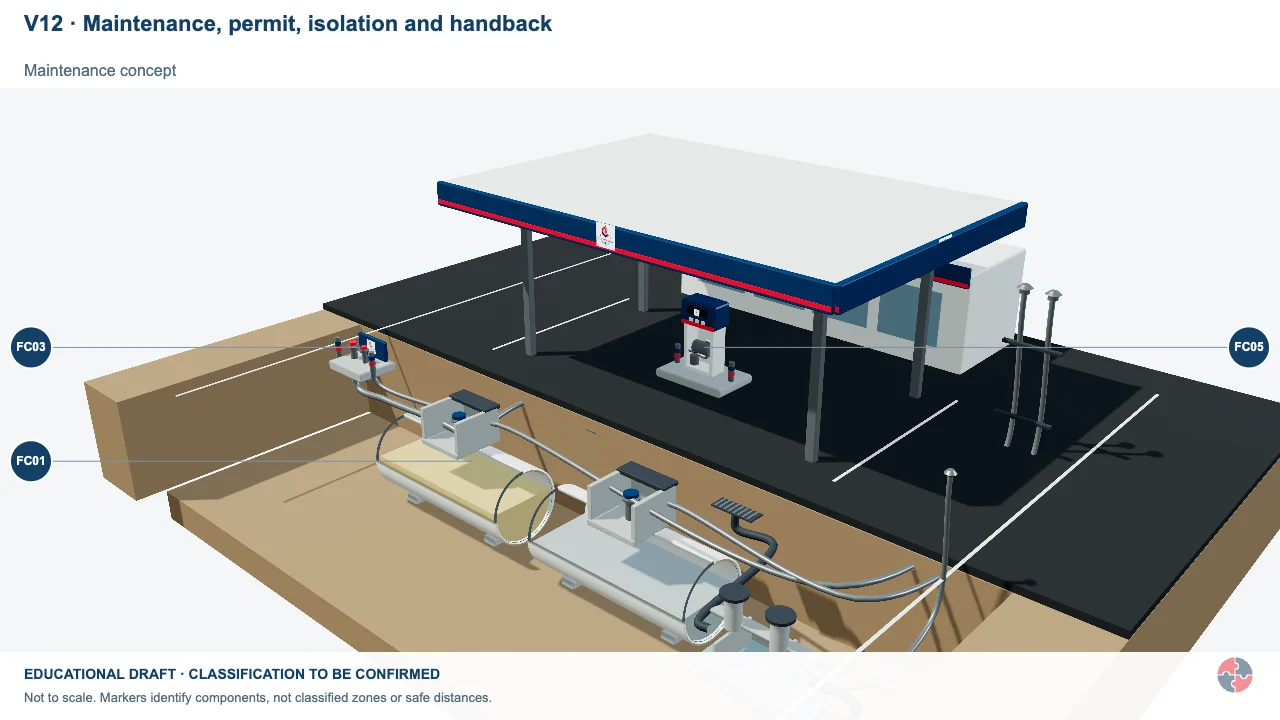
Maintenance, permit, isolation and handback
Maintenance changes the task and may open systems that are closed during normal use.
Activity focus: Inspect the work boundary, nearby live activities and responsibility for restoring the installation.
Contextual workplace scene. Use the task, control and evidence checks in this section; appearance alone does not establish safe conditions, individual health or approval.
Educational illustration, not to scale. Coloured zones are teaching examples, not a site-specific hazardous-area classification.
What do the acronyms and key terms mean?
These short forms and technical words identify different decisions in the lesson.
| Term | Full expression | Meaning here |
|---|---|---|
| COMAH | Control of Major Accident Hazards | Major-accident regime where the establishment is within scope. |
| HSE | Health and Safety Executive | GB safety regulator. |
| NI | Northern Ireland | Separate legal jurisdiction and regulator route. |
| PSSR | Pre-start-up safety review | A local readiness review here; do not confuse with Pressure Systems Safety Regulations. |
| MOC | Management of change | Approved review of plant, process or procedure changes. |
| Trip | Protective automatic action | Moves equipment or process toward a defined safe state. |
Unlock another resource
You have used this month’s two free downloads. Publish a post in your own words to unlock one more resource, or choose SHARE Individual for 10 downloads per month.
You decide whether to share. If you do, use the relevant platform disclosure tools and do not make claims you do not genuinely hold.