SHARE Knowledge Hub
Ventilation, Local Exhaust Ventilation and Workplace Air Control
Workplace ventilation supplies fresh air, while local exhaust ventilation (LEV) captures hazardous dust, fume, mist, vapour or gas close to its source. Inhaling an uncontrolled plume can cause acute irritation or long-term disease, even when the air looks clear. Prevent emissions first, then prove that capture, discharge and maintenance work during the real task; stop the affected work when control fails.
Understanding Ventilation, Local Exhaust Ventilation and Workplace Air Control
Workplace ventilation supplies fresh air, while local exhaust ventilation (LEV) captures hazardous dust, fume, mist, vapour or gas close to its source. Inhaling an uncontrolled plume can cause acute irritation or long-term disease, even when the air looks clear. Prevent emissions first, then prove that capture, discharge and maintenance work during the real task; stop the affected work when control fails.
Why this matters at work
Identify credible failure modes: fan trip, power loss, belt failure, filter blockage, duct rupture, scrubber loss, damper closure, discharge obstruction and fire. Decide whether the hazardous process stops automatically, what alarm is given, how people withdraw and how the source is made safe. Emergency response must not require a worker to enter a contaminant cloud to reach an isolator. Provide backup or redundant extraction where loss cannot be tolerated during safe shutdown.
Inhaled contaminants may cause irritation, sensitisation, occupational asthma, chronic obstructive pulmonary disease, pneumoconiosis, cancer, systemic poisoning, infection or acute unconsciousness depending on substance, particle size, concentration and duration. Ventilation can also reduce deposition onto skin and surfaces, but it does not control every dermal or ingestion route. Assessment therefore considers inhalation alongside skin contact, hand-to-mouth transfer, contaminated clothing, cleaning and waste handling.
How organisations manage this in practice
Create an action plan with immediate restrictions, engineered improvement, responsible owner, competent support, resources, deadline and completion evidence. Do not close actions on purchase order or repair invoice; close on demonstrated control and updated lifecycle information. Build routine user checks, maintenance, TExT, exposure monitoring and change control into the management system. Consult workers during design and verify across shifts. Senior review should remove recurring barriers and fund replacement where legacy systems cannot be made reliable.
Assurance should combine document review, field observation, worker discussion and technical data. Useful measures of preventive activity and current assurance include percentage of systems with current commissioning baselines, visible airflow indicators, completed pre-use checks, planned maintenance, TExT actions closed by risk, change controls and supervisor observations. Lagging indicators include exposure exceedances, symptoms, visible escape, filter release, fires, unplanned shutdowns and repeated defects. A check or test completed before loss of control measures preventive activity; a defect or escape found by that check measures failed control. Both are useful and should be paired. Corrective-action completion does not erase the failure or justify continued inadequate control.
Maintenance can change balance and performance even when the repair is technically sound. Replacement filters may have different resistance; fan belts may change speed; a flexible hose may be longer; cleaned ducts may reveal leaks; software settings may reset. Require post-maintenance checks proportionate to the work and a return-to-service release. Trend recurring defects and premature loading as design or process signals. Replacing the same component repeatedly without addressing cause is not a maintenance strategy.
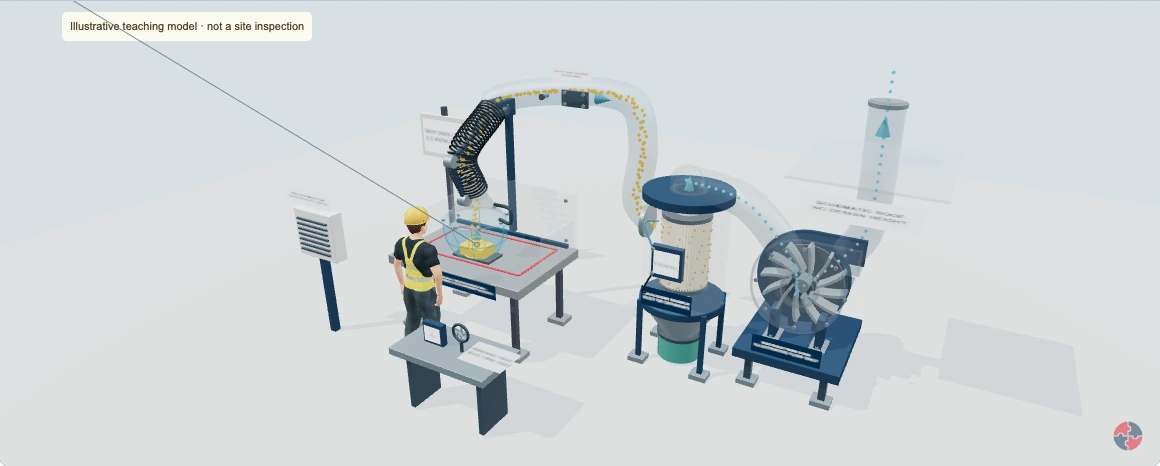

LEV: follow the harmful substance out of the breathing zone
Move the capturing hood, watch the fan draw air through connected ductwork and follow harmful dust or particulate fume away from the breathing zone. Move the work beyond the marked bench area to see why a running fan can still leave people exposed.
Checksheets and risk assessments
Equipment checksheets
Risk assessment forms
Risk assessment examples
Forms and tools
Full written walkthrough — all 13 steps
1. Identify the source, task and people
What is happening: The source marker represents airborne dust or particulate fume released by a task. The same task may expose the operator, neighbours, cleaners and maintenance staff.
How harm can occur: Contaminant reaching a breathing zone can be inhaled; the type of harm depends on the substance, exposure and person.
Best practice to apply: Assess the actual substance and work. Consider elimination, substitution and source reduction before selecting suitable extraction and other controls.
2. Position the hood close to the source
What is happening: The hood is raised. Its flexible duct and jointed support remain connected, but the source is further from the hood mouth. Use Lower hood or drag the hood-position control.
How harm can occur: The capture effect weakens rapidly with distance. A contaminant cloud can pass through the breathing zone while the fan keeps turning.
Best practice to apply: Position the hood as specified for the actual task. Use the commissioning information and a representative competent test to establish the allowed source position, height and full working movement.
Why this works: Air speed at the source matters. Neither a strong draught at the hood mouth nor the sound of a fan proves effective capture where the work happens.
LEV Local Exhaust Ventilation · What are capture zones, working zones and breathing zones?3. Lower the hood and keep the source in range
What is happening: The open flanged hood is lowered towards the source. Air is drawn towards the mouth and into the flexible duct. The red tape marks only an illustrative bench footprint; source height and the whole tool movement matter too. The translucent blue volume shows an illustrative three-dimensional capture envelope: source height and sideways distance both matter. Select Move the hood or Move the workpiece to drag them independently around the bench.
How harm can occur: A source beyond the effective capture zone can release contaminant into the worker’s or a bystander’s breathing zone, even with the fan running.
Best practice to apply: Have a competent person test the actual process, hood, source position/height, airflow and expected draughts. Mark the verified working footprint on the bench and record the maximum position/height and hood setting. Keep the full working zone inside it; change the hood or method if this is impractical. A real capture envelope must be established by representative competent testing; the blue shape is not a measured safe boundary.
Why this works: A visible position mark helps repeat the tested arrangement. It is a positioning aid, not a certificate, a universal distance or proof that changed conditions remain controlled.
LEV Local Exhaust Ventilation · What are capture zones, working zones and breathing zones?4. Watch the impeller draw air away
What is happening: The cutaway shows a slowly rotating impeller connected to a fixed motor. Press Animate fan and airflow to turn the rotor and follow the arrows from source to hood, duct, filter, fan and discharge. The real guard and casing stay closed.
How harm can occur: Loss of flow can allow the source cloud to escape; moving fan parts create separate servicing hazards.
Best practice to apply: A running fan or a single pressure indication does not prove capture. Check suitable indicators and interpret measurements against the real design/commissioning basis.
5. Stop: work has moved outside the marked area
What is happening: The workpiece moves beyond the red bench mark. The fan continues running, but most of the illustrative cloud misses the hood and escapes towards people. The same hood has less capture effect at the more distant source. Try moving the hood towards the workpiece. The teaching cloud changes when the full source moves into or out of the three-dimensional envelope; changing the real arrangement still needs verification.
How harm can occur: Dust or fume can be inhaled by the operator or nearby workers. Moving the work outside the tested capture zone can defeat otherwise functioning extraction.
Best practice to apply: Stop the contaminant-generating task. Move the work back into the verified zone, reposition the hood or choose a more suitable control. Check the indicator and have changed arrangements verified before restarting.
Why this works: A bench mark helps repeat a tested arrangement; it is not a physical wall. The hood must control the full cloud, including the edges of the work and its movement.
LEV Local Exhaust Ventilation · What are capture zones, working zones and breathing zones?6. Restore the working position and recheck
What is happening: The workpiece returns inside the illustrative footprint and the hood is lowered. The dust/fume path is drawn into the hood again in this teaching example.
How harm can occur: A different material, source height, tool movement or cross-draught may still defeat capture even after moving the work back.
Best practice to apply: Repeat the actual verified arrangement and pre-use checks. If reliable control cannot be restored, keep the task stopped and report the defect. Do not use the animation as an exposure measurement. A moved hood requires review of the new three-dimensional working zone; do not rely on the old tape mark.
LEV Local Exhaust Ventilation · What are capture zones, working zones and breathing zones?7. Carry the contaminant through the duct
What is happening: The cutaway follows the contaminant-bearing stream through connected ductwork. Flanges, access and a test point are visible.
How harm can occur: Leaks, deposits, damage or obstructions can impair control and expose people during operation or maintenance.
Best practice to apply: Use suitable design and actual inspection/measurement. The moving dots show a route, not a calculated velocity, concentration or leak test.
8. Separate suitable particles in the cleaner
What is happening: Inspect the pleated cartridge. Amber teaching particles collect on the outer media; the blue carrier-air path continues from the inner side.
How harm can occur: Damaged, unsuitable or heavily loaded media can impair control. A particulate filter does not establish removal of gases or vapours.
Best practice to apply: Select and verify cleaning appropriate to the actual contaminant and process. No filtration efficiency or safe discharge concentration is calculated.
9. Contain and handle collected material
What is happening: Follow the separated material towards the closed hopper/bin. Dust does not stop being hazardous because it has left the breathing zone.
How harm can occur: Opening, emptying or changing components may release dust; combustible material can introduce fire/explosion hazards.
Best practice to apply: Use suitable containment, isolation, waste handling and substance-specific precautions. The model does not approve collection of combustible or reactive dust.
10. Stop: the fan is off but the source can still release
What is happening: The impeller stops and the air-path arrows disappear. The source may continue releasing harmful material until the actual process is stopped or otherwise made safe.
How harm can occur: Without extraction, the contaminant can spread into the breathing zone. A hidden motor failure or disconnected supply may leave a task uncontrolled.
Best practice to apply: Stop the affected task, report the fault and follow the site procedure. Any automatic interlock needs separate design and testing; this model does not simulate one.
LEV Local Exhaust Ventilation · What are capture zones, working zones and breathing zones?11. Compare a loaded filter with a running fan
What is happening: The fan still rotates. Collected material is shown on the cartridge; slower symbolic tracers and escaped particles illustrate possible reduced capture as system resistance changes.
How harm can occur: A running motor does not prove the specified airflow. A blocked or damaged filter, leaking duct or changed system can leave people exposed.
Best practice to apply: Compare suitable airflow and pressure indicators with the actual commissioning data. Investigate defects; isolate before intrusive maintenance and control exposure to collected material.
LEV Local Exhaust Ventilation · What are capture zones, working zones and breathing zones?12. Consider discharge and replacement air
What is happening: Blue particles identify the continuing air route beyond the fan. Blue does not mean the discharge has been proven harmless.
How harm can occur: An unsuitable discharge or air-supply arrangement can expose other people or disturb capture at the source.
Best practice to apply: Assess actual contaminant removal, discharge, nearby intakes and replacement air. No dispersion, discharge height or safe separation is established.
13. Verify performance and review changes
What is happening: The measurement station connects design, commissioning, routine checks, maintenance, examination/testing and review. Its instruments do not display measured results.
How harm can occur: A system that looks intact can still leave people exposed, especially when tasks, materials or operating conditions change.
Best practice to apply: Use competent performance verification and exposure assessment where needed. Record defects and stop affected work when control is unreliable.
Illustrative awareness learning. The model does not design equipment, authorise work, verify safe conditions or complete a real inspection.
The wider workplace has its own account and subscription access. Exploring this lesson does not grant access, record course completion or authorise work.
UK guidance for further reading
HSE: local exhaust ventilationHSE HSG258: controlling airborne contaminantsHSE: COSHHHow can I practise this topic in 3D?
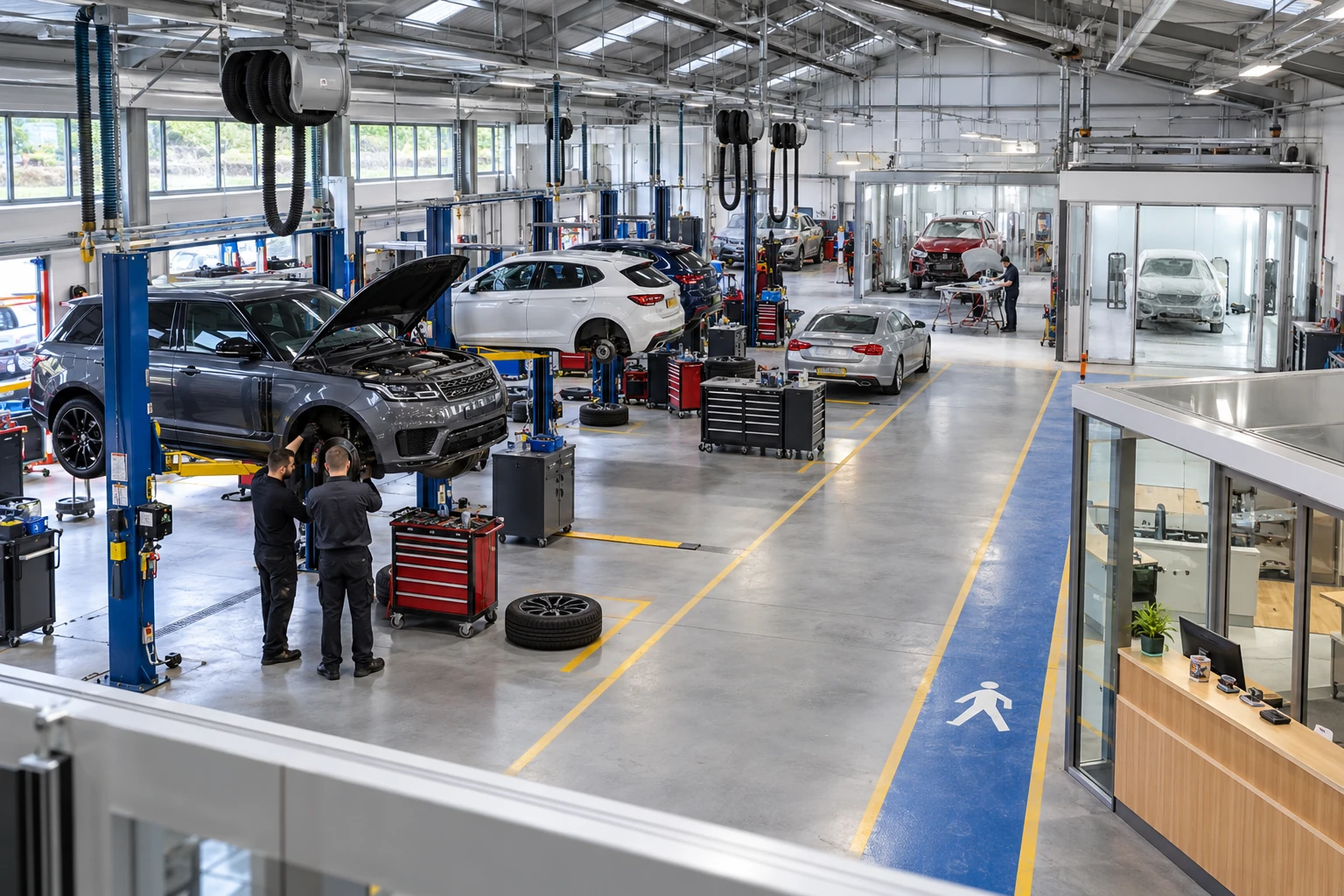
An idling engine without tailpipe extraction
All related inspection points 3 across 1 location
Garage workshop 3 inspection points
Practice in the SHAREhub environment. Browser practice is separate from workplace competence and formal learning records.
What does this page cover and exclude?
It covers general fresh-air ventilation and airborne hazardous-substance control by LEV; specialist containment and emergency atmospheres need additional task-specific assessment.
Examples include occupied rooms, welding, sanding, spraying, powder handling and maintenance of hoods, ducts, filters and fans. HSG258 itself does not cover the detailed design of biological-agent containment, radioactive work, pharmaceutical containment or confined-space ventilation. Fire and explosion hazards, environmental discharge, breathing-air supply and health surveillance may create additional duties. A comfortable room, open door, ordinary air cleaner or CO2 reading does not clear a hazardous task.
How do general ventilation, dilution and LEV differ?
General ventilation supplies and removes room air; dilution reduces a dispersed concentration; LEV captures a contaminant close to its source before it reaches people.
Best-practice guide: Ventilation, Local Exhaust Ventilation and Workplace Air Control
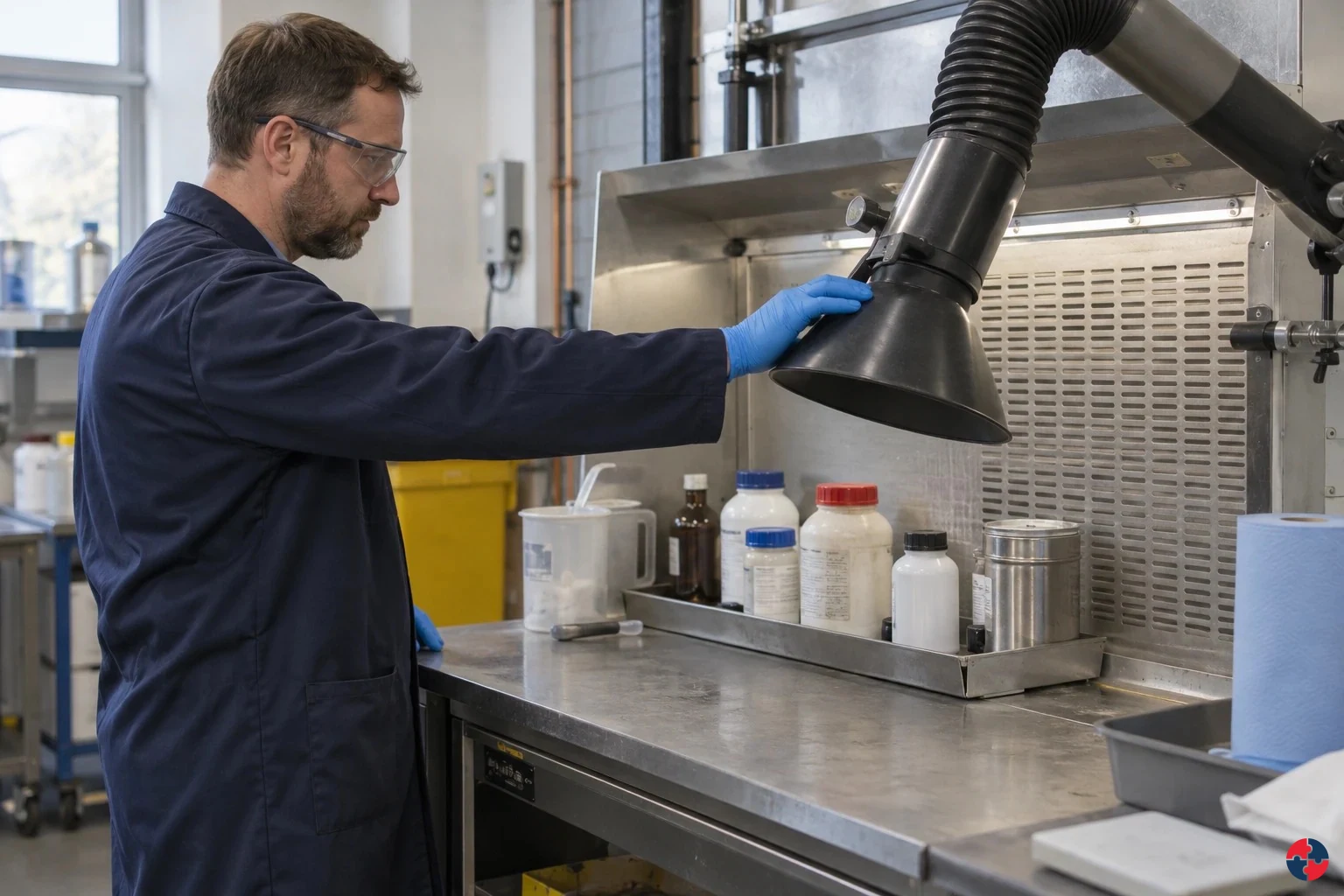
How do general ventilation, dilution and LEV differ?
General ventilation supplies and removes room air; dilution reduces a dispersed concentration; LEV captures a contaminant close to its source before it reaches people. Workplace ventilation supplies fresh air, while local exhaust ventilation (LEV) captures hazardous dust, fume, mist, vapour or gas close to its source.
Turn ventilation, local exhaust ventilation and workplace air control knowledge into a decision
Workplace ventilation supplies fresh air, while local exhaust ventilation (LEV) captures hazardous dust, fume, mist, vapour or gas close to its source. Inhaling an uncontrolled plume can cause acute irritation or long-term disease, even when the air looks clear. Task assessment, pre-use check, defect, repair, verification and exposure decision.
Riverside workshop source capture
Keep source in capture zone; observe fume and dust with actual doors and simultaneous work. Contain waste, repair and competently verify capture, update assessment and brief users.
How can bad air control harm people?
An uncontrolled emission can pass through the worker’s breathing zone before capture. First consider eliminating or reducing the emission, then verify capture during the actual task. Retain skin, ingestion, fire, explosion and discharge assessments where relevant; a fan or certificate alone does not establish control.
Choose controls for ventilation, local exhaust ventilation and workplace air control
At
Use the full ventilation, local exhaust ventilation and workplace air control lesson
Use the full topic for the decision points, practical examples, detailed control tables and source scope. HSE guidance applies to Great Britain; use HSENI for the Northern Ireland route and the source’s stated jurisdiction. A simplified guide does not change the page’s technical-review or approval status.
Read all six steps as text
1. How do general ventilation, dilution and LEV differ?
General ventilation supplies and removes room air; dilution reduces a dispersed concentration; LEV captures a contaminant close to its source before it reaches people.
- Avoid / redesign: Can the substance or emission be eliminated or reduced?
- Control the task: Are skin, ingestion, fire and discharge risks assessed?
- Verify before release: Check capture at the real task, hood position and indicator against the commissioned benchmark; a running fan alone is not proof.
General ventilation supplies and removes room air; dilution reduces a dispersed concentration; LEV captures a contaminant close to its source before it reaches people. Workplace ventilation supplies fresh air, while local exhaust ventilation (LEV) captures hazardous dust, fume, mist, vapour or gas close to its source.
Apply it: Which part of this plan would you check at the workface before authorising the task?
2. Turn ventilation, local exhaust ventilation and workplace air control knowledge into a decision
Use the evidence to improve the actual work arrangement.
- Change at source: Can the substance or emission be eliminated or reduced?
- Make it observable: Observe the emission, breathing-zone route and effect of doors or cross-draughts; compare the indicator with the commissioned benchmark.
- Keep useful evidence: Task assessment, pre-use check, defect, repair, verification and exposure decision.
Workplace ventilation supplies fresh air, while local exhaust ventilation (LEV) captures hazardous dust, fume, mist, vapour or gas close to its source. Inhaling an uncontrolled plume can cause acute irritation or long-term disease, even when the air looks clear. Task assessment, pre-use check, defect, repair, verification and exposure decision.
Apply it: What evidence would show that the change improves this task, rather than only completing a record?
3. Riverside workshop source capture
Example: a practical application of the existing topic lesson.
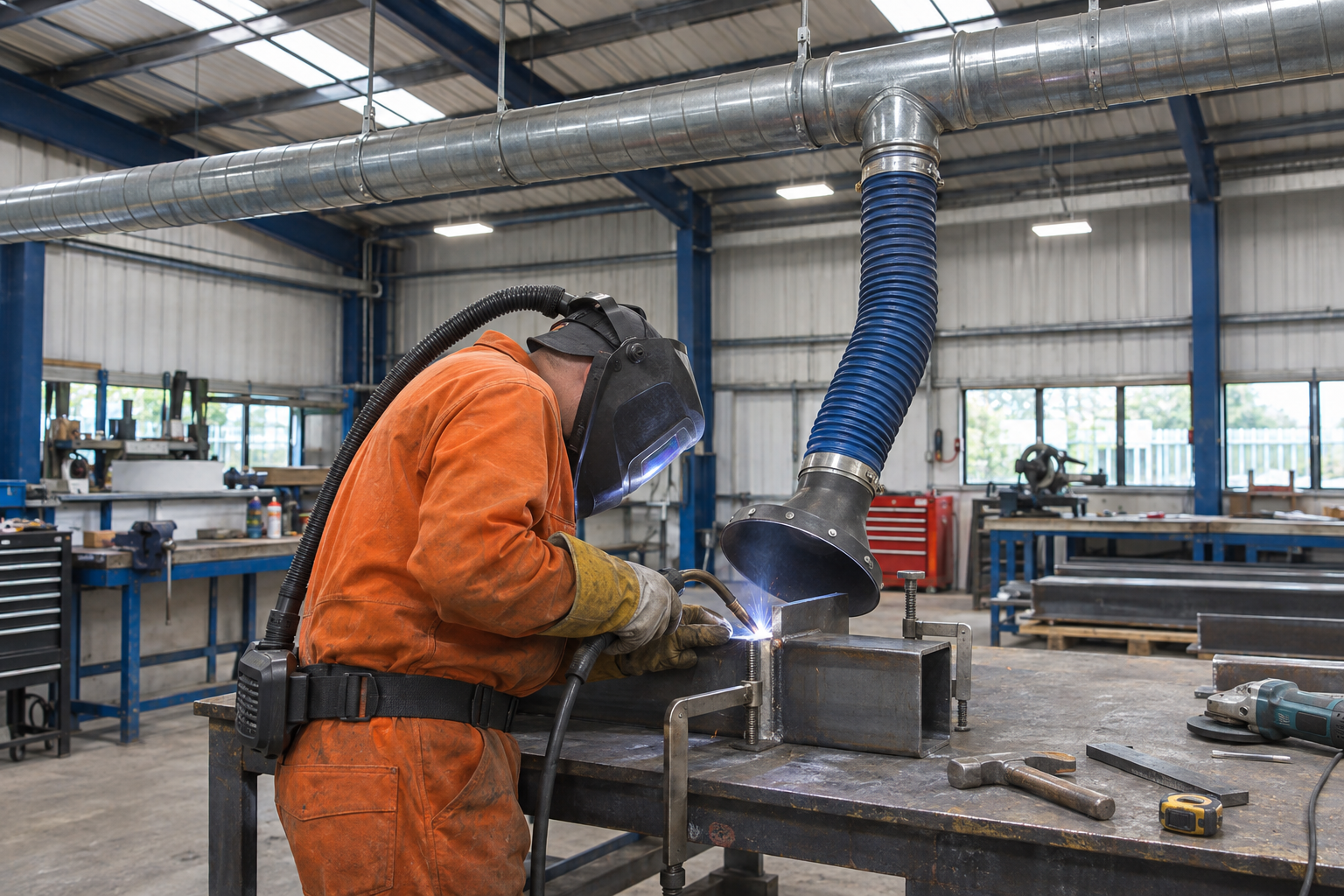
- Setting: Weld a repaired steel fitting and sand a wooden panel in a leisure-centre maintenance workshop; coating identity must be known.
- Act: Confirm material and emission, other occupants, hood/tool match, hose/filter and flow indication.
- Hold / review: Stop for split hose, low flow, escaping plume or unknown coating; protect other staff and escalate.
Keep source in capture zone; observe fume and dust with actual doors and simultaneous work. Contain waste, repair and competently verify capture, update assessment and brief users.
Apply it: At which point would you hold this example, and what evidence would allow it to proceed?
4. How can bad air control harm people?
Connect the task, the route to the person and the control that can fail.
- At source: Can the substance or emission be eliminated or reduced?
- Air movement: Can the cloud pass through a breathing zone before capture?
- Other routes: Are skin, ingestion, fire and discharge risks assessed?
An uncontrolled emission can pass through the worker’s breathing zone before capture. First consider eliminating or reducing the emission, then verify capture during the actual task. Retain skin, ingestion, fire, explosion and discharge assessments where relevant; a fan or certificate alone does not establish control.
Apply it: Who could be exposed, including other trades, cleaners, maintainers and people nearby?
5. Choose controls for ventilation, local exhaust ventilation and workplace air control
Start with the stronger practicable options and verify their effect.
- At source: Can the substance or emission be eliminated or reduced?
- Air movement: Can the cloud pass through a breathing zone before capture?
- Other routes: Are skin, ingestion, fire and discharge risks assessed?
- Long latency: Do exposure and health checks match the hazard?
At
Apply it: Which stronger option can be used here, and who will verify it before accepting the remaining risk?
6. Use the full ventilation, local exhaust ventilation and workplace air control lesson
Follow the official sources below and retain the task-specific evidence.
- Official guidance: HSE Ventilation in the workplace
- Official guidance: HSE Improving workplace ventilation
- Task decision: Task assessment, pre-use check, defect, repair, verification and exposure decision.
Use the full topic for the decision points, practical examples, detailed control tables and source scope. HSE guidance applies to Great Britain; use HSENI for the Northern Ireland route and the source’s stated jurisdiction. A simplified guide does not change the page’s technical-review or approval status.
Apply it: Which official source and full-topic section will you use to resolve the next decision?
Natural or mechanical fresh air can address stale, hot or humid air, but HSE explicitly separates this from process dust and fume control. Dilution may be suitable for some assessed low-risk emissions, but can carry a cloud through a breathing zone before mixing. LEV relies on a well-chosen hood and complete airflow path. Enclosure or source change can be more reliable still. Pressure and directional airflow may be needed for controlled enclosures but require specialist design and verification.
- Remove or reduce source Change the process or material where feasible before relying on room air or a mask.
- Capture the release Specify and position local exhaust for the actual plume, task, people and cross-draughts.
- Demonstrate performance Commission the system, set a baseline, and check capture and user indicators during real work.
- Stop on failure Hold the affected process if capture fails or changes; repair, examine and verify before hand-back.
| Method | What it proves | What it does not prove |
|---|---|---|
| Fresh-air ventilation | Room air is renewed or purified sufficiently for its use. | A hazardous emission is captured at source. |
| Dilution | A specified emission is reduced under assessed mixing conditions. | A nearby worker avoids a high plume. |
| LEV | The specified source is captured and safely exhausted in tested conditions. | Every new substance, task or hood position is safe. |
How can bad air control harm people?
Inhaled dust, fume, mist, vapour or gas can cause acute effects or long-latency disease; flammable emissions can also create fire or explosion risk.
The exposure pathway runs from material and process through emission, airflow and worker breathing zone. A visible cloud is a warning, but fine particles and vapours may be invisible. Skin exposure and contamination also need control; ventilation does not address every route. Symptoms, odour or a low accident rate are not proof of safety. The severity depends on substance, quantity, process, duration and who is nearby. See HSE.
| Pathway | Decision |
|---|---|
| At source | Can the substance or emission be eliminated or reduced? Source |
| Air movement | Can the cloud pass through a breathing zone before capture? Source |
| Other routes | Are skin, ingestion, fire and discharge risks assessed? Source |
| Long latency | Do exposure and health checks match the hazard? Source |
Which controls come before ventilation?
Prevent or reduce emissions first, then enclose or capture what remains; use respiratory protective equipment (RPE) where the assessment shows it is still needed, not as proof that poor extraction is acceptable.
Change product, form or process, lower emission energy, contain transfer or work wet where suitable. For residual airborne release, specify enclosure or LEV around the actual source. Keep people out of the plume and minimise exposure duration as supporting controls. RPE selection, fit, maintenance and worker training may be needed, particularly in high-risk or interim work, but it does not repair a failed engineered control. A workplace exposure limit (WEL), where one exists, is a substance- and averaging-period-specific limit, not a universal design target or a guarantee against all harm. See HSE.
How should stronger source controls be chosen?
Start by avoiding the hazardous task or release, then use suitable substitution and physical controls before relying on work rules or personal protection.
The order guides a decision; the actual control depends on this task, the people exposed and what a change could introduce. A supervisor should observe the control during real work, hold a failed task and obtain a competent release after correction. HSE guidance for this control decision
| Control layer | Task decision |
|---|---|
| Avoid | Avoid an emission-generating operation |
| Substitute or reduce | Use a lower-emission material or process where suitable |
| Engineer | Enclose or capture the actual plume at source |
| Organise and verify | Check hood position, indicators, testing and changes during real work |
| Protect residual exposure | Use selected and fitted RPE for assessed residual exposure |
How do controls change across industries?
The same control principle needs a different design and stop decision when the task, equipment and people change.
The source, airflow and people at risk change with the job. A room-air measure that helps comfort does not automatically control a process plume; each arrangement needs task-specific capture evidence and a stop route. See HSE.
| Sector, task and people | Exposure and harm | Strongest feasible control | Check or stop point |
|---|---|---|---|
| Manufacturing: welding in a workshop; welder and neighbours. | Fume enters the breathing zone and can damage lungs. | Change joining method where feasible; otherwise on-torch or hood capture, with suitable residual RPE. | Observe capture in real work; hold if fume escapes or extraction fails. Source |
| Construction: concrete cutting indoors; operator and other trades. | Respirable dust spreads with tool motion and draughts. | Use a lower-dust method, wet control where suitable and on-tool extraction with suitable RPE. | Check hose, filter and actual dust escape; stop on failure or changed material. Source |
| Hospitality: kitchen cooking; cooks and adjacent staff. | Heat, grease and combustion products accumulate when canopy capture or fresh air fails. | Use appropriate cooking method and maintained canopy/extract plus make-up air. | Hold affected cooking if extract or make-up air is inadequate; competent repair. Source |
| Logistics: diesel vehicle indoors; drivers and warehouse staff. | Exhaust enters an enclosed bay and exposes nearby workers. | Avoid engine idling and use cleaner propulsion or external loading where feasible; provide engineered ventilation. | Observe vehicle pattern and air path; stop on exhaust build-up or failed fans. Source |
What must work in an LEV system?
Hood, duct, air mover, any air cleaner, discharge and replacement air must act as one system for the specified source and process.
An enclosing hood generally contains more of a cloud than a distant capture hood, but the selection depends on access and process. Ducts must transport contaminant without leakage or deposition; filters must suit the material and be maintained; the fan must overcome system resistance. Discharge must avoid re-entry and harm, and make-up air must not starve extraction or drag a plume past people. Flammable or combustible material needs a separate fire/explosion design assessment.
| Part | Failure question |
|---|---|
| Hood | Is the source within its effective working zone? |
| Duct/fan/filter | Is flow, condition and cleaning performance maintained? |
| Discharge and make-up air | Is contaminated air removed safely without starving capture? |
Prove capture at the actual source
LEV works as a complete system: source, hood, duct, air cleaner where needed, air mover and safe discharge. The test is whether it controls exposure during the real task; a running fan or an examination certificate alone does not prove this.

Observe the real emission
Identify where the dust, mist, fume or vapour is generated, its direction and how the worker carries out the task. Keep the worker’s breathing zone out of the contaminant route; an attractive hood position in a photograph is not evidence of capture.
Compare with the commissioned arrangement
Check the hood, enclosure, work position, make-up air and indicator against the commissioned benchmark and user instructions. There is no universal safe hood distance or airflow for all substances and processes.
Check the whole system
Look for changes, damaged ducts, blocked filters, failed indicators and discharge or recirculation concerns. General room air and make-up air have different functions from capture at source. Retain fire, explosion and non-inhalation exposure assessments where relevant.
Respond to failure and prove recovery
Stop or make the emitting task safe using the agreed procedure if capture fails. Arrange competent investigation, repair and task-based verification before restart. Maintain user checks, maintenance and the required examination and test records.
Do not keep working solely because the fan sounds normal. The actual emission, hood position, air movement and benchmark evidence must support the decision.
What should a buyer specify before choosing LEV?
Give the competent designer the substance, emission, process, work envelope, people, simultaneous uses and required control outcome; require proof under representative conditions.
The specification should describe hazards and any exposure benchmark, source size and movement, operator position, task sequence, cleaning and maintenance, existing ventilation and other users of shared ducts. Include flammability, corrosivity, filtration and safe discharge where relevant. Set a commissioning and user-information deliverable. Do not buy solely by fan rating, hose diameter, quoted capture velocity or a catalogue claim; compatibility depends on the complete process and system. See HSE.
| Input | Why it matters |
|---|---|
| Substance and form | Dust, mist, fume and vapour behave and filter differently. Source |
| Emission and operator movement | Hood must work across the real source and breathing zones. Source |
| Interfaces | Other hoods, doors and make-up air can change flow. Source |
| Acceptance | Commissioning must demonstrate adequate control and give baseline values. Source |
Which airflow measurements matter?
Capture velocity, face velocity, duct transport velocity, volume flow and pressure answer different questions; none alone proves exposure control.
Capture velocity is the air speed at a source for a capturing hood. Face velocity is the speed through an opening. Transport velocity helps prevent settling in a dust duct. Volume flow and static pressure describe system performance. Values depend on hood geometry, contaminant, emission energy, work position and disturbances. HSE says a hand cannot reliably judge hood airflow. On-torch welding extraction is judged with the manufacturer method and actual fume capture, not a generic hood capture-velocity reading. A competent person sets and interprets benchmarks for this system.
| Measure | Useful question | Limit |
|---|---|---|
| Capture or face velocity | Does air enter the hood or opening as designed? | Geometry and cross-draughts change effective capture. Source: HSE |
| Duct velocity and pressure | Will contaminant transport and system balance hold? | May be normal while a hood is misplaced. Source: HSE |
| Exposure measurement | What did people inhale in representative work? | Sampling must match substance, task and averaging period. Sources: HSE; HSE |
What does commissioning have to demonstrate?
Before LEV is relied on, competent commissioning should show that the installed system controls the intended emission in actual operating conditions and establish benchmarks for later checks.
Verify the process, substances, source, hood position, installation, balance, airflow, pressure, filter, make-up air and discharge. Observe capture with a suitable method and assess exposure if needed. The report should identify the system, conditions, methods, results, defects, user instructions and measurable targets at test points. HSE says the employer is responsible for the commissioner being competent and impartial. If original data are missing, a competent specialist should reconstruct a defensible performance basis; do not treat an unexplained airflow number as a pass. See HSE.
What should users check before and during use?
Check the LEV each time it is used against the local instructions: correct hood, position, flow indication, intact connections and no obvious escape or fault.
The user must know what a normal indicator means for this system. A green light alone cannot prove capture if the hood is too far away, a hose is damaged or the process changed. Check filters or collection equipment as specified, and confirm the extraction starts before the hazardous process and remains on through the task or measured clearance period. Report abnormal noise, odour, visible escape, low flow, leaks or a fault alarm. Supervisors should verify practice and arrange repair rather than normalise a defect. See HSE.
What matters during work and at hand-back?
Keep the source within the tested capture zone and the system running as required; close out by containing waste, logging faults and leaving the system ready for safe next use.
Watch for changes in doors, fans, other hoods, weather, workpiece orientation, material and operator stance. Avoid putting the worker between source and hood. Do not sweep or blow accumulated dust into the air if the method requires safe capture. After work, follow the system run-on or measured booth clearance procedure, handle collected material without re-exposure, and record any damage or deviations. Maintenance and cleaning can create a new exposure task needing isolation and RPE.
When is thorough examination and test required?
For most COSHH LEV systems in GB and NI, a competent thorough examination and test is required at intervals no longer than 14 months; some scheduled processes have shorter legal maxima.
Check the relevant GB or NI COSHH Schedule 4 for the particular process, and test more often where wear could degrade protection between tests. Keep the thorough examination and test (TExT) record for at least five years. The examiner needs intended-performance data and must assess whether the system still controls exposure, not just whether a fan runs. On-tool extraction is LEV too; HSE explains the extraction unit TExT and separate frequent checks of hood, hose and tool. A TExT is not a substitute for commissioning, user checks, maintenance or correction of defects.
| Question | Decision |
|---|---|
| Most COSHH LEV? | Maximum 14-month interval, subject to condition and specific exceptions. Sources: legislation.gov.uk; legislation.gov.uk |
| Schedule 4 process? | Apply the shorter GB or NI legal interval. Sources: legislation.gov.uk; legislation.gov.uk |
| Wear or performance drift? | Set a shorter risk-based interval. Source: HSE |
| Report says failed? | Hold affected process and repair, then competent verification. Source: HSE |
Which LEV records make a test meaningful?
Keep the design intent, commissioning baseline, manual and logbook alongside routine checks, maintenance, TExT reports, defects and corrective-action evidence.
A report should identify each hood, test conditions and methods, measured values against baseline, observed capture, defects, practical action and next examination due. HSE says TExT reports should be retained at least five years, while intended-performance information should be available for the equipment life. A label helps users see status but is not a specific standalone legal requirement; a green or dated label with unresolved critical defects is misleading. If the design basis is missing, a competent person must determine how to judge the system before declaring it effective.
| Record | Why it matters |
|---|---|
| Specification and commissioning | States what must be controlled and how performance was first shown. |
| Manual and logbook | Defines user checks, servicing and changes. |
| TExT and repair | Shows continuing performance and actual close-out. |
| Exposure evidence | Tests whether people remain adequately protected. |
Which warning signs show control is failing?
Low or unstable flow, visible escape, damaged hoses, blocked filters, dust deposits, odour, altered work position and worker symptoms all require investigation.
Airflow may fall because of filter loading, fan or belt failure, duct blockage, leakage, closed dampers or competing hoods. A system may show normal pressure while a mispositioned hood fails to capture. Changes to process, doors or make-up air can defeat previously commissioned conditions. Repeated workarounds often signal a poor design or inaccessible work zone, not simply a training lapse. Treat unresolved TExT defects and repeated health complaints as control failure signals. See HSE.
| Signal | Immediate response |
|---|---|
| Low flow or damaged part | Hold affected emission and report defect. Source |
| Visible plume or deposit | Check hood/process and affected people; escalate exposure. Source |
| New odour, symptom or monitoring concern | Stop or restrict task and obtain specialist assessment. Source |
| Repeated bypass or repositioning | Review design and work method, not just behaviour. Source |
When must hazardous work stop?
Stop the emission-producing task when the assessment relies on LEV that is failed, doubtful, not suitable or outside its tested operating envelope.
Do not continue because room air feels fresh, a fan is audible, RPE is available or a certificate exists. Secure the process without creating a new release, keep others from exposure and tell the supervisor. A competent person determines repair and whether an alternative method actually controls exposure. For a flammable or high-toxicity release, use the site emergency plan and keep people out of the suspect area. Restart requires the affected control repaired and verified under real task conditions, with the method and people rebriefed. See HSE.
| Trigger | Hold action |
|---|---|
| Failed hood, fan, filter or indicator | Stop source and quarantine affected LEV or process. Source |
| Unknown substance or changed emission | Reassess COSHH and obtain competent design advice. Source |
| Spray booth clearance unknown or failed | Do not demask or re-enter on a guessed time. Source |
| Fire/explosion risk | Activate site response and DSEAR assessment. Source |
What can air and health monitoring prove?
Representative exposure monitoring and appropriate health surveillance can test whether control works, but neither replaces prevention or an effective LEV system.
An occupational hygienist selects method, substance, task, people and averaging period; a result below a workplace exposure limit does not remove the duty to use good control practice or reduce certain high-hazard exposures further. Health surveillance may detect early harm but is not a permission to keep exposing workers. CO2 monitoring in occupied rooms is a broad fresh-air indicator and is unsuitable as proof that process dust, fume, vapour or gas is safe; it is particularly limited in large open spaces or where the process generates CO2.
Where does respiratory protection fit?
RPE supplements assessed source control. Tight-fitting RPE requires a successful individual fit test for the selected facepiece, a clean-shaven sealing area and a fit check every time it is donned; use a suitable assessed loose-fitting alternative when a tight seal cannot be achieved.
Fit testing selects a facepiece for the individual wearer; the successfully tested make, model, type and size must be provided. The wearer must keep the sealing area clean-shaven and check the seal each time the tight-fitting facepiece is put on. A fit check is not a substitute for the individual fit test. If facial hair or another factor prevents a reliable tight seal, assess suitable RPE that does not rely on one, such as an appropriate loose-fitting type. Select protection for the actual contaminant, wearer, task and manufacturer instructions; do not invent a universal fit-test expiry or protection factor. RPE may supplement effective engineering control or a genuinely adequate assessed interim method, but cannot excuse failed source capture. Supplied-air equipment has separate air-quality and maintenance requirements. HSE bodyshop guidance for isocyanate spraying calls for an extracted booth and air-fed breathing apparatus with measured clearance; do not generalise that arrangement to other contaminants.
What is a spray-booth clearance time?
It is a measured, booth-specific period for aerosol to clear after spraying; do not lift RPE, enter or open the booth as if the air were clear before the site rule permits.
HSE gives a smoke/fog method for measuring clearance and recommends including it in booth TExT. The result depends on booth, filters, airflow and operating condition; there is no transferable number here. For isocyanate paint, the mist may be invisible and HSE calls for air-fed RPE during spraying and clearance, plus biological and health surveillance as appropriate. A change in ventilation or booth condition can invalidate the established time. This is a specialist MVR example, not a generic rule for all enclosures.
| Gate | Evidence |
|---|---|
| Before spraying | Booth condition, airflow, air-fed RPE and displayed measured time. Sources: HSE; HSE |
| After trigger released | Keep extraction and protection in place for the site clearance sequence. Source: HSE |
| Changed booth or failed test | Hold and remeasure/reassess with competent people. Source: HSE |
How should welding and sanding be controlled in a workshop?
At Riverside Leisure Ltd, general room ventilation remains for fresh air, while welding fume and dry sanding dust need assessed source capture and verification.
A maintenance workshop has a welding bay and a shared sanding bench. Before work, the supervisor identifies metal and coating, dust material, other workers and the actual hood or on-tool extraction. The trained workers check the hood position, hose, flow indication and collector. During work, they observe whether fume and dust enter capture without crossing their breathing zones; doors and cross-draughts are controlled. If a hose splits or a new coating is unknown, the task stops and other workers are kept clear. Maintenance repairs the system and a competent person verifies effective capture under the real task. Completion includes contained dust waste, defect record, rebrief and any exposure reassessment. See HSE.
Riverside workshop source capture
Task material and setting: Weld a repaired steel fitting and sand a wooden panel in a leisure-centre maintenance workshop; coating identity must be known.
People and prerequisites: Welder, joiner, supervisor and nearby staff; COSHH assessment, suitable hood/on-tool unit, trained users and current performance basis.
Before: Confirm material and emission, other occupants, hood/tool match, hose/filter and flow indication.
During: Keep source in capture zone; observe fume and dust with actual doors and simultaneous work.
Hold or stop: Stop for split hose, low flow, escaping plume or unknown coating; protect other staff and escalate.
Completion and hand back: Contain waste, repair and competently verify capture, update assessment and brief users.
Evidence: Task assessment, pre-use check, defect, repair, verification and exposure decision.
What if a contractor brings extraction for dusty repair?
The host should not accept a hired or contractor unit on its label alone; check the actual tool, hood, hose, collector, task and people exposed.
A Riverside contractor will cut wall material in a public-facing plant corridor. The host identifies the material and occupants, schedules isolation, and asks for the compatible on-tool extraction and current TExT record for the extraction unit. The contractor checks tool shroud, hose, filter/bag and indicator before cutting, and uses a controlled cleaning method. If the material proves uncertain or the hose is mismatched, the job is held for sampling or revised method. At hand-back, dust is contained, surfaces checked, waste removed and the area released by the host. The TExT does not replace these task checks. See HSE.
Riverside contractor extraction handoff
Task material and setting: Cut a wall penetration in a leisure-centre plant corridor using a hired on-tool extraction unit; material identity is a prerequisite.
People and prerequisites: Host manager, contractor, cleaner and nearby staff; material survey, segregation, compatible tool/extractor and TExT information.
Before: Confirm material, method, shroud, hose, unit, filter/bag, flow check and protected public route.
During: Use controlled cutting and observe dust capture; keep uninvolved people out.
Hold or stop: Stop for unidentified material, failed unit, incompatible hose or dust escaping into public space.
Completion and hand back: Contain waste, clean by assessed method, inspect corridor and host-release the area.
Evidence: Survey, contractor brief, unit TExT, pre-use check, exception, cleaning and hand-back.
Ask for material-to-tool evidence
Before sanding, identify the substrate and coating; unidentified material keeps the disturbance on hold. Ask the contractor to show the material-appropriate dust-class extraction unit, the tool/shroud/hose compatibility, required flow and working low-flow indication, plus contained bag and filter handling. A general commercial vacuum or a label alone is not evidence of suitable on-tool extraction. Check HSE CIS69: Controlling construction dust with on-tool extraction and the relevant HSE material/task sheet with competent advice; do not apply one dust class or RPE type to every dust.
What if the LEV fails during a task?
Stop the emitting process, withdraw or isolate affected people as needed, and do not restart until the fault is repaired and effective control is competently verified.
In a Riverside workshop, a low-flow alarm sounds during sanding and visible dust escapes. The operator stops sanding, leaves extraction running only if it is safe and useful, and tells the supervisor. The supervisor restricts access, checks for affected people and quarantines the unit. Maintenance finds a blocked filter and damaged duct; it replaces and repairs them without exposing cleaners. A competent person checks indicator, flow and capture with representative sanding. The supervisor reviews whether dust escaped beyond the work area, arranges any exposure follow-up and records a separate restart decision. A new filter or green lamp alone is not enough. See HSE.
Riverside low-flow response
Task material and setting: Dry-sand a wooden panel in a maintenance workshop; dust reaches adjacent bench when extraction fails.
People and prerequisites: Operator, supervisor, maintainer and nearby staff; known material, operating benchmark, fault procedure and suitable cleaning method.
Before: Check capture, indicator, collector and work-zone segregation.
During: Low-flow alarm and dust escape trigger immediate stop and access restriction.
Hold or stop: No sanding, sweeping or substitute extractor until the exposure and equipment are assessed.
Completion and hand back: Repair filter/duct, verify flow and actual capture, assess spread and exposure, then named site release.
Evidence: Alarm, defect, maintenance, performance check, exposure decision and restart authorisation.
Which changes invalidate an air-control assumption?
Changing substance, source, production rate, hood position, tools, room layout, simultaneous hoods, doors, filters or discharge can require reassessment and recommissioning.
A new fan or filter can change system balance; more extraction from one branch can weaken another. Weather, open doors and make-up air can change cross-draughts. A new coating or workpiece can change emission and health hazard. Designers and hygienists should review significant changes before operators are told the original TExT remains sufficient. Record the changed design, tests, user instructions and any new exposure evidence.
How is competence demonstrated at each level?
Learning should match the decision a person makes, with a practical check and reassessment after change.
Competence follows the decision a person is allowed to make. A user can recognise a weak hood; design, commissioning and thorough examination need specialist skills and a defined employer response to defects. See HSE.
| Role or level | Task learning | Demonstration and assessor | Record and reassessment |
|---|---|---|---|
| Everyone nearby | Recognise contaminant release, alarms and reporting route. | Supervisor asks them to identify plume and safe withdrawal. | Induction record; repeat after process or route change. Source |
| Operators | Set hood position, use flow indicator and stop on failure. | Supervisor observes real setup and a simulated failed-flow response. | Task authorisation and check record; reassess after hood/process change. Source |
| Maintainers and contractors | Isolate, clean and repair without releasing collected material. | Competent maintainer demonstrates isolation, filter handling and hand-back. | Maintenance/permit record; reassess after system modification. Source |
| Supervisors | Match tasks to extraction capacity and act on failed tests. | Manager samples a real hold, alternative-control and restart decision. | Defect/action record; reassess after repeat escape or new material. Source |
| Designers, purchasers and managers | Specify substance, source, occupancy, commissioning and lifecycle support. | Technical authority reviews specification and proof of capture under real work. | Design and approval record; reassess after new process or layout. Source |
| Examiners, hygienists and auditors | Test system against intended performance and assess actual exposure. | Qualified lead reviews measurements, uncertainty and remedial prioritisation. | Report and competence scope; reassess with method or guidance change. Source |
Which GB and NI duties govern air control?
GB and NI each have workplace fresh-air and COSHH duties; their instruments are separate, and DSEAR adds fire/explosion requirements where dangerous substances are in scope.
GB Workplace Regulations 1992 regulation 6 and NI Workplace Regulations 1993 regulation 6 address fresh or purified air in enclosed workplaces. GB COSHH 2002 and NI COSHH 2003 govern prevention or adequate control of hazardous-substance exposure, LEV maintenance and TExT. Check the jurisdiction-specific Schedule 4 for shorter process intervals. RPE, noise, fire, environmental discharge, machinery supply or specialist substance rules may also apply. HSE guidance is GB guidance; HSENI and NI law are the NI authority. See legislation.gov.uk.
| Location | Fresh-air route | Hazardous-substance route |
|---|---|---|
| Great Britain | Workplace Regulations 1992, regulation 6. | COSHH 2002; DSEAR 2002 if in scope. Source; Control of Substances Hazardous to Health Regulations 2002; Dangerous Substances and Explosive Atmospheres Regulations 2002 |
| Northern Ireland | Workplace Regulations (NI) 1993, regulation 6. | COSHH (NI) 2003; DSEAR (NI) 2003 if in scope. Source; COSHH Regulations (Northern Ireland) 2003; Dangerous Substances and Explosive Atmospheres Regulations (NI) 2003; HSENI Control of Substances Hazardous to Health |
How do product supply and workplace use differ?
Supplier information helps select equipment, but the employer must assess, maintain and verify the installed system for its real task.
HSE HSG258 and the LEV commissioning guidance support a task-specific design and baseline. The supplier’s instructions inform installation and maintenance; a badge or generic airflow value cannot establish capture at the worker’s actual release point. A competent examiner should identify the correct system and test basis before use and after a material process change.
What should management and auditors verify?
Trace each hazardous task from assessment to working control, commissioning baseline, user practice, maintenance, TExT, defect response and exposure evidence.
Sample different shifts and actual tasks. Ask users to show hood position and fault response. Compare measured performance with intended values and check that report actions were closed physically. Trend low-flow alarms, filter changes, repeat defects, symptoms and contractor work. Ensure maintenance and examination resources match risk, and that a new process cannot begin without design review. A dashboard of completed tests does not prove capture.
| Control | Leading evidence | Warning |
|---|---|---|
| Design and change | Specification and competent acceptance. | Off-the-shelf unit used for new emission. |
| Daily use | Observed capture and user checks. | Hood moved aside or alarm ignored. |
| Maintenance/TExT | Current report and tested close-out. | Repeat failure or overdue action. |
| Exposure | Hygiene/health review where warranted. | Symptoms, deposition or adverse samples. |
How could Riverside Leisure Ltd manage air control?

Riverside keeps occupied-room fresh air, cleaning chemical vapour and workshop dust as separate control decisions with named owners and evidence.
Facilities checks fresh-air supply in gyms and changing rooms, but does not use a CO2 reading to clear workshop sanding. Cleaning managers reduce volatile products and assess storage or use. The workshop uses matched capture and records checks and defects. Procurement requires competent design and commissioning for new extraction. Maintenance arranges TExT and acts on failures. Leadership reviews repeat symptoms, alarms, overdue actions and room-use changes. These are example arrangements, not a published Riverside policy or legal template. See HSE.
Chemical hazard symbols: what do they mean?
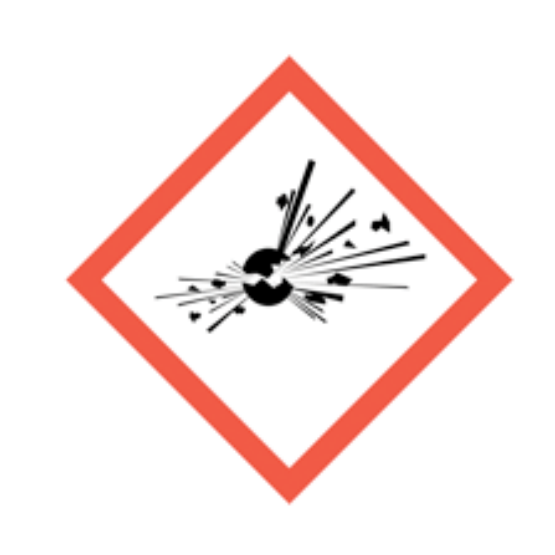
Exploding bomb
Explosive, self-reactive or organic peroxide hazards.
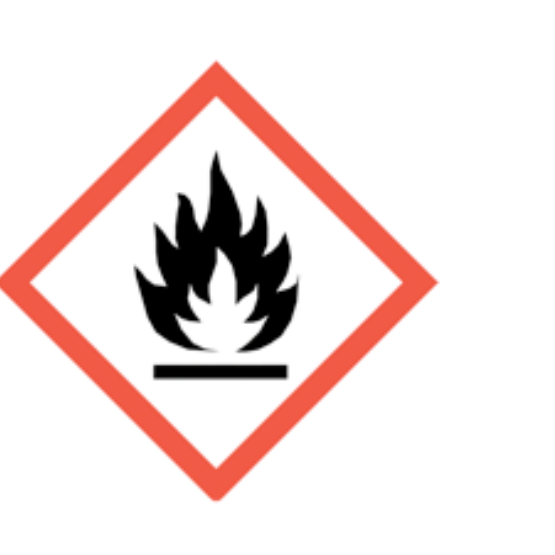
Flame
Flammable, self-heating or pyrophoric substances.
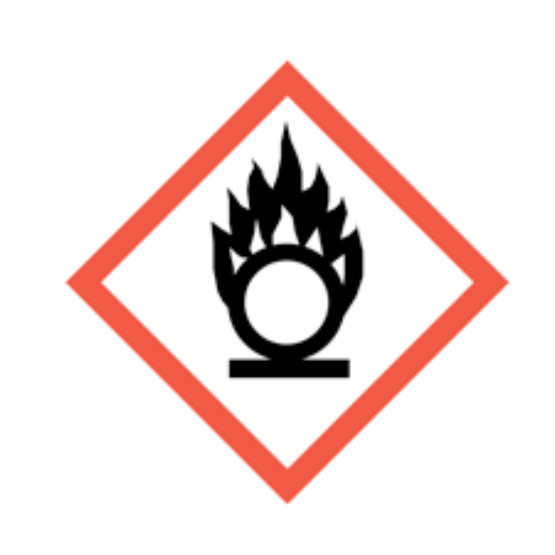
Flame over circle
Oxidising substances that can intensify fire.
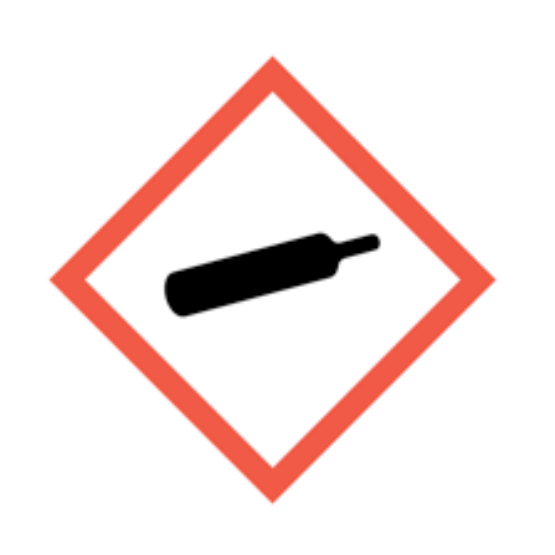
Gas cylinder
Gas under pressure.
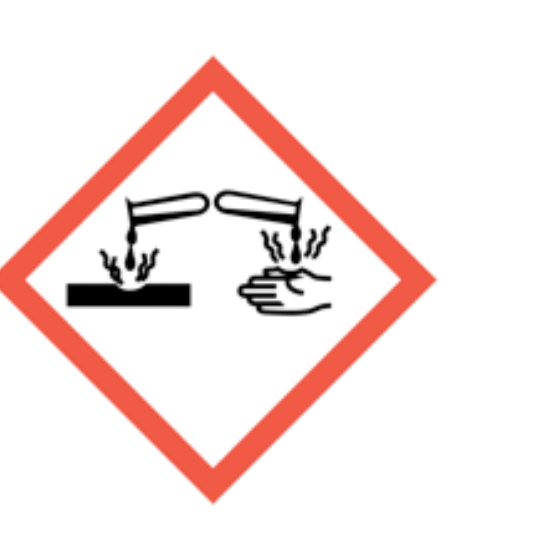
Corrosion
Skin burns, eye damage or corrosive to metals.
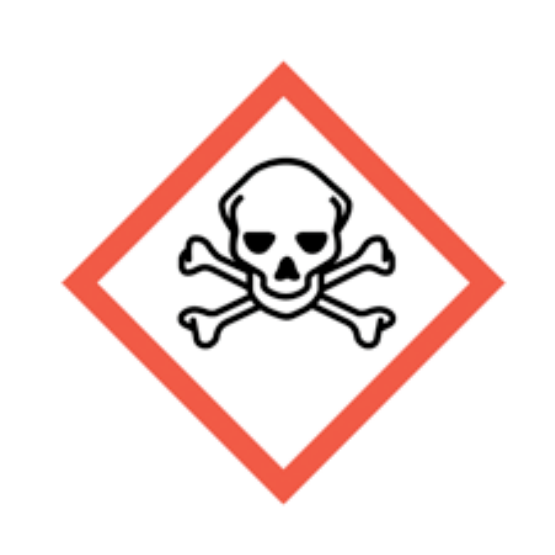
Skull and crossbones
Acute toxicity.
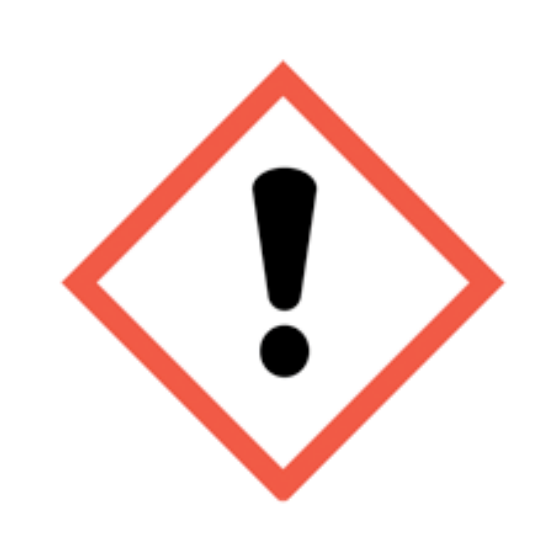
Exclamation mark
Irritation, harmful effects or skin sensitisation; some classifications cover drowsiness, dizziness or ozone-layer hazard. Read the actual hazard statements. Skin sensitisation differs from respiratory sensitisation.
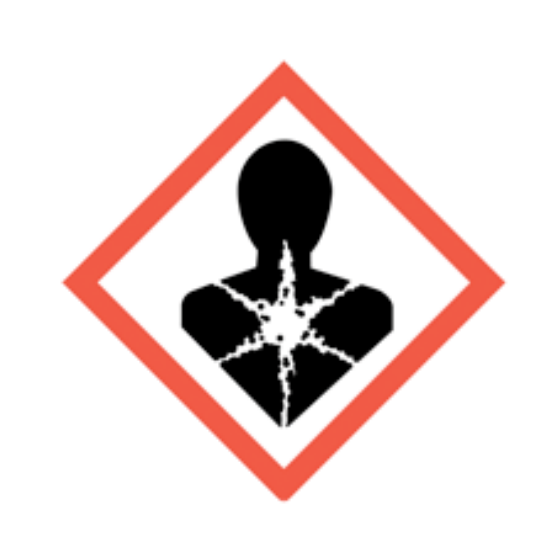
Health hazard
Serious health hazards, including organ damage, aspiration hazard, respiratory sensitisation, cancer and reproductive effects; some can follow a single exposure.
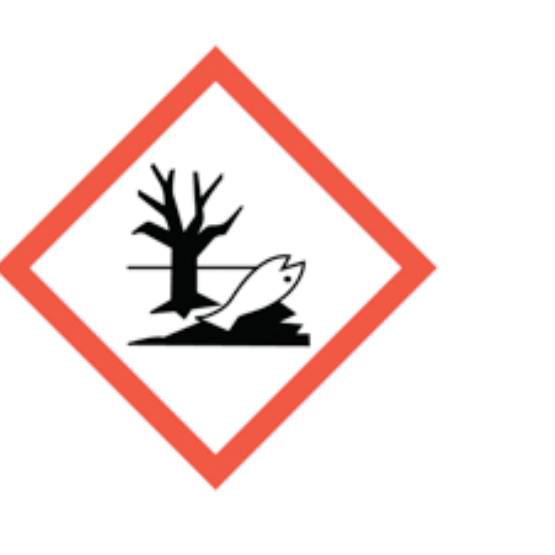
Environment
Hazardous to the aquatic environment.
What do the acronyms and key terms mean?
Expand each abbreviation at first use and keep its practical meaning attached to the task.
| Term | Full expansion | Meaning in this task |
|---|---|---|
| LEV | Local exhaust ventilation | Captures a process plume close to source, unlike general fresh-air supply. |
| COSHH | Control of Substances Hazardous to Health | Separate GB and NI substance-exposure duties. |
| TExT | Thorough examination and test | Competent periodic examination against intended LEV performance. |
| RPE | Respiratory protective equipment | Personal protection for assessed residual exposure, not a replacement for failed capture. |
| WEL | Workplace exposure limit | Substance- and period-specific occupational limit; not proof that the hood works. |
| DSEAR | Dangerous Substances and Explosive Atmospheres Regulations | Additional fire and explosion controls where dangerous substances are in scope. |
| Capture | Contaminant entry into a hood | Must be shown under the actual process and operator position. |

Unlock another resource
You have used this month’s two free downloads. Publish a post in your own words to unlock one more resource, or choose SHARE Individual for 10 downloads per month.
You decide whether to share. If you do, use the relevant platform disclosure tools and do not make claims you do not genuinely hold.