SHARE Knowledge Hub
Air Quality
Air quality at work has three different routes: fresh air in occupied rooms, hazardous substances created by work, and outdoor pollution. Identify the source and people exposed, control emissions before relying on masks, and check that ventilation or extraction really works. A room CO2 reading or public air-quality index does not prove compliance with a workplace exposure limit. Stop and escalate a suspected dangerous atmosphere.
Understanding Air Quality
Air quality at work has three different routes: fresh air in occupied rooms, hazardous substances created by work, and outdoor pollution. Identify the source and people exposed, control emissions before relying on masks, and check that ventilation or extraction really works. A room CO2 reading or public air-quality index does not prove compliance with a workplace exposure limit. Stop and escalate a suspected dangerous atmosphere.
Why this matters at work
Exposure monitoring measures contaminant in workplace air to answer a defined question: baseline exposure, WEL compliance, task peaks, control performance, group exposure, investigation or validation after change. Personal breathing-zone sampling usually represents individual inhalation exposure better than a fixed room monitor. Static and direct-reading instruments can explain source and variation when used competently. Monitoring exposure Workplace exposure limits HSENI COSHH .
Observe normal and abnormal scenarios and record source location, physical form, quantity, temperature, pressure, duration, work rate, enclosure, airflow, recirculation and possible migration. Source behaviour matters: a hot plume, high energy spray and diffuse vapour need different capture approaches. Specify the required performance of containment, extraction, make up air, discharge, work methods and maintenance. Decide what exposure monitoring, residual RPE or occupational health input is needed and how a failed control will stop work. Seek competent hygiene and engineering advice where the source or exposure is uncertain. Review symptoms and worker feedback alongside measurements and reassess after material or process changes.
How organisations manage this in practice
Eliminate the substance or emission-generating task where reasonably practicable. Reduce quantity, toxicity, dustiness, volatility, temperature, pressure, spray energy, drop height, duration and people exposed. Isolate through closed transfer, enclosure, remote operation, segregation, negative-pressure rooms or cabs. Control at source with integrated capture, LEV, wet suppression, process automation and safe general ventilation. HSE good control practice HSE RPE types .
Assurance should trace each significant source through prevention, capture, transport, cleaning, discharge and worker protection. Verify assessments, design basis, commissioning, indicators, maintenance, TExT, exposure monitoring, health surveillance, RPE and emergency response. Observe actual work and non-routine maintenance rather than relying on certificates. LEV frequently asked questions HSENI COSHH .
Staff report a problem after an air-handling change. The production manager records affected tasks and shifts, and commissions competent inspection of the system. Maintenance and workers check the corrected system under the same operating conditions.
This page is workplace guidance, not medical advice. Suspected significant exposure to dust, fumes, gases, smoke, carbon monoxide, oxygen-deficient air or other harmful airborne contaminants should be assessed by a medical professional.
What symptoms matter first?
- Breathlessness, wheeze, coughing, chest tightness, throat irritation, eye irritation or asthma-like symptoms.
- Headache, dizziness, nausea, confusion, unusual tiredness or collapse where carbon monoxide or oxygen depletion may be possible.
- Several people reporting symptoms in the same area, task, room, vehicle, cabin or enclosed space.
What should happen immediately?
- Stop the task, move people to clean air if safe, prevent others entering the affected area and raise the alarm.
- Do not rely on smell, taste or irritation as a safe warning system; some dangerous gases cannot be detected by senses.
- Identify the source, substance, process, ventilation condition and people exposed for responders, managers and clinicians.
When is medical assessment needed?
- Breathing difficulty, chest pain, confusion, collapse, suspected carbon monoxide exposure or symptoms after smoke or toxic gas exposure.
- Symptoms in a worker with asthma, chronic obstructive pulmonary disease, heart disease or other higher vulnerability.
- Delayed symptoms after the person initially seemed to recover from an airborne exposure.
What workplace air-quality decision does this guide support?
Use separate routes for occupied-room ventilation, hazardous workplace exposure and outdoor air; this guide is not a clearance certificate or an emergency-entry procedure.
It covers routine and changed work in offices, construction, workshops, welfare areas, outdoor sites and contractor interfaces. It does not replace a substance-specific COSHH assessment, an occupational hygienist, a building ventilation design, a confined-space safe system or clinical advice. Lead, asbestos, radioactive material and some other hazards have separate regimes. Environmental-emission compliance is separate from a worker's breathing-zone protection.
Choose the question before choosing a meter
Write the question first: does a room need more fresh air, is a worker exposed to a process contaminant, or is a dangerous atmosphere possible? Different questions need different evidence. A CO2 ventilation indicator does not measure welding fume, solvent identity or oxygen safety.
Best-practice guide: Air Quality
Choose the question before choosing a meter
Write the question first: does a room need more fresh air, is a worker exposed to a process contaminant, or is a dangerous atmosphere possible? Different questions need different evidence. Air quality at work has three different routes: fresh air in occupied rooms, hazardous substances created by work, and outdoor pollution.
Turn air quality knowledge into a decision
Air quality at work has three different routes: fresh air in occupied rooms, hazardous substances created by work, and outdoor pollution. Identify the source and people exposed, control emissions before relying on masks, and check that ventilation or extraction really works. Room, time, occupancy, readings, ventilation action, worker feedback and review.
Occupied meeting room feels stale
Record CO2 with occupancy and ventilation state; improve fresh air or reduce occupancy when a pattern indicates poor ventilation. Facilities confirms the change works in real occupancy and records outstanding building repairs.
Air-quality harm routes
Upper airway irritation: Dust, vapour, gas or smoke irritates the nose, throat and larger airways. Deep-lung deposition: Fine particles and respirable dust reach the smaller airways and lung tissue. Systemic poisoning: Some gases or vapours enter the bloodstream or interfere with oxygen transport.
Choose controls for air quality
Eliminate: Remove the source or avoid the task that creates airborne contamination. Reduce: Reduce the quantity, energy, duration or release rate of the contaminant. Isolate: Separate people from contaminated air or separate the process from occupied areas. Control: Capture, remove, dilute or monitor the contaminant through engineered and procedural controls. PPE: Use personal protective equipment and respiratory protective equipment for residual exposure. Read the full control table for qualifications, ownership and verification. Use the actual task and applicable jurisdiction; existing technical approval remains unchanged.
Use the full air quality lesson
Use the full topic for the decision points, practical examples, detailed control tables and source scope. HSE guidance applies to Great Britain; use HSENI for the Northern Ireland route and the source’s stated jurisdiction. A simplified guide does not change the page’s technical-review or approval status.

Read all six steps as text
1. Choose the question before choosing a meter
Write the question first: does a room need more fresh air, is a worker exposed to a process contaminant, or is a dangerous atmosphere possible?
- Avoid / redesign: Remove the source or avoid the task that creates airborne contamination.
- Control the task: Separate people from contaminated air or separate the process from occupied areas.
- Verify before release: Pre-cut materials off site; avoid solvent use; use electric plant instead of diesel indoors; avoid dry sweeping.
Write the question first: does a room need more fresh air, is a worker exposed to a process contaminant, or is a dangerous atmosphere possible? Different questions need different evidence. Air quality at work has three different routes: fresh air in occupied rooms, hazardous substances created by work, and outdoor pollution.
Apply it: Which part of this plan would you check at the workface before authorising the task?
2. Turn air quality knowledge into a decision
Use the evidence to improve the actual work arrangement.
- Change at source: Remove the source or avoid the task that creates airborne contamination.
- Make it observable: Pre-cut materials off site; avoid solvent use; use electric plant instead of diesel indoors; avoid dry sweeping.
- Keep useful evidence: Room, time, occupancy, readings, ventilation action, worker feedback and review.
Air quality at work has three different routes: fresh air in occupied rooms, hazardous substances created by work, and outdoor pollution. Identify the source and people exposed, control emissions before relying on masks, and check that ventilation or extraction really works. Room, time, occupancy, readings, ventilation action, worker feedback and review.
Apply it: What evidence would show that the change improves this task, rather than only completing a record?
3. Occupied meeting room feels stale
Example: a practical application of the existing topic lesson.
- Setting: the site team staff use a small meeting room for a long session; the aim is adequate fresh air, not a declaration that the room is pollutant-free.
- Act: Check occupancy, openable vents or mechanical supply, outside intake and complaints; place a suitable CO2 monitor away from people and vents if it helps the assessment.
- Hold / review: Consistently above 1500 ppm in an occupied room is HSE evidence to act, not a chemical-exposure limit; symptoms or a credible combustion source require a separate investigation.
Record CO2 with occupancy and ventilation state; improve fresh air or reduce occupancy when a pattern indicates poor ventilation. Facilities confirms the change works in real occupancy and records outstanding building repairs.
Apply it: At which point would you hold this example, and what evidence would allow it to proceed?
4. Air-quality harm routes
Connect the task, the route to the person and the control that can fail.
- Upper airway irritation: Dust, vapour, gas or smoke irritates the nose, throat and larger airways.
- Deep-lung deposition: Fine particles and respirable dust reach the smaller airways and lung tissue.
- Systemic poisoning: Some gases or vapours enter the bloodstream or interfere with oxygen transport.
Upper airway irritation: Dust, vapour, gas or smoke irritates the nose, throat and larger airways. Deep-lung deposition: Fine particles and respirable dust reach the smaller airways and lung tissue. Systemic poisoning: Some gases or vapours enter the bloodstream or interfere with oxygen transport.
Apply it: Who could be exposed, including other trades, cleaners, maintainers and people nearby?
5. Choose controls for air quality
Start with the stronger practicable options and verify their effect.
- Eliminate: Remove the source or avoid the task that creates airborne contamination.
- Reduce: Reduce the quantity, energy, duration or release rate of the contaminant.
- Isolate: Separate people from contaminated air or separate the process from occupied areas.
- Control: Capture, remove, dilute or monitor the contaminant through engineered and procedural controls.
- PPE: Use personal protective equipment and respiratory protective equipment for residual exposure.
Eliminate: Remove the source or avoid the task that creates airborne contamination. Reduce: Reduce the quantity, energy, duration or release rate of the contaminant. Isolate: Separate people from contaminated air or separate the process from occupied areas. Control: Capture, remove, dilute or monitor the contaminant through engineered and procedural controls. PPE: Use personal protective equipment and respiratory protective equipment for residual exposure. Read the full control table for qualifications, ownership and verification. Use the actual task and applicable jurisdiction; existing technical approval remains unchanged.
Apply it: Which stronger option can be used here, and who will verify it before accepting the remaining risk?
6. Use the full air quality lesson
Follow the official sources below and retain the task-specific evidence.
- Official guidance: HSE Using CO2 monitors (Live HSE page)
- Official guidance: HSE Monitoring hazardous-substance exposure (Live HSE page)
- Task decision: Room, time, occupancy, readings, ventilation action, worker feedback and review.
Use the full topic for the decision points, practical examples, detailed control tables and source scope. HSE guidance applies to Great Britain; use HSENI for the Northern Ireland route and the source’s stated jurisdiction. A simplified guide does not change the page’s technical-review or approval status.
Apply it: Which official source and full-topic section will you use to resolve the next decision?
A useful measurement plan identifies the source, people, operating conditions, instrument limitations, sampling location and relevant period. State who can interpret the result and what finding will stop or change the task. Record uncertainty rather than turn a convenient number into clearance.
A reassuring room monitor beside welding work
Illustrative example. A supervisor sees an ordinary CO2 result in a workshop and asks whether it proves the welding task is adequately controlled.
Decision. Assess welding-fume generation and source capture separately; use competent exposure evidence for the actual process.
Evidence to check. Check welding method, materials, worker position, extraction performance and representative sampling needs.
Hold or escalation point. Do not use CO2, outdoor DAQI or odour as proof of contaminant control.
Follow-up. Review capture and exposure evidence during representative work, including changed materials or enclosure.
Who checks, acts and authorises an air-quality decision?
Workers report exposure and control failure; supervisors pause unsafe tasks; facilities and occupational specialists test the right question; the dutyholder authorises restart.
| Role | Action | Boundary and evidence |
|---|---|---|
| All workers and building users | Report symptoms, dust, odour, blocked vents or failed extraction; use controls as instructed. | Do not diagnose the contaminant from smell or a room sensor. Give task, location and time. |
| Supervisors and host contractors | Check the planned material, process, neighbouring trades and stop triggers; pause work if control fails. | Record as-found conditions and who can release work. |
| Facilities and maintainers | Check fresh-air systems, intakes, filters and actual operating conditions; repair defects. | Do not treat a room CO2 number as a COSHH result. |
| Purchasers and designers | Specify process, contaminant and capture duty before buying LEV or RPE. | Require commissioning, user instructions, maintenance and competence evidence. |
| Safety lead and occupational hygienist | Plan substance-specific sampling and interpret results with task variation and WEL reference periods. | Area screening is not a personal exposure conclusion. |
| Managers and occupational health | Fund controls, review incidents and arrange appropriate health surveillance where indicated. | Clinical health findings and exposure measurements are different records. |
Which air-quality route should a reader follow first?
Ask whether the problem is fresh air, a substance generated by work, outdoor ambient pollution or an immediately dangerous atmosphere; each needs a different control and measurement.
Three air questions need three routes


Read this visual as text
- ROOM VENTILATION: Carbon dioxide can help assess ventilation in suitable occupied spaces; it is not a general toxic-gas or dust test.
- PROCESS EXPOSURE: Use the substance and task assessment, source controls and representative exposure evidence.
- DANGEROUS ATMOSPHERE: Consider oxygen deficiency, flammable or toxic gases and confined-space controls; prevent unplanned entry.
Keep the three questions separate: room ventilation, personal exposure and dangerous-atmosphere assessment need different evidence and competent interpretation.
Choose the Air Quality Route
Two linked parts · 5 questions. Open Part 2 to complete the route.

Continue to questions 4–5 · Part 2 of 2


Read this visual as text
- Start: A worker or manager reports an air-quality concern.
- Question 1: Is there a gas alarm, collapse or an unknown dangerous atmosphere? Decision owner: Incident controller / emergency services.
- YES — STOP / REFER: Keep out, raise the alarm and activate the emergency plan. STOP / REFER → APPROPRIATE RESPONSE.
- NO: No such warning is identified; continue the remaining checks. CONTINUE → QUESTION 2.
- UNKNOWN — PROTECT FIRST: Protect people and hold the affected work. Obtain the responsible specialist’s assessment; do not assume the warning is absent. HOLD → OWNER RESOLVES BEFORE RESUMING.
- Question 2: Which concern is present? Decision owner: Responsible manager / competent air-quality assessor.
- Occupied-room ventilation: Assess fresh-air supply, occupancy and maintenance. CONTINUE → QUESTION 3.
- Task-generated contaminant: Identify the source and apply the relevant GB or NI substance assessment. CONTINUE → QUESTION 3.
- Outdoor pollution: Check the current public air-quality advice and control site emissions separately. CONTINUE → QUESTION 3.
- UNKNOWN / NONE FITS: Keep affected work or the decision held. The named owner resolves the facts; immediate protection takes priority. HOLD → OWNER RESOLVES BEFORE RESUMING.
- Question 3: Have all overlapping routes been recognised? Decision owner: Responsible manager / competent air-quality assessor.
- YES: The required evidence or condition is confirmed. CONTINUE → QUESTION 4.
- NO / UNKNOWN — HOLD: Run each applicable assessment; room ventilation does not clear process exposure. HOLD → REPEAT QUESTION 3 AFTER CORRECTION.
- Question 4: Is there a competent owner and suitable immediate control? Decision owner: Responsible manager / competent air-quality assessor.
- YES: The required evidence or condition is confirmed. CONTINUE → QUESTION 5.
- NO / UNKNOWN — HOLD: Hold uncontrolled exposure while the assessment and practical controls are resolved. HOLD → REPEAT QUESTION 4 AFTER CORRECTION.
- Question 5: Record the route and next action Decision owner: Responsible manager / competent air-quality assessor.
- ACTION: Name the question, control owner, evidence needed and review trigger. OUTCOME → RECORD AND HAND OVER.
- Outcome: Correct assessment owner, immediate hold if needed and recorded next action.
- Stop and escalation boundary: No entry or work continuation when atmosphere, material or control is unknown; escalate to competent people.
These routes can overlap. A polluted outdoor intake does not remove the need to control indoor emissions. A comfortable office can still have a task-generated solvent or carbon-monoxide hazard. Choose the route from the source and task, not the device already on site.
| Situation | First decision | Evidence and boundary |
|---|---|---|
| Occupied room | Check fresh-air provision, occupancy and maintenance. | CO2 may indicate ventilation in suitable rooms, not chemical safety. |
| Task dust, fume, gas, mist or vapour | Use the GB or NI COSHH route and control at source. | Identify material and task; personal exposure sampling may be needed. |
| Outdoor public pollution | Check UK AIR and DAQI advice; adapt exposed outdoor work. | DAQI is not a personal workplace limit. |
| Unknown, oxygen-deficient or toxic atmosphere | Prevent entry, evacuate or isolate and activate specialist emergency arrangements. | No improvised rescue or filtering respirator. |
A meter answers a defined question
Choose the measurement method to answer a defined question about the workplace air. Check what the instrument measures, its limitations and whether the reading represents the exposure you need to assess.
| Question | Suitable evidence | What it does not establish |
|---|---|---|
| Is this occupied room adequately ventilated? | A competent ventilation assessment, with representative carbon dioxide readings where the space is suitable for that method. Consider occupancy, location and ventilation conditions. | A low carbon dioxide reading is not clearance for solvent vapour, dust, carbon monoxide or every other pollutant. |
| What does the person breathe during this process? | A sampling strategy suited to the substance, task and exposure period, with competent interpretation of personal exposure evidence. | A general room reading or one later measurement may not represent the worker’s short task or breathing zone. |
| Could the atmosphere be immediately dangerous? | The authorised hazardous-atmosphere assessment and emergency arrangements, using suitable equipment and competent people. | A room-ventilation monitor is not entry permission. Do not enter or attempt an unplanned rescue when the atmosphere may be dangerous. |
What are the key points for air quality at work?
Air quality is controlled by knowing the source, the contaminant, the exposure route, the people affected and the evidence that controls are effective.
Do not call a room safe because one CO2, PM or odour reading is reassuring; the source, time, location and pollutant must match the decision.
Air quality is not just comfort
Stuffy rooms, odours and high carbon dioxide may indicate poor ventilation, but harmful exposure can also come from invisible gases, fine dust, fume, vapour or mist generated by the work.
The source matters most
Controls should start where the contaminant is generated: cutting, grinding, spraying, welding, combustion, cleaning, curing, drying, heating, vehicle movement or material handling.
General ventilation is not enough for many process hazards
Fresh air helps dilute stale indoor air, but hazardous dust, mist, fume, gas or vapour often needs source control, enclosure or local exhaust ventilation.
Monitoring must answer a decision
Measurements should be chosen to answer a practical question: is ventilation poor, is a workplace exposure limit at risk, is LEV working or is outdoor pollution high enough to adjust work?
RPE is a last line of defence
Respiratory protective equipment can protect residual exposure, but only when selected correctly, fit tested, worn, maintained and supported by training and supervision.
Symptoms are weak signals
Repeated headaches, coughing, eye irritation, breathing difficulty, chest tightness or multiple complaints in one area should trigger investigation, not reassurance by assumption.
What is workplace air quality?
Workplace air quality is the condition of indoor or outdoor air where people work, judged by ventilation, contaminants, exposure level, exposure duration and worker vulnerability.
Workplace indoor air, task-generated exposure and outdoor ambient pollution overlap but are measured and regulated differently.
Air quality can be a comfort issue, a health risk, an environmental compliance matter or all three at once. In an office it may involve poor ventilation, high carbon dioxide, damp, mould, odours or cleaning-product vapours. In construction, manufacturing, healthcare, laboratories, workshops or process environments it may involve dusts, fumes, vapours, gases, smoke, fibres, bioaerosols or oxygen-deficient atmospheres.
The most important distinction is between general indoor air quality and task-generated airborne contaminants. General ventilation brings fresh air in and removes stale air. Process control removes or captures harmful substances at the point they are created. If a process produces welding fume, wood dust, silica dust, solvent vapour or diesel exhaust, the answer is rarely simply to open a window.
A good air-quality assessment asks what is being breathed in, how much, for how long and by whom. Vulnerable workers may include people with asthma, chronic obstructive pulmonary disease, heart disease, pregnancy-related needs, older workers, young workers or workers returning after respiratory illness.
| Category | What it means | Typical workplace examples |
|---|---|---|
| General ventilation | Fresh-air supply and removal of stale, warm, humid or occupied-room air. | Offices, welfare cabins, classrooms, meeting rooms, retail spaces and control rooms. |
| Process-generated airborne contaminants | Dust, mist, vapour, gas, fume or fibres produced by work activity. | Cutting, sanding, welding, spraying, cleaning, woodworking, grinding, diesel plant and chemical use. |
| Combustion and engine emissions | Air pollutants produced by fuel burning or incomplete combustion. | Diesel exhaust, heaters, generators, forklifts, boilers, carbon monoxide and nitrogen oxides. |
| Outdoor pollution affecting work | Ambient air pollution entering workplaces or affecting outdoor workers. | Roadside work, construction, delivery work, outdoor events and high-pollution days. |
| Hazardous atmospheres | Air that may be oxygen-deficient, toxic, flammable or otherwise immediately dangerous. | Confined spaces, tanks, silos, pits, drains, basements, excavations and poorly ventilated plant rooms. |
How do air-quality decisions change in real work?
Decide from the source, people, operating conditions and working control: start only when evidence is adequate, stop on a failed hold point and verify hand-back.
Three air questions need different evidence
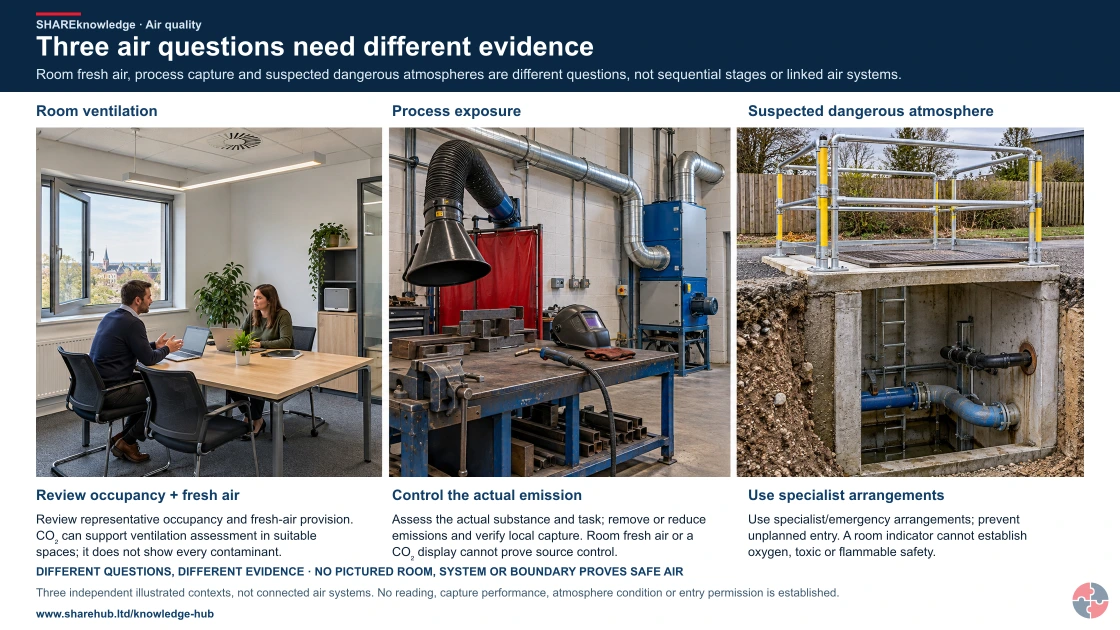
Full written explanation
One complete landscape comparison contains three large, clearly separate realistic HD physical contexts: an occupied meeting room with outside window/ceiling ventilation and a neutral blank-display monitor; an inactive fabrication bench with hood and extraction equipment; and an empty below-ground service-chamber cutaway with controlled top access. Native headings and evidence explanations distinguish room ventilation, actual process exposure and suspected dangerous-atmosphere questions. They are parallel assessment routes, not stages and not one shared building or air system. Each context retains its own evidence: representative occupancy/fresh-air provision; actual substance/task/source-control verification; or the appropriate specialist/emergency arrangements preventing unplanned entry. No CO₂ number, ratio, green safe-air signal, instrument result, captured contaminant level, oxygen/flammability condition, clinical inference, rescue or entry procedure is supplied. The panorama is not an engineering design or atmosphere certificate. The current complete topic retains its separate outdoor-pollution/DAQI, WEL/reference-period, jurisdiction, health and emergency qualifications unchanged; no forecast is made into an occupational exposure result.
Room fresh air, process capture and suspected dangerous atmospheres are different questions, not sequential stages or linked air systems.
- Room ventilation. Occupied rooms need suitable fresh-air provision; CO₂ can support a ventilation assessment in appropriate spaces.
- Process exposure. Dust, fume, mist, vapour or gas from work needs a substance-and-task assessment and effective source control.
- Dangerous atmosphere. Toxic, flammable or oxygen-deficient conditions need the appropriate specialist and emergency arrangements.
Change the pathway
- Review real occupancy. Check ventilation mode and representative occupied conditions, not a single snapshot.
- Capture at source. Use a suitable enclosure, lower-release method or correctly specified and functioning LEV.
- Prevent unplanned entry. Do not use a CO₂ comfort indicator to clear a suspected dangerous atmosphere.
Evidence check: A room ventilation indicator does not measure welding fume, chemical identity or oxygen safety.
Primary references: HSE CO₂ monitors — representative room-ventilation assessment and limitations · HSE hazardous-substance monitoring — control/exposure evidence, separate from worker health · HSE LEV — source capture and competent system-specific evidence
Open the complete HD image (new tab)Download image

Primary references: HSE CO₂ monitors — representative room-ventilation assessment and limitations · HSE hazardous-substance monitoring — control/exposure evidence, separate from worker health · HSE LEV — source capture and competent system-specific evidence
Match the evidence to the actual source and task
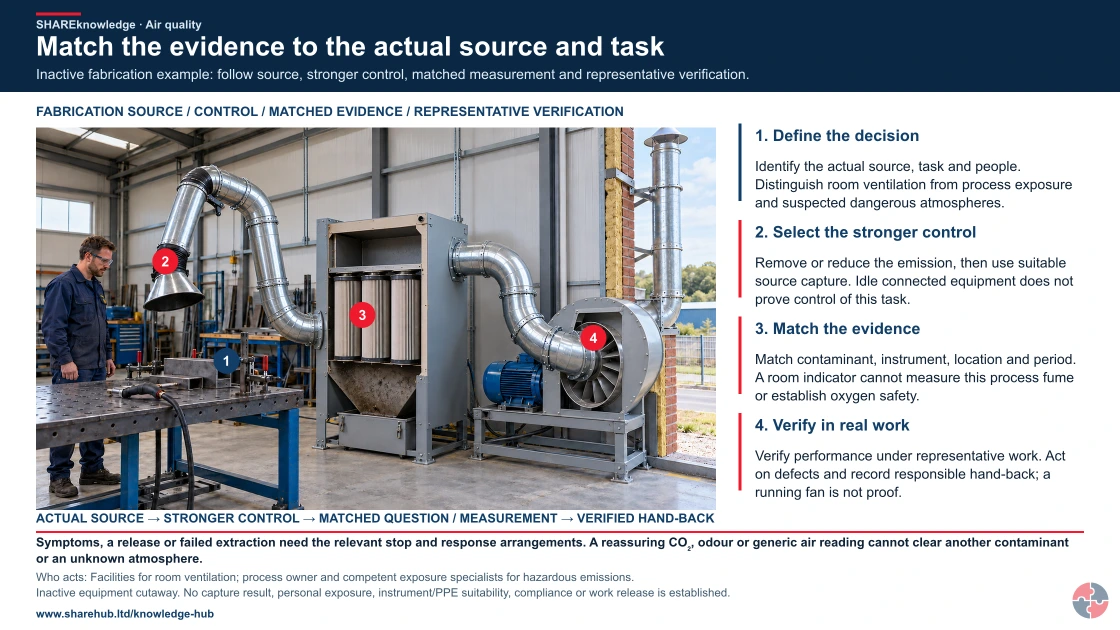
Full written explanation
A detailed realistic HD inactive fabrication cutaway shows a source bench and close-capture hood connected by duct to a sectioned air cleaner, fan and discharge context. Four native checks follow the genuine maintained relationship from defining the source/task/people question, through stronger source controls, to matched contaminant/instrument/location/period evidence and verification during representative work. The open filter/fan views are educational cutaways, not permission to open or operate unguarded equipment. No active process, meter display, calibration, measurement success, sampling recipe or PPE selection is depicted. The image explains why visible ducting, a running fan, low room CO₂, comfort or odour cannot establish process exposure control or oxygen safety. It supplies no numeric limit, compliance finding, personal exposure estimate, emergency re-entry condition or automatic task release. All original source questions, stronger-control qualifications, complete four checks, current technical/emergency/country routes, holds, roles and cases remain in the written/native source. Existing diagrams and controls are retained.
Inactive fabrication example: follow source, stronger control, matched measurement and representative verification.
- Define the decision. Identify the source, people and whether the issue is room air, process exposure or a dangerous atmosphere.
- Select the stronger control. Remove or reduce the source; use suitable local capture before relying on general dilution or residual RPE.
- Match the evidence. Choose the actual contaminant, instrument, location and period needed to answer the assessment question.
- Verify in real work. Check the control under representative conditions, act on defects and record the responsible hand-back.
When the evidence does not fit: Symptoms, a release or failed extraction need the relevant stop and response arrangements. A reassuring CO₂, odour or generic air reading cannot clear another contaminant or an unknown atmosphere.
Who acts: Facilities for room ventilation; process owner and competent exposure specialists for hazardous emissions.
Changed workplace
Stuffy meeting room: Review occupancy, fresh-air provision and representative readings; comfort is not a general pollutant clearance.
Fabrication welding: Lost capture needs a task hold and competent repair/verification; a low room CO₂ reading is irrelevant.
Evidence check: A room ventilation indicator does not measure welding fume, chemical identity or oxygen safety.
Primary references: HSE CO₂ monitors — representative room-ventilation assessment and limitations · HSE hazardous-substance monitoring — control/exposure evidence, separate from worker health · HSE LEV — source capture and competent system-specific evidence
Open the complete HD image (new tab)Download image

Primary references: HSE CO₂ monitors — representative room-ventilation assessment and limitations · HSE hazardous-substance monitoring — control/exposure evidence, separate from worker health · HSE LEV — source capture and competent system-specific evidence
Keep concrete dust at the tool


Read this visual as text
- The capture point, hose, extractor and boundary form one control system. Source control must suit the material and method; a tidy room or a low carbon-dioxide reading cannot establish that silica exposure is controlled.
- CAPTURE AT SOURCE
- CHECK THE EXTRACTION
- PROTECT OTHER TRADES
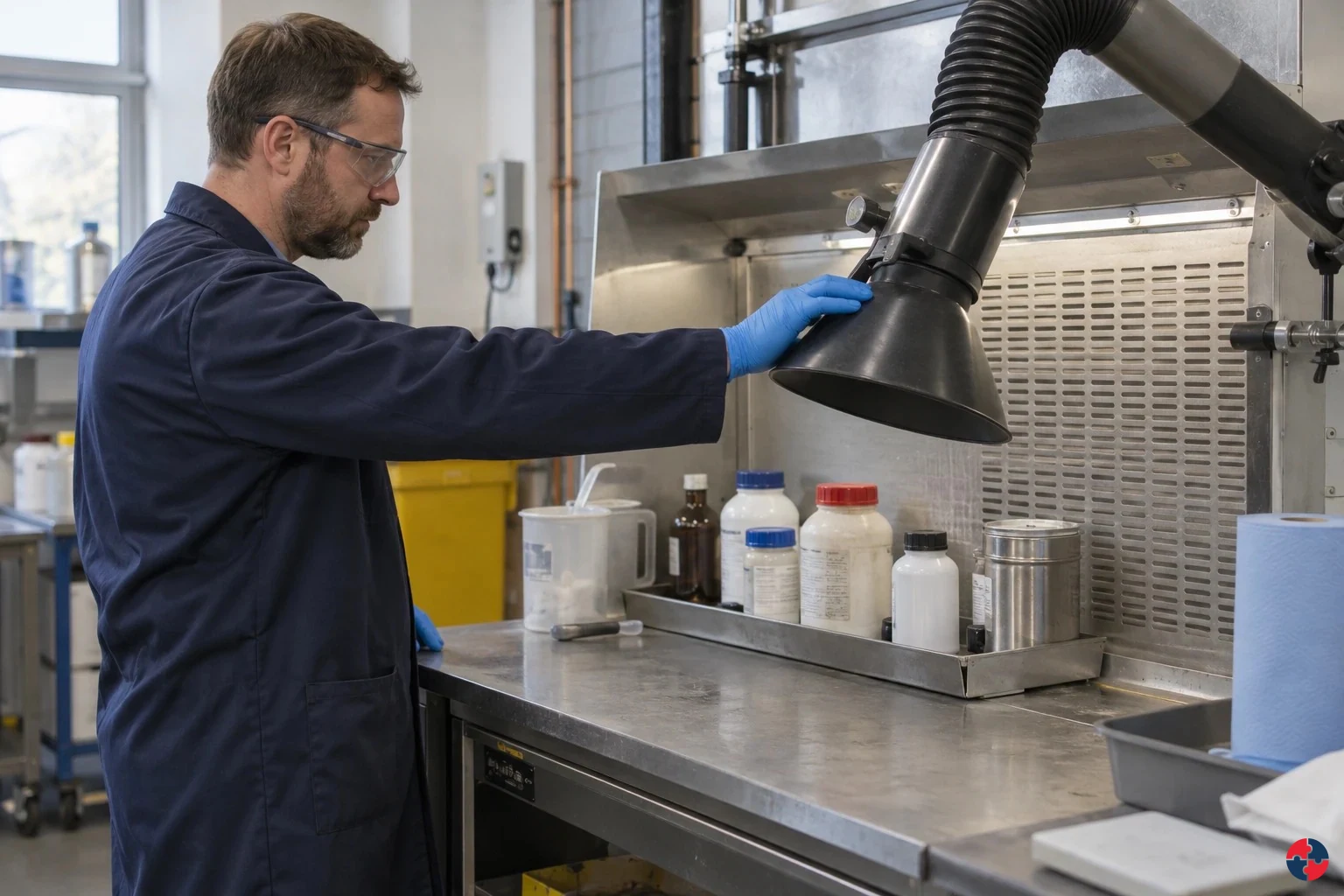
Illustrative source-control arrangement. Follow the capture point, connected hose and extractor to their performance evidence. This photograph cannot demonstrate capture effectiveness, exposure level or PPE suitability.
These seven examples are teaching cases, not substitute site procedures or universal numerical release criteria. GB and NI organisations must use their own assessed tasks, competent advice and authorisation routes.
1. Occupied meeting room feels stale
Task material and setting: BuildOut staff use a small meeting room for a long session; the aim is adequate fresh air, not a declaration that the room is pollutant-free.
People and prerequisites: Office workers and visitors may be affected; facilities staff know the ventilation mode, occupancy and maintenance route.
Before: Check occupancy, openable vents or mechanical supply, outside intake and complaints; place a suitable CO2 monitor away from people and vents if it helps the assessment.
During: Record CO2 with occupancy and ventilation state; improve fresh air or reduce occupancy when a pattern indicates poor ventilation.
Hold or stop: Consistently above 1500 ppm in an occupied room is HSE evidence to act, not a chemical-exposure limit; symptoms or a credible combustion source require a separate investigation.
Completion and hand back: Facilities confirms the change works in real occupancy and records outstanding building repairs.
Evidence: Room, time, occupancy, readings, ventilation action, worker feedback and review.
2. Routine concrete cutting beside other trades
Task material and setting: A contractor cuts silica-containing concrete indoors; the aim is to prevent dust at source and protect adjacent workers.
People and prerequisites: Cutter, nearby trades, cleaner and occupants may be affected; the host and contractor share the task assessment, tool data and trained operator.
Before: Confirm material, location, enclosure or segregation, suitable on-tool extraction or wet method, RPE assessment and waste route.
During: Use the specified control while cutting; keep others out of the exposure area and remove residue without dry sweeping.
Hold or stop: Stop for lost water, disconnected extraction, damaged hose, visible escaping dust or changed material; a disposable mask alone is not the plan.
Completion and hand back: Clean safely, check controls and release the area only when the contractor and host agree it is fit for the next trade.
Evidence: COSHH assessment, control checks, contractor handover, defects and any competent sampling.
3. Diesel plant moves beside a fresh-air intake
Task material and setting: A generator is moved beside a welfare-unit intake after a site-layout change; the aim is to prevent exhaust entering occupied air.
People and prerequisites: Welfare users, operators and neighbours may be affected; the supervisor knows intake positions and an engineer reviews the new layout.
Before: Identify the exhaust path, wind and intake; prefer a different location or non-combustion supply before adding ventilation.
During: Stop use at the affected position, keep people away from suspected exhaust and have a competent person assess any carbon-monoxide concern.
Hold or stop: Headache, confusion, alarm, visible exhaust ingress or uncertain air path means leave the area and escalate; CO2 or DAQI readings cannot clear a CO hazard.
Completion and hand back: Verify the relocated plant and air supply in operating conditions before reopening the unit.
Evidence: Change approval, location plan, incident record, checks and reopening authority.
4. Welding extraction fails mid-shift
Task material and setting: An LEV airflow indicator falls and fume escapes during welding; the aim is to prevent continued inhalation.
People and prerequisites: Welder and nearby workers may be affected; an authorised supervisor and competent LEV maintainer are available.
Before: Check that the extraction is specified for this process, correctly positioned and in its approved test and maintenance state.
During: Pause welding, isolate or restrict the affected area and report the actual indicator and capture failure.
Hold or stop: Do not continue merely because the fan sounds normal, a mask is available or the last thorough test passed.
Completion and hand back: Repair and verify capture during real work; an authorised supervisor releases the task with any revised controls.
Evidence: Defect, last test, as-found and as-left checks, exposure review and restart decision.
5. Unknown coating during occupied refurbishment
Task material and setting: A subcontractor opens an unlabelled coating in an occupied building; the aim is to stop an unknown vapour release before use.
People and prerequisites: Applicator, occupants and other contractors may be affected; product identity, current safety data and ventilation plan are prerequisites.
Before: Hold the container closed; obtain identity, SDS, application method, quantities and a task-specific assessment.
During: Choose a safer product or segregated controlled method; coordinate with the building manager and other trades.
Hold or stop: No product identity, no SDS or unclear ventilation means do not apply it; odour or a generic VOC meter is not proof of safety.
Completion and hand back: Reopen the area only after the assessment, controls, clearance method and handover are approved.
Evidence: Product record, SDS, contractor plan, air-control decision and area hand-back.
6. High outdoor pollution forecast for strenuous work
Task material and setting: A road crew plans strenuous work during a high DAQI forecast; the aim is to plan exposure and support workers with heart or lung conditions.
People and prerequisites: Outdoor staff and the public may be affected; the manager checks the local forecast and workers have a private route for health advice.
Before: Check the current UK AIR forecast and GOV.UK DAQI health advice, site traffic sources, exertion and planned breaks.
During: Consider timing, location, lower-exertion methods and individual clinical advice where needed; still control the crew's own dust and exhaust.
Hold or stop: Severe symptoms or a separate site emission hazard require immediate action; a DAQI band is not a personal WEL or automatic universal work ban.
Completion and hand back: Review forecast changes and worker feedback before the next shift.
Evidence: Forecast checked, work adjustment, private support route and review.
7. Alarm at an enclosed service pit
Task material and setting: A worker collapses near an enclosed pit after a gas alarm; the aim is to prevent a second casualty and bring trained responders.
People and prerequisites: Worker, would-be rescuers and responders may be affected; the site must have a confined-space assessment and emergency arrangements.
Before: Keep the area controlled; identify the alarm and emergency plan without entering the pit.
During: Raise the alarm, call 999, prevent entry and tell responders the known gases, layout and last readings.
Hold or stop: No improvised rescue, untested entry or filtering respirator in an unknown or oxygen-deficient atmosphere.
Completion and hand back: Competent responders and the site authority control recovery, atmospheric verification and later return to service.
Evidence: Alarm timeline, affected persons, responder handover, investigation and signed reopening.
Which pollutants commonly affect workplace air quality?
Common workplace air pollutants include particulates, dusts, fibres, fumes, vapours, gases, mists, smoke, bioaerosols and outdoor pollution drawn into the workplace.
The hazardous product label may miss a contaminant generated by the process, such as silica dust or welding fume. Identify both supplied material and by-product.
Pollutants behave differently depending on their physical form. Coarse dust may settle on surfaces and become visible; respirable dust may stay airborne and reach deep into the lungs. Vapours may evaporate from liquids; fumes may form when hot metal or chemicals cool in air; gases may displace oxygen or poison without being seen.
This matters because the control method must match the pollutant. A filter suitable for dust may not control solvent vapour. A carbon dioxide monitor can help indicate ventilation in occupied spaces, but it does not measure welding fume, silica dust or carbon monoxide. A disposable dust mask will not make a toxic gas release safe.
The key learning point is to identify the contaminant before selecting the control. The name of the task is not enough; the assessment needs to know the material, process, energy source, by-products, exposure route and likely concentration.
| Pollutant or form | Common sources | Main concern |
|---|---|---|
| PM10 and PM2.5 particulate matter | Traffic, diesel engines, combustion, construction, grinding, demolition, wood burning and outdoor air pollution. | Can irritate airways; fine particles can penetrate deep into the lungs and contribute to respiratory and cardiovascular disease. |
| Respirable crystalline silica | Cutting, grinding, drilling or breaking concrete, stone, brick, tile and other silica-containing materials. | Can cause silicosis, chronic obstructive pulmonary disease and lung cancer. |
| Wood dust | Sawing, sanding, routing, machining and cleaning wood waste. | Can cause asthma, dermatitis and nasal cancer risk depending on wood type and exposure. |
| Welding fume and metal fume | Welding, hot cutting, brazing, soldering, galvanised metal work and thermal processes. | Can cause acute irritation and long-term lung disease; some metal fumes have specific toxic effects. |
| Volatile organic compounds | Paints, solvents, adhesives, cleaning agents, fuels, resins, coatings and curing products. | May cause irritation, headache, dizziness, nervous-system effects and, for some substances, cancer risk. |
| Carbon monoxide | Incomplete combustion from engines, heaters, generators, boilers and poorly ventilated combustion equipment. | Can prevent blood carrying oxygen, causing headache, confusion, collapse and death. |
| Nitrogen dioxide and sulphur dioxide | Combustion, traffic, boilers, generators, industrial processes and outdoor pollution. | Can irritate the airways and aggravate asthma and other respiratory conditions. |
| Bioaerosols, mould and damp-related contaminants | Poorly maintained buildings, water systems, waste handling, composting, agriculture and damp materials. | May cause irritation, allergy, infection risk or asthma aggravation depending on the agent and person. |
How does poor air quality harm the body?
Poor air quality mainly harms people through inhalation, but some airborne substances can also affect the eyes, skin, nervous system, blood, heart and wider body.
Symptoms are a prompt to protect people and investigate; absence of symptoms does not prove that a long-latency exposure is controlled.
Inhalation is the main route because contaminants enter the nose, throat, airways and lungs. Larger particles may irritate the upper airways, while respirable dust and fine particulate matter can reach the gas-exchange region of the lung. Some gases and vapours dissolve in wet tissues and cause irritation; others can enter the bloodstream.
Dose matters. A short high exposure can cause acute inhalation injury, poisoning or asthma symptoms. Repeated lower exposures can contribute to chronic disease. Exposure duration, concentration, particle size, solubility, toxicity, breathing rate and worker vulnerability all influence harm.
Air-quality complaints should be taken seriously because early symptoms may be the only visible signal that controls are failing. Several people with the same symptoms in the same area is a stronger signal than one isolated complaint.
| Route or effect | What happens | Workplace implication |
|---|---|---|
| Upper airway irritation | Dust, vapour, gas or smoke irritates the nose, throat and larger airways. | Look for coughing, sore throat, hoarseness, eye watering or complaints during specific tasks. |
| Deep-lung deposition | Fine particles and respirable dust reach the smaller airways and lung tissue. | Controls must prevent respirable dust, not just visible dust; cleaning and dry sweeping can re-suspend fine material. |
| Systemic poisoning | Some gases or vapours enter the bloodstream or interfere with oxygen transport. | Carbon monoxide, solvents and some gases need specific monitoring and emergency arrangements. |
| Asthma and sensitisation | Some substances can trigger asthma or make existing asthma worse. | Early reporting, exposure control, health surveillance and prompt investigation matter. |
| Cardiovascular stress | Fine particles and gases can aggravate heart and circulatory disease in vulnerable people. | Outdoor workers and vulnerable workers may need modified plans on high-pollution days. |
| Eye, skin and mucous membrane effects | Irritant gases, mists, smoke and some vapours affect exposed tissues. | Ventilation, source control, eye protection, hygiene and substitution may all be needed. |
Where does air quality usually fail in workplaces?
Air quality usually fails where contaminants are generated faster than they are removed, or where fresh air, maintenance, cleaning and task planning are not matched to real work.
A changed intake, enclosure, weather pattern or adjacent contractor task can invalidate yesterday's assessment.
Different workplaces need different questions. In offices, the first questions may be fresh air, occupancy, heating, air conditioning, damp, mould, cleaning products and carbon dioxide. In workshops, the questions shift to airborne contaminants from the process: is dust or fume captured at source, is the LEV positioned correctly and is it tested?
Construction and temporary workplaces create particular challenges because conditions change quickly. Dust controls may be bypassed, diesel plant may run near workfaces, welfare cabins may become crowded, and temporary screens or weather protection can trap contaminants.
Confined spaces and similar enclosed areas should not be treated as ordinary air-quality problems. Oxygen deficiency, toxic gases and flammable atmospheres can be fatal very quickly and need specific confined-space assessment, testing, ventilation, rescue and permit arrangements.
| Setting | Typical issue | Control focus |
|---|---|---|
| Offices and occupied rooms | Stale air, high occupancy, poor ventilation, odours, damp, mould or poor thermal comfort. | Ventilation assessment, carbon dioxide indicators, HVAC maintenance, cleaning controls and occupancy management. |
| Workshops and fabrication areas | Welding fume, metal dust, grinding dust, solvent vapour, combustion products and poor extraction. | LEV, process enclosure, segregation, housekeeping, exposure monitoring and RPE where residual risk remains. |
| Construction sites | Silica dust, wood dust, diesel exhaust, cement dust, demolition dust and temporary enclosed work areas. | Water suppression, on-tool extraction, plant controls, sequencing, welfare ventilation and supervisor checks. |
| Healthcare, leisure and public buildings | Cleaning vapours, disinfectants, poor ventilation, damp, allergens or high-occupancy areas. | Product selection, ventilation, safe dilution, storage, cleaning method and worker/public reporting routes. |
| Warehouses and loading areas | Diesel or gas-fuelled equipment, idling vehicles, dust, cold air management and battery charging by-products. | Electric plant, no-idling rules, ventilation, maintenance, charging-area controls and monitoring where needed. |
| Confined or poorly ventilated spaces | Oxygen depletion, carbon monoxide, hydrogen sulphide, methane, solvent vapour or toxic atmospheres. | Confined-space procedure, atmospheric testing, mechanical ventilation, rescue plan and permit control. |
Which measurement answers which air-quality question?
Specify the contaminant, instrument, sampling position, reference period, jurisdiction and action before collecting a number; a CO2 or DAQI reading cannot prove WEL compliance.
Select a Measurement
Two linked parts · 6 questions. Open Part 2 to complete the route.

Continue to questions 4–6 · Part 2 of 2


Read this visual as text
- Start: Someone proposes an air reading or cites a number as proof that work is safe.
- Question 1: Is the decision question and contaminant or indicator defined? Decision owner: Responsible manager / competent air-quality assessor.
- YES: The required evidence or condition is confirmed. CONTINUE → QUESTION 2.
- NO / UNKNOWN — HOLD: Do not select a convenient meter before knowing what it must establish. HOLD → REPEAT QUESTION 1 AFTER CORRECTION.
- Question 2: What evidence is needed? Decision owner: Occupational hygienist / competent specialist.
- Room ventilation: Use suitable carbon-dioxide monitoring with occupancy and ventilation context. CONTINUE → QUESTION 3.
- Personal substance exposure: Use a substance-specific representative sampling plan and reference period. CONTINUE → QUESTION 3.
- Rapid gas danger / outdoor alert: Use matched emergency instruments or official outdoor indicators for their stated purpose. CONTINUE → QUESTION 3.
- UNKNOWN / NONE FITS: Keep affected work or the decision held. The named owner resolves the facts; immediate protection takes priority. HOLD → OWNER RESOLVES BEFORE RESUMING.
- Question 3: Do sensor, range, calibration and sampling location match the question? Decision owner: Responsible manager / competent air-quality assessor.
- YES: The required evidence or condition is confirmed. CONTINUE → QUESTION 4.
- NO / UNKNOWN — HOLD: Resolve wrong-sensor or unknown-substance uncertainty before interpreting a result. HOLD → REPEAT QUESTION 3 AFTER CORRECTION.
- Question 4: Are duration, operating conditions and applicable jurisdiction matched? Decision owner: Responsible manager / competent air-quality assessor.
- YES: The required evidence or condition is confirmed. CONTINUE → QUESTION 5.
- NO / UNKNOWN — HOLD: Check the current limit or indicator and averaging period; do not mix GB and NI assumptions. HOLD → REPEAT QUESTION 4 AFTER CORRECTION.
- Question 5: Is competent interpretation tied to a control action? Decision owner: Responsible manager / competent air-quality assessor.
- YES: The required evidence or condition is confirmed. CONTINUE → QUESTION 6.
- NO / UNKNOWN — HOLD: Retain controls and seek advice; a single convenient reading is not clearance. HOLD → REPEAT QUESTION 5 AFTER CORRECTION.
- Question 6: Communicate the evidence limits Decision owner: Responsible manager / competent air-quality assessor.
- ACTION: Record what the result supports, what remains unknown and who acts next. OUTCOME → RECORD AND HAND OVER.
- Outcome: A measurement plan, applicable limit or indicator boundary, action owner and communicated result.
- Stop and escalation boundary: Wrong sensor, unknown substance, unsupported averaging or no action plan: do not call a pass; keep controls and seek specialist advice.
For occupied-room CO2 interpretation use HSE ventilation guidance; for hazardous process exposure use the separate HSE sampling guidance, WEL guidance. A room CO2 reading is not a wood-dust result.
HSE describes CO2 as a broad occupied-room ventilation indicator; consistently above 1500 ppm in a suitable occupied room indicates poor ventilation and action, not a universal safe-air limit. CO2 monitoring is unsuitable where a process produces CO2 or air-cleaning units remove contaminants without removing CO2; in sparsely occupied or poorly mixed large spaces, results may not represent ventilation reliably. HSE distinguishes screening devices from personal air sampling and health surveillance. A WEL is a concentration of a named substance averaged over its stated reference period. GB EH40 generally uses 8-hour and, where set, 15-minute periods; check the current entry and units. HSENI identifies EH40/2005 fourth edition as approved for COSHH (NI) 2003 and says its WEL list is legally binding under that NI instrument; verify the current edition and amendments before use.
Worked decision: HSE gives GB hardwood dust a WEL of 3 mg/m3 as an 8-hour time-weighted average. A brief room PM2.5 reading cannot establish that WEL is met: it measures a different fraction, in a different place and period. Keep source controls in place and ask a competent hygienist whether representative personal wood-dust sampling is needed. A result below a WEL does not end the duty to reduce exposure appropriately.
| Measurement | Useful decision | Cannot prove |
|---|---|---|
| Occupied-room CO2 | Find patterns of insufficient fresh air with occupancy and ventilation recorded. | That dust, CO, solvent vapour or infection risk is absent. |
| Personal substance sample | Estimate worker breathing-zone exposure for a defined task and averaging period. | Control for every task or person without representative design. |
| Static or direct-reading sensor | Locate a source or detect a specified rapidly changing hazard. | A personal shift average unless validated and placed for that purpose. |
| LEV performance check | Compare capture and operating data with commissioned duty. | Actual worker exposure from airflow alone. |
| Outdoor DAQI | Plan public-pollution-related outdoor activity and individual advice. | Compliance with a workplace WEL. |
| Health surveillance | Detect relevant health effects and trigger control review where required. | Airborne concentration at the task. |
What is the difference between general ventilation and local exhaust ventilation?
General ventilation replaces stale indoor air, while local exhaust ventilation captures harmful airborne contaminants close to where they are produced.
LEV Defect to Hand Back
Two linked parts · 6 questions. Open Part 2 to complete the route.

Continue to questions 4–6 · Part 2 of 2


Read this visual as text
- Start: LEV capture, indicator or condition is abnormal during a hazardous task.
- Question 1: Is hazardous material being generated with failed or uncertain capture? Decision owner: Responsible manager / competent air-quality assessor.
- YES — STOP / REFER: Stop generation, safely isolate and report the defect. STOP / REFER → APPROPRIATE RESPONSE.
- NO: No such warning is identified; continue the remaining checks. CONTINUE → QUESTION 2.
- UNKNOWN — PROTECT FIRST: Protect people and hold the affected work. Obtain the responsible specialist’s assessment; do not assume the warning is absent. HOLD → OWNER RESOLVES BEFORE RESUMING.
- Question 2: Are as-found condition and affected processes recorded? Decision owner: Responsible manager / competent air-quality assessor.
- YES: The required evidence or condition is confirmed. CONTINUE → QUESTION 3.
- NO / UNKNOWN — HOLD: Identify linked tasks and keep them restricted where the same duty is impaired. HOLD → REPEAT QUESTION 2 AFTER CORRECTION.
- Question 3: Is the repair within competent maintenance arrangements? Decision owner: Responsible manager / competent air-quality assessor.
- YES: The required evidence or condition is confirmed. CONTINUE → QUESTION 4.
- NO / UNKNOWN — HOLD: Assign the authorised maintainer and prevent unintended restart. HOLD → REPEAT QUESTION 3 AFTER CORRECTION.
- Question 4: Does verification test the commissioned duty in representative conditions? Decision owner: Responsible manager / competent air-quality assessor.
- YES: The required evidence or condition is confirmed. CONTINUE → QUESTION 5.
- NO / UNKNOWN — HOLD: Fan noise or a past sticker is insufficient; obtain suitable performance evidence. HOLD → REPEAT QUESTION 4 AFTER CORRECTION.
- Question 5: Is adequate capture and control demonstrated? Decision owner: Responsible manager / competent air-quality assessor.
- Yes: Supervisor accepts as-left evidence and briefs affected people. CONTINUE → QUESTION 6.
- No / uncertain: Retain the hold; correct and retest or assess an alternative engineered method. HOLD → OWNER RESOLVES BEFORE RESUMING.
- Question 6: Record hand-back Decision owner: Responsible manager / competent air-quality assessor.
- ACTION: Keep the fault, repair, test, verifier and next review together. OUTCOME → RECORD AND HAND OVER.
- Outcome: Documented as-found fault, repair, as-left performance and named restart.
- Stop and escalation boundary: Do not rely on fan noise, a past test sticker or ad hoc RPE to declare the original duty restored.
For most GB and NI COSHH LEV, the statutory maximum thorough-examination interval is 14 months, with shorter intervals for listed processes or deterioration. User checks and maintenance are separate.
This difference matters enormously. General ventilation can make an office, classroom or welfare area healthier and more comfortable by bringing in fresh air and removing stale air. It can also help dilute low-level contaminants. However, dilution is often unreliable for processes that generate hazardous dust, fume, vapour, mist or gas.
Local exhaust ventilation is designed around the source. A hood, booth, enclosure or on-tool extraction captures the contaminant before it reaches the worker’s breathing zone. The system then moves contaminated air through ducts, fans and filters or discharge arrangements. For LEV to work, it must be specified correctly, installed properly, used in the right position, checked by users, maintained and thoroughly examined by a competent person.
A common failure is buying extraction that looks impressive but does not capture the contaminant. The right test is not whether there is a fan noise; it is whether the contaminant is controlled during real work.
| Control type | Best used for | What good evidence looks like |
|---|---|---|
| General ventilation | Occupied indoor spaces, stale air, heat, humidity and low-level background contaminants. | Ventilation assessment, CO2 checks where useful, maintenance records, filter changes and worker feedback. |
| Local exhaust ventilation | Dust, mist, fume, vapour or gas generated by a specific process. | Commissioning report, user manual, log book, airflow indicator, user checks and thorough examination report. |
| On-tool extraction | Portable cutting, grinding, sanding and drilling tasks. | Correct tool/extractor match, filter class, hose condition, capture at source and dust-class extractor maintenance. |
| Enclosure or booth | Spraying, weighing powders, dusty transfer, laboratory work or repeat processes. | Containment design, airflow direction, user training, inspection and maintenance. |
| Air cleaners or filtration units | Supplementary removal of particulates in some indoor environments. | Correct filter selection, clean-air delivery, maintenance and proof they do not replace source control where COSHH applies. |
| Natural ventilation | Low-risk fresh-air improvement where openings and conditions make it reliable. | Assessment showing sufficient airflow and no conflict with security, noise, weather, fire or process controls. |
Follow the contaminant into the extraction system
Illustrative on-tool extraction path: material disturbed at the tool → shroud or hood captures the release → connected duct or hose conveys it → suitable extraction and discharge arrangements handle it. The intended path must keep contaminant from reaching people; an operating fan alone does not demonstrate that.
Start at the source
Identify the substance, process, emission direction and breathing-zone position. Check that the hood or shroud and the method are suited to the actual work.
Check the connected path
Check the shroud, hose, connections, extractor and the relevant operating indication against the documented arrangement. A detached hose, blocked route or misplaced hood can break the intended capture path.
Compare with performance evidence
Use the system’s commissioning information, operating benchmarks and examination/test findings. Check the arrangement under representative work conditions; a tidy scene or lack of visible dust cannot establish adequate exposure control.
Respond to failure
Hold the affected task when required capture fails. Have the defect assessed and rectified, then obtain the defined hand-back before restarting. Reassess changed materials, tools or operating conditions.
Extraction design and physical ventilation are engineering controls. Training, inspections, maintenance scheduling and interpretation of results are organisational arrangements that keep those controls effective.
How can the hierarchy of controls reduce exposure to poor workplace air quality?
ERICPD reduces air-quality risk by removing the source first, then reducing generation, isolating people, controlling spread and using RPE only for residual exposure.
Select RPE for the actual contaminant and task; a filtering respirator cannot make an unknown or oxygen-deficient atmosphere safe.
The hierarchy is particularly important for airborne hazards because once a contaminant is in the air it can spread, be inhaled by people who are not doing the task and remain invisible. The best control is usually to avoid generating the contaminant in the first place.
For dust, wet methods and on-tool extraction may be more reliable than relying on people to avoid dusty areas. For vapours, substitution and closed transfer may be more effective than opening doors. For diesel exhaust, electric plant, no-idling rules and physical separation usually beat trying to mask exposure afterwards.
RPE can be essential for some residual risks, but it should not be the only control where engineering or work-planning measures are reasonably practicable.
A workshop with timber machining and an adjacent occupied office needs two different decisions. For the saw, avoid unnecessary cutting or use pre-cut stock first; a lower-dust material or method is substitution within ERICPD Reduce. A properly designed and maintained extraction hood at the cutter is engineering capture, and enclosure separates bystanders. The engineer records design airflow and commissioning evidence for the actual machine; the operator checks the capture indicator and visible escape before starting. Cleaning method, work zoning and maintenance are administrative layers; suitable RPE protects only against assessed residual dust. If capture fails or dust escapes into occupied space, stop the machining and correct the source control.
For the office, a CO2 reading is a broad ventilation clue, not a wood-dust exposure test or proof that air is safe. The facilities manager records occupancy, monitor location and repeated readings, checks the fresh-air system and corrects a failed supply. An occupational hygienist uses substance-specific sampling and the right averaging period for hazardous process exposure. ERICPD Discipline means sustaining both systems through inspection, worker reports and measured review. If an atmosphere may be immediately dangerous, leave and use the emergency plan rather than trying to validate it with an office CO2 monitor or improvised RPE.
How can the ERICPD hierarchy of controls reduce exposure to poor workplace air quality?

| ERICPD level | What it means for air quality | Practical examples |
|---|---|---|
| Eliminate | Remove the source or avoid the task that creates airborne contamination. | Pre-cut materials off site; avoid solvent use; use electric plant instead of diesel indoors; avoid dry sweeping. |
| Reduce | Reduce the quantity, energy, duration or release rate of the contaminant. | Lower-emission products, smaller batches, wet cutting, low-dust materials, reduced idling and shorter exposure periods. |
| Isolate | Separate people from contaminated air or separate the process from occupied areas. | Enclosures, segregated dusty zones, vehicle exclusion, barriers, negative-pressure booths and restricted access. |
| Control | Capture, remove, dilute or monitor the contaminant through engineered and procedural controls. | LEV, general ventilation, airflow indicators, maintenance, monitoring, cleaning methods and permit controls where needed. |
| PPE | Use personal protective equipment and respiratory protective equipment for residual exposure. | Fit-tested RPE, eye protection, protective clothing and hygiene arrangements where the assessment justifies them. |
| Discipline | Use rules, supervision and enforcement to keep controls in place. | No dry sweeping, no idling, no bypassing extraction, stop-work authority and corrective action for repeated non-use. |
How can the ISO 45001 hierarchy of controls reduce exposure to poor workplace air quality?

| ESEAP control level | What it means for air quality | Practical examples |
|---|---|---|
| Elimination / Substitution | Remove the source or avoid the task that creates airborne contamination. | Pre-cut materials off site; avoid solvent use; use electric plant instead of diesel indoors; avoid dry sweeping. |
| Substitution / Engineering controls / Administrative controls | Reduce the quantity, energy, duration or release rate of the contaminant. | Lower-emission products, smaller batches, wet cutting, low-dust materials, reduced idling and shorter exposure periods. |
| Engineering controls / Administrative controls | Separate people from contaminated air or separate the process from occupied areas. | Enclosures, segregated dusty zones, vehicle exclusion, barriers, negative-pressure booths and restricted access. |
| Engineering controls / Administrative controls | Capture, remove, dilute or monitor the contaminant through engineered and procedural controls. | LEV, general ventilation, airflow indicators, maintenance, monitoring, cleaning methods and permit controls where needed. |
| PPE | Use personal protective equipment and respiratory protective equipment for residual exposure. | Fit-tested RPE, eye protection, protective clothing and hygiene arrangements where the assessment justifies them. |
| Administrative controls | Use rules, supervision and enforcement to keep controls in place. | No dry sweeping, no idling, no bypassing extraction, stop-work authority and corrective action for repeated non-use. |
What must be checked before, during and after work?
Identify the source and control before work, watch for changed conditions during work, and hand back only after defects and exposure concerns are resolved.
| Phase | Check or action | Stop or release boundary |
|---|---|---|
| Before | Confirm material, SDS where relevant, task, nearby people, ventilation or LEV design, RPE and emergency plan. | Unknown product or atmosphere, missing control or unclear contractor ownership: do not start. |
| During | Check actual capture, airflow indicator, wet supply, intake location, symptoms, alarm and work changes. | Failed LEV, uncontrolled visible dust, gas alarm or unexpected symptoms: pause, isolate and escalate. |
| After | Clean without resuspending dust, report defects, review any exposure and protect the next trade. | No restart or occupied-area return until competent control check and named hand-back. |
How should an air-quality risk assessment be carried out?
An air-quality risk assessment should identify sources, contaminants, exposure routes, people affected, controls, evidence and review triggers.
A safety data sheet informs, but does not replace, a task-specific COSHH assessment. Outdoor DAQI and room CO2 are different evidence from breathing-zone sampling.
The assessment should not start with a generic air-quality checklist. It should start with the work: what materials are used, what processes create airborne contaminants, where people stand, how air moves, what ventilation exists, how long exposure lasts and who else could be affected.
If the concern is poor ventilation in an occupied space, the assessment may focus on occupancy, room volume, fresh-air supply, carbon dioxide, maintenance and worker feedback. If the concern is hazardous substances, the assessment should follow COSHH: substance hazards, exposure routes, workplace exposure limits, control measures, monitoring, health surveillance and training.
The assessment should be reviewed when processes change, complaints arise, monitoring suggests poor control, LEV fails, outdoor pollution conditions affect work, workers report symptoms or health surveillance identifies concern.
| Assessment prompt | What to consider | Good evidence |
|---|---|---|
| What is the source? | Task, material, process, engine, building system, outdoor pollution, damp, mould or confined atmosphere. | Task observation, process list, material inventory, SDS, building plan and worker feedback. |
| What is in the air? | Dust, fume, vapour, gas, mist, smoke, fibres, bioaerosols, carbon monoxide, oxygen deficiency or outdoor pollutants. | COSHH assessment, safety data, monitoring plan and competent advice. |
| Who is exposed? | Operators, nearby workers, cleaners, maintenance staff, contractors, visitors, public and vulnerable workers. | Exposure groups, shift patterns, site layout and occupancy records. |
| How is exposure controlled? | Elimination, substitution, enclosure, LEV, general ventilation, wet methods, cleaning, RPE and supervision. | Control specification, inspection records, training and maintenance evidence. |
| How is control checked? | Air monitoring, CO2 checks, LEV examination, airflow indicators, smoke tests, worker checks and health surveillance. | Monitoring reports, LEV log book, action tracker and health surveillance review. |
| What triggers review? | Symptoms, complaints, failed inspections, process changes, new substances, new plant, weather changes, high DAQI, incidents or near misses. | Review log, change control, incident learning and management review minutes. |
What happens when the atmosphere may be dangerous?
Leave or keep out of the affected space, raise the alarm, call 999 for a serious exposure or collapse, and use the preplanned responder route; never improvise entry or rescue.
Dangerous Atmosphere and Rescue
Two linked parts · 5 questions. Open Part 2 to complete the route.

Continue to questions 4–5 · Part 2 of 2


Read this visual as text
- Start: Gas alarm, severe symptoms, collapse or suspected oxygen deficiency at a pit or enclosure.
- Question 1: Raise the alarm and keep out Decision owner: Responsible manager / competent air-quality assessor.
- ACTION: Withdraw by the safe route; call 999 for immediate danger or serious illness. CONTINUE → QUESTION 2.
- Question 2: Are trained responders and the planned rescue arrangements active? Decision owner: Incident controller.
- YES: The required evidence or condition is confirmed. CONTINUE → QUESTION 3.
- NO / UNKNOWN — HOLD: Nobody enters for an improvised rescue. HOLD → REPEAT QUESTION 2 AFTER CORRECTION.
- Question 3: Are known space, atmosphere and access hazards briefed to responders? Decision owner: Responsible manager / competent air-quality assessor.
- YES: The required evidence or condition is confirmed. CONTINUE → QUESTION 4.
- NO / UNKNOWN — HOLD: Pass available facts from safety; uncertainty is itself important information. HOLD → REPEAT QUESTION 3 AFTER CORRECTION.
- Question 4: Is specialist recovery and atmosphere assessment complete? Decision owner: Responsible manager / competent air-quality assessor.
- YES: The required evidence or condition is confirmed. CONTINUE → QUESTION 5.
- NO / UNKNOWN — HOLD: Keep the scene secured; no reopening on one normal-looking reading. HOLD → REPEAT QUESTION 4 AFTER CORRECTION.
- Question 5: Has the authorised site lead accepted area return to service? Decision owner: Responsible manager / competent air-quality assessor.
- YES: The required evidence or condition is confirmed. OUTCOME → RECORD AND HAND OVER.
- NO / UNKNOWN — HOLD: Keep operational release separate from clinical care for affected people. HOLD → REPEAT QUESTION 5 AFTER CORRECTION.
- Outcome: Responder handover, secured scene, incident record and separately signed return to service.
- Stop and escalation boundary: No unprotected rescue, no filtering respirator for low oxygen, no clearance from a single normal-looking reading.
Suspected carbon monoxide, toxic gas, oxygen deficiency, flammable vapour, smoke or rapid-onset symptoms need an emergency response, not a room-ventilation experiment. Do not use a particle or gas filter in an unknown or oxygen-deficient atmosphere; filtering respirators do not supply oxygen. Confined-space entry and rescue require a competent, preplanned system and the correct GB or NI law. Trained first-aiders follow their scope; clinical assessment and treatment belong to emergency professionals.
| Trigger | Immediate action | Do not |
|---|---|---|
| Gas alarm or suspected dangerous atmosphere | Stop the task, keep people out, raise site alarm and follow the emergency plan. | Enter to investigate on a spot reading or smell. |
| Collapse or severe symptoms | Call 999 and direct responders to the location and known hazard information. | Attempt an unprotected rescue or wait for routine sampling. |
| After responders take control | Secure equipment, record facts and obtain competent atmospheric and control verification. | Reopen because the alarm has cleared without an authorised assessment. |
Which duties apply in Great Britain and Northern Ireland?
Use GB and NI workplace-ventilation and COSHH instruments separately; public outdoor-air data and environmental permits are not worker exposure limits.
In Great Britain, the 1974 Act and 1999 Management Regulations frame assessment and protection; the 1992 Workplace Regulations cover adequate ventilation in enclosed workplaces; COSHH 2002 governs many hazardous-substance exposures. In Northern Ireland, the 1978 Order, Management Regulations 2000, Workplace Regulations 1993 and COSHH Regulations 2003 are the separate routes. Confined-space law also differs. EH40 is approved in GB and HSENI identifies its current list as approved and legally binding under COSHH (NI) 2003. Cite the separate NI instrument and verify the edition and any later amendments before using a number. Lead, asbestos, radiation and certain other hazards need their own rules. Supply/conformity rules for an LEV unit or RPE product do not alone establish safe workplace use.
| Place or issue | Applicable route | Decision boundary |
|---|---|---|
| GB general duties | Health and Safety at Work etc Act 1974; Management Regulations 1999. | Assess actual work and protect affected people. Official source |
| NI general duties | Health and Safety at Work (NI) Order 1978; Management Regulations (NI) 2000. | Do not cite the GB Act as NI legislation. Official source |
| GB enclosed workplace | Workplace (Health, Safety and Welfare) Regulations 1992. | Provide adequate ventilation; process exposure needs separate controls. Official source |
| NI enclosed workplace | Workplace (Health, Safety and Welfare) Regulations (NI) 1993. | Provide sufficient fresh or purified air under the NI rule. Official source |
| GB hazardous substances | COSHH Regulations 2002; GB-approved EH40 WELs where applicable. | Assess and prevent or adequately control; a WEL is not a safe-air guarantee. Official source |
| NI hazardous substances | COSHH Regulations (NI) 2003; HSENI says EH40/2005 fourth edition is approved and its WEL list is legally binding under COSHH NI. | Cite COSHH NI 2003, confirm the current HSENI-approved EH40 edition and check the substance-specific entry before citing a number. Official source |
| Dangerous confined space | GB Confined Spaces Regulations 1997 or NI Regulations 1999. | Avoid entry; use a safe system and planned rescue if necessary. GB source NI source |
| Outdoor ambient air and emissions | Use applicable public-health guidance and jurisdiction-specific environmental law or permit. | Ambient standards and permit compliance do not prove worker breathing-zone control. Official source |
What should an air-quality risk register contain?
The risk register should link each air-quality source to the contaminant, exposed people, controls, monitoring evidence and action owners.
Keep specific sources, controls, affected groups, monitoring question, action owner and release authority; avoid a generic poor-air-quality entry.
A useful register does not simply say poor air quality. It names the source and the control pathway. For example: silica dust from cutting blocks, diesel exhaust from plant in a partially enclosed area, carbon monoxide from heaters, solvent vapour from coating work, or high carbon dioxide in a crowded meeting room.
The register should also capture assurance. If LEV is the control, where is the examination report and daily user check? If RPE is used, where is fit testing and maintenance? If ventilation is the control, what evidence shows it is adequate?
| Register item | What to record | Evidence of control |
|---|---|---|
| Source and activity | The task, process, building condition or external pollution source creating the air-quality issue. | Task observation, process map, building inspection, site plan and worker feedback. |
| Contaminant | Dust, fume, vapour, gas, mist, smoke, fibres, bioaerosol, carbon monoxide, carbon dioxide indicator or oxygen deficiency. | SDS, COSHH assessment, occupational hygiene advice, monitoring data and official guidance. |
| Exposed people | Operators, nearby trades, office workers, drivers, visitors, cleaners, maintenance staff or vulnerable workers. | Exposure groups, work schedules, site layout and health surveillance decisions. |
| Controls | Elimination, substitution, enclosure, LEV, general ventilation, cleaning, segregation, work planning, RPE and emergency controls. | Control specifications, inspection records, maintenance records and supervisor checks. |
| Monitoring and assurance | What is measured, by whom, how often and what action follows poor results. | Monitoring reports, calibration records, LEV thorough examination, CO2 reviews and action logs. |
| Review triggers | Complaints, symptoms, process change, failed checks, new materials, high-pollution days, incidents or medical feedback. | Review record, investigation output, change-control records and management review. |
How could BuildOut Ltd manage air quality?

BuildOut keeps building fresh air, process-generated exposure, public outdoor pollution and emergency atmospheres as separate decisions. It does not infer a safe worker exposure from the DAQI or an office CO2 reading.
BuildOut Ltd would manage air quality by linking construction-dust control, diesel-emission planning, welfare ventilation, temporary enclosure decisions, COSHH assessments and occupational hygiene evidence into one site control system.
BuildOut’s main air-quality risks arise from cutting and grinding concrete, drilling, demolition, sweeping, wood machining, cement handling, diesel plant, temporary generators, enclosed refurbishment work and crowded welfare cabins. The company would not treat these as generic air problems; each would be entered into the project risk register with the contaminant, task, control and evidence needed.
At planning stage, BuildOut would design out dusty work where possible by using pre-cut materials, off-site fabrication and sequencing that separates dusty trades from other workers. Procurement would require low-dust methods, suitable M-class or H-class extraction where relevant, water suppression, compatible tools, diesel plant standards and evidence of RPE fit testing for workers who still need tight-fitting respiratory protective equipment.
During work, supervisors would verify controls at the point of use. A permit or task briefing would not be enough if the saw is used dry, the extractor hose is damaged, the welfare cabin is overcrowded or diesel plant is idling next to an enclosed workface. Near misses, dust complaints, failed LEV checks, health surveillance feedback and occupational hygiene results would feed into lessons learned for future projects.
| Management area | How BuildOut manages it | Evidence and improvement loop |
|---|---|---|
| Assessment and design | Identifies dust, fume, exhaust, confined and welfare-air risks during tender, design review and construction phase planning. | Pre-construction information, construction phase plan, task risk assessments and design-change log. |
| Procurement and contractor control | Specifies low-dust methods, on-tool extraction, water suppression, compatible plant, LEV standards, diesel controls and RPE competence. | Supplier requirements, contractor RAMS review, plant inspection and procurement checks. |
| Task implementation | Uses wet cutting, extraction, exclusion zones, cleaning controls, segregation, ventilation and stop-work authority when dust or fumes escape. | Supervisor inspections, photo evidence, worker feedback and daily briefings. |
| Monitoring and assurance | Uses visual checks, dust observations, exposure monitoring where needed, CO checks for combustion equipment and ventilation checks in welfare areas. | Occupational hygiene reports, CO monitor checks, LEV records, action tracker and management review. |
| Training and competence | Trains operatives on dust types, silica, diesel exhaust, RPE limits, symptoms, cleaning methods and how to report poor air quality. | Training matrix, toolbox talks, face-fit records, supervisor coaching and assessment records. |
| Health and wellbeing | Provides health surveillance where required, encourages symptom reporting and modifies work for vulnerable workers where needed. | Health surveillance programme, occupational health advice, confidential records and control review. |
| Learning and improvement | Reviews dust complaints, non-compliances, near misses, monitoring results, contractor performance and health surveillance signals. | Lessons learned, revised method statements, procurement updates and project close-out review. |
What knowledge and competence does each role need?
Teach all staff the warning signs and reporting route; train exposed workers on actual controls and supervisors on stop and hand-back decisions; use specialists for sampling and LEV assessment.
There is no universal half-day course or certificate for every air-quality task. The depth of instruction follows the material, process, equipment, risk and role. A training attendance record does not demonstrate LEV capture, a correct RPE fit or a reliable sampling strategy.
| Role and learning | Practice on the actual task | Competence evidence and record | Assessor and reassessment trigger |
|---|---|---|---|
| Occupants and task workers: report conditions | Recognise stuffiness, visible dust or fumes, failed extraction and alarms; stop affected work and report. | Observed task or room scenario and correct reporting route. | Supervisor rechecks after layout, occupancy, material or ventilation change. |
| Supervisors: separate the three air routes | Choose occupied-room ventilation, task COSHH exposure or outdoor-air pathway; hold work on a failed control. | Observed walkthrough, control status and documented restart decision. | Competent manager rechecks after failed LEV, complaint or changed process. |
| Maintenance and LEV users: keep capture effective | Check extraction at source, indicators, defects and examination status before release. | Demonstrated pre-use check, defect escalation and examination record. | LEV competent person rechecks after alteration, repair or poor capture. |
| Hygienists and ventilation specialists: test the right question | Design representative breathing-zone sampling or ventilation assessment; explain uncertainty and WEL limits. | Sampling plan, calibration, task observations and interpreted results. | Technical peer checks after new contaminant, process or abnormal result. |
| Managers: resource assurance | Assign owners, maintenance, monitoring, response thresholds and action closure across GB or NI site duties. | Management review of exposure evidence, worker reports and verified closure. | Accountable lead reopens after incident, sustained complaints or law change. |
Record the demonstrated decision, assessor and limits of authority. Reassess after changes to the task, substance, equipment or response plan, or after an incident; no universal certificate period is assumed.
What do standards and retained publications add?
Use ISO 45001 for worker-risk management, ISO 14001 for environmental aspects and HSE LEV publications for technical practice; none replaces the task assessment or GB/NI law.
| Reference | Useful scope | Limit |
|---|---|---|
| ISO 45001 (edition to verify) | Worker participation, hazard control, competence and review. | Voluntary framework, not a breathing-zone certificate. |
| ISO 14001 (edition to verify) | Environmental aspects and emissions management. | Not occupational exposure evidence; confirm publication status and scope using an authorised current copy. |
| HSE HSG258 and INDG408 | LEV design, commissioning, use and examination. | Current process and competent design govern actual performance. |
| Retained EH40 and INDG leaflets | EH40 WEL list is GB-approved and separately HSENI-approved for COSHH NI; dated INDG leaflets are practical guidance. | Verify the current EH40 edition, amendments, NI approval and each leaflet's current status. |
How should air-quality controls be assured over time?
Keep an owner for each source and control, maintain the equipment, test the decision the monitoring was designed to answer, and close defects before release.
ISO 45001:2018 can organise worker health risk management; ISO 14001 can organise environmental aspects. These are voluntary frameworks, not proof that a person's exposure is below a WEL. Use worker feedback, change control and specialist review to challenge apparently reassuring readings.
| Control | Owner and evidence | Review trigger |
|---|---|---|
| Room fresh air | Facilities owner, operating mode, occupancy feedback and repair log. | Persistent CO2 pattern, complaints or intake change. |
| Process emissions | Task owner, COSHH assessment, control specification and contractor handover. | Material, method, location or neighbouring trade changes. |
| LEV and RPE | Competent design, commissioning, user checks, statutory examination and fit/maintenance records. | Damage, failed capture, new process or overdue action. |
| Exposure and health | Hygienist sampling plan and interpretation; occupational-health surveillance where indicated. | Limit concern, symptoms or new evidence of harm. |
When should air-quality arrangements be reviewed by a competent specialist?
Competent specialist review is needed when exposure, ventilation, respiratory health, monitoring or legal compliance cannot be judged reliably by routine management checks alone.
Obtain competent advice when the substance, representative exposure, LEV capture or worker-health finding cannot be interpreted reliably.
Air-quality problems can look simple while hiding serious technical risk. A room that feels stuffy may need a building-services review, but a process that creates respirable silica, welding fume, solvent vapour, isocyanate mist, carbon monoxide or diesel exhaust may need occupational hygiene sampling, LEV design input, RPE competence and occupational health advice.
Expert review is particularly important where legal exposure limits may apply, where symptoms or health surveillance suggest harm, where vulnerable workers are affected, where workers rely heavily on RPE, where LEV has failed, where several people report similar symptoms, or where a confined or poorly ventilated space could contain a dangerous atmosphere.
A competent review should leave usable evidence, not just reassurance. The output should explain what was checked, what standard or benchmark was used, what the findings mean, what actions are required, who owns them and how effectiveness will be verified.
| Trigger | Who may be needed | What good review should produce |
|---|---|---|
| Possible WEL exposure | Occupational hygienist or competent exposure-monitoring specialist. | Sampling strategy, results, comparison with EH40, interpretation, control recommendations and worker communication. |
| LEV design, failure or uncertainty | Competent LEV designer, examiner or ventilation engineer. | Specification, commissioning evidence, thorough examination report, defect list and capture-performance advice. |
| Repeated symptoms or health concerns | Occupational health, GP/NHS route for the individual and safety/occupational hygiene review for the workplace. | Functional advice, health surveillance review where relevant and control investigation without unnecessary medical disclosure. |
| Carbon monoxide, oxygen deficiency or toxic gas concern | Competent gas-monitoring, confined-space or emergency-response specialist. | Atmospheric testing plan, calibration evidence, safe-system review, emergency arrangements and stop-work criteria. |
| Building ventilation complaints | Facilities manager, ventilation engineer or building-services specialist. | Ventilation assessment, maintenance findings, filter records, CO2 review where useful and occupancy recommendations. |
| Heavy reliance on RPE | RPE competent person, fit tester and occupational hygiene support where exposure remains significant. | RPE selection rationale, fit-test records, maintenance arrangements, wearer training and review of higher-order controls. |
| Outdoor air pollution affecting work | Safety adviser with public-health guidance input and occupational health advice for vulnerable workers where needed. | DAQI planning approach, vulnerable-worker arrangements, task modification and communication plan. |
What are the warning signs that air quality is not being managed?
Warning signs include symptoms, visible dust, odours, failed extraction, poor cleaning, unmanaged ventilation complaints and controls that exist only on paper.
A normal reading from the wrong sensor is also a warning sign when the actual contaminant is unknown.
Air-quality warning signs are easy to dismiss because people adapt to smells, dust and stuffiness. That is dangerous. A workplace should investigate patterns: the same room, the same shift, the same task, the same product, the same plant item or the same weather condition.
The practical question is always how the warning sign could lead to harm. Settled dust means airborne dust was present earlier and may become airborne again. A noisy extractor with no capture means people may be breathing the contaminant. Several headache complaints may indicate poor ventilation or combustion products.
| Warning sign | How it may manifest | How harm can develop |
|---|---|---|
| Visible dust or settled contamination | Dust on ledges, clothing, tools, welfare areas or nearby trades. | Dust was airborne before it settled and can be inhaled or re-suspended during cleaning or movement. |
| Repeated odours or irritation | Workers report smells, eye watering, sore throats, coughing or headaches in a specific area. | The source may be vapour, fume, poor ventilation or combustion products that need investigation. |
| LEV is noisy but not capturing | Fans run but dust or fume escapes around the hood or worker breathing zone. | A working fan can give false confidence while exposure continues. |
| Controls are bypassed for speed | Dry cutting, disconnected extraction, open chemical containers or idling engines near work areas. | Short-term convenience can create high exposure peaks and normalise unsafe practice. |
| Monitoring has no action level | Numbers are collected but no one knows whether they are acceptable or what action follows. | Poor control may remain uncorrected because data is not linked to decisions. |
| RPE is treated as the main control | Workers are told to wear masks while source control, extraction or cleaning remain poor. | Incorrectly selected, poorly fitted or inconsistently worn RPE may leave people unprotected. |
| Complaints are treated as comfort only | Stuffy rooms, headaches or breathlessness are dismissed without checking ventilation or contaminants. | Building or process issues can continue until illness, absence or enforcement occurs. |
Standards named on this page are background context. Confirm the current edition, scope and exact requirements from an authorised copy before applying them. The open official sources below support the specific public-law and regulator guidance claims they are cited for.
What do the acronyms and key terms mean?
Distinguish room ventilation, personal exposure, outdoor pollution, worker health checks and source extraction before interpreting any result.
| Term | Meaning | Decision boundary |
|---|---|---|
| CO2 | Carbon dioxide from occupancy or other sources. | In suitable rooms it indicates ventilation; not a CO or dust result. |
| CO | Carbon monoxide from incomplete combustion. | Poisonous gas requiring a specific hazard response. |
| COSHH | Control of Substances Hazardous to Health. | Separate GB 2002 and NI 2003 instruments. |
| WEL | Workplace exposure limit for a named substance and averaging period. | Check GB approval and NI route; not a universal safe-air level. |
| LEV | Local exhaust ventilation at the source. | Capture performance differs from room fresh-air supply. |
| RPE | Respiratory protective equipment. | Filter must match hazard; filtering devices do not supply oxygen. |
| DAQI | Daily Air Quality Index for outdoor public pollution. | Public-health guidance, not a workplace WEL. |
| PM2.5 and PM10 | Fine and coarse ambient particle-size fractions. | A generic particle sensor does not identify a specific process dust. |
| Health surveillance | Planned checks for work-related health effects. | Not a measurement of airborne concentration. |