SHARE Knowledge Hub
Asbestosis and asbestos-related lung scarring
Asbestosis is lung scarring linked to substantial asbestos exposure, often recognised decades later. Symptoms or an exposure history cannot diagnose it: tell a GP about symptoms and past work, and use urgent care for severe breathing or chest symptoms. At work, avoid disturbance, stop uncertain work and record suspected exposure.
Understanding Asbestosis and asbestos-related lung scarring
Asbestosis is lung scarring linked to substantial asbestos exposure, often recognised decades later. Symptoms or an exposure history cannot diagnose it: tell a GP about symptoms and past work, and use urgent care for severe breathing or chest symptoms. At work, avoid disturbance, stop uncertain work and record suspected exposure.
Why this matters at work
Asbestosis is diffuse fibrosis of lung tissue caused by inhaled asbestos fibres; it is not mesothelioma, lung cancer, pleural plaque or a generic label for any breathlessness after asbestos exposure. Fibres deposited in the distal lung can produce persistent inflammation and scarring that stiffen the lungs and impair gas transfer. Risk is associated particularly with substantial cumulative exposure and long latency. Smoking does not cause asbestosis, although it can worsen respiratory health and materially increases lung-cancer risk alongside asbestos exposure.
Clinical assessment may include occupational history, examination, chest imaging and lung-function tests, with specialist referral where indicated. Only qualified clinicians interpret whether the pattern supports asbestosis and distinguish infection, asthma, COPD, cardiac disease, other pulmonary fibrosis, pleural disease and malignancy. A normal early test after an isolated event does not prove that no fibres were inhaled or predict future disease, and HSE does not recommend routine chest X-rays simply to assess inadvertent exposure.
How organisations manage this in practice
Eliminate exposure by designing work away from ACM, specifying asbestos-free materials and removing ACM under correctly controlled conditions where this gives the safest lifecycle outcome. Reduce disturbance through smaller scope, lower-energy methods and planned access. Isolate using exclusion, enclosures, remote work and safe zoning. Engineering controls include controlled wetting, source capture, negative pressure and class H vacuuming where the approved method requires them.
Procedural controls include identification before work, work-category decision, suitable assessment and plan, licensed-contractor selection, permit hold points, competence, supervision, progressive cleaning, air monitoring, waste and emergency response. PPE includes suitable fit-tested RPE and protective clothing for residual exposure and contamination; it is the last exposure-control layer, not permission to disturb unknown material.
Breathlessness, persistent cough, fatigue and other respiratory symptoms can have many causes. A history of asbestos work is relevant to clinical assessment but does not establish asbestosis or exclude another urgent condition. Support prompt medical review and give an accurate occupational and exposure history. Severe or rapidly worsening symptoms need the appropriate emergency response rather than a routine workplace review.
Anyone with breathlessness, persistent cough, wheeze, fatigue, chest or shoulder pain, finger clubbing or concern about past asbestos exposure should seek qualified medical advice and explain their work history. Current work that may disturb asbestos should stop until competent asbestos information and controls are in place.
What is this page for?
Use this page to recognise when medical advice or workplace escalation is needed and to prevent further asbestos exposure; it cannot diagnose an individual or settle legal causation.
Asbestosis is a clinical condition, not a label for every asbestos-related illness. A GP or respiratory specialist assesses symptoms, work history, imaging and lung function, and considers other causes. Do not infer the disease, severity, prognosis, or the cause of a scan finding from a job title, one incident or a symptom list. An exposure event must be investigated even if no one feels ill.
Support assessment with a factual work history
Use healthcare advice for symptoms, then support it with factual employment and task history. Asbestosis, mesothelioma, lung cancer and pleural thickening are not interchangeable labels. A workplace history can help a clinician assess the person, but cannot establish a diagnosis or individual causation.
Work history, clinical assessment and prevention differ
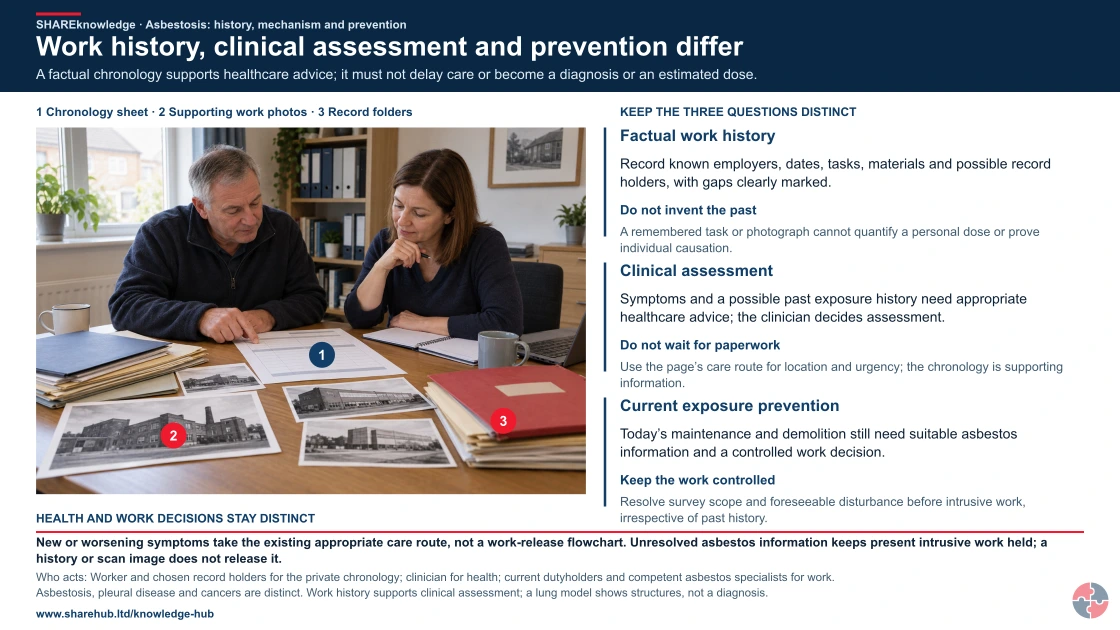
Full written explanation
An illustrative private work-history records desk shows two plainclothes adults, a blank chronology sheet, generic exterior-building photographs and inert archive folders. One literal numbered key identifies the chronology sheet, supporting work photos and record folders. There is no clinician, symptom demonstration, clinical equipment, lung model or test. Age, job title, building photograph and paper do not establish exposure, dose, causation, diagnosis, prognosis, entitlement or individual capability. Three questions remain parallel: record factual employers, dates, tasks, materials, record holders and gaps; seek appropriate clinical assessment independently of the chronology; and prevent current exposure through suitable asbestos information and a controlled work decision. Matched boundaries are to avoid inventing the past, never wait for paperwork before care, and keep present work controlled irrespective of past history. The records are inert illustrative props, not actual private employment or health files. The support conversation is not employer screening, medical assessment or work release. Available history may support healthcare advice; missing records, a meeting, employer review or a model must not delay the existing appropriate care route. HEALTH AND WORK DECISIONS STAY DISTINCT: New or worsening symptoms take the existing appropriate care route, not a work-release flowchart. Unresolved asbestos information keeps present intrusive work held; a history or scan image does not release it. Who acts: Worker and chosen record holders for the private chronology; clinician for health; current dutyholders and competent asbestos specialists for work. DIFFERENT PEOPLE · DIFFERENT EVIDENCE. Former facilities worker: Bring a factual history to the healthcare discussion; do not infer a dose, diagnosis or benefit entitlement. Demolition planning office: Use historical lessons to strengthen present survey and work information; do not use a former worker’s diagnosis as the task assessment.
A factual chronology supports healthcare advice; it must not delay care or become a diagnosis or an estimated dose.
- Factual work history. Record known employers, dates, tasks, materials and possible record holders, with gaps clearly marked.
- Clinical assessment. Symptoms and a possible past exposure history need appropriate healthcare advice; the clinician decides assessment.
- Current exposure prevention. Today’s maintenance and demolition still need suitable asbestos information and a controlled work decision.
Change the pathway
- Do not invent the past. A remembered task or photograph cannot quantify a personal dose or prove individual causation.
- Do not wait for paperwork. Use the page’s care route for location and urgency; the chronology is supporting information.
- Keep the work controlled. Resolve survey scope and foreseeable disturbance before intrusive work, irrespective of past history.
Evidence check: Asbestosis, pleural disease and cancers are distinct. Work history supports clinical assessment; a lung model shows structures, not a diagnosis.
Existing respiratory learning model and its current explanation
Primary references: NHS: asbestosis · UKHSA: asbestos toxicological overview
Open the complete HD image (new tab)Download image

Existing respiratory learning model and its current explanation
Primary references: NHS: asbestosis · UKHSA: asbestos toxicological overview
Record dates, jobs, materials and where reliable records may exist; label uncertainty rather than invent an exposure estimate. Employer prevention and record retention are separate from clinical assessment and optional benefit/support routes. Keep the worker history in their chosen private destination.
A retired worker reconstructs old maintenance tasks
Illustrative example. A former maintainer remembers work around old insulation but has incomplete employer records.
Decision. Prepare a factual chronology for the clinical appointment and identify possible record holders.
Evidence to check. Include known employers, places, dates, tasks, material descriptions and records, with uncertainty clearly marked.
Hold or escalation point. Do not calculate a dose from recollection or promise that the history proves a disease or award.
Follow-up. The worker can update the private chronology as records are located; clinicians decide the assessment.
Who should act on an asbestosis concern?
The person chooses medical care; the employer prevents further exposure and preserves work facts; occupational health advises on work fitness and adjustments without sharing unnecessary clinical detail.
| Role | Action | Boundary and evidence |
|---|---|---|
| Worker or former worker | Tell a GP about symptoms and a dated work or exposure history; seek urgent help for red flags. | Keep a personal timeline; do not self-diagnose from symptoms or an old scan. |
| Supervisor | Stop suspect disturbance, protect others, report facts and arrange safe work reassessment. | Do not clean suspect debris or decide if someone has asbestosis. |
| Employer or dutyholder | Identify or presume ACMs, control work, investigate incidents and retain applicable worker health and exposure records. | Work order, survey, incident facts and restricted-access records. |
| Occupational health and HR | Seek consent-based work advice; discuss individual capability, adjustments and review with the person. | Give managers functional advice, not entire medical records. |
| GP and respiratory team | Assess symptoms, differential diagnosis, tests, treatment and referrals. | Medical decisions remain clinical and confidential. |
| Safety, legal and benefits adviser | Check GB or NI regulator and benefit route; support evidence retrieval and rights advice. | No automatic reportability, entitlement or liability conclusion. |
What must not be inferred from symptoms or exposure?
Breathlessness, a chest image or past asbestos work does not by itself prove asbestosis, prognosis, workplace causation or benefit eligibility.
Asbestosis may coexist with other lung or pleural conditions, and similar symptoms can have many causes. The treating clinician considers a detailed exposure history, examination and appropriate tests. No screening scan or routine X-ray should be arranged by a manager after a one-off suspected exposure; HSE says an X-ray cannot tell whether fibres were inhaled and does not advocate routine X-rays for inadvertent exposure. Record the incident, consult a GP if concerned and follow competent workplace investigation.
Keep health information confidential. Occupational health may advise on fitness and restrictions without giving a line manager the full diagnosis or medical record. Discuss work support with the person; neither symptoms nor diagnosis alone justify an automatic employment decision. Benefits and compensation depend on scheme and individual evidence, not this page.
What are the key facts about asbestosis?
The key fact is that asbestosis is preventable, irreversible and often only becomes visible decades after asbestos exposure.
Long latency
Symptoms may not appear until many years after exposure, so absence of symptoms after a job does not prove the exposure was harmless.
Cumulative exposure matters
Heavy historical exposure is strongly associated with asbestosis, but repeated smaller exposures are still unacceptable because fibre dose accumulates.
It is not cancer
Asbestosis is lung scarring, but asbestos exposure also increases risk of mesothelioma and asbestos-related lung cancer.
Symptoms need medical assessment
Breathlessness, persistent cough, wheeze, fatigue, chest or shoulder discomfort and finger clubbing should not be assessed casually by the workplace.
Prevention is the control strategy
Because scarring cannot be reversed, the workplace answer is to prevent inhalation of asbestos fibres in the first place.
Records can matter decades later
Exposure history, health records, medical surveillance and work records may become important long after the original work.
What is asbestosis?
Asbestosis is non-cancerous scarring of lung tissue after inhalation of asbestos fibres, normally following heavy exposure over many years.
It is a form of pneumoconiosis and interstitial lung disease: persistent fibres can trigger inflammation and fibrosis, making lung tissue less flexible. NHS guidance says symptoms can emerge 20 to 30 years after exposure, but the interval varies and some people have no symptoms. HSE says asbestosis normally follows heavy exposure over many years; a brief exposure is not evidence that a person has developed asbestosis, though every avoidable fibre release still needs control and recording.
Clinicians may use work history, imaging and lung-function tests to assess possible disease and consider other causes of scarring. Established damage cannot be reversed, but clinical care can support symptoms and function. No individual outcome can be predicted from exposure history alone.
How is asbestosis different from other asbestos-related disease?
Asbestosis scars the lung tissue; pleural disease affects the lung lining; mesothelioma and lung cancer are cancers. One exposure history can be relevant to more than one condition, but each needs its own diagnosis.
Asbestos-related conditions are not interchangeable


Read this visual as text
- ASBESTOSIS: Diffuse lung scarring associated with asbestos exposure; it is not another name for every asbestos-related condition.
- PLEURAL CHANGES: Changes affecting the lining around the lung are different from diffuse scarring within the lung.
- CANCERS: Mesothelioma and lung cancer are distinct conditions with their own clinical assessment and treatment routes.
| Condition | What it affects | Do not infer |
|---|---|---|
| Asbestosis | Diffuse scarring of the lung tissue, usually after substantial cumulative exposure. | A scan mention of fibrosis is not, alone, an asbestosis diagnosis. |
| Pleural plaques or diffuse pleural thickening | The pleura, or lung lining; diffuse thickening can restrict expansion. | Plaques are not the same as lung fibrosis or proof of future cancer. |
| Mesothelioma | A cancer usually of the pleural lining, sometimes another mesothelial lining. | Breathlessness or chest pain is not a cancer diagnosis. |
| Lung cancer | A malignant lung tumour with several possible risk factors, including asbestos and smoking. | A smoking history does not rule out occupational contribution or determine causation. |
Read the lung model as an explanation, not a diagnosis
Asbestosis involves scarring in lung tissue. Pleural conditions affect the lung lining; mesothelioma and lung cancer are separate diseases. The asbestos example below uses an explicit jump in time, because a short animation cannot represent the years over which disease may develop.
The model cannot confirm asbestos in a material, estimate an individual's exposure or decide whether symptoms are asbestosis. Continue to the clinical assessment section for the distinction between a work history, tests and diagnosis.
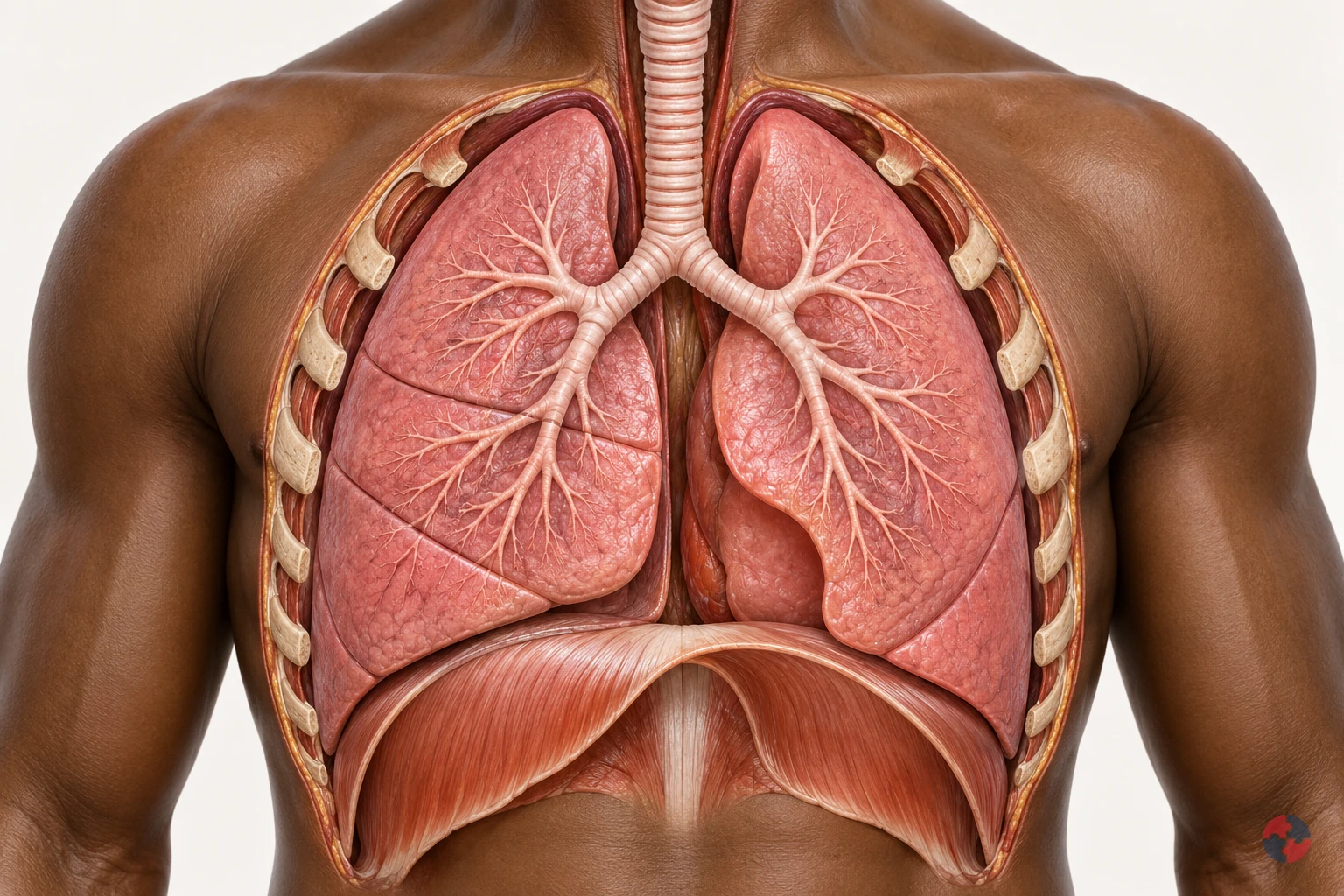

How do the lungs work, and how can workplace exposures affect breathing?
Interactive anatomy · Respiratory tract and lungs · Updated 2026-10-23
Read all anatomy and process explanations without the viewer
Simplified education, not diagnosis, a lung-function or oxygen-saturation test, an exposure calculator or a fitness-to-work assessment. No breath-holding challenge, breathing-rate score or personal health-data collection. Ordinary particle filters do not protect against every gas or oxygen deficiency. COPD and coal-dust topics may reuse normal anatomy only until separate mechanisms are reviewed.
Nose and mouth
Air enters and leaves here. The nose and mouth connect the outside air with the respiratory passages. Air moves through these openings on both the inward and outward breath. Follow the route towards the windpipe before looking at the smaller branches. The illustrated flow is air, a mixture of gases, rather than pure oxygen passing directly into blood. Frimley Health NHS Foundation Trust: How your lungs work · Central and North West London NHS Foundation Trust: How do we breathe?
Trachea
The windpipe carries air into the chest. The trachea, commonly called the windpipe, carries air down towards the chest. It divides into the two main bronchi that supply the lungs. Locate this shared passage before following either branch. Its role is to conduct air towards the gas-exchange regions and provide an outward route for the next exhalation. Frimley Health NHS Foundation Trust: How your lungs work
Bronchi
A main branch carries air into each lung. The two main bronchi take air from the windpipe into the right and left lungs. They divide into progressively smaller branches, distributing the breath through the lungs. Use the split as a landmark before following one highlighted route. These are air passages, distinct from the blood vessels that run through the same organs. Frimley Health NHS Foundation Trust: How your lungs work · University Hospitals of North Midlands NHS Trust: My lung surgery: about your lungs
Bronchioles
Smaller branches distribute air. Bronchioles are smaller branches of the airway system inside the lungs. Their branching routes lead towards clusters of alveoli, where the breath reaches the gas-exchange surface. Follow one branch to its end, using the others as context. This simplified route represents part of a much larger network supplying the lungs together. Frimley Health NHS Foundation Trust: How your lungs work
Alveoli
Tiny air sacs provide a gas-exchange surface. Alveoli are tiny air sacs at the ends of the small airway routes. Their close relationship with surrounding capillaries allows oxygen to pass towards blood and carbon dioxide towards alveolar air. Connect the highlighted cluster with the enlarged gas-exchange view. The enlargement changes the scale so the air space and neighbouring blood vessel can be distinguished. Frimley Health NHS Foundation Trust: How your lungs work · Central and North West London NHS Foundation Trust: How do we breathe?
Air–blood barrier
A thin boundary separates air from blood. The thin alveolar and capillary walls separate air in the sac from blood in its neighbouring vessel. Oxygen and carbon dioxide cross this boundary in opposite directions. Locate the tissue between the two spaces in the enlarged view. Blood cells remain in the vessel; the model does not represent an open connection through which air and blood mix. Central and North West London NHS Foundation Trust: How do we breathe?
Pulmonary capillaries
Small blood vessels pass beside the air sacs. Pulmonary capillaries are small blood vessels beside the alveoli. Blood moving through them receives oxygen and releases carbon dioxide across the thin exchange boundary, then continues through the circulation. Follow the labelled gas routes separately from the blood cells. These cells stay inside the capillary rather than moving into the air sac. Central and North West London NHS Foundation Trust: How do we breathe?
Diaphragm
This muscle helps make room for a breath. The diaphragm is a broad, dome-shaped breathing muscle beneath the lungs. It contracts and flattens downwards during inhalation, helping increase the space in the chest. During a quiet exhalation it relaxes towards its dome shape. Compare it with the rib cage: their changing positions help move air without the lung tissue acting as a contracting muscle. Cambridge University Hospitals NHS Foundation Trust: Breathing techniques to ease breathlessness: muscles involved
Rib cage and breathing muscles
Chest movement changes the space around the lungs. The rib cage protects the chest organs and moves with the breathing muscles. Expansion upwards and outwards helps increase chest space during inhalation; relaxation reduces that space during a quiet exhalation. Compare this movement with the diaphragm below the lungs. Together these structures provide the mechanics that allow air to move through the airways. Central and North West London NHS Foundation Trust: How do we breathe? · Cambridge University Hospitals NHS Foundation Trust: Breathing techniques to ease breathlessness: muscles involved
Pleura
Two thin layers surround the lungs and line the chest. The pleura has two thin layers around the lungs and inside the chest wall. A small amount of fluid between them allows the surfaces to slide with less friction as breathing changes the chest space. Locate this outer covering separately from the internal air sacs; it is not the thin air–blood exchange boundary. Blackpool Teaching Hospitals NHS Foundation Trust: Pleural clinic
Open the complete process transcript
The process, step by step
1 · Make space
Breathing in begins with a change in the space inside the chest. The diaphragm, a dome-shaped muscle beneath the lungs, contracts and moves downwards. Muscles around the ribs help lift the chest upwards and outwards. As the lungs expand with this changing space, air can enter through the airways. Locate the diaphragm and rib cage together rather than treating the lungs as muscles that pull themselves open. The model separates the movement into a teaching step so you can follow its purpose. In the body, chest movement, airflow and blood circulation are connected parts of a continuing process. Central and North West London NHS Foundation Trust: How do we breathe? · Cambridge University Hospitals NHS Foundation Trust: Breathing techniques to ease breathlessness: muscles involved
What to watch: Locate the diaphragm beneath the lungs and the rib cage around them; compare their positions with the space occupied by the lungs.
Why it matters: Changing the chest space draws air into the lung passages. The breathing muscles supply the movement, while the lungs expand with the chest to receive the next breath.
Explore this step: Select the diaphragm and rib cage in turn, then explain how their movement helps air enter without the lungs contracting like muscles.
2 · Move air
Air entering through the nose or mouth travels down the trachea, or windpipe, towards the chest. The trachea divides into the two main bronchi, with one route supplying each lung. Follow this continuous passage in the whole-chest view before moving into the smaller branches. The moving air is a mixture of gases, including oxygen; it is not a stream of pure oxygen travelling straight into the blood. These larger airways carry the breath towards the places where gas exchange happens. The same connected passages also provide the outward route when air is breathed out. Frimley Health NHS Foundation Trust: How your lungs work
What to watch: Start at the nose and mouth, follow the trachea downwards and find the split into the right and left main bronchi.
Why it matters: The larger passages distribute air to both lungs and connect the outside air with the smaller branches inside. Gas exchange takes place further along the route, rather than within the windpipe.
Explore this step: Trace the route to each lung and distinguish the tubes carrying air from the separate vessels carrying blood.
3 · Reach the air sacs
Inside each lung, the bronchi divide into smaller branches called bronchioles. These passages distribute air towards clusters of tiny air sacs, the alveoli. Follow one branch in the close-up and connect its end with an air-sac cluster, using the other branches as surrounding context. These routes distribute the breath throughout the lungs rather than supplying only one working air sac. A real lung contains many branching routes and air sacs operating together. This distribution brings air close to a large network of small blood vessels, preparing for the exchange shown in the next view. Frimley Health NHS Foundation Trust: How your lungs work
What to watch: Follow one smaller airway to the cluster of air sacs at its end, keeping the other branches as surrounding context.
Why it matters: Branching delivers air throughout the lungs instead of to one large chamber. The many air sacs bring the inhaled gases close to blood vessels where oxygen and carbon dioxide can cross.
Explore this step: Trace one complete branch to its air sacs, then explain how the many branches distribute air throughout the lungs.
4 · Change scale
The lesson now changes from a branching airway to an enlarged air–blood interface. An alveolus contains air; beside it runs a capillary containing blood. Their very thin walls form the boundary across which gases can move. Locate the air space, the separating tissue and the inside of the vessel before following any gas symbols. The magnified view represents a tiny part of the same lung, not a separate organ or a hole that joins air and blood into one space. The enlargement helps explain how the two systems can exchange gases while keeping their contents separate. Central and North West London NHS Foundation Trust: How do we breathe?
What to watch: Find the air inside the enlarged alveolus, the thin separating boundary and the neighbouring capillary with blood cells inside it.
Why it matters: A close boundary allows gases to cross between alveolar air and capillary blood. Keeping the two spaces separate lets ventilation and circulation cooperate without blood cells entering the air sac.
Explore this step: Identify the air space and blood-vessel space, then point to the boundary each gas must cross between them.
5 · Exchange gases
At the air–blood boundary, oxygen moves from the alveolar air into the capillary blood. At the same time, carbon dioxide carried back from the body moves from the blood into the air sac. The two gases cross in opposite directions; blood cells stay within the vessel. Follow each labelled symbol separately so that exchanging gases is not confused with mixing the air and blood together. Blood then carries oxygen onwards towards the heart and the body’s tissues. The teaching symbols simplify continuous gas movement, and their size, colour and speed do not represent a measurement. Central and North West London NHS Foundation Trust: How do we breathe?
What to watch: Follow the O₂ symbol towards the capillary and the CO₂ symbol towards the air sac, while locating the blood cells within the vessel.
Why it matters: Oxygen can be carried onwards for use by the body, while carbon dioxide returns to the airways for removal. Both transfers connect the breath with the continuing circulation of blood.
Explore this step: Trace the two gas routes in opposite directions and explain why a blood cell should remain inside the capillary.
6 · Breathe out
During a quiet breath out, the diaphragm and other breathing muscles relax. The diaphragm returns towards its dome shape, chest space decreases and air moves back along the airways to the nose or mouth. This outgoing air carries carbon dioxide that crossed from the blood into the alveoli. Trace the route in reverse without reversing the direction of blood circulation: oxygen-carrying blood continues towards the heart while another breath prepares to enter. The model presents a single cycle to explain the relationship. It does not show breathing as a series of separate events in which circulation stops between steps. Central and North West London NHS Foundation Trust: How do we breathe? · Cambridge University Hospitals NHS Foundation Trust: Breathing techniques to ease breathlessness: muscles involved
What to watch: Compare the diaphragm and chest with the inhalation step, then follow the outward airway route from the lungs to the nose or mouth.
Why it matters: Exhalation removes air containing carbon dioxide from gas exchange. Meanwhile, blood circulation continues carrying oxygen onwards, linking this breathing cycle with the needs of the rest of the body.
Explore this step: Trace the outward air route and the onward blood route separately, then describe why they are connected processes with different pathways.
Mechanisms and their limits
Asbestos fibres: inhalation, retention and scarring Microscopic asbestos fibres can be breathed deep into the lungs. Some reach the tiny air sacs and remain in or around their walls because they are difficult to clear. Persistent inflammation can lead to asbestosis: stiff scar tissue that makes breathing and gas exchange harder, usually after substantial exposure over many years. Fibres are enlarged and coloured gold here; they are not visible at this size in real air. Retention is not caused by literal hooks or barbs. Mesothelioma is a separate cancer, not a stage of asbestosis. Do not show one exposure causing immediate fibrosis or cancer. The sequence is illustrative and timing varies. The illustration cannot establish whether material contains asbestos or whether a person has an asbestos-related disease. The cutaway shows air-sac lining and nearby lung tissue, not a hollow lung with one internal wall. Some fibres are cleared; others persist. Split ends are illustrative fibrils, not hooks or barbs. The cutaway shows air-sac lining and nearby lung tissue, not a hollow lung with one internal wall. Some fibres are cleared; others persist. Split ends are illustrative fibrils, not hooks or barbs. The cutaway shows air-sac lining and nearby lung tissue, not a hollow lung with one internal wall. Some fibres are cleared; others persist. Split ends are illustrative fibrils, not hooks or barbs. The cutaway shows air-sac lining and nearby lung tissue, not a hollow lung with one internal wall. Some fibres are cleared; others persist. Split ends are illustrative fibrils, not hooks or barbs. The cutaway shows air-sac lining and nearby lung tissue, not a hollow lung with one internal wall. Some fibres are cleared; others persist. Split ends are illustrative fibrils, not hooks or barbs. The cutaway shows air-sac lining and nearby lung tissue, not a hollow lung with one internal wall. Some fibres are cleared; others persist. Split ends are illustrative fibrils, not hooks or barbs. The cutaway shows air-sac lining and nearby lung tissue, not a hollow lung with one internal wall. Some fibres are cleared; others persist. Split ends are illustrative fibrils, not hooks or barbs. The cutaway shows air-sac lining and nearby lung tissue, not a hollow lung with one internal wall. Some fibres are cleared; others persist. Split ends are illustrative fibrils, not hooks or barbs. The cutaway shows air-sac lining and nearby lung tissue, not a hollow lung with one internal wall. Some fibres are cleared; others persist. Split ends are illustrative fibrils, not hooks or barbs. HSE: Why is asbestos dangerous? · UK Health Security Agency: Asbestos: toxicological overview
Understand the separate asbestos diseases
Asbestos fibres: inhalation, retention and scarring — follow the anatomy
Look at: Follow the gold fibres into the lungs, then inspect the enlarged wall of one air sac in the tissue-effect stage.
What changes: Some long, durable fibres are retained. Clearance cells can struggle to engulf and remove them; this is not a hook-and-barb attachment.
Why it matters: Persistent inflammation can produce stiff scar tissue over many years, making the lungs less flexible and gas exchange harder. This is asbestosis, separate from mesothelioma.
What to do: Choose Exposure to follow entry, then Tissue effect for the cutaway. In the 3D view, the two fibre buttons open these same stages. Pause and read the explanation.
From inhaled fibres to possible later lung scarring
A worker pulls down an older ceiling or roof-lining panel and dust falls beside their face. This shows an uncontrolled disturbance to avoid, not a safe removal method. Explicit time jump: asbestos-related disease can emerge many years after exposure. Asbestosis is a later scarring example, not a seconds-long transformation. Asbestosis, pleural disease and mesothelioma are different conditions. The visible dust is an illustrative cue, not a way to identify asbestos or judge whether air is safe. This example does not predict illness after one disturbance.
Pulling down a ceiling panel The worker pulls an overhead panel away from its frame and dust falls into the work area. This is a hazardous example, not a removal method. Check the asbestos information before disturbance; stop if the material or work arrangements are unclear. Health and Safety Executive: Asbestos essentials
Follow fibres from the airways to the air sacs Follow the enlarged gold fibres through the trachea and smaller airways. Some inhaled fibres reach the tiny air sacs, where clearance is slower. The gold colour, number and size help you follow the route; they do not represent a measured exposure. HSE: Why is asbestos dangerous? · Health and Safety Executive: Asbestos essentials · UK Health Security Agency: Asbestos: toxicological overview
Cutaway: fibres retained in lung tissue The view now magnifies an air-sac wall. Gold fibres lie in or cross the lining into nearby tissue. The blue-grey clearance cell tries to engulf a long fibre but cannot always remove it. Persistent irritation and inflammation can lead to the thickened, scarred tissue shown here. This is an explicit time jump over years, not immediate damage from one breath. HSE: Why is asbestos dangerous? · UK Health Security Agency: Asbestos: toxicological overview
Prevent further disturbance Prevent further exposure: stop disturbance and use competent asbestos-management arrangements. Some fibres can persist after exposure stops; the model does not show them falling out or the scar instantly healing. Asbestosis, pleural disease and mesothelioma are different conditions. Seek appropriate advice about exposure concerns. Health and Safety Executive: Asbestos essentials · HSE: Why is asbestos dangerous? · UK Health Security Agency: Asbestos: toxicological overview
Read the practice situations and all answer explanations
LU-Q1: Which plan best addresses the hazard?
A team plans repeated concrete cuts with a handheld cut-off saw. Dust can enter the operator’s and nearby workers’ breathing zones.
Open a window and use the same dry-cutting method. — A window alone does not control dust generated beside the face. Choose task controls that prevent or capture it at source.
First reduce the need to cut, then assess source suppression or extraction and any required suitable RPE. — This addresses the task before exposure occurs. Check that suppression or extraction works and that required RPE is suitable, fitted and used.
Continue while nobody is coughing. — Symptoms are not an exposure monitor. Harmful respirable dust may be invisible, and a worker can feel well during exposure.
HSE: Construction dust: cutting paving blocks, kerbs and flagsLU-Q2: What is the most useful next action?
A bakery worker notices repeated wheeze after dusty flour tasks, including some symptoms later in the evening.
Report the pattern and seek medical and workplace assessment. — Reporting the pattern allows exposure controls and clinical assessment to be reviewed. Symptoms can be delayed; a clinician may need further investigation.
Use this model to diagnose occupational asthma. — The model explains a mechanism. It cannot diagnose asthma or establish that work caused it.
Assume the task is safe if breathing improves away from work. — Improvement away from work may be useful information for investigation, but it does not show that returning to the same exposure is safe.
HSE: Asthma: an overview · HSE: Advice for employers: occupational asthma · NHS: Asthma · HSE: Flour dust and risks to bakersLU-Q3: What is the important distinction?
One diagram shows a narrowed airway at LUN03–04. A second shows scarred gas-exchange tissue around LUN05–07.
They show the same disease at successive stages. — Narrowed airways and scarred lung tissue are different changes. One is not automatically the next stage of the other.
Both effects disappear when airborne dust settles. — Removing airborne dust does not reverse established fibrosis. Controlling further exposure remains important.
Airway narrowing and tissue fibrosis are different mechanisms. — Correct. Airway narrowing affects the passage for air; fibrosis affects lung tissue and its function. Neither picture supplies an individual diagnosis.
NHS: Silicosis · NHS: AsthmaSources and how the model is made
The opening images are AI-generated anatomical illustrations. The interactive 3D models and labelled SVG diagrams use original procedural artwork. These teaching images are not medical scans or diagnostic tools. Source references support the learner explanations and do not grant artwork rights.
- Frimley Health NHS Foundation Trust: How your lungs work — Normal airway branching, air sacs and capillary gas exchange; factual text only.
- Central and North West London NHS Foundation Trust: How do we breathe? — Thin alveolar/capillary walls, opposing gas transfer, circulation and chest mechanics. No illustrations or exercises copied.
- Cambridge University Hospitals NHS Foundation Trust: Breathing techniques to ease breathlessness: muscles involved — Diaphragm movement and breathing-muscle context only; this module does not prescribe breathing exercises.
- HSE: Health risks from welding — Welding-related airway irritation, possible deeper injury and irritant asthma; not a universal pattern for every gas.
- HSE: Asthma: an overview — Sensitisation, later triggering and work aggravation. Legacy labelling language and statistics are not reused.
- HSE: Advice for employers: occupational asthma — Exposure prevention, controls and health surveillance only; legacy legislation wording is not reused.
- NHS: Silicosis — Silica-associated inflammation/fibrosis, varying latency, irreversible damage and possible progression after exposure stops.
- HSE: Why is asbestos dangerous? — Asbestosis, mesothelioma and pleural disease are distinct; long disease latency.
- HSE: Construction dust: cutting paving blocks, kerbs and flags — Task design, source suppression/extraction, suitable RPE and checking controls; not a generic dust safe-dose rule.
- NHS: Shortness of breath — Emergency recognition of severe breathing difficulty and 999; emergency advice is outside the activity.
- NHS: Asthma — Narrowed/swollen airways, symptoms and clinical diagnosis; no medication doses or treatment plan reproduced.
- University Hospitals of North Midlands NHS Trust: My lung surgery: about your lungs — Right/left lung lobe counts and airway anatomy; no source image copied.
- Blackpool Teaching Hospitals NHS Foundation Trust: Pleural clinic — Pleural layers and the small lubricating fluid layer outside lung tissue; no procedural teaching included.
- HSE: Asphyxiation hazards in welding and allied processes — Oxygen-deficient spaces and need for independent air supply; no unprotected entry or rescue.
- HSE: Respiratory protective equipment at work — RPE selection must match the contaminant and conditions; filtering protection is not a supply of oxygen.
- HSE: Flour dust and risks to bakers — Flour sensitisation and practical reduction of dusty handling; exposure-limit numbers are not reused.
- Health and Safety Executive: Asbestos essentials — Task planning, training and competent asbestos work arrangements for the maintenance exposure example; not permission to disturb unknown material or a licence/classification decision.
- Health and Safety Executive: Welding fume: protect your workers — Alternative joining, fume reduction, LEV, suitable RPE and maintained controls for the welding-fume example. No unprotected exposure or rescue procedure.
- UK Health Security Agency: Asbestos: toxicological overview — Deep-lung fibre retention, slow clearance, persistent inflammation and fibrosis; illustrative geometry is not a clinical model.
What health effects are linked to asbestos exposure?
Asbestos exposure can cause asbestosis, pleural thickening, mesothelioma and asbestos-related lung cancer.
Asbestosis is one part of the asbestos-related disease picture. A person with relevant asbestos exposure may also be at risk of pleural thickening, mesothelioma and asbestos-related lung cancer. This is why an exposure event should be taken seriously even if the immediate task seemed minor.
Smoking is especially important in worker advice because it increases the risk of lung cancer in people exposed to asbestos. The workplace should not use this to blame the individual; it should use it to signpost smoking cessation support and reinforce prevention of asbestos exposure.
The practical workplace lesson is that asbestos-related disease is largely a failure of exposure prevention. The correct control question is not whether one specific exposure will definitely cause disease; it is whether the organisation did everything reasonably practicable to prevent fibre inhalation and record what happened.
| Condition | What it affects | Workplace learning point |
|---|---|---|
| Asbestosis | Lung tissue, causing scarring and stiffness. | Usually linked with heavier exposure; prevention must focus on avoiding fibre inhalation. |
| Diffuse pleural thickening | Pleura, the lining around the lungs. | Can restrict lung expansion and cause breathlessness or chest discomfort. |
| Pleural plaques | Localised pleural changes often found incidentally. | May indicate previous exposure, though not the same as asbestosis. |
| Mesothelioma | Lining of the lungs or abdomen. | Strongly associated with asbestos exposure and often fatal. |
| Asbestos-related lung cancer | Lung tissue malignancy. | Risk is increased by asbestos exposure and is higher where smoking is also present. |
What causes asbestosis at work?
Asbestosis is caused by inhaling asbestos fibres released when asbestos-containing materials are disturbed, damaged or worked on without adequate control.
Historically, the highest exposures occurred in industries and trades that handled asbestos insulation, sprayed coatings, pipe lagging, boilers, ships, asbestos products, fire protection and demolition debris. Many people diagnosed today were exposed decades ago, before current controls were in place.
Modern exposure risk is different but still real. It often arises during refurbishment, maintenance, demolition, installation, surveying, repair or emergency work in older buildings. A worker may drill asbestos insulating board, cut a panel, disturb lagging, lift old flooring, clean debris or open a concealed void without knowing asbestos is present.
Asbestosis is associated with cumulative dose. A single low-level exposure does not automatically mean a person will develop disease, but repeated uncontrolled exposures are preventable and unacceptable. Workplaces should avoid minimising incidents because the worker feels fine at the time.
| Exposure scenario | How fibres are inhaled | Prevention focus |
|---|---|---|
| Insulation and lagging work | Friable insulation releases fibres when cut, stripped, repaired or removed. | Licensed contractor decisions, enclosure, decontamination, air monitoring and clearance. |
| Construction and refurbishment | Hidden asbestos is disturbed during drilling, demolition, strip-out, service installation or structural work. | Correct survey type, register checks, CDM planning and stop-work triggers. |
| Routine maintenance | Small jobs disturb asbestos in ceiling voids, risers, plant rooms, fire doors, panels, gaskets or flooring. | Asbestos awareness, work-order screening and task-specific controls. |
| Damaged building fabric | Deteriorated boards, lagging, coatings or debris release fibres during occupancy or cleaning. | Condition monitoring, access restriction, repair, encapsulation or removal. |
| Poor cleaning | Sweeping, brushing, dry wiping or ordinary vacuuming re-suspends settled asbestos fibres. | Asbestos-suitable cleaning methods and competent advice. |
| Waste and contaminated tools | Fibres spread from bags, clothing, tools, vehicles or equipment. | Waste controls, decontamination and exposure-record decisions. |
How does asbestos fibre exposure damage the lungs?
Inhaled fibres can lodge deep in the lungs and trigger inflammation, scarring and reduced gas transfer over time.
Trace the mechanism without diagnosing from a history
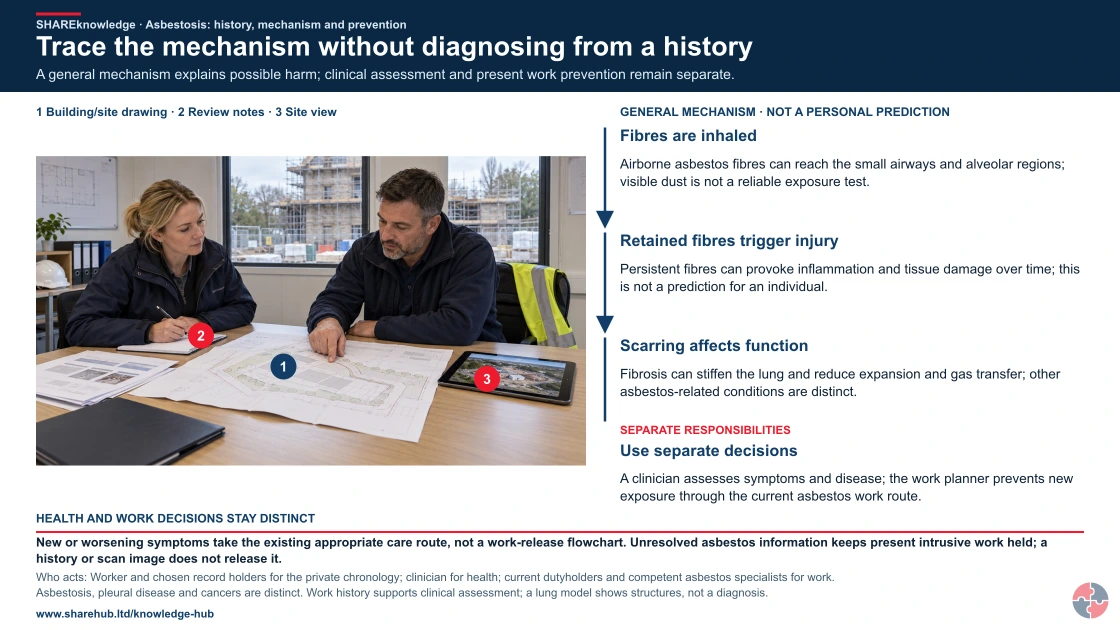
Full written explanation
An illustrative construction planning office shows normal staff reviewing building/site drawings, inert notes and a tablet site view. One literal picture key identifies the building/site drawing, review notes and site view. No asbestos task, biological mechanism, symptom, examination, scan or clinical test is pictured. The office scene supports a present work-information discussion; it does not establish that demolition is authorised, material is asbestos, a survey is suitable or a control has passed. The general source-attributed mechanism is explained in text: fibres may be inhaled into small airways and alveolar regions; retained fibres may provoke inflammation and tissue damage over time; fibrosis can stiffen the lung and reduce expansion and gas transfer. The statements describe a general mechanism, not a prediction or diagnosis for an individual, and other asbestos-related conditions remain distinct. Only those three general statements have causal arrows. The fourth statement is visibly separate: the clinician assesses symptoms and disease, while the work planner prevents new exposure through the current asbestos work route. No arrow makes a diagnosis or work permission follow from the general mechanism. Existing healthcare action does not depend on a completed work pack, employer review or historical record. HEALTH AND WORK DECISIONS STAY DISTINCT: New or worsening symptoms take the existing appropriate care route, not a work-release flowchart. Unresolved asbestos information keeps present intrusive work held; a history or scan image does not release it. Who acts: Worker and chosen record holders for the private chronology; clinician for health; current dutyholders and competent asbestos specialists for work. DIFFERENT PEOPLE · DIFFERENT EVIDENCE. Former facilities worker: Bring a factual history to the healthcare discussion; do not infer a dose, diagnosis or benefit entitlement. Demolition planning office: Use historical lessons to strengthen present survey and work information; do not use a former worker’s diagnosis as the task assessment.
A general mechanism explains possible harm; clinical assessment and present work prevention remain separate.
- Fibres are inhaled. Airborne asbestos fibres can reach the small airways and alveolar regions; visible dust is not a reliable exposure test.
- Retained fibres trigger injury. Persistent fibres can provoke inflammation and tissue damage over time; this is not a prediction for an individual.
- Scarring affects function. Fibrosis can stiffen the lung and reduce expansion and gas transfer; other asbestos-related conditions are distinct.
- Use separate decisions. A clinician assesses symptoms and disease; the work planner prevents new exposure through the current asbestos work route.
When the evidence does not fit: New or worsening symptoms take the existing appropriate care route, not a work-release flowchart. Unresolved asbestos information keeps present intrusive work held; a history or scan image does not release it.
Who acts: Worker and chosen record holders for the private chronology; clinician for health; current dutyholders and competent asbestos specialists for work.
Changed workplace
Former facilities worker: Bring a factual history to the healthcare discussion; do not infer a dose, diagnosis or benefit entitlement.
Demolition planning office: Use historical lessons to strengthen present survey and work information; do not use a former worker’s diagnosis as the task assessment.
Evidence check: Asbestosis, pleural disease and cancers are distinct. Work history supports clinical assessment; a lung model shows structures, not a diagnosis.
Existing respiratory learning model and its current explanation
Primary references: NHS: asbestosis · UKHSA: asbestos toxicological overview
Open the complete HD image (new tab)Download image

Existing respiratory learning model and its current explanation
Primary references: NHS: asbestosis · UKHSA: asbestos toxicological overview
The respiratory system is built to clear many particles, but asbestos fibres can be thin, durable and persistent. Some fibres reach the small airways and alveolar regions where oxygen normally transfers into the blood. The body's attempt to respond to retained fibres can cause chronic inflammation and tissue damage.
Over time, fibrotic scarring makes the lungs less elastic. A stiff lung requires more effort to breathe and becomes less effective at transferring oxygen. This is why breathlessness often appears first during exertion, then may progress to ordinary daily tasks.
The pleura can also be affected. Diffuse pleural thickening can restrict lung expansion from the outside, adding to breathlessness or chest discomfort. A person may therefore have more than one asbestos-related process contributing to their symptoms.
| Mechanism stage | What happens | Why it matters |
|---|---|---|
| Fibre inhalation | Airborne asbestos fibres are breathed into the respiratory tract. | Exposure control must stop fibres entering the breathing zone. |
| Deep lung deposition | Some fibres reach small airways and alveolar regions. | Invisible airborne fibres can create serious risk even without obvious dust clouds. |
| Inflammation | The body reacts to retained fibres. | Repeated exposure can sustain tissue injury over time. |
| Fibrosis | Scar tissue develops and lung tissue becomes stiffer. | Reduced lung expansion and gas transfer drive breathlessness. |
| Functional decline | Exercise tolerance and respiratory reserve reduce. | Work capability, daily life and emergency resilience may be affected. |
| Associated disease risk | Exposure also links to pleural disease, mesothelioma and lung cancer. | Health surveillance and signposting should consider the wider exposure history. |
Which symptoms need medical attention?
Persistent breathlessness or cough after possible asbestos exposure warrants GP assessment. A few blood spots or streaks need urgent clinical advice; more than a few, or blood with breathing difficulty, a very fast heartbeat or chest or upper-back pain, needs 999 or A&E immediately.
NHS pages list shortness of breath, persistent cough, wheeze, fatigue, chest or shoulder pain and sometimes clubbed fingertips. These are not specific to asbestosis. Tell the clinician when and where asbestos exposure may have occurred, including older jobs and any documented incidents. Do not wait for an occupational-health appointment if new or worsening symptoms need medical assessment.
| Situation | Action | Why |
|---|---|---|
| Severe difficulty breathing, heavy or persistent chest pain, colour change or sudden confusion | Call 999 or use emergency care; do not drive yourself to A&E. | These can signal an acute emergency unrelated to asbestosis. |
| Coughing up more than a few blood spots or streaks, or any blood with difficulty breathing, a very fast heartbeat, or chest or upper-back pain | Call 999 or go to A&E immediately. Do not drive yourself; do not delay to measure the blood or assemble exposure records. | These signs may indicate an acute illness, including a blood clot, and cannot be attributed to asbestosis without assessment. |
| Breathing noticeably worse than usual, or only a few small blood spots, flecks or streaks without emergency signs | Seek an urgent GP appointment or the nation-specific urgent-care service. If bleeding increases or emergency signs appear, call 999 or go to A&E. | Blood needs clinical assessment; do not assume asbestosis or wait for an occupational-health review. |
| Persistent cough, progressive breathlessness or other listed symptoms with possible past exposure | Arrange GP review and take a work/exposure timeline. | Assessment can consider asbestosis and other causes. |
| Past exposure but no symptoms | Keep the exposure record; discuss concerns with a GP if needed. | Absence of symptoms now cannot prove no future risk; routine X-rays after inadvertent exposure are not advocated by HSE. |
NHS England and NHS 111 Wales distinguish a few small blood spots or streaks from more bleeding or bleeding with breathing difficulty, a very fast heartbeat or chest or upper-back pain. The latter is an immediate 999 or A&E route; uncertainty or rapid deterioration should not delay emergency help. For non-emergency symptoms, use the service in your UK nation shown below.
Where should someone seek care in each UK nation?
Across all four nations, call 999 for life-threatening breathing or chest symptoms; for persistent symptoms start with a GP and describe past asbestos work. Urgent non-emergency access varies by nation.
Symptoms and Care Route
Two linked parts · 5 questions. Open Part 2 to complete the route.

Continue to questions 4–5 · Part 2 of 2


Read this visual as text
- Start: A person reports respiratory symptoms and possible past asbestos work.
- Question 1: Is there severe difficulty breathing, heavy chest pain or another life-threatening sign? Decision owner: Emergency services.
- YES — STOP / REFER: Call 999 or use immediate emergency care; never delay for exposure records. STOP / REFER → APPROPRIATE RESPONSE.
- NO: No such warning is identified; continue the remaining checks. CONTINUE → QUESTION 2.
- UNKNOWN — PROTECT FIRST: Protect people and hold the affected work. Obtain the responsible specialist’s assessment; do not assume the warning is absent. HOLD → OWNER RESOLVES BEFORE RESUMING.
- Question 2: Is there significant coughing of blood, or blood with breathlessness, fast heartbeat or chest/upper-back pain? Decision owner: Clinical service.
- YES — STOP / REFER: Use immediate emergency assessment; do not wait to measure blood. STOP / REFER → APPROPRIATE RESPONSE.
- NO: No such warning is identified; continue the remaining checks. CONTINUE → QUESTION 3.
- UNKNOWN — PROTECT FIRST: Protect people and hold the affected work. Obtain the responsible specialist’s assessment; do not assume the warning is absent. HOLD → OWNER RESOLVES BEFORE RESUMING.
- Question 3: Are there a few small blood streaks or worsening symptoms without emergency signs? Decision owner: Clinical service for health; dutyholder for workplace controls.
- Yes: Use the current nation-specific urgent clinical service. STOP / REFER → APPROPRIATE RESPONSE.
- No emergency / persistent symptoms: Arrange GP review with a factual work history. CONTINUE → QUESTION 4.
- Uncertain urgency: Seek prompt clinical triage rather than assuming a routine appointment. STOP / REFER → APPROPRIATE RESPONSE.
- Question 4: Is the work and exposure timeline available without delaying care? Decision owner: Clinical service for health; dutyholder for workplace controls.
- YES: The required evidence or condition is confirmed. CONTINUE → QUESTION 5.
- NO / UNKNOWN — HOLD: Provide factual roles, tasks, dates and known materials; do not invent dose. HOLD → REPEAT QUESTION 4 AFTER CORRECTION.
- Question 5: Leave diagnosis and testing to clinicians Decision owner: Clinical service for health; dutyholder for workplace controls.
- ACTION: Symptoms, job titles or images alone do not establish asbestosis. OUTCOME → RECORD AND HAND OVER.
- Outcome: Appropriate care contact made, or emergency service activated; workplace role remains signposting and factual records.
- Stop and escalation boundary: Never delay emergency care to gather exposure records. Do not infer asbestosis from symptoms, a job title or an image.
| Nation | Routine or urgent route | Official source |
|---|---|---|
| England | GP for asbestosis-type symptoms; NHS 111 for urgent advice when it is not a 999 emergency. | NHS asbestosis and breathlessness. |
| Scotland | GP for symptoms and exposure history; NHS 24 on 111 for urgent non-emergency advice. | NHS inform asbestosis and breathlessness. |
| Wales | GP for ongoing symptoms; NHS 111 Wales for urgent non-emergency breathing concerns. | NHS 111 Wales breathlessness. |
| Northern Ireland | GP for ongoing symptoms; GP out-of-hours for sudden breathlessness; 999 if worsening and urgent help cannot be reached or there is a life-threatening emergency. | nidirect breathlessness. |
These links are care-navigation routes, not a diagnosis pathway or a promise of a particular test or referral.
How is possible asbestosis assessed?
A GP or respiratory specialist combines symptoms, examination, a detailed work and exposure history and appropriate imaging and lung-function tests, while considering other explanations.
The clinician may arrange chest X-ray, CT or lung-function tests. NHS inform specifically notes that specialists consider other causes of lung scarring. A single film, symptom, chest sign, job title or remembered asbestos incident does not settle diagnosis or causation. A manager must not interpret a radiology report or require a worker to disclose it. Occupational health can translate clinical advice into task restrictions or adjustments with appropriate confidentiality.
For a recent suspected exposure, the employer investigates material, task, location, duration, affected people and controls. HSE advises a concerned person to ask a GP to note the possible exposure, but does not advocate routine X-rays simply to check whether fibres were inhaled.
Build a work history that keeps facts and uncertainty separate
A useful history records what work was done, when and where, what materials were known, and which facts remain uncertain. It supports clinical assessment; it cannot diagnose asbestosis or calculate a personal dose.
Care comes first: do not postpone medical advice while searching for old employment records. Use the symptom and urgent-help guidance and the care route for your UK nation.
Work-history example. Dates, tasks and gaps below illustrate how to record uncertainty. They do not predict disease.
| Period and task | What the person can report | What remains unknown |
|---|---|---|
| Approximately 1988–1992: building maintenance | Worked near service panels; recalls opening some enclosures. An employment record supports the approximate dates. | Exact panel material, frequency of disturbance and controls used. Do not relabel a remembered material as confirmed asbestos. |
| Approximately 1997–2001: refurbishment support | Recalls several sites and cutting or clearing tasks. Some job records may still exist. | Which materials were disturbed, time spent near others' work and any measured exposure. Separate direct memory from later assumptions. |
| Current work: facilities coordination | Reports the present task and any recent incident separately; current register and work-order records may be available. | Past exposure is not inferred from the current job title, and a current symptom does not identify its cause. |
Bring together: approximate dates, employer/site details if known, actual tasks, material evidence, disturbance and control information, available records and explicit gaps. Share clinical information through the appropriate confidential care route.
Two paths remain separate: current symptoms → clinical advice; historical facts → supporting evidence for assessment. The clinician determines diagnosis and any further tests. Managers receive the work-relevant advice needed for support, rather than an unrestricted medical history.
Basis: NHS: asbestosis and assessment. The timeline is an original worked example.
How can work be supported after a diagnosis or respiratory concern?
Discuss the actual job and functional effects with the worker and occupational health; assess safe duties and reasonable adjustments individually without assuming that everyone with asbestosis must stop working.
Breathlessness or fatigue may make stairs, long walks, carrying loads, emergency response or tight-fitting RPE difficult. An occupational-health report can advise on functional limits, further respiratory exposure, work pace, redeployment, attendance for care and review dates. The employer should remove preventable asbestos exposure for everyone, not use RPE as a way to force a symptomatic person through unsuitable work. Medical treatment and prognosis remain with the clinical team.
In Great Britain, the Equality Act 2010 may require reasonable adjustments when the legal disability criteria are met. Northern Ireland uses its separate disability discrimination framework. Avoid automatic legal conclusions: ask the person what helps, seek specialist advice, make a proportionate risk assessment and keep the decision under review.
Which jobs and workplaces are most associated with asbestosis risk?
Higher-risk groups include people with historic heavy asbestos exposure and those who may disturb asbestos-containing materials in older buildings today.
Many current diagnoses reflect work carried out decades ago. Older workers or retired workers may have been exposed in shipbuilding, insulation, manufacturing, construction, demolition, boiler houses, rail, power stations, dockyards, public buildings or industrial maintenance.
Modern exposures can still occur where trades disturb hidden asbestos in pre-2000 buildings. Electricians, plumbers, heating and ventilation engineers, joiners, plasterers, decorators, roofers, shopfitters, alarm installers, telecommunications engineers, caretakers, demolition workers and maintenance teams may all encounter asbestos if work planning is weak.
Risk is not limited to people with asbestos in their job title. A school caretaker drilling a ceiling tile, an electrician fitting cables through a riser, a plumber opening boxing, or a contractor sweeping unknown debris can all create exposure if asbestos information is missing.
| Work group | Why exposure can occur | Prevention focus |
|---|---|---|
| Historical insulation and lagging trades | Direct work with friable asbestos insulation, pipe lagging and boilers. | Exposure-history reconstruction, medical signposting and records. |
| Shipbuilding and heavy engineering | Past use of asbestos insulation, gaskets, fireproofing and plant components. | Awareness of historical exposure and support routes. |
| Construction and demolition workers | Refurbishment and demolition can disturb hidden asbestos-containing materials. | R&D surveys, licensed-contractor decisions and CDM controls. |
| Building maintenance and estates | Routine jobs in older premises can disturb panels, risers, ceilings, floors and plant rooms. | Register checks, work-order hold points and stop-work authority. |
| Facilities contractors | Contractors may work across many sites with varying asbestos information quality. | Procurement, induction, register extracts and supervisor checks. |
| Public-building staff | Caretakers or site staff may drill, repair, clean or move materials in older premises. | Awareness training, management plan communication and condition monitoring. |
How can the hierarchy of controls reduce asbestos exposure and the risk of asbestosis?
ERICPD prevents asbestosis by stopping asbestos fibres being inhaled, starting with avoiding disturbance before relying on respiratory protection.
ERICPD stands for Eliminate, Reduce, Isolate, Control, Personal Protective Equipment and Discipline. For asbestosis prevention, the hierarchy should be used before work starts. A respirator should never be used as a substitute for identifying asbestos, choosing the right survey, controlling the work method or appointing competent contractors.
The strongest control is to eliminate fibre release by avoiding disturbance, redesigning work or removing asbestos under proper arrangements before other trades begin. Where asbestos work is unavoidable, the method must be legally classified, planned, isolated, supervised and cleaned correctly. Personal protective equipment and respiratory protective equipment protect only if the higher-level controls have already reduced exposure.
Asbestosis prevention starts at the asbestos source, not at medical screening. For a repair near suspect ceiling material, avoid disturbing it by using another fixing or route where practicable. A revised construction method may substitute for the penetration. If work on asbestos is required, the competent asbestos decision determines the category and specified enclosure, low-dust method, equipment and clearance. These are ERICPD Eliminate/Reduce/Isolate/Control mapped to elimination, substitution and engineering; permits, instruction and supervision are administrative safeguards. RPE is residual protection within the approved method, not proof that exposure is controlled or a reason to bypass a survey.
The dutyholder checks register and survey coverage before release; the specialist verifies containment and completion; the owner records hand-back and any exposure incident. ERICPD Discipline means preserving the information and control system and investigating failures without blaming a potentially exposed worker. If material identity is uncertain, debris appears, a barrier fails or a worker reports a credible exposure, stop and restrict the task and use the competent exposure and health route. A routine chest image cannot establish that the workplace control was effective or diagnose an individual from this page.
How can the ERICPD hierarchy of controls reduce asbestos exposure and the risk of asbestosis?

| ERICPD level | Practical asbestos exposure control | Evidence to check |
|---|---|---|
| Eliminate | Avoid disturbing asbestos; reroute services; redesign the job; remove asbestos before refurbishment where appropriate. | Design review, survey confirmation, removal certificate and updated register. |
| Reduce | Minimise the amount of material disturbed, the number of people exposed and the time spent near the work. | Job scope, sequencing, access plan and supervisor briefing. |
| Isolate | Separate asbestos work from others using restricted areas, barriers, enclosures or controlled access. | Signage, access logs, enclosure checks and area hand-back. |
| Control | Use competent plans of work, wetting, Class H vacuuming, decontamination, waste controls and monitoring where required. | Plan of work, equipment checks, waste consignment and clearance evidence. |
| PPE | Use suitable protective clothing and RPE matched to the task, wearer and exposure risk. | RPE selection, face-fit records, PPE issue and doffing checks. |
| Discipline | Train people, enforce stop-work, investigate disturbances and review the asbestos management plan. | Training matrix, incident reports, action tracker and management review. |
How can the ISO 45001 hierarchy of controls reduce asbestos exposure and the risk of asbestosis?

| ERICPD level | Practical asbestos exposure control | Evidence to check |
|---|---|---|
| Eliminate | Avoid disturbing asbestos; reroute services; redesign the job; remove asbestos before refurbishment where appropriate. | Design review, survey confirmation, removal certificate and updated register. |
| Reduce | Minimise the amount of material disturbed, the number of people exposed and the time spent near the work. | Job scope, sequencing, access plan and supervisor briefing. |
| Isolate | Separate asbestos work from others using restricted areas, barriers, enclosures or controlled access. | Signage, access logs, enclosure checks and area hand-back. |
| Control | Use competent plans of work, wetting, Class H vacuuming, decontamination, waste controls and monitoring where required. | Plan of work, equipment checks, waste consignment and clearance evidence. |
| PPE | Use suitable protective clothing and RPE matched to the task, wearer and exposure risk. | RPE selection, face-fit records, PPE issue and doffing checks. |
| Discipline | Train people, enforce stop-work, investigate disturbances and review the asbestos management plan. | Training matrix, incident reports, action tracker and management review. |
What should happen after a suspected asbestos exposure?
Stop the disturbing task, leave the area safely, prevent others entering, inform the dutyholder and arrange competent assessment; record facts and offer medical signposting without trying to diagnose disease. If clothing, hair or footwear is heavily contaminated, avoid carrying fibres through clean areas: stop movement at a safe location and obtain trained emergency-plan assistance for controlled decontamination. Immediate life danger takes priority. Do not take contaminated clothing home or put it in ordinary laundry.
Suspected Exposure Event
Two linked parts · 6 questions. Open Part 2 to complete the route.

Continue to questions 4–6 · Part 2 of 2


Read this visual as text
- Start: A task may have damaged or disturbed an asbestos-containing material.
- Question 1: Stop and protect Decision owner: Clinical service for health; dutyholder for workplace controls.
- ACTION: Cease disturbance, withdraw safely and prevent access to suspect contamination. CONTINUE → QUESTION 2.
- Question 2: Are material, location and people potentially present recorded? Decision owner: Clinical service for health; dutyholder for workplace controls.
- YES: The required evidence or condition is confirmed. CONTINUE → QUESTION 3.
- NO / UNKNOWN — HOLD: Notify the dutyholder and retain facts and uncertainty; no self-sampling. HOLD → REPEAT QUESTION 2 AFTER CORRECTION.
- Question 3: Is competent asbestos assessment and recovery arranged? Decision owner: Clinical service for health; dutyholder for workplace controls.
- YES: The required evidence or condition is confirmed. CONTINUE → QUESTION 4.
- NO / UNKNOWN — HOLD: No dry sweeping, ordinary vacuum or visual-only release. HOLD → REPEAT QUESTION 3 AFTER CORRECTION.
- Question 4: Have concerned people been offered the appropriate clinical route? Decision owner: Clinical service for health; dutyholder for workplace controls.
- YES: The required evidence or condition is confirmed. CONTINUE → QUESTION 5.
- NO / UNKNOWN — HOLD: Use factual exposure information; do not promise a scan or workplace diagnosis. HOLD → REPEAT QUESTION 4 AFTER CORRECTION.
- Question 5: Are clearance/cleanliness and GB or NI reporting decisions resolved? Decision owner: Clinical service for health; dutyholder for workplace controls.
- YES: The required evidence or condition is confirmed. CONTINUE → QUESTION 6.
- NO / UNKNOWN — HOLD: Keep the area held while required evidence or responsibilities are missing. HOLD → REPEAT QUESTION 5 AFTER CORRECTION.
- Question 6: Hand back and revise planning Decision owner: Clinical service for health; dutyholder for workplace controls.
- ACTION: Dutyholder accepts recovery evidence, updates records and verifies corrective actions. OUTCOME → RECORD AND HAND OVER.
- Outcome: Competent hand-back with records and corrective actions, or continued hold pending evidence.
- Stop and escalation boundary: No dry sweeping, ordinary vacuum, self-sampling, visual-only release, invented dose or automatic medical scan.
| Stage | Action | Hold or evidence |
|---|---|---|
| Stop and protect | Stop work, keep people out and follow the site asbestos emergency plan. Do not dry sweep, use an ordinary vacuum or carry suspect debris away. | Hold access and nearby work; preserve the scene without increasing exposure. |
| Competent assessment | Dutyholder and competent asbestos adviser identify material, extent, affected people and recovery route. | No restart from visual reassurance alone; record analysis, cleaning and clearance decisions. |
| Exposure facts | Record date, location, task, possible material, duration, people, controls, estimated exposure where possible and uncertainty. | Give affected people an appropriate copy or route to their record; do not invent a fibre dose. |
| Health and learning | Signpost concerned people to a GP; ask that possible exposure be noted. Review work planning and reportability with GB or NI criteria. | No routine X-ray solely for the incident; close corrective actions and update asbestos information. |
Concern after an exposure is understandable. Explain what is known, arrange competent incident assessment and offer appropriate clinical or occupational-health support; do not label worry as an asbestos-related lung disease.
If clothing, hair or footwear is heavily contaminated, avoid carrying fibres through clean areas: stop movement at a safe location and obtain trained emergency-plan assistance for controlled decontamination. Immediate life danger takes priority. Do not take contaminated clothing home or put it in ordinary laundry. Follow the Asbestos dust controlled first-response boundary and HSE EM1 evidence.
Primary contaminated-person response evidence: HSE EM1 accidental disturbance and contaminated-person response.
Which exposure and health records should be kept?
Keep a factual incident record for suspected exposure; for licensed or notifiable non-licensed asbestos work, keep the worker health records and medical-surveillance arrangements required by the applicable GB or NI asbestos regulations.
HSE says GB licensed and NNLW worker health records are kept for 40 years. The record should describe relevant work, dates, likely or measured exposure where known and medical-examination dates; confidential clinical notes are medical records held by the health professional, not general personnel files. NI has its own 2012 Regulations and HSENI route; verify local requirements rather than importing an HSE form or process unchanged. Records of one unexpected event should be accurate even when exposure cannot be quantified; do not convert uncertainty into a false dose estimate or an automatic surveillance entitlement.
| Record | Owner and content | Access and jurisdiction |
|---|---|---|
| Survey, register and work pack | Dutyholder and employer: material, location, work scope, controls, licence or notice and hand-back. | Share work-relevant information before disturbance; GB and NI duty routes must be checked separately. |
| Suspected exposure event | Employer: known people, task, date, possible material, duration, controls, recovery and reporting decision. | Record facts and uncertainty, not a fabricated fibre dose; restrict personal details. |
| Licensed or NNLW worker health record | GB employer: relevant asbestos work and estimated exposure plus medical-examination dates where applicable. | GB statutory retention is 40 years from the last entry; keep separately from an open building register. |
| NI asbestos-work health record | NI employer: check the applicable licensed and NNLW health-record and medical requirements under NI asbestos law. | Confirm the NI retention and access route with HSENI; do not rely on a GB form or statement alone. |
| Confidential clinical record | Clinician or occupational-health professional: symptoms, tests, diagnosis and clinical assessment. | Medical confidentiality; managers receive only necessary functional advice, not the entire medical file. |
Which law applies in Great Britain and Northern Ireland?
Great Britain and Northern Ireland have separate 2012 asbestos regulations and regulator routes; a health concern does not itself decide licensing, disease reporting, disability status or benefit entitlement.
| Issue | Jurisdiction | Applicable route and decision |
|---|---|---|
| Asbestos prevention and work | Great Britain | Control of Asbestos Regulations 2012; the employer classifies licensed, NNLW or other work and follows the relevant enforcing route. |
| Asbestos prevention and work | Northern Ireland | Control of Asbestos Regulations (Northern Ireland) 2012 and the HSENI route; do not assume a GB form or licence applies. |
| Occupational disease | Great Britain | Asbestosis itself is not on the GB RIDDOR reportable-disease list. A retired worker's diagnosis from old work is not automatically reportable; a current-work occupational cancer has separate criteria. |
| Uncontrolled fibre release | Great Britain | Assess the incident separately against the GB RIDDOR asbestos dangerous-occurrence criteria; a suspected exposure is not automatically reportable. |
| Disease or dangerous occurrence | Northern Ireland | NI RIDDOR 1997 is a separate scheme. The responsible person checks its disease and incident criteria with HSENI and uses the appropriate NI form where required. |
| Disability and adjustments | Great Britain | Consider an individual reasonable-adjustment assessment under the Equality Act 2010 where the legal criteria apply; a diagnosis alone does not decide the outcome. |
| Disability and adjustments | Northern Ireland | Apply the separate NI disability-discrimination framework and Equality Commission NI guidance; do not import the GB Equality Act route. |
| Medical information | United Kingdom | Keep confidential clinical detail with the clinician or occupational-health provider; share only necessary functional advice with managers through an appropriate lawful process. |
Asbestos has its own exposure-control regulations; this is not an ordinary COSHH-only risk assessment. Product-supply and waste obligations are distinct from the medical and workplace-health scope here. Seek jurisdiction-specific legal advice for a live case.
Where can workers ask about benefits, compensation and support?
A diagnosed person may ask the relevant official benefits service and an independent adviser about possible routes; no payment, civil claim or time limit can be promised from a diagnosis or this page.
Working With Respiratory Limitations
Two linked parts · 6 questions. Open Part 2 to complete the route.

Continue to questions 4–6 · Part 2 of 2


Read this visual as text
- Start: A worker reports asbestosis or breathlessness affecting a work task.
- Question 1: Listen to the worker Decision owner: Clinical service for health; dutyholder for workplace controls.
- ACTION: Discuss what is difficult, including exertion, exposure and the actual duties. CONTINUE → QUESTION 2.
- Question 2: Is the proposed task safe now and free of uncontrolled hazardous exposure? Decision owner: Clinical service for health; dutyholder for workplace controls.
- YES: The required evidence or condition is confirmed. CONTINUE → QUESTION 3.
- NO / UNKNOWN — HOLD: Make the duty safe for all; a respirator cannot compensate for an unsuitable task. HOLD → REPEAT QUESTION 2 AFTER CORRECTION.
- Question 3: Is appropriate functional occupational-health advice available where needed? Decision owner: Clinical service for health; dutyholder for workplace controls.
- YES: The required evidence or condition is confirmed. CONTINUE → QUESTION 4.
- NO / UNKNOWN — HOLD: Use a proper referral and explain necessary information sharing; no demand for full clinical notes. HOLD → REPEAT QUESTION 3 AFTER CORRECTION.
- Question 4: Have suitable task or schedule adjustments and the GB/NI duty route been considered? Decision owner: Clinical service for health; dutyholder for workplace controls.
- YES: The required evidence or condition is confirmed. CONTINUE → QUESTION 5.
- NO / UNKNOWN — HOLD: Work with the person and appropriate HR/OH advice. HOLD → REPEAT QUESTION 4 AFTER CORRECTION.
- Question 5: Are agreed duties, support, owner and review clear? Decision owner: Clinical service for health; dutyholder for workplace controls.
- YES: The required evidence or condition is confirmed. CONTINUE → QUESTION 6.
- NO / UNKNOWN — HOLD: Maintain a supported duty hold where task evidence or specialist advice is unresolved. HOLD → REPEAT QUESTION 5 AFTER CORRECTION.
- Question 6: Review in real work Decision owner: Clinical service for health; dutyholder for workplace controls.
- ACTION: Check whether the arrangement remains safe and useful; do not assume automatic fitness or exclusion. OUTCOME → RECORD AND HAND OVER.
- Outcome: Agreed safe duties and review date, or a supported hold while specialist advice is obtained.
- Stop and escalation boundary: Do not demand full clinical records, assume automatic dismissal or fitness, or use a respirator to compensate for an unsuitable task.
For Great Britain, GOV.UK lists pneumoconiosis including asbestosis in Industrial Injuries Disablement Benefit guidance and describes a separate possible 1979 Act payment. Northern Ireland has a separate nidirect Industrial Injuries Disablement Benefit route. Eligibility turns on specific employment, diagnosis, exposure and scheme rules. Self-employment, a former employer that has closed, prior compensation and dependency claims can change the route. Avoid using generic UK wording where the two systems differ.
A person seeking civil compensation should obtain qualified independent legal advice promptly, especially where deadlines may apply; this page does not set or interpret a limitation period. The employer should preserve accurate relevant records, provide lawful access, and avoid treating a claim or concern as misconduct. Support can include occupational health, adjustments and confidential advice.
| Jurisdiction | Official route | Boundary |
|---|---|---|
| Great Britain | GOV.UK Industrial Injuries Disablement Benefit guidance includes pneumoconiosis, including asbestosis, and explains a separate possible 1979 Act route. | Eligibility depends on the scheme's diagnosis, work and other conditions; do not promise a payment. |
| Northern Ireland | Use nidirect's separate Industrial Injuries Disablement Benefit route and obtain NI-specific advice. | Do not transfer GB 1979 Act or IIDB conditions to NI; check the applicable NI scheme. |
What should a risk register include for asbestosis prevention?
A useful risk register links asbestos exposure scenarios to controls, evidence, owners and health-record decisions.
A disease-prevention risk register should not wait for a diagnosis. It should identify where asbestos exposure could occur today and what evidence proves the controls are live. For asbestosis, that means focusing on fibre inhalation from disturbed materials, poor work planning, weak contractor control and incomplete records.
The register should also include learning triggers. A near miss, register mismatch, damaged asbestos-containing material, missed survey caveat or worker concern should be treated as evidence that the system needs review.
| Event or failure route | Possible consequence | Key controls | Evidence to check |
|---|---|---|---|
| Repeated small maintenance jobs disturb hidden asbestos | Cumulative fibre exposure and future asbestos-related disease risk. | Register checks, awareness training, work-order hold points and stop-work rules. | Work-order audits and worker interviews. |
| Damaged asbestos-containing material remains in occupied area | Ongoing fibre release or accidental disturbance. | Condition monitoring, isolation, repair, encapsulation or removal. | Inspection records, photos and action closure. |
| R&D survey not obtained before refurbishment | Hidden asbestos disturbed during construction work. | Project gateway, CDM planning and survey scope review. | Survey report, pre-construction information and permit checks. |
| Contractor carries out asbestos work outside competence | Exposure, contamination spread, illegal work and enforcement. | Competence checks, licence verification, RAMS review and supervision. | Approved contractor records and site audit. |
| Exposure event not recorded | Future health assessment lacks evidence and learning is lost. | Incident procedure, exposure record template and occupational-health signposting. | Incident report and health-record decision. |
| Workers do not understand asbestos health effects | Complacency about small exposures and poor reporting. | Awareness training, toolbox talks and supervisor reinforcement. | Training matrix and knowledge checks. |
How do health and exposure decisions work in practice?
These eight BuildOut Ltd cases show where work stops, medical advice begins, records matter and no one should infer an individual diagnosis.
A factual work history supports assessment


Read this visual as text
- A private consultation can connect symptoms and a past work history to an appropriate clinical assessment. The scene does not diagnose asbestosis, and a photograph, symptom list or exposure history alone cannot establish the condition.
- DESCRIBE THE WORK
- RECORD THE TIMELINE
- SEEK CLINICAL ASSESSMENT
A private discussion can connect symptoms, actual tasks and an approximate work history to clinical assessment. Record gaps honestly and use the confidential care route. A picture, symptom list or work history does not diagnose asbestosis, and collecting old records must not delay urgent help.
Routine maintenance in an older building
Task material and setting: Replace a wall sign without drilling a suspected ACM.
People and prerequisites: Maintenance worker, supervisor and occupants; current register and exact fixing position.
Before: Check survey and choose a no-disturbance mounting method.
During: Use only authorised scope and keep others informed.
Hold or stop: Stop if material or route differs, or the register has a gap.
Completion and hand back: Hand back with no damage and update work order.
Evidence: Register check, task assessment, briefing and completion record.
Retired worker with new breathlessness
Task material and setting: Explain 1970s lagging work to a GP.
People and prerequisites: Former worker and GP; approximate job and employer history.
Before: Write a dated exposure timeline without guessing dose.
During: Use GP or urgent route based on current symptoms.
Hold or stop: Do not assume breathlessness proves asbestosis or wait if symptoms worsen.
Completion and hand back: Follow clinician referral and keep a personal copy of work history.
Evidence: GP note and any available employment or exposure records.
Unplanned board disturbance
Task material and setting: Drill releases dust from an unidentified ceiling board.
People and prerequisites: Electrician, supervisor, dutyholder and nearby workers.
Before: Know stop and evacuation route before work.
During: Stop, leave safely, restrict access and summon competent asbestos advice.
Hold or stop: No sweeping, ordinary vacuum, visual clearance or resumed permit.
Completion and hand back: Competent recovery, reoccupation decision and work-plan review.
Evidence: People and task facts, material result, recovery, reporting decision and corrective actions.
Refurbishment survey exclusion
Task material and setting: Install a duct into a void marked no access.
People and prerequisites: Designer, client, contractor, surveyor and occupants.
Before: Compare exact duct path to the survey caveat.
During: Redesign to avoid or commission task-matched competent survey.
Hold or stop: Hold the job while void material remains unknown.
Completion and hand back: Release only with assessed method and updated records.
Evidence: Survey scope, alternative design and authorised work pack.
Work adjustment after diagnosis
Task material and setting: Review a worker who is breathless on stairs and site walks.
People and prerequisites: Worker, manager, occupational health and HR.
Before: Ask for consent-based functional advice and review the actual tasks.
During: Trial proportionate changes to pace, routes or duties.
Hold or stop: Do not demand full clinical notes or assume automatic incapacity.
Completion and hand back: Review function and adjustments with worker and OH.
Evidence: Restricted functional report, task assessment and review date.
Request for old exposure records
Task material and setting: Find a former employee’s asbestos work and incident history.
People and prerequisites: Records owner, former worker and privacy adviser.
Before: Verify identity and locate lawful worker health, work and incident records.
During: Share relevant facts through the lawful access route.
Hold or stop: Do not invent exposure levels or disclose another worker’s medical data.
Completion and hand back: Explain gaps and preserve remaining records.
Evidence: Search log, copies supplied and retention decision.
Benefit and compensation question
Task material and setting: Worker with confirmed asbestosis asks about financial support.
People and prerequisites: Worker, HR, benefits adviser and legal adviser.
Before: Identify GB or NI residence/work route and official current scheme page.
During: Signpost official service and independent advice; preserve work facts.
Hold or stop: Do not promise eligibility, award, liability or a deadline.
Completion and hand back: Support record access and any adjustment review.
Evidence: Information supplied and referral route, not a company legal finding.
Licensed work and neighbouring staff
Task material and setting: Remove damaged lagging beside occupied offices.
People and prerequisites: Dutyholder, specialist contractor, analyst and staff.
Before: Check GB or NI licence/notice, plan, exclusion and interface.
During: Keep staff outside controlled area and monitor scope.
Hold or stop: Stop on enclosure failure, changed material or uncontrolled release.
Completion and hand back: Accept competent clearance and update premises and worker records.
Evidence: Licence/notice, plan, incident if any, clearance and register revision.
How could BuildOut Ltd prevent asbestosis risk in practice?

BuildOut would prevent asbestosis by making asbestos exposure prevention part of work planning, contractor control, records, training and worker support.
BuildOut Ltd
BuildOut Ltd is used as a construction and facilities example because asbestosis prevention depends on the everyday control of older buildings, intrusive work, contractors and worker health records.
BuildOut treats asbestosis as a preventable long-latency disease, not a historical problem. Its asbestos register is linked to maintenance requests, project planning, contractor approval and training records. If a job involves drilling, cutting, chasing, opening voids, lifting flooring, working on roofs or entering older plant rooms, the work order requires a register check before the task is authorised.
For projects, BuildOut checks whether the survey is suitable for the work. A management survey is accepted for normal occupation and routine maintenance only where it covers the exact work area; refurbishment or demolition requires the appropriate intrusive survey. Survey caveats and no-access areas are treated as unresolved risks, not as asbestos-free areas.
The company also manages health information carefully. If workers are involved in NNLW or licensed asbestos work, health-record and medical-surveillance duties are tracked. If an accidental disturbance occurs, the incident record captures the task, material, people potentially exposed, controls, advice received and whether exposure or health records are required. Personal medical information is restricted to appropriate occupational-health or HR routes.
Learning is reviewed by operations, health and safety, facilities and contractor-management leads. They look for repeated register queries, near misses, damaged materials, overdue inspections, training gaps, contractor non-conformances and evidence that workers do not know how to stop work. Those weak signals are treated as prevention data, because the outcome may not appear for decades.
| Management area | How BuildOut manages it | Evidence used for assurance |
|---|---|---|
| Hazard identification | Maintains asbestos surveys, registers and presumed-asbestos controls for older buildings. | Survey scope log, register revision history and caveat tracker. |
| Work planning | Screens intrusive maintenance and project work before authorisation. | Work-order hold points, permit checks and supervisor sign-off. |
| Contractor control | Checks competence, licence status, RAMS, waste route and clearance needs. | Approved contractor list, licence verification and site inspection reports. |
| Training | Provides awareness for trades, task-specific briefings for supervisors and asbestos-management training for estates managers. | Training matrix, refresher records and knowledge checks. |
| Health records | Tracks NNLW and licensed-work record duties and records accidental exposure decisions. | Health-record register, medical-surveillance certificate log and exposure event record. |
| Worker support | Routes symptoms or exposure concerns through occupational health and avoids informal diagnosis by managers. | Referral records, confidentiality controls and adjustment reviews. |
| Learning and improvement | Investigates near misses, register mismatches and damaged materials as leading indicators. | Incident reports, action tracker and management review minutes. |
What training supports asbestosis prevention?
Training should explain asbestos health effects clearly and give people role-specific actions that prevent fibre inhalation.
General asbestos awareness should make the health risk real without turning the session into a medical lecture. Workers need to understand that asbestosis can develop decades later, that feeling fine after exposure is not proof of safety, and that small uncontrolled disturbances should be stopped and reported.
Task-specific training is needed for anyone doing non-licensed or notifiable non-licensed work with asbestos. It should cover safe methods, RPE and PPE, cleaning, decontamination, waste, emergency action and record keeping. Licensed asbestos work requires specialist competence and licensing arrangements.
Supervisors and managers need training on decisions: survey suitability, work category, contractor competence, stop-work triggers, exposure-event recording and worker support. They should know when to involve occupational health, asbestos specialists, analysts, licensed contractors and senior managers.
| Role and learning | Practice on the actual task | Competence evidence and record | Assessor and reassessment trigger |
|---|---|---|---|
| Workers: report health concerns and avoid exposure | Raise persistent breathlessness or asbestos-exposure concerns and stop unsafe disturbance; do not self-diagnose. | Observed report route and work-safety decision. | Supervisor rechecks after symptoms or job change. |
| Supervisors: control work, not diagnosis | Remove exposure, record task facts, arrange safe duties and confidential occupational-health referral. | Observed case response and functional support plan. | Manager reviews after health or task change. |
| Clinicians and occupational health: assess condition | Use exposure history, symptoms, imaging and lung function within clinical scope; distinguish asbestosis from other disease. | Qualified opinion and confidential follow-up. | Clinical specialist reviews with new tests or deterioration. |
| Dutyholders: prevent future exposure | Maintain asbestos information, choose competent contractors, control work and keep required records. | Register, assessment, competent work decision and closed actions. | Competent asbestos lead reviews after disturbance or plan change. |
| HR and managers: support fair work | Consider actual functional restrictions, GB/NI adjustment route and restricted medical information. | Agreed adjustment and review record. | HR/occupational-health lead checks after return, flare or role change. |
Record observed task decisions, assessor and reassessment trigger; attendance alone does not establish competence.
How does asbestosis support NEBOSH and professional development?
Asbestosis helps learners connect occupational disease, long latency, exposure prevention, asbestos law and evidence-based risk management.
For NEBOSH learners, asbestosis is useful because it tests whether the learner understands health risk rather than immediate accident risk. Good answers explain that exposure may happen today while disease appears decades later, so proactive control and records are essential.
For National General Certificate and Construction Certificate study, asbestosis links to asbestos awareness, hazardous substances, construction health hazards, worker information, control measures and health surveillance. For Diploma-level study, it also links to occupational disease reasoning, legal compliance, survey strategy, contractor control and professional advice.
Scenario answers should avoid saying simply 'provide PPE'. A stronger answer starts with identifying or presuming asbestos, checking survey scope, preventing disturbance, deciding work category, using competent contractors, controlling the work, keeping records and reviewing the management system.
| Study route | What to understand | Scenario application |
|---|---|---|
| NEBOSH National General Certificate | Asbestos health effects, hazardous substances and preventing exposure. | Explain why awareness, register checks and stop-work rules protect future health. |
| NEBOSH Construction Certificate | Asbestos in older buildings, refurbishment, demolition and trade exposure. | Challenge work starting without suitable asbestos information. |
| NEBOSH Diploma | Occupational disease, exposure records, health surveillance, legal duties and professional judgement. | Build a structured advisory answer from exposure route to control evidence. |
| Supervisor CPD | How to apply survey information and stop work when uncertainty exists. | Use examples of drilling, ceiling work, plant rooms and refurbishment. |
| Manager CPD | How to govern the asbestos management plan, contractor control and health-record process. | Audit the register, training, work-order screening and incident learning. |
How can management-system themes support asbestosis and asbestos-related lung scarring?
Disease prevention needs an owned plan that controls exposure at the task and learns when a safeguard weakens.
For asbestos, a useful management review asks whether suspect material was identified before work, the correct survey and work category were chosen, controls were observed, and exposure or health concerns reached competent decision makers.
The table below presents practical management themes and evidence to examine. It does not quote, number or map ISO 45001 clauses.
| Management-system theme | How it supports asbestosis prevention | Example evidence |
|---|---|---|
| Context of the organisation / Needs and expectations of workers and interested parties | Recognises older premises, contractors, trades, regulators, insurers and affected workers. | Premises profile, worker consultation and contractor interface review. |
| Organisational roles, responsibilities and authorities | Defines who owns asbestos management, exposure records and worker-support routes. | Responsible-person matrix and occupational-health escalation route. |
| Hazard identification and assessment of risks and opportunities | Identifies where asbestos fibres could be released and inhaled. | Asbestos register, risk assessment and exposure-route review. |
| Determination of legal and other requirements | Maintains current asbestos, construction, reporting and health-record duties. | Legal register and compliance review. |
| Competence | Matches training and competence to asbestos decisions and work activities. | Training-needs analysis, matrix and competence checks. |
| Communication | Ensures asbestos health-risk information reaches workers and contractors before work. | Register extracts, toolbox talks and contractor briefings. |
| Operational planning and control | Controls intrusive work, asbestos work, contractors and emergency arrangements. | Work-order holds, permits, RAMS and project gateways. |
| Monitoring, measurement, analysis and performance evaluation | Checks condition monitoring, exposure records, training effectiveness and action close-out. | Inspection records, audit reports and KPI review. |
| Incident, nonconformity and corrective action | Learns from disturbance, near misses, survey gaps and worker concerns. | Investigation reports, corrective actions and management-plan updates. |
ISO 45001 is a voluntary occupational health and safety management-system standard. It can support prevention and assurance, but it cannot replace GB or NI asbestos law, clinical judgement, a required work licence or a clearance process.
What official learning shows why asbestosis prevention still matters?
HSE asbestos guidance and statistics show that asbestos disease remains a current health issue even though many exposures happened decades ago.
HSE continues to describe asbestos as the greatest cause of work-related deaths in Great Britain, with around 5,000 deaths each year from asbestos-related diseases. That context matters for asbestosis because the disease is part of the continuing legacy of historic exposure and a warning about current disturbance in older buildings.
HSE's asbestos guidance also makes a crucial point for modern workplaces: asbestos is not only a problem of the past. It can still be present in buildings built or refurbished before 2000, and fibres can be released when asbestos-containing materials are damaged or disturbed.
For this page, the learning is prevention-led. The organisation cannot know today which exposure could become serious decades later. It can, however, ensure survey information is suitable, contractors are competent, workers know to stop, records are kept and every disturbance is investigated.
| Learning theme | Why it matters | Management action |
|---|---|---|
| Long-latency disease | Harm may only appear decades after exposure. | Keep records and prevent exposure even when no one feels ill. |
| Older buildings remain relevant | Asbestos may remain in buildings built or refurbished before 2000. | Check registers and survey scope before intrusive work. |
| Trades are still at risk | Maintenance and refurbishment tasks can disturb hidden asbestos. | Target training and work-order controls at likely disturbance tasks. |
| Smoking increases lung cancer risk | Asbestos-exposed smokers have a much higher lung cancer risk. | Provide smoking-cessation signposting without reducing employer duty. |
| Asbestos work classification matters | Licensed, non-licensed and NNLW controls differ. | Use competent decisions and keep health/work records where required. |
What are the warning signs that asbestosis prevention is not being managed well?
Weak prevention shows up when asbestos information is missing, work continues despite uncertainty, exposure records are poor or health concerns are mishandled.
People treat asbestos as a historical issue
This leads to complacency in older buildings where fibres can still be released today.
Work starts from incomplete survey information
A management survey or register caveat is stretched to cover intrusive refurbishment or demolition.
Workers rely on appearance
Asbestos-containing materials cannot be reliably identified by sight, so guessing creates exposure risk.
Small jobs are not controlled
Repeated drilling, cutting, cleaning or fixing tasks can create cumulative exposure over time.
RPE is used as the main control
Respiratory protective equipment cannot make up for poor survey, planning, isolation or work method.
Exposure events are not recorded
Future medical assessment and organisational learning may be weakened.
Worker symptoms are informally judged
Managers should not dismiss or diagnose breathlessness, cough or chest symptoms.
Health records are not retained
NNLW and licensed-work records may be needed long after the job is complete.
Chemical hazard symbols: what do they mean?
Exploding bomb
Explosive, self-reactive or organic peroxide hazards.
Flame
Flammable, self-heating or pyrophoric substances.
Flame over circle
Oxidising substances that can intensify fire.

Gas cylinder
Gas under pressure.
Corrosion
Skin burns, eye damage or corrosive to metals.
Skull and crossbones
Acute toxicity.

Exclamation mark
Irritation, harmful effects or skin sensitisation; some classifications cover drowsiness, dizziness or ozone-layer hazard. Read the actual hazard statements. Skin sensitisation differs from respiratory sensitisation.
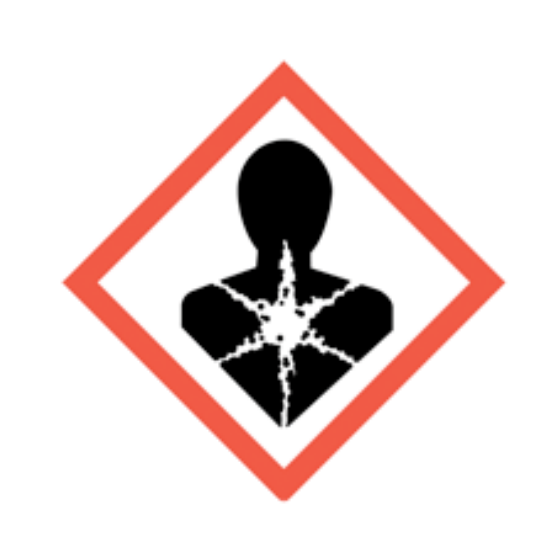
Health hazard
Serious health hazards, including organ damage, aspiration hazard, respiratory sensitisation, cancer and reproductive effects; some can follow a single exposure.
Environment
Hazardous to the aquatic environment.
Standards named on this page are background context. Confirm the current edition, scope and exact requirements from an authorised copy before applying them. The open official sources below support the specific public-law and regulator guidance claims they are cited for.
What do the acronyms and key terms mean?
Acronyms and medical terms should be defined so readers can understand disease, records and workplace controls.
| Acronym or term | Full wording | Meaning in this topic |
|---|---|---|
| ACM | Asbestos-containing material | Any material or product that contains asbestos. |
| AIB | Asbestos insulating board | A board product that may release fibres if drilled, cut, broken or removed incorrectly. |
| CAR 2012 | Control of Asbestos Regulations 2012 | Main Great Britain asbestos legal framework. |
| NNLW | Notifiable non-licensed work | Non-licensed asbestos work with additional notification, medical surveillance and health-record requirements. |
| RPE | Respiratory protective equipment | Respirators or breathing apparatus used to reduce inhalation exposure where required. |
| PPE | Personal protective equipment | Protective clothing, gloves and other protective equipment used alongside other controls. |
| OH | Occupational health | Qualified health support that can advise on fitness for work, adjustments and health surveillance. |
| ILD | Interstitial lung disease | A group of diseases affecting lung tissue, including asbestosis. |
| Fibrosis | Scarring | Scarring of lung tissue that can reduce breathing capacity. |
| Latency | Delay between exposure and disease | Explains why asbestos-related disease can appear decades after exposure. |
| IIDB | Industrial Injuries Disablement Benefit | Government benefit route that may apply to certain occupational diseases, including asbestosis. |
| RIDDOR | Reporting of Injuries, Diseases and Dangerous Occurrences Regulations | Reporting framework that may apply to diagnosed occupational diseases where criteria are met. |