SHARE Knowledge Hub
Asbestos dust
If work releases suspected asbestos dust or fibres, stop, leave the affected area, keep others out and report it. Do not sweep or use an ordinary vacuum. A competent asbestos adviser must assess the material, possible spread, exposure, clean-up and evidence needed before anyone resumes work or reoccupies the area.
Understanding Asbestos dust
Asbestos dust is not ordinary nuisance dust. It consists of, or is contaminated with, microscopic asbestos fibres released when asbestos-containing materials are damaged, abraded, cut, drilled, broken, weathered, cleaned or otherwise disturbed. Fibres can remain airborne, settle on surfaces and clothing, and become airborne again. Inhalation can cause mesothelioma, asbestos-related lung cancer, asbestosis and diffuse pleural thickening after a long latency.
Why this matters at work
Exposure pathways include direct inhalation at source; bystander exposure; leakage from enclosures or boundaries; transfer on clothing and equipment; recirculation through ventilation; waste damage; and secondary re-entry into an inadequately cleaned area. Assess every pathway and every person, including cleaners, security, drivers and occupants.
An asbestos-dust assessment must begin with the material and the energy applied to it, not with whether a visible cloud was seen. Record the exact ACM or presumed ACM, fibre-binding matrix, surface treatment, condition, extent and accessibility. Then describe the initiating action: drilling, cutting, snapping, scraping, wire brushing, sanding, dropping, vehicle impact, vibration, air movement, fire, water damage or dry handling. Friable lagging, sprayed coating, loose fill and degraded AIB can release fibre readily; bonded products can still release respirable fibre when abraded, broken or weathered.
How organisations manage this in practice
Control selection follows the release mechanism and legal work category. Eliminate disturbance, redesign access or remove ACM in a separately controlled project where that gives the lowest lifecycle risk. Reduce energy, breakage, duration and exposed area. Isolate people through an exclusion zone, controlled area or enclosure. Engineering may include controlled wetting, intact removal, local capture with conforming class H equipment, negative pressure and correctly designed transit and decontamination. Procedures, RPE and protective clothing support these barriers but cannot turn a high-release method into acceptable work.
Engineering controls include injection or low-pressure wetting, drill cowls, class H shadow vacuuming, negative-pressure units, sealed waste interfaces and decontamination facilities. Procedural controls include category decision, plan, permit, trained team, restricted access, supervision, cleaning, monitoring and change control.
Supervisors inspect material condition, boundary, wetness, vacuum flow, RPE fit, clean/dirty route, waste and other trades. They need authority to stop and revise the plan. Refresher training responds to task, performance, change and annual HSE expectations for workers doing licensed/non-licensed work.
Keep people away, prevent spread, do not sweep, brush, dry-wipe, blow down or use an ordinary vacuum, and report it so competent asbestos advice can be obtained before anyone continues.
What does this asbestos dust guide cover?
This is an incident and fibre-spread guide for work in Great Britain and Northern Ireland, not permission to identify, sample, clean or remove asbestos yourself.
Use it when a task could release fibres, suspect dust or debris is found, controls fail, or an affected area needs a documented hand-back. The broader asbestos guide covers premises management, surveys and work-category planning in more detail. Asbestos fibres cannot be reliably recognised by sight, smell or the size of a dust cloud. Treat uncertain material as suspect until a competent assessment says otherwise.
Jurisdiction: Great Britain uses the Control of Asbestos Regulations 2012 and HSE or the relevant enforcing authority. Northern Ireland has separate 2012 Regulations and HSENI licensing and notification routes. Check the site-specific route.
How can I practise this topic in 3D?


Intrusive work relies on an incomplete asbestos survey
All related inspection points 1 across 1 location
Riverside Leisure 1 inspection point
Practice in the SHAREhub environment. Browser practice is separate from workplace competence and formal learning records.
Treat suspected fibre spread as an incident route
This is the accidental fibre-release and spread-control route. A suspected debris incident is different from planned asbestos management or a task already classified by a competent specialist. Prevent further disturbance and movement using the existing immediate-actions section.
Best-practice guide: Asbestos dust
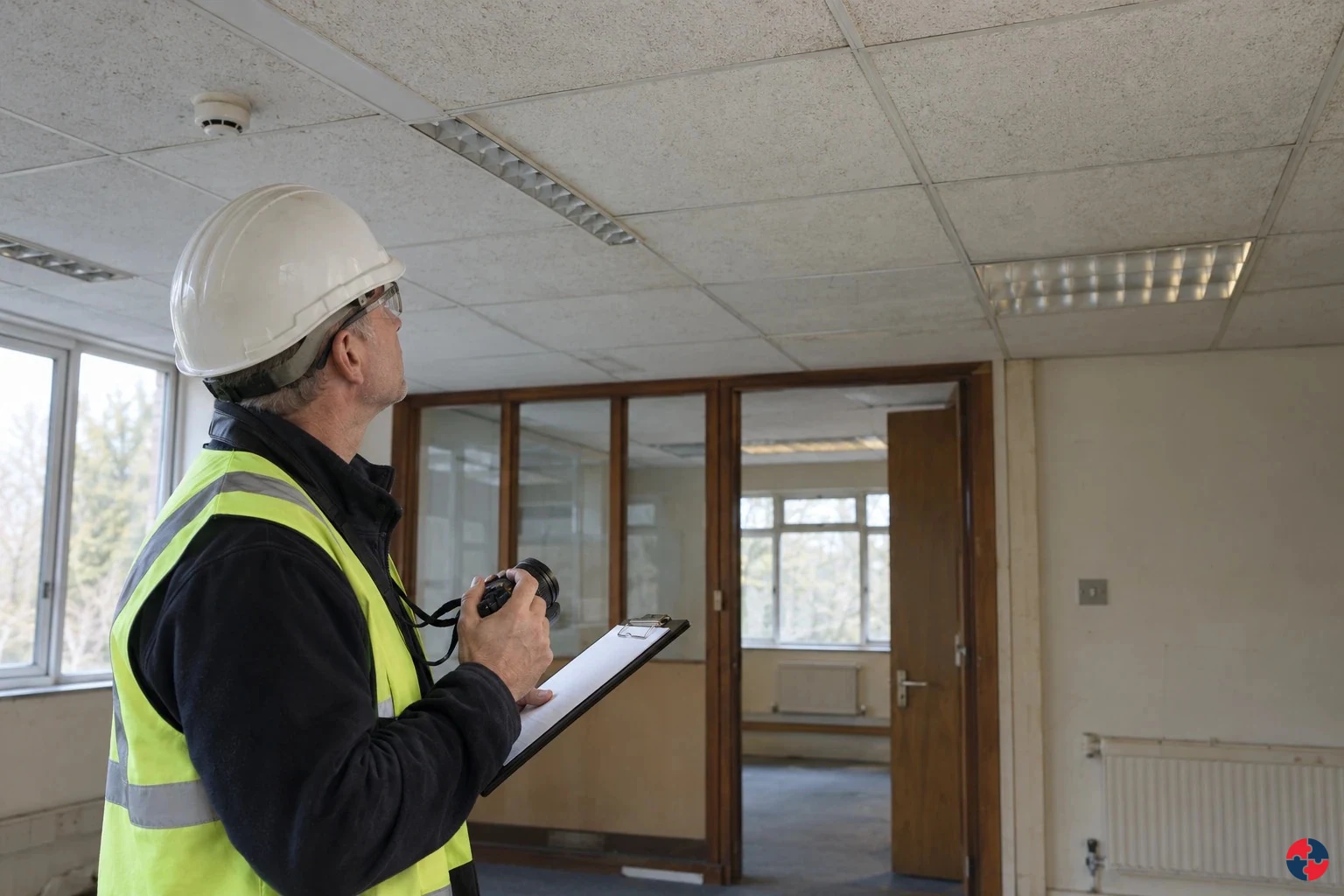
Hold disturbance when the material is uncertain
The priority is to prevent fibre release and exposure. Unknown material, survey limitations or changed work require a hold and a competent decision. Suitable intact asbestos-containing material may be managed in place; removal is not the automatic answer.
Turn asbestos dust knowledge into a decision
If work releases suspected asbestos dust or fibres, stop, leave the affected area, keep others out and report it. Do not sweep or use an ordinary vacuum. Photographs from safe position, survey scope, incident log and hand-back.
Debris on a corridor floor
Supervisor contains access and obtains competent inspection without moving debris. Specialist decides material, clean-up and reoccupation evidence; dutyholder updates register.
Asbestos fibre release mechanisms
Drilling, boring or screw fixing: The tool cuts into boards, coatings, cement, tile backing or hidden materials and can eject fine debris. Breaking or impact damage: Fragments and edges expose fibres, especially in brittle or aged materials. Dry scraping or sanding: Mechanical abrasion creates fine airborne dust and contaminates nearby surfaces.
Choose controls for asbestos dust
Eliminate: Avoid disturbing asbestos by changing the work, rerouting services, using non-intrusive methods or removing asbestos first where appropriate. Reduce: Reduce the amount of disturbance, time, people exposed and area affected. Isolate: Separate people from potential fibre release using barriers, enclosure, locked rooms, exclusion zones or controlled areas. Control: Use competent plans of work, wetting, shadow vacuuming, H-type vacuuming, decontamination and waste controls where appropriate. PPE: Use suitable disposable clothing, gloves and respiratory protective equipment required by the assessment. Read the full control table for qualifications, ownership and verification. Use the actual task and applicable jurisdiction; existing technical approval remains unchanged.
Use the full asbestos dust lesson
Use the full topic for the decision points, practical examples, detailed control tables and source scope. HSE guidance applies to Great Britain; use HSENI for the Northern Ireland route and the source’s stated jurisdiction. A simplified guide does not change the page’s technical-review or approval status.

Read all six steps as text
1. Hold disturbance when the material is uncertain
This is the accidental fibre-release and spread-control route.
- Identify: Check the material and whether the survey covers the proposed work.
- Avoid: Use a suitable method that avoids disturbing suspected asbestos.
- Escalate: Stop and keep others clear if damage or suspect dust is found.
The priority is to prevent fibre release and exposure. Unknown material, survey limitations or changed work require a hold and a competent decision. Suitable intact asbestos-containing material may be managed in place; removal is not the automatic answer.
Apply it: What could disturb this material, and who resolves uncertainty before work resumes?
2. Turn asbestos dust knowledge into a decision
Use the evidence to improve the actual work arrangement.
- Change at source: Avoid disturbing asbestos by changing the work, rerouting services, using non-intrusive methods or removing asbestos first where appropriate.
- Make it observable: Design review, survey scope, pre-construction information and removal hand-back.
- Keep useful evidence: Photographs from safe position, survey scope, incident log and hand-back.
If work releases suspected asbestos dust or fibres, stop, leave the affected area, keep others out and report it. Do not sweep or use an ordinary vacuum. Photographs from safe position, survey scope, incident log and hand-back.
Apply it: What evidence would show that the change improves this task, rather than only completing a record?
3. Debris on a corridor floor
Example: a practical application of the existing topic lesson.
- Setting: Suspect fragments beneath a pre-2000 ceiling; the identity is unknown.
- Act: Stop access and compare the exact ceiling location with the register; keep people on a clean route.
- Hold / review: Do not sweep, bag by hand or assume visible fragments are asbestos free.
Supervisor contains access and obtains competent inspection without moving debris. Specialist decides material, clean-up and reoccupation evidence; dutyholder updates register.
Apply it: At which point would you hold this example, and what evidence would allow it to proceed?
4. Asbestos fibre release mechanisms
Connect the task, the route to the person and the control that can fail.
- Drilling, boring or screw fixing: The tool cuts into boards, coatings, cement, tile backing or hidden materials and can eject fine debris.
- Breaking or impact damage: Fragments and edges expose fibres, especially in brittle or aged materials.
- Dry scraping or sanding: Mechanical abrasion creates fine airborne dust and contaminates nearby surfaces.
Drilling, boring or screw fixing: The tool cuts into boards, coatings, cement, tile backing or hidden materials and can eject fine debris. Breaking or impact damage: Fragments and edges expose fibres, especially in brittle or aged materials. Dry scraping or sanding: Mechanical abrasion creates fine airborne dust and contaminates nearby surfaces.
Apply it: Who could be exposed, including other trades, cleaners, maintainers and people nearby?
5. Choose controls for asbestos dust
Start with the stronger practicable options and verify their effect.
- Eliminate: Avoid disturbing asbestos by changing the work, rerouting services, using non-intrusive methods or removing asbestos first where appropriate.
- Reduce: Reduce the amount of disturbance, time, people exposed and area affected.
- Isolate: Separate people from potential fibre release using barriers, enclosure, locked rooms, exclusion zones or controlled areas.
- Control: Use competent plans of work, wetting, shadow vacuuming, H-type vacuuming, decontamination and waste controls where appropriate.
- PPE: Use suitable disposable clothing, gloves and respiratory protective equipment required by the assessment.
Eliminate: Avoid disturbing asbestos by changing the work, rerouting services, using non-intrusive methods or removing asbestos first where appropriate. Reduce: Reduce the amount of disturbance, time, people exposed and area affected. Isolate: Separate people from potential fibre release using barriers, enclosure, locked rooms, exclusion zones or controlled areas. Control: Use competent plans of work, wetting, shadow vacuuming, H-type vacuuming, decontamination and waste controls where appropriate. PPE: Use suitable disposable clothing, gloves and respiratory protective equipment required by the assessment. Read the full control table for qualifications, ownership and verification. Use the actual task and applicable jurisdiction; existing technical approval remains unchanged.
Apply it: Which stronger option can be used here, and who will verify it before accepting the remaining risk?
6. Use the full asbestos dust lesson
Follow the official sources below and retain the task-specific evidence.
- Official guidance: HSE EM1 accidental disturbance (HSE Asbestos essentials sheet)
- Official guidance: HSE asbestos FAQs (Current web guidance)
- Task decision: Photographs from safe position, survey scope, incident log and hand-back.
Use the full topic for the decision points, practical examples, detailed control tables and source scope. HSE guidance applies to Great Britain; use HSENI for the Northern Ireland route and the source’s stated jurisdiction. A simplified guide does not change the page’s technical-review or approval status.
Apply it: Which official source and full-topic section will you use to resolve the next decision?
Record the initial workface and possible spread through people, clothing, tools and ventilation. The record supports the specialist assessment; it does not authorise self-cleaning, sampling or reopening. An H-type vacuum reference is not permission for unassessed clean-up.
Suspect fragments reach an occupied corridor
Illustrative example. Debris beneath an older ceiling is found after work; people and tools have passed through the corridor.
Decision. Stop the affected activity, apply the existing incident route and define the areas and movement requiring specialist assessment.
Evidence to check. Record material location, actual disturbance, movement, ventilation state and factual handover to the responsible specialist.
Hold or escalation point. No sweeping, ordinary cleaning or visual-only release; controls for people and adjoining areas remain unresolved until assessed.
Follow-up. The responsible owner records specialist hand-back and revisits work planning to prevent a repeat.
What is the health, legal and competence boundary for asbestos dust information?
This page is workplace guidance and learning content, not medical, legal or specialist asbestos consultancy advice.
Asbestos-related disease is clinical territory. Concerns about symptoms, diagnosis, treatment or personal exposure history should be discussed with qualified medical or occupational-health professionals. Managers should not provide medical reassurance after a potential exposure event.
Asbestos dust control is also a specialist legal and technical area. Decisions about whether work is licensed, notifiable non-licensed or non-licensed should be made by competent people using the Control of Asbestos Regulations 2012, HSE guidance, the material condition and the actual work method.
Worker health information, exposure records, medical surveillance, occupational-health advice and incident records should be handled confidentially and securely. The workplace record should focus on the exposure scenario, control failures, actions taken, advice received and review dates, not unnecessary private medical detail.
What are the key facts about asbestos dust?
The key fact is simple: asbestos dust can release invisible respirable fibres that may cause fatal disease long after exposure.
Visible dust is not the test
A material can release respirable asbestos fibres without creating a dramatic visible cloud, especially during drilling, scraping, breakage or poor cleaning.
Settled dust can become airborne again
Dust on floors, ledges, tools, clothing or waste can be re-suspended by sweeping, brushing, air movement, traffic or further work.
Cleaning can make exposure worse
Dry sweeping, ordinary vacuuming, compressed air and uncontrolled wiping can spread asbestos fibres beyond the original work area.
RPE is not the starting point
Respiratory protective equipment must be correctly selected, fitted, used, maintained and supervised, but stronger controls should prevent or reduce fibre release first.
Work category matters
The same material can require different arrangements depending on condition, task, duration, method and likely exposure.
Records matter for decades
Exposure and health records may be relevant many years later, especially for licensed work and notifiable non-licensed work.
What is asbestos dust?
Asbestos dust is airborne or settled asbestos fibre released from asbestos-containing materials during damage, disturbance or poor cleaning.
The term 'dust' can be misleading because asbestos risk is about fibres. Some asbestos fibres are small enough to remain suspended in air and to be inhaled deep into the lungs. Other fibres and contaminated debris can settle on surfaces and become airborne again later. This is why an area that looks tidy after sweeping may be more hazardous than it looks.
Asbestos dust may come from friable materials such as sprayed coatings, pipe lagging, loose fill insulation and damaged asbestos insulating board. It can also come from more firmly bonded materials where work methods break, abrade, drill, saw, sand or grind the material. Even low-risk materials become a problem if the work method is uncontrolled.
A good asbestos dust system begins before the dust exists. It asks what the material is, whether the work will disturb it, whether the survey information is enough, who is competent to do the work, how fibres will be prevented or controlled, how waste will be handled and what happens if the work discovers something unexpected.
| Concept | Plain-English meaning | Practical consequence |
|---|---|---|
| Airborne fibres | Fibres suspended in the air after disturbance. | Can be inhaled and require controls at source, isolation, RPE where needed and competent assessment. |
| Settled contamination | Fibres and dust settled on surfaces, tools, waste, clothing or floors. | Can be re-suspended by movement or poor cleaning, so clean-up method matters. |
| Friability | How easily a material can crumble or release fibres. | Friable or damaged materials normally need stronger controls and may trigger licensed or notifiable requirements. |
| Matrix bonding | How firmly fibres are held inside another material such as cement, bitumen or resin. | Firmly bonded materials may be lower risk if intact and carefully handled, but cutting or breaking changes the risk. |
| Disturbance | Any action that damages, opens, abrades or moves an asbestos-containing material. | Planning should prevent disturbance unless the task has been properly assessed and controlled. |
What health effects can asbestos dust cause?
Inhaled asbestos fibres can cause mesothelioma, asbestos-related lung cancer, asbestosis and diffuse pleural thickening many years after exposure.
Asbestos dust is primarily an inhalation hazard. Fibres that reach the lungs or pleura can remain in the body for long periods and may contribute to serious long-latency disease. The person exposed may feel well at the time, so symptoms are not a reliable way of judging whether the event mattered.
Smoking and asbestos together increase the overall risk of lung cancer, which makes smoking cessation advice relevant in occupational-health signposting. However, the workplace control message remains the same for everyone: prevent fibre release and inhalation.
After a suspected release, the organisation should record the event, identify who may have been exposed, obtain competent asbestos advice and signpost affected people to appropriate medical or occupational-health routes where needed.
| Health effect | What it means | Workplace implication |
|---|---|---|
| Mesothelioma | Cancer mainly affecting the lining of the lungs or abdomen, strongly associated with asbestos exposure. | Preventing fibre inhalation is critical because disease can occur decades later. |
| Asbestos-related lung cancer | Lung cancer caused or contributed to by asbestos exposure. | Exposure prevention and accurate work/exposure history matter. |
| Asbestosis | Scarring of lung tissue usually linked to heavier asbestos exposure. | Higher-risk work and repeated uncontrolled exposure need strong prevention and records. |
| Diffuse pleural thickening | Thickening of the pleura that can restrict breathing. | Another long-latency condition linked to asbestos exposure. |
Separate the incident from the later health effects
The respiratory activity below illustrates asbestos-related lung scarring over a long timescale. It does not show an immediate diagnosis after a dust release. Material identification, exposure assessment, clinical advice and permission to reoccupy are separate decisions.
If an incident is happening now, use the first-minutes route. The optional model must not delay care or the action needed to prevent further exposure.
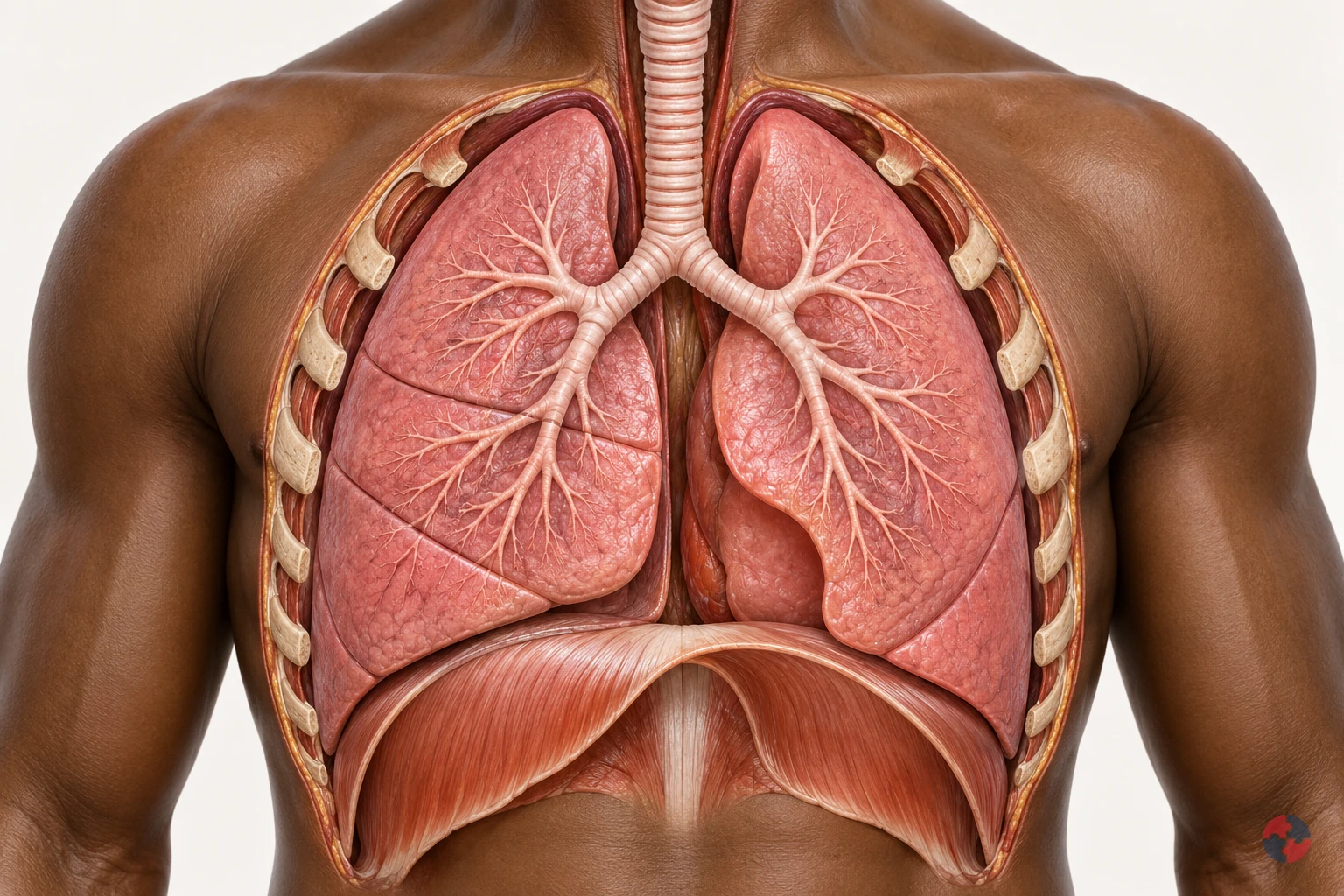
How do the lungs work, and how can workplace exposures affect breathing?
Interactive anatomy · Respiratory tract and lungs · Updated 2026-10-23
Read all anatomy and process explanations without the viewer
Simplified education, not diagnosis, a lung-function or oxygen-saturation test, an exposure calculator or a fitness-to-work assessment. No breath-holding challenge, breathing-rate score or personal health-data collection. Ordinary particle filters do not protect against every gas or oxygen deficiency. COPD and coal-dust topics may reuse normal anatomy only until separate mechanisms are reviewed.
Nose and mouth
Air enters and leaves here. The nose and mouth connect the outside air with the respiratory passages. Air moves through these openings on both the inward and outward breath. Follow the route towards the windpipe before looking at the smaller branches. The illustrated flow is air, a mixture of gases, rather than pure oxygen passing directly into blood. Frimley Health NHS Foundation Trust: How your lungs work · Central and North West London NHS Foundation Trust: How do we breathe?
Trachea
The windpipe carries air into the chest. The trachea, commonly called the windpipe, carries air down towards the chest. It divides into the two main bronchi that supply the lungs. Locate this shared passage before following either branch. Its role is to conduct air towards the gas-exchange regions and provide an outward route for the next exhalation. Frimley Health NHS Foundation Trust: How your lungs work
Bronchi
A main branch carries air into each lung. The two main bronchi take air from the windpipe into the right and left lungs. They divide into progressively smaller branches, distributing the breath through the lungs. Use the split as a landmark before following one highlighted route. These are air passages, distinct from the blood vessels that run through the same organs. Frimley Health NHS Foundation Trust: How your lungs work · University Hospitals of North Midlands NHS Trust: My lung surgery: about your lungs
Bronchioles
Smaller branches distribute air. Bronchioles are smaller branches of the airway system inside the lungs. Their branching routes lead towards clusters of alveoli, where the breath reaches the gas-exchange surface. Follow one branch to its end, using the others as context. This simplified route represents part of a much larger network supplying the lungs together. Frimley Health NHS Foundation Trust: How your lungs work
Alveoli
Tiny air sacs provide a gas-exchange surface. Alveoli are tiny air sacs at the ends of the small airway routes. Their close relationship with surrounding capillaries allows oxygen to pass towards blood and carbon dioxide towards alveolar air. Connect the highlighted cluster with the enlarged gas-exchange view. The enlargement changes the scale so the air space and neighbouring blood vessel can be distinguished. Frimley Health NHS Foundation Trust: How your lungs work · Central and North West London NHS Foundation Trust: How do we breathe?
Air–blood barrier
A thin boundary separates air from blood. The thin alveolar and capillary walls separate air in the sac from blood in its neighbouring vessel. Oxygen and carbon dioxide cross this boundary in opposite directions. Locate the tissue between the two spaces in the enlarged view. Blood cells remain in the vessel; the model does not represent an open connection through which air and blood mix. Central and North West London NHS Foundation Trust: How do we breathe?
Pulmonary capillaries
Small blood vessels pass beside the air sacs. Pulmonary capillaries are small blood vessels beside the alveoli. Blood moving through them receives oxygen and releases carbon dioxide across the thin exchange boundary, then continues through the circulation. Follow the labelled gas routes separately from the blood cells. These cells stay inside the capillary rather than moving into the air sac. Central and North West London NHS Foundation Trust: How do we breathe?
Diaphragm
This muscle helps make room for a breath. The diaphragm is a broad, dome-shaped breathing muscle beneath the lungs. It contracts and flattens downwards during inhalation, helping increase the space in the chest. During a quiet exhalation it relaxes towards its dome shape. Compare it with the rib cage: their changing positions help move air without the lung tissue acting as a contracting muscle. Cambridge University Hospitals NHS Foundation Trust: Breathing techniques to ease breathlessness: muscles involved
Rib cage and breathing muscles
Chest movement changes the space around the lungs. The rib cage protects the chest organs and moves with the breathing muscles. Expansion upwards and outwards helps increase chest space during inhalation; relaxation reduces that space during a quiet exhalation. Compare this movement with the diaphragm below the lungs. Together these structures provide the mechanics that allow air to move through the airways. Central and North West London NHS Foundation Trust: How do we breathe? · Cambridge University Hospitals NHS Foundation Trust: Breathing techniques to ease breathlessness: muscles involved
Pleura
Two thin layers surround the lungs and line the chest. The pleura has two thin layers around the lungs and inside the chest wall. A small amount of fluid between them allows the surfaces to slide with less friction as breathing changes the chest space. Locate this outer covering separately from the internal air sacs; it is not the thin air–blood exchange boundary. Blackpool Teaching Hospitals NHS Foundation Trust: Pleural clinic
Open the complete process transcript
The process, step by step
1 · Make space
Breathing in begins with a change in the space inside the chest. The diaphragm, a dome-shaped muscle beneath the lungs, contracts and moves downwards. Muscles around the ribs help lift the chest upwards and outwards. As the lungs expand with this changing space, air can enter through the airways. Locate the diaphragm and rib cage together rather than treating the lungs as muscles that pull themselves open. The model separates the movement into a teaching step so you can follow its purpose. In the body, chest movement, airflow and blood circulation are connected parts of a continuing process. Central and North West London NHS Foundation Trust: How do we breathe? · Cambridge University Hospitals NHS Foundation Trust: Breathing techniques to ease breathlessness: muscles involved
What to watch: Locate the diaphragm beneath the lungs and the rib cage around them; compare their positions with the space occupied by the lungs.
Why it matters: Changing the chest space draws air into the lung passages. The breathing muscles supply the movement, while the lungs expand with the chest to receive the next breath.
Explore this step: Select the diaphragm and rib cage in turn, then explain how their movement helps air enter without the lungs contracting like muscles.
2 · Move air
Air entering through the nose or mouth travels down the trachea, or windpipe, towards the chest. The trachea divides into the two main bronchi, with one route supplying each lung. Follow this continuous passage in the whole-chest view before moving into the smaller branches. The moving air is a mixture of gases, including oxygen; it is not a stream of pure oxygen travelling straight into the blood. These larger airways carry the breath towards the places where gas exchange happens. The same connected passages also provide the outward route when air is breathed out. Frimley Health NHS Foundation Trust: How your lungs work
What to watch: Start at the nose and mouth, follow the trachea downwards and find the split into the right and left main bronchi.
Why it matters: The larger passages distribute air to both lungs and connect the outside air with the smaller branches inside. Gas exchange takes place further along the route, rather than within the windpipe.
Explore this step: Trace the route to each lung and distinguish the tubes carrying air from the separate vessels carrying blood.
3 · Reach the air sacs
Inside each lung, the bronchi divide into smaller branches called bronchioles. These passages distribute air towards clusters of tiny air sacs, the alveoli. Follow one branch in the close-up and connect its end with an air-sac cluster, using the other branches as surrounding context. These routes distribute the breath throughout the lungs rather than supplying only one working air sac. A real lung contains many branching routes and air sacs operating together. This distribution brings air close to a large network of small blood vessels, preparing for the exchange shown in the next view. Frimley Health NHS Foundation Trust: How your lungs work
What to watch: Follow one smaller airway to the cluster of air sacs at its end, keeping the other branches as surrounding context.
Why it matters: Branching delivers air throughout the lungs instead of to one large chamber. The many air sacs bring the inhaled gases close to blood vessels where oxygen and carbon dioxide can cross.
Explore this step: Trace one complete branch to its air sacs, then explain how the many branches distribute air throughout the lungs.
4 · Change scale
The lesson now changes from a branching airway to an enlarged air–blood interface. An alveolus contains air; beside it runs a capillary containing blood. Their very thin walls form the boundary across which gases can move. Locate the air space, the separating tissue and the inside of the vessel before following any gas symbols. The magnified view represents a tiny part of the same lung, not a separate organ or a hole that joins air and blood into one space. The enlargement helps explain how the two systems can exchange gases while keeping their contents separate. Central and North West London NHS Foundation Trust: How do we breathe?
What to watch: Find the air inside the enlarged alveolus, the thin separating boundary and the neighbouring capillary with blood cells inside it.
Why it matters: A close boundary allows gases to cross between alveolar air and capillary blood. Keeping the two spaces separate lets ventilation and circulation cooperate without blood cells entering the air sac.
Explore this step: Identify the air space and blood-vessel space, then point to the boundary each gas must cross between them.
5 · Exchange gases
At the air–blood boundary, oxygen moves from the alveolar air into the capillary blood. At the same time, carbon dioxide carried back from the body moves from the blood into the air sac. The two gases cross in opposite directions; blood cells stay within the vessel. Follow each labelled symbol separately so that exchanging gases is not confused with mixing the air and blood together. Blood then carries oxygen onwards towards the heart and the body’s tissues. The teaching symbols simplify continuous gas movement, and their size, colour and speed do not represent a measurement. Central and North West London NHS Foundation Trust: How do we breathe?
What to watch: Follow the O₂ symbol towards the capillary and the CO₂ symbol towards the air sac, while locating the blood cells within the vessel.
Why it matters: Oxygen can be carried onwards for use by the body, while carbon dioxide returns to the airways for removal. Both transfers connect the breath with the continuing circulation of blood.
Explore this step: Trace the two gas routes in opposite directions and explain why a blood cell should remain inside the capillary.
6 · Breathe out
During a quiet breath out, the diaphragm and other breathing muscles relax. The diaphragm returns towards its dome shape, chest space decreases and air moves back along the airways to the nose or mouth. This outgoing air carries carbon dioxide that crossed from the blood into the alveoli. Trace the route in reverse without reversing the direction of blood circulation: oxygen-carrying blood continues towards the heart while another breath prepares to enter. The model presents a single cycle to explain the relationship. It does not show breathing as a series of separate events in which circulation stops between steps. Central and North West London NHS Foundation Trust: How do we breathe? · Cambridge University Hospitals NHS Foundation Trust: Breathing techniques to ease breathlessness: muscles involved
What to watch: Compare the diaphragm and chest with the inhalation step, then follow the outward airway route from the lungs to the nose or mouth.
Why it matters: Exhalation removes air containing carbon dioxide from gas exchange. Meanwhile, blood circulation continues carrying oxygen onwards, linking this breathing cycle with the needs of the rest of the body.
Explore this step: Trace the outward air route and the onward blood route separately, then describe why they are connected processes with different pathways.
Mechanisms and their limits
Dust-related fibrosis · asbestos Inhaled asbestos fibres can cause asbestosis: scarring of lung tissue, usually after heavy exposure over many years. Mesothelioma is a separate cancer involving linings such as the pleura; it is not another name or a later stage of asbestosis. Lung scarring and the separate pleural annotation show different disease concepts. Other asbestos diseases also exist. Do not show one exposure causing immediate fibrosis or cancer. The sequence is illustrative and timing varies. The illustration cannot establish whether material contains asbestos or whether a person has an asbestos-related disease. HSE: Why is asbestos dangerous?
Understand the separate asbestos diseases
Dust-related fibrosis · asbestos — follow the anatomy
Look at: The deep lung tissue around the air sacs.
What changes: Inhaled asbestos fibres can cause scarring after a long delay.
Why it matters: Asbestosis reduces lung function; this fibrosis example is separate from mesothelioma and other asbestos diseases.
What to do: Identify asbestos before work and prevent disturbance through competent controls.
Disturbing asbestos-containing material during maintenance
A worker pulls down an older ceiling or roof-lining panel and dust falls beside their face. This shows an uncontrolled disturbance to avoid, not a safe removal method. Explicit time jump: asbestos-related disease can emerge many years after exposure. Asbestosis is a later scarring example, not a seconds-long transformation. Asbestosis, pleural disease and mesothelioma are different conditions. The visible dust is an illustrative cue, not a way to identify asbestos or judge whether air is safe. This example does not predict illness after one disturbance.
Pulling down a ceiling panel The worker pulls an overhead panel away from its frame and dust falls into the work area. This is a hazardous example, not a removal method. Check the asbestos information before disturbance; stop if the material or work arrangements are unclear. Health and Safety Executive: Asbestos essentials
What a failed control could allow In the counterfactual exposure example, disturbing asbestos-containing material releases fibres that may be inhaled. The timeline then jumps forward; no new disturbance is instructed. HSE: Why is asbestos dangerous? · Health and Safety Executive: Asbestos essentials
One possible later asbestos effect A separate asbestosis view illustrates scarring within lung tissue after substantial exposure over time. The outside pleural layer remains distinct; it is not a cancer or a generic asbestos-disease patch. HSE: Why is asbestos dangerous?
Prevent further disturbance Stop and follow competent asbestos-management arrangements, with suitable classification, planning and specialist work where needed. Seek appropriate advice about exposure concerns; neither a clear-looking room nor a normal diagram gives clearance. Health and Safety Executive: Asbestos essentials · HSE: Why is asbestos dangerous?
Read the practice situations and all answer explanations
LU-Q1: Which plan best addresses the hazard?
A team plans repeated concrete cuts with a handheld cut-off saw. Dust can enter the operator’s and nearby workers’ breathing zones.
Open a window and use the same dry-cutting method. — A window alone does not control dust generated beside the face. Choose task controls that prevent or capture it at source.
First reduce the need to cut, then assess source suppression or extraction and any required suitable RPE. — This addresses the task before exposure occurs. Check that suppression or extraction works and that required RPE is suitable, fitted and used.
Continue while nobody is coughing. — Symptoms are not an exposure monitor. Harmful respirable dust may be invisible, and a worker can feel well during exposure.
HSE: Construction dust: cutting paving blocks, kerbs and flagsLU-Q2: What is the most useful next action?
A bakery worker notices repeated wheeze after dusty flour tasks, including some symptoms later in the evening.
Report the pattern and seek medical and workplace assessment. — Reporting the pattern allows exposure controls and clinical assessment to be reviewed. Symptoms can be delayed; a clinician may need further investigation.
Use this model to diagnose occupational asthma. — The model explains a mechanism. It cannot diagnose asthma or establish that work caused it.
Assume the task is safe if breathing improves away from work. — Improvement away from work may be useful information for investigation, but it does not show that returning to the same exposure is safe.
HSE: Asthma: an overview · HSE: Advice for employers: occupational asthma · NHS: Asthma · HSE: Flour dust and risks to bakersLU-Q3: What is the important distinction?
One diagram shows a narrowed airway at LUN03–04. A second shows scarred gas-exchange tissue around LUN05–07.
They show the same disease at successive stages. — Narrowed airways and scarred lung tissue are different changes. One is not automatically the next stage of the other.
Both effects disappear when airborne dust settles. — Removing airborne dust does not reverse established fibrosis. Controlling further exposure remains important.
Airway narrowing and tissue fibrosis are different mechanisms. — Correct. Airway narrowing affects the passage for air; fibrosis affects lung tissue and its function. Neither picture supplies an individual diagnosis.
NHS: Silicosis · NHS: AsthmaSources and how the model is made
The opening images are AI-generated anatomical illustrations. The interactive 3D models and labelled SVG diagrams use original procedural artwork. These teaching images are not medical scans or diagnostic tools. Source references support the learner explanations and do not grant artwork rights.
- Frimley Health NHS Foundation Trust: How your lungs work — Normal airway branching, air sacs and capillary gas exchange; factual text only.
- Central and North West London NHS Foundation Trust: How do we breathe? — Thin alveolar/capillary walls, opposing gas transfer, circulation and chest mechanics. No illustrations or exercises copied.
- Cambridge University Hospitals NHS Foundation Trust: Breathing techniques to ease breathlessness: muscles involved — Diaphragm movement and breathing-muscle context only; this module does not prescribe breathing exercises.
- HSE: Health risks from welding — Welding-related airway irritation, possible deeper injury and irritant asthma; not a universal pattern for every gas.
- HSE: Asthma: an overview — Sensitisation, later triggering and work aggravation. Legacy labelling language and statistics are not reused.
- HSE: Advice for employers: occupational asthma — Exposure prevention, controls and health surveillance only; legacy legislation wording is not reused.
- NHS: Silicosis — Silica-associated inflammation/fibrosis, varying latency, irreversible damage and possible progression after exposure stops.
- HSE: Why is asbestos dangerous? — Asbestosis, mesothelioma and pleural disease are distinct; long disease latency.
- HSE: Construction dust: cutting paving blocks, kerbs and flags — Task design, source suppression/extraction, suitable RPE and checking controls; not a generic dust safe-dose rule.
- NHS: Shortness of breath — Emergency recognition of severe breathing difficulty and 999; emergency advice is outside the activity.
- NHS: Asthma — Narrowed/swollen airways, symptoms and clinical diagnosis; no medication doses or treatment plan reproduced.
- University Hospitals of North Midlands NHS Trust: My lung surgery: about your lungs — Right/left lung lobe counts and airway anatomy; no source image copied.
- Blackpool Teaching Hospitals NHS Foundation Trust: Pleural clinic — Pleural layers and the small lubricating fluid layer outside lung tissue; no procedural teaching included.
- HSE: Asphyxiation hazards in welding and allied processes — Oxygen-deficient spaces and need for independent air supply; no unprotected entry or rescue.
- HSE: Respiratory protective equipment at work — RPE selection must match the contaminant and conditions; filtering protection is not a supply of oxygen.
- HSE: Flour dust and risks to bakers — Flour sensitisation and practical reduction of dusty handling; exposure-limit numbers are not reused.
- Health and Safety Executive: Asbestos essentials — Task planning, training and competent asbestos work arrangements for the maintenance exposure example; not permission to disturb unknown material or a licence/classification decision.
- Health and Safety Executive: Welding fume: protect your workers — Alternative joining, fume reduction, LEV, suitable RPE and maintained controls for the welding-fume example. No unprotected exposure or rescue procedure.
How is asbestos dust released during work?
Asbestos dust is released when the material is damaged, abraded, broken, drilled, cut, stripped, cleaned incorrectly or allowed to deteriorate.
A suspect release changes the whole work boundary
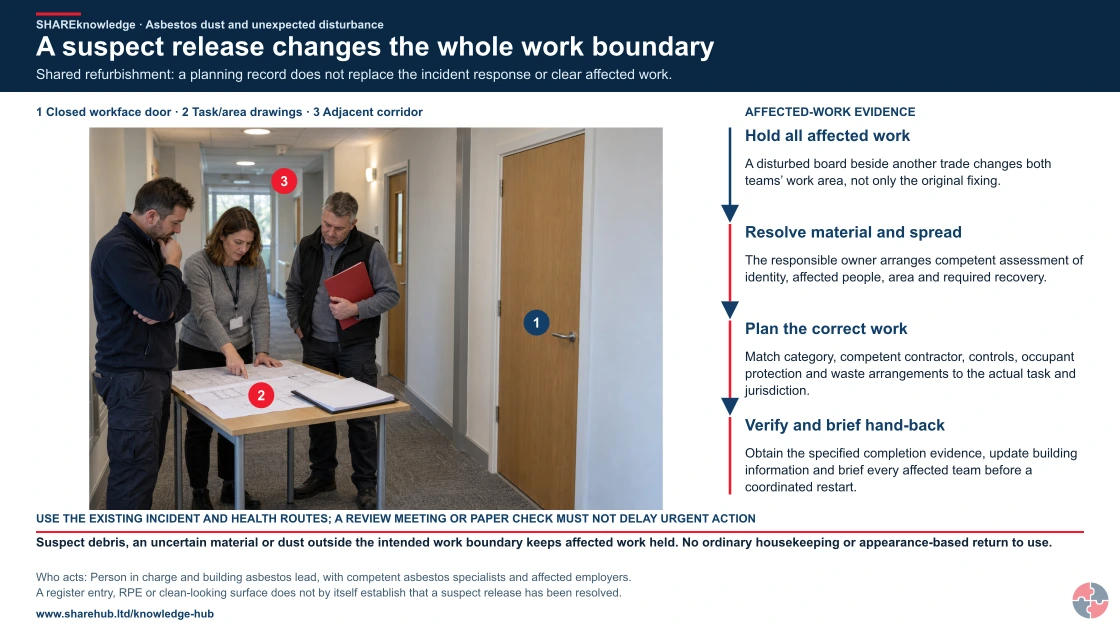
Full written explanation
An illustrative UK refurbishment corridor shows three adult work representatives reviewing inert task/area drawings and a blank evidence folder beside a closed plain workface door. One literal numbered picture key identifies the closed door, task/area drawings and adjacent corridor. No door, service panel or fabric is opened, and no active work, material, damage, debris, particles or fibre cloud is shown. The corridor is normal physical coordination context, not a map of contamination or a demonstration of the first-minute response. A closed door and normal-looking surfaces do not prove containment, clean zones, the affected boundary, survey coverage or clearance. The complete four-check relationship concerns both contractors and follow-on work: hold all affected tasks; arrange competent assessment of material, possible spread, affected people and required recovery; match the actual task and jurisdiction to the appropriate work category, competent contractor and arrangements; then obtain the specified completion evidence, update building information and brief affected teams before a coordinated restart. Records and signatures alone cannot release an unresolved suspect incident. The school-maintenance case concerns protecting occupants and reporting unexpected disturbance, not a cleaning method. The shared-riser case concerns coordinating both contractors and follow-on work; the original permit does not cover an expanded suspect release. The existing incident and appropriate health routes remain independent of this review meeting: paperwork or a model must not delay urgent action. No asbestos identification, exposure estimate, sampling, testing, removal, cleaning, waste handling, decontamination, RPE selection, work-category decision, limit, clinical instruction, clearance result or work permission is supplied by the image.
Shared refurbishment: a planning record does not replace the incident response or clear affected work.
- Hold all affected work. A disturbed board beside another trade changes both teams’ work area, not only the original fixing.
- Resolve material and spread. The responsible owner arranges competent assessment of identity, affected people, area and required recovery.
- Plan the correct work. Match category, competent contractor, controls, occupant protection and waste arrangements to the actual task and jurisdiction.
- Verify and brief hand-back. Obtain the specified completion evidence, update building information and brief every affected team before a coordinated restart.
When the evidence does not fit: Suspect debris, an uncertain material or dust outside the intended work boundary keeps affected work held. No ordinary housekeeping or appearance-based return to use.
Who acts: Person in charge and building asbestos lead, with competent asbestos specialists and affected employers.
Changed workplace
School maintenance: Protect occupants and report the unexpected disturbance; this is not a clean-up method.
Shared refurbishment riser: Coordinate both contractors and follow-on work; the original permit does not cover an expanded suspect release.
Evidence check: A register entry, RPE or clean-looking surface does not by itself establish that a suspect release has been resolved.
Primary references: HSE: asbestos discovery and accidental disturbance (EM1) · HSE worker guidance — disturbance, information and competence boundaries · HSENI managing and working with asbestos — Northern Ireland route
Open the complete HD image (new tab)Download image

Primary references: HSE: asbestos discovery and accidental disturbance (EM1) · HSE worker guidance — disturbance, information and competence boundaries · HSENI managing and working with asbestos — Northern Ireland route
Most accidental exposures begin with ordinary work: drilling a fixing, removing a panel, opening a ceiling void, lifting old flooring, chasing a wall, repairing a leak, stripping plant, cleaning debris or soft-stripping a building. The work may feel routine, but the material being disturbed is not routine.
Release is affected by material condition and method. A damaged, friable board can release fibres with light contact. A cement sheet may release fewer fibres if removed whole and wetted, but far more if broken, dropped, cut with power tools or pressure washed. A gasket may appear small, but scraping it dry from a flange can create local contamination.
The planning question should be specific: what exact material will be disturbed, what energy will be applied, what dust or fibre path will be created, who is nearby, what surfaces can become contaminated and what evidence shows the work method is lawful and controlled?
| Work activity or condition | How fibres can be released | Control implication |
|---|---|---|
| Drilling, boring or screw fixing | The tool cuts into boards, coatings, cement, tile backing or hidden materials and can eject fine debris. | Check the register and survey scope first; use competent task sheets only where work is permitted. |
| Breaking or impact damage | Fragments and edges expose fibres, especially in brittle or aged materials. | Stop work, restrict access and assess before moving debris. |
| Dry scraping or sanding | Mechanical abrasion creates fine airborne dust and contaminates nearby surfaces. | Avoid dry abrasive methods; classify the work correctly and use competent controls. |
| Power cutting or grinding | High-energy tools can create rapid airborne release and spread contamination. | Normally avoid for asbestos-containing materials unless a competent asbestos method explicitly controls the risk. |
| Removing panels, tiles or insulation | Movement can break fixings, crumble edges or release hidden dust behind the material. | Use correct work category, isolation, wetting or extraction and waste route. |
| Poor cleaning | Sweeping, brushing, dry wiping or ordinary vacuuming re-suspends fibres. | Use competent asbestos cleaning methods, such as suitable Class H vacuum or damp methods where appropriate. |
| Weathering and deterioration | Age, water damage, vibration or impact weakens materials and leaves residues. | Reinspect known asbestos-containing materials and act on damaged items. |
| Naturally occurring asbestos in stone | Some stone or mineral products may contain small amounts of naturally occurring asbestos and release dust when cut or worked. | Procurement, supplier checks, material testing and dust control may be needed for relevant stone products. |
Which materials are more likely to release asbestos dust?
Friable, damaged, loose, sprayed, insulated or board-type asbestos materials are generally higher concern than intact firmly bonded products.
Material risk is not a simple yes or no. The same asbestos-containing material can be low risk while sealed, undamaged and undisturbed, then high risk when broken, drilled, abraded or removed. This is why asbestos management uses both material assessment and priority assessment: what is it, what condition is it in and how likely is disturbance?
Asbestos insulating board, sprayed coatings, lagging and loose fill insulation deserve special attention because they can release fibres more readily and often fall into higher-control or licensed-work territory. Textured coatings, floor tiles, bitumen products and asbestos cement may be lower risk in some controlled tasks, but only when the material, condition and method support that judgement.
| Material or product | Dust-release concern | Typical work that can create release |
|---|---|---|
| Sprayed coatings | Usually high concern because they can be friable and were used for fire protection or insulation. | Impact, scraping, refurbishment, demolition or service installation. |
| Pipe lagging and insulation | Often high concern, especially if damaged or poorly sealed. | Plant maintenance, leak repair, valve replacement, stripping or emergency work. |
| Loose fill insulation | High concern because fibres or contaminated fill can be easily disturbed. | Accessing voids, demolition or uncontrolled clean-up. |
| Asbestos insulating board | Can release fibres when drilled, cut, broken or removed. | Ceiling tile work, riser access, fire-door work, panel removal or fixing. |
| Asbestos cement | Usually more firmly bonded, but breaking, drilling, cutting, dropping or pressure washing can release fibres. | Roofing, gutters, flues, cladding and old water tanks. |
| Textured coatings | May release fibres when sanded, scraped, drilled or stripped. | Decorating, electrical fittings, smoke-alarm installation or ceiling collapse clean-up. |
| Floor tiles and bitumen | Fibres may be bound in the matrix, but aggressive removal can create dust and residues. | Floor replacement, sanding, grinding, tile lifting or adhesive removal. |
| Gaskets, ropes and seals | Small items can still release fibres when scraped or dismantled dry. | Boiler, heater, kiln, flange and plant maintenance. |
| Some marble and other stone with naturally occurring asbestos | HSE AM1 addresses specific stone products and tasks; do not infer that all stone contains asbestos. | Stone cutting or finishing where supplier and geological information indicate possible asbestos. |
How can asbestos dust spread beyond the work area?
Asbestos dust can spread through air movement, tools, clothing, waste, cleaning methods, ventilation paths and people walking through contaminated areas.
Fibre spread is wider than the visible debris


Read this visual as text
- SOURCE: Disturbance of suspect material can release fibres. Leave the material and debris undisturbed.
- TRANSFER: People, tools, clothing and cleaning can spread contamination into clean areas. Control movement.
- RECOVERY: Competent assessment determines the recovery and the evidence needed before reoccupation.
Stopping release is only half of the problem. Once fibres are on surfaces or in the air, normal workplace movement can carry contamination beyond the source. Dust can settle on ledges, cables, ceiling grids, scaffolds, toolboxes, footwear, vehicles and waste bags. People may then move it into clean areas without realising.
Poor housekeeping can therefore become an exposure pathway. A worker who sweeps a small pile of suspect debris, carries an unsealed bag through a corridor or places contaminated tools in a van may spread fibres further than the original task did. The response must prevent both exposure and spread.
| Spread route | How it happens | Control point |
|---|---|---|
| Air movement | Fibres move through draughts, doors, risers, ceiling voids, ventilation paths or pressure differences. | Isolate the area, stop disturbance and get competent advice before ventilation or cleaning decisions. |
| Tools and equipment | Dust settles on drills, hoses, vacuums, ladders, scaffold boards and hand tools. | Define decontamination or disposal arrangements before removing tools from the area. |
| Clothing and PPE | Fibres cling to disposable coveralls, footwear, gloves and personal clothing. | Use correct PPE/RPE, doffing, bagging and decontamination arrangements. |
| Waste and debris | Broken fragments, bags and wrapping release fibres if damaged or incorrectly handled. | Use correct labelled packaging, waste route and authorised disposal. |
| Cleaning activities | Sweeping, brushing, dry wiping or ordinary vacuuming re-suspends dust. | Use asbestos-suitable cleaning methods and competent supervision. |
| People and traffic | Walking through debris spreads contamination to corridors, welfare areas, vehicles or occupied rooms. | Restrict access, mark boundaries and prevent unauthorised entry. |
| Water or leak events | Water damage can carry contaminated residue and weaken asbestos-containing materials. | Treat affected areas as potentially contaminated until assessed. |
The incident boundary follows possible spread
Visible debris is only the starting point for a competent assessment. Record where people and equipment have moved, without disturbing suspect material or walking the route to investigate it yourself.
Illustrative corridor incident: work stops beneath a suspect panel. The following numbered routes are questions for the incident lead, not a map of confirmed contamination.
Disturbance point → nearby floor and surfaces
Record the location and activity already known. Keep others away and report what happened. A clear-looking surface does not establish absence of fibres.
Person → next room or welfare area
Tell the incident lead about possible transfer on footwear or clothing. Follow the site's specialist advice; do not improvise brushing, laundering or decontamination.
Tool or trolley → another work area
Identify equipment already moved and its destination. Prevent further transfer under the incident arrangements; do not carry suspect items away as ordinary waste.
Open doorway or air movement → adjacent space
Describe the known layout and conditions. The competent assessment decides the affected area and recovery controls; this illustration does not predict airborne spread.
One incident record: source location → possible transfer routes → people and areas to consider → specialist recovery plan → evidence for hand-back.
No general clean-up permission: wet methods, class-H vacuuming and decontamination are task-specific controls for appropriately competent people. The work category, method, equipment and reoccupation evidence must be settled before recovery; do not sweep or use an ordinary vacuum.
Who can undertake the work? · What evidence allows reoccupation? · People and exposure records.
Basis: HSE EM1: discovery or accidental disturbance and Asbestos essentials and its task-specific scope.
Who does what in the first minutes?
The worker stops and leaves safely, with controlled assistance where heavily contaminated; the supervisor prevents access and spread; the dutyholder and employer arrange competent assessment and keep the area on hold.
| Role | Immediate action | Do not release until |
|---|---|---|
| Worker or trade | Stop disturbing the material, leave by a route that minimises spread, warn others and report the exact task and location. If clothing, hair or footwear is heavily contaminated, avoid carrying fibres through clean areas: stop movement at a safe location and obtain trained emergency-plan assistance for controlled decontamination. Immediate life danger takes priority. Do not take contaminated clothing home or put it in ordinary laundry. | Supervisor gives a new instruction based on competent assessment. |
| Supervisor or contractor lead | Stop adjacent work, keep people out, prevent tracked dust and record who may have entered. Do not send staff back to tidy. | Material, contamination and safe work route are established. |
| Dutyholder or client | Supply register and survey, coordinate occupants and contractors, commission competent assessment, retain incident ownership. | Documented clean-up, clearance or cleanliness decision and register update are complete. |
| Competent asbestos adviser or contractor | Assess material and release, decide work category, controls, exposure estimate, clean-up, monitoring and clearance scope. | Required evidence and communication support hand-back. |
What happens after suspect dust or an uncontrolled release?
Stop, leave safely, keep people out, prevent spread and report. If clothing, hair or footwear is heavily contaminated, avoid carrying fibres through clean areas: stop movement at a safe location and obtain trained emergency-plan assistance for controlled decontamination. Immediate life danger takes priority. Do not take contaminated clothing home or put it in ordinary laundry. Cleaning, sampling, re-entry and restarting are specialist decisions.
Suspect Dust Found
Two linked parts · 6 questions. Open Part 2 to complete the route.

Continue to questions 4–6 · Part 2 of 2


Read this visual as text
- Start: A worker finds dust or debris near material that may contain asbestos.
- Question 1: Stop and warn Decision owner: Premises dutyholder / competent asbestos employer.
- ACTION: Cease disturbance; do not sweep, vacuum, touch or sample suspect dust. CONTINUE → QUESTION 2.
- Question 2: Can people withdraw without further disturbance or spread? Decision owner: Premises dutyholder / competent asbestos employer.
- YES: The required evidence or condition is confirmed. CONTINUE → QUESTION 3.
- NO / UNKNOWN — HOLD: Follow the incident plan for people, clothing and tools; obtain competent instructions. HOLD → REPEAT QUESTION 2 AFTER CORRECTION.
- Question 3: Are nearby access and linked tasks held? Decision owner: Premises dutyholder / competent asbestos employer.
- YES: The required evidence or condition is confirmed. CONTINUE → QUESTION 4.
- NO / UNKNOWN — HOLD: Supervisor prevents unnecessary movement and further exposure. HOLD → REPEAT QUESTION 3 AFTER CORRECTION.
- Question 4: Are survey, register and task records available for the exact location? Decision owner: Premises dutyholder / competent asbestos employer.
- YES: The required evidence or condition is confirmed. CONTINUE → QUESTION 5.
- NO / UNKNOWN — HOLD: Treat uncertain material as suspect while competent assessment is arranged. HOLD → REPEAT QUESTION 4 AFTER CORRECTION.
- Question 5: Has possible spread beyond visible debris been assessed? Decision owner: Premises dutyholder / competent asbestos employer.
- YES: The required evidence or condition is confirmed. CONTINUE → QUESTION 6.
- NO / UNKNOWN — HOLD: Include routes, tools, clothing and other zones; apparent cleanliness is insufficient. HOLD → REPEAT QUESTION 5 AFTER CORRECTION.
- Question 6: Assign the incident and assessment owner Decision owner: Premises dutyholder / competent asbestos employer.
- ACTION: Keep the area controlled until the competent recovery route and evidence are agreed. OUTCOME → RECORD AND HAND OVER.
- Outcome: Controlled area with named incident owner and competent assessment request; later specialist recovery and documented hand-back.
- Stop and escalation boundary: Do not sweep, use an ordinary vacuum, collect samples by hand or resume because the area looks clean.
| Gate | Action | Evidence or hold |
|---|---|---|
| 1 Stop and withdraw | Stop tools and disturbance. Leave safely without carrying debris or walking through clean areas unnecessarily. Warn others. If clothing, hair or footwear is heavily contaminated, avoid carrying fibres through clean areas: stop movement at a safe location and obtain trained emergency-plan assistance for controlled decontamination. Immediate life danger takes priority. Do not take contaminated clothing home or put it in ordinary laundry. | Do not finish the cut, inspect inside the material or attempt a tidy-up. |
| 2 Keep out and limit spread | Supervisor controls entry and adjacent activities under the site emergency plan. Avoid actions that disperse dust. | Keep the affected and clean zones distinct; do not sweep, blow down, dry-wipe or use an ordinary vacuum. |
| 3 Report and preserve facts | Record task, material, location, time, people, ventilation, route, prior survey and any attempted cleaning; photograph only from a safe place. | Incident owner, contact list and register/survey extract. |
| 4 Competent assessment | Confirm or presume material; assess contamination, possible exposure, work category, specialist clean-up, monitoring and reporting thresholds. | Written assessment and controlled plan; high-release material or substantial contamination may require licensed contractor. |
| 5 Recover and hand back | Specialist controls the clean-up. Use independent clearance and Certificate for Reoccupation where required; otherwise document the appropriate cleanliness decision. | Named dutyholder accepts evidence, communicates area status and updates register and work instructions before reopening. |
Heavy contamination needs a controlled person-response as well as an area response. HSE EM1 distinguishes contamination of clothing, hair and footwear: avoid spreading it through clean areas, stop further movement at a safe location and seek trained, equipped assistance under the emergency plan for controlled decontamination. Immediate life danger takes priority; do not remain in a dangerous location to protect a clean area. Do not take contaminated clothing home or use ordinary laundry. These are response boundaries, not instructions for untrained people to clean themselves or re-enter. See HSE EM1 first-response flowchart.
How should work be planned so asbestos dust is not created?
Planning should identify or presume asbestos before work starts and prevent uncontrolled disturbance.
The best asbestos dust control is a hold point before intrusive work. Drilling, chasing, sanding, cutting, fixing, ceiling access, floor lifting, plant stripping and demolition should not start until the asbestos information matches the actual work area and method. A management survey may support normal occupation, but intrusive refurbishment or demolition work needs more intrusive survey information.
Planning should also decide what happens if the work moves outside the planned area. A common failure is survey creep: the surveyed room is clear, but the cable route moves into an unsurveyed riser or the repair expands behind boxing. Stop-work triggers should be written into the method, permit or supervisor briefing.
Where asbestos work is planned, the method needs to be specific. It should identify material type, condition, work category, controls, equipment, respiratory protective equipment, personal protective equipment, cleaning, decontamination, waste route, supervision, emergency action and records.
| Planning control | What it should achieve | Evidence to keep |
|---|---|---|
| Survey scope check | Confirm that asbestos information covers the exact work area, void, route, plant or fabric to be disturbed. | Survey brief, report limitations review, marked-up drawings and approval hold point. |
| Register check | Make known and presumed asbestos information available before work starts. | Register extract, photos, room reference and contractor briefing. |
| Work-category decision | Decide whether work is no asbestos work, non-licensed, NNLW or licensed. | Competent decision record, plan of work and contractor competence evidence. |
| Method selection | Choose methods that avoid dry disturbance and prevent fibre spread. | RAMS, task sheet reference, wetting/extraction plan and waste route. |
| Access control | Keep unauthorised people away from the work and potential contamination area. | Barriers, signage, permits, briefing and supervisor checks. |
| Stop-work trigger | Make it clear that unexpected suspect material, dust or scope change pauses the job. | Toolbox talk, permit condition and supervisor observation. |
Who decides whether clean-up or asbestos work needs a licence?
A competent employer or specialist classifies the actual material, condition, method and expected fibre release; the presence of dust or the job duration alone does not decide the category.
Who May Recover the Area
Two linked parts · 6 questions. Open Part 2 to complete the route.

Continue to questions 4–6 · Part 2 of 2


Read this visual as text
- Start: Material, condition and contamination need classification before any clean-up.
- Question 1: Are material, condition, contamination and proposed recovery method assessed? Decision owner: Premises dutyholder / competent asbestos employer.
- YES: The required evidence or condition is confirmed. CONTINUE → QUESTION 2.
- NO / UNKNOWN — HOLD: Keep cleaning held; an ordinary cleaner or awareness course does not establish competence. HOLD → REPEAT QUESTION 1 AFTER CORRECTION.
- Question 2: Has the competent employer established the work category? Decision owner: Premises dutyholder / competent asbestos employer.
- Licensable: Use the correct licensed employer, authority and applicable notice route. CONTINUE → QUESTION 3.
- NNLW: Complete the applicable pre-work notification, designated area, medical and health-record arrangements. CONTINUE → QUESTION 3.
- Other non-licensed: Use appropriately trained people and a controlled plan; exemption does not mean uncontrolled work. CONTINUE → QUESTION 3.
- UNKNOWN / NONE FITS: Keep affected work or the decision held. The named owner resolves the facts; immediate protection takes priority. HOLD → OWNER RESOLVES BEFORE RESUMING.
- Question 3: Are the site jurisdiction and exact notification or licence requirements confirmed? Decision owner: Premises dutyholder / competent asbestos employer.
- YES: The required evidence or condition is confirmed. CONTINUE → QUESTION 4.
- NO / UNKNOWN — HOLD: Resolve GB or NI requirements before work; do not classify from a photograph or duration alone. HOLD → REPEAT QUESTION 3 AFTER CORRECTION.
- Question 4: Are method, enclosure/control, RPE and decontamination suitable? Decision owner: Premises dutyholder / competent asbestos employer.
- YES: The required evidence or condition is confirmed. CONTINUE → QUESTION 5.
- NO / UNKNOWN — HOLD: Retain the hold for high release, damaged lagging or unproven protection. HOLD → REPEAT QUESTION 4 AFTER CORRECTION.
- Question 5: Are waste classification, packaging, carrier and receiving route verified? Decision owner: Premises dutyholder / competent asbestos employer.
- YES: The required evidence or condition is confirmed. CONTINUE → QUESTION 6.
- NO / UNKNOWN — HOLD: Check the relevant nation’s consignment/movement requirements, including the NI route where applicable. HOLD → REPEAT QUESTION 5 AFTER CORRECTION.
- Question 6: Has the competent recovery plan been accepted for this actual site? Decision owner: Premises dutyholder / competent asbestos employer.
- YES: The required evidence or condition is confirmed. OUTCOME → RECORD AND HAND OVER.
- NO / UNKNOWN — HOLD: No recovery until responsibilities, evidence and hand-back criteria are clear. HOLD → REPEAT QUESTION 6 AFTER CORRECTION.
- Outcome: Approved competent recovery plan for the actual site or continued hold pending more evidence.
- Stop and escalation boundary: Unknown material, high release, damaged lagging, missing notification, unsuitable RPE or ordinary cleaner: keep on hold.
In Great Britain, licensable, notifiable non-licensed work (NNLW) and other non-licensed work have different requirements. Many tasks on sprayed coatings, lagging, loose fill and some asbestos insulating board are licensable. Damaged asbestos cement likely to break up may be NNLW. Non-licensed work still requires an assessment, plan, trained workers and controls. The 0.1 fibres/cm3 four-hour GB control limit is not a safe exposure level; a 0.6 fibres/cm3 ten-minute criterion forms part of GB licence-exemption assessment, not a green light. Northern Ireland uses its own Regulations and HSENI notification/licensing route. See the asbestos work-category guide for the full planning route.
Incident hold: If material identity, contamination extent, survey coverage or task method is uncertain, leave the area controlled while a competent person decides. Awareness training, a photograph or an RPE supply is not authority to clean.
How can the hierarchy of controls prevent asbestos disturbance and fibre exposure?
ERICPD helps dutyholders control asbestos dust by prioritising avoidance, reduction, isolation and competent methods before relying on RPE.
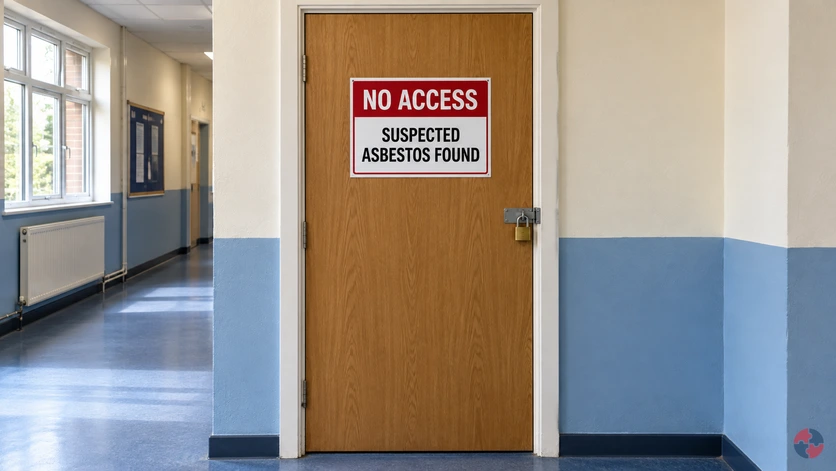
Stop work, prevent entry and report from outside
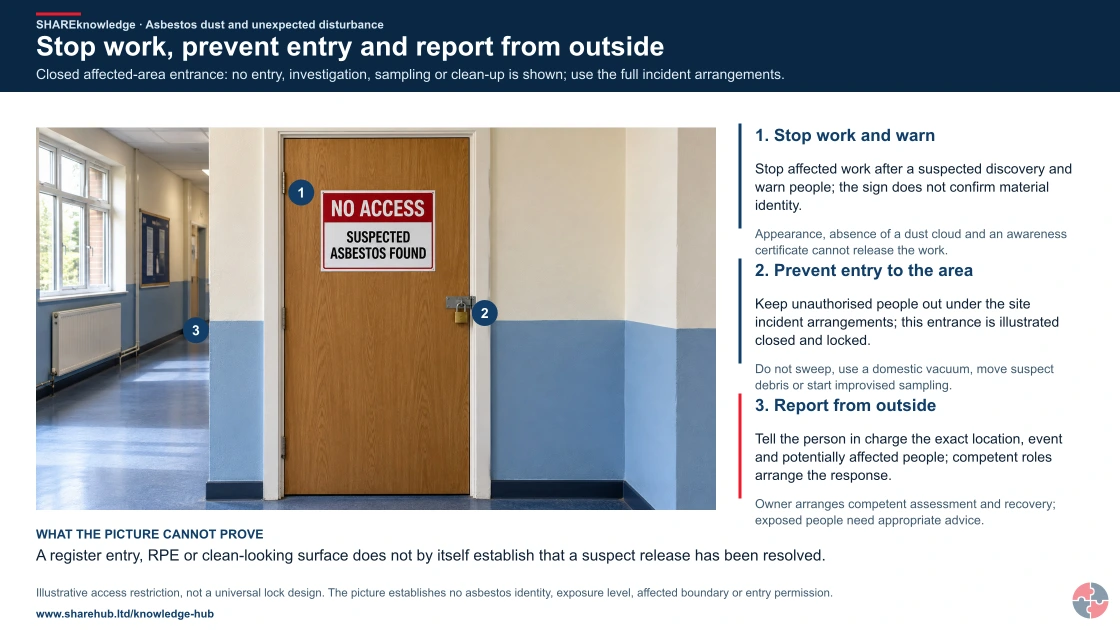
Full written explanation
Closed affected-area entrance: no entry, investigation, sampling or clean-up is shown; use the full incident arrangements.
- Stop work and warn. Stop affected work after a suspected discovery and warn people; the sign does not confirm material identity.
- Prevent entry to the area. Keep unauthorised people out under the site incident arrangements; this entrance is illustrated closed and locked.
- Report from outside. Tell the person in charge the exact location, event and potentially affected people; competent roles arrange the response.
Change the pathway
- Do not continue the task. Appearance, absence of a dust cloud and an awareness certificate cannot release the work.
- No ordinary clean-up. Do not sweep, use a domestic vacuum, move suspect debris or start improvised sampling.
- Competent response. Owner arranges competent assessment and recovery; exposed people need appropriate advice.
Evidence check: A register entry, RPE or clean-looking surface does not by itself establish that a suspect release has been resolved.
Primary references: HSE: asbestos discovery and accidental disturbance (EM1) · HSE worker guidance — disturbance, information and competence boundaries · HSENI managing and working with asbestos — Northern Ireland route
Open the complete HD image (new tab)Download image

Primary references: HSE: asbestos discovery and accidental disturbance (EM1) · HSE worker guidance — disturbance, information and competence boundaries · HSENI managing and working with asbestos — Northern Ireland route
ERICPD stands for Eliminate, Reduce, Isolate, Control, Personal Protective Equipment and Discipline. For asbestos dust, the hierarchy is not theoretical. It helps stop organisations jumping straight to masks and overalls while still allowing uncontrolled fibre release.
The most effective control is not to create the dust. If the work can be rerouted, redesigned, postponed until a survey is complete, or completed after licensed removal, exposure is prevented at source. Where asbestos work is genuinely required, the method must be selected by competent people and controlled through physical, procedural and evidence-based arrangements.
A drilling request in a pre-2000 ceiling must start with the register, survey scope and the exact material, not a mask selection. Avoid the penetration if the fitting can use an existing route. A design that moves the service can substitute for drilling. If asbestos work is genuinely required, the competent contractor chooses the lawful work category and designs any enclosure, controlled wet or low-dust method, Class H equipment, decontamination and clearance appropriate to that task. These are ERICPD Eliminate/Reduce/Isolate/Control mapped to elimination, substitution and engineering; permit and briefing are administrative layers. RPE is a final residual layer and does not make uncontrolled drilling acceptable.
The dutyholder verifies the contractor’s scope, work boundary and occupant protection before starting; the competent contractor checks equipment and method during work and provides the specified completion evidence. ERICPD Discipline means maintaining the controls, capturing defects and updating building information. A missing survey, damaged enclosure, dust outside the boundary, unknown material or changed task is a stop point. The area stays restricted until a competent person has assessed the event and authorised safe hand-back; ordinary housekeeping must not be used to clear suspect debris.
How can the ERICPD hierarchy of controls prevent asbestos disturbance and fibre exposure?

Planning examples must be selected through the asbestos work-category decision. Wetting, shadow vacuuming and decontamination are not general instructions to clean a suspected release: they require the competent task-specific plan, equipment and procedures.
| ERICPD level | Practical asbestos dust application | Evidence to check |
|---|---|---|
| Eliminate | Avoid disturbing asbestos by changing the work, rerouting services, using non-intrusive methods or removing asbestos first where appropriate. | Design review, survey scope, pre-construction information and removal hand-back. |
| Reduce | Reduce the amount of disturbance, time, people exposed and area affected. | Task scope, sequencing plan, exclusion plan and workface briefing. |
| Isolate | Separate people from potential fibre release using barriers, enclosure, locked rooms, exclusion zones or controlled areas. | Signage, barriers, access logs, enclosure checks and supervisor inspections. |
| Control | Use competent plans of work, wetting, shadow vacuuming, H-type vacuuming, decontamination and waste controls where appropriate. | Plan of work, equipment checks, method observations and waste records. |
| PPE | Use suitable disposable clothing, gloves and respiratory protective equipment required by the assessment. | PPE/RPE specification, face-fit records, issue records and doffing checks. |
| Discipline | Train, supervise, stop unsafe work, investigate disturbances and update the management plan. | Training matrix, audit findings, incident reports and action close-out. |
How can the ISO 45001 hierarchy of controls prevent asbestos disturbance and fibre exposure?

Apply this hierarchy through the assessed asbestos work route. No stage authorises an untrained person to disturb material or recover a contaminated area; the actual method and reoccupation evidence are decided by competent people.
| ERICPD level | Practical asbestos dust application | Evidence to check |
|---|---|---|
| Eliminate | Avoid disturbing asbestos by changing the work, rerouting services, using non-intrusive methods or removing asbestos first where appropriate. | Design review, survey scope, pre-construction information and removal hand-back. |
| Reduce | Reduce the amount of disturbance, time, people exposed and area affected. | Task scope, sequencing plan, exclusion plan and workface briefing. |
| Isolate | Separate people from potential fibre release using barriers, enclosure, locked rooms, exclusion zones or controlled areas. | Signage, barriers, access logs, enclosure checks and supervisor inspections. |
| Control | Use competent plans of work, wetting, shadow vacuuming, H-type vacuuming, decontamination and waste controls where appropriate. | Plan of work, equipment checks, method observations and waste records. |
| PPE | Use suitable disposable clothing, gloves and respiratory protective equipment required by the assessment. | PPE/RPE specification, face-fit records, issue records and doffing checks. |
| Discipline | Train, supervise, stop unsafe work, investigate disturbances and update the management plan. | Training matrix, audit findings, incident reports and action close-out. |
How should asbestos dust cleaning, H-type vacuuming and waste be managed?
Cleaning should prevent fibres becoming airborne again and must use asbestos-suitable methods, equipment, waste control and competence.
Cleaning asbestos contamination is not ordinary housekeeping. A broom, compressed-air line, dry rag or domestic vacuum can turn settled contamination into airborne fibre. Even a vacuum labelled HEPA is not automatically suitable for asbestos. HSE asbestos essentials guidance refers to Class H vacuum arrangements and controlled damp methods for specific asbestos tasks.
Cleaning should be planned before work starts and reconsidered after any accidental disturbance. The plan should cover what will be picked up, what will be vacuumed, what will be wiped, how rags and filters become waste, how tools are decontaminated, who is competent to do the cleaning and when the area can be released.
Waste is part of exposure control. Contaminated rags, disposable PPE, filters, sheeting and debris can continue releasing fibres if they are damaged, unlabelled, carried through clean areas or mixed with ordinary waste.
| Control area | Good practice expectation | Common failure to avoid |
|---|---|---|
| Class H vacuum use | Use asbestos-suitable Class H vacuum arrangements where the task method requires them, with competent use, checks and correct attachments. | Using domestic or unsuitable vacuums, damaged hoses, blocked filters or brush attachments that cannot be cleaned. |
| Shadow vacuuming | Capture fibres close to the point of release during permitted controlled tasks. | Holding extraction too far from the source or relying on it while using a poor work method. |
| Wetting and damp methods | Use controlled wetting or damp wiping where appropriate to suppress fibre release. | Over-wetting electrical or fragile areas, damaging filters with wet material or spreading slurry. |
| Damp rags | Use damp rags for minor contamination only where the task method permits it, then treat rags as contaminated waste. | Dry wiping, reusing dirty rags or leaving contaminated cloths in clean areas. |
| Waste packaging | Double-bag or wrap, label and protect asbestos waste from damage. | Unlabelled bags, torn wrapping, dusty skips or ordinary rubble disposal. |
| Tool and area decontamination | Clean or dispose of contaminated tools, attachments, PPE and sheeting under controlled arrangements. | Putting dusty tools back in vans, lockers or shared stores. |
| Release or hand-back | Use competent assessment, cleanliness checks, air monitoring or clearance where required by the work type. | Allowing reoccupation because the area 'looks clean' without suitable evidence. |
What must be checked before a planned Class H clean?
This is an assurance check for the supervisor and trained, authorised operator after the work category and cleaning method have been approved. It is not permission for an untrained worker to clean a suspected release. HSE EM4 says Class H is useful for some non-licensed tasks but is not mandatory for every such task; a domestic HEPA vacuum remains unsuitable. Follow the manufacturer's instructions and the competent plan.
| Hold point | Supervisor or authorised operator checks | If not satisfactory |
|---|---|---|
| Identity and task | Confirm asbestos-suitable Class H equipment, intended dry or wet/dry task, correct supplied attachments and the approved method; use a wet/dry model if water must be removed. | Hold the clean and obtain the specified equipment; a standard dry Class H unit is not a water vacuum. |
| Examination certificate | For hired equipment, check the current examination/test certificate and that it remains valid for the hire period. HSE EM4 says the hire company should examine and test at least every six months. | Do not accept an out-of-date machine; ask the supplier for testing or a replacement. |
| Pre-use condition | Before each use, inspect casing, hose and attachments for damage; confirm adequate suction and whether a fitted low-flow indicator is activated. | Stop, remove defective equipment from service and escalate to the competent supplier or maintainer; do not open or change a contaminated bag yourself. |
Which equipment standards matter?
| Reference | Use | Boundary |
|---|---|---|
| BS 8520-3:2009 | Operation, cleaning and maintenance of Class H vacuums in controlled ACM work. | Equipment guidance; does not classify work, approve incident clean-up or cover all liquid applications. |
| BS EN 1822 | Filter conformity reference for the Class H equipment described in HSE EM4. | A filter label alone does not make a domestic vacuum asbestos-suitable or authorise reoccupation. |
What is the waste movement hold point?
Asbestos-work notification, incident reporting and waste movement are separate decisions. The waste lead verifies classification, intact packaging, appropriate carrier registration where required, a receiving facility authorised for the classified waste and the relevant hazardous or special-waste consignment. Keep the receiving record. Do not substitute an ordinary transfer note where a consignment note is required.
| Nation | Regulator route | Before movement |
|---|---|---|
| England | Environment Agency hazardous-waste guidance. | Check carrier, authorised destination, classification and applicable consignment note. |
| Wales | Natural Resources Wales hazardous-waste guidance. | Check producer, carrier, receiving facility and consignment requirements for the movement. |
| Scotland | SEPA special-waste guidance. | Check carrier and facility authority and the Scottish special-waste consignment route. |
| Northern Ireland | NIEA hazardous-waste movement notice. | Parts A and B ordinarily must reach NIEA at least 72 working hours before movement; exceptions exist. Confirm exact timing and route with NIEA before scheduling. |
What can RPE and PPE do, and what can they not do?
RPE and PPE are last-line protection for a planned asbestos method. They do not prevent release, protect bystanders, authorise entry or turn an untrained person into a clean-up worker.
A competent assessor chooses adequate and suitable RPE for the task, likely exposure, wearer and environment, with face-fit testing for tight-fitting facepieces, checks, supervision and maintenance. Contaminated coveralls, gloves and footwear need a planned removal and waste route. HSG53 supports general RPE selection but does not replace asbestos-specific task guidance. The retained RPE1 sheet is a generic COSHH R1/APF4 sheet, not an asbestos respirator specification. Do not infer a mask type from it or from this page. HSE EM6 places PPE/RPE after avoidance and source controls.
If a control or RPE seal fails, stop the task under the plan and escalate; do not rely on another mask to compensate for an uncontrolled release.
What evidence allows safe reoccupation?
A competent person decides whether material sampling, exposure assessment, air monitoring, independent four-stage clearance or a Certificate for Reoccupation is needed for the actual incident and work.
Incident to Safe Hand Back
Two linked parts · 6 questions. Open Part 2 to complete the route.

Continue to questions 4–6 · Part 2 of 2


Read this visual as text
- Start: An uncontrolled release has occurred and an area is held out of use.
- Question 1: Are affected people, event facts and contamination extent recorded? Decision owner: Premises dutyholder / competent asbestos employer.
- YES: The required evidence or condition is confirmed. CONTINUE → QUESTION 2.
- NO / UNKNOWN — HOLD: Preserve uncertainty and brief the competent incident owner. HOLD → REPEAT QUESTION 1 AFTER CORRECTION.
- Question 2: Has specialist recovery been completed to the approved scope? Decision owner: Premises dutyholder / competent asbestos employer.
- YES: The required evidence or condition is confirmed. CONTINUE → QUESTION 3.
- NO / UNKNOWN — HOLD: Keep the area out of use while contamination or work scope is unresolved. HOLD → REPEAT QUESTION 2 AFTER CORRECTION.
- Question 3: Is independent clearance required for this work? Decision owner: Premises dutyholder / competent asbestos employer.
- Required: Obtain the appropriate scope-verified independent analyst and required evidence. CONTINUE → QUESTION 4.
- Not required: Obtain the cleanliness and hand-back evidence appropriate to the actual work. CONTINUE → QUESTION 4.
- Uncertain: Resolve the requirement with competent asbestos advice before reopening. HOLD → OWNER RESOLVES BEFORE RESUMING.
- Question 4: Has the responsible person checked GB or NI incident reportability? Decision owner: Premises dutyholder / competent asbestos employer.
- YES: The required evidence or condition is confirmed. CONTINUE → QUESTION 5.
- NO / UNKNOWN — HOLD: Record the decision and timing without delaying initial protection. HOLD → REPEAT QUESTION 4 AFTER CORRECTION.
- Question 5: Are register updates, occupancy information and restrictions complete? Decision owner: Premises dutyholder / competent asbestos employer.
- YES: The required evidence or condition is confirmed. CONTINUE → QUESTION 6.
- NO / UNKNOWN — HOLD: Do not treat air results alone as closure. HOLD → REPEAT QUESTION 5 AFTER CORRECTION.
- Question 6: Has the dutyholder accepted the full hand-back evidence? Decision owner: Premises dutyholder / competent asbestos employer.
- YES: The required evidence or condition is confirmed. OUTCOME → RECORD AND HAND OVER.
- NO / UNKNOWN — HOLD: Maintain the restriction until the material, clearance and ownership questions are resolved. HOLD → REPEAT QUESTION 6 AFTER CORRECTION.
- Outcome: Named hand-back with clearance or cleanliness evidence, communication, revised register and incident learning.
- Stop and escalation boundary: No reoccupation while material, contamination, clearance or responsibility is unresolved. Air results alone do not close the case.
Air sampling after a release cannot undo or necessarily reconstruct a short peak exposure. A low result does not by itself prove that every surface is clean or that the original work was safe. Licensed removal may require independent four-stage clearance and a Certificate for Reoccupation under HSG248. Other controlled work may require a documented visual cleanliness and hand-back decision instead. The dutyholder should keep the affected area out of use until the relevant evidence is satisfactory, communicate the decision and update the register.
| Situation | Competent decision | Hand-back evidence |
|---|---|---|
| Planned controlled non-licensed task | Confirm task method, cleaning and waste controls were followed. | Cleanliness check, work record and waste trail appropriate to task. |
| Licensed removal | Confirm independent clearance scope under HSG248. | Satisfactory four-stage clearance and Certificate for Reoccupation where required. |
| Uncontrolled release | Assess material, spread, people, controls, possible exposure, specialist clean-up, monitoring and reportability. | Incident assessment, completed recovery, appropriate clearance or cleanliness decision, communication and register revision. |
Who may confirm the material and hand-back?
Commission the right specialist for the exact question. Check current UKAS accreditation for the activity and method, not just a logo, and keep the scope, analyst independence and report. A low air measurement is evidence for a defined sampling question, never a stand-alone certificate that every surface is clean or that reoccupation is safe.
| Decision | GB position | Release evidence |
|---|---|---|
| Survey and sampling | A competent, impartial surveyor covers the exact work face and limitations. HSE strongly recommends UKAS BS EN ISO/IEC 17020 survey accreditation; it is not universally a legal requirement. | Task-matched survey brief, report, exclusions and competent sampling rationale. |
| Bulk sample analysis | Commissioned asbestos analysis needs an ISO/IEC 17025-accredited laboratory with the relevant UKAS testing scope. | Representative sample, laboratory report and activity-scope check; no photo or dust-colour identification. |
| Air measurement and licensed-work clearance | Commission ISO/IEC 17025-accredited air measurement. Where required, an independent competent analyst completes HSG248 four-stage clearance and a Certificate for Reoccupation. | Sampling and clearance scope, stages and certificate; one low result or visible cleanliness is insufficient. |
| Northern Ireland specialist route | Apply NI law and HSENI guidance; HSENI lists UKAS-accredited testing and inspection providers. | Confirm NI legal, analyst and accreditation scope with HSENI and the provider; use the task-specific competent clearance decision, not a GB form. |
| Other incident recovery | Not every incident follows licensed four-stage clearance, but every affected area needs a documented competent cleanliness and hand-back decision for its actual contamination. | Material and spread assessment, specialist recovery record, suitable checks, dutyholder sign-off and register update before reoccupation. |
How are affected people and reporting decisions handled?
Record facts and provide an appropriate health-advice route; the responsible person checks reportability against the regulator's threshold rather than reporting every concern automatically.
Capture who may have been present, task, material, time, possible spread, controls and the competent exposure estimate. Tell affected people what is known, uncertain, being assessed and when they will hear more. HSE says routine X-rays are not advocated after inadvertent exposure; individuals with concerns can seek medical advice and ask that the event be noted. Do not promise that a single event is harmless or diagnose risk from visible dust.
In Great Britain, HSE says a work activity's accidental airborne release is RIDDOR-reportable when the quantity is sufficient to cause damage to health; an employer or responsible person must assess the facts and record the decision. In Northern Ireland check HSENI's distinct RIDDOR (NI) route. Separate asbestos-work notification from incident reporting: neither replaces the other.
The responsible person records the GB or NI reportability decision, owner, facts and reason after the area is isolated. In GB, HSE describes a dangerous occurrence where a work activity accidentally releases airborne asbestos fibres in a quantity sufficient to risk health; not every encounter meets that threshold. NI uses its separate 1997 RIDDOR route. Seek regulator advice when uncertain and meet the applicable deadline if reportable.
A suspected release may cause understandable worry. Give affected people clear facts about the assessment, controls and follow-up route without presenting worry as an asbestos disease or diagnosing anyone.
What asbestos dust records and health surveillance evidence are needed?
Records should show what happened, who may have been exposed, what controls were used, what advice was obtained and what long-term records are required.
For routine asbestos management, records include register checks, survey reviews, plans of work, training, equipment checks, permits, waste records and supervision. For accidental disturbance, the record should also capture the event timeline, people present, task, material, photos where safe, suspected spread, immediate actions, competent advice and lessons learned.
Licensed asbestos work and notifiable non-licensed work have specific medical surveillance and health-record requirements. Employer health records are not the same as a doctor's confidential medical record. The employer record should allow a view of the nature, duration and typical degree of exposure; the medical record is held under medical confidentiality.
For Great Britain, HSE's asbestos ACOP explains that relevant employer health records should be kept for 40 years after the last entry or until the employee reaches age 80, whichever is longer. Certificates of examination should be kept by the employer for at least four years.
| Record type | What it should include | Retention or review point |
|---|---|---|
| Register and survey check | Location, material, survey scope, limitations and work-area match. | Reviewed before work and after change, damage or new information. |
| Plan of work or RAMS | Material, method, controls, RPE/PPE, cleaning, waste, emergency action and supervision. | Reviewed before work and after any deviation or disturbance. |
| Accidental disturbance record | Task, location, people present, material, spread, actions, competent advice and outcome. | Kept as incident evidence and used for learning. |
| Exposure estimate | Nature and duration of exposure, likely fibre release, controls, RPE/PPE and sampling evidence where available. | Used to support health records and advice. |
| Employer health record | For licensed work and NNLW, records of relevant asbestos work and medical examination dates. | Great Britain: 40 years after last entry or until age 80 where longer, following L143 guidance. |
| Medical examination certificate | Confirmation and date of required medical examination. | Great Britain: kept by the employer for at least four years. |
| Training and competence record | Awareness, task-specific training, NNLW or licensed-work competence and refresher triggers. | Reviewed after incidents, changes, poor observations or expired competence. |
| NI health record and surveillance | Record asbestos work, exposure and medical information required under NI regulation 22 and use HSENI routes. | Retain employer health records for at least 40 years after the last entry under NI regulation 22; check NI medical-examination and certificate rules. GB L143 age-80 advice is not an NI ACOP. |
Which law and regulator route applies?
Asbestos-specific 2012 Regulations are the primary exposure regime: HSE's Great Britain route and the separate HSENI Northern Ireland route must not be merged.
| Route | Decision and evidence |
|---|---|
| Great Britain: Control of Asbestos Regulations 2012 | Identify or presume asbestos before work; prevent or reduce exposure and spread; use assessed plans, competence, licence/NNLW notification, emergency procedures and records as applicable. |
| Northern Ireland: Control of Asbestos Regulations (Northern Ireland) 2012 | Use NI asbestos duties, HSENI licence and notification routes, and local work and emergency arrangements. A GB notice is not NI authority. |
| Great Britain incident reporting | The responsible person applies GB RIDDOR 2013. HSE says an accidental airborne fibre release from work is reportable when sufficient to risk health; record the facts and decision, and report through the GB route if the threshold is met. |
| Northern Ireland incident reporting | The responsible person applies the separate Northern Ireland RIDDOR 1997 route and HSENI guidance; record the facts and decision, and use the NI reporting form and deadline if reportable. Do not use GB criteria or forms as NI authority. |
| Waste and construction interfaces | Use the relevant GB or NI construction information and nation-specific waste classification, packaging, carrier and consignment arrangements. |
COSHH is not the general legal substitute for asbestos-specific exposure controls. Other hazardous dusts may need separate COSHH assessment; do not use the generic retained RPE1 COSHH sheet to determine asbestos protection. Check current law and regulator guidance for the exact site and task.
What should an asbestos dust risk register include?
An asbestos dust risk register should describe credible fibre-release scenarios, preventing barriers, response controls and assurance evidence.
A risk register entry should be scenario based, not a generic line saying 'asbestos dust'. Useful wording identifies the work, material, route to exposure and failed barrier. For example: 'electrician drills through presumed asbestos insulating board in an unsurveyed riser because the cable route changed after the pre-start briefing'.
That wording points to real controls: survey scope, change control, register access, permit or hold point, supervisor check, stop-work authority and contractor briefing. It also supports later review because the scenario connects the hazard, task, control and evidence.
| Credible event | How exposure or spread occurs | Preventing barriers | Mitigation and response | Assurance evidence |
|---|---|---|---|---|
| Drilling into hidden AIB | Tool releases fibres and debris into a riser or occupied area. | Survey scope, register check, permit hold point and stop-work trigger. | Stop, isolate, assess, clean up competently and record exposure. | Permit sample, register access log, supervisor observation and incident review. |
| Dry sweeping after ceiling collapse | Settled asbestos-containing dust is re-suspended and spread through rooms. | Emergency procedure, awareness training and prohibition on dry cleaning. | Restrict access, competent contamination assessment and specialist clean-up. | Emergency drill, cleaning contractor approval and investigation actions. |
| Breaking asbestos cement sheets | Fragments and dust spread during roof or cladding removal. | Work-category decision, intact removal method, wetting, access control and waste route. | Pause work, review method, clean debris and update plan. | Supervisor photos, waste records and method audit. |
| Generic contractor RAMS | Controls do not match actual material, location or survey limitations. | RAMS review, pre-start walkdown and contractor competence checks. | Reject method, rebrief and reassess before work. | Approved supplier record, RAMS comments and close-out. |
| Poor RPE programme | Workers wear masks that do not fit or are used incorrectly. | RPE selection, face-fit testing, clean-shaven rules, training and supervision. | Stop task, replace/fit-test RPE and review exposure. | Fit-test records, observations and maintenance logs. |
| Waste bag damaged in transit | Contaminated waste releases fibres in corridors, lifts, skips or vehicles. | Waste packaging, protected route, labelled bags and trained handlers. | Secure area, clean up competently and review waste route. | Waste audits, consignment records and route checks. |
How do real dust concerns change the decision?
These BuildOut Ltd examples show the hold points from first suspicion through controlled hand-back; none is a clean-up method.
Stop the dust route without spreading it


Read this visual as text
- The drill is off and the affected corridor is held. Warn others and prevent entry; workers must not brush, vacuum, sample or carry debris through the building as an improvised cleanup.
- STOP DISTURBANCE
- PREVENT SPREAD
- GET COMPETENT HELP
The stopped drill and held corridor show an incident boundary. The specialist assessment must also consider possible transfer by people, tools, clothing and nearby access. Do not brush, sample, vacuum or transport debris as an improvised response. Recovery requires the appropriate work category, competent people, task-specific method and hand-back evidence.
Debris on a corridor floor
Task material and setting: Suspect fragments beneath a pre-2000 ceiling; the identity is unknown.
People and prerequisites: Caretaker, occupants and dutyholder; register and survey available but no clean-up authorisation.
Before: Stop access and compare the exact ceiling location with the register; keep people on a clean route.
During: Supervisor contains access and obtains competent inspection without moving debris.
Hold or stop: Do not sweep, bag by hand or assume visible fragments are asbestos free.
Completion and hand back: Specialist decides material, clean-up and reoccupation evidence; dutyholder updates register.
Evidence: Photographs from safe position, survey scope, incident log and hand-back.
Unsurveyed ceiling penetration
Task material and setting: Electrician starts a cable hole in an unsurveyed void and sees dust.
People and prerequisites: Trade, supervisor and adjacent office occupants; intrusive route not covered.
Before: Check the work route against survey limitations before drilling.
During: If dust appears, stop, withdraw, warn others and control corridor traffic.
Hold or stop: No finishing the hole, dry wiping or ordinary vacuuming; hold other void work.
Completion and hand back: Competent sampling or presumption, recovery and redesigned route before release.
Evidence: Job pack, survey limitation, affected people, assessment and revised permit.
Damaged pipe lagging
Task material and setting: Maintenance finds crumbling insulation in a plant room.
People and prerequisites: Maintainer, dutyholder and licensed asbestos contractor potentially needed.
Before: Keep maintenance out; supply pipe history, register and prior repair records.
During: Prevent access and await competent assessment of damage and spread.
Hold or stop: No taping, wrapping, patching or handling by ordinary maintenance staff.
Completion and hand back: Licensed route where required, appropriate clearance and register update.
Evidence: Material decision, contractor licence, plan, clearance and handover.
Broken asbestos cement at waste point
Task material and setting: Forklift damages wrapped sheets at an outdoor collection point.
People and prerequisites: Waste team, carrier and public boundary; site waste plan.
Before: Agree classification, secure packaging and labels, appropriately registered carrier where required, authorised receiving facility, nation-specific consignment and any NI movement pre-notification before movement.
During: Stop movement, segregate area and escalate broken packaging.
Hold or stop: No ordinary skip, unprotected hand collection or casual rewrapping.
Completion and hand back: Competent recovery, receiving-site acceptance and nation-specific waste consignment trail; the asbestos-work notice is a separate decision.
Evidence: Damage report, packaging check, carrier registration, facility authorisation, consignment and receipt; NIEA notice where applicable.
Negative pressure alarm
Task material and setting: Alarm sounds during licensed removal in an enclosed room.
People and prerequisites: Licensed contractor, analyst, supervisor, dutyholder and occupants.
Before: Confirm contingency, alarm response and communication in plan.
During: Specialist stops planned work and applies its emergency procedure; dutyholder holds adjacent access.
Hold or stop: No reopening because alarm resets; verify containment and any escape.
Completion and hand back: Specialist verification, independent clearance where required and formal hand-back.
Evidence: Alarm log, fault investigation, monitoring, clearance and signed release.
Two contractors share a riser
Task material and setting: One contractor disturbs suspect boxing beside another team.
People and prerequisites: Client, facilities manager and two contractor leads.
Before: Share register, survey and work limits with both teams.
During: Stop both tasks, separate teams and assess potential spread.
Hold or stop: No follow-on installation or parallel work inside affected zone.
Completion and hand back: Competent recovery, coordinated restart and revised information to both teams.
Evidence: Briefings, access log, assessment, revised plan and hand-back.
Possible dust tracked to a clean room
Task material and setting: Worker leaves a suspect work zone with dusty boots and tools.
People and prerequisites: Worker, supervisor, occupants and facilities team.
Before: Plan boundary and decontamination for any authorised task.
During: Stop movement, protect clean areas and identify route and people.
Hold or stop: No ordinary cleaning of boots, tools, van or corridor.
Completion and hand back: Specialist assesses route, equipment and occupied areas before release.
Evidence: Movement timeline, affected zones, clean-up evidence and communication.
Stone with possible natural asbestos
Task material and setting: Cutting imported or quarried decorative stone with an uncertain source.
People and prerequisites: Stone team, supplier and competent analyst; AM1 applies only to some stone.
Before: Check provenance and competent assessment; do not assume all stone contains asbestos.
During: If suspicion arises, stop cutting and control the area while identity is assessed.
Hold or stop: Do not use AM1 as proof that every stone dust is asbestos; do not resume on appearance.
Completion and hand back: Apply asbestos route only if supported; separately control respirable crystalline silica or other dust.
Evidence: Supplier evidence, analytical result, dust assessment and revised method.
How could BuildOut Ltd manage asbestos dust?

BuildOut Ltd could manage asbestos dust by treating fibre release as a controlled work scenario, not a housekeeping issue.
BuildOut Ltd
BuildOut Ltd is a construction and refurbishment contractor used to show how asbestos dust control works in real projects, occupied buildings, emergency repairs and subcontractor-led tasks.
BuildOut works across refurbishments, maintenance frameworks and occupied premises. Its asbestos dust risk comes from drilling, ceiling access, riser works, floor lifting, roof sheet work, plant-room repairs, soft strip, emergency leaks and subcontractor activity. The company therefore manages asbestos dust through tender review, survey scope, work planning, contractor approval, site supervision, stop-work escalation and incident learning.
At tender stage, BuildOut asks whether the property was built or refurbished before 2000, requests asbestos registers and surveys, and checks whether planned works are intrusive. If survey information is missing, limited or mismatched to the planned work area, the project is held until the client obtains suitable information. The commercial team is not allowed to price a risky shortcut as a productivity gain.
Before site work starts, the project manager adds asbestos dust scenarios to the project risk register: drilling risers, chasing walls, lifting old floor tiles, removing ceilings, repairing plant lagging, working on roof sheets and cleaning suspect debris. Each scenario has named barriers: survey check, method review, supervisor hold point, RPE/PPE specification where relevant, waste route, cleaning method and emergency stop-work response.
BuildOut manages contractors through evidence. Awareness training is required for those liable to encounter asbestos. Task-specific competence is required for any non-licensed asbestos work. NNLW and licensed work are separated from ordinary trade activities. Licensed contractors are checked before appointment, and generic RAMS are rejected if they do not identify the actual material, location, condition and dust-control method.
Assurance is layered. Frontline supervisors complete simple binary checks before intrusive work: survey seen, location matched, stop-work rule briefed, dust method agreed, waste route defined. The HSE adviser samples projects for quality: survey limitations, contractor competence, RPE programme, accidental disturbance drills and action close-out. Senior managers review stopped jobs, asbestos discoveries, contractor failures, exposure records and repeated survey gaps to improve procurement, planning and training.
| Management area | How BuildOut applies it | Evidence, oversight and improvement |
|---|---|---|
| Risk register and planning | Records asbestos dust scenarios for each project and links them to survey scope, work category, method, supervision and stop-work barriers. | Project risk register, survey-scope review, permit or hold-point checklist and action tracker. |
| Survey and register control | Checks that survey information matches the actual work area and pauses work where scope changes. | Register extract, drawings, photos, limitations review and pre-start sign-off. |
| Contractor management | Separates awareness, non-licensed, NNLW and licensed competence and rejects generic RAMS. | Approved supplier list, training evidence, licence checks, RAMS comments and site audits. |
| Equipment and controls | Uses controlled wetting, H-type vacuum arrangements, RPE/PPE and waste routes only where the task assessment and work category support them. | Equipment inspection, face-fit records, method observations and waste documentation. |
| Training and communication | Briefs trades on where asbestos dust may arise, what not to clean, how to stop work and who to contact. | Induction, toolbox talks, knowledge checks and supervisor observation records. |
| Incident learning | Investigates suspect dust and asbestos disturbance to find failures in survey scope, planning, contractor control or supervision. | Investigation reports, exposure records, revised procedures and management review. |
| Continuous improvement | Uses trends from stopped jobs, near misses, audits and contractor defects to improve procurement and project planning. | Monthly dashboard, lessons learned, supplier feedback and updated training matrix. |
What asbestos dust training is required?
Training must match the role, because recognising asbestos dust, avoiding disturbance and carrying out asbestos work are different competence levels.
Everyone who may encounter asbestos needs to understand the stop-work rule. However, awareness training does not authorise asbestos work or asbestos dust clean-up. People who carry out non-licensed asbestos work need task-specific training. People supervising NNLW or licensed work need deeper competence and formal controls.
Training should be practical. A worker should be able to explain where asbestos dust may arise, why ordinary cleaning is unsafe, how to check the register, when to stop, how to report, what RPE/PPE limitations mean and why a survey limitation matters. Supervisors should be able to challenge generic RAMS and pause work when the area or method changes.
| Role and learning | Practice on the actual task | Competence evidence and record | Assessor and reassessment trigger |
|---|---|---|---|
| Workers: stop and contain disturbance | Recognise suspect material, stop work, leave safely, keep others out and report before touching debris. | Observed scenario and correct isolation/report route. | Supervisor rechecks after a new task, area or incident. |
| Supervisors: hold and protect the area | Secure access, avoid spreading dust, preserve task details and call a competent asbestos lead. | Observed hold, people check and handover record. | Dutyholder rechecks after changed material, scope or control failure. |
| Asbestos specialists: assess and plan | Identify material and work category, choose sampling/cleaning controls and competent contractor or analyst. | Documented assessment, method and independent check where required. | Technical peer reviews after unexpected finding or method change. |
| Occupational health: handle exposure concern | Take incident and exposure facts, advise clinical referral, confidentiality and records without implying instant diagnosis. | Qualified advice and restricted follow-up record. | Clinical lead reviews after symptoms or new exposure evidence. |
| Dutyholders and waste leads: assure hand-back | Check cleaning, waste route, clearance evidence, register update and incident learning before reopening. | Signed release, waste record and closed corrective actions. | Accountable lead reviews after failed clearance or recurrence. |
Record observed task decisions, assessor and reassessment trigger; attendance alone does not establish competence.
How does asbestos dust support study and professional development?
Asbestos dust is a strong learning topic because it connects hazardous substances, construction health risk, exposure control, legal duties, competence and evidence.
For NEBOSH National General Certificate learners, asbestos dust supports GNC hazardous-substance learning because it demonstrates routes of entry, chronic disease, carcinogenic exposure, limitations of PPE, control hierarchy, health surveillance and why absence of symptoms does not prove safety.
For NEBOSH Construction Certificate learners, asbestos dust sits strongly in CN1-12 chemical and biological agents. Good scenario answers should mention pre-2000 buildings, asbestos registers, refurbishment or demolition surveys, contractor competence, stop-work triggers, dust spread, RPE/PPE limitations, waste control and exposure records.
For practising managers, professional development should focus on recognising weak real-world systems: surveys not matching the job, contractors working from generic RAMS, workers cleaning suspect dust, RPE being used as the main control, and near misses that are cleaned up but not investigated.
| Learning route | What the learner should understand | Scenario-based application |
|---|---|---|
| NEBOSH National General Certificate - GNC 7.5 | Asbestos dust as a hazardous substance exposure, carcinogen and chronic disease risk. | Explain how workers could be exposed during maintenance and why controls must prevent release before relying on RPE. |
| NEBOSH Construction Certificate - CN1-12 | Asbestos dust as a construction chemical agent requiring survey, planning and contractor control. | Advise a site manager after an electrician drills into suspect board above a suspended ceiling. |
| Supervisor development | Register checks, stop-work triggers, RPE/PPE limits, cleaning controls and contractor challenge. | Pause work where a generic RAMS does not mention asbestos survey limitations. |
| Dutyholder development | Management plan, reinspection, communication, emergency procedure and action close-out. | Review whether known damaged asbestos could release dust during routine maintenance. |
| Specialist development | Work classification, air monitoring, clearance, exposure assessment and analytical quality. | Decide when reassurance monitoring, clearance or licensed contractor input is needed. |
How can ISO 45001 support asbestos dust management?
ISO 45001 can help turn asbestos dust controls into a managed system with ownership, competence, evidence and improvement.
ISO 45001 does not replace asbestos law or specialist competence. Its value is to make the organisation manage the topic consistently: roles, legal requirements, planning, competence, documents, procurement, emergency response, monitoring, audit and corrective action.
The themes below show how a management-system approach can support asbestos controls; they do not reproduce or verify the standard’s clause text.
| Management-system theme | What this means | How it supports asbestos dust management |
|---|---|---|
| Organisational roles, responsibilities and authorities | Name owners for work release, area isolation, clean-up appointment and hand-back. | Defines who owns asbestos registers, survey review, contractor approval, dust controls and emergency response. |
| Consultation and participation of workers | Act on reports of unknown material, poor register access or pressure to clean. | Uses worker feedback on unknown materials, poor access to registers and unsafe cleaning pressure. |
| Hazard identification and assessment of risks and opportunities | Assess material, disturbance, spread and affected people before releasing work. | Identifies credible fibre-release scenarios during maintenance, refurbishment and cleaning. |
| Determination of legal requirements and other requirements | Select the applicable GB or NI work, record, reporting and waste route. | Maintains asbestos, COSHH, CDM, PPE, reporting and waste legal requirements. |
| Competence | Check task training, licence where required and survey or analytical scope. | Controls competence for trades, supervisors, asbestos workers, surveyors, analysts and contractors. |
| Awareness | Check that people stop, withdraw, prevent entry and report suspect dust. | Ensures people know asbestos dust stop-work triggers and what not to clean. |
| Documented information | Keep survey limits, work plans, exposure evidence and hand-back records usable. | Controls register extracts, surveys, RAMS, exposure records, fit tests, waste records and incident learning. |
| Operational planning and control | Hold unplanned cleaning and disturbance until competent controls are in place. | Controls intrusive work, cleaning, waste, permits, contractor activity and hand-back. |
| Procurement | Verify equipment suitability, current hire certificate and specialist scope. | Checks asbestos contractor competence, RPE provision, equipment hire and survey provider suitability. |
| Emergency preparedness and response | Practise stop-work, isolation and out-of-hours competent escalation. | Tests accidental disturbance response and out-of-hours access to asbestos information. |
| Monitoring, measurement, analysis and performance evaluation | Verify control evidence, exposure records and overdue corrective actions. | Reviews audit findings, exposure records, stopped jobs, RPE checks and training currency. |
| Incident, nonconformity and corrective action | Investigate release pathways and verify correction before similar work resumes. | Investigates disturbances and verifies corrective actions. |
What enforcement learning shows why asbestos dust control matters?
HSE enforcement cases show that asbestos dust failures often involve poor planning, weak survey use, unlicensed work, poor contractor control and unsafe clean-up.
A useful enforcement lesson is the large-scale asbestos disturbance prosecution publicised by HSE in 2026. The case involved demolition work where asbestos was discovered, a refurbishment and demolition survey later identified significant asbestos-containing materials and debris, and HSE found serious planning and management failures. The learning for asbestos dust is direct: once demolition or refurbishment creates debris, the issue is no longer theoretical register management; it is potential fibre release, spread, contractor competence and clean-up control.
The practical lesson is that clients and contractors should not rely on a management survey for intrusive work, should not allow unlicensed or incompetent clean-up, and should not treat asbestos debris as a normal site waste problem. If the right survey, contractor and control decisions are not made before disturbance, the site can quickly create exposure, public risk, regulatory action and major delay.
HSE enforcement also reinforces a management-system point. The dutyholder must be able to show how asbestos information was obtained, communicated and acted upon, and how work was stopped or changed when new information appeared.
| Failure theme | How it creates asbestos dust risk | Good management response |
|---|---|---|
| Wrong survey for the work | Hidden asbestos is disturbed because intrusive areas were not surveyed. | Use refurbishment or demolition surveys before intrusive work. |
| Uncontrolled demolition or strip-out | Materials are broken and spread through debris and dust. | Plan asbestos removal or control before demolition activity. |
| Incompetent clean-up | Debris is moved or cleaned without licensed or competent arrangements. | Use competent asbestos contractors and analysts where required. |
| Weak client and contractor coordination | Dutyholders assume another party has managed asbestos information. | Use CDM coordination, pre-construction information and clear responsibilities. |
| Poor learning after discovery | The immediate issue is cleared but similar areas remain uncontrolled. | Investigate, check similar areas, update registers and improve procurement controls. |
What are the warning signs that asbestos dust is not being managed well?
Weak asbestos dust management shows up as poor survey use, dry methods, unsafe cleaning, weak RPE control, poor contractor evidence and repeated stop-work events.
Warning signs should be treated as evidence that barriers are weak. A single dusty ceiling tile, unlabelled debris bag or worker using a broom near suspect material may reveal a much wider problem: the register is not being used, supervisors are under pressure, contractors are not briefed or people do not understand asbestos dust.
The right response is to correct the system, not only the visible defect. Each warning sign below explains the harm route and the immediate improvement action.
| Warning sign | How it can cause harm | How it may show up | Immediate improvement |
|---|---|---|---|
| Workers clean suspect dust themselves | Sweeping or wiping can re-suspend fibres and spread contamination. | Brooms, dry rags, ordinary vacuums or dusty waste bags. | Stop cleaning, isolate area and obtain competent advice. |
| Survey scope does not match the job | Work reaches unsurveyed voids or materials and releases fibres. | Cable route, ceiling void or riser not covered by the survey. | Pause work and review survey adequacy. |
| Generic RAMS | Controls are not matched to the actual asbestos material or condition. | Method says 'avoid asbestos' but gives no location-specific controls. | Reject and revise RAMS before work. |
| RPE is used as the main control | Fibres are still released and may expose others or contaminate the area. | Masks worn while dry drilling, cutting or sweeping continues. | Move up the hierarchy and prevent release at source. |
| Class H vacuum not checked | A defective or unsuitable vacuum may spread fibres instead of controlling them. | Damaged hose, full container, no inspection record or wrong hire equipment. | Quarantine equipment and verify suitability. |
| Waste is not labelled or protected | Contaminated waste can release fibres during handling or transport. | Torn bags, unwrapped debris or mixed skips. | Secure waste and review the waste route. |
| Stop-work reports are rising | The site is repeatedly finding asbestos late rather than planning it out. | Repeated discoveries during similar tasks. | Review survey strategy, client information and planning controls. |
| No exposure record after disturbance | People may lack evidence later and the business cannot show what happened. | Incident closed as housekeeping with no people, task or advice record. | Record exposure scenario and obtain competent assessment. |
Chemical hazard symbols: what do they mean?
Exploding bomb
Explosive, self-reactive or organic peroxide hazards.
Flame
Flammable, self-heating or pyrophoric substances.
Flame over circle
Oxidising substances that can intensify fire.

Gas cylinder
Gas under pressure.
Corrosion
Skin burns, eye damage or corrosive to metals.
Skull and crossbones
Acute toxicity.

Exclamation mark
Irritation, harmful effects or skin sensitisation; some classifications cover drowsiness, dizziness or ozone-layer hazard. Read the actual hazard statements. Skin sensitisation differs from respiratory sensitisation.
Health hazard
Serious health hazards, including organ damage, aspiration hazard, respiratory sensitisation, cancer and reproductive effects; some can follow a single exposure.
Environment
Hazardous to the aquatic environment.
Standards named on this page are background context. Confirm the current edition, scope and exact requirements from an authorised copy before applying them. The open official sources below support the specific public-law and regulator guidance claims they are cited for.
What do the acronyms and key terms mean?
Acronyms should be defined so readers can understand the controls, records and official guidance.
| Acronym or term | Full wording | Meaning in this topic |
|---|---|---|
| ACM | Asbestos-containing material | Any material or product that contains asbestos. |
| AIB | Asbestos insulating board | A higher-risk board product often linked with fibre release when disturbed. |
| CAR 2012 | Control of Asbestos Regulations 2012 | The main Great Britain asbestos legal framework. |
| NNLW | Notifiable non-licensed work | Non-licensed asbestos work with additional notification, medical surveillance and record requirements. |
| RPE | Respiratory protective equipment | Respirators or breathing apparatus used to reduce inhalation exposure where the assessment requires it. |
| PPE | Personal protective equipment | Protective clothing, gloves and other items used as part of the control system. |
| APF | Assigned protection factor | A measure used in RPE selection to understand the protection level expected from correctly selected and used equipment. |
| HEPA | High-efficiency particulate air | A filtration term; a domestic vacuum with HEPA claims is still not suitable for asbestos dust. |
| Class H vacuum | High-hazard dust vacuum cleaner | Specialist vacuum type used for asbestos and other high-hazard dusts where required. |
| RAMS | Risk assessment and method statement | Document explaining the task, risks and work method; for asbestos it must be site and task specific. |
| UKAS | United Kingdom Accreditation Service | Accreditation body relevant to asbestos surveying, analysis and testing services. |
| Certificate for Reoccupation | Clearance certificate after relevant asbestos work | Evidence that required clearance stages have been completed satisfactorily before reoccupation. |