SHARE Knowledge Hub
Brucellosis and occupational exposure
Brucellosis is a rare but important occupational zoonotic infection caused by Brucella bacteria, usually linked to infected animals, reproductive tissues, blood, unpasteurised dairy products or infectious laboratory cultures. In UK workplaces it is most relevant to farming, veterinary work, abattoirs, animal research, laboratories, imported animals and animal-contact settings because exposure can occur through skin breaks, eyes, mouth, inhalation of aerosols or ingestion. Prevention depends on COSHH assessment, biosecurity, avoiding raw dairy exposure, safe handling of birth products and carcasses, containment of laboratory work, hygiene, suitable personal protective equipment, exposure reporting, worker information and prompt medical assessment where compatible symptoms follow relevant exposure.
Understanding Brucellosis and occupational exposure
Brucellosis is a rare but important occupational zoonotic infection caused by Brucella bacteria, usually linked to infected animals, reproductive tissues, blood, unpasteurised dairy products or infectious laboratory cultures. In UK workplaces it is most relevant to farming, veterinary work, abattoirs, animal research, laboratories, imported animals and animal-contact settings because exposure can occur through skin breaks, eyes, mouth, inhalation of aerosols or ingestion. Prevention depends on COSHH assessment, biosecurity, avoiding raw dairy exposure, safe handling of birth products and carcasses, containment of laboratory work, hygiene, suitable personal protective equipment, exposure reporting, worker information and prompt medical assessment where compatible symptoms follow relevant exposure.
Why this matters at work
After a potentially significant occupational exposure, use the established clinical and occupational-health route rather than waiting for illness or an internal report to be complete. Severe or rapidly worsening illness needs appropriate urgent help. Managers should facilitate access and provide exposure facts without prescribing tests, antibiotics or prophylaxis. Keep clinical records with healthcare services and restrict the employer record to necessary exposure, support and functional information. An animal test or laboratory incident record can inform but cannot replace individual assessment. Continue technical investigation of the exposure pathway and protective measures while clinical decisions proceed separately.
A test result has a purpose, specimen, timing and interpretation specific to the animal, person or agent. A negative screening result cannot establish absence of every exposure risk or approve every subsequent procedure. Livestock disease-free status concerns specified populations and organisms; it does not demonstrate absence of canine infection or remove laboratory risks from imported cases. Brucella species do not all have identical host ranges, test characteristics or animal-control rules. Obtain competent veterinary or laboratory interpretation and preserve uncertainty in the task assessment. For dogs, origin and contacts matter, including links between locally born animals and imported infected animals or reproductive material. Record the actual history, material and planned work and decide how protection changes while information is incomplete. Do not transfer culture-handling instructions to routine contact or assume that ordinary contact controls suffice for aerosol-generating specimen work. Communicate relevant information before material is opened or sent elsewhere. The safe method must follow the procedure and credible exposure route, not one reassuring label.
How organisations manage this in practice
Preserve the event record and relevant material information while protecting clinical confidentiality. Coordinate sender, recipient and transport interfaces to determine why the warning did not reach the right person before opening. Review delays, changed recipients and information updates as well as packaging and task controls. Identify the applicable GB or NI workplace and animal or public-health routes with competent advice. Correct the transfer system and verify the change rather than closing the incident with a reminder to read forms. An animal result cannot diagnose exposed workers, and a lack of immediate symptoms cannot demonstrate that the incident required no further professional assessment.
Identify whether the question concerns a worker, animal, specimen or culture, then establish the species or suspected agent, animal origin and contacts, relevant reproductive or clinical history, material and procedure. Contact with bodily fluids, aerosols, sharps or contaminated surfaces presents different exposure opportunities. A national disease-free designation or apparently healthy animal does not settle every task, and country of birth alone cannot replace contact history. Obtain veterinary or laboratory interpretation for test and animal decisions and competent advice for workplace containment and exposure control. Record missing information and how uncertainty changes the safe method rather than allowing an administrative form to classify an animal. Include cleaning, waste, transport and others receiving material. GB and NI have separate workplace and animal-reporting routes. Human symptoms require clinical assessment; a positive canine result does not diagnose a worker, and a negative screening result cannot authorise every procedure. The guide is not a laboratory protocol, a prophylaxis prescription or authority to handle infected material.
Anyone with fever, sweats, extreme tiredness, headache, loss of appetite, back pain or joint pain after relevant animal, dairy, travel or laboratory exposure should seek medical assessment and explain the exposure history. Suspected animal disease, workplace exposure or laboratory exposure should be reported through the organisation's procedures and the appropriate public-health, veterinary or regulatory route.
Keep animal, clinical and employer routes distinct
Identify species/material, task, exposure route and nation before choosing the next authority. A suspect animal event, human illness and laboratory exposure can create parallel responsibilities; completing one notification does not close the others.
Provide factual exposure information promptly while qualified advisers decide clinical follow-up and task-specific controls. B. canis, livestock abortion materials, raw dairy and culture work must not share an unqualified answer. Restrict health information and give the operational team only the controls they need.
Livestock material and an unexpected laboratory culture
Illustrative example. In separate teaching cases, farm staff encounter aborted-calf material and a laboratory receives an unexpected culture identification.
Decision. Use the relevant veterinary/biosecurity route in the farm case and biosafety/clinical exposure route in the culture case, with individual care handled independently.
Evidence to check. Record species/material, task, time, route, containment and advice; distinguish specimen from culture.
Hold or escalation point. Do not send human illness only to an animal authority or treat routine patient blood as automatically equivalent to culture work.
Follow-up. The responsible owners verify the amended controls and complete each applicable route separately.
Contain the source and record the exposure route
Treat suspected animal material and a suspected laboratory culture as different work scenarios. Neither appearance nor a general risk label establishes infection status or the correct handling method.

- Livestock source / contact routes
- Assessed work boundary
- Laboratory advice is a separate inset
Read the labels in the full-size drawing
- ANIMAL MATERIAL ROUTE
- WORKER CLINICAL ROUTE
- LAB CULTURE: SEPARATE
- ADVICE
- Separate responsibilities; connect necessary evidence
Livestock material
Identify possible skin/broken-skin, eye/mouth and airborne contact for the assessed task. Restrict unnecessary disturbance and use the competent animal-health plan and source boundary.
Suspected laboratory culture
Stop unnecessary manipulation and obtain designated laboratory/biosafety advice. A culture exposure is not interchangeable with routine processing of every patient blood sample.
Separate follow-up routes
The animal-health authority handles the animal concern; the qualified clinical/OH route assesses worker exposure and care. The employer records work controls and necessary facts without making a diagnosis.
No collection procedure, disinfectant recipe, waste method, laboratory containment level or respirator prescription is given here. Use the current specialist route and the exact source/task evidence.
What is the health and advice boundary for brucellosis?
This page supports workplace risk management and learning; it does not diagnose or treat brucellosis.
Brucellosis symptoms can resemble flu or other infections, so workplace personnel should not try to diagnose it. The practical workplace role is to prevent exposure, recognise when exposure history matters, signpost medical assessment, record and investigate workplace exposure, and review whether controls failed.
A worker should be encouraged to tell a clinician about close animal contact, unpasteurised dairy, animal birth products, laboratory exposure, imported animals or relevant travel. That exposure history can be important because the symptoms are non-specific.
Employers should also protect confidentiality. Health details should only be shared where needed for support, risk control or statutory/public-health processes.
Worker has compatible symptoms after exposure. Encourage medical assessment and explain exposure history. Do not diagnose or advise treatment.
Animal disease is suspected. Use veterinary/reporting routes and prevent uncontrolled contact. Do not manage animal disease informally.
Laboratory culture exposure occurs. Follow exposure assessment and competent laboratory/public-health advice. Do not rely on informal monitoring.
Worker shares health information. Limit sharing and record only what is necessary. Respect medical confidentiality and data protection.
What are the key facts about brucellosis?
The key facts are that brucellosis is zoonotic, rare in the UK, potentially prolonged and preventable through exposure control.
It is caused by bacteria
Brucellosis is caused by Brucella species that mainly infect animals such as cattle, sheep, goats, pigs and dogs.
It is a zoonosis
A zoonosis is an infection naturally carried by animals that can infect humans.
UK cases are rare
Low frequency does not remove the need for controls where high-risk exposure exists.
Symptoms can be vague
Fever, sweats, fatigue, headache, back pain and joint pain may be mistaken for other illness.
Exposure history matters
Medical assessment is stronger when the worker explains animal, dairy, travel or lab exposure.
Control is prevention-led
COSHH assessment, biosecurity, hygiene, PPE, containment and training prevent exposure.
What is brucellosis?
Brucellosis is a bacterial infection transmitted mainly from infected animals or animal products to humans.Defra/APHA brucellosis and human exposure information
Brucella bacteria can infect livestock and other animals. Human infection may occur when the bacteria enter the body through contaminated hands, cuts, eyes, mouth, inhaled aerosols or contaminated food and drink.
The condition has historically been called undulant fever or Mediterranean fever because fever can fluctuate or recur. Defra/APHA describes potentially chronic illness after infection. UKHSA’s dog-associated B. canis guidance describes persistent or recurrent symptoms; this species-specific evidence does not establish the same course for every Brucella infection. Clinicians assess the species, exposure and individual clinical course.
In a workplace context, brucellosis should be managed as a biological-agent hazard and a zoonosis. The employer's focus is not the clinical management of disease; it is the prevention of exposure and the management of work-related exposure events.
Agent. Brucella species bacteria. Managed as a biological agent.
Disease type. Zoonotic infectious disease. Relevant where people work with animals or specimens.
UK position. Rare in humans in the UK. Risk assessment still needed for higher-risk work.
Main routes. Contact, ingestion and inhalation. Controls must cover hygiene, food, aerosols and PPE.
Health effect. Flu-like illness that can become chronic. Exposure history and prompt medical advice matter; recurrence information here is specific to B. canis.
How can people be exposed to brucellosis at work?
People can be exposed through infected animal fluids or tissues, unpasteurised dairy, aerosols, contaminated hands or laboratory cultures. HSE zoonoses
The highest-risk animal materials are often reproductive materials: placenta, aborted foetuses, birth fluids, uterine discharges and contaminated bedding. Exposure may happen through cuts, splashes to eyes or mouth, hand-to-mouth contact or poor hygiene after animal handling.
In laboratories, Brucella is a recognised exposure concern because culture manipulation can generate aerosols or involve splashes. In food and agricultural settings, unpasteurised milk and products made from raw milk remain a classic route.
Exposure controls must therefore match the route. Gloves alone do not control aerosols. Handwashing alone does not control splashes. A strong assessment looks at the task, material, route, people exposed and failure modes.
Skin breaks. Cuts or abrasions contact infected fluids, tissues or contaminated surfaces. Cover wounds, gloves, hand hygiene and cleaning.
Eyes, mouth or nose. Splashes or contaminated hands reach mucous membranes. Eye/face protection, hygiene and no hand-to-mouth contact.
Ingestion. Unpasteurised milk, raw dairy or contaminated food is consumed. No raw dairy controls, food hygiene and worker information.
Inhalation. Aerosols arise during laboratory, slaughter or high-energy handling tasks. Containment, biosafety cabinets, process controls and respiratory protection where assessed.
Sharps or accidental inoculation. Veterinary or laboratory incidents introduce material directly. Sharps controls, safe systems and exposure response.
What symptoms may suggest brucellosis after relevant exposure?
Possible symptoms include fever, sweating, headache, extreme tiredness, loss of appetite, back pain and joint pain.Defra/APHA brucellosis and human exposure information
Symptoms may start suddenly or develop gradually. They are non-specific, which is why the exposure history is so important. A worker who simply reports flu-like illness may not connect it with animal handling, unpasteurised dairy, travel or laboratory work unless the workplace has explained what to look for.
Brucellosis can affect working life because fever, fatigue and musculoskeletal pain can reduce stamina, concentration and ability to work safely. Relapse or prolonged symptoms may create return-to-work and adjustment needs.
This page does not provide diagnosis. It helps employers and workers recognise when healthcare advice and exposure reporting are appropriate.
Fever and sweats. High temperature, sweating, feeling unwell. Encourage medical assessment if linked to exposure history.
Fatigue and malaise. Extreme tiredness or reduced stamina. Review fitness for safety-critical or physical work.
Pain. Back pain, joint pain or muscle pain. Consider work restrictions through competent advice.
Relapsing pattern. Symptoms improve and return. Encourage follow-up medical advice and avoid assumptions.
Complicated illness. More serious organ or joint involvement may occur. Use qualified medical and occupational-health routes.
The linked UKHSA public information concerns dog-associated B. canis and includes fever, sweating, fatigue, headache, appetite loss and back or joint pain. Defra/APHA describes human fever, headache, muscle/joint pain and marked tiredness after livestock exposure. These overlapping symptoms do not identify the species or diagnose infection; tell the clinician the animal, travel, dairy or culture history promptly.
Which work activities are most associated with brucellosis risk?
Higher-risk work involves close animal contact, reproductive materials, raw dairy, slaughter, laboratory culture or imported animals. HSE zoonoses
Brucellosis is not a general office risk. It becomes relevant where the work brings people into contact with potential sources. That includes livestock births and abortions, veterinary procedures, abattoir operations, meat processing, animal research, microbiology work and some animal-contact visitor environments.
The presence of animals does not automatically mean high risk, but the assessment should ask what species are present, whether animals are imported or unwell, whether birth products are handled, whether raw milk is present, whether aerosols can be generated, and who could be exposed.
Livestock farming. Calving, lambing, kidding, abortion handling, milking and bedding. Contact with birth products, milk, animal fluids and contaminated environments.
Veterinary work. Reproductive procedures, animal disease investigation, imported animal care. Direct contact with fluids, tissues and potential aerosols.
Abattoirs and meat processing. Slaughter, evisceration, carcass handling and cleaning. Blood, tissues, aerosols and contaminated surfaces.
Laboratories. Blood culture work, isolate handling and Brucella culture manipulation. Aerosols, splashes and high-risk culture exposure.
Animal-contact venues. Visitor farms, leisure sites with animals, education sessions. Public and worker contact with animals, bedding, manure and hand hygiene issues.
How should brucellosis be controlled at work?
Control should combine COSHH assessment, biosecurity, hygiene, containment, safe systems, PPE, training and exposure follow-up. HSE biological hazards at work
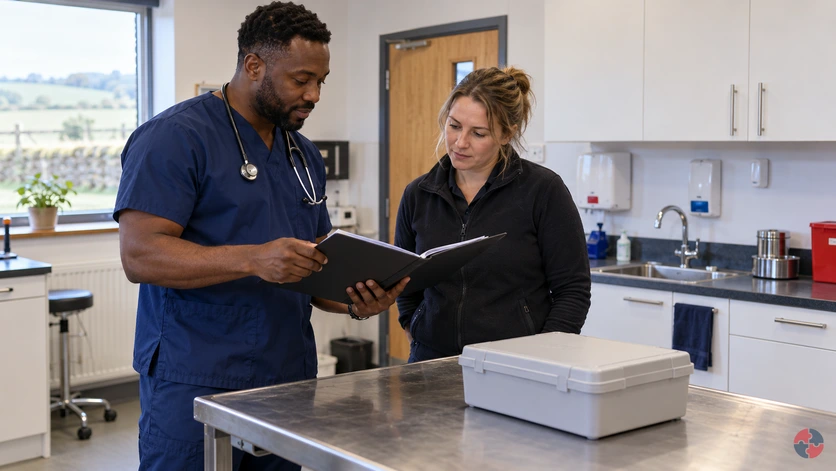
Assess the task before contact with animal material
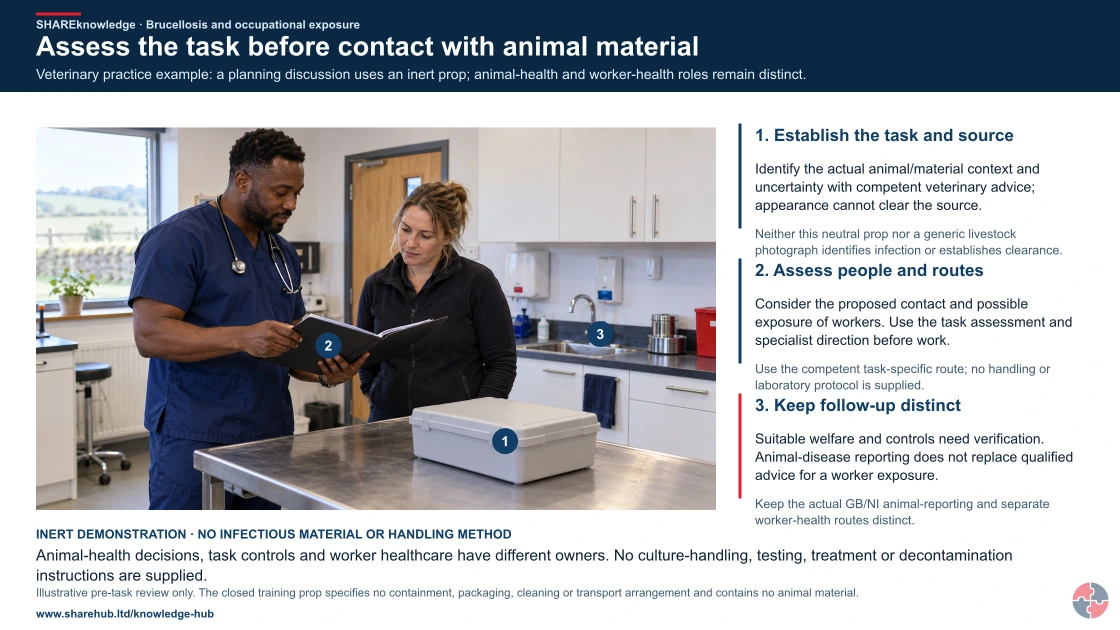
Full written explanation
Veterinary practice example: a planning discussion uses an inert prop; animal-health and worker-health roles remain distinct.
- Establish the task and source. Identify the actual animal/material context and uncertainty with competent veterinary advice; appearance cannot clear the source.
- Assess people and routes. Consider the proposed contact and possible exposure of workers. Use the task assessment and specialist direction before work.
- Keep follow-up distinct. Suitable welfare and controls need verification. Animal-disease reporting does not replace qualified advice for a worker exposure.
Change the pathway
- Do not infer disease status. Neither this neutral prop nor a generic livestock photograph identifies infection or establishes clearance.
- No generic operating recipe. Use the competent task-specific route; no handling or laboratory protocol is supplied.
- Connect the right services. Keep the actual GB/NI animal-reporting and separate worker-health routes distinct.
Evidence check: Animal-health decisions, task controls and worker healthcare have different owners. No culture-handling, testing, treatment or decontamination instructions are supplied.
Full health-awareness and appropriate clinical-advice context
Primary references: HSE: zoonoses and occupational risk assessment · Defra/APHA: livestock disease reporting in Great Britain · NHS: brucellosis health information
Open the complete HD image (new tab)Download image

Full health-awareness and appropriate clinical-advice context
Primary references: HSE: zoonoses and occupational risk assessment · Defra/APHA: livestock disease reporting in Great Britain · NHS: brucellosis health information
One animal event can create several exposure routes


Read the complete visual as text
- SOURCE: Aborted material, reproductive tissues or contaminated animal fluids may carry Brucella; uncertain herd status needs competent veterinary direction.
- ENTRY: Contact with skin breaks, eyes or mouth, aerosol inhalation and ingestion are distinct routes to assess.
- CONTROL: Isolate the material and area, use contained trained handling and an authorised disposal/cleaning method, with washing and task-assessed protection.
- FOLLOW-UP: An animal-disease report does not close the worker exposure. Record relevant contact and arrange prompt qualified advice; do not diagnose from symptoms alone.
COSHH requires employers to assess and control exposure to biological agents. For brucellosis, the assessment should start with the source: animals, animal materials, dairy products, specimens, cultures and contaminated environments. It should then consider who can be exposed and by which route.
Practical control is layered. Biosecurity reduces the chance of infected animals or contaminated materials entering the system. Hygiene prevents hand-to-mouth and mucous membrane exposure. Containment prevents aerosols and splashes. PPE protects skin, eyes and clothing. Training makes sure workers know why the controls matter.
Controls must be maintained. Handwash stations without soap, PPE that is unavailable, unclear animal-abortion reporting, poor laboratory request information or unreviewed COSHH assessments all weaken the system.
COSHH assessment. Specific assessment for animal/contact, laboratory or dairy exposure routes. COSHH assessment and review record.
Biosecurity. Animal disease controls, isolation, reporting and cleaning arrangements. Biosecurity plan and veterinary advice records.
Hygiene. Handwashing, covered wounds, no eating/drinking in animal areas and cleaning. Inspection records and worker briefings.
Containment. Safe handling of cultures, specimens and potentially contaminated materials. Laboratory procedures and containment checks.
PPE. Gloves, protective clothing and eye/face protection selected for splash/contact tasks. PPE issue, fit/use checks and training.
Exposure response. Clear reporting, recording, advice and follow-up routes. Incident reports and occupational-health/public-health referral evidence.
How can ERICPD be applied to brucellosis risk?
ERICPD helps choose stronger controls before relying on behaviour or PPE. HSE biological hazards at work
For zoonotic infection, the hierarchy starts with source control. If infection in animals is prevented, detected or removed, human exposure is reduced before it reaches the worker. Where source elimination is not possible, controls should reduce contact, isolate hazardous work, contain aerosols and support disciplined hygiene.
PPE is important, but it should not be the only control. Gloves do not replace handwashing, eye protection does not replace splash prevention, and masks do not replace biological containment where laboratory aerosol risk exists.
Eliminate. Remove or avoid the infectious source where possible. Do not use raw milk; remove infected animals through official animal-health controls.
Reduce. Reduce frequency and intensity of contact. Limit access to birth-product handling and high-risk animal areas.
Isolate. Separate people from contaminated materials or animals. Isolate suspected animals and restrict contaminated bedding/material areas.
Control. Use engineering, procedural and hygiene controls. Containment, cleaning, safe disposal, handwashing and food rules.
PPE. Protect skin, mucous membranes and clothing. Gloves, aprons, coveralls and eye/face protection during splash tasks.
Discipline. Keep controls working through training, supervision and review. Briefings, reporting, inspections and exposure follow-up.
How should laboratory brucellosis exposure be managed?
Laboratory exposure should be managed through risk assessment, containment, competent procedures and formal follow-up. UKHSA Brucella laboratory and clinical services
Laboratories need a different control emphasis from farms. Manipulating a Brucella culture or suspect isolate can create aerosol or splash exposure and requires containment and individual exposure assessment. UKHSA says routine diagnostic processing of patient blood does not normally place staff at risk and generally does not require monitoring or testing.
Good practice includes clear request-form information where brucellosis is suspected, containment arrangements for suspected Category 3 organisms, biological safety cabinets where needed, avoiding aerosol-generating open-bench work, staff training and a written exposure procedure.
After a suspected laboratory exposure, the organisation should preserve facts, identify exposed workers, seek competent advice and check whether laboratory controls, communication or specimen triage failed.
Clinical information. Flags suspected brucellosis to the laboratory. Request form and communication route.
Containment. Controls aerosols and splashes from cultures or specimens. Risk assessment and containment records.
Competence. Ensures staff understand Brucella exposure risk. Training and competency assessment.
Exposure flowchart. Supports consistent assessment and follow-up. Procedure and incident records.
Review. Identifies whether procedures or information failed. Investigation and corrective actions.
How do unpasteurised dairy and food controls fit into brucellosis prevention?
Raw milk and dairy products made from unpasteurised milk are a recognised brucellosis transmission route.Defra/APHA brucellosis and human exposure information
Defra/APHA guidance identifies unpasteurised milk and dairy products from infected livestock as important routes. In workplaces, this matters for farms, food businesses, rural hospitality, visitor attractions, staff welfare areas and anyone working abroad or with imported products.
The control message should be simple: workers should not consume raw milk or products made from unpasteurised milk where brucellosis could be a concern, and food should be kept separate from animal work areas. Handwashing before eating, drinking or smoking is fundamental.
Where a business sells or handles dairy products, it should follow food safety and animal-health requirements as well as workplace health controls.
Raw milk consumption. Prohibit or control consumption where risk exists. Worker briefing and welfare rules.
Dairy sales. Follow official testing, hygiene and food safety requirements. Supplier and testing records.
Animal areas. Separate eating and drinking from animal contact. Site rules and inspections.
Hand hygiene. Provide soap, water and hand-drying facilities. Handwash checks and signage.
Visitor information. Use clear food and hygiene messages. Visitor signage and supervision.
How should suspected occupational brucellosis exposure be managed?
Suspected exposure should be reported, recorded, assessed and followed up through competent health and regulatory routes.Defra/APHA brucellosis and human exposure information
The first workplace need is to prevent further exposure. Stop or control the task, preserve information about the source, identify who may have been exposed and make sure workers know what symptoms and exposure history to discuss with healthcare professionals.
The employer should review whether COSHH controls were suitable and used. That includes PPE, hygiene, containment, training, supervision, animal-health reporting, laboratory procedures and cleaning. If other workers may be at risk, communication should be careful, factual and confidentiality-aware.
Return-to-work decisions should be based on functional ability and competent medical or occupational-health advice, not assumptions about diagnosis.
1. Stop uncontrolled exposure and secure the area/material. Prevents further contact.
2. Record who was exposed, what happened and by which route. Supports assessment and follow-up.
3. Signpost medical assessment where symptoms or significant exposure occur. Exposure history may affect diagnosis.
4. Seek competent public-health, veterinary, laboratory or occupational-health advice as relevant. Ensures the right route is used.
5. Review COSHH, biosecurity, PPE, hygiene and training. Identifies control failures.
6. Track actions and verify controls are improved. Prevents repeat exposure.
What if relevant animal information arrives after the task?
If later information changes concern about an animal already handled, reconstruct the actual contacts rather than assuming that every person on site had the same exposure. Identify the animal, tasks, dates, materials handled, contact routes and controls used. Preserve those facts for the appropriate veterinary, occupational-health and public-health advice while controlling any continuing source.
For an illustrative dog-care workplace receiving a later Brucella canis concern, the manager pauses the affected handling activities and seeks veterinary and competent worker-exposure advice. Include staff and contractors who cleaned relevant contaminated material, not only the primary handler. Tell potentially affected people how to obtain individual healthcare advice and provide the relevant task history privately. A manager should not prescribe tests, preventive antibiotics or a universal follow-up schedule. Animal-control decisions and assessment of a person’s health are separate decisions; a late result should trigger proportionate review rather than either reassurance based on earlier routine work or disclosure of everyone’s medical details.
Guidance and scope: Original SHARE dog-work example; Brucella canis public advice is species-specific and must not be copied as a livestock or laboratory protocol. HSE zoonoses guidance is GB guidance; human clinical and animal notification routes follow the applicable jurisdiction. UKHSA Brucella canis public information HSE zoonoses
Which legal duties apply to brucellosis at work?
Brucellosis is controlled through general health and safety duties, COSHH biological-agent duties and animal-disease notification requirements.
Employers do not need a separate brucellosis regulation to have duties. If work can expose people to Brucella, the risk must be assessed and controlled under the health and safety framework. Animal disease notification and public-health processes may also be relevant depending on the circumstances.
The legal position can differ between human health, worker exposure, animal disease and food production, so businesses should use competent advice where suspected disease, laboratory exposure or occupational illness occurs.
| Duty or regulation | Jurisdiction | How it applies | Practical evidence |
|---|---|---|---|
| Health and Safety at Work etc. Act 1974 | Great Britain | General duties to protect employees and others affected by work activities. | Risk assessments, safe systems, supervision and training. |
| Control of Substances Hazardous to Health Regulations 2002 | Great Britain | Applies to biological agents, including zoonotic micro-organisms, where work creates exposure. | COSHH assessment, controls, information, training and review. |
| Management of Health and Safety at Work Regulations 1999 | Great Britain | Requires risk assessment, preventive arrangements and competent support. | Risk register, controls, emergency and exposure arrangements. |
| Reporting of Injuries, Diseases and Dangerous Occurrences Regulations 2013 | Great Britain | May be relevant where occupational disease or dangerous occurrence reporting criteria are met. | RIDDOR assessment and reporting decision record. |
| Specified Diseases (Notification and Slaughter) Order 1992 | Great Britain | Relates to specified notifiable animal diseases and control measures. | Animal-health reporting and APHA/DAERA liaison records. |
| Specified Diseases (Notification) Order 1996 | Great Britain | Supports notification of specified animal diseases. | Reporting route and veterinary advice records. |
| Control of Substances Hazardous to Health Regulations (Northern Ireland) 2003 | Northern Ireland | Assess and control work exposure to biological agents. | Task COSHH assessment and control checks. |
| Reporting of Injuries, Diseases and Dangerous Occurrences Regulations (Northern Ireland) 1997 | Northern Ireland | Assess NI occupational-disease reportability. | Documented reporting decision. |
| DAERA notifiable animal disease guidance | Northern Ireland | Use the animal-health notification route for applicable species and circumstances. | Veterinary and DAERA advice record. |
The table above identifies Great Britain instruments and the GB APHA animal-notification route. Northern Ireland uses COSHH (Northern Ireland) 2003, HSENI occupational-disease reporting and DAERA animal-health notification. Human clinical/public-health reporting is a separate route. Check the actual exposure and jurisdiction before deciding whether RIDDOR applies.
Northern Ireland Schedule 3 item 16 in the HSENI RIDDOR (NI) booklet lists brucellosis linked to work involving contact with infected animals or carcasses, their untreated products, or laboratory specimens or vaccines containing Brucella. A suspected exposure still needs immediate control and medical advice; the employer assesses disease reporting when a doctor notifies a qualifying work-related diagnosis.
How should brucellosis be recorded in a risk register?
A brucellosis entry should identify exposure source, route, affected groups, controls, response arrangements and review evidence. COSHH Regulations 2002
A useful register entry does not simply say “zoonoses”. It should name the relevant source: cattle abortion material, imported dogs, raw dairy, abattoir tissues, laboratory cultures or animal-contact events. It should then identify who can be exposed and how.
The control set should cover source control, hygiene, containment, PPE, training, supervision, health signposting and reporting. Review triggers should include animal disease alerts, suspected exposure, imported animals, process change, visitor events, laboratory incidents and worker symptoms linked to exposure.
| Field | What to record | Example |
|---|---|---|
| Source | Animal, product, specimen or culture creating the hazard. | Aborted livestock material or Brucella culture. COSHH Regulations 2002 |
| Route | Skin, mucous membrane, ingestion, inhalation or inoculation. | Splash to eye during animal birth assistance. COSHH Regulations 2002 |
| Exposed groups | Workers, contractors, visitors or lab staff. | Stock handlers and veterinary contractor. COSHH Regulations 2002 |
| Controls | COSHH, hygiene, PPE, containment, biosecurity and food rules. | Gloves, eye protection, handwashing, isolation. COSHH Regulations 2002 |
| Response | Reporting, medical signposting and competent advice. | Exposure form and OH/public-health escalation. COSHH Regulations 2002 |
| Review triggers | Events that require reassessment. | Animal abortion, suspected disease, lab exposure or imported animal. COSHH Regulations 2002 |
How could Riverside Leisure Ltd manage brucellosis risk?

Riverside Leisure Ltd could manage brucellosis through a specific zoonoses risk register, animal-contact controls and visitor-facing hygiene arrangements.
Riverside Leisure Ltd
a leisure and holiday park operator with outdoor education areas, seasonal events, food outlets and occasional animal-contact activities
Riverside does not assume that brucellosis is likely across the whole business. It identifies where the risk could exist: a seasonal petting area, contractor-led animal encounters, staff supporting animal welfare, imported animals for events, food outlets handling dairy products, and waste or bedding from animal areas.
Before animal-contact activities are approved, the events manager completes a zoonoses risk review with the animal provider. The review checks animal health declarations, species, origin, vaccination/testing information where relevant, welfare arrangements, no raw milk provision, handwashing facilities, visitor flow, vulnerable visitor information, staff PPE, cleaning and incident reporting.
Frontline staff receive a short briefing on animal-contact hygiene, handwashing supervision, food separation, signs of animal illness, who to contact, and what to do if there is contact with birth products, blood or animal fluids. Supervisors check the controls daily using a short checklist: soap present, handwash water available, food kept separate, bedding controlled, PPE available, waste secure and visitor signage visible.
If an animal becomes ill, gives birth unexpectedly, aborts or a worker has a splash/contact incident, Riverside stops the activity, isolates the area, contacts the animal provider and competent veterinary/public-health routes as appropriate, records the incident, identifies anyone potentially exposed and reviews the COSHH/zoonoses assessment before reopening.
Assess. Identifies animal-contact, dairy and waste exposure routes before events are approved. Zoonoses risk register and event approval form.
Analyse. Reviews species, source, animal health information, visitor groups and exposure routes. Supplier declarations and risk review notes.
Train. Briefs staff on hygiene, no-food rules, PPE, incident reporting and exposure signposting. Training records and daily briefing sheet.
Implement. Provides handwashing, barriers, signage, food separation, waste controls and PPE. Inspection records and event setup checklist.
Check. Supervisors complete daily checks and managers sample contractor compliance. Daily checks, contractor monitoring and photographs.
Learn. Reviews incidents, near misses, visitor feedback and official guidance changes. Incident review and revised controls.
Improve. Updates supplier criteria, layout, staffing, signage or activity approval based on learning. Corrective actions and management review.
What training is useful for brucellosis and zoonoses control?
Training should help people understand exposure routes, practical hygiene, PPE, reporting and the limits of workplace advice.
General awareness is useful for anyone working near animals or animal-contact areas. It should explain zoonoses, hand hygiene, food separation, not touching wounds or face with contaminated hands, and reporting unwell animals or unusual exposures.
Task-specific training should go deeper for livestock handlers, veterinary teams, laboratory staff, abattoir workers and supervisors. It should cover reproductive materials, aerosols, containment, PPE, cleaning, waste, reporting and what exposure history workers should explain to healthcare professionals.
Manager and supervisor training should include COSHH ownership, worker communication, confidentiality, public-health/veterinary escalation, incident investigation and review of controls.
Competence means a person can carry out the actual task safely, recognise a changed condition and respond correctly. Attendance alone is insufficient. The matrix makes assessment, ownership, records and reassessment explicit.
| Role | Required learning | How competence is assessed | Assessor or owner | Record | Reassess when |
|---|---|---|---|---|---|
| Animal worker | Recognise birthing and abortion exposure, hygiene, symptoms and stop point | Demonstrate safe isolation and report route in a farm case | Farm supervisor with veterinary input | Task observation and briefing | Herd status or task changes |
| Laboratory worker | Distinguish routine blood processing from suspect culture handling | Demonstrate isolate recognition, containment and escalation | Laboratory biosafety lead | Observed exercise and exposure log | Method or isolate changes |
| Supervisor | Separate animal notification, clinical care and work reporting | Work through livestock and imported-dog cases | Animal-health adviser | Case and route decision | Species, nation or guidance changes |
| Adviser | Assess COSHH controls and exposure follow-up | Review a culture exposure and referral decision | Biosafety and occupational-health leads | Assessment and referral record | Exposure or procedure changes |
How does brucellosis support study and professional development?
Brucellosis helps learners connect biological agents, COSHH, zoonoses, occupational health and worker support.
For NEBOSH National General Certificate learners, the key is to recognise that micro-organisms can be hazardous substances under COSHH. A scenario may involve a farm, abattoir, laboratory or visitor attraction and ask how exposure should be assessed and controlled.
Learners should be able to describe who is exposed, the route of entry, the health effect, controls using the hierarchy, training, supervision, hygiene facilities, PPE and incident follow-up.
At diploma or professional level, the answer should also include biological-agent classification, containment, public-health/veterinary interfaces, assurance, health surveillance where appropriate, confidentiality and management review.
Biological agents. Brucella is a biological hazard that can cause infection. Identify source, route and exposed workers.
COSHH. Biological agents require assessment and exposure control. Apply COSHH to animal-contact or laboratory work.
ERICPD. Controls should start at source and not rely only on PPE. Select biosecurity, containment, hygiene and PPE.
Occupational health. Exposure history and symptoms may affect work and support. Signpost medical/OH routes without diagnosing.
Management systems. Controls need training, inspection, incident learning and review. Build evidence for assurance and improvement.
How can management systems strengthen brucellosis control?
A management system ensures zoonotic risk is identified, controlled, checked and improved rather than treated as a one-off briefing.
A robust system names the owner for zoonoses risk, sets COSHH assessment requirements, defines animal and laboratory controls, trains workers, checks hygiene and PPE, records exposures and reviews incidents.
The HSE management cycle is useful when it drives practical controls: worker consultation, hazard identification, competence, communication, monitoring and corrective action. A competent biosafety assessment must still verify the agent and actual exposure route.
| Management-system stage | How it supports the topic | Practical evidence |
|---|---|---|
| Consultation and participation of workers | Workers help identify realistic exposure routes and hygiene barriers. | Consultation notes and worker feedback. |
| Hazard identification and assessment of risks and opportunities | Brucellosis is assessed as a biological-agent/zoonoses risk where relevant. | COSHH assessment and risk register. |
| Competence | Workers understand zoonoses controls and exposure reporting. | Training matrix and competence checks. |
| Communication | Clear messages explain hygiene, symptoms signposting and reporting. | Briefings, signage and communication plan. |
| Operational planning and control | Controls are built into animal work, lab work, food rules and cleaning. | Procedures, inspections and contractor controls. |
| Monitoring, measurement, analysis and performance evaluation | Inspections and exposure trends are reviewed. | Audit results and management review. |
| Incident, nonconformity and corrective action | Exposure events drive investigation and control improvement. | Incident reports and verified actions. |
What are the warning signs that brucellosis risk is not being managed?
Warning signs include poor hygiene, uncontrolled animal fluids, raw dairy exposure, weak PPE, unclear reporting and ignored exposure symptoms.
Control failure is often visible before illness is recognised: workers eat in animal areas, handwashing is poor, gloves are reused, animal abortions are handled informally, lab cultures are manipulated without suitable containment, or people do not know who to tell after exposure.
Each warning sign can cause harm because it creates an exposure route. The improvement should remove the route, not just remind people to be careful.
Birth products handled without barriers. Brucella may contact skin, eyes or mouth. Stop task, review PPE, hygiene and reporting controls.
Raw milk consumed or provided. Ingestion can transmit infection. Remove raw dairy route and brief workers/visitors.
Handwashing facilities missing. Contaminated hands transfer bacteria to mouth or eyes. Provide soap, water, drying and supervision.
Laboratory aerosol control weak. Workers may inhale infectious aerosols. Review containment, procedures and competence.
Symptoms not linked to exposure history. Medical assessment may be delayed. Improve worker information and exposure records.
No incident/exposure procedure. Others at risk may not be identified. Create reporting, assessment and follow-up route.
Who reports a suspected human, animal or work-related case?
Keep three routes distinct. A clinician reports suspected human brucellosis through the public-health route. For suspected notifiable livestock brucellosis, the animal keeper must immediately use the GB APHA or NI DAERA route. For dogs, Brucella canis has a different threshold: in Great Britain it is reportable after identification in a dog; in Northern Ireland it is notifiable. Seek veterinary and animal-health advice for a suspect imported dog and check the nation-specific route. An employer assesses occupational-disease reporting separately when evidence indicates that work exposure to a biological agent likely caused a diagnosed disease.
Do not wait for workplace attribution before someone with compatible symptoms receives medical assessment, and do not report a human illness to the animal-disease authority in place of clinical care.
Direct authority: Defra/APHA brucellosis and human exposure information; Defra and APHA brucellosis reporting; DAERA notifiable diseases in Northern Ireland; UKHSA HAIRS Brucella canis risk assessment
Does routine patient blood processing need the same response as exposure to a culture?
No. UKHSA says staff are not normally at risk from routine diagnostic processing of patient blood and monitoring or testing is generally unnecessary. Exposure to a Brucella culture requires an individual risk assessment and follow-up. Stop open-bench manipulation of a suspect culture or isolate, secure it and seek competent containment and reference-service advice.
Document what was handled, how, when and by whom. A biosafety and clinical team decides who needs follow-up; do not automatically classify ordinary specimen processing as a culture exposure.
Direct authority: UKHSA Brucella laboratory and clinical services; UKHSA Brucella laboratory exposure guidance
What does official guidance add to this decision?
Connect animal and specimen information to exposure routes, containment, hygiene and worker follow-up. A generic checklist does not prove a particular task is safe.
Use the current HSE zoonoses guidance and the jurisdiction-specific duties listed on this page to verify the actual task and controls.
If a contract or competent design specifies a published technical standard, obtain authorised access to its current text and check its exact scope and edition. Apply the standard only within its stated scope; this guidance does not reproduce its clauses.
How do the decisions work in practice?
These examples show the prerequisites, controls, stop conditions, decision owner and hand-back for an actual scenario. Adapt them to the assessed site or building. UKHSA Brucella laboratory and clinical services
Different settings need the right specialist roles
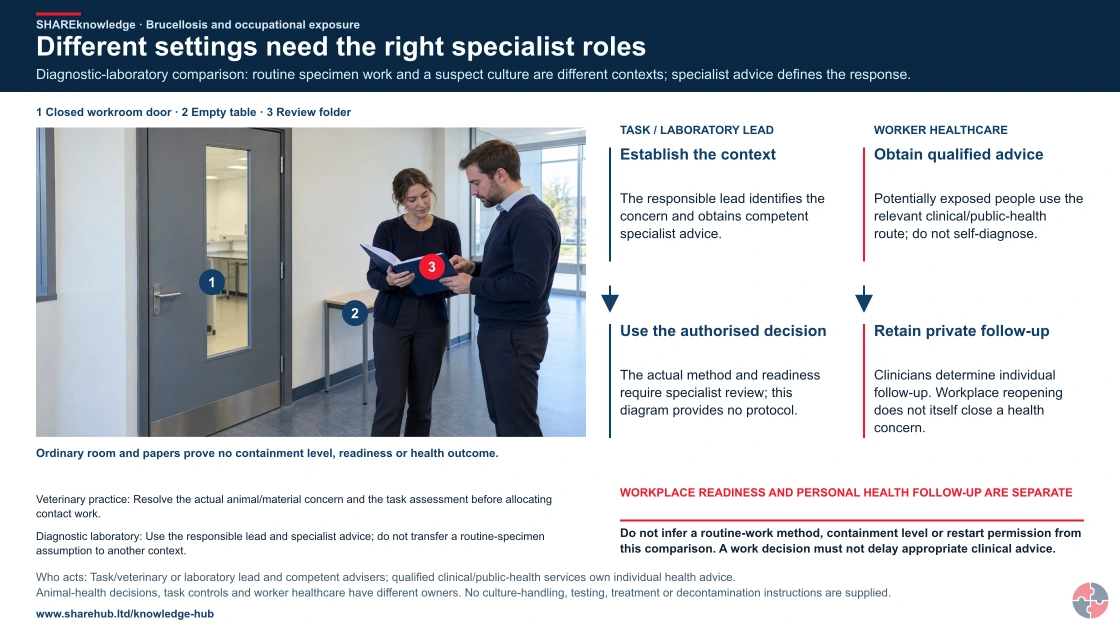
Full written explanation
An illustrative planning discussion outside an ordinary closed workroom shows empty benches through a door window, an empty adjacent table and two ordinary adults reviewing an inert folder. One literal picture key identifies 1 closed workroom door, 2 empty table and 3 review folder. This generic planning setting does not verify diagnostic use or a biological containment arrangement. Two independent tracks retain the four checks. Task and laboratory lead: Establish the context: The responsible lead identifies the concern and obtains competent specialist advice. Use the authorised decision: The actual method and readiness require specialist review; this diagram provides no protocol. Worker healthcare: Obtain qualified advice: Potentially exposed people use the relevant clinical/public-health route; do not self-diagnose. Retain private follow-up: Clinicians determine individual follow-up. Workplace reopening does not itself close a health concern. Only one arrow within each track shows its own order; no work decision or reopening clears a personal health concern. WORKPLACE READINESS AND PERSONAL HEALTH FOLLOW-UP ARE SEPARATE. Do not infer a routine-work method, containment level or restart permission from this comparison. A work decision must not delay appropriate clinical advice. Who acts: Task/veterinary or laboratory lead and competent advisers; qualified clinical/public-health services own individual health advice. Animal-health decisions, task controls and worker healthcare have different owners. No culture-handling, testing, treatment or decontamination instructions are supplied. Veterinary practice: Resolve the actual animal/material concern and the task assessment before allocating contact work. Diagnostic laboratory: Use the responsible lead and specialist advice; do not transfer a routine-specimen assumption to another context. Routine diagnostic blood processing and culture exposure remain different contexts under the full qualified source; this scene does not classify either. Individual clinical or public-health advice must not wait for workplace readiness, animal notification, employer reporting, forms, records or results. No specimen, culture, animal, tissue, fluid, particle, aerosol, handling, exposure or clinical act is depicted. A closed door, empty bench, table or folder proves no pathogen status, containment level, pressure, cleanliness, access security, approved layout, competence, health outcome or restart permission. The folder is an inert work-review prop, not a patient or health record. No testing, treatment, follow-up timetable, PPE, cleaning, decontamination, disposal, transport or biological operating instructions are supplied.
Diagnostic-laboratory comparison: routine specimen work and a suspect culture are different contexts; specialist advice defines the response.
- Establish the context. The responsible lead identifies the concern and obtains competent specialist advice.
- Use the authorised decision. The actual method and readiness require specialist review; this diagram provides no protocol.
- Obtain qualified advice. Potentially exposed people use the relevant clinical/public-health route; do not self-diagnose.
- Retain private follow-up. Clinicians determine individual follow-up. Workplace reopening does not itself close a health concern.
When the evidence does not fit: Do not infer a routine-work method, containment level or restart permission from this comparison. A work decision must not delay appropriate clinical advice.
Who acts: Task/veterinary or laboratory lead and competent advisers; qualified clinical/public-health services own individual health advice.
Changed workplace
Veterinary practice: Resolve the actual animal/material concern and the task assessment before allocating contact work.
Diagnostic laboratory: Use the responsible lead and specialist advice; do not transfer a routine-specimen assumption to another context.
Evidence check: Animal-health decisions, task controls and worker healthcare have different owners. No culture-handling, testing, treatment or decontamination instructions are supplied.
Full health-awareness and appropriate clinical-advice context
Primary references: HSE: zoonoses and occupational risk assessment · Defra/APHA: livestock disease reporting in Great Britain · NHS: brucellosis health information
Open the complete HD image (new tab)Download image

Full health-awareness and appropriate clinical-advice context
Primary references: HSE: zoonoses and occupational risk assessment · Defra/APHA: livestock disease reporting in Great Britain · NHS: brucellosis health information
Keep suspected birth material contained


Read the complete visual as text
- Stop open handling
- Use veterinary direction
- Keep worker exposure follow-up separate
- The photograph provides topic context. Aborted calf on a livestock site is an illustrative learning example; the checks below must be adapted to the actual task.
Aborted calf: evidence for controlled handling


Read the complete visual as text
- 1. ACTUAL TASK: Identify the abortion material, uncertain herd status, proposed clean-up and any uncovered skin wounds.
- 2. PEOPLE AND BASIS: The farm manager invokes the animal-disease reporting route and obtains veterinary direction before handling.
- 3. BEFORE: Stop open handling, isolate material and the area, and keep workers away until assessed controls exist.
- 4. VERIFY DURING: Use trained contained handling, authorised disposal, washing and cleaning that does not disperse contamination.
- 5. HOLD OR REFER: Hold for unresolved disease status, protection or disposal route; identify skin, eye, mouth or aerosol exposure for prompt advice.
- 6. HAND BACK AND REVIEW: Verify veterinary instructions, disposal, cleaning and remaining restrictions; separately record worker exposure facts and the clinical contact route.
Aborted calf on a livestock site
Task material and setting: A stock worker is asked to clear an aborted calf and placenta. The herd status is uncertain and the worker has an uncovered cut.
People and prerequisites: The farm manager, animal keeper and veterinary adviser need the species/herd history, abortion-notification route, exposure facts, safe containment and authorised disposal plan; workers need task-specific training and covered skin breaks.
Before: Stop open handling, isolate the material and area, use the farm animal-disease reporting route and obtain veterinary direction. Keep workers away until a task assessment and suitable barriers exist.
During: Arrange trained handling under veterinary direction, with contained material and an authorised disposal route. Control splashes and avoid dispersing contaminated material; provide suitable protective clothing, covered wounds, handwashing and a cleaning method that does not spread contamination. Identify anyone with skin, eye, mouth or aerosol exposure for prompt competent advice.
Hold or stop: Hold the task if animal-disease status, protective controls or disposal route is unresolved.
Decision owner: The animal keeper owns statutory notification; the farm manager controls workers; clinical advice belongs to healthcare.
Completion and hand back: Resume the affected area only after veterinary/animal-health instructions, safe disposal, cleaning and work controls are verified by the farm manager. Record exposed-person facts and the clinical advice route; an animal report alone does not close a worker exposure.
Evidence: Keep animal report, exposed-person facts, COSHH review, cleaning and worker briefing.
Changed conditions: Reassess when the task, people, equipment, evidence or legal scope changes.
Source scope: Defra/APHA livestock notification guidance is GB; NI uses DAERA. B. canis public information concerns dogs, not herd-clearance criteria. Clinical and occupational disease reporting are separate.
Unexpected Brucella culture in a laboratory
Task material and setting: A culture is manipulated on an open bench before a suspect Brucella isolate is recognised. Several workers were nearby. This differs from routine diagnostic processing of patient blood.
People and prerequisites: The laboratory lead and biosafety adviser need the organism suspicion, exact bench procedures, aerosol/splash incidents, people and timing, containment equipment status and reference-service contact route.
Before: Stop further open-bench work, secure the culture and identify tasks and people involved. Use the UKHSA laboratory exposure procedure and competent biosafety advice.
During: Trace aerosol-generating manipulation, proximity, splash and containment facts for each potentially exposed person; use specialist exposure advice to decide follow-up. Secure material for the reference service without further open-bench manipulation. Clinicians determine testing or treatment; generic staff monitoring is not a substitute for individual culture-exposure assessment.
Hold or stop: Do not restart suspect culture handling until the containment and referral method are verified and staff are briefed.
Decision owner: The laboratory lead owns containment and incident facts; competent public-health and clinical teams own exposure follow-up.
Completion and hand back: Restart the suspect-isolate method after competent confirmation of containment, safe referral/transport and decontamination, corrected work instructions and staff competence. Keep exposure follow-up open for its clinically directed duration even when the bench is operational again.
Evidence: Keep exposure assessment, worker follow-up, training, corrective action and any reportability decision.
Changed conditions: Reassess when the task, people, equipment, evidence or legal scope changes.
Source scope: UKHSA laboratory guidance distinguishes routine diagnostic blood processing from culture exposure. This illustrates containment and referral, not a prescription or fixed follow-up timetable.
How can the hierarchy of controls reduce occupational exposure to Brucella bacteria?
Start by removing or redesigning the actual harm route. ERICPD (Eliminate, Reduce including substitution, Isolate, Control, PPE, Discipline) and the five-level HSE hierarchy (elimination, substitution, engineering, administrative, PPE) overlap but are not identical. Discipline sustains stronger controls through checks and learning; it is not blame. The table applies both to one realistic task and explains why a higher-level measure is or is not feasible. See HSE hierarchy; HSE five-level hierarchy of control
- RecogniseIdentify an animal-material or suspect-culture task that could create aerosol or direct contact.
- AvoidStop unnecessary handling; keep untrained people away and use the competent containment route.
- EscalateFollow the organism-specific incident and clinical advice route; do not improvise sampling or treatment.
- ReviewThe biosafety or site owner checks exposure, containment, reporting scope and safe hand-back.
Choose the activity
How can the ERICPD hierarchy of controls reduce risks while collecting livestock abortion material?

| Control level | Control for this activity | Owner and verification | Stop / restart decision |
|---|---|---|---|
| Eliminate | Avoid further animal and worker contact by taking the affected area out of use under veterinary direction. The existing material still requires controlled collection; using a contractor does not eliminate that collector’s exposure. | Farm manager and veterinary adviser identify affected animals, the contaminated area and the authorised collection route; identify who will still handle the material. | If the hazardous step remains, retain a task assessment and select the stronger feasible remaining controls. |
| Reduce, including substitution | Use a veterinary-approved closed collection method that reduces open handling of tissues and fluids. | Process/technical owner validates the alternative, its compatibility and any new risks before adoption. | Reject the alternative if suitability is unproved or its new hazards are unresolved. |
| Isolate | Separate the affected animals and restrict people from the contaminated area while the veterinary plan is established. | Supervisor verifies the task boundaries and that the separation or isolation protects affected people and connected work. | Hold or stop for unplanned contact, leaking container, aerosol generation or an uncertain disposal route. |
| Control: physical safeguards | Provide leakproof collection, controlled waste containment and suitable washing facilities; prevent splashes and aerosol-producing cleaning. | Competent equipment/process owner checks veterinary instructions, container integrity, washing and contamination boundaries. | Hold or stop for unplanned contact, leaking container, aerosol generation or an uncertain disposal route. |
| Control: work method and response | Brief authorised workers on the animal-health plan, exposure reporting and contaminated clothing; coordinate disposal with the veterinary adviser. | Supervisor confirms the limits, response, communication and restart authority with the people doing this activity. | Stop if the agreed method, communication, competent cover or task limits cannot be maintained. |
| PPE | Select gloves, protective clothing and eye protection for the assessed contact risk, with task-assessed respiratory protection if required. | Assessor confirms whether PPE is needed and checks selection, condition, compatibility and any required face-fit evidence. | Do not rely on unsuitable or defective protection, or use PPE to continue after an essential source control fails. |
| Discipline | Verify decontamination, waste handover and veterinary release before reopening the area. | Release only after farm manager records veterinary advice and accepts the completed decontamination. Retain the checks and unresolved restrictions at handover. | Keep the activity on hold while defects or required reinstatement evidence remain unresolved. |
How can the ISO 45001 hierarchy of controls reduce risks while collecting livestock abortion material?

| Control level | Control for this activity | Owner and verification | Stop / restart decision |
|---|---|---|---|
| Elimination | Avoid further animal and worker contact by taking the affected area out of use under veterinary direction. The existing material still requires controlled collection; using a contractor does not eliminate that collector’s exposure. | Farm manager and veterinary adviser identify affected animals, the contaminated area and the authorised collection route; identify who will still handle the material. | If the hazardous step remains, retain a task assessment and select the stronger feasible remaining controls. |
| Engineering controls | Use a veterinary-approved closed collection method that reduces open handling of tissues and fluids. | Process/technical owner validates the alternative, its compatibility and any new risks before adoption. | Reject the alternative if suitability is unproved or its new hazards are unresolved. |
| Engineering controls | Separate the affected animals and restrict people from the contaminated area while the veterinary plan is established. | Supervisor verifies the task boundaries and that the separation or isolation protects affected people and connected work. | Hold or stop for unplanned contact, leaking container, aerosol generation or an uncertain disposal route. |
| Engineering controls | Provide leakproof collection, controlled waste containment and suitable washing facilities; prevent splashes and aerosol-producing cleaning. | Competent equipment/process owner checks veterinary instructions, container integrity, washing and contamination boundaries. | Hold or stop for unplanned contact, leaking container, aerosol generation or an uncertain disposal route. |
| Administrative controls | Brief authorised workers on the animal-health plan, exposure reporting and contaminated clothing; coordinate disposal with the veterinary adviser. | Supervisor confirms the limits, response, communication and restart authority with the people doing this activity. | Stop if the agreed method, communication, competent cover or task limits cannot be maintained. |
| PPE | Select gloves, protective clothing and eye protection for the assessed contact risk, with task-assessed respiratory protection if required. | Assessor confirms whether PPE is needed and checks selection, condition, compatibility and any required face-fit evidence. | Do not rely on unsuitable or defective protection, or use PPE to continue after an essential source control fails. |
| Administrative controls | Verify decontamination, waste handover and veterinary release before reopening the area. | Release only after farm manager records veterinary advice and accepts the completed decontamination. Retain the checks and unresolved restrictions at handover. | Keep the activity on hold while defects or required reinstatement evidence remain unresolved. |
How can the ERICPD hierarchy of controls reduce risks while handling a suspected Brucella laboratory culture?

| Control level | Control for this activity | Owner and verification | Stop / restart decision |
|---|---|---|---|
| Eliminate | Avoid unnecessary propagation and further open manipulation; consult the designated reference laboratory. | Process owner verifies that the revised workflow achieves the required output and the hazardous step is genuinely removed. | If the hazardous step remains, retain a task assessment and select the stronger feasible remaining controls. |
| Reduce, including substitution | Use a validated identification or referral method that avoids growing or opening additional cultures where the diagnostic service permits. | Process/technical owner validates the alternative, its compatibility and any new risks before adoption. | Reject the alternative if suitability is unproved or its new hazards are unresolved. |
| Isolate | Restrict access and use the containment arrangements specified by the laboratory biological-risk assessment. | Supervisor verifies the task boundaries and that the separation or isolation protects affected people and connected work. | Hold or stop for open-culture manipulation, cabinet failure, spill or uncertain containment requirements. |
| Control: physical safeguards | Use the appropriate verified microbiological safety cabinet, containment equipment and sealed transport system for the assessed work. | Competent equipment/process owner checks organism alert, cabinet performance, containment procedure and referral acceptance. | Hold or stop for open-culture manipulation, cabinet failure, spill or uncertain containment requirements. |
| Control: work method and response | Alert laboratory management, assess any potential exposure and agree referral, decontamination and incident actions before work resumes. | Supervisor confirms the limits, response, communication and restart authority with the people doing this activity. | Stop if the agreed method, communication, competent cover or task limits cannot be maintained. |
| PPE | Use laboratory-selected protective clothing, gloves and eye or respiratory protection required by the assessed procedure. | Assessor confirms whether PPE is needed and checks selection, condition, compatibility and any required face-fit evidence. | Do not rely on unsuitable or defective protection, or use PPE to continue after an essential source control fails. |
| Discipline | Retain containment checks, referral documentation and the authorised release of equipment and work areas. | Release only after laboratory lead authorises work after the biological-safety review. Retain the checks and unresolved restrictions at handover. | Keep the activity on hold while defects or required reinstatement evidence remain unresolved. |
How can the ISO 45001 hierarchy of controls reduce risks while handling a suspected Brucella laboratory culture?

| Control level | Control for this activity | Owner and verification | Stop / restart decision |
|---|---|---|---|
| Elimination | Avoid unnecessary propagation and further open manipulation; consult the designated reference laboratory. | Process owner verifies that the revised workflow achieves the required output and the hazardous step is genuinely removed. | If the hazardous step remains, retain a task assessment and select the stronger feasible remaining controls. |
| Substitution | Use a validated identification or referral method that avoids growing or opening additional cultures where the diagnostic service permits. | Process/technical owner validates the alternative, its compatibility and any new risks before adoption. | Reject the alternative if suitability is unproved or its new hazards are unresolved. |
| Engineering controls | Restrict access and use the containment arrangements specified by the laboratory biological-risk assessment. | Supervisor verifies the task boundaries and that the separation or isolation protects affected people and connected work. | Hold or stop for open-culture manipulation, cabinet failure, spill or uncertain containment requirements. |
| Engineering controls | Use the appropriate verified microbiological safety cabinet, containment equipment and sealed transport system for the assessed work. | Competent equipment/process owner checks organism alert, cabinet performance, containment procedure and referral acceptance. | Hold or stop for open-culture manipulation, cabinet failure, spill or uncertain containment requirements. |
| Administrative controls | Alert laboratory management, assess any potential exposure and agree referral, decontamination and incident actions before work resumes. | Supervisor confirms the limits, response, communication and restart authority with the people doing this activity. | Stop if the agreed method, communication, competent cover or task limits cannot be maintained. |
| PPE | Use laboratory-selected protective clothing, gloves and eye or respiratory protection required by the assessed procedure. | Assessor confirms whether PPE is needed and checks selection, condition, compatibility and any required face-fit evidence. | Do not rely on unsuitable or defective protection, or use PPE to continue after an essential source control fails. |
| Administrative controls | Retain containment checks, referral documentation and the authorised release of equipment and work areas. | Release only after laboratory lead authorises work after the biological-safety review. Retain the checks and unresolved restrictions at handover. | Keep the activity on hold while defects or required reinstatement evidence remain unresolved. |
In a laboratory, routine diagnostic patient blood processing does not normally require exposure monitoring; an unexpected suspect Brucella culture does require containment, individual exposure assessment and specialist follow-up. Treat that culture as a distinct aerosol scenario.
Which national legal route governs this decision?
Use the rule for the place and the actual activity. These rows identify the topic-specific work-risk route; existing legal sections explain other relevant instruments.
| Direct authority | Jurisdiction | Application to this topic | Practical evidence |
|---|---|---|---|
| COSHH Regulations 2002 | Great Britain | GB biological-agent exposure requires COSHH control. | Applicability, task assessment, control owner and review record. |
| COSHH Regulations (Northern Ireland) 2003 | Northern Ireland | NI biological-agent exposure follows separate NI COSHH. | Applicability, task assessment, control owner and review record. |
| Reporting of Injuries, Diseases and Dangerous Occurrences Regulations 2013 | Great Britain | Check GB work-related disease reportability against its specified conditions. | Applicability, task assessment, control owner and review record. |
| NI RIDDOR Regulations 1997 | Northern Ireland | NI disease reporting uses its separate schedule and trigger. | Applicability, task assessment, control owner and review record. |
How should the selected controls be checked in practice?
For each controllable work hazard, the five HSE levels and ERICPD guide a specific decision. A stronger measure is assessed for feasibility before reliance on procedures or personal protection; the owner checks whether it works and stops the task on failure. HSE examples are GB regulator guidance applied as technical principles in NI, not NI law; use the separate NI legal map. See HSE five-level hierarchy of control; HSE five-level hierarchy of control
What do the acronyms and key terms mean?
Acronyms help readers follow biological-agent, occupational-health and reporting guidance.
| Acronym or term | Meaning | Why it matters |
|---|---|---|
| APHA | Animal and Plant Health Agency | GB animal-health body involved in notifiable animal disease response. |
| BRU | Brucella Reference Unit | UK specialist reference service for Brucella. |
| COSHH | Control of Substances Hazardous to Health Regulations | Main workplace framework for biological-agent exposure control. |
| DAERA | Department of Agriculture, Environment and Rural Affairs | Northern Ireland animal-health authority. |
| ERICPD | Eliminate, Reduce, Isolate, Control, PPE, Discipline | Hierarchy used to organise practical controls. |
| GP | General Practitioner | Healthcare route for symptoms and assessment. |
| OH | Occupational Health | Work-health advice route for fitness, restrictions and support. |
| PPE | Personal Protective Equipment | Protective clothing and equipment used after stronger controls. |
| RPE | Respiratory Protective Equipment | Respiratory protection where aerosol risk assessment requires it. |
| UKHSA | UK Health Security Agency | Public-health body providing infectious disease guidance. |