
SHARE Knowledge Hub
How can cold and flu spread be prevented at work?
Reduce respiratory infection spread through a workable stay-home route when unwell, fresh air, hand hygiene, cleaning and current vaccination signposting. England public-health advice is guidance, not a universal UK legal isolation rule. Employers should support a worker who cannot attend safely and protect people at higher risk without collecting unnecessary health details.
Understanding How can cold and flu spread be prevented at work?
Reduce respiratory infection spread through a workable stay-home route when unwell, fresh air, hand hygiene, cleaning and current vaccination signposting. England public-health advice is guidance, not a universal UK legal isolation rule. Employers should support a worker who cannot attend safely and protect people at higher risk without collecting unnecessary health details.
Why this matters at work
Vaccination helps prevent influenza and serious illness but does not prevent common colds or guarantee no infection. Protection develops over time and the seasonal programme changes; neither a vaccination record nor previous infection is a general fitness pass. A symptomatic person still needs decisions based on illness, function, task, vulnerable contacts and current public-health or sector advice. Avoid promising individual immunity or requiring clinical disclosure beyond what is necessary.
Arrange competent ventilation advice where performance is uncertain, maintain suitable warmth and welfare and consider occupancy or scheduling changes without removing usable breaks. Support illness reporting and appropriate staying-home arrangements and ensure handwashing, tissues and cleaning are practical. Involve occupational health, infection-control or public-health expertise according to sector and severity. Use minimal necessary health information to map onset, locations and links. Record actions, owners and verification and check vulnerable people confidentially. Do not invent a universal outbreak count or quarantine period. Review whether the measures work on nights and during cold weather, when conditions differ from summer.
How organisations manage this in practice
Keep proportionate records of assessment, ventilation plans and maintenance, occupancy arrangements, cleaning and welfare checks, training, programme offers, outbreak actions and policy reviews. Record defects and their verified closure rather than collecting diagnoses by default. Useful indicators include poorly ventilated spaces corrected, washing supplies available, response to reports and whether absence and cover arrangements are usable. Vaccination uptake or low recorded sickness alone cannot establish control. When concerns cluster, use appropriate operational, HR, safety, occupational health and infection-control or public-health input. Map timing, locations, shifts and relevant shared activity using only necessary information, and avoid naming a presumed source. Evaluate whether changes reached agency, contractor, night and remote workers and whether they created new barriers. Assign owners and review dates and retain information through authorised systems and lawful retention arrangements. Better reporting may initially increase recorded concerns, so interpret trends with context. Reopen current national and sector guidance when circumstances change rather than treating an old winter policy as permanently valid.
No. Colds often develop more gradually and flu often causes rapid marked illness, but these are broad patterns rather than a diagnostic test. Cough, fever, tiredness, aches, sore throat and other symptoms overlap across respiratory infections. A manager should not declare influenza from sudden onset or clear someone because there is no measured fever. Clinical assessment and any appropriate testing depend on the actual circumstances and current advice. Focus workplace decisions on how unwell the person is, the task, spread risk, vulnerable contacts and national or sector guidance. Symptoms or sedating medicines can make driving, plant, food handling or close care unsuitable even when an infection is considered mild. Enable appropriate clinical help and urgent escalation for serious signs. Keep personal information proportionate and support reporting without blame. Avoid importing one fixed infectious period, test requirement or exclusion rule into every illness and workplace. Review decisions as function and current guidance change, and continue ordinary ventilation, hygiene and sensible work organisation regardless of a presumed virus label.
Signpost the current programme for the person's nation and season. Eligibility, timing and product decisions belong with the clinical service, and England's arrangements should not be presented as UK-wide. Any employer programme needs competent provision, informed participation, privacy and safe follow-up. Make access practical across shifts without using uptake alone as the safety measure. Continue ventilation, hygiene, work organisation and fair reporting and absence arrangements. Record offers and programme governance appropriately rather than circulating individual health status. A vaccine supports layered prevention; it cannot justify poor fresh air, crowded breaks or pressure to work while too unwell for normal activities.
Prepare the workplace and support an unwell worker through different routes
Seasonal readiness includes actual ventilation, shared-space use, hygiene supplies, cleaning and staffing resilience. An individual who is unwell needs a private conversation and the applicable public-health and absence route, not a diagnosis by a supervisor. Keep current national guidance distinct from company policy and statutory duties.
At Riverside, a crowded staff room and a cover shortage can undermine a campaign that otherwise reads well. Change break use and space arrangements, check ventilation and plan competent relief before asking symptomatic staff to attend to keep the rota full. Keep vaccination information linked by country and season rather than embedding one assumed UK-wide entitlement.
Riverside: crowded breaks during a staffing shortage
Illustrative example. A leisure team shares a small break room during a busy period and managers struggle to cover absence.
Decision. The manager changes space use and break planning, checks ventilation and activates a competent cover plan.
Evidence to check. Observed occupancy, ventilation and hygiene checks, absence guidance and safe staffing arrangements.
Hold or escalation point. Do not solve a cover gap by pressuring an unwell worker into public-facing or safety-sensitive duties.
Follow-up. Review access to breaks and absence support across every shift, including agency and seasonal workers.
Make fresh air, welfare and absence support work together
The office layout and work arrangements can reduce close waiting and support people who are unwell. They do not identify a particular infection.

Air and contact
Review suitable ventilation and ways to reduce crowded waiting or unnecessary close contact, including remote alternatives where appropriate.
Facilities and behaviour
Provide usable hand/tissue facilities and cleaning arrangements suited to the work; keep access practical throughout the shift.
Support and help
Make illness reporting and appropriate absence workable, and use current public-health/clinical signposting for further help.
Do not use a workplace symptom score to diagnose flu or issue a generic clearance to return.
What are the key facts about cold and flu prevention?
The key facts are that respiratory infections spread through people, air, hands and surfaces, and prevention works best when hygiene, ventilation, cleaning and sickness culture reinforce each other.
This page is workplace guidance, not medical, legal or HR advice. People with symptoms should follow NHS and public-health guidance, and workplaces should use GP, occupational health, HR or public-health routes where individual fitness, vulnerable workers, outbreaks or sensitive absence matters need advice.
What signs matter first?
- High temperature, feeling too unwell for normal activities, persistent cough, sore throat, sneezing, fatigue, aches, chills or flu-like illness.
- Several workers in the same team, vehicle, shared accommodation, classroom, care setting or welfare area becoming ill close together.
- Workers attending while clearly infectious because workload, sick pay, rota pressure or culture makes staying away difficult.
What should happen at work?
- Make hand hygiene, respiratory hygiene, cleaning, ventilation, waste disposal and staying away when unwell easy to do.
- Protect people at higher risk by planning around close contact, public-facing duties, shared welfare and pregnancy or immune-suppression concerns.
- Track absence and outbreak patterns without recording unnecessary medical detail or blaming people for being ill.
When is medical assessment needed?
- When symptoms are severe, prolonged, worsening, unusual for the person or affecting safe work, breathing, hydration or normal function.
- When the person is pregnant, older, immunocompromised or has a long-term respiratory, heart, kidney, liver, neurological or metabolic condition.
- When an employer needs advice on fitness for safety-critical work, return to work, adjustments or protecting a vulnerable worker.
Prevention is a system
Handwashing helps, but it works best alongside fresh air, cleaning, tissues, waste bins and sensible absence decisions.
Presenteeism can spread illness
People attending while feverish or clearly unwell can extend outbreaks and put vulnerable colleagues or service users at risk.
Vaccination is a signposting issue
Employers can encourage eligible people to use NHS and public-health vaccination routes without straying into personal medical decisions.
Ventilation is part of welfare
Fresh, clean air helps reduce respiratory particles and is also part of basic workplace welfare arrangements.
Vulnerable workers need privacy
Pregnancy, immune suppression and long-term conditions should be handled confidentially and with competent advice where needed.
Cleaning needs targeting
Frequently touched surfaces, shared equipment, toilets, kitchens, vehicles and break areas need practical standards during peak periods.
What is cold and flu prevention in the workplace?
Cold and flu prevention is the set of workplace arrangements that reduce the chance of respiratory infections spreading between people.
Common colds and flu are usually community infections, but workplaces can make spread easier. Close contact, shared desks, shared tools, poor ventilation, crowded welfare rooms, customer contact, shared vehicles and pressure to attend while unwell all increase the chance that one person’s illness becomes a team problem.
The workplace is not expected to prevent every seasonal infection. The realistic standard is proportionate prevention: make good hygiene easy, keep spaces clean and ventilated, communicate clearly, manage absence fairly and protect people who could become seriously ill.
This topic sits between health and safety, wellbeing, facilities, HR and business continuity. It matters because infection peaks affect staffing, service quality, fatigue, concentration, vulnerable people and trust in management.
| Element | Plain-English meaning | Workplace significance |
|---|---|---|
| Respiratory hygiene | Cover coughs and sneezes and dispose of tissues. | Reduces droplets and contaminated hands. |
| Hand hygiene | Wash hands with soap and water at useful points in the day. | Reduces transfer from hands to surfaces and face. |
| Ventilation | Bring in fresh air and avoid stale crowded rooms. | Dilutes respiratory particles. |
| Cleaning | Clean surfaces people touch often. | Reduces surface contamination. |
| Absence culture | Support people to stay away when genuinely unwell. | Reduces spread and improves recovery. |
| Vaccination signposting | Encourage eligible people to use official vaccination routes. | Reduces risk of severe flu in eligible groups. |
How do colds and flu spread at work?
Respiratory particles spread most readily with close contact and shared poorly ventilated indoor air; hands and frequently touched surfaces also matter.
In a busy reception, an unwell colleague can share air with visitors for hours. A queue, staff room or vehicle cab changes contact patterns, so the manager should observe the actual flow of people. The UKHSA ventilation guidance explains how fresh air can reduce airborne infection risk. Cleaning and hand hygiene remain useful, particularly after coughs, sneezes and shared equipment, but surface cleaning cannot replace fresh air or an unwell worker’s supported absence.
What is the practical difference between a cold and flu?
A cold is usually milder and develops gradually, while flu often comes on quickly and is more likely to cause fever, aches, exhaustion and significant time away from normal activity.
Managers should not diagnose, but understanding the difference helps them judge work impact. A worker with a mild runny nose may be well enough for normal duties, while a worker with fever, chills, aches and marked fatigue may be unsafe, unproductive and infectious.
The workplace decision should focus on function and transmission risk: is the person well enough to work safely, are they likely to spread infection to others, and can the task be adjusted temporarily? For safety-critical roles, driving, lone work, machine operation, care work, food work or public-facing duties, fatigue and fever can matter as much as the infection itself.
| Feature | Common cold | Flu |
|---|---|---|
| Onset | Usually gradual. | Often rapid. |
| Severity | Often mild to moderate. | Often more severe. |
| Typical focus | Runny or blocked nose, sore throat, sneezing and mild cough. | Fever, aches, chills, exhaustion, dry cough and headache. |
| Work impact | May allow some work if the person feels well. | Often needs rest and time away from normal duties. |
| Risk to others | Can still spread in close-contact settings. | Highly infectious, especially early in illness. |
How can colds and flu affect work?
Colds and flu can affect work by increasing absence, reducing concentration, spreading illness, worsening fatigue and creating risk for vulnerable colleagues or service users.
The direct effects are obvious: cough, fever, sore throat, aches, poor sleep and tiredness. The indirect effects are often bigger for the business: rota gaps, pressured cover, delayed work, customer complaints, mistakes, overtime fatigue and managers quietly encouraging people to attend because the team is short.
Presenteeism is a major cultural issue. If people believe they will be punished, judged or financially harmed for staying away when genuinely unwell, they may attend and spread infection. That can be worse than a short absence because more people become ill and vulnerable individuals face greater risk.
| Impact | How it shows up | Management response |
|---|---|---|
| Safety performance | Fatigue, fever or medication affects judgement or coordination. | Review fitness for safety-critical duties. |
| Staffing | Several people in one team are absent at once. | Winter continuity plan and cross-training. |
| Service users | Infection reaches people who are older, pregnant or clinically vulnerable. | Enhanced controls and public-health signposting. |
| Morale | People feel pressured to work while ill. | Fair absence culture and manager training. |
| Cleaning workload | Peak illness increases high-touch cleaning demand. | Clear cleaning schedule and supplies. |
When should a worker avoid attending?
In England, someone with a high temperature or who feels too unwell for normal activity is advised to try to stay home and avoid contact until they are better.
The England public-health advice is guidance, not a universal statutory absence period. A line manager should offer the organisation’s sick-leave route or suitable remote work, and should not pressure someone with fever into a public-facing shift. Mild symptoms in an otherwise well person call for practical precautions and the site’s policy. In Northern Ireland, use nidirect flu advice and local public-health guidance. Breathlessness, worsening illness or concern about a high-risk person warrants clinical advice; emergency symptoms require 999.
How can the hierarchy of controls reduce workplace transmission of cold and flu viruses?
Use a layered approach and verify that workers can follow it during a real shift, including the leave and staffing arrangements.

Fresh air and supported absence add different layers
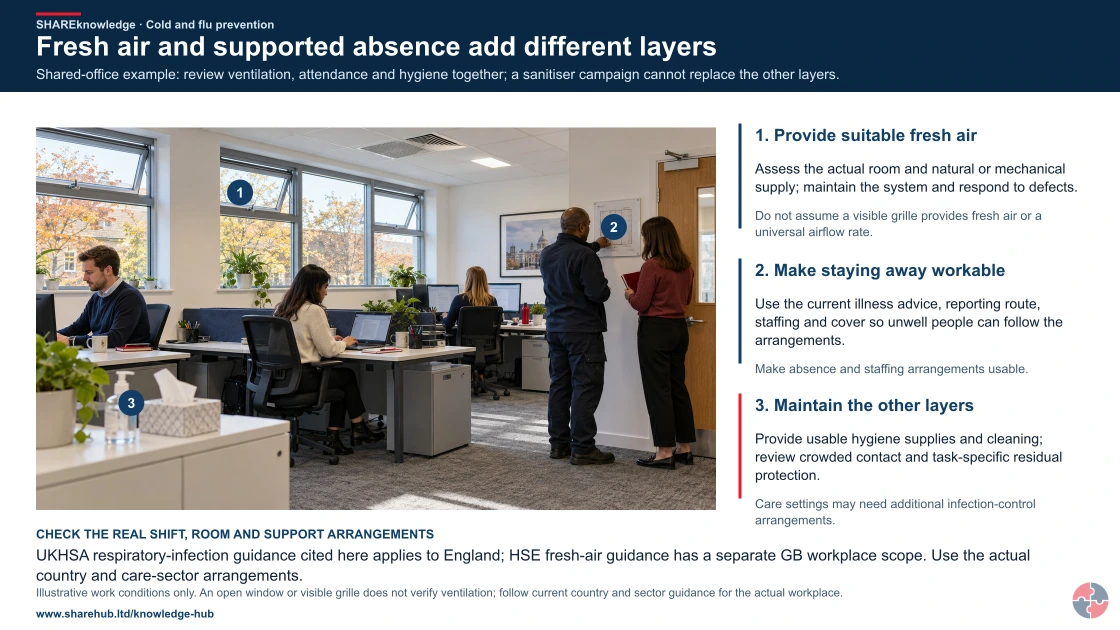
Full written explanation
Shared-office example: review ventilation, attendance and hygiene together; a sanitiser campaign cannot replace the other layers.
- Provide suitable fresh air. Assess the actual room and natural or mechanical supply; maintain the system and respond to defects.
- Make staying away workable. Use the current illness advice, reporting route, staffing and cover so unwell people can follow the arrangements.
- Maintain the other layers. Provide usable hygiene supplies and cleaning; review crowded contact and task-specific residual protection.
Change the pathway
- Check the actual supply. Do not assume a visible grille provides fresh air or a universal airflow rate.
- Avoid attendance pressure. Make absence and staffing arrangements usable.
- Use current sector advice. Care settings may need additional infection-control arrangements.
Evidence check: UKHSA respiratory-infection guidance cited here applies to England; HSE fresh-air guidance has a separate GB workplace scope. Use the actual country and care-sector arrangements.
Complete layered hierarchy, scope and worked reception controls
Primary references: UKHSA: workplace respiratory-infection principles (England) · UKHSA: ventilation and respiratory infections (England) · HSE: fresh-air workplace ventilation (GB scope)
Open the complete HD image (new tab)Download image

Complete layered hierarchy, scope and worked reception controls
Primary references: UKHSA: workplace respiratory-infection principles (England) · UKHSA: ventilation and respiratory infections (England) · HSE: fresh-air workplace ventilation (GB scope)
ERICPD and the five-level hierarchy can organise decisions; a service change may reduce contact, but cannot guarantee removal of respiratory viruses. Eliminate avoidable exposure by enabling unwell people to stay away; reduce crowded contact and isolate a symptomatic person from visitors while they leave; engineer fresh-air supply; use administrative cleaning, hand and cough hygiene; consider suitable face coverings or task-specific PPE for residual risk and current sector guidance. The UKHSA ventilation guidance supports fresh air; HSE ventilation guidance supports maintaining sufficient workplace fresh air in GB. Neither implies a universal fixed air-change rate for every room.
On a small screen, scroll this table sideways to read all columns.
How can the ERICPD hierarchy of controls reduce workplace transmission of cold and flu viruses?

| Hierarchy / ERICPD | Task control and feasibility | Owner, check, failure and stop |
|---|---|---|
| Elimination / eliminate | Offer remote or rescheduled appointments and supported absence for a feverish worker. | Duty manager checks cover; remove an unwell person from public-facing duty. |
| Substitution / reduce | Use telephone check-in or shorter indoor queues when service quality permits. | Service lead compares wait and crowding; revert or adjust if access is harmed. |
| Engineering / isolate and control | Maintain designed fresh-air supply through suitable natural or mechanical ventilation. | Facilities checks airflow and defects; restrict room use if ventilation fails and crowding persists. |
| Administrative / discipline | Provide handwashing, tissues, cleaning and an absence/reporting route; arrange separation and safe departure for a symptomatic visitor. | Supervisor checks supplies and practice; correct missing supplies immediately. |
| PPE / PPE | Use task-specific face coverings or PPE where current sector guidance and assessment call for it. | Competent lead checks fit/use where applicable; do not rely on it to compensate for failed ventilation or attendance control. |
How can the ISO 45001 hierarchy of controls reduce workplace transmission of cold and flu viruses?

| Hierarchy / ERICPD | Task control and feasibility | Owner, check, failure and stop |
|---|---|---|
| Elimination / eliminate | Offer remote or rescheduled appointments and supported absence for a feverish worker. | Duty manager checks cover; remove an unwell person from public-facing duty. |
| Substitution / reduce | Use telephone check-in or shorter indoor queues when service quality permits. | Service lead compares wait and crowding; revert or adjust if access is harmed. |
| Engineering / isolate and control | Maintain designed fresh-air supply through suitable natural or mechanical ventilation. | Facilities checks airflow and defects; restrict room use if ventilation fails and crowding persists. |
| Administrative / discipline | Provide handwashing, tissues, cleaning and an absence/reporting route; arrange separation and safe departure for a symptomatic visitor. | Supervisor checks supplies and practice; correct missing supplies immediately. |
| PPE / PPE | Use task-specific face coverings or PPE where current sector guidance and assessment call for it. | Competent lead checks fit/use where applicable; do not rely on it to compensate for failed ventilation or attendance control. |
HSE’s five-level hierarchy is the GB teaching framework for elimination, substitution, engineering, administrative controls and PPE. ERICPD is a complementary mnemonic. Select controls for the actual task and applicable work location, then check that they remain effective.
How should ventilation, cleaning and welfare facilities be managed?
Ventilation, cleaning and welfare facilities should be reliable, visible and maintained so infection-control behaviours are easy to follow.
Ventilation helps dilute respiratory particles. In simple workplaces this may mean opening windows safely where practical; in mechanically ventilated buildings it means making sure systems are maintained and set to provide adequate fresh air. Ventilation should be balanced with thermal comfort and the needs of people sensitive to cold.
Cleaning should focus on what people actually touch: door handles, light switches, phones, keyboards, tills, handrails, shared tools, vehicle controls, kitchen surfaces, taps, toilet areas and break-room tables. Washing facilities should be stocked, clean and convenient; if workers cannot wash their hands easily, the infection-prevention message is performative.
| Control area | Good practice | Evidence |
|---|---|---|
| Ventilation | Fresh air provided through safe natural or mechanical ventilation. | Ventilation checks and maintenance records. |
| Handwashing | Warm water, soap, drying facilities and clean toilets available. | Welfare inspection and stock checks. |
| High-touch cleaning | Frequently touched surfaces cleaned at suitable intervals. | Cleaning schedule and supervisor checks. |
| Shared equipment | Cleaning expectations for tools, desks, vehicles and devices. | User guidance and cleaning supplies. |
| Waste | Tissues and contaminated waste disposed of quickly. | Bins available and emptied. |
| Break areas | Eating and rest areas kept clean, ventilated and not overcrowded. | Welfare inspection and occupancy review. |
Facilities should establish the fresh-air provision for the actual occupancy/activity, with competent engineering advice where needed, and commission changes before relying on them. Check the system’s operating setting and airflow route before opening; maintain it and review when occupancy, layout or use changes. Recirculating room air is not fresh-air supply. A failed fan or blocked inlet triggers repair and reduced occupancy, relocation or restricted room use as the assessment requires; confirm restored performance before reopening. Do not prop fire doors open to improve airflow. HSE workplace ventilation guidance and UKHSA England ventilation guidance support these decisions. No single airflow target is prescribed here.
How should vaccination be discussed?
Signpost to the current local flu programme and let clinicians determine eligibility; do not promise a vaccine to every worker.
The England 2026–27 programme letter sets the current national offer in England. nidirect flu vaccine guidance is the NI route. Dates and eligible groups can change each season. An employer may facilitate access or paid time where its policy allows, but should not collect clinical vaccine details without a lawful, necessary purpose. Vaccination complements ventilation, absence support and hygiene; it does not make a symptomatic shift safe by itself.
How should vulnerable workers and new or expectant mothers be supported?
Vulnerable workers should be supported through confidential conversation, official health advice, proportionate adjustments and review of avoidable exposure.
Some workers are more likely to become seriously ill from flu or other respiratory infections. This may include pregnant workers, older workers and people with certain long-term conditions or weakened immune systems. Managers do not need detailed diagnoses; they need to understand work restrictions, support needs and whether temporary changes are needed.
HSE’s GB guidance on pregnant workers and new mothers identifies infectious diseases among harmful agents to consider in the individual work assessment. Assess the actual exposure, work tasks and individual circumstances. Possible work changes include reducing close contact with symptomatic people, revised public-facing duties, home working or alternative duties where appropriate; agree and review the arrangement rather than assuming a single adjustment suits everyone.
| Situation | Support option | Management evidence |
|---|---|---|
| Pregnancy or new motherhood | Review infection exposure and work tasks confidentially. | New/expectant mother risk assessment review. |
| Immunocompromised worker | Seek occupational-health or GP-informed work advice where needed. | Fitness advice and agreed adjustments. |
| Long-term respiratory or heart condition | Reduce avoidable contact during outbreaks where practical. | Temporary work plan and review date. |
| Care or healthcare role | Follow sector infection prevention and vaccination guidance. | Briefing, PPE where required and outbreak actions. |
| Public-facing role | Use distancing, screens, rota changes or alternative duties where proportionate. | Risk assessment and manager record. |
Keep support focused on the work barrier and necessary arrangements. ICO worker-health guidance requires a lawful basis and, for special-category health data, an appropriate condition; limit collection, access and retention to what the purpose needs. Supervisors usually need the agreed work action rather than a detailed clinical narrative.
What is the legal and public-health boundary?
General workplace risk, welfare and ventilation duties still apply, while public-health advice and seasonal vaccination programmes vary by jurisdiction.
HSE’s GB risk-assessment guidance and GB ventilation guidance support a proportionate workplace plan. The England stay-home page is public-health advice, not an automatic UK-wide employer mandate. Northern Ireland has separate public advice through nidirect; Scotland and Wales should be checked against their current devolved public-health guidance before reusing an England instruction. Sector-specific healthcare and care requirements may impose additional controls and must be checked for that setting. A manager should assess staffing and exposure without diagnosing individual workers.
How should cold and flu prevention appear in the risk register?
Cold and flu prevention should appear through transmission scenarios, vulnerable groups, business continuity risks and controls that reduce spread.
Make the care-support work plan usable in practice
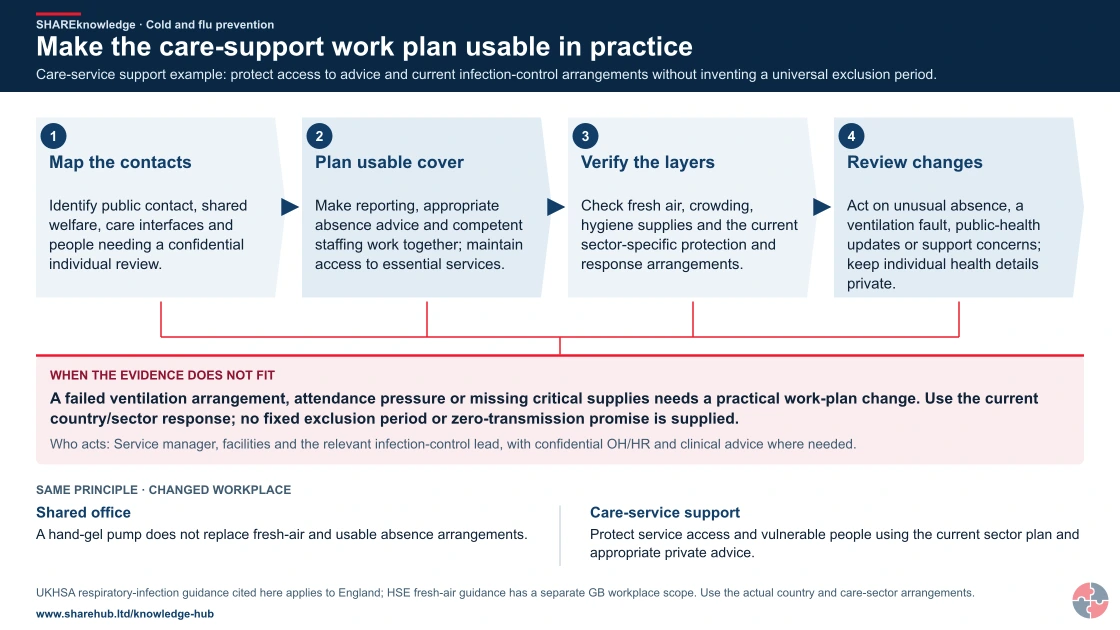
Full written explanation
Care-service support example: protect access to advice and current infection-control arrangements without inventing a universal exclusion period.
- Map the contacts. Identify public contact, shared welfare, care interfaces and people needing a confidential individual review.
- Plan usable cover. Make reporting, appropriate absence advice and competent staffing work together; maintain access to essential services.
- Verify the layers. Check fresh air, crowding, hygiene supplies and the current sector-specific protection and response arrangements.
- Review changes. Act on unusual absence, a ventilation fault, public-health updates or support concerns; keep individual health details private.
When the evidence does not fit: A failed ventilation arrangement, attendance pressure or missing critical supplies needs a practical work-plan change. Use the current country/sector response; no fixed exclusion period or zero-transmission promise is supplied.
Who acts: Service manager, facilities and the relevant infection-control lead, with confidential OH/HR and clinical advice where needed.
Changed workplace
Shared office: A hand-gel pump does not replace fresh-air and usable absence arrangements.
Care-service support: Protect service access and vulnerable people using the current sector plan and appropriate private advice.
Evidence check: UKHSA respiratory-infection guidance cited here applies to England; HSE fresh-air guidance has a separate GB workplace scope. Use the actual country and care-sector arrangements.
Complete layered hierarchy, scope and worked reception controls
Primary references: UKHSA: workplace respiratory-infection principles (England) · UKHSA: ventilation and respiratory infections (England) · HSE: fresh-air workplace ventilation (GB scope)
Open the complete HD image (new tab)Download image

Complete layered hierarchy, scope and worked reception controls
Primary references: UKHSA: workplace respiratory-infection principles (England) · UKHSA: ventilation and respiratory infections (England) · HSE: fresh-air workplace ventilation (GB scope)
For most workplaces, this should be a seasonal or wellbeing risk entry, not an over-engineered hazard file. The entry should identify the work factors that make transmission likely: public contact, shared welfare, crowded offices, shared vehicles, close-contact care, cleaning gaps or absence pressure.
The register should also include review triggers: winter season, unusual absence, outbreak in a team, public-health update, vulnerable-worker concern, ventilation fault or repeated attendance while clearly unwell.
| Scenario | Risk route | Controls | Assurance |
|---|---|---|---|
| Shared welfare outbreak | Workers gather in poorly ventilated break areas. | Ventilation, cleaning, staggered breaks and supplies. | Welfare inspection and absence trend. |
| Public-facing illness spread | Staff and customers exchange respiratory infections. | Hand hygiene, screens where useful and staying away when unwell. | Supervisor checks and customer-contact review. |
| Critical team absence | Several trained people become ill at once. | Cross-training, rota resilience and remote options. | Continuity plan and absence dashboard. |
| Vulnerable worker exposure | Higher-risk person has avoidable close contact during peak illness. | Confidential review and temporary adjustment. | OH/HR record and review date. |
| Cleaning supplies fail | Soap, tissues or cleaning materials run out. | Stock checks and named facility owner. | Facilities checklist and replenishment log. |
How could Riverside Leisure Ltd manage cold and flu prevention?

Riverside Leisure Ltd would manage cold and flu prevention by combining public-facing hygiene controls, staff absence culture, vulnerable-customer awareness and practical winter readiness.
Riverside Leisure Ltd
A leisure and hospitality business running a swimming pool, gym, cafe, events space and outdoor activity centre with staff, contractors, children, families and older visitors.
Riverside maps infection spread across reception desks, cafe tills, changing rooms, gym equipment, poolside radios, staff rooms, children’s parties, classes and shared vehicles. The seasonal risk register identifies high-touch surfaces, busy sessions, vulnerable customer groups, cleaning peaks, ventilation checks and staffing pressure during winter.
The business does not rely on posters alone. Reception, gym and cafe supervisors have short checklists for soap, hand-drying, tissues, bins, high-touch cleaning, ventilation, shared equipment cleaning and whether staff appear too unwell for public-facing work. Cleaning tasks are increased during respiratory infection peaks and are checked at realistic times, not only at opening.
Riverside also manages the human side. Staff are told before winter that staying away when genuinely unwell is expected, not disloyal. Managers are trained to discuss symptoms privately, avoid demanding unnecessary medical detail and consider temporary changes such as non-public-facing duties, remote admin, shift swaps or phased return. HR reviews absence patterns, but also checks whether rota pressure or sick-pay concerns are encouraging presenteeism.
| Management area | How Riverside applies it | Evidence and improvement |
|---|---|---|
| Assess and analyse | Maps transmission points in reception, gym, cafe, changing rooms, classes and staff welfare. | Seasonal risk register and site walk-through. |
| Implement controls | Uses handwashing, cleaning schedules, ventilation checks, tissues, bins and shared-equipment cleaning. | Supervisor checklist and facilities inspection. |
| Train and communicate | Briefs workers on symptoms, staying away, customer contact, vulnerable users and cleaning expectations. | Winter briefing and knowledge check. |
| Manage absence culture | Supports fair reporting and avoids pressuring infectious staff into customer-facing work. | Absence procedure, HR review and manager coaching. |
| Protect vulnerable people | Reviews classes, older-user sessions, pregnancy concerns and clinically vulnerable staff discreetly. | Adjustment record and review date. |
| Learn and improve | Reviews absence spikes, complaints, cleaning misses and supply failures after winter peaks. | Lessons learned and revised winter-readiness plan. |
What should each role learn and demonstrate?
Learning must match the decisions people make, from recognising danger to checking that controls work.
Briefings should tell people how to act, but attendance alone does not show competence. Assess the real decision or task, record who assessed it and revisit after a material change, failed control or incident. A local authorisation is task-specific; no universal external certificate is implied.
On a small screen, scroll this table sideways to read all columns.
| Role and learning | Demonstration and assessor | Record and reassessment trigger |
|---|---|---|
| Line manager: attendance decision. | Run a feverish reception-worker scenario using supported absence and safe cover. | Recorded scenario and policy check. |
| Facilities: fresh air. | Inspect the busiest room and log ventilation defects and response. | Airflow/maintenance record. |
| Worker: everyday practice. | Demonstrate cough hygiene and know how to report symptoms. | Observation and replenished supplies. |
| Health lead: seasonal update. | Check England/NI vaccine links before autumn communications. | Dated signposting review. |
How can a management system sustain effective decisions?
Give each hazard or support route an owner, a control, a check and a response to failure.
Track absence support, fresh-air defects and high-contact tasks as connected controls. Review after service, season or public-health guidance changes; no unverified ISO clause application is asserted. An owner should sample actual work and corrective actions, not accept a policy or certificate as evidence that the controls work.
The free GB regulator guide HSE Managing for health and safety (HSG65) explains a plan–do–check–act approach: assign controls and owners, involve workers, check work as done, and correct failures. For Northern Ireland, use HSENI risk assessment guidance for the local duty. A certificate alone does not demonstrate that a control works.
What warning signs show cold and flu prevention is weak?
Warning signs include presenteeism, poor welfare supplies, stale air, inconsistent cleaning, absence spikes and managers treating illness as a conduct problem too quickly.
A weak system is usually visible. Soap runs out, bins overflow, staff rooms feel stuffy, people come in feverish because cover is impossible, managers joke about sickness, or cleaning records are signed without anyone checking the areas that people actually touch.
These warning signs can cause harm by spreading infection, increasing absence, exposing vulnerable people and reducing trust. The fix should remove barriers: stock supplies, improve ventilation, update rotas, brief managers, review cleaning and make absence expectations clear before winter pressure arrives.
| Warning sign | How harm can develop | What to improve |
|---|---|---|
| People work while clearly unwell | Infection spreads and recovery is delayed. | Absence culture, cover plans and manager training. |
| Soap or drying facilities missing | Hand hygiene becomes impossible. | Facilities checks and stock ownership. |
| Poor ventilation | Respiratory particles build up in occupied spaces. | Ventilation review and maintenance. |
| High-touch cleaning is vague | Shared surfaces remain contaminated. | Specific cleaning schedule and verification. |
| Vulnerable workers are ignored | People at higher risk may face avoidable exposure. | Confidential review and temporary adjustments. |
| Absence data is used punitively only | People hide illness and attend while infectious. | Use trends for prevention and fair support. |
What acronyms are used on this cold and flu prevention page?
Acronyms should be explained so health, HR and workplace-control language remains accessible.
| Acronym | Meaning | Why it matters |
|---|---|---|
| Acas | Advisory, Conciliation and Arbitration Service | Official employment relations guidance. |
| GP | General practitioner | Usual primary-care doctor route for personal health advice. |
| HSE | Health and Safety Executive | Great Britain regulator for workplace health and safety. |
| HR | Human resources | Supports absence, adjustments and confidential employment processes. |
| NHS | National Health Service | NHS England health information; check devolved advice by work location. |
| OH | Occupational health | Work-health advice for fitness, restrictions and adjustments. |
| RPE | Respiratory protective equipment | Masks or respirators where specific risk assessment requires them. |
| UKHSA | UK Health Security Agency | UK public-health agency for infection, vaccination and health protection guidance. |