
SHARE Knowledge Hub
What are chemical and biological agents at work?
Hazardous chemicals and biological agents may be bought in, created by work or encountered incidentally in contaminated materials. Identify the agent, task and exposure route before choosing source controls, hygiene, PPE and surveillance. Incidental infection exposure differs from deliberate laboratory work, which can require specialist containment and notification.
Understanding What are chemical and biological agents at work?
Hazardous chemicals and biological agents may be bought in, created by work or encountered incidentally in contaminated materials. Identify the agent, task and exposure route before choosing source controls, hygiene, PPE and surveillance. Incidental infection exposure differs from deliberate laboratory work, which can require specialist containment and notification.
Why this matters at work
Start with credible events for the actual inventory: liquid or gas release, powder escape, contamination of a person, sharps injury, aerosol or ventilation failure. Identify who raises the alarm, isolates remotely where safe, excludes people, contacts emergency services and undertakes specialist response. Protect responders and do not rely on an unprotected rescue. A universal kit, neutraliser or disinfectant may be ineffective or create another hazardous reaction. Specify compatible materials, containment, decontamination, waste handling, medical handover and conditions for re-entry through competent assessment. Read product information across first aid, firefighting, accidental release and stability sections rather than copying one instruction in isolation. Biological incidents may require agent-specific exposure assessment and clinical advice; chemical incidents may include delayed toxicity and fire risk. Practise the arrangements for all shifts and contractor interfaces. Record response limitations and who authorises the local recovery process. Prioritise casualty care without unnecessary spread of contamination. Review after exercises or incidents and verify that equipment, water, communication and specialist support are available where the scenario could occur.
Clarify the task, source, visible condition, possible sharps, contamination route and nearby people. Select handling, containment, cleaning, disposal and any PPE through the appropriate assessment; one disinfectant or spill kit is not suitable for all chemicals and organisms. If exposure has occurred, use the relevant prompt medical and first-aid route without waiting for full identification. Record known facts and uncertainty, actions and responsibility, with personal health information protected. Before resuming, verify a method and destination for the material and communicate it to contractors and cleaners as well as the normal team.
How organisations manage this in practice
Use the correct product information and relevant biological guidance, then assess level, type and duration of exposure, routes, controls and foreseeable failures. A label or safety data sheet cannot describe every generated contaminant or workplace condition. Choose prevention and source controls before relying on PPE, and check that cleaning or disinfection does not introduce incompatible chemical risks. Assign actions and verification responsibilities. GB and NI COSHH are separate instruments, and specialist hazards such as asbestos, lead or deliberate biological work can require additional routes. Record those boundaries and seek competent assistance where identity, containment or treatment decisions exceed local capability.
Map the work rather than compiling only a purchased-chemical list. Identify supplied substances, process-generated dust, fume or mist, contaminated water, waste, body fluids and other credible biological sources. Describe how each can reach people by inhalation, skin or eye contact, ingestion or inoculation. Include operators, cleaners, maintenance staff, contractors, visitors and vulnerable people where relevant. Observe receipt, use, cleaning, shutdown, waste and abnormal work.
Significant chemical exposure, suspected infection exposure, sharps injury, asbestos disturbance, silica overexposure, legionella concern or unknown contamination should be escalated through the site emergency, first-aid, occupational health, infection-control or competent specialist route as appropriate.
Who needs to understand chemical and biological agents?
Chemical and biological agents should be understood by workers, supervisors, managers, designers, contractors, H&S advisers, occupational health teams and learners.
Construction workers
Need practical knowledge of dusts, wet cement, asbestos, contaminated land, welfare and hygiene.
Supervisors
Need to brief controls, check welfare, stop uncontrolled work and recognise symptoms or contamination.
Site managers
Need to coordinate COSHH, asbestos, silica, legionella, waste, contractors and emergency arrangements.
Designers and planners
Need to reduce exposures through specification, sequencing and pre-construction information.
Contractors
Need to declare substances brought to site and follow site hygiene, storage and exposure controls.
Learners
Need to connect construction safety study theory to realistic site scenarios and evidence.
How can I practise this topic in 3D?


One gas reading is used as a permanent clearance
All related inspection points 3 across 1 location
Construction site 3 inspection points
Practice in the SHAREhub environment. Browser practice is separate from workplace competence and formal learning records.
Use the agent-and-task route before choosing controls
Use four cases to select the next assessment. A bought-in cleaner starts with product identity and current supplier information, then a Chemical Safety and task-COSHH review. Cutting masonry creates dust through the process and leads to Construction Dust; the tool’s SDS cannot describe that exposure. Contaminated drainage is an incidental biological-exposure task requiring its own assessment and hygiene and contact controls.
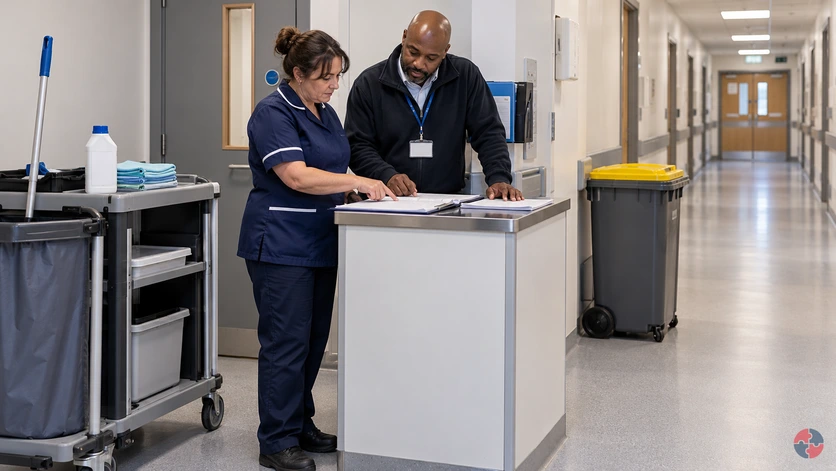
Different sources need different task evidence
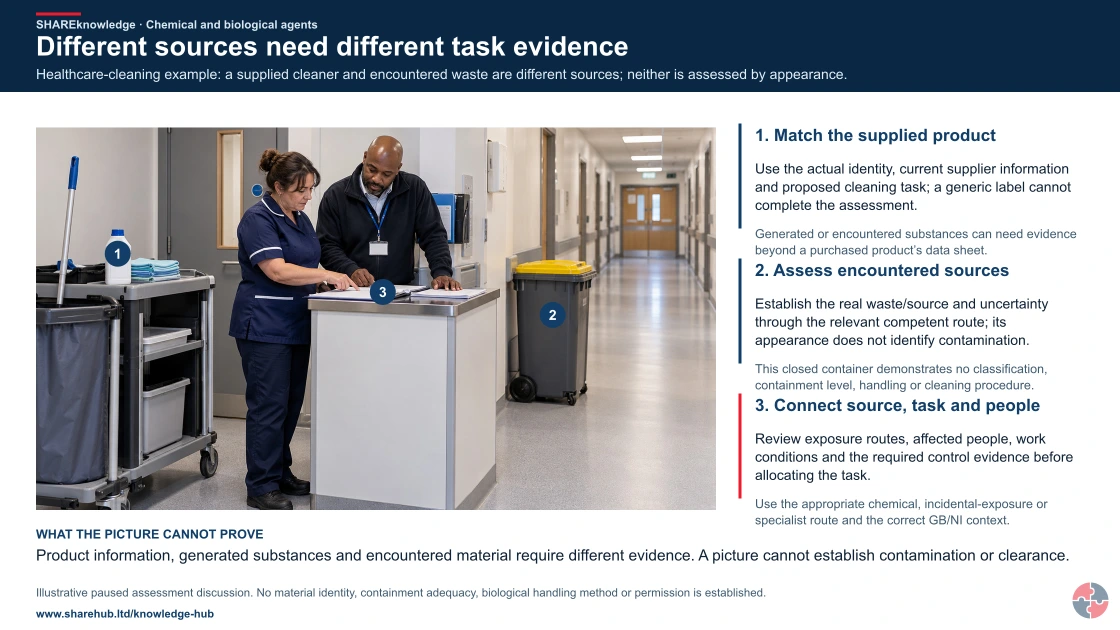
Full written explanation
Healthcare-cleaning example: a supplied cleaner and encountered waste are different sources; neither is assessed by appearance.
- Match the supplied product. Use the actual identity, current supplier information and proposed cleaning task; a generic label cannot complete the assessment.
- Assess encountered sources. Establish the real waste/source and uncertainty through the relevant competent route; its appearance does not identify contamination.
- Connect source, task and people. Review exposure routes, affected people, work conditions and the required control evidence before allocating the task.
Change the pathway
- Do not stop at the SDS. Generated or encountered substances can need evidence beyond a purchased product’s data sheet.
- No biological operating recipe. This closed container demonstrates no classification, containment level, handling or cleaning procedure.
- Preserve the actual scope. Use the appropriate chemical, incidental-exposure or specialist route and the correct GB/NI context.
Evidence check: Product information, generated substances and encountered material require different evidence. A picture cannot establish contamination or clearance.
Full source, task, specialist-route and GB/NI assessment context
Primary references: HSE: COSHH risk assessment (GB) · HSE: what COSHH covers (GB)
Open the complete HD image (new tab)Download image

Full source, task, specialist-route and GB/NI assessment context
Primary references: HSE: COSHH risk assessment (GB) · HSE: what COSHH covers (GB)
A laboratory culture is deliberate biological work: the biological-safety lead must decide classification, containment and the relevant location-specific approvals before work. These cases have different assessment owners and evidence. If material is unknown, the supervisor holds intrusive work and obtains competent identification; neither a guessed classification nor a generic SDS makes asbestos, lead or an unidentified residue safe.
BuildOut: the drainage task is not routine product use
Illustrative example. A refurbishment team finds contaminated water and an unidentified residue where a cleaner was originally planned.
Decision. The site manager stops the changed task, obtains competent assessment and selects the incidental-exposure and unknown-material routes.
Evidence to check. Actual contents, exposure routes, affected people, safe access, welfare and the appropriate specialist input.
Hold or escalation point. No disturbance or mixing while the agent and safe method remain unresolved.
Follow-up. Update the project information and brief the revised scope before authorising the work.
Identify the agent and route before choosing controls
A construction dust task and contaminated-water work can require very different controls. “Chemical” and “biological” are categories, not complete assessments.

Agent and task
Identify what is present and how the work can release or transfer it. Hold uncertainty for competent identification.
Exposure route
Consider inhalation, skin, eyes and ingestion as relevant to the actual agent and task; do not copy one generic PPE list across both scenes.
Prevention and response
Control at source, manage spread and clean boundaries, and provide suitable hygiene and the assessed response to an exposure.
This comparison does not identify a pathogen, chemical or disinfection method from the appearance of water or dust.
What are the key facts about chemical and biological agents?
The key facts are that agents may be bought in, naturally present, hidden in materials or generated by the work process itself.
Not all agents arrive with a label
Silica dust, welding fume, diesel exhaust, sewage contamination and legionella can be produced or encountered during work.
The task changes the risk
A solid material may become respirable dust when cut, or a liquid may become an inhalable aerosol when sprayed.
Biological risk can be incidental
Workers may be exposed because of the environment, materials, waste, water or animals rather than deliberate laboratory work.
COSHH links both families
COSHH requires assessment and prevention or adequate control of exposure to substances hazardous to health, including biological agents.
Health effects can be delayed
Occupational asthma, dermatitis, silicosis, asbestos disease, infection and cancer may not appear immediately.
Hygiene is a control measure
Washing, welfare, clean/dirty separation, vaccination where relevant and waste controls can prevent exposure.
Which chemical or biological route is this?
Start by classifying the work: bought-in product, process-generated substance, incidental biological exposure or deliberate biological work.
A product safety data sheet helps with a bought-in chemical, but it cannot describe every fume, dust or by-product created when material is cut, heated or mixed. Observe the actual task and neighbouring work. For incidental biological exposure, identify contaminated water, waste, sharps, animals or materials and how organisms might reach a worker. Deliberate work means intentional handling or propagation in laboratories or similar work and needs specialist classification and containment; the GB notification route for Hazard Groups 2–4 is not a generic requirement for a construction site that may encounter sewage.
On a small screen, scroll this table sideways to read all columns.
| Route | Example | First control and escalation |
|---|---|---|
| Bought-in chemical | Cleaner, resin, solvent or cement product. | Read current SDS and observe use; substitute or enclose where feasible. |
| Process-generated agent | Silica dust, welding fume or diesel exhaust. | Assess the actual generating process; specify source capture and nearby-worker protection. |
| Incidental biological exposure | Sewage, contaminated water, sharps or animal waste. | Avoid contact/aerosol, control access, plan hygiene, waste and occupational-health escalation. |
| Deliberate biological work | Laboratory culture, diagnostic or research manipulation. | Stop generic site route; specialist biosafety classification, containment and current regulator notification check. |
What are chemical and biological agents at work?
Chemical and biological agents are hazardous substances or organisms that can damage health when people are exposed during work.
A chemical agent may be a liquid, gas, vapour, fume, dust, mist, powder, paste, fibre, residue or process by-product. Some are toxic, corrosive, irritant, sensitising, carcinogenic, flammable, oxidising or harmful to reproduction.
A biological agent is a micro-organism, cell culture or human endoparasite capable of causing infection, allergy, toxicity or another hazard to human health. Bacteria, viruses, fungi and some parasites are examples; contaminated blood, sewage, soil and water are materials that may carry biological agents, not agents in themselves.
The practical question is always the same: what agent is present, how could exposure happen, who could be harmed, what disease or injury could occur, what controls prevent exposure and what evidence shows that the controls are working?
| Agent family | Typical examples | What makes it hazardous |
|---|---|---|
| Chemical agents | Cement, solvents, paints, resins, fuels, acids, alkalis, lead and welding fume. | Toxicity, burns, sensitisation, respiratory disease, cancer, poisoning or fire/explosion. |
| Biological agents | Legionella, sewage organisms, moulds, bloodborne viruses and animal-related infections. | Infection, allergy, toxicity, contamination or spread. |
| Fibres and dusts | Asbestos, silica, wood dust, cement dust and mineral dust. | Inhalation exposure and long-term lung disease. |
| Process-generated agents | Welding fume, diesel exhaust, cutting dust and cleaning aerosols. | Created by the method of work, so may be missed by product registers. |
Which chemical agents are commonly found at work?
Common chemical agents include bought-in substances, construction materials, fuels, fumes, dusts and residues produced by normal work.
Chemical agents should be assessed by product and by task. The product name alone is not enough. A paint may be brushed, sprayed, heated, sanded after curing or removed during refurbishment, and each activity creates a different exposure profile.
Construction brings several high-consequence agents together: silica from cutting concrete and masonry, wet cement burns and dermatitis, asbestos in older buildings, lead in old paint, isocyanates in some coatings and foams, solvent vapours, welding fume and diesel exhaust.
The strongest assessments connect the agent to the work method, duration, controls, exposed group and evidence. A generic COSHH file that simply says 'use gloves and mask' does not teach workers or control exposure.
| Agent | Typical source | Main concern |
|---|---|---|
| Respirable crystalline silica | Cutting, drilling or breaking concrete, brick, stone, mortar and tiles. | Silicosis, COPD and lung cancer risk. |
| Cement | Dry powder, mortar, concrete and wet cement. | Airway irritation, alkaline burns and dermatitis. |
| Asbestos | Older building materials disturbed by maintenance or refurbishment. | Mesothelioma, lung cancer and asbestosis. |
| Lead | Old paint, pipework, solder and contaminated dust. | Systemic toxicity and reproductive harm. |
| Solvents | Paints, cleaners, adhesives and degreasers. | Vapour inhalation, skin absorption, fire and neurological effects. |
| Isocyanates and resins | Spray coatings, foams, adhesives and two-pack products. | Occupational asthma and dermatitis. |
| Welding fume | Hot work and metal fabrication. | Respiratory disease and metal fume exposure. |
| Diesel exhaust | Plant, generators and vehicles. | Respiratory irritation and carcinogenic exposure concern. |
Which biological agents are relevant to workplaces?
Relevant biological agents depend on the work environment, materials handled and whether exposure is incidental or deliberate.
In construction and maintenance, most biological exposure is incidental. Workers may encounter sewage, contaminated water, bird or animal droppings, discarded needles, mould, contaminated soil, blocked drains, stagnant water or poorly managed water systems.
In laboratories, healthcare, animal work and biotechnology, biological agents may be deliberately handled. That is a higher-specialism area with containment levels, classification, notification and specialist procedures.
For general workplace and construction readers, the key is to recognise when the environment or material is contaminated and to avoid turning biological exposure into a normal housekeeping job. Cleaning sewage, sharps, mould or contaminated water without competent controls can create infection and public-health risk.
Before deliberate biological work in Great Britain, the biosafety specialist should check the current Approved List and review the task assessment when an agent is added or reclassified. The 2026 sixth edition includes classification and vaccine-advice changes. An unlisted organism is not automatically Hazard Group 1: classify it through a competent risk assessment, then select containment for both the agent and the activity. Confirm the Northern Ireland requirements with HSENI for work there.
| Agent or source | Where it may arise | Main concern |
|---|---|---|
| Legionella | Water systems, cooling systems, showers, hoses and stagnant water. | Legionnaires' disease and respiratory infection risk. |
| Sewage organisms | Drainage work, blocked toilets, contaminated basements and flooding. | Gastrointestinal infection, leptospirosis and skin/eye exposure. |
| Moulds and fungi | Damp buildings, demolition, refurbishment and poorly ventilated spaces. | Respiratory irritation, allergy and infection risk for vulnerable people. |
| Bloodborne viruses | Sharps, needles, bodily fluids and healthcare-type waste. | Hepatitis and HIV exposure risk through inoculation or mucous membrane contact. |
| Animal waste organisms | Bird droppings, rodent contamination, farms and contaminated lofts. | Infection, allergy and respiratory exposure. |
| Clinical or laboratory agents | Healthcare, diagnostics, research and teaching laboratories. | Deliberate biological-agent exposure requiring specialist containment. |
How do chemical and biological agents apply to construction work?
Construction work can expose people to agents during demolition, refurbishment, excavation, cutting, cleaning, welfare, plant use, water management and maintenance.
Construction risk changes quickly as the job progresses. A site may start with asbestos and lead surveys, move into demolition dust, then excavation in contaminated ground, then wet cement and silica exposure, then cleaning chemicals and handover water-system controls.
The construction phase plan should therefore link CDM planning, survey information, COSHH assessments, welfare, storage, permits, contractor coordination, exposure monitoring and health surveillance. Chemical and biological risk cannot sit in a separate folder away from the programme.
Good site control uses pre-construction information, surveys, sequencing and supervision to avoid surprises. If workers discover unknown insulation, contaminated water, sharps, strong odours, unusual residues or unlabelled containers, work should pause until competent assessment decides the next step.
| Scenario | Agent concern | Control focus |
|---|---|---|
| Refurbishing a pre-2000 building | Asbestos, lead paint, mould and dust. | Surveys, information, licensed/non-licensed controls and stop-work rules. |
| Cutting concrete or masonry | Respirable crystalline silica. | Design out cutting, wet methods, on-tool extraction, RPE and exclusion. |
| Pouring concrete or laying blocks | Wet cement and cement dust. | Skin/eye protection, washing, training and skin checks. |
| Drainage or contaminated ground work | Sewage organisms, contaminated soil and sharps. | Welfare, hygiene, vaccination advice where relevant and specialist disposal. |
| Temporary water systems | Legionella and stagnant water. | Water management, flushing, temperature control and competent checks. |
| Plant and generator use | Diesel exhaust and carbon monoxide. | Ventilation, positioning, maintenance and monitoring where required. |
How can chemical and biological agents enter the body?
Chemical and biological agents can enter the body by inhalation, skin or mucous membrane contact, eye contact, ingestion and injection.
Inhalation is the main route for dusts, fumes, vapours, gases, mists and some biological aerosols. Skin and eye contact are common where liquids, wet materials, contaminated surfaces or splashes are present. Ingestion usually follows poor hygiene. Injection can happen through sharps, punctures or high-pressure equipment.
Biological agents also require thinking about transmission: contaminated hands, droplets, aerosols, blood or body fluid contact, contaminated water, contaminated surfaces, animal waste or vectors. Not every exposure causes infection, but the assessment should consider susceptibility, vaccination, pregnancy, immune status and vulnerable workers where relevant.
Control must follow the route. A mask will not stop contaminated hands transferring organisms to the mouth. Gloves will not control silica dust in the breathing zone. Good hygiene, welfare and cleaning are not optional extras.
| Route | Chemical examples | Biological examples |
|---|---|---|
| Inhalation | Silica dust, solvent vapour, welding fume and diesel exhaust. | Aerosols, legionella and mould spores. |
| Skin contact | Wet cement, resins, solvents, acids and alkalis. | Sewage, contaminated water and animal waste. |
| Eye contact | Chemical splash, dust and aerosols. | Contaminated splash and droplets. |
| Ingestion | Contaminated hands, food, drink or cigarettes. | Hand-to-mouth transfer from waste, soil or sewage. |
| Injection | High-pressure fluid, contaminated tools or sharps. | Needlestick and contaminated puncture injuries. |
What health effects can chemical and biological agents cause?
Effects can include burns, poisoning, asthma, dermatitis, lung disease, infection, allergy, toxicity, cancer and long-latency occupational disease.
Chemical harm may be acute or chronic. Acute effects include burns, eye injury, dizziness, asphyxiation and poisoning. Chronic effects include dermatitis, asthma, silicosis, solvent-related nervous-system harm and occupational cancer.
Biological harm may involve infection, allergy or toxic effects. Some people are more vulnerable because of pregnancy, immune suppression, underlying health conditions or lack of vaccination. The assessment should not assume all workers have the same susceptibility.
Because several diseases develop slowly, absence of immediate symptoms is not proof of control. Exposure evidence, health surveillance, worker feedback and inspections are needed to show the system is working.
| Outcome | Possible agent | Why it matters |
|---|---|---|
| Dermatitis | Cement, wet work, resins, solvents and disinfectants. | Can become chronic and prevent normal work. |
| Occupational asthma | Isocyanates, wood dust, flour dust and some biological agents. | Sensitisation can make future small exposures trigger symptoms. |
| Silicosis | Respirable crystalline silica. | Serious lung disease linked to cutting and grinding silica-containing materials. |
| Asbestos disease | Asbestos fibres. | Long-latency fatal diseases including mesothelioma and lung cancer. |
| Infection | Legionella, sewage organisms, sharps and animal waste. | Can affect workers and sometimes others beyond the site. |
| Poisoning | Lead, carbon monoxide, solvents and toxic gases. | Can affect the nervous system, blood, organs or consciousness. |
| Chemical burns | Acids, alkalis and wet cement. | Can cause severe tissue damage and eye injury. |
How should chemical and biological agents be assessed?
Assessment should identify the agent, source, task, exposure route, people exposed, health effect, existing controls, further controls and evidence of effectiveness.
For chemical agents, start with SDSs, labels, WELs, product form, process-generated substances and task observation. For biological agents, identify whether exposure is incidental or deliberate, what material or environment may contain the agent, how transmission could occur and who may be more vulnerable.
Assessment should be specific enough for the job. 'Use PPE' is not a control strategy. The assessment should state the wet method, extraction type, glove material, hygiene arrangement, exclusion area, spill response, waste route and supervision standard where those details matter.
Construction assessments should also connect to CDM. Pre-construction information, surveys, construction phase planning, RAMS, permits, inductions and welfare arrangements are all part of preventing exposure.
| Question | Chemical angle | Biological angle |
|---|---|---|
| What is present? | Product, dust, fume, vapour, fibre or residue. | Organism, contaminated material, water, waste, animal or environment. |
| How is it released? | Cutting, spraying, mixing, heating, cleaning or storage failure. | Contact, aerosol, splash, sharps, contaminated surface or water system. |
| Who is exposed? | Users, nearby trades, cleaners, maintenance and contractors. | Workers, vulnerable workers, visitors and public where relevant. |
| What harm could occur? | Burns, asthma, dermatitis, poisoning, lung disease or cancer. | Infection, allergy, toxicity or spread. |
| What controls exist? | Substitution, LEV, RPE, storage, PPE and training. | Hygiene, segregation, disinfection, sharps control, vaccination advice and procedures. |
| What proves control? | Monitoring, inspections, health surveillance and records. | Cleaning checks, incident reports, surveillance, training and specialist review. |
How can the hierarchy of controls reduce exposure to chemical and biological agents?
Exposure should be controlled by eliminating or reducing the agent, isolating people, controlling release or transmission, using PPE/RPE and enforcing disciplined work practices.
An unexpected waste source changes the assessment
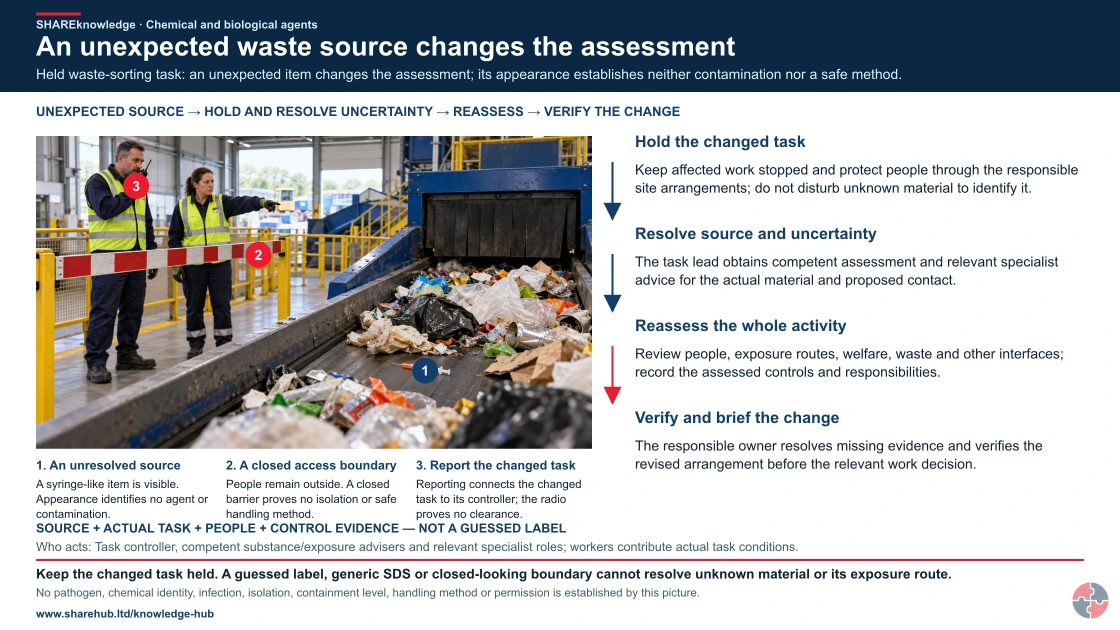
Full written explanation
A waste-sorting scene shows a whole conveyor, mixed material, an unexpected syringe-like item, a closed access barrier and two colleagues outside while one reports by radio. Nobody touches, removes or sorts the item. Picture key1 identifies an unresolved source,2the closed access boundary and3reporting to the task controller. Appearance establishes no pathogen, chemical, contamination, injury or biological classification. The closed barrier does not prove machinery isolation, containment adequacy or a safe handling method; the radio does not prove clearance. The independent unnumbered process connects a held changed task with competent source/uncertainty assessment, review of the whole activity and affected people/interfaces, then verification and briefing of the revised arrangement before the relevant work decision. A purchased product’s information, a process-generated substance and encountered material can require different evidence and responsible routes. Keep actual chemical, incidental-exposure or specialist scope and GB/NI context distinct. A guessed label, generic SDS or closed-looking container cannot resolve an unknown material or exposure route. No touching/removal, sorting, cleaning, disinfection, waste classification, vaccination, exposure, treatment, biological handling or machine-isolation procedure is supplied, and no pictured glove, barrier or still conveyor establishes work permission.
Held waste-sorting task: an unexpected item changes the assessment; its appearance establishes neither contamination nor a safe method.
- Hold the changed task. Keep affected work stopped and protect people through the responsible site arrangements; do not disturb unknown material to identify it.
- Resolve source and uncertainty. The task lead obtains competent assessment and relevant specialist advice for the actual material and proposed contact.
- Reassess the whole activity. Review people, exposure routes, welfare, waste and other interfaces; record the assessed controls and responsibilities.
- Verify and brief the change. The responsible owner resolves missing evidence and verifies the revised arrangement before the relevant work decision.
When the evidence does not fit: Unknown material or an unresolved exposure route is not cleared by a guessed label, a generic SDS or a closed-looking container. No disturbance or mixing while the actual scope and safe method remain unresolved.
Who acts: Task controller, competent substance/exposure advisers and relevant specialist roles; workers contribute actual task conditions.
Changed workplace
Healthcare cleaning: Separate supplied product information from the assessment of encountered material and actual contact work.
Waste sorting: Resolve an unexpected source and the changed task through competent assessment before routine work resumes.
Evidence check: Product information, generated substances and encountered material require different evidence. A picture cannot establish contamination or clearance.
Full source, task, specialist-route and GB/NI assessment context
Primary references: HSE: COSHH risk assessment (GB) · HSE: what COSHH covers (GB)
Open the complete HD image (new tab)Download image

Full source, task, specialist-route and GB/NI assessment context
Primary references: HSE: COSHH risk assessment (GB) · HSE: what COSHH covers (GB)
ERICPD is useful because it keeps the conversation away from PPE as the default. Eliminate the task or agent where possible. Reduce hazard by using safer substances, off-site fabrication, pre-cut materials, lower-dust methods or less contaminated approaches. Isolate people through exclusion, enclosure or segregation. Control the source using wet methods, LEV, containment, hygiene, disinfection and cleaning. PPE/RPE then manages residual exposure. Discipline keeps checks, training and supervision alive.
For biological agents, control also means breaking the chain of transmission: avoid contact with contaminated material, prevent aerosol generation, use hygiene and welfare, provide safe sharps and waste routes, clean surfaces, consider vaccination where relevant and communicate symptoms or exposure reporting routes.
Controls should be practical enough for site conditions. A control that only works in a classroom, clean laboratory or perfect weather will fail on a busy construction site unless it is designed, supervised and resourced properly.
How can the ERICPD hierarchy of controls reduce exposure to chemical and biological agents?

| ERICPD level | Chemical example | Biological example |
|---|---|---|
| Eliminate | Design out cutting, avoid hazardous product or buy pre-finished components. | Avoid entering contaminated area until cleaned or remediated. |
| Reduce | Use lower-hazard products, lower-dust methods or smaller quantities. | Reduce aerosol generation, contact time or number of exposed workers. |
| Isolate | Use enclosures, restricted areas and closed transfer. | Segregate contaminated zones and restrict access. |
| Control | Use wet methods, LEV, ventilation, safe storage and spill controls. | Use hygiene, disinfection, sharps controls and waste routes. |
| PPE/RPE | Use compatible gloves, goggles, protective clothing and fit-tested RPE. | Use gloves, eye protection, coveralls and respiratory protection where justified. |
| Discipline | Brief, supervise, inspect, maintain and learn from findings. | Train, report exposure, clean correctly and review incidents. |
How can the ISO 45001 hierarchy of controls reduce exposure to chemical and biological agents?

| ERICPD level | Chemical example | Biological example |
|---|---|---|
| Eliminate | Design out cutting, avoid hazardous product or buy pre-finished components. | Avoid entering contaminated area until cleaned or remediated. |
| Reduce | Use lower-hazard products, lower-dust methods or smaller quantities. | Reduce aerosol generation, contact time or number of exposed workers. |
| Isolate | Use enclosures, restricted areas and closed transfer. | Segregate contaminated zones and restrict access. |
| Control | Use wet methods, LEV, ventilation, safe storage and spill controls. | Use hygiene, disinfection, sharps controls and waste routes. |
| PPE/RPE | Use compatible gloves, goggles, protective clothing and fit-tested RPE. | Use gloves, eye protection, coveralls and respiratory protection where justified. |
| Discipline | Brief, supervise, inspect, maintain and learn from findings. | Train, report exposure, clean correctly and review incidents. |
Why are welfare and hygiene central to chemical and biological control?
Welfare and hygiene prevent exposure by stopping contamination from moving from work areas to skin, mouths, welfare rooms, vehicles, families and other workgroups.
For chemical agents, hygiene prevents ingestion, skin disease and secondary exposure. Workers need clean washing facilities, skin-care arrangements, suitable changing, clean and dirty separation, safe storage of contaminated clothing and rules on eating, drinking and smoking.
For biological agents, hygiene is often the primary barrier. Handwashing, safe cleaning, disinfection, covered wounds, sharps controls, waste segregation and contamination procedures reduce infection risk. If welfare is poor, even a good written assessment will fail.
Supervisors should treat dirty welfare, missing soap, shared contaminated gloves or eating in work areas as control failures, not minor housekeeping issues.
| Control | Why it matters | Evidence |
|---|---|---|
| Handwashing | Reduces ingestion, skin exposure and biological transfer. | Welfare inspections and worker observation. |
| Clean/dirty separation | Stops contaminants entering welfare and vehicles. | Changing arrangements and housekeeping checks. |
| No eating in work zones | Prevents hand-to-mouth transfer. | Site rules and supervision. |
| Skin protection | Reduces dermatitis and chemical contact. | Skin-care programme and surveillance. |
| Sharps and waste control | Prevents puncture and biological contamination. | Waste procedure and incident records. |
| Decontamination | Controls contaminated tools, plant and PPE. | Cleaning method statements and inspection. |
How should exposure controls be monitored?
Controls should be monitored by user checks, supervisor inspections, exposure monitoring, LEV tests, RPE checks, hygiene inspections, health surveillance and incident review.
Monitoring should be proportionate to risk. A low-risk cleaning product may need simple checks and training; silica cutting may need method control, RPE fit testing and inspection; work with lead, asbestos or biological agents may need specialist records and competent support.
Exposure monitoring is useful when WELs apply, when exposure is uncertain or when control effectiveness needs proof. Biological monitoring or health surveillance may be needed for some agents. For biological risk, monitoring may include water testing, cleaning verification, vaccination records or exposure-incident review.
The most useful monitoring asks whether the control is working in the field: is dust captured, is the worker clean-shaven for tight-fitting RPE, are contaminated gloves being removed correctly, is water stagnant, and are welfare facilities actually usable?
| Method | Chemical use | Biological use |
|---|---|---|
| Frontline checks | PPE, RPE, labels, extraction, dust suppression and storage. | Hygiene, waste, sharps, cleaning and welfare. |
| Supervisor inspections | Task controls, segregation, method compliance and worker understanding. | Contaminated area control and exposure reporting. |
| Exposure monitoring | Air sampling against WELs or control verification. | Specialist sampling where justified by risk assessment. |
| LEV thorough examination | Confirms engineering controls remain effective. | May apply to biological aerosol controls in specialist settings. |
| Health surveillance | Skin, respiratory or biological monitoring where required. | Post-exposure follow-up and occupational health review where needed. |
| Incident trend review | Spills, symptoms, odour, dust and PPE failures. | Sharps, contamination, infection exposure and cleaning failures. |
When is health surveillance needed?
Health surveillance is needed where a substance is linked to an identifiable disease or adverse effect, early detection can reduce harm, and workplace conditions make that harm likely.
For chemical agents, surveillance may include skin checks for dermatitis, respiratory surveillance for asthmagens and exposure-related occupational health review. For some substances, biological monitoring may help assess uptake into the body.
For biological agents, health surveillance and records depend on the agent, work type and exposure route. Deliberate work with certain biological agents has additional requirements such as worker lists and notification routes.
Health information should be handled confidentially. Managers need fitness, restrictions and control-learning information, not unnecessary clinical detail.
| Exposure | Possible health surveillance | Management purpose |
|---|---|---|
| Wet cement, resins and solvents | Skin checks and dermatitis reporting. | Find skin damage early and improve controls. |
| Isocyanates, wood dust and other asthmagens | Respiratory questionnaires and lung-function checks. | Identify work-related asthma early. |
| Lead or certain solvents | Biological monitoring where required or advised. | Check uptake and control effectiveness. |
| Silica | Health surveillance depending on risk and exposure profile. | Detect respiratory effects and verify control strategy. |
| Biological exposure incidents | Occupational health review and follow-up where appropriate. | Manage infection risk and lessons learned. |
Do chemical and biological agent duties differ across the UK?
The practical control principles are broadly aligned across the UK, but the enforcing body, legal citation and chemical-supply arrangements may differ.
Great Britain workplaces usually follow HSE or local-authority enforcement routes under COSHH 2002. Northern Ireland workplaces use HSENI guidance and COSHH NI legal references. In practice, both expect assessment, prevention or control of exposure, training, maintenance, monitoring, health surveillance and emergency planning.
For chemical supply, businesses operating across Great Britain and Northern Ireland should check current official guidance because REACH and CLP routes may not always align in the same way. For workplace users, the operational rule is to maintain current supplier information and build task-specific controls.
Biological-agent guidance should also be checked against the sector. Laboratories, healthcare, animal work and construction sites may have different specialist expectations even though COSHH principles still underpin the control approach.
| Jurisdiction | What stays broadly the same | What may differ |
|---|---|---|
| Great Britain | COSHH assessment, control, training, surveillance and HSE guidance. | Enforcing authority may be HSE or local authority. |
| Northern Ireland | COSHH-style duties and similar control principles. | HSENI guidance and COSHH NI legal citation. |
| Multi-site businesses | Need clear registers, SDS access and task controls. | Chemical supply, regulator and notification route may differ. |
Which duties apply to chemical and biological agents?
COSHH covers relevant hazardous substances and biological exposures, but statutory instruments and specialist routes differ between GB and Northern Ireland.
GB uses COSHH 2002 and NI uses COSHH (Northern Ireland) 2003. Both require a suitable assessment and effective prevention or control, with monitoring, surveillance and emergency arrangements when indicated. Asbestos, lead, Legionella, dangerous substances and deliberate biological work can carry additional specific obligations; do not treat a generic SDS register as compliance. HSE’s deliberate-work Hazard Group 2–4 notification is a GB specialist route; confirm the NI biosafety route with HSENI before starting such work there. Chemical supply/REACH/CLP arrangements also need current location-specific advice, separate from workplace exposure controls.
On a small screen, scroll this table sideways to read all columns.
| Decision | Great Britain | Northern Ireland |
|---|---|---|
| General hazardous-substance and incidental bio exposure | COSHH 2002 and HSE task guidance. | COSHH (NI) 2003 and HSENI task guidance. |
| Deliberate work with biological agents | Apply HSE classification, containment and notification where required. | Seek HSENI/NI specialist requirements before deliberate work; do not use GB CBA1 by assumption. |
| Construction process-generated dust | Assess cutting/fume source and people affected; add specialist asbestos/silica controls. | Assess task-generated agent under NI COSHH and relevant specialist law. |
| Exposure limits and surveillance | Check current EH40 substance entry and COSHH trigger; air data cannot rule out skin or infection risk. | Use HSENI COSHH and current applicable limit/surveillance route for NI. |
How could BuildOut Ltd manage chemical and biological agents?

BuildOut Ltd could manage chemical and biological agents by linking pre-construction information, surveys, COSHH, welfare, contractor control, inspection and health surveillance into the construction phase plan.
BuildOut Ltd
For this example, BuildOut Ltd is managing refurbishment, demolition and fit-out projects where workers may encounter asbestos, silica, cement, lead paint, mould, sewage, sharps, fuels, resins and cleaning chemicals.
BuildOut starts before site work begins. The pre-construction information is reviewed for asbestos, lead, contaminated land, existing water systems, previous industrial use, drainage, mould and hazardous materials. Where information is missing, surveys or specialist checks are commissioned before intrusive work starts. The construction phase plan then identifies the main chemical and biological agents and assigns owners for each control.
The project risk register separates agent families. Asbestos is controlled through survey information and licensed or non-licensed asbestos procedures. Silica is controlled through design, pre-cut materials, wet methods, on-tool extraction, RPE and exclusion. Cement is controlled through skin and eye protection, washing and skin checks. Biological risks from drains, sharps and contaminated spaces are managed through hygiene, segregation, waste routes, vaccination advice where relevant and competent cleaning.
Implementation is checked at several levels. Supervisors complete daily binary checks on dust suppression, RPE, welfare and exclusion zones. The site manager reviews COSHH assessments, asbestos information, contractor RAMS, spill arrangements and waste records. The H&S adviser samples high-risk tasks, checks face-fit evidence, reviews health surveillance triggers and audits whether workers understand the controls. Learning from dermatitis reports, dust complaints, unknown material discoveries or spill events is fed back into procurement, planning and toolbox talks.
This makes the example more than a policy. It shows how a construction business can assess, analyse, train, implement, check, learn and improve using documented systems rather than relying on experience alone.
| System element | Example control | Assurance method | Owner, check and failure stop |
|---|---|---|---|
| Pre-construction review | Identify asbestos, lead, contamination, water and hazardous materials before work. | Survey tracker and design risk review. | Project designer checks: Survey and design review; Hold intrusive work if material status is unknown. |
| Risk register | Separate silica, asbestos, cement, biological, solvent and fuel risks. | Named owners and action review. | Principal contractor checks: Review named risk owners weekly; Hold affected work if an uncontrolled risk lacks an owner. |
| COSHH assessments | Task-specific assessments for cutting, mixing, cleaning, drainage and coatings. | Supervisor briefing and H&S sample audit. | Task supervisor checks: Observe work and sample the assessment; Stop task if controls do not match actual exposure. |
| Contractor management | Require SDS, method statements, competence and exposure controls. | RAMS review, permits and site observations. | Host contract manager checks: Witness workface permit and control check; Hold contractor work when method or competence differs from approval. |
| Training | Awareness, task-specific briefings, RPE fit testing and supervisor verification. | Training matrix and observed competence. | Training lead checks: Observe RPE fit and task demonstration; Stop task if required competence or fit is unproven. |
| Welfare and hygiene | Clean/dirty separation, washing, waste and skin-care arrangements. | Daily welfare inspection. | Site manager checks: Inspect welfare and hygiene daily; Stop contamination-prone work if washing or separation fails. |
| Learning | Investigate symptoms, spills, unknown materials and control failures. | Incident review and verified close-out. | H&S lead checks: Verify corrective action at the workface; Hold recurrence-prone work until failed control is restored. |
What should each role learn and demonstrate?
Learning must match the decisions people make, from recognising danger to checking that controls work.
Briefings should tell people how to act, but attendance alone does not show competence. Assess the real decision or task, record who assessed it and revisit after a material change, failed control or incident. A local authorisation is task-specific; no universal external certificate is implied.
On a small screen, scroll this table sideways to read all columns.
| Role and learning | Demonstration and assessor | Record and reassessment trigger |
|---|---|---|
| Worker: identify product, process by-product and contamination. | Supervisor checks a real task briefing and response to a missing SDS, dust cloud or sharps find. | Briefing and observed stop response; refresh after task change. |
| Supervisor: exposure routes, hygiene and controls. | Hygienist/safety lead reviews a workface for capture, segregation, wash access and PPE removal. | Site observation and action close-out; revisit after defect or symptom. |
| Buyer/designer: substitution and sequence. | Competent reviewer tests whether an agent can be removed or generated exposure reduced before procurement. | Selection record and revised assessment; repeat at design change. |
| Biosafety specialist: incidental versus deliberate route. | Specialist evaluates classification, containment, vaccination and reporting route for a scenario. | Signed specialist decision; revisit if agent or work changes. |
| Safety/OH lead: monitoring and surveillance. | Competent adviser distinguishes exposure monitoring, health surveillance and reportability, with GB/NI scope. | Professional decision and review trigger after abnormal findings. |
How does this topic support NEBOSH Construction Certificate study?
This topic supports construction safety study by turning chemical and biological agent theory into site-based decisions, controls and evidence.
For construction safety study, learners can practise how to identify hazardous substances, understand routes of entry, explain labels and safety data sheets, describe health-risk assessment, apply control measures and recognise specific agents such as asbestos, silica, cement, lead, legionella and biological contamination.
Scenario questions are likely to describe real construction activity: dry cutting, poor welfare, unknown materials, contaminated land, drainage work, wet cement, stored chemicals, contractors or workers reporting symptoms. Strong answers explain what is wrong, why it matters, what controls are needed and how management should check implementation.
Learners should practise linking controls to evidence: survey, register, COSHH assessment, construction phase plan, RAMS, inspection, face-fit record, LEV test, health surveillance trigger, training record and action close-out.
| Syllabus area | What to know | How to apply it |
|---|---|---|
| Hazardous substances | Forms, classifications, labels, SDSs and process-generated agents. | Identify the agent and exposure route in a site scenario. |
| Assessment of health risks | Who may be harmed, how exposure occurs and what disease could result. | Build a task-specific COSHH assessment. |
| Control measures | Hierarchy, COSHH controls, PPE/RPE, hygiene, welfare and monitoring. | Choose controls in order of reliability. |
| Specific agents | Asbestos, silica, cement, lead, legionella and biological contamination. | State agent-specific controls and stop-work triggers. |
| Evidence | Records that prove controls are used and working. | Explain inspection, surveillance, monitoring and review. |
How can a management system sustain effective decisions?
Give each hazard or support route an owner, a control, a check and a response to failure.
Join product approval, process design, biosafety, contractor control, exposure monitoring, hygiene and occupational health through one change and corrective-action route. A manager should sample the real work, not just signed assessments. An owner should sample actual work and corrective actions, not accept a policy or certificate as evidence that the controls work.
The free GB regulator guide HSE Managing for health and safety (HSG65) explains a plan–do–check–act approach: assign controls and owners, involve workers, check work as done, and correct failures. For Northern Ireland, use HSENI risk assessment guidance for the local duty. A certificate alone does not demonstrate that a control works.
What are the warning signs that chemical and biological agents are poorly controlled?
Warning signs include uncontrolled dust, poor welfare, missing surveys, generic COSHH assessments, unlabelled substances, weak RPE control and workers reporting symptoms.
A warning sign should be linked to the harm it can cause. Dry cutting can create respirable silica exposure. Missing washing facilities can turn wet cement into dermatitis and burns. Unknown insulation can become asbestos exposure. Contaminated water or sharps can create infection risk. Unlabelled containers can cause wrong use or incompatible mixing.
Good management treats these signs as system feedback. The response should be to stop or contain the task where needed, review the assessment, speak with workers, inspect controls, involve competent advice and close actions with evidence.
If the same findings repeat, the organisation should improve planning, procurement, training, supervision or contractor management rather than simply reminding workers again.
| Warning sign | How harm can develop | Response |
|---|---|---|
| Dry cutting or visible dust | Respirable silica or nuisance dust exposure can spread to others. | Stop, apply wet/extraction controls and review RPE. |
| Poor welfare | Chemical and biological contamination transfers to skin, mouth and welfare areas. | Restore welfare and review site hygiene. |
| Missing asbestos or contamination information | Workers may disturb high-risk materials unknowingly. | Pause intrusive work and obtain competent survey/advice. |
| Generic COSHH assessments | Real exposure routes and controls are missed. | Rewrite for the task and brief workers. |
| Unlabelled substances | Wrong use, ingestion or incompatible mixing can occur. | Identify, label or remove from use. |
| Workers report cough, rash or stomach illness | Controls may be failing or biological exposure may be occurring. | Escalate through reporting and occupational health routes. |
| Contractors bring unknown products | Site controls and compatibility checks are bypassed. | Require SDS, assessment and approval before use. |
Chemical and biological agents FAQs - what do people ask?
Common questions focus on what counts as an agent, how exposure occurs, what COSHH requires and how construction examples should be controlled.
What are chemical and biological agents?
Chemical agents are substances that can harm health through toxic, corrosive, irritant, sensitising or other effects; biological agents are micro-organisms or materials that can cause infection, allergy or toxicity.
Why are chemical and biological agents important in construction?
Construction work can create dust, fume and exposure to contaminated materials, asbestos, silica, wet cement, sewage, standing water, mould and animal waste.
Are biological agents covered by COSHH?
Yes. COSHH covers biological agents as substances hazardous to health, including incidental exposure and deliberate work.
What is incidental biological exposure?
Incidental exposure occurs when normal work brings people into contact with contaminated material or environments, such as sewage, waste, water systems or contaminated land.
What is deliberate work with biological agents?
Deliberate work is planned handling, propagation or manipulation of biological agents, usually in laboratories, diagnostics, research or industrial processes.
What are the main exposure routes?
Inhalation, skin or mucous membrane contact, eye contact, ingestion and direct inoculation through sharps or puncture injuries.
What are the key chemical agents in construction?
Silica dust, cement, asbestos, lead, solvents, resins, welding fume, diesel exhaust, paints, adhesives and cleaning chemicals are common examples.
What are the key biological agents in construction?
Legionella, sewage-related pathogens, moulds, animal waste organisms and bloodborne-virus risks from sharps are common examples.
What controls should be considered first?
Elimination, substitution, design change, isolation, enclosure, wet methods, LEV, hygiene and welfare should be considered before relying on PPE.
When is RPE needed?
RPE is needed where airborne exposure remains after stronger controls, but it must be suitable, face-fit tested where tight-fitting and maintained.
When is health surveillance needed?
Health surveillance is needed where an identifiable disease or adverse effect is associated with exposure, it can be detected early enough to reduce harm, and workplace conditions make it likely.
What should learners examine in this topic?
Learners should understand hazardous substances, health-risk assessment, control measures, exposure limits, labels, SDSs, monitoring, health surveillance and specific agents such as asbestos, silica and biological hazards.
Chemical hazard symbols: what do they mean?
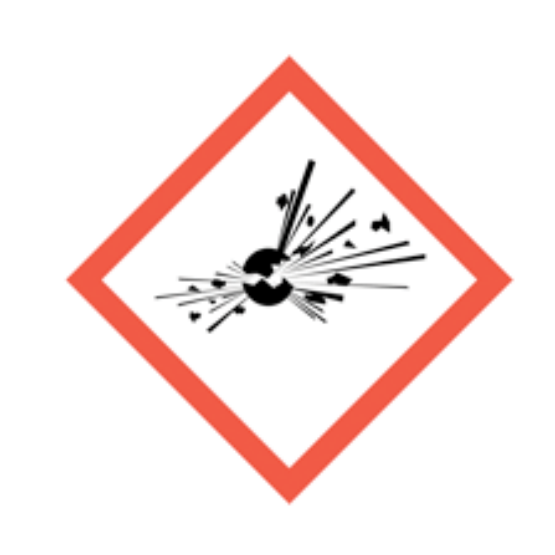
Exploding bomb
Explosive, self-reactive or organic peroxide hazards.
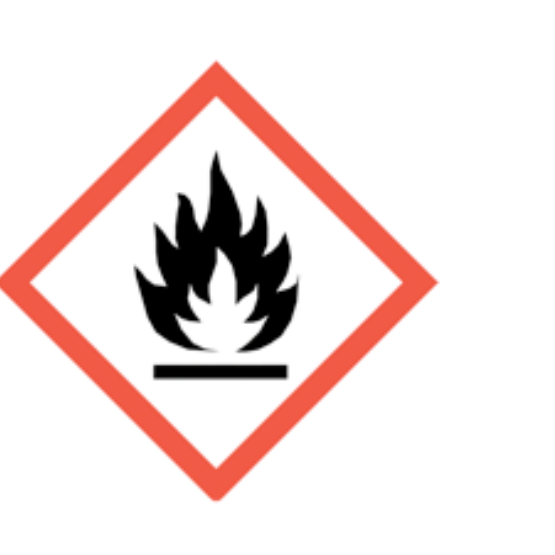
Flame
Flammable, self-heating or pyrophoric substances.
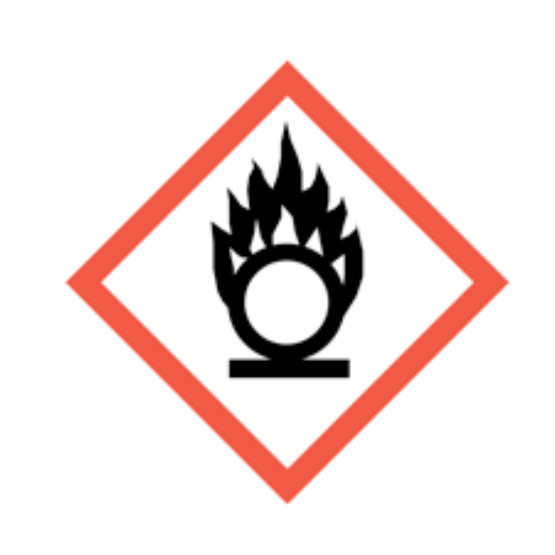
Flame over circle
Oxidising substances that can intensify fire.

Gas cylinder
Gas under pressure.
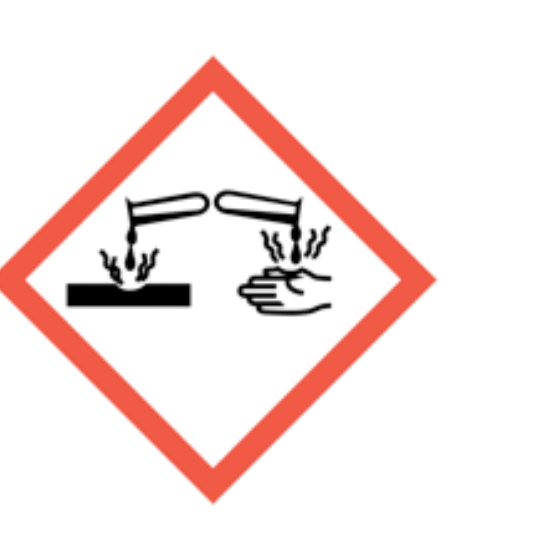
Corrosion
Skin burns, eye damage or corrosive to metals.
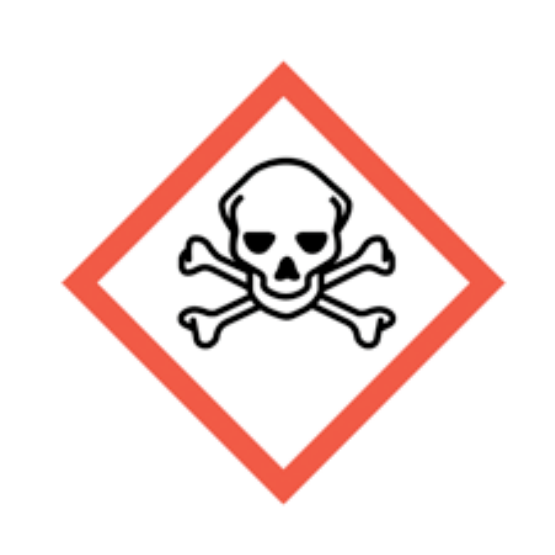
Skull and crossbones
Acute toxicity.

Exclamation mark
Irritation, harmful effects or skin sensitisation; some classifications cover drowsiness, dizziness or ozone-layer hazard. Read the actual hazard statements. Skin sensitisation differs from respiratory sensitisation.
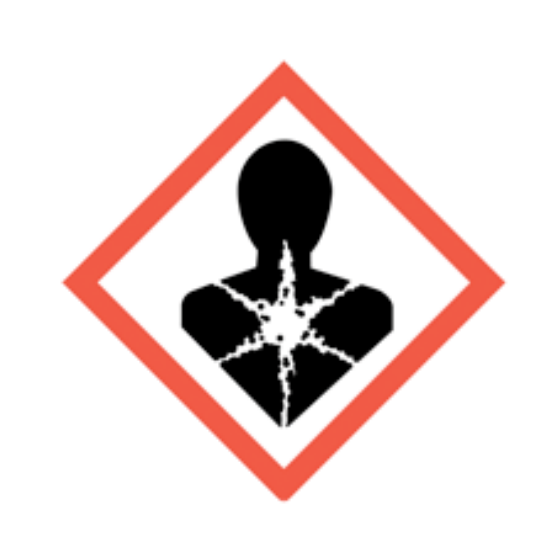
Health hazard
Serious health hazards, including organ damage, aspiration hazard, respiratory sensitisation, cancer and reproductive effects; some can follow a single exposure.
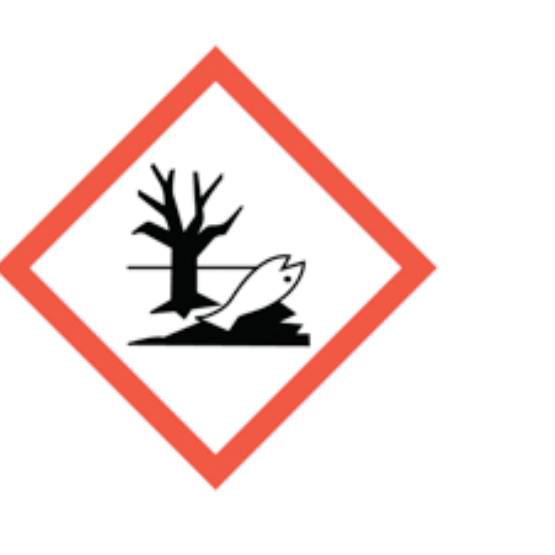
Environment
Hazardous to the aquatic environment.
What acronyms and terms should readers understand for chemical and biological agents?
This topic uses legal, occupational hygiene, biological and construction terms that should be explained for learners and workplace readers.
| Term | Meaning | Plain-English use |
|---|---|---|
| COSHH | Control of Substances Hazardous to Health | Main workplace framework for hazardous substances and biological agents. |
| SDS | Safety Data Sheet | Supplier document used to inform local assessment. |
| WEL | Workplace Exposure Limit | Airborne exposure limit listed in EH40. |
| RPE | Respiratory Protective Equipment | Masks and respirators used where airborne risk remains. |
| LEV | Local Exhaust Ventilation | Engineering control to capture airborne contaminants. |
| PPE | Personal Protective Equipment | Gloves, eye protection, clothing and other worn protection. |
| RCS | Respirable Crystalline Silica | Fine silica dust that can reach deep into the lungs. |
| ACM | Asbestos-Containing Material | Material that contains asbestos and needs specific controls. |
| HSENI | Health and Safety Executive for Northern Ireland | Northern Ireland workplace health and safety regulator. |