SHARE Knowledge Hub
Hand Hygiene and Infection Prevention
Hand hygiene and infection prevention are everyday controls that reduce the spread of infectious illness through hands, surfaces, respiratory droplets, contaminated food, blood and body fluids, animals, waste and shared workspaces. For most workplaces the essentials are simple: clean toilets and washing facilities, soap and drying, sensible cleaning, respiratory hygiene, staying away when infectious, good food hygiene, vaccination signposting where relevant, protection of vulnerable workers and a culture where people do not feel pressured to attend while unwell. Higher-risk work needs more formal COSHH biological-agent assessment and competent infection-control advice.
Understanding Hand Hygiene and Infection Prevention
Hand hygiene is a core infection-prevention measure, but it is only one part of a wider control system.
Why this matters at work
Prioritise immediate safety, appropriate clinical or public-health advice and control of the source and transmission route. Identify the affected tasks, people and facilities without circulating unnecessary health details. Symptoms, sharps injuries, body-fluid exposure and environmental contamination need different responses; do not assume extra sanitiser solves each event. Use current national and sector-specific advice and the relevant authority or occupational-health route.
Question: Is this an ordinary hygiene issue or occupational biological-agent risk?; Minimum reliable answer: Identify work material, activity, environment, exposure route and who may be harmed.; Evidence: Risk assessment, task observation and exposure information.; Critical correction: Do not apply a generic office poster to sewage, clinical, animal, waste or laboratory work.
How organisations manage this in practice
Reduce unnecessary wet work and contact with irritating products through task design and suitable equipment. Choose appropriate cleaning and hand products and follow instructions; more aggressive washing is not automatically safer. Provide thorough drying and suitable skin-care arrangements, with compatible gloves where assessed. Damaged skin can undermine hygiene and worker wellbeing, so early reporting should lead to action rather than blame. Check glove suitability, duration, changing and contamination during removal. Avoid replacing source control with continuous glove use, which may itself create problems. Train workers to recognise skin changes and obtain appropriate occupational-health or clinical advice without diagnosing dermatitis from a manager's observation. Review the task and similar workers when concerns arise, and use suitable health surveillance where required by risk and law. Keep necessary management records separate from clinical details. Verify that products and facilities remain available during busy work. A cream dispenser or poster does not demonstrate that exposure, drying and work patterns are controlled, and no universal glove-change interval fits every task.
Identify the source, route of transmission, exposed people and consequences, then combine appropriate controls. Hand cleaning is important but cannot compensate for uncontrolled aerosols, unsafe sharps, contaminated food flow or inadequate facilities. Work design, cleaning, ventilation where relevant, waste arrangements, sickness reporting, information and suitable personal protection may also be needed. GB and NI workplace duties and national sector guidance have separate scope. Provide accessible, stocked and maintained facilities where and when the task requires them. Use task-specific instructions for soap and water, hand rub, glove use and specialist decontamination rather than one poster for every hazard. NHS public advice and national care guidance have useful principles but do not automatically establish a clinical protocol for every workplace. Check implementation during remote, night and peak work. Record defects, action owners and verification, protect skin and support reporting. A bottle of sanitiser, attendance record or glove stock does not demonstrate a complete and effective infection-prevention system.
Failure: Same gloves used across dirty and clean tasks; Mechanism: Contamination transfers to food, person, equipment or control.; Potential harm: Infection, allergen transfer and product contamination.; Barrier: Task-defined change points, clean/dirty workflow, observation and correction.
Who should use this hand hygiene and infection prevention page?
This page is for people who need practical infection-prevention guidance for ordinary and higher-risk workplaces.
Who should use this hand hygiene and infection prevention page? — part 1 of 2


Read the complete visual as text
- This page is for people who need practical infection-prevention…: This page is for people who need practical infection-prevention guidance for ordinary and higher-risk workplaces.
- Workers and volunteers: People who share welfare facilities, food areas, tools, desks, vehicles or public-facing spaces.
- Supervisors and managers: People responsible for welfare, cleaning, sickness culture, outbreak response and communication.
Who should use this hand hygiene and infection prevention page? — part 2 of 2


Read the complete visual as text
- Facilities and cleaning teams: People who specify toilets, washrooms, cleaning schedules, waste and shared-area controls.
- Health, safety and wellbeing leads: People who assess biological-agent risks, vulnerable-worker controls and infection-prevention campaigns.
Workers and volunteers
People who share welfare facilities, food areas, tools, desks, vehicles or public-facing spaces.
Supervisors and managers
People responsible for welfare, cleaning, sickness culture, outbreak response and communication.
Facilities and cleaning teams
People who specify toilets, washrooms, cleaning schedules, waste and shared-area controls.
Health, safety and wellbeing leads
People who assess biological-agent risks, vulnerable-worker controls and infection-prevention campaigns.
What are the key facts about hand hygiene and infection prevention?
The key facts are that infection prevention relies on facilities, habits, cleaning, communication and sensible absence culture.
What are the key facts about hand hygiene and infection prevention? — part 1 of 2


Read the complete visual as text
- The key facts are that infection prevention relies on…: The key facts are that infection prevention relies on facilities, habits, cleaning, communication and sensible absence culture.
- Soap and water remain fundamental: Handwashing removes dirt, viruses and bacteria and is especially important after toilet use and before food handling.
- Facilities make behaviour possible: People cannot maintain good hygiene without accessible toilets, soap, water, drying and waste arrangements.
What are the key facts about hand hygiene and infection prevention? — part 2 of 2


Read the complete visual as text
- Transmission routes differ: Infections may spread through hands, droplets, aerosols, surfaces, blood/body fluids, animals, waste or food.
- Presenteeism can spread illness: People attending while infectious may affect colleagues, customers, patients, pupils or vulnerable workers.
- Some work needs specialist controls: Healthcare, care, laboratories, waste, animal work, sewage and cleaning of contamination may need COSHH biological-agent assessment.
Best-practice guide: Hand Hygiene and Infection Prevention
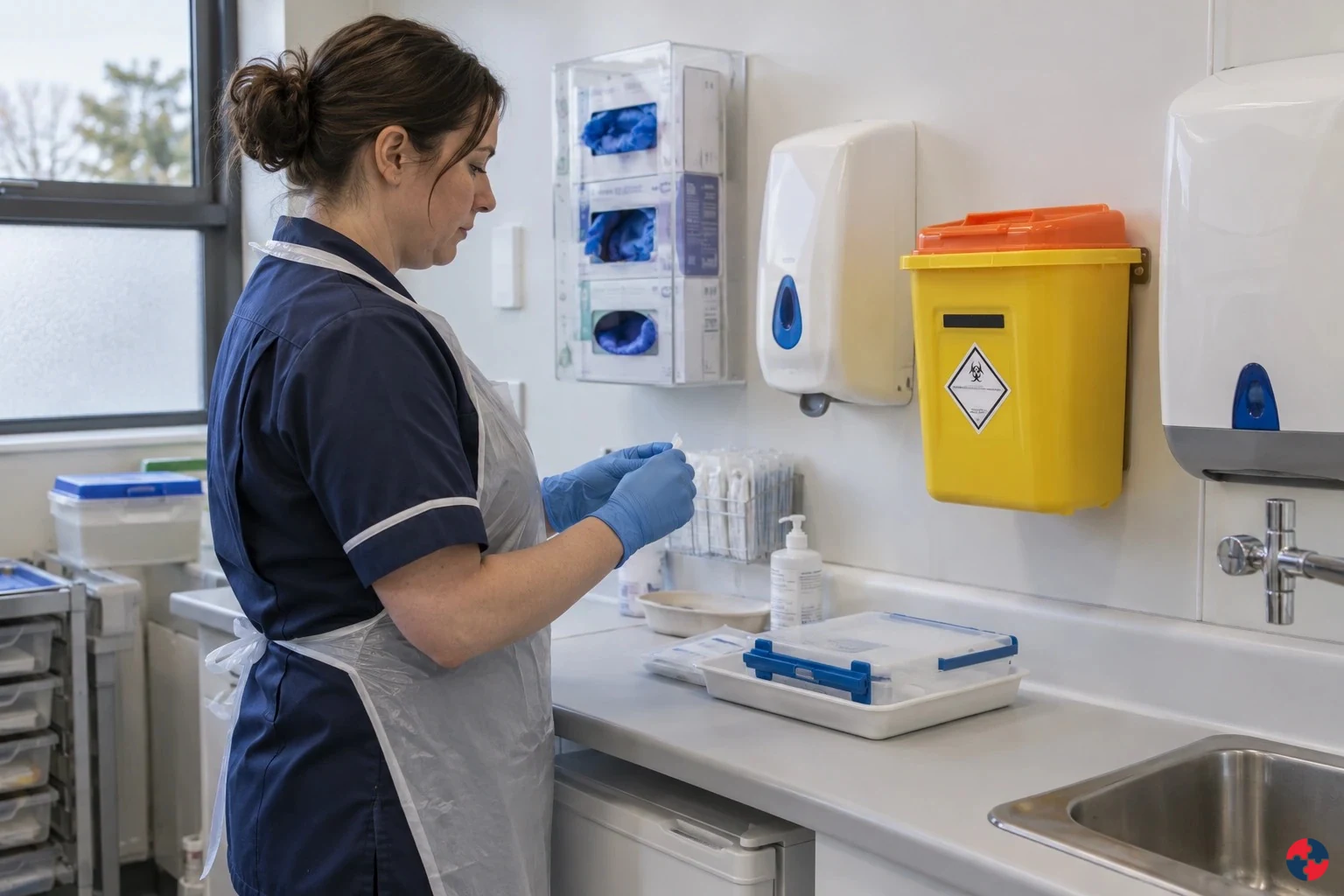
What are the key facts about hand hygiene and infection prevention?
The key facts are that infection prevention relies on facilities, habits, cleaning, communication and sensible absence culture. Hand hygiene and infection prevention are everyday controls that reduce the spread of infectious illness through hands, surfaces, respiratory droplets, contaminated food, blood and body fluids, animals, waste and shared workspaces.
Turn hand hygiene and infection prevention knowledge into a decision
Hand hygiene and infection prevention are everyday controls that reduce the spread of infectious illness through hands, surfaces, respiratory droplets, contaminated food, blood and body fluids, animals, waste and shared workspaces. For most workplaces the essentials are simple: clean toilets and washing facilities, soap and drying, sensible cleaning, respiratory hygiene, staying away when infectious, good food hygiene, vaccination signposting where relevant, protection of vulnerable workers and a culture where people do not feel pressured to attend while unwell. Infection-prevention risk register and site hygiene map.
the leisure operator worked example
Assessing: Map infection routes across toilets, changing rooms, poolside, cafe, first aid, cleaning, waste, parties and shared workstations. Evidence / response: Infection-prevention risk register and site hygiene map. Analysing: Identify higher-risk points such as body-fluid cleaning, food handling, repeated illness, new/expectant mothers and crowded events. Evidence / response: Task assessments, incident trends and vulnerable-worker review route.
Harm Chain
Toilet, food or shared-tool contamination: Hands transfer organisms to mouth or eyes; gastrointestinal or other infection can follow. Close contact in a poorly ventilated room: Respiratory organisms can reach others; fever, cough or more serious illness may result. Body fluids, sharps, sewage or animal waste: Contact with broken skin, mucosa or a puncture can transmit a specific biological agent.
Choose controls for hand hygiene and infection prevention
Elimination: Remove unnecessary sharps use at source where clinically feasible and prevent unavoidable sharps entering bags by direct disposal into suitable sharps containers. Engineering controls: Use suitable leak-resistant waste packaging and collection arrangements for the actual waste classification. Engineering controls: Separate clinical waste from clean supplies and the public; use secure designated holding and collection routes. Engineering controls: Provide suitable lidded transport equipment, secure containers and washing facilities; prevent hand compression of bags. Administrative controls: Check bag condition, fill limits and classification; do not reach into bags or manually retrieve a concealed sharp. Read the full control table for qualifications, ownership and verification. Use the actual task and applicable jurisdiction; existing technical approval remains unchanged.
Use the full hand hygiene and infection prevention lesson
Use the full topic for the decision points, practical examples, detailed control tables and source scope. HSE guidance applies to Great Britain; use HSENI for the Northern Ireland route and the source’s stated jurisdiction. A simplified guide does not change the page’s technical-review or approval status.

Read all six steps as text
1. What are the key facts about hand hygiene and infection prevention?
The key facts are that infection prevention relies on facilities, habits, cleaning, communication and sensible absence culture.
- Avoid / redesign: Remove unnecessary sharps use at source where clinically feasible and prevent unavoidable sharps entering bags by direct disposal into suitable sharps containers.
- Control the task: Separate clinical waste from clean supplies and the public; use secure designated holding and collection routes.
- Verify before release: If the hazardous step remains, retain a task assessment and select the stronger feasible remaining controls.
The key facts are that infection prevention relies on facilities, habits, cleaning, communication and sensible absence culture. Hand hygiene and infection prevention are everyday controls that reduce the spread of infectious illness through hands, surfaces, respiratory droplets, contaminated food, blood and body fluids, animals, waste and shared workspaces.
Apply it: Which part of this plan would you check at the workface before authorising the task?
2. Turn hand hygiene and infection prevention knowledge into a decision
Use the evidence to improve the actual work arrangement.
- Change at source: Remove unnecessary sharps use at source where clinically feasible and prevent unavoidable sharps entering bags by direct disposal into suitable sharps containers.
- Make it observable: If the hazardous step remains, retain a task assessment and select the stronger feasible remaining controls.
- Keep useful evidence: Infection-prevention risk register and site hygiene map.
Hand hygiene and infection prevention are everyday controls that reduce the spread of infectious illness through hands, surfaces, respiratory droplets, contaminated food, blood and body fluids, animals, waste and shared workspaces. For most workplaces the essentials are simple: clean toilets and washing facilities, soap and drying, sensible cleaning, respiratory hygiene, staying away when infectious, good food hygiene, vaccination signposting where relevant, protection of vulnerable workers and a culture where people do not feel pressured to attend while unwell. Infection-prevention risk register and site hygiene map.
Apply it: What evidence would show that the change improves this task, rather than only completing a record?
3. the leisure operator worked example
Example: a practical application of the existing topic lesson.
- Assessing: Map infection routes across toilets, changing rooms, poolside, cafe, first aid, cleaning, waste, parties and shared workstations.
- Analysing: Identify higher-risk points such as body-fluid cleaning, food handling, repeated illness, new/expectant mothers and crowded events.
- Implementing: Provide soap, drying, cleaning schedules, body-fluid spill kits, staff sickness rules and food-area hygiene controls.
Assessing: Map infection routes across toilets, changing rooms, poolside, cafe, first aid, cleaning, waste, parties and shared workstations. Evidence / response: Infection-prevention risk register and site hygiene map. Analysing: Identify higher-risk points such as body-fluid cleaning, food handling, repeated illness, new/expectant mothers and crowded events. Evidence / response: Task assessments, incident trends and vulnerable-worker review route.
Apply it: At which point would you hold this example, and what evidence would allow it to proceed?
4. Harm Chain
Connect the task, the route to the person and the control that can fail.
- Toilet, food or shared-tool contamination: Hands transfer organisms to mouth or eyes; gastrointestinal or other infection can follow.
- Close contact in a poorly ventilated room: Respiratory organisms can reach others; fever, cough or more serious illness may result.
- Body fluids, sharps, sewage or animal waste: Contact with broken skin, mucosa or a puncture can transmit a specific biological agent.
Toilet, food or shared-tool contamination: Hands transfer organisms to mouth or eyes; gastrointestinal or other infection can follow. Close contact in a poorly ventilated room: Respiratory organisms can reach others; fever, cough or more serious illness may result. Body fluids, sharps, sewage or animal waste: Contact with broken skin, mucosa or a puncture can transmit a specific biological agent.
Apply it: Who could be exposed, including other trades, cleaners, maintainers and people nearby?
5. Choose controls for hand hygiene and infection prevention
Start with the stronger practicable options and verify their effect.
- Elimination: Remove unnecessary sharps use at source where clinically feasible and prevent unavoidable sharps entering bags by direct disposal into suitable sharps containers.
- Engineering controls: Use suitable leak-resistant waste packaging and collection arrangements for the actual waste classification.
- Engineering controls: Separate clinical waste from clean supplies and the public; use secure designated holding and collection routes.
- Engineering controls: Provide suitable lidded transport equipment, secure containers and washing facilities; prevent hand compression of bags.
- Administrative controls: Check bag condition, fill limits and classification; do not reach into bags or manually retrieve a concealed sharp.
Elimination: Remove unnecessary sharps use at source where clinically feasible and prevent unavoidable sharps entering bags by direct disposal into suitable sharps containers. Engineering controls: Use suitable leak-resistant waste packaging and collection arrangements for the actual waste classification. Engineering controls: Separate clinical waste from clean supplies and the public; use secure designated holding and collection routes. Engineering controls: Provide suitable lidded transport equipment, secure containers and washing facilities; prevent hand compression of bags. Administrative controls: Check bag condition, fill limits and classification; do not reach into bags or manually retrieve a concealed sharp. Read the full control table for qualifications, ownership and verification. Use the actual task and applicable jurisdiction; existing technical approval remains unchanged.
Apply it: Which stronger option can be used here, and who will verify it before accepting the remaining risk?
6. Use the full hand hygiene and infection prevention lesson
Follow the official sources below and retain the task-specific evidence.
- Official guidance: HSE incidental infection at work
- Official guidance: HSE workplace facilities
- Task decision: Infection-prevention risk register and site hygiene map.
Use the full topic for the decision points, practical examples, detailed control tables and source scope. HSE guidance applies to Great Britain; use HSENI for the Northern Ireland route and the source’s stated jurisdiction. A simplified guide does not change the page’s technical-review or approval status.
Apply it: Which official source and full-topic section will you use to resolve the next decision?
Soap and water remain fundamental
Handwashing removes dirt, viruses and bacteria and is especially important after toilet use and before food handling.
Facilities make behaviour possible
People cannot maintain good hygiene without accessible toilets, soap, water, drying and waste arrangements.
Transmission routes differ
Infections may spread through hands, droplets, aerosols, surfaces, blood/body fluids, animals, waste or food.
Presenteeism can spread illness
People attending while infectious may affect colleagues, customers, patients, pupils or vulnerable workers.
Some work needs specialist controls
Healthcare, care, laboratories, waste, animal work, sewage and cleaning of contamination may need COSHH biological-agent assessment.
What should readers understand before using infection-prevention information?
This page gives general workplace guidance, not diagnosis, treatment or personal medical advice.
Workers with symptoms should use NHS, GP, occupational health or emergency advice as appropriate. Managers should avoid diagnosing illness, forcing disclosure of medical detail or making assumptions about infection risk based on appearance, nationality, disability, pregnancy or personal characteristics.
Personal health information, vaccination information and pregnancy-related information should be handled confidentially and only where there is a clear workplace need.
| Area | Good practice | Avoid |
|---|---|---|
| General prevention | Provide facilities, cleaning, communication and NHS signposting. | Giving unqualified medical advice. |
| Symptoms | Encourage appropriate health advice and sensible absence decisions. | Pressuring visibly unwell people to stay at work. |
| Vaccination | Signpost official information and occupational-health advice where work requires it. | Coercive or public disclosure approaches. |
| Vulnerable workers | Assess work impact confidentially and consider adjustments. | Discussing private health information with teams. |
| Outbreaks | Review controls and seek specialist advice where needed. | Treating repeated infection spread as unavoidable. |
What does hand hygiene and infection prevention mean in practice?
It means interrupting the routes by which infectious agents move from source to person.
Hand hygiene is one part of infection prevention. A strong workplace system also considers cleaning, ventilation, waste, PPE, welfare, food hygiene, sharps, body fluids, animal contact, sickness absence, vaccination signposting and protection of people at greater risk.
For ordinary offices and welfare areas, simple controls can be enough. For care settings, schools, leisure venues, laboratories, animal work, sewage, waste or healthcare, the control standard may need to be much more formal.
| Building block | Purpose | Example |
|---|---|---|
| Source control | Reduce infectious material at source. | Stay away when infectious, cover wounds and manage contaminated waste. |
| Hand hygiene | Remove contamination before it spreads. | Wash after toilet use, coughing, cleaning, food handling or animal contact. |
| Surface control | Reduce transfer from shared touchpoints. | Clean handles, taps, desks, controls and shared tools. |
| Respiratory hygiene | Reduce droplets and aerosols. | Cover coughs, dispose of tissues and improve ventilation. |
| Welfare | Make hygiene behaviour easy. | Soap, water, drying, bins and suitable rest/eating areas. |
| Escalation | Recognise when routine control is not enough. | Outbreak review, occupational-health or public-health advice. |
How is ordinary workplace hygiene different from higher-risk biological exposure?
Occupational immunisation decision
Where assessment identifies occupational exposure to agents with effective readily available vaccines, the employer should offer protective immunisation free of charge through competent occupational-health advice. Explain benefits and limits, obtain informed consent and keep appropriate confidential records. If vaccination is declined or ineffective, review other controls. This supplements source/pathway controls; it is not a compulsory programme for every office worker.
HSE: Preventing incidental exposure to infection at work · COSHH Regulations (Northern Ireland) 2003
Ordinary workplaces usually need reliable welfare and cleaning, while higher-risk biological exposure needs formal assessment and specialist control.
Most workplaces manage infection prevention through good welfare, cleaning, handwashing, respiratory hygiene, sensible absence culture and clear communication. That is enough for many offices, shops, warehouses and general workplaces where infection risk is broadly similar to normal community exposure.
The control standard changes when the work itself creates exposure. Cleaning body fluids, handling waste, working with animals, preparing food, caring for vulnerable people, dealing with sewage, carrying out first aid, handling sharps or working in laboratories creates a more specific biological route. In those situations, handwashing remains important, but it sits alongside COSHH assessment, PPE, waste arrangements, vaccination signposting, training, incident response and competent advice.
| Workplace route | Typical examples | Control standard |
|---|---|---|
| Normal workplace hygiene | Offices, meeting rooms, welfare areas, shared vehicles and ordinary customer contact. | Clean facilities, soap and drying, routine cleaning, illness culture and NHS-aligned awareness. |
| Food-handling hygiene | Cafes, events, buffets, staff kitchens and food service. | Handwashing, illness reporting, allergen and food-safety controls, cleaning schedules and supervision. |
| Public-facing higher-contact settings | Leisure centres, schools, hospitality, reception areas and soft play. | More frequent touchpoint cleaning, toilet checks, outbreak response and protection of vulnerable users. |
| Body-fluid or sharps exposure | First aid, cleaning vomit, blood spill response or discarded sharps. | Trained responders, PPE, spill kits, sharps procedure, waste control and reporting. |
| Biological-agent work | Healthcare, care, laboratories, animal work, sewage, waste and pest control. | Formal COSHH biological assessment, exposure controls, health advice and specialist competence. |
How do infections spread in workplaces?
An infectious agent needs a source, a route into another person and an opportunity for exposure; the controls depend on that route.
Contaminated hands can transfer material from toilets, food, animals, waste or shared equipment to the mouth, eyes or a wound. Respiratory infections can spread through close contact and air in poorly ventilated spaces. Blood or body-fluid contact, including a sharps injury, needs a different response from routine desk cleaning. The person affected is not the hazard: the infectious agent and the work conditions that allow its transfer are the risk source.
Handwashing breaks contact transfer but cannot fix poor ventilation or a sharps procedure. Symptoms may follow hours or days later, so absence of immediate illness does not prove that an exposure was harmless. Stop a task when contamination or a protective barrier is uncontrolled, isolate the area safely and obtain competent advice for the suspected agent and route.
| Source and task | Route and possible harm | Early sign or warning | Stop and escalate |
|---|---|---|---|
| Toilet, food or shared-tool contamination | Hands transfer organisms to mouth or eyes; gastrointestinal or other infection can follow. | Empty soap, visible contamination, illness cluster. | Restore washing and cleaning before resuming food or shared work; seek public-health or clinical advice for illness. |
| Close contact in a poorly ventilated room | Respiratory organisms can reach others; fever, cough or more serious illness may result. | Ill person at work, repeated cases, poor ventilation. | Reduce exposure, support staying away when infectious and review ventilation; escalate clusters. |
| Body fluids, sharps, sewage or animal waste | Contact with broken skin, mucosa or a puncture can transmit a specific biological agent. | Spill, puncture, damaged glove or unknown waste. | Stop routine cleaning, use the assessed exposure-response route and seek prompt medical advice after suspected exposure. |
The risk assessment must identify the likely agent where possible, exposed workers and others, route, vulnerable groups and credible failures. HSE incidental infection guidance.
How does infection prevention transfer between sectors?
The route and affected people change with the task, so washing, ventilation, cleaning and specialist controls must be selected for that setting.
Sector Transfer


Read the complete visual as text
- Manufacturing: shared controls and welfare; operators, cleaners: Route and likely harm: Contaminated hands or surfaces can transfer an infectious agent and cause illness. Strongest feasible controls: Maintain accessible washing, soap and drying; assign shared-touchpoint cleaning. Residual safeguard and stop point: Supervisor verifies supplies and cleaning; stop food handling if washing fails.
- Construction: temporary toilets and eating areas; trades and visitors: Route and likely harm: Dirty hands, sewage or contaminated clothing may carry organisms to mouth or wounds. Strongest feasible controls: Provide proper site washing separated from eating; contain identified contamination. Residual safeguard and stop point: Inspect mobile welfare; stop and obtain a specialist method for sewage or body-fluid work.
- Hospitality: food preparation and guest areas; staff and customers: Route and likely harm: Poor hand hygiene or infectious food handlers can contaminate food or shared surfaces. Strongest feasible controls: Design food-handling handwash access and illness rules; use food-specific controls. Residual safeguard and stop point: Manager checks facilities and exclusion decisions; stop food preparation if essential hygiene fails.
- Logistics: shared vehicles and delivery welfare; drivers and depot staff: Route and likely harm: Shared controls and inaccessible washing can transfer contamination between users. Strongest feasible controls: Provide driver access to toilets and handwashing; assign vehicle handover cleaning where risk warrants. Residual safeguard and stop point: Check accessible route and supplies; escalate denied or defective welfare.
A poster cannot replace a working hand basin, a cleaning method or a decision about infectious attendance. A supervisor first identifies the transfer point and people at risk, then checks whether the strongest feasible control actually works during the shift. Care and childcare add vulnerable-person and specialist infection-control requirements; the four examples below illustrate general workplaces.
| Sector, task and people | Route and likely harm | Strongest feasible controls | Residual safeguard and stop point |
|---|---|---|---|
| Manufacturing: shared controls and welfare; operators, cleaners | Contaminated hands or surfaces can transfer an infectious agent and cause illness. | Maintain accessible washing, soap and drying; assign shared-touchpoint cleaning. | Supervisor verifies supplies and cleaning; stop food handling if washing fails. |
| Construction: temporary toilets and eating areas; trades and visitors | Dirty hands, sewage or contaminated clothing may carry organisms to mouth or wounds. | Provide proper site washing separated from eating; contain identified contamination. | Inspect mobile welfare; stop and obtain a specialist method for sewage or body-fluid work. |
| Hospitality: food preparation and guest areas; staff and customers | Poor hand hygiene or infectious food handlers can contaminate food or shared surfaces. | Design food-handling handwash access and illness rules; use food-specific controls. | Manager checks facilities and exclusion decisions; stop food preparation if essential hygiene fails. |
| Logistics: shared vehicles and delivery welfare; drivers and depot staff | Shared controls and inaccessible washing can transfer contamination between users. | Provide driver access to toilets and handwashing; assign vehicle handover cleaning where risk warrants. | Check accessible route and supplies; escalate denied or defective welfare. |
A leisure centre with body-fluid contamination should use a trained spill-response method and clear public access control; a care setting follows its infection-control lead rather than this general table.
When and how should hands be washed?
Water provision and effective washing
Provide suitable comfortably warm water under the applicable welfare arrangements. Effective washing also needs soap, coverage, rubbing, rinsing and thorough drying. Avoid scalding water; when cold water is all that is immediately available, washing is still useful while the facility defect is addressed.
Hands should be washed with soap and water at key contamination points and dried properly.
NHS guidance explains that handwashing is a simple way to protect yourself and others. In workplace language, it is a low-cost control that fails if facilities are missing, workers are rushed, soap is empty or drying is poor.
Wet hands with water, apply soap, rub palms, backs, between fingers, thumbs and fingertips for about 20 seconds, then rinse and dry thoroughly with a disposable towel or clean dryer. This is the NHS routine handwashing method; task-specific clinical or food procedures may add steps. Sanitiser can help when soap and water are not immediately available, but it should not replace washing for dirty hands, toilet hygiene, food handling or visible contamination. If norovirus is suspected after vomiting or diarrhoea, wash with soap and water: alcohol hand gel is not reliably effective against it. NHS handwashing steps; NHS norovirus advice.
| When | Why it matters | Workplace support |
|---|---|---|
| After toilet use | Reduces faecal-oral spread of infections. | Clean toilets, soap, water and drying. |
| Before eating or handling food | Prevents contamination of food and mouth. | Handwash near welfare and food areas. |
| After coughing, sneezing or blowing nose | Reduces respiratory infection spread via hands and surfaces. | Tissues, bins and hand hygiene prompts. |
| Before and after treating cuts | Reduces wound contamination. | First-aid hygiene and disposable gloves. |
| After animal or waste contact | Reduces biological contamination transfer. | Task-specific washing, PPE and changing arrangements. |
| After cleaning contamination | Protects cleaners and others from residues. | Gloves, spill procedure and handwash access. |
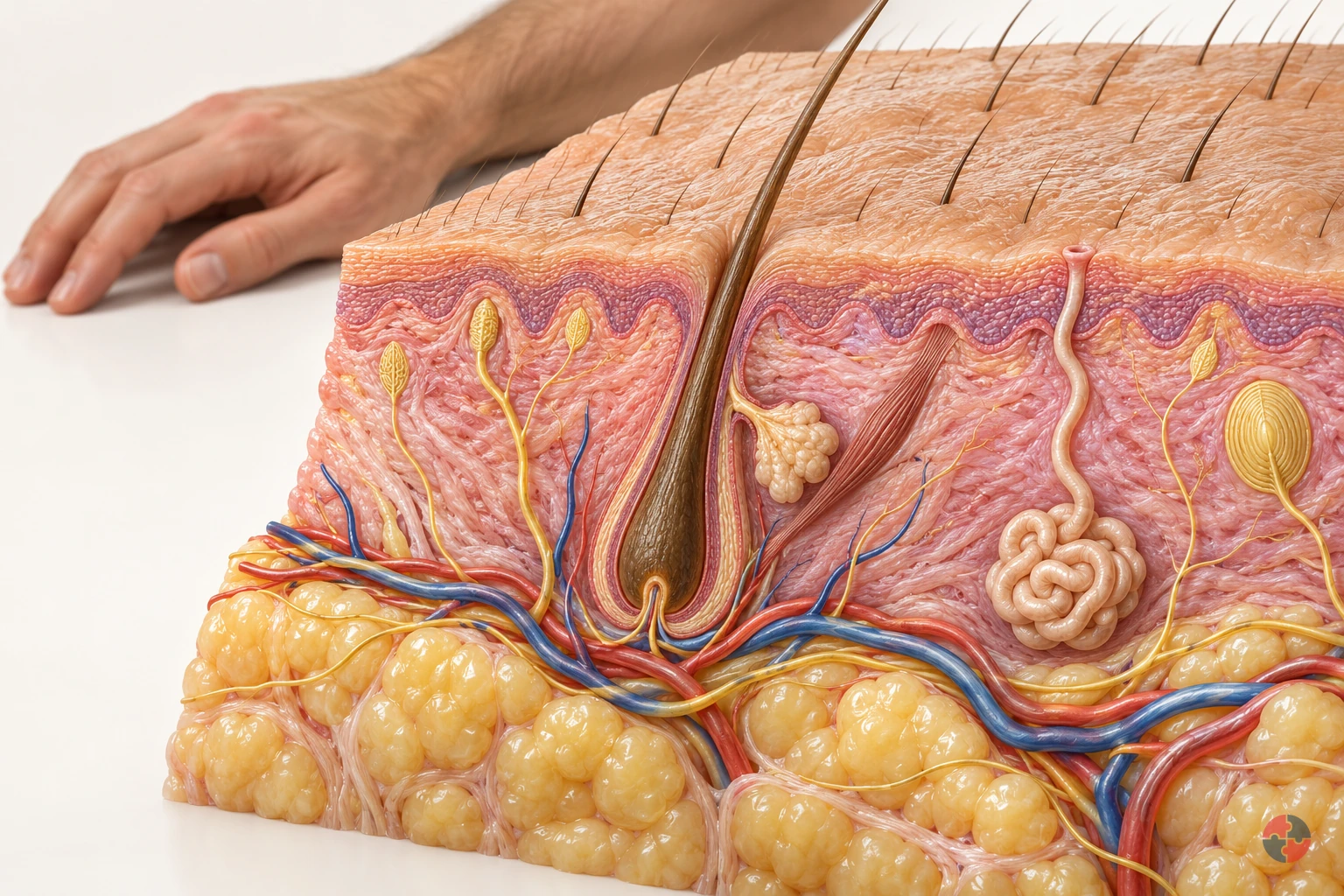

How does the skin barrier work, and how can workplace contact damage it?
Interactive anatomy · Skin barrier and injury · Updated 2026-10-23
Read all anatomy and process explanations without the viewer
General education about normal skin and example mechanisms; not diagnosis, treatment selection or a patient assessment. Hair-bearing forearm example. Vessels remain below the epidermis; the normal barrier has no large open holes. Image-based diagnosis or patch-testing simulation Treatment doses or guaranteed glove/barrier-cream protection Calculated injury depth, contact-dose thresholds or a number of safe washes Hydrofluoric-acid protocols and unreviewed named-substance injury overlays Immediate chemical-burn advice must remain readable outside the model and before any scenario answer.
Outer barrier
The outermost layer helps limit water loss and harmful contact. The outermost epidermal layer combines flattened cells with materials between them to help retain moisture and limit harmful contact. It is a selective protective barrier, rather than a waterproof coating. Use the magnified inset to locate its components. The model shows their relationship but cannot tell whether a particular substance will cross a person’s skin. Health and Safety Executive: Structure and functions of the skin
Barrier lipids
Lipids between surface cells help maintain the barrier. Repeated detergent contact can remove some of these fatty materials and overwhelm repair. Health and Safety Executive: Understanding the causes of skin disease
Epidermis
The outer skin layer continually renews. New cells form in the deeper epidermis and move towards the surface, becoming flattened as the outer layer is renewed and shed. The epidermis therefore contributes active renewal as well as surface protection. Follow its position above the dermis in the cutaway; the model enlarges a static structure rather than timing an individual’s cell renewal. Health and Safety Executive: Structure and functions of the skin
Dermis
Supporting tissue beneath the epidermis contains vessels, nerves and glands. The dermis is supporting tissue beneath the epidermis. It contains structures involved in supply, sensation and temperature regulation, including vessels, nerves and sweat glands. The cutaway enlarges selected components so their different functions can be followed. Their shared location does not mean that they form one open passage through the skin barrier. Oxford Health NHS Foundation Trust: The Skin — Community Tissue Viability Team
Subcutaneous tissue
Tissue and fat below the dermis help insulate and cushion. The lower layer supports the skin block; it is not part of the surface barrier. Health and Safety Executive: Structure and functions of the skin · Oxford Health NHS Foundation Trust: The Skin — Community Tissue Viability Team
Blood vessels
Vessels supply the deeper skin. These vessels supply the deeper skin tissues. They sit below the epidermal surface in the cutaway, alongside other supporting structures. Compare them with the nerve and sweat duct rather than interpreting every tube as the same pathway. The drawing explains location and function; its vessel size and colour are not measurements of circulation or skin temperature. Oxford Health NHS Foundation Trust: The Skin — Community Tissue Viability Team
Sensory nerves
Nerve endings help detect touch and temperature. The signalling symbol represents sensory information, not a visible electrical spark. Health and Safety Executive: Structure and functions of the skin · Oxford Health NHS Foundation Trust: The Skin — Community Tissue Viability Team
Sweat gland and duct
Sweat reaches the surface through a duct. A sweat gland produces sweat that reaches an opening at the surface through a duct. This contributes to the skin’s role in temperature regulation. Trace the coiled gland and its duct separately from the vessels and nerves. The enlarged path makes the connection visible; it does not measure sweating or represent every route by which a substance can enter skin. Health and Safety Executive: Structure and functions of the skin
Hair follicle
Hair grows from a follicle in hair-bearing skin. This forearm example includes a follicle. The palm has a different structure and must not use this site label. Health and Safety Executive: Structure and functions of the skin
Immune response inset
Skin participates in immune responses. In contact allergy, prior sensitisation can lead to an inflammatory response after later contact. Health and Safety Executive: Understanding the causes of skin disease · NHS: Contact dermatitis — causes
Open the complete process transcript
The process, step by step
Find the surface
Start with the forearm locator to establish where this sample of skin belongs. The enlarged block represents hair-bearing skin, with the epidermis on the outside, the dermis beneath it and deeper subcutaneous tissue below. The surface is only one part of this living organ. New epidermal cells are formed deeper down and move towards the outside, where flattened cells contribute to the protective layer. Use the block to connect the familiar body surface with these layers; it is an enlarged teaching section, not a standard thickness shared by every body site. Health and Safety Executive: Structure and functions of the skin
What to watch: Use the forearm locator first, then follow the enlarged block from the outer epidermis down through the dermis to the deeper tissue.
Why it matters: Locating the body site prevents the sample from being mistaken for every kind of skin. The outer layer, supporting tissues and deeper structures contribute different functions within the same organ.
Explore this step: Identify the outermost layer and the hair follicle before changing to the magnified barrier view.
Magnify the barrier
The outer barrier depends on both flattened surface cells and the fatty materials, or lipids, between them. The cells provide one part of the structure; the surrounding lipids help control the passage of water and substances through it. Look at their arrangement together rather than treating the skin as a single waterproof sheet. This is a selective barrier, not a complete seal against every material. The enlargement helps explain why a change in the material between cells can affect protection even when there is no large cut through the skin. Health and Safety Executive: Understanding the causes of skin disease
What to watch: Compare the flattened surface cells with the lipids between them, using the enlarged barrier inset rather than the whole skin block.
Why it matters: The arrangement helps limit unwanted passage through the surface while retaining moisture. Understanding both components explains why skin protection depends on more than whether the surface looks visibly broken.
Explore this step: Point out one surface cell and the surrounding lipid region, then describe how they work together.
Limit water loss
Water retention is part of healthy barrier function. The outer cells and the materials between them help limit water leaving the skin, while some water can still pass through. The labelled arrows represent that background loss; they are not streams from a wound or measurements of an individual’s hydration. Moisture matters because the outer layer needs appropriate hydration to remain flexible and function well. Read the arrows alongside the cell-and-lipid arrangement, so the explanation connects a movement across the surface with the structure that helps regulate it. Health and Safety Executive: Understanding the causes of skin disease
What to watch: Look at the labelled water-loss arrows beside the outer cells and lipids, noting their direction across the barrier surface.
Why it matters: Limiting water loss helps the outer layer retain the moisture needed for normal function. A barrier can perform this role without being impermeable, and the model cannot assess somebody’s skin hydration.
Explore this step: Compare this step with the barrier enlargement and explain why “limits water loss” is more accurate than “waterproof”.
Explore deeper structures
The deeper skin contains structures with different jobs. Blood vessels supply the deeper tissues, sensory nerves help carry information such as touch and temperature, and sweat glands connect to the surface through ducts. Follow each labelled structure separately instead of reading the cutaway as one channel running down through the skin. The enlarged vessels, nerves and gland are learning features within the supporting tissue; their positions explain relationships, not the route or speed of an absorbed substance. Notice that surface barrier function and these deeper functions are connected parts of skin health. Health and Safety Executive: Structure and functions of the skin · Oxford Health NHS Foundation Trust: The Skin — Community Tissue Viability Team
What to watch: Locate the vessels, sensory nerves and coiled sweat gland below the surface, then trace the gland’s duct towards its opening.
Why it matters: Supply, sensation and temperature regulation require different structures. Recognising those roles avoids mistaking every visible line for a chemical entry route or assuming the outer barrier carries out all skin functions.
Explore this step: Select the gland, nerve and vessel labels in turn and name a different function for each.
Connect structure and function
Return to the whole section and connect the functions you have explored. The renewing outer layer helps form a protective barrier and limit moisture loss. Deeper supporting tissues contain sensory structures, vessels and glands, while subcutaneous tissue contributes cushioning and insulation. These functions operate together rather than as a single switch that makes skin either completely protected or unprotected. Use the separate mechanism examples to explore particular changes only after locating the healthy structures. The cutaway explains relationships; its colours and enlarged components do not diagnose a skin condition or identify a safe contact time. Health and Safety Executive: Structure and functions of the skin · Oxford Health NHS Foundation Trust: The Skin — Community Tissue Viability Team
What to watch: Review the complete skin section, connecting the outer barrier with the supporting dermis, sensory structures, sweat gland and deeper tissue.
Why it matters: Skin both separates the body from its surroundings and helps it respond to them. Connecting protection, sensation and temperature functions gives a more useful picture than viewing the surface as a passive covering.
Explore this step: Choose one structure from the surface and one from deeper tissue, and explain how their jobs differ.
Mechanisms and their limits
Cumulative irritant dermatitis Repeated wet work or contact with detergents and other irritants can damage the barrier and cause inflammation. Strong irritants may act much more rapidly. Repeated task cards illustrate accumulated contact, not a threshold number of washes. One mild contact does not inevitably cause disease. Susceptibility varies. Dryness, cracking and discomfort need attention; colour alone does not show the cause. Health and Safety Executive: Understanding the causes of skin disease · NHS: Contact dermatitis — causes · NHS: Contact dermatitis — symptoms
HSE: prevent work-related skin problems
Cumulative irritant dermatitis — follow the anatomy
Look at: The rough, dry patch: raised flakes and branching cracks in the outer barrier.
What changes: Repeated wet work or irritants can disrupt the protective barrier. Flaking and fissures make the damaged surface visible in this example.
Why it matters: Skin may become dry, sore and cracked, making further exposure more damaging.
What to do: Reduce wet work and contact; use suitable gloves, gentle cleaning and skin care.
Repeated wet work at a commercial wash-up station
Catering: frequent washing and detergent contact repeatedly wet and dry the hands. Explicit time jump across repeated tasks and shifts: cumulative barrier damage does not develop at a fixed number of washes or within this 32-second clip. People differ in susceptibility; similar skin changes may have different causes. A short exposure does not inevitably produce dermatitis.
Look at the whole wet-work pattern The job combines water, detergent handling, hand cleaning and time in gloves. Review unnecessary skin contact and how tasks are organised. Health and Safety Executive: Understanding the causes of skin disease · Health and Safety Executive: How do I prevent skin problems in my business?
Repeated contact challenges the barrier The timeline jumps across separate contacts. Mild irritants can disrupt surface lipids and outpace the skin’s repair; prolonged wetness can also affect barrier function. Health and Safety Executive: Understanding the causes of skin disease
Irritant dermatitis: dry scales and cracked skin The lifted flakes and branching cracks show a dry, disrupted barrier. Irritation may also cause soreness, inflammation or blisters. Irritant and allergic dermatitis can look alike; these features alone do not identify the cause. Health and Safety Executive: Understanding the causes of skin disease · NHS: Contact dermatitis — causes · NHS: Contact dermatitis — symptoms
Reduce contact and report early changes Review the method, suitable protection, washing/drying and skin care. Encourage early reporting and appropriate medical advice instead of stronger scrubbing or assuming a cream makes contact safe. Health and Safety Executive: How do I prevent skin problems in my business?
Read the practice situations and all answer explanations
SK-Q1: Which response addresses the work as well as the early skin changes?
Frequent wet work leaves a worker’s hands dry and sore.
Automatically diagnose an allergy. — Several causes are possible. A picture or short work history cannot establish an allergy; clinical assessment may be needed.
Report early changes and review harmful contact, suitable controls, cleaning and skin care. — Yes. Reduce harmful contact and review the work before problems worsen. Include suitable cleaning, drying, skin care and exposure controls.
Scrub the hands harder with solvent. — Solvents and harsh scrubbing can further damage the barrier. Use the suitable cleaning arrangements provided for the task.
NHS: Contact dermatitis — causes · Health and Safety Executive: How do I prevent skin problems in my business?SK-Q2: What takes priority now?
Wet cement is trapped inside a worker’s boot.
Stop exposure and obtain immediate first aid and medical help. — Correct. Wet cement can cause a serious chemical burn. The chemical-burn action panel is available immediately; do not wait for this lesson.
Wait to see whether it starts to hurt. — Do not wait for pain. Trapped wet cement can rapidly cause a serious burn. Stop exposure and obtain immediate help.
Neutralise the cement with an acidic household product. — Do not add another chemical or attempt neutralisation. Follow immediate chemical-burn first aid and obtain medical help.
Health and Safety Executive: Construction hazardous substances: Cement · NHS: Acid and chemical burnsSK-Q3: Which mechanism fits the example?
In this teaching example a sensitised worker reacts after later contact with the known allergen.
The skin must have worn through at that instant. — Allergic contact dermatitis does not require the surface to wear away at that moment. Mechanical injury and allergy are different mechanisms.
Any glove would have guaranteed protection. — Gloves must be selected for the substance and task, and used correctly. Any glove is not a guarantee.
A sensitised immune system can react after later contact. — Yes. Prior sensitisation and later contact are separate stages. Irritant and allergic mechanisms can occur together; this example does not diagnose a real person.
Health and Safety Executive: Understanding the causes of skin disease · Health and Safety Executive: How do I prevent skin problems in my business?Sources and how the model is made
The opening images are AI-generated anatomical illustrations. The interactive 3D models and labelled SVG diagrams use original procedural artwork. These teaching images are not medical scans or diagnostic tools. Source references support the learner explanations and do not grant artwork rights.
- Health and Safety Executive: Structure and functions of the skin — Three skin layers; renewal; sweat, hair, sensory, barrier and temperature functions. Factual reference only; no diagram copied.
- Oxford Health NHS Foundation Trust: The Skin — Community Tissue Viability Team — Layer and deeper vessel/nerve context, mechanical injury and skin-tone assessment considerations. No treatment regimen or illustration reused.
- Health and Safety Executive: Understanding the causes of skin disease — Barrier lipids and water retention; cumulative irritation; sensitisation, delayed contact allergy, small subsequent amounts and coexistence. Replaces the former separate dermatitis URL, which failed direct retrieval.
- NHS: Contact dermatitis — causes — Irritant versus allergic mechanisms and workplace wet work. Printed next-review date May 2026 is overdue; recheck at qualified clinical sign-off and corroborate with HSE.
- Health and Safety Executive: Construction hazardous substances: Cement — Alkaline burns from trapped cement; abrasive irritation; chromate sensitisation; task methods and suitable contact protection.
- Health and Safety Executive: How do I prevent skin problems in my business? — Avoid contact, suitable gloves, washing and drying, skin care, early checks/reporting and medical advice. No universal glove or cream claim.
- NHS: Acid and chemical burns — Immediate chemical skin-burn first aid: 999, avoid contamination, clothing and dry-chemical removal, copious water about one hour, no creams or other chemicals. Skin advice is not substituted for eye or thermal guidance.
- NHS: Cuts and grazes — General shallow-wound context and the need for professional help with serious wounds; not a visual diagnosis or full first-aid simulation.
- NHS: Contact dermatitis — symptoms — Dryness, cracking, inflammation and fluid-filled blisters can occur in contact dermatitis. Irritant and allergic appearances overlap. Original illustrative textures are not diagnostic photographs and no source artwork is copied.
What facilities make hand hygiene reliable?
Reliable hygiene needs toilets, washing, soap, drying, waste, cleaning and rest areas that match the work.
A site cannot rely on personal responsibility if workers cannot access basic welfare. Facilities should be available to employees, contractors and, where relevant, visiting workers such as delivery drivers. Mobile and temporary work need planned welfare rather than a hope that something will be nearby.
Facilities also need inspection. Empty soap, broken dryers, blocked toilets or overflowing bins send a clear message that hygiene is not being managed.
| Facility | What good looks like | Evidence |
|---|---|---|
| Toilets | Clean, accessible and sufficient for the workforce. | Cleaning and inspection records. |
| Washing facilities | Hot/warm water where required, soap and usable sinks. | Facilities inspection and defect log. |
| Drying | Hygienic hand drying available. | Stock and maintenance checks. |
| Waste bins | Suitable bins for tissues, sanitary waste and contaminated items. | Waste arrangements and collection records. |
| Eating areas | Separated from contamination and kept clean. | Rest-area inspection and cleaning schedule. |
| Mobile welfare | Planned access for mobile or remote workers. | Route plans and welfare arrangements. |
How should cleaning support infection prevention?
Cleaning should target the surfaces, rooms, equipment and tasks most likely to transfer contamination.
A cleaning schedule should say what is cleaned, how often, by whom, using which product and what action is taken if the area is contaminated. High-touch points such as handles, taps, controls, shared tools, desks and food areas need clear ownership.
Cleaning becomes more specialist after body-fluid contamination, food contamination, animal waste, sewage, sharps, infectious illness clusters or cleaning in healthcare/care environments. Workers need the right PPE, method and waste route.
| Area | Routine issue | Good practice |
|---|---|---|
| Washrooms | High contact and contamination potential. | Frequent cleaning, soap checks and defect reporting. |
| Shared tools | Transfer between workers. | Wipe-down rule and personal allocation where practical. |
| Food areas | Cross-contamination and pest attraction. | Cleaning schedule, waste control and handwash prompts. |
| Vehicles | Shared steering wheels, controls and handles. | Vehicle hygiene kit and handover checks. |
| Body-fluid spill | Higher contamination and exposure risk. | Spill kit, trained cleaner and waste route. |
| Outbreak setting | Routine cleaning may need enhancement. | Review frequency, products, touchpoints and advice. |
How can the hierarchy of controls prevent infection before relying on hand hygiene?
Remove avoidable contamination and provide reliable facilities first; use task-specific barriers, cleaning and behaviour checks for the remaining routes.
ERICPD is a practical six-stage planning aid, not a statute. It maps to the HSE hierarchy: eliminate the source, substitute or reduce it, isolate people, use engineering and administrative controls, then add suitable personal protection where needed. “Discipline” means supervision and follow-through on a workable method, never blame. Cleaning products can introduce chemical or skin risks, so their own assessment and instructions matter.
Choose the activity
How can the ERICPD hierarchy of controls reduce risks while cleaning a vomit-contaminated bathroom?

| Control level | Control for this activity | Owner and verification | Stop / restart decision |
|---|---|---|---|
| Eliminate | Remove the source of contamination through the approved controlled clean-up before reopening the bathroom. There is no elimination credit for simply closing the door: the cleaner still needs the remaining controls. | Cleaning lead verifies that visible contamination and the required cleaning/disinfection are complete and that the waste is securely removed before releasing the room. | If the hazardous step remains, retain a task assessment and select the stronger feasible remaining controls. |
| Reduce, including substitution | Use a suitable disposable collection or lower-aerosol cleaning method rather than dry brushing or spraying that spreads contamination. | Process/technical owner validates the alternative, its compatibility and any new risks before adoption. | Reject the alternative if suitability is unproved or its new hazards are unresolved. |
| Isolate | Restrict the room and separate contaminated equipment, clothing and waste from clean supplies and occupied routes. | Supervisor verifies the task boundaries and that the separation or isolation protects affected people and connected work. | Hold or stop for uncontrolled aerosol/splash, chemical incompatibility or unavailable hygiene facilities. |
| Control: physical safeguards | Provide suitable spill equipment, compatible waste containment and accessible handwashing and decontamination facilities. | Competent equipment/process owner checks cleaning procedure, product suitability, waste containment and handwashing provision. | Hold or stop for uncontrolled aerosol/splash, chemical incompatibility or unavailable hygiene facilities. |
| Control: work method and response | Follow the approved cleaning/disinfection sequence and product instructions; never mix cleaning chemicals or improvise disinfectant concentrations. | Supervisor confirms the limits, response, communication and restart authority with the people doing this activity. | Stop if the agreed method, communication, competent cover or task limits cannot be maintained. |
| PPE | Use assessed gloves, clothing and splash protection; remove them without contaminating hands and wash hands as required. | Assessor confirms whether PPE is needed and checks selection, condition, compatibility and any required face-fit evidence. | Do not rely on unsuitable or defective protection, or use PPE to continue after an essential source control fails. |
| Discipline | Verify cleaning, waste removal and restored facilities before reopening; replace or decontaminate equipment before reuse. | Release only after cleaning lead confirms decontamination and safe reopening. Retain the checks and unresolved restrictions at handover. | Keep the activity on hold while defects or required reinstatement evidence remain unresolved. |
How can the ISO 45001 hierarchy of controls reduce risks while cleaning a vomit-contaminated bathroom?

| Control level | Control for this activity | Owner and verification | Stop / restart decision |
|---|---|---|---|
| Elimination | Remove the source of contamination through the approved controlled clean-up before reopening the bathroom. There is no elimination credit for simply closing the door: the cleaner still needs the remaining controls. | Cleaning lead verifies that visible contamination and the required cleaning/disinfection are complete and that the waste is securely removed before releasing the room. | If the hazardous step remains, retain a task assessment and select the stronger feasible remaining controls. |
| Engineering controls | Use a suitable disposable collection or lower-aerosol cleaning method rather than dry brushing or spraying that spreads contamination. | Process/technical owner validates the alternative, its compatibility and any new risks before adoption. | Reject the alternative if suitability is unproved or its new hazards are unresolved. |
| Engineering controls | Restrict the room and separate contaminated equipment, clothing and waste from clean supplies and occupied routes. | Supervisor verifies the task boundaries and that the separation or isolation protects affected people and connected work. | Hold or stop for uncontrolled aerosol/splash, chemical incompatibility or unavailable hygiene facilities. |
| Engineering controls | Provide suitable spill equipment, compatible waste containment and accessible handwashing and decontamination facilities. | Competent equipment/process owner checks cleaning procedure, product suitability, waste containment and handwashing provision. | Hold or stop for uncontrolled aerosol/splash, chemical incompatibility or unavailable hygiene facilities. |
| Administrative controls | Follow the approved cleaning/disinfection sequence and product instructions; never mix cleaning chemicals or improvise disinfectant concentrations. | Supervisor confirms the limits, response, communication and restart authority with the people doing this activity. | Stop if the agreed method, communication, competent cover or task limits cannot be maintained. |
| PPE | Use assessed gloves, clothing and splash protection; remove them without contaminating hands and wash hands as required. | Assessor confirms whether PPE is needed and checks selection, condition, compatibility and any required face-fit evidence. | Do not rely on unsuitable or defective protection, or use PPE to continue after an essential source control fails. |
| Administrative controls | Verify cleaning, waste removal and restored facilities before reopening; replace or decontaminate equipment before reuse. | Release only after cleaning lead confirms decontamination and safe reopening. Retain the checks and unresolved restrictions at handover. | Keep the activity on hold while defects or required reinstatement evidence remain unresolved. |
How can the ERICPD hierarchy of controls reduce risks while collecting contaminated clinical-waste bags?

| Control level | Control for this activity | Owner and verification | Stop / restart decision |
|---|---|---|---|
| Eliminate | Remove unnecessary sharps use at source where clinically feasible and prevent unavoidable sharps entering bags by direct disposal into suitable sharps containers. Existing contaminated waste still needs controlled collection. | Process owner verifies that the revised workflow achieves the required output and the hazardous step is genuinely removed. | If the hazardous step remains, retain a task assessment and select the stronger feasible remaining controls. |
| Reduce, including substitution | Use suitable leak-resistant waste packaging and collection arrangements for the actual waste classification. | Process/technical owner validates the alternative, its compatibility and any new risks before adoption. | Reject the alternative if suitability is unproved or its new hazards are unresolved. |
| Isolate | Separate clinical waste from clean supplies and the public; use secure designated holding and collection routes. | Supervisor verifies the task boundaries and that the separation or isolation protects affected people and connected work. | Hold or stop for leaking or overfilled bag, loose sharp or unavailable safe container. |
| Control: physical safeguards | Provide suitable lidded transport equipment, secure containers and washing facilities; prevent hand compression of bags. | Competent equipment/process owner checks waste classification, bag/container integrity, route and washing facilities. | Hold or stop for leaking or overfilled bag, loose sharp or unavailable safe container. |
| Control: work method and response | Check bag condition, fill limits and classification; do not reach into bags or manually retrieve a concealed sharp. | Supervisor confirms the limits, response, communication and restart authority with the people doing this activity. | Stop if the agreed method, communication, competent cover or task limits cannot be maintained. |
| PPE | Use assessed hand and clothing protection and wash hands after safe removal; no glove makes handling hidden needles safe. | Assessor confirms whether PPE is needed and checks selection, condition, compatibility and any required face-fit evidence. | Do not rely on unsuitable or defective protection, or use PPE to continue after an essential source control fails. |
| Discipline | Report leaks and sharps errors, check collection equipment and retain the required waste handover evidence. | Release only after waste lead accepts correctly contained waste and a clean collection route. Retain the checks and unresolved restrictions at handover. | Keep the activity on hold while defects or required reinstatement evidence remain unresolved. |
How can the ISO 45001 hierarchy of controls reduce risks while collecting contaminated clinical-waste bags?

| Control level | Control for this activity | Owner and verification | Stop / restart decision |
|---|---|---|---|
| Elimination | Remove unnecessary sharps use at source where clinically feasible and prevent unavoidable sharps entering bags by direct disposal into suitable sharps containers. Existing contaminated waste still needs controlled collection. | Process owner verifies that the revised workflow achieves the required output and the hazardous step is genuinely removed. | If the hazardous step remains, retain a task assessment and select the stronger feasible remaining controls. |
| Engineering controls | Use suitable leak-resistant waste packaging and collection arrangements for the actual waste classification. | Process/technical owner validates the alternative, its compatibility and any new risks before adoption. | Reject the alternative if suitability is unproved or its new hazards are unresolved. |
| Engineering controls | Separate clinical waste from clean supplies and the public; use secure designated holding and collection routes. | Supervisor verifies the task boundaries and that the separation or isolation protects affected people and connected work. | Hold or stop for leaking or overfilled bag, loose sharp or unavailable safe container. |
| Engineering controls | Provide suitable lidded transport equipment, secure containers and washing facilities; prevent hand compression of bags. | Competent equipment/process owner checks waste classification, bag/container integrity, route and washing facilities. | Hold or stop for leaking or overfilled bag, loose sharp or unavailable safe container. |
| Administrative controls | Check bag condition, fill limits and classification; do not reach into bags or manually retrieve a concealed sharp. | Supervisor confirms the limits, response, communication and restart authority with the people doing this activity. | Stop if the agreed method, communication, competent cover or task limits cannot be maintained. |
| PPE | Use assessed hand and clothing protection and wash hands after safe removal; no glove makes handling hidden needles safe. | Assessor confirms whether PPE is needed and checks selection, condition, compatibility and any required face-fit evidence. | Do not rely on unsuitable or defective protection, or use PPE to continue after an essential source control fails. |
| Administrative controls | Report leaks and sharps errors, check collection equipment and retain the required waste handover evidence. | Release only after waste lead accepts correctly contained waste and a clean collection route. Retain the checks and unresolved restrictions at handover. | Keep the activity on hold while defects or required reinstatement evidence remain unresolved. |
For an ordinary office, the immediate decision may be restoring soap and allowing an ill worker to stay away. For body fluids or a deliberate biological-agent process, stop and use the specialist risk assessment and response plan. HSE infection-risk guidance.
How should the selected controls be checked in practice?
ERICPD is used here as a planning mnemonic. The linked HSE five-level hierarchy is the official source for the order and relative reliability of controls; the two labels are not identical.
Start with removing or redesigning the hazard, test substitution and engineered separation, then verify the remaining procedure and PPE against the real task.
A hotel cleaner must clear a vomit-contaminated bathroom while guests and colleagues use the corridor. The manager identifies the likely transmission routes through hands, touchpoints and shared facilities, closes the area, and uses the applicable infection-control plan. Essential cleaning cannot simply be skipped; the control order explains how to protect the cleaner and others without treating gloves as a complete answer. HSE incidental infection at work
ERICPD is a six-stage planning aid. The HSE five-level hierarchy separates substitution, engineering, administration and PPE. ERICPD Isolate usually means engineered separation; Control can be physical or procedural; Discipline sustains controls but cannot replace them. HSE five-level control hierarchy; HSE PPE hierarchy
How should management verify controls for this task?
For Hand Hygiene and Infection Prevention, the management check should start with a real control decision: Manager documents task redesign or safe alternative. Name the person who will test it, keep evidence from the actual work, and reopen the assessment when the failure condition in the hierarchy table occurs. HSE management-system guidance.
A review should compare the planned control with what workers and supervisors can use in practice. Record the defect, owner, interim protection, verification and next review trigger so that a policy statement or certificate does not stand in for a working control.
How should infectious illness at work be handled?
Food-worker sickness exclusion
For work with or around open food, vomiting or diarrhoea normally requires exclusion until at least 48 hours after symptoms stop naturally. Some infections need a different exclusion or clinical clearance. Use Food Standards Agency guidance in England, Wales and Northern Ireland, and Food Standards Scotland CookSafe in Scotland. Do not apply this as a universal rule for every respiratory illness.
Food Standards Agency: Fitness to work · Food Standards Scotland: CookSafe
Infectious illness should be handled through sensible absence culture, hygiene, communication and protection of vulnerable people.
The workplace risk is not only the ill person. A worker with flu-like symptoms, vomiting, diarrhoea or fever may spread illness to colleagues, customers or vulnerable people, and may also be less able to work safely. Presenteeism can therefore create both wellbeing and operational risk.
Managers should encourage early reporting and avoid rewarding attendance at all costs. Remote work may help some cases, but not if the person is too unwell to work.
| Situation | Management response | Why it matters |
|---|---|---|
| Vomiting or diarrhoea | Follow sickness and food-handling rules and avoid exposing others. | Reduces spread through food and surfaces. |
| Flu-like symptoms | Signpost NHS information and avoid pressure to attend when infectious. | Protects colleagues and vulnerable people. |
| Repeated team illness | Review ventilation, cleaning, welfare and attendance pressure. | Finds workplace contributors. |
| Customer-facing work | Consider exposure to public and vulnerable groups. | Protects service users and reputation. |
| Safety-critical role | Assess whether symptoms or medication affect safe work. | Prevents impaired performance. |
How should vulnerable people be considered?
Vulnerable people should be considered through confidential risk assessment, official advice and practical adjustments.
Some people may be at greater risk from infection because of pregnancy, recent birth, immune suppression, certain medical conditions, age or the nature of the people they live with or support. Managers should not force disclosure, but they should provide a route for private conversation and competent advice.
Where infection exposure is part of the job, such as care, education, animal work, waste or laboratory settings, the assessment should consider whether additional controls, temporary changes or occupational-health input are needed.
| Group or situation | Possible concern | Practical response |
|---|---|---|
| New or expectant mothers | Certain infections may create additional risk. | Confidential risk review and HSE/NHS signposting. |
| Immunocompromised workers | Ordinary infections may have greater impact. | Adjust work exposure and seek occupational-health advice. |
| Workers with skin conditions | Frequent washing may aggravate dermatitis. | Skin-friendly products, moisturising arrangements and advice. |
| Care or childcare settings | Contact with vulnerable service users. | Higher hygiene, sickness and cleaning standards. |
| Food handlers | Illness may contaminate food. | Illness reporting and exclusion rules. |
When is a formal biological-risk assessment needed?
Formal assessment is needed where work creates foreseeable exposure to biological agents or infection risk beyond normal community exposure.
For many workplaces, a welfare and hygiene plan is enough. Higher-risk work needs more: care activities, healthcare, laboratories, animal contact, sewage, waste, cleaning contaminated rooms, sharps, body fluids, pest control, travel or work with new and expectant mothers may require specific assessment.
The assessment should identify the source, route, susceptible people, control measures, PPE, hygiene, waste, vaccination or health advice, incident response and review triggers.
| Trigger | Example | Assessment focus |
|---|---|---|
| Blood or body fluids | First aid, cleaning vomit or sharps. | Exposure route, PPE, waste and reporting. |
| Animal contact | Animal care, pests or contaminated bedding. | Zoonoses, hygiene and task controls. |
| Sewage or waste | Drain work, waste handling or cleaning contaminated areas. | PPE, washing, vaccination advice and decontamination. |
| Vulnerable people | Care, childcare or pregnancy-related concern. | Individual and task-specific controls. |
| Outbreaks | Repeated illness in a team or setting. | Cleaning, ventilation, absence culture and advice. |
| Deliberate biological work | Laboratory or contained-use activity. | Competent biosafety assessment and containment. |
What competence does each role need?
Everyone needs a usable hygiene route; people who clean contamination, supervise facilities or assess biological agents need task-specific assessed competence.
A short awareness talk does not authorise body-fluid clean-up or specialist infection control. Show people the actual facilities and task; ask them to demonstrate handwashing, contamination reporting and safe withdrawal. Supervisors need to verify stock and cleaning quality, protect privacy and know when specialist advice is needed. Reassess after a changed agent, method, outbreak or repeated control failure.
| Role and learning | Demonstration | Assessor and record | Reassess when |
|---|---|---|---|
| General staff and visitors: hygiene and reporting | Locate washing; demonstrate key handwash and illness-reporting decisions. | Supervisor checks understanding; keep induction evidence. | Facilities, work pattern or official advice changes. |
| Food handlers and routine cleaners: contamination route and product method | Demonstrate actual cleaning, hand hygiene and waste handling without cross-contamination. | Competent food or cleaning supervisor observes; record task authorisation. | Product, task, incident or observed practice changes. |
| Specialist cleaner, first aider or biological-risk worker: exposure response | Show assessed PPE, spill, sharps and escalation method for assigned scope. | Specialist lead assesses practical skill; keep scope and response training record. | Agent, kit, procedure or exposure event changes. |
| Supervisors: welfare, absence, contractor and outbreak decisions | Find a failed facility, hold the task, coordinate repair and confirm safe restart. | Manager samples decisions; keep checks and action closure. | Repeated stock-out, cluster or contractor change. |
| Facilities managers, assessors and auditors: design and assurance | Trace source-route-control, review facility capacity and sample evidence of effectiveness. | Competent manager or adviser records assessment and audit actions. | Site design, workforce, law or infection profile changes. |
Occupational health and public-health professionals advise on individual clinical or outbreak questions; managers record only the work decision and necessary adjustment, not unnecessary diagnosis detail.
Which duties apply in Great Britain and Northern Ireland?
Both jurisdictions require suitable welfare and control of work-related biological-agent exposure, but their statutory instruments and regulators differ.
In Great Britain, use the 1992 Workplace Regulations for relevant workplaces and COSHH 2002 for biological-agent exposure arising from work. In Northern Ireland, the Workplace Regulations (NI) 1993 and COSHH (NI) 2003 are the separate instruments. Construction and specialist care or food work need their applicable sector rules. General community illness alone does not automatically make every workplace a high-containment biological-agent operation.
| Decision | Great Britain | Northern Ireland |
|---|---|---|
| Washing and welfare | HSE workplace facilities under the Workplace Regulations 1992 for relevant premises. | HSENI welfare facilities under the Workplace Regulations (NI) 1993. |
| Work-related biological-agent exposure | HSE incidental infection guidance applies COSHH 2002 where work exposes people. | HSENI COSHH route applies COSHH (NI) 2003 where work exposes people. |
| Incident reporting | Use HSE RIDDOR criteria for specific reportable events; an ordinary cold is not automatically reportable. | Use HSENI reporting under the NI regime; check the actual event and work link. |
An occupational exposure, suspected outbreak or failed welfare provision needs a named owner, immediate control and a record of what was fixed. Clinical diagnosis, vaccination and individual adjustments follow professional health advice and privacy rules, not a manager’s guess.
How could Riverside Leisure Ltd manage this in practice?

Riverside Leisure Ltd would manage hand hygiene and infection prevention through welfare, cleaning, illness culture, food-area controls, public-facing risk and vulnerable-person review.
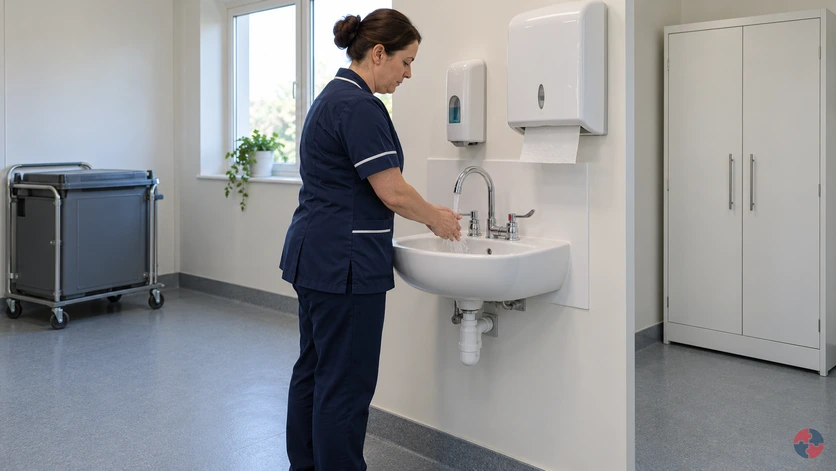
Put hand hygiene at the task transition, before the clean touch
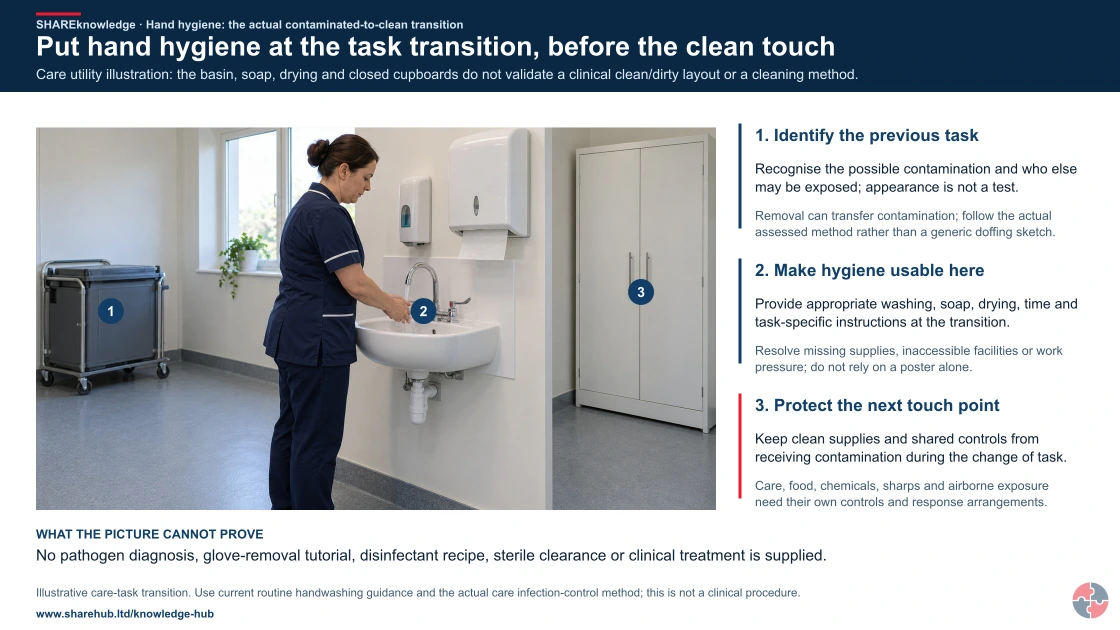
Full written explanation
A new realistic care-utility illustration shows a worker with bare hands at a dedicated basin, with soap and disposable-towel dispensers visible. A closed used-equipment trolley stands separately from a closed clean-supplies cupboard; neither is being handled. Three numbered prompts connect the previous task and likely contamination, appropriate hand hygiene with usable facilities, and the next clean touch point. The picture is a single context still, not a handwashing-coverage sequence, glove-removal method, sterile field or validated care-room design. The existing gloved care-work image remains a separate context in which gloves, sharps and task-specific controls do not replace appropriate hygiene. The new maintenance comparison explains how contamination can pass from gloves or surfaces to hands and another task while preserving the actual care infection-control and chemical-contamination procedures.
Care utility illustration: the basin, soap, drying and closed cupboards do not validate a clinical clean/dirty layout or a cleaning method.
- Identify the previous task. Recognise the possible contamination and who else may be exposed; appearance is not a test.
- Make hygiene usable here. Provide appropriate washing, soap, drying, time and task-specific instructions at the transition.
- Protect the next touch point. Keep clean supplies and shared controls from receiving contamination during the change of task.
Change the pathway
- Gloves are not every control. Removal can transfer contamination; follow the actual assessed method rather than a generic doffing sketch.
- Facilities must actually work. Resolve missing supplies, inaccessible facilities or work pressure; do not rely on a poster alone.
- Match the setting and route. Care, food, chemicals, sharps and airborne exposure need their own controls and response arrangements.
Evidence check: No pathogen diagnosis, glove-removal tutorial, disinfectant recipe, sterile clearance or clinical treatment is supplied.
Match the actual source, transmission route and specialist response
Primary references: HSE actual incidental biological exposure · NHS routine handwashing guidance · HSENI welfare facilities
Open the complete HD image (new tab)Download image

Match the actual source, transmission route and specialist response
Primary references: HSE actual incidental biological exposure · NHS routine handwashing guidance · HSENI welfare facilities
Break contact transfer without assuming one procedure fits every task
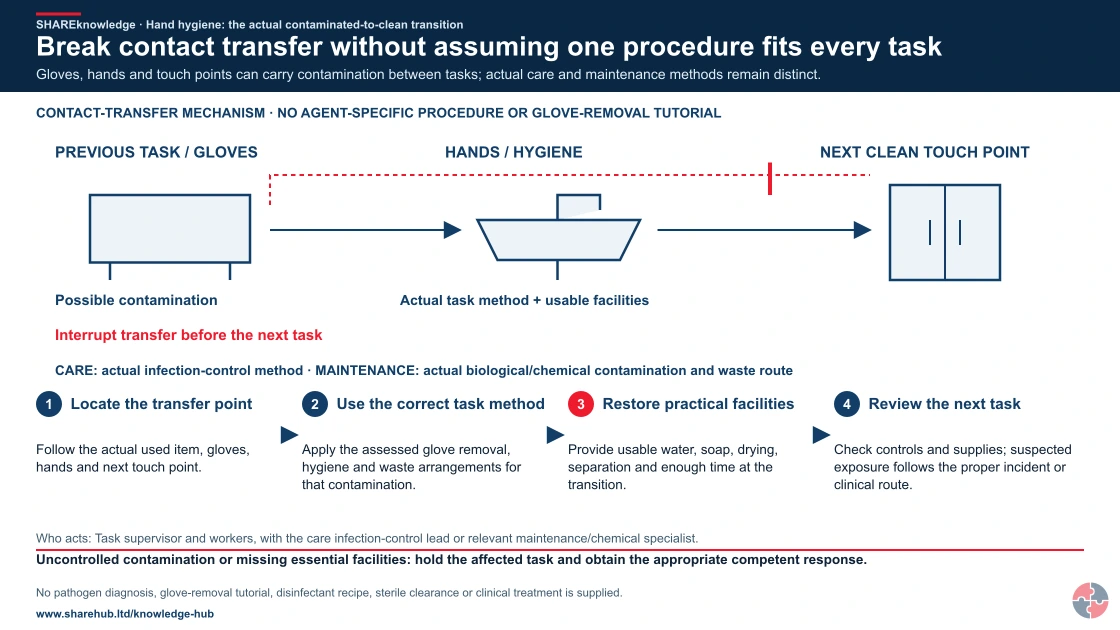
Full written explanation
A complete native contact-transfer schematic connects a contaminated task or glove to hands and then a clean touch point. The red possible bypass route is interrupted by an explicit task-transition hold, appropriate hand hygiene and a check of usable facilities and separation. It is a transfer mechanism rather than a pathogen-specific procedure or a glove-removal tutorial. Two separate context lines distinguish care work, where the infection-control lead and actual care method govern, from maintenance work, where biological and chemical contaminants, glove handling, cleaning and waste need the actual task assessment. Hand hygiene does not by itself resolve airborne exposure, a sharps event or a chemical splash, which retain the relevant response route. No disinfectant concentration, pathogen exclusion period, clinical treatment or sterile clearance is assigned.
Gloves, hands and touch points can carry contamination between tasks; actual care and maintenance methods remain distinct.
- Locate the transfer point. Follow the actual used item, gloves, hands and next touch point.
- Use the correct task method. Apply the assessed glove removal, hygiene and waste arrangements for that contamination.
- Restore practical facilities. Provide usable water, soap, drying, separation and enough time at the transition.
- Review the next task. Check controls and supplies; suspected exposure follows the proper incident or clinical route.
When the evidence does not fit: Uncontrolled contamination or missing essential facilities: hold the affected task and obtain the appropriate competent response.
Who acts: Task supervisor and workers, with the care infection-control lead or relevant maintenance/chemical specialist.
Changed workplace
Care-work transition: Follow the actual infection-control method and protect clean touch points before the next task.
Maintenance glove removal: Identify biological and chemical contamination; use the assessed removal, hygiene, cleaning and waste route.
Evidence check: No pathogen diagnosis, glove-removal tutorial, disinfectant recipe, sterile clearance or clinical treatment is supplied.
Match the actual source, transmission route and specialist response
Primary references: HSE actual incidental biological exposure · NHS routine handwashing guidance · HSENI welfare facilities
Open the complete HD image (new tab)Download image

Match the actual source, transmission route and specialist response
Primary references: HSE actual incidental biological exposure · NHS routine handwashing guidance · HSENI welfare facilities
In this worked example, Riverside Leisure Ltd operates a leisure centre with swimming pools, changing rooms, cafe, soft play, fitness areas, events and cleaning teams. Infection prevention matters because workers share facilities with the public, children, families, contractors and people who may be more vulnerable.
At Riverside Leisure Ltd, the duty manager checks washrooms and soap before opening, assigns changing-room and café touchpoints to named cleaners, and makes an illness-reporting route clear to staff. During a body-fluid spill, the affected area is closed and a trained cleaner uses the assessed kit and waste method; the manager does not ask an untrained attendant to improvise. Reopening follows confirmed cleaning, restocked facilities and a recorded supervisor check. The table is the hand-back record, not a substitute for that sequence.
| Management element | How the business would manage it | Evidence to review |
|---|---|---|
| Assessing | Map infection routes across toilets, changing rooms, poolside, cafe, first aid, cleaning, waste, parties and shared workstations. | Infection-prevention risk register and site hygiene map. |
| Analysing | Identify higher-risk points such as body-fluid cleaning, food handling, repeated illness, new/expectant mothers and crowded events. | Task assessments, incident trends and vulnerable-worker review route. |
| Implementing | Provide soap, drying, cleaning schedules, body-fluid spill kits, staff sickness rules and food-area hygiene controls. | Facilities checks, cleaning records and stock checks. |
| Training | Train front-line staff on handwashing, illness reporting, shared equipment, first-aid hygiene and when to escalate contamination. | Training matrix and supervisor observations. |
| Checking | Supervisors sample washroom standards, cleaning quality, cafe hygiene and illness patterns. | Inspection records and corrective-action tracker. |
| Learning | Review complaints, outbreaks, cleaning failures, stock-outs and body-fluid incidents to improve routines. | Incident review and management meeting actions. |
What warning signs show infection-prevention controls are weak?
Weak infection prevention is usually visible through poor welfare, missing supplies, repeated illness, dirty touchpoints and confused responsibilities.
| Warning sign | How harm can develop | Action |
|---|---|---|
| Soap or towels run out | Workers cannot wash effectively after contamination. | Improve stock checks and accountability. |
| Cleaning sheets are signed but areas are dirty | Paperwork replaces real control. | Verify cleaning quality and retrain. |
| People work while clearly infectious | Illness may spread and performance may be impaired. | Review sickness culture and manager expectations. |
| Shared tools are never cleaned | Contamination transfers across users. | Introduce cleaning or personal allocation. |
| Body-fluid spills are improvised | Cleaners and others may be exposed. | Provide spill kits, training and waste route. |
| Vulnerable-worker concerns are public | Confidentiality and trust are damaged. | Reset privacy and escalation arrangements. |
What do the acronyms and key terms mean?
These terms distinguish routine hygiene, biological-agent control and the applicable authority.
| Term | Full form | Meaning here |
|---|---|---|
| NHS | National Health Service | Official health information; the linked NHS pages are England routes. |
| HSE | Health and Safety Executive | Workplace regulator for Great Britain. |
| HSENI | Health and Safety Executive for Northern Ireland | Workplace regulator for Northern Ireland. |
| COSHH | Control of Substances Hazardous to Health | Separate GB 2002 and NI 2003 rules can govern work-related biological-agent exposure. |
| PPE | Personal protective equipment | Gloves, eye or respiratory protection chosen for the assessed residual task. |
| OH | Occupational health | Specialist advice on health and work capability, not routine line-management diagnosis. |
| RIDDOR | Reporting of Injuries, Diseases and Dangerous Occurrences Regulations | GB and NI reporting regimes differ; check the specified event. |
| ERICPD | Eliminate, Reduce, Isolate, Control, Personal Protective Equipment, Discipline | A planning framework for controls, not a statute. |
| Biological agent | Not an acronym | A micro-organism that may cause infection, allergy, toxicity or another health hazard. |
Unlock another resource
You have used this month’s two free downloads. Publish a post in your own words to unlock one more resource, or choose SHARE Individual for 10 downloads per month.
You decide whether to share. If you do, use the relevant platform disclosure tools and do not make claims you do not genuinely hold.