
SHARE Knowledge Hub
How do coroners, inquests and fatal incident legal processes work?
After a work-related death, protect people, notify the correct authorities, preserve evidence, support the family and workers, and keep the legal investigation separate from a candid safety-learning review. England/Wales, Northern Ireland and Scotland use different court processes.
Understanding How do coroners, inquests and fatal incident legal processes work?
After a work-related death, protect people, notify the correct authorities, preserve evidence, support the family and workers, and keep the legal investigation separate from a candid safety-learning review. England/Wales, Northern Ireland and Scotland use different court processes.
Why this matters at work
The coroner decides whether investigation and an inquest are required under the applicable law. Do not assume every reported death leads to a hearing or that every inquest has a jury. Interested-person status, disclosure, questioning and procedural issues require the actual case directions and competent advice. NI has separate arrangements; Scotland uses its own death-investigation and FAI system. Employers should cooperate lawfully, preserve evidence and maintain prevention without presenting their internal conclusions as the court’s finding.
Investigate technical and organisational causes, including design, maintenance, workload, supervision and earlier warnings. Record competing explanations and uncertainty and revise the scope when new evidence warrants it. Obtain legal advice on disclosure, privilege and compelled material; simply marking a document confidential does not determine its legal status. Protect personal information and support witnesses without coaching. Take necessary preventive action for continuing risks, preserving evidence of what changed. A fair investigation can improve control while leaving liability and public findings to the proper decision makers.
How organisations manage this in practice
Identify the appropriate police, regulator and reporting routes using the actual jurisdiction and event, and appoint a competent coordination contact. Preserve originals and apply lawful retention holds before routine deletion destroys evidence. Keep accounts factual and separate direct observation from inference. Arrange support for witnesses and family liaison with appropriate authorities. Obtain legal advice for compelled interviews, disclosure and privilege questions; do not coach witnesses or promise that an internal investigation is automatically confidential or privileged.
Identify the country, event, authorities involved and your role before deciding what to do. Protect people, arrange urgent help, preserve evidence and obtain competent legal and technical support. Maintain a factual record of notifications, requests, decisions and outstanding actions. Support bereaved people and affected workers through an appropriate named contact without speculation or promises about findings. Public authorities decide their processes; this guidance cannot determine jurisdiction, participant status or liability for a particular death.
A death may involve emergency response, police and regulator investigation, internal learning, a death investigation, criminal proceedings and civil matters. Each has its own purpose, legal test and decision maker. In England and Wales the coroner route differs from Scotland’s Procurator Fiscal investigation and Fatal Accident Inquiry framework. Northern Ireland has its own coroner service and legislation. Do not treat an employer’s internal finding as the outcome of any public process.
Choose the jurisdiction and preserve a factual first-hours response
A fatal-event plan needs a jurisdiction-first contact route. England-and-Wales coronial processes, Scotland’s procurator fiscal and FAI routes, and Northern Ireland’s route must stay distinct. The page does not determine which investigation or charge will follow a live case; use the responsible authorities and competent advice.

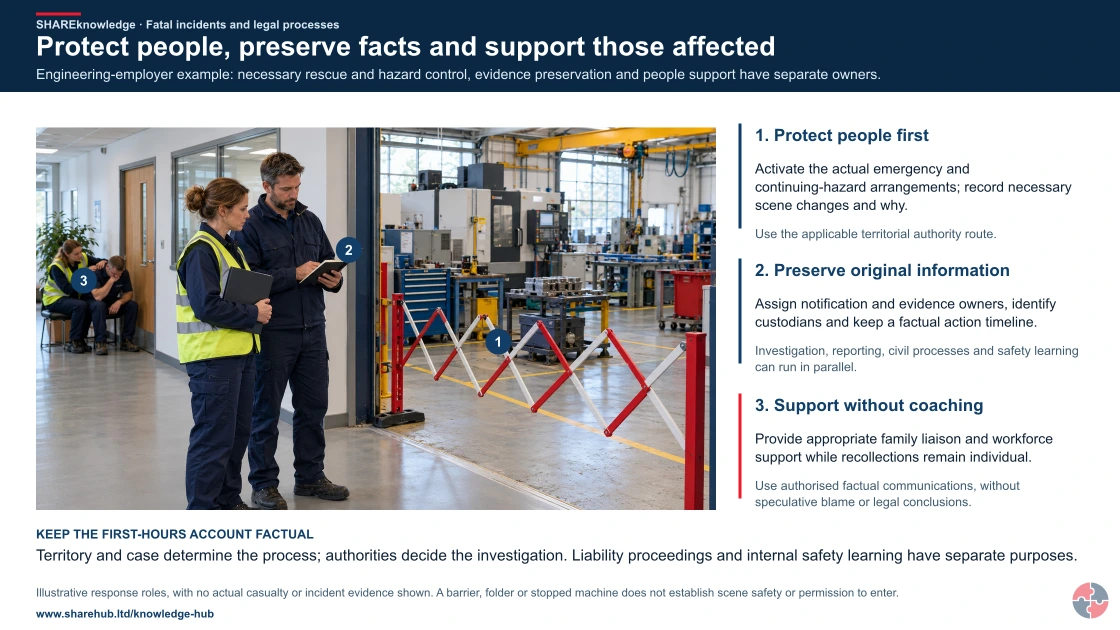
Protect people, preserve facts and support those affected
Full written explanation
Engineering-employer example: necessary rescue and hazard control, evidence preservation and people support have separate owners.
- Protect people first. Activate the actual emergency and continuing-hazard arrangements; record necessary scene changes and why.
- Preserve original information. Assign notification and evidence owners, identify custodians and keep a factual action timeline.
- Support without coaching. Provide appropriate family liaison and workforce support while recollections remain individual.
Change the pathway
- Use the correct authority route. Use the applicable territorial authority route.
- Do not obstruct lawful inquiries. Investigation, reporting, civil processes and safety learning can run in parallel.
- Communicate respectfully. Use authorised factual communications, without speculative blame or legal conclusions.
Evidence check: Territory and case determine the process; authorities decide the investigation. Liability proceedings and internal safety learning have separate purposes.
Complete territory-first response, emergency priorities and independent witness context
Primary references: Judiciary: England-and-Wales coroner service scope · COPFS: Fatal Accident Inquiries (Scotland) · DoJ: Northern Ireland Coroners Service
Open the complete HD image (new tab)Download image

Complete territory-first response, emergency priorities and independent witness context
Primary references: Judiciary: England-and-Wales coroner service scope · COPFS: Fatal Accident Inquiries (Scotland) · DoJ: Northern Ireland Coroners Service
The first-hours sequence starts with rescue and continuing hazard control, then a named notification owner, protected originals and scene information, appropriate family contact and workforce support. Death investigation, regulator or police investigation, reporting, civil processes and internal safety learning may run in parallel. Do not obstruct lawful access, coach witnesses or assume an internal review is privileged. Recollections remain individual.
BuildOut: parallel processes after a fatal event
Illustrative example. A construction site faces a fatal incident while other work still presents a hazard.
Decision. The response lead activates emergency and hazard-control arrangements, uses the correct jurisdiction’s notification route and assigns evidence and people-support owners.
Evidence to check. Original scene and work records, a factual action timeline, custodian details and independent witness recollections.
Hold or escalation point. Do not alter evidence beyond necessary rescue or hazard control, or issue speculative blame or legal conclusions.
Follow-up. Coordinate lawful investigations and verified prevention actions while maintaining support and appropriate family liaison.
Keep care, evidence and legal routes distinct
After a fatal incident, emergency needs and factual preservation come first. The death-inquiry, enforcement and civil routes depend on jurisdiction and must not be collapsed into a guilt finding.

Care and facts
Protect people, obtain emergency help and preserve relevant scene/record evidence without creating further risk.
Correct route
Identify jurisdiction and the designated legal/contact arrangements. Keep the applicable death inquiry distinct from potential enforcement and civil claims.
Support and integrity
Maintain appropriate support for affected people and families. Record facts and uncertainty without predicting findings or inventing fixed timescales.
This teaching map does not supply legal conclusions or replace the directions of the relevant authorities and advisers.
What are the key points about fatal incident legal processes?
The key points are to protect people, preserve evidence, cooperate with investigators, support bereaved families, avoid speculation and learn from verified facts.
Fatal incident legal processes are serious, sensitive and jurisdiction-specific. Organisations should take competent legal, regulatory, insurance and occupational health advice where a death, serious incident, inquest, Fatal Accident Inquiry, prosecution, Prevention of Future Deaths report or bereaved-family communication issue arises.
The legal route depends on jurisdiction
England and Wales, Scotland and Northern Ireland use different processes and terminology.
The inquest is not the only process
Police, HSE, local authority, prosecutors, insurers and civil claims may also be involved.
Evidence preservation starts immediately
Poor evidence control can compromise investigations and organisational learning.
Families must be treated with dignity
Communication should be timely, careful, compassionate and coordinated.
PFD reports are learning signals
A Prevention of Future Deaths report requires a serious, evidenced and timely response.
Diploma answers need evaluation
Strong answers explain process, evidence, people, legal interfaces and management-system learning.
What is a coroner’s inquest or fatal incident legal process?
It is a formal legal and investigative process used to establish facts about a death and, where appropriate, support prevention of future deaths.
In England and Wales, coroners investigate deaths reported to them where the death appears violent, unnatural, unknown in cause, or occurred in custody or state detention. The inquest answers statutory questions about identity and how, when and where the person died. It is a public inquiry, not a prosecution.
In Scotland, deaths are investigated through the procurator fiscal, and certain deaths may lead to a Fatal Accident Inquiry before a sheriff. In Northern Ireland, coroners investigate deaths requiring further inquiry and may hold an inquest.
For workplace deaths, these processes often interact with HSE or local authority investigation, police investigation under the Work-related Death Protocol, Crown Prosecution Service or Crown Office decisions, corporate manslaughter considerations, civil claims and internal management review.
| Process | Jurisdiction or role | Purpose |
|---|---|---|
| Coroner investigation and inquest | England, Wales and Northern Ireland. | Establish who died and how, when and where. |
| Fatal Accident Inquiry | Scotland. | Public inquiry into specified deaths and fatal accidents. |
| Police investigation | UK, with different prosecuting systems. | Consider manslaughter or other serious criminal offences. |
| HSE or regulator investigation | Depends on enforcing authority. | Investigate health and safety law breaches and prevention. |
| Criminal prosecution | CPS, HSE, local authority, COPFS or other relevant body. | Determine whether criminal offences should be prosecuted. |
| Organisational investigation | Employer or dutyholder. | Learn facts, improve controls and support legal/regulatory duties. |
How do the fatal-death court routes differ?
England and Wales have coroners, NI has its own coroner service, and Scotland generally uses a sheriff-led Fatal Accident Inquiry where required.
The England and Wales judiciary FAQ explains the inquest’s purpose. The NI judiciary describes NI coroners and investigation. Scottish Courts FAI rules govern Scottish inquiries. A workplace death may also involve police, HSE/HSENI and prosecutors; an inquest or FAI is not the company’s internal root-cause report or a substitute for reporting duties.
On a small screen, scroll this table sideways to read all columns.
| Place | Judicial route | Official starting point |
|---|---|---|
| England and Wales | Coroner investigation and inquest where required. | Judiciary E&W guidance. |
| Scotland | Sheriff-led FAI under Scottish rules where required. | Scottish Courts FAI rules. |
| Northern Ireland | NI coroner investigation and inquest where required. | Judiciary NI guidance. |
COPFS FAI guide explains the sheriff’s public inquiry and prevention purpose. A death from an accident in Scotland during employment or occupation normally requires an FAI; the Lord Advocate may waive a mandatory inquiry where other proceedings sufficiently established the circumstances. A prosecution does not automatically remove the need. Scottish work-related deaths protocol gives the Scottish liaison and evidence framework. The HSE protocol landing provides separate England/Wales and Scotland routes; use local NI arrangements with HSENI, police and prosecutors, rather than applying the E&W protocol across the UK.
What usually happens after a work-related death?
After a work-related death, emergency response, evidence preservation, notification, police/regulator investigation, family contact and legal process management begin quickly.
The first priority is life safety: rescue, medical response, making the scene safe and preventing further harm. Once immediate dangers are controlled, the organisation must preserve the scene and evidence unless moving something is necessary to protect life or prevent further serious risk.
The police and HSE or another regulator may liaise from the start. The HSE work-related deaths protocol explains that police consider serious criminal offences while HSE investigates possible health and safety law failures. The coroner or procurator fiscal process may run alongside or pause while criminal investigations or proceedings continue.
Internal management should avoid speculation. Early communications should be factual, compassionate and coordinated. Decisions about internal investigation, witness contact, document creation, privilege, disclosure and public statements need competent advice.
| Stage | What happens | Management focus |
|---|---|---|
| Immediate response | Emergency services, rescue, scene safety and first notifications. | Protect life and prevent further harm. |
| Scene preservation | Secure area, evidence, plant, records and data. | Avoid contamination or loss. |
| Regulator/police liaison | Police and HSE/local authority decide lead and scope. | Cooperate and provide information. |
| Family communication | Police FLO, regulator and organisation may communicate. | Show dignity and avoid speculation. |
| Investigation | Statements, documents, expert evidence and analysis gathered. | Support process and protect evidence integrity. |
| Legal proceedings | Inquest, FAI, prosecution or civil process may follow. | Use competent advice and maintain learning focus. |
| Learning and action | Findings become control improvements. | Verify actions and update management system. |
What evidence should be preserved and managed?
Evidence should be preserved in a controlled, traceable and factual way so investigators and the organisation can understand what happened.
Evidence after a fatal incident can be physical, documentary, digital and human. It can include equipment, tools, PPE, permits, risk assessments, training records, maintenance logs, inspection records, CCTV, telematics, emails, photos, phone data, shift logs, handovers, alarms, method statements and witness recollections.
Good evidence management has two purposes: it supports external legal investigations and it helps the organisation learn. Poor evidence handling can damage both. Organisations should avoid altering records, backfilling paperwork or asking workers to “tidy up” accounts.
Witnesses should be treated with care. People may be distressed, traumatised or fearful. Internal interviews should be handled by competent people and coordinated with external investigators and legal advice.
| Evidence type | Examples | Good practice |
|---|---|---|
| Physical evidence | Plant, tools, PPE, guards, materials and scene condition. | Secure, photograph and do not alter unless necessary for safety. |
| Documents | Risk assessments, permits, RAMS, policies and training records. | Preserve originals and version history. |
| Digital data | CCTV, access logs, telematics, alarms and emails. | Secure quickly before overwrite. |
| Witness evidence | Statements, observations and worker accounts. | Support people and avoid leading questions. |
| Maintenance evidence | Inspection, defect, repair and service records. | Preserve logs and contractor records. |
| Management evidence | Audit findings, action trackers and previous incidents. | Review for prior warning signs. |
What are Prevention of Future Deaths reports?
Prevention of Future Deaths reports are coronial reports issued where action should be taken to prevent or reduce a risk of future deaths.
In England and Wales, coroners have a statutory duty to issue a PFD report where the legal threshold is met. E&W Judiciary PFD guidance explains that recipients must respond, normally within 56 days, with details of action taken or proposed, or explain why no action is proposed.
For organisations, a PFD report should be treated as a high-priority governance issue. It is not simply a legal letter. It signals that a coroner has identified a continuing risk of death that the recipient may have power to address.
A good response is specific, owned, timed and evidenced. It should not rely on vague commitments such as “we will remind staff” unless that is part of a wider verified improvement. The board or senior leadership should track delivery and verify that actions have reduced the risk.
| Requirement | What good looks like | Evidence |
|---|---|---|
| Recognise significance | Escalate to senior leadership, legal and risk owners. | Governance record. |
| Understand concern | Identify the specific future-death risk raised. | Issue analysis and root causes. |
| Define actions | Set practical actions, owners and timescales. | Action plan. |
| Respond on time | Submit a clear response within the required period. | Response record. |
| Verify completion | Check action effectiveness, not only completion. | Audit or assurance evidence. |
| Share learning | Update procedures, training and risk registers where relevant. | Learning brief and management review. |
The Chief Coroner’s PFD chapter, 1 January 2025 requires a reply within 56 days unless the coroner extends the period. The reply sets out action taken or proposed and its timetable, or explains why no action is proposed. Record receipt, the applicable deadline, accountable owner and evidence of delivery. This E&W process must not be substituted for Scottish recommendations or NI court directions.
How can the hierarchy of controls turn fatal-incident findings into stronger prevention measures?
Protect the scene and people, report promptly, preserve records, communicate respectfully, and assign legal and safety-learning roles.
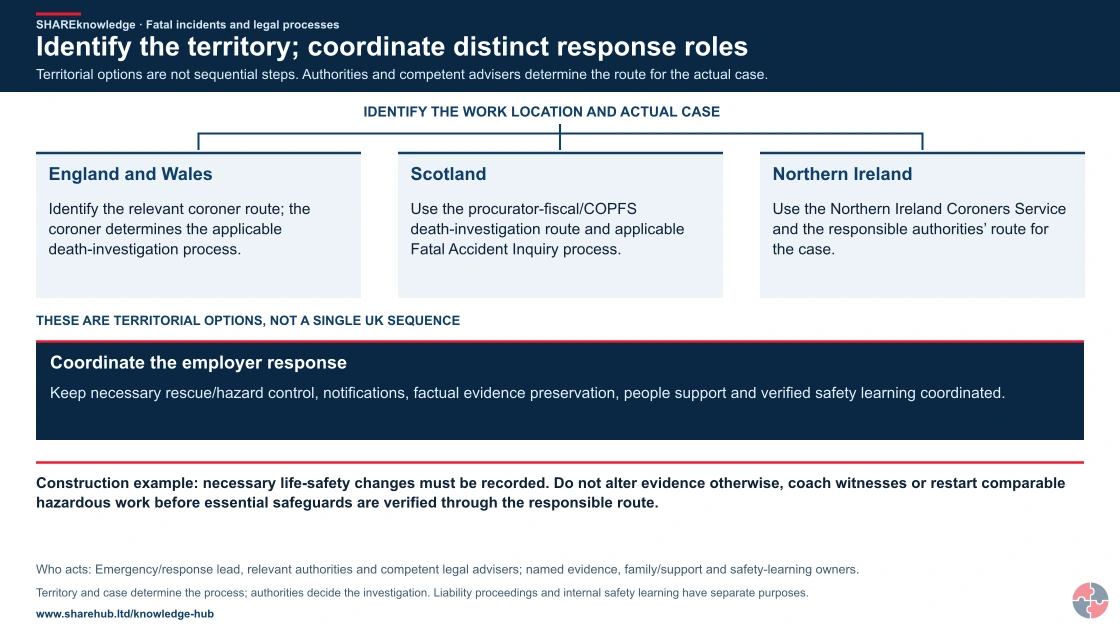
Identify the territory; coordinate distinct response roles
Full written explanation
Territorial options are not sequential steps. Authorities and competent advisers determine the route for the actual case.
- England and Wales. Identify the relevant coroner route; the coroner determines the applicable death-investigation process.
- Scotland. Use the procurator-fiscal/COPFS death-investigation route and applicable Fatal Accident Inquiry process.
- Northern Ireland. Use the Northern Ireland Coroners Service and the responsible authorities’ route for the case.
- Coordinate the employer response. Keep necessary rescue/hazard control, notifications, factual evidence preservation, people support and verified safety learning coordinated.
When the evidence does not fit: Construction example: necessary life-safety changes must be recorded. Do not alter evidence otherwise, coach witnesses or restart comparable hazardous work before essential safeguards are verified through the responsible route.
Who acts: Emergency/response lead, relevant authorities and competent legal advisers; named evidence, family/support and safety-learning owners.
Changed workplace
Engineering employer: Preserve originals and support people without turning individual recollections into a group narrative.
Construction project: Check comparable excavation hazards now while cooperating with the applicable authorities and preserving records.
Evidence check: Territory and case determine the process; authorities decide the investigation. Liability proceedings and internal safety learning have separate purposes.
Complete territory-first response, emergency priorities and independent witness context
Primary references: Judiciary: England-and-Wales coroner service scope · COPFS: Fatal Accident Inquiries (Scotland) · DoJ: Northern Ireland Coroners Service
Open the complete HD image (new tab)Download image

Complete territory-first response, emergency priorities and independent witness context
Primary references: Judiciary: England-and-Wales coroner service scope · COPFS: Fatal Accident Inquiries (Scotland) · DoJ: Northern Ireland Coroners Service
The HSE excavation guide describes technical collapse controls; the HSENI CDM guide is the NI project route. A fatal fall near an excavation requires the site lead to stop adjacent work and remove immediate danger without destroying evidence. Record who changed the scene and why; preserve permits, drawings, inspections, messages and equipment; support witnesses and family through a named contact. The HSE RIDDOR timing guide governs GB reporting; HSENI reporting is the NI route. Legal advisers manage disclosure and court engagement while independent safety staff test whether similar hazards exist elsewhere now. Stop comparable work until essential barriers are verified.
On a small screen, scroll this table sideways to read all columns.
How can the ERICPD hierarchy of controls turn fatal-incident findings into stronger prevention measures?

| Five-level / ERICPD | Control choice | Owner, evidence, failure and stop |
|---|---|---|
| Eliminate / eliminate | Avoid trench entry with remote route if feasible. | Designer records option; hold entry while safer route works. |
| Substitute / reduce | Use shallower reroute after service survey. | Engineer approves; stop on unknown service. |
| Engineering / isolate and control | Engineered support and plant exclusion. | Temporary-works lead verifies; stop on movement or breach. |
| Administrative / discipline | Permit, inspections and change review. | Site manager checks; hold restart until verified. |
| PPE / PPE | Residual task PPE; cannot prevent collapse. | Supervisor checks; stop entry if required protection fails. |
How can the ISO 45001 hierarchy of controls turn fatal-incident findings into stronger prevention measures?

| Five-level / ERICPD | Control choice | Owner, evidence, failure and stop |
|---|---|---|
| Eliminate / eliminate | Avoid trench entry with remote route if feasible. | Designer records option; hold entry while safer route works. |
| Substitute / reduce | Use shallower reroute after service survey. | Engineer approves; stop on unknown service. |
| Engineering / isolate and control | Engineered support and plant exclusion. | Temporary-works lead verifies; stop on movement or breach. |
| Administrative / discipline | Permit, inspections and change review. | Site manager checks; hold restart until verified. |
| PPE / PPE | Residual task PPE; cannot prevent collapse. | Supervisor checks; stop entry if required protection fails. |
For this excavation, HSE’s five-level hierarchy complements ERICPD. The competent engineer assesses actual ground, depth, water, services, nearby structures and plant/spoil loads, then specifies suitable support or battering, access and edge protection before excavation. Verify installed supports against the design and record acceptance before entry. Maintain supports and barriers; a competent person inspects at each shift start, after an event affecting stability and after a fall of earth or rock, with required records. Keep people clear of movement, water ingress or a breached boundary. Correct the cause and have the competent person verify safety before the site lead authorises restart. HSE excavation guidance supports these GB precautions; NI uses its separate CDM duties. After an incident, necessary life-safety changes must be recorded and evidence preserved.
Which legal routes must be separated?
Court investigation, fatal-incident reporting, police/prosecution and organisational safety learning have different purposes and national routes.
Use the E&W coroner source, NI coroner source or Scottish FAI rules as appropriate. Check GB HSE RIDDOR or NI HSENI RIDDOR separately. Specific deadlines, evidence disclosure and legal privilege require competent advice for the live case.
How should fatal incident legal process risk appear in a risk register?
The risk register should identify credible fatal scenarios, evidence-critical controls and post-incident responsibilities.
Fatal incident legal processes are not a substitute for prevention. The risk register should focus on preventing fatal outcomes first, but it should also define what the organisation will do if the worst happens: emergency response, evidence preservation, family communication, regulator liaison, legal advice, witness support and learning governance.
For higher-risk organisations, each credible fatal accident scenario should have named owners, critical controls, assurance evidence and a post-incident playbook.
| Scenario | Critical controls | Evidence |
|---|---|---|
| Fatal fall from height | Work at height controls, rescue plan and contractor assurance. | Permits, inspections and training. |
| Fatal machinery incident | Guarding, isolation, supervision and maintenance. | PUWER checks and lock-off records. |
| Fatal vehicle/pedestrian collision | Traffic segregation, banksman control and site rules. | Traffic plan and monitoring. |
| Fatal confined-space event | Entry permit, atmosphere testing and rescue arrangements. | Permit and rescue drill records. |
| Post-incident evidence loss | Scene control, digital data preservation and document hold. | Incident response procedure. |
| PFD report received | Governance, response owner and action verification. | Board action tracker. |
How could BuildOut Ltd manage fatal incident legal processes?

BuildOut Ltd could manage fatal incident legal processes by combining prevention, emergency response, evidence discipline, family support and verified learning.
BuildOut Ltd
BuildOut Ltd is a construction and refurbishment contractor used by SHARE to show how fatal incident response can be managed across higher-risk project work.
BuildOut identifies fatal-risk activities in its risk register: work at height, temporary works, lifting, traffic management, electrical isolation, excavation, confined spaces, hot work and demolition. Each has critical controls, assurance checks and a named senior owner.
If a fatal incident occurs, BuildOut’s response plan requires emergency response, scene control, police/HSE cooperation, document preservation, CCTV/data hold, nominated family liaison support through appropriate official routes, worker wellbeing support and escalation to legal, insurance and senior leadership.
The company does not allow managers to rewrite risk assessments, coach witnesses or issue speculative statements. Witness support is separated from evidence interference. Internal investigation is coordinated with external investigators and competent legal advice.
After an inquest, FAI, PFD report or enforcement outcome, BuildOut reviews the facts against its management system: procurement, RAMS, supervision, temporary works control, training, audits, previous near misses and leadership review. Actions are tracked to verification, not just closure.
| Management element | How BuildOut applies it | Evidence |
|---|---|---|
| Prevention | Fatal-risk register and critical-control checks. | Risk register and assurance reports. |
| Immediate response | Emergency plan, scene preservation and notifications. | Incident response log. |
| Evidence | Document hold, CCTV preservation and equipment quarantine. | Evidence register. |
| People support | Family, witness and worker support routes. | Support plan and communications log. |
| Legal/regulator liaison | Nominated leads coordinate with HSE, police and advisers. | Contact log and request tracker. |
| Learning | Findings update controls, training and assurance. | Board-reviewed action plan. |
What should each role learn and demonstrate?
Learning must match the decisions people make, from recognising danger to checking that controls work.
Briefings should tell people how to act, but attendance alone does not show competence. Assess the real decision or task, record who assessed it and revisit after a material change, failed control or incident. A local authorisation is task-specific; no universal external certificate is implied.
On a small screen, scroll this table sideways to read all columns.
| Role and learning | Demonstration and assessor | Record and reassessment trigger |
|---|---|---|
| Incident lead | Protect scene and people, preserve evidence; legal/safety leads assess. | Chronology; revisit after new facts. |
| Reporter | Apply location-specific reporting route; competent adviser checks. | Submission record; correct promptly. |
| Executive | Resource safe restart and family/worker support; board assesses. | Barrier evidence and actions; review until closed. |
How should NEBOSH Diploma learners understand this topic?
NEBOSH Diploma learners should understand the legal process, evidence requirements, stakeholder roles and how fatal incident findings drive prevention.
For Diploma study, this is not just a memory topic. Learners should be able to compare legal routes, explain the role of coroners and FAIs, describe HSE/police interaction, identify evidence types, support bereaved-family communication principles, and evaluate whether organisational learning is credible.
Scenario-based answers should show maturity. A strong answer would say: secure the scene, protect life, notify authorities, cooperate with police/HSE, preserve records, support witnesses, avoid speculation, involve competent legal advice, maintain family communication, conduct or support investigation, respond to any PFD or determination, and verify corrective actions.
Diploma-level analysis also looks at management-system weaknesses revealed by fatal incidents: poor contractor control, inadequate supervision, weak audit, action closure without verification, normalisation of deviance, poor competence assurance or failure to learn from previous near misses.
| Requirement | What to understand | How to apply it |
|---|---|---|
| Legal routes | Coroners, FAIs, HSE, police, prosecutors and civil claims. | Map the likely process after a fatal workplace incident. |
| Evidence | Physical, documentary, digital and witness evidence. | Explain preservation and integrity. |
| Stakeholders | Bereaved families, workers, regulators, insurers, courts and media. | Communicate carefully and coordinate roles. |
| PFD/FAI learning | Future-death prevention and sheriff/coroner findings. | Convert findings into verified controls. |
| Management systems | Leadership, risk control, monitoring and audit weaknesses. | Evaluate root causes beyond immediate acts. |
| Professional judgement | Legal advice, compassion and factual discipline. | Avoid speculation and demonstrate ethical practice. |
How can a management system sustain effective decisions?
Give each hazard or support route an owner, a control, a check and a response to failure.
Keep emergency response, reporting, evidence, court interface, family care and independent learning distinct but coordinated. An owner should sample actual work and corrective actions, not accept a policy or certificate as evidence that the controls work.
The free GB regulator guide HSE Managing for health and safety (HSG65) explains a plan–do–check–act approach: assign controls and owners, involve workers, check work as done, and correct failures. For Northern Ireland, use HSENI risk assessment guidance for the local duty. A certificate alone does not demonstrate that a control works.
What warning signs show poor readiness for fatal incident legal processes?
Warning signs include no fatal incident plan, poor evidence discipline, unsupported witnesses, unclear family communication and action plans that are not verified.
These warning signs are not administrative niceties. After a fatal incident, confusion can harm families, workers, legal processes and learning. A business that cannot locate permits, training records or CCTV will struggle to understand what happened. A business that closes actions without verification may repeat the same conditions.
Preparedness is part of prevention culture. It shows whether an organisation has thought seriously about its highest-consequence risks.
| Warning sign | How harm can arise | Response |
|---|---|---|
| No response plan | Managers improvise under pressure. | Create and exercise fatal incident playbook. |
| Evidence not preserved | Facts are lost or disputed. | Use document hold and scene control. |
| Speculative communication | Families and workers receive inaccurate messages. | Use factual coordinated communications. |
| Witnesses unsupported | People become distressed or fearful. | Provide support and clear process guidance. |
| PFD response vague | Future-death risk may remain. | Create specific verified action plan. |
| Learning not verified | Similar failures recur. | Audit action effectiveness. |
What acronyms are used on this page?
Acronyms should be explained so legal process information is accessible.
| Acronym | Meaning | Why it matters |
|---|---|---|
| CPS | Crown Prosecution Service | Prosecuting authority for England and Wales. |
| COPFS | Crown Office and Procurator Fiscal Service | Scottish prosecution service and death investigation body. |
| FAI | Fatal Accident Inquiry | Scottish public inquiry into certain deaths. |
| FLO | Family Liaison Officer | Police role supporting communication with bereaved families. |
| HSE | Health and Safety Executive | Regulator for many work-related fatal incidents. |
| HSENI | Health and Safety Executive for Northern Ireland | Northern Ireland health and safety regulator. |
| PFD | Prevention of Future Deaths | Coroner report requiring response to future-death risk. |
| WRDP | Work-related Death Protocol | Protocol for liaison after work-related deaths. |