SHARE Knowledge Hub
Domestic Abuse and Workplace Support
Domestic abuse and workplace support is about how an employer can recognise possible work impacts, provide safe and confidential routes for help, and control workplace risks without trying to investigate, diagnose or manage the abuse itself. Domestic abuse can include physical violence, coercive control, emotional abuse, sexual abuse, economic abuse, technological monitoring, threats, stalking, harassment and controlling behaviour by a partner, ex-partner or family member. The workplace can be a place of safety, a route to support, or a point of increased risk if work patterns, contact details, pay information, homeworking arrangements or site access are not handled carefully.
Understanding Domestic Abuse and Workplace Support
Domestic abuse and workplace support is about how an employer can recognise possible work impacts, provide safe and confidential routes for help, and control workplace risks without trying to investigate, diagnose or manage the abuse itself. Domestic abuse can include physical violence, coercive control, emotional abuse, sexual abuse, economic abuse, technological monitoring, threats, stalking, harassment and controlling behaviour by a partner, ex-partner or family member. The workplace can be a place of safety, a route to support, or a point of increased risk if work patterns, contact details, pay information, homeworking arrangements or site access are not handled carefully.
Why this matters at work
Inclusion also means preventing secondary harm at work. Challenge victim-blaming, intrusive curiosity, gossip, stereotyping, discriminatory assumptions, retaliatory treatment and misuse of confidential information. Train managers to recognise that a worker may not be able to use a telephone, video call, work computer, personal vehicle or a conventional emergency contact. Make support available without requiring a public declaration, and test whether people who are rarely on site or outside the core workforce can find the route safely.
Manage attendance and performance fairly. Abuse can affect sleep, injury, concentration, appointments, housing, childcare and emergency travel. Do not automatically treat absence, late arrival, reduced output, remote-working difficulty or a safety concern as misconduct. Agree how leave, absence codes, performance targets and communication will be handled confidentially. Use a fair, documented process and seek HR advice.
How organisations manage this in practice
Document the decision, owner, deadline and review trigger rather than recording an unnecessary personal account. A control is not complete merely because it has been agreed: test whether it works on night shifts, during absence, at another site, for agency staff, in an emergency and when the named manager is unavailable. The worker can withdraw or change consent for information sharing, but the organisation still needs to explain and act on any immediate safety or safeguarding duty. Review controls as circumstances change, rather than asking the worker to prove that risk has worsened. Distinguish a changed support preference or withdrawal of processing consent from information handled under another applicable lawful basis. Check the actual safeguarding duty and country; disclosure alone does not trigger one universal mandatory reporting rule.
Managers and colleagues may be affected by the disclosure or an incident. Provide supervision, clear escalation, debrief and appropriate support without sharing confidential personal detail. Make sure named contacts have cover and are not individually carrying high-risk cases without expertise. Use learning review to improve the organisation, not to judge whether a manager could solve an abuse situation alone. Supportive management is a collective workplace control with clear limits and specialist back-up.
A policy should make support accessible without forcing disclosure. State the purpose, scope, named contacts, safe ways to seek help, confidentiality limits, emergency action, workplace safety planning, adjustments, referral, data handling, allegations against employees, non-retaliation, manager support, contractor inclusion and review. Publish the policy in plain language and through more than one route. Avoid examples that imply abuse has a single form or only affects a particular group. Test whether a night worker, driver, home worker, agency worker or person without safe access to a work computer can find support without alerting someone at home.
Start with safety and the agreed contact method
Use the existing national support and emergency routes. Agree a safe means and time of contact with the person, and restrict records; managers support workplace safety rather than investigating abuse.

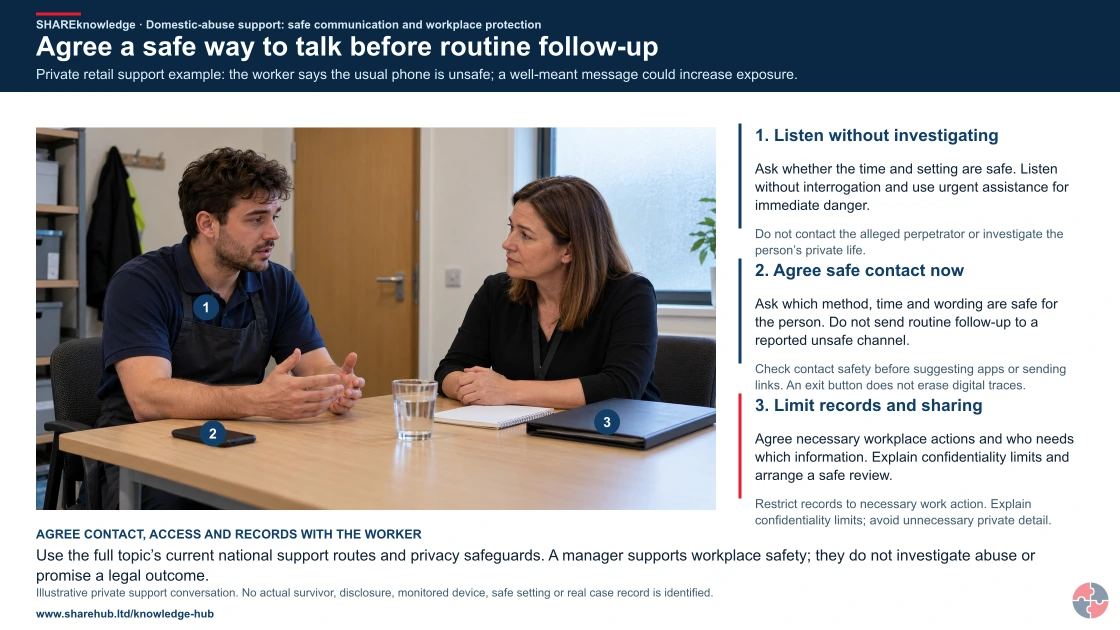
Agree a safe way to talk before routine follow-up
Full written explanation
Private retail support example: the worker says the usual phone is unsafe; a well-meant message could increase exposure.
- Listen without investigating. Ask whether the time and setting are safe. Listen without interrogation and use urgent assistance for immediate danger.
- Agree safe contact now. Ask which method, time and wording are safe for the person. Do not send routine follow-up to a reported unsafe channel.
- Limit records and sharing. Agree necessary workplace actions and who needs which information. Explain confidentiality limits and arrange a safe review.
Change the pathway
- Support the person’s choices. Do not contact the alleged perpetrator or investigate the person’s private life.
- Do not assume digital safety. Check contact safety before suggesting apps or sending links. An exit button does not erase digital traces.
- Keep information proportionate. Restrict records to necessary work action. Explain confidentiality limits; avoid unnecessary private detail.
Evidence check: Use the full topic’s current national support routes and privacy safeguards. A manager supports workplace safety; they do not investigate abuse or promise a legal outcome.
Existing first response, safe communication, restricted records and national support routes
Primary references: Home Office: technology monitoring and national domestic-abuse support · Acas: safe workplace communication and support (GB)
Open the complete HD image (new tab)Download image

Existing first response, safe communication, restricted records and national support routes
Primary references: Home Office: technology monitoring and national domestic-abuse support · Acas: safe workplace communication and support (GB)
A previously safe phone is now monitored
Illustrative example. A worker changes the agreed way they can be contacted.
Decision. Confirm the safe alternative discreetly before further contact and review necessary work adjustments.
Evidence to check. The person’s current contact preference, relevant security arrangements and minimum necessary information.
Hold or escalation point. Do not send a well-meant follow-up to the old number or promise that an exit button erases history.
Follow-up. Review contact safety when circumstances change; check current national leave information before promising an entitlement.
First agree whether the time and channel are safe
A support conversation must not create new exposure through an unsafe contact method. Separate immediate danger from the worker’s chosen routine support and workplace plan.
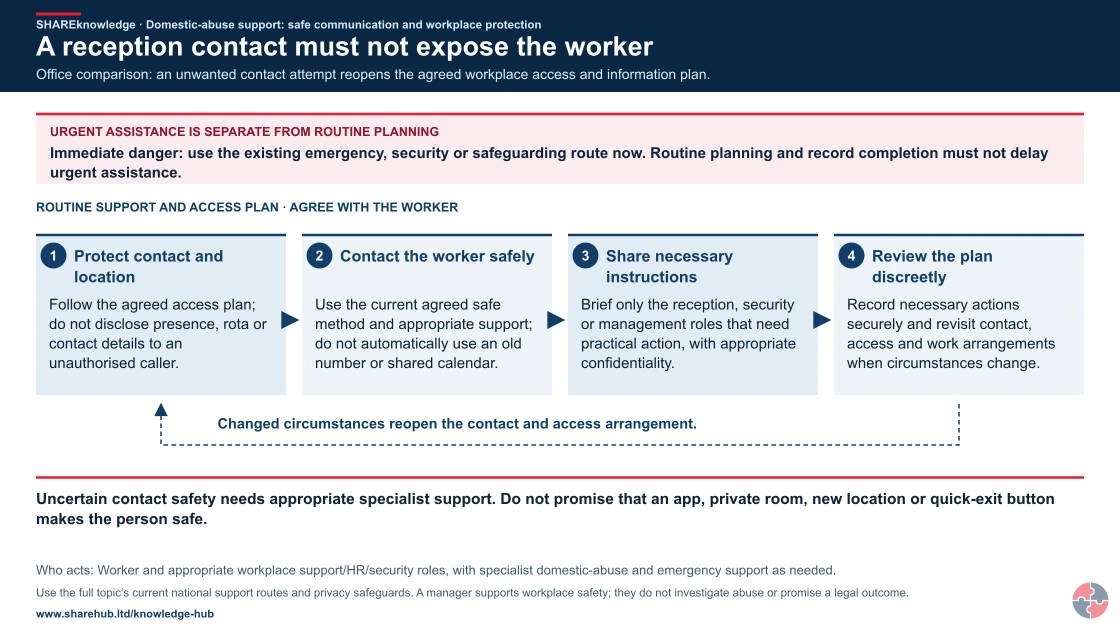
A reception contact must not expose the worker
Full written explanation
Immediate danger: use the existing emergency, security or safeguarding route now. Routine planning and record completion must not delay urgent assistance.
Office comparison: an unwanted contact attempt reopens the agreed workplace access and information plan.
- Protect contact and location. Follow the agreed access plan; do not disclose presence, rota or contact details to an unauthorised caller.
- Contact the worker safely. Use the current agreed safe method and appropriate support; do not automatically use an old number or shared calendar.
- Share necessary instructions. Brief only the reception, security or management roles that need practical action, with appropriate confidentiality.
- Review the plan discreetly. Record necessary actions securely and revisit contact, access and work arrangements when circumstances change.
When the evidence does not fit: Uncertain contact safety needs appropriate specialist support. Do not promise that an app, private room, new location or quick-exit button makes the person safe.
Who acts: Worker and appropriate workplace support/HR/security roles, with specialist domestic-abuse and emergency support as needed.
Changed workplace
Retail disclosure: Agree a safe time, channel and necessary workplace actions with the worker.
Unwanted reception contact: Protect access and information under the agreed plan; revisit it if risk changes.
Evidence check: Use the full topic’s current national support routes and privacy safeguards. A manager supports workplace safety; they do not investigate abuse or promise a legal outcome.
Existing first response, safe communication, restricted records and national support routes
Primary references: Home Office: technology monitoring and national domestic-abuse support · Acas: safe workplace communication and support (GB)
Open the complete HD image (new tab)Download image

Existing first response, safe communication, restricted records and national support routes
Primary references: Home Office: technology monitoring and national domestic-abuse support · Acas: safe workplace communication and support (GB)

Safe contact
Ask whether this is a safe time and channel; avoid unnecessary personal details in routine messages.
Danger or support
Use appropriate urgent assistance for immediate danger. Otherwise listen and agree the support and necessary sharing with the worker.
Workplace plan
Review access, contacts and work arrangements with the appropriate competent support, and revisit after circumstances change.
The scene uses no survivor identity or real location. Do not promise absolute confidentiality beyond the applicable safeguarding/emergency arrangements.
What key facts should people know first about domestic abuse at work?
Domestic abuse support at work should be survivor-led, confidential, safety-focused and connected to specialist support routes.
This page is general workplace guidance, not legal, HR, medical, safeguarding or specialist domestic abuse advice. Individual cases can be high-risk and should be handled through competent internal routes and specialist external support where appropriate.
The worker should normally control what they share, who is told and which practical support feels safe. A manager should not promise absolute secrecy if there is a serious risk of harm, but should be clear, calm and specific about who may need to know and why.
The first workplace question is not 'what happened?' It is 'how can we communicate safely, what work arrangements may increase risk, what support do you want, and what needs to change now?' See GOV.UK - Workplace support for victims of domestic abuse (2021 review).
| Key fact | Practical meaning |
|---|---|
| Domestic abuse is caused by the perpetrator | Avoid language that blames the worker or suggests the abuse is caused by stress, relationship difficulty or poor choices. Source: GOV.UK - Workplace support for victims of domestic abuse (2021 review). |
| The workplace may be a safe place | Work can provide routine, income, contact, support and privacy from the perpetrator. Source: GOV.UK - Workplace support for victims of domestic abuse (2021 review). |
| Work can also increase risk | Rota patterns, work address, parking, public-facing roles, phone calls, email, payroll and homeworking can expose information. Source: GOV.UK - Workplace support for victims of domestic abuse (2021 review). |
| Safe communication comes first | Agree whether phone, text, email, video, in-person contact or a code word is safe. Source: GOV.UK - Workplace support for victims of domestic abuse (2021 review). |
| Managers must not investigate | Do not contact the alleged perpetrator, test the worker's account or attempt informal mediation. Source: GOV.UK - Workplace support for victims of domestic abuse (2021 review). |
| Records must be proportionate | Record support actions and risk controls without unnecessary personal detail. Source: GOV.UK - Workplace support for victims of domestic abuse (2021 review). |
What is domestic abuse?
Domestic abuse is a pattern of abusive, controlling, coercive, threatening, violent or degrading behaviour by a partner, ex-partner or family member.
Domestic abuse can include physical violence, emotional abuse, sexual abuse, economic abuse, threats, stalking, coercive control, isolation, intimidation, humiliation, technological monitoring and control of money, devices, movement or relationships.
It can affect anyone. Assumptions about gender, job role, seniority, income, confidence, sexuality, disability, age, culture or relationship status can make support less safe and less accessible. Some workers may never use the words 'domestic abuse' but may describe being monitored, controlled, threatened, followed, financially restricted or frightened.
The effects can reach work through tiredness, injury, fear, poor sleep, distraction, sudden absence, financial distress, changed communication, reluctance to work from home, reluctance to attend the office, repeated calls or messages, or concerns about the perpetrator arriving at the workplace. See GOV.UK - Domestic abuse: how to get help.
| Type | What it can involve | Workplace relevance |
|---|---|---|
| Physical abuse | Assault, injury, threats or intimidation. | Injuries, absence, medical appointments or fear of travel/workplace access. Source: GOV.UK - Domestic abuse: how to get help. |
| Coercive control | Monitoring, isolation, rules, threats or control of daily life. | Restricted communication, controlled travel, fear of making decisions or limited access to work devices. Source: GOV.UK - Domestic abuse: how to get help. |
| Economic abuse | Control of money, wages, debt, benefits, bank accounts or possessions. | Payroll privacy, bank detail changes, financial wellbeing and requests for pay-related information. Source: GOV.UK - Domestic abuse: how to get help. |
| Technological abuse | Monitoring calls, emails, location, devices, social media or accounts. | Unsafe contact methods, device security, remote working and personal information controls. Source: GOV.UK - Domestic abuse: how to get help. |
| Stalking and harassment | Following, repeated contact, surveillance, threats or workplace visits. | Reception/security controls, parking, travel and lone-working arrangements. Source: GOV.UK - Domestic abuse: how to get help. |
| Emotional and psychological abuse | Humiliation, threats, manipulation, fear, isolation or loss of confidence. | Concentration, confidence, attendance, mental health and performance impact. Source: GOV.UK - Domestic abuse: how to get help. |
What should the workplace do first if domestic abuse is disclosed or suspected?
The first response should protect immediate safety, safe communication and confidentiality before wider action is taken.
If a worker discloses domestic abuse, the manager should listen, thank them for telling them, avoid disbelief or interrogation, and ask how communication can be done safely. If the conversation is taking place remotely, do not assume the worker can speak freely.
If there appears to be immediate danger at work, the organisation should use its emergency, security, safeguarding or violence-prevention arrangements. If the issue is not immediate, the response should still be planned and careful: agree who is involved, what can be recorded, how contact will happen and what practical changes are needed.
A manager should avoid actions that can increase risk: contacting the alleged perpetrator, sending visible emails without agreement, leaving voicemail messages, changing work location without consultation, sharing details widely or treating the matter as ordinary performance management. See GOV.UK - Domestic abuse: how to get help; NHS - Getting help for domestic violence and abuse; Northern Ireland domestic abuse support.
| Step | What to do | Why it matters |
|---|---|---|
| Listen privately | Use a calm, confidential setting and avoid judgement. | The person may be frightened, monitored or unsure whether disclosure is safe. Source: GOV.UK - Domestic abuse: how to get help. |
| Check safe contact | Ask which method, time and wording is safe. | Calls, emails or texts may be monitored by the perpetrator. Source: GOV.UK - Domestic abuse: how to get help. |
| Assess work risk | Consider site access, travel, lone working, homeworking, rota visibility and public contact. | Work arrangements may expose the person or colleagues to risk. Source: GOV.UK - Domestic abuse: how to get help. |
| Agree support | Discuss flexibility, time off, safe workplace, payroll privacy, security instructions and specialist signposting. | Practical support can reduce immediate barriers and risk. Source: GOV.UK - Domestic abuse: how to get help. |
| Record carefully | Record agreed actions, owners and review dates only where needed. | Excess detail can create privacy or safety problems. Source: GOV.UK - Domestic abuse: how to get help. |
| Review | Set a safe review method and timeframe. | Risk and support needs can change quickly. Source: GOV.UK - Domestic abuse: how to get help. |
How can domestic abuse affect work, health and safety?
Domestic abuse can affect work through safety risk, attendance, concentration, health, communication, money, travel and work location.
The work effects are not always obvious. A person may perform well while using work as a place of stability, or may appear unreliable because they are managing threats, surveillance, injury, disrupted sleep, childcare, housing, police contact or legal appointments.
Managers should focus on work impact rather than private detail. Useful questions include: are you safe to receive messages; is homeworking safe; is travelling to work safe; is the workplace address known; do we need reception or security controls; would time off or flexible hours help; do payroll or emergency contact details need protecting?
The risk can extend beyond the individual. If a perpetrator attends the workplace, contacts colleagues, uses business channels to monitor the worker, or knows shift patterns and site access, colleagues and public-facing teams may also need protective arrangements. See GOV.UK - Workplace support for victims of domestic abuse (2021 review).
| Work impact | How it may show | Possible workplace response |
|---|---|---|
| Attendance and timekeeping | Lateness, sudden absence, appointments or disrupted routine. | Flexible hours, special leave, safe review conversations and support planning. Source: GOV.UK - Workplace support for victims of domestic abuse (2021 review). |
| Concentration and errors | Distraction, fatigue, fear, poor sleep or anxiety. | Temporary workload adjustment, supervision support and safety-critical review. Source: GOV.UK - Workplace support for victims of domestic abuse (2021 review). |
| Work location | Home may be unsafe or office may be known to the perpetrator. | Alternative work location, safe room, adjusted rota or security briefing. Source: GOV.UK - Workplace support for victims of domestic abuse (2021 review). |
| Communication | Calls, emails or messages may be monitored. | Safe contact method, code word, neutral wording and restricted distribution. Source: GOV.UK - Workplace support for victims of domestic abuse (2021 review). |
| Financial control | Wages, bank details, debt or payroll information may be controlled. | Payroll confidentiality, secure records and signposting to financial wellbeing support. Source: GOV.UK - Workplace support for victims of domestic abuse (2021 review). |
| Workplace access | The perpetrator may attend reception, car park or public areas. | Visitor controls, reception instructions, parking arrangements and escalation plan. Source: GOV.UK - Workplace support for victims of domestic abuse (2021 review). |
How should safe communication and confidentiality be managed?
Safe communication should be agreed with the worker because ordinary contact methods may increase risk.
A well-meaning message can be unsafe if it appears on a monitored phone or shared laptop. Before sending emails, texts, meeting invites or voicemail messages, ask what is safe. In some cases a neutral subject line, agreed phrase, different email address, face-to-face conversation, written note, code word or indirect contact route may be safer.
Confidentiality should be explained in plain language. The worker should know who will be told, why they need to know, what will be recorded and where it will be stored. Wider team explanations should be minimal and practical, such as a rota change or temporary working arrangement, without revealing domestic abuse.
Payroll, HR systems, emergency contact records and work directories can hold sensitive information. Access should be restricted and reviewed if the perpetrator may know or try to obtain workplace information. See Acas - Domestic violence and abuse when working from home; ICO - Data protection and workers' health information.
The Home Office help guidance recognises technology monitoring as a form of abuse and warns that a support app should only be downloaded when it is safe and the phone is not monitored. Apply that caution before suggesting digital support. For example, agree a safe private conversation with the worker before sending a labelled support link or installation reminder to their personal phone. This workplace example illustrates the safety principle; it is not a prescribed contact procedure or an endorsement of a particular app. Seek appropriate specialist support if a safe contact method is uncertain.
| Control | Good practice | Common mistake |
|---|---|---|
| Safe contact method | Agree whether phone, text, email, video, in-person or written contact is safe. | Assuming the worker can speak freely at home. Source: Acas - Domestic violence and abuse when working from home. |
| Code word or signal | Agree a phrase or signal for when the person cannot talk safely. | Using a code word without briefing the person who receives it. Source: Acas - Domestic violence and abuse when working from home. |
| Neutral wording | Use agreed neutral subject lines and meeting titles. | Sending obvious domestic abuse or wellbeing labels to a monitored device. Source: Acas - Domestic violence and abuse when working from home. |
| Access control | Limit HR, payroll, address, rota and emergency-contact access. | Allowing unnecessary system access to sensitive information. Source: Acas - Domestic violence and abuse when working from home. |
| Reception/security briefing | Share only necessary instructions with trained people. | Disclosing personal details to a wide group. Source: Acas - Domestic violence and abuse when working from home. |
| Review contact safety | Check the arrangement still works because risk can change. | Setting one method and never reviewing it. Source: Acas - Domestic violence and abuse when working from home. |
What should a domestic abuse workplace policy include?
A domestic abuse policy should make support visible before a crisis and tell managers exactly how to respond safely.
The policy should be short enough to use and strong enough to guide action. It should explain that domestic abuse is unacceptable, can affect work, and will be handled confidentially and supportively. It should include routes for disclosure, trained contacts, safe communication, paid or unpaid leave options, work adjustments, security arrangements, records and review.
The policy should also connect to other arrangements: violence and aggression at work, lone working, homeworking, flexible working, absence, dignity at work, safeguarding, data protection, disciplinary procedures, visitor control, payroll, emergency response and occupational health.
A policy is not enough on its own. Managers need training and workers need repeated, discreet reminders of where support can be found. Remote workers and people on long-term leave may need different access routes. See GOV.UK - Workplace support for victims of domestic abuse (2021 review).
| Policy component | What it should cover | Evidence of use |
|---|---|---|
| Purpose and scope | Commitment to support workers affected by domestic abuse. | Policy approved, communicated and reviewed. Source: GOV.UK - Workplace support for victims of domestic abuse (2021 review). |
| Disclosure routes | Named trained contacts, HR route, manager route and safe alternatives. | Contact list, intranet page and awareness briefings. Source: GOV.UK - Workplace support for victims of domestic abuse (2021 review). |
| Safe communication | Safe contact method, code word, neutral wording and monitored-device risk. | Conversation form and safe-contact agreement. Source: GOV.UK - Workplace support for victims of domestic abuse (2021 review). |
| Work adjustments | Work location, hours, leave, workload, pay, access and security options. | Action plan and review dates. Source: GOV.UK - Workplace support for victims of domestic abuse (2021 review). |
| Confidentiality and records | Need-to-know access, minimal records and data protection. | Restricted case records and audit of access. Source: GOV.UK - Workplace support for victims of domestic abuse (2021 review). |
| Perpetrator considerations | How to respond if the alleged perpetrator is a worker or attends the site. | Escalation route, HR/legal advice and security plan. Source: GOV.UK - Workplace support for victims of domestic abuse (2021 review). |
| Training and review | Manager competence, worker awareness and policy review. | Training matrix, feedback and lessons learned. Source: GOV.UK - Workplace support for victims of domestic abuse (2021 review). |
Choose controls using HSE’s hierarchy and the task-specific guidance cited below.
How can the hierarchy of controls reduce risks while agreeing a workplace access and contact plan?
Controls should be practical, proportionate and agreed with the worker wherever possible.
Domestic abuse controls are not the same as ordinary wellbeing benefits. They may need to protect location, communication, money, access, travel and time. A good plan is specific: who will do what, what information can be shared, which arrangements need changing and when the plan will be reviewed.
The organisation should avoid one-size-fits-all responses. Homeworking may be protective for one person and dangerous for another. Office working may provide safety for one person and expose another to stalking. The worker's view is essential because they often understand the risk pattern better than the employer.
Where there is workplace violence, threats, stalking or harassment connected to the work activity, HSE violence-at-work principles also become relevant: assess the risk, control access, train staff, report incidents, support workers and learn from events. See GOV.UK - Workplace support for victims of domestic abuse (2021 review); Protecting workers from violence and aggression.
| Control area | Examples | Review question |
|---|---|---|
| Work location | Alternative office, safe workspace, private room, adjusted homeworking or office-working pattern. | Does this location increase or reduce risk today? Source: GOV.UK - Workplace support for victims of domestic abuse (2021 review). |
| Working time | Flexible hours, changed shift, time off for appointments or altered start/finish arrangements. | Does the pattern expose predictable movements? Source: GOV.UK - Workplace support for victims of domestic abuse (2021 review). |
| Security | Reception instructions, visitor controls, car parking, escort arrangements and photograph alert where appropriate. | Who needs to know and how much should they know? Source: GOV.UK - Workplace support for victims of domestic abuse (2021 review). |
| Technology | Alternative email, safe phone, device privacy, Teams/Zoom caution and calendar privacy. | Could this contact be monitored? Source: GOV.UK - Workplace support for victims of domestic abuse (2021 review). |
| Pay and records | Payroll confidentiality, bank detail changes, address suppression and restricted HR access. | Could workplace records reveal location or finances? Source: GOV.UK - Workplace support for victims of domestic abuse (2021 review). |
| Workload | Temporary adjustment to deadlines, public-facing tasks, travel or safety-critical duties. | Is the person being asked to carry risk while distracted or frightened? Source: GOV.UK - Workplace support for victims of domestic abuse (2021 review). |
| Support route | Named contact, HR, wellbeing, EAP, occupational health or specialist signposting. | Is there a coordinated owner and safe review date? Source: GOV.UK - Workplace support for victims of domestic abuse (2021 review). |
A worker tells a Riverside leisure-centre manager that an abusive former partner knows the rota and sometimes waits outside the venue. The workplace harm route is unwanted contact at work and unsafe communications. The employer can control work access and information, but it cannot investigate or eliminate abuse outside work. The two hierarchies are related decision aids, not legislation or interchangeable labels. Test upstream changes first; the exact feasibility and residual risk depend on the task.
How should controls be prioritised?
How can the ERICPD hierarchy of controls reduce risks while agreeing a workplace access and contact plan?

| Control level | Control for this activity | Owner and verification | Stop / restart decision |
|---|---|---|---|
| Eliminate | Remove unnecessary public disclosure of the worker’s location, direct contact details and predictable work pattern where it can be done safely. | Task owner verifies that the proposed change removes the named hazardous step, including foreseeable cleaning, maintenance and work transferred elsewhere. | If the hazardous step remains, keep it within the task assessment and select the stronger feasible remaining controls. |
| Reduce, including substitution | Consider an alternative contact channel, work location or travel arrangement only after discussing the risks and practical effects with the worker. | Competent task/process owner validates suitability, compatibility and new hazards against the actual operating requirements before the alternative is adopted. | Reject an alternative if its performance is unproved or its new hazards are unresolved. |
| Isolate | Control visitor access to staff-only areas and prevent unauthorised disclosure through reception, calls and deliveries. | Supervisor checks the actual boundary, affected people and connected work; verify separation or isolation before allowing access. | Hold or stop for an immediate threat, failed access control or an arrangement the worker identifies as increasing danger. |
| Control: physical safeguards | Provide suitable access control, private communication and tested assistance arrangements for the actual workplace and threat assessment. | Competent equipment/process owner checks worker-agreed communication, visitor controls, assistance response and limited information sharing. | Hold or stop for an immediate threat, failed access control or an arrangement the worker identifies as increasing danger. |
| Control: work method and response | Agree named contacts, safe ways to communicate, emergency actions and a review point. Share only the information needed by those implementing the plan. | Supervisor confirms the work limits, competent cover, communication and stop/restart authority with the people doing this activity. | Hold work when the agreed limits, competent cover or effective communication cannot be maintained. |
| PPE | PPE does not control stalking or coercive behaviour; it is not a substitute for access, communication and emergency arrangements. | Assessor confirms whether personal protection is needed and checks suitability, condition, compatibility and any required fit evidence. | Do not use unsuitable protection or rely on PPE to continue after an essential source control fails. |
| Discipline | Review after a reported threat, contact attempt, shift or location change; verify that the plan still protects the worker without exposing their whereabouts. | Release only after responsible manager and worker review the plan with suitable specialist support. Retain verification and unresolved restrictions at handover. | Keep the task on hold until required reinstatement evidence and unresolved defects are accepted by the responsible owner. |
How can the ISO 45001 hierarchy of controls reduce risks while agreeing a workplace access and contact plan?

| Control level | Control for this activity | Owner and verification | Stop / restart decision |
|---|---|---|---|
| Elimination | Remove unnecessary public disclosure of the worker’s location, direct contact details and predictable work pattern where it can be done safely. | Task owner verifies that the proposed change removes the named hazardous step, including foreseeable cleaning, maintenance and work transferred elsewhere. | If the hazardous step remains, keep it within the task assessment and select the stronger feasible remaining controls. |
| Administrative controls | Consider an alternative contact channel, work location or travel arrangement only after discussing the risks and practical effects with the worker. | Competent task/process owner validates suitability, compatibility and new hazards against the actual operating requirements before the alternative is adopted. | Reject an alternative if its performance is unproved or its new hazards are unresolved. |
| Engineering controls | Control visitor access to staff-only areas and prevent unauthorised disclosure through reception, calls and deliveries. | Supervisor checks the actual boundary, affected people and connected work; verify separation or isolation before allowing access. | Hold or stop for an immediate threat, failed access control or an arrangement the worker identifies as increasing danger. |
| Engineering controls | Provide suitable access control, private communication and tested assistance arrangements for the actual workplace and threat assessment. | Competent equipment/process owner checks worker-agreed communication, visitor controls, assistance response and limited information sharing. | Hold or stop for an immediate threat, failed access control or an arrangement the worker identifies as increasing danger. |
| Administrative controls | Agree named contacts, safe ways to communicate, emergency actions and a review point. Share only the information needed by those implementing the plan. | Supervisor confirms the work limits, competent cover, communication and stop/restart authority with the people doing this activity. | Hold work when the agreed limits, competent cover or effective communication cannot be maintained. |
| PPE | PPE does not control stalking or coercive behaviour; it is not a substitute for access, communication and emergency arrangements. | Assessor confirms whether personal protection is needed and checks suitability, condition, compatibility and any required fit evidence. | Do not use unsuitable protection or rely on PPE to continue after an essential source control fails. |
| Administrative controls | Review after a reported threat, contact attempt, shift or location change; verify that the plan still protects the worker without exposing their whereabouts. | Release only after responsible manager and worker review the plan with suitable specialist support. Retain verification and unresolved restrictions at handover. | Keep the task on hold until required reinstatement evidence and unresolved defects are accepted by the responsible owner. |
A construction site may need gate and contractor-access controls; a hotel may need reception, booking and staff-room information controls. In both, agree the contact method with the worker, keep details restricted, and stop a change that reveals their location.
How should homeworking and hybrid work be handled?
Homeworking and hybrid work should be checked carefully because home may not be a safe or private place.
Domestic abuse changed the meaning of homeworking for many workers. A worker may not be able to talk openly on video calls, may have devices monitored, may be prevented from working, or may be safer attending the workplace. Employers should avoid assuming that home is automatically the safest or most flexible option.
A homeworking risk conversation should include safe contact, privacy, equipment, working hours, ability to take breaks, attendance at site, and whether another location would be safer. These questions must be asked sensitively, not as an inspection of the person's home life.
Managers should be aware of signs that remote contact may not be safe: sudden silence when someone enters the room, reluctance to use camera, controlled answers, unexplained disconnection, visible anxiety, or requests to use text rather than voice. See Acas - Domestic violence and abuse when working from home; Northern Ireland domestic abuse support.
| Prompt | Why it matters | Possible action |
|---|---|---|
| Can the worker speak safely? | The perpetrator may be nearby or listening. | Use agreed safe channel or delay sensitive conversation. Source: Acas - Domestic violence and abuse when working from home. |
| Is the device monitored? | Messages, browsing and calls may be visible. | Use neutral wording, alternative contact or in-person route. Source: Acas - Domestic violence and abuse when working from home. |
| Is home a safe work location? | The person may need the workplace as a safe space. | Offer alternative site, adjusted rota or private workspace. Source: Acas - Domestic violence and abuse when working from home. |
| Are work patterns predictable? | Predictable travel may create stalking or confrontation risk. | Vary start/finish times or parking arrangements. Source: Acas - Domestic violence and abuse when working from home. |
| Can the worker access support? | Isolation can make help harder to reach. | Provide safe signposting and agreed check-ins. Source: Acas - Domestic violence and abuse when working from home. |
How should records and data protection be managed?
Records should be minimal, factual, secure and focused on agreed workplace actions rather than private detail.
Domestic abuse information can include health, safety, safeguarding, criminal, family, address, financial and employment information. Even where it is not strictly health data, it is highly sensitive and could create serious harm if mishandled.
The workplace record should usually focus on what the organisation needs to do: safe contact method, work adjustments, access controls, payroll arrangements, time off, named owner, review date and any escalation route. It should avoid unnecessary narrative about abuse, allegations, medical history or family circumstances.
Access should be limited. Managers, HR, security, payroll, occupational health or senior leaders may need different parts of the plan, but not everyone needs the whole story. If a disclosure could involve criminal proceedings, safeguarding, legal advice or employment action, competent advice should be sought. See ICO - Data protection and workers' health information; ICO - Employment information.
| Record issue | Good practice | Risk if mishandled |
|---|---|---|
| Case notes | Record agreed work actions and review dates. | Unnecessary personal detail spreads or is later disclosed. Source: ICO - Data protection and workers' health information. |
| Safe contact | Record only the agreed safe method in a restricted place. | Unsafe messages are sent to monitored devices. Source: ICO - Data protection and workers' health information. |
| Payroll and address | Restrict access to sensitive location or financial information. | Perpetrator gains information or control. Source: ICO - Data protection and workers' health information. |
| Security instructions | Share practical instructions with those who need them. | Too much detail is shared or too little action is taken. Source: ICO - Data protection and workers' health information. |
| Health information | Use occupational health and ICO principles where health data is involved. | Special category data is mishandled. Source: ICO - Data protection and workers' health information. |
| Retention | Keep records only for a clear purpose and period, subject to legal need. | Over-retention creates unnecessary exposure. Source: ICO - Data protection and workers' health information. |
Which legal duties and official expectations are relevant?
The legal framework brings together health and safety, employment relations, equality, data protection and violence-at-work controls.
Domestic abuse itself is not caused by work, but employers can have duties where work arrangements affect health, safety, welfare, confidentiality, discrimination risk, violence at work or worker wellbeing. The practical standard is to respond reasonably once the employer is aware that work may be affected or workplace risk may exist.
HSE is not the primary authority for domestic abuse as a private matter, but HSE violence-at-work, stress and risk-assessment principles are relevant where threats, harassment, assault, homeworking, lone working, public-facing work or work-related contact create risk.
Legal and HR decisions should be made with competent advice where disciplinary action, alleged perpetrator employment, safeguarding, police involvement, data sharing, equality duties or dismissal risk may arise.
The legal route follows the work location and actual risk. GB general health and safety duties and the Equality Act 2010 should not be presented as NI employment law. In Northern Ireland use the NI work-safety Order, HSENI workplace violence guidance and the NI disability adjustment route where applicable. Do not turn a disclosure into an investigation by the manager.
| Duty or source | Jurisdiction | How it applies | Practical evidence |
|---|---|---|---|
| Health and Safety at Work etc. Act 1974 | Great Britain | General duties to protect health, safety and welfare where work-related risk is present. | Risk assessment, safe-contact plan, workplace security controls and manager training. Source: Health and Safety at Work etc. Act 1974. |
| Management of Health and Safety at Work Regulations 1999 | Great Britain | Requires assessment, preventive arrangements, competence, cooperation and review. | Homeworking review, lone-working assessment, violence controls and action plan. Source: Management of Health and Safety at Work Regulations 1999. |
| Equality Act 2010 | Great Britain | May be relevant where health effects, disability, harassment, victimisation or protected characteristics are engaged. | Reasonable adjustment consideration, fair process and non-discriminatory handling. Source: Equality Act 2010. |
| Data Protection Act 2018 | United Kingdom | Applies to personal data and sensitive information held by the employer. | Restricted records, lawful purpose, secure storage and minimal sharing. Source: Data Protection Act 2018. |
| Acas domestic violence and abuse when working from home | Great Britain | Provides practical employment-relations guidance on support, communication and policy. | Policy, safe communication, code word and support records. Source: Acas - Domestic violence and abuse when working from home. |
| HSE violence and aggression at work | Great Britain | Relevant where violence, threats or aggression relate to work activity. | Violence risk assessment, reporting, training and post-incident support. Source: HSE - Violence and aggression at work. |
Northern Ireland route
Use the NI sources and the actual work or court location; a GB rule is not automatically the NI provision.
| Duty or rule | Jurisdiction | How it applies | Evidence or decision |
|---|---|---|---|
| Health and Safety at Work (NI) Order 1978 — direct source | Northern Ireland | NI work-related safety risk, including workplace threats and affected arrangements. | Safety plan and controls proportionate to the worker’s circumstances. |
| NI Management Regulations 2000 — direct source | Northern Ireland | NI risk assessment and prevention where work creates or worsens exposure. | Restricted assessment and named control owner. |
| HSENI workplace violence guidance — direct source | Northern Ireland | NI route for threats or violence connected with work. | Security, escalation and post-incident support record. |
| NI disability discrimination guidance — direct source | Northern Ireland | Consider NI adjustments if a qualifying disability-related impact exists; do not assume every case meets that test. | Individual adjustment decision with restricted access. |
NI Safe Leave status: the Department for the Economy’s 8 July 2026 announcement described planned paid safe leave and secondary legislation still needed to operationalise it. That announcement does not establish a current entitlement. Check the current NI rules before deciding leave; an employer may agree support under its own policy meanwhile.
How could Riverside Leisure Ltd manage domestic abuse workplace support?

Riverside Leisure Ltd could manage domestic abuse support through safe disclosure routes, trained managers, security controls and confidential case review.
Riverside Leisure Ltd
Riverside Leisure Ltd is a leisure, hospitality and visitor-facing business. It has reception desks, public access, evening shifts, seasonal workers, lone-opening duties, payroll systems, car parks, remote bookings staff and employees who may work from home or travel between venues.
Riverside builds domestic abuse support into its wellbeing and personal security arrangements. The policy names trained contacts in HR and operations, explains safe communication, allows workers to request a private route for disclosure, and makes clear that managers must not contact the alleged perpetrator or attempt mediation.
Risk assessment is practical rather than intrusive. If a worker discloses risk, Riverside checks whether the perpetrator knows the venue, rota, parking space, uniform, phone number or email address. Controls may include altered shifts, private parking, reception instructions, visitor refusal arrangements, safe check-ins, different work location, time off for appointments, payroll privacy and a restricted HR case file.
The company treats learning carefully. It reviews whether managers know the policy, whether homeworking check-ins are safe, whether reception teams know how to escalate concerns, whether lone-working arrangements consider personal security, and whether records are restricted. Lessons are anonymised and used to improve policy without exposing workers.
Worked example: a leisure-centre rota and access risk
Task material and setting: A Riverside employee says an abusive former partner has appeared near the leisure-centre entrance and knows their published shift pattern. The worker wants to keep working but fears messages to a shared phone. The workplace has public reception, parking and a contractor gate.
People and prerequisites: The worker chooses a safe contact channel and what can be shared. A trained HR case lead coordinates support; the manager changes work arrangements; security acts only on a minimum necessary description. A specialist service or police is contacted with the worker where appropriate, or urgently when immediate danger requires it.
Before: Ask if it is safe to talk now, agree a contact word/time, check immediate danger, restrict rota visibility, and plan entrance, parking and reception response with the worker. Explain confidentiality limits without promising absolute secrecy.
During: Use only the agreed channel, review whether schedule and access changes are helping, and give staff a simple response plan without circulating private history. Preserve worker choice and do not contact the alleged perpetrator to test the account.
Hold or stop: An immediate threat, attempted entry, unsafe message, leaked shift pattern or an arrangement the worker says increases risk stops normal handling. Follow the emergency plan and call 999 when needed; refer to trained specialist support.
Completion and hand back: The case lead checks the plan privately with the worker at agreed intervals, records only necessary actions and access, and updates arrangements if the risk changes. There is no imposed personal-safety “closure” date.
Evidence: Keep a restricted record of agreed safe contact, work adjustments, access changes, decision owners, review dates and any incident actions. Do not record unnecessary intimate details or broad manager speculation.
| Management area | How Riverside applies it | Evidence and assurance |
|---|---|---|
| Policy and ownership | Assigns HR as policy owner with HSE/security support for work-related risk. | Policy review, named trained contacts and management approval. Source: GOV.UK - Workplace support for victims of domestic abuse (2021 review). |
| Safe disclosure | Offers manager, HR, wellbeing and worker-representative routes with safe-contact prompts. | Disclosure pathway, intranet page and awareness briefings. Source: GOV.UK - Workplace support for victims of domestic abuse (2021 review). |
| Risk assessment | Checks rota visibility, car park, reception, public access, homeworking and lone-opening duties. | Personal safety plan and restricted action log. Source: GOV.UK - Workplace support for victims of domestic abuse (2021 review). |
| Security controls | Briefs reception/security only on practical access instructions where needed. | Visitor-control note, escalation route and incident record. Source: GOV.UK - Workplace support for victims of domestic abuse (2021 review). |
| Payroll and records | Restricts access to address, bank, emergency contact and case notes. | Access permissions, audit trail and retention review. Source: GOV.UK - Workplace support for victims of domestic abuse (2021 review). |
| Training | Trains managers on signs, conversations, safe communication and escalation. | Training matrix, scenario exercises and refresher dates. Source: GOV.UK - Workplace support for victims of domestic abuse (2021 review). |
| Learning | Uses anonymised trends and feedback to improve policy, homeworking checks and lone-working controls. | Wellbeing review, action tracker and leadership review. Source: GOV.UK - Workplace support for victims of domestic abuse (2021 review). |
What training helps organisations respond safely?
Training should be tiered so awareness is broad but detailed case handling is limited to competent people.
Everyone does not need to become a specialist domestic abuse adviser. The aim of training is to make support visible, reduce stigma, prevent unsafe reactions and help people know where to go. Training should also be trauma-informed enough to avoid blame, disbelief, forced disclosure or unsafe communication.
Managers need more detail than general awareness. They should practise private opening conversations, safe contact questions, confidentiality wording, documentation boundaries, immediate work controls and escalation routes. They should know that performance, absence or conduct concerns may need support exploration before formal action.
HR, wellbeing, security and senior leaders need case-management training: policy, data protection, domestic abuse risk, alleged perpetrator scenarios, safeguarding prompts, workplace access, payroll privacy, legal advice triggers and post-incident review.
| Level | Audience | Content |
|---|---|---|
| General awareness | All workers. | What domestic abuse can include, stigma reduction, support routes, safe disclosure and bystander boundaries. Demonstration, assessor, record and reassessment: Trained contact checks a short safe-signposting scenario, records completion and refreshes when support routes change; no worker is asked to disclose personal experience. Source: Acas - Domestic violence and abuse when working from home. |
| Manager short course | Line managers and supervisors. | Possible signs, private conversations, safe communication, confidentiality, records, adjustments and escalation. Demonstration, assessor, record and reassessment: HR lead observes a private-conversation and safe-contact role play; keep sign-off and coaching record. Reassess after a mishandled contact or policy change. Source: Acas - Domestic violence and abuse when working from home. |
| HR/wellbeing case handling | HR, wellbeing leads and named contacts. | Policy, case coordination, data protection, safe-contact planning, time off, payroll privacy and legal advice triggers. Demonstration, assessor, record and reassessment: Safeguarding or specialist HR lead reviews an anonymised case plan and data-minimisation exercise; retain case-handler authorisation. Reassess after a risk escalation or new service route. Source: Acas - Domestic violence and abuse when working from home. |
| Security and reception briefing | Reception, security, facilities and front-of-house roles. | Visitor control, escalation, confidentiality and practical instructions without unnecessary personal detail. Demonstration, assessor, record and reassessment: Security lead rehearses a minimum-information visitor response without revealing the worker’s history; retain briefing and drill record. Reassess after layout or access change. Source: Acas - Domestic violence and abuse when working from home. |
| Senior leadership briefing | Directors and senior managers. | Culture, policy assurance, resourcing, governance, worker trust and review of anonymised trends. Demonstration, assessor, record and reassessment: Board or designated senior lead reviews a policy and anonymised assurance case; retain minutes and action owner. Reassess after repeated access failures or new legal guidance. Source: Acas - Domestic violence and abuse when working from home. |
How should the controls be managed and reviewed?
Assign owners to the significant risks, put the chosen controls into the work plan, check that they work in practice and change them when conditions or evidence change.
HSE describes this as a continuing plan, do, check and act process. For domestic abuse and workplace support, record who checks the controls, what evidence shows they are working, and which failure stops the work or triggers review. A formal management system is a choice, not a substitute for the applicable legal duties. Read HSE management guidance.
What are the warning signs that workplace support is failing?
Warning signs include unsafe communication, blame, over-sharing, no trained contact, no review and treating domestic abuse as ordinary performance management.
Failure often shows through small behaviours before it becomes a major incident. A manager leaves a voicemail using unsafe words. A rota is changed without asking the worker. Reception is told too much. Payroll details remain visible. A worker is asked repeatedly to retell traumatic events to different people. These are system weaknesses, not just individual mistakes.
The harm can be serious: increased perpetrator control, workplace confrontation, absence, distress, loss of trust, unsafe homeworking, data breach, discriminatory handling or preventable escalation. Domestic abuse support needs a calm system because improvisation can make risk worse.
Where weaknesses are found, the corrective action should improve the system: retrain managers, tighten access to records, revise the policy, test safe-contact arrangements, update homeworking assessment and review worker feedback. See GOV.UK - Domestic abuse: how to get help.
| Warning sign | How harm can manifest | Improvement action |
|---|---|---|
| Manager tries to investigate | Worker may feel disbelieved, unsafe or exposed. | Train managers to listen, support and signpost, not investigate. Source: GOV.UK - Domestic abuse: how to get help. |
| Unsafe messages are sent | Perpetrator may see messages and risk may increase. | Agree safe contact and neutral wording. Source: GOV.UK - Domestic abuse: how to get help. |
| No trained contact | Disclosure depends on luck and manager confidence. | Name trained contacts and publicise routes. Source: GOV.UK - Domestic abuse: how to get help. |
| Over-sharing details | Privacy is breached and trust is lost. | Restrict access and record only necessary actions. Source: GOV.UK - Domestic abuse: how to get help. |
| Homeworking assumed safe | Worker may be trapped in an unsafe setting. | Add domestic abuse prompts to homeworking wellbeing review. Source: GOV.UK - Domestic abuse: how to get help. |
| Performance managed too quickly | Abuse-related barriers are missed and harm worsens. | Explore support and work barriers before formal action where appropriate. Source: GOV.UK - Domestic abuse: how to get help. |
| No review date | Controls drift and risk changes are missed. | Set safe review method and owner. Source: GOV.UK - Domestic abuse: how to get help. |
What do the acronyms and key terms mean?
Acronyms and terms should be explained so sensitive workplace support is clear to everyone involved.
| Term | Meaning | Meaning in this topic |
|---|---|---|
| Acas | Advisory, Conciliation and Arbitration Service. | GB employment-relations guidance; check NI route separately. |
| ICO | Information Commissioner's Office. | UK data-protection regulator for restricted case records. |
| EAP | Employee Assistance Programme. | Optional support route, not a substitute for specialist domestic abuse services. |
| HR | Human Resources. | Holds designated case support and restricted records. |
| OH | Occupational Health. | Advises on work adjustments without taking over personal safety decisions. |
| GDPR | General Data Protection Regulation, as applied in the UK. | Requires lawful, limited handling of sensitive personal information. |
| Safe contact | An agreed way of communicating that does not increase risk to the worker. | Agree channel, time and wording with the worker before contacting them. |
| Coercive control | A pattern of controlling or threatening behaviour that restricts another person's freedom and safety. | A pattern relevant to risk recognition; managers do not investigate allegations. |