
SHARE Knowledge Hub
Lone Working
Lone work is work without close or direct supervision, where help may not be immediately available. Decide if the task can be done alone at all, then assess its hazards, the worker’s competence and health needs, location, communication coverage and realistic rescue time. A check-in device is useful only when a missed check triggers a named response that can reach the person.
Understanding Lone Working
Lone working is not automatically unlawful or automatically high risk. The decision depends on the task, location, person, foreseeable events and speed at which effective help can arrive. Stop lone work when the assessment requires another person, a safety-critical control is unavailable, contact cannot be maintained, conditions differ from the plan or the worker feels unsafe.
Why this matters at work
Assess the task, location, person, timing, equipment, substances, public or client interface, communication and emergency response. Identify how harm could occur, what lone status changes, how quickly help is needed and whether the worker can recognise and control abnormal conditions. Observe the work and consult those who do it. Consider previous violence, near misses, missed check-ins, ill health, equipment failure, weather, travel, fatigue, poor signal, inaccessible rooms and incorrect location data. Generic assessments can support common controls but must not hide site, client or individual differences. Apply the hierarchy: eliminate lone work or the hazardous task; redesign, automate or move it; reduce hazard and duration; add collective or engineering protection; set competence, supervision, contact and procedural controls; and use PPE for residual exposure.
Plan credible events such as injury, collapse, violence, fire, chemical release, fall, entrapment, vehicle collision, lost person and communication failure. For each, define detection, alarm, location, isolation, access, responder, equipment, emergency-service call and command. Rescue from confined space, water, fall arrest, machinery or toxic atmosphere needs specialist people and equipment; calling emergency services alone may not be a suitable immediate rescue plan. Do not expose a colleague to the same hazard. Keep location, maps, keys, codes, hazards and worker information available to the responder without depending on the missing person's device. Coordinate with hosts and emergency services where risk warrants pre-planning. Exercise the full chain during representative shifts and conditions, including an uncontactable worker, false location, network outage and unavailable first responder.
How organisations manage this in practice
First ask whether the task needs to be done alone, at that place or at that time. Move work into staffed hours, combine visits, use remote inspection, provide safe automatic shutdown, relocate controls, improve access or eliminate cash and confrontation. Design decisions are stronger than relying on perfect check-ins.
Test controls with users under representative signal, noise, gloves, weather, darkness and stress. A method that works in the office may fail in a basement or at a roadside. Review the residual risk after controls and decide explicitly whether working alone remains acceptable.
Review after incident, threat, missed contact, alarm failure, health or role change, new location, changed hours, supplier or technology change, guidance update and at planned intervals. Close actions only after workers and field tests show the system works.


Lone Working in a working scene
Try 2 scenarios with images, explanations and decisions that develop into follow-on situations. Trace how a hazard can cause harm, compare work arrangements and choose controls.
What does lone working mean?
A lone worker works without close or direct supervision and may be at greater risk because help is not immediately available.
Best-practice guide: Lone Working
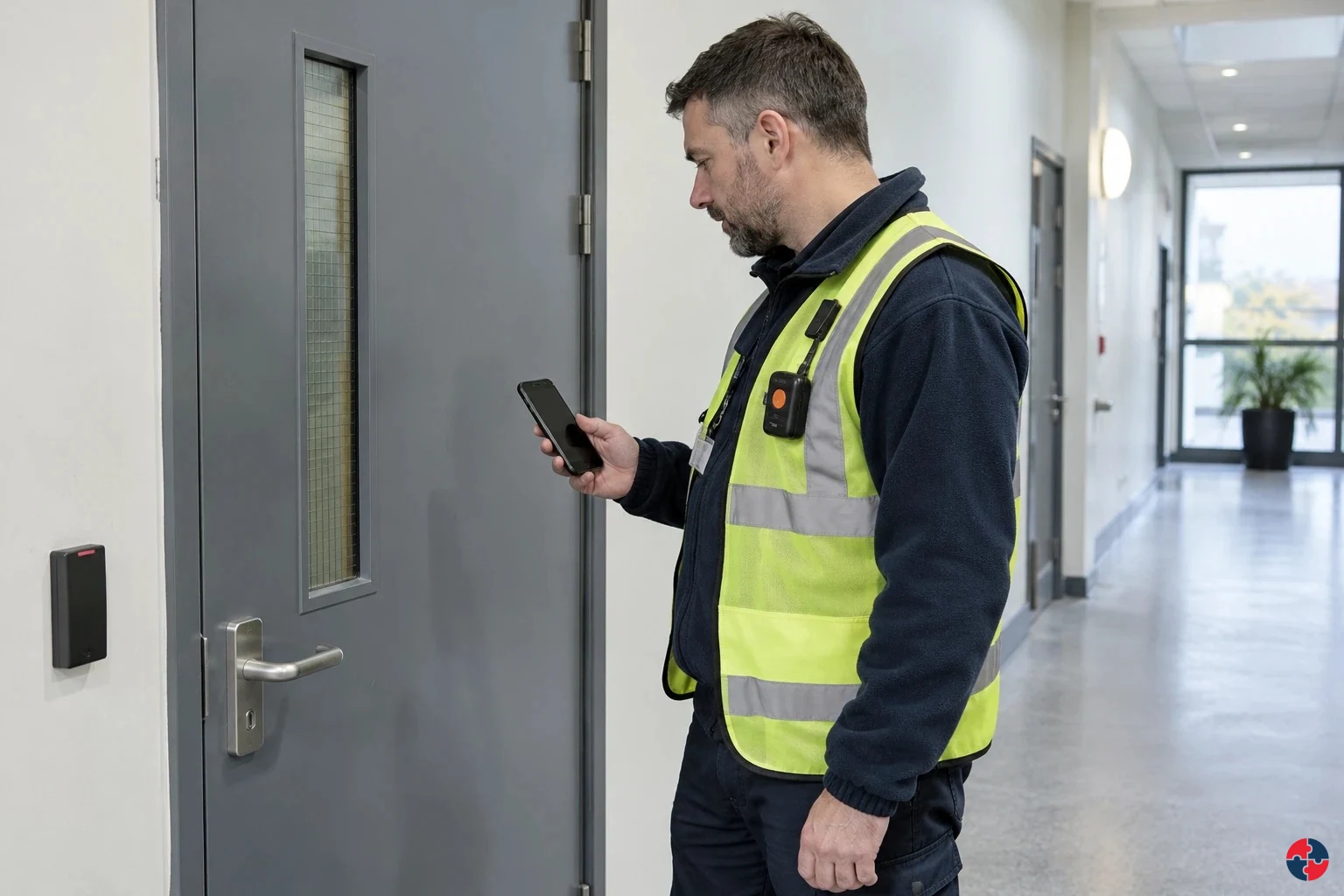
What does lone working mean?
A lone worker works without close or direct supervision and may be at greater risk because help is not immediately available. Lone work is work without close or direct supervision, where help may not be immediately available.
Turn lone working knowledge into a decision
Lone work is work without close or direct supervision, where help may not be immediately available. Decide if the task can be done alone at all, then assess its hazards, the worker’s competence and health needs, location, communication coverage and realistic rescue time. Lone worker register and task assessment.
Check the response before a lone visit
Lone working can increase the consequences of an incident because help is less immediate. The planner checks competence, work limits, supervision and response arrangements. A phone alone is insufficient if the site has no reliable signal or no one acts on a missed check.
Isolation can delay recognition and help
A fall, illness, violence or task failure can leave a person unable to call. A missed contact may pass unnoticed without a named responder. Help can arrive too late when location, access and escalation are unresolved. Use the full topic for the detailed mechanism, task limits and source scope.
Choose controls for lone working
Eliminate: Do the inspection remotely or during a paired visit when feasible. Reduce: Use a low-risk visual check instead of intrusive fault-finding. Isolate: Secure access, lighting and reliable communication/location technology. Control: Check-in clock, route, named responder, training and rescue drill. PPE: Task-suitable protection for residual site hazards. Read the full control table for qualifications, ownership and verification. Use the actual task and applicable jurisdiction; existing technical approval remains unchanged.
Use the full lone working lesson
Use the full topic for the decision points, practical examples, detailed control tables and source scope. HSE guidance applies to Great Britain; use HSENI for the Northern Ireland route and the source’s stated jurisdiction. A simplified guide does not change the page’s technical-review or approval status.

Read all six steps as text
1. What does lone working mean?
A lone worker works without close or direct supervision and may be at greater risk because help is not immediately available.
- Avoid / redesign: Do the inspection remotely or during a paired visit when feasible.
- Control the task: Secure access, lighting and reliable communication/location technology.
- Verify before release: Planner documents option; prohibited task cannot proceed alone.
A lone worker works without close or direct supervision and may be at greater risk because help is not immediately available. Lone work is work without close or direct supervision, where help may not be immediately available.
Apply it: Which part of this plan would you check at the workface before authorising the task?
2. Turn lone working knowledge into a decision
Use the evidence to improve the actual work arrangement.
- Change at source: Do the inspection remotely or during a paired visit when feasible.
- Make it observable: Planner documents option; prohibited task cannot proceed alone.
- Keep useful evidence: Lone worker register and task assessment.
Lone work is work without close or direct supervision, where help may not be immediately available. Decide if the task can be done alone at all, then assess its hazards, the worker’s competence and health needs, location, communication coverage and realistic rescue time. Lone worker register and task assessment.
Apply it: What evidence would show that the change improves this task, rather than only completing a record?
3. Check the response before a lone visit
Example: a worker plans a remote maintenance visit.
- Assess: Check the task, location, contact arrangements and foreseeable emergency.
- Decide: Do not allocate work alone when the assessment requires assistance.
- Verify: Test contact, missed-check response and the route for summoning help.
Lone working can increase the consequences of an incident because help is less immediate. The planner checks competence, work limits, supervision and response arrangements. A phone alone is insufficient if the site has no reliable signal or no one acts on a missed check.
Apply it: What happens if the worker misses the agreed contact, and who takes action?
4. Isolation can delay recognition and help
Connect the task, the route to the person and the control that can fail.
- Incident: A fall, illness, violence or task failure can leave a person unable to call.
- Delay: A missed contact may pass unnoticed without a named responder.
- Consequence: Help can arrive too late when location, access and escalation are unresolved.
A fall, illness, violence or task failure can leave a person unable to call. A missed contact may pass unnoticed without a named responder. Help can arrive too late when location, access and escalation are unresolved. Use the full topic for the detailed mechanism, task limits and source scope.
Apply it: Where is this harm route present in the actual work, and which control breaks it before anyone is exposed?
5. Choose controls for lone working
Start with the stronger practicable options and verify their effect.
- Eliminate: Do the inspection remotely or during a paired visit when feasible.
- Reduce: Use a low-risk visual check instead of intrusive fault-finding.
- Isolate: Secure access, lighting and reliable communication/location technology.
- Control: Check-in clock, route, named responder, training and rescue drill.
- PPE: Task-suitable protection for residual site hazards.
Eliminate: Do the inspection remotely or during a paired visit when feasible. Reduce: Use a low-risk visual check instead of intrusive fault-finding. Isolate: Secure access, lighting and reliable communication/location technology. Control: Check-in clock, route, named responder, training and rescue drill. PPE: Task-suitable protection for residual site hazards. Read the full control table for qualifications, ownership and verification. Use the actual task and applicable jurisdiction; existing technical approval remains unchanged.
Apply it: Which stronger option can be used here, and who will verify it before accepting the remaining risk?
6. Use the full lone working lesson
Follow the official sources below and retain the task-specific evidence.
- Official guidance: Protect those working alone
- Task decision: Lone worker register and task assessment.
Use the full topic for the decision points, practical examples, detailed control tables and source scope. HSE guidance applies to Great Britain; use HSENI for the Northern Ireland route and the source’s stated jurisdiction. A simplified guide does not change the page’s technical-review or approval status.
Apply it: Which official source and full-topic section will you use to resolve the next decision?
Lone working includes obvious examples such as delivery drivers, security staff, cleaners, community workers, engineers, maintenance workers, home workers and people opening or closing premises. It also includes short periods where a person becomes isolated: working in a plant room, checking a remote store, visiting a client, driving between sites, carrying out a late maintenance task or working in a building after others have left.
Lone working is not automatically banned. The question is whether the risk can be controlled without direct supervision or immediate help. Some activities may be acceptable with communication, competence and emergency arrangements. Others should not be done alone, especially where rescue would be time-critical, violence risk is high, the task is safety-critical, conditions are uncertain or the worker's individual health factors make the risk different.
For home working, assess display screen equipment (DSE) risks proportionately. Where a location device is needed, Global Positioning System (GPS) data should be limited to the safety purpose. The Health and Safety Executive (HSE) issues guidance for Great Britain; the Health and Safety Executive for Northern Ireland (HSENI) issues guidance for Northern Ireland.
| Type | Examples | Main risk question |
|---|---|---|
| Fixed-site lone work | Reception, petrol station, warehouse, plant room, depot, out-of-hours office. | Can the worker get help quickly if injured, threatened or unwell? |
| Mobile lone work | Drivers, engineers, inspectors, home visitors, grounds teams. | Is the journey, location, communication and emergency response controlled? |
| Remote or isolated work | Rural sites, utilities, farms, water assets, empty buildings. | Can conditions change without anyone knowing and can rescue reach the person? |
| Home working | Home-based office work or remote administrative roles. | Are DSE, stress, isolation, supervision and contact managed proportionately? |
| Short-duration isolation | Task that becomes lone work temporarily during breaks, handover or overtime. | Has the assessment considered real work patterns, not just planned staffing? |
How should lone working be risk assessed?
The go/no-go decision depends on task severity, ability to call for help and a rehearsed response, not on a generic “lone-worker” label.
Being alone can change the outcome
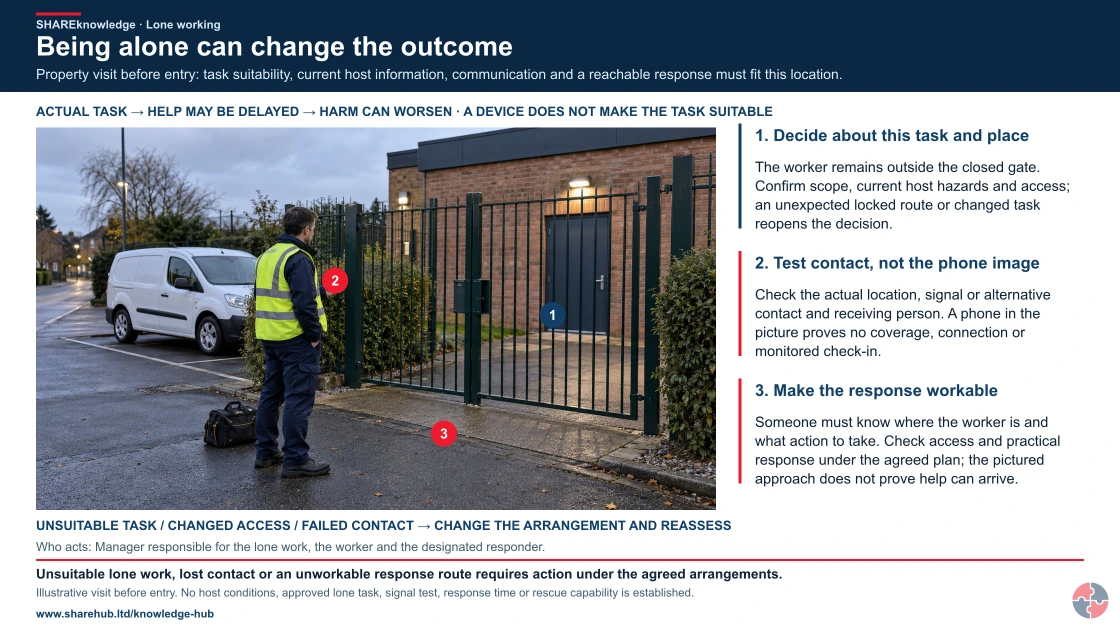
Full written explanation
A realistic UK property-visit scene shows the whole worker, closed gate and route to the service building, street approach, parked van and closed tool bag. The worker pauses outside before entry, holding a dark phone; no inspection, repair or high-risk intervention is underway. Three new native markers connect actual task/place and current host information, real communication/receiving arrangements, and the route by which practical help would reach the person. The full native harm relationship remains actual task, possible delay to help and worsening consequences, with a change/failure relationship returning to reassessment and a different arrangement. The locked gate is an illustrated changed-access question, not proof of the host conditions or a universal prohibition. Neither the phone nor clothing establishes a live connection, expected check-in, responder, signal test, suitable lone task or planned response time. No entry permission, safe assignment, automatic help or rescue outcome is inferred. The complete original task restrictions, high-risk work requiring other people, emergency/host coordination, hierarchy artwork, privacy and GB/NI source distinctions remain in the current source and written alternative. There is no clinical, electrical, confined-space or rescue procedure in this visual.
Property visit before entry: task suitability, current host information, communication and a reachable response must fit this location.
- The actual task. Remote travel, contact with people and the work itself create different hazards.
- Help may be delayed. Poor signal, incapacity, unclear escalation or no responder can break the chain.
- Harm can worsen. A communication device does not by itself make the task suitable for lone work.
Change the pathway
- Decide whether to work alone. Avoid unsuitable lone tasks and change the method or staffing.
- Prepare communication and support. Check competence, location, contact methods and the practical response.
- Act on missed contact. A named responder follows a workable escalation arrangement.
Evidence check: A phone, app or scheduled message is not a rescue capability.
Primary references: HSE: manage the risks of working alone (GB) · HSE: training, supervision and monitoring (GB) · HSENI: lone working (Northern Ireland)
Open the complete HD image (new tab)Download image

Primary references: HSE: manage the risks of working alone (GB) · HSE: training, supervision and monitoring (GB) · HSENI: lone working (Northern Ireland)
HSE lone-working guidance says employers must manage the risks before people work alone. HSENI lone-working guidance gives the separate NI context. A remote pump-site inspection may be acceptable alone only if access is safe, the task excludes high-risk intervention, communications work and a person can reach the worker within the planned time.
Check violence/abuse, driving, weather, confined space, electrical isolation and medical vulnerability as relevant. Record the worker’s expected location and return, emergency contact, escalation clock and who calls emergency services. A changed task or lost signal reopens the decision.
| Question | Acceptable evidence | No-go trigger | Direct source |
|---|---|---|---|
| Task and place | Known inspection scope, stable access and no prohibited intervention. | Unplanned repair or uncontrolled high-risk task. | HSE risk management |
| Contact | Tested communication and check-in at the actual location. | No signal or no receiving responder. | INDG73 |
| Rescue | Named responder can locate and reach the worker in time. | Rescue cannot be delivered as planned. | HSENI lone working |
Before an out-of-hours maintenance visit to a host employer, the sending employer obtains current hazard, access and emergency information, agrees who controls concurrent work and confirms a reachable host contact. A changed locked gate, isolated route or unavailable contact reopens the go/no-go decision; the visitor’s generic checklist cannot establish actual host conditions. Sources: HSE lone-work risk management.
How can the hierarchy of controls reduce lone-worker risks before relying on check-in arrangements?
Match the control to the actual lone task; a remote inspection and a high-risk intervention are different decisions.
A check-in only works if somebody responds
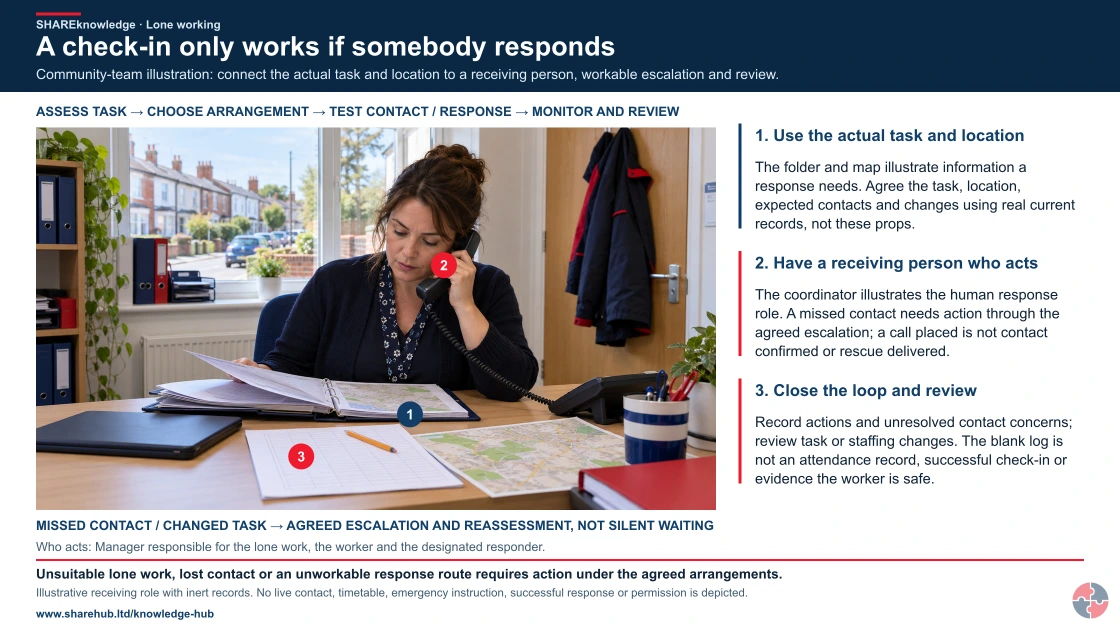
Full written explanation
A realistic UK community-team coordination office makes the receiving half of lone-working control visible: a coordinator with a handset, task folder, non-identifying map and blank check-in sheet beside a residential-street window. The scene is an illustration of the information and human role needed to act; it is not a live call, record of a missed check-in or successful response. Three native markers connect task/location information, a receiving person who follows the agreed escalation and an action/review record. A complete native sequence follows assessment, choice of arrangement, tested contact/response and ongoing review. Missed contact or changed work returns to agreed action and reassessment rather than an automatic rescue or silent wait. The scene supplies no telephone numbers, named workers, visit address, check-in time, prescribed escalation interval or emergency recipe. Paper/map details are inert synthetic planning props and do not verify anyone’s whereabouts or safety. All original written controls, named responsible roles, work restrictions, practice/testing, worker feedback, technology/privacy limits and separate jurisdictions are retained. No individual suitability assessment, clinical instruction, safe assignment or permission is added.
Community-team illustration: connect the actual task and location to a receiving person, workable escalation and review.
- Assess the actual lone task. Consider foreseeable harm, location, people, capability and ability to obtain help.
- Choose a suitable arrangement. Change the work or staffing if lone work is unsuitable; do not start with the phone.
- Test contact and response. Check signal/alternative contact, expected check-ins, named responders and escalation.
- Monitor and review. Act on missed contact and task changes; review whether the arrangement works in practice.
When the evidence does not fit: Unsuitable lone work, lost contact or an unworkable response route requires action under the agreed arrangements.
Who acts: Manager responsible for the lone work, the worker and the designated responder.
Changed workplace
Property inspection: Consider the building, contacts, travel and how help reaches the worker.
Community-based work: Review changing visits and personal-safety needs; use the actual support and escalation route.
Evidence check: A phone, app or scheduled message is not a rescue capability.
Primary references: HSE: manage the risks of working alone (GB) · HSE: training, supervision and monitoring (GB) · HSENI: lone working (Northern Ireland)
Open the complete HD image (new tab)Download image

Primary references: HSE: manage the risks of working alone (GB) · HSE: training, supervision and monitoring (GB) · HSENI: lone working (Northern Ireland)
For a remote pump-site inspection, Eliminate, Reduce, Isolate, Control, Personal protective equipment (PPE) and Discipline (ERICPD) below maps to the five-level hierarchy. HSE guidance requires risk-based supervision and contact. The safest choice may be to remove the lone arrangement entirely for electrical, confined-space or other high-consequence interventions.
The hierarchy has elimination, substitution, engineering, administrative controls and PPE. “Discipline” maintains the plan: test coverage, rehearse rescue and learn from missed check-ins.
How can the ERICPD hierarchy of controls reduce lone-worker risks before relying on check-in arrangements?

| ERICPD | Five-level hierarchy | Remote-site choice | Owner, proof and stop |
|---|---|---|---|
| Eliminate | Elimination | Do the inspection remotely or during a paired visit when feasible. | Planner documents option; prohibited task cannot proceed alone. |
| Reduce | Substitution | Use a low-risk visual check instead of intrusive fault-finding. | Supervisor sets scope; change to intervention stops lone work. |
| Isolate / Control | Engineering controls | Secure access, lighting and reliable communication/location technology. | Site owner tests at location; signal failure triggers withdrawal. |
| Control | Administrative controls | Check-in clock, route, named responder, training and rescue drill. | Controller tests response; missed check triggers escalation. |
| PPE | PPE | Task-suitable protection for residual site hazards. | Worker checks condition; PPE does not replace rescue. |
| Discipline | Sustaining all levels | Review missed contacts, incidents and worker feedback; update plan. | Manager verifies corrective action and re-drills. |
How can the ISO 45001 hierarchy of controls reduce lone-worker risks before relying on check-in arrangements?

| ERICPD | Five-level hierarchy | Remote-site choice | Owner, proof and stop |
|---|---|---|---|
| Eliminate | Elimination | Do the inspection remotely or during a paired visit when feasible. | Planner documents option; prohibited task cannot proceed alone. |
| Reduce | Substitution | Use a low-risk visual check instead of intrusive fault-finding. | Supervisor sets scope; change to intervention stops lone work. |
| Isolate / Control | Engineering controls | Secure access, lighting and reliable communication/location technology. | Site owner tests at location; signal failure triggers withdrawal. |
| Control | Administrative controls | Check-in clock, route, named responder, training and rescue drill. | Controller tests response; missed check triggers escalation. |
| PPE | PPE | Task-suitable protection for residual site hazards. | Worker checks condition; PPE does not replace rescue. |
| Discipline | Sustaining all levels | Review missed contacts, incidents and worker feedback; update plan. | Manager verifies corrective action and re-drills. |
When should lone work be stopped or restricted?
Stop lone work when the task, contact or rescue assumption breaks.
HSE INDG73 stresses monitoring, keeping in touch, training and supervision. A worker at a remote pumping station should withdraw to a safe location if the task becomes electrical fault-finding, if the phone/radio loses coverage, if access floods or if an aggressor appears. A missed check-in triggers a pre-agreed escalation clock rather than an indefinite wait.
The supervisor should know the last confirmed location, attempt contact, dispatch a safe responder and call emergency services when the trigger is met. Test the arrangement in drills; an alarm without response capacity is not a control.
| Trigger | Immediate action | Owner and proof | Source |
|---|---|---|---|
| Missed call | Try agreed channels, check travel/location information. | Controller records time and attempts. | HSE keeping in touch |
| No contact by escalation point | Send a safe responder and use emergency services according to plan. | Supervisor records dispatch and handover. | HSE supervision |
| Worker found/returns | Provide help, record event and review task/contact system. | Manager closes corrective action. | HSENI lone working |
Illustrative tabletop sequence, with timings set by the assessed emergency and achievable response: at start, the controller confirms the worker’s location, access and cover; at a missed scheduled contact, the named cover follows the agreed immediate contact/escalation steps within the documented deadline. A distress alarm or known incident triggers immediate emergency action and does not wait for the routine missed-call deadline. Record last known location, access details, who calls emergency services and out-of-hours controller cover. If a safe response cannot arrive in time, redesign or remove the lone arrangement. Responders must not enter danger for an unplanned rescue; rehearse the clock and change it if the test fails. Sources: HSE lone-work monitoring.
How should lone-worker technology be used?
Technology supports lone working but does not replace risk assessment, supervision or emergency planning.
Lone-worker apps, alarms, GPS tracking, timed check-ins, fall detection and panic buttons can be useful, but only if they are selected for the actual risk, tested in the real location and linked to a response that works. A device that has no signal in a basement, no monitored escalation out of hours or no agreed responder is a false reassurance.
ICO guidance on monitoring workers requires monitoring to be transparent and proportionate. Tell workers what location or alarm data is collected, why it is needed, who sees it, how long it is retained and whether it serves any other purpose. Review the lawful basis and privacy impact before deploying continuous tracking; do not silently reuse safety data for performance monitoring.
| Technology | Useful when | Assurance question |
|---|---|---|
| Timed check-in | Routine low-to-medium risk lone work where missed contact matters. | Who acts when the check-in is missed and how fast? |
| Panic alarm | Public-facing, violence, remote or emergency risk. | Is it reachable during the task and is response monitored? |
| GPS/location | Mobile or remote work where exact location may be needed. | Is tracking proportionate, explained and protected? |
| Fall/no-motion alert | Falls, remote work or health-event risk. | Does it work in the real environment and avoid nuisance alarm fatigue? |
| Two-way communication | Dynamic risk, remote advice or emergency escalation. | Is signal coverage tested and backup available? |
Why is technology not the control by itself?
A lone-worker device is only useful when the whole response system has been designed, tested and owned.
The phrase 'we have an app' is not a lone-working control on its own. The control is the complete arrangement: risk assessment, worker training, signal coverage, device suitability, realistic check-in frequency, monitored escalation, responder competence, privacy rules and learning from alarms. If the worker is injured in a basement with no signal, if nobody monitors alerts at night or if responders do not know where the worker is, the technology has not controlled the risk.
Managers should test the system in the actual conditions of use. That means testing signal in plant rooms, remote sites and car parks; checking that workers can activate the alarm while wearing gloves or PPE; confirming that missed check-ins generate action; and making sure responders know when to call, attend, contact emergency services or escalate to senior management.
| Failure mode | What it looks like | Better assurance |
|---|---|---|
| No signal in the real location | The device works in the office but not in basement, rural, plant-room or mobile locations. | Signal testing, backup method and location-specific controls. |
| Alert is not monitored | The worker presses alarm but nobody is actively responsible for response. | Named responder, monitoring hours, escalation clock and drill evidence. |
| Panic alarm is unreachable | Device is in a bag, vehicle or under clothing during the high-risk task. | Wearable placement, worker practice and task-specific instruction. |
| GPS used as productivity monitoring | Trust falls because safety tracking is used for discipline or output control. | Clear privacy wording, limited access and safety-only purpose. |
| Responder cannot act | Responder has no key, vehicle, site knowledge, emergency contact or authority. | Response plan, site information, access arrangements and competence. |
| Alarm fatigue | False alarms become normal and response quality drops. | Review nuisance alarms, maintain devices and improve trigger settings or training. |
| No test records | The system is assumed to work because it was bought. | Scheduled test, failed-test action, worker feedback and management review. |
What evidence shows lone working is controlled?
Evidence should show the assessment matches real lone work and that escalation works when tested.
Test the live chain: a worker can explain the task limit, the device works on site, the controller knows the check-in clock and a responder can reach the location. Sample a missed-check drill and its corrective actions.
| Evidence | What it should show | Weakness to challenge |
|---|---|---|
| Lone-working risk assessment | Task, person, location, communication, emergency response and stop triggers. | One generic assessment for all lone workers. |
| Worker list or register | Who works alone, where, when and under what controls. | Home workers or occasional out-of-hours work not included. |
| Check-in records | Contact is made as planned and missed checks are escalated. | Missed check-ins closed with no explanation. |
| Emergency response test | The escalation route works out of hours and in remote areas. | Device works but response process is unclear. |
| Violence risk review | Public-facing and conflict risks are assessed. | Incident reports do not change staffing or controls. |
| Training and supervision | Workers know limits, emergency actions and dynamic stop decisions. | Online training only, no practical scenario test. |
Which legal duties apply to lone working?
Use the instrument for the work location and verify the actual task, people and equipment.
Great Britain and Northern Ireland have distinct primary and management law. Equipment-specific rules apply only when the equipment and activity fall within their scope; guidance helps make the practical decision.
| Jurisdiction | Direct instrument or guidance | Operational decision supported |
|---|---|---|
| Great Britain | Health and Safety at Work etc. Act 1974 | General duties. |
| Northern Ireland | Health and Safety at Work (NI) Order 1978 | Separate NI general duties. |
| Great Britain | Management Regulations 1999 | Risk assessment and arrangements. |
| Northern Ireland | Management Regulations (NI) 2000 | Separate NI risk and management route. |
How should controls be owned and reviewed?
Assign a competent owner, check that task controls work, involve workers and act when evidence changes.
For Lone working, record the actual hazard and task, the chosen control, the person responsible, the evidence that it works and the point at which work must stop or be reassessed. HSE management guidance for Great Britain describes planning, worker consultation, checking and action. HSENI guidance for Northern Ireland describes competent help, risk control and review. These management steps do not prove that a particular task control is suitable; use the topic-specific evidence and the applicable GB or NI law elsewhere on this page.
What training is needed for lone working?
Training should use real scenarios because lone workers may need to make decisions without a supervisor beside them.
Competence is checked against the actual task, equipment, abnormal event and role. Briefing alone is insufficient when a person must make a stop or rescue decision.
| Level | Who it is for | What it should cover |
|---|---|---|
| General awareness | Anyone assigned a lone task | Know permitted tasks, contact route, no-go triggers and how to summon help. |
| Task-specific practical training | Lone workers | Practise site communication checks, dynamic withdrawal, alarm use, missed-contact response and safe return. |
| Supervisor and line manager training | Supervisors and check-in controllers | Set the escalation clock, confirm location and responder availability, run drills and stop work when contact fails. |
| HSE, HR, OH or technical adviser coordination | Safety, security and privacy advisers | Review task risk, violence and rescue plans, alarm performance, data minimisation and corrective action. |
| Specialist competence | Emergency, security and technical specialists | Design and test response for remote, violent or high-consequence settings; define tasks that require a second person. |
How could BuildOut Ltd manage this in practice?

BuildOut Ltd would decide which tasks can be done alone, provide proportionate support and make sure monitoring leads to an effective response when contact is lost.
BuildOut Ltd · practical example
Make a missed check-in lead to a real response
The key lesson Lone-worker monitoring is useful only when someone can recognise a problem and respond effectively.
The situation: A maintenance operative is proposed for an early visit to a closed project. Mobile coverage is unreliable in part of the building. Sending the person with a phone would not resolve the task or emergency arrangements.
Why this matters: An injury, illness or access problem may prevent a lone worker from calling, especially where the location or signal is uncertain.
How BuildOut Ltd would manage it
- Check the task's suitability — Site Manager. Review the location, work, competence and foreseeable emergencies with the operative. Identify activities that cannot proceed alone under the assessed arrangements and arrange appropriate support.
- Agree the visit information — Trade Supervisor. Record the planned location, access, task limits and expected contact. Explain changes that require permission and how the worker can stop or leave an unsuitable situation.
- Test communications and response — Site Manager. Confirm a workable communication method and name the person receiving check-ins. Agree the missed-contact escalation and available response resources, including out-of-hours cover.
- Monitor without assuming — Named check-in contact. Record the agreed contacts and act when one is missed. Follow the escalation rather than assuming the worker is busy; responders must not enter an unsafe situation without appropriate arrangements.
- Review actual visits — Health and Safety Manager. Discuss poor signal, delayed response and near misses with workers. Improve task allocation, communications or staffing and check that monitoring remains proportionate and respectful of personal information.
When the conditions change
- Recognise the trigger
- The task, location, communication or response capability differs from the plan.
- Make the immediate decision
- Do not begin the visit if the permitted task, reliable contact or missed-contact response is unavailable.
- Verify the next step
- The Site Manager confirms the authorised task and location, demonstrated communication method, named monitoring contact and effective escalation cover before releasing the lone visit.
What good looks like
The worker and contact know the same plan, a missed message triggers action and help can reach the actual location. Prohibited lone tasks are not relabelled to meet the programme.
Evidence to look for: Task assessment, authorised limits, visit details, communication test, check-in log and escalation review.
Common mistake to avoid: Equating possession of a mobile phone with an effective lone-working system.
Apply this to your work: Who would act if your worker could not make the next check-in?
Guidance behind the management approach: HSE: protecting those working alone. Use the topic's legal and technical guidance for the applicable work and location.
In construction and maintenance, lone working may appear during early opening, late locking-up, plant-room checks, snagging, remote stores, driving between sites and out-of-hours callouts. BuildOut would not allow lone work by default; it would define which tasks are permitted, which are prohibited, who approves exceptions and how missed contact is escalated.
| Management element | How the business would manage it | Evidence to review |
|---|---|---|
| Assess | Identify lone tasks by location, time, activity and person, including temporary and out-of-hours work. | Lone worker register and task assessment. |
| Restrict | Apply task-specific supervision and rescue rules before allocating lone work. Confined-space work and work near exposed live conductors can require at least one other person; a permit, alarm or unspecified specialist control cannot waive that requirement. Assess roof work against its actual height, access and rescue arrangements rather than inventing a universal two-person rule. | Procedure and supervisor briefing. |
| Communicate | Use check-ins, emergency contacts, site information and tested signal coverage. | Check-in log and test record. |
| Respond | Define escalation if contact is missed, including who attends, when and with what information. | Escalation protocol and drill record. |
| Improve | Review near misses, missed check-ins, violence, fatigue and worker feedback. | Trend review and action tracker. |
Which acronyms and terms are useful for lone working?
These terms identify the lone-task decision and response.
| Term | Meaning | Use here |
|---|---|---|
| GB | Great Britain | England, Scotland and Wales legal route. |
| NI | Northern Ireland | Separate management law and HSENI guidance. |
| INDG73 | HSE lone-working guidance leaflet | Risk, supervision and contact advice. |
| Check-in | Planned contact at a set time | Must trigger a response when missed. |
| No-go | Decision not to perform the task alone | Applies when task, communication or rescue condition fails. |
| ERICPD | Eliminate, Reduce, Isolate, Control, PPE, Discipline | Task hazard planning and sustained checks. |
| DSE | Display screen equipment | Home-working screen and workstation risks. |
| GPS | Global Positioning System | Location feature requiring proportionate monitoring. |
| HSE | Health and Safety Executive | GB regulator and guidance source. |
| HSENI | Health and Safety Executive for Northern Ireland | NI regulator and guidance source. |
| PPE | Personal protective equipment | Residual task protection, not a substitute for rescue. |
Which BuildOut documents support this topic?
Download individual editable BuildOut documents for this topic. Procedures and plans contain completed arrangements; forms, checklists, assessments, RAMS and permits are blank masters. Registers include separate worked examples.
| Document | Purpose and content | Editable download |
|---|---|---|
| Office/DSE assessment and lone-worker contact procedure BOUK-PRO-OFF · Completed worked example · v1.0 | Assess workstations and isolated work, provide adjustments and test escalation arrangements. | Download DOCX Read preview |
| DSE workstation assessment BOUK-RA-OFF-01 · Blank editable master · v1.0 | Assess qualifying workstation use and identify appropriate changes. | Download DOCX Read preview |
| Lone-working and violence-risk assessment BOUK-RA-OFF-02 · Blank editable master · v1.0 | Assess isolation, communication, vulnerable locations and foreseeable aggression. | Download DOCX Read preview |
| Office and home-work environment check BOUK-CHK-OFF-01 · Blank editable master · v1.0 | Review access, fire, electrical, storage and general welfare risks. | Download DOCX Read preview |
| Lone-worker check-in and missed-contact escalation BOUK-FRM-OFF-01 · Blank editable master · v1.0 | Record contacts and proportionate escalation without unnecessary surveillance. | Download DOCX Read preview |
| DSE adjustment and eye-test request record BOUK-FRM-OFF-02 · Blank editable master · v1.0 | Track agreed equipment/work changes and applicable eye-test provision. | Download DOCX Read preview |
Review and adapt the documents for your organisation, activities and jurisdiction before approval and issue. Open the SHAREms management-system hierarchy to find each document under its parent policy.
Which Crownway Fuels documents support this topic?
Open an editable document, read the preview, or find its place in the Crownway hierarchy. 6 resources relate to this page.
Fictional Crownway Fuels examples for English forecourts, with a separate illustrative bulk terminal. Check site applicability, permissions and actual controls before adapting any document for use.
Lone working violence and security policy (6)
- Lone working violence and security policy (CWF-POL-LONE · Completed fictional example)
Set company expectations, responsibilities and resources for lone working violence and security.
Read preview · Download DOCX · Show in hierarchy - Lone working violence and security procedure (CWF-PRO-LONE · Completed fictional example)
Explain who does what, in what sequence, the control rationale, evidence, escalation and safe restart conditions.
Read preview · Download DOCX · Show in hierarchy - Site and shift lone working and violence assessment (CWF-RA-LONE-01 · Blank editable master)
Provide the site/task-specific site and shift lone working and violence assessment and retain its controlled output.
Read preview · Download DOCX · Show in hierarchy - Lone worker check in and emergency escalation plan (CWF-PLN-LONE-01 · Completed fictional example)
Provide the site/task-specific lone worker check in and emergency escalation plan and retain its controlled output.
Read preview · Download DOCX · Show in hierarchy - Security alarm communication and safe area check (CWF-CHK-LONE-01 · Blank editable master)
Provide the site/task-specific security alarm communication and safe area check and retain its controlled output.
Read preview · Download DOCX · Download PDF · Show in hierarchy - Violence threat and wellbeing support record (CWF-FRM-LONE-01 · Blank editable master)
Provide the site/task-specific violence threat and wellbeing support record and retain its controlled output.
Read preview · Download DOCX · Show in hierarchy
Unlock another resource
You have used this month’s two free downloads. Publish a post in your own words to unlock one more resource, or choose SHARE Individual for 10 downloads per month.
You decide whether to share. If you do, use the relevant platform disclosure tools and do not make claims you do not genuinely hold.