
SHARE Knowledge Hub
How should confined spaces be controlled?
Avoid entry when the work can be done safely from outside. If entry is unavoidable, a competent assessment must define the exact space, isolation, atmosphere, safe system, supervision and rescue before anyone enters. A permit or gas reading alone cannot make an unsafe space safe.
Understanding How should confined spaces be controlled?
Avoid entry when the work can be done safely from outside. If entry is unavoidable, a competent assessment must define the exact space, isolation, atmosphere, safe system, supervision and rescue before anyone enters. A permit or gas reading alone cannot make an unsafe space safe.
Why this matters at work
Compare the handback with the original scope, changes and permit or isolation records. Close or transfer outstanding items explicitly and communicate the resulting plant state to operations and the next shift. Record inspection or test evidence required by the task, who verified it and the separate restart decision. Review avoidance opportunities and lessons from the work so that future entry can be reduced. Preserve relevant exposure and incident information in the appropriate records without treating a completed form as operational authority.
Suspend the entry authority and secure access. Competent people should investigate the failure and reassess atmosphere, work-generated hazards and all affected controls before any proposed re-entry. Verify repair and readiness, rebrief the team and apply the actual authorisation process. Record the event, readings where available, affected people, response and corrective actions. This scenario does not specify a safe waiting period or detector threshold; those depend on the assessed substance, space, equipment and conditions.
How organisations manage this in practice
No single reading demonstrates control of every confined-space hazard. Testing must use suitable detection technology for the expected substances and oxygen conditions, competent operators and representative sampling. Consider stratification, remote pockets, sampling delay, changing work and the limitations of the instrument. The assessment determines where and when to test and whether continuous monitoring is needed. Never infer oxygen safety from a flammable-gas result or assume that absence of odour means a safe atmosphere. Atmosphere control also depends on preventing ingress, suitable ventilation and managing materials or processes introduced by the work. Mechanical, electrical, thermal, engulfment and access hazards remain even with acceptable atmospheric evidence. Define alarm and loss-of-control responses before entry and stop work if conditions change or monitoring fails. Maintain instrument checks, calibration and task records through the actual competent system. This guidance deliberately does not prescribe a universal concentration, ventilation duration or entry release criterion.
If entry is genuinely necessary, competent assessment must establish the safe system, people, equipment, supervision, communication and protected rescue capability before anyone enters. A permit or gas reading alone is insufficient. Verify the real isolation and atmosphere arrangements for the specific task; this answer supplies no acceptable detector reading or purge time. Keep entry on hold if any essential control or rescue condition is unproven. Record the avoidance options, assessment, authorisation boundaries and handback requirements.
Account for all people, tools and temporary equipment, and confirm that the space and connected plant are in the defined condition for handback. Identify remaining defects, contamination, temporary blanks or isolations and any restrictions. Reinstatement must be controlled through competent authorised roles, considering connected users and the potential reintroduction of energy or material. A contractor’s statement that the task is complete does not establish that the plant is ready for service.
Ask whether entry can be avoided before preparing an entry
For a drainage chamber, first define the required outcome and test remote inspection or a method that avoids entry. Do not start by choosing a permit or assigning an entrant. If entry remains necessary, the exact space, connected systems, specified risks and planned work determine the safe system and rescue capability.
Inspect the chamber without putting a person inside
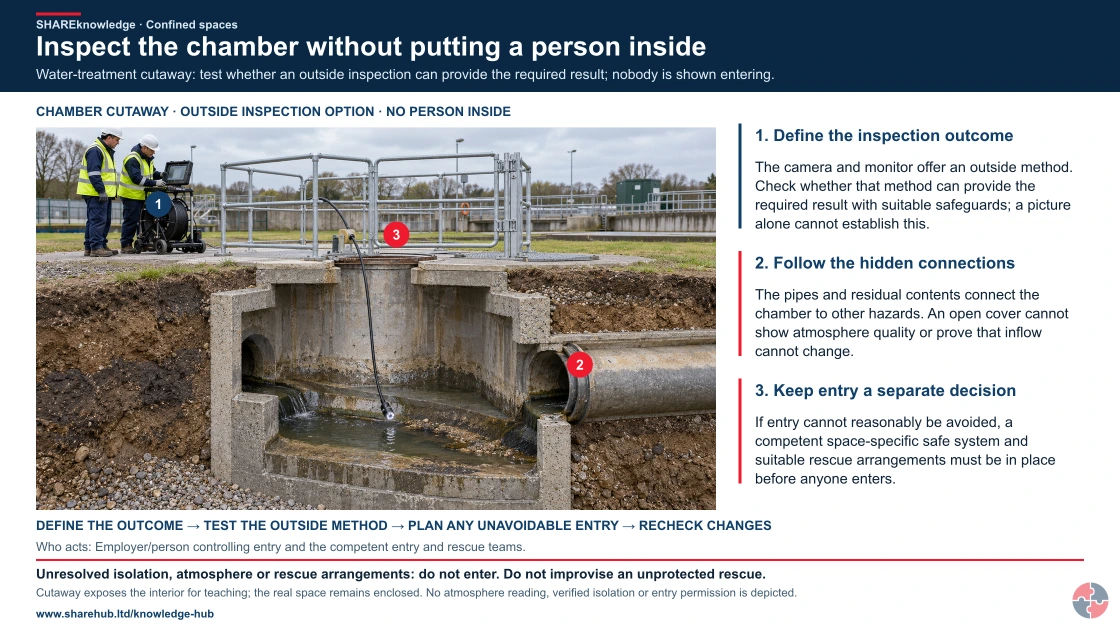
Full written explanation
A realistic water-treatment cutaway shows the enclosed concrete chamber, residual contents and connected drainage pipes in the same landscape scene as a guarded surface opening. Two workers remain fully outside the guarded perimeter and review an external monitor. A continuous camera cable passes from the reel through the opening to a small inspection head inside. Three native numbered explanations connect the required inspection outcome, hidden connected hazards and the separate decision about any unavoidable entry. The near wall and soil are removed only for the teaching view; this is not a survey or an actual open-sided space. No visible atmosphere cloud, gas result, verified isolation, permit or rescue demonstration is shown. The outside method needs its own suitability and safeguards check. If entry is unavoidable the complete current safe-system, isolation, atmospheric, permit, competent-role and rescue requirements remain authoritative.
Water-treatment cutaway: test whether an outside inspection can provide the required result; nobody is shown entering.
- Define the inspection outcome. The camera and monitor offer an outside method. Check whether that method can provide the required result with suitable safeguards; a picture alone cannot establish this.
- Follow the hidden connections. The pipes and residual contents connect the chamber to other hazards. An open cover cannot show atmosphere quality or prove that inflow cannot change.
- Keep entry a separate decision. If entry cannot reasonably be avoided, a competent space-specific safe system and suitable rescue arrangements must be in place before anyone enters.
Change the pathway
- Avoid entry. Consider feasible inspection, cleaning or other work from outside.
- Control the actual risks. Competently plan isolation, atmosphere and the full safe system for the task.
- Prepare suitable rescue. Verify trained people, equipment, communication and a workable response before entry.
Evidence check: A signed permit or one gas reading does not prove that conditions will remain safe.
Read the complete task-specific safe-system, isolation, atmosphere, permit and rescue requirements
Primary references: HSE confined-spaces introduction (Great Britain) · HSE L101: avoidance, safe systems and rescue (Great Britain) · HSENI approval of L101 for Northern Ireland
Open the complete HD image (new tab)Download image

Read the complete task-specific safe-system, isolation, atmosphere, permit and rescue requirements
Primary references: HSE confined-spaces introduction (Great Britain) · HSE L101: avoidance, safe systems and rescue (Great Britain) · HSENI approval of L101 for Northern Ireland
Best-practice guide: Confined Spaces
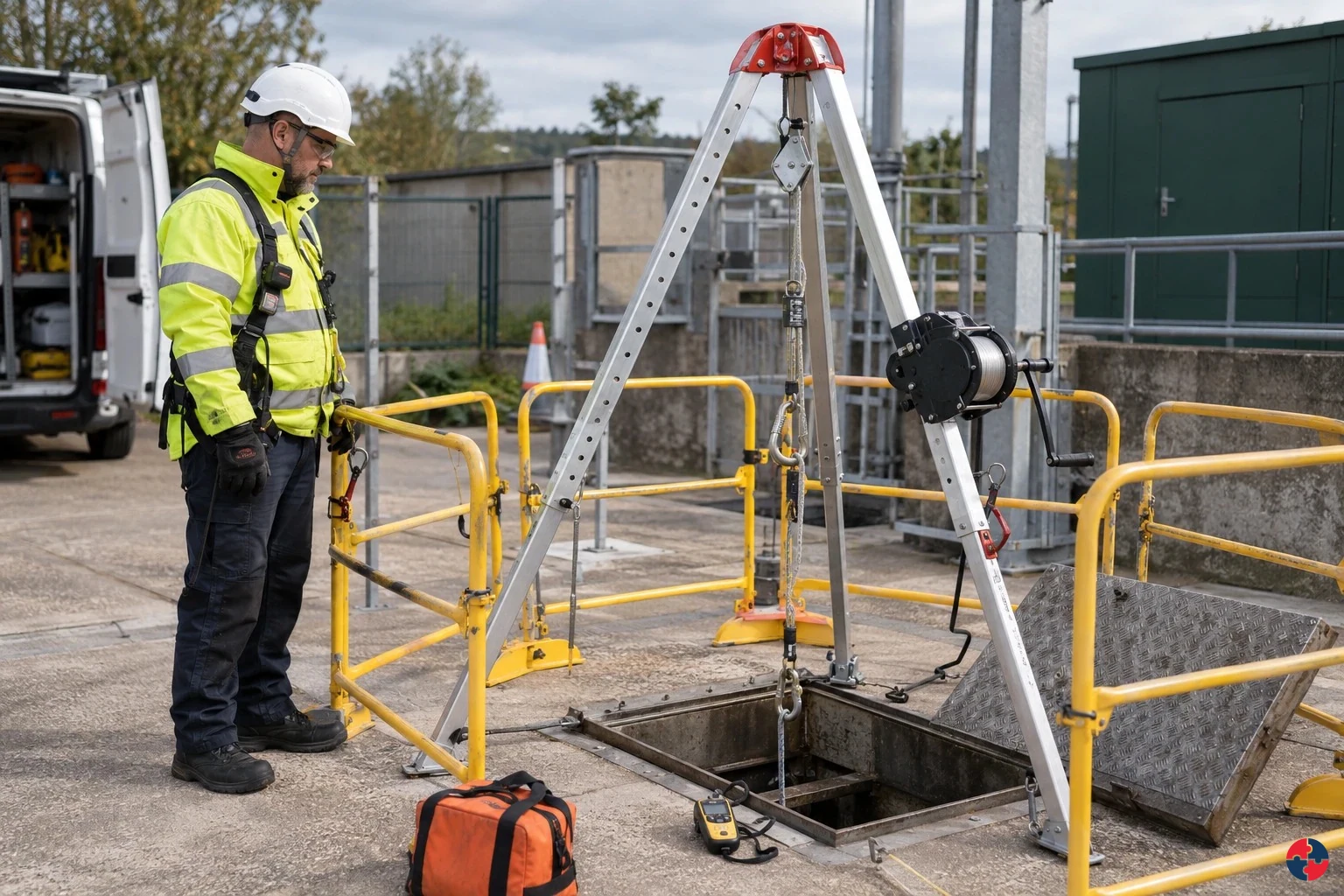
Ask whether entry can be avoided before preparing an entry
For a drainage chamber, first define the required outcome and test remote inspection or a method that avoids entry. Do not start by choosing a permit or assigning an entrant. Avoid entry when the work can be done safely from outside.
Turn confined spaces knowledge into a decision
Avoid entry when the work can be done safely from outside. If entry is unavoidable, a competent assessment must define the exact space, isolation, atmosphere, safe system, supervision and rescue before anyone enters. Confined-space register, project risk register and no-entry review.
Inspect a drainage chamber without entering it
The planner tests whether the inspection can be completed safely without entry. If it cannot, the team assesses the exact chamber, connected systems, atmosphere, contents and work. Rescue capability must be in place before any planned entry; a spontaneous rescue can expose another person.
An atmosphere or inflow can defeat a routine job
A confined space is substantially enclosed and has a possible specified serious risk. Size alone is not the test. Isolation, relevant atmospheric assessment and testing, supervision and a prepared rescue arrangement belong to the complete safe system.
Choose controls for confined spaces
Eliminate: Remote camera and jetting from outside where safely feasible. Substitute: Change cleaning method or use external access, checking pressure and chemical hazards. Engineering: Lock/isolate inlets and energy; verify zero flow, ventilate and test relevant atmosphere. Administrative: Permit, standby, entry count, communications, repeat testing and drilled rescue. PPE: Task-specific protection or breathing apparatus only with trained team and rescue. Read the full control table for qualifications, ownership and verification. Use the actual task and applicable jurisdiction; existing technical approval remains unchanged.
Use the full confined spaces lesson
Use the full topic for the decision points, practical examples, detailed control tables and source scope. HSE guidance applies to Great Britain; use HSENI for the Northern Ireland route and the source’s stated jurisdiction. A simplified guide does not change the page’s technical-review or approval status.

Read all six steps as text
1. Ask whether entry can be avoided before preparing an entry
For a drainage chamber, first define the required outcome and test remote inspection or a method that avoids entry.
- Avoid / redesign: Remote camera and jetting from outside where safely feasible.
- Control the task: Lock/isolate inlets and energy; verify zero flow, ventilate and test relevant atmosphere.
- Verify before release: Planner records no-entry decision; no entry merely for convenience.
For a drainage chamber, first define the required outcome and test remote inspection or a method that avoids entry. Do not start by choosing a permit or assigning an entrant. Avoid entry when the work can be done safely from outside.
Apply it: Which part of this plan would you check at the workface before authorising the task?
2. Turn confined spaces knowledge into a decision
Use the evidence to improve the actual work arrangement.
- Change at source: Remote camera and jetting from outside where safely feasible.
- Make it observable: Planner records no-entry decision; no entry merely for convenience.
- Keep useful evidence: Confined-space register, project risk register and no-entry review.
Avoid entry when the work can be done safely from outside. If entry is unavoidable, a competent assessment must define the exact space, isolation, atmosphere, safe system, supervision and rescue before anyone enters. Confined-space register, project risk register and no-entry review.
Apply it: What evidence would show that the change improves this task, rather than only completing a record?
3. Inspect a drainage chamber without entering it
Example: a maintenance team needs a condition inspection.
- Define: Agree the inspection outcome and consider a remote camera from outside.
- Decide: Do not enter merely because a permit form is available.
- If entry remains: Use a competent space-specific assessment, safe system and rescue plan.
The planner tests whether the inspection can be completed safely without entry. If it cannot, the team assesses the exact chamber, connected systems, atmosphere, contents and work. Rescue capability must be in place before any planned entry; a spontaneous rescue can expose another person.
Apply it: Can the required information be obtained safely from outside, and who decides whether entry is truly necessary?
4. An atmosphere or inflow can defeat a routine job
Connect the task, the route to the person and the control that can fail.
- Atmosphere: Low oxygen or toxic gas can cause collapse or asphyxiation.
- Contents: Incoming liquid or free-flowing solids can drown or engulf a person.
- Work changes: Cleaning, hot work or chemicals can create a new serious risk.
A confined space is substantially enclosed and has a possible specified serious risk. Size alone is not the test. Isolation, relevant atmospheric assessment and testing, supervision and a prepared rescue arrangement belong to the complete safe system.
Apply it: Which connected process, inlet or task could change the space after the initial checks?
5. Choose controls for confined spaces
Start with the stronger practicable options and verify their effect.
- Eliminate: Remote camera and jetting from outside where safely feasible.
- Substitute: Change cleaning method or use external access, checking pressure and chemical hazards.
- Engineering: Lock/isolate inlets and energy; verify zero flow, ventilate and test relevant atmosphere.
- Administrative: Permit, standby, entry count, communications, repeat testing and drilled rescue.
- PPE: Task-specific protection or breathing apparatus only with trained team and rescue.
Eliminate: Remote camera and jetting from outside where safely feasible. Substitute: Change cleaning method or use external access, checking pressure and chemical hazards. Engineering: Lock/isolate inlets and energy; verify zero flow, ventilate and test relevant atmosphere. Administrative: Permit, standby, entry count, communications, repeat testing and drilled rescue. PPE: Task-specific protection or breathing apparatus only with trained team and rescue. Read the full control table for qualifications, ownership and verification. Use the actual task and applicable jurisdiction; existing technical approval remains unchanged.
Apply it: Which stronger option can be used here, and who will verify it before accepting the remaining risk?
6. Use the full confined spaces lesson
Follow the official sources below and retain the task-specific evidence.
- Official guidance: HSE confined-spaces introduction
- Official guidance: HSENI Safe work in confined spaces ACOP
- Task decision: Confined-space register, project risk register and no-entry review.
Use the full topic for the decision points, practical examples, detailed control tables and source scope. HSE guidance applies to Great Britain; use HSENI for the Northern Ireland route and the source’s stated jurisdiction. A simplified guide does not change the page’s technical-review or approval status.
Apply it: Which official source and full-topic section will you use to resolve the next decision?
A rescue plan must work for a foreseeable unconscious casualty in the actual geometry, not only for an alert person climbing out. Verify suitable equipment, trained people, access and the planned response before entry. Keep the space held if that capability is absent. Use Confined Spaces Risk Management for programme ownership and change control; this page supplies the immediate task decision.
BuildOut: the chamber rescue route does not fit
Illustrative example. A drainage inspection cannot be completed remotely, but the proposed rescue method cannot recover an unconscious casualty through the access.
Decision. The supervisor keeps entry held while competent specialists revise the method and demonstrate suitable emergency capability.
Evidence to check. Avoid-entry review, actual dimensions, isolation and atmosphere plan, competent roles and a suitable rehearsed rescue arrangement.
Hold or escalation point. No entry because a permit is signed, and no unprotected colleague sent in during a casualty event.
Follow-up. Recheck the plan if access, contents, method or contractor capability changes before or during the job.
First ask whether the work can be done from outside
A drainage-chamber task may have a remote option. Compare that with conditional entry planning rather than treat entry as the default.

Define the outcome
Identify what the task must achieve and whether remote inspection or another outside method can do it.
Assess the space and task
If entry cannot be avoided, assess the particular contents, inflows, connections, energy and hazards introduced by the work.
Plan before work
Arrange competent controls, communications and rescue before entry, with verified responsibility and a change/hold route.
This chamber cutaway is not an entry permit, a safe-atmosphere result or a rescue procedure. No unplanned entry to help.
What is the immediate rule before entering?
Do not enter an unassessed confined space or improvise a rescue. Stop, keep others out and activate the planned emergency response.
A tank, chamber, silo, pit or duct can become dangerous through its contents, atmosphere or connected plant. A casualty may be overcome in seconds, and an unprotected rescuer can become a second casualty. The HSE introduction and HSENI approval of L101 for Northern Ireland both make planned controls and rescue central. Calling 999 is essential in an emergency but may not be a complete rescue plan for the work.
What are the key points about confined spaces?
The key points are to recognise confined spaces early, avoid entry where possible, control the atmosphere, isolate energy and materials, and plan rescue before entry.
Confined space is about specified risk
A place becomes legally and practically significant when serious risks such as fire, explosion, asphyxiation, drowning or toxic atmosphere may arise.
Entry is the last option
The law expects no entry where the work can be done safely by another reasonably practicable method.
Atmospheres can change quickly
Testing before entry is important, but ventilation, continuous monitoring and stop-work rules may be needed during work.
Isolation must be verified
Valves, pipes, conveyors, agitators, electrical supplies, hydraulics and product feeds can create serious risk if not isolated properly.
Rescue must be suitable and sufficient
A rescue plan must work for the actual space, people, access, atmosphere and equipment.
Competence is role-specific
Entrants, attendants, supervisors, testers, permit issuers and rescue teams need different levels of training and assessment.
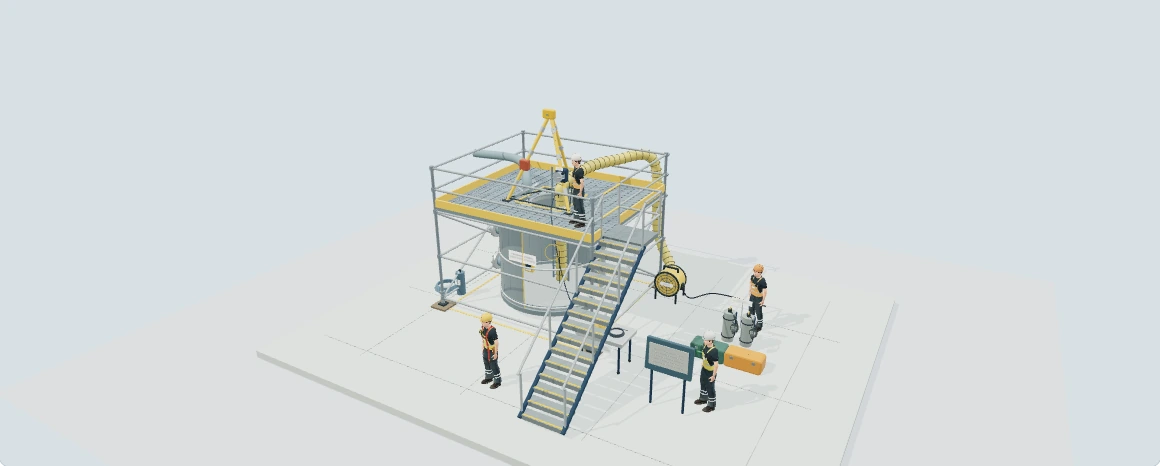

Confined-space tank entry: prepare, monitor and rescue
Follow a fictional tank inspection from avoiding entry through preparation, a supervised entry example and emergency response. Explore the access scaffold, rescue tripod and retrieval line, fresh-air duct, sample probe, personal gas monitor and standby team. Each step explains what the equipment does and what must be verified in the real job.
Checksheets and risk assessments
Risk assessment forms
Risk assessment examples
Forms and tools
Full written walkthrough — all 16 steps
1. First ask: can the task be done outside?
What is happening: A camera, remote inspection or suitable external cleaning may remove the need for anyone to enter. This example considers a tank with previous hydrocarbon service; the internal cutaway is a teaching view, not a second doorway.
How harm can occur: An enclosed space with a foreseeable specified risk can cause fire, explosion, poisoning, loss of consciousness, drowning or asphyxiation. Size alone does not decide whether it is a confined space.
Best practice to apply: Define the task, tank history, residues and connected plant. Avoid entry where reasonably practicable. A competent person develops the safe system and site-specific emergency arrangements before entry is considered.
2. Plan the job, people and permit
What is happening: The supervisor coordinates operations, contractors, the entry team and rescue team. The plan defines the work, duration, tools, exposure controls, access, communications and permit boundaries.
How harm can occur: A change of task, shift or neighbouring operation can defeat an earlier assessment. Hot work, solvents, sludge disturbance and heat can introduce new hazards.
Best practice to apply: Identify named competent roles, suitable entrants and fitness considerations. Decide the permit-to-work requirements, isolation responsibilities, authorised activities and the conditions that suspend work. The model never issues permission.
3. Empty, drain and clean from outside
What is happening: In this fictional preparation stage the tank is emptied, drained and flushed under a planned method before entry. Water is used only if compatible with the previous contents; contaminated washings go to controlled collection.
How harm can occur: Empty does not mean clean: sludge, scale, pockets and connected pipework may retain toxic or flammable material. Cleaning itself can release vapour or create chemical reactions and environmental risks.
Best practice to apply: Before draining or cleaning, establish and verify the isolations required for that preparation stage. Confirm substance compatibility, drainage, safe disposal and effective removal of residues. Do not prescribe a universal flushing time or assume water removes every substance. Reassess if residues remain or will be disturbed.
4. Prove and maintain all isolations
What is happening: Identify every inlet, outlet, bypass, drain, nitrogen and utility connection, plus pumps, agitators and electrical energy. The visible blanks illustrate positive separation; actual isolation must be selected, installed and verified.
How harm can occur: A closed valve may pass. Pressure, gravity inflow, rotating equipment or reconnection can overwhelm someone inside. Temporary preparation hoses can become an overlooked route back into the tank.
Best practice to apply: Use the plant isolation scheme, locks, tags and independent checks where required; establish zero-energy conditions. Control each preparation stage and verify the final entry boundary, including removal/isolation of temporary supplies. See the linked HSG253 lesson.
5. Purging removes a hazard and can create another
What is happening: If a competent hydrocarbon preparation plan requires inert-gas purging, it happens without entrants. Nitrogen can displace flammable vapour, but also displaces oxygen. The stored nitrogen hose is disconnected in the entry example.
How harm can occur: Nitrogen is invisible and can cause rapid unconsciousness without warning. Bringing air into remaining flammable vapour can create an explosive mixture; gases vented outside can also harm the standby team.
Best practice to apply: Use a designed purge and gas-freeing sequence with suitable instruments and controlled discharge. Verify each transition before admitting air. Remove/isolate the nitrogen supply, ventilate with fresh air, and test before considering entry. Never enter to investigate a purge problem.
6. Ventilate with clean fresh air — never oxygen
What is happening: A blower takes uncontaminated outside air through a flexible duct routed through the top manway and down to the lower part of the tank. Air then leaves by the separate outlet. Blue arrows show the intended supply route; amber arrows show the outlet route, not measured gas concentrations.
How harm can occur: Short-circuiting airflow, dead pockets, contaminated intakes or failed fans can leave dangerous conditions. Adding oxygen greatly increases the fire risk. Ventilation does not replace isolation or testing.
Best practice to apply: Select suitable equipment for the assessed atmosphere and ignition risks; position the intake away from exhausts and the discharge away from people and re-entry. Check effective circulation and maintain the required flow throughout work. Keep ducts clear of entry and rescue routes.
7. Sample the atmosphere before anyone enters
What is happening: The tester uses a pump and probe from outside. Sample representative positions, including different heights, the work area and pockets; do not assume gases form neat layers. The model probe and instrument are illustrative.
How harm can occur: One sample at the hatch can miss a dangerous pocket. A blocked tube, wrong sensor, poor calibration or insufficient sample travel time can create false reassurance. Some flammable sensors do not work reliably in low oxygen.
Best practice to apply: Use a competent tester, suitable sensors, current calibration and manufacturer-specified function/bump checks. Check oxygen first, then flammability and relevant toxic contaminants; allow sample transport and instrument response time. Record locations, time and results against the task-specific limits. Normal air is about 20.9% oxygen; departures need investigation, not an automatic green light.
8. Provide safe scaffold access and a clear hatch
What is happening: The access stair, boarded platform, guardrails, toe boards and guarded transfer point give the team a working position at the tank top. The hatch and fixed internal ladder provide the illustrative entry route.
How harm can occur: Falls, dropped tools and a restricted hatch can injure the entrant or prevent casualty recovery. Tank roofs and ordinary guardrails must not be assumed capable of carrying rescue loads.
Best practice to apply: Have competent people design/erect/inspect the access and verify its load paths. Check roof and platform capacity, opening protection, clearances with PPE/BA and a casualty, ladder security and a clear route to ground. The drawn scaffold is not a build specification.
9. Rig the tripod and retrieval equipment
What is happening: The tripod is aligned above the hatch and its feet secured on an engineered supporting arrangement. A personnel retrieval winch/line leads through the head pulley to a compatible harness. A separate fall-protection function is provided where the assessment requires it.
How harm can occur: A normal inertia/fall-arrest reel is not automatically a rescue winch. Incompatible components, inadequate anchors, sharp edges, snags or side loads can defeat recovery. A line is not a guarantee that an unconscious person fits through the hatch.
Best practice to apply: Verify equipment compatibility, ratings, inspections/examinations and pre-use checks; follow the manufacturer’s rescue configuration. Rehearse the actual route with a suitable dummy. Assess entanglement and the need for entry rescue; never improvise by attaching to a guardrail.
10. Fit the entrant’s equipment and escape provision
What is happening: The entrant wears a correctly fitted rescue harness, a personal gas monitor in the breathing zone and suitable PPE. The small escape set is carried where the assessment calls for it. The rescue team’s full breathing apparatus is staged outside.
How harm can occur: A filtering mask does not supply oxygen. An escape set is for leaving a developing emergency, not routine work or re-entry. A gas meter only detects the hazards its sensors are designed for.
Best practice to apply: Check the person is trained and suited to the task; fit and check harness, monitor, communications and escape equipment. Confirm battery, alarms, sensors, cylinders and escape duration for the route. This example assumes a verified breathable atmosphere; work requiring BA needs its own competent plan.
11. Brief the whole team at the entry point
What is happening: The entrant, dedicated standby attendant, supervisor and rescue team agree the job and rehearse the response before the permit is released. The attendant remains outside, maintains an entry log and stays in reliable contact.
How harm can occur: Unclear commands, competing duties or an absent attendant can delay evacuation. Relying solely on calling 999 leaves an incapacitated worker without an immediate suitable rescue arrangement.
Best practice to apply: Point out isolation boundaries, gas-test results, alarm/evacuation triggers, check-in method and backup signal, rescue roles, equipment, casualty route, first aid/AED and emergency rendezvous. Verify responders are ready and enough people are available. Each person repeats their role and stop-work authority.
12. Illustrative entry: maintain all the controls
What is happening: Only at this learning stage does the entrant appear inside, connected to the retrieval line. Assume the actual competent authoriser has verified the safe system. The attendant remains at the hatch; ventilation, an area monitor and the personal monitor remain in use.
How harm can occur: Conditions can deteriorate after a satisfactory pre-entry test. Work can release vapours, consume oxygen or produce heat and fumes; a meter at one location cannot describe every pocket.
Best practice to apply: Maintain the monitoring and communication specified for the work, repeat tests after interruptions/changes, and keep the entry log current. Record real readings; the model shows no invented safe values. Never continue if a critical control is lost.
13. Alarm or loss of a control: stop and get out
What is happening: A gas alarm, failed ventilation, lost communication, unexpected inflow or illness triggers the agreed response. A responsive entrant stops work and leaves immediately using the planned route, using an escape set only as trained and specified.
How harm can occur: Stopping to troubleshoot inside can turn a recoverable problem into a casualty. Silence or a failed instrument is not evidence that the atmosphere is safe.
Best practice to apply: The attendant raises the alarm and starts the site response. Do not silence the alarm and continue or restart from a single better reading. Secure the space and require reassessment, testing and fresh authorisation before any return.
14. Unresponsive entrant: planned non-entry recovery
What is happening: The attendant summons the trained rescue team and emergency services as planned. Where the assessed route and casualty position allow, trained personnel use the prepared system to recover the casualty without another person entering.
How harm can occur: Pulling a trapped casualty, a snagged line or an unplanned angle can cause further injury. An attendant who rushes in may become a second casualty.
Best practice to apply: Use only the practised, compatible recovery method. Keep people outside the hazardous atmosphere. If the route is obstructed or recovery cannot be safely achieved, stop that attempt and use the planned specialist entry-rescue response; do not improvise.
15. Entry rescue requires a protected, trained team
What is happening: Some emergencies need rescuers to enter. The staged full BA, communications, rescue equipment and casualty handling arrangements illustrate preparation for that separate rescue operation.
How harm can occur: A spare mask or escape hood does not make rescue entry safe. The same atmosphere, energy, entrapment or fire that affected the entrant can harm rescuers.
Best practice to apply: Only trained, equipped and properly supported rescuers use the site-specific entry-rescue plan, with suitable BA, control of entry, backup and remaining-air management. Maintain required isolations/plant controls. Emergency-service support complements the arrangements already in place.
16. Receive the casualty, then hand back safely
What is happening: The team moves the casualty to the planned safe area for trained first aid and ambulance handover. After normal work or an incident, account for all people and equipment and close the entry under the agreed handback process.
How harm can occur: A contaminated casualty can expose helpers. Premature reinstatement can trap someone or reintroduce energy; an incident must not be treated as permission to resume.
Best practice to apply: Give responders the tank identity, substances, readings and events. Provide first aid/AED only within training and follow emergency advice. Record the event, inspect affected equipment, review the plan and formally control removal of isolations and return to service.
Awareness example, not an entry permit, engineered rescue design or gas-clearance certificate. Actual entry requires a competent assessment, verified controls and a practised rescue plan for that space. Ventilate with clean fresh air — never oxygen. No entry during nitrogen purging.
The wider workplace has its own account and subscription access. Exploring this lesson does not grant access, record course completion or authorise work.
How can I practise this topic in 3D?
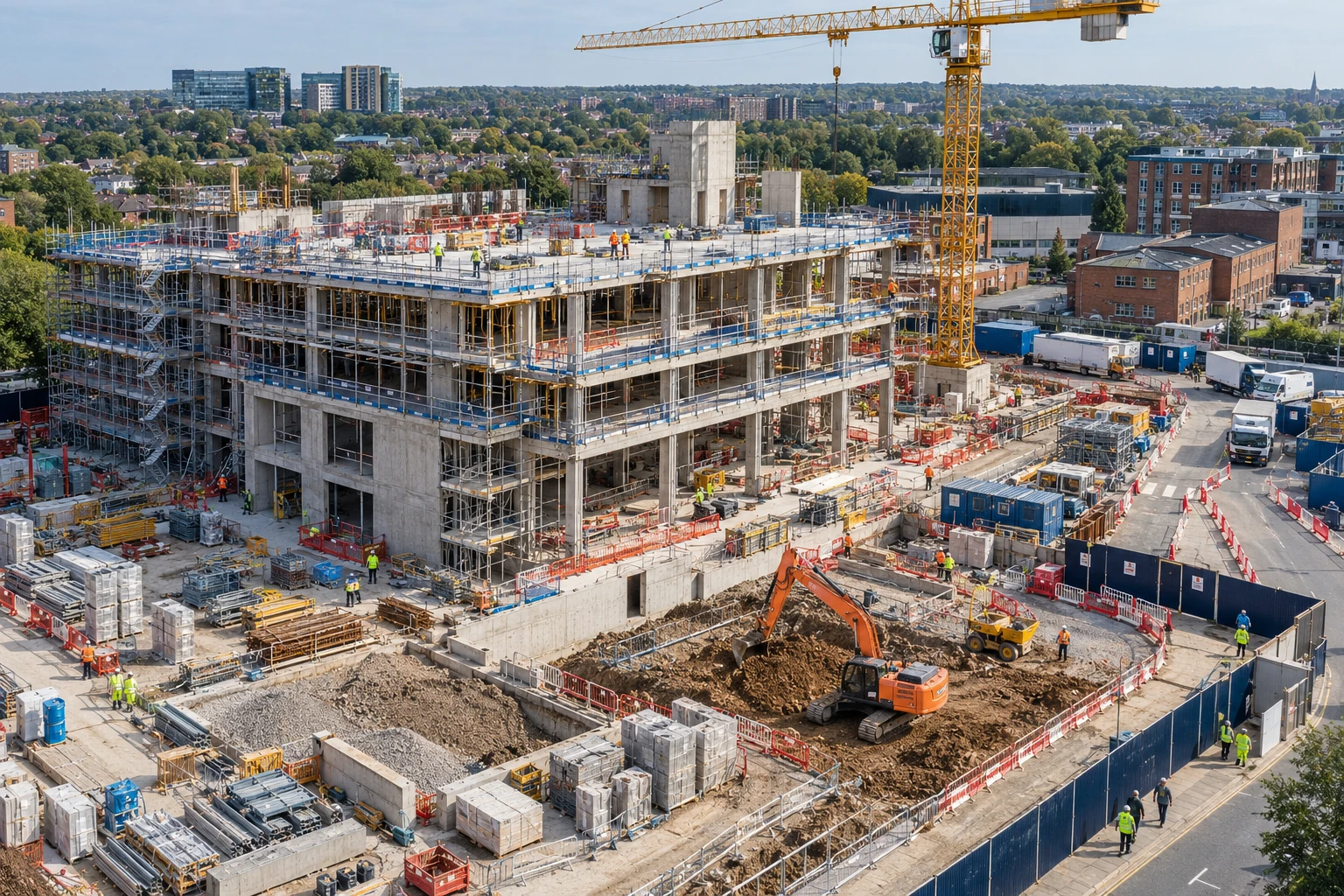
A chamber entry is treated as routine
Oven or duct entry and confined-space assessment
All related inspection points 2 across 2 locations
Construction site 1 inspection point
Aerosystems Engineering 1 inspection point
Practice in the SHAREhub environment. Browser practice is separate from workplace competence and formal learning records.
Explore tank preparation while keeping entry held
Follow the fictional tank preparation from outside. Compare water cleaning, nitrogen introduction and gas-test evidence, and see why an apparently empty tank or zero LEL indication cannot authorise entry.
Included with Paid membership. Authorised staff can review the model. Select Start guided example to follow the authored scenes; browsing stage text alone does not change the model. Stop restores the saved manual example.
The 22-stage example follows initial isolation and inventory recovery; temporary water and collection hoses at the DBB bleed connections; nitrogen to a reviewed top vent; pressure and gas-test evidence; locks and example documents; the protected first break and final spades; external pump work; then protected spade removal, remade joints, specified bolting and a separate line-test and handback review.
Keep the evidence separate. Water appearance and authored zero gauges do not establish cleaning or proof. Zero LEL after nitrogen does not establish a safe atmosphere. No universal torque, tank test pressure, leak-test pass or entry permission is supplied.
Conceptual learning only: no work, first break or confined-space entry is authorised. HSG253 and L101 are GB-origin HSE guidance; use the applicable local law and a competent, plant-specific assessment.
Read the full isolation explanation and source links or use the eight illustrated isolation arrangements on the free topic page.
What is a confined space?
A confined space is a substantially enclosed place where one or more specified serious risks could arise because of the space, its contents, its atmosphere or the work being done.
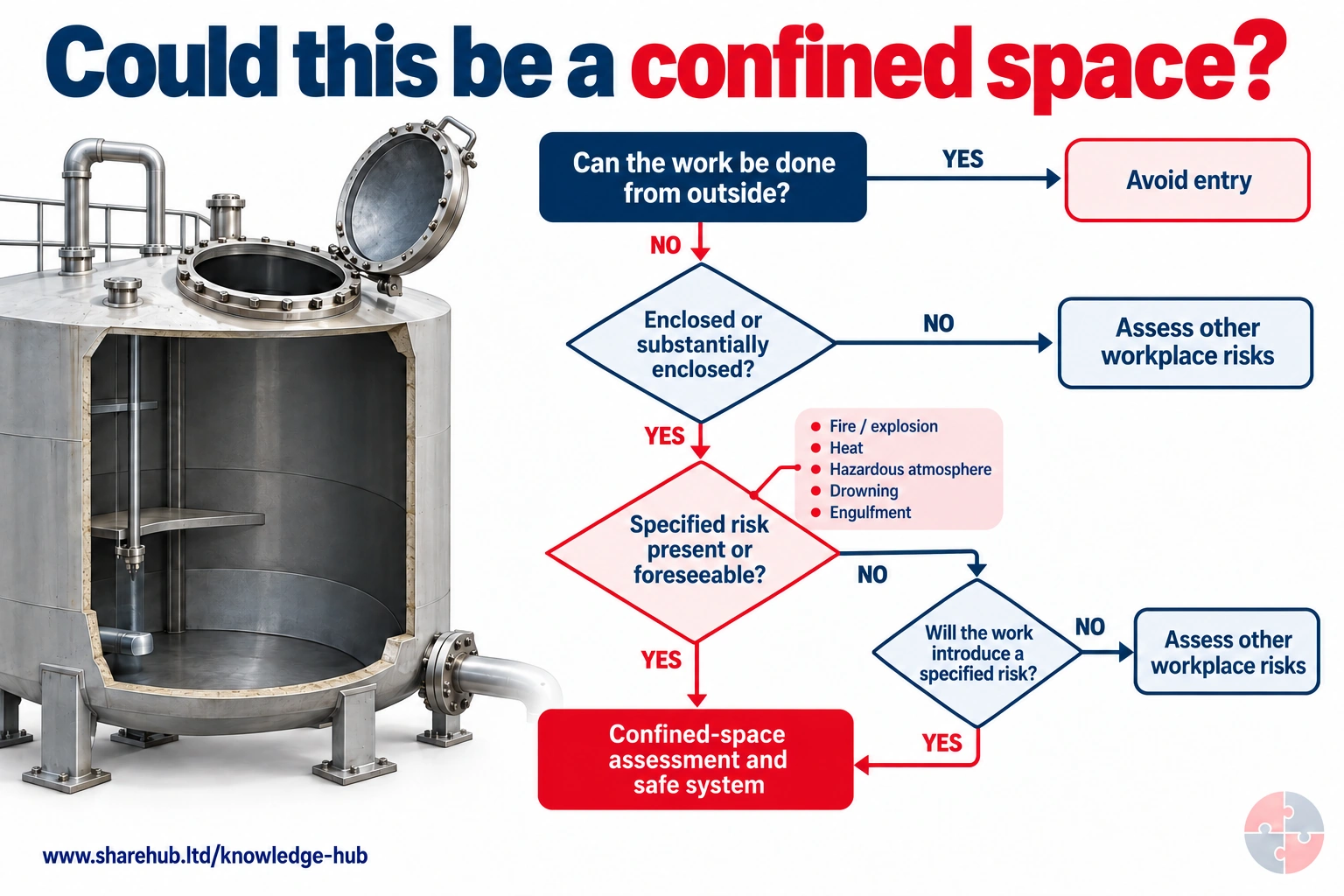

Entry avoidance is considered first. Confined-space status requires substantial enclosure together with a present or reasonably foreseeable specified risk, including one introduced by the work. The short labels mean serious injury from fire/explosion; loss of consciousness from heat; loss of consciousness/asphyxiation from gas, fume, vapour or oxygen shortage; drowning as liquid rises; or asphyxiation/trapping by a free-flowing solid.
Can planned work change whether a space needs confined-space controls?
Yes. Work can create a specified risk in an enclosed space, and the confined-space controls continue while that work or any residual specified risk remains. Controlling a risk does not automatically remove confined-space status.
Simplified awareness flow based on L101, with shorthand image labels rather than the full statutory definitions. A competent assessment must cover the precise specified risks, changing conditions, safe system and suitable emergency/rescue arrangements before entry.
Source guidance: HSE L101
A confined space does not have to be tiny, fully enclosed or difficult to enter. The important questions are whether the space is substantially enclosed and whether a specified risk may arise. Specified risks include serious injury from fire or explosion; loss of consciousness from increased body temperature; loss of consciousness or asphyxiation from gas, fume, vapour or lack of oxygen; drowning from rising liquid; and asphyxiation by a free-flowing solid or entrapment by that solid preventing access to breathable air. Difficult access or rescue is a separate planning concern, not by itself the statutory definition.
Some confined spaces are obvious, such as tanks, vessels, sewers and silos. Others are overlooked because workers enter them regularly: pits, chambers, ducts, service voids, trenches, plant rooms, sumps, lift shafts, ship holds, inspection chambers and large process vessels. Familiarity is dangerous when it leads people to assume the space is safe without checking current conditions.
| Test | What to ask | Example |
|---|---|---|
| Substantially enclosed? | Does the structure restrict natural ventilation, movement, access or escape? | Tank, chamber, sewer, silo, duct or pit. |
| Specified risk possible? | Could serious injury from fire/explosion, heat-related loss of consciousness, atmospheric loss of consciousness or asphyxiation, drowning from rising liquid, or a free-flowing-solid asphyxiation/entrapment risk arise? | Low oxygen, toxic gas, free-flowing solid or incoming liquid. |
| Work creates risk? | Could cleaning, welding, solvents, purging or disturbance change the atmosphere? | Hot work inside a tank. |
| Contents create risk? | Could residues, sludge, grain, sewage or chemicals release hazards? | Hydrogen sulphide from sludge. |
| Rescue planning (separate from definition)? | Once the legal definition is assessed, would access or rescue be difficult? | Narrow access hatch or vertical entry. |
What are common examples of confined spaces?
Common confined spaces include tanks, vessels, sewers, drains, silos, pits, ducts, chambers, tunnels, ship holds, voids and some excavations.
The examples matter because many workplaces have confined spaces without calling them that. Maintenance teams may enter pits, tanks or ducts; cleaners may enter sumps or vats; construction workers may enter excavations or service chambers; water and utility workers may enter sewers and manholes; process sites may enter vessels, reactors or bunded areas.
A confined-space register can help, but it must not replace assessment. Temporary works, unusual maintenance, blocked drains, cleaning, breakdowns and contractor tasks can create confined-space conditions that are not on the usual list.
| Space | Why it may be dangerous | Typical controls |
|---|---|---|
| Tank or vessel | Residues, low oxygen, toxic vapour, difficult access and internal fittings. | No-entry cleaning, isolation, testing, ventilation, permit and rescue plan. |
| Sewer or drain | Hydrogen sulphide, methane, low oxygen, flooding and biological contamination. | Monitoring, ventilation, flow control, hygiene and rescue arrangements. |
| Silo or hopper | Engulfment, bridging, dust explosion and oxygen issues. | Lock-off, no-entry clearing, harness, standby and rescue. |
| Pit or chamber | Poor ventilation, gases, falls, flooding and restricted rescue. | Barriers, testing, pump-out, permit and attendant. |
| Duct or crawl space | Restricted movement, dust, fumes, heat and poor communication. | Access planning, ventilation, lighting, communication and supervision. |
| Excavation or trench | Ground collapse, gases, services, flooding and access difficulty. | Support, service isolation, testing where needed and emergency planning. |
When might a drainage excavation or chamber need a confined-space assessment?
Inspect the chamber, drainage connection and changed-condition example from outside the excavation. Consider the actual specified risks and specialist controls rather than treating every open trench identically.
An open hatch is not an entry decision
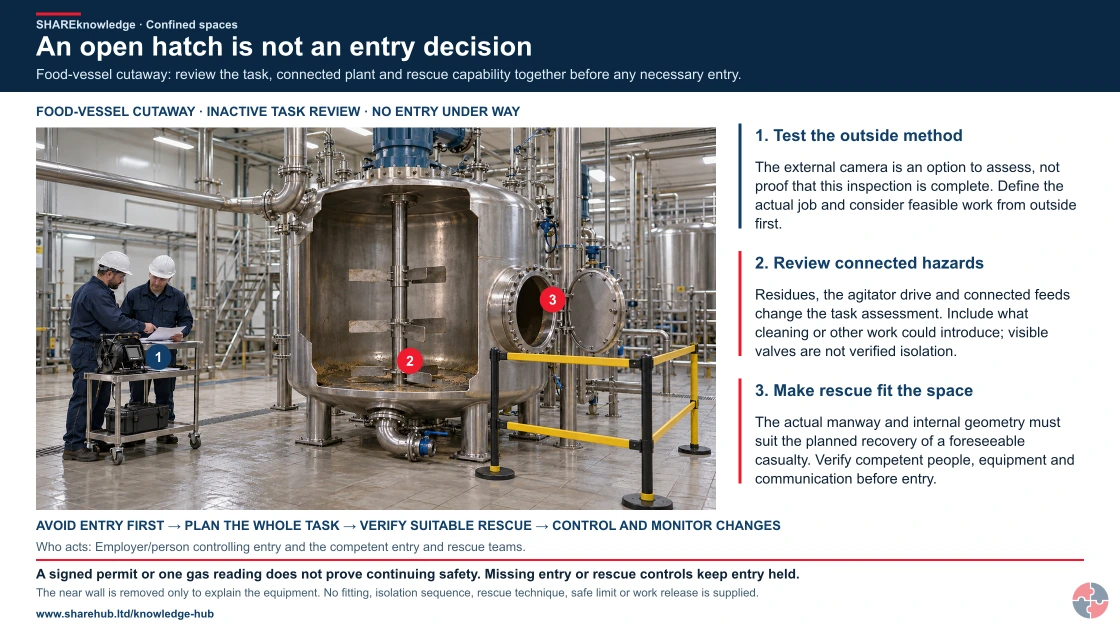
Full written explanation
A realistic food-process-vessel cutaway shows a stationary agitator, drive connection, residue patch, attached feed and discharge pipework and a side manway behind an access-control barrier. Two planners remain outside with papers and an unused external camera reel. Native numbered explanations connect the outside work option, changing residue/energy/process hazards and the requirement for rescue capability suited to the real access and foreseeable casualty. The cutaway removes the near shell only to reveal the physical relationships; it does not create a practical access route. Nobody enters, mixes, cleans, tests or rescues. An open hatch, a barrier, a valve position, a clean-looking room or a detector-looking device cannot establish a released entry. No numeric atmosphere criterion, operating/isolation method or chosen rescue technique is provided. The full task-specific entry, monitoring, permit and emergency arrangements in the current topic remain required.
Food-vessel cutaway: review the task, connected plant and rescue capability together before any necessary entry.
- Ask whether entry is needed. Examine feasible methods from outside and assess the actual confined-space risks.
- Plan the complete task. Define hazards, isolation, atmosphere controls, people and interfaces.
- Verify rescue readiness. Confirm a suitable task-specific rescue arrangement and communication before planned entry.
- Control and monitor work. Use the competent safe system and required permits; respond to changed conditions.
When the evidence does not fit: Unresolved isolation, atmosphere or rescue arrangements: do not enter. An emergency is not permission for an unprotected rescue entry.
Who acts: Employer/person controlling entry and the competent entry and rescue teams.
Changed workplace
Water-treatment chamber: Consider whether inspection or cleaning can be completed from outside.
Food-process vessel: Product residues, cleaning and connected systems change the assessment and rescue needs.
Evidence check: A signed permit or one gas reading does not prove that conditions will remain safe.
Read the complete task-specific safe-system, isolation, atmosphere, permit and rescue requirements
Primary references: HSE confined-spaces introduction (Great Britain) · HSE L101: avoidance, safe systems and rescue (Great Britain) · HSENI approval of L101 for Northern Ireland
Open the complete HD image (new tab)Download image

Read the complete task-specific safe-system, isolation, atmosphere, permit and rescue requirements
Primary references: HSE confined-spaces introduction (Great Britain) · HSE L101: avoidance, safe systems and rescue (Great Britain) · HSENI approval of L101 for Northern Ireland
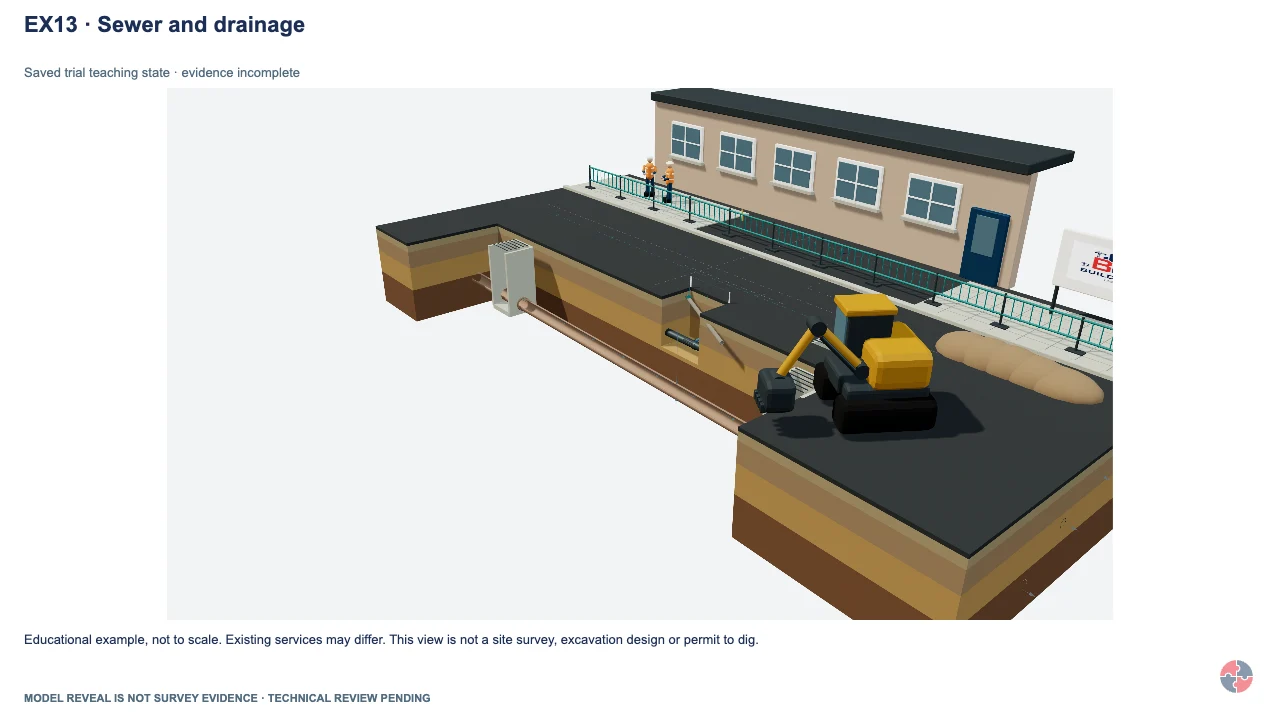
Sewer and drainage
The invert is the inside bottom of the pipe. Cover runs from the surface to the outside top. Chambers may present confined-space risks.
Learning focus: The invert is the inside bottom of the pipe. Cover runs from the surface to the outside top. Chambers may present confined-space risks.
Contextual workplace scene. Use the task, control and evidence checks in this section; appearance alone does not establish safe conditions, individual health or approval.
Educational example, not to scale. Existing services may differ. This view is not a site survey, excavation design or permit to dig.
Screening and referral only; no entry, rescue method or confined-space permit is provided.
Return to the main excavation lesson · Explore the planned Build Out excavation controls
What hazards make confined spaces dangerous?
Confined spaces are dangerous because hazardous atmospheres, physical constraints and rescue difficulty can combine and escalate very quickly.
Atmospheric hazards are often the most serious because they may not be visible. Oxygen can be depleted by rusting, combustion, fermentation, displacement by other gases or inerting. Toxic gases such as hydrogen sulphide, carbon monoxide or solvent vapours can build up. Flammable vapours or dusts can create fire and explosion risks, especially if hot work or electrical equipment is introduced.
Physical hazards also matter: moving machinery, agitators, conveyors, hot surfaces, sharp edges, engulfment in grain or powders, incoming liquids, slips, falls, heat stress, poor lighting, noise, poor communication and awkward posture. The safe system needs to consider the whole task, not only gas testing.
| Hazard | How harm occurs | Control focus |
|---|---|---|
| Oxygen deficiency | Person becomes dizzy, collapses, loses consciousness or dies. | Avoid entry, isolate, ventilate, test and use suitable breathing apparatus where needed. |
| Oxygen enrichment | Materials ignite more easily and fires burn intensely. | Prevent oxygen leaks, control equipment and test atmosphere. |
| Toxic gases or vapours | Inhalation can cause poisoning, collapse or long-term harm. | Identify source, test, ventilate, isolate and select suitable RPE/BA. |
| Flammable atmosphere | Ignition can cause flash fire or explosion. | Remove fuel, ventilate, test, control ignition and use appropriate equipment. |
| Engulfment | Free-flowing solids or liquids trap or suffocate a person. | Prevent entry, isolate material, empty, lock off and use rescue-ready systems. |
| Entrapment and restricted rescue | Person cannot escape or be removed quickly. | Access planning, harnesses, lifelines where suitable and rescue plan. |
How should confined-space risk assessment be carried out?
Confined-space risk assessment should identify the space, the specified risks, the work activity, changing conditions, affected people and the controls needed before entry.
A suitable assessment starts before the job is planned. It asks whether the work can be done without entry, what the space contains, what it previously contained, what is connected to it, what work will be done, who will enter, who will supervise, what could change and how rescue would be achieved.
The assessment should be task-specific. Inspecting an empty clean vessel is not the same as welding inside a tank, removing sludge from a sump, entering a sewer, clearing a silo bridge or cleaning a duct with solvents. The hazards change with residues, temperature, equipment, ventilation, weather, isolation and the tools introduced.
| Question | Why it matters | Evidence |
|---|---|---|
| Can entry be avoided? | Elimination is the strongest control. | No-entry option review. |
| What atmosphere could exist? | Gas and oxygen hazards can be fatal. | Testing plan and detector selection. |
| What will the work create? | Hot work, solvents or disturbance can create new hazards. | Task method and change review. |
| What is connected? | Pipes, valves, drains, conveyors and energy sources can introduce hazards. | Isolation plan and verification. |
| Who is involved? | Entrants, attendants, supervisors, contractors and rescuers need role competence. | Training and authorisation records. |
| How will rescue work? | Rescue cannot be improvised after collapse. | Rescue plan, equipment and drill evidence. |
How can entry be avoided?
First test a safe no-entry method; design out the need to place a person in the hazardous space wherever reasonably practicable.
For a blocked drainage chamber, use a remote camera and jetting access from outside if the method can safely clear the blockage. A fixed sampling port, clean-in-place system or external gauge can avoid repeated inspection entry. Verify the no-entry equipment itself does not create pressure, chemical or public-exposure hazards. The HSE L101 ACOP sets the GB avoid-entry principle; NI regulations provide the NI route. If entry remains necessary, record why alternatives are not reasonably practicable and move to a task-specific safe system.
What should a confined-space safe system of work include?
A safe system of work should bring together entry control, isolation, cleaning, testing, ventilation, equipment, supervision, communication and rescue.
The safe system should be specific enough to inspect. It should state who authorises the work, who enters, who remains outside, how the space is isolated, how the atmosphere is tested, what ventilation is required, what tools and lighting are suitable, what PPE or breathing apparatus is needed, how communication will be maintained and what stops the job.
For higher-risk entry, the safe system is commonly supported by a permit-to-work. The permit should not be treated as permission alone; it is a live communication and control document confirming that preconditions are satisfied and responsibilities are understood.
| Element | What it should cover | Evidence |
|---|---|---|
| Authorisation | Who can approve entry and under what conditions. | Permit or entry authorisation. |
| Isolation | Energy, substances, fluids, gases and moving equipment. | Isolation certificate and verification. |
| Cleaning and preparation | Residues, sludge, contamination and heat. | Cleaning record and pre-entry check. |
| Atmospheric controls | Testing, ventilation and monitoring. | Gas-test records and ventilation plan. |
| People and roles | Entrant, attendant, supervisor, tester and rescue team. | Competence and briefing records. |
| Emergency arrangements | Rescue method, equipment, communications and external support. | Rescue plan and drill record. |
How should atmospheric hazards be controlled?
Atmospheric hazards should be controlled by identifying likely gases, testing with suitable equipment, ventilating effectively and monitoring where conditions may change.
Atmospheric testing must be planned around expected hazards. A detector that is not calibrated, not bump-tested, not suitable for the gas or used in the wrong location can create false assurance. Testing may need to sample at different levels because gases and vapours can stratify. Oxygen, flammable gas and toxic gas results should be understood before entry decisions are made.
Ventilation should be suitable for the space and the work. Natural ventilation is often not enough. Forced ventilation may be needed before and during entry, but it must not introduce hazards, spread contaminants or interfere with atmospheric testing. Where a safe atmosphere cannot be achieved or maintained, suitable breathing apparatus and a much stronger rescue arrangement may be needed.
| Control | Why it matters | Good evidence |
|---|---|---|
| Hazard prediction | Testing must match likely gases or vapours. | Substance history, process knowledge and SDS review. |
| Pre-entry testing | Confirms whether the atmosphere is safe before entry. | Recorded oxygen, flammable and toxic gas readings. |
| Continuous monitoring | Detects changes during the task. | Monitor readings and alarm response plan. |
| Ventilation | Dilutes or removes hazardous atmosphere. | Ventilation equipment check and airflow arrangement. |
| Detector management | Prevents false readings. | Calibration, bump-test and user competence records. |
| Respiratory protection | Protects where atmosphere cannot be made safe by other means. | RPE/BA selection, fit, maintenance and training evidence. |
How should isolation be managed before entry?
Isolation should prevent substances, gases, liquids, energy or moving parts entering or operating while people are inside.
Isolation is often the difference between a controlled entry and a fatal event. Valves can leak or be opened, pumps can start, agitators can move, conveyors can run, steam can enter, liquids can flood, material can collapse and electrical or hydraulic energy can be released. Isolation should therefore be physical, verified and protected from unauthorised change.
The method depends on the hazard. Lock-off may be enough for some electrical equipment, but fluid or gas systems may need draining, depressurising, purging, blanking, disconnection or double isolation with monitoring. Stored energy and residual contents must be considered, not just live feeds.
| Hazard source | Typical isolation | Verification |
|---|---|---|
| Electrical equipment | Lock-off, tag and test dead where relevant. | Lock register and competent-person check. |
| Mechanical movement | Isolate and secure agitators, conveyors and moving parts. | Try-start or physical verification where suitable. |
| Pipes and valves | Blank, disconnect, drain, purge or lock valves as required. | Isolation certificate and line walk. |
| Liquids or solids | Empty, secure and prevent refill or flow. | Level check and feed isolation. |
| Stored pressure or heat | Depressurise, cool and verify. | Pressure, temperature and release checks. |
| Adjacent operations | Control simultaneous work and process changes. | Coordination meeting and permit interface. |
When should a permit-to-work be used for confined spaces?
A permit-to-work should be used where confined-space entry needs formal authorisation, coordination, isolation, atmospheric controls, rescue arrangements or hand-back.
A permit is not a substitute for risk assessment or competence. Its value is in bringing critical controls together at the point of work: the exact space, work scope, people, isolations, gas-test results, ventilation, equipment, PPE, communication, rescue plan, validity period and hand-back requirements.
Permit failure often occurs when forms are copied, issued from an office without a field check, extended without reassessment or closed without confirming the space is safe to return to service. The permit issuer, supervisor, entrant and attendant must understand the conditions of entry and what invalidates the permit.
| Permit point | What to confirm | Why it matters |
|---|---|---|
| Scope | Exact space, task and people involved. | Prevents work expanding beyond assessed conditions. |
| Preconditions | Isolation, cleaning, testing, ventilation and rescue are ready. | Confirms entry controls before exposure. |
| Time limits | Permit valid only while conditions remain controlled. | Prompts reassessment after breaks, shift change or change. |
| Communication | Entrants, attendants and supervisors understand controls. | Reduces assumption and handover failure. |
| Suspension | Clear triggers to stop work. | Responds to alarms, weather, process change or new hazards. |
| Hand-back | Space and plant are returned safely. | Prevents uncontrolled restart or missed people/equipment. |
How must rescue be prepared?
Plan, equip, staff and rehearse a rescue suited to the exact space and foreseeable casualty condition before entry.
Use the tank example to brief your team, then build a rescue plan for your project. Download worked plan and briefing sheets (PDF) · Create your project rescue plan
The HSE L101 ACOP says emergency arrangements must be suitable for foreseeable risks. Identify who alerts, who remains outside, retrieval route, lifting equipment, breathing apparatus if indicated, first aid and emergency-service access. The standby person should not enter spontaneously. Test the drill with the same access geometry and an incapacitated-person scenario. If a key rescuer, equipment item or communications link is unavailable, entry does not start; if it fails during entry, withdraw and activate the planned response from safety.
How can the hierarchy of controls avoid confined-space entry and control remaining entry risks?
Eliminate entry first, then reduce and isolate the hazard, engineer reliable controls, use procedures and competent people, and reserve PPE or breathing apparatus for residual assessed exposure.
Consider a sewer chamber with possible toxic gas and inflow. Elimination means remote inspection. Substitution or reduction may use a less hazardous cleaning method. Engineering requires positive isolation of inlets and moving plant, tested ventilation, suitable gas detection and a reliable retrieval/rescue route. Administrative controls cover a current permit, standby person, communications, entry count and repeated testing. Breathing apparatus is a specialist last layer, not permission to enter an uncontrolled atmosphere. A competent confined-space lead must verify the method and stop entry if isolation, readings, ventilation, communications or rescue readiness fail.
On a small screen, scroll this table sideways to read all columns.
How can the ERICPD hierarchy of controls avoid confined-space entry and control remaining entry risks?

| Five-level / ERICPD | Specific option and feasibility | Owner, verification, failure and stop |
|---|---|---|
| Eliminate / eliminate | Remote camera and jetting from outside where safely feasible. | Planner records no-entry decision; no entry merely for convenience. |
| Substitute / reduce | Change cleaning method or use external access, checking pressure and chemical hazards. | Competent lead approves method; reject new uncontrolled risk. |
| Engineering / isolate and control | Lock/isolate inlets and energy; verify zero flow, ventilate and test relevant atmosphere. | Engineer proves isolation and detector suitability; stop on leak, alarm or failed test. |
| Administrative / discipline | Permit, standby, entry count, communications, repeat testing and drilled rescue. | Entry supervisor signs checks; withdraw on lost contact or changing conditions. |
| PPE / PPE | Task-specific protection or breathing apparatus only with trained team and rescue. | Rescue lead checks fit, supply and readiness; no entry without the complete system. |
How can the ISO 45001 hierarchy of controls avoid confined-space entry and control remaining entry risks?

| Five-level / ERICPD | Specific option and feasibility | Owner, verification, failure and stop |
|---|---|---|
| Eliminate / eliminate | Remote camera and jetting from outside where safely feasible. | Planner records no-entry decision; no entry merely for convenience. |
| Substitute / reduce | Change cleaning method or use external access, checking pressure and chemical hazards. | Competent lead approves method; reject new uncontrolled risk. |
| Engineering / isolate and control | Lock/isolate inlets and energy; verify zero flow, ventilate and test relevant atmosphere. | Engineer proves isolation and detector suitability; stop on leak, alarm or failed test. |
| Administrative / discipline | Permit, standby, entry count, communications, repeat testing and drilled rescue. | Entry supervisor signs checks; withdraw on lost contact or changing conditions. |
| PPE / PPE | Task-specific protection or breathing apparatus only with trained team and rescue. | Rescue lead checks fit, supply and readiness; no entry without the complete system. |
HSE’s five-level hierarchy is the GB framework for elimination, substitution, engineering, administrative controls and PPE. ERICPD is complementary. Select measures for the actual hazard and work location, then verify physical and human controls separately.
For the chamber example, commission ventilation for the actual geometry, residues and work-generated contaminants, with clean-air intake and safe discharge. Verify isolation and detector suitability before entry. GB L1012014 requires representative atmosphere testing by a competent person: allow sample-line transit time and check the relevant contaminants, not just oxygen. Record equipment response/calibration checks and the monitoring plan; conditions need continuous monitoring where forced ventilation or the activity may change them. Never add oxygen to refresh the air. Loss of ventilation, isolation, contact, rescue readiness or acceptable readings triggers safe withdrawal under the plan. The entry supervisor permits re-entry only after the cause is corrected, controls and atmosphere are rechecked, and the authorisation is renewed. Maintenance and task/change review must keep those controls effective.
What evidence shows confined spaces are controlled?
Evidence should show that confined spaces are identified, entry is avoided where possible, safe systems are used and rescue arrangements are workable.
The most useful evidence is field evidence. A confined-space register helps, but it must be backed by risk assessments, permits, isolation records, gas-test records, equipment checks, training records, rescue drills and supervisor observations. The question is whether the arrangements would protect people during real entry, not whether paperwork exists.
Audits should sample both planned and unplanned work. Maintenance, cleaning, breakdowns and contractor work often create confined-space risk outside routine operations. Evidence should also show that learning from drills, false alarms, permit defects or near misses is used to improve the system.
| Evidence | What it proves | What to watch for |
|---|---|---|
| Confined-space register | Known spaces are identified and owned. | Missing temporary or non-routine spaces. |
| No-entry review | Entry avoidance was considered. | Assumption that entry is normal. |
| Risk assessment | Task hazards and controls are identified. | Generic assessment not matched to the space. |
| Permit and isolation records | Controls were verified before entry. | Office-issued permits with no field check. |
| Gas-test records | Atmosphere was tested using suitable equipment. | No calibration, bump-test or user competence evidence. |
| Rescue drill evidence | Rescue plan is practical. | Plan says call emergency services only. |
Which confined-space law applies?
Great Britain uses the Confined Spaces Regulations 1997 and HSE L101. Northern Ireland uses its separate 1999 Regulations and HSENI-approved L101 third edition (2014).
The HSE legislation page confirms the GB sequence: avoid entry where reasonably practicable, use a safe system when entry is unavoidable, and arrange suitable emergency response before work. The NI 1999 instrument and HSENI approval of L101 for Northern Ireland are the NI starting points. An underground chamber is not automatically a regulated confined space merely by name: identify substantial enclosure and specified risk. Other duties concerning hazardous substances, equipment, electricity, contractor coordination and rescue may apply by task. The competent site lead should verify current instrument effects and any sector rules for a live entry.
On a small screen, scroll this table sideways to read all columns.
| Location | Primary route | Practical gate |
|---|---|---|
| Great Britain | 1997 Regulations and HSE L101. | No-entry test, safe system if unavoidable, rescue before entry. |
| Northern Ireland | 1999 NI Regulations; HSENI-approved L101 third edition (2014). | NI no-entry, safe-system and emergency checks before entry. |
HSE lists L101 third edition (2014). HSENI approved it for use with the NI 1999 Regulations and withdrew approval of the first NI edition (1999), both effective 21 March 2022. This changed the ACOP route, not the NI Regulations. Check current amendments and task-specific equipment requirements before live work.
How could BuildOut Ltd manage confined spaces?

BuildOut Ltd would manage confined spaces through a register, no-entry reviews, permit controls, contractor coordination, trained people, rescue plans and active assurance.
BuildOut Ltd
A construction and refurbishment contractor delivering fit-out, maintenance, civils, drainage work, plant-room refurbishment, excavation, demolition and subcontracted specialist work.
BuildOut maps potential confined spaces across its projects: drainage chambers, manholes, service ducts, lift pits, tanks, excavations, basement voids, culverts, sumps and plant rooms. Each project team identifies whether planned or foreseeable work could create specified risks. The site manager must consider no-entry methods before approving any entry.
For unavoidable entry, BuildOut uses a confined-space permit supported by a task-specific risk assessment, isolation record, atmospheric-test plan, ventilation arrangement, attendant role, communication method and rescue plan. Contractors are not allowed to self-authorise entry. Specialist subcontractors may provide technical input, but BuildOut retains enough oversight to check that the method is suitable for the site.
The assurance loop is practical. Supervisors observe live controls, check detector calibration and bump-test evidence, review permits during work, verify rescue equipment is present and debrief after entries. Any gas alarm, incomplete permit, rescue drill failure or contractor deviation is recorded, investigated and fed back into training, procurement and project planning.
| Management area | How BuildOut applies it | Evidence and improvement |
|---|---|---|
| Assess and analyse | Identifies potential confined spaces during tender, design review, site setup and task planning. | Confined-space register, project risk register and no-entry review. |
| Plan and control | Uses task-specific risk assessment, permit, isolation, gas testing, ventilation and rescue planning. | Permit pack, gas-test record, isolation certificate and rescue plan. |
| Train and supervise | Trains entrants, attendants, permit issuers and supervisors to role-specific standards. | Training matrix, observed assessments and supervisor checks. |
| Manage contractors | Checks specialist competence and prevents self-authorised entry. | Contractor approval, RAMS review, induction and field monitoring. |
| Audit and learn | Samples permits, observes entry work and reviews drill findings. | Audit report, debrief notes and corrective actions. |
| Improve | Updates procedures, equipment, training and procurement after weak signals. | Management review and verified close-out. |
Why do fuel tanks and chambers require separate confined-space consideration?
Distinguish the tank interior from the surrounding chamber and connected drainage. Visual emptiness does not establish a safe atmosphere or authorise entry.
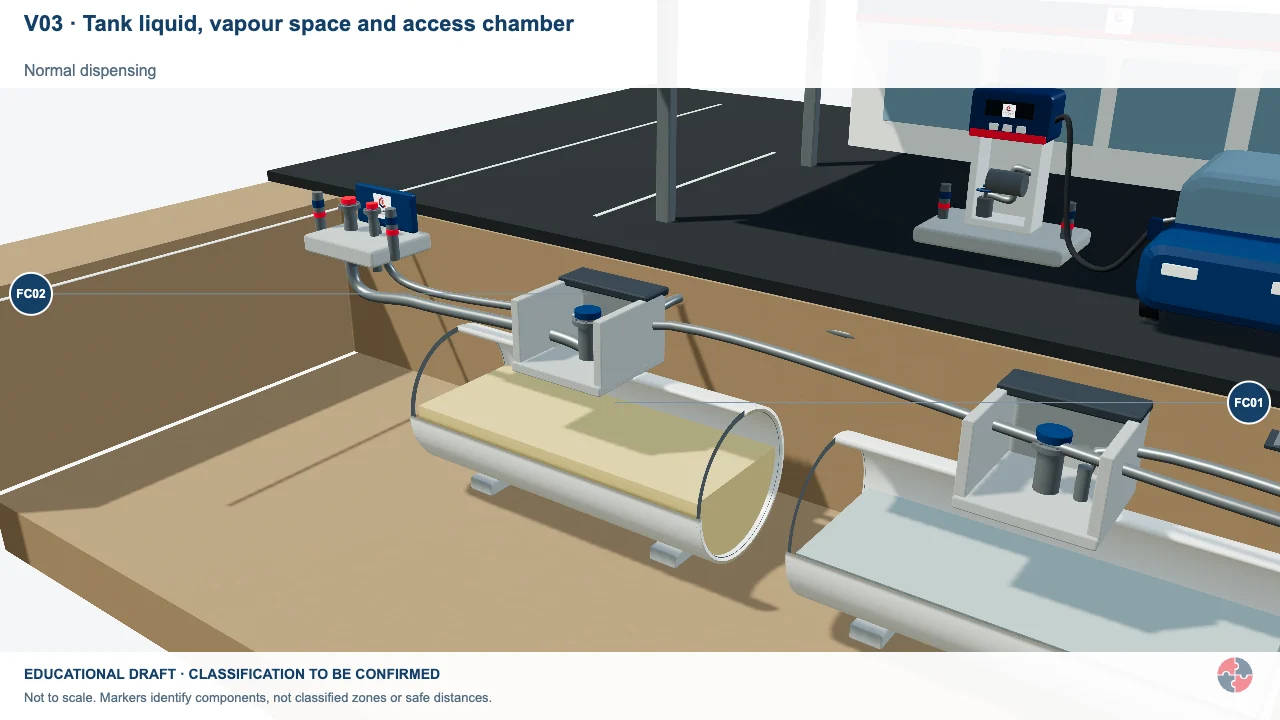
Tank liquid, vapour space and access chamber
The fuel liquid, space above it and surrounding access chamber are separate spaces with different assessment inputs.
Activity focus: Use the section to identify all three; the tank opening is not an access invitation.
Contextual workplace scene. Use the task, control and evidence checks in this section; appearance alone does not establish safe conditions, individual health or approval.
Educational illustration, not to scale. Coloured zones are teaching examples, not a site-specific hazardous-area classification.
What should each role learn and demonstrate?
Learning must match the decisions people make, from recognising danger to checking that controls work.
Briefings should tell people how to act, but attendance alone does not show competence. Assess the real decision or task, record who assessed it and revisit after a material change, failed control or incident. A local authorisation is task-specific; no universal external certificate is implied.
On a small screen, scroll this table sideways to read all columns.
| Role and learning | Demonstration and assessor | Record and reassessment trigger |
|---|---|---|
| Entry supervisor | Demonstrate permit, isolation, atmosphere and withdrawal check to confined-space assessor. | Signed authorisation; reassess after space or method change. |
| Gas tester | Sample expected gases at relevant levels with suitable calibrated device; technical lead assesses. | Test result and calibration; repeat after atmosphere change. |
| Standby/rescue team | Drill alarm, retrieval and casualty transfer without improvised entry; rescue lead assesses. | Drill record; retest after equipment or team change. |
| Manager | Test no-entry alternatives and resource a safe system; competent adviser assesses. | Decision record; revisit after design or incident change. |
How does confined spaces support NEBOSH General Certificate study?
The confined-spaces topic supports general safety study by helping learners identify types, hazards, risks, assessment factors and safe-system precautions.
For NEBOSH study, a strong confined-space answer should start with the definition and specified risks, then show the hierarchy: avoid entry, assess the task, isolate and prepare the space, test and control the atmosphere, use competent people, supervise, communicate and plan rescue. Generic answers that say only 'wear PPE and train workers' miss the main legal and practical controls.
Scenario questions often test whether the learner can spot that a space is confined even if it is not labelled. They may describe a tank, drain, pit, silo, vessel, chamber or excavation, then add clues such as sludge, welding, solvents, poor ventilation, difficult access, residues, flooding or someone being sent in alone.
| Study point | What to know | How to apply it |
|---|---|---|
| Types of space | Tanks, vessels, sewers, silos, pits, ducts, chambers and excavations. | Do not rely on size or name alone. |
| Why dangerous | Atmosphere, engulfment, fire, explosion, drowning, heat and rescue difficulty. | Explain the harm pathway. |
| Risk assessment | Contents, previous contents, work activity, connections, people and change. | Make the assessment task-specific. |
| Precautions | Avoid entry, isolate, test, ventilate, permit, supervise and rescue. | Use hierarchy and safe system. |
| Emergency arrangements | Rescue must be planned before entry. | Explain why improvised rescue is unsafe. |
How can a management system sustain effective decisions?
Give each hazard or support route an owner, a control, a check and a response to failure.
Link the no-entry decision, isolation, atmosphere, permit, contractor interface, supervision and rescue to named owners. Test the actual controls and stop on failed barriers. An owner should sample actual work and corrective actions, not accept a policy or certificate as evidence that the controls work.
The free GB regulator guide HSE Managing for health and safety (HSG65) explains a plan–do–check–act approach: assign controls and owners, involve workers, check work as done, and correct failures. For Northern Ireland, use HSENI risk assessment guidance for the local duty. A certificate alone does not demonstrate that a control works.
Which confined-space learning points matter most?
The most important learning point is that confined-space incidents often become multiple-casualty events when entry, atmosphere and rescue are not controlled.
HSE confined-space guidance describes the type of incident where people enter enclosed plant areas or containers without appreciating the atmosphere, then rescuers are also affected. The recurring pattern is not simply individual error; it is weak identification, weak no-entry thinking, poor atmosphere control, inadequate supervision and no workable rescue plan.
For managers, the learning is blunt: if the rescue plan cannot be explained, equipped and practised before entry, the entry should not proceed. If the atmosphere can change during the work, a single pre-entry test is not enough. If the task can be completed from outside, entry should be challenged before a permit is considered.
| Learning theme | What failed | Better control |
|---|---|---|
| Unrecognised space | Work was treated as routine maintenance or cleaning. | Identify and register spaces; train people to recognise specified risks. |
| Atmosphere assumption | Workers relied on smell, appearance or previous entry. | Use competent testing, ventilation and monitoring. |
| Rescue improvisation | People entered to help without protection. | Plan, equip and practise rescue before entry. |
| Permit weakness | Permit did not confirm real controls at the space. | Field verification, time limits and hand-back. |
| Contractor interface | Host and contractor assumed the other controlled entry. | Clear responsibility, briefing and monitoring. |
What warning signs show confined spaces are not controlled?
Warning signs include unlabelled spaces, routine entry without challenge, missing gas-test evidence, weak rescue planning, copied permits and contractors self-authorising work.
Weak confined-space management usually appears as normalisation. People say 'we always go in there', 'it has never been a problem', 'we will only be a minute' or 'the contractor knows what they are doing'. These phrases should make supervisors pause, because confined-space conditions can change without visible warning.
Every warning sign should trigger a practical check: is the space identified, is entry avoidable, is the assessment task-specific, are isolations verified, is the atmosphere tested properly, is rescue workable and are the people competent for their actual roles?
| Warning sign | How harm can develop | What to improve |
|---|---|---|
| No confined-space register | Spaces are missed during planning. | Identify, label and review known spaces. |
| No-entry not considered | People are exposed unnecessarily. | Challenge entry and design remote methods. |
| Gas detector not checked | Unsafe atmosphere may be missed. | Calibration, bump test and tester competence. |
| Rescue plan says call emergency services only | Casualty cannot be recovered quickly. | Task-specific rescue plan and drill. |
| Copied permits | Controls may not match today's conditions. | Fresh field verification and handover. |
| Poor contractor coordination | Roles and controls are assumed. | Host oversight and permit interface. |
What acronyms are used on this confined spaces page?
Acronyms should be explained so confined-space controls remain accessible to workers, supervisors and learners.
| Acronym | Meaning | Why it matters |
|---|---|---|
| ACOP | Approved Code of Practice | Practical guidance with special legal status. |
| BA | Breathing apparatus | Equipment that supplies breathable air in hazardous atmospheres. |
| COSHH | Control of Substances Hazardous to Health | Relevant to gases, vapours, fumes, residues and biological hazards. |
| DSEAR | Dangerous Substances and Explosive Atmospheres Regulations | Relevant to flammable atmospheres and explosion risk. |
| GNC | NEBOSH National General Certificate | General safety study context for confined spaces. |
| HSE | Health and Safety Executive | Great Britain regulator; Northern Ireland uses HSENI. |
| LEL | Lower explosive limit | Gas or vapour concentration above which ignition may be possible. |
| PTW | Permit to work | Formal authorisation and control system for high-risk work. |
| RPE | Respiratory protective equipment | Protection against inhalation hazards; it must be suitable for the atmosphere. |
| SCBA | Self-contained breathing apparatus | BA carried by the wearer, used where breathable air cannot be relied upon. |
Which BuildOut documents support this topic?
Download individual editable BuildOut documents for this topic. Procedures and plans contain completed arrangements; forms, checklists, assessments, RAMS and permits are blank masters. Registers include separate worked examples.
| Document | Purpose and content | Editable download |
|---|---|---|
| Confined-space assessment, entry and rescue procedure BOUK-PRO-CONF · Completed worked example · v1.0 | Classify the space, isolate, test/control atmosphere, authorise entry and rehearse rescue. | Download DOCX Read preview |
| Confined-space identification and avoidance assessment BOUK-RA-CONF-01 · Blank editable master · v1.0 | Determine confined-space status and specified risks; explore work without entry. | Download DOCX Read preview |
| Confined-space entry permit and handback BOUK-PTW-CONF-01 · Blank editable master · v1.0 | Confirm isolation, atmospheric testing, ventilation, entrants, standby and rescue readiness. | Download DOCX Read preview |
| Confined-space rescue and emergency plan BOUK-PLN-CONF-01 · Completed worked example · v1.0 | Provide suitable rescue arrangements and competent people before entry. | Download DOCX Read preview |
| Atmospheric test, equipment and entrant log BOUK-FRM-CONF-01 · Blank editable master · v1.0 | Record readings, test equipment status, entrants and changing conditions. | Download DOCX Read preview |
| Confined-space drill and readiness review BOUK-CHK-CONF-01 · Blank editable master · v1.0 | Test practical rescue communications, equipment and team readiness. | Download DOCX Read preview |
Review and adapt the documents for your organisation, activities and jurisdiction before approval and issue. Open the SHAREms management-system hierarchy to find each document under its parent policy.
Which Crownway Fuels documents support this topic?
Open an editable document, read the preview, or find its place in the Crownway hierarchy. 8 resources relate to this page.
Fictional Crownway Fuels examples for English forecourts, with a separate illustrative bulk terminal. Check site applicability, permissions and actual controls before adapting any document for use.
Confined space avoidance entry and rescue policy (8)
- Confined space avoidance entry and rescue policy (CWF-POL-CONF · Completed fictional example)
Set company expectations, responsibilities and resources for confined space avoidance entry and rescue.
Read preview · Download DOCX · Show in hierarchy - Confined space avoidance entry and rescue procedure (CWF-PRO-CONF · Completed fictional example)
Explain who does what, in what sequence, the control rationale, evidence, escalation and safe restart conditions.
Read preview · Download DOCX · Show in hierarchy - Confined space identification and avoidance register (CWF-REG-CONF-01 · Blank register with separate fictional worked entries)
Provide the site/task-specific confined space identification and avoidance register and retain its controlled output.
Read preview · Download XLSX · Show in hierarchy - Confined space task and rescue assessment (CWF-RA-CONF-01 · Blank editable master)
Provide the site/task-specific confined space task and rescue assessment and retain its controlled output.
Read preview · Download DOCX · Show in hierarchy - Confined space entry permit (CWF-PTW-CONF-01 · Blank editable master)
Provide the site/task-specific confined space entry permit and retain its controlled output.
Read preview · Download DOCX · Show in hierarchy - Site specific confined space rescue plan (CWF-PLN-CONF-01 · Completed fictional example)
Provide the site/task-specific site specific confined space rescue plan and retain its controlled output.
Read preview · Download DOCX · Show in hierarchy - Gas testing entry and attendant log (CWF-FRM-CONF-01 · Blank editable master)
Provide the site/task-specific gas testing entry and attendant log and retain its controlled output.
Read preview · Download DOCX · Show in hierarchy - Confined space rescue readiness check (CWF-CHK-CONF-01 · Blank editable master)
Provide the site/task-specific confined space rescue readiness check and retain its controlled output.
Read preview · Download DOCX · Download PDF · Show in hierarchy