SHARE Knowledge Hub
Establishing a process safety management system
A process safety management system keeps major-accident hazards, safety-critical barriers and decision rights under control through the whole plant life. Start with credible release, fire, explosion and toxic scenarios; give each barrier a performance standard, owner and test; and make impairments, change, learning and restart decisions visible. COMAH duties depend on site nation, dangerous-substance inventory and tier.
Understanding Establishing a process safety management system
A process safety management system is the organised way an operator prevents, detects, controls and mitigates major accident hazards involving dangerous substances, pressure, fire, explosion, toxic release, loss of containment or escalation. It is not a policy alone, a personal-safety programme or a collection of disconnected procedures. It connects the credible major accident scenarios at a site to the barriers that control them, the people who own those barriers and the evidence that they work today.
Why this matters at work
A process safety system starts with the energy and hazardous inventory that could escape control. Typical initiating events include corrosion, overpressure, loss of cooling, wrong material, pump or seal failure, human error, degraded safety instrumented function, ignition source, utility loss, vehicle impact, external fire, alarm overload, poor isolation, unauthorised change and loss of containment during transfer or maintenance. The top event may be release, loss of control, ignition, runaway reaction or structural failure.
Investigate loss of containment, process excursions, near misses, barrier demands, alarm floods, impairment breaches, unauthorised changes, emergency failures and recurring abnormal conditions at a level proportionate to potential consequence. Preserve evidence, establish a competent team, define the event and intended system state, collect documents and worker accounts, analyse technical, organisational and human factors, identify immediate and underlying causes, then restore safe conditions before returning to normal operation.
How organisations manage this in practice
Investigate significant excursions, loss of containment, barrier demands or failures, unauthorised changes and recurring abnormal conditions in proportion to potential consequence. Preserve evidence, define the intended state and examine technical, organisational and human factors with the relevant competence. Seek worker accounts and disconfirming evidence rather than stopping at operator error. Manage present danger and recovery separately from establishing the complete historical explanation. Translate findings into changes to design, integrity, operating limits, procedures, competence or resourcing, with owners and verification. Apply change control and readiness review where corrective work alters the system. Check similar assets and scenarios and revise barrier and indicator information. Close actions through evidence that the risk control works, not only a new document or training attendance. Management review should expose unresolved critical defects, dependencies and operational restrictions and ensure resources address them. Keep national legal duties and reporting distinct from the organisation's improvement method; a successful audit or lack of incidents does not guarantee that every major-accident barrier is effective.
Digital control systems, alarm management, historians, maintenance systems, electronic permits, remote access and engineering workstations can affect barrier health. Define asset ownership, access control, change authority, backup, recovery, patching, obsolescence, configuration management, cyber incident response and how safe operation is maintained when systems are unavailable. The relevant standard of control depends on the plant and threat, but cyber resilience must not be isolated from process safety management.
Restoration fields identify expiry review, safe rollback or permanent-change decision, removal of temporary equipment and overrides, restored functions, corrected records and affected-worker briefing. Close with verification after operation and investigation of recurrence. An incomplete or failed change stays in the control system with its restrictions; it cannot disappear through administrative closure. Keep actual signatures and operational security information outside the teaching corpus. Sources: Operating procedures; Organisational change; Plant modification; Maintenance procedures; Permit to work systems.
Connect the overfill barrier to today’s operating decision
For the overfill scenario, policy sets responsibility, the operating procedure sets receiving limits, the instrument owner controls proof tests and the shift supervisor checks the live barrier and bypass register before transfer. A failed or unverified critical trip changes today’s transfer decision; it cannot wait for the next audit score.
- Build a new system — Start with credible scenarios, performance standards and named owners.
- Review a deteriorating safeguard — Use test evidence, impairment control and the defined operating limit.
- Manage change and restart — Resolve changes, temporary overrides and technical hand-back.
An authorised bypass decision must address the actual scenario and operating restrictions through the site’s competent process. Shift handover carries the impairment, limits, owner and expiry or review condition. Restart requires verified restoration and the appropriate technical release. A signed policy or strong personal-injury rate cannot establish major-accident readiness; retain nation, inventory and COMAH-tier qualifications.
Content amended 19 October 2026 by the SHARE Knowledge Hub editorial team. This records an editorial content change; the existing technical-review and approval status still applies.
Make the tank barrier standard testable
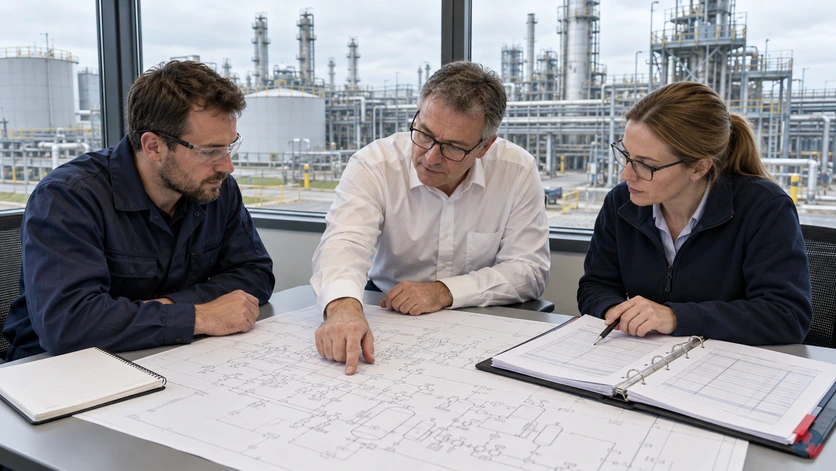
A loss-of-containment scenario connects causes and consequences to barriers. Each important barrier needs an owner, performance requirement, evidence and an impairment response.
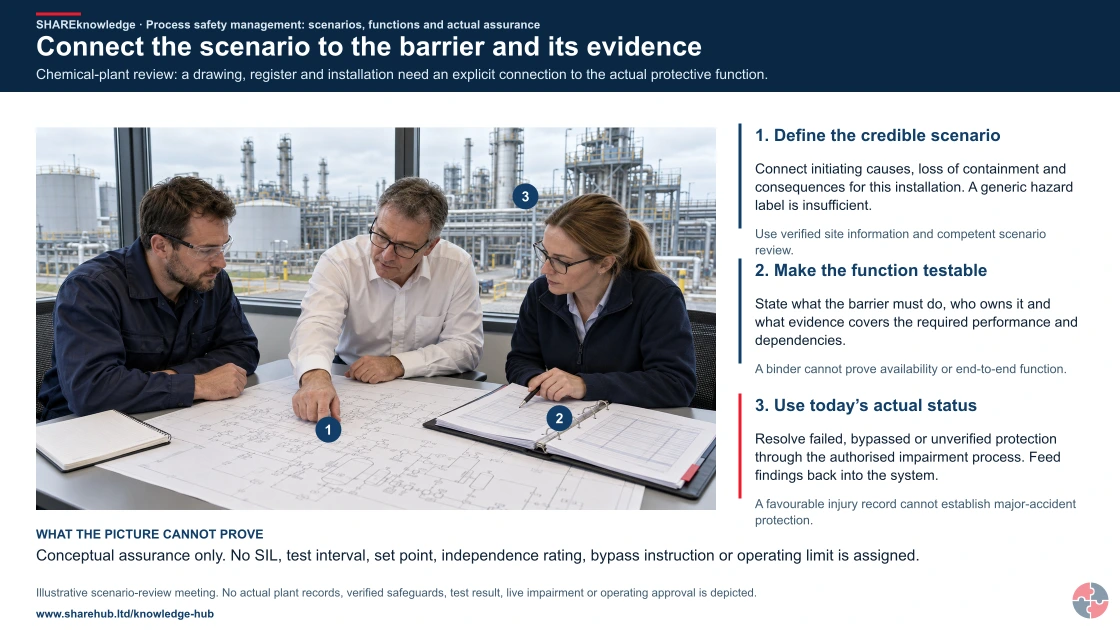
Connect the scenario to the barrier and its evidence
Full written explanation
Chemical-plant review: a drawing, register and installation need an explicit connection to the actual protective function.
- Define the credible scenario. Connect initiating causes, loss of containment and consequences for this installation. A generic hazard label is insufficient.
- Make the function testable. State what the barrier must do, who owns it and what evidence covers the required performance and dependencies.
- Use today’s actual status. Resolve failed, bypassed or unverified protection through the authorised impairment process. Feed findings back into the system.
Change the pathway
- The drawing is not the design basis. Use verified site information and competent scenario review.
- Document volume is not assurance. A binder cannot prove availability or end-to-end function.
- Personal-injury rates are separate. A favourable injury record cannot establish major-accident protection.
Evidence check: Conceptual assurance only. No SIL, test interval, set point, independence rating, bypass instruction or operating limit is assigned.
The actual overfill barrier and today’s operating decision
Primary references: HSE: process-safety assurance indicators — HSG254 · HSE: instrumented-system elements — verify the current design basis · HSE: managing for health and safety — HSG65
Open the complete HD image (new tab)Download image

The actual overfill barrier and today’s operating decision
Primary references: HSE: process-safety assurance indicators — HSG254 · HSE: instrumented-system elements — verify the current design basis · HSE: managing for health and safety — HSG65

Define the scenario
Describe the initiating causes, loss-of-containment event and credible consequences for this installation.
Set the barrier standard
Specify what each barrier must do and how competent evidence demonstrates it. Identify dependencies and accountable owners.
Manage impairment and learning
Hold or otherwise control the activity through the authorised impairment process, verify restoration and feed lessons back into the system.
A bypassed or unverified trip cannot be counted as available protection. This example assigns no SIL, design rating or operating limit.
What proves a process safety system is working today?
For a credible major-accident scenario, show the current hazard basis, the preventive and mitigative barriers, their owners and performance criteria, and the latest evidence that each works. A policy or incident-free period alone is insufficient.
| Barrier area | What good looks like | Evidence |
|---|---|---|
| Cause | Identify credible causes rather than vague hazards. | Scenario list. |
| Top event | Define the loss of control, release, ignition, explosion or failed decision point. | Bow-tie or fault tree. |
| Consequence | Describe escalation, harm, business impact and emergency interface. | Consequence analysis. |
| Prevention barriers | Controls that stop the top event occurring. | Barrier register and performance standards. |
| Mitigation barriers | Controls that limit consequences after the top event. | Proof tests, inspections and drill evidence. |
| Impairment controls | Bypasses, degraded safeguards and overdue tests are authorised and temporary controls set. | Impairment log. |
| ALARP record | Risk reduction decisions are documented and periodically reviewed. | ALARP decision record. |
A tank overfill scenario relies on level control, an independent high-high trip, operator response and bunding. Before transfer, operations checks the trip test and any override, maintenance resolves defects, and the responsible manager decides whether transfer can proceed. A failed or bypassed trip is a hold point, not a late dashboard exception.
Who needs to understand a process safety management system?
A PSM system needs to be understood by everyone who can affect major accident hazards, from operators to directors.
Who needs to understand a process safety management system? — part 1 of 3


Read the complete visual as text
- A PSM system needs to be understood by everyone…: A PSM system needs to be understood by everyone who can affect major accident hazards, from operators to directors.
- Operators: Need safe operating limits, alarm response, abnormal condition rules and authority to stop unsafe work.
- Supervisors: Need to manage shift handover, permits, simultaneous operations, competence and escalation.
Who needs to understand a process safety management system? — part 2 of 3


Read the complete visual as text
- Engineers and technical authorities: Need to own process safety information, design basis, hazard studies, safeguards and technical risk decisions.
- Maintenance and inspection teams: Need to protect asset integrity, safety critical equipment, backlog, isolations and handback.
Who needs to understand a process safety management system? — part 3 of 3


Read the complete visual as text
- Contractors: Need clear interface controls, induction, supervision and understanding of the hazards they can affect.
- Senior leaders: Need to resource barrier health, challenge weak signals and protect process safety from business pressure.
Operators
Need safe operating limits, alarm response, abnormal condition rules and authority to stop unsafe work.
Supervisors
Need to manage shift handover, permits, simultaneous operations, competence and escalation.
Engineers and technical authorities
Need to own process safety information, design basis, hazard studies, safeguards and technical risk decisions.
Maintenance and inspection teams
Need to protect asset integrity, safety critical equipment, backlog, isolations and handback.
Contractors
Need clear interface controls, induction, supervision and understanding of the hazards they can affect.
Senior leaders
Need to resource barrier health, challenge weak signals and protect process safety from business pressure.
How can I practise this topic in 3D?
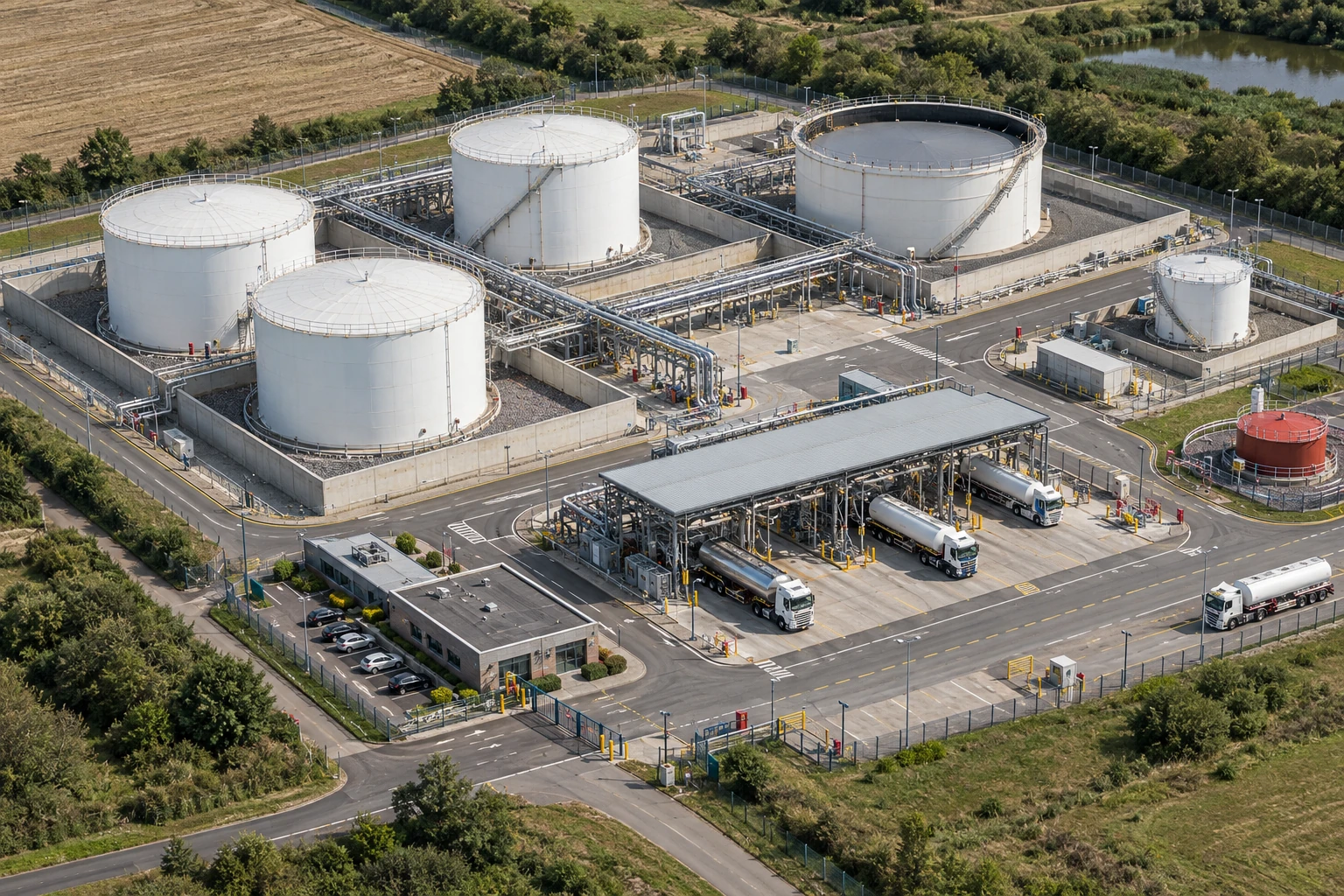

The dashboard counts injuries but misses failing barriers
All related inspection points 1 across 1 location
Crown Fuels terminal 1 inspection point
Practice in the SHAREhub environment. Browser practice is separate from workplace competence and formal learning records.
What are the key facts about establishing a process safety management system?
The key facts are that PSM is scenario-led, barrier-led and evidence-led.
Start with major accident scenarios
Define credible loss of containment, fire, explosion, toxic release, overpressure, runaway reaction and escalation events.
Know the hazardous inventory
A PSM system depends on understanding substances, energy, process chemistry, conditions and safe operating limits.
Define barriers clearly
Barriers need owners, performance standards, inspection or test evidence and impairment rules.
Manage the whole lifecycle
Design, commissioning, operation, maintenance, change, emergency response and decommissioning all affect risk.
Use indicators for control, not decoration
Process safety indicators should reveal barrier degradation and prompt leadership action.
Learn from weak signals
Small leaks, nuisance alarms, overrides, overdue actions and workarounds can indicate major accident control drift.
What is a process safety management system?
A process safety management system is the management framework used to control major accident hazards through reliable technical and organisational barriers.
PSM system purpose — part 1 of 2


Read the complete visual as text
- Understand hazards: What it means: Identify hazardous inventory, process conditions and credible scenarios. Evidence: Process safety information and hazard studies.
- Control risk: What it means: Select preventive, detection, control, mitigation and emergency barriers. Evidence: Barrier register and performance standards.
- Operate safely: What it means: Keep operation within the safe envelope. Evidence: Operating procedures, alarm response and shift logs.
PSM system purpose — part 2 of 2


Read the complete visual as text
- Maintain integrity: What it means: Keep safety critical equipment fit for purpose. Evidence: Inspection, testing and maintenance records.
- Control change: What it means: Review technical and organisational change before implementation. Evidence: MOC and pre-start-up review records.
- Learn and improve: What it means: Act on incidents, audits, indicators and weak signals. Evidence: Action tracker and management review.
A PSM system is not separate from operations. It should shape how the plant is designed, operated, maintained, modified, inspected, restarted and shut down. If it only appears in a policy, it is not established. See HSE COMAH 2015 overview.
The practical test is simple: can the site explain its major accident hazards, show the barriers relied on, prove those barriers are healthy today and demonstrate that leaders act when the evidence shows degradation?
The strongest systems join technical hazard understanding with management discipline. Hazard studies identify what can go wrong. Procedures, engineering standards, competence, maintenance, permits, MOC, emergency planning, indicators and audit make sure the controls stay real.
| Purpose | What it means | Evidence |
|---|---|---|
| Understand hazards | Identify hazardous inventory, process conditions and credible scenarios. | Process safety information and hazard studies. |
| Control risk | Select preventive, detection, control, mitigation and emergency barriers. | Barrier register and performance standards. |
| Operate safely | Keep operation within the safe envelope. | Operating procedures, alarm response and shift logs. |
| Maintain integrity | Keep safety critical equipment fit for purpose. | Inspection, testing and maintenance records. |
| Control change | Review technical and organisational change before implementation. | MOC and pre-start-up review records. |
| Learn and improve | Act on incidents, audits, indicators and weak signals. | Action tracker and management review. |
Why should the PSM system start with major accident scenarios?
The PSM system should start with scenarios because paperwork only matters if it controls a real route to a major accident.
Scenario-led PSM questions — part 1 of 2


Read the complete visual as text
- What can be released or go out of control?: Why it matters: Defines hazardous inventory and initiating events. Example evidence: Inventory register and process description.
- What is the top event?: Why it matters: Clarifies the loss of control to prevent. Example evidence: Bowtie or hazard study output.
- What prevents it?: Why it matters: Identifies preventive barriers. Example evidence: Design standards, alarms, trips and procedures.
Scenario-led PSM questions — part 2 of 2


Read the complete visual as text
- What detects it?: Why it matters: Identifies monitoring and response triggers. Example evidence: Gas detection, level alarms and operator rounds.
- What mitigates consequences?: Why it matters: Identifies emergency and consequence controls. Example evidence: Isolation, relief, deluge, bunds and emergency plans.
- How is barrier health known?: Why it matters: Turns assumptions into assurance. Example evidence: Tests, inspections, indicators and audits.
A generic checklist can miss the danger. A site storing flammable liquid needs to understand overfill, vapour formation, ignition, bund failure, firewater runoff and emergency response. A reactor site needs to understand runaway reaction, pressure relief, incompatible additions, cooling failure and emergency shutdown. A toxic gas system needs to understand detection, isolation, ventilation, shelter, evacuation and responder protection.
Once the scenario is defined, the organisation can ask better questions: what prevents the event, what detects it, what controls it, what limits consequences, what emergency actions are needed and what evidence proves each layer is healthy.
| Scenario question | Why it matters | Example evidence |
|---|---|---|
| What can be released or go out of control? | Defines hazardous inventory and initiating events. | Inventory register and process description. |
| What is the top event? | Clarifies the loss of control to prevent. | Bowtie or hazard study output. |
| What prevents it? | Identifies preventive barriers. | Design standards, alarms, trips and procedures. |
| What detects it? | Identifies monitoring and response triggers. | Gas detection, level alarms and operator rounds. |
| What mitigates consequences? | Identifies emergency and consequence controls. | Isolation, relief, deluge, bunds and emergency plans. |
| How is barrier health known? | Turns assumptions into assurance. | Tests, inspections, indicators and audits. |
Which core elements make up a process safety management system?
Core PSM elements cover knowledge, hazard analysis, operating control, competence, integrity, change, emergency response, audit and learning.
Best-practice guide: Establishing a process safety management system
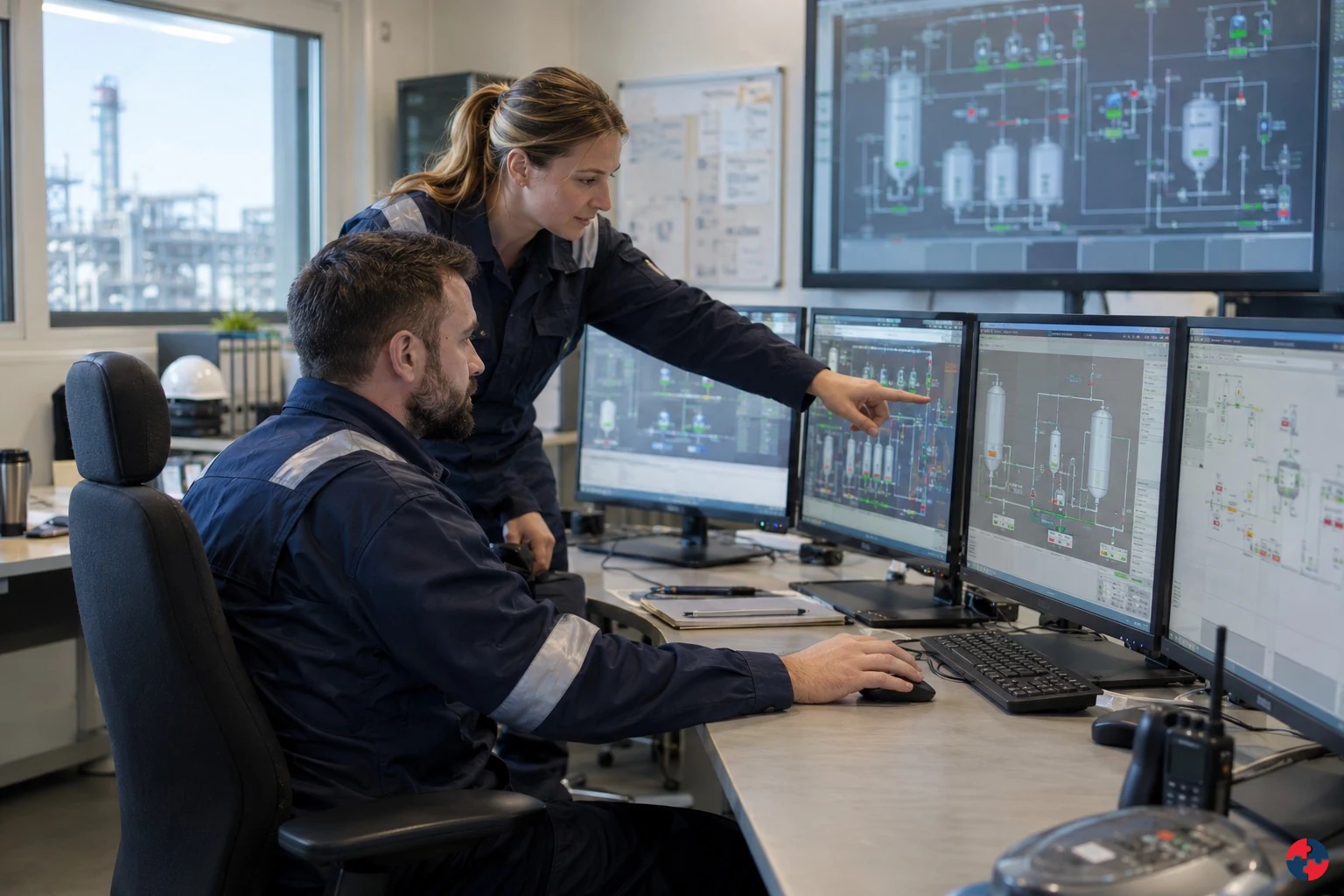
Which core elements make up a process safety management system?
Core PSM elements cover knowledge, hazard analysis, operating control, competence, integrity, change, emergency response, audit and learning. A process safety management system keeps major-accident hazards, safety-critical barriers and decision rights under control through the whole plant life.
Turn establishing a process safety management system knowledge into a decision
A process safety management system keeps major-accident hazards, safety-critical barriers and decision rights under control through the whole plant life. Start with credible release, fire, explosion and toxic scenarios; give each barrier a performance standard, owner and test; and make impairments, change, learning and restart decisions visible. Transfer log, proof-test record, bypass decision, defect action, owner, technical approval and hand-back record.
A decision that changes work
Monitor transfer against limits and respond to the defined alarm and trip sequence; communicate deviations at shift handover. Confirm final level, restore and test any temporary isolation, close permits and return barriers to normal status.
PSM warning signs
Overdue safety critical maintenance: A barrier may fail on demand. Repeated small leaks: Containment degradation becomes normal. Alarm floods or nuisance alarms: Operators may miss critical warnings.
Choose controls for establishing a process safety management system
Operating procedures: Clear normal, abnormal, start-up and shutdown instructions. Safe operating envelope: Defined limits and required response to exceedance. Shift handover: Hazards, impairments, permits, alarms and abnormal conditions communicated. Alarm response: Alarms are meaningful, prioritised and understood. Permit interfaces: Maintenance and operations share isolation and hazard information. Read the full control table for qualifications, ownership and verification. Use the actual task and applicable jurisdiction; existing technical approval remains unchanged.
Use the full establishing a process safety management system lesson
Use the full topic for the decision points, practical examples, detailed control tables and source scope. HSE guidance applies to Great Britain; use HSENI for the Northern Ireland route and the source’s stated jurisdiction. A simplified guide does not change the page’s technical-review or approval status.

Read all six steps as text
1. Which core elements make up a process safety management system?
Core PSM elements cover knowledge, hazard analysis, operating control, competence, integrity, change, emergency response, audit and learning.
- Avoid / redesign: Clear normal, abnormal, start-up and shutdown instructions.
- Control the task: Hazards, impairments, permits, alarms and abnormal conditions communicated.
- Verify before release: Field-verified procedures and revision history.
Core PSM elements cover knowledge, hazard analysis, operating control, competence, integrity, change, emergency response, audit and learning. A process safety management system keeps major-accident hazards, safety-critical barriers and decision rights under control through the whole plant life.
Apply it: Which part of this plan would you check at the workface before authorising the task?
2. Turn establishing a process safety management system knowledge into a decision
Use the evidence to improve the actual work arrangement.
- Change at source: Clear normal, abnormal, start-up and shutdown instructions.
- Make it observable: Field-verified procedures and revision history.
- Keep useful evidence: Transfer log, proof-test record, bypass decision, defect action, owner, technical approval and hand-back record.
A process safety management system keeps major-accident hazards, safety-critical barriers and decision rights under control through the whole plant life. Start with credible release, fire, explosion and toxic scenarios; give each barrier a performance standard, owner and test; and make impairments, change, learning and restart decisions visible. Transfer log, proof-test record, bypass decision, defect action, owner, technical approval and hand-back record.
Apply it: What evidence would show that the change improves this task, rather than only completing a record?
3. A decision that changes work
Example: a practical application of the existing topic lesson.
- Setting: Transfer of flammable liquid to a storage tank with credible overfill and vapour-release consequences.
- Act: Check inventory, level instrumentation, independent trip test, bypass register, operator response and containment condition.
- Hold / review: Do not transfer if a critical trip is bypassed, failed or unverified, or if the receiving capacity is uncertain.
Monitor transfer against limits and respond to the defined alarm and trip sequence; communicate deviations at shift handover. Confirm final level, restore and test any temporary isolation, close permits and return barriers to normal status.
Apply it: At which point would you hold this example, and what evidence would allow it to proceed?
4. PSM warning signs
Connect the task, the route to the person and the control that can fail.
- Overdue safety critical maintenance: A barrier may fail on demand.
- Repeated small leaks: Containment degradation becomes normal.
- Alarm floods or nuisance alarms: Operators may miss critical warnings.
Overdue safety critical maintenance: A barrier may fail on demand. Repeated small leaks: Containment degradation becomes normal. Alarm floods or nuisance alarms: Operators may miss critical warnings.
Apply it: Who could be exposed, including other trades, cleaners, maintainers and people nearby?
5. Choose controls for establishing a process safety management system
Start with the stronger practicable options and verify their effect.
- Operating procedures: Clear normal, abnormal, start-up and shutdown instructions.
- Safe operating envelope: Defined limits and required response to exceedance.
- Shift handover: Hazards, impairments, permits, alarms and abnormal conditions communicated.
- Alarm response: Alarms are meaningful, prioritised and understood.
- Permit interfaces: Maintenance and operations share isolation and hazard information.
Operating procedures: Clear normal, abnormal, start-up and shutdown instructions. Safe operating envelope: Defined limits and required response to exceedance. Shift handover: Hazards, impairments, permits, alarms and abnormal conditions communicated. Alarm response: Alarms are meaningful, prioritised and understood. Permit interfaces: Maintenance and operations share isolation and hazard information. Read the full control table for qualifications, ownership and verification. Use the actual task and applicable jurisdiction; existing technical approval remains unchanged.
Apply it: Which stronger option can be used here, and who will verify it before accepting the remaining risk?
6. Use the full establishing a process safety management system lesson
Follow the official sources below and retain the task-specific evidence.
- Official guidance: HSE COMAH 2015 overview
- Official guidance: HSENI COMAH overview
- Task decision: Transfer log, proof-test record, bypass decision, defect action, owner, technical approval and hand-back record.
Use the full topic for the decision points, practical examples, detailed control tables and source scope. HSE guidance applies to Great Britain; use HSENI for the Northern Ireland route and the source’s stated jurisdiction. A simplified guide does not change the page’s technical-review or approval status.
Apply it: Which official source and full-topic section will you use to resolve the next decision?
Different frameworks use different wording, but the substance is consistent. A site needs to know its hazards, control operations, maintain equipment, manage people and contractors, control change, prepare for emergencies and learn from evidence. See HSE COMAH 2015 overview.
The elements should not be isolated departments. A weak MOC can damage asset integrity. Poor competence can defeat procedures. Weak indicators can hide degraded barriers. Poor leadership can normalise overdue safety critical actions.
| Element | What it controls | Useful evidence |
|---|---|---|
| Process safety information | Hazardous substances, design basis, operating limits and equipment information. | P&IDs, SDS, relief basis, safe limits and drawings. |
| Hazard identification and risk analysis | Credible scenarios and safeguards. | HAZOP, LOPA, bowties and action records. |
| Operating procedures and safe systems | Normal, abnormal, start-up, shutdown and emergency operation. | Field-verified procedures and shift handover records. |
| Competence and training | People in safety critical roles and tasks. | Training matrix, assessments and authorisations. |
| Asset integrity | Safety critical equipment and containment. | Inspection, test, maintenance and backlog evidence. |
| Contractor and permit control | High-risk work interfaces. | PTW, isolation, induction and supervision records. |
| Management of change | Technical, procedural, organisational and temporary change. | MOC screening, risk review and approval. |
| Emergency planning | Response to credible major accident scenarios. | Exercises, learning and plan updates. |
| Audit and review | System effectiveness and improvement. | Audit reports, indicators and leadership decisions. |
How should a site implement a PSM system step by step?
Implementation should build from hazard understanding to barrier ownership, operating control, assurance and management review.
A site should not launch PSM as a branding exercise. Start with the major accident hazard profile and build the system around the controls that actually stop or limit those events.
Implementation needs a realistic plan. The organisation may already have many pieces: HAZOPs, permits, procedures, inspections and emergency plans. The work is to connect them, test them and close the gaps.
| Step | Action | Output |
|---|---|---|
| 1. Define scope | Identify processes, inventories, substances, energy sources and COMAH status. | PSM scope and hazard profile. |
| 2. Identify scenarios | Define credible major accident scenarios and escalation paths. | Major accident scenario register. |
| 3. Map barriers | List preventive, detection, control, mitigation and emergency barriers. | Barrier register and bowties. |
| 4. Assign ownership | Name owners for barriers, elements and risk acceptance decisions. | Responsibility matrix and technical authority rules. |
| 5. Set standards | Define performance requirements, test frequencies and impairment rules. | Barrier performance standards. |
| 6. Gather evidence | Connect procedures, tests, inspections, competence and indicators. | Assurance plan and dashboards. |
| 7. Audit and review | Sample field reality, close actions and review weak signals. | Audit programme and leadership review. |
How should barriers be defined and assured?
Barriers should be defined by their role in the scenario, their performance requirement and the evidence that proves they work.
A barrier name alone is weak. 'Alarm' is not enough. The system needs to know which alarm, what condition it detects, who responds, how much time is available, whether response is realistic, how the alarm is tested and what happens if it is bypassed or impaired.
The best barrier registers separate prevention, detection, control, mitigation and emergency response. They also distinguish engineered barriers from human or procedural barriers because their reliability and assurance needs differ.
| Barrier type | Examples | Assurance evidence |
|---|---|---|
| Prevention | Design, containment, incompatible separation, safe operating limits. | Design review, inspection and operating envelope checks. |
| Detection | Level alarms, gas detection, pressure alarms and operator rounds. | Functional tests, alarm response records and calibration. |
| Control | Trips, interlocks, emergency shutdown, isolation and relief. | Proof tests, bypass controls and impairment review. |
| Mitigation | Bunds, deluge, firewater containment, blast protection and ventilation. | Inspection, scenario drills and maintenance. |
| Emergency response | Incident command, evacuation, shelter, firefighting and mutual aid. | Exercises, debriefs and plan updates. |
| Organisational | Competence, supervision, permit control and technical authority. | Assessments, audits and decision records. |
Illustrative seven-step decision route; this is a SHARE teaching example, not a prescribed legal checklist.
| Step | Action | Check | Failure mode | Hold point |
|---|---|---|---|---|
| Define hazard | Identify inventory, initiating event, release and affected people/environment. | Process-safety lead validates the scenario basis. | A generic risk register omits credible escalation. | Hold design or operation until major scenarios are stated. |
| Prevent | Prefer inventory reduction and independent overfill prevention. | Engineering verifies design basis and proof test. | A shared instrument can defeat both control layers. | Do not operate with an unassessed preventive barrier loss. |
| Detect | Set alarms and independent trips with known response time. | Operations checks test and bypass status before transfer. | Alarm overload or bypass removes warning. | Stop transfer when the critical trip is unavailable. |
| Mitigate | Provide suitable containment and emergency isolation. | Emergency and engineering teams test reachable actions. | Bund or isolation may be impaired by maintenance. | Hold operation when the mitigation basis is false. |
| Operate | Use limits, competence, permits and shift handover. | Supervisor samples actual records and field practice. | Production pressure normalises deviation. | Escalate limit excursion and pause unsafe work. |
| Change | Apply MOC to plant, software, staffing and temporary changes. | Technical authority approves revised risk and hand-back. | A temporary bypass can become permanent. | No restart before changed barriers are verified. |
| Assure | Review leading indicators, tests, actions and near misses. | Leader traces one scenario to current barrier evidence. | A green dashboard can conceal overdue safety-critical tests. | Reopen risk when tests or actions are overdue. |
Why is process safety information essential?
Process safety information is essential because people cannot operate, maintain or modify a hazardous process safely if the basis of safety is missing, wrong or not understood.
Process safety information includes chemical hazards, reaction hazards, inventories, design codes, equipment data, P&IDs, relief basis, safe operating limits, cause and effect logic, hazardous area information and emergency assumptions.
Poor information creates hidden risk. If drawings are out of date, operating limits are unclear, relief assumptions are unknown or plant modifications are not reflected in procedures, people may unknowingly defeat the basis of safety.
| Information type | Why it matters | Control check |
|---|---|---|
| Hazardous properties | Defines fire, explosion, toxic, reactive and environmental hazards. | SDS and chemical hazard review. |
| Design basis | Explains why equipment and safeguards are suitable. | Controlled design file and calculations. |
| P&IDs and drawings | Support operation, isolation, maintenance and emergency response. | Drawing control and field verification. |
| Safe operating limits | Define the envelope that should not be exceeded. | Operating procedures and alarm settings. |
| Safety critical equipment data | Supports inspection, testing and maintenance. | Equipment register and performance standards. |
| Emergency assumptions | Define response time, isolation and mitigation expectations. | Emergency plan and exercise evidence. |
How should operating discipline be managed?
Operating discipline should keep the process within the safe envelope during normal, abnormal, start-up, shutdown and emergency conditions.
Operating procedures should be usable. If they are too long, out of date, unclear or not matched to field conditions, people will create informal workarounds. A good PSM system field-verifies procedures with operators and includes what to do when conditions are abnormal.
Shift handover, alarm management, permit interfaces and start-up control deserve special attention because major accidents often occur when the plant is not in steady state.
| Control | What good looks like | Evidence |
|---|---|---|
| Operating procedures | Clear normal, abnormal, start-up and shutdown instructions. | Field-verified procedures and revision history. |
| Safe operating envelope | Defined limits and required response to exceedance. | Operating limits and excursion records. |
| Shift handover | Hazards, impairments, permits, alarms and abnormal conditions communicated. | Handover logs and supervisor checks. |
| Alarm response | Alarms are meaningful, prioritised and understood. | Alarm rationalisation and response training. |
| Permit interfaces | Maintenance and operations share isolation and hazard information. | PTW, isolation and handback records. |
| Stop-work authority | Workers can pause work when barrier status is uncertain. | Stop-work examples and leadership response. |
How does asset integrity fit into the PSM system?
Asset integrity keeps containment, safety critical equipment and protective systems reliable throughout the asset lifecycle.
Asset integrity is where process safety often becomes visible: corrosion, inspection deferrals, overdue relief valve tests, temporary repairs, leaking seals, impaired firewater systems and maintenance backlog all tell leaders whether the plant is drifting.
The PSM system should classify safety critical equipment, define inspection and test requirements, manage impairments, review backlog as major accident risk and prevent production pressure from normalising degraded safeguards.
| Area | PSM expectation | Evidence |
|---|---|---|
| Safety critical equipment | Identify equipment that prevents or mitigates major accidents. | SCE register and performance standards. |
| Inspection and testing | Complete tests at required frequency and quality. | Inspection reports and proof test results. |
| Maintenance backlog | Review overdue work for major accident risk. | Backlog risk review and escalation. |
| Temporary repairs | Risk assess, approve, time-limit and monitor. | Temporary repair register. |
| Impairments and bypasses | Control and communicate unavailable safeguards. | Bypass log and compensating measures. |
| Ageing plant | Identify degradation mechanisms and long-term replacement needs. | Integrity review and lifecycle plan. |
How should competence, contractors and human factors be built into PSM?
PSM depends on people who are competent, authorised, supported and given systems that are usable under real operating conditions.
Training attendance is not competence. Competence needs practical assessment, refreshers, supervision and clear authorisation for safety critical roles and tasks.
Contractors can affect major accident risk through maintenance, isolation, hot work, excavation, lifting, cleaning, inspection, testing and shutdown work. The host site must set rules, communicate hazards, verify competence and supervise interfaces.
Human factors should be designed into the system. Procedures, alarms, control rooms, staffing, fatigue, workload, communication and handover all shape whether people can respond reliably when barriers are challenged.
| Role | Learning | Demonstration | Assessor | Record | Reassess when |
|---|---|---|---|---|---|
| Operator | Know process limits and stop points | Respond to overfill scenario | Shift lead | Drill and log | Change or alarm |
| Supervisor | Manage bypass and safe restart | Review test and permit | PSM lead | Decision log | Impairment |
| Engineer | Own barrier performance basis | Trace one safeguard | Technical authority | Design/test file | MOC |
| Maintenance | Restore safety-critical assets | Demonstrate test and hand-back | Engineering lead | Work order | Defect |
| Emergency lead | Exercise credible escalation | Run scenario drill | Site manager | Exercise record | Plan change |
| Director | Challenge high-consequence barrier health | Trace scenario to evidence | Independent assurance | Board action | Backlog |
Why is management of change central to PSM?
Management of change is central because apparently small technical, procedural or organisational changes can weaken major accident barriers.
Change includes plant modifications, temporary repairs, control logic changes, chemicals, operating limits, procedures, staffing, contractors, suppliers, software, alarm settings, inspection intervals and organisational structure.
A strong MOC process screens for process safety impact before implementation, uses competent review, updates documents, trains affected people, completes pre-start-up safety review where needed and verifies that actions are closed.
| Change type | Possible PSM impact | Control |
|---|---|---|
| Equipment change | Design basis, relief, materials or isolation may change. | Technical review and drawing update. |
| Operating limit change | Safe envelope may be altered. | Hazard review and procedure update. |
| Control system change | Trips, alarms or interlocks may be affected. | Cause and effect review and testing. |
| Organisational change | Competence, supervision or technical authority may weaken. | Organisation risk assessment. |
| Temporary change | Short-term workaround may become normal. | Expiry date, review and compensating measures. |
| Restart after change | Hazards may not be ready for operation. | Pre-start-up safety review. |
How should process safety indicators be used?
Process safety indicators should show whether major accident controls are healthy, degrading or failing.
HSG254 is useful because it encourages organisations to measure the health of controls over major hazard risks. Indicators should be tied to specific barriers and scenarios, not selected because data is easy to count. See HSE developing process safety indicators.
Leading indicators might track overdue safety critical maintenance, proof test completion, MOC action closure, alarm floods, impaired safeguards or emergency drill actions. Lagging indicators might track leaks, releases, fires, trips, demands on safeguards or process safety events.
| Indicator type | Example | Leadership question |
|---|---|---|
| Leading | Percentage of safety critical inspections completed on time. | Are we maintaining barriers before demand? |
| Leading | Overdue MOC safety actions. | Are changes being closed safely? |
| Leading | Number of impaired safeguards with expired review dates. | Are temporary risk acceptances drifting? |
| Lagging | Loss of containment events by severity. | Which barriers failed and why? |
| Lagging | Demands on relief, trips or emergency shutdown. | Are initiating events increasing? |
| Weak signal | Alarm floods, nuisance trips or repeated permit findings. | What common degradation pattern is emerging? |
How should PSM audit and management review work?
PSM audit and review should test field reality, barrier health, action effectiveness and leadership decisions.
A process safety audit should not only ask whether procedures exist. It should sample real jobs, maintenance history, barrier tests, MOC records, alarm response, emergency drills, action closure evidence and whether workers understand critical controls. See HSE managing for health and safety.
Management review should focus on major accident risk. Injury rates alone do not prove process safety. Leaders need to see barrier health, high-risk actions, risk acceptances, overdue safety critical work, weak signals and learning from incidents.
| Assurance level | Typical activity | Output |
|---|---|---|
| First line | Supervisors and operators check permits, isolations, rounds, handover and barrier status. | Field checks and immediate corrections. |
| Second line | HSSE, engineering and technical authorities audit PSM elements and barrier evidence. | Findings, ranked actions and trend review. |
| Third line | Independent internal or external specialist reviews test system effectiveness. | Formal audit report and leadership action plan. |
| Management review | Senior leaders review indicators, impairments, actions and risk acceptance. | Decisions, resources and escalation. |
| Regulator engagement | COMAH inspections, safety report review or regulatory findings. | Regulator correspondence and verified response. |
How should emergency planning connect to the PSM system?
Emergency planning should be based on credible major accident scenarios, not generic evacuation arrangements alone.
Emergency plans should reflect the hazardous inventory and possible escalation. For a fuel terminal, this may include tank fire, bund fire, vapour cloud explosion, firewater runoff and neighbouring impacts. For a toxic process, it may include release detection, isolation, shelter, evacuation, public communication and responder protection.
Exercises should test incident command, communication, isolation, mutual aid, responder access, environmental protection and recovery. Learning should feed back into the PSM system.
| Emergency element | PSM link | Evidence |
|---|---|---|
| Scenario basis | Plans match credible major accident scenarios. | Emergency planning scenarios and HSG191 alignment. |
| Detection and alarm | People know when to activate response. | Alarm tests and response drills. |
| Isolation and mitigation | Source control is understood and practicable. | Valve maps, ESD tests and exercises. |
| Incident command | Roles, authority and communication are clear. | Exercise debriefs and training records. |
| Environmental protection | Firewater and pollutants are controlled where relevant. | Containment plan and drill learning. |
| Recovery and learning | Restart and investigation are controlled. | Recovery plan and action tracker. |
Which major accident shows why PSM systems matter?
Buncefield shows why a PSM system must control routine operations through reliable barriers, leadership and learning.
At Buncefield in December 2005, a fuel storage depot suffered massive explosions and a large fire after a tank overfilled during a transfer operation. More than 40 people were injured, a large area was evacuated, the fire burned for several days and there was extensive damage to the site and surrounding property.
The process safety lesson is not only 'avoid overfill'. The wider lesson is that routine operations can become major accident scenarios when hazardous inventory, level control, independent overfill protection, alarm response, supervision, leadership attention and learning are weak. A PSM system should have made tank overfill a clearly owned major accident scenario with defined barriers, testing, indicators, escalation and management review.
For a modern site, Buncefield should trigger direct questions: which tanks or vessels could overfill, which independent layers prevent it, how are alarms tested, what happens if instrumentation is impaired, how do operators know the safe limit, what indicators would show drift and how do leaders respond to overdue actions?
| PSM area | What failed as a learning theme | Modern assurance question |
|---|---|---|
| Hazard recognition | A routine transfer had major accident potential. | Is each credible overfill or loss-of-containment scenario registered? |
| Independent protection | Reliance on level control and overfill protection proved weak. | Are independent safeguards tested and impairment-controlled? |
| Operating discipline | Operators needed clear limits, alarms and response expectations. | Can operators explain what to do before the safe limit is exceeded? |
| Indicators | Weak signals and degraded control should have been visible. | Which indicators reveal barrier degradation before an event? |
| Leadership | Major hazard risk needed stronger senior attention. | Do leaders review barrier health, not only personal injury data? |
| Learning | Industry learning needed translating into local action. | Can the site prove lessons have changed standards and field practice? |
Which UK legal duties apply to process safety management systems?
Select the current duty by site nation, dangerous-substance inventory, establishment tier and activity. Great Britain legislation does not automatically govern Northern Ireland.
For qualifying sites, lower-tier operators prepare a major accident prevention policy (MAPP) and implement a safety management system; upper-tier operators have additional safety-report duties. Check the separate GB and NI regimes and the actual inventory before assuming a site’s tier.
| Where | Instrument or rule | Practical boundary |
|---|---|---|
| Great Britain | Control of Major Accident Hazards Regulations 2015 | GB major-accident prevention and mitigation duties for qualifying establishments. |
| Northern Ireland | Control of Major Accident Hazards Regulations (Northern Ireland) 2015 | NI major-accident duties, MAPP, SMS, safety reports and tier boundaries. |
| Great Britain | Health and Safety at Work etc. Act 1974 | GB general work-safety duties |
| Northern Ireland | Health and Safety at Work (Northern Ireland) Order 1978 | NI general work-safety duties |
| Great Britain | Management of Health and Safety at Work Regulations 1999 | GB risk assessment and prevention arrangements |
| Northern Ireland | Management of Health and Safety at Work Regulations (Northern Ireland) 2000 | NI risk assessment and prevention arrangements |
| Great Britain | Dangerous Substances and Explosive Atmospheres Regulations 2002 | GB dangerous-substance fire and explosion risk duties. |
| Northern Ireland | Dangerous Substances and Explosive Atmospheres Regulations (Northern Ireland) 2003 | NI dangerous-substance fire and explosion risk duties. |
COMAH applies only where dangerous-substance thresholds and other scope tests are met; ordinary health and safety duties remain relevant elsewhere. Verify the current tier and site-specific regulator requirements before assigning MAPP or safety-report work.
What should be in a major accident hazard and barrier register?
A major accident hazard register should connect scenarios, initiating events, barriers, owners, assurance evidence and escalation rules.
A normal risk register often hides process safety because it collapses complex scenarios into broad words such as 'fire' or 'chemical release'. A PSM register should describe the scenario clearly enough for operators, engineers and leaders to understand what prevents it.
The register should be live. If a barrier is impaired, a test is overdue, a temporary repair is accepted or a change is proposed, the risk status should update.
| Field | What to record | Example |
|---|---|---|
| Scenario | Credible major accident event. | Tank overfill leading to vapour cloud and ignition. |
| Initiating events | What could start loss of control. | Transfer continues after high level. |
| Preventive barriers | Controls that prevent the top event. | Independent high-high level trip and operator response. |
| Mitigative barriers | Controls that limit consequences. | Bund, firewater, emergency isolation and incident command. |
| Owner | Person or function accountable for barrier health. | Operations manager, asset integrity lead or technical authority. |
| Performance standard | What the barrier must do and how often it is tested. | Trip proof test interval and response time. |
| Assurance | Evidence that the barrier is healthy. | Test records, inspections, audit and indicators. |
| Escalation | What happens when the barrier is degraded. | Impairment approval, compensating measure and risk review. |
How could Crownway Fuels Ltd establish a PSM system?

Crownway Fuels Ltd could establish a PSM system by building every process safety element around credible fuel storage and transfer major accident scenarios.
Test scope must cover the protective function
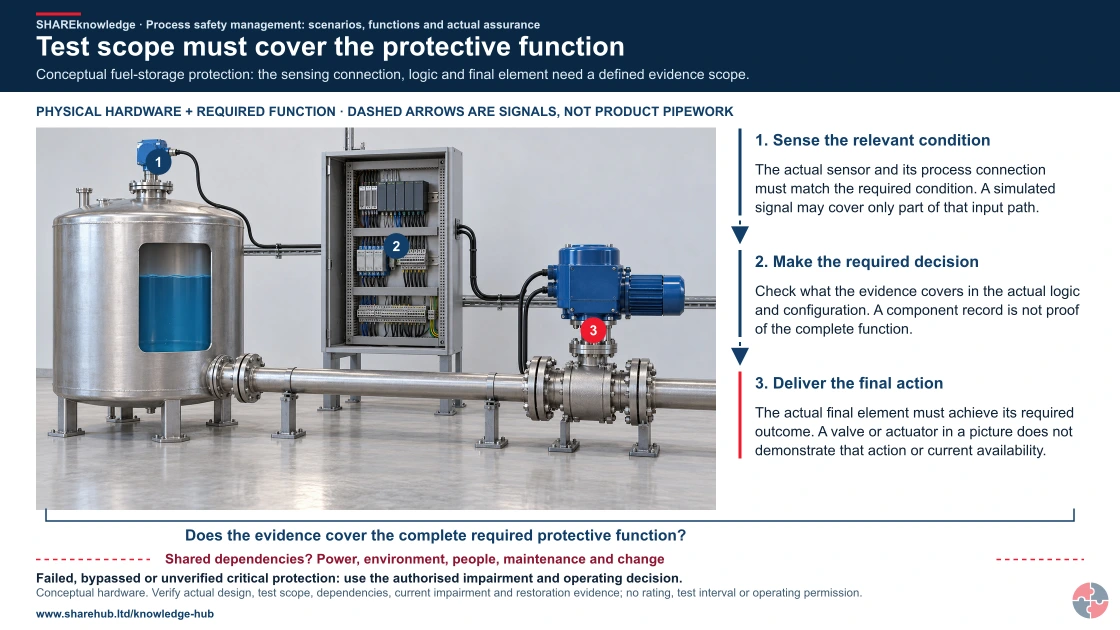
Full written explanation
A new realistic HD conceptual hardware scene shows a storage vessel and roof-mounted sensing housing on the left, an open logic/module enclosure in the centre, and a motor-actuated inline valve on the right. A continuous lower material pipe links the valve to the vessel; separate dark cables illustrate electrical connections, not a wiring specification. Three native numbered labels connect the physical sensing/process interface, the decision logic/configuration and the required final action. Dashed native arrows represent signals, not product pipework. A bracket asks whether competent evidence covers the complete required protective function, while a separate dependency band identifies shared power, environment, people, maintenance and change. The actual scenario, performance basis, test scope, impairment and restoration decision remain necessary; an isolated component test or a convincing-looking arrangement cannot establish available end-to-end protection. The illustration gives no engineered isolation/protection scheme, valve position, set point, SIL, independence rating, test interval, proof-test procedure, bypass instruction or permission to transfer/restart. The already-HD chemical-plant scenario-review pathway remains unchanged.
Conceptual fuel-storage protection: the sensing connection, logic and final element need a defined evidence scope.
- State the requirement. Define the actual scenario, required function and performance basis; do not infer them from a symbol or test label.
- Check the evidence scope. Ask what the competent test actually covered: sensing, logic, final action and relevant dependencies.
- Resolve current impairment. Use the actual status and authorised impairment decision. A failed or unverified critical function changes reliance on it now.
- Restore and learn. Verify restoration within the real change/release process and feed defects, ownership and assurance gaps back into management.
When the evidence does not fit: A bypassed, failed or unverified function cannot be assumed available. Use the actual authorised impairment and operating decision; this chain supplies no bypass or restart permission.
Who acts: Barrier/equipment owner, competent verifier, shift/operations decision owner and the process-safety management lead.
Changed workplace
Chemical-plant scenario: Join causes, consequences, function and accountable evidence.
Fuel-terminal barrier: Check test scope and current status before relying on protection.
Evidence check: Conceptual assurance only. No SIL, test interval, set point, independence rating, bypass instruction or operating limit is assigned.
The actual overfill barrier and today’s operating decision
Primary references: HSE: process-safety assurance indicators — HSG254 · HSE: instrumented-system elements — verify the current design basis · HSE: managing for health and safety — HSG65
Open the complete HD image (new tab)Download image

The actual overfill barrier and today’s operating decision
Primary references: HSE: process-safety assurance indicators — HSG254 · HSE: instrumented-system elements — verify the current design basis · HSE: managing for health and safety — HSG65
Crownway Fuels Ltd (worked example). a fuel storage and distribution business with bulk tanks, tanker loading, hazardous areas, contractors, maintenance, transfer operations, DSEAR risks and COMAH-style major accident hazard controls.
Crownway would start with its hazardous inventory: petrol, diesel, additives, vapours, tanks, pipework, pumps, loading arms, drainage, electrical equipment and ignition sources. The site would define its credible scenarios, including tank overfill, bund fire, vapour cloud formation, tanker loading release, pump seal failure, static ignition, hot work ignition, firewater runoff and contractor damage to containment.
For each scenario, Crownway would define barriers and owners. Operations would own operating limits, alarms, handover and transfer procedures. Engineering would own design basis, level instrumentation, proof testing, hazardous area equipment and relief or isolation systems. Maintenance would own safety critical equipment, backlog and impairments. HSSE would coordinate PSM indicators, audits, emergency exercises and learning. Senior leaders would review barrier health, risk acceptances and resourcing.
The business would avoid treating PSM as one department's paperwork. Procurement would specify compatible equipment and competent contractors. Planning would control simultaneous operations. HR and training would manage safety critical competence. Finance and leadership would understand that deferred inspection or staffing reduction can become major accident risk.
| Management element | How Crownway would apply it | Evidence produced |
|---|---|---|
| Assess and analyse | Build a major accident hazard register for tanks, transfers, loading, vapours, ignition and drainage. | Scenario register, bowties and DSEAR assessment. |
| Implement barriers | Define overfill protection, alarms, trips, operating limits, bunds, fire protection and emergency response. | Barrier register and performance standards. |
| Train and authorise | Assess competence for operators, supervisors, permit issuers, maintainers and contractors. | Competence matrix and authorisations. |
| Manage contractors | Pre-qualify, induct, supervise and audit contractors who affect containment or ignition control. | Contractor bridging rules, PTW records and audits. |
| Control change | Screen technical, organisational, procedural and temporary changes for PSM impact. | MOC records and pre-start-up reviews. |
| Check and audit | Use first-line checks, second-line PSM audits and independent specialist reviews. | Audit findings, action tracker and verification evidence. |
| Learn and improve | Review leaks, alarm issues, near misses, drill findings and Buncefield learning. | Leadership review pack and updated standards. |
A decision that changes work
Task, material and setting: Transfer of flammable liquid to a storage tank with credible overfill and vapour-release consequences.
People and prerequisites: Operator, supervisor, instrument engineer, maintenance and process-safety lead; current transfer limits and barrier status are available.
Before: Check inventory, level instrumentation, independent trip test, bypass register, operator response and containment condition.
During: Monitor transfer against limits and respond to the defined alarm and trip sequence; communicate deviations at shift handover.
Hold or stop: Do not transfer if a critical trip is bypassed, failed or unverified, or if the receiving capacity is uncertain.
Completion and hand back: Confirm final level, restore and test any temporary isolation, close permits and return barriers to normal status.
Evidence: Transfer log, proof-test record, bypass decision, defect action, owner, technical approval and hand-back record.
How does establishing a PSM system support NEBOSH PSM study?
This topic supports NEBOSH PSM by showing how major accident prevention is organised, assured and improved.
A strong answer should not describe a generic health and safety policy. It should identify major accident hazards, hazardous inventory, credible scenarios, safety critical barriers, competence, asset integrity, MOC, emergency planning, indicators and leadership review.
Scenario questions often ask what a site should do after weak indicators, repeated leaks, permit failures, maintenance deferrals, alarm problems or organisational change. The answer should connect those weak signals to barrier health and management review.
| Study area | What to explain | Scenario application |
|---|---|---|
| PSM purpose | Prevent and mitigate major accidents through a structured system. | Explain why injury rates do not prove process safety. |
| Hazard understanding | Inventory, process conditions and credible scenarios. | Identify top events and escalation routes. |
| Barrier assurance | Owners, standards, testing and impairment control. | Request evidence of barrier health. |
| MOC | Change can degrade safeguards. | Screen organisational or technical change. |
| Indicators | Leading and lagging indicators reveal control health. | Create indicators linked to barriers. |
| Accident learning | Buncefield and similar events show interacting failures. | Translate lessons into local audit questions. |
How do management frameworks support this topic?
HSE’s Plan–Do–Check–Act guidance helps assign ownership, deliver controls, check evidence and improve weak arrangements. Apply the relevant legal duties and task-specific technical evidence separately.
Official management guidance: HSE Managing for health and safety (HSG65)
| Framework | Status and scope | Contribution | Limit |
|---|---|---|---|
| HSE HSG65 | GB regulator management guidance | Plan, do, check and act with evidence of current control | Apply to the actual high-consequence scenario. |
What are the warning signs that a PSM system is failing?
Warning signs include degraded barriers, weak signals, poor ownership, overdue safety critical actions and leadership focus on the wrong data.
PSM failure rarely appears as one dramatic warning. It usually appears as normalised drift: repeated small leaks, nuisance alarms, overdue inspections, bypassed safeguards, incomplete MOC, temporary repairs, vague risk acceptances and poor action closure.
The danger is that each issue is closed locally without asking whether the major accident barrier system is degrading.
| Warning sign | How it can lead to harm | Response |
|---|---|---|
| Overdue safety critical maintenance | A barrier may fail on demand. | Escalate backlog as major accident risk. |
| Repeated small leaks | Containment degradation becomes normal. | Trend, investigate and fix root causes. |
| Alarm floods or nuisance alarms | Operators may miss critical warnings. | Review alarm performance and response. |
| Temporary repairs without expiry | Temporary risk becomes permanent. | Apply MOC and impairment control. |
| MOC actions closed on paper only | Change may proceed with unresolved risk. | Verify physical and procedural completion. |
| Leadership reviews injury rates only | Major accident risk may be invisible. | Add barrier health and PSM indicators. |
| Contractors unclear on hazards | High-risk work can defeat site controls. | Strengthen induction, PTW and supervision. |
What do the acronyms and key terms mean?
Acronyms should be explained because process safety pages use specialist legal, engineering and management language.
| Term | Meaning |
|---|---|
| COMAH | Control of Major Accident Hazards. |
| DSEAR | Dangerous Substances and Explosive Atmospheres Regulations. |
| ESD | Emergency Shutdown. |
| HAZOP | Hazard and Operability study. |
| HSG | Health and Safety Guidance publication. |
| LOPA | Layers of Protection Analysis. |
| MAPP | Major Accident Prevention Policy. |
| MOC | Management of Change. |
| P&ID | Piping and Instrumentation Diagram. |
| PSM | Process Safety Management. |
| PSSR | Pre-start-up Safety Review. |
| SCE | Safety Critical Equipment. |
| SMS | Safety Management System. |
Explore the Crownway Fuels hierarchy
Start at the company policy and follow a branch from duties and responsibilities to procedures and evidence.
Choose a document to see why it is used, who owns it, which duties it supports and what evidence it should produce. Switch to Text hierarchy for a list of expandable branches.
Fictional Crownway Fuels examples for English forecourts, with a separate illustrative bulk terminal. Check site applicability, permissions and actual controls before adapting any document for use.
Loading the Crownway register…
Which Crownway Fuels documents support this topic?
Open an editable document, read the preview, or find its place in the Crownway hierarchy. 10 resources relate to this page.
Fictional Crownway Fuels examples for English forecourts, with a separate illustrative bulk terminal. Check site applicability, permissions and actual controls before adapting any document for use.
Major accident prevention policy (9)
- Major accident prevention policy (CWF-POL-COMAH · Completed fictional example)
Document the lower-tier MAPP, approved commitments and organisational arrangements implemented through a proportionate SMS.
Read preview · Download DOCX · Show in hierarchy - Major accident prevention and proportionate safety management procedure (CWF-PRO-COMAH · Completed fictional example)
Explain who does what, in what sequence, the control rationale, evidence, escalation and safe restart conditions.
Read preview · Download DOCX · Show in hierarchy - Lower tier COMAH MAPP and SMS implementation plan (CWF-PLN-COMAH-01 · Completed fictional example)
Provide the site/task-specific lower tier comah mapp and sms implementation plan and retain its controlled output.
Read preview · Download DOCX · Show in hierarchy - Major accident hazard and scenario register (CWF-REG-COMAH-01 · Blank register with separate fictional worked entries)
Provide the site/task-specific major accident hazard and scenario register and retain its controlled output.
Read preview · Download XLSX · Show in hierarchy - Major accident risk and barrier evaluation (CWF-RA-COMAH-01 · Blank editable master)
Provide the site/task-specific major accident risk and barrier evaluation and retain its controlled output.
Read preview · Download DOCX · Show in hierarchy - Safety critical elements and performance standards register (CWF-REG-COMAH-02 · Blank register with separate fictional worked entries)
Provide the site/task-specific safety critical elements and performance standards register and retain its controlled output.
Read preview · Download XLSX · Show in hierarchy - COMAH notification and public information review record (CWF-FRM-COMAH-01 · Blank editable master)
Provide the site/task-specific comah notification and public information review record and retain its controlled output.
Read preview · Download DOCX · Show in hierarchy - MAPP and SMS effectiveness audit (CWF-AUD-COMAH-01 · Blank editable master)
Provide the site/task-specific mapp and sms effectiveness audit and retain its controlled output.
Read preview · Download DOCX · Show in hierarchy - MAPP five yearly and material change review (CWF-FRM-COMAH-02 · Blank editable master)
Provide the site/task-specific mapp five yearly and material change review and retain its controlled output.
Read preview · Download DOCX · Show in hierarchy
Worked example for the illustrative bulk terminal (1)
- Fuel terminal major accident prevention policy (CWF-MAPP-TERM-01 · Completed fictional example)
Shows the terminal’s policy, responsibilities and arrangements for major accident prevention.
Read preview · Download DOCX · Download PDF · Show related branch