SHARE Knowledge Hub
Fire Classification, Extinguishing Media and Portable Fire-Fighting Equipment
Fire classification helps identify what can burn and why a portable extinguisher may be unsafe, ineffective or beyond a person’s role. The risk assessment must consider the actual fuel, mixed hazards, people, escape and equipment limitations. Prevent ignition, raise the alarm and evacuate first; use portable firefighting only as a trained, very limited response when the local plan and a safe retreat allow it.
Understanding Fire Classification, Extinguishing Media and Portable Fire-Fighting Equipment
Fire classification helps identify what can burn and why a portable extinguisher may be unsafe, ineffective or beyond a person’s role. The risk assessment must consider the actual fuel, mixed hazards, people, escape and equipment limitations. Prevent ignition, raise the alarm and evacuate first; use portable firefighting only as a trained, very limited response when the local plan and a safe retreat allow it.
Why this matters at work
Compare the agent’s fire performance with visibility loss, inhalation, contamination, confined-space conditions and the effects on escape. Consider the foreseeable user and the people nearby as well as the fuel class. Obtain competent selection advice and ensure the product is suitable for the actual risk. Do not replace one unsuitable agent with another based only on colour coding. Record the selection basis and retain evacuation as the priority when intervention could worsen exposure.
Base provision and siting on the assessment, actual hazards, accessibility and safe approach. Keep equipment visible and reachable without passing through a fire, and ensure users can identify the intended equipment. Check condition and arrange competent maintenance under the applicable programme and manufacturer requirements. Record faults and replace or restore provision promptly. Do not invent a universal spacing or quantity from a generic answer; site geometry, ratings, special hazards and the relevant guidance must be considered together.
How organisations manage this in practice
Discharged or defective equipment changes the provision available to the premises. Control that impairment and restore suitable coverage rather than returning a partly used unit to its bracket. The fire itself may leave concealed heat, contaminated surfaces or damaged services. Equipment servicing, incident investigation and safe reoccupation are separate decisions that all need appropriate evidence.
Available equipment must be suitable, identifiable, accessible and in satisfactory condition for the planned role. Its provision and maintenance need the actual hazard and premises information. Checks should detect missing, damaged, discharged or obstructed units and lead to action. Quantity, siting and maintenance requirements should not be reduced to an unsupported universal figure.
Identify what is actually burning and any energised equipment or reactive material involved before choosing an agent. UK classes are A for ordinary solid combustibles such as wood and paper, B for liquids or liquefiable solids, C for gases, D for metals and F for cooking oils and fats. Electrical equipment is an additional hazard rather than a separate UK fire class. Check the product’s rating, instructions and limitations and the site plan. Classification supports selection; it does not authorise intervention, prove agent compatibility with every chemical or remove the need for a clear escape route.
Use the class as recognition, then decide whether intervention is permitted
A fuel-class table helps identify a hazard; it does not grant permission to tackle it. Check the actual material and any mixed hazards, equipment instructions, local emergency plan, training, isolation conditions and withdrawal route. If the fuel, suitable medium, competence or escape is uncertain, raise the alarm and withdraw under the plan instead of experimenting.
Best-practice guide: Fire Classification, Extinguishing Media and Portable Fire-Fighting Equipment

Use the class as recognition, then decide whether intervention is permitted
A fuel-class table helps identify a hazard; it does not grant permission to tackle it. Check the actual material and any mixed hazards, equipment instructions, local emergency plan, training, isolation conditions and withdrawal route. Fire classification helps identify what can burn and why a portable extinguisher may be unsafe, ineffective or beyond a person’s role.
Turn fire classification, extinguishing media and portable fire-fighting equipment knowledge into a decision
Fire classification helps identify what can burn and why a portable extinguisher may be unsafe, ineffective or beyond a person’s role. The risk assessment must consider the actual fuel, mixed hazards, people, escape and equipment limitations. Class A/electrical risk considered and signed.
Mixed workplace media worked example
Office: Class A/electrical risk considered and signed. Kitchen: Class F media, blanket and staff training.
Where does portable firefighting equipment management fail?
It fails when equipment is copied from a standard layout instead of selected for actual fire risk and maintained as a live control.
Choose controls for the actual task
Elimination: Remove avoidable ignition and fuel before the task starts. Substitution: Use a less hazardous product or method where feasible. Engineering: Physically separate the electrical equipment and liquid-fuel work so one ignition cannot involve both hazards. Administrative: Train staff on media limits, escape-first decisions and inspection. PPE: Firefighting PPE never authorises untrained attack on a growing fire. Read the full control table for qualifications, ownership and verification. Use the actual task and applicable jurisdiction; existing technical approval remains unchanged.
Use the full fire classification, extinguishing media and portable fire-fighting equipment lesson
Use the full topic for the decision points, practical examples, detailed control tables and source scope. HSE guidance applies to Great Britain; use HSENI for the Northern Ireland route and the source’s stated jurisdiction. A simplified guide does not change the page’s technical-review or approval status.

Read all six steps as text
1. Use the class as recognition, then decide whether intervention is permitted
A fuel-class table helps identify a hazard; it does not grant permission to tackle it.
- Avoid / redesign: Remove avoidable ignition and fuel before the task starts.
- Control the task: Physically separate the electrical equipment and liquid-fuel work so one ignition cannot involve both hazards.
- Verify before release: Stop or redesign if wrong media or blocked escape.
A fuel-class table helps identify a hazard; it does not grant permission to tackle it. Check the actual material and any mixed hazards, equipment instructions, local emergency plan, training, isolation conditions and withdrawal route. Fire classification helps identify what can burn and why a portable extinguisher may be unsafe, ineffective or beyond a person’s role.
Apply it: Which part of this plan would you check at the workface before authorising the task?
2. Turn fire classification, extinguishing media and portable fire-fighting equipment knowledge into a decision
Use the evidence to improve the actual work arrangement.
- Change at source: Remove avoidable ignition and fuel before the task starts.
- Make it observable: Stop or redesign if wrong media or blocked escape.
- Keep useful evidence: Class A/electrical risk considered and signed.
Fire classification helps identify what can burn and why a portable extinguisher may be unsafe, ineffective or beyond a person’s role. The risk assessment must consider the actual fuel, mixed hazards, people, escape and equipment limitations. Class A/electrical risk considered and signed.
Apply it: What evidence would show that the change improves this task, rather than only completing a record?
3. Mixed workplace media worked example
Example: a practical application of the existing topic lesson.
- Office: Class A/electrical risk considered and signed.
- Kitchen: Class F media, blanket and staff training.
- Workshop: FRA links fire class, hot work and storage controls.
Office: Class A/electrical risk considered and signed. Kitchen: Class F media, blanket and staff training.
Apply it: At which point would you hold this example, and what evidence would allow it to proceed?
4. Where does portable firefighting equipment management fail?
Connect the task, the route to the person and the control that can fail.
- Source / exposure: It fails when equipment is copied from a standard layout instead of selected for actual fire risk and maintained as a live control.
- Possible consequence: Common failures include wrong media, obstructed extinguishers, missing service tags, no staff training, equipment moved after cleaning or contractor work, fire blankets hidden in cupboards and extinguishers installed where people cannot reach them safely.
- Control failure: The presence of extinguishers can create a false sense of control if ignition sources, fuel loading, detection, escape and compartmentation are weak.
It fails when equipment is copied from a standard layout instead of selected for actual fire risk and maintained as a live control.
Apply it: Who could be exposed, including other trades, cleaners, maintainers and people nearby?
5. Choose controls for the actual task
Control summary. Read the complete task-specific controls and checks in the linked topic.
- Elimination: Remove avoidable ignition and fuel before the task starts.
- Substitution: Use a less hazardous product or method where feasible.
- Engineering controls: Physically separate the electrical equipment and liquid-fuel work so one ignition cannot involve both hazards.
- Administrative controls: Train staff on media limits, escape-first decisions and inspection.
- PPE: Firefighting PPE never authorises untrained attack on a growing fire.
Elimination: Remove avoidable ignition and fuel before the task starts. Substitution: Use a less hazardous product or method where feasible. Engineering: Physically separate the electrical equipment and liquid-fuel work so one ignition cannot involve both hazards. Administrative: Train staff on media limits, escape-first decisions and inspection. PPE: Firefighting PPE never authorises untrained attack on a growing fire. Read the full control table for qualifications, ownership and verification. Use the actual task and applicable jurisdiction; existing technical approval remains unchanged.
Apply it: Which stronger option can be used here, and who will verify it before accepting the remaining risk?
6. Use the full fire classification, extinguishing media and portable fire-fighting equipment lesson
Follow the official sources below and retain the task-specific evidence.
- Official guidance: GOV.UK fire risk assessment
- Official guidance: GOV.UK fire safety risk assessment: offices and shops
- Task decision: Raise the alarm, leave and obtain emergency assistance when the fire, media, competence or route is uncertain. No chart authorises entry into smoke.
Use the full topic for the decision points, practical examples, detailed control tables and source scope. HSE guidance applies to Great Britain; use HSENI for the Northern Ireland route and the source’s stated jurisdiction. A simplified guide does not change the page’s technical-review or approval status.
Apply it: Which official source and full-topic section will you use to resolve the next decision?
A solvent spill beside live electrical equipment combines flammable liquid and electrical involvement, so one extinguisher label cannot settle the response. A cooking-oil fire presents a different fuel and medium limitation; do not transfer the solvent decision to it. Pressurised containers, batteries and specialist chemical fires remain on their dedicated emergency routes. The priority is people reaching safety, not protecting stock.
Two fires, no transferable permission
Illustrative example. A workshop solvent spill involves live equipment; separately a kitchen has a cooking-oil fire.
Decision. Staff use their local plan and trained limits, raise the alarm and withdraw whenever the intervention conditions are not satisfied.
Evidence to check. Known fuel, equipment status, medium limitations, training, authority and a continuously safe retreat.
Hold or escalation point. Do not approach an uncertain mixed hazard or remain when smoke or fire threatens withdrawal.
Follow-up. After the incident, the competent fire lead reviews equipment selection, prevention and staff decision-making.
Recognition comes before any decision to intervene
UK fire classes describe fuels; electrical involvement is a separate equipment and shock hazard. A class label alone does not establish a safe firefighting action.
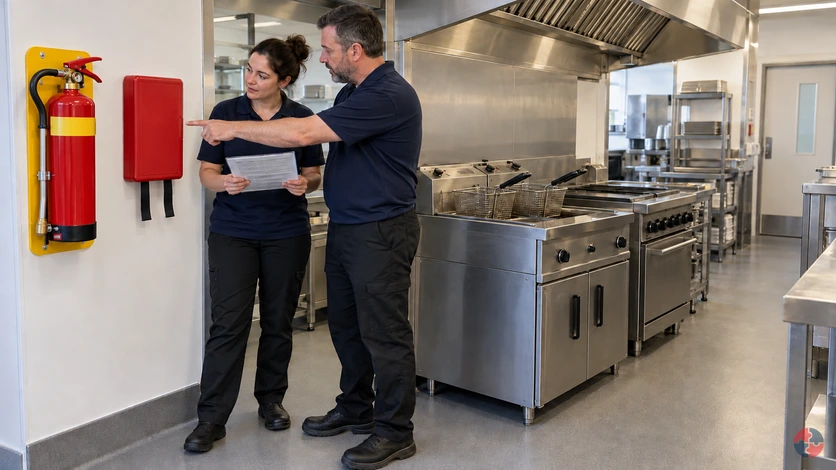
A kitchen appliance and a yellow band do not settle the decision
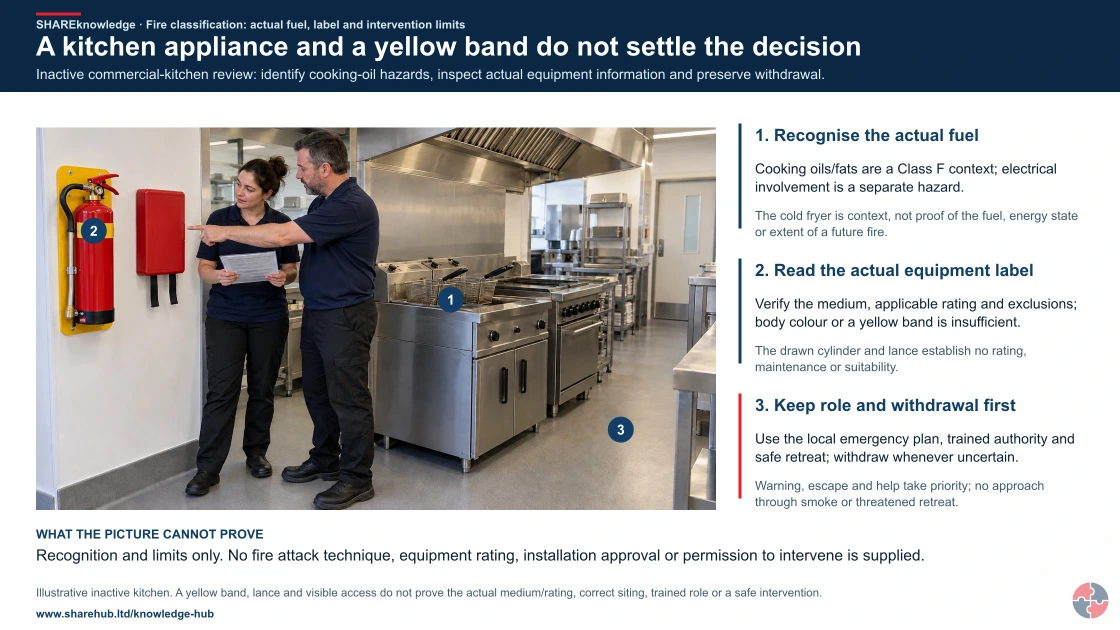
Full written explanation
The new inactive commercial-kitchen scene marks the cold fryer, wall-mounted red cylinder with yellow band and application lance, and the visible access area. A closed blanket case and two staff reviewing an inert sheet supply context. The lance was corrected against the retained SHARE wet-chemical equipment reference. No readable medium/rating, suitable installation, active fire, training or continuously safe escape is proven. The checks identify the actual fuel, use the real product label and restrictions and keep role and escape limits first.
Inactive commercial-kitchen review: identify cooking-oil hazards, inspect actual equipment information and preserve withdrawal.
- Recognise the actual fuel. Cooking oils/fats are a Class F context; electrical involvement is a separate hazard.
- Read the actual equipment label. Verify the medium, applicable rating and exclusions; body colour or a yellow band is insufficient.
- Keep role and withdrawal first. Use the local emergency plan, trained authority and safe retreat; withdraw whenever uncertain.
Change the pathway
- A still is not the incident. The cold fryer is context, not proof of the fuel, energy state or extent of a future fire.
- Recognition is not performance. The drawn cylinder and lance establish no rating, maintenance or suitability.
- Equipment does not grant a role. Warning, escape and help take priority; no approach through smoke or threatened retreat.
Evidence check: Recognition and limits only. No fire attack technique, equipment rating, installation approval or permission to intervene is supplied.
Keep fuel recognition separate from the intervention decision
Primary references: Scottish Government: existing non-residential fire-safety guidance · GOV.UK: offices and shops — equipment and actual fire risk · Scottish Fire and Rescue: never put water on burning fat/oil
Open the complete HD image (new tab)Download image

Keep fuel recognition separate from the intervention decision
Primary references: Scottish Government: existing non-residential fire-safety guidance · GOV.UK: offices and shops — equipment and actual fire risk · Scottish Fire and Rescue: never put water on burning fat/oil

Recognise the context
Identify the fuel and possible electrical involvement without approaching an unsafe fire; do not import overseas class meanings.
Use the actual equipment label
Selection depends on the assessed fire risks, media limits, suitable equipment and competent maintenance, not cylinder body colour alone.
Keep escape first
Only trained and authorised people consider a limited intervention within the emergency plan and with a safe escape route.
Withdraw when uncertain
Raise the alarm, leave and obtain emergency assistance when the fire, media, competence or route is uncertain. No chart authorises entry into smoke.
Read the complete task-specific control examples
ERICPD is a planning cross-map: Discipline verifies and sustains every control. ESEAP compares effectiveness. A label does not authorise the task; retain the owner, evidence and stop or change decision.
Fire Classification, Extinguishing Media and Portable Fire-Fighting Equipment · ERICPD
- Eliminate
- Remove avoidable ignition and fuel before the task starts.
- Reduce
- Use a less hazardous product or method where feasible.
- Isolate
- Physically separate the electrical equipment and liquid-fuel work so one ignition cannot involve both hazards.
- Control
- Train staff on media limits, escape-first decisions and inspection.
- PPE
- Firefighting PPE never authorises untrained attack on a growing fire.
- Discipline
- Verify fire-risk assessment, equipment labels, servicing and drill outcomes.
Fire Classification, Extinguishing Media and Portable Fire-Fighting Equipment · ESEAP
- Elimination
- Remove avoidable ignition and fuel before the task starts.
- Substitution
- Use a less hazardous product or method where feasible.
- Engineering controls
- Physically separate the electrical equipment and liquid-fuel work so one ignition cannot involve both hazards.
- Administrative controls
- Train staff on media limits, escape-first decisions and inspection.
- PPE
- Firefighting PPE never authorises untrained attack on a growing fire.
Why does fire classification matter?
Fire classification links what is burning to the extinguishing media that may be safe and effective.
Different fires behave differently because fuels, temperatures, oxygen supply and reactions differ. A paper fire, a flammable liquid fire, a gas flame, a burning metal and a deep-fat fryer fire need different thinking. Selecting the wrong media can make the fire worse, spread fuel, create shock risk, react violently or expose the user to smoke and heat.
Portable firefighting equipment is a support control. It is not the foundation of fire safety and it is not a substitute for preventing ignition, controlling fuel, maintaining escape routes, installing suitable detection and warning, training staff and calling the fire and rescue service where needed.
A good fire risk assessment explains why the equipment is suitable: the likely classes of fire, size of possible fire, people expected to use it, equipment location, travel routes, public access, maintenance regime and whether specialist advice is needed.
| Fire class or scenario | Typical fuel | Selection issue |
|---|---|---|
| Class A | Wood, paper, textiles and many ordinary solids. | Water or foam may be suitable where electrical or special hazards are not present. |
| Class B | Flammable liquids such as petrol, solvents, paints or oils. | Foam, CO2 or powder may be needed; water jet can spread burning liquid. |
| Class C | Flammable gases. | Priority is isolation of gas supply; extinguishing without isolation can allow explosive atmosphere. |
| Class D | Combustible metals. | Needs specialist media; ordinary extinguishers can react dangerously. |
| Class F | Cooking oils and fats. | Wet chemical media is typically used; water can cause violent boil-over. |
| Electrical equipment | Energised equipment or electrical cabinets. | Isolate where possible; choose media suitable for electrical risk. |
What can a fire class tell you, and what can it not?
A class identifies a broad burning-fuel family; it does not establish that an individual should attack the fire or that one medium is safe for a mixed hazard.
Class A is ordinary solid combustibles; B is flammable liquids; C is flammable gases; D is combustible metals; F is cooking fats and oils. Energised electrical involvement is a separate condition, not a UK fire class. Battery systems may combine stored electrical energy, flammable electrolyte, toxic smoke and re-ignition, so a simple class label is not an adequate response plan.
Assess fuel quantity, container, ventilation, pressure, enclosure, adjacent materials, people, escape, likely growth and post-discharge effects. One area may contain packaging, solvent and live equipment; a single pictogram cannot settle the incident response. Raise the alarm and prioritise escape before considering portable equipment.
Do not treat an aerosol container or pressurised gas jet as a small ordinary Class B or C fire. Heating can rupture an aerosol, while extinguishing a gas flame without safe fuel isolation can leave an unignited release. Raise the alarm, withdraw, communicate the inventory and leave isolation and response to the site emergency plan and competent responders.
How should extinguishing media and equipment be selected?
Selection should follow the fire risk assessment, fuel class, equipment risk, user capability and maintenance needs.
Extinguishers should be chosen because they suit the likely fire, not because a standard set is copied from another building. Offices, kitchens, laboratories, workshops, battery charging areas, warehouses and construction sites create different fire classes and user risks.
The assessment should also consider what happens after discharge. Dry powder may be effective on some fires but can reduce visibility and contaminate equipment. CO2 leaves no residue but has limited cooling and can create asphyxiation concerns in small spaces. Foam and wet chemical need to match the fuel and appliance. Specialist metal fires need competent advice.
| Media/equipment | Where it may help | Limitations and cautions |
|---|---|---|
| Water | Ordinary Class A solids. | Not for live electrical equipment, flammable liquids or metal fires. |
| Foam | Some Class A and Class B liquid risks. | Must suit the liquid; can be unsuitable for electrical or reactive materials. |
| CO2 | Electrical equipment and some small liquid fires. | Limited cooling; discharge horn can freeze; not ideal outdoors or deep-seated fires. |
| Dry powder | Some liquid, gas and electrical scenarios. | Visibility, inhalation, residue and indoor use limitations need assessment. |
| Wet chemical | Class F cooking oil fires. | Selected for fryers and cooking oil; user training still needed. |
| Specialist metal media | Combustible metal fires. | Needs specific match to metal and competent advice. |
| Fire blanket | Small pan or clothing fire scenarios. | Needs correct use and realistic siting. |
How should extinguishing-media choice be checked?
Use the fire assessment, equipment label and competent selection advice for the actual fuel and premises; never improvise a medium during a fire.
Water can spread some burning liquids or react with certain materials; a conductive stream can create electrical risk. Foam, powder, carbon dioxide, wet chemical and specialist metal media also have limits linked to fuel, ventilation, visibility, toxicity, cooling, re-ignition and clean-up. Media suitability on paper does not make it safe for staff to approach.
A competent person should select, position, commission and maintain portable extinguishers for the actual premises and fire assessment. The linked government premises guidance does not establish requirements for motor vehicles, aircraft, caravans or marine craft; those settings need their own applicable advice. Equipment instructions and the local response plan govern safe use. A selection or maintenance record never supplies a universal permission to fight a fire.
Which extinguisher matches the fire, and what parts should I recognise?
Identify the fuel and additional electrical hazard, read the actual extinguisher label and follow the site fire plan. Raise the alarm and protect escape first; only trained, authorised people should consider a small initial fire within their safe response limits.
Which fire extinguisher is suitable for each type of fire?Fire classes · agent types · dangerous mismatches
 Recognise the fuel. Read the extinguisher. Protect your escape.
UK awareness reference for common and specialist portable extinguisher families. Actual ratings, exclusions and manufacturer instructions govern each unit. Reading this guide is not practical training or permission to fight a fire. Fixed systems, hose reels and specialist industrial firefighting require their own assessed arrangements.
What is burning? Understand the fire classes
Class L is the 2026 addition to the classification standard. Existing extinguisher labels and product test claims vary; a new class name does not certify every battery product.
Extinguisher types: uses and dangers
These are typical applications, not universal permissions. Check the label on the actual unit. Images are AI-generated photorealistic teaching illustrations inspired by the referenced equipment; they are not photographs or certified product labels. Use Inspect the parts to explore the hardware. Band, nozzle and label details vary.
| Type and recognition | Typical rating and use | Wrong use: what can go wrong? |
|---|---|---|
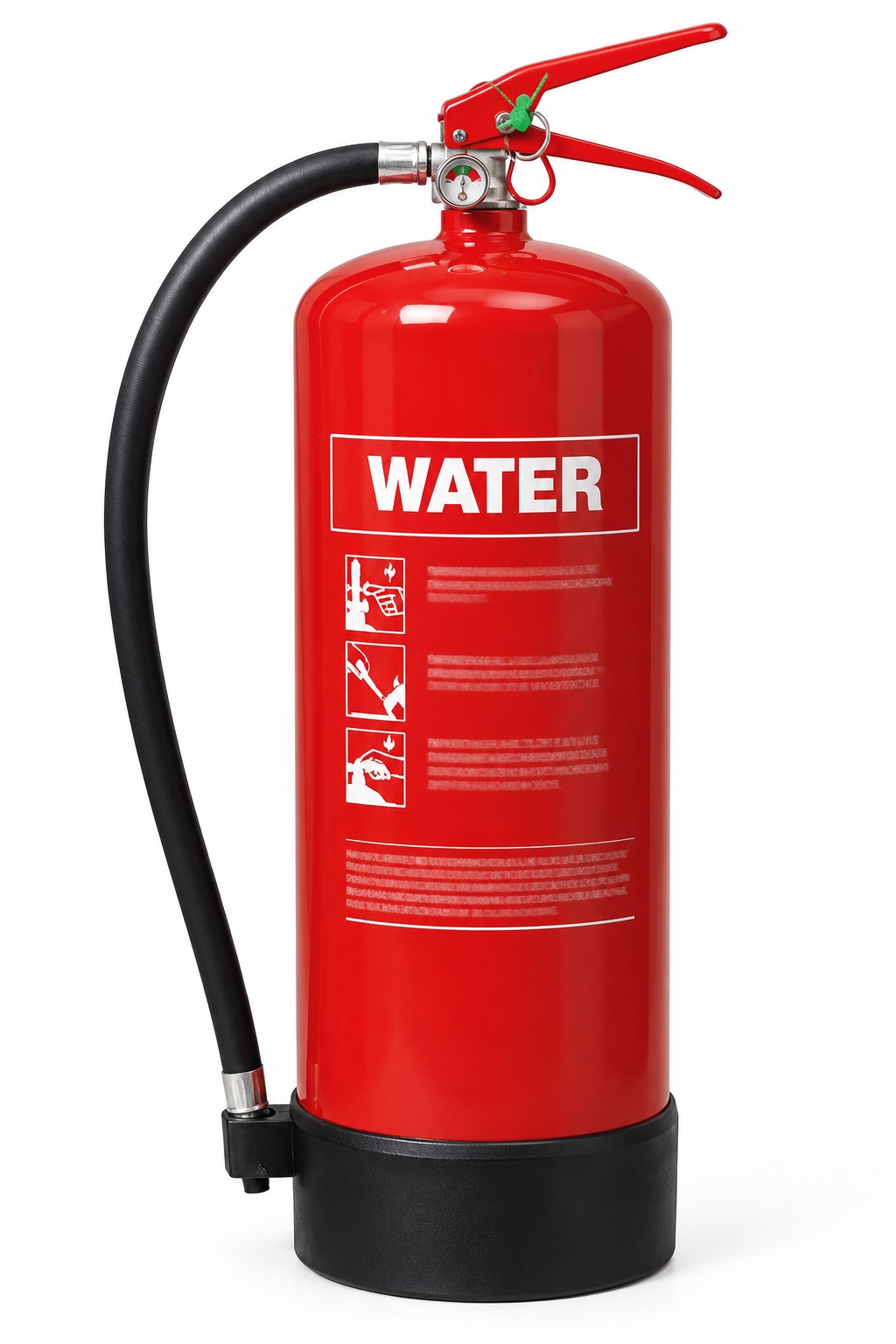  | Normally A Cools burning solid material such as paper, wood or fabric. | Check the limitation Ordinary water is unsuitable for live electrical equipment, flammable-liquid pools, cooking oil and reactive metals: shock, spreading fuel or violent reaction can result. |
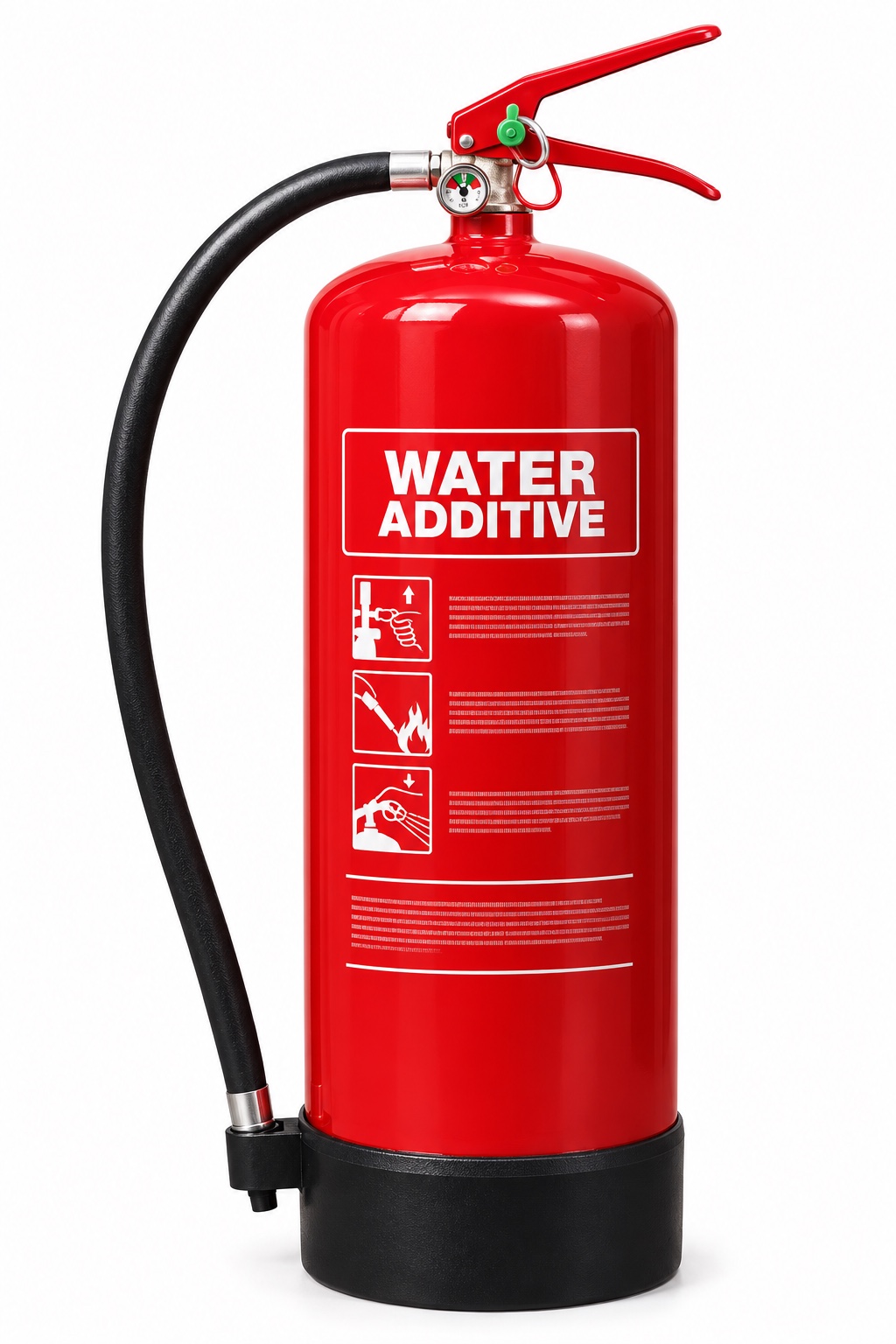 | A; B only if explicitly rated Improved wetting or spray performance can help on the hazards stated on that model’s label. | Check the limitation An additive does not make every water extinguisher safe for electricity, oils or reactive chemicals. Check the specific exclusions. |
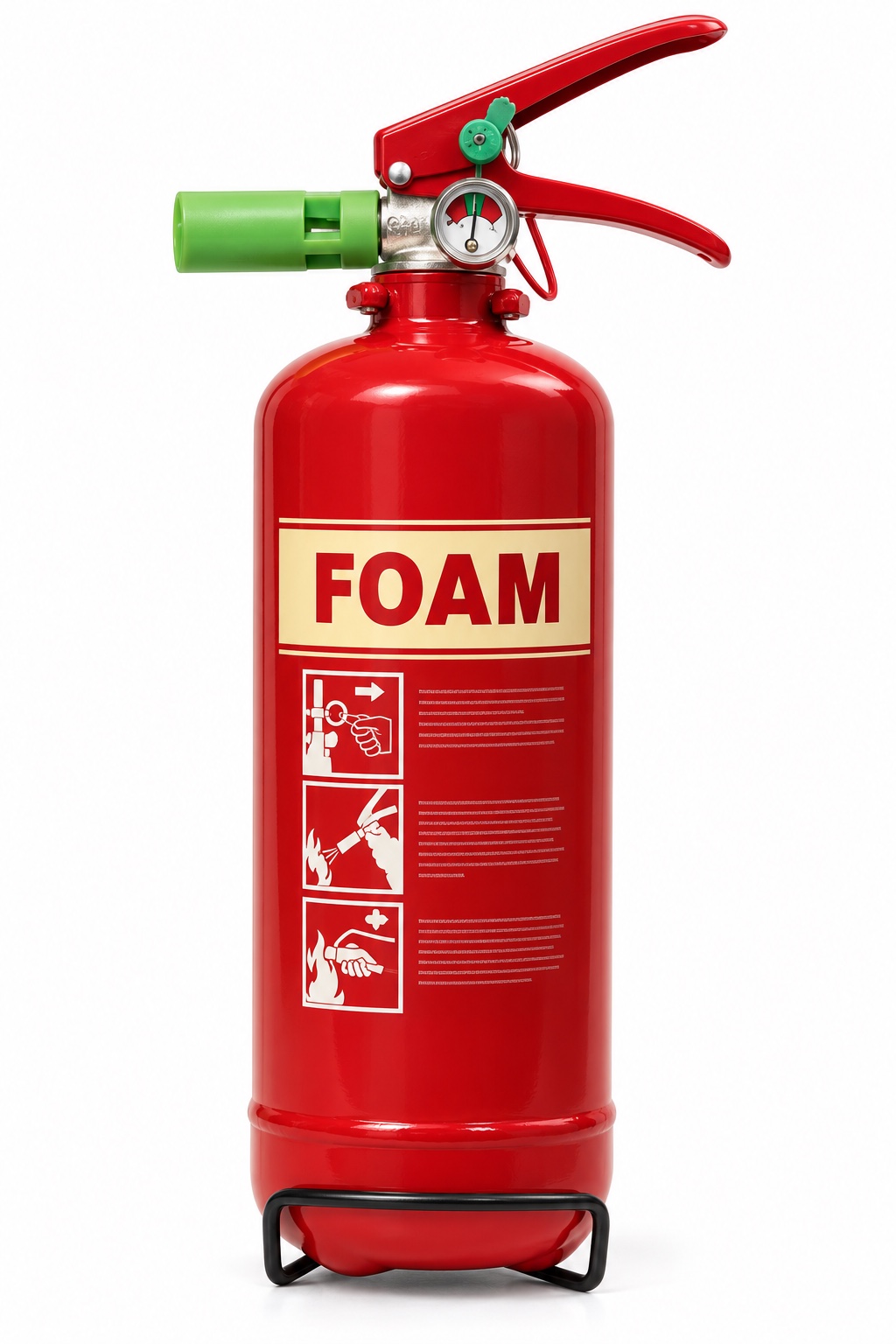 | Commonly A and B Cools and forms a surface blanket on suitable liquid fires. The agent must suit the actual fuel; some alcohols need alcohol-resistant foam. | Check the limitation Ordinary foam is not a general answer for live electricity, cooking oil or metal fires. Unsuitable foam may break down on a solvent; a jet can spread fuel. Free-flowing fuel needs specialist response. |
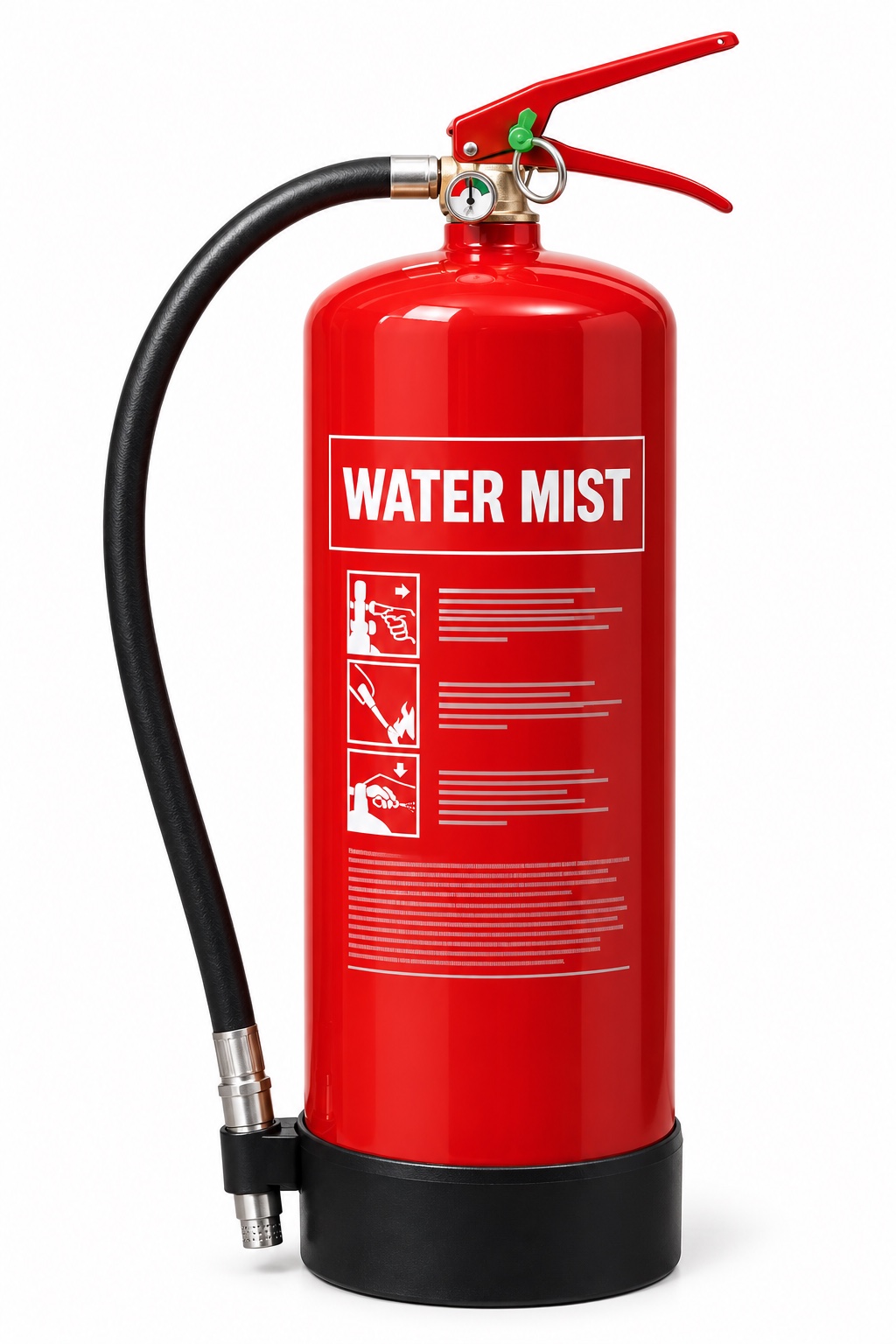 | Model-specific; commonly A, some F Fine droplets absorb heat. Some products have additional ratings or tested electrical suitability, with stated voltage and distance conditions. | Check the limitation ‘Mist’ is not universal approval. Use only the classes and electrical conditions actually declared for that model; do not assume it covers metals, liquids or batteries. |
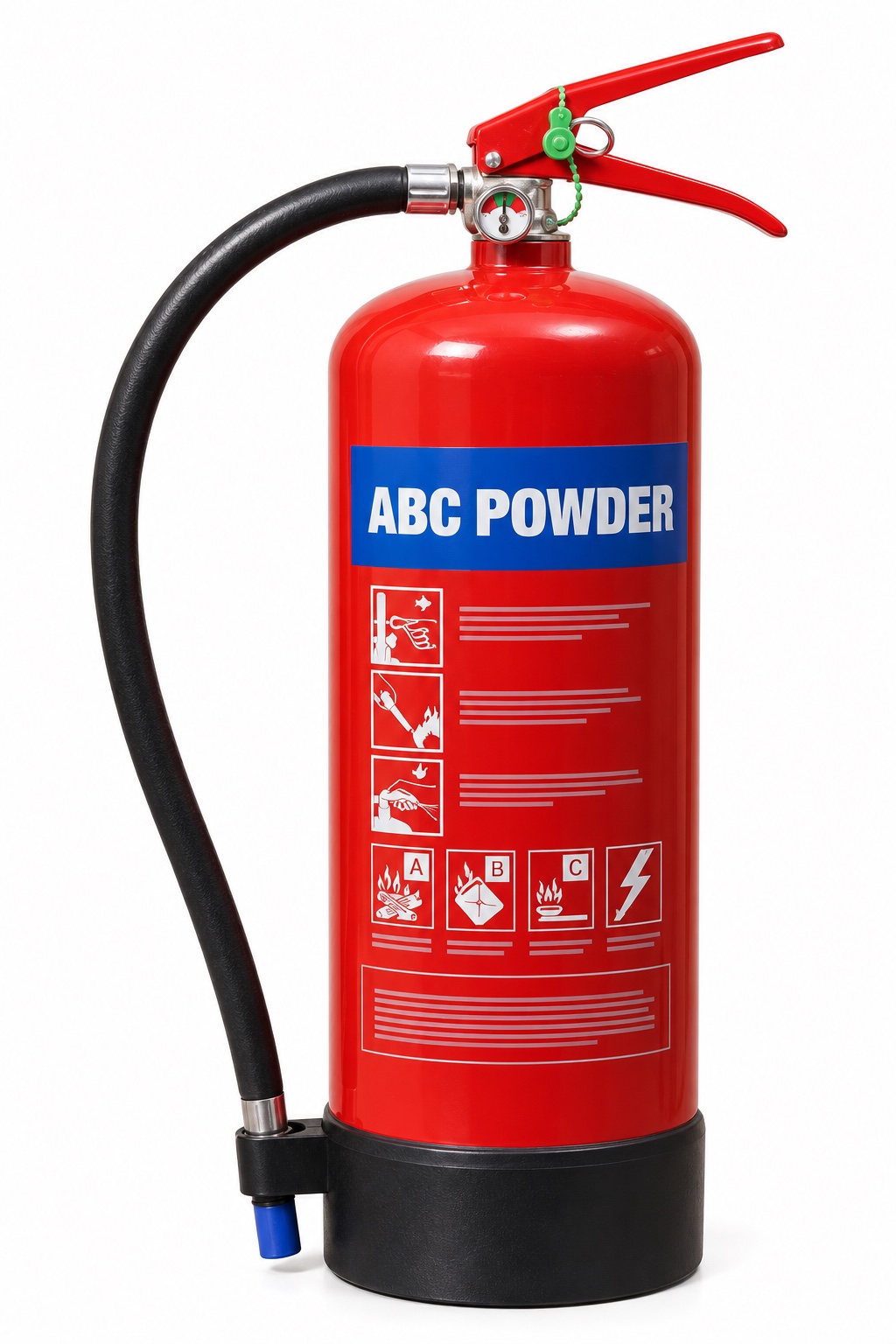 | A, B and C if marked Interrupts flame chemistry; multipurpose powder also acts on Class A material. A C marking does not authorise tackling a gas leak. | Check the limitation Powder can obscure escape and impair breathing; it is not generally recommended indoors. Limited cooling allows reignition. It is not metal-specific D powder or a substitute for F-rated cooking-oil equipment. |
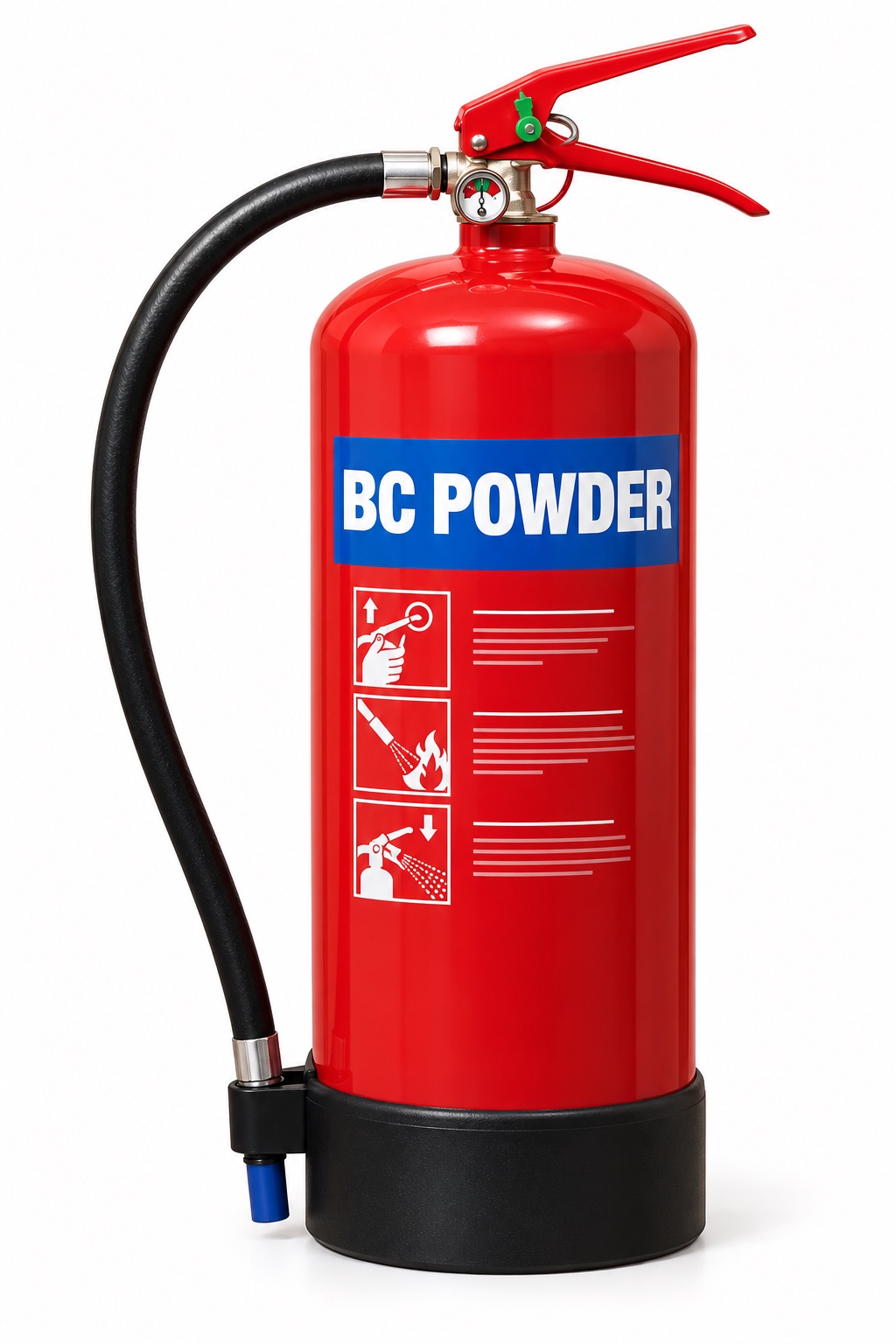 | B and C if marked; not A Selected for particular liquid or gas hazards under the assessed plan. Electrical use must follow the actual unit’s instructions. | Check the limitation Do not assume all blue powder extinguishers protect wood or paper. It has the visibility, breathing and reignition limitations of powder; it does not provide Class D or F protection. |
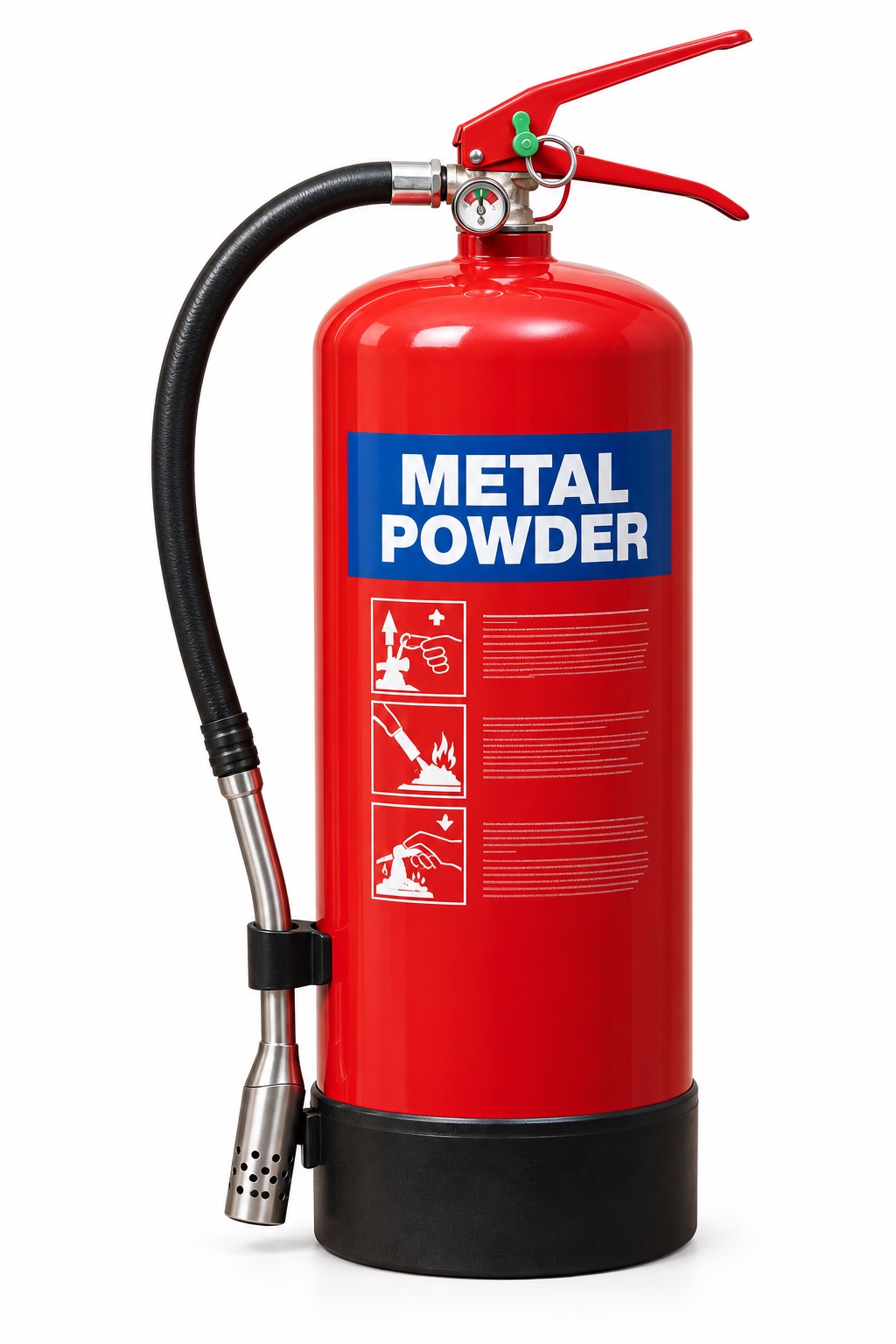 | D, for the specified metal A specialist powder can isolate or absorb heat from a compatible burning metal. Selection requires knowledge of the metal and its form. | Check the limitation The wrong powder can fail or react. Water, foam and CO₂ can be dangerous on certain burning metals. A powder suitable for magnesium is not automatically suitable for metallic lithium. |
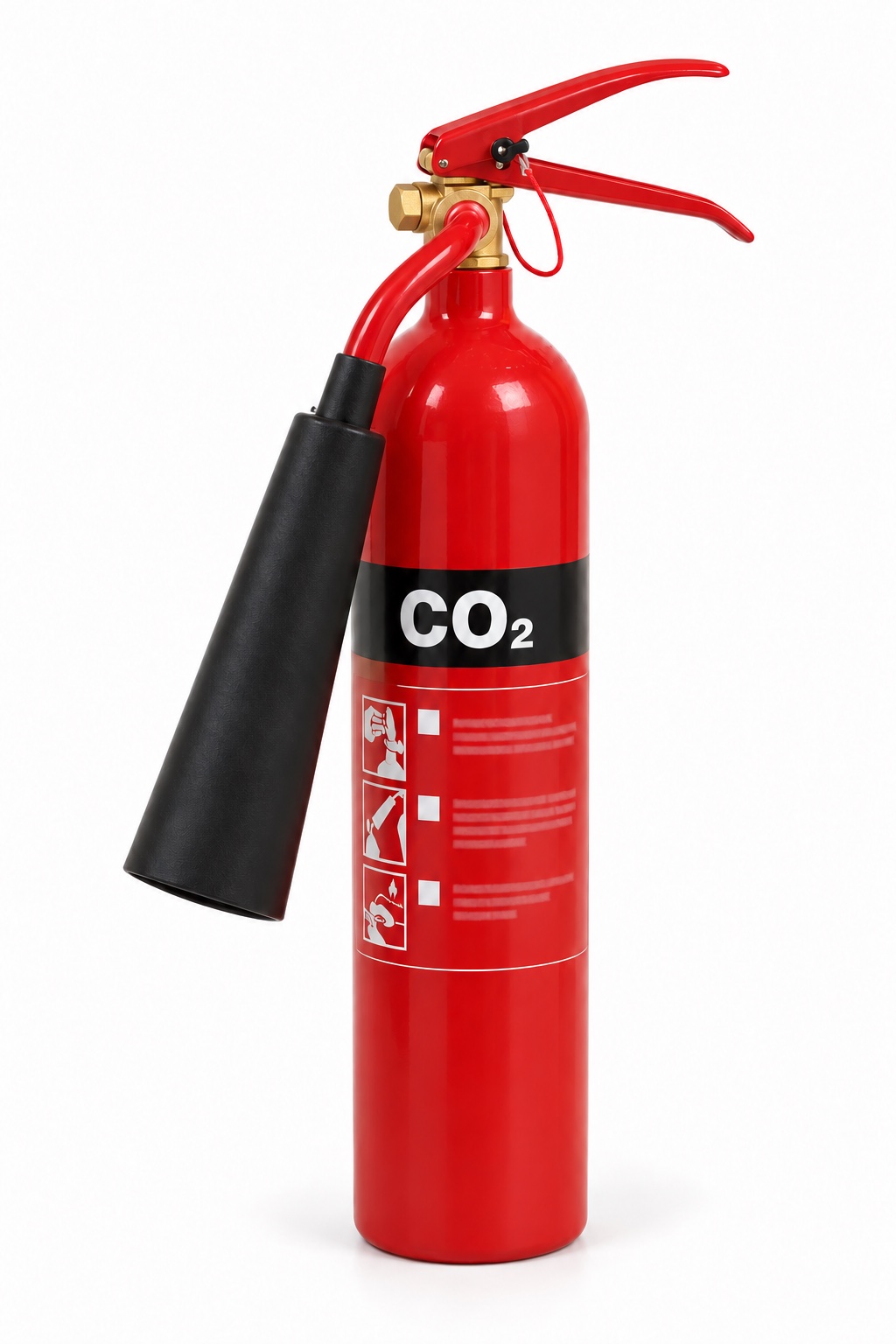 | B; electrical use as instructed Displaces the atmosphere around a small flame and leaves no powder residue. Often selected around electrical equipment. | Check the limitation Poor cooling means reignition is possible. CO₂ can create a dangerous atmosphere in enclosed spaces; discharge can cause frostbite. Hold only the designated insulated parts. Not a cooking-oil or metal-fire substitute. |
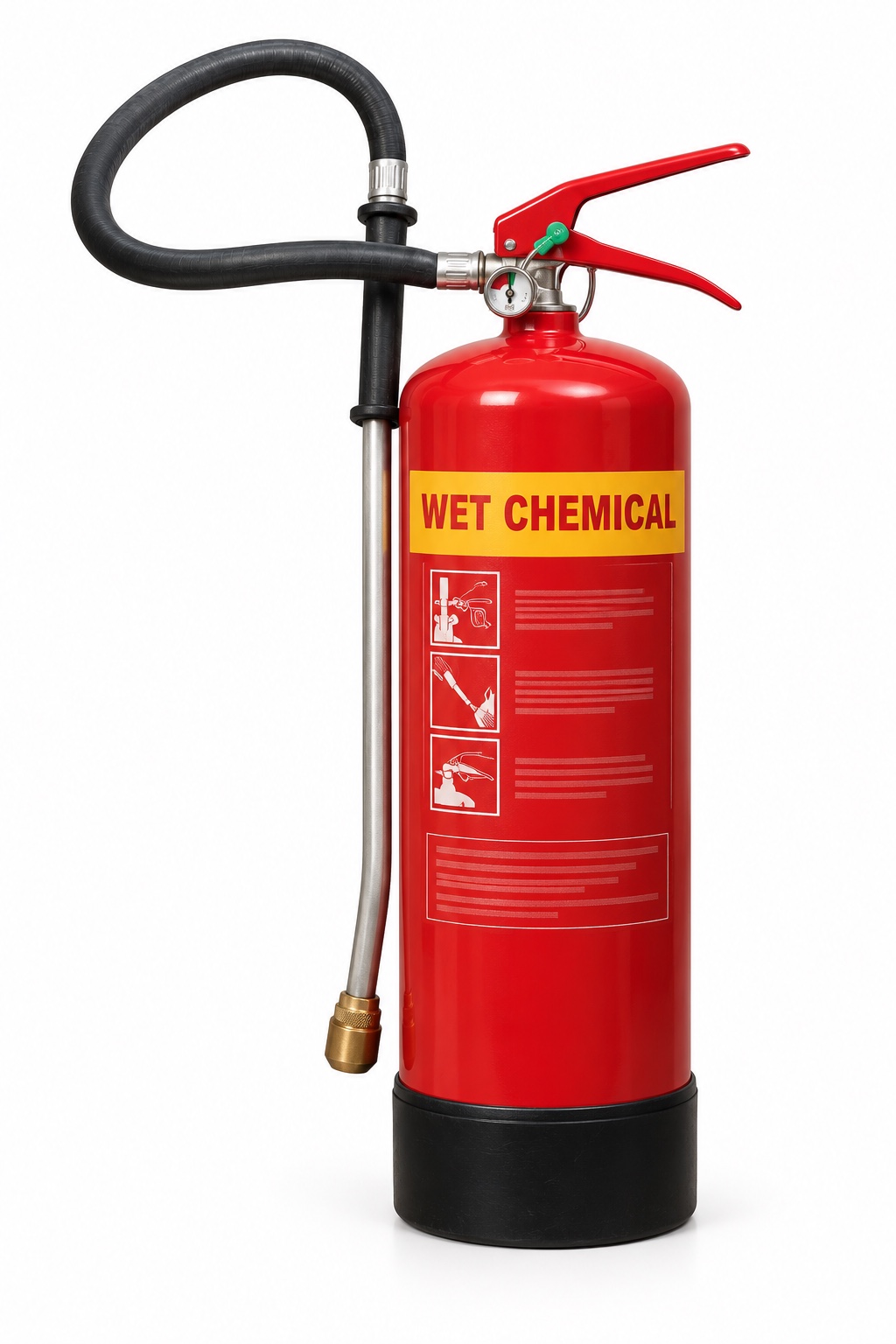 | F; often A if marked Cools cooking oil and creates a protective surface layer through reaction with the fat. Use only within the actual unit’s rating and instructions. | Check the limitation Do not mistake it for a general liquid-fire or electrical extinguisher. Incorrect application or moving the fryer can splash hot oil; apparent flame-out does not establish safe temperature. |
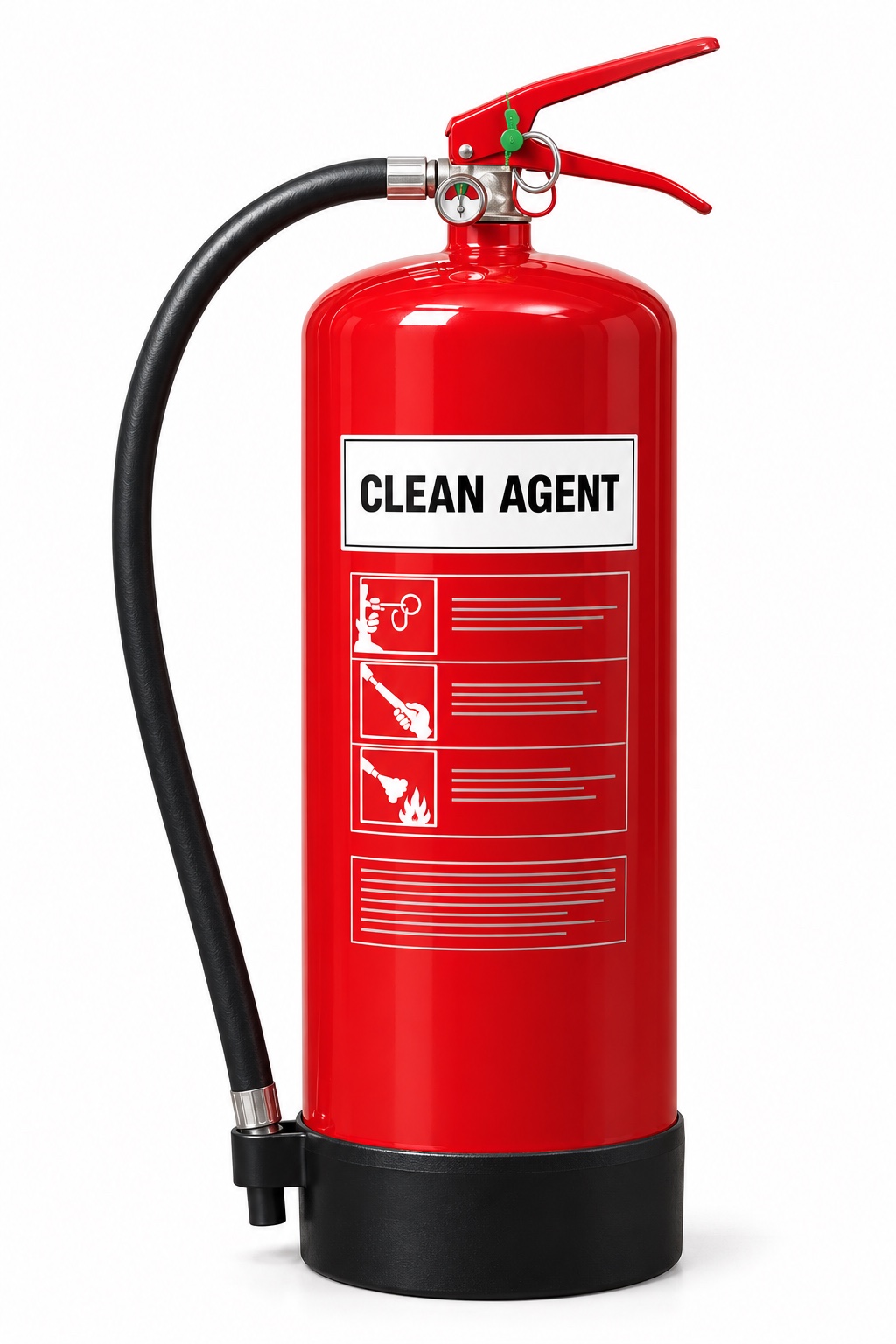 | Product- and jurisdiction-specific Specialist low-residue agents may protect sensitive equipment. Confirm the UK-approved application and the manufacturer’s limits. | Check the limitation Low residue does not mean safe to breathe. Do not copy a US A:B:C rating as UK gas-fire approval. Legacy halon is restricted to permitted critical uses and applicable deadlines. |
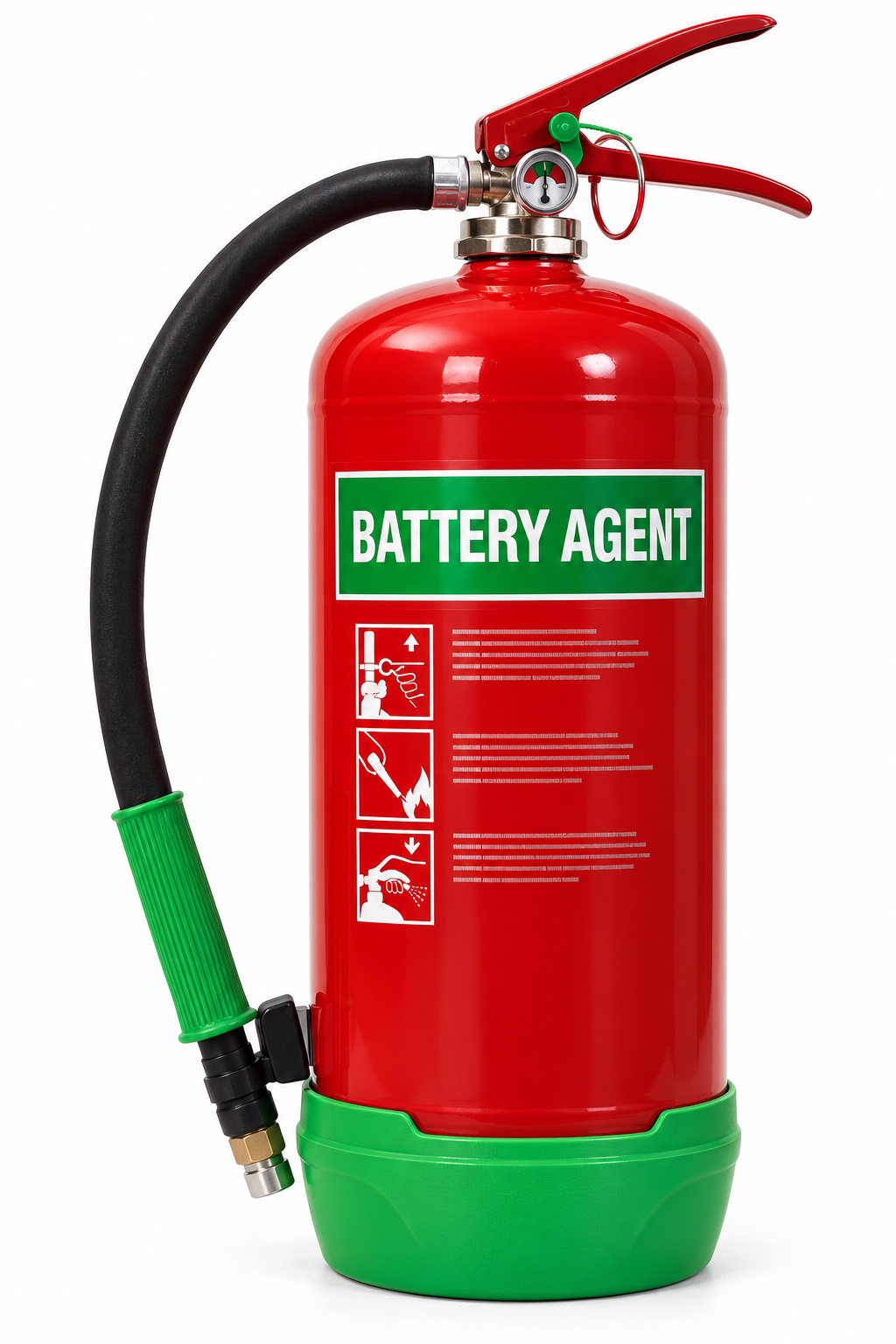 | Check independent scope and instructions Some products use water-based cooling or specialist media such as aqueous vermiculite for specified battery scenarios. Selection depends on chemistry, capacity and location. | Check the limitation A ‘lithium’ label is not proof it will stop thermal runaway in a large pack. Flame suppression may not prevent reignition or gas release. Do not approach, carry or submerge a failing battery as a learner exercise. |
Lithium-ion product example · Firechief 6 L Lith-Ex

A named product example helps connect the generic table to an actual unit. Confirm the exact product before using its claims.
- Agent and intended application
- The linked Seton example uses aqueous vermiculite dispersion (AVD) for specified lithium-ion battery fire applications. Water content cools; the dispersed mineral helps form a barrier. This is not generic Class D metal-fire powder.
- Read the actual rating
- Seton lists a 6 L product with a 13A rating. That A rating describes its solid-material test performance; it does not, by itself, certify a universal Class L battery capability.
- Match the exact model and generation
- The manufacturer’s current 6 L G2 page identifies FLE6X and different discharge details from the retailer’s older listing. Do not mix their time, range or pressure values. Match the delivered label, product sheet and manual.
- Check the battery scope
- Confirm the allowed battery chemistry, energy capacity, state and scenario with the current manufacturer information and competent fire assessment. A large EV or energy-storage pack cannot be treated as a small-device fire.
- Electrical conditions are product-specific
- The supplied product label includes a voltage and minimum-distance condition. Do not transfer that condition to another battery extinguisher or infer that it makes an unsafe electrical approach acceptable.
- After the flame disappears
- Heat, off-gas and reignition can remain. Follow the planned withdrawal, exclusion and fire-service response; do not pick up, submerge or return a failed battery to charging.
Seton · supplied 6 L Lith-Ex example ↗
Firechief · current 6 L G2 model information ↗
Read the actual label
Read the agent, fire-class letters, performance rating, electrical warnings, operating instructions and service condition. Numbers such as 13A or 55B describe standardised test performance, not a safe room size or permission to tackle that amount of fire. Colour is a clue; the actual label and assessed plan decide suitability.
Spot the dangerous assumption
Pause at each question, then open the explanation. These are unscored learning prompts alongside the course assessment.
Keep prevention, alarms, compartmentation and escape effective. Report a missing, obstructed, damaged or discharged extinguisher; do not return a partly used unit to service. Competent selection, maintenance and practical training belong in the fire arrangements.
How should extinguishers be chosen for a mixed workplace?
The selection should map real fire scenarios to media, siting, training and maintenance.
Cooking oil and a solvent/electrical fire need separate decisions
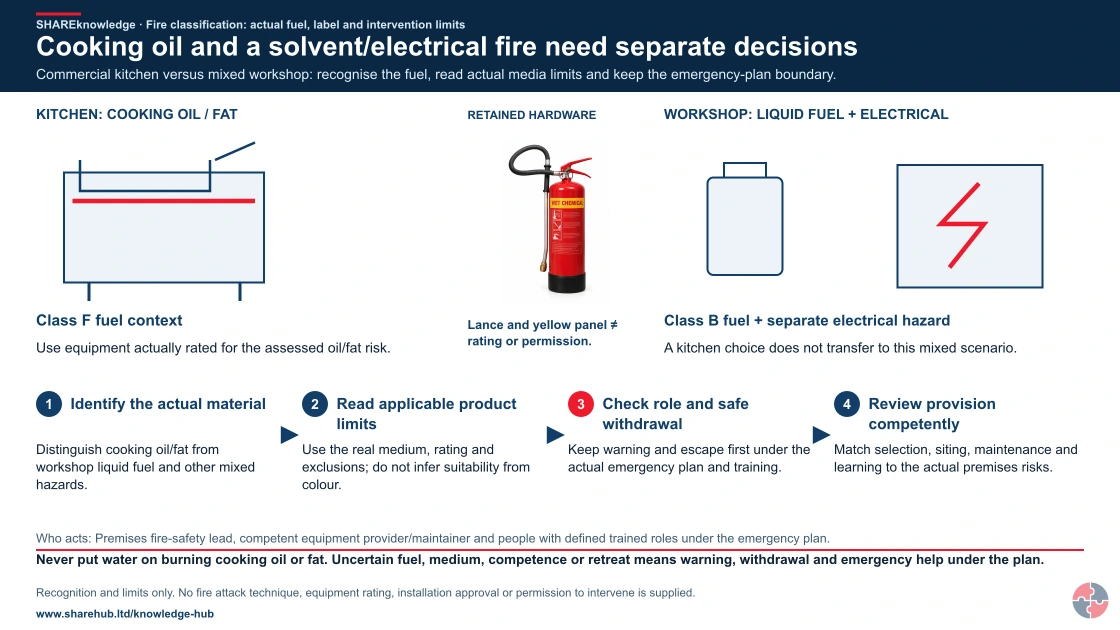
Full written explanation
Two native context sketches compare a cooking-oil/fat fryer with a workshop flammable-liquid scenario involving electrical equipment. Class F and Class B refer to different fuels; electricity remains a separate hazard, not a UK Class E. A small exact retained wet-chemical extinguisher image supports recognising the lance and yellow medium panel only, not reproducing operating instructions or assigning a rating. Four checks compare actual material, product limits, role/retreat and competent equipment review. Gases, metals and lithium-ion batteries remain on dedicated specialist routes; no Class L, universal tick chart or transferable permission is created.
Commercial kitchen versus mixed workshop: recognise the fuel, read actual media limits and keep the emergency-plan boundary.
- Identify the actual material. Distinguish cooking oil/fat from workshop liquid fuel and other mixed hazards.
- Read applicable product limits. Use the real medium, rating and exclusions; do not infer suitability from colour.
- Check role and safe withdrawal. Keep warning and escape first under the actual emergency plan and training.
- Review provision competently. Match selection, siting, maintenance and learning to the actual premises risks.
When the evidence does not fit: Never put water on burning cooking oil or fat. Uncertain fuel, medium, competence or retreat means warning, withdrawal and emergency help under the plan.
Who acts: Premises fire-safety lead, competent equipment provider/maintainer and people with defined trained roles under the emergency plan.
Changed workplace
Commercial kitchen: Cooking-oil hazards need equipment actually rated for the assessed Class F risk.
Workshop: Flammable liquid and live equipment combine fuel and electrical hazards; the kitchen decision does not transfer.
Evidence check: Recognition and limits only. No fire attack technique, equipment rating, installation approval or permission to intervene is supplied.
Keep fuel recognition separate from the intervention decision
Primary references: Scottish Government: existing non-residential fire-safety guidance · GOV.UK: offices and shops — equipment and actual fire risk · Scottish Fire and Rescue: never put water on burning fat/oil
Open the complete HD image (new tab)Download image

Keep fuel recognition separate from the intervention decision
Primary references: Scottish Government: existing non-residential fire-safety guidance · GOV.UK: offices and shops — equipment and actual fire risk · Scottish Fire and Rescue: never put water on burning fat/oil
A business has an office, small kitchen, workshop, solvent store and battery charging area. The weak approach is to place identical extinguishers at every exit. The stronger approach identifies ordinary combustibles, electrical equipment, cooking oil, flammable liquids, hot work and charging hazards, then selects media and siting for each area.
The resulting plan may include water or foam for ordinary combustibles, CO2 near electrical equipment, wet chemical in the kitchen, specific arrangements for flammable liquids and specialist review for unusual battery or metal risks. Staff are trained to raise the alarm first and only use equipment where safe.
| Area | Weak provision | Better provision |
|---|---|---|
| Office | Random extinguisher by reception. | Class A/electrical risk considered and signed. |
| Kitchen | No wet chemical near fryer. | Class F media, blanket and staff training. |
| Workshop | Media not matched to solvents/hot work. | FRA links fire class, hot work and storage controls. |
| Solvent store | Water extinguisher nearby. | Competent review of flammable liquid controls and media. |
| Battery charging | Assume CO2 solves all charging fires. | Review isolation, detection, ventilation and emergency plan. |
| Maintenance | Annual service only. | User visual checks and defect route. |
What does a good portable firefighting equipment standard include?
The standard should define type, location, access, signage, inspection, servicing, training and defect action.
Portable equipment needs a management system. Someone must decide what is needed, where it is placed, how people identify it, how often it is checked, who services it, who may use it and what happens if it is missing, discharged or obstructed.
Equipment should support escape and early intervention; it should not encourage people to enter smoke or delay evacuation.
| Control | What good looks like | Evidence |
|---|---|---|
| Selection | Media matches the fire classes and hazards. | FRA or competent media schedule. |
| Siting | Equipment is visible, accessible and near relevant risk/escape routes. | Layout plan and inspection. |
| Signage | Type and instructions are clear. | Sign check and staff understanding. |
| Inspection | User checks identify missing, discharged or obstructed equipment. | Visual check log. |
| Servicing | Competent servicing follows relevant standard/contract. | Service certificate and defect close-out. |
| Training | Staff understand alarm-first and safe-use limits. | Training and drill record. |
How should extinguishers and media be chosen across different premises?
Premises type changes the expected fuel, user, siting and maintenance standard.
An extinguisher schedule should be specific enough to explain why each type is present. Public venues need clear staff roles; workshops need media matched to flammable liquids and hot work; kitchens need Class F thinking; laboratories need competent review of unusual substances.
Shared buildings need cooperation because media and maintenance gaps in common areas can affect more than one responsible person.
| Premises | Likely issue | Selection focus |
|---|---|---|
| Office | Paper, furniture and electrical equipment. | Ordinary combustible and electrical equipment provision. |
| Commercial kitchen | Cooking oils, extraction and hot surfaces. | Wet chemical, blankets and kitchen fire controls. |
| Workshop | Hot work, oils, paints and machinery. | Flammable liquid and electrical media review. |
| Laboratory | Chemicals may react with ordinary media. | Specialist advice and SDS review. |
| Warehouse | High fire load and large compartments. | Siting, access, alarm, sprinklers and escape priority. |
| Construction/refurbishment | Temporary risks and changing layout. | Temporary fire plan and mobile equipment checks. |
What can go wrong when an extinguisher medium is misapplied?
Wrong-media selection can intensify the fire, spread burning material, expose people to shock or create visibility and recovery problems.
Extinguishing media should be selected from the fire risk assessment, the fuel type, the likely user, the location and the wider emergency plan. The presence of an extinguisher does not make a worker competent to use it, and a technically suitable medium may still be unsuitable in a particular room or scenario.
Learners should be able to explain not only which extinguisher matches which class, but also why some apparently obvious choices are dangerous. Water may be excellent for some solid combustibles and unacceptable for energised electrical equipment or burning liquid spread. CO2 can be useful for electrical equipment but limited outdoors and potentially hazardous in small poorly ventilated spaces.
| Example | What can go wrong | Better decision |
|---|---|---|
| Water used on energised electrical equipment | Electric shock risk and equipment damage may increase. | Isolate if safe and use suitable media only if trained; otherwise evacuate. |
| Water jet used on flammable liquid | Burning liquid may spread across the floor or into drains. | Use suitable foam or other selected media and control the spill source. |
| Foam used without checking limitations | Foam may be unsuitable for some chemicals, electrical hazards or three-dimensional liquid fires. | Confirm media compatibility through the fire risk assessment and SDS where relevant. |
| CO2 used in a confined room | Oxygen displacement, re-ignition and user exposure can be concerns. | Use only where suitable, keep escape available and evacuate if control is not immediate. |
| Wet chemical not provided for cooking oil | Deep-fat fryer or oil fire may escalate violently if wrong media is used. | Provide suitable Class F media, isolation and trained kitchen response. |
| Dry powder used indoors without planning | Visibility, inhalation irritation, clean-up and business interruption can be significant. | Use where appropriate for the risk, but avoid treating powder as a universal answer. |
| Class D metal fire treated with ordinary extinguisher | Reaction or spread may occur depending on the metal. | Use specialist metal extinguishing media and competent emergency arrangements. |
When should portable firefighting provision be escalated?
Escalation is needed where the fire class, media suitability, access, maintenance or staff competence is uncertain.
If equipment is missing, discharged, obstructed, out of service or not matched to the risk, the responsible person should review whether the area can remain in normal use.
Unusual materials, combustible metals, flammable liquid stores, large battery charging areas and specialist processes should trigger competent review rather than guesswork.
| Trigger or question | Immediate action | Evidence before normal operation |
|---|---|---|
| Fire class not understood | Pause selection and seek competent advice. | Media assessment and FRA update. |
| Extinguisher missing or discharged | Replace promptly and review temporary controls. | Replacement and service record. |
| Equipment obstructed | Clear immediately and fix storage behaviour. | Inspection and corrective action. |
| Unusual chemicals/metals/batteries | Escalate to competent fire/technical adviser. | Specialist assessment. |
| Staff unsure about use | Re-brief alarm-first and safe-use limits. | Training record. |
| Repeated servicing defects | Review contractor, environment and management checks. | Defect trend and action plan. |
When should a person leave rather than attempt first-aid firefighting?
The alarm, evacuation and emergency call take priority; only a trained person may consider a very small early-stage fire when the local plan and a clear retreat permit it.
Leave if smoke, heat, visibility, fire growth, pressure, cylinders, battery involvement, chemicals, electrical uncertainty or a compromised exit make the situation unsafe. No one should be pressured to save stock or meet a production target. Report the fire location, fuel and any hazardous inventory from a safe position.
A worker’s confidence, the equipment type and its service label are only parts of the decision. Training must include withdrawal, alerting others and preserving escape; a scenario beyond first response goes to the fire service and site emergency command.
An aerosol fire, a heated cylinder, a pressure-fed jet flame or an uncertain gas release is a withdrawal trigger. Do not approach with a portable extinguisher to test whether it works; report the fuel and isolation information from safety.
Where does portable firefighting equipment management fail?
It fails when equipment is copied from a standard layout instead of selected for actual fire risk and maintained as a live control.
Common failures include wrong media, obstructed extinguishers, missing service tags, no staff training, equipment moved after cleaning or contractor work, fire blankets hidden in cupboards and extinguishers installed where people cannot reach them safely.
Another failure is overconfidence. The presence of extinguishers can create a false sense of control if ignition sources, fuel loading, detection, escape and compartmentation are weak.
| Failure or weak practice | How it develops | What good looks like |
|---|---|---|
| Wrong media | Fire class not assessed. | Select against likely fuel and competent guidance. |
| Obstructed access | Stock, displays or furniture creep into access space. | Daily/weekly visibility and access checks. |
| Poor siting | Equipment too far from risk or escape path. | Layout review and signage. |
| No training | Staff panic or use equipment unsafely. | Alarm-first and safe-use training. |
| Annual service mindset | No user checks between services. | Visual checks and defect reporting. |
| Specialist hazard missed | Metal, chemical or battery risk treated as ordinary fire. | Competent technical review. |
What evidence shows fire classification, extinguishing media and portable fire-fighting equipment is controlled?
Evidence should show that fire precautions are suitable, available, maintained, tested, understood and reviewed.
Fire evidence should connect the fire risk assessment to real controls. A log book alone is not enough if defects remain open, staff do not know the procedure or equipment cannot be reached during normal work.
Good records show what was checked, what failed, who owned the action, when it was closed and how the responsible person knows the arrangement still protects relevant persons.
| Evidence item | What it should show | Assurance question |
|---|---|---|
| FRA/media schedule | Fire classes and equipment selection are justified. | Does media match real fuels? |
| Equipment location plan | Extinguishers, blankets and hose reels are mapped. | Can people find equipment under stress? |
| Inspection records | Missing, damaged, discharged or obstructed equipment is found. | Are actions closed quickly? |
| Service records | Competent servicing and defect correction are recorded. | Are recurring issues investigated? |
| Training records | Relevant staff understand safe-use limits. | Do people know evacuation comes first? |
| Change review | New processes, kitchens, stores or chargers trigger review. | Was the FRA updated after change? |
What if portable equipment is missing, blocked or out of service?
Treat a missing credited extinguisher as a changed fire risk and decide what work or occupancy can safely continue.
Name the location, hazard, equipment function and people affected. Keep exit and alarm arrangements effective; reduce ignition and fuel, provide a suitable replacement only with competent selection, or restrict the activity if the residual risk is not controlled. A generic spare on the wall is not proof of equivalence.
After repair or replacement, check the right unit is present, accessible and maintained, brief affected users and close the impairment with an owner and evidence. Repeated blocked or discharged units point to storage, supervision or training weakness.
What should the extinguisher and media risk register show?
Record each credible fuel scenario, prevention, warning, escape, limited equipment role, owner, failed-state decision and verification.
A kitchen oil fire, solvent spill, vehicle-battery incident and metal-dust fire need different assessment. For each, identify who may be affected, what prevents ignition or release, what equipment is credited and what the staff response limit is. The register should distinguish a missing extinguisher from a fire scenario that portable equipment could never safely control.
Check during busy and changed conditions: storage, contractor activity, new fuel, altered appliances, training cover and service defects. Close an action only after the equipment and work method are verified in place.
How can the hierarchy of controls reduce fire risk before selecting portable extinguishers?
Remove the actual hazard where possible, then use substitution and verified physical controls before relying on procedures or PPE. Discipline checks that the chosen barriers still work.
The scenario is wrong extinguisher at a mixed-risk work area. The controls below are reasoned task applications of linked guidance, not a prescribed design or evidence that each intervention appears verbatim in a source. A competent owner must check feasibility, local law and stop criteria.
Use current government guidance and competent task-specific advice; this section does not establish a technical specification.
How can the ERICPD hierarchy of controls reduce fire risk before selecting portable extinguishers?

| Hazard and harm route | ERICPD → five-level control | Task intervention and feasibility | Owner, test and evidence | Failure and stop decision |
|---|---|---|---|---|
| Wrong extinguisher at a mixed-risk work area | Eliminate → Elimination | Remove avoidable ignition and fuel before the task starts. Source: GOV.UK fire safety risk assessment: offices and shops. | Confirm avoidable fuel and ignition work are removed before selecting any residual extinguisher provision. | Stop or redesign if wrong media or blocked escape. |
| Same scenario | Reduce → Substitution | Use a less hazardous product or method where feasible. Source: GOV.UK fire safety risk assessment: offices and shops. | Fire-risk assessor trials the replacement method and documents new hazards, residual risk and worker feedback before release. | Pause until the alternative and its new risks are assessed. |
| Same scenario | Isolate → Engineering | Physically separate the electrical equipment and liquid-fuel work so one ignition cannot involve both hazards. Source: GOV.UK fire safety risk assessment: offices and shops. | Fire-risk assessor must inspect the physical separation and check the selected extinguisher against the actual fire-risk assessment. | Stop or redesign if wrong media or blocked escape. |
| Same scenario | Control → Administrative | Train staff on media limits, escape-first decisions and inspection. Source: GOV.UK fire safety risk assessment: offices and shops. | Fire-risk assessor spot-checks the actual instruction, authorisation and shift handover against work in progress. | Pause if the procedure or handover cannot be verified. |
| Same scenario | PPE → PPE | Firefighting PPE never authorises untrained attack on a growing fire. Source: GOV.UK fire safety risk assessment: offices and shops. | Fire-risk assessor records why PPE cannot control this mapped harm, checks the operative higher-level barrier, and stops the task if that barrier fails. | PPE cannot be the sole credited barrier. |
| Same scenario | Discipline → Administrative assurance | Verify fire-risk assessment, equipment labels, servicing and drill outcomes. Source: GOV.UK fire safety risk assessment: offices and shops. | Verify fire-risk assessment, equipment labels, servicing and drill outcomes. | Stop or redesign if wrong media or blocked escape. |
How can the ISO 45001 hierarchy of controls reduce fire risk before selecting portable extinguishers?

| Hazard and harm route | ERICPD → five-level control | Task intervention and feasibility | Owner, test and evidence | Failure and stop decision |
|---|---|---|---|---|
| Wrong extinguisher at a mixed-risk work area | Eliminate → Elimination | Remove avoidable ignition and fuel before the task starts. Source: GOV.UK fire safety risk assessment: offices and shops. | Confirm avoidable fuel and ignition work are removed before selecting any residual extinguisher provision. | Stop or redesign if wrong media or blocked escape. |
| Same scenario | Reduce → Substitution | Use a less hazardous product or method where feasible. Source: GOV.UK fire safety risk assessment: offices and shops. | Fire-risk assessor trials the replacement method and documents new hazards, residual risk and worker feedback before release. | Pause until the alternative and its new risks are assessed. |
| Same scenario | Isolate → Engineering | Physically separate the electrical equipment and liquid-fuel work so one ignition cannot involve both hazards. Source: GOV.UK fire safety risk assessment: offices and shops. | Fire-risk assessor must inspect the physical separation and check the selected extinguisher against the actual fire-risk assessment. | Stop or redesign if wrong media or blocked escape. |
| Same scenario | Control → Administrative | Train staff on media limits, escape-first decisions and inspection. Source: GOV.UK fire safety risk assessment: offices and shops. | Fire-risk assessor spot-checks the actual instruction, authorisation and shift handover against work in progress. | Pause if the procedure or handover cannot be verified. |
| Same scenario | PPE → PPE | Firefighting PPE never authorises untrained attack on a growing fire. Source: GOV.UK fire safety risk assessment: offices and shops. | Fire-risk assessor records why PPE cannot control this mapped harm, checks the operative higher-level barrier, and stops the task if that barrier fails. | PPE cannot be the sole credited barrier. |
| Same scenario | Discipline → Administrative assurance | Verify fire-risk assessment, equipment labels, servicing and drill outcomes. Source: GOV.UK fire safety risk assessment: offices and shops. | Verify fire-risk assessment, equipment labels, servicing and drill outcomes. | Stop or redesign if wrong media or blocked escape. |
How should fire classification, extinguishing media and portable fire-fighting equipment be assured?
Assurance should test whether the fire arrangement works in the building, at the time, with the people who may need it.
First-line assurance comes from daily checks, weekly tests, warden observations and immediate defect reporting. Second-line assurance reviews fire risk assessment actions, drills, maintenance, contractor records and repeat findings. Specialist assurance may include competent fire risk assessor review, fire alarm contractor reports, extinguisher servicing, emergency lighting testing and enforcement feedback.
The test is practical: if the alarm operates today, can everyone hear, understand, move, escape, account for vulnerable people and keep routes safe without relying on luck?
| Assurance layer | What to check | What good looks like |
|---|---|---|
| User check | Equipment present, accessible and apparently serviceable. | Defects are reported immediately. |
| Manager inspection | Siting, signage, obstruction and service status. | Repeated obstruction is fixed at source. |
| Contractor service | Competent maintenance and defect report. | Actions are owned, not just filed. |
| Fire risk review | Media provision matches changing fuel risks. | Changes trigger FRA update. |
| Leadership review | High-risk process or premises changes. | Resources follow competent advice. |
Which UK legal duties and official guidance are relevant?
Premises fire safety follows different legal routes in England and Wales, Scotland and Northern Ireland. Work activity and dangerous-substance duties also depend on location and scenario.
The Fire Safety Order is the England and Wales premises route. Scotland and Northern Ireland have separate premises laws. Great Britain health-and-safety and DSEAR instruments do not silently extend to Northern Ireland; use the corresponding NI work-risk rules where applicable.
| Jurisdiction | Duty or guidance | What it means | How to apply it |
|---|---|---|---|
| E&W | Regulatory Reform (Fire Safety) Order 2005 | Requires the responsible person to assess fire risk and maintain suitable fire precautions in non-domestic premises. | Use as the main fire safety legal framework for England and Wales. |
| GB | Health and Safety at Work etc. Act 1974 | Requires employers to protect employees and others affected by work so far as reasonably practicable. | Use for work activities that create fire, emergency or firefighting risk. |
| GB | Management of Health and Safety at Work Regulations 1999 | Requires suitable and sufficient risk assessment, preventive arrangements, competent help, emergency arrangements and review. | Use for management arrangements, competence and emergency procedures. |
| GB | Dangerous Substances and Explosive Atmospheres Regulations 2002 | Requires fire and explosion risk from dangerous substances to be assessed and controlled. | Use where flammable substances, gases, vapours, dusts or oxygen enrichment affect the fire arrangements. |
| Scotland | Fire (Scotland) Act 2005 | Scottish non-domestic premises fire-safety framework. | Assess people and precautions in the actual Scottish premises. |
| Scotland | Fire Safety (Scotland) Regulations 2006 | Detailed Scottish premises duties and arrangements. | Check suitable warning, escape, equipment, maintenance and coordination. |
| NI | Fire and Rescue Services (NI) Order 2006 | Northern Ireland non-domestic premises fire-safety framework. | Identify the appropriate person and premises scope. |
| NI | Fire Safety Regulations (NI) 2010 | Detailed Northern Ireland premises requirements. | Apply the Northern Ireland premises regulations to warning, escape and maintenance for the actual premises. |
| NI | Health and Safety at Work (NI) Order 1978 | NI general work-health and safety duties. | Control work-created fire and emergency risks. |
| NI | Management Regulations (NI) 2000 | NI work-risk assessment and emergency arrangements. | Coordinate work controls, competence and contractor activity. |
| NI | DSEAR (NI) 2003 | NI dangerous-substance and explosive-atmosphere work-risk route. | Apply when flammable or reactive work creates this hazard. |
How can BS EN ISO 45001 support fire classification, extinguishing media and portable fire-fighting equipment management?
ISO 45001 helps turn this topic into leadership, planning, support, operational control, performance evaluation and continual improvement rather than a static page of guidance.
Use current government guidance and competent task-specific advice; this section does not establish a technical specification.
| Management theme | Practical management principle | How to apply it |
|---|---|---|
| Leadership and commitment | Fund appropriate provision and give trained staff authority to withdraw. | Leaders should set expectations, provide resources, remove conflicting pressures and review evidence of control. Public management context: HSE health and safety management-system overview. |
| Hazard identification and assessment of risks and opportunities | Assess actual fuels, mixed hazards, people and escape before selecting equipment. | Assess credible harm pathways, affected people, routine work, non-routine work, change, emergency conditions and practical opportunities to improve. Public management context: HSE health and safety management-system overview. |
| Competence | Demonstrate equipment limits, alarm-first action and withdrawal decisions. | Define training, authorisation, assessment, supervision and refresher expectations for workers, supervisors, managers and specialists. Public management context: HSE health and safety management-system overview. |
| Operational planning and control | Keep selected units available, accessible and maintained as the premises change. | Turn assessment decisions into field controls, safe systems, supervision, equipment standards, welfare, emergency arrangements and change controls. Public management context: HSE health and safety management-system overview. |
| Monitoring, measurement, analysis and performance evaluation | Check placement, defects, blocked access and exercise outcomes. | Use inspections, assurance checks, worker feedback, trend data, audit findings, incident learning and overdue action reviews. Public management context: HSE health and safety management-system overview. |
These are practical management-system themes, not a clause-by-clause interpretation. A competent reviewer must verify any clause mapping against a lawfully accessed current standard.
Who needs competence, and how is it demonstrated?
Training should help people understand fire classification, extinguishing media and portable fire-fighting equipment, their role, emergency actions, defect reporting, vulnerable-person arrangements and when to escalate.
Training should be role-based. General awareness creates a baseline, but supervisors, managers, advisers and senior leaders need different levels of decision-making, verification and escalation competence.
| Role | Learning to test | Competence demonstration | Assessor and record | Reassessment trigger |
|---|---|---|---|---|
| All workers and contractors | Know local alarm, escape, reporting and non-intervention limits. | Respond to a drill and identify a blocked or suspect unit. | Supervisor records site induction and observation. | Changed layout, fuel or task. |
| Nominated first responders | Recognise fuel uncertainty, correct equipment and withdrawal triggers. | Demonstrate the decision to evacuate in mixed-fuel and growing-fire scenarios. | Competent fire trainer observes practical decision and records limits. | New hazard, equipment or drill finding. |
| Supervisors and managers | Own equipment availability, interim controls and contractor interfaces. | Decide whether a kitchen, workshop or storage area can operate with missing provision. | Competent fire lead samples the risk decision and hand-back. | Impairment, new process or repeated obstruction. |
| Fire risk assessors and equipment specialists | Select premises provision and maintain it within code scope. | Trace a mixed-fuel assessment through selection, siting and maintenance record. | Technical lead reviews design basis and limitations. | New fuel, code revision or failed service. |
| Assurance and emergency leads | Connect equipment to prevention, warning, escape and incident response. | Run a tabletop fire with wrong-media temptation and a blocked escape. | Leadership reviews exercise and action effectiveness. | Fire, near miss or material change. |
How could Riverside Leisure Ltd manage this in practice?

At Riverside Leisure Ltd, a kitchen is refitted and a new fryer changes the credible cooking-oil scenario. The manager stops using the old equipment schedule as proof of suitability, has a competent adviser review the fuel and provision, preserves alarm and escape, and trains the nominated staff on immediate withdrawal. During a busy event a portable unit is blocked by deliveries: staff clear the route and report the failed availability, while the manager restricts any activity whose risk cannot be controlled. The hand-back records the correct provision, access and observed staff response.
Riverside Leisure Ltd can manage extinguishers and media by mapping fire classes across the building and checking equipment remains suitable and accessible.
In this leisure centre, fire classes may arise in offices, kitchens, plant rooms, workshops, laundry areas, public spaces, stores and contractor work.
| Management element | How the business would manage it | Evidence to review |
|---|---|---|
| Classification | FRA identifies likely fire classes. | Fire class schedule. |
| Selection | Equipment matches fuel and user capability. | Media plan. |
| Siting | Equipment is visible and accessible. | Location checks. |
| Training | Staff know alarm-first and safe-use limits. | Training record. |
| Inspection | Visual checks catch missing or obstructed equipment. | Fire log book. |
| Review | Kitchen, plant or storage changes update provision. | FRA review. |
Why must fire-extinguishing arrangements match the fuel scenario?
Use the fuel and response views to establish what is involved before considering suitable firefighting provisions. No equipment selection or permission to tackle a fire is established here.
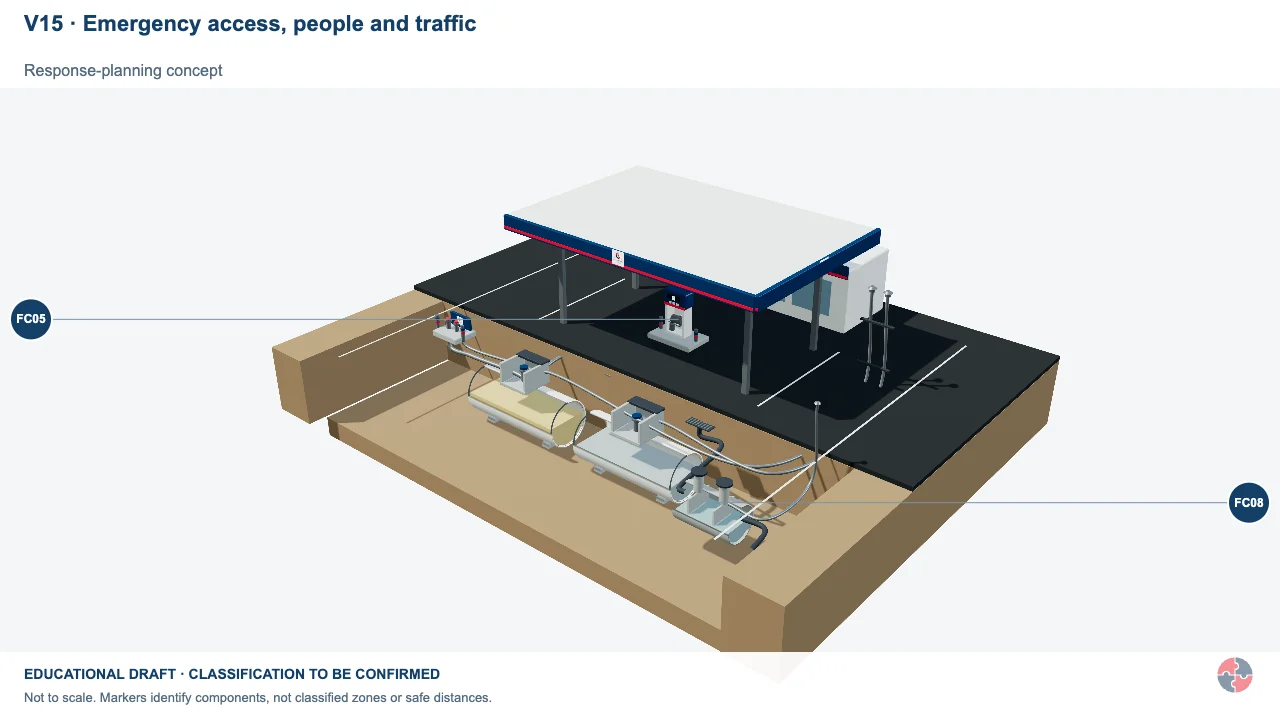

Emergency access, people and traffic
Delivery hoses, the movable refuelling interface and drainage sources can affect access and response. Plan routes around the incident and people involved rather than using a coloured zone as a muster boundary.
Activity focus: Inspect the tanker working area, hose route, nozzle/filler positions, separator covers and vent. Check communication, control of dispensing and traffic, and access for the response plan.
Contextual illustration. The image alone does not establish equipment state, effective controls, individual health or authorisation; use the task-specific checks and competent evidence.
Educational illustration, not to scale. Coloured zones are teaching examples, not a site-specific hazardous-area classification.
Which acronyms and terms matter here?
Acronyms should be understood before they are used in assessments, briefings, audits or learning answers.
Acronyms can exclude newer readers if they are not explained. This section keeps the main terms available at the end of the page so the article stays readable while still supporting learners and audit users.
| Acronym | Meaning | Plain-English use |
|---|---|---|
| ACOP | Approved Code of Practice | Practical guidance with special legal status; following it is not compulsory, but it can be used as evidence of compliance. |
| FRA | Fire Risk Assessment | A structured assessment of fire hazards, people at risk, controls, emergency arrangements and review needs. |
| FRS | Fire and Rescue Service | The emergency service and enforcing authority for many fire safety matters in England and Wales. |
| HSE | Health and Safety Executive | Great Britain workplace health and safety regulator. |
| HSWA | Health and Safety at Work etc. Act 1974 | Great Britain general work-health and safety statute; Northern Ireland has its separate 1978 Order. |
| MHSWR | Management of Health and Safety at Work Regulations 1999 | Regulations requiring suitable and sufficient risk assessment and management arrangements. |
| PEEP | Personal Emergency Evacuation Plan | A person-specific plan for someone who may need assistance to evacuate safely. |
| CO2 | Carbon Dioxide | Extinguishing medium often used for some electrical or liquid fire scenarios. |
| ERICPD | Eliminate, Reduce, Isolate, Control, Protect, Discipline | Prioritises removal and engineering before individual protection and practice. |
| Class F | Cooking fats and oils | A fire category whose appliance and media need competent selection. |
| DSEAR | Dangerous Substances and Explosive Atmospheres Regulations | GB 2002 and separate NI 2003 work-risk routes. |
How can I practise the checks in 3D?
Follow the highlighted check, compare a sound part with a fault, and see how a missed fault can cause harm. Then use the matching blank checksheet to record what you actually find.
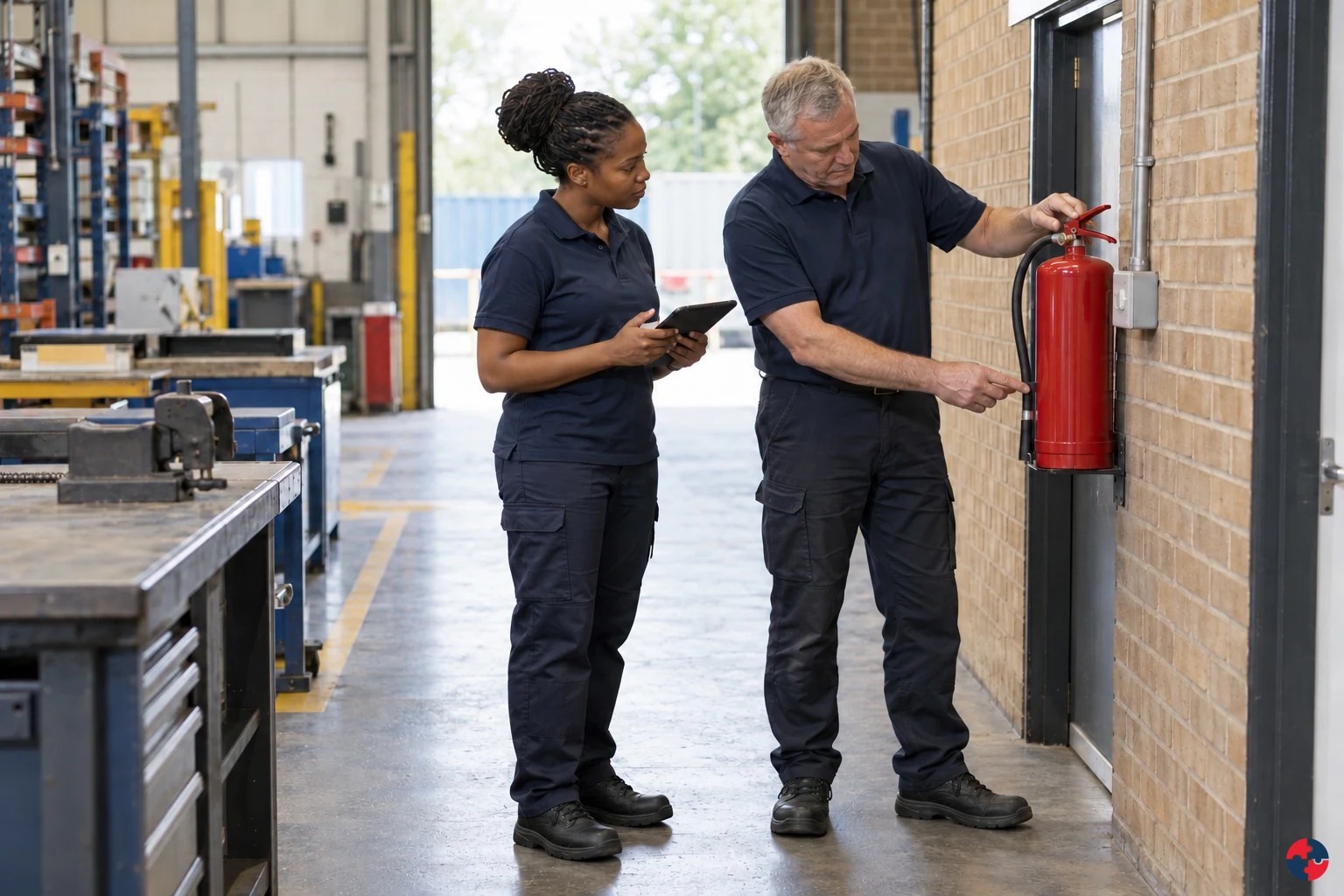
Fire extinguishers and fire points
24 checks · sound and fault examples
Check extinguisher condition, identification, access and fire-point readiness. A readiness check does not authorise firefighting. Follow the emergency plan, training and safe escape arrangements.
Unlock another resource
You have used this month’s two free downloads. Publish a post in your own words to unlock one more resource, or choose SHARE Individual for 10 downloads per month.
You decide whether to share. If you do, use the relevant platform disclosure tools and do not make claims you do not genuinely hold.