SHARE Knowledge Hub
Fire Safety at Work
Fire safety at work means preventing ignition and growth, keeping smoke and heat away from people, warning everyone in time and enabling safe escape. The responsible person must assess the actual premises, activities and occupants, maintain the measures that assessment requires and plan for failure and change. A single extinguisher, alarm or template cannot prove a building or task safe; stop or restrict use when a critical barrier is unavailable and obtain competent fire-safety advice.
Understanding Fire Safety at Work
Fire safety at work means preventing ignition and growth, keeping smoke and heat away from people, warning everyone in time and enabling safe escape. The responsible person must assess the actual premises, activities and occupants, maintain the measures that assessment requires and plan for failure and change. A single extinguisher, alarm or template cannot prove a building or task safe; stop or restrict use when a critical barrier is unavailable and obtain competent fire-safety advice.
Why this matters at work
A useful fire record follows the whole causal chain: activity or condition; ignition and fuel; fire and smoke development; exposure or entrapment; injury, illness or wider loss; then prevention, protection, response and recovery. Typical serious outcomes include thermal burns, airway burns, carbon-monoxide or other toxic-product poisoning, asphyxia, crush injury during movement, trauma from falls or collapse, and psychological harm after an emergency. Each material scenario should therefore name both the initiating hazard and the way people could be harmed.
Fire can cause burns, smoke inhalation, toxic-gas exposure, oxygen depletion, heat stress, panic, falls, structural collapse, explosion, environmental pollution and public harm. The immediate cause can be a heat source, electrical fault, chemical reaction, hot work, arson, friction, dust cloud, flammable release or poor housekeeping; the systemic cause is often weak assessment, design, maintenance, management of change or supervision.
How organisations manage this in practice
Connect the identified ignition sources, fuels and people to implemented controls, safe escape and reliable management. Walk the premises during representative work and compare the evidence with drawings and procedures. Record urgent defects, owners, interim restrictions and verification of repairs. Review the assessment when occupancy, stock, processes or building conditions change. Use the correct national legal route; an assessment report or building-control history does not itself demonstrate that the premises are safe in their current operation.
Fire safety is a management system: appoint competent persons, maintain asset registers and routines, inspect critical controls, train affected people, control contractors, manage impairments and report to leadership. The organisation must know which barriers are safety-critical for a scenario and what evidence shows they are available, effective and recoverable.
Consult workers and safety representatives about hazards, routes, arrangements, emergency practice, defects and changes. Include night shifts, remote workers, contractors, cleaners, maintenance staff, disabled employees and people who use the building differently. Workers often know where storage drifts, doors are wedged, alarm signals are unclear or response plans do not work at busy times.
Choose the fire decision that matches the situation now
Use this page as the entry point. If there is immediate danger, follow the alarm, escape and emergency arrangements first. For planned work, establish the premises nation, who controls it, the current assessment and the prevention, warning and protected-escape arrangements. Construction changes and impaired critical protection need a live use decision, not simply a new document.

Delivery stock can change ignition and escape conditions together

Full written explanation
A new UK manufacturing/packing scene marks a portable heater beside packing stock, a loaded trolley intruding into the exit approach and the closed push-bar door. Reviewers observe from the foreground; no active heat, fire or emergency is shown. The heater’s energisation/isolation is not visible and no state is claimed. A green pictogram, push bar or available floor area does not prove a usable exit, sufficient width, door operation or received warning. Three checks join ignition/fuel prevention, warning/escape and action/verification during deliveries and changes. Picture key: 1 Portable heater · 2 Loaded stock trolley · 3 Closed push-bar door. The separate process headings are unnumbered.
Inactive manufacturing walkdown: heater/packing stock and the loaded trolley at an exit approach raise connected questions.
- Prevent the ignition pathway. Review the actual heating, charging, work and combustible inventory; remove avoidable risks.
- Check warning and the whole route. Review delivery stock, door operation, all occupants and any assistance needs.
- Act, then verify the arrangement. Control the obstruction or impairment now; assign repair, briefing and evidence before hand-back.
Change the pathway
- Presence is not an operating state. The still does not prove whether the heater is energised, isolated or suitable.
- An exit sign cannot clear stock. Door hardware and markings do not establish actual warning or usable escape.
- A future repair is not present protection. Confirm the affected-use decision and actual restoration; keep continuing checks.
Evidence check: Illustrative workplace learning. No heater state, safe route width, emergency strategy, firefighting role or permission to continue is established.
Distinguish prevention, impairment and the actual emergency response
Primary references: GOV.UK: current assessment and prevention context · GOV.UK: premises emergency and evacuation arrangements
Open the complete HD image (new tab)Download image

Distinguish prevention, impairment and the actual emergency response
Primary references: GOV.UK: current assessment and prevention context · GOV.UK: premises emergency and evacuation arrangements
Choose a specialist route by its job: Objectives and Competence for appointing an assessor; Principles and Practice for observing and acting on risks; the emergency-controls bridge for operating those actions; detection and communication for warning; evacuation and strategy for getting people to safety. Process-fire, gas detection and fixed-protection guides address their separate engineering barriers. After impairment, the accountable owner accepts use only on relevant verification evidence.
BuildOut: temporary work removes a warning assumption
Illustrative example. An occupied refurbishment changes a detector zone while contractors also alter a corridor and temporary power.
Decision. The site and premises leads identify affected people and use, agree restrictions and obtain competent warning and route verification.
Evidence to check. The live construction/fire plan, impairment status, actual staffing, usable escape and witnessed restoration.
Hold or escalation point. Do not release the area because an alarm panel is normal or portable extinguishers are present.
Follow-up. Accept hand-back after the protection and actual route work; update change coordination before the next phase.
Distinguish prevention, impairment and an actual emergency
An ignition concern, a failed protective system and smoke or an alarm require different actions. Keep escape and warning ahead of any firefighting decision.
A changed shop back room needs review before the layout is relied on

Full written explanation
An illustrative inactive retail scene shows a heater, stock trolley, visibly CLOSED door with a stair seen through glazing, and review papers. Picture key: 1 Heater · 2 Stock trolley · 3 CLOSED door · 4 Review sheet. Heater state, isolation, contents, clearance, door operation or rating, received warning and usable escape are not established by appearance. A separate red emergency-first line sends smoke or an alarm to the actual premises emergency arrangements without a records or investigation gate. The four planned-change checks are separate from that emergency condition. Outside the scene, an explicitly SEPARATE ASSUMED back-room plan retains existing stock, the new-delivery relationship, Warning? and Route and door still usable? questions. Its drawn gap and open leaf describe that assumed plan only; they are not the photographed CLOSED door. The stock-change arrow stays within the analytical insert, with no heat, smoke or escape trajectory on the retail scene. Four unnumbered checks identify the changed use, control work and routes, resolve impaired protection, then accept evidence and keep checking through the named owner. Full hold, evidence and changed-workplace cases apply. No actual route, layout, occupancy, strategy, firefighting role, repair result or permission is approved. The retail source transfers no nation, legal role or emergency plan from its original context.
Inactive retail context and a separate assumed plan; planned change never gates the actual emergency response.
- Identify the changed use. Check deliveries, layout, stock, ignition sources and every affected person.
- Control the work and routes. Remove avoidable fuel/ignition and keep necessary warning and escape effective.
- Resolve impaired protection. Agree competent restrictions or alternatives; verify repair and brief affected people.
- Accept and keep checking. The accountable owner checks the arrangement in use and reviews further change.
When the evidence does not fit: Smoke or an alarm: follow the premises emergency arrangements first. Do not enter smoke, delay escape for records or re-enter without authorisation.
Who acts: Premises fire lead, shop/production manager, relevant contractors and owners of shared precautions.
Changed workplace
Manufacturing deliveries: Inspect ignition/fuel and the deteriorating exit approach together.
Small-shop change: Review the changed back room before relying on warning, escape and maintenance assumptions.
Evidence check: Illustrative workplace learning. No heater state, safe route width, emergency strategy, firefighting role or permission to continue is established.
Distinguish prevention, impairment and the actual emergency response
Primary references: GOV.UK: current assessment and prevention context · GOV.UK: premises emergency and evacuation arrangements
Open the complete HD image (new tab)Download image

Distinguish prevention, impairment and the actual emergency response
Primary references: GOV.UK: current assessment and prevention context · GOV.UK: premises emergency and evacuation arrangements

Prevent ignition
Review fuel, ignition and the actual hot-work or storage task; remove unnecessary hazards and verify remaining controls.
Respond to impairment
The responsible owner assesses affected occupancy and protection, restricts unsafe use and arranges competent restoration and verification.
Act on smoke or an alarm
Use the premises emergency arrangements, leave by the planned safe route and raise the alarm or summon emergency help as appropriate. Do not enter smoke.
Control re-entry
Account for people, pass relevant information to responders and await authorised re-entry; an extinguisher or PPE is not permission to remain.
Read the complete task-specific control examples
ERICPD is a planning cross-map: Discipline verifies and sustains every control. ESEAP compares effectiveness. A label does not authorise the task; retain the owner, evidence and stop or change decision.
Repairing pipework with proposed hot work · ERICPD
- Eliminate
- Use a suitable cold repair, mechanical joint or off-site fabrication if that removes the hot-work step.
- Reduce
- Choose a suitable lower-ignition repair process through engineering review; do not assume a different tool is safe around flammables.
- Isolate
- Isolate and make safe connected hazardous contents; remove or protect combustibles and separate the work from occupied routes.
- Control
- Provide the engineered isolation, ventilation, screens and fire protection required for the assessed hot-work area.
- PPE
- Select suitable eye/face, heat and other task protection; fire-resistant clothing does not authorise work in an unsafe atmosphere.
- Discipline
- Inspect concealed and adjacent spaces and complete the agreed post-work checks before hand-back.
Repairing pipework with proposed hot work · ESEAP
- Elimination
- Use a suitable cold repair, mechanical joint or off-site fabrication if that removes the hot-work step.
- Substitution
- Choose a suitable lower-ignition repair process through engineering review; do not assume a different tool is safe around flammables.
- Engineering controls
- Isolate and make safe connected hazardous contents; remove or protect combustibles and separate the work from occupied routes.
- Administrative controls
- Verify the permit conditions, gas testing where required, fire watch and emergency communications before starting.
- PPE
- Select suitable eye/face, heat and other task protection; fire-resistant clothing does not authorise work in an unsafe atmosphere.
Reorganising a stockroom beside an escape corridor · ERICPD
- Eliminate
- Remove unnecessary combustible stock and prohibit storage in the escape corridor.
- Reduce
- Select lower-fire-load packaging or an alternative storage/charging arrangement after checking compatibility and operational needs.
- Isolate
- Separate stock and charging from escape routes with the assessed fire-resisting arrangement.
- Control
- Maintain compartmentation, fire doors and specified detection/protection; prevent stock obstructing their operation.
- PPE
- Occupant fire safety depends on prevention, protection and escape; PPE is not a control for an obstructed corridor.
- Discipline
- Inspect routes at deliveries and shift changes; correct door, stock and charging defects rather than leaving them on an action list.
Reorganising a stockroom beside an escape corridor · ESEAP
- Elimination
- Remove unnecessary combustible stock and prohibit storage in the escape corridor.
- Substitution
- Select lower-fire-load packaging or an alternative storage/charging arrangement after checking compatibility and operational needs.
- Engineering controls
- Separate stock and charging from escape routes with the assessed fire-resisting arrangement.
- Administrative controls
- Set stock limits, delivery routes and charging rules consistent with the fire risk assessment and evacuation plan.
- PPE
- Occupant fire safety depends on prevention, protection and escape; PPE is not a control for an obstructed corridor.
Who owns fire safety duties?
Fire safety must be owned by the responsible person or equivalent dutyholder, with clear delegation, competent support and active management review.
In England and Wales, GOV.UK frames workplace fire safety around the responsible person. In a workplace this is usually the employer, but people who control premises, parts of premises or fire safety arrangements can also hold duties. Multi-occupied buildings can have more than one responsible person, which means cooperation and coordination become essential rather than optional.
The responsible person should not treat the fire risk assessment as a supplier document that arrives once a year and disappears into a folder. They need to understand the main findings, make sure staff know the risks, maintain fire measures, plan for emergencies, provide training and regularly review whether arrangements still match the premises. Competent advisers can help, but ownership of the duty cannot simply be outsourced.
| Duty area | What the dutyholder must make sure happens | Evidence that should exist |
|---|---|---|
| Fire risk assessment | A suitable assessment is carried out, recorded and reviewed. | Current FRA, assessor details, review date and responsible-person sign-off. |
| Information to staff | People are told about significant fire risks and local arrangements. | Induction, briefings, fire notices and contractor information. |
| Fire measures | Fire precautions are provided, maintained and kept available. | Alarm, emergency lighting, extinguisher, fire door and fixed-system records. |
| Emergency planning | People know what to do if a fire starts or the alarm operates. | Emergency plan, drill records, warden roles and assistance arrangements. |
| Training | Workers receive suitable fire safety instruction and role-specific training. | Training matrix, refresher records and drill observations. |
| Cooperation and coordination | Other responsible persons, landlords, occupiers and contractors are coordinated. | Meeting notes, shared arrangements and interface actions. |
| Review and action close-out | Findings, defects and changes are reviewed and acted on. | Action tracker with owner, date, risk ranking and field verification. |
What does a good fire risk assessment look like?
A good fire risk assessment explains the real premises, real people, real fire hazards, existing precautions, gaps, actions, evidence checked and review triggers.
GOV.UK describes a five-step fire risk assessment approach: identify fire hazards, identify people at risk, evaluate and reduce risk, record findings with emergency planning and training, then review. A strong assessment follows those steps but also shows judgement. It explains why controls are suitable, what evidence was checked, who owns the actions and what would trigger an earlier review.
The assessment should be specific enough that a manager, auditor or fire officer can walk the premises and recognise the same conditions. It should not be a generic template with the address changed. It should consider ignition, fuel, oxygen, people at risk, vulnerable people, contractors, visitors, sleeping risk, common parts, dangerous substances, fire spread, alarm, escape, firefighting equipment, maintenance, training and management arrangements.
| Quality element | What good looks like | Weak output to reject |
|---|---|---|
| People at risk | Employees, contractors, visitors, public, disabled people, lone workers, night workers and nearby persons are considered. | Only says 'staff'. |
| Fire hazards | Ignition, fuel and oxygen sources are described by location and activity. | Generic list with no site detail. |
| Existing precautions | Alarms, escape, doors, lighting, extinguishers, training and maintenance are checked in the workplace. | Controls listed without evidence. |
| Significant findings | Findings explain why the issue matters and who could be harmed. | A vague note such as 'improve fire safety'. |
| Action plan | Actions have owner, risk priority, timescale and verification method. | Actions have no owner or date. |
| Competent assessor details | Assessor name, organisation where applicable, competence basis and limitations are recorded. | No assessor details or copied signature. |
| Evidence checked | Photos, drawings, registers, test logs, training records and inspection notes support conclusions. | No evidence trail. |
| Review trigger | Review is linked to change, fire, near miss, works, occupancy, storage, substances or defects. | Only reviewed by calendar date. |
| Responsible-person sign-off | The responsible person accepts ownership and tracks actions. | Assessment filed without management review. |
What are the key facts about fire safety at work?
The key facts are that fire safety is about controlling the conditions for ignition, limiting fire and smoke spread, warning people early and proving escape arrangements will work.
Fire needs fuel, oxygen and ignition
Remove or control one side of the fire triangle and the fire cannot start or continue in the same way.
Smoke is often the immediate life-safety problem
Smoke can reduce visibility, irritate airways, disorientate people, block escape routes and incapacitate people before flames reach them.
Fire precautions must match the premises and work
An office, construction site, kitchen, workshop, care setting and chemical store do not have the same fire profile.
Construction fire risk changes quickly
Temporary works, hot work, waste, temporary electrics and incomplete compartmentation can make yesterday's assessment out of date.
Dangerous substances need DSEAR thinking
Flammable vapour, gases, dusts and oxidisers need ignition control, zoning where relevant, storage control and emergency planning.
Evidence matters
Assessments, tests, checks, defects, training, drills, action close-out and contractor controls show whether arrangements are alive or only written down.
What immediate actions should be taken when fire controls fail?
Immediate action should protect people first, then control the area, escalate, record the issue and verify recovery before returning to normal.
Fire safety needs clear stop-and-escalate rules. People should not wait for the next audit when an escape route is blocked, an alarm is impaired, a fire door will not close, hot work cannot be controlled or dangerous substances are involved. These are live control failures.
Immediate action does not always mean evacuation. It means selecting the right protective response for the situation: stop work, remove obstruction, isolate ignition, reinstate a control, provide a temporary control, inform affected people, call competent help, review the assessment and record the decision.
| Trigger | Immediate action | Follow-up evidence |
|---|---|---|
| Alarm activates | Follow the emergency plan, evacuate or respond according to local procedure, and do not re-enter until authorised. | Incident log, roll call result and investigation note. |
| Escape route is blocked | Remove the obstruction immediately or take the route out of service and provide a safe alternative. | Route check, corrective action and communication. |
| Fire door is damaged or wedged | Close it if safe, remove wedges and report defects; use temporary controls if protection is compromised. | Defect record, repair order and reinspection. |
| Hot work cannot be controlled | Stop the job until fuel, ignition, permits, fire watch and post-work checks are suitable. | Permit suspension and supervisor verification. |
| Alarm or emergency lighting is impaired | Assess affected areas, inform occupants, introduce temporary arrangements and escalate repair. | Impairment log, temporary control and repair close-out. |
| Dangerous substances are present | Control ignition, isolate sources where safe and apply DSEAR/emergency arrangements. | DSEAR review, inventory and briefing. |
| Fire or near miss occurs | Make the area safe, preserve evidence where possible and investigate before restarting normal arrangements. | Investigation, learning actions and FRA review. |
What does fire safety at work mean in plain English?
Fire safety at work means preventing fires where possible and making sure people can be warned, escape and be protected if fire occurs.
A practical fire safety system is not a single document. It is the day-to-day control of combustible material, ignition sources, work activities, building features, alarms, escape routes, maintenance and people. Good fire safety asks: what could burn, what could ignite it, who may be affected, how would they know, how would they escape, what could make the fire spread, and what proves the controls still work?
The answer changes by setting. In a small office the main controls may be electrical safety, housekeeping, alarm, escape routes, fire doors and simple staff training. In construction, controls must deal with temporary electrics, hot work, waste, gas cylinders, timber, incomplete compartmentation and changing routes. In process or chemical work, fire safety also connects to DSEAR, hazardous areas, isolation, emergency shutdown, firewater, foam, drainage and escalation control.
| Control area | What it means | What good looks like |
|---|---|---|
| Prevention | Stopping fire from starting. | Fuel control, ignition control, safe storage, hot-work control and housekeeping. |
| Protection | Limiting fire and smoke spread. | Fire doors, compartmentation, protected routes and suitable passive protection. |
| Detection and warning | Alerting people early enough. | Suitable alarms, detection, testing and fault response. |
| Escape | Getting people to a place of safety. | Clear routes, signs, lighting, assembly and assistance arrangements. |
| Response | Managing the event safely. | Trained wardens, emergency plan, liaison and suitable firefighting facilities. |
| Assurance | Proving controls remain effective. | Inspection, maintenance, drills, audits and action verification. |
How does fire start and develop?
Fire starts when fuel, oxygen and sufficient ignition energy come together, then develops according to the fuel load, ventilation, layout, detection, suppression and building condition.
The fire triangle is simple, but its workplace use is powerful. Fuel includes paper, packaging, timber, insulation, waste, furniture, oil, gas, vapour, dust, plastics, textiles and structural materials. Oxygen is usually present in air, but oxygen enrichment, oxidising substances and ventilation patterns can make fire more severe. Ignition can come from hot work, heaters, smoking, electrical faults, static electricity, friction, hot surfaces, charging batteries or process equipment.
Once a fire starts, heat transfer matters. Conduction can heat metal or building elements; convection moves hot gases and smoke; radiation can ignite nearby materials without direct flame contact. Fire growth is affected by compartment size, doors, voids, openings, ventilation, fuel arrangement, ceiling linings, sprinklers, detection and whether people close doors behind them.
| Principle | Workplace meaning | Control decision |
|---|---|---|
| Fuel | Combustible material that can burn. | Reduce, separate, store safely and remove waste. |
| Oxygen | Air, oxidisers or oxygen-enriched atmospheres supporting combustion. | Control oxidisers, ventilation and oxygen equipment. |
| Ignition | Heat, spark, flame, arc, friction or hot surface. | Control hot work, electrics, heaters and static. |
| Heat transfer | Fire can spread through conduction, convection and radiation. | Protect gaps, voids, walls, ducts and adjacent stores. |
| Smoke movement | Smoke follows routes, voids, stairwells, doors and ventilation flows. | Maintain compartmentation and protected escape. |
| Flashover or rapid growth | A room fire can become unsurvivable quickly. | Early detection, suppression, fuel control and escape. |
What fire classes and extinguishing media should people understand?
Fire classes help people choose suitable extinguishing media, but people must only use extinguishers when trained, safe and appropriate.
Fire extinguishers are not the main fire safety system. They are a small but useful part of the emergency arrangements where a person is trained, the fire is very small, escape is available and the correct media is present. Incorrect media can make matters worse, especially on flammable liquids, electrical equipment, cooking oils, metal fires or pressurised gas fires.
Businesses should select and position extinguishers through fire risk assessment and competent advice. Staff should know the alarm and escape procedure first; firefighting is secondary and should never delay evacuation where people could be trapped or exposed to smoke.
| Fire class | Typical fuel | Common media and caution |
|---|---|---|
| Class A | Solids such as paper, wood, textiles and many plastics. | Water, foam or suitable multi-purpose extinguishers, depending on electrical and site risk. |
| Class B | Flammable liquids such as petrol, solvents, paints and oils. | Foam, dry powder or carbon dioxide depending on scenario; avoid spreading burning liquid. |
| Class C | Flammable gases such as LPG, propane and acetylene. | Usually isolate gas supply if safe; specialist response may be needed. |
| Class D | Combustible metals. | Specialist metal powder only; water can react violently with some metals. |
| Class F | Cooking oils and fats. | Wet chemical extinguishers; water can cause dangerous splashing and fire spread. |
| Electrical equipment | Live electrical equipment is not a fuel class but changes media selection. | Isolate power if safe; use suitable non-conductive media where appropriate. |
Which extinguisher matches the fire, and what parts should I recognise?
Identify the fuel and additional electrical hazard, read the actual extinguisher label and follow the site fire plan. Raise the alarm and protect escape first; only trained, authorised people should consider a small initial fire within their safe response limits.
Fire classes and fire extinguishersFire classes · agent types · dangerous mismatches
 Recognise the fuel. Read the extinguisher. Protect your escape.
UK awareness reference for common and specialist portable extinguisher families. Actual ratings, exclusions and manufacturer instructions govern each unit. Reading this guide is not practical training or permission to fight a fire. Fixed systems, hose reels and specialist industrial firefighting require their own assessed arrangements.
What is burning? Understand the fire classes
Class L is the 2026 addition to the classification standard. Existing extinguisher labels and product test claims vary; a new class name does not certify every battery product.
Extinguisher types: uses and dangers
These are typical applications, not universal permissions. Check the label on the actual unit. Images are AI-generated photorealistic teaching illustrations inspired by the referenced equipment; they are not photographs or certified product labels. Use Inspect the parts to explore the hardware. Band, nozzle and label details vary.
| Type and recognition | Typical rating and use | Wrong use: what can go wrong? |
|---|---|---|
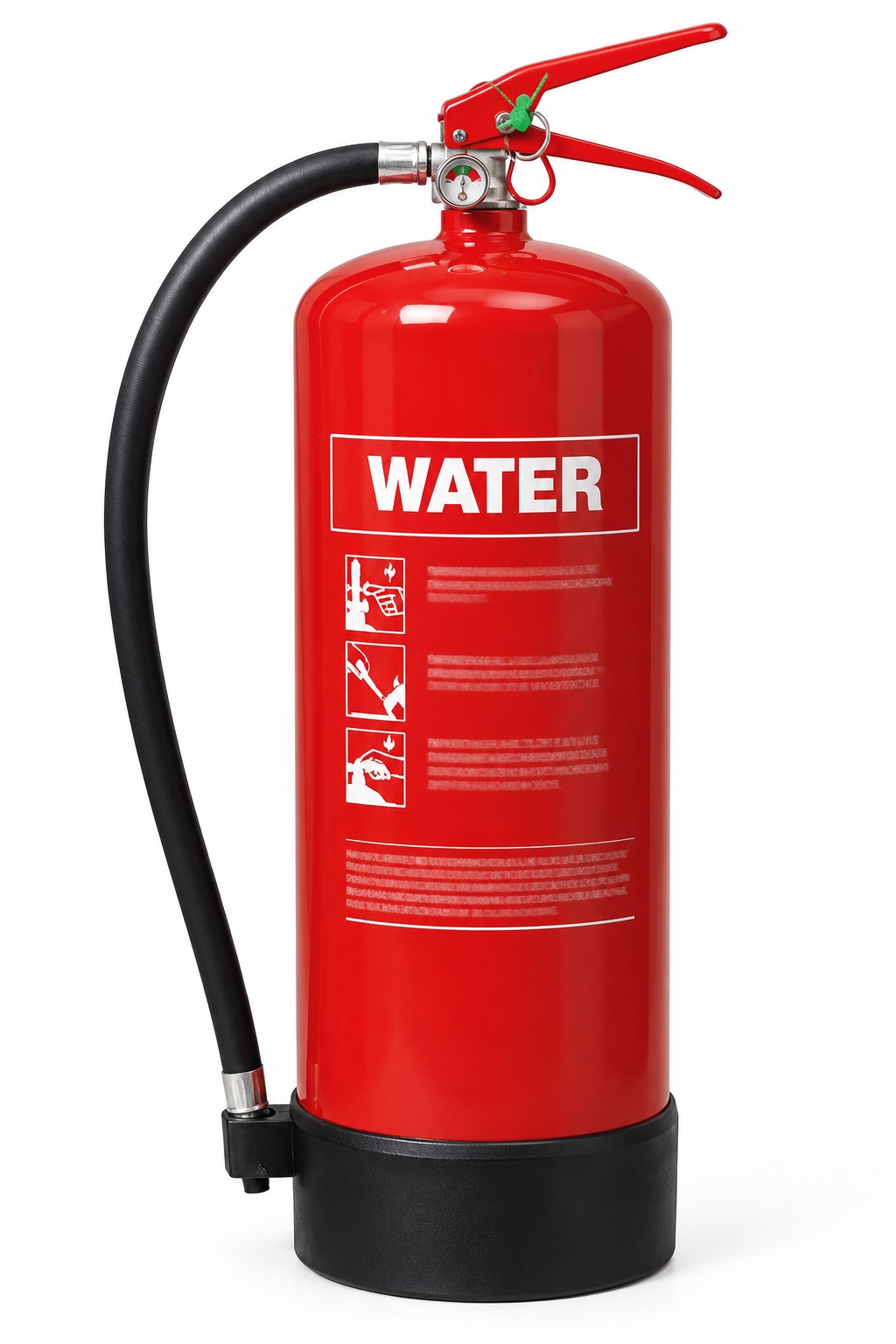  | Normally A Cools burning solid material such as paper, wood or fabric. | Check the limitation Ordinary water is unsuitable for live electrical equipment, flammable-liquid pools, cooking oil and reactive metals: shock, spreading fuel or violent reaction can result. |
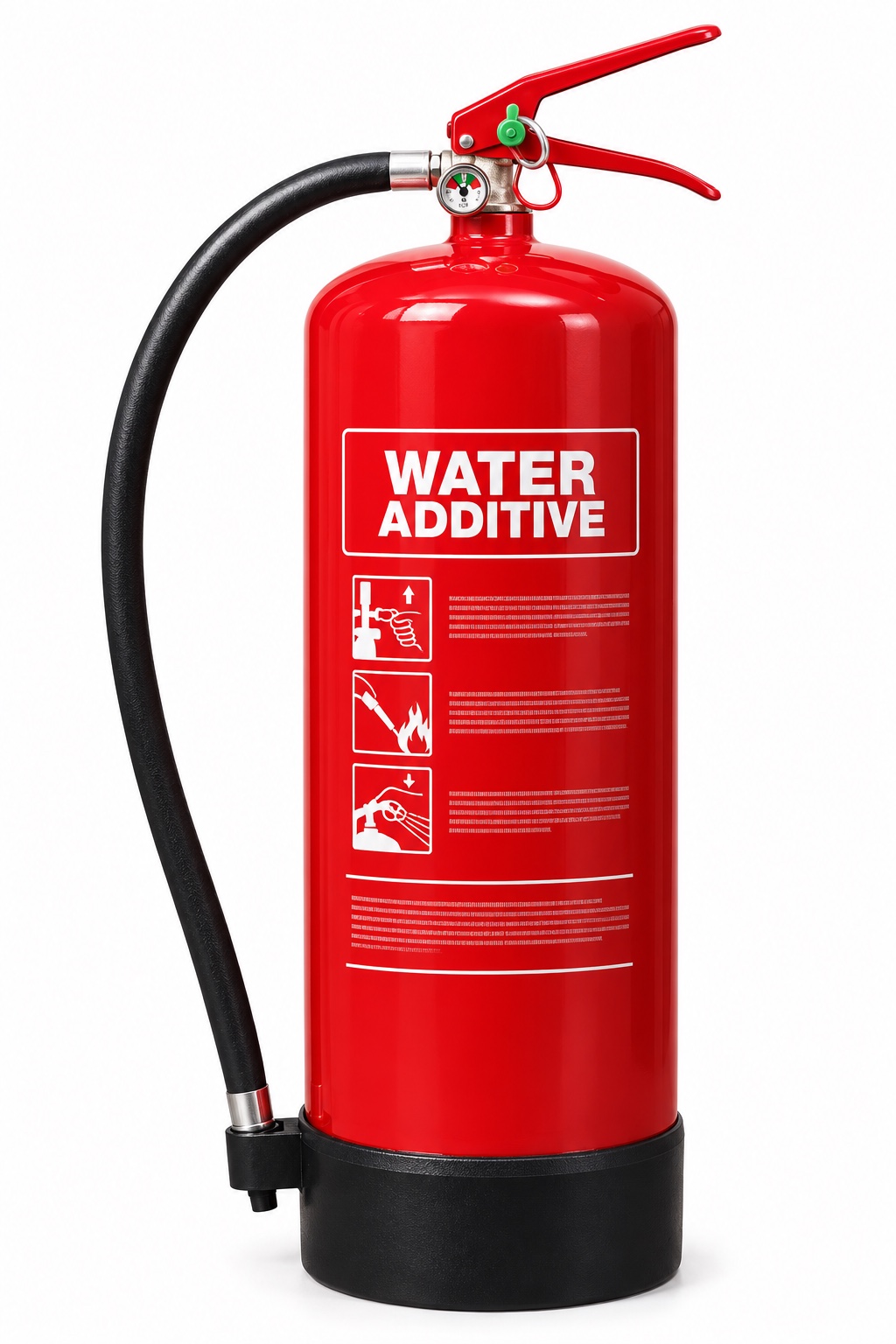 | A; B only if explicitly rated Improved wetting or spray performance can help on the hazards stated on that model’s label. | Check the limitation An additive does not make every water extinguisher safe for electricity, oils or reactive chemicals. Check the specific exclusions. |
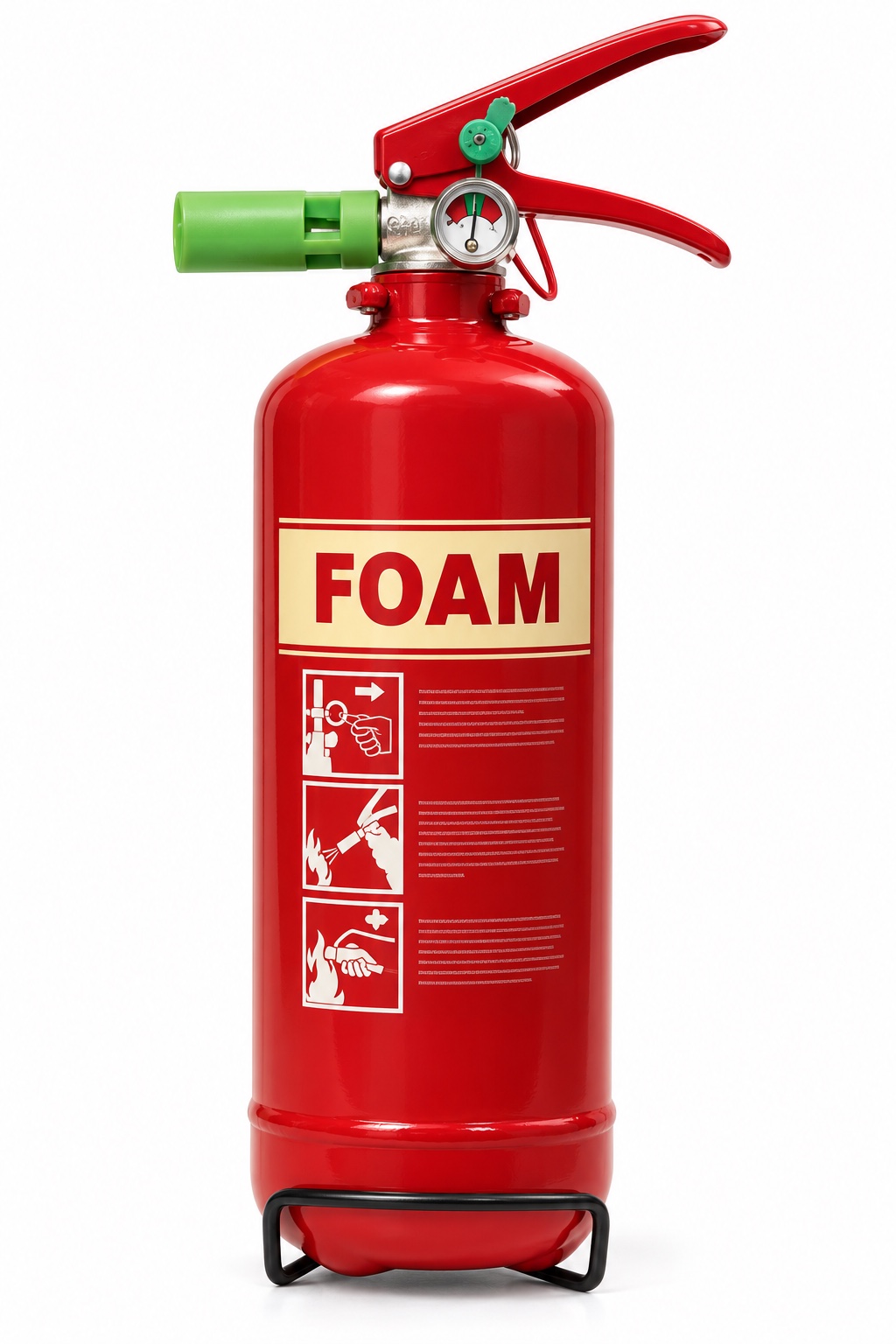 | Commonly A and B Cools and forms a surface blanket on suitable liquid fires. The agent must suit the actual fuel; some alcohols need alcohol-resistant foam. | Check the limitation Ordinary foam is not a general answer for live electricity, cooking oil or metal fires. Unsuitable foam may break down on a solvent; a jet can spread fuel. Free-flowing fuel needs specialist response. |
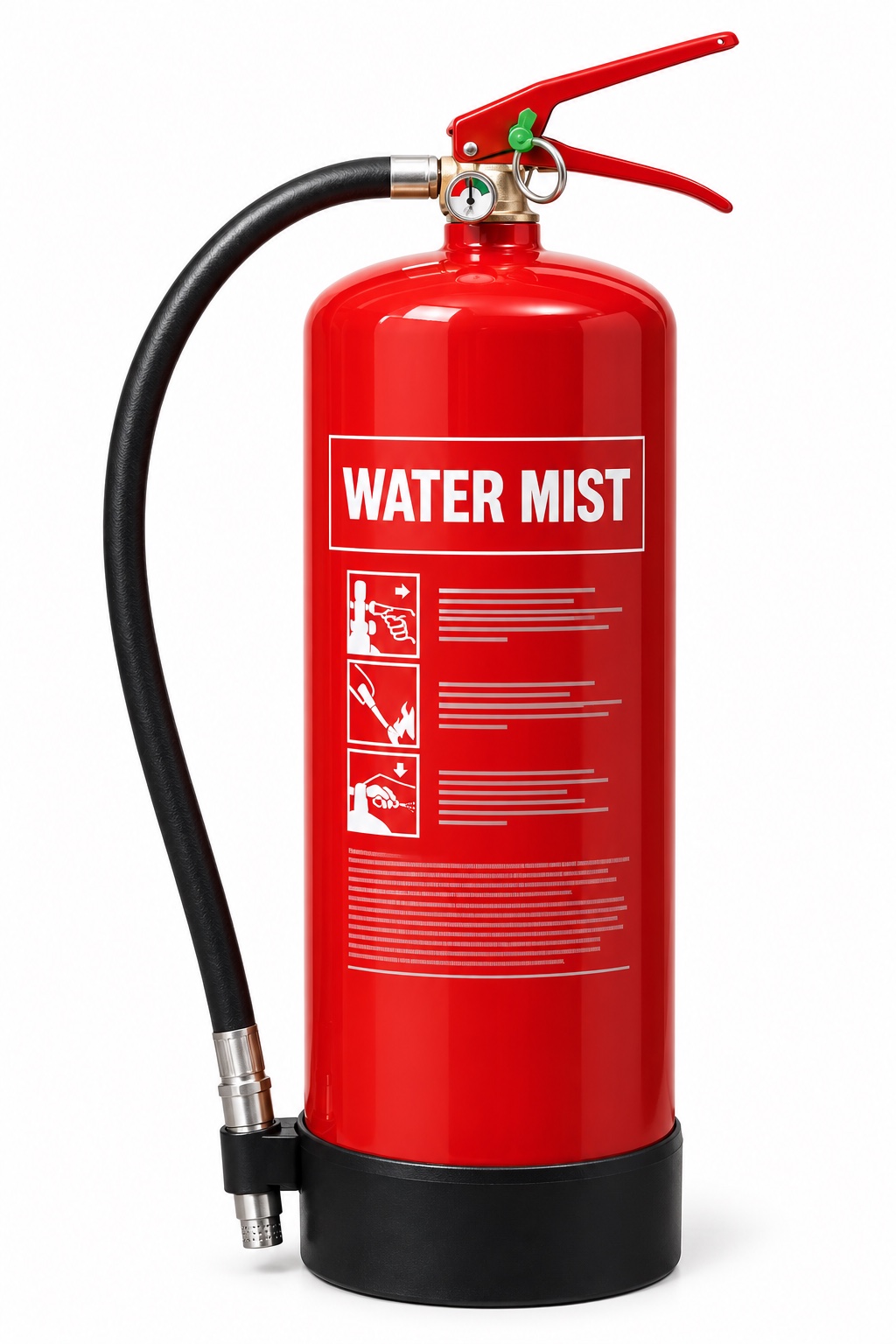 | Model-specific; commonly A, some F Fine droplets absorb heat. Some products have additional ratings or tested electrical suitability, with stated voltage and distance conditions. | Check the limitation ‘Mist’ is not universal approval. Use only the classes and electrical conditions actually declared for that model; do not assume it covers metals, liquids or batteries. |
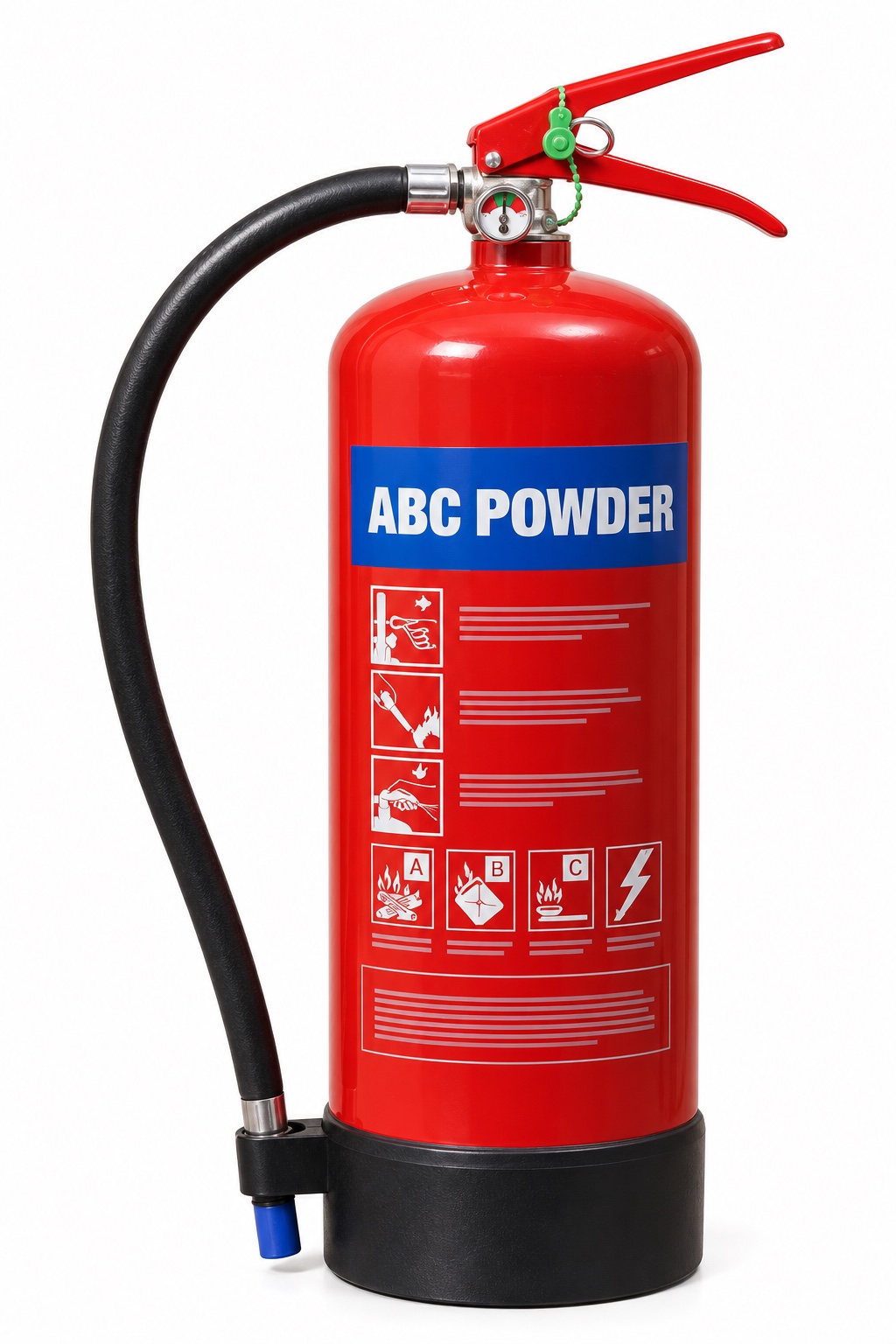 | A, B and C if marked Interrupts flame chemistry; multipurpose powder also acts on Class A material. A C marking does not authorise tackling a gas leak. | Check the limitation Powder can obscure escape and impair breathing; it is not generally recommended indoors. Limited cooling allows reignition. It is not metal-specific D powder or a substitute for F-rated cooking-oil equipment. |
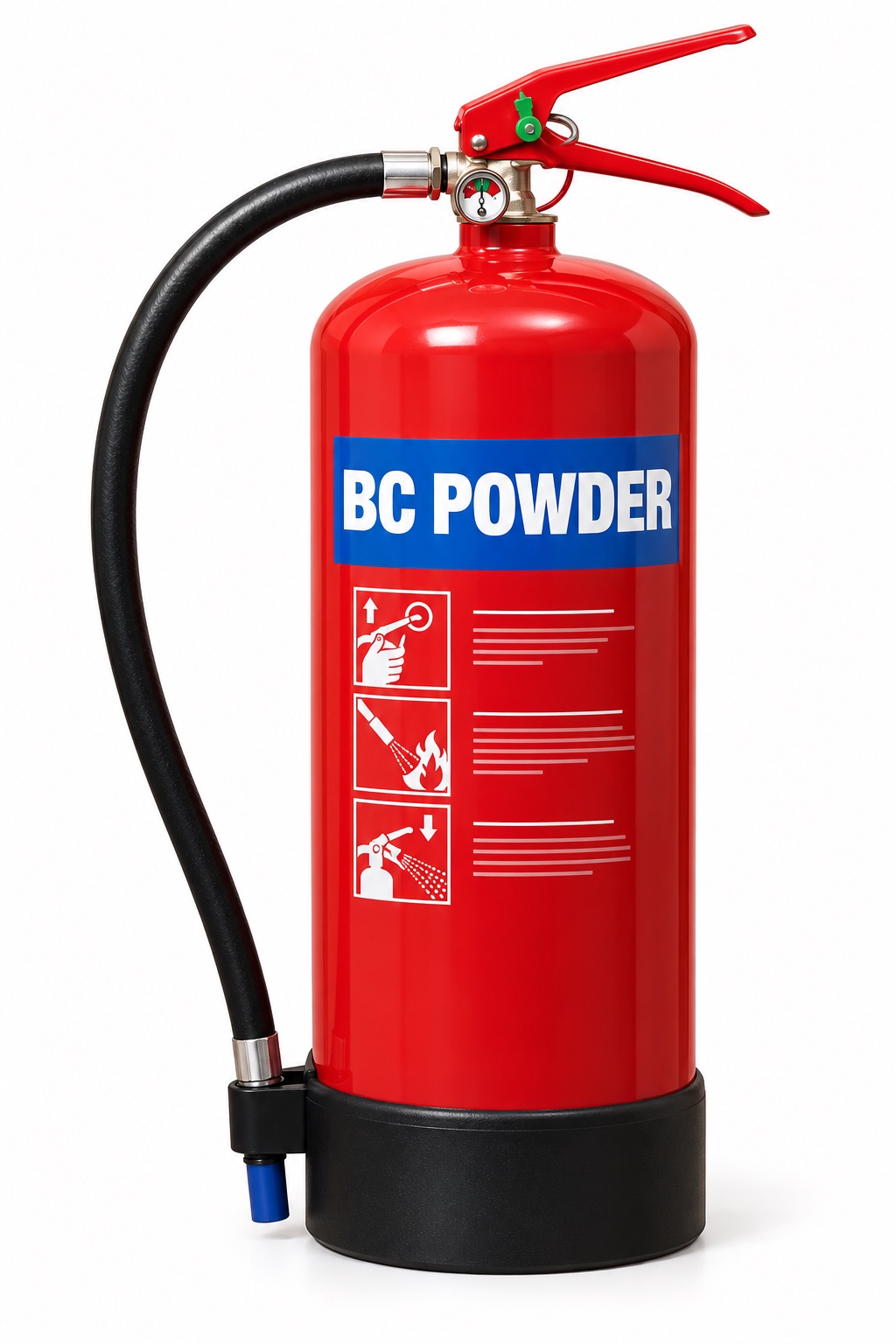 | B and C if marked; not A Selected for particular liquid or gas hazards under the assessed plan. Electrical use must follow the actual unit’s instructions. | Check the limitation Do not assume all blue powder extinguishers protect wood or paper. It has the visibility, breathing and reignition limitations of powder; it does not provide Class D or F protection. |
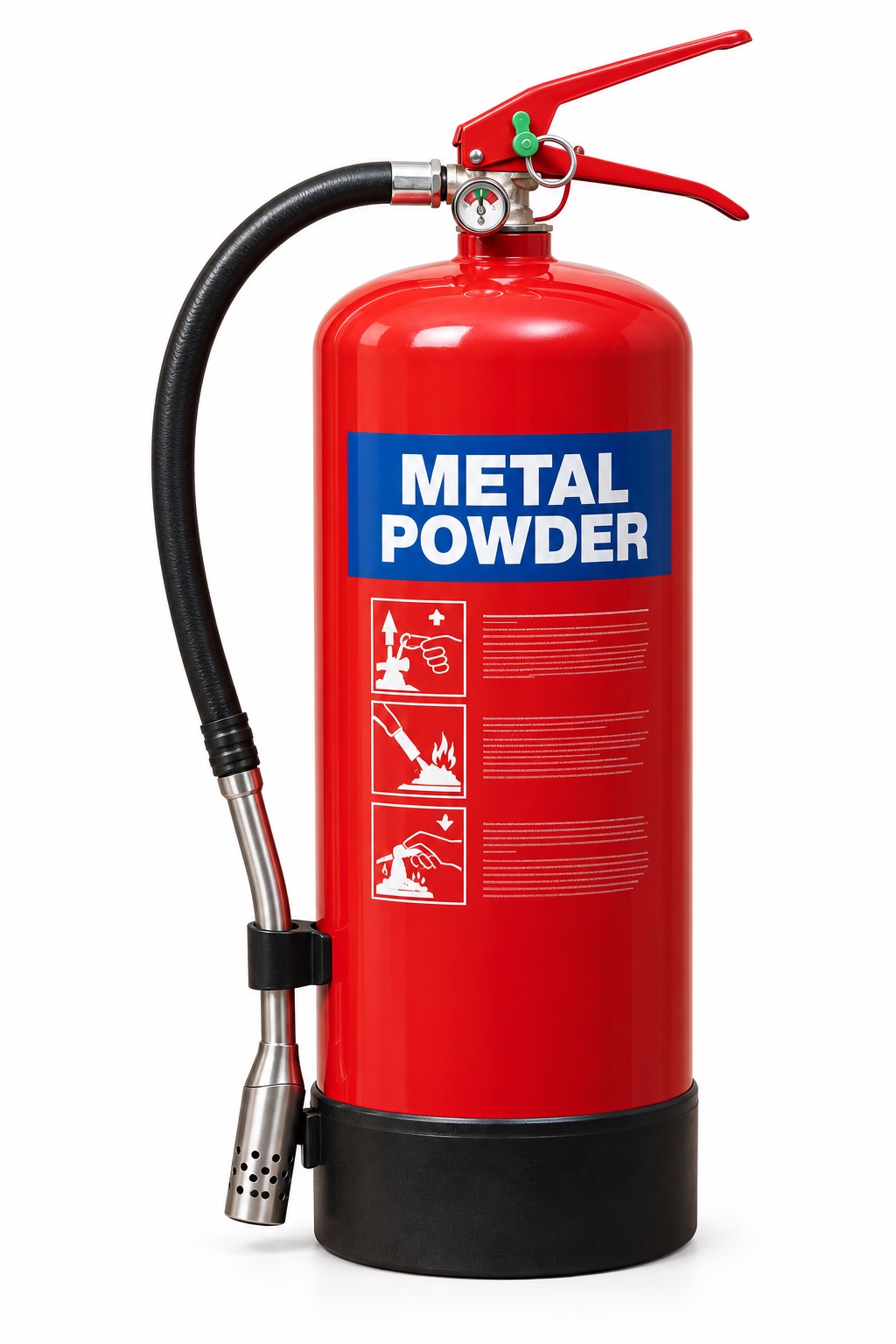 | D, for the specified metal A specialist powder can isolate or absorb heat from a compatible burning metal. Selection requires knowledge of the metal and its form. | Check the limitation The wrong powder can fail or react. Water, foam and CO₂ can be dangerous on certain burning metals. A powder suitable for magnesium is not automatically suitable for metallic lithium. |
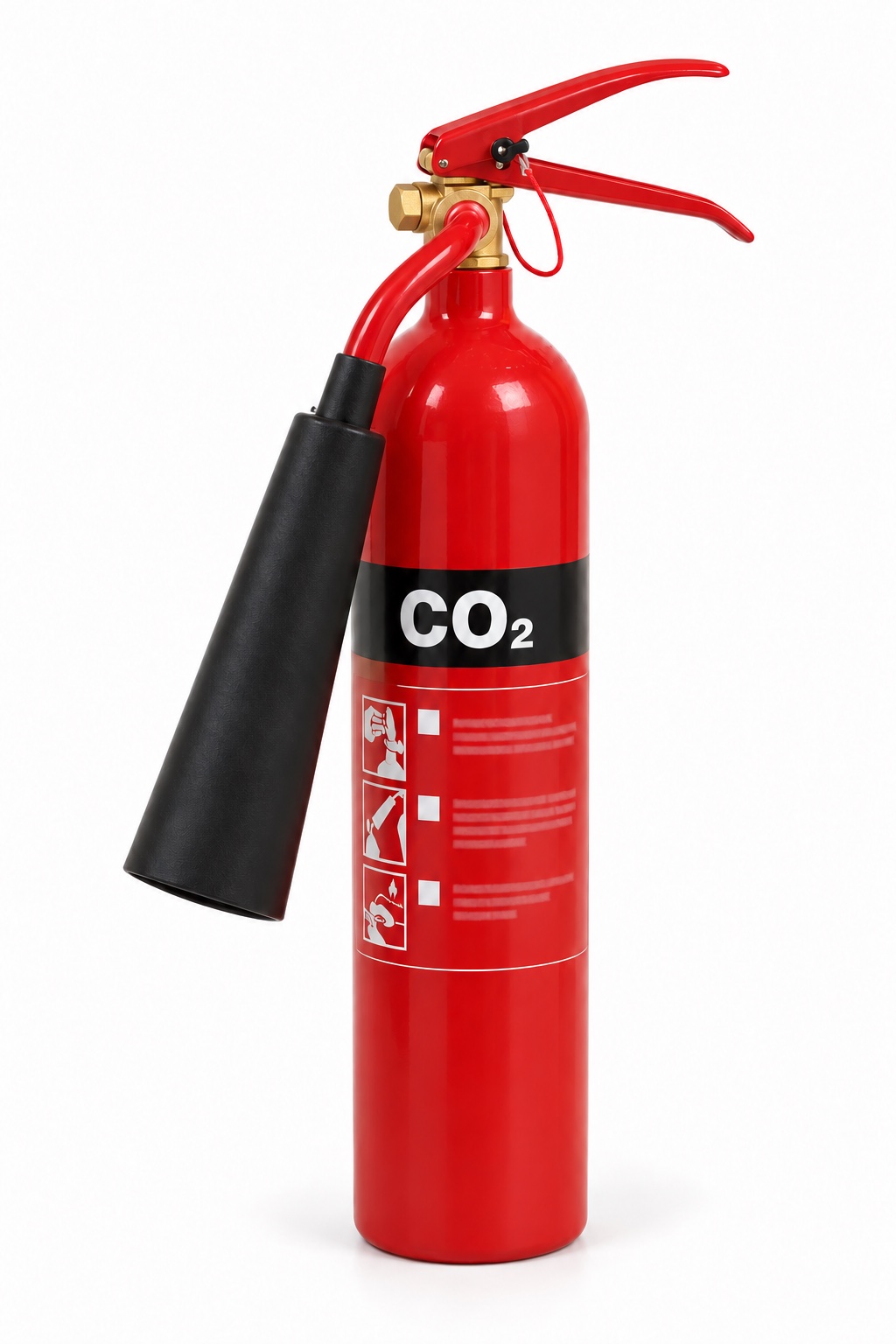 | B; electrical use as instructed Displaces the atmosphere around a small flame and leaves no powder residue. Often selected around electrical equipment. | Check the limitation Poor cooling means reignition is possible. CO₂ can create a dangerous atmosphere in enclosed spaces; discharge can cause frostbite. Hold only the designated insulated parts. Not a cooking-oil or metal-fire substitute. |
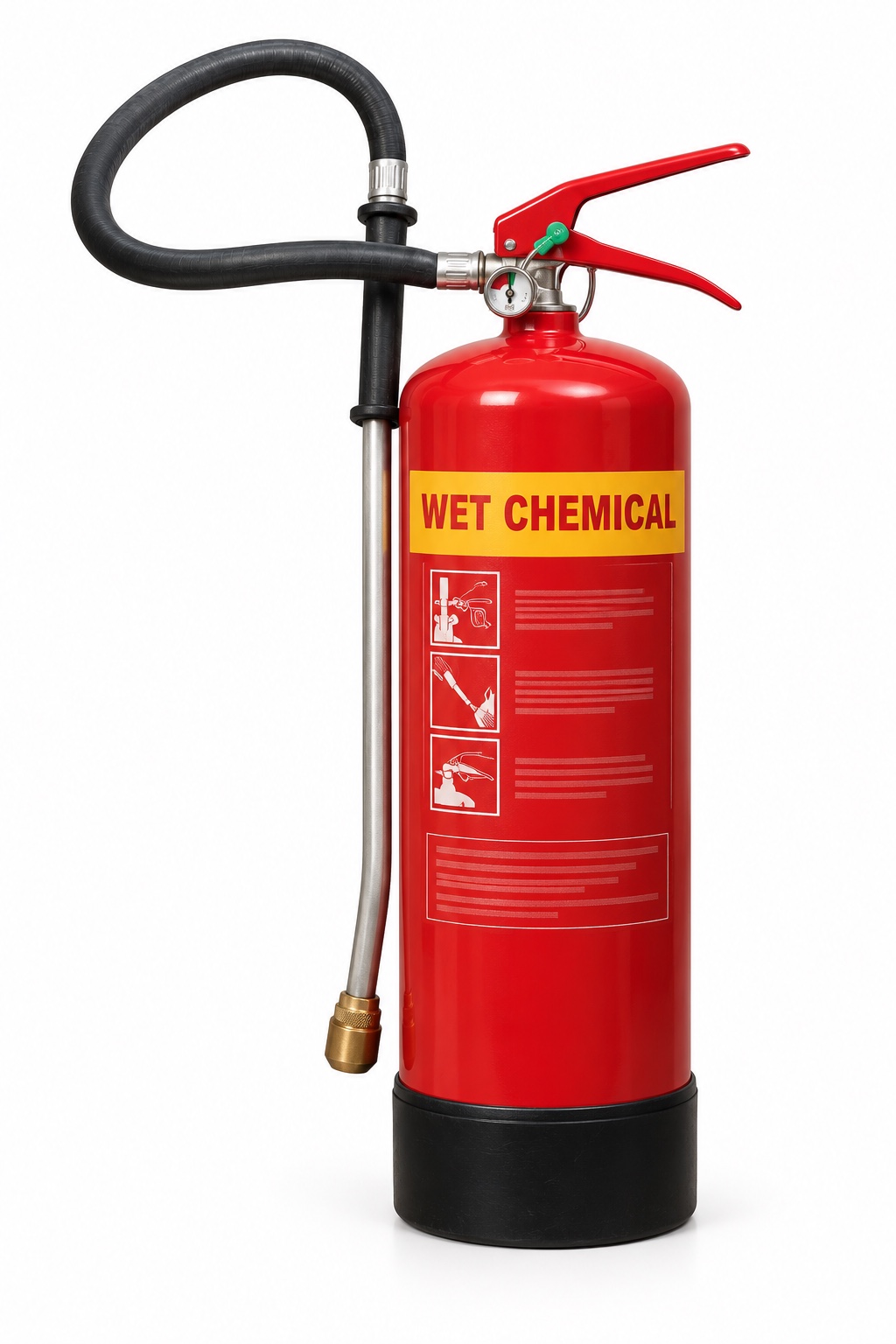 | F; often A if marked Cools cooking oil and creates a protective surface layer through reaction with the fat. Use only within the actual unit’s rating and instructions. | Check the limitation Do not mistake it for a general liquid-fire or electrical extinguisher. Incorrect application or moving the fryer can splash hot oil; apparent flame-out does not establish safe temperature. |
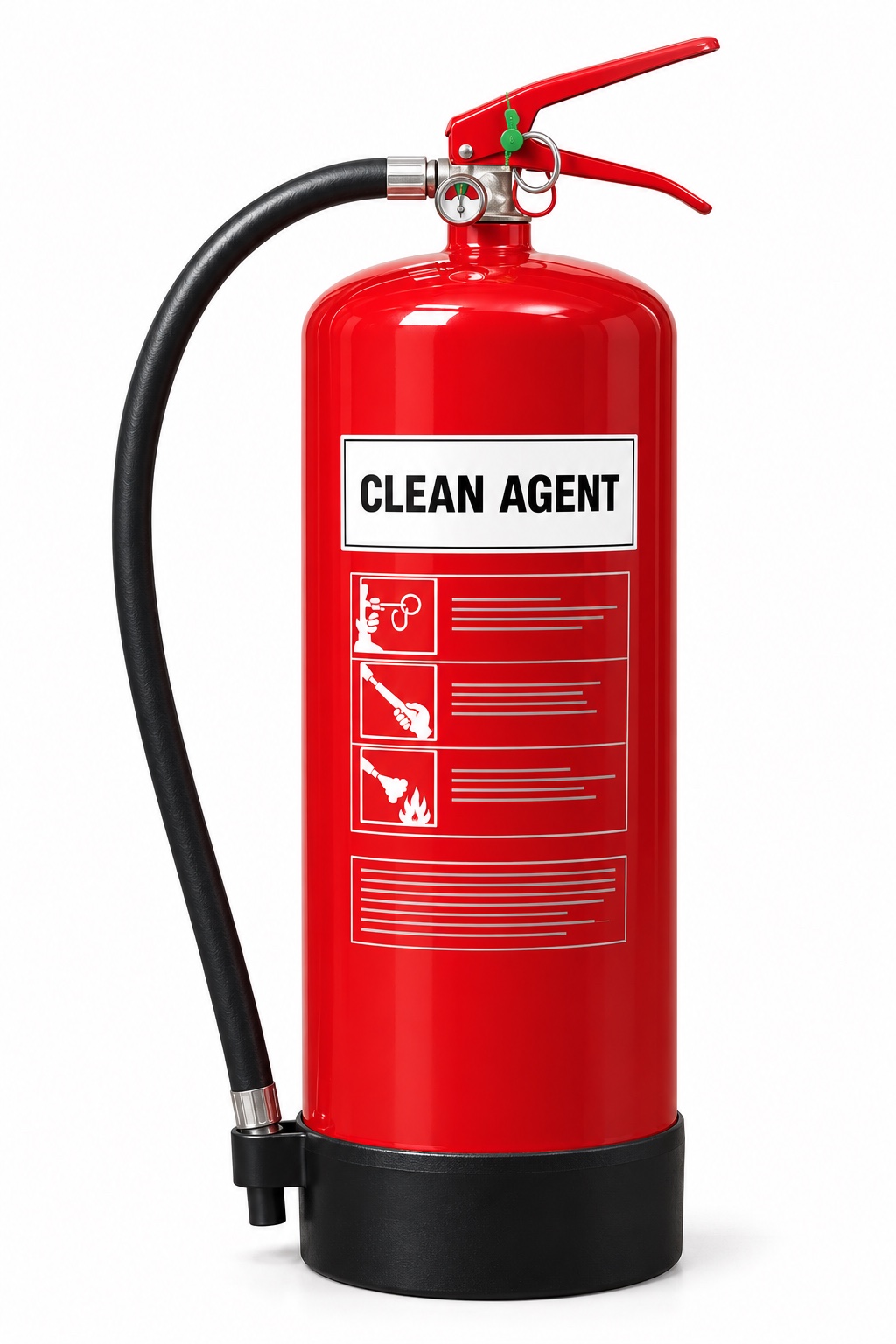 | Product- and jurisdiction-specific Specialist low-residue agents may protect sensitive equipment. Confirm the UK-approved application and the manufacturer’s limits. | Check the limitation Low residue does not mean safe to breathe. Do not copy a US A:B:C rating as UK gas-fire approval. Legacy halon is restricted to permitted critical uses and applicable deadlines. |
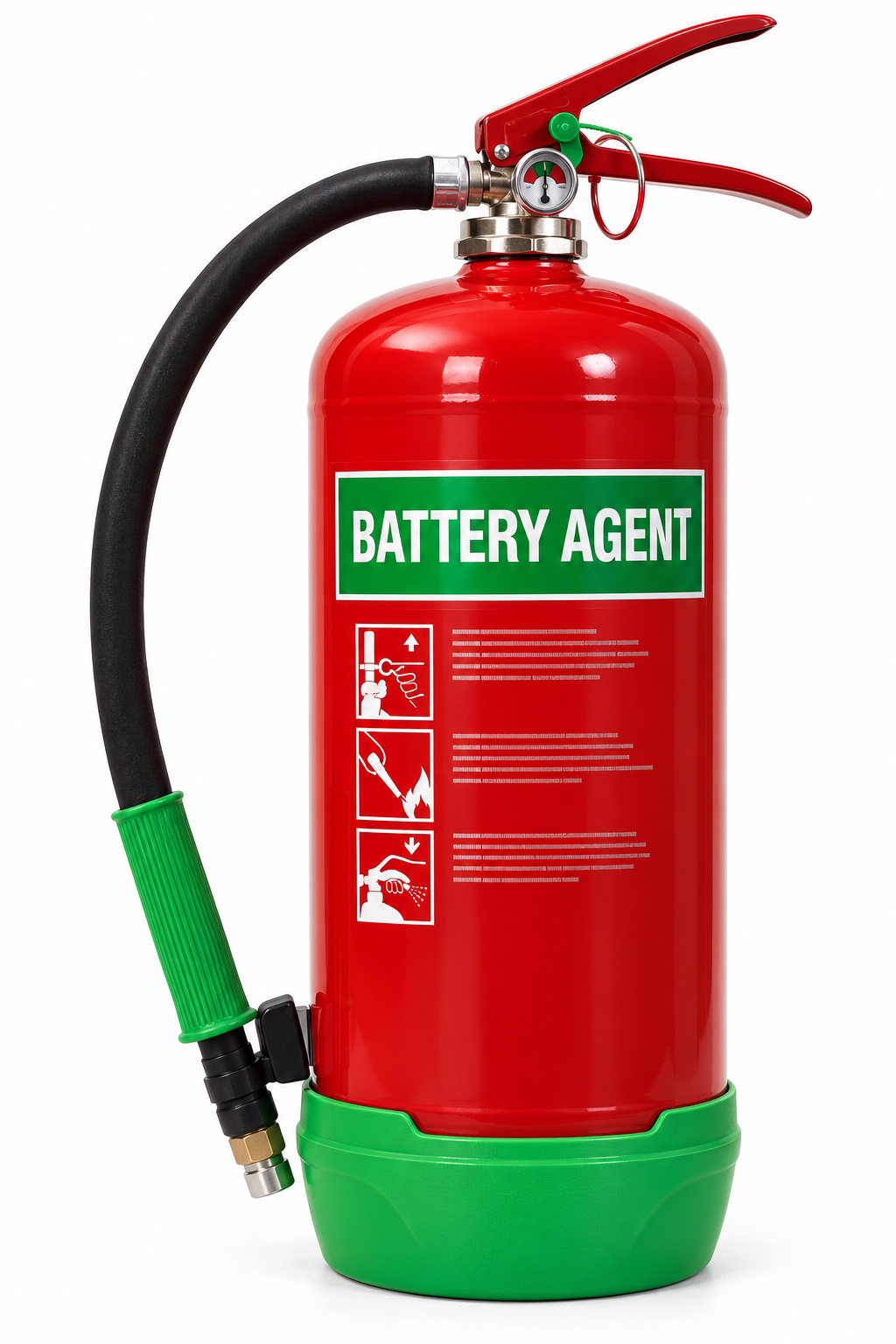 | Check independent scope and instructions Some products use water-based cooling or specialist media such as aqueous vermiculite for specified battery scenarios. Selection depends on chemistry, capacity and location. | Check the limitation A ‘lithium’ label is not proof it will stop thermal runaway in a large pack. Flame suppression may not prevent reignition or gas release. Do not approach, carry or submerge a failing battery as a learner exercise. |
Lithium-ion product example · Firechief 6 L Lith-Ex

A named product example helps connect the generic table to an actual unit. Confirm the exact product before using its claims.
- Agent and intended application
- The linked Seton example uses aqueous vermiculite dispersion (AVD) for specified lithium-ion battery fire applications. Water content cools; the dispersed mineral helps form a barrier. This is not generic Class D metal-fire powder.
- Read the actual rating
- Seton lists a 6 L product with a 13A rating. That A rating describes its solid-material test performance; it does not, by itself, certify a universal Class L battery capability.
- Match the exact model and generation
- The manufacturer’s current 6 L G2 page identifies FLE6X and different discharge details from the retailer’s older listing. Do not mix their time, range or pressure values. Match the delivered label, product sheet and manual.
- Check the battery scope
- Confirm the allowed battery chemistry, energy capacity, state and scenario with the current manufacturer information and competent fire assessment. A large EV or energy-storage pack cannot be treated as a small-device fire.
- Electrical conditions are product-specific
- The supplied product label includes a voltage and minimum-distance condition. Do not transfer that condition to another battery extinguisher or infer that it makes an unsafe electrical approach acceptable.
- After the flame disappears
- Heat, off-gas and reignition can remain. Follow the planned withdrawal, exclusion and fire-service response; do not pick up, submerge or return a failed battery to charging.
Seton · supplied 6 L Lith-Ex example ↗
Firechief · current 6 L G2 model information ↗
Read the actual label
Read the agent, fire-class letters, performance rating, electrical warnings, operating instructions and service condition. Numbers such as 13A or 55B describe standardised test performance, not a safe room size or permission to tackle that amount of fire. Colour is a clue; the actual label and assessed plan decide suitability.
Spot the dangerous assumption
Pause at each question, then open the explanation. These are unscored learning prompts alongside the course assessment.
Keep prevention, alarms, compartmentation and escape effective. Report a missing, obstructed, damaged or discharged extinguisher; do not return a partly used unit to service. Competent selection, maintenance and practical training belong in the fire arrangements.
Which fire risk route are you dealing with?
The quickest way to make fire risk assessment useful is to select the right route for the premises, people, work activity and fire mechanism.
A broad word such as 'fire' hides very different control routes. An office fire assessment will look closely at people at risk, escape routes, doors, alarms and housekeeping. A construction fire plan must anticipate temporary stages, combustible packages, hot work and changing routes. A DSEAR assessment starts with dangerous substances, releases, flammable atmospheres, ignition and explosion effects.
Route selection also helps the page journey. A reader should be able to decide whether they need ordinary workplace precautions, construction fire planning, residential/common-parts duties, place-of-assembly controls, DSEAR controls, process-safety barriers or sleeping/care setting controls.
| Fire route | Use this control route when | Deeper page or next step |
|---|---|---|
| Ordinary workplace fire | The main risk is an office, shop, school, warehouse, workshop or leisure workplace with familiar occupants. | <a href="fire-risk-assessment-principles-and-practice.html">Fire Risk Assessment Principles and Practice</a> |
| Construction fire | The site or refurbishment work has temporary electrics, hot work, waste, changing routes or incomplete compartmentation. | <a href="fire.html">Fire Safety at Work</a> |
| Residential/common parts fire | The premises include common parts, flat entrance doors, external walls or residential duties. | <a href="fire-safety-regulation-enforcement-and-responsible-persons.html">Fire Safety Regulation, Enforcement and Responsible Persons</a> |
| Public venue or assembly fire | People may be unfamiliar with the premises, present in large numbers or depend on staff direction. | <a href="fire-evacuation-strategies.html">Fire Evacuation Strategies</a> |
| Dangerous substance or DSEAR fire | Flammable liquids, vapours, gases, aerosols, combustible dusts or oxidisers are present. | <a href="flammable-and-explosive-materials-and-dsear.html">Flammable and Explosive Materials and DSEAR</a> |
| Process fire | Loss of containment, tanks, pipework, pumps, reactors or escalation to safety-critical plant is credible. | <a href="fire-science-for-process-safety.html">Fire Science for Process Safety</a> |
| Sleeping accommodation or care setting fire | People may be asleep, dependent, unfamiliar, vulnerable or unable to self-evacuate quickly. | <a href="fire-evacuation-strategies.html">Fire Evacuation Strategies</a> |
How should ordinary workplaces and higher-risk sites be managed differently?
Ordinary workplaces need reliable premises fire precautions, while higher-risk sites need deeper control of dangerous substances, plant conditions and escalation scenarios.
The Dangerous Substances and Explosive Atmospheres Regulations 2002 are a Great Britain work-risk route. Northern Ireland uses its separate 2003 regulations; HSENI approves the GB L138 code for NI use. Neither route replaces the premises fire-safety law in the relevant nation.
Most workplaces need sound basics: suitable fire risk assessment, clear escape routes, maintained fire doors, alarm testing, emergency lighting, extinguisher checks, staff training, housekeeping and action close-out. These basics should not be dismissed as low-level compliance. They protect people every day and often fail because nobody owns routine checks.
Higher-risk work adds layers. Flammable substances, explosive atmospheres, combustible dust, hot work near hidden voids, process plant, compressed gases, large fuel loads or difficult evacuation can require DSEAR assessment, permit-to-work, isolation, gas testing, fixed detection, suppression, emergency service liaison, business continuity and environmental containment.
| Setting | Main concern | Additional controls |
|---|---|---|
| Office or retail | Escape, alarm, fire doors, housekeeping and electrical safety. | Routine checks, drill learning and clear responsibility. |
| Workshop | Combustible waste, charging, tools, heaters and hot surfaces. | Segregated storage, extraction cleaning and local training. |
| Commercial kitchen | Cooking oils, duct grease, gas and hot surfaces. | Cleaning regime, shut-off, suitable extinguishers and training. |
| Construction site | Changing layout, temporary services and hot work. | Fire plan, permits, waste control, emergency routes and site security. |
| Chemical or fuel site | Loss of containment, ignition and escalation. | DSEAR, zoning, isolation, firewater, foam and emergency response. |
| Public venue | Crowd movement, vulnerable people and unfamiliar occupants. | Evacuation strategy, staff roles, information and route management. |
What makes construction fire safety different?
Construction fire safety is different because the site, structure, escape routes, fuel load, workers, contractors and fire precautions can change daily.
Construction (Design and Management) Regulations 2015 are the Great Britain route; Northern Ireland uses its separate 2016 CDM Regulations. Both work-activity routes require coordination with the applicable premises fire law and phase-specific fire strategy.
Construction work often creates temporary fire risk before permanent fire precautions are complete. Compartmentation may be missing, fire doors may not be installed, escape routes may move, temporary electrics may be in use, waste may build up, hot work may occur near combustible materials and temporary accommodation may be occupied while works continue.
A strong construction fire plan should be live. It should cover site layout, fire points, alarms, muster, emergency lighting, fire service access, hot-work permits, storage, LPG and gas cylinders, temporary accommodation units, heaters, battery charging, waste removal, security, out-of-hours fire risk and what happens when the construction sequence changes.
| Issue | How it creates fire risk | Control evidence |
|---|---|---|
| Hot work | Introduces sparks, heat and flame near combustibles or hidden voids. | Permit, fire watch, area clearance and post-work checks. |
| Temporary electrics | Damaged, overloaded or poorly routed equipment can ignite materials. | Installation checks, RCD protection, inspection and defect close-out. |
| Combustible waste | Provides fuel and supports rapid spread. | Daily housekeeping, skips, segregation and end-of-shift checks. |
| Incomplete compartmentation | Smoke and fire can spread through openings, voids and unfinished barriers. | Temporary fire stopping and route inspections. |
| Gas cylinders and flammables | Can escalate fire and threaten responders. | Secure external storage, separation and inventory. |
| Changing escape routes | Workers may follow old routes during an alarm. | Briefings, signage, drills and supervisor checks. |
How can the hierarchy of controls prevent workplace fires and reduce their consequences?
Eliminate, Reduce, Isolate, Control, Protect and Discipline (ERICPD) orders fire-risk controls so prevention and engineering come before reliance on behaviour, PPE or extinguishers.
Fire controls are often weakened when businesses rely too heavily on signs, rules and extinguishers. ERICPD keeps the discussion practical. Can the fuel be eliminated? Can the ignition source be removed? Can the work be redesigned? Can flammables be substituted? Can quantities be reduced? Can engineering controls separate fuel from ignition or detect fire early?
Personal protective equipment has a limited place in ordinary fire safety. Fire-resistant clothing may be relevant for hot work or specialist roles, but it does not replace prevention, separation, alarm, escape or competent emergency planning.
Choose the activity
How can the ERICPD hierarchy of controls reduce risks while repairing pipework with proposed hot work?

| Control level | Control for this activity | Owner and verification | Stop / restart decision |
|---|---|---|---|
| Eliminate | Use a suitable cold repair, mechanical joint or off-site fabrication if that removes the hot-work step. | Process owner verifies that the revised workflow achieves the required output and the hazardous step is genuinely removed. | If the hazardous step remains, retain a task assessment and select the stronger feasible remaining controls. |
| Reduce, including substitution | Choose a suitable lower-ignition repair process through engineering review; do not assume a different tool is safe around flammables. | Process/technical owner validates the alternative, its compatibility and any new risks before adoption. | Reject the alternative if suitability is unproved or its new hazards are unresolved. |
| Isolate | Isolate and make safe connected hazardous contents; remove or protect combustibles and separate the work from occupied routes. | Supervisor verifies the task boundaries and that the separation or isolation protects affected people and connected work. | Hold or stop for uncertain contents, gas alarm, uncontrolled sparks or loss of required fire precautions. |
| Control: physical safeguards | Provide the engineered isolation, ventilation, screens and fire protection required for the assessed hot-work area. | Competent equipment/process owner checks contents and isolation, combustible exposure, spark paths and permit conditions. | Hold or stop for uncertain contents, gas alarm, uncontrolled sparks or loss of required fire precautions. |
| Control: work method and response | Verify the permit conditions, gas testing where required, fire watch and emergency communications before starting. | Supervisor confirms the limits, response, communication and restart authority with the people doing this activity. | Stop if the agreed method, communication, competent cover or task limits cannot be maintained. |
| PPE | Select suitable eye/face, heat and other task protection; fire-resistant clothing does not authorise work in an unsafe atmosphere. | Assessor confirms whether PPE is needed and checks selection, condition, compatibility and any required face-fit evidence. | Do not rely on unsuitable or defective protection, or use PPE to continue after an essential source control fails. |
| Discipline | Inspect concealed and adjacent spaces and complete the agreed post-work checks before hand-back. | Release only after permit owner accepts completion and the specified fire-watch/hand-back evidence. Retain the checks and unresolved restrictions at handover. | Keep the activity on hold while defects or required reinstatement evidence remain unresolved. |
How can the ISO 45001 hierarchy of controls reduce risks while repairing pipework with proposed hot work?

| Control level | Control for this activity | Owner and verification | Stop / restart decision |
|---|---|---|---|
| Elimination | Use a suitable cold repair, mechanical joint or off-site fabrication if that removes the hot-work step. | Process owner verifies that the revised workflow achieves the required output and the hazardous step is genuinely removed. | If the hazardous step remains, retain a task assessment and select the stronger feasible remaining controls. |
| Substitution | Choose a suitable lower-ignition repair process through engineering review; do not assume a different tool is safe around flammables. | Process/technical owner validates the alternative, its compatibility and any new risks before adoption. | Reject the alternative if suitability is unproved or its new hazards are unresolved. |
| Engineering controls | Isolate and make safe connected hazardous contents; remove or protect combustibles and separate the work from occupied routes. | Supervisor verifies the task boundaries and that the separation or isolation protects affected people and connected work. | Hold or stop for uncertain contents, gas alarm, uncontrolled sparks or loss of required fire precautions. |
| Engineering controls | Provide the engineered isolation, ventilation, screens and fire protection required for the assessed hot-work area. | Competent equipment/process owner checks contents and isolation, combustible exposure, spark paths and permit conditions. | Hold or stop for uncertain contents, gas alarm, uncontrolled sparks or loss of required fire precautions. |
| Administrative controls | Verify the permit conditions, gas testing where required, fire watch and emergency communications before starting. | Supervisor confirms the limits, response, communication and restart authority with the people doing this activity. | Stop if the agreed method, communication, competent cover or task limits cannot be maintained. |
| PPE | Select suitable eye/face, heat and other task protection; fire-resistant clothing does not authorise work in an unsafe atmosphere. | Assessor confirms whether PPE is needed and checks selection, condition, compatibility and any required face-fit evidence. | Do not rely on unsuitable or defective protection, or use PPE to continue after an essential source control fails. |
| Administrative controls | Inspect concealed and adjacent spaces and complete the agreed post-work checks before hand-back. | Release only after permit owner accepts completion and the specified fire-watch/hand-back evidence. Retain the checks and unresolved restrictions at handover. | Keep the activity on hold while defects or required reinstatement evidence remain unresolved. |
How can the ERICPD hierarchy of controls reduce risks while reorganising a stockroom beside an escape corridor?

| Control level | Control for this activity | Owner and verification | Stop / restart decision |
|---|---|---|---|
| Eliminate | Remove unnecessary combustible stock and prohibit storage in the escape corridor. | Process owner verifies that the revised workflow achieves the required output and the hazardous step is genuinely removed. | If the hazardous step remains, retain a task assessment and select the stronger feasible remaining controls. |
| Reduce, including substitution | Select lower-fire-load packaging or an alternative storage/charging arrangement after checking compatibility and operational needs. | Process/technical owner validates the alternative, its compatibility and any new risks before adoption. | Reject the alternative if suitability is unproved or its new hazards are unresolved. |
| Isolate | Separate stock and charging from escape routes with the assessed fire-resisting arrangement. | Supervisor verifies the task boundaries and that the separation or isolation protects affected people and connected work. | Hold or stop for blocked escape, defective fire door or unassessed combustible accumulation. |
| Control: physical safeguards | Maintain compartmentation, fire doors and specified detection/protection; prevent stock obstructing their operation. | Competent equipment/process owner checks escape-route clearance, fire doors, compartmentation and actual stock/charging layout. | Hold or stop for blocked escape, defective fire door or unassessed combustible accumulation. |
| Control: work method and response | Set stock limits, delivery routes and charging rules consistent with the fire risk assessment and evacuation plan. | Supervisor confirms the limits, response, communication and restart authority with the people doing this activity. | Stop if the agreed method, communication, competent cover or task limits cannot be maintained. |
| PPE | Occupant fire safety depends on prevention, protection and escape; PPE is not a control for an obstructed corridor. | Assessor confirms whether PPE is needed and checks selection, condition, compatibility and any required face-fit evidence. | Do not rely on unsuitable or defective protection, or use PPE to continue after an essential source control fails. |
| Discipline | Inspect routes at deliveries and shift changes; correct door, stock and charging defects rather than leaving them on an action list. | Release only after responsible manager verifies the revised store and usable escape route. Retain the checks and unresolved restrictions at handover. | Keep the activity on hold while defects or required reinstatement evidence remain unresolved. |
How can the ISO 45001 hierarchy of controls reduce risks while reorganising a stockroom beside an escape corridor?

| Control level | Control for this activity | Owner and verification | Stop / restart decision |
|---|---|---|---|
| Elimination | Remove unnecessary combustible stock and prohibit storage in the escape corridor. | Process owner verifies that the revised workflow achieves the required output and the hazardous step is genuinely removed. | If the hazardous step remains, retain a task assessment and select the stronger feasible remaining controls. |
| Substitution | Select lower-fire-load packaging or an alternative storage/charging arrangement after checking compatibility and operational needs. | Process/technical owner validates the alternative, its compatibility and any new risks before adoption. | Reject the alternative if suitability is unproved or its new hazards are unresolved. |
| Engineering controls | Separate stock and charging from escape routes with the assessed fire-resisting arrangement. | Supervisor verifies the task boundaries and that the separation or isolation protects affected people and connected work. | Hold or stop for blocked escape, defective fire door or unassessed combustible accumulation. |
| Engineering controls | Maintain compartmentation, fire doors and specified detection/protection; prevent stock obstructing their operation. | Competent equipment/process owner checks escape-route clearance, fire doors, compartmentation and actual stock/charging layout. | Hold or stop for blocked escape, defective fire door or unassessed combustible accumulation. |
| Administrative controls | Set stock limits, delivery routes and charging rules consistent with the fire risk assessment and evacuation plan. | Supervisor confirms the limits, response, communication and restart authority with the people doing this activity. | Stop if the agreed method, communication, competent cover or task limits cannot be maintained. |
| PPE | Occupant fire safety depends on prevention, protection and escape; PPE is not a control for an obstructed corridor. | Assessor confirms whether PPE is needed and checks selection, condition, compatibility and any required face-fit evidence. | Do not rely on unsuitable or defective protection, or use PPE to continue after an essential source control fails. |
| Administrative controls | Inspect routes at deliveries and shift changes; correct door, stock and charging defects rather than leaving them on an action list. | Release only after responsible manager verifies the revised store and usable escape route. Retain the checks and unresolved restrictions at handover. | Keep the activity on hold while defects or required reinstatement evidence remain unresolved. |
How should fire and smoke spread be controlled?
Fire and smoke spread should be controlled through compartmentation, protected routes, fire doors, housekeeping, void control, ventilation awareness and maintenance.
Fire spread is not only about flames crossing a room. Smoke can travel through open doors, service risers, ceiling voids, ducts, gaps around pipes and unsealed penetrations. A fire door that is wedged open, missing seals or damaged by a contractor can defeat a carefully designed escape strategy.
Responsible persons and managers should treat passive fire protection as a live control. Fire doors, walls, floors, ceilings, dampers, fire stopping and protected stairways need inspection, defect reporting and careful management during works. Temporary breaches should be risk assessed, controlled and reinstated.
| Control | What it protects | Failure mode to watch |
|---|---|---|
| Fire doors | Protected routes and compartments. | Wedged open, damaged, poor closer, missing seals. |
| Compartmentation | Limits fire and smoke spread. | Unsealed penetrations and poor contractor reinstatement. |
| Housekeeping | Reduces available fuel. | Combustibles stored in corridors, risers or plant rooms. |
| External storage | Stops fire spreading to buildings. | Bins, pallets or cylinders against walls. |
| Ventilation and ducts | Can carry smoke, heat or flame. | Grease build-up, missing dampers or poor isolation. |
| Protected routes | Keeps escape available. | Blocked routes, locked exits or poor lighting. |
Why can smoke make an escape route unusable before flame reaches it?
Smoke, heat, low oxygen and toxic products can impair escape before direct flame contact.
Smoke can obscure signs and routes, irritate breathing and carry carbon monoxide and other toxic products. The mixture depends on the fuel and ventilation, so smell or visible density is not a safe exposure measure. A geometrically open exit may be unusable by the time a person reaches it, especially if they need assistance.
Prevent ignition and fuel accumulation, preserve complete compartmentation, and maintain early warning, protected routes and smoke control where the fire strategy relies on them. Do not set generic tenability times or occupant exposure limits: complex escape and smoke-control performance needs competent fire engineering and current design information.
After a fire, exclude people from contaminated or unstable areas. Re-entry requires control of structural, electrical, atmosphere, residue and re-ignition hazards; significant smoke exposure or concerning symptoms need prompt medical assessment through emergency arrangements.
What emergency arrangements should be in place for fire?
Fire emergency arrangements should tell people how they will be warned, how they will escape, who supports evacuation and how the incident will be managed.
Emergency arrangements must be practical for the people and premises. Workers should know the alarm sound, escape routes, assembly location and reporting arrangements. Managers should know who checks areas, who calls the fire and rescue service, how visitors and contractors are accounted for, how disabled or vulnerable people are assisted, and when nobody should re-enter.
Drills are not theatre. They should test whether people hear the alarm, routes work, wardens understand their roles, contractors respond correctly and assembly arrangements make sense. Learning should be recorded and converted into actions.
| Element | What it should cover | Evidence |
|---|---|---|
| Alarm and warning | How people are alerted in all relevant areas. | Alarm test records and drill feedback. |
| Escape routes | Safe routes to a place of safety. | Route inspections and emergency lighting checks. |
| Roles | Wardens, sweepers, incident lead and caller. | Role training and drill observations. |
| People needing assistance | Personal or generic emergency evacuation arrangements. | Confidential arrangements and reviews. |
| Contractors and visitors | Induction, sign-in, escort and muster. | Visitor process and contractor induction. |
| Emergency services | Access, information, shut-offs and hazards. | Site plan, liaison and information box where relevant. |
What must be ready for firefighters and for safe recovery?
Keep access and premises information usable, then separate life safety from later reoccupation and business recovery.
A fire crew may need open approach routes, gates and keys, water, risers, shafts, isolation points and a concise current plan of occupancy, hazardous materials, batteries, cylinders, utilities and protection-system status. Construction work, parking and storage can quietly block these. Assign a competent liaison at a safe rendezvous point without attempting to direct tactics.
Pre-plan firewater and released-product containment where credible, but do not obstruct rescue or create a new hazard. After the incident, keep exclusion controls until the emergency service has released the scene and competent people assess structure, electricity, atmosphere, contamination, used fire protection and welfare. Commercial pressure is not a restart criterion.
Document who accepts reoccupation, which checks and repairs were completed, and how the assessment, training and continuity plan changed. Preserve investigation evidence while putting rescue and hazard control first.
How should warning and escape work for people who need assistance?
Plan warning, movement, assistance and fallback with the people affected before an emergency.
Risk depends on the setting as well as the person: a visitor may not know the route, a lone worker may miss the signal, and a person with mobility, sensory, communication or cognitive needs may need a different warning or way out. Consult respectfully and record the functional requirement, not unnecessary diagnosis detail.
Check that the person can receive and understand warning, reach a protected route or refuge, obtain trained help and be accounted for. Any evacuation device, lift or refuge communication needs suitability, maintenance, trained cover and a fallback for power loss or absence. A plan that depends on one helper or routine rescue by the Fire and Rescue Service is not robust.
Walk through the route and practise proportionately without humiliating or endangering anyone. Review after a changed shift, layout, alarm, staffing or individual need; share only what nominated helpers and responders need.
Which legal duties apply to fire safety at work?
Fire safety law depends on nation, premises type, work activity, dangerous substances, construction status and residential/common-parts duties.
Premises fire law differs across England and Wales, Scotland and Northern Ireland. A work activity can also engage health-and-safety or dangerous-substance duties; do not use those as a substitute for the local premises fire regime. Confirm the premises type, people at risk and competent responsible person before adopting a legal route.
England and Wales generally use the Regulatory Reform (Fire Safety) Order for most non-domestic premises and the common parts of buildings containing two or more domestic premises. Scotland and Northern Ireland use separate fire safety legislation and guidance, so a UK-facing business should avoid assuming one legal route covers every site.
Construction and dangerous substances add further layers. CDM and HSG168 apply to construction planning and site fire precautions. DSEAR applies where dangerous substances can create fire, explosion or similar energy-release risks. Residential and higher-risk building contexts may also require attention to the Fire Safety Act, Fire Safety (England) Regulations and Section 156 changes introduced through the Building Safety Act.
| Jurisdiction | Duty or regulation | Where it applies | What evidence should show |
|---|---|---|---|
| E&W | Regulatory Reform (Fire Safety) Order 2005 | Most non-domestic premises in England and Wales. | Fire risk assessment, general fire precautions, training, maintenance and emergency plan. |
| E&W | Fire Safety Act 2021 | Relevant premises where structure, external walls and flat entrance doors are within scope. | Assessment and management of relevant building fire safety matters. |
| England | Fire Safety (England) Regulations 2022 | Certain residential buildings in England. | Information, checks and duties matched to building height and scope. |
| E&W | Building Safety Act 2022 | Includes Section 156 changes affecting responsible-person duties under the Fire Safety Order. | Full recording of fire risk assessment and arrangements where required, plus assessor details where applicable. |
| Scotland | Fire (Scotland) Act 2005 | Scottish fire safety regime. | Scottish fire risk assessment and fire safety arrangements. |
| Scotland | Fire Safety (Scotland) Regulations 2006 | Scottish premises within scope. | Specific fire safety precautions and compliance evidence. |
| NI | Fire and Rescue Services (Northern Ireland) Order 2006 | Northern Ireland fire safety framework. | Duties and enforcement arrangements for relevant premises. |
| NI | Fire Safety Regulations (Northern Ireland) 2010 | Northern Ireland fire safety regulations. | Risk assessment and fire safety controls in relevant premises. |
| GB | Health and Safety at Work etc. Act 1974 | Work activities that create fire risk. | Safe work, safe plant, contractor control and protection of affected people. |
| GB | Management of Health and Safety at Work Regulations 1999 | Workplace risk assessment and preventive arrangements. | Risk assessment, competence, cooperation and monitoring. |
| GB | Dangerous Substances and Explosive Atmospheres Regulations 2002 | Dangerous substances that can create fire or explosion risk. | DSEAR assessment, ignition control, zoning, emergency arrangements and training. |
| GB | Construction (Design and Management) Regulations 2015 | Construction work. | Construction phase plan, site rules, emergency arrangements and contractor coordination. |
| NI | Dangerous Substances and Explosive Atmospheres Regulations (NI) 2003 | Northern Ireland work-risk assessment and controls for dangerous substances and explosive atmospheres. | NI-specific assessment, ignition control, emergency arrangements and competent verification. |
| NI | Health and Safety at Work (Northern Ireland) Order 1978 | NI general work-health and safety duties for employers and others affected by work. | Assess and control work activities that create fire or emergency risk. |
| NI | Management Regulations (Northern Ireland) 2000 | NI work-risk assessment, preventive arrangements, competence and emergency procedures. | Coordinate the work-risk controls with the separate premises fire strategy. |
| NI | CDM Regulations (Northern Ireland) 2016 | NI construction dutyholder planning and coordination. | Plan temporary fire precautions, occupied refurbishments, contractor interfaces and changing routes. |
How should fire extinguishers be checked and maintained?
Fire extinguishers should be visually checked by trained site personnel and periodically serviced by competent people in line with risk assessment, manufacturer instructions and recognised standards.
Portable fire extinguishers are life-safety equipment, but they are also easy to neglect. They get moved, discharged, blocked by storage, knocked by trolleys, hidden behind displays, selected for the wrong hazard or left with expired service labels. Routine checks are therefore about availability and obvious condition; they are not the same as competent servicing.
A simple workplace check can normally be carried out by trained staff, fire wardens or facilities teams. They should know what the correct extinguisher looks like, where it should be, what obvious defects matter and how to report or quarantine a suspect unit. More detailed inspection, maintenance, recharge, extended service, replacement or suitability review should be carried out by a competent service engineer or competent fire protection provider. There is no single universal statutory licence for every extinguisher check, but competence should be evidenced through training, experience, suitable supervision, knowledge of the relevant BS 5306 series, manufacturer requirements and, where appropriate, third-party certification expected by the client, insurer or responsible person.
| Check or activity | What should be checked | Who should normally do it |
|---|---|---|
| Routine visual check | The extinguisher is in the right location, visible, accessible and not blocked. | Trained site staff, fire warden or facilities team. |
| Suitability check | The type and rating match the fire hazards nearby, such as Class A, flammable liquid, electrical equipment or cooking oil. | Responsible person with competent fire advice where needed. |
| Condition check | No obvious corrosion, dents, leakage, missing hose/nozzle, damaged handle, broken tamper seal or missing safety pin. | Trained site staff for obvious defects; competent service provider for technical judgement. |
| Pressure or indicator check | Gauge or indicator appears within the expected range where fitted. | Trained site staff for visual checks; competent service engineer for servicing. |
| Service label check | Service label is present, legible and within the planned service date. | Facilities team or fire warden during routine checks. |
| Annual competent maintenance | Detailed inspection, service, maintenance actions and replacement recommendations. | Competent service engineer or fire protection contractor. |
| After use or discharge | Unit removed from service, replaced, recharged or serviced, and the incident reviewed. | Site team isolates the unit; competent provider reinstates. |
| Register update | Location, type, serial number, service date, defects, action and close-out are recorded. | Facilities, responsible person or fire safety lead. |
How should fire doors be checked and maintained?
Fire doors should be routinely checked for obvious defects, kept closed and unobstructed, and technically inspected or repaired by competent specialists where damage, replacement or uncertainty exists.
Fire doors are not ordinary doors with a blue sign on them. They protect escape routes and compartments by resisting fire and limiting smoke movement. A damaged door, failed closer, excessive gap, missing intumescent or smoke seal, damaged glazing, altered air transfer grille, loose hinge, missing latch or poor frame fit can allow smoke and heat to spread before people have escaped.
GOV.UK fire door guidance for England makes a useful distinction. Simple routine checks are intended to confirm that doors remain in efficient working order and good repair; they are not a detailed technical examination of fire resistance. If obvious damage, replacement, alteration or performance uncertainty is found, the responsible person should escalate to a competent fire door inspector, competent joinery/fire door contractor or fire risk assessor. For relevant multi-occupied residential buildings in England, Regulation 10 creates specific fire door check duties; other premises still need fire doors maintained as part of general fire precautions and the fire risk assessment.
| Check or activity | What should be checked | Who should normally do it |
|---|---|---|
| Routine obstruction check | The door is not wedged, tied, blocked or prevented from closing. | Workers, supervisors, fire wardens and facilities teams. |
| Self-closing check | The closer shuts the door fully into the frame from different opening positions. | Trained site staff for simple checks; specialist if adjustment or repair is needed. |
| Gap and fit check | Obvious excessive gaps, poor fit, rubbing, warping or failure to latch are identified. | Trained site staff can spot obvious issues; competent inspector for technical assessment. |
| Seal and frame check | Intumescent or smoke seals, frame, hinges, latch, glazing and air transfer grilles appear intact. | Trained fire door checker or competent fire door inspector depending on complexity. |
| Damage and alteration check | Holes, impact damage, missing signage, changed ironmongery, added locks or unapproved alterations are identified. | Facilities team reports; competent specialist assesses and repairs. |
| Residential common parts check | In England, relevant multi-occupied residential buildings over 11m require quarterly common fire door checks and annual flat entrance door checks on a best-endeavours basis. | Responsible person or appointed competent person following the regulatory scope. |
| Technical inspection or repair | Suitability, certification, fire resistance, smoke control, replacement, major repair or installation is assessed. | Competent fire door inspector, competent contractor or specialist assessor. |
| Register update | Door location, type where known, inspection result, defect, action, owner and close-out are recorded. | Responsible person, building manager or facilities team. |
What if a sprinkler, smoke-control system or fire door is impaired?
Treat a missing credited barrier as a changed fire risk, with an authorised interim plan and verified reinstatement.
The fire strategy should say which scenario each system or passive element controls. A changed storage height, blocked sprinkler discharge, closed valve, bypassed detector, unsealed penetration or failed door can defeat that purpose. Do not assume one remaining measure compensates for another without competent assessment.
Before planned isolation, identify affected zones and people, authorise scope and duration, reduce fuel or operations, communicate to occupants and responders, and provide proportionate temporary controls. If the residual risk cannot be managed, restrict occupancy or stop the activity. An unexpected impairment needs the same urgent decision.
On return, restore valves and overrides, repair or replace the component, perform the appropriate functional check and confirm monitoring and hand-back. Record the evidence and investigate repeated impairment rather than closing an action only because a test sheet exists.
Which fire safety registers and records should a business hold?
A well-managed business should hold live fire safety registers that show what exists, who owns it, when it was checked, what defects exist and whether actions are closed.
This is where fire safety becomes an operating system. Registers do not make people safe by themselves, but they make ownership, defects, trends and evidence visible. A fire risk assessment may say fire doors are important; the fire door register shows which doors exist, when they were checked, which defects remain open and whether repairs were verified.
Records should connect to the risk assessment and action tracker. If an extinguisher check finds a missing unit, the action should appear in the tracker. If a drill shows people cannot hear the alarm in a noisy area, the alarm register, risk assessment and training plan should be updated. If a fire system is impaired, the impairment log should show temporary controls and who accepted the risk.
| Register or record | What it should contain | Why it matters |
|---|---|---|
| Fire risk assessment register | Current assessment, assessor details, review date, findings, sign-off and action status. | Shows the assessment is owned and current. |
| Fire action tracker | Action, risk priority, owner, due date, status and verification evidence. | Prevents findings becoming permanent background noise. |
| Fire door register | Door location, rating where known, inspection result, defects and repair status. | Protects compartmentation and escape routes. |
| Extinguisher register | Type, location, service date, defects, missing units and replacement status. | Shows equipment matches hazards and remains available. |
| Alarm test register | Call point tested, result, audibility notes, faults and corrective action. | Shows warning arrangements are checked. |
| Emergency lighting register | Monthly and periodic test results, defects and repairs. | Shows routes remain usable during power failure. |
| Drill records | Date, scenario, response, weaknesses, roll call and learning actions. | Shows the emergency plan works in practice. |
| Fire warden training records | Role, training date, refresher date, drill participation and competence notes. | Shows role holders understand duties. |
| Hot work permits | Scope, area clearance, isolation, fire watch, post-work check and close-out. | Controls ignition during high-risk work. |
| DSEAR assessment register | Dangerous substance scenarios, zoning where relevant, ignition controls and emergency arrangements. | Connects flammables and explosive atmospheres to fire control. |
| Impairment log | Failed or isolated fire systems, affected area, temporary controls, notifications and reinstatement. | Prevents hidden loss of critical fire protection. |
What competence and standards should support fire safety?
Fire safety needs competent assessment, competent maintenance and specialist standards where the premises or systems are complex.
A responsible person may carry out a simple fire risk assessment if they are genuinely competent for the premises and risk. More complex premises, sleeping risk, public assembly, residential common parts, dangerous substances, construction work, fire-engineered buildings or serious defects need specialist competence. Competence should be evidenced by training, experience, scope of work, professional judgement, limitations and suitable independence where needed.
British Standards are not the law by themselves, but they are important technical reference points. They help dutyholders and specialists understand recognised expectations for design, installation, commissioning, maintenance and management. The page should not pretend a manager needs to memorise them, but managers should know when the subject has moved beyond ordinary awareness and into specialist design or verification.
| Area | Standard or competence signpost | When to use specialist help |
|---|---|---|
| Fire risk assessment | Competent fire risk assessor; PAS 79-style structure is commonly used for methodical FRA thinking. | Complex premises, vulnerable occupants, residential common parts, dangerous substances, major works or serious enforcement/action history. |
| Fire detection and alarm systems | Use current government guidance and competent task-specific advice; this section does not establish a technical specification. | Design, installation, commissioning, modification, cause-and-effect review or persistent unwanted alarms. |
| Emergency lighting | Use current government guidance and competent task-specific advice; this section does not establish a technical specification. | Design, upgrade, testing strategy, route changes or poor lighting performance. |
| Portable extinguishers | Use current government guidance and competent task-specific advice; this section does not establish a technical specification. | Selection, positioning, servicing, unusual hazards, refurbishments or persistent missing/damaged equipment. |
| Fire-resisting and smoke control doors | Use current government guidance and competent task-specific advice; this section does not establish a technical specification. | Specification, installation, maintenance, repair, replacement, smoke control or technical inspection of fire doors. |
| Fire safety management | BS 9999 principles and competent fire safety management advice. | Larger premises, complex evacuation strategy, mixed use, public venues or fire-engineered arrangements. |
| Construction fire | HSG168 Fire safety in construction | Construction, refurbishment, demolition, temporary accommodation, timber frame, roofing or hot work. |
| Dangerous substances | DSEAR | Flammable liquids, vapours, gases, aerosols, combustible dusts, hazardous areas or process fire scenarios. |
Use current government guidance and competent task-specific advice; this section does not establish a technical specification.
How should fire appear in a risk register?
Fire should appear as specific credible scenarios, not as the single word fire.
An alarm outage, blocked exit, defective fire door, failed suppression or missing assistance plan triggers a fresh occupancy and work decision. Record temporary measures and the person who can authorise use again after competent repair and verification; a generic “action closed” entry is not enough.
In a mixed-use building, follow one credible scenario from ignition to smoke spread, warning, assisted escape and firefighter access. The responsible person should name each barrier owner and its evidence, including a test, inspection or walk-through in the actual configuration.
A useful register separates scenarios by location, fuel, ignition, people at risk and escalation route. 'Fire in workshop from charging battery' leads to different controls than 'roofing hot work ignites insulation in a hidden void' or 'flammable vapour ignites during transfer'.
The register should identify critical controls, owners, inspection or test frequency, evidence and stop-work triggers. It should also show how actions from fire risk assessment, drills, audits, incidents and maintenance defects are tracked to completion.
| Scenario | Possible harm | Critical controls and evidence |
|---|---|---|
| Hot work ignites combustible material | Fire spread, smoke exposure and building damage. | Permit, area clearance, fire watch, post-work check and supervisor verification. |
| Blocked escape route during trading hours | Delayed evacuation and crowding. | Daily route check, defect reporting and manager sign-off. |
| Flammable liquid vapour ignites | Flash fire, burns, explosion or escalation. | DSEAR assessment, ventilation, storage, bonding/earthing and ignition control. |
| Construction waste fire out of hours | Major property loss and spread to neighbours. | Waste removal, security, separation and end-of-day inspection. |
| Fire door held open or damaged | Smoke spread into protected route. | Inspection, defect closure and contractor control. |
| Combustible dust cloud ignites | Explosion, fire spread and structural damage. | Dust control, extraction cleaning, ignition control and DSEAR review. |
How should the selected controls be checked in practice?
Remove the actual hazard where possible, then use substitution and verified physical controls before relying on procedures or PPE. Discipline checks that the chosen barriers still work.
The scenario is stockroom fire threatening a protected corridor. The controls below are reasoned task applications of linked guidance, not a prescribed design or evidence that each intervention appears verbatim in a source. A competent owner must check feasibility, local law and stop criteria.
Use current government guidance and competent task-specific advice; this section does not establish a technical specification.
How could BuildOut Ltd manage fire safety?

BuildOut Ltd would manage fire safety by linking construction planning, site controls, contractor rules, training, inspection, emergency drills and action tracking.
BuildOut Ltd
a principal contractor delivering refurbishment, commercial fit-out, roofing, demolition-enabling works and new-build projects with multiple subcontractors and changing site conditions
BuildOut starts fire management before the project begins. The pre-construction information and design review identify combustible construction materials, adjacent occupied buildings, hot-work needs, temporary accommodation, fire service access, temporary power, phasing and any work that could compromise compartmentation. The construction phase plan then sets the fire strategy for the live project rather than copying a generic fire section.
The site risk register records credible fire scenarios: hot work in ceiling voids, charging batteries in welfare units, LPG storage, waste accumulation, temporary electrics, roofing works, timber storage, damaged fire doors in occupied refurbishment and changed escape routes. Each scenario has controls, owners and evidence: permits, isolation records, waste checks, fire-point inspections, weekly fire-route walks, temporary fire stopping checks, alarm or call-point tests and emergency lighting checks.
BuildOut also runs fire safety as a set of live registers. The fire action tracker records all findings from fire risk assessment, site inspections, drills, client walkdowns, contractor audits and near misses. The fire door and temporary compartmentation register shows which doors, screens, hoardings or temporary fire stopping protect escape routes. The alarm and emergency lighting registers show checks, defects and repairs. The impairment log records any temporary loss of alarms, lighting, fire doors or extinguishers, with temporary controls and named acceptance before work continues.
Contractor management is central. BuildOut pre-qualifies subcontractors for hot work, electrical work, roofing and temporary works competence. Site rules explain no-smoking controls, flammable storage, battery charging, heater use, waste removal, permit requirements, alarm response and end-of-shift checks. Supervisors carry out first-line checks; project managers complete second-line assurance; the HSE team or external fire specialist performs deeper audits on high-risk stages. Drill learning, near misses and defects are reviewed in project meetings and used to update the fire plan.
For example, before hot work in an occupied BuildOut refurbishment, the site and premises responsible persons agree the permit, fuel removal, detector-isolation boundary, fire watch, evacuation route and hand-back time. During the job a temporary cable blocks an exit and a detector zone remains isolated: the supervisor stops the work, clears the route and reports the impairment rather than relying on a fire extinguisher.
A competent person tests the restored detection and exit route, confirms the fire watch and affected occupiers understand the current plan, and records authorisation before normal use resumes. The next shift checks that the permit, isolation and contractor handover match the actual building state.
| Stage | How BuildOut applies it | Evidence |
|---|---|---|
| Assess | Identifies project-specific fire scenarios, people at risk, fire service access, work phases and neighbouring occupiers. | Fire risk assessment, construction phase plan and risk register. |
| Plan | Builds fire controls into site layout, storage, welfare, temporary electrics, hot work, escape routes and emergency arrangements. | Site fire plan, drawings, permits and contractor rules. |
| Train | Briefs all workers and visitors; gives role-specific training to fire wardens, hot-work supervisors and site managers. | Induction, toolbox talks, permit issuer training and drill records. |
| Implement | Controls waste, cylinders, flammables, hot work, temporary accommodation, charging areas, routes and compartment breaches. | Daily checks, permit records, impairment log and supervisor sign-off. |
| Check | Uses frontline checks, manager inspections and specialist fire audits at high-risk phases. | Inspection records, register reviews, audit reports and action tracker. |
| Learn | Reviews drills, defects, near misses, contractor breaches and design changes, then updates plans, registers and briefings. | Project review minutes and verified close-out evidence. |
Who needs fire-safety competence, and how is it checked?
Fire safety training should match the role, premises, fire risks, legal duties and emergency arrangements.
Everyone needs simple, local fire awareness: how to prevent fire, how to raise the alarm, where to escape, where to assemble, how to report defects and why fire doors and routes must be protected. This can be supported by computer-based learning, but local induction and site-specific briefing are still needed because alarms, routes and rules differ.
Higher-risk roles need more. Fire wardens or marshals need practical evacuation duties, sweep methods, human behaviour, assembly control and vulnerable-person support. Managers need fire risk assessment ownership, action tracking, contractor control, maintenance records and legal duties. Construction teams need temporary fire planning, hot work, storage, waste, temporary electrics and changing routes. DSEAR roles need flammable atmospheres, ignition control, bonding, earthing, zoning and emergency escalation.
| Role | Learning to test | Competence demonstration | Assessor and record | Reassessment trigger |
|---|---|---|---|---|
| Workers, visitors and contractors | Recognise local alarm, escape, stop and reporting routes. | Follow a walk-through from work area to safe assembly and report a blocked route. | Supervisor or host observes and records induction. | Changed layout, alarm or contractor task. |
| Fire wardens and helpers | Assist without delaying own escape or replacing the emergency plan. | Lead a scenario with an unavailable helper or inaccessible route and account for people. | Fire-safety lead assesses exercise and records action. | Drill failure, shift or occupant change. |
| Responsible persons and managers | Own assessment, coordination, impairment, resources and review. | Decide whether occupancy or hot work can continue after a failed critical barrier. | Independent competent fire adviser samples decision and hand-back. | Building change, incident or repeated defect. |
| Maintainers and technical specialists | Verify system design basis, service, fault diagnosis and complete reinstatement. | Trace a detector or sprinkler impairment through isolation, test and signed restoration. | Competent technical lead signs records and limitations. | System change, failed test or standard revision. |
| Emergency and recovery leads | Coordinate warning, responder information, firewater and reoccupation gates. | Run a tabletop fire with smoke, assisted escape, responder access and post-fire exclusion. | Leadership and responder liaison review learning. | Major change, drill, fire or missing resource. |
How does fire support health and safety study and professional development?
Fire supports health and safety study when learners can explain the science and then apply it to realistic workplace controls.
In construction fire-safety study, learners should understand the fire triangle, fire classes, heat transmission, common causes of construction fire, consequences, prevention, spread control, temporary accommodation units, alarms, extinguishers and fire service access. Strong answers should use construction examples such as hot work, temporary electrics, LPG storage, combustible waste, incomplete compartmentation and changing escape routes.
For fire safety and general health and safety study, the key is application. A good scenario answer does not simply list extinguishers. It explains how the assessment identifies fuel, ignition, people at risk, fire growth, smoke spread, escape, warning, emergency roles, maintenance and verification. In higher-risk settings, learners should also recognise when DSEAR, combustible dust, flammable vapour, fixed fire protection or emergency service liaison becomes relevant.
| Study area | What to know | How to apply it |
|---|---|---|
| Fire triangle | Fuel, oxygen and ignition. | Remove or control one side of the triangle in a scenario. |
| Fire spread | Heat transfer, smoke movement and compartmentation. | Explain why fire doors, voids and protected routes matter. |
| Construction fire | Hot work, temporary electrics, waste, cylinders and changing routes. | Build controls into a construction phase plan. |
| Emergency arrangements | Alarm, escape, wardens, assembly and assistance. | Test arrangements through drills and improve weaknesses. |
| DSEAR link | Dangerous substances can cause fire or explosion. | Identify ignition control, storage and ventilation controls. |
| Evidence | Training, tests, checks, audits and action close-out. | Show how a dutyholder proves controls are working. |
How can BS EN ISO 45001 support fire safety at work management?
ISO-style clauses help fire safety become planned, resourced, checked and improved rather than left to annual assessment.
Use current government guidance and competent task-specific advice; this section does not establish a technical specification.
For non-domestic alarm systems, BSI lists BS 5839-1:2025 as current; for portable-extinguisher commissioning and maintenance, BS 5306-3:2017 is current and under review. Both are voluntary technical codes whose application depends on the fire assessment and licensed text. Neither is a statutory permission to use an unsafe building or substitute for competent system design.
| Management theme | Practical management principle | Useful evidence |
|---|---|---|
| Leadership and commitment | Name an accountable owner, provide resources and review whether controls work. | Leadership review and action funding. |
| Consultation and participation of workers | Ask affected workers and representatives how controls work in real conditions. | Worker feedback and close-out records. |
| Hazard identification and assessment of OH&S risks and opportunities | Identify credible harm pathways, affected people and control failures. | Fire risk assessment and DSEAR assessment where relevant. |
| Competence | Check that people can demonstrate the decisions their roles require. | Training matrix and refresher records. |
| Communication | Make the warning, instructions and escalation route understandable to affected people. | Briefings, inductions and notices. |
| Operational planning and control | Translate assessment into practical controls, ownership and change management. | Permits, inspections and contractor rules. |
| Emergency preparedness and response | Test the response plan against credible abnormal and emergency conditions. | Drill records and emergency plan reviews. |
| Monitoring, measurement, analysis and evaluation | Use field checks, trends and feedback to test actual performance. | Inspection dashboards and maintenance records. |
| Incident, nonconformity and corrective action | Investigate failures and verify that corrective actions are effective. | Corrective-action tracker and verification. |
These are practical management-system themes, not a clause-by-clause interpretation. A competent reviewer must verify any clause mapping against a lawfully accessed current standard.
What are the warning signs that fire safety is not managed?
Warning signs include blocked routes, poor housekeeping, damaged fire doors, overdue maintenance, generic assessments, weak contractor control and actions closed without verification.
Fire safety failure normally becomes visible before a serious fire: combustible storage creeps into corridors, fire doors are wedged, alarm faults repeat, waste accumulates, contractors create penetrations without reinstatement, hot work starts without proper checks, and drills show confusion that nobody fixes.
Each sign can manifest as harm. Blocked routes delay escape; wedged doors allow smoke spread; poor housekeeping increases fuel load; poor hot-work control creates ignition; poor maintenance means alarms or emergency lighting may fail; weak training means people delay, use wrong routes or attempt unsafe firefighting.
| Warning sign | How harm can develop | Management response |
|---|---|---|
| Blocked escape routes | People are delayed, forced into smoke or unable to evacuate safely. | Daily checks, ownership and immediate removal. |
| Wedged or damaged fire doors | Smoke and heat enter protected routes. | Fire door inspections, repairs and worker briefing. |
| Poor housekeeping | Fuel load increases and fire spreads faster. | Waste removal and end-of-shift checks. |
| Generic fire risk assessment | Real hazards and vulnerable people are missed. | Review assessment by area, task and occupancy. |
| Overdue alarm or lighting tests | People may not be warned or guided during evacuation. | Maintenance plan and defect escalation. |
| Weak hot-work control | Sparks ignite hidden combustibles or voids. | Permit, supervision, fire watch and post-work inspection. |
| Drill learning ignored | The same evacuation failure repeats. | Action tracker with verified close-out. |
Riverside hotel fire safety examples
Use these fictional hotel policies and records to see how a manager documents local fire precautions, evacuation arrangements and decisions on shift. Adapt the examples to the premises and obtain local approval before use.
- England Word and PDF pack (ZIP) · England reading copy (PDF)
- Northern Ireland Word and PDF pack (ZIP) · Northern Ireland reading copy (PDF)
- Scotland Word and PDF pack (ZIP) · Scotland reading copy (PDF)
- Wales Word and PDF pack (ZIP) · Wales reading copy (PDF)
Browse all Riverside fire examples in the Policy Builder library
Which acronyms and terms matter here?
Acronyms should be explained so fire safety, construction and DSEAR language remains accessible.
| Acronym | Meaning | Plain English use |
|---|---|---|
| BS | British Standard | Technical standard often used to support competent design, installation, testing or maintenance. |
| BSA | Building Safety Act | Legislation that introduced Section 156 changes to responsible-person duties under the Fire Safety Order. |
| CDM | Construction (Design and Management) Regulations | Construction planning, coordination and site management law. |
| DSEAR | Dangerous Substances and Explosive Atmospheres Regulations | Controls fire and explosion risks from dangerous substances. |
| FRA | Fire risk assessment | Assessment of fire hazards, people at risk and precautions. |
| HSE | Health and Safety Executive | Great Britain workplace health and safety regulator. |
| LPG | Liquefied petroleum gas | Common flammable gas used in cylinders and temporary heating. |
| PEEP | Personal emergency evacuation plan | Individual plan for people who may need assistance to evacuate. |
| RP | Responsible person | Person or organisation with fire safety duties in premises under the Fire Safety Order. |
| RRO | Regulatory Reform Order | Common shorthand for the Fire Safety Order in England and Wales. |
| ERICPD | Eliminate, Reduce, Isolate, Control, Protect, Discipline | A risk-reduction sequence that prioritises removal and engineering before personal protection and disciplined practice. |
| Tenability | Conditions that permit safe escape or intervention | Depends on smoke, heat, visibility, oxygen, toxic dose and the people involved. |
| Impairment | Credited fire protection unavailable or degraded | Requires an interim risk decision and verified reinstatement. |
| GEEP | Generic emergency evacuation plan | A route for visitors or groups with similar assistance needs. |
Which BuildOut documents support this topic?
Download individual editable BuildOut documents for this topic. Procedures and plans contain completed arrangements; forms, checklists, assessments, RAMS and permits are blank masters. Registers include separate worked examples.
| Document | Purpose and content | Editable download |
|---|---|---|
| Fire risk assessment, hot-work and fire-watch procedure BOUK-PRO-FIRE · Completed worked example · v1.0 | Assess ignition/fuel/occupants, coordinate occupied premises, authorise hot work and inspect fire precautions. | Download DOCX Read preview |
| Site and occupied-interface fire risk assessment BOUK-RA-FIRE-01 · Blank editable master · v1.0 | Assess ignition/fuel, people at risk, escape, alarms, response and coordinated arrangements. | Download DOCX Read preview |
| Hot-work permit and fire-watch record BOUK-PTW-FIRE-01 · Blank editable master · v1.0 | Control ignition, combustible removal, fire watch, checks and final handback. | Download DOCX Read preview |
| Fire precautions, escape routes and alarm checks BOUK-CHK-FIRE-01 · Blank editable master · v1.0 | Inspect escape/access, fire doors, alarms, extinguishers and housekeeping. | Download DOCX Read preview |
| Construction fire and evacuation plan BOUK-PLN-FIRE-01 · Completed worked example · v1.0 | Coordinate alarm, assembly, assistance, communication and emergency-service access. | Download DOCX Read preview |
| Flammable substances and explosive-atmosphere assessment BOUK-RA-FIRE-02 · Blank editable master · v1.0 | Assess dangerous substances, ventilation, ignition controls and hazardous-area needs. | Download DOCX Read preview |
| Occupied residential building fire-duty interface checklist BOUK-CHK-FIRE-02 · Blank editable master · v1.0 | Identify responsible persons, building scope and information/evacuation interfaces before refurbishment. | Download DOCX Read preview |
| Welding, brazing and thermal cutting RAMS BOUK-RAMS-FIRE-01 · Blank editable master · v1.0 | Fume capture, optical radiation, fire control, gas cylinders and permit interfaces. | Download DOCX Read preview |
Review and adapt the documents for your organisation, activities and jurisdiction before approval and issue. Open the SHAREms management-system hierarchy to find each document under its parent policy.