SHARE Knowledge Hub
Sources of Fuel, Oxygen and Fire Load
Sources of fuel, oxygen and fire load explains how combustible materials, flammable substances, oxidisers, ventilation and storage arrangements influence fire growth, smoke production, escape conditions and firefighting difficulty. It supports fire risk assessment by helping readers map what can burn, what can intensify burning, where fire load is concentrated and what evidence proves fuel and oxygen risks are controlled.
Understanding Sources of Fuel, Oxygen and Fire Load
Sources of fuel, oxygen and fire load explains how combustible materials, flammable substances, oxidisers, ventilation and storage arrangements influence fire growth, smoke production, escape conditions and firefighting difficulty. It supports fire risk assessment by helping readers map what can burn, what can intensify burning, where fire load is concentrated and what evidence proves fuel and oxygen risks are controlled.
Why this matters at work
Coordinate the premises fire assessment, emergency arrangements and process hazards with the relevant dutyholders and competent advisers. DSEAR addresses dangerous-substance risks in Great Britain and NI has corresponding separate requirements. Do not assume a process assessment covers all general fire precautions, or that a general fire checklist resolves explosive-atmosphere design. Record who controls each measure and how information and changes are shared, using the applicable national sources rather than labelling every UK dutyholder the responsible person.
Prevent leaks and incompatible mixing, control storage and handling and maintain the correct equipment and cleanliness requirements. Do not improvise lubricants, fittings, connections or cleaning methods for oxygen service. Coordinate medical or process needs with fire safety rather than instruct staff to remove essential supplies without authority. Record the assessed controls, checks, training and emergency actions. A universal cylinder separation distance or oxygen concentration limit cannot be supplied without the applicable design and task conditions.
How organisations manage this in practice
Eliminate or reduce unnecessary fuel and prevent uncontrolled release, then separate incompatible materials and ignition sources. Assess dangerous substances under DSEAR where applicable and coordinate the general fire assessment. Do not calculate a single fire-load number and treat it as proof that escape, compartmentation or process protection is adequate. Complex storage or process scenarios need competent assessment and actual product information, not a generic limit copied from another site.
Ordinary air supplies oxygen for many fires, while oxygen supplies or oxidising substances can make an event more severe or easier to sustain. Identify cylinders, piping, leaks, ventilation, oxidisers and incompatible contamination in the actual task. A material need not be labelled flammable to worsen combustion or create a dangerous reaction. Use supplier information and competent advice for the specific chemicals and equipment.
Fire risk depends on the material's physical form, location and behaviour as well as quantity. Vapours, fine dust, aerosols or reactive materials can behave very differently from the same mass of ordinary solid stock. Consider release, ignition, confinement, ventilation, smoke, fire spread, people at risk and available protection. Include temporary stock, packaging, residues and waste rather than only the purchasing inventory.
Check inventory, oxidisers, ignition and escape together
Changing stock and packaging can alter fire development and defeat the assessed premises arrangements. Fuel, oxygen/supporting oxidiser and ignition have distinct roles.

Combustible inventory
Identify what burns, where it is stored and how quantities and packaging change through the day. Consider unwanted accumulation and waste.
Oxidiser is not fuel
Identify oxygen enrichment or other supporting oxidisers and their incompatibilities separately. A combustion relationship does not make every substance a fuel.
Ignition interfaces
Check charging, heating, electrical equipment and proposed hot work near storage. The presence of a cabinet does not answer every ignition or release route.
Escape and compartments
Keep assessed escape routes, doors and compartmentation effective as inventory changes. Do not solve storage pressure by obstructing a protected route.
Remove surplus and assess storage
Reduce unnecessary combustible accumulation and use the suitable assessed storage/segregation arrangements for the actual materials, including flammables and oxidisers.
Reassess change
Review changed quantities, substances, charging areas and layout through the fire-risk process and relevant jurisdiction. Check the resulting arrangement during real use.
Read the complete controls: ERICPD planning prompts
Discipline verifies and sustains all the controls; it is not a separate substitute for them.
| Prompt or level | Complete task-specific example |
|---|---|
| Eliminate | Remove surplus packaging and unnecessary stock. |
| Reduce | Reduce quantities through an assessed storage plan. |
| Isolate | Separate chargers and oxidisers from fuel. |
| Control | Protect escape routes and fire compartments. |
| PPE | PPE does not restore an unsafe escape route. |
| Discipline | Maintain inspections, briefing and physical control checks. Read the accompanying source table for the framework distinctions. |
Read the complete controls: ESEAP effectiveness order
Compare stronger feasible controls while preserving the actual task, checks and release requirements.
| Prompt or level | Complete task-specific example |
|---|---|
| Elimination | Remove surplus packaging and unnecessary stock. |
| Substitution | No separate measure is specified in this example. |
| Engineering controls | Separate chargers and oxidisers from fuel. Provide and maintain assessed fire-resisting construction, suitable fire doors and physical compartmentation. |
| Administrative controls | Reduce quantities through an assessed storage plan. Maintain storage limits, route/door inspections, defect escalation and verification. Maintain inspections, briefing and physical control checks. |
| PPE | PPE does not restore an unsafe escape route. Read the accompanying source table for the framework distinctions. |
No fire-load threshold, cabinet separation distance or storage capacity is invented. This is a qualitative inventory check.
How do fuel, oxygen and fire load fit into the fire triangle?
A fire can begin when ignition meets fuel in the presence of oxygen. Fire load describes combustible material available to feed growth; it is not a single safe-or-unsafe number. Map ordinary combustibles, flammable liquids or gases, oxygen enrichment, storage and spread paths against people and escape. Remove or reduce fuel and oxygen contribution, prevent ignition, and verify fire precautions under the law for the actual UK nation.
Best-practice guide: Sources of Fuel, Oxygen and Fire Load
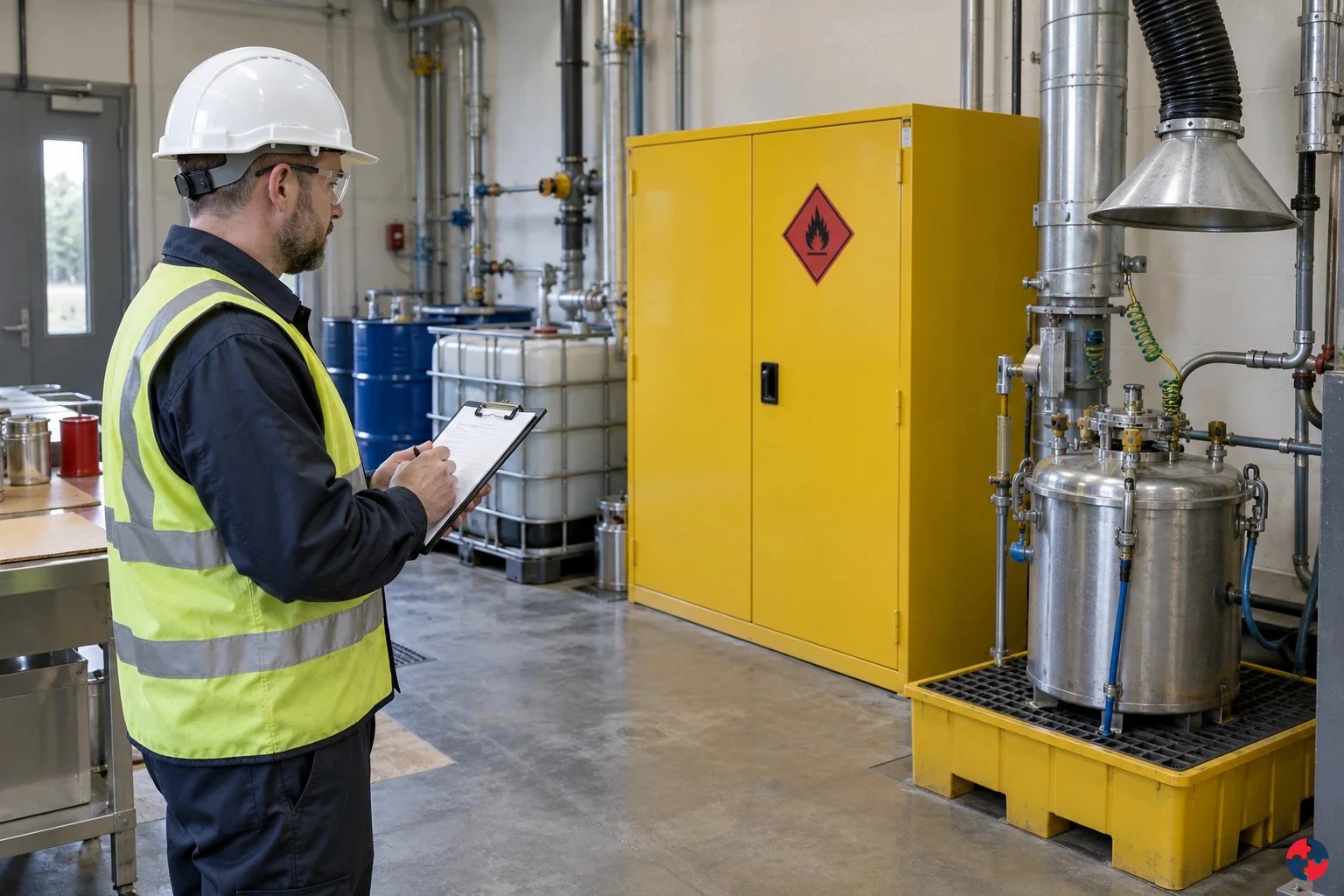
How do fuel, oxygen and fire load fit into the fire triangle?
A fire can begin when ignition meets fuel in the presence of oxygen. Fire load describes combustible material available to feed growth; it is not a single safe-or-unsafe number. Sources of fuel, oxygen and fire load explains how combustible materials, flammable substances, oxidisers, ventilation and storage arrangements influence fire growth, smoke production, escape conditions and firefighting difficulty.
Turn sources of fuel, oxygen and fire load knowledge into a decision
Sources of fuel, oxygen and fire load explains how combustible materials, flammable substances, oxidisers, ventilation and storage arrangements influence fire growth, smoke production, escape conditions and firefighting difficulty. It supports fire risk assessment by helping readers map what can burn, what can intensify burning, where fire load is concentrated and what evidence proves fuel and oxygen risks are controlled. Quantities, locations, classification, assessment, action owner and reinspection.
Warehouse stockroom accumulation
Remove excess fuel, segregate incompatible materials, keep exits clear and review ignition and ventilation. Set storage limits from the risk assessment, inspect peak stock and verify fire precautions.
Storage drift can change fire and escape conditions
No generic fire-load threshold or universal storage distance is provided. Check the current premises, activities and relevant jurisdiction.
Choose controls for sources of fuel, oxygen and fire load
Eliminate: Remove surplus packaging and unnecessary stock. Reduce: Reduce quantities through an assessed storage plan. Isolate: Separate chargers and oxidisers from fuel. Control: Protect escape routes and fire compartments. PPE: PPE does not restore an unsafe escape route. Read the full control table for qualifications, ownership and verification. Use the actual task and applicable jurisdiction; existing technical approval remains unchanged.
Use the full sources of fuel, oxygen and fire load lesson
Use the full topic for the decision points, practical examples, detailed control tables and source scope. HSE guidance applies to Great Britain; use HSENI for the Northern Ireland route and the source’s stated jurisdiction. A simplified guide does not change the page’s technical-review or approval status.

Read all six steps as text
1. How do fuel, oxygen and fire load fit into the fire triangle?
A fire can begin when ignition meets fuel in the presence of oxygen.
- Avoid / redesign: Remove surplus packaging and unnecessary stock.
- Control the task: Separate chargers and oxidisers from fuel.
- Verify before release: Read the full task example, checks and stop points on this page.
A fire can begin when ignition meets fuel in the presence of oxygen. Fire load describes combustible material available to feed growth; it is not a single safe-or-unsafe number. Sources of fuel, oxygen and fire load explains how combustible materials, flammable substances, oxidisers, ventilation and storage arrangements influence fire growth, smoke production, escape conditions and firefighting difficulty.
Apply it: Which part of this plan would you check at the workface before authorising the task?
2. Turn sources of fuel, oxygen and fire load knowledge into a decision
Use the evidence to improve the actual work arrangement.
- Change at source: Remove surplus packaging and unnecessary stock.
- Make it observable: Read the full task example, checks and stop points on this page.
- Keep useful evidence: Quantities, locations, classification, assessment, action owner and reinspection.
Sources of fuel, oxygen and fire load explains how combustible materials, flammable substances, oxidisers, ventilation and storage arrangements influence fire growth, smoke production, escape conditions and firefighting difficulty. It supports fire risk assessment by helping readers map what can burn, what can intensify burning, where fire load is concentrated and what evidence proves fuel and oxygen risks are controlled. Quantities, locations, classification, assessment, action owner and reinspection.
Apply it: What evidence would show that the change improves this task, rather than only completing a record?
3. Warehouse stockroom accumulation
Example: a practical application of the existing topic lesson.
- Setting: Stockroom with cardboard, solvent stock and temporary electrical equipment.
- Act: Combustible stock accumulates beside an escape route.
- Hold / review: Stop the affected work or occupancy if safe escape or dangerous-substance controls cannot be maintained; restore a verified safe escape arrangement before restart.
Remove excess fuel, segregate incompatible materials, keep exits clear and review ignition and ventilation. Set storage limits from the risk assessment, inspect peak stock and verify fire precautions.
Apply it: At which point would you hold this example, and what evidence would allow it to proceed?
4. Storage drift can change fire and escape conditions
Inventory change is the failed condition; fire development and escape harm are possible consequences.
- Changed condition: Packaging, seasonal stock, waste or charging arrangements increase without review; an escape route or fire door becomes obstructed.
- Possible consequence: The changed fuel/ignition interfaces can increase fire severity, smoke and difficulty escaping.
- Restore and reassess: Remove surplus, restore escape/compartment arrangements and reassess the actual material quantities, oxidiser interfaces and ignition controls.
No generic fire-load threshold or universal storage distance is provided. Check the current premises, activities and relevant jurisdiction.
Apply it: What changed since the assessment, which protection is affected and who verifies restoration?
5. Choose controls for sources of fuel, oxygen and fire load
Start with the stronger practicable options and verify their effect.
- Eliminate: Remove surplus packaging and unnecessary stock.
- Reduce: Reduce quantities through an assessed storage plan.
- Isolate: Separate chargers and oxidisers from fuel.
- Control: Protect escape routes and fire compartments.
- PPE: PPE does not restore an unsafe escape route.
Eliminate: Remove surplus packaging and unnecessary stock. Reduce: Reduce quantities through an assessed storage plan. Isolate: Separate chargers and oxidisers from fuel. Control: Protect escape routes and fire compartments. PPE: PPE does not restore an unsafe escape route. Read the full control table for qualifications, ownership and verification. Use the actual task and applicable jurisdiction; existing technical approval remains unchanged.
Apply it: Which stronger option can be used here, and who will verify it before accepting the remaining risk?
6. Use the full sources of fuel, oxygen and fire load lesson
Follow the official sources below and retain the task-specific evidence.
- Official guidance: HSE Introduction to fire safety
- Official guidance: HSE DSEAR dangerous-substance controls
- Task decision: Quantities, locations, classification, assessment, action owner and reinspection.
Use the full topic for the decision points, practical examples, detailed control tables and source scope. HSE guidance applies to Great Britain; use HSENI for the Northern Ireland route and the source’s stated jurisdiction. A simplified guide does not change the page’s technical-review or approval status.
Apply it: Which official source and full-topic section will you use to resolve the next decision?
HSE explains that fire needs ignition, fuel and oxygen; control the interaction before relying on response measures. HSE Introduction to fire safety.
Fuel is anything that can burn: paper, cardboard, furniture, plastics, textiles, insulation, packaging, timber, waste, flammable liquids, gases, dusts, aerosols, cooking oils, wall linings, roof materials and some process materials. Oxygen is usually present in air, but the risk increases where ventilation, oxygen cylinders, oxidising chemicals or oxygen-rich processes can intensify burning.
Fire load is the combustible burden in an area. It affects how quickly a fire grows, how much heat and smoke it produces, whether escape routes remain tenable, how long compartmentation must resist fire, and how difficult firefighting may become. A clean office with controlled paper storage has a different fire load from a stockroom full of cardboard, foam packaging, aerosols and battery chargers.
Fire risk assessment should therefore look beyond the ignition source. Removing fuel, reducing fuel quantity, segregating combustibles, controlling oxidisers, managing ventilation and keeping escape routes clear can be as important as controlling hot work or electrics.
| Concept | Meaning | Workplace example |
|---|---|---|
| Fuel | Material that can burn. | Packaging, furniture, textiles, flammable liquids, aerosols or waste. HSE DSEAR dangerous-substance controls |
| Oxygen | Supports combustion and can intensify burning when enriched. | Normal air, ventilation, oxygen cylinders or oxidising substances. HSE Oxygen use in the workplace |
| Ignition | Heat or spark that starts combustion. | Hot work, electrical fault, smoking materials or hot surface. HSE Fire safety in construction HSG168 |
| Fire load | Total combustible burden in an area. | High stock density in a warehouse aisle or temporary waste pile. HSE Introduction to fire safety |
| Fire growth | How quickly flame, heat and smoke develop. | Foam seating, plastics or palletised goods burning rapidly. |
| Compartment demand | How much fire resistance may be needed to contain fire. | Store room fire load behind a fire door. |
| Escape impact | How fuel and smoke affect routes and available escape time. | Combustibles stored in stairwell or corridor. |
Fire load is one assessment input, not a design calculation for a door, compartment or sprinkler system. Material arrangement, smoke, people and the existing protection all matter; competent fire design must establish adequacy. Home Office factory/warehouse fire assessment.
How can I practise this topic in 3D?


Gas and fuel are proposed outside controlled storage
All related inspection points 1 across 1 location
Construction site 1 inspection point
Practice in the SHAREhub environment. Browser practice is separate from workplace competence and formal learning records.
How should fuel and oxygen sources be mapped?
Mapping should follow the pathway from material or oxygen source to fire growth, spread, escape impact and control evidence.
A good fire load survey is not a neat list of contents. It asks where combustible materials are concentrated, how they are stored, whether they are close to ignition sources, whether oxygen or oxidisers can intensify fire, whether compartmentation is intact, whether escape routes are protected and whether housekeeping changes during busy periods.
The strongest teaching model is: fuel source, availability, ignition proximity, fire growth and smoke, spread route, people at risk, control and evidence. That model works in offices, warehouses, care settings, construction sites and process areas.
| Pathway step | Question to ask | Example control |
|---|---|---|
| Fuel source | What can burn here? | Remove, reduce or substitute combustibles where practicable. |
| Fuel availability | Is the quantity, surface area or storage method increasing fire load? | Limit stock, close containers and improve storage separation. |
| Ignition proximity | Is fuel close to heat, electrics, smoking, hot work or charging? | Separate fuel from ignition sources. |
| Oxygen contribution | Could ventilation, oxygen cylinders or oxidisers intensify fire? | Control oxygen storage, ventilation and oxidiser segregation. |
| Growth and smoke | Would fire grow fast or create toxic smoke? | Reduce plastics/foam, protect routes and maintain detection. |
| Spread route | Could fire move through risers, voids, doors or ducts? | Maintain compartmentation and fire stopping. |
| Escape impact | Could fuel compromise routes or exits? | Keep escape routes sterile and inspected. |
| Evidence | What proves controls remain effective? | Inspection records, waste controls, FRA actions and training. |
The mapping table is a survey aid. Home Office factory/warehouse fire assessment supports storage, escape and fire precautions; HSE oxygen-use precautions addresses oxygen equipment. Exact survey fields are local choices.
How can fire load build up in a warehouse or stockroom?
A realistic stockroom example shows how ordinary materials can create a serious fire risk when storage, oxygen and ignition are poorly controlled.
Warehouse stockroom accumulation
Task material and setting: Stockroom with cardboard, solvent stock and temporary electrical equipment.
People and prerequisites: Stockroom manager, workers and fire-risk assessor; inventory and escape plan available.
Before: Combustible stock accumulates beside an escape route.
During: Remove excess fuel, segregate incompatible materials, keep exits clear and review ignition and ventilation.
Hold or stop: Stop the affected work or occupancy if safe escape or dangerous-substance controls cannot be maintained; restore a verified safe escape arrangement before restart. Do not simply close an essential escape route.
Completion and hand back: Set storage limits from the risk assessment, inspect peak stock and verify fire precautions.
Evidence: Quantities, locations, classification, assessment, action owner and reinspection.
A retail stockroom starts with controlled quantities of boxed stock. Over the Christmas period, cardboard packaging, display materials, foam inserts, aerosols, cleaning chemicals and returned electrical goods accumulate. Temporary extension leads and battery chargers are added. A fire door is wedged open for deliveries and excess stock creeps into the escape route.
The problem is not one item. It is the combined fire load, ignition proximity, open fire spread route and reduced escape protection. A competent fire risk review would reduce stock density, segregate aerosols and oxidisers, control charging, reinstate the fire door, clear escape routes, remove waste daily, check fire stopping and brief supervisors on seasonal fire load triggers.
| Condition | Fire-risk effect | Control response |
|---|---|---|
| Cardboard and packaging accumulation | Higher fire load and faster spread. | Limit quantities and remove waste frequently. Fire safety risk assessment: factories and warehouses |
| Aerosols mixed with general stock | Pressurised containers can escalate fire. | Segregate and store as required by risk assessment. Fire safety risk assessment: factories and warehouses; DSEAR in detail |
| Battery charging near packaging | Ignition close to fuel. | Dedicated charging area with clear separation and inspection. Fire safety risk assessment: factories and warehouses |
| Fire door wedged open | Compartmentation fails early. | Keep shut or fit suitable hold-open linked to alarm where appropriate. Fire safety risk assessment: factories and warehouses |
| Stock in escape route | Escape and firefighting access compromised. | Sterile route standard and inspections. Fire safety risk assessment: factories and warehouses |
| Oxidising cleaner stored with combustibles | Burning may intensify. | Segregate oxidisers and train storekeepers. DSEAR in detail |
What are common sources of fuel in workplaces?
Fuel sources include ordinary combustibles, process materials, waste, furnishings, building contents and dangerous substances.
Fuel control starts by looking at what is actually present, not just what is intended to be present. Waste build-up, seasonal stock, contractor materials, temporary works, packaging returns and refurbishment debris can change fire load quickly.
Some fuels mainly affect ordinary fire growth, while others create dangerous-substance or explosion risks. Flammable liquids, gases, vapours, aerosols and combustible dusts need DSEAR consideration as well as ordinary fire risk assessment.
| Fuel type | Examples | Control focus |
|---|---|---|
| Ordinary combustibles | Paper, cardboard, timber, textiles and furniture. | Quantity control, storage and housekeeping. HSE Introduction to fire safety |
| Plastics and foam | Packaging, insulation, seating, displays and linings. | Smoke/toxicity, separation and specification. HSE Introduction to fire safety |
| Flammable liquids | Solvents, paints, fuels, cleaning products and adhesives. | Containers, cabinets, ventilation, ignition control and DSEAR. HSE DSEAR dangerous-substance controls |
| Flammable gases | LPG, acetylene, hydrogen and fuel gases. | Cage/storage, segregation, leak control and emergency arrangements. HSE DSEAR dangerous-substance controls |
| Aerosols | Cleaning, maintenance, paints and personal products. | Quantity limits, heat separation and storage rules. HSE DSEAR dangerous-substance controls |
| Combustible dusts | Wood, flour, metal powders and some process dusts. | Housekeeping, extraction, DSEAR and ignition control. HSE DSEAR dangerous-substance controls |
| Waste | Bins, pallets, skips, oily rags and packaging. | Removal frequency, location and fire-resistant storage where needed. HSE Introduction to fire safety |
| Building materials | Linings, insulation, temporary coverings and void contents. | Specification, compartmentation and refurbishment control. HSE Fire safety in construction HSG168 |
The fuel groups combine ordinary premises and dangerous-substance risks. HSE workplace fire prevention supports combustible/ignition assessment; HSE DSEAR dangerous-substance controls supplies the dangerous-substance boundary. Exact storage choices require material and site assessment.
What oxygen sources and oxidisers need control?
Oxygen is normally present in air, but some sources can increase fire intensity or make materials burn more readily.
Most workplace fires burn in normal air, but oxygen and oxidising materials can make fire behaviour more severe. Oxygen cylinders, piped oxygen, ventilation systems, oxidising chemicals, peroxides and some process conditions can change the fire scenario dramatically.
Oxygen control is not about removing breathable air from workplaces. It is about identifying oxygen enrichment, oxidising substances and ventilation paths that could support rapid growth, spread or escape-route smoke movement.
| Source | How it affects fire | Control focus |
|---|---|---|
| Normal air | Supports combustion in almost all workplaces. | Control fuel and ignition, maintain compartments. HSE Introduction to fire safety |
| Mechanical ventilation | Can feed fire or move smoke if poorly managed. | Fire dampers, shutdown logic and maintenance. |
| Oxygen cylinders | Oxygen enrichment makes materials ignite more easily and burn intensely. | Segregation, secure storage, leak checks and no smoking. HSE Oxygen use in the workplace |
| Medical oxygen | Creates patient, care or home-visit interface risk. | User briefing, signage and ignition control. HSE Oxygen use in the workplace |
| Oxidising chemicals | Can intensify burning or react with combustibles. | Segregate from fuels and follow SDS/COSHH. HSE DSEAR dangerous-substance controls |
| Organic peroxides | May decompose and intensify fire. | Specialist storage, temperature control and emergency plan. HSE DSEAR dangerous-substance controls |
| Pyrotechnics | Provide oxidiser and fuel in one package. | Competent storage, quantity control and event controls. HSE DSEAR dangerous-substance controls |
Use HSE oxygen-use precautions for leak prevention, compatible oxygen equipment and ventilation against enrichment. The oxidiser/peroxide examples require product-specific HSE DSEAR dangerous-substance controls assessment; ventilation/fire-damper decisions require competent fire and engineering design.
Never use oxygen to freshen air or blow dust from clothing or machinery. Keep oxygen-service equipment free from oil and grease and use compatible materials. Suspected enrichment needs a safe stop, competent leak response and controlled re-entry; do not enter a hazardous space to investigate. HSE oxygen-use precautions.
How does fire load differ by sector?
Fire load should be interpreted in the context of people, premises, escape, process hazards and housekeeping.
A high fire load in a warehouse may be managed through storage design, sprinkler protection and aisle discipline. The same fire load in a care-home corridor or above a basement escape route would be far less tolerable because people may need assistance to escape.
Sector context also affects how quickly fire load changes. Construction and refurbishment are especially dynamic because packaging, temporary coverings, timber, hot works, open risers and incomplete fire stopping change from day to day.
| Sector | Typical fire load issue | Control focus |
|---|---|---|
| Office | Paper, furniture, bins, electrical equipment and kitchen areas. | Housekeeping, appliance control and protected routes. Fire safety risk assessment: offices and shops |
| Retail | Seasonal stock, displays, packaging and customer routes. | Stock limits, escape route checks and waste removal. Fire safety risk assessment: offices and shops |
| Warehouse | Pallets, racking, packaging, aerosols and chargers. | Storage plan, separation, sprinklers and inspection. Fire safety risk assessment: factories and warehouses |
| Care setting | Bedding, oxygen, mobility aids and delayed evacuation. | Personal emergency planning and strict corridor control. Fire safety risk assessment: residential care premises; Oxygen use in the workplace |
| Hospitality | Cooking oils, gas, linens, waste and decorations. | Kitchen controls, grease management and waste removal. Introduction to fire safety |
| Construction | Timber, temporary coverings, waste, hot works and open voids. | Fire plan, hot-work control and daily housekeeping. Fire safety in construction |
| Process site | Flammable liquids, gases, oxidisers, bunds and drainage. | DSEAR/COMAH controls and emergency response. COMAH active and passive fire protection; DSEAR in detail |
| Laboratory | Solvents, oxidisers, gases and waste chemicals. | Storage compatibility, fume cupboards and emergency controls. DSEAR in detail |
These sector illustrations require the actual fire strategy, occupancy and material inventory; warehouse, care and process authorities have different scopes.
How should a fire load survey or inspection be carried out?
A fire load review should identify combustible concentration, oxygen contribution, spread routes, people at risk and evidence of control.
A practical survey starts at the entrance and follows the routes people and fire could take. It looks in cupboards, risers, plant rooms, stores, welfare areas, waste yards, lofts, voids, corridors, escape stairs and temporary works areas. The assessor should ask whether normal storage becomes unsafe during busy periods.
The output should not be a vague instruction to improve housekeeping. It should identify the location, material, quantity, risk pathway, responsible person, action, interim control and review date.
| Survey area | What to look for | Evidence |
|---|---|---|
| Escape routes | Combustibles, bins, decorations, mobility aids or stock. | Sterile-route inspection record. |
| Store rooms | Stock density, aerosols, flammables, oxidisers and electrical items. | Storage rules and inspection. |
| Waste areas | Skips, pallets, oily rags, cardboard and proximity to building. | Waste schedule and fire separation. |
| Plant rooms | Storage creep, combustible maintenance materials and penetrations. | Access control and housekeeping check. |
| Risers and voids | Openings, fire stopping, temporary services and waste. | Fire-stopping inspection. |
| Construction areas | Temporary coverings, timber, packaging, hot works and open shafts. | Daily fire check and permit evidence. |
| Ventilation/oxygen | Air movement, cylinders, oxidisers and oxygen enrichment. | Maintenance and storage records. |
The survey locations and record fields are local inspection prompts. Home Office factory/warehouse fire assessment supplies premises storage/escape guidance; oxygen and dangerous substances need their separate assessments.
Use authorised safe access and existing drawings/inspection evidence. Do not remove unknown linings, disturb suspect asbestos, enter confined spaces or defeat electrical/plant restrictions to complete a survey. Record inaccessible areas and unknowns and refer them for competent investigation.
What should fire-load survey evidence look like in different premises?
Survey evidence should show what was found, why it matters, what was done and how the action was verified.
A fire-load survey is strongest when it produces practical evidence, not just a comment that housekeeping is adequate. Photographs, marked storage zones, waste controls, oxygen segregation, fire-door checks, hot-work controls and FRA action tracking make the assessment usable for managers and auditors.
The evidence standard should rise with risk. A small office cupboard may need a simple inspection note, while a care home, vehicle repair workshop or live refurbishment site needs stronger control because people, oxygen, ignition and compartmentation conditions are more complex.
| Premises | What to inspect | Evidence expected |
|---|---|---|
| Warehouse | Pallets, cardboard, racking, aerosols, chargers, sprinkler clearance and escape aisles. | Marked storage zones, photos, stock limits, waste records and inspection close-out. Fire safety risk assessment: factories and warehouses |
| Care home | Bedding, mobility aids, oxygen cylinders, corridor storage, laundry and assisted escape routes. | Oxygen segregation, sterile corridor checks, PEEP/fire strategy links and action tracker. Fire safety risk assessment: residential care premises; Oxygen use in the workplace |
| Workshop | Oily rags, paints, solvents, welding gases, chargers, dust, extraction and hot surfaces. | Flammable cabinet checks, waste container records, hot-work controls and DSEAR review where needed. DSEAR in detail |
| Construction refurbishment | Temporary coverings, timber, packaging, open risers, incomplete fire stopping and hot works. | Daily fire check, photos, permit records, fire-door/fire-stopping actions and contractor briefings. Fire safety in construction |
| Office or hybrid hub | Paper stores, bins, soft furnishings, kitchen appliances and escape routes. | Housekeeping inspection, appliance controls and clear-route evidence. Fire safety risk assessment: offices and shops |
| Retail stockroom | Seasonal stock, displays, aerosols, electrical returns and waste. | Quantity control, segregated storage, waste frequency and FRA action tracking. Fire safety risk assessment: offices and shops |
The evidence examples illustrate verifying work at the actual premises. They do not prescribe every photograph, form or storage limit.
Transfer seasonal stockroom thinking to a care corridor: bedding and oxygen interact with residents who may need assistance. Clear the route, verify the care fire strategy and assistance arrangements, and involve the competent fire lead; a warehouse stock limit is not a care-home approval. HSE oxygen-use precautions supports the enrichment boundary; nation-specific duties still apply.
How can the hierarchy of controls control fuel, oxygen and workplace fire load?
Control classification: Classify the mechanism separately from its upkeep: physical floor repair, drainage, barriers, protected routes, compartmentation, fire doors and suitable disposal facilities are physical measures where specified. Cleaning schedules, inspections, policies, funding, supervision and verification are administrative arrangements maintaining them. A verbal instruction is not a physical barrier. Read this correction with the source table. Retained overview and stage artwork requires the matching classification update.
Remove or reduce the hazard before relying on procedures or personal protection.
For sources of fuel, oxygen and fire load, assess the actual task and first look for a way to remove the hazard. Where that is not possible, consider a safer substitute, engineered separation and then clear work procedures. PPE protects against remaining exposure; it does not make an uncontrolled task safe. HSE hierarchy of controls
The selected measures need a named owner, a usable stop point and a check that they still work when the task or conditions change. In Northern Ireland, verify the separate legal route and site instructions.
In the stockroom case, eliminate surplus packaging and avoid unnecessary stock; reduce the remaining quantity through an assessed storage plan, separate chargers/oxidisers from fuel and protect routes and compartments. Use inspections and briefing to sustain these physical controls. PPE does not restore an unsafe escape route. ERICPD (Eliminate, Reduce, Isolate, Control, PPE, Discipline) is a teaching prompt; Discipline means maintaining and checking controls. HSE hierarchy of controls; Home Office factory/warehouse fire assessment.
How can the ERICPD hierarchy of controls control fuel, oxygen and workplace fire load?

| ERICPD control level | Topic-specific example | Source and full task context |
|---|---|---|
| Eliminate | Remove surplus packaging and unnecessary stock. | Read the full task example, checks and stop points on this page. HSE hierarchy of controls · Home Office factory/warehouse fire assessment |
| Reduce | Reduce quantities through an assessed storage plan. | Read the full task example, checks and stop points on this page. HSE hierarchy of controls · Home Office factory/warehouse fire assessment |
| Isolate | Separate chargers and oxidisers from fuel. | Read the full task example, checks and stop points on this page. HSE hierarchy of controls · Home Office factory/warehouse fire assessment |
| Control | Protect escape routes and fire compartments. | Read the full task example, checks and stop points on this page. HSE hierarchy of controls · Home Office factory/warehouse fire assessment |
| PPE | PPE does not restore an unsafe escape route. | Read the full task example, checks and stop points on this page. HSE hierarchy of controls · Home Office factory/warehouse fire assessment |
| Discipline | Maintain inspections, briefing and physical control checks. | Read the full task example, checks and stop points on this page. HSE hierarchy of controls · Home Office factory/warehouse fire assessment |
How can the ISO 45001 hierarchy of controls control fuel, oxygen and workplace fire load?

| Five-level control stage(s) | Topic-specific example | Source and full task context |
|---|---|---|
| Elimination | Remove surplus packaging and unnecessary stock. | Read the full task example, checks and stop points on this page. HSE hierarchy of controls · Home Office factory/warehouse fire assessment |
| Administrative controls | Reduce quantities through an assessed storage plan. | Read the full task example, checks and stop points on this page. HSE hierarchy of controls · Home Office factory/warehouse fire assessment |
| Engineering controls | Separate chargers and oxidisers from fuel. | Read the full task example, checks and stop points on this page. HSE hierarchy of controls · Home Office factory/warehouse fire assessment |
| Engineering controls / Administrative controls | Protect escape routes and fire compartments. | Read the full task example, checks and stop points on this page. HSE hierarchy of controls · Home Office factory/warehouse fire assessment |
| PPE | PPE does not restore an unsafe escape route. | Read the full task example, checks and stop points on this page. HSE hierarchy of controls · Home Office factory/warehouse fire assessment |
| Administrative controls | Maintain inspections, briefing and physical control checks. | Read the full task example, checks and stop points on this page. HSE hierarchy of controls · Home Office factory/warehouse fire assessment |
When should fuel or oxygen sources be reduced or escalated?
Reduction or escalation is needed when combustible load, oxygen contribution or storage conditions could increase fire growth, smoke, spread or escape risk.
The decision should be risk-based. A small amount of office paper in a cabinet is ordinary. The same material stacked in an escape stair, against a fire door, near a charger or in a plant room becomes a control failure. Oxygen cylinders, oxidisers and flammable substances also require sharper segregation and emergency planning.
Escalation should happen quickly where fuel load compromises escape, fire doors, compartments, detection, sprinklers, firefighting access or DSEAR controls.
| Trigger | Immediate action | Review point |
|---|---|---|
| Combustibles in escape route | Remove the obstruction safely and restore the route. If safe escape cannot be maintained, stop affected work or occupancy and escalate. | Review storage behaviour and inspection frequency. |
| Fire door blocked or wedged | Restore protection immediately. | Check why it was blocked and whether design needs change. |
| Waste or pallets near building | Move or reduce waste. | Review waste collection and separation. |
| Flammables near ignition source | Separate and control ignition. | Review DSEAR/fire risk assessment. |
| Oxygen cylinder near combustibles | Segregate and secure. | Review oxygen storage and user briefing. |
| Seasonal stock increase | Set quantity limits and route checks. | Review FRA and management controls. |
| Incomplete fire stopping with high fire load | Stop or control work area. | Escalate to competent fire/temporary works advice. |
These escalation prompts implement assessed precautions. An unavailable escape route affects occupancy; an oxygen or flammable release additionally needs competent emergency controls.
Where do fuel, oxygen and fire load controls commonly fail?
They fail when combustible materials, oxygen sources and storage practices drift from the fire risk assessment between formal reviews.
Fire load usually grows slowly. A box is left in a corridor, then seasonal stock arrives, then waste collections are missed, then chargers are added, then a fire door is held open for convenience. Each decision may look small, but together they can change escape conditions and fire severity.
The strongest controls are visible and routine: storage standards, waste removal, inspection, fire door discipline, oxygen segregation, combustible-free plant rooms, hot-work control and rapid action when conditions change.
| Failure or weak practice | How it develops | What good looks like |
|---|---|---|
| Storage creep | Corridors, risers and plant rooms become stores. | Sterile-route and plant-room standards. |
| Waste backlog | Cardboard, pallets or oily rags accumulate. | Waste removal frequency and fire separation. |
| Oxidiser mixed with fuel | Cleaning or lab chemicals stored with combustibles. | Compatibility storage and SDS review. |
| Oxygen cylinders unmanaged | Cylinders near heat, fuel or poor signage. | Secure, segregate and brief users. |
| Temporary works fire load | Timber, coverings and packaging on site with open risers. | Construction fire plan and daily checks. |
| Fire door discipline weak | Doors wedged for convenience. | Fix access issues and maintain doors closed. |
| FRA not reviewed after change | New stock, layout or process not assessed. | Trigger review after layout, stock or use change. |
These failures show storage and protection drift. Inspection must result in verified correction, not only a recorded finding.
What evidence shows fuel, oxygen and fire load are controlled?
Good evidence shows that controls are planned, used, checked, corrected and reviewed.
Evidence should be proportionate to risk. Routine premises need proportionate inspection records; dangerous substances, oxygen enrichment or complex occupancy need a deeper, competent assessment and verified controls.
| Evidence item | What it should show | Assurance question |
|---|---|---|
| Fire risk assessment | Fuel, oxygen, ignition, people at risk, escape, detection, compartmentation and review. | Does it reflect current storage and work? |
| Fire load survey | Combustible materials, quantities, locations, spread routes and action priorities. | Are high-load areas mapped? |
| Housekeeping inspections | Routes, stores, plant rooms, risers, waste and temporary areas. | Are findings closed quickly? |
| Storage compatibility records | Flammables, oxidisers, gases, aerosols and oxygen cylinders. | Are incompatible materials separated? |
| Waste controls | Collection frequency, skip location, oily rag control and external storage. | Is waste separated from buildings and ignition? |
| Fire door and compartment checks | Doors, penetrations, fire stopping and riser condition. | Are fire spread routes controlled? |
| Change records | New stock, layout, refurbishment, process or occupancy changes. | Did the FRA change when the workplace changed? |
These records illustrate verifying controls at the workface; keep information proportionate to the task and actual obligations.
How should sources of fuel, oxygen and fire load be assured?
Assurance should test whether controls work in practice, not whether the page or procedure exists.
Assurance should include frontline checks, manager review and periodic independent sampling where risk warrants it. The purpose is to find weak signals early, close actions properly and update the risk assessment when work changes.
| Assurance level | What to check | What good looks like |
|---|---|---|
| Daily frontline check | Escape routes, fire doors, waste and obvious storage creep. | Immediate correction before occupancy or work continues. |
| Facilities review | Stores, plant rooms, risers, oxygen storage and waste yards. | Recurring failures drive design or storage changes. |
| Fire assessor review | Fire load, people at risk, compartmentation and emergency arrangements. | FRA reflects real layout and activities. |
| DSEAR/process review | Flammables, vapours, dusts, gases and oxidisers. | Dangerous-substance controls are integrated. |
| Leadership review | High-risk actions, repeat findings, insurance issues and capital needs. | Resources remove persistent fire load problems. |
The assurance levels are local management choices. Sample the physical controls, act on defects and verify closure.
Which GB and Northern Ireland duties apply?
Fire risk assessment duties differ across England and Wales, Scotland and Northern Ireland. The England/Wales Fire Safety Order, Scottish Fire Act sections 53 and 54 and NI Fire and Rescue Services Order each require an applicable dutyholder to assess and control fire risk. GB DSEAR and separate NI DSEAR regulations address dangerous substances; use the location-specific regime and specialist advice for complex process hazards.
Check the actual work, place and responsible authority before applying a rule.
| Jurisdiction | Route | Direct source | Decision supported |
|---|---|---|---|
| England and Wales | Fire risk assessment | Regulatory Reform (Fire Safety) Order 2005, article 9; Fire safety risk assessment: offices and shops | Identify fuel, oxygen, ignition and exposed people. |
| Scotland | Fire risk assessment | Fire (Scotland) Act 2005, section 54 | Assess relevant premises and take proportionate measures. |
| Northern Ireland | Employer fire assessment | Fire and Rescue Services (Northern Ireland) Order 2006, article 25; Fire safety | Apply separate NI fire duties. |
| Great Britain | Dangerous substances | DSEAR in detail; Flammable liquids in work areas | Control fire/explosion risk and quantity in work areas. |
| Scotland | Employer fire duties to employees | Fire (Scotland) Act 2005, section 53 | Read with section 54 premises/relevant-person duties. |
| Northern Ireland | Dangerous substances and explosive atmospheres | Dangerous Substances and Explosive Atmospheres Regulations (Northern Ireland) 2003 | Apply the separate NI regime to relevant dangerous substances. |
In NI, employer Article 25 sits alongside NI Article 26 premises duties for a person with relevant premises control, where applicable. Identify the actual dutyholder and extent of control.
How should management check this work?
Use a defined plan, carry out the controls, check performance and correct what does not work.
For sources of fuel, oxygen and fire load, assign a competent owner to set the work controls, check their use and review them after change, failure or new evidence. HSE managing health and safety
A management-system label or certificate is not approval of a site limit, procedure or individual work decision. Apply GB and NI duties to the correct location.
What training and competence are needed?
People should demonstrate role-specific decisions, not just attend a generic briefing.
These assessment methods and records are illustrative SHARE implementation choices. Home Office offices and shops fire assessment supports the subject matter, not a prescribed training format.
| Role | Practice to demonstrate | Assessor and method | Evidence | Reassess when |
|---|---|---|---|---|
| All workers | Spot combustible build-up and blocked escape. | Supervisor observes a route walk. | Induction result and defect report. | Layout or stock change. Home Office offices and shops fire assessment |
| Stores teams | Separate fuel types and keep agreed quantity/location controls. | Store lead observes a stockroom check. | Inventory and location record. | New material or seasonal peak. Home Office offices and shops fire assessment |
| Supervisors | Stop unsafe storage and verify corrective action. | Fire lead tests an escalation scenario. | Action and reinspection. | Repeated drift. Home Office offices and shops fire assessment |
| Fire-risk assessors | Trace fuel, oxygen, ignition, people and escape in the correct nation. | Competent peer reviews an assessment. | Assessment and peer rationale. | Premises or law change. Home Office offices and shops fire assessment |
| Process specialists | Assess dangerous-substance storage and ignition interfaces. | DSEAR specialist reviews the scenario. | Classification, assessment and control verification. | New substance/process. DSEAR in detail |
How could Crownway Fuels Ltd manage this in practice?

Crownway Fuels Ltd can manage fuel, oxygen and fire load by separating ordinary combustible storage from dangerous-substance fire and explosion controls.
In this fuel business, ordinary fire load includes packaging, pallets, office contents and maintenance waste, while high-hazard fire load includes flammable liquids, vapours, gas cylinders and process materials. Both need control, but the evidence standard is much higher for DSEAR and major accident scenarios.
| Management element | How the business would manage it | Evidence to review |
|---|---|---|
| Office and welfare | Paper, furniture and kitchen combustibles controlled through housekeeping. | Inspection and FRA review. |
| Warehouse | Pallets, packaging and aerosols kept to storage plan. | Storage inspection and quantity limits. |
| Fuel areas | Flammable liquids and vapours controlled under DSEAR. | DSEAR assessment and permit controls. |
| Oxygen/gas storage | Cylinders secured and segregated from fuel and heat. | Gas inventory and inspection. |
| Construction/refurbishment | Temporary coverings, waste and hot works controlled daily. | Construction fire plan and hot-work permits. |
This example business table illustrates implementation; it does not approve an operating limit, technical method or exact record format.
Where are fuel and fire-load sources in a forecourt or depot?
Locate the stored fuel and connected handling systems. Keep the inventory and release conditions separate from an assumption that every visible object has the same hazard.
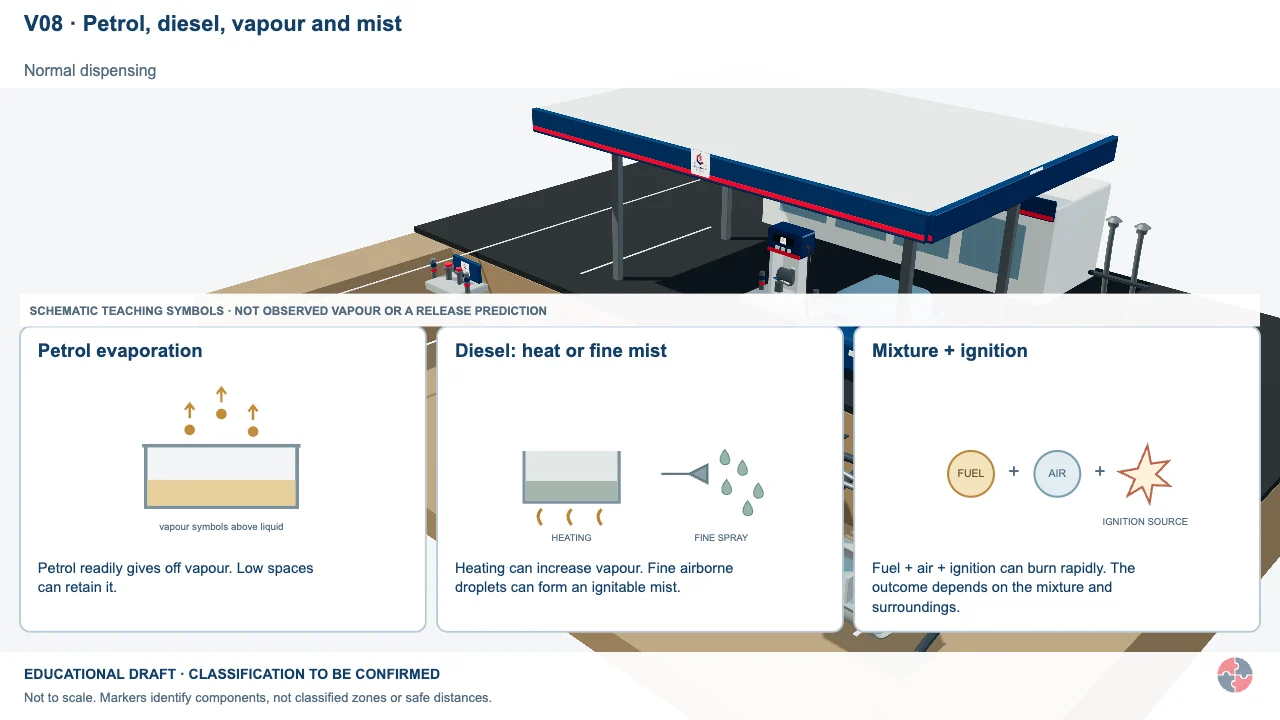
Petrol, diesel, vapour and mist
Compare petrol evaporation, diesel conditions and fine droplets. Petrol carried into a separator can remain a vapour source after the visible forecourt spill has passed.
Activity focus: Identify the actual product and release mechanism. For drainage, ask whether petrol could reach or remain in the separator; for refuelling, confirm the stated Stage II recovery arrangement.
Contextual workplace scene. Use the task, control and evidence checks in this section; appearance alone does not establish safe conditions, individual health or approval.
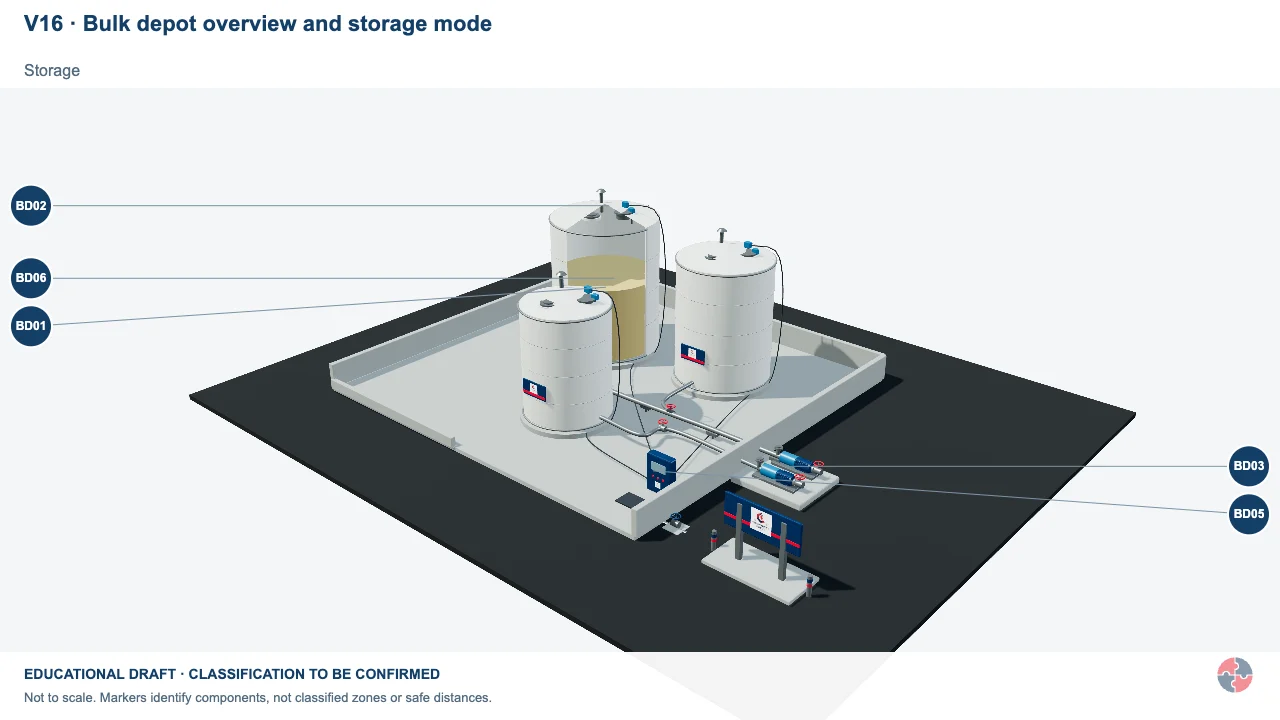
Bulk depot overview and storage mode
Explore the bulk depot system and compare selectable Zone 0, Zone 1 and Zone 2 teaching volumes around its petrol example.
Activity focus: Use cutaway for the internal vapour spaces, then compare the rounded vent, pump and mode-dependent connection envelopes.
Contextual workplace scene. Use the task, control and evidence checks in this section; appearance alone does not establish safe conditions, individual health or approval.
Educational illustration, not to scale. Coloured zones are teaching examples, not a site-specific hazardous-area classification.
What do the acronyms and key terms mean?
These terms help distinguish the mechanism, control and evidence route.
| Term | Meaning | Practical use |
|---|---|---|
| Fuel | Material that can burn | Map quantity and location. |
| Oxygen | Combustion supporter | Consider enrichment and oxidisers. |
| Fire load | Combustible material available to feed fire | Interpret with context. |
| DSEAR | Dangerous Substances and Explosive Atmospheres Regulations | GB process fire/explosion duties. |
| Oxidiser | Substance that supports combustion | Check product classification and segregation. |
| FRA | Fire risk assessment | Assess people, hazards and precautions |
| LPG | Liquefied petroleum gas | Flammable gas storage |
| HVAC | Heating, ventilation and air conditioning | Air and smoke movement |
| COMAH | Control of Major Accident Hazards | Separate major-hazard regime |
| PEEP | Personal emergency evacuation plan | Individual evacuation arrangements |
| HSENI | Health and Safety Executive for Northern Ireland | NI regulator |
| ERICPD | Eliminate, Reduce, Isolate, Control, PPE, Discipline | Illustrative teaching prompt; Discipline means sustained controls, briefing and review. |
Unlock another resource
You have used this month’s two free downloads. Publish a post in your own words to unlock one more resource, or choose SHARE Individual for 10 downloads per month.
You decide whether to share. If you do, use the relevant platform disclosure tools and do not make claims you do not genuinely hold.