SHARE Knowledge Hub
Fire Detection, Alarm Systems and Emergency Communication
Fire detection and emergency communication must give the right people an understandable warning in time to act and escape. Assess the whole chain from discovery through system interfaces, accessible messages, staff response and assisted evacuation. A detector or normal panel cannot prove the chain works; an impaired warning route requires a current use decision, competent repair and verified hand-back.
Understanding Fire Detection, Alarm Systems and Emergency Communication
Fire detection and emergency communication must give the right people an understandable warning in time to act and escape. Assess the whole chain from discovery through system interfaces, accessible messages, staff response and assisted evacuation. A detector or normal panel cannot prove the chain works; an impaired warning route requires a current use decision, competent repair and verified hand-back.
Why this matters at work
Unwanted activations need their cause corrected while necessary protection remains effective. Detector suitability, contamination, work control and maintenance should be examined with the response history. Blanket silencing or permanent isolation can hide the problem. Monitor both reliable coverage and occupant behaviour so a quieter system is not mistaken for a safer one. Use the incident history to locate the cause, such as environmental contamination, unsuitable detection or uncontrolled work. Arrange competent correction and appropriate work controls rather than routinely disabling coverage. Assess any temporary isolation and keep its status visible. Explain the continued evacuation response and monitor recurrence. A lower unwanted-alarm count can be misleading if it results from disabled devices or discouraged reporting; evidence must include restored detection and reliable occupant response.
Start from fire scenarios, escape strategy and people’s ability to notice and understand the warning. Consider unoccupied rooms, sleeping or lone occupants, noisy tasks, hearing protection, sensory needs and language. Define the system and response performance before selecting devices. Obtain competent design and commissioning evidence and preserve the cause-and-effect information. A panel test at reception does not show that a warning reaches everyone at the required time or that its meaning is understood.
How organisations manage this in practice
Record the minimum operational information needed to deliver support. Identify a lawful basis and, where health data is involved, the required special-category condition; restrict access and sharing, explain purpose and review accuracy/security. A signature does not automatically make employment consent freely given. ICO guidance is currently under review following the Data (Use and Access) Act, so check the current processing route. Confidentiality does not justify withholding essential action instructions from trained helpers.
A warning system should meet the response needs of the actual occupants and fire strategy. Delayed discovery in unused areas, inaccessible warning or misunderstood instructions can defeat escape even if equipment operates. Performance requirements should therefore include recognition, communication and action as well as detection. Specialist design is needed for coverage, interfaces and complex arrangements.
Check intelligibility, coverage, priority, backup power and the people who must receive and act on the message. For refuge communications, identify who answers, how assistance is dispatched and what happens if a link fails. Test under the relevant occupied conditions and train the actual response team. A refuge is part of an escape plan rather than a place to leave someone indefinitely. Any delay or phased instruction needs the validated building strategy and competent oversight.
Trace the warning all the way to the person who must act
This is the warning-design and communication route. Follow detector or manual initiation through interfaces, the message, recognition, action and any assistance needed to reach a usable route. Test occupied noisy or isolated rooms, visitors, contractors and people unable to receive the usual audible warning. A signal at the panel is only one part of that chain.

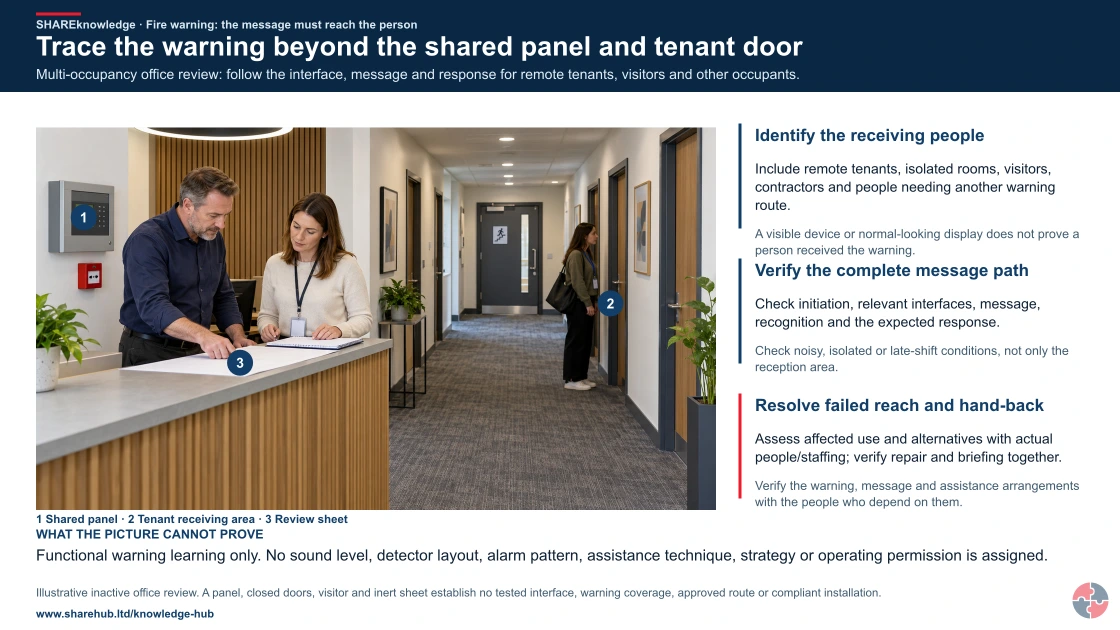
Trace the warning beyond the shared panel and tenant door
Full written explanation
A new inactive shared-office scene marks the grey alarm panel, a remote tenant entrance/visitor and the blank site-review sheet. The separate doors and visitor make the receiving-person question visible. No actual fault, alarm pattern, audibility, interface test, route capacity or successful evacuation is established by the scene. The checks join warning initiation and relevant interfaces to people receiving, understanding and acting on the message, including agreed assistance. Picture key: 1 Shared panel · 2 Tenant receiving area · 3 Review sheet. The separate process headings are unnumbered.
Multi-occupancy office review: follow the interface, message and response for remote tenants, visitors and other occupants.
- Identify the receiving people. Include remote tenants, isolated rooms, visitors, contractors and people needing another warning route.
- Verify the complete message path. Check initiation, relevant interfaces, message, recognition and the expected response.
- Resolve failed reach and hand-back. Assess affected use and alternatives with actual people/staffing; verify repair and briefing together.
Change the pathway
- A panel is only one element. A visible device or normal-looking display does not prove a person received the warning.
- One audience is not every audience. Check noisy, isolated or late-shift conditions, not only the reception area.
- A paper route is not performance. Verify the warning, message and assistance arrangements with the people who depend on them.
Evidence check: Functional warning learning only. No sound level, detector layout, alarm pattern, assistance technique, strategy or operating permission is assigned.
Follow the full warning, recognition, action and assistance pathway
Primary references: GOV.UK: fire-safety equipment, warning and training · GOV.UK: accessible escape/communication guidance — stated England scope
Open the complete HD image (new tab)Download image

Follow the full warning, recognition, action and assistance pathway
Primary references: GOV.UK: fire-safety equipment, warning and training · GOV.UK: accessible escape/communication guidance — stated England scope
When the accessible warning route fails, the premises owner should identify affected use and obtain competent advice on restriction and any alternative. Verify the alternative with the people and staffing who will actually use it, including late shifts. Following repair, witness the relevant system interfaces and message/assistance arrangements together before accepting normal operation.
The warning reaches the room but not everyone in it
Illustrative example. During an evening event, a person cannot receive the usual warning and the planned helper is absent.
Decision. The dutyholder restricts affected use until a competent, inclusive warning and assistance arrangement is verified.
Evidence to check. Detector/interface tests, message reception, staff knowledge, available assistance and a usable escape path.
Hold or escalation point. Do not rely on an untested verbal relay or the daytime staffing plan for evening occupation.
Follow-up. Test restored equipment and the person-to-route sequence; brief the next shift before reopening.
A warning must reach and be understood by people
Detection is only the start. A warning chain must work for the people and conditions actually present, including visitors and people needing different communication methods.

Detect and transmit
Identify the initiating device, signal path and any interfaces or impaired parts.
Perceive the warning
Check the workshop, office, remote area and personal-device arrangements under representative conditions; a working panel does not prove receipt.
Understand and act
Check the meaning, roles, language and agreed assistance with affected users. Hearing protection is not a warning channel.
Close a gap
The system owner arranges competent physical correction and representative testing, then briefs users and records acceptance or continued restrictions.
Read the complete task-specific control examples
ERICPD is a planning cross-map: Discipline verifies and sustains every control. ESEAP compares effectiveness. A label does not authorise the task; retain the owner, evidence and stop or change decision.
Fire Detection, Alarm Systems and Emergency Communication · ERICPD
- Eliminate
- Remove occupancy from the unprotected area until warning works.
- Reduce
- Provide and verify suitable physical detection and warning channels for the affected occupants and representative conditions; a panel indication alone does not establish that warning is perceived.
- Isolate
- No separate physical-isolation measure is specified. Verify the applicable engineered protection and work arrangements under Control.
- Control
- Provide suitable audible, visual or personal alerting that fits the strategy.
- PPE
- PPE or hearing protection cannot be the only warning channel.
- Discipline
- Witness a realistic alarm test with affected users and record corrective actions.
Fire Detection, Alarm Systems and Emergency Communication · ESEAP
- Elimination
- Remove occupancy from the unprotected area until warning works.
- Substitution
- No separate substitute is specified. Compare suitable safer materials, equipment or processes; check new risks before any change.
- Engineering controls
- Provide and verify suitable physical detection and warning channels for the affected occupants and representative conditions; a panel indication alone does not establish that warning is perceived.
- Administrative controls
- Manage any relocation or occupancy restriction, test understanding and roles with users, and coordinate impairment, assisted escape and named restoration acceptance.
- PPE
- PPE or hearing protection cannot be the only warning channel.
What is the purpose of fire detection and emergency communication?
The purpose is to discover fire early, warn people clearly and trigger the right emergency actions before escape time is lost.
Detection and warning are time controls. They do not stop a fire starting, but they can give people time to leave, support others, shut down critical processes where planned, call the fire and rescue service and protect relevant persons before smoke, heat or flame compromise escape routes.
A suitable system may be simple or complex depending on the premises. Some small premises may rely on manual discovery and a simple alarm. Larger, sleeping, public, high-risk or complex premises may need automatic detection, zoning, voice messages, remote signalling, visual alarms, staff alerting systems or staged response arrangements.
Emergency communication is wider than the alarm sound. It includes staff instructions, voice alarm messages, public-address announcements, radio communication, refuge communication, contractor briefings, visitor management and clear information for the fire and rescue service.
| Control element | Purpose | Failure question |
|---|---|---|
| Automatic detection | Discovers fire where people may not see it quickly. | Could fire grow unseen in voids, stores, plant rooms or out of hours? |
| Manual call points | Allow people to raise the alarm immediately. | Can people find and reach them on escape routes? |
| Alarm sounders/visual alarms | Warn people to act. | Can everyone hear, see or understand the warning? |
| Control panel/zoning | Shows where the alarm came from. | Can staff and responders identify the location? |
| Emergency communication | Gives instructions, reassurance and coordination. | Are messages clear under pressure? |
| Maintenance/testing | Keeps protection available. | Are faults managed with risk-based temporary controls? |
What chain must work between detecting fire and people reaching safety?
Detection, transmission, intelligible warning, human action and safe escape all need to work in the actual building.
A detector, call point or observer initiates information; panels, power, networks, sounders, visual devices, voice messages or staff pass it on. Occupants must understand what to do, including assisted escape, while the incident controller and emergency services receive the right information. A fault anywhere in this chain can make a technically present alarm ineffective.
Test plausible failure combinations: power loss, a noisy plant area, sleeping or unfamiliar occupants, a door interface, missing staff cover, an isolated zone and a changed escape route. Do not infer warning performance from one successful button test or a normal panel display.
How should detection and warning systems be specified?
Specification should be based on fire risk, building layout, occupancy, people at risk, escape strategy and competent design.
Use a competent designer or maintainer to decide system design, coverage, zoning, power, interfaces, commissioning and test arrangements for the actual fire strategy. Government premises guidance explains the risk-based decision but does not supply a universal detector layout or evacuation rule. Legal duties depend on the premises and nation; technical design and any standards needed must be checked for the actual installation.
Detection type matters. Smoke detectors can provide early warning in many situations but may be unsuitable where dust, steam or aerosols create unwanted alarms. Heat detectors may reduce false alarms in some environments but normally detect later. Flame detection, aspirating detection or specialist systems may be needed for particular risks.
Warning must suit the people and place. A siren may be adequate in a small office but not in a noisy workshop, sleeping accommodation, public venue, care setting or building with people who may need visual, tactile, voice or assisted communication.
| Question | Design implication | Evidence |
|---|---|---|
| What could burn and how fast? | Detector type and location must match fire development. | Fire risk assessment and design certificate. |
| Where could fire start unseen? | Automatic detection may be needed in hidden or remote areas. | Detector coverage review. |
| Who needs warning? | Audible, visual, voice or assisted warning may be needed. | Occupant profile and PEEP review. |
| What is the evacuation strategy? | Simultaneous, staged or progressive strategies need different messaging. | Emergency plan and alarm cause/effect. |
| How are faults handled? | Impairments need temporary controls. | Fault log and impairment procedure. |
| How is performance tested? | Tests must prove warning and response, not just panel function. | Test, drill and maintenance records. |
How can emergency communication fail during an alarm?
Communication fails when the alarm signal is technically working but people do not know what it means or what to do.
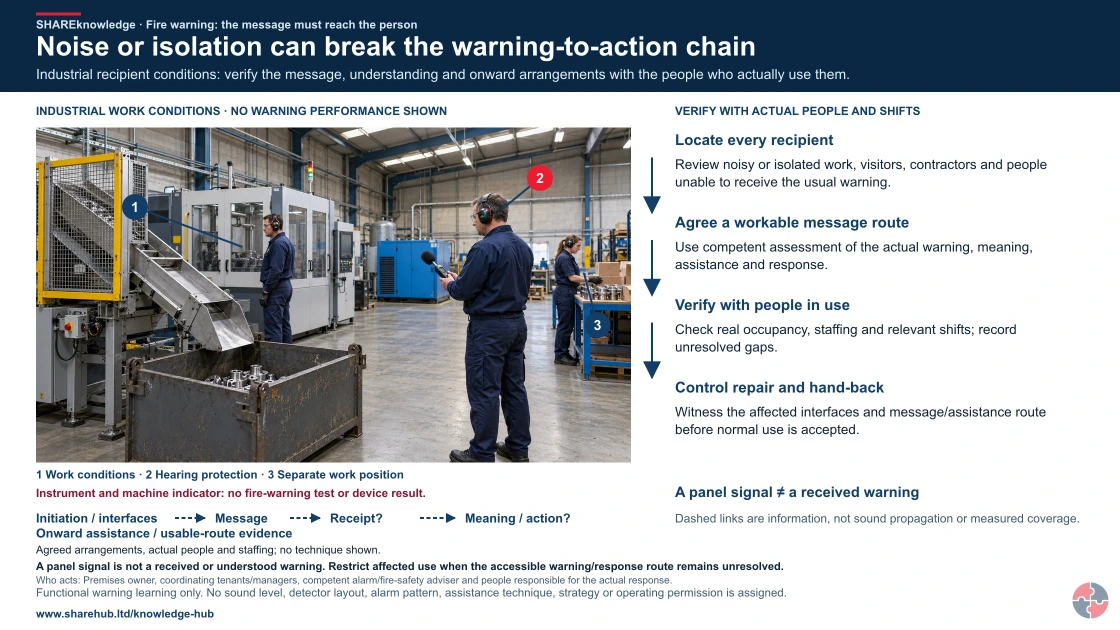
Noise or isolation can break the warning-to-action chain
Full written explanation
An illustrative industrial workshop scene shows enclosed machinery, people wearing hearing protectors and separate work positions. Picture key: 1 Work conditions · 2 Hearing protection · 3 Separate work position. The handheld instrument and machine indicator are not a fire-warning test or device result; neither is identified as alarm hardware. The scene establishes no noise reading, personal hearing deficit, warning perception or machine operating state. Dashed information links join initiation and relevant interfaces to the message, receipt question and meaning/action question. They represent neither sound propagation nor measured warning coverage. Evidence for agreed onward assistance and a usable route remains a separate question involving the actual people and staffing. Four unnumbered checks locate every recipient, assess a workable message route, verify actual use and shifts, and control repair hand-back. A panel signal does not establish a received or understood warning. No sound level, detector layout, alarm pattern, test procedure, assistance technique, evacuation strategy or work permission is supplied.
Industrial recipient conditions: verify the message, understanding and onward arrangements with the people who actually use them.
- Locate every recipient. Review noisy or isolated work, visitors, contractors and people unable to receive the usual warning.
- Agree a workable message route. Use competent assessment of the actual warning, meaning, assistance and response.
- Verify with people in use. Check real occupancy, staffing and relevant shifts; record unresolved gaps.
- Control repair and hand-back. Witness the affected interfaces and message/assistance route before normal use is accepted.
When the evidence does not fit: A panel signal is not a received or understood warning. Restrict affected use when the accessible warning/response route remains unresolved.
Who acts: Premises owner, coordinating tenants/managers, competent alarm/fire-safety adviser and people responsible for the actual response.
Changed workplace
Multi-occupancy office: Trace the shared system and tenant interface to the actual receiving people.
Noisy industrial premises: Verify perception, meaning and response under the conditions people actually work in.
Evidence check: Functional warning learning only. No sound level, detector layout, alarm pattern, assistance technique, strategy or operating permission is assigned.
Follow the full warning, recognition, action and assistance pathway
Primary references: GOV.UK: fire-safety equipment, warning and training · GOV.UK: accessible escape/communication guidance — stated England scope
Open the complete HD image (new tab)Download image

Follow the full warning, recognition, action and assistance pathway
Primary references: GOV.UK: fire-safety equipment, warning and training · GOV.UK: accessible escape/communication guidance — stated England scope
A public venue uses a two-stage alarm. Staff hear an intermittent alert but new starters do not know whether to prepare, investigate or evacuate. A group in a noisy activity room cannot hear the sounder clearly, and a contractor in a plant room has not been briefed. The system operates, but the emergency communication system has failed.
A stronger arrangement defines alarm meanings, trains staff by role, checks audibility, briefs contractors, uses public messages where appropriate, provides visual alerts where needed and tests the arrangements through realistic drills.
| Issue | Weak practice | Better practice |
|---|---|---|
| Two-stage alarm | Staff do not know signal meanings. | Training explains alert, investigate and evacuate actions. |
| Noisy room | Assume sounders are enough. | Audibility check and visual/manager alert route. |
| Contractor | Contractor not told alarm procedure. | Site induction and permit briefing include alarm action. |
| Public message | Staff shout conflicting instructions. | Pre-planned voice or staff messages. |
| Panel location | Only one person understands the panel. | Multiple trained staff and plain zone map. |
| Drill | Annual drill with no learning. | Scenario drill records communication weaknesses. |
How do detector types change the control standard?
Detector type should match the expected fire, environment and unwanted alarm risk.
Detector choice should be competent and risk based. Smoke, heat, flame, beam, aspirating and specialist detection systems each have strengths and limitations.
Unwanted alarms should be reduced by good design, maintenance and work control, not by disabling detection without proper temporary measures.
| Detector or system | Where it may help | Key limitation |
|---|---|---|
| Smoke detector | Early detection of many smouldering or smoke-producing fires. | Dust, steam or aerosols may create unwanted alarms. |
| Heat detector | Kitchens, dusty or steamy areas where smoke detection is unsuitable. | May detect later than smoke detection. |
| Flame detector | Fast flame detection in specific high-hazard settings. | Needs line of sight and specialist design. |
| Beam detection | Large open spaces such as warehouses or halls. | Obstruction, alignment and maintenance matter. |
| Aspirating detection | Very early or specialist detection needs. | Requires competent design and maintenance. |
| Manual call point | Allows people to raise alarm quickly. | Depends on visibility, access and human action. |
How should unwanted alarms and uncertain signals be managed?
Treat every activation under the emergency plan while investigating repeats and preserving protection.
Cooking, steam, dust, construction work, a contaminated detector or an interface fault can create unwanted alarms. Record time, zone, device, conditions, response and likely cause, then have a competent person correct the design, maintenance or work condition. Repeated signals can normalise slow or absent evacuation.
Do not silence, bypass or weaken a detector merely to improve the false-alarm count. Before any planned isolation, identify people and affected functions, authorise an interim risk decision and restrict work or occupancy if reliable warning cannot be maintained. Confirm the restored system by functional and interface testing.
Who may need different emergency communication?
Warning arrangements must work for all relevant persons, not only regular staff.
The fire risk assessment should consider disabled people, visitors, contractors, lone workers, night workers, people in noisy areas, people wearing hearing protection, people in plant rooms, people who do not speak English confidently and members of the public.
Communication arrangements may include visual alarms, vibrating devices, buddy systems, PEEPs, refuge communication, public-address messages, radios, marshals or pre-briefed contractor arrangements.
| Group/location | Possible communication issue | Control option |
|---|---|---|
| Noisy workshop | Alarm may not be heard through equipment or hearing protection. | Visual alarm, supervisor alert and shut-down procedure. |
| Public venue | Visitors may not know routes or alarm meaning. | Staff-led directions and clear public messages. |
| Contractors | May not know local alarm, exits or assembly point. | Induction, permit briefing and host responsibility. |
| Disabled person | May need assistance, equipment or route planning. | PEEP or general emergency evacuation plan. |
| Lone/out-of-hours worker | May be isolated from normal response. | Check-in, automatic detection and emergency communication route. |
| Sleeping risk | People may not respond quickly. | Specialist detection, warning and staffing review. |
How should emergency messages reach people with different needs?
Choose and test warning methods with affected people, tasks and conditions, then connect the message to an achievable escape plan.
A sounder may be missed through hearing protection, in a noisy workshop, by a person with hearing loss or during sleep. A visual signal may fail when it is outside sight, in bright light or during power loss. Spoken instructions can help in complex premises but need clear language, audibility, trained staff and fallback. Visitors, agency workers and contractors may not know local signals.
Consider sensory, mobility, cognitive, language, literacy, temporary-injury and unfamiliarity needs without making diagnosis a proxy for capability. Consult respectfully and record functional assistance and helper cover. Exercise the route, refuge communications where used, roll call and a missing-helper scenario; do not build a plan around routine fire-service rescue.
How should detection and alarm impairments be controlled?
A disabled detector, alarm fault or communication failure changes the fire risk profile immediately.
Impairments should be authorised, recorded, communicated and controlled until normal protection is restored. Temporary arrangements might include additional patrols, temporary detection, restricted activities, reduced occupancy, contractor controls or closure of an affected area.
The responsible person should know which areas are affected and whether the building can remain in normal use.
| Impairment | Immediate question | Temporary control |
|---|---|---|
| Detector zone disabled | What area is no longer protected? | Fire watch, temporary detector or area restriction. |
| Sounder fault | Who may not receive warning? | Alternative warning and urgent repair. |
| Panel fault | Can alarm source be identified? | Trained response and contractor repair. |
| Voice alarm unavailable | How will public instructions be given? | Staff messaging plan and reduced occupancy. |
| Repeated false alarms | Is detection type or work activity causing it? | Investigation, cleaning, redesign or procedure change. |
| Contractor isolation | Has temporary protection been approved? | Permit/impairment process and handback check. |
What happens when the alarm controls doors, ventilation or process equipment?
Treat each cause-and-effect interface as part of the fire strategy and test it through to the expected safe response.
An alarm may release access doors, start or stop ventilation, alert a monitoring centre, operate smoke control or communicate with process protection. An incorrect configuration or an isolated component can prevent escape or spread smoke even when a detector and sounder pass an isolated test.
Keep a current cause-and-effect record, identify the owner of each connected function and coordinate building, security and process contractors. On change or repair, witness the affected sequence, confirm panel state and remove overrides, then record authorised hand-back. A specialist must determine technical settings and compatibility.
When should detection or emergency communication be escalated?
Escalate when warning may not reach people, detection is impaired, system faults persist or emergency messages are unclear.
Detection and warning defects can remove the time people need to escape. A fault should be assessed for its effect on relevant persons, not just logged as an engineering issue.
Changes in layout, occupation, public use, sleeping risk, disability needs, noise, process hazards or refurbishment can also make a previously adequate system unsuitable.
| Trigger or question | Immediate action | Evidence before normal operation |
|---|---|---|
| Alarm cannot be heard/seen in an area | Assess affected persons and provide temporary warning route. | Audibility/visibility review and corrective action. |
| Detector or zone disabled | Authorise impairment and apply temporary controls. | Impairment log and repair evidence. |
| Repeated unwanted alarms | Investigate cause without weakening protection. | Trend, action and design review. |
| Emergency message unclear | Re-brief staff and revise procedure. | Drill learning and communication script. |
| Occupancy or layout changes | Review detection, warning and evacuation interface. | FRA and system review. |
| Contractor works affect system | Control isolation and handback. | Permit and handback record. |
Where do detection and emergency communication systems fail?
They fail when the technical system operates but people do not receive, understand or act on the warning.
Common failures include poor detector selection, blocked detectors, unreviewed layout changes, sounders unheard in noisy areas, alarm panels no one can interpret, false alarms that train people to ignore warning and contractors isolating systems without temporary controls.
Communication also fails when staff are told the procedure once but never practise it. People respond better when roles, messages and responsibilities are trained and rehearsed.
| Failure or weak practice | How it develops | What good looks like |
|---|---|---|
| Wrong detector | Environment creates false alarms or late detection. | Competent detector selection and review. |
| People cannot hear/see alarm | No audibility, visual or accessibility review. | Test warning under real conditions. |
| Panel not understood | Technical zone labels delay response. | Plain location maps and trained staff. |
| Contractor isolation | System disabled without temporary control. | Permit, impairment and handback. |
| False alarm complacency | People delay response. | Investigate causes and reinforce evacuation. |
| Poor emergency messages | Staff give inconsistent instructions. | Pre-planned communications and drills. |
What evidence shows fire detection, alarm systems and emergency communication is controlled?
Evidence should show that fire precautions are suitable, available, maintained, tested, understood and reviewed.
Fire evidence should connect the fire risk assessment to real controls. A log book alone is not enough if defects remain open, staff do not know the procedure or equipment cannot be reached during normal work.
Good records show what was checked, what failed, who owned the action, when it was closed and how the responsible person knows the arrangement still protects relevant persons.
| Evidence item | What it should show | Assurance question |
|---|---|---|
| FRA and system design basis | Detection and warning match the premises and people at risk. | Has the system been reviewed after change? |
| Commissioning/service records | System was installed and maintained by competent people. | Are defects closed? |
| Weekly test records | Manual call points and warning devices are tested. | Does testing sample different parts where appropriate? |
| Audibility/visibility evidence | Warning reaches noisy, isolated and accessible areas. | Were real work conditions considered? |
| Impairment logs | Faults and isolations have temporary controls. | Was risk assessed during impairment? |
| Drill records | People understood alarm and communication. | Did drill learning change procedures? |
What should a detection and communication risk register show?
Record the fire scenario, people needing warning, credited signal path, owner, impairment decision and field evidence.
For a leisure centre plant-room fire, identify the detector or human discovery route, message to pool staff and visitors, door and ventilation interfaces, assisted escape and out-of-hours cover. A failed sounder in a noisy area or an isolated detector zone should trigger a changed-use decision, not just a maintenance ticket.
Review after a drill, unwanted-alarm trend, building work, new tenant, occupancy change, false signal, fault or incident. Verify that action improved the real warning journey from detection to safe assembly.
How can the hierarchy of controls reduce fire risk before relying on detection and emergency messages?
Remove the actual hazard where possible, then use substitution and verified physical controls before relying on procedures or PPE. Discipline checks that the chosen barriers still work.
The scenario is unheard alarm in a noisy accessible area. The controls below are reasoned task applications of linked guidance, not a prescribed design or evidence that each intervention appears verbatim in a source. A competent owner must check feasibility, local law and stop criteria.
Use current government guidance and competent task-specific advice; this section does not establish a technical specification.
How can the ERICPD hierarchy of controls reduce fire risk before relying on detection and emergency messages?

| Hazard and harm route | ERICPD → five-level control | Task intervention and feasibility | Owner, test and evidence | Failure and stop decision |
|---|---|---|---|---|
| Unheard alarm in a noisy accessible area | Eliminate → Elimination | Remove occupancy from the unprotected area until warning works. Source: GOV.UK fire safety risk assessment: offices and shops. | Confirm the unwarned area is vacant until effective accessible warning is demonstrated. | Stop or redesign if occupants missing the warning. |
| Same scenario | Reduce → Substitution | Provide and verify suitable physical detection and warning channels for the affected occupants and representative conditions; a panel indication alone does not establish that warning is perceived. Source: GOV.UK fire safety risk assessment: offices and shops. | Alarm system owner trials the replacement method and documents new hazards, residual risk and worker feedback before release. | Pause until the alternative and its new risks are assessed. |
| Same scenario | Control → Engineering | Provide suitable audible, visual or personal alerting that fits the strategy. Source: GOV.UK fire safety risk assessment: offices and shops. | Alarm system owner must witness audible, visual and personal alerting with affected users under realistic noise conditions. | Stop or redesign if occupants missing the warning. |
| Same scenario | Control → Administrative | Manage any relocation or occupancy restriction, test understanding and roles with users, and coordinate impairment, assisted escape and named restoration acceptance. Source: GOV.UK fire safety risk assessment: offices and shops. | Alarm system owner spot-checks the actual instruction, authorisation and shift handover against work in progress. | Pause if the procedure or handover cannot be verified. |
| Same scenario | PPE → PPE | PPE or hearing protection cannot be the only warning channel. Source: GOV.UK fire safety risk assessment: offices and shops. | Alarm system owner records why PPE cannot control this mapped harm, checks the operative higher-level barrier, and stops the task if that barrier fails. | PPE cannot be the sole credited barrier. |
| Same scenario | Discipline → Administrative assurance | Witness a realistic alarm test with affected users and record corrective actions. Source: GOV.UK fire safety risk assessment: offices and shops. | Witness a realistic alarm test with affected users and record corrective actions. | Stop or redesign if occupants missing the warning. |
How can the ISO 45001 hierarchy of controls reduce fire risk before relying on detection and emergency messages?

| Hazard and harm route | ERICPD → five-level control | Task intervention and feasibility | Owner, test and evidence | Failure and stop decision |
|---|---|---|---|---|
| Unheard alarm in a noisy accessible area | Eliminate → Elimination | Remove occupancy from the unprotected area until warning works. Source: GOV.UK fire safety risk assessment: offices and shops. | Confirm the unwarned area is vacant until effective accessible warning is demonstrated. | Stop or redesign if occupants missing the warning. |
| Same scenario | Reduce → Substitution | Provide and verify suitable physical detection and warning channels for the affected occupants and representative conditions; a panel indication alone does not establish that warning is perceived. Source: GOV.UK fire safety risk assessment: offices and shops. | Alarm system owner trials the replacement method and documents new hazards, residual risk and worker feedback before release. | Pause until the alternative and its new risks are assessed. |
| Same scenario | Control → Engineering | Provide suitable audible, visual or personal alerting that fits the strategy. Source: GOV.UK fire safety risk assessment: offices and shops. | Alarm system owner must witness audible, visual and personal alerting with affected users under realistic noise conditions. | Stop or redesign if occupants missing the warning. |
| Same scenario | Control → Administrative | Manage any relocation or occupancy restriction, test understanding and roles with users, and coordinate impairment, assisted escape and named restoration acceptance. Source: GOV.UK fire safety risk assessment: offices and shops. | Alarm system owner spot-checks the actual instruction, authorisation and shift handover against work in progress. | Pause if the procedure or handover cannot be verified. |
| Same scenario | PPE → PPE | PPE or hearing protection cannot be the only warning channel. Source: GOV.UK fire safety risk assessment: offices and shops. | Alarm system owner records why PPE cannot control this mapped harm, checks the operative higher-level barrier, and stops the task if that barrier fails. | PPE cannot be the sole credited barrier. |
| Same scenario | Discipline → Administrative assurance | Witness a realistic alarm test with affected users and record corrective actions. Source: GOV.UK fire safety risk assessment: offices and shops. | Witness a realistic alarm test with affected users and record corrective actions. | Stop or redesign if occupants missing the warning. |
How should fire detection, alarm systems and emergency communication be assured?
Assurance should test whether the fire arrangement works in the building, at the time, with the people who may need it.
First-line assurance comes from daily checks, weekly tests, warden observations and immediate defect reporting. Second-line assurance reviews fire risk assessment actions, drills, maintenance, contractor records and repeat findings. Specialist assurance may include competent fire risk assessor review, fire alarm contractor reports, extinguisher servicing, emergency lighting testing and enforcement feedback.
The test is practical: if the alarm operates today, can everyone hear, understand, move, escape, account for vulnerable people and keep routes safe without relying on luck?
| Assurance layer | What to check | What good looks like |
|---|---|---|
| Weekly user test | Alarm signal and panel response. | Faults are acted on quickly. |
| Fire warden feedback | People hear, see and act on warning. | Confusion is captured and fixed. |
| Contractor maintenance | Detection, panel, batteries, sounders and interfaces. | Reports are reviewed for risk meaning. |
| Scenario drill | Communication to staff, public, contractors and vulnerable persons. | Messages are clear under pressure. |
| Management review | False alarms, impairments and change. | System suitability keeps pace with premises changes. |
Which UK legal duties and official guidance are relevant?
Premises fire safety follows different legal routes in England and Wales, Scotland and Northern Ireland. Work activity and dangerous-substance duties also depend on location and scenario.
The Fire Safety Order is the England and Wales premises route. Scotland and Northern Ireland have separate premises laws. Great Britain health-and-safety and DSEAR instruments do not silently extend to Northern Ireland; use the corresponding NI work-risk rules where applicable.
| Jurisdiction | Duty or guidance | What it means | How to apply it |
|---|---|---|---|
| E&W | Regulatory Reform (Fire Safety) Order 2005 | Requires the responsible person to assess fire risk and maintain suitable fire precautions in non-domestic premises. | Use as the main fire safety legal framework for England and Wales. |
| GB | Health and Safety at Work etc. Act 1974 | Requires employers to protect employees and others affected by work so far as reasonably practicable. | Use for work activities that create fire, emergency or firefighting risk. |
| GB | Management of Health and Safety at Work Regulations 1999 | Requires suitable and sufficient risk assessment, preventive arrangements, competent help, emergency arrangements and review. | Use for management arrangements, competence and emergency procedures. |
| GB | Dangerous Substances and Explosive Atmospheres Regulations 2002 | Requires fire and explosion risk from dangerous substances to be assessed and controlled. | Use where flammable substances, gases, vapours, dusts or oxygen enrichment affect the fire arrangements. |
| Scotland | Fire (Scotland) Act 2005 | Scottish non-domestic premises fire-safety framework. | Assess people and precautions in the actual Scottish premises. |
| Scotland | Fire Safety (Scotland) Regulations 2006 | Detailed Scottish premises duties and arrangements. | Check suitable warning, escape, equipment, maintenance and coordination. |
| NI | Fire and Rescue Services (NI) Order 2006 | Northern Ireland non-domestic premises fire-safety framework. | Identify the appropriate person and premises scope. |
| NI | Fire Safety Regulations (NI) 2010 | Detailed Northern Ireland premises requirements. | Apply the Northern Ireland premises regulations to warning, escape and maintenance for the actual premises. |
| NI | Health and Safety at Work (NI) Order 1978 | NI general work-health and safety duties. | Control work-created fire and emergency risks. |
| NI | Management Regulations (NI) 2000 | NI work-risk assessment and emergency arrangements. | Coordinate work controls, competence and contractor activity. |
| NI | DSEAR (NI) 2003 | NI dangerous-substance and explosive-atmosphere work-risk route. | Apply when flammable or reactive work creates this hazard. |
How can BS EN ISO 45001 support fire detection, alarm systems and emergency communication management?
ISO 45001 helps turn this topic into leadership, planning, support, operational control, performance evaluation and continual improvement rather than a static page of guidance.
Use current government guidance and competent task-specific advice; this section does not establish a technical specification.
| Management theme | Practical management principle | How to apply it |
|---|---|---|
| Leadership and commitment | Own the warning strategy, resources and occupancy decisions during faults. | Leaders should set expectations, provide resources, remove conflicting pressures and review evidence of control. Public management context: HSE health and safety management-system overview. |
| Hazard identification and assessment of risks and opportunities | Identify who must receive, understand and act on the warning in realistic conditions. | Assess credible harm pathways, affected people, routine work, non-routine work, change, emergency conditions and practical opportunities to improve. Public management context: HSE health and safety management-system overview. |
| Competence | Test staff, helpers, designers and maintainers against their distinct response and hand-back roles. | Define training, authorisation, assessment, supervision and refresher expectations for workers, supervisors, managers and specialists. Public management context: HSE health and safety management-system overview. |
| Operational planning and control | Control system interfaces, planned isolations and changes to premises or occupancy. | Turn assessment decisions into field controls, safe systems, supervision, equipment standards, welfare, emergency arrangements and change controls. Public management context: HSE health and safety management-system overview. |
| Monitoring, measurement, analysis and performance evaluation | Use full-chain tests, unwanted-alarm trends, drills and field feedback. | Use inspections, assurance checks, worker feedback, trend data, audit findings, incident learning and overdue action reviews. Public management context: HSE health and safety management-system overview. |
These are practical management-system themes, not a clause-by-clause interpretation. A competent reviewer must verify any clause mapping against a lawfully accessed current standard.
Who needs competence, and how is it demonstrated?
Training should help people understand fire detection, alarm systems and emergency communication, their role, emergency actions, defect reporting, vulnerable-person arrangements and when to escalate.
Training should be role-based. General awareness creates a baseline, but supervisors, managers, advisers and senior leaders need different levels of decision-making, verification and escalation competence.
| Role | Learning to test | Competence demonstration | Assessor and record | Reassessment trigger |
|---|---|---|---|---|
| Workers, visitors and contractors | Recognise local warning, message and route; report uncertain or failed signals. | Follow a drill from the actual work area and identify a missed warning. | Supervisor or host records induction and exercise. | Changed work area or signal. |
| Wardens and assistance helpers | Know staged response, public information, assisted escape and fallback. | Run a scenario with absent helper, noisy area or failed route. | Competent fire lead assesses practical exercise. | Drill failure or change in occupants. |
| Responsible persons and managers | Own assessment, system availability, impairment and occupancy decision. | Decide whether a leisure area can stay open with a failed detector zone. | Independent competent adviser samples decision and hand-back. | Fault, building work or repeated false alarms. |
| Designers, engineers and maintainers | Understand design basis, zoning, power, interfaces, tests and safe restoration. | Trace alarm initiation through message, door interface and witnessed return. | Technical lead signs commissioning or change record. | System change or failed test. |
| Emergency and assurance leads | Link warning to responder information, accessible escape and trend review. | Run a tabletop fire with false alarms, visitors and power loss. | Leadership reviews outcome and action effectiveness. | Incident, major change or exercise finding. |
How could Riverside Leisure Ltd manage this in practice?

At Riverside Leisure Ltd, a pool plant-room detector fault appears before a busy event. The manager checks which areas and interfaces are affected, uses competent advice to decide whether the pool may remain open, and tells staff how to warn visitors if needed. A shift change reveals the only trained helper is absent, so the affected area is restricted. After repair, the engineer witnesses detector, warning and door-interface tests; the manager walks the evacuation route and signs hand-back before reopening.
Riverside Leisure Ltd would connect fire detection and alarm maintenance to the hotel's assessment, guest needs, staff response and a clear decision about affected use.
Riverside Leisure Ltd · practical example
Manage an alarm fault through to a checked operating decision
The key lesson A functioning warning system and people's ability to receive and act on its message are both necessary parts of the arrangement.
The situation: In this England-and-Wales hotel example, a fault is reported in part of the alarm system before the evening shift. Reception, bedrooms and leisure facilities may be affected differently. The team would establish the implications rather than leaving a fault message for the next manager.
Why this matters: Sleeping guests, unfamiliar visitors and people needing assistance may depend on different warning and response provisions.
How Riverside Leisure Ltd would manage it
- Establish the affected functions — Hotel Manager. Ask the appropriate competent fire and alarm specialists to interpret the fault against the hotel's assessment and design. Identify affected areas, interfaces and uncertainties without asking staff to silence or reset an unexplained problem.
- Decide the interim use — Responsible person. Obtain competent advice on the precautions and any restrictions needed while the fault remains. Apply the legal and premises scope for that hotel; another site's arrangement is not automatic justification.
- Communicate the decision — Duty Manager. Tell reception, leisure staff, contractors and incoming shifts what is affected and what actions apply. Make restrictions visible to the people allocating rooms or opening facilities.
- Verify the corrective work — Facilities Coordinator. Arrange competent repair and the required functional and interface checks. Obtain evidence about the restored functions rather than accepting only that the panel no longer displays a message.
- Check the human response — Hotel Manager. Confirm current staff roles, warning and assistance arrangements and relevant briefings before accepting normal use. Review recurrent faults and communication gaps with the Operations Director.
When the conditions change
- Recognise the trigger
- A detection, warning or communication function is impaired or uncertain.
- Make the immediate decision
- Apply the responsible person’s assessed restrictions while necessary warning or response functions remain impaired.
- Verify the next step
- The responsible person accepts competent evidence for the restored warning and interfaces; the Hotel Manager confirms affected shifts and guest-assistance arrangements before lifting the relevant occupancy or use restriction.
What good looks like
The responsible person can explain the fault's impact and interim decision. Staff know the current response, and restoration is supported by appropriate checks of the system and operating arrangements.
Evidence to look for: Fault record, competent advice, restrictions, shift communications, maintenance verification and staff response checks.
Common mistake to avoid: Assuming the disappearance of a fault message proves the whole fire strategy is restored.
Apply this to your work: Would room allocation and night staff know immediately that warning arrangements had changed?
Guidance behind the management approach: GOV.UK: workplace fire risk assessments. Use the topic's legal and technical guidance for the applicable work and location.
In this leisure centre, warning must reach reception, pool areas, changing rooms, plant rooms, activity rooms, offices, kitchens, contractors and visitors.
| Management element | How the business would manage it | Evidence to review |
|---|---|---|
| Detection | Detector types match rooms and false alarm risks. | System design and service report. |
| Warning | Audibility/visual arrangements cover noisy and public areas. | Warning review. |
| Communication | Staff messages and warden roles are rehearsed. | Drill records. |
| Impairment | Faults and isolations trigger temporary controls. | Impairment log. |
| Contractors | Work affecting alarms is controlled. | Permit and handback. |
| Review | False alarms and drills drive improvements. | Manager action tracker. |
What should fuel-site alarm and emergency communication arrangements connect?
Locate the selected incident context and discuss who must receive and act on a warning. The scene does not demonstrate detector coverage or an approved alarm response.
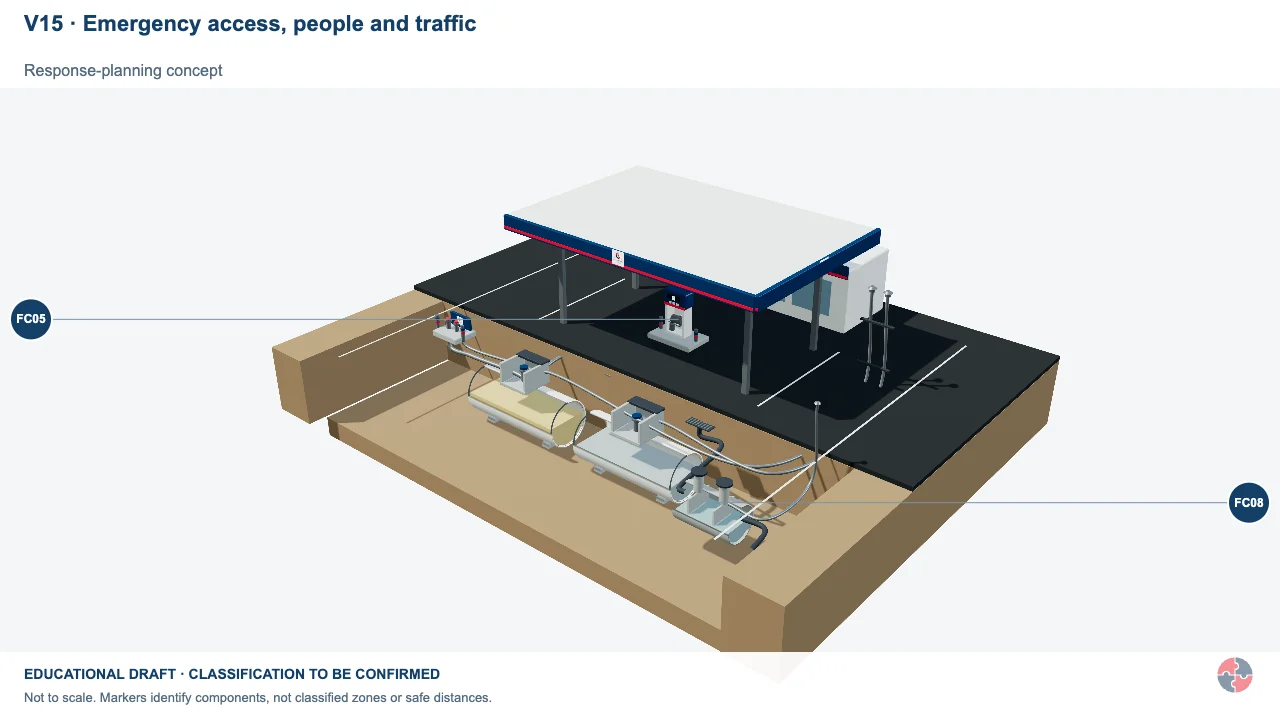

Emergency access, people and traffic
Delivery hoses, the movable refuelling interface and drainage sources can affect access and response. Plan routes around the incident and people involved rather than using a coloured zone as a muster boundary.
Activity focus: Inspect the tanker working area, hose route, nozzle/filler positions, separator covers and vent. Check communication, control of dispensing and traffic, and access for the response plan.
Contextual illustration. The image alone does not establish equipment state, effective controls, individual health or authorisation; use the task-specific checks and competent evidence.
Educational illustration, not to scale. Coloured zones are teaching examples, not a site-specific hazardous-area classification.
Which acronyms and terms matter here?
Acronyms should be understood before they are used in assessments, briefings, audits or learning answers.
Acronyms can exclude newer readers if they are not explained. This section keeps the main terms available at the end of the page so the article stays readable while still supporting learners and audit users.
| Acronym | Meaning | Plain-English use |
|---|---|---|
| ACOP | Approved Code of Practice | Practical guidance with special legal status; following it is not compulsory, but it can be used as evidence of compliance. |
| FRA | Fire Risk Assessment | A structured assessment of fire hazards, people at risk, controls, emergency arrangements and review needs. |
| FRS | Fire and Rescue Service | The emergency service and enforcing authority for many fire safety matters in England and Wales. |
| HSE | Health and Safety Executive | Great Britain workplace health and safety regulator. |
| HSWA | Health and Safety at Work etc. Act 1974 | Great Britain general work-health and safety statute; Northern Ireland has its separate 1978 Order. |
| MHSWR | Management of Health and Safety at Work Regulations 1999 | Regulations requiring suitable and sufficient risk assessment and management arrangements. |
| PEEP | Personal Emergency Evacuation Plan | A person-specific plan for someone who may need assistance to evacuate safely. |
| AOV | Automatic Opening Vent | Ventilation opening used in some smoke control systems. |
| PA | Public Address | Voice communication system used to give instructions to occupants. |
| Cause and effect | Documented system response to each initiation | Connects detection, warning, doors, ventilation and other interfaces. |
| DSEAR | Dangerous Substances and Explosive Atmospheres Regulations | GB 2002 and separate NI 2003 work-risk routes. |
Unlock another resource
You have used this month’s two free downloads. Publish a post in your own words to unlock one more resource, or choose SHARE Individual for 10 downloads per month.
You decide whether to share. If you do, use the relevant platform disclosure tools and do not make claims you do not genuinely hold.