SHARE Knowledge Hub
Fire Evacuation
Fire evacuation succeeds only when each person can receive the warning, understand it and reach a safe place using a route that works at the time. Plan assistance with the people affected, test alternate routes and staffing, and treat a refuge and roll call as parts of the process rather than proof of safety. Restrict use when warning, escape or helper cover fails, and control re-entry after the incident.
Understanding Fire Evacuation
Fire evacuation succeeds only when each person can receive the warning, understand it and reach a safe place using a route that works at the time. Plan assistance with the people affected, test alternate routes and staffing, and treat a refuge and roll call as parts of the process rather than proof of safety. Restrict use when warning, escape or helper cover fails, and control re-entry after the incident.
Why this matters at work
Use the defined incident-control and competent handback arrangements. Determine whether the alarm cause, fire, smoke, structural or utility risks and impaired protection have been resolved for the proposed use. Follow emergency-service restrictions and obtain appropriate specialist advice. Do not interpret silence, a reset panel or no visible flames as clearance. Communicate the authorised scope of reoccupation and retain restrictions on affected areas, with the decision and evidence recorded.
Use the best available attendance and location information, but make uncertainty explicit. Tell the incident lead and arriving fire service who is missing, last known location and any relevant hazards. Do not send staff back into smoke to complete a roll call or assume a sign-in list is perfectly current. Reconcile the information safely and improve visitor and delivery arrangements afterwards. Accountability supports responder decisions; it does not justify exposing wardens to an uncontrolled search.
How organisations manage this in practice
Reentry is a controlled decision about remaining hazards and available protection. Fire, smoke, damaged services and structure can create risks beyond the initial event. A reset alarm says nothing by itself about those conditions. Communicate who authorises return, which areas and activities are allowed and what restrictions remain, with competent evidence appropriate to the incident.
The England small non domestic premises guide has stated simple low risk scope and is not complex process guidance. Its proportionate training and drill discussion is not a blanket annual drill exemption or universal testing interval. Keep warning, roles, assistance, changed work and untested conditions within the actual assessment and competent review.
Follow the premises emergency instructions: raise the alarm, leave by a safe available route and ensure emergency assistance is called through the defined arrangement. Do not collect belongings, enter smoke or delay to investigate an unknown alarm unless that is a specific trained role within a validated plan. Go to the agreed safe location and report relevant information. Local instructions must reflect the actual strategy; a generic answer cannot replace the building’s coordinated procedure.
How can I practise this topic in 3D?


Parts stored across the escape route

A phase change reveals an alarm and escape gap

Alarm, evacuation and visitor accountability
All related inspection points 3 across 3 locations
Garage workshop 1 inspection point
Construction site 1 inspection point
Aerosystems Engineering 1 inspection point
Practice in the SHAREhub environment. Browser practice is separate from workplace competence and formal learning records.
Check every link from receiving the alarm to reaching a safe place
Start with the full pathway rather than a drill time: warning, recognition, movement, assistance, final exit, safe assembly, information for responders and controlled re-entry. Include a visitor or contractor who does not know the building and a person whose assistance arrangements differ from the normal staff route. A refuge or chair is an intermediate element, not proof of a completed journey.

A personal plan needs actual people, assistance and a complete journey

Full written explanation
The new care-premises scene marks a blank assistance-plan sheet, an inert staffing notebook and a closed corridor door behind a person-led conversation. A wheelchair user and staff member sit at the same eye level; no lifting, transfer or evacuation technique is demonstrated. The still establishes no diagnosis, dependency category, available-helper count, trained capability, door protection, selected strategy or completed journey. The checks connect individual needs, actual assistance/resources and review when the assumed helper or route is unavailable. Picture key: 1 Personal-plan paper · 2 Review notebook · 3 Closed door. The separate process headings are unnumbered.
Care-premises review: agree needs with the person and verify the actual resources, warning, route and onward arrangements.
- Agree the person’s actual needs. Check receiving the warning, understanding, movement and any agreed assistance with the person.
- Match the real resources. Verify available trained people, appropriate equipment, communication and the whole onward route.
- Challenge a missing assumption. Test an absent helper or unavailable route through competent review; restrict affected use if unresolved.
Change the pathway
- A wheelchair is not a needs assessment. Do not infer a diagnosis, capability or a single method of assistance from the image.
- A notebook is not shift coverage. Actual people, capability and protection must match the plan, including late shifts.
- A door or refuge is not the endpoint. Verify the complete journey and onward arrangements under the actual premises strategy.
Evidence check: Premises-specific learning only. No universal evacuation route, assistance method, capacity, drill-time target or re-entry permission is provided.
Check every link from receiving warning to the complete journey
Primary references: GOV.UK: accessible means of escape — stated England scope · Scottish Government: care-home residents and staffing — Scotland
Open the complete HD image (new tab)Download image

Check every link from receiving warning to the complete journey
Primary references: GOV.UK: accessible means of escape — stated England scope · Scottish Government: care-home residents and staffing — Scotland
Best-practice guide: Fire Evacuation

Check every link from receiving the alarm to reaching a safe place
Start with the full pathway rather than a drill time: warning, recognition, movement, assistance, final exit, safe assembly, information for responders and controlled re-entry. Include a visitor or contractor who does not know the building and a person whose assistance arrangements differ from the normal staff route. Fire evacuation succeeds only when each person can receive the warning, understand it and reach a safe place using a route that works at the time.
Turn fire evacuation knowledge into a decision
Fire evacuation succeeds only when each person can receive the warning, understand it and reach a safe place using a route that works at the time. Plan assistance with the people affected, test alternate routes and staffing, and treat a refuge and roll call as parts of the process rather than proof of safety. Alarm means act immediately unless trained staged procedure says otherwise.
Evacuation failure worked example
Delayed response: Alarm means act immediately unless trained staged procedure says otherwise. Contractor isolated: Induction, local alarm test and host check.
Where do fire evacuation arrangements fail?
They fail when organisations assume people will behave perfectly despite unclear alarms, blocked routes or untested roles.
Choose controls for the actual task
Elimination: Remove the access barrier or relocate the activity to an accessible safe area. Substitution: Use an alternative safe route verified for the person and premises. Engineering: Provide suitable protected route, refuge or evacuation equipment per strategy. Administrative: Agree assistance, roles, communication and rehearsal with the person. PPE: PPE cannot compensate for an unusable escape route. Read the full control table for qualifications, ownership and verification. Use the actual task and applicable jurisdiction; existing technical approval remains unchanged.
Use the full fire evacuation lesson
Use the full topic for the decision points, practical examples, detailed control tables and source scope. HSE guidance applies to Great Britain; use HSENI for the Northern Ireland route and the source’s stated jurisdiction. A simplified guide does not change the page’s technical-review or approval status.

Read all six steps as text
1. Check every link from receiving the alarm to reaching a safe place
Start with the full pathway rather than a drill time: warning, recognition, movement, assistance, final exit, safe assembly, information for responders and controlled re-entry.
- Avoid / redesign: Remove the access barrier or relocate the activity to an accessible safe area.
- Control the task: Provide suitable protected route, refuge or evacuation equipment per strategy.
- Verify before release: Stop or redesign if a person left without safe escape.
Start with the full pathway rather than a drill time: warning, recognition, movement, assistance, final exit, safe assembly, information for responders and controlled re-entry. Include a visitor or contractor who does not know the building and a person whose assistance arrangements differ from the normal staff route. Fire evacuation succeeds only when each person can receive the warning, understand it and reach a safe place using a route that works at the time.
Apply it: Which part of this plan would you check at the workface before authorising the task?
2. Turn fire evacuation knowledge into a decision
Use the evidence to improve the actual work arrangement.
- Change at source: Remove the access barrier or relocate the activity to an accessible safe area.
- Make it observable: Stop or redesign if a person left without safe escape.
- Keep useful evidence: Alarm means act immediately unless trained staged procedure says otherwise.
Fire evacuation succeeds only when each person can receive the warning, understand it and reach a safe place using a route that works at the time. Plan assistance with the people affected, test alternate routes and staffing, and treat a refuge and roll call as parts of the process rather than proof of safety. Alarm means act immediately unless trained staged procedure says otherwise.
Apply it: What evidence would show that the change improves this task, rather than only completing a record?
3. Evacuation failure worked example
Example: a practical application of the existing topic lesson.
- Delayed response: Alarm means act immediately unless trained staged procedure says otherwise.
- Contractor isolated: Induction, local alarm test and host check.
- Blocked exit: Daily route checks and storage control.
Delayed response: Alarm means act immediately unless trained staged procedure says otherwise. Contractor isolated: Induction, local alarm test and host check.
Apply it: At which point would you hold this example, and what evidence would allow it to proceed?
4. Where do fire evacuation arrangements fail?
Connect the task, the route to the person and the control that can fail.
- Source / exposure: They fail when organisations assume people will behave perfectly despite unclear alarms, blocked routes or untested roles.
- Possible consequence: Common failures include people delaying because of false alarms, blocked or locked exits, poor emergency lighting, no visitor system, PEEPs not reviewed, wardens absent, contractors not briefed, assembly points in unsafe places and managers allowing re-entry.
- Control failure: People often look for confirmation, follow familiar routes, collect belongings or copy others.
They fail when organisations assume people will behave perfectly despite unclear alarms, blocked routes or untested roles.
Apply it: Who could be exposed, including other trades, cleaners, maintainers and people nearby?
5. Choose controls for the actual task
Control summary. Read the complete task-specific controls and checks in the linked topic.
- Elimination: Remove the access barrier or relocate the activity to an accessible safe area.
- Substitution: Use an alternative safe route verified for the person and premises.
- Engineering controls: Provide suitable protected route, refuge or evacuation equipment per strategy.
- Administrative controls: Agree assistance, roles, communication and rehearsal with the person.
- PPE: PPE cannot compensate for an unusable escape route.
Elimination: Remove the access barrier or relocate the activity to an accessible safe area. Substitution: Use an alternative safe route verified for the person and premises. Engineering: Provide suitable protected route, refuge or evacuation equipment per strategy. Administrative: Agree assistance, roles, communication and rehearsal with the person. PPE: PPE cannot compensate for an unusable escape route. Read the full control table for qualifications, ownership and verification. Use the actual task and applicable jurisdiction; existing technical approval remains unchanged.
Apply it: Which stronger option can be used here, and who will verify it before accepting the remaining risk?
6. Use the full fire evacuation lesson
Follow the official sources below and retain the task-specific evidence.
- Official guidance: GOV.UK fire safety risk assessment: offices and shops
- Official guidance: HSE emergency procedures
- Task decision: The responsible owner resolves gaps found by different shifts and users; only the authorised route permits re-entry.
Use the full topic for the decision points, practical examples, detailed control tables and source scope. HSE guidance applies to Great Britain; use HSENI for the Northern Ireland route and the source’s stated jurisdiction. A simplified guide does not change the page’s technical-review or approval status.
Apply it: Which official source and full-topic section will you use to resolve the next decision?
Test a blocked primary route and an absent helper during the late shift. A competent assessment must establish a workable alternative with the actual people, equipment and protection, or the affected use stays restricted. Communicate uncertainty about anyone unaccounted for to incident command; a complete-looking roll call is not permission for staff re-entry.
Riverside: late shift, blocked route, absent helper
Illustrative example. A public event continues into the evening when a primary route is obstructed and a planned helper is unavailable.
Decision. The duty manager restricts affected use until the alternative warning-to-safe-place route and assistance are verified.
Evidence to check. The actual route, current staff cover, consulted assistance plan, visitor briefing and observed end-to-end exercise.
Hold or escalation point. Do not leave the plan at a refuge or chair, improvise rescue, or send staff back for a missing record.
Follow-up. Check late-shift resilience after staffing, visitor or building changes and control re-entry through the incident plan.
Follow the whole path from warning to a safe place
An assembly photograph shows only one stage. Check every link in the actual evacuation arrangements, including agreed assistance and contractor communication.
Warning understood
Confirm how occupants and visitors receive and understand the signal or instruction for the premises strategy.
Route and assistance
Verify the planned escape route and agreed assistance; a refuge is part of a plan, not the end of an evacuation.
Exit and account
Proceed to the designated safe place and use the agreed accounting and missing-person information arrangements. Do not search in smoke.
Review and re-entry
The responsible owner resolves gaps found by different shifts and users; only the authorised route permits re-entry.
Read the complete task-specific control examples
ERICPD is a planning cross-map: Discipline verifies and sustains every control. ESEAP compares effectiveness. A label does not authorise the task; retain the owner, evidence and stop or change decision.
Fire Evacuation · ERICPD
- Eliminate
- Remove the access barrier or relocate the activity to an accessible safe area.
- Reduce
- Use an alternative safe route verified for the person and premises.
- Isolate
- No separate physical-isolation measure is specified. Verify the applicable engineered protection and work arrangements under Control.
- Control
- Provide suitable protected route, refuge or evacuation equipment per strategy.
- PPE
- PPE cannot compensate for an unusable escape route.
- Discipline
- Run a representative drill and close failures before relying on the plan.
Fire Evacuation · ESEAP
- Elimination
- Remove the access barrier or relocate the activity to an accessible safe area.
- Substitution
- Use an alternative safe route verified for the person and premises.
- Engineering controls
- Provide suitable protected route, refuge or evacuation equipment per strategy.
- Administrative controls
- Agree assistance, roles, communication and rehearsal with the person.
- PPE
- PPE cannot compensate for an unusable escape route.
What does fire evacuation need to achieve?
Fire evacuation needs to get all relevant persons to a place of safety quickly enough for the fire scenario and building conditions.


The paired plans show why an escape arrangement must be reviewed when works obstruct its original direction: the revised sign and arrow lead towards a clear alternative exit. Smoke and obstruction identify the unsafe side; signs cannot compensate for an unsuitable or blocked route.
Does redirecting a sign make an obstructed route usable?
No. The escape arrangement must provide a clear, suitable alternative.
Planned change-management example, not instructions to rearrange signs during a fire. A competent fire-risk review must establish suitable routes, travel distances, capacity, protection, lighting and communication before the changed arrangement is used. Follow the emergency plan and never enter smoke.
Source guidance: HSE HSG168
Evacuation is the final life-safety control when prevention, detection or containment are no longer enough. It depends on warning, human behaviour, clear routes, sufficient exits, protected escape, emergency lighting, signs, staff roles, assistance arrangements and people believing they must act immediately.
A good evacuation plan is not just a route map. It considers people who are unfamiliar with the building, disabled people, visitors, contractors, children, night workers, lone workers, people in toilets or plant rooms, people in noisy areas, people with limited English and people who may delay because of false alarms or uncertainty.
Evacuation arrangements should be tested and reviewed. Drills should identify whether people leave promptly, routes remain clear, doors open, wardens know roles, assembly works and re-entry is controlled.
| Element | Purpose | Professional test |
|---|---|---|
| Warning | Prompt people to start evacuation. | Do people recognise and act on the alarm? |
| Escape routes | Provide safe movement away from danger. | Are routes clear, protected, lit and signed? |
| Exits/final exits | Allow people to leave the building. | Can doors be opened immediately when needed? |
| Assistance | Support people who need help. | Are PEEPs or general arrangements current? |
| Assembly/re-entry control | Keep people safe after leaving. | Are people kept away from fire service routes and prevented from re-entering? |
| Drills and learning | Test the plan under realistic conditions. | Are findings acted on? |
How should fire evacuation work in practice?
Evacuation should connect alarm, movement, assistance, assembly, accountability and re-entry control.
Follow the whole journey: alarm recognised, action started, safe route chosen, assistance delivered, exit reached, person accounted for as far as records allow and re-entry controlled. Test this with actual shift cover, visitors, changing rooms, hearing protection and an unusable route. A roll call helps locate a possible missing person; it never proves every person is safe.
The practical pathway is: alarm or instruction - immediate response - movement by suitable escape routes - assistance for those who need it - assembly at a safe place - information to the fire and rescue service - no re-entry until authorised. Weakness at any stage can compromise life safety.
The evacuation strategy should match the building and people. Many workplaces use simultaneous evacuation. Some premises may use staged, phased or progressive horizontal evacuation where the fire risk assessment and building design support it. Those strategies require stronger staff training and management.
| Stage | What should happen | Common weakness |
|---|---|---|
| Alarm | People recognise the warning and start leaving. | People wait for confirmation or finish tasks. |
| Route choice | People use clear, signed escape routes. | People use familiar route only or find blocked route. |
| Assistance | People needing help receive planned support. | PEEPs not current or deputies absent. |
| Assembly | People move to safe assembly area. | Assembly point too close or obstructs fire service access. |
| Information | Responsible person gives relevant information to responders. | No one knows missing persons, hazards or zones. |
| Re-entry | No one returns until authorised. | Managers re-enter to collect items or restart work. |
How can evacuation fail during a real alarm?
Evacuation can fail when people delay, routes are compromised, assistance is unclear or re-entry is not controlled.
A blocked familiar route needs an assessed alternative and accountability

Full written explanation
An illustrative inactive office exercise-review scene shows adults discussing an inert review sheet outside an office, including a wheelchair user. Picture key: 1 Exercise review sheet · 2 People in review · 3 Office entrance context. The photograph establishes no assembly location, selected route, evacuation strategy, personal capability, assistance method or completed escape. A separate illustrative office plan keeps three rooms connected through drawn door gaps to a corridor. The familiar right-hand direction is unavailable only as an exercise assumption; the dashed left alternative ends in a competent-assessment question. This plan is not a survey of the photographed building and does not declare a safe alternative. Four unnumbered checks identify changed conditions and affected people, verify an actual alternative and assistance, brief every receiving person and pass accountability uncertainty to incident command while controlling re-entry. The actual premises strategy and person-led private assistance arrangements remain necessary for the whole onward journey. No active smoke, crowd movement, rescue, emergency action recipe, route distance, capacity, door rating or drill-time target is shown. An unaccounted-for person gives staff no search, rescue or re-entry permission.
Office exercise: the pictured review and illustrative plan cannot select a route, strategy or complete anyone’s journey.
- Name the changed condition. Record the unavailable route, missing helper or warning gap and affected occupants.
- Verify a workable alternative. Use competent assessment of the real people, route, assistance and protection.
- Brief every receiving person. Include visitors, contractors, isolated rooms and the people giving assistance.
- Account and control re-entry. Pass missing-person uncertainty to incident command; staff do not re-enter to search or collect belongings.
When the evidence does not fit: An unaccounted-for person is information for incident command, not permission for staff rescue or re-entry. Restrict use where an essential route or assistance remains unresolved.
Who acts: Premises fire lead, actual assistance/evacuation roles, visitor/contractor coordinators and incident command under the plan.
Changed workplace
Care premises: Match agreed assistance to actual people, equipment, protection and the whole journey.
Office with visitors: Challenge an unavailable familiar route and verify warning, alternatives and accountability.
Evidence check: Premises-specific learning only. No universal evacuation route, assistance method, capacity, drill-time target or re-entry permission is provided.
Check every link from receiving warning to the complete journey
Primary references: GOV.UK: accessible means of escape — stated England scope · Scottish Government: care-home residents and staffing — Scotland
Open the complete HD image (new tab)Download image

Check every link from receiving warning to the complete journey
Primary references: GOV.UK: accessible means of escape — stated England scope · Scottish Government: care-home residents and staffing — Scotland
A fire alarm sounds in a multi-use building. Office workers leave quickly, but a meeting room waits for a manager, a contractor in a plant room does not hear the alarm, a fire exit is restricted by temporary storage, a visitor using a wheelchair has no current assistance plan and a supervisor goes back inside to collect a laptop.
A stronger system treats those as design and management failures. It checks warning coverage, controls storage, briefs contractors, keeps assistance plans current, trains staff to evacuate immediately and controls re-entry.
| Issue | Weak practice | Better practice |
|---|---|---|
| Delayed response | People wait for manager confirmation. | Alarm means act immediately unless trained staged procedure says otherwise. |
| Contractor isolated | Contractor not briefed and misses alarm. | Induction, local alarm test and host check. |
| Blocked exit | Temporary storage allowed on route. | Daily route checks and storage control. |
| Assistance need | Visitor support improvised. | PEEP/general assistance route and trained staff. |
| Assembly | People gather in vehicle route. | Assembly point selected and controlled. |
| Re-entry | Supervisor returns for property. | No re-entry until authorised by competent person/FRS. |
How do evacuation strategies differ?
The strategy should be selected by competent fire risk assessment and building design, not preference.
Simultaneous evacuation is common in many workplaces: everyone leaves when the alarm sounds. Staged or phased evacuation may be used in more complex buildings where the fire strategy supports it. Progressive horizontal evacuation may apply in care or healthcare settings where people move from one compartment to another before leaving.
More complex strategies need stronger staff competence, communication, compartmentation, drills and management control.
| Strategy | Typical use | Management need |
|---|---|---|
| Simultaneous evacuation | Many offices, shops, workshops and simple premises. | Clear alarm response and routes. |
| Staged evacuation | Premises where staff alert/investigation or phased movement is planned. | Staff understand different alarm meanings. |
| Phased evacuation | Larger or taller buildings with designed fire strategy. | Strong communication and protected routes. |
| Progressive horizontal evacuation | Care/health settings with compartments and assisted movement. | Staffing, compartmentation and rehearsed support. |
| Stay-put or delayed movement | Specialist residential/building strategy contexts. | Must be justified by competent fire strategy and law. |
| Temporary evacuation plan | Construction/refurbishment or impaired routes. | Frequent review as conditions change. |
How should evacuation support be planned for people who may need assistance?
Assistance should be planned privately, practically and before an emergency occurs.
Discuss functional assistance with the person; keep personal information proportionate and private. Define the warning method, route, helper and backup, refuge communication where used and what happens if a lift or door fails. A refuge is a temporary place within an escape plan, not a destination where people wait for routine fire-service rescue. An ordinary passenger lift is not assumed safe for evacuation.
Some people may need assistance because of mobility, sensory, cognitive, pregnancy, injury, anxiety, language, medication, temporary impairment or unfamiliarity with the building. Support should not rely on assumptions or public disclosure.
PEEPs are one route for known individual needs. General emergency evacuation plans may also be needed for visitors or unknown users.
| Need | Possible issue | Control |
|---|---|---|
| Mobility impairment | Stairs, distance or speed may be difficult. | PEEP, refuge, evacuation chair or assisted route. |
| Hearing impairment | Audible alarm may not be enough. | Visual/tactile alert or buddy arrangement. |
| Visual impairment | Route finding and signs may be difficult. | Orientation, assistance and clear routes. |
| Visitor/public user | No individual plan exists. | General assistance procedure and trained staff. |
| Temporary injury/pregnancy | Needs may change quickly. | Short-term support review. |
| Contractor/lone worker | May be outside normal communication. | Induction, check-in and alarm briefing. |
The Home Office means-of-escape guide applies in England and explains personal plans, refuges and suitable evacuation lifts. Scotland and Northern Ireland need their own premises guidance and competent building-specific design.
What should evacuation drills test?
Drills should test behaviour, routes, roles and learning rather than simply ticking a calendar requirement.
Vary the exercise: use a blocked route, absent helper, night or low-staff period, unfamiliar visitor and failed public-address message. Observe recognition and action as well as final headcount. Debrief people who needed help, close route or staffing defects and repeat the relevant part before declaring the arrangement effective.
A useful drill observes how quickly people respond, whether wardens check areas safely, whether routes are clear, whether exit doors operate, whether visitors are managed, whether people go to the right assembly point and whether re-entry is controlled.
Different scenarios should be considered over time, such as blocked route, absent warden, contractor on site, public event, out-of-hours staffing or a person needing assistance.
| Drill aspect | What to observe | Learning question |
|---|---|---|
| Alarm response | Do people leave immediately? | Is false alarm complacency present? |
| Routes | Are routes clear and known? | Do people use nearest safe exit or familiar route only? |
| Wardens | Are roles and deputies effective? | What happens when key people are absent? |
| Assistance | Are PEEPs/general plans practical? | Were support arrangements realistic? |
| Assembly | Is the assembly point safe and controlled? | Does it obstruct emergency access? |
| Debrief | Are findings recorded and closed? | Did the drill improve the system? |
Plan exercises safely: represent an unavailable route or helper through a briefing or simulation while keeping real emergency exits usable. Agree participation and assistance with the person. Use trained operators and suitable manual-handling assessment; simulate carry-down where practice would create avoidable injury risk. Stop the exercise if it threatens anyone’s safety.
What should an evacuation risk register show?
For each credible fire scenario, record who must receive warning, the route and assistance available, owner, defect decision and observed field evidence.
Record the building use and shift, visitors or temporary workers, alternative route, door and lighting dependencies, refuge or lift arrangements, assembly and re-entry authority. A new partition, blocked stair or missing helper changes the risk even if the fire risk assessment document has not expired.
Use drill observations and spot checks to prove the route works; keep unresolved defects visible and restrict affected use where safe evacuation is not credible.
How can the hierarchy of controls reduce fire exposure and evacuation risks?
Remove the actual hazard where possible, then use substitution and verified physical controls before relying on procedures or PPE. Discipline checks that the chosen barriers still work.
The scenario is blocked assisted-escape route. The controls below are reasoned task applications of linked guidance, not a prescribed design or evidence that each intervention appears verbatim in a source. A competent owner must check feasibility, local law and stop criteria.
Use current government guidance and competent task-specific advice; this section does not establish a technical specification.
How can the ERICPD hierarchy of controls reduce fire exposure and evacuation risks?

| Hazard and harm route | ERICPD → five-level control | Task intervention and feasibility | Owner, test and evidence | Failure and stop decision |
|---|---|---|---|---|
| Blocked assisted-escape route | Eliminate → Elimination | Remove the access barrier or relocate the activity to an accessible safe area. Source: Home Office means-of-escape guide. | Walk the revised route with the affected person or verify relocation to an accessible area; retain an assisted-escape plan for remaining constraints. | Stop or redesign if a person left without safe escape. |
| Same scenario | Reduce → Substitution | Use an alternative safe route verified for the person and premises. Source: Home Office means-of-escape guide. | Premises fire lead trials the replacement method and documents new hazards, residual risk and worker feedback before release. | Pause until the alternative and its new risks are assessed. |
| Same scenario | Control → Engineering | Provide suitable protected route, refuge or evacuation equipment per strategy. Source: Home Office means-of-escape guide. | Premises fire lead must witness a representative assisted-escape drill and test the route or equipment under realistic occupancy. | Stop or redesign if a person left without safe escape. |
| Same scenario | Control → Administrative | Agree assistance, roles, communication and rehearsal with the person. Source: Home Office means-of-escape guide. | Premises fire lead spot-checks the actual instruction, authorisation and shift handover against work in progress. | Pause if the procedure or handover cannot be verified. |
| Same scenario | PPE → PPE | PPE cannot compensate for an unusable escape route. Source: Home Office means-of-escape guide. | Premises fire lead records why PPE cannot control this mapped harm, checks the operative higher-level barrier, and stops the task if that barrier fails. | PPE cannot be the sole credited barrier. |
| Same scenario | Discipline → Administrative assurance | Run a representative drill and close failures before relying on the plan. Source: Home Office means-of-escape guide. | Run a representative drill and close failures before relying on the plan. | Stop or redesign if a person left without safe escape. |
How can the ISO 45001 hierarchy of controls reduce fire exposure and evacuation risks?

| Hazard and harm route | ERICPD → five-level control | Task intervention and feasibility | Owner, test and evidence | Failure and stop decision |
|---|---|---|---|---|
| Blocked assisted-escape route | Eliminate → Elimination | Remove the access barrier or relocate the activity to an accessible safe area. Source: Home Office means-of-escape guide. | Walk the revised route with the affected person or verify relocation to an accessible area; retain an assisted-escape plan for remaining constraints. | Stop or redesign if a person left without safe escape. |
| Same scenario | Reduce → Substitution | Use an alternative safe route verified for the person and premises. Source: Home Office means-of-escape guide. | Premises fire lead trials the replacement method and documents new hazards, residual risk and worker feedback before release. | Pause until the alternative and its new risks are assessed. |
| Same scenario | Control → Engineering | Provide suitable protected route, refuge or evacuation equipment per strategy. Source: Home Office means-of-escape guide. | Premises fire lead must witness a representative assisted-escape drill and test the route or equipment under realistic occupancy. | Stop or redesign if a person left without safe escape. |
| Same scenario | Control → Administrative | Agree assistance, roles, communication and rehearsal with the person. Source: Home Office means-of-escape guide. | Premises fire lead spot-checks the actual instruction, authorisation and shift handover against work in progress. | Pause if the procedure or handover cannot be verified. |
| Same scenario | PPE → PPE | PPE cannot compensate for an unusable escape route. Source: Home Office means-of-escape guide. | Premises fire lead records why PPE cannot control this mapped harm, checks the operative higher-level barrier, and stops the task if that barrier fails. | PPE cannot be the sole credited barrier. |
| Same scenario | Discipline → Administrative assurance | Run a representative drill and close failures before relying on the plan. Source: Home Office means-of-escape guide. | Run a representative drill and close failures before relying on the plan. | Stop or redesign if a person left without safe escape. |
What does a complete fire evacuation pathway look like?
A complete pathway follows the event from alarm activation through recognition, movement, assistance, accountability, fire service information and re-entry control.
Evacuation should be tested as a sequence rather than a single drill time. A fast drill is not enough if some people did not hear the alarm, visitors were not directed, a refuge call was unanswered, the assembly point was unsafe or nobody controlled re-entry.
The pathway should be realistic for the building as used: public visitors, contractors, lone workers, night staff, disabled people, security-controlled doors, bad weather, shift handover and blocked routes should all be considered where relevant.
| Pathway step | What must happen | Evidence or quality test |
|---|---|---|
| Alarm | Fire is detected or reported and the alarm is raised without delay. | Alarm test, call point availability and detection maintenance. |
| Recognition | People understand that they must act now. | Clear sounders, visual alarms, voice messages or staff instruction. |
| Movement | People move by safe, direct and available routes. | Route inspections, emergency lighting and drill observations. |
| Assistance and PEEP | People who need help receive planned support with dignity. | Current plans, trained helpers and refuge communication checks. |
| Refuge if used | Refuges are protected, communicated with and managed. | Communication test and procedure for escalation. |
| Assembly | People reach a safe meeting point away from emergency access and smoke. | Assembly point review and warden observations. |
| Roll call or accountability | The organisation has a realistic way to identify missing persons without delaying evacuation. | Visitor, contractor and staff accountability arrangements. |
| Fire service information | Information on hazards, missing persons, isolations and layout is available. | Premises information box, site plan or incident controller briefing. |
| Re-entry control | Nobody returns until authorised by the appropriate person or emergency services. | Warden instruction, security control and incident log. |
When should evacuation arrangements be stopped or escalated?
Escalate when warning, routes, exits, assistance, staffing or re-entry control cannot be relied on.
Evacuation defects are life-safety defects. A blocked exit, failed emergency lighting, locked final exit, unclear assistance plan or alarm communication problem may require immediate restriction, temporary controls or closure of an area.
The responsible person should record the decision and keep temporary controls under review until normal protection is restored.
| Trigger or question | Immediate action | Evidence before normal operation |
|---|---|---|
| Exit or escape route blocked | Clear immediately or restrict affected area. | Route check and corrective action. |
| Final exit locked or hard to open | Remove restriction and review security interface. | Door check and defect close-out. |
| Emergency lighting failure | Assess affected route and apply temporary controls. | Repair/test evidence. |
| Person needs assistance and no plan exists | Create temporary support and review PEEP/general plan. | Support plan and briefing. |
| Drill shows delay or confusion | Debrief, retrain and update plan. | Drill action close-out. |
| Re-entry not controlled | Brief managers/wardens and revise assembly control. | Procedure and drill evidence. |
Where do fire evacuation arrangements fail?
They fail when organisations assume people will behave perfectly despite unclear alarms, blocked routes or untested roles.
Common failures include people delaying because of false alarms, blocked or locked exits, poor emergency lighting, no visitor system, PEEPs not reviewed, wardens absent, contractors not briefed, assembly points in unsafe places and managers allowing re-entry.
Human behaviour matters. People often look for confirmation, follow familiar routes, collect belongings or copy others. Drills and clear leadership reduce that uncertainty.
| Failure or weak practice | How it develops | What good looks like |
|---|---|---|
| Delayed evacuation | False alarm history or unclear instructions. | Immediate response culture and false alarm review. |
| Blocked route | Housekeeping or temporary works creep. | Daily checks and contractor controls. |
| Locked exit | Security conflicts with escape. | Emergency opening checks and management review. |
| PEEP failure | Plan not updated or deputies absent. | Private review and trained assistance. |
| Assembly problem | People gather too close or in vehicle routes. | Safe location and warden control. |
| Re-entry | People return for belongings or work. | Clear authority and boundary control. |
What evidence shows fire evacuation is controlled?
Evidence should show that fire precautions are suitable, available, maintained, tested, understood and reviewed.
Fire evidence should connect the fire risk assessment to real controls. A log book alone is not enough if defects remain open, staff do not know the procedure or equipment cannot be reached during normal work.
Good records show what was checked, what failed, who owned the action, when it was closed and how the responsible person knows the arrangement still protects relevant persons.
| Evidence item | What it should show | Assurance question |
|---|---|---|
| Fire risk assessment | Evacuation needs, escape routes and people at risk are assessed. | Does it reflect current occupancy? |
| Emergency plan | Alarm action, roles, assistance and assembly are defined. | Can staff explain it? |
| Route/exit checks | Escape routes, final exits and signs are checked. | Are defects closed? |
| Emergency lighting records | Lighting is tested and maintained. | Are failed tests escalated? |
| PEEP/general plan records | Assistance arrangements are current and private. | Are deputies and visitors considered? |
| Drill records | Evacuation performance and learning are recorded. | Did actions improve the system? |
How should fire evacuation be assured?
Assurance should test whether the fire arrangement works in the building, at the time, with the people who may need it.
First-line assurance comes from daily checks, weekly tests, warden observations and immediate defect reporting. Second-line assurance reviews fire risk assessment actions, drills, maintenance, contractor records and repeat findings. Specialist assurance may include competent fire risk assessor review, fire alarm contractor reports, extinguisher servicing, emergency lighting testing and enforcement feedback.
The test is practical: if the alarm operates today, can everyone hear, understand, move, escape, account for vulnerable people and keep routes safe without relying on luck?
| Assurance layer | What to check | What good looks like |
|---|---|---|
| Daily checks | Routes, exits, signs and obstructions. | Unsafe conditions are corrected immediately. |
| Warden checks | Occupant response and assistance arrangements. | People know what to do. |
| Drills | Alarm response, routes, assembly and re-entry. | Learning is specific and closed. |
| Manager review | Actions, PEEPs, layout changes and contractor impacts. | Changes trigger plan review. |
| Leadership review | Repeated evacuation weaknesses or major defects. | Resources address life-safety gaps. |
Which UK legal duties and official guidance are relevant?
England and Wales, Scotland and Northern Ireland have separate non-domestic premises fire routes; work and dangerous-substance duties must also be checked for the actual location and activity.
The Fire Safety Order is the England and Wales premises route. Scottish and Northern Irish instruments are separate. GB work-health rules and DSEAR do not silently apply in NI; use the corresponding NI rules where in scope. This table identifies routes, not legal approval for a site-specific strategy.
| Jurisdiction | Duty or guidance | What it means | How to apply it |
|---|---|---|---|
| E&W | Regulatory Reform (Fire Safety) Order 2005 | Requires the responsible person to assess fire risk and maintain suitable fire precautions in non-domestic premises. | Use as the main fire safety legal framework for England and Wales. |
| GB | Health and Safety at Work etc. Act 1974 | Requires employers to protect employees and others affected by work so far as reasonably practicable. | Use for work activities that create fire, emergency or firefighting risk. |
| GB | Management of Health and Safety at Work Regulations 1999 | Requires suitable and sufficient risk assessment, preventive arrangements, competent help, emergency arrangements and review. | Use for management arrangements, competence and emergency procedures. |
| GB | Dangerous Substances and Explosive Atmospheres Regulations 2002 | Requires fire and explosion risk from dangerous substances to be assessed and controlled. | Use where flammable substances, gases, vapours, dusts or oxygen enrichment affect the fire arrangements. |
| Scotland | Fire (Scotland) Act 2005 | Scottish non-domestic premises fire framework. | Assess people and fire precautions in the actual premises. |
| Scotland | Fire Safety (Scotland) Regulations 2006 | Scottish detailed premises precautions. | Warning, escape, maintenance and coordination. |
| NI | Fire and Rescue Services (NI) Order 2006 | NI non-domestic premises fire framework. | Identify the appropriate person and affected premises. |
| NI | Fire Safety Regulations (NI) 2010 | NI detailed premises precautions. | Warning, escape, maintenance and review. |
| NI | Health and Safety at Work (NI) Order 1978 | NI general work-health and safety route. | Control work-created fire and emergency risks. |
| NI | Management Regulations (NI) 2000 | NI risk-assessment and emergency arrangements. | Coordinate workers, contractors, competence and emergency action. |
| NI | DSEAR (NI) 2003 | NI dangerous-substance work-risk route where relevant. | Plan release, ignition and emergency controls. |
In England and Wales, Article 14 of the Fire Safety Order addresses emergency routes and exits; Article 15 addresses procedures for serious and imminent danger, including appropriate drills. The Workplace Regulations 1992 address ordinary traffic routes, not emergency escape routes.
How can BS EN ISO 45001 support fire evacuation management?
Voluntary ISO 45001 themes can organise ownership, competence, operation and review; the fire strategy and legal duties still need competent, site-specific decisions.
Use current government guidance and competent task-specific advice; this section does not establish a technical specification.
| Management theme | Practical management principle | How to apply it |
|---|---|---|
| Leadership and commitment | Provide viable routes, warning, assistance and trained cover at every operating time. | Leaders should set expectations, provide resources, remove conflicting pressures and review evidence of control. Public context: HSE health and safety management-system overview. |
| Hazard identification and assessment of risks and opportunities | Test the journey to safety for people and conditions actually present. | Assess credible harm pathways, affected people, routine work, non-routine work, change, emergency conditions and practical opportunities to improve. Public context: HSE health and safety management-system overview. |
| Competence | Observe workers, wardens and helpers making correct alarm and assistance decisions. | Define training, authorisation, assessment, supervision and refresher expectations for workers, supervisors, managers and specialists. Public context: HSE health and safety management-system overview. |
| Operational planning and control | Keep exits, routes, refuge communication and assembly arrangements usable. | Turn assessment decisions into field controls, safe systems, supervision, equipment standards, welfare, emergency arrangements and change controls. Public context: HSE health and safety management-system overview. |
| Monitoring, measurement, analysis and performance evaluation | Use drills and field checks to find delayed response, blocked routes and gaps in cover. | Use inspections, assurance checks, worker feedback, trend data, audit findings, incident learning and overdue action reviews. Public context: HSE health and safety management-system overview. |
These are practical management-system themes, not a clause-by-clause interpretation. A competent reviewer must verify any clause mapping against a lawfully accessed current standard.
Who needs competence, and how should it be demonstrated?
Test the decisions and actions each role must make in a realistic fire scenario, including faults, absent staff and hand-back.
| Role | Learning to test | Competence demonstration | Assessor and record | Reassessment trigger |
|---|---|---|---|---|
| All workers and contractors | Local warning, exit, assembly and non-re-entry rules. | Use the actual route during a drill. | Supervisor records induction and observation. | Change in route or location. |
| Wardens and public-facing staff | Direct visitors, check assigned areas, report uncertainty. | Respond to a blocked route and incomplete visitor count. | Competent fire lead records exercise. | Drill failure or new occupancy. |
| Assistance helpers | Consent-based plan, refuge communication and backup. | Support a person when primary helper or lift is unavailable. | Competent assessor and affected person review outcome. | New support need or system defect. |
| Managers and dutyholders | Own staffing, defects, restrictions and re-entry. | Decide whether an affected area can open with a failed route. | Independent fire adviser samples decision. | Route defect, incident or change. |
| Designers and maintainers | Understand route, alarm, door and lift interfaces. | Witness repair and full-path hand-back. | Technical lead records verification. | Modification or failed test. |
Plan exercises safely: represent an unavailable route or helper through a briefing or simulation while keeping real emergency exits usable. Agree participation and assistance with the person. Use trained operators and suitable manual-handling assessment; simulate carry-down where practice would create avoidable injury risk. Stop the exercise if it threatens anyone’s safety.
How could Riverside Leisure Ltd manage this in practice?

At Riverside Leisure Ltd, a smoke alarm starts while families use the pool and one changing-room exit is obstructed. Lifeguards direct people away from smoke; reception calls emergency services and reports the blocked route, while a trained helper checks the agreed assistance plan. The assembly lead treats a missing visitor record as uncertain rather than declaring everyone accounted for. The manager keeps the area closed until the exit is cleared, the alarm path tested, staff cover restored and an exercise verifies the revised route.
Riverside Leisure Ltd can manage fire evacuation by testing routes, staff roles, public communication, assistance arrangements and re-entry control.
In this leisure centre, evacuation includes pool users, children, visitors, contractors, changing rooms, plant rooms, offices and public events.
| Management element | How the business would manage it | Evidence to review |
|---|---|---|
| Plan | Evacuation strategy and staff roles are defined. | Emergency plan. |
| Routes | Routes and exits are checked daily. | Route check log. |
| Assistance | PEEPs and visitor support arrangements are current. | Assistance review. |
| Drills | Different scenarios and times are tested. | Drill report. |
| Assembly | Assembly point is safe and controlled. | Warden checklist. |
| Review | Defects and learning update FRA. | Action tracker. |
What should a fuel-site evacuation plan consider beyond zoning?
Use the incident context to discuss people, access and communication. An ATEX boundary does not determine every possible consequence or establish an evacuation route.
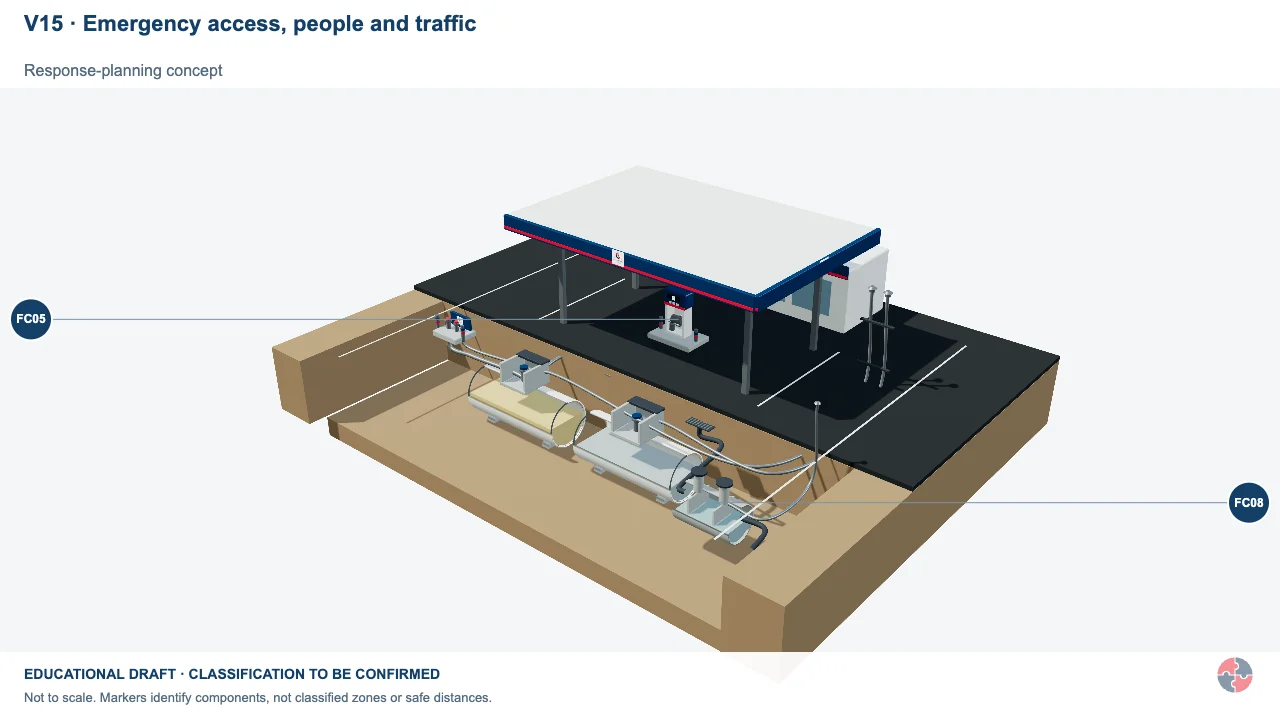
Emergency access, people and traffic
Delivery hoses, the movable refuelling interface and drainage sources can affect access and response. Plan routes around the incident and people involved rather than using a coloured zone as a muster boundary.
Activity focus: Inspect the tanker working area, hose route, nozzle/filler positions, separator covers and vent. Check communication, control of dispensing and traffic, and access for the response plan.
Contextual illustration. The image alone does not establish equipment state, effective controls, individual health or authorisation; use the task-specific checks and competent evidence.
Educational illustration, not to scale. Coloured zones are teaching examples, not a site-specific hazardous-area classification.
Riverside hotel fire safety examples
Use these fictional hotel policies and records to see how a manager documents local fire precautions, evacuation arrangements and decisions on shift. Adapt the examples to the premises and obtain local approval before use.
- England Word and PDF pack (ZIP) · England reading copy (PDF)
- Northern Ireland Word and PDF pack (ZIP) · Northern Ireland reading copy (PDF)
- Scotland Word and PDF pack (ZIP) · Scotland reading copy (PDF)
- Wales Word and PDF pack (ZIP) · Wales reading copy (PDF)
Browse all Riverside fire examples in the Policy Builder library
Which acronyms and terms matter here?
Acronyms should be understood before they are used in assessments, briefings, audits or learning answers.
Acronyms can exclude newer readers if they are not explained. This section keeps the main terms available at the end of the page so the article stays readable while still supporting learners and audit users.
| Acronym | Meaning | Plain-English use |
|---|---|---|
| ACOP | Approved Code of Practice | Practical guidance with special legal status; following it is not compulsory, but it can be used as evidence of compliance. |
| FRA | Fire Risk Assessment | A structured assessment of fire hazards, people at risk, controls, emergency arrangements and review needs. |
| FRS | Fire and Rescue Service | The emergency service and enforcing authority for many fire safety matters in England and Wales. |
| HSE | Health and Safety Executive | Great Britain workplace health and safety regulator. |
| HSWA | Health and Safety at Work etc. Act 1974 | Great Britain general work-health and safety statute; Northern Ireland has a separate 1978 Order. |
| MHSWR | Management of Health and Safety at Work Regulations 1999 | Regulations requiring suitable and sufficient risk assessment and management arrangements. |
| PEEP | Personal Emergency Evacuation Plan | A person-specific plan for someone who may need assistance to evacuate safely. |
| GEEP | General Emergency Evacuation Plan | General arrangements for assisting people who may need help when individual PEEPs are not known in advance. |
Unlock another resource
You have used this month’s two free downloads. Publish a post in your own words to unlock one more resource, or choose SHARE Individual for 10 downloads per month.
You decide whether to share. If you do, use the relevant platform disclosure tools and do not make claims you do not genuinely hold.