SHARE Knowledge Hub
Fire Emergency Plans, Business Continuity and Environmental Impacts
A fire emergency plan must move people to safety, support emergency responders and define safe decisions during and after the incident. The same scenario may create smoke, contaminated firewater and lost services, but environmental containment and business recovery must not delay escape. Map people, substances, drains, critical dependencies and responsible roles; exercise the plan and require competent evidence before re-entry or restart.
Understanding Fire Emergency Plans, Business Continuity and Environmental Impacts
A fire emergency plan must move people to safety, support emergency responders and define safe decisions during and after the incident. The same scenario may create smoke, contaminated firewater and lost services, but environmental containment and business recovery must not delay escape. Map people, substances, drains, critical dependencies and responsible roles; exercise the plan and require competent evidence before re-entry or restart.
Why this matters at work
Plan safe hours, rest, travel, communication and support for displaced or distressed workers alongside the equipment restart. Avoid relying on a small team’s repeated overtime to restore production. Give people clear task boundaries and a route to raise concerns without pressure to enter damaged areas. Use occupational and other specialist support where appropriate. Record the staffing basis and review actual workload as recovery develops; completion of a continuity milestone does not establish that fatigue and exposure risks are controlled.
Emergency planning joins immediate life safety with command, responder information, environmental consequences and controlled recovery. These stages have different priorities and authority. Plans must reflect current hazards, people, access, utilities and dependencies and remain usable out of hours. Continuity planning supports restoration of safe operations; commercial targets cannot substitute for emergency control or competent reentry decisions.
How organisations manage this in practice
Protect life first, then define safe operational shutdown, responder information, environmental pathways and controlled recovery. Identify command roles, deputies, communications and dependencies on utilities, suppliers and neighbouring premises. Keep current site and drainage information accessible and test it against real conditions. Distinguish emergency actions from later business recovery decisions. A continuity target does not justify unsafe entry or restarting equipment before fire protection, structure, utilities and work controls have been verified.
Exercises should challenge the plan’s assumptions and decision interfaces without putting participants at risk. Useful evidence includes communication failures, absent cover, inaccessible information and unavailable resources as well as elapsed times. State what was simulated and untested. Actions need implementation and follow-up checks; attendance or completion alone does not validate every emergency or recovery scenario.
Determine the actual drainage connections, pollutants, available containment and receiving environment with competent advisers and relevant authorities. Protect life and support responder tactics; do not improvise containment that increases danger. Check the applicable national environmental and sewer requirements rather than assuming ordinary trade-effluent consent authorises an emergency release. Record decisions and notifications using verified facts. No generic guide can supply a universal containment volume or approve a discharge for an unidentified site.
How can I practise this topic in 3D?


Corridor trolley blocks escape
All related inspection points 7 across 1 location
Riverside Leisure 7 inspection points
Practice in the SHAREhub environment. Browser practice is separate from workplace competence and formal learning records.
Protect escape first, then coordinate firewater information and recovery
Life-safety action comes before stock protection, pollution response or business recovery. Identify who passes current substance, drainage and utility information to incident command, and which trained people may operate a safe remote control under the plan. No one should reach a drain valve through smoke or delay evacuation to install containment.
After the incident, treat loss of a utility as a specific recovery gate. If power, water, ventilation or warning is unavailable, identify which activities depend on it and arrange a verified alternative or keep those activities closed. Name the person who obtains competent structural, electrical, contamination and environmental evidence, the authority accepting restart and the test showing the replacement arrangement actually works.
Riverside: firewater and a lost utility
Illustrative example. A plant-room fire threatens escape and drainage; the incident also removes a utility needed by the public facility.
Decision. Staff evacuate, brief responders and use only planned safe controls; recovery switches to an assessed alternative arrangement.
Evidence to check. Current drain/substance plans, utility dependencies, competent inspection and contamination advice, and a witnessed alternative-service test.
Hold or escalation point. No smoke entry for a valve, stock recovery or deadline-led reopening while critical protection is unavailable.
Follow-up. The responsible owner signs staged restart and retests the changed arrangement before returning to routine use.
Keep life safety ahead of environmental recovery
Evacuation, responder information, environmental protection and later recovery have different owners and timing. A drainage drawing does not prove containment capacity.

People first
Raise the alarm, use planned safe escape and communicate assistance needs without delaying for stock or environmental work.
Responder information
Provide known hazards, people information and relevant drainage or containment plans through the agreed liaison route.
Specialist containment
Only competent authorised responders implement the assessed firewater and environmental arrangements; schematic pathways are possibilities, not observed flow.
Separate recovery
Plan waste, environmental assessment and business recovery after life-safety control; require appropriate re-entry and recovery acceptance.
Read the complete task-specific control examples
ERICPD is a planning cross-map: Discipline verifies and sustains every control. ESEAP compares effectiveness. A label does not authorise the task; retain the owner, evidence and stop or change decision.
Fire Emergency Plans, Business Continuity and Environmental Impacts · ERICPD
- Eliminate
- Reduce or remove unnecessary combustible inventory.
- Reduce
- Use lower-risk materials and storage arrangements.
- Isolate
- Provide suitable containment, drainage isolation and fire protection.
- Control
- Coordinate evacuation, responders, environmental notification and recovery.
- PPE
- Response PPE protects trained responders only; it cannot substitute for the plan.
- Discipline
- Exercise isolation, confirm contacts and record recovery and waste evidence.
Fire Emergency Plans, Business Continuity and Environmental Impacts · ESEAP
- Elimination
- Reduce or remove unnecessary combustible inventory.
- Substitution
- Use lower-risk materials and storage arrangements.
- Engineering controls
- Provide suitable containment, drainage isolation and fire protection.
- Administrative controls
- Coordinate evacuation, responders, environmental notification and recovery.
- PPE
- Response PPE protects trained responders only; it cannot substitute for the plan.
What should a fire emergency plan achieve?
It should explain how people are warned, moved to safety, supported, accounted for and protected from foreseeable secondary impacts.
A fire emergency plan is not a poster by the exit. It is the operating plan for what people do when normal work is interrupted by fire, smoke, alarm, evacuation, shutdown, emergency services attendance, environmental risk and recovery needs.
Life safety comes first. Business continuity and environmental protection matter, but they must not delay warning, evacuation or emergency response. Once people are safe, the plan should help control utilities, processes, hazardous substances, critical records, communications, salvage, clean-up and restart decisions.
The plan should be proportionate to risk. A small office may need a simple plan, but a warehouse, care setting, laboratory, process plant, school, construction site, multi-occupied premises or venue may need detailed roles, maps, shutdown procedures, vulnerable-person arrangements and coordination with other responsible persons.
| Plan element | Purpose | Evidence test |
|---|---|---|
| Alarm response | Make sure people act immediately. | Do people know what the alarm means? |
| Evacuation and assistance | Move all relevant persons to safety. | Are PEEPs and visitor arrangements current? |
| Emergency roles | Avoid confusion and duplication. | Are wardens, deputies and managers trained? |
| Fire service interface | Provide information and access. | Are plans, hazards and contact routes available? |
| Environmental protection | Limit firewater, smoke and contamination impacts where safe. | Are high-risk drains, stores and substances identified? |
| Recovery and continuity | Restore safely and learn. | Are restart and business continuity decisions controlled? |
How should fire emergency plans connect response, continuity and environmental protection?
Plans should separate immediate life safety from secondary control, recovery and learning decisions.
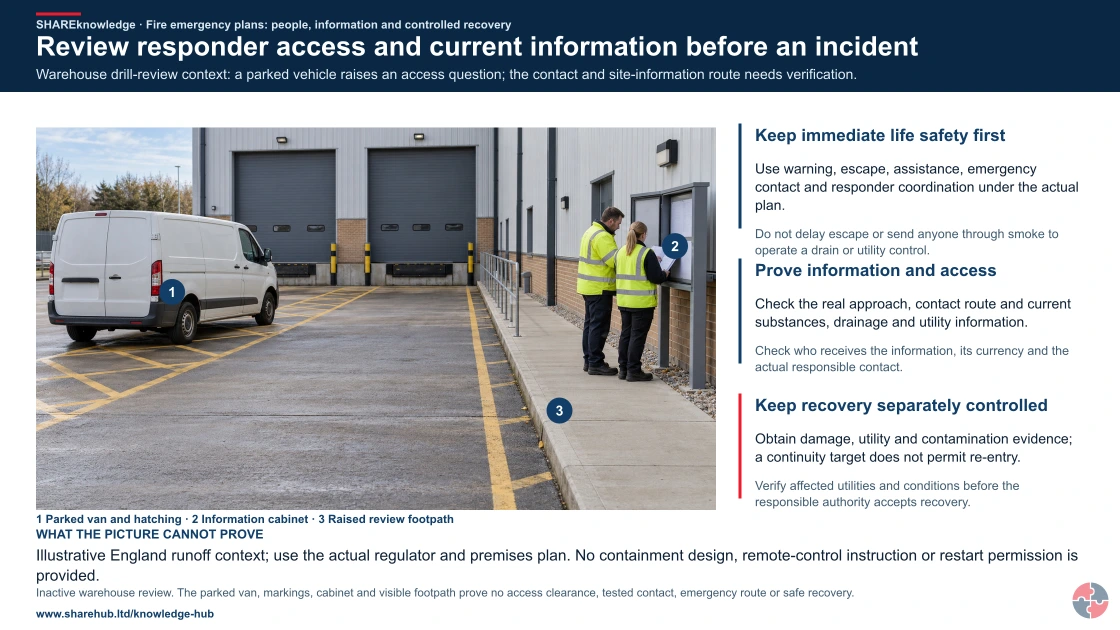
Review responder access and current information before an incident
Full written explanation
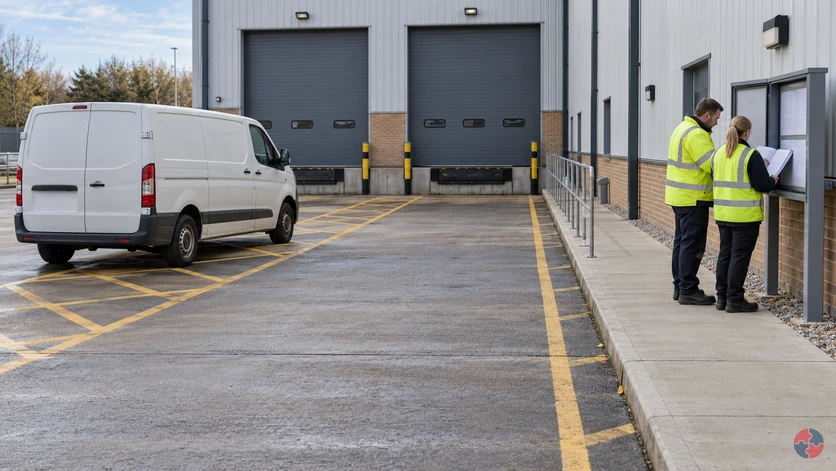
A new inactive UK warehouse-yard scene marks the parked van/hatching, the information cabinet and the separate raised review footpath. Two staff examine inert site/contact papers. It is an access-and-information review context, not an active emergency or a measured finding that a particular appliance cannot pass. The image proves neither responder clearance, a tested contact route, complete assistance arrangements nor safe re-entry. Three checks prioritise people, verified current information and separately controlled recovery. Picture key: 1 Parked van and hatching · 2 Information cabinet · 3 Raised review footpath. The separate process headings are unnumbered.
Warehouse drill-review context: a parked vehicle raises an access question; the contact and site-information route needs verification.
- Keep immediate life safety first. Use warning, escape, assistance, emergency contact and responder coordination under the actual plan.
- Prove information and access. Check the real approach, contact route and current substances, drainage and utility information.
- Keep recovery separately controlled. Obtain damage, utility and contamination evidence; a continuity target does not permit re-entry.
Change the pathway
- No stock-protection detour. Do not delay escape or send anyone through smoke to operate a drain or utility control.
- A cabinet is not a tested route. Check who receives the information, its currency and the actual responsible contact.
- Appearance is not restoration. Verify affected utilities and conditions before the responsible authority accepts recovery.
Evidence check: Illustrative England runoff context; use the actual regulator and premises plan. No containment design, remote-control instruction or restart permission is provided.
Protect escape first and treat lost utilities as a recovery gate
Primary references: GOV.UK: fire safety and evacuation plans · Environment Agency: pollution prevention — England
Open the complete HD image (new tab)Download image

Protect escape first and treat lost utilities as a recovery gate
Primary references: GOV.UK: fire safety and evacuation plans · Environment Agency: pollution prevention — England
Use three decision phases: protect people and call emergency services; control environmental release only where a trained person can do so without delaying escape; then assess damage and authorise reoccupation or restart. Assign different owners to incident command, environmental liaison and business recovery. A continuity target cannot justify early re-entry.
The first layer is immediate response: raise alarm, evacuate, assist vulnerable people, call the fire and rescue service, account for people where appropriate and prevent re-entry. The second layer is control: shut down processes only where planned and safe, isolate utilities where competent people can do so, provide premises information and protect responders from unknown hazards.
The third layer is continuity and environmental management. A fire can damage critical equipment, release smoke, contaminate water, produce hazardous waste, disrupt services and create insurance, regulatory and reputational consequences. The plan should say who makes decisions after the emergency and what evidence is needed before recovery or reoccupation.
| Layer | Decision focus | Examples |
|---|---|---|
| Life safety | Warning, evacuation and assistance. | Alarm, PEEPs, assembly, visitor control. |
| Incident control | Safe shutdown and information for responders. | Isolation, site plans, hazard information. |
| Environmental protection | Reduce pollution where safe and planned. | Drain covers, firewater containment, SDS information. |
| Business continuity | Keep critical services and communication functioning. | Contact tree, alternative premises, IT and supplier plan. |
| Recovery | Decide when areas can be reoccupied or restarted. | Structural, electrical, contamination and insurer checks. |
| Learning | Improve arrangements after drills or incidents. | Debrief, action tracker and FRA review. |
How should a fire in a small chemical store be managed?
The plan should prioritise evacuation while giving responders the information needed to manage substances and run-off.
A fire starts in a maintenance chemical store. The weak plan only tells people to leave by the nearest exit. The stronger plan identifies the store on fire plans, lists substance classes, keeps SDS access available, controls nearby ignition and storage, tells staff not to fight unknown chemical fires, identifies drains and run-off routes, and gives the fire and rescue service relevant information.
After the fire, reoccupation is not automatic. The organisation checks structural damage, electrical safety, smoke contamination, waste disposal, firewater run-off, extinguisher discharge, stock replacement, insurer requirements and whether the fire risk assessment needs revision.
| Stage | Weak practice | Better practice |
|---|---|---|
| Discovery | Staff investigate smoke in store. | Raise alarm and evacuate. |
| Information | No one knows what is stored. | SDS and store inventory available to responders. |
| Firefighting | Staff use nearest extinguisher on unknown fire. | Only trained action if safe and media is suitable. |
| Environmental risk | Run-off routes unknown. | Drain and containment information planned. |
| Continuity | Business assumes reopening next morning. | Reoccupation depends on competent safety checks. |
| Learning | Replace damaged stock only. | Review storage, ignition control, detection and emergency plan. |
What should a fire emergency plan include?
The plan should describe actions, roles, communications, assistance, shutdowns, information and review.
A good plan is specific enough to work on the day. It names roles, deputies, call-out arrangements, assembly points, vulnerable-person support, contractor and visitor arrangements, high-risk areas, fire service information, emergency contacts and post-incident decision routes.
It should be tested through drills and reviewed after changes, near misses, false alarms, building works, occupancy changes, enforcement findings or lessons from incidents.
| Plan area | What to define | Evidence |
|---|---|---|
| Alarm action | What people do when alarm sounds. | Procedure and drill record. |
| Roles | Wardens, deputies, incident lead and reception/security roles. | Role list and training. |
| Vulnerable people | PEEPs or general assistance arrangements. | Private plan and review. |
| Shutdowns | Only planned safe shutdowns and competent isolation. | Shutdown instruction. |
| Fire service information | Plans, hazards, utilities, access and contacts. | Premises information pack. |
| Recovery | Who authorises re-entry and restart. | Post-incident checklist. |
What environmental impacts should fire plans consider?
Fire can create pollution through smoke, contaminated run-off, damaged containers, residues and waste.
Map what a fire might mobilise: smoke, contaminated firefighting water, ruptured containers and hazardous debris. Mark drains, surface-water paths, shut-off points, containment and neighbours on the responder information plan. A valve or drain mat is an option only if the person is trained, the route is safe and emergency command agrees; do not send staff into smoke to protect the environment.
Environmental controls must be safe and realistic. Staff should not put themselves at risk to protect property or the environment. However, foreseeable environmental impacts can often be planned before the fire, especially where hazardous substances, oils, fuels, chemicals, drains, bunds or watercourses are nearby.
The plan should identify who can advise on run-off, spill control, waste disposal, regulator contact and clean-up.
| Impact | How it can arise | Planning control |
|---|---|---|
| Firewater run-off | Water carries chemicals, oils or soot to drains. | Drain plans, isolation points and containment options. |
| Smoke plume | Combustion products affect neighbours or workers. | Emergency communication and responder information. |
| Damaged containers | Heat ruptures drums, cylinders or IBCs. | Storage segregation and inventory information. |
| Extinguisher residues | Powder, foam or wet chemical needs clean-up. | Waste route and reoccupation check. |
| Asbestos/legacy materials | Fire damages building fabric. | Competent assessment before clean-up. |
| Contaminated waste | Fire-damaged stock becomes controlled waste. | Waste contractor and insurer coordination. |
Scope matters: Environment Agency fire-prevention-plan guidance requires firewater containment for permitted combustible-waste sites in England; it is not a universal requirement or design capacity for every premises. Scottish pollution guidance identifies SEPA for urgent incidents. Use the site permit and the correct national environmental regulator route.
How should fire planning support business continuity?
Continuity planning should help the organisation recover without rushing unsafe re-entry or restart.
Once people are safe, identify lost rooms, utilities, IT, stock, suppliers and customer commitments; provide worker welfare and clear communications. Recovery steps should state who can authorise inspection, cleaning, temporary operations and restart. Keep salvage teams out until the fire service or incident command releases the area and competent checks have addressed structural, electrical, chemical and environmental hazards.
Business continuity should identify critical operations, records, equipment, suppliers, communications, alternative work locations and customer or resident impacts. It should also define who can make recovery decisions and what checks are needed before restarting.
Continuity plans fail when they focus on IT and ignore people, building safety, utilities, smoke contamination, regulators, insurers and staff welfare after a serious event.
| Continuity area | Question | Evidence |
|---|---|---|
| Critical people | Who must be contacted and who deputises? | Contact tree and deputies. |
| Critical systems | What equipment, IT or utilities are essential? | Asset and recovery plan. |
| Alternative operations | Where can work continue safely? | Alternative premises or service plan. |
| Insurer/legal route | Who preserves evidence and notifies insurer/regulator? | Notification and evidence protocol. |
| Reoccupation | Who confirms building, electrical and contamination safety? | Competent sign-off. |
| Staff support | How are affected staff briefed and supported? | Communication and welfare record. |
What should an integrated fire-response risk register record?
Record the fire scenario, people and response chain, substances and runoff paths, critical services, owners, exercise evidence and stop or restart triggers.
Link the alarm and assisted escape route to emergency calls, responder information, safe isolations and the authority for re-entry. Note which actions must wait until evacuation is complete and which are for responders rather than staff.
A successful drill or a filed plan is not proof that the drain shut-off, contractor contact list or replacement service will work. Sample them in realistic exercises and record defects, restrictions and closure evidence.
How can the hierarchy of controls reduce fire consequences for people, operations and the environment?
Remove the actual hazard where possible, then use substitution and verified physical controls before relying on procedures or PPE. Discipline checks that the chosen barriers still work.
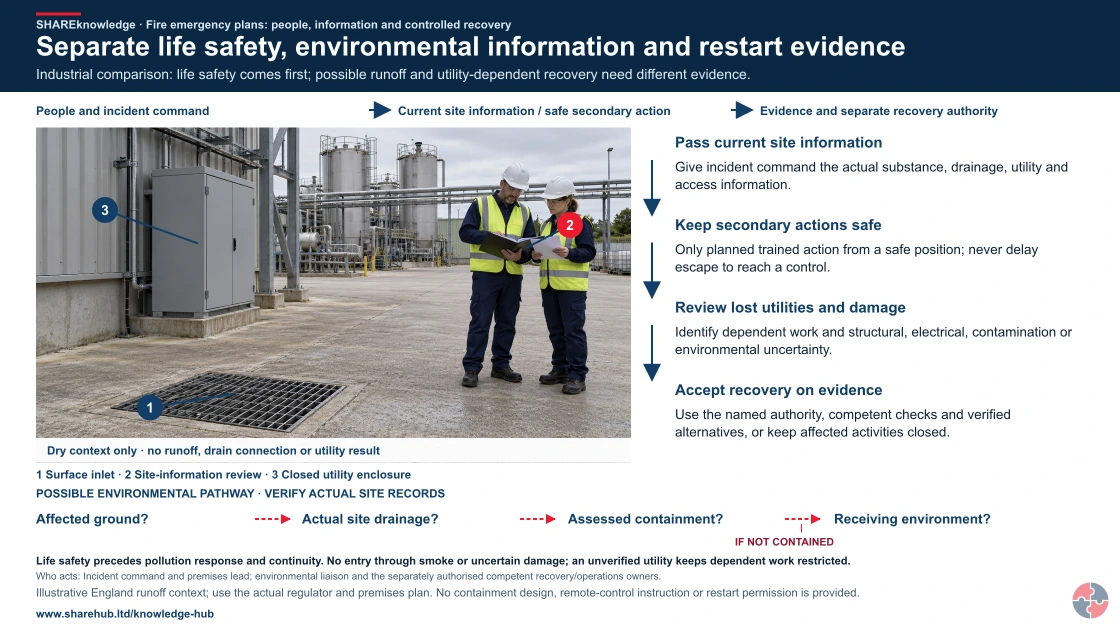
Separate life safety, environmental information and restart evidence
Full written explanation
An illustrative dry England industrial-yard scene shows a closed surface inlet, two staff reviewing inert site information and a closed utility enclosure. Picture key: 1 Surface inlet · 2 Site-information review · 3 Closed utility enclosure. The scene establishes no actual runoff, contamination, drain connection, outfall, containment state, flow, utility availability or recovery result. Three distinct decision phases put people and incident command first, current site information and safe planned secondary action next, and evidence with a separate recovery authority last. A conditional environmental pathway asks about affected ground, actual site drainage and assessed containment; only the edge labelled IF NOT CONTAINED leads to a possible receiving environment. This is a potential consequence question, not an approved drain route or discharge. Four unnumbered checks pass actual substance/drainage/utility/access information, keep secondary action within safe planned trained roles, review lost utilities and damage, and accept recovery only on the actual authority and evidence. Pollution response or a continuity target does not authorise re-entry. No firewater release, underground design, valve instruction, duty/capacity, remote-control method or restart permission is supplied. The England regulator and relevant permit scope must be checked for the actual premises.
Industrial comparison: life safety comes first; possible runoff and utility-dependent recovery need different evidence.
- Pass current site information. Give incident command the actual substance, drainage, utility and access information.
- Keep secondary actions safe. Only planned trained action from a safe position; never delay escape to reach a control.
- Review lost utilities and damage. Identify dependent work and structural, electrical, contamination or environmental uncertainty.
- Accept recovery on evidence. Use the named authority, competent checks and verified alternatives, or keep affected activities closed.
When the evidence does not fit: Life safety precedes pollution response and continuity. No entry through smoke or uncertain damage; an unverified utility keeps dependent work restricted.
Who acts: Incident command and premises lead; environmental liaison and the separately authorised competent recovery/operations owners.
Changed workplace
Warehouse complex: Review responder approach, information currency, contacts and assistance.
Industrial processing site: Separate life safety from possible contaminated runoff and utility-dependent recovery.
Evidence check: Illustrative England runoff context; use the actual regulator and premises plan. No containment design, remote-control instruction or restart permission is provided.
Protect escape first and treat lost utilities as a recovery gate
Primary references: GOV.UK: fire safety and evacuation plans · Environment Agency: pollution prevention — England
Open the complete HD image (new tab)Download image

Protect escape first and treat lost utilities as a recovery gate
Primary references: GOV.UK: fire safety and evacuation plans · Environment Agency: pollution prevention — England
The runoff example assumes an England warehouse. Environment Agency pollution guidance is England-specific; its permitted-waste fire-prevention-plan route applies only where that permit scope is met. Check Wales, Scotland or Northern Ireland regulators for other locations.
The scenario is warehouse fire with contaminated runoff. The controls below are reasoned task applications of linked guidance, not a prescribed design or evidence that each intervention appears verbatim in a source. A competent owner must check feasibility, local law and stop criteria.
Use current government guidance and competent task-specific advice; this section does not establish a technical specification.
How can the ERICPD hierarchy of controls reduce fire consequences for people, operations and the environment?

| Hazard and harm route | ERICPD → five-level control | Task intervention and feasibility | Owner, test and evidence | Failure and stop decision |
|---|---|---|---|---|
| Warehouse fire with contaminated runoff | Eliminate → Elimination | Reduce or remove unnecessary combustible inventory. Source: GOV.UK fire safety risk assessment: offices and shops. | Verify the combustible inventory reduction and reassess the remaining firewater and drainage-contamination scenario. | Stop or redesign if uncontrolled evacuation or runoff. |
| Same scenario | Reduce → Substitution | Use lower-risk materials and storage arrangements. Source: GOV.UK fire safety risk assessment: offices and shops. | Emergency planning lead trials the replacement method and documents new hazards, residual risk and worker feedback before release. | Pause until the alternative and its new risks are assessed. |
| Same scenario | Isolate → Engineering | Provide suitable containment, drainage isolation and fire protection. Source: Environment Agency pollution prevention for businesses. | Emergency planning lead must exercise drainage isolation and confirm containment capacity against the credible firewater scenario. | Stop or redesign if uncontrolled evacuation or runoff. |
| Same scenario | Control → Administrative | Coordinate evacuation, responders, environmental notification and recovery. Source: HSE emergency procedures. | Emergency planning lead spot-checks the actual instruction, authorisation and shift handover against work in progress. | Pause if the procedure or handover cannot be verified. |
| Same scenario | PPE → PPE | Response PPE protects trained responders only; it cannot substitute for the plan. Source: HSE emergency procedures. | Emergency planning lead records why PPE cannot control this mapped harm, checks the operative higher-level barrier, and stops the task if that barrier fails. | PPE cannot be the sole credited barrier. |
| Same scenario | Discipline → Administrative assurance | Exercise isolation, confirm contacts and record recovery and waste evidence. Source: Environment Agency pollution prevention for businesses. | Exercise isolation, confirm contacts and record recovery and waste evidence. | Stop or redesign if uncontrolled evacuation or runoff. |
How can the ISO 45001 hierarchy of controls reduce fire consequences for people, operations and the environment?

| Hazard and harm route | ERICPD → five-level control | Task intervention and feasibility | Owner, test and evidence | Failure and stop decision |
|---|---|---|---|---|
| Warehouse fire with contaminated runoff | Eliminate → Elimination | Reduce or remove unnecessary combustible inventory. Source: GOV.UK fire safety risk assessment: offices and shops. | Verify the combustible inventory reduction and reassess the remaining firewater and drainage-contamination scenario. | Stop or redesign if uncontrolled evacuation or runoff. |
| Same scenario | Reduce → Substitution | Use lower-risk materials and storage arrangements. Source: GOV.UK fire safety risk assessment: offices and shops. | Emergency planning lead trials the replacement method and documents new hazards, residual risk and worker feedback before release. | Pause until the alternative and its new risks are assessed. |
| Same scenario | Isolate → Engineering | Provide suitable containment, drainage isolation and fire protection. Source: Environment Agency pollution prevention for businesses. | Emergency planning lead must exercise drainage isolation and confirm containment capacity against the credible firewater scenario. | Stop or redesign if uncontrolled evacuation or runoff. |
| Same scenario | Control → Administrative | Coordinate evacuation, responders, environmental notification and recovery. Source: HSE emergency procedures. | Emergency planning lead spot-checks the actual instruction, authorisation and shift handover against work in progress. | Pause if the procedure or handover cannot be verified. |
| Same scenario | PPE → PPE | Response PPE protects trained responders only; it cannot substitute for the plan. Source: HSE emergency procedures. | Emergency planning lead records why PPE cannot control this mapped harm, checks the operative higher-level barrier, and stops the task if that barrier fails. | PPE cannot be the sole credited barrier. |
| Same scenario | Discipline → Administrative assurance | Exercise isolation, confirm contacts and record recovery and waste evidence. Source: Environment Agency pollution prevention for businesses. | Exercise isolation, confirm contacts and record recovery and waste evidence. | Stop or redesign if uncontrolled evacuation or runoff. |
How can a fire create environmental and business continuity consequences?
A fire can become an environmental, regulatory, neighbour, supply-chain and recovery event as well as an evacuation event.
A competent emergency plan should think beyond people leaving the building. Firewater run-off may carry fuels, chemicals, silt, ash, detergents or contaminated stock into drains, watercourses or ground. Smoke may affect neighbours. Fire-damaged stock may become hazardous waste. Utilities may need isolation. The site may be unable to restart until structural, electrical, environmental and insurer controls have been reviewed.
This does not mean life safety is diluted. It means life safety, environmental protection and recovery priorities are planned in the right order. The emergency plan should identify drain covers, isolation valves, spill kits, hazardous substance inventories, site plans for the fire and rescue service, neighbour communication routes, regulator notification routes and recovery decision owners.
| Event stage | What can happen | Planning and evidence standard |
|---|---|---|
| Initial fire | Fire starts in a chemical store or stock area. | Inventory, SDS access, isolation plan and fire service information box are current. |
| Firefighting water | Run-off may carry contaminants toward drains. | Drain covers, containment, site drainage plan and trained response roles are available. |
| Smoke impact | Neighbours, nearby businesses or public routes may be affected. | Communication route, incident controller and emergency service liaison are defined. |
| Stock and waste | Damaged goods, absorbents and debris may need controlled disposal. | Waste contractor, segregation area and waste transfer evidence are planned. |
| Site shutdown | Utilities, access, security and business operations may be interrupted. | Business continuity plan, salvage priorities and safe re-entry criteria are agreed. |
| Regulator or insurer contact | Environmental, fire authority, insurer or landlord notification may be needed. | Contact list, incident log and decision records are maintained. |
| Restart | Structural, electrical, fire protection and contamination issues may remain. | Competent checks, action close-out and management approval before restart. |
When should fire emergency plans be escalated or reviewed?
Review is needed when people, premises, hazards, emergency roles, environment or business-critical dependencies change.
Emergency plans should be living arrangements. Building work, a new tenant, a new hazardous store, staffing changes, vulnerable-person needs, false alarms, failed drills, insurer comments or fire service feedback should trigger review.
A plan that has not been rehearsed is an assumption. Drills and tabletop exercises show whether the plan works.
| Trigger or question | Immediate action | Evidence before normal operation |
|---|---|---|
| Failed or confused drill | Debrief, update roles and repeat learning. | Drill action close-out. |
| New high-risk store or process | Review emergency plan, fire service information and environmental controls. | FRA and plan update. |
| Change in occupancy or vulnerable persons | Review evacuation assistance and communication. | PEEP/general plan review. |
| Building work or temporary layout | Update escape, alarm, assembly and fire service access. | Temporary fire plan. |
| Firewater or pollution risk identified | Escalate to environmental/competent advice. | Pollution response plan. |
| Post-fire reoccupation pressure | Hold until competent checks are complete. | Reoccupation sign-off. |
Where do fire emergency plans fail?
They fail when plans are generic, untested, unknown to staff or disconnected from real building and business risks.
Common failures include outdated contact lists, no deputies, PEEPs not reviewed, staff not trained on roles, plans ignoring contractors or visitors, no information for the fire service, environmental risks missed and continuity plans pushing restart before safety checks.
Another failure is treating drills as performance theatre. A drill that reveals confusion is valuable if the organisation learns from it.
| Failure or weak practice | How it develops | What good looks like |
|---|---|---|
| Generic plan | Copied procedure does not match premises. | Premises-specific roles, routes and hazards. |
| Untested roles | Wardens named but not rehearsed. | Drills and tabletop exercises. |
| Vulnerable people missed | Visitors or disabled people not considered. | PEEP/general evacuation review. |
| Environmental blind spot | Run-off, smoke or damaged chemicals ignored. | Environmental impact planning. |
| Poor continuity link | Recovery decisions focus only on reopening. | Competent reoccupation and restart checks. |
| No debrief | Drill or incident learning is lost. | Debrief, actions and FRA review. |
What evidence shows fire emergency plans, business continuity and environmental impacts is controlled?
Evidence should show that fire precautions are suitable, available, maintained, tested, understood and reviewed.
Fire evidence should connect the fire risk assessment to real controls. A log book alone is not enough if defects remain open, staff do not know the procedure or equipment cannot be reached during normal work.
Good records show what was checked, what failed, who owned the action, when it was closed and how the responsible person knows the arrangement still protects relevant persons.
| Evidence item | What it should show | Assurance question |
|---|---|---|
| Emergency plan | Roles, actions, contacts, assistance and fire service information are defined. | Does it match the current premises? |
| Drill/tabletop records | Plans are rehearsed and learning is captured. | Were actions closed? |
| PEEP/general evacuation records | People needing assistance are supported privately. | Are plans current after changes? |
| Environmental plan | Run-off, hazardous substances and waste routes are considered. | Are high-risk drains/stores identified? |
| Business continuity plan | Critical functions and recovery decisions are defined. | Does it include safety checks before restart? |
| Post-incident review | Incident learning updates FRA and controls. | Were root causes and weak signals addressed? |
How should fire emergency plans, business continuity and environmental impacts be assured?
Assurance should test whether the fire arrangement works in the building, at the time, with the people who may need it.
First-line assurance comes from daily checks, weekly tests, warden observations and immediate defect reporting. Second-line assurance reviews fire risk assessment actions, drills, maintenance, contractor records and repeat findings. Specialist assurance may include competent fire risk assessor review, fire alarm contractor reports, extinguisher servicing, emergency lighting testing and enforcement feedback.
The test is practical: if the alarm operates today, can everyone hear, understand, move, escape, account for vulnerable people and keep routes safe without relying on luck?
| Assurance layer | What to check | What good looks like |
|---|---|---|
| Frontline drill | People respond to alarm and roles work. | Confusion becomes learning. |
| Manager review | Plan, contacts, PEEPs and actions are current. | Changes trigger updates. |
| Specialist review | Fire, environmental, insurer or technical input. | Complex risks get competent advice. |
| Leadership review | Continuity, resources and unresolved fire risks. | Recovery pressure does not override safety. |
| External interface | Fire service, landlord, tenants and contractors. | Shared plans are coordinated. |
Which UK legal duties and official guidance are relevant?
England and Wales, Scotland and Northern Ireland have separate non-domestic premises fire routes; work and dangerous-substance duties must also be checked for the actual location and activity.
The Fire Safety Order is the England and Wales premises route. Scottish and Northern Irish instruments are separate. GB work-health rules and DSEAR do not silently apply in NI; use the corresponding NI rules where in scope. This table identifies routes, not legal approval for a site-specific strategy.
| Jurisdiction | Duty or guidance | What it means | How to apply it |
|---|---|---|---|
| E&W | Regulatory Reform (Fire Safety) Order 2005 | Requires the responsible person to assess fire risk and maintain suitable fire precautions in non-domestic premises. | Use as the main fire safety legal framework for England and Wales. |
| GB | Health and Safety at Work etc. Act 1974 | Requires employers to protect employees and others affected by work so far as reasonably practicable. | Use for work activities that create fire, emergency or firefighting risk. |
| GB | Management of Health and Safety at Work Regulations 1999 | Requires suitable and sufficient risk assessment, preventive arrangements, competent help, emergency arrangements and review. | Use for management arrangements, competence and emergency procedures. |
| GB | Dangerous Substances and Explosive Atmospheres Regulations 2002 | Requires fire and explosion risk from dangerous substances to be assessed and controlled. | Use where flammable substances, gases, vapours, dusts or oxygen enrichment affect the fire arrangements. |
| GB | Control of Major Accident Hazards Regulations 2015 | Requires major accident hazard controls and emergency arrangements for COMAH establishments. | Use where a fire could become a major accident event. |
| Scotland | Fire (Scotland) Act 2005 | Scottish non-domestic premises fire framework. | Assess people and fire precautions in the actual premises. |
| Scotland | Fire Safety (Scotland) Regulations 2006 | Scottish detailed premises precautions. | Warning, escape, maintenance and coordination. |
| NI | Fire and Rescue Services (NI) Order 2006 | NI non-domestic premises fire framework. | Identify the appropriate person and affected premises. |
| NI | Fire Safety Regulations (NI) 2010 | NI detailed premises precautions. | Warning, escape, maintenance and review. |
| NI | Health and Safety at Work (NI) Order 1978 | NI general work-health and safety route. | Control work-created fire and emergency risks. |
| NI | Management Regulations (NI) 2000 | NI risk-assessment and emergency arrangements. | Coordinate workers, contractors, competence and emergency action. |
| NI | DSEAR (NI) 2003 | NI dangerous-substance work-risk route where relevant. | Plan release, ignition and emergency controls. |
| NI | COMAH Regulations (NI) 2015 | NI major-accident route for in-scope establishments. | Emergency planning and major-accident scenario evidence. |
In England and Wales, Article 14 of the Fire Safety Order addresses emergency routes and exits; Article 15 addresses procedures for serious and imminent danger, including appropriate drills. The Workplace Regulations 1992 address ordinary traffic routes, not emergency escape routes.
How can BS EN ISO 45001 support fire emergency plans, business continuity and environmental impacts management?
Voluntary ISO 45001 themes can organise ownership, competence, operation and review; the fire strategy and legal duties still need competent, site-specific decisions.
Use current government guidance and competent task-specific advice; this section does not establish a technical specification.
| Management theme | Practical management principle | How to apply it |
|---|---|---|
| Leadership and commitment | Resource life-safety response first, then environmental control and recovery decisions. | Leaders should set expectations, provide resources, remove conflicting pressures and review evidence of control. Public context: HSE health and safety management-system overview. |
| Hazard identification and assessment of risks and opportunities | Map plausible fire, evacuation, firewater and critical-service scenarios. | Assess credible harm pathways, affected people, routine work, non-routine work, change, emergency conditions and practical opportunities to improve. Public context: HSE health and safety management-system overview. |
| Competence | Exercise callers, wardens, plant isolators, incident leads and recovery decision-makers. | Define training, authorisation, assessment, supervision and refresher expectations for workers, supervisors, managers and specialists. Public context: HSE health and safety management-system overview. |
| Operational planning and control | Keep site plans, contacts, isolation arrangements and restart gates current. | Turn assessment decisions into field controls, safe systems, supervision, equipment standards, welfare, emergency arrangements and change controls. Public context: HSE health and safety management-system overview. |
| Monitoring, measurement, analysis and performance evaluation | Use drills, equipment checks and incident learning to test the plan. | Use inspections, assurance checks, worker feedback, trend data, audit findings, incident learning and overdue action reviews. Public context: HSE health and safety management-system overview. |
These are practical management-system themes, not a clause-by-clause interpretation. A competent reviewer must verify any clause mapping against a lawfully accessed current standard.
Who needs competence, and how should it be demonstrated?
Test the decisions and actions each role must make in a realistic fire scenario, including faults, absent staff and hand-back.
| Role | Learning to test | Competence demonstration | Assessor and record | Reassessment trigger |
|---|---|---|---|---|
| All staff and contractors | Alarm, escape, emergency call and non-intervention limits. | Respond to smoke and identify their safe route. | Supervisor observes and records induction. | New area, alarm or route. |
| Wardens and assistance helpers | Public direction, functional assistance and accountability. | Run a scenario with a missing helper and visitor count gap. | Competent fire lead records exercise. | Drill failure or occupancy change. |
| Facilities and environmental responders | Safe isolation boundaries, substances, drains and responder information. | Demonstrate a no-entry decision when isolation is through smoke. | Technical lead witnesses scenario and plan. | Plant, chemical or drain change. |
| Incident and continuity leads | Life-safety command, environmental liaison and recovery gates. | Decide on closure, communications and evidence needed before re-entry. | Senior manager reviews tabletop record. | Incident, supplier or service change. |
| Competent advisers and dutyholders | Risk assessment, national duties, plan coordination and assurance. | Challenge combined evacuation, runoff and restart scenario. | Independent competent reviewer records limits. | Major change or failed exercise. |
How could Riverside Leisure Ltd manage this in practice?

At Riverside Leisure Ltd, a plant-room fire sends smoke toward the changing rooms while pool chemicals and drainage are nearby. Staff raise the alarm, call emergency services, guide visitors to the agreed safe assembly and pass a current chemical and drain plan to the incident lead. The trained facilities team does not operate a drain valve through smoke. Once the incident is controlled, the manager records lost services and temporary closure, arranges environmental advice and only reopens after competent checks, cleaning and an authorised hand-back.
Riverside Leisure Ltd can manage fire emergency planning by linking evacuation, staff roles, fire service information, environmental controls and recovery decisions.
In this leisure centre, emergency planning covers a public building with pool chemicals, kitchens, plant rooms, contractors, visitors, children and vulnerable users.
| Management element | How the business would manage it | Evidence to review |
|---|---|---|
| Plan | Fire emergency plan covers alarm, evacuation and roles. | Emergency plan. |
| People | PEEPs and visitor assistance are reviewed. | Assistance record. |
| Environment | Chemical store and drain risks are mapped. | Environmental plan. |
| Continuity | Critical services and recovery decisions are defined. | BCP. |
| Drills | Drills test different times and areas. | Drill log. |
| Review | Actions update FRA and training. | Action tracker. |
How do fuel spills connect fire response and environmental containment?
Inspect drainage and containment alongside people and access. The document does not establish safe discharge, firewater capacity or a site emergency response.
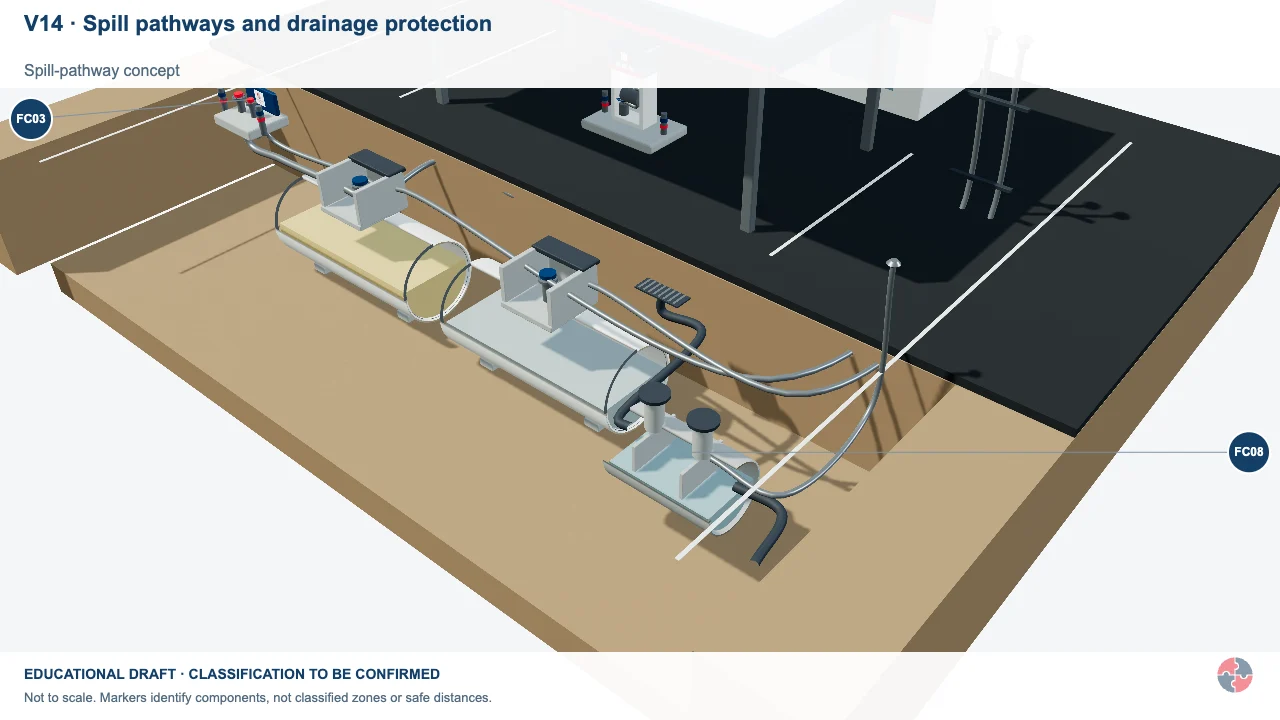
Spill pathways and drainage protection
A forecourt spill can travel with surface runoff into drains and the separator. Retained petrol can create a continuing vapour source at a different location from the original spill.
Activity focus: Trace the route from spill to drainage inlet, separator and separate vent. Check the actual containment capability, maintenance condition and planned spill response rather than assuming the interceptor removes the fire risk.
Contextual illustration. The image alone does not establish equipment state, effective controls, individual health or authorisation; use the task-specific checks and competent evidence.
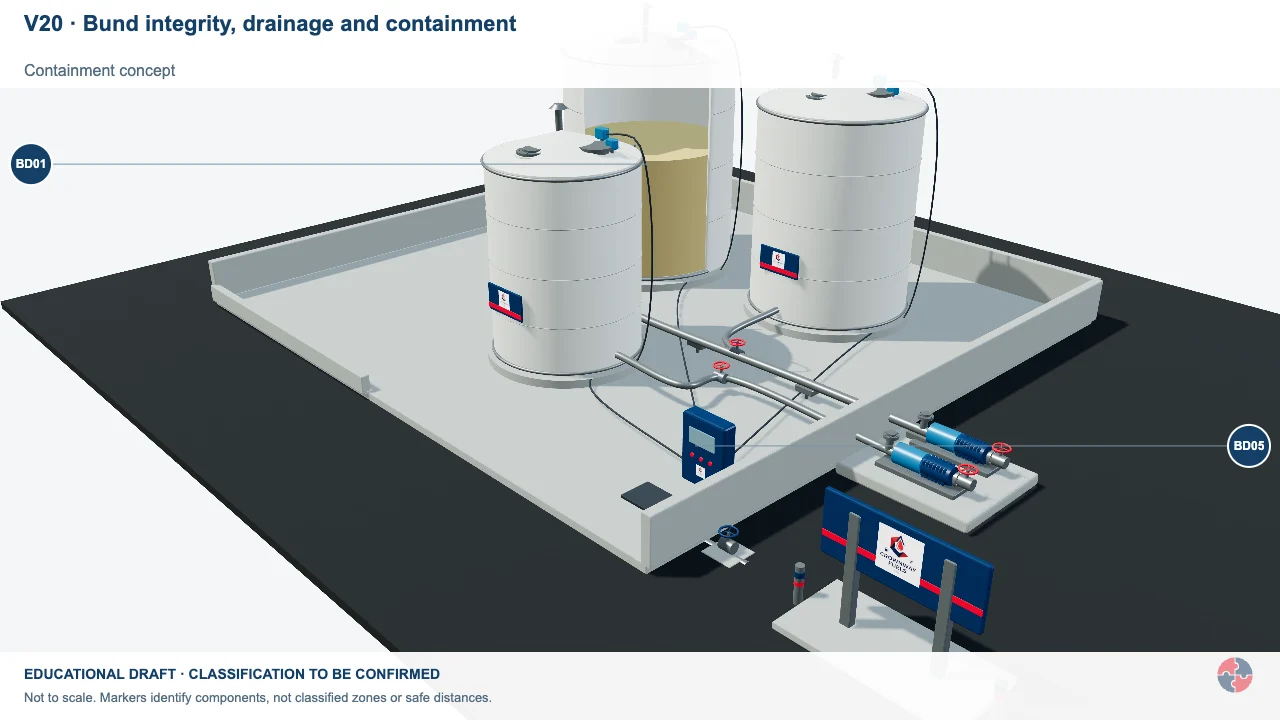
Bund integrity, drainage and containment
The bund is intended to retain liquid from a release, while controlled drainage and intact surfaces preserve that function.
Activity focus: Inspect walls, floor, penetrations and drainage as one containment system.
Contextual illustration. The image alone does not establish equipment state, effective controls, individual health or authorisation; use the task-specific checks and competent evidence.
Educational illustration, not to scale. Coloured zones are teaching examples, not a site-specific hazardous-area classification.
How does portable-extinguisher recognition support this topic?
Identify the fuel and additional electrical hazard, read the actual extinguisher label and follow the site fire plan. Raise the alarm and protect escape first; only trained, authorised people should consider a small initial fire within their safe response limits.
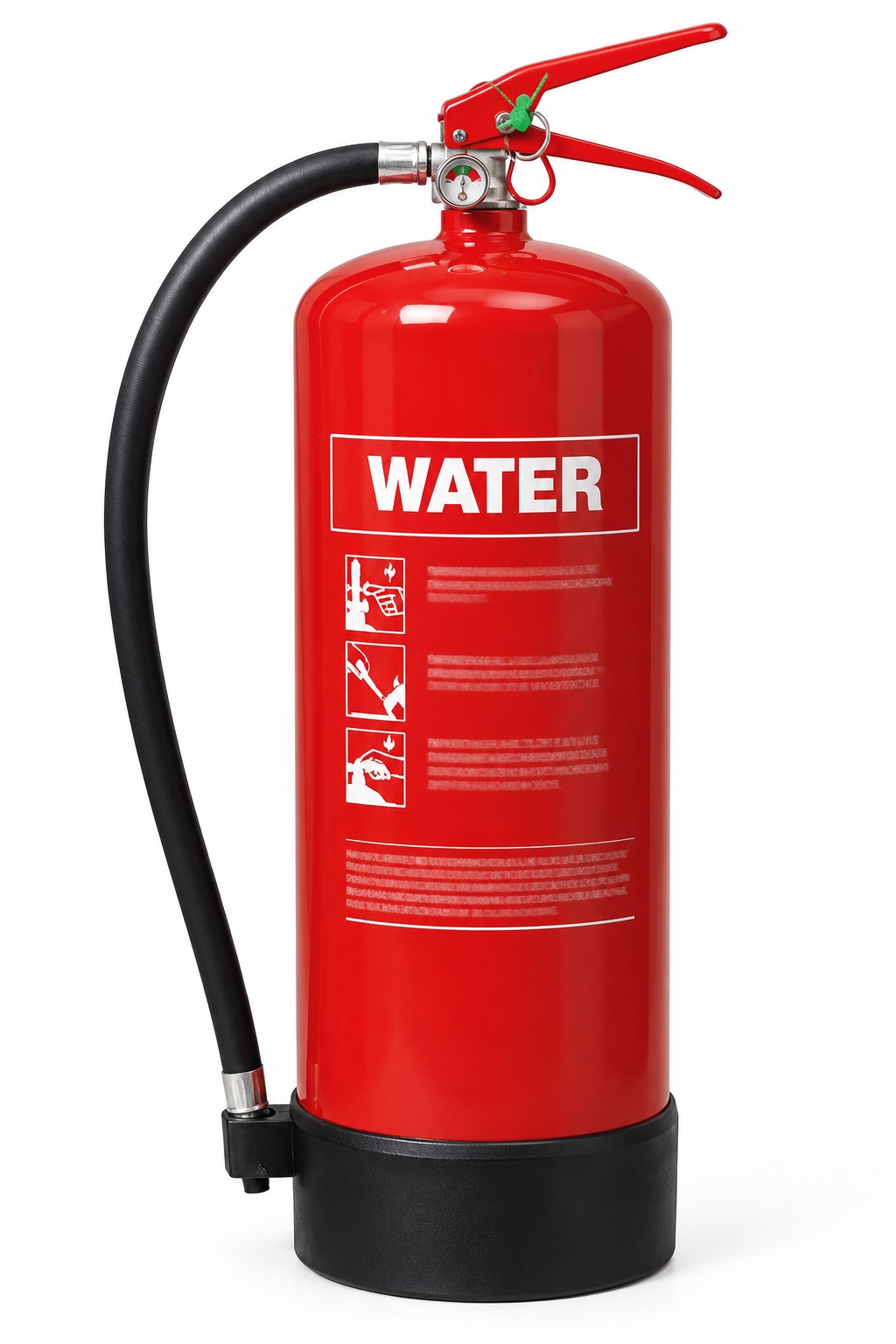

Recognise the pin, seal, pressure gauge and agent marking.
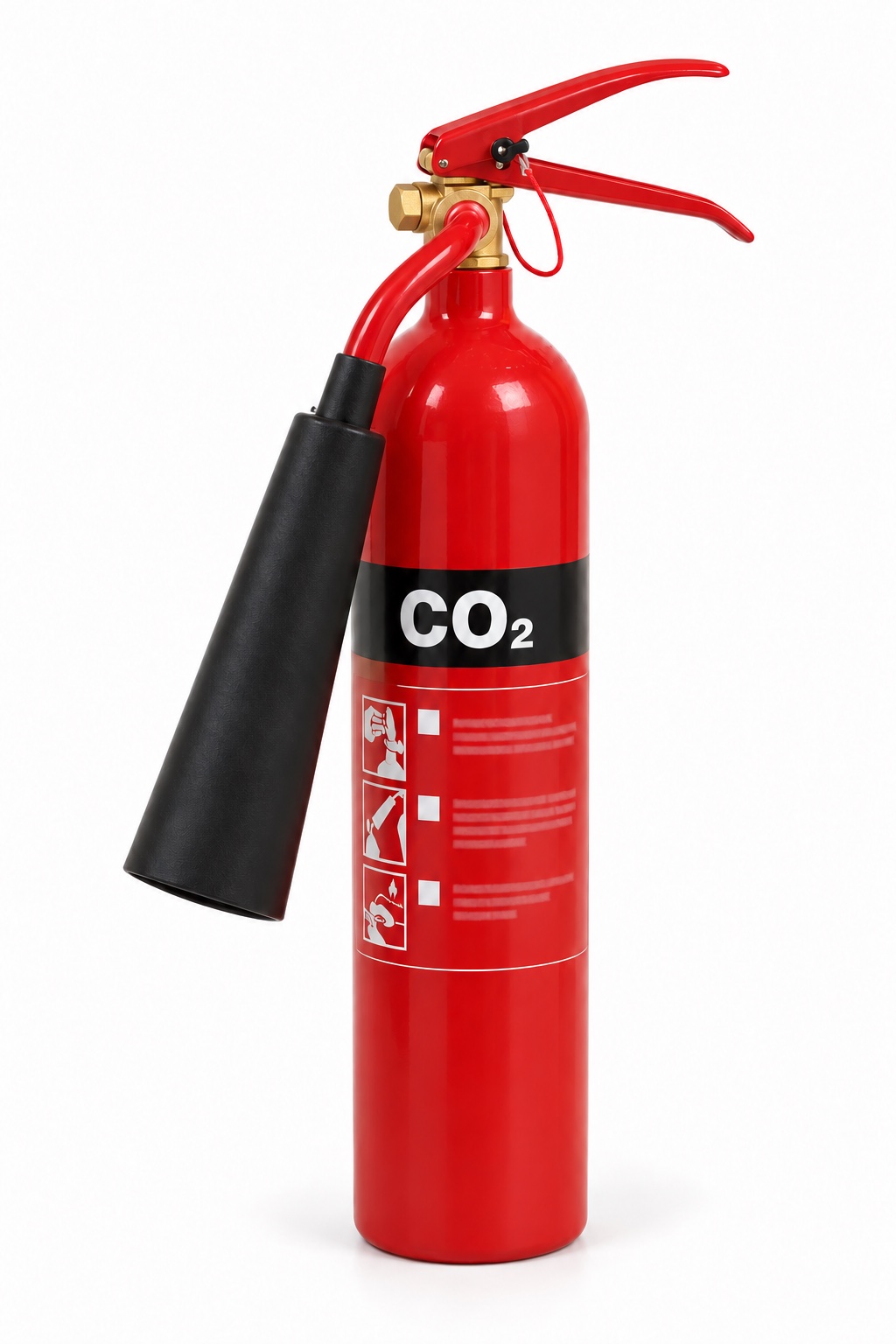
A different cylinder and discharge arrangement; cold and atmosphere hazards still matter.
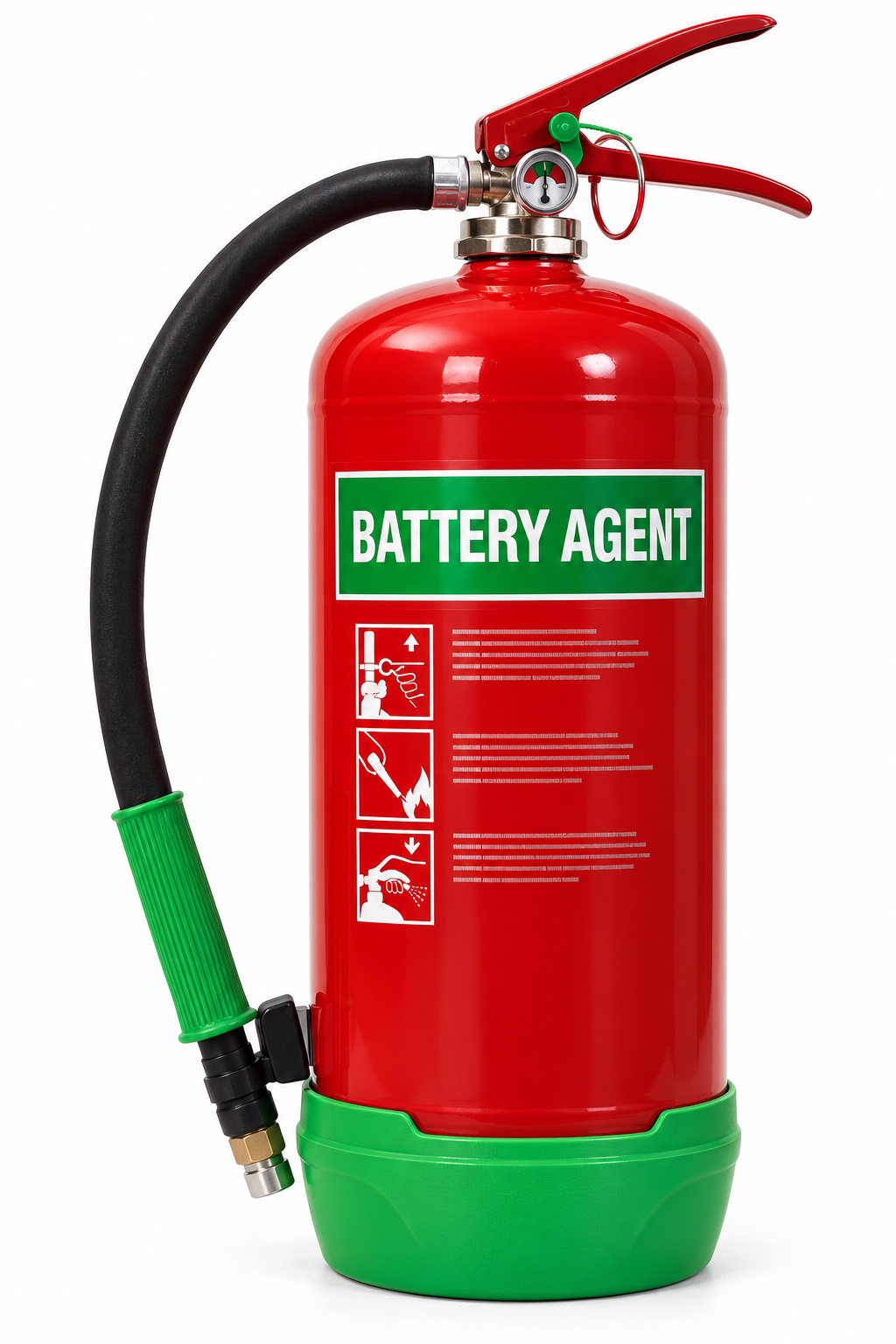
The named product and battery scope matter; green is not a universal Class L colour code.
Raise the alarm, follow the site’s evacuation plan and arrange the emergency call to 999. Only consider a small fire in its earliest stage if you are trained, authorised, have the correct equipment and a clear escape behind you. Smoke, spreading fire, uncertainty or an unsafe approach mean withdraw. Never delay escape to fetch an extinguisher.
Riverside hotel fire safety examples
Use these fictional hotel policies and records to see how a manager documents local fire precautions, evacuation arrangements and decisions on shift. Adapt the examples to the premises and obtain local approval before use.
- England Word and PDF pack (ZIP) · England reading copy (PDF)
- Northern Ireland Word and PDF pack (ZIP) · Northern Ireland reading copy (PDF)
- Scotland Word and PDF pack (ZIP) · Scotland reading copy (PDF)
- Wales Word and PDF pack (ZIP) · Wales reading copy (PDF)
Browse all Riverside fire examples in the Policy Builder library
Which acronyms and terms matter here?
Acronyms should be understood before they are used in assessments, briefings, audits or learning answers.
Acronyms can exclude newer readers if they are not explained. This section keeps the main terms available at the end of the page so the article stays readable while still supporting learners and audit users.
| Acronym | Meaning | Plain-English use |
|---|---|---|
| ACOP | Approved Code of Practice | Practical guidance with special legal status; following it is not compulsory, but it can be used as evidence of compliance. |
| FRA | Fire Risk Assessment | A structured assessment of fire hazards, people at risk, controls, emergency arrangements and review needs. |
| FRS | Fire and Rescue Service | The emergency service and enforcing authority for many fire safety matters in England and Wales. |
| HSE | Health and Safety Executive | Great Britain workplace health and safety regulator. |
| HSWA | Health and Safety at Work etc. Act 1974 | Great Britain general work-health and safety statute; Northern Ireland has a separate 1978 Order. |
| MHSWR | Management of Health and Safety at Work Regulations 1999 | Regulations requiring suitable and sufficient risk assessment and management arrangements. |
| PEEP | Personal Emergency Evacuation Plan | A person-specific plan for someone who may need assistance to evacuate safely. |
| BCP | Business Continuity Plan | Plan for maintaining or restoring important operations after disruption. |
| SDS | Safety Data Sheet | Supplier document giving hazard, control, storage and emergency information for hazardous substances. |
Unlock another resource
You have used this month’s two free downloads. Publish a post in your own words to unlock one more resource, or choose SHARE Individual for 10 downloads per month.
You decide whether to share. If you do, use the relevant platform disclosure tools and do not make claims you do not genuinely hold.