SHARE Knowledge Hub
Fire Principles
Fire prevention starts by finding fuel, ignition and oxygen or other oxidisers in the actual task. A fire can then spread through stored material, smoke routes and building openings, so prevention must work with warning, escape and compartmentation. Reduce fuel and ignition first, verify physical controls in the field, and stop work when a dangerous substance or protection failure is not understood.
Understanding Fire Principles
Fire prevention starts by finding fuel, ignition and oxygen or other oxidisers in the actual task. A fire can then spread through stored material, smoke routes and building openings, so prevention must work with warning, escape and compartmentation. Reduce fuel and ignition first, verify physical controls in the field, and stop work when a dangerous substance or protection failure is not understood.
Why this matters at work
Decision point: Current phase; Evidence to retain: Changed fuel systems and occupied periods; Failure to avoid: Different checklists assumed same conditions Decision point: Owners; Evidence to retain: Premises operational and contractor interfaces; Failure to avoid: Unowned protection hidden by role titles Decision point: Verification; Evidence to retain: Actual observations exercise scope and limits; Failure to avoid: Day drill treated as night capability Decision point: Closure; Evidence to retain: Accepted individual findings and remaining limits; Failure to avoid: Form completion treated as safe occupation.
Decision point: Changed task; Evidence to retain: Actual transfer and release pathways; Failure to avoid: Same product taken as same risk Decision point: Source scope; Evidence to retain: Container versus tank versus handling; Failure to avoid: One guide treated as all arrangements Decision point: Barrier basis; Evidence to retain: Competent design and accountable roles; Failure to avoid: Training used to fill engineering gap Decision point: Closure; Evidence to retain: Current verified operation and limits; Failure to avoid: Purchasing record treated as handback.
How organisations manage this in practice
Combustion needs interacting conditions, and prevention can interrupt those conditions before an event. Fuel loading and ignition control should be considered through the full work cycle, including waste and maintenance. The fire triangle is useful teaching but cannot capture every reaction, dust or stored-energy hazard. A proper assessment identifies mechanisms, people and reliable controls. Identify the actual fuel, ignition and oxygen pathways in each activity, then remove or reduce them where feasible. Follow that analysis through abnormal work, cleaning, maintenance and waste handling, not only normal production. Assign controls to people who can implement and verify them. The triangle is a teaching model rather than a complete risk assessment: reaction hazards, dust clouds, stored energy and vulnerable occupants can require more detailed evidence and specialist controls.
Identify oxygen enrichment, oxidising chemicals and incompatible materials through the actual product and process information. Review storage, segregation, transfer, contamination and ignition control using competent advice where required. Do not assume an ordinary combustible needs the same ignition energy or burns in the same way in enriched conditions. Ensure emergency information identifies the special hazard. A generic fire triangle does not set a safe oxygen concentration or establish compatibility between unnamed substances.
Decision point: Material change; Evidence to retain: Actual dust/process evidence; Failure to avoid: Ingredient name treated as explosibility test Decision point: Cloud and deposits; Evidence to retain: Plant and building pathways; Failure to avoid: Clean floor treated as complete protection Decision point: System review; Evidence to retain: Whole arrangement and test limits; Failure to avoid: Fan operation treated as explosion evidence Decision point: Closure; Evidence to retain: Accepted change and maintenance information; Failure to avoid: Unresolved interfaces silently removed.
Turn fuel, ignition and oxidiser into a decision about the actual job
Use this as the general learning route. A workshop hot-work proposal needs more than naming the fire triangle: first consider avoiding the hot work, then identify combustible stock, contaminated rags, aerosols, nearby processes and any unexpected oxidiser. Control the real fuel and ignition pathways, warning and escape before the job is released.
A permit documents an agreed method; it cannot establish that a hidden void is clear, a product has been identified or ventilation is effective. Reassess when an aerosol inventory or substance changes and verify controls in the work area and at hand-back. Use Process Fire Science where release, inventory and escalation require engineering detail, rather than extending a simple classroom model into a design prescription.
A repair can be moved away from the fuel
Illustrative example. A contractor proposes welding beside stored cartons, aerosols and cleaning products in a maintenance workshop.
Decision. The owner first considers a cold method or safe relocation and obtains competent assessment of remaining fire and substance risks.
Evidence to check. Material identity, fuel removal or separation, task controls, verified warning/escape and post-work hand-back.
Hold or escalation point. Hold work when hidden fuel, oxidiser, vapour or ventilation conditions remain uncertain.
Follow-up. Check that storage and contractor planning keep the same conditions from recurring on the next repair.
Connect each prevention choice to the fire mechanism
Fuel, an oxidising agent and ignition or heat interact in combustion. Use the mechanism to examine a task, while keeping chain-reaction teaching and emergency action distinct.

Review ignition and fuel before a heat-producing task starts

Full written explanation
A new inactive UK maintenance-workshop scene marks a stopped guarded grinder/loose plug, nearby cardboard and the reviewers’ inert sheet. No grinding, sparks, fire or repair is being performed. The visible plug does not prove verified isolation or tool suitability. The annotations identify actual fuel/release form, ignition/oxidising conditions and the physically verified prevention choice, then connect openings, people and escape protection. A permit, equipment item or clear-looking floor cannot establish hidden conditions, effective ventilation or approval to start.
Inactive workshop comparison: a stopped grinder, loose plug and nearby packaging raise different checks from a permit sheet.
- Identify what can burn. Check the actual substance, amount, release form and nearby or hidden combustibles.
- Challenge the ignition task. Ask if heat work can be avoided; assess ignition, atmosphere and the actual work area.
- Verify the prevention choice. Confirm physical conditions, spread protection and people; a permit is only part of the evidence.
Change the pathway
- The picture does not identify substances. Appearance cannot establish a product, atmosphere or dangerous-substance assessment.
- Stopped is not verified safe. No live task is shown; the plug and guard are not an isolation or suitability test.
- PPE cannot remove the pathway. Protect the task and escape arrangements; equipment presence does not authorise work.
Evidence check: Assumed inactive comparisons only. No ignition experiment, atmosphere limit, clearance, watch period, isolation procedure or permission to start.
Use the mechanism to verify a real prevention choice
Primary references: GOV.UK: offices and shops fire-prevention context · NIST: combustion and heat-transfer scientific context
Open the complete HD image (new tab)Download image
Use the mechanism to verify a real prevention choice
Primary references: GOV.UK: offices and shops fire-prevention context · NIST: combustion and heat-transfer scientific context

Fuel and release form
Identify solid fuel, liquid evaporation, mist or gas as relevant to the actual substance and task.
Ignition and heat
Identify credible ignition sources and how heat reaches the fuel; a small pictorial flame is not a prediction of fire size.
Oxidising conditions
Consider the actual atmosphere and oxidising materials through competent assessment rather than assuming air is the only source.
Verify the prevention choice
Check what was physically removed or controlled and what remains. A diagram of a removed element does not authorise work or firefighting.
Read the complete task-specific control examples
ERICPD is a planning cross-map: Discipline verifies and sustains every control. ESEAP compares effectiveness. A label does not authorise the task; retain the owner, evidence and stop or change decision.
Fire Principles · ERICPD
- Eliminate
- Move welding or remove the combustible and flammable inventory.
- Reduce
- Use a cold cutting or prefabricated method if it achieves the work safely.
- Isolate
- Physically segregate the hot-work zone and control vapour release.
- Control
- Confirm substance assessment, permit, fire watch and post-work checks.
- PPE
- Provide hot-work PPE for the worker, not as a fire-prevention barrier.
- Discipline
- Sample the permit against real fuel removal, watch and hand-back evidence.
Fire Principles · ESEAP
- Elimination
- Move welding or remove the combustible and flammable inventory.
- Substitution
- Use a cold cutting or prefabricated method if it achieves the work safely.
- Engineering controls
- Physically segregate the hot-work zone and control vapour release.
- Administrative controls
- Confirm substance assessment, permit, fire watch and post-work checks.
- PPE
- Provide hot-work PPE for the worker, not as a fire-prevention barrier.
What are the basic fire principles?
Fire needs fuel, oxygen and a source of ignition; workplace fire safety controls these elements and protects people if prevention fails.
The fire triangle is a useful start: fuel, oxygen or another oxidiser, and enough heat for ignition. Sustained flaming also involves a chemical chain reaction, which is why the tetrahedron is sometimes used. In a workplace the practical questions are what can ignite, what can burn, how fire or smoke may spread and who cannot escape. Removing one component can prevent or control fire, but the safe method depends on the actual substance and process.
The fire triangle is simple, but its workplace application is not simplistic. Fuel may be cardboard, timber, textiles, plastics, waste, dust, vapour, gas, oil, paint, furnishings, insulation, packaging or structural materials. Oxygen may be normal air, oxygen enrichment or oxidising substances. Ignition may be hot work, electrical faults, static electricity, smoking, heaters, cooking, friction, hot surfaces, batteries, vehicles or process heat.
A fire risk assessment uses these principles to ask practical questions: what could ignite, what could burn, how quickly could it spread, who could be harmed, how would they be warned, how would they escape and what evidence shows controls are maintained?
Learners should avoid treating fire principles as a memory exercise. The value is in seeing how basic theory explains real decisions: separating fuel from ignition, controlling hot work, limiting fire load, maintaining fire doors, choosing extinguishing media, designing escape routes and reviewing changes before fire safety is weakened.
| Fire triangle element | Workplace examples | Control focus |
|---|---|---|
| Fuel | Packaging, pallets, waste, solvents, flammable gas cylinders, oils, furnishings, timber, dusts and plastics. | Reduce quantity, separate storage, control housekeeping and manage waste. |
| Oxygen | Air, open doors, ventilation, oxygen cylinders, oxidising chemicals and leaks. | Control oxygen enrichment, ventilation interfaces and cylinder storage. |
| Ignition | Hot work, electrics, smoking, heaters, static, friction, batteries, vehicles and cooking. | Eliminate or control ignition sources and authorise high-risk work. |
| Heat transfer | Conduction, convection, radiation and direct flame. | Maintain separation, compartmentation, shielding and route protection. |
| People at risk | Workers, visitors, contractors, lone workers, young people, disabled people and night staff. | Plan warning, escape, assistance, training and drills. |
| Evidence | Inspections, tests, maintenance, permits, risk assessment, training and action close-out. | Prove controls work in the real workplace. |
How do fire principles become workplace controls?
Fire theory becomes useful when it is converted into prevention, detection, containment, escape and recovery controls.
First reduce combustible inventory and prevent ignition: control hot work, damaged electrics, charging, cooking, smoking and heaters; separate dangerous substances where required. Then maintain detection, warning, fire doors, protected routes and suitable emergency arrangements. Training helps people respond, but it does not replace a sound installation or remove the need to control fuel and heat.
The practical model is: prevent ignition where possible, reduce available fuel, control oxygen or dangerous substances where relevant, detect fire early, warn people, contain smoke and heat, support evacuation, provide suitable firefighting equipment and learn from defects, drills and near misses.
This model also helps with proportionality. A small low-risk office may need simple measures, while a workshop with hot work, LPG, spray paints, dust extraction, charging batteries and public access needs a more detailed assessment, stronger controls and clearer evidence.
| Principle | Question | Example control |
|---|---|---|
| Ignition control | What could start a fire? | Electrical inspection, hot work permit, no-smoking controls and charger management. |
| Fuel control | What could burn and how much is present? | Waste removal, storage limits and separation from heaters or hot work. |
| Oxygen control | Is normal air, oxygen enrichment or oxidiser risk relevant? | Cylinder segregation, leak response and oxidiser storage control. |
| Spread control | How could fire, smoke or heat travel? | Fire doors, compartmentation, fire stopping and protected routes. |
| Life safety | Who needs warning and escape? | Alarm, emergency lighting, signage, routes, assistance plans and drills. |
| Management evidence | How do we know controls still work? | Inspection, maintenance, testing, training and action tracking. |
How can the fire triangle and tetrahedron help explain prevention controls?
Explore fuel, oxidiser, heat and continuing reaction as separate requirements. The model links these concepts to a distinct flame and returning heat, helping explain what a control must interrupt.


Explore the interactive fire triangle and tetrahedron
Original 3D geometry, matching stills, eight explanations and four illustrative states. Scientific and editorial review pending; no process prediction or work authorisation.
How do fire principles apply to a small workshop?
A workshop example shows how fuel, ignition and people at risk combine into practical control decisions.
The same principles produce different workface checks

Full written explanation
Two illustrative inactive workplace scenes support a matched fire-principles comparison. Picture key: 1 Stopped workshop tool · 2 Workshop packaging · 3 Inactive retail heater · 4 Retail stock and trolley · 5 Closed retail door. The workshop shows a stopped grinder, loose plug, nearby packing materials and inert review paper. The retail stockroom shows a heater with loose plug, stored cartons/trolley, a closed door and inert review papers. Neither photograph establishes verified isolation, actual atmosphere, substance identity, effective ventilation, safe clearance, fire resistance, usable escape or permission to start. Separate analytical questions show the potential workshop tool-to-fuel/atmosphere relationship and the ASSUMED retail heat-source-to-stored-fuel relationship, followed by an open-interface question. The drawn opening is a separate assumed condition; it is not the photographed closed door. Its arrow passes through the drawn gap and is not smoke or heat movement in either scene. There is no causal arrow between the independent workplace contexts. In both, assess actual oxidising conditions, substances and hidden paths. Four unnumbered checks describe the real task, remove or redesign first, check spread and response, then accept evidence at the workface through the named owner. No ignition experiment, heat/smoke trajectory, measurement, fire watch duration, clearance, isolation procedure, firefighting technique or operating permission is provided.
Inactive workshop and retail contexts; separate assumed questions cannot establish conditions or release either task.
- Describe the real task. Identify substance/release form, ignition sources, atmosphere and affected people.
- Remove or redesign first. Consider avoiding the heat task or combustible inventory before lower-level reliance.
- Check spread and response. Verify openings, warning, escape and any assistance under the actual plan.
- Accept evidence at the workface. The named owner checks physical conditions and limitations; unresolved assumptions hold the task.
When the evidence does not fit: A permit or fire triangle is not proof of a clear void, identified product or effective ventilation. Do not start on unverified conditions.
Who acts: Task owner, competent fire/dangerous-substance adviser, contractor coordinator and premises fire lead.
Changed workplace
Workshop heat task: Question the tool, actual atmosphere, combustibles and hidden spread paths together.
Retail stockroom: Question stored fuel, ignition sources, openings, unfamiliar people and warning/escape.
Evidence check: Assumed inactive comparisons only. No ignition experiment, atmosphere limit, clearance, watch period, isolation procedure or permission to start.
Use the mechanism to verify a real prevention choice
Primary references: GOV.UK: offices and shops fire-prevention context · NIST: combustion and heat-transfer scientific context
Open the complete HD image (new tab)Download image

Use the mechanism to verify a real prevention choice
Primary references: GOV.UK: offices and shops fire-prevention context · NIST: combustion and heat-transfer scientific context
A maintenance workshop stores aerosol cans, oils, cardboard packaging and rags. Workers use battery chargers, portable heaters and grinders. A contractor arrives for a small welding repair. The basic fire triangle immediately turns into operational decisions: remove or reduce fuel, control ignition, confirm ventilation, protect others, brief workers and check firefighting and escape.
A poor assessment says 'fire extinguishers available'. A good assessment asks whether hot work is separated from combustibles, whether rags are in lidded bins, whether chargers are inspected, whether heaters are suitable, whether aerosols are stored correctly, whether the alarm can be heard over work noise and whether exits stay clear during deliveries.
| Condition | Fire principle | Competent control |
|---|---|---|
| Rags soaked in drying oil (for example linseed oil) in an open bin | Oxidising oil can self-heat in contaminated rags; control storage and disposal. | For contaminated rags within HSG140 scope, use a suitably labelled metal bin with a self-closing metal lid and empty it at least daily; follow assessed substance-specific disposal arrangements. Support: London Fire Brigade fire-prevention guidance; HSE HSG140: safe use and handling of flammable liquids. |
| Grinding near cardboard | Ignition source close to fuel. | Clear area, shield sparks and supervise work. |
| Portable heater by stock | Heat source close to combustibles. | Remove heater or relocate combustibles with safe clearance. |
| Battery charging corner | Electrical/thermal ignition and possible gas risk. | Inspect chargers, isolate damaged equipment and ventilate as needed. |
| Contractor welding | Hot work introduces high ignition risk. | Use permit-style controls, fire watch and post-work check. |
How do fire classes fit into fire principles?
Fire classes help people understand the fuel involved and why the wrong extinguishing media can make the fire worse.
Class A ordinary solids, B liquids, C gases, D metals and F cooking oils describe fuel families in UK fire guidance. Energised electrical equipment is a condition, not an extra UK fire class. A class label alone cannot settle extinguisher choice when fuel, pressure, battery energy or escape conditions are uncertain. Raise the alarm and retreat; only trained staff may consider a very small fire within the local plan.
Fire class is a fuel classification, not a complete risk assessment. It helps decide whether water, foam, carbon dioxide, dry powder, wet chemical or specialist media may be suitable, but it must be read alongside electrical risk, flammable liquid behaviour, ventilation, people nearby and staff competence.
For example, a waste-paper fire, cooking oil fire, lithium battery event and solvent vapour fire are all fires, but they behave differently. The safest response may be evacuation rather than manual firefighting.
| Class or issue | Fuel type | Learning point |
|---|---|---|
| Class A | Solid combustibles such as paper, wood and textiles. | Cooling with water may be suitable where electrical risk is not present. |
| Class B | Flammable liquids. | Smothering or vapour control may be needed; water jets can spread liquid. |
| Class C | Flammable gases. | Control the gas supply; extinguishing flame without isolation may create explosion risk. |
| Class D | Combustible metals such as magnesium. | Specialist media and competent assessment are needed; ordinary water or other media can worsen some metal fires. |
| Class F | Cooking oils and fats. | Wet chemical media is usually needed; water can cause violent spread. |
| Electrical involvement | Energised electrical equipment. | Isolate if safe; select media and distance carefully. |
Which extinguisher matches the fire, and what parts should I recognise?
Identify the fuel and additional electrical hazard, read the actual extinguisher label and follow the site fire plan. Raise the alarm and protect escape first; only trained, authorised people should consider a small initial fire within their safe response limits.
Fire classes and fire extinguishersFire classes · agent types · dangerous mismatches
 Recognise the fuel. Read the extinguisher. Protect your escape.
UK awareness reference for common and specialist portable extinguisher families. Actual ratings, exclusions and manufacturer instructions govern each unit. Reading this guide is not practical training or permission to fight a fire. Fixed systems, hose reels and specialist industrial firefighting require their own assessed arrangements.
What is burning? Understand the fire classes
Class L is the 2026 addition to the classification standard. Existing extinguisher labels and product test claims vary; a new class name does not certify every battery product.
Extinguisher types: uses and dangers
These are typical applications, not universal permissions. Check the label on the actual unit. Images are AI-generated photorealistic teaching illustrations inspired by the referenced equipment; they are not photographs or certified product labels. Use Inspect the parts to explore the hardware. Band, nozzle and label details vary.
| Type and recognition | Typical rating and use | Wrong use: what can go wrong? |
|---|---|---|
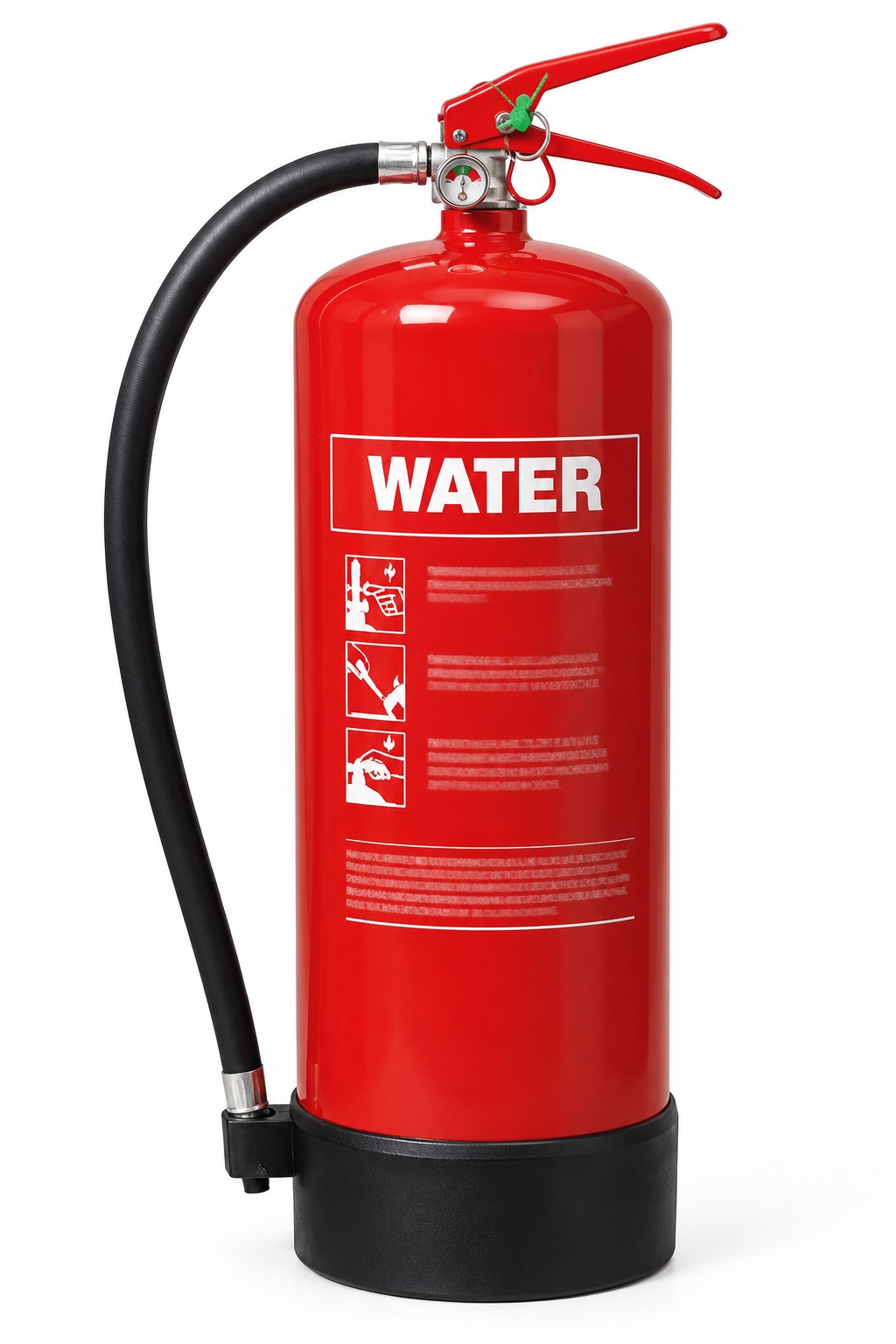  | Normally A Cools burning solid material such as paper, wood or fabric. | Check the limitation Ordinary water is unsuitable for live electrical equipment, flammable-liquid pools, cooking oil and reactive metals: shock, spreading fuel or violent reaction can result. |
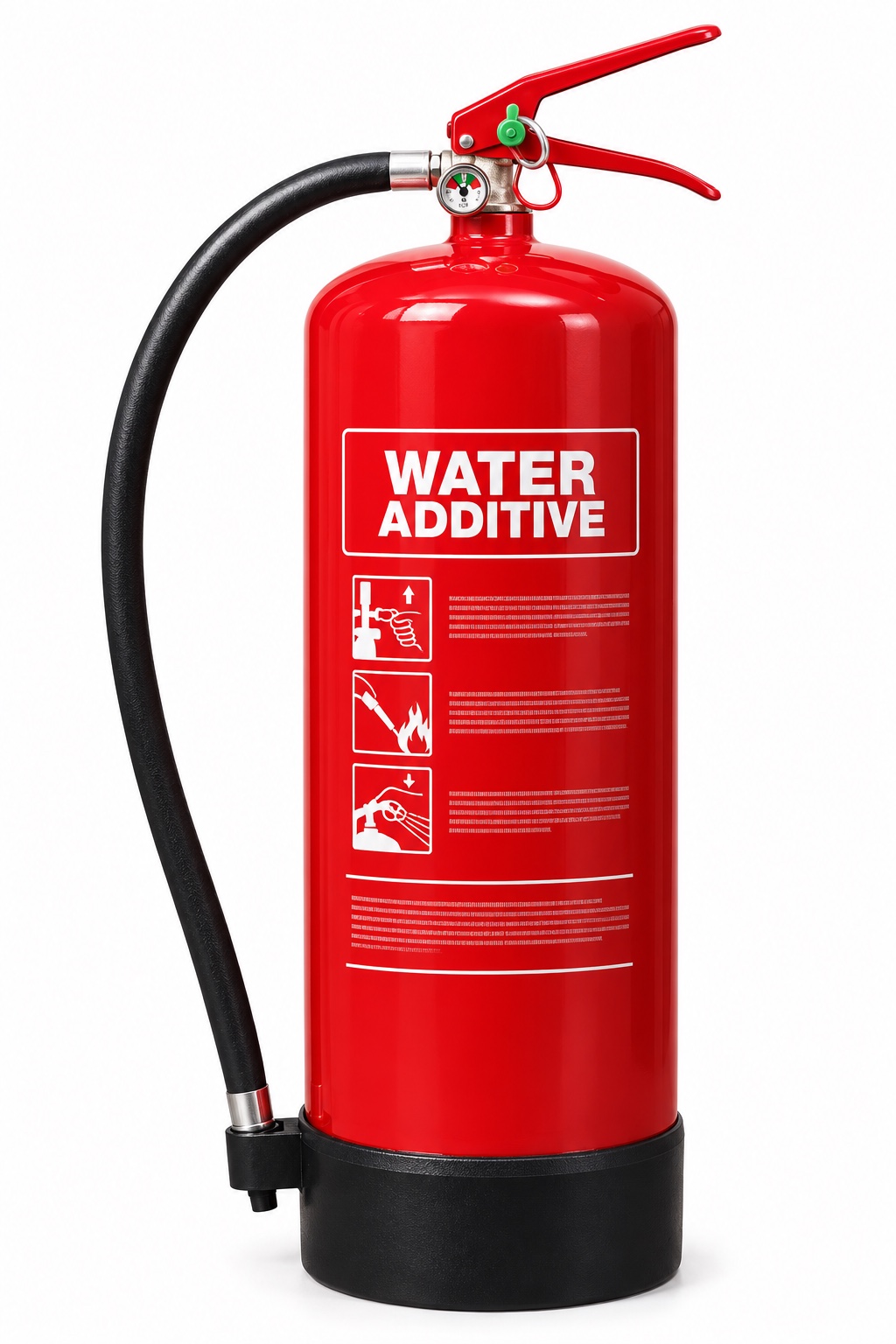 | A; B only if explicitly rated Improved wetting or spray performance can help on the hazards stated on that model’s label. | Check the limitation An additive does not make every water extinguisher safe for electricity, oils or reactive chemicals. Check the specific exclusions. |
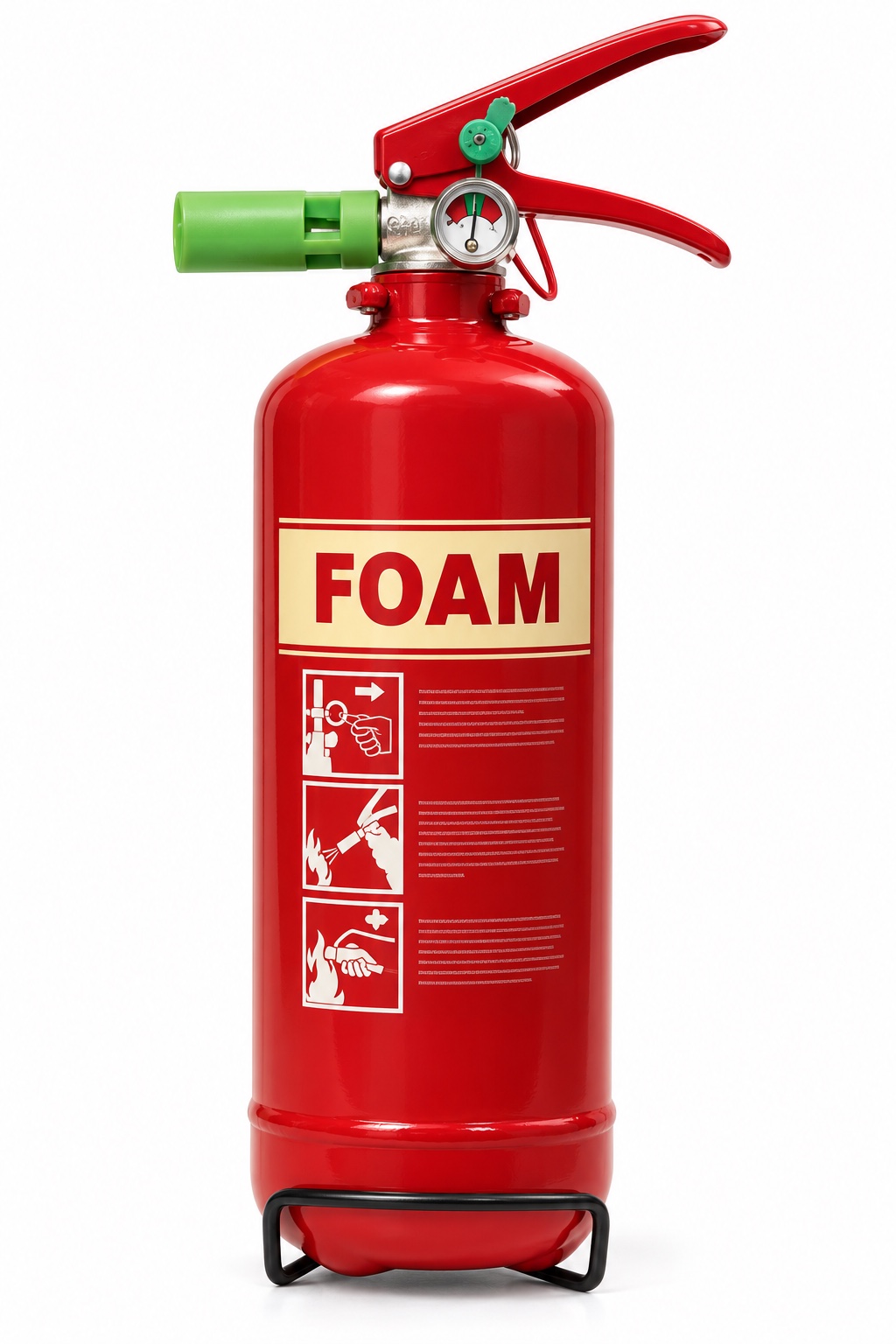 | Commonly A and B Cools and forms a surface blanket on suitable liquid fires. The agent must suit the actual fuel; some alcohols need alcohol-resistant foam. | Check the limitation Ordinary foam is not a general answer for live electricity, cooking oil or metal fires. Unsuitable foam may break down on a solvent; a jet can spread fuel. Free-flowing fuel needs specialist response. |
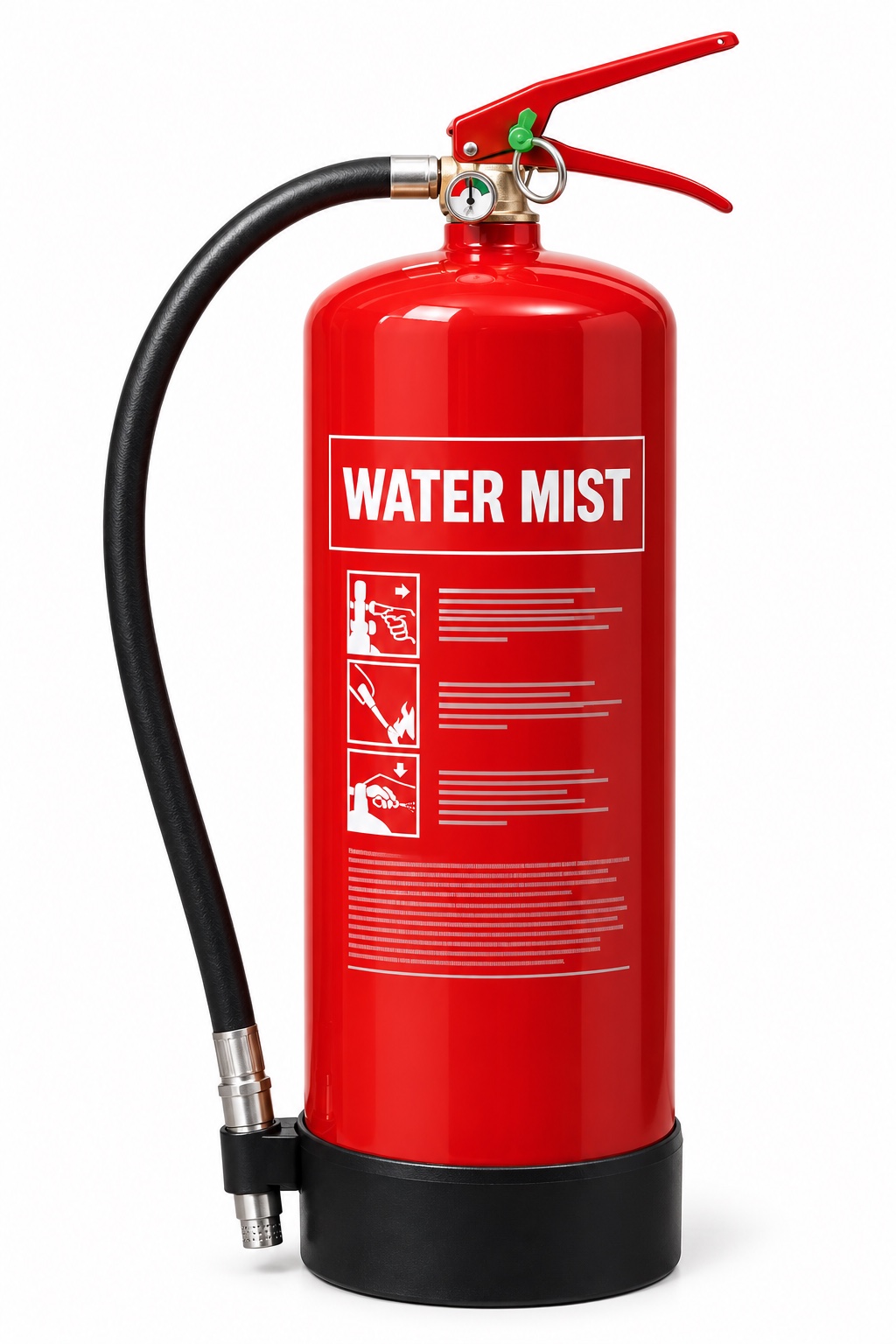 | Model-specific; commonly A, some F Fine droplets absorb heat. Some products have additional ratings or tested electrical suitability, with stated voltage and distance conditions. | Check the limitation ‘Mist’ is not universal approval. Use only the classes and electrical conditions actually declared for that model; do not assume it covers metals, liquids or batteries. |
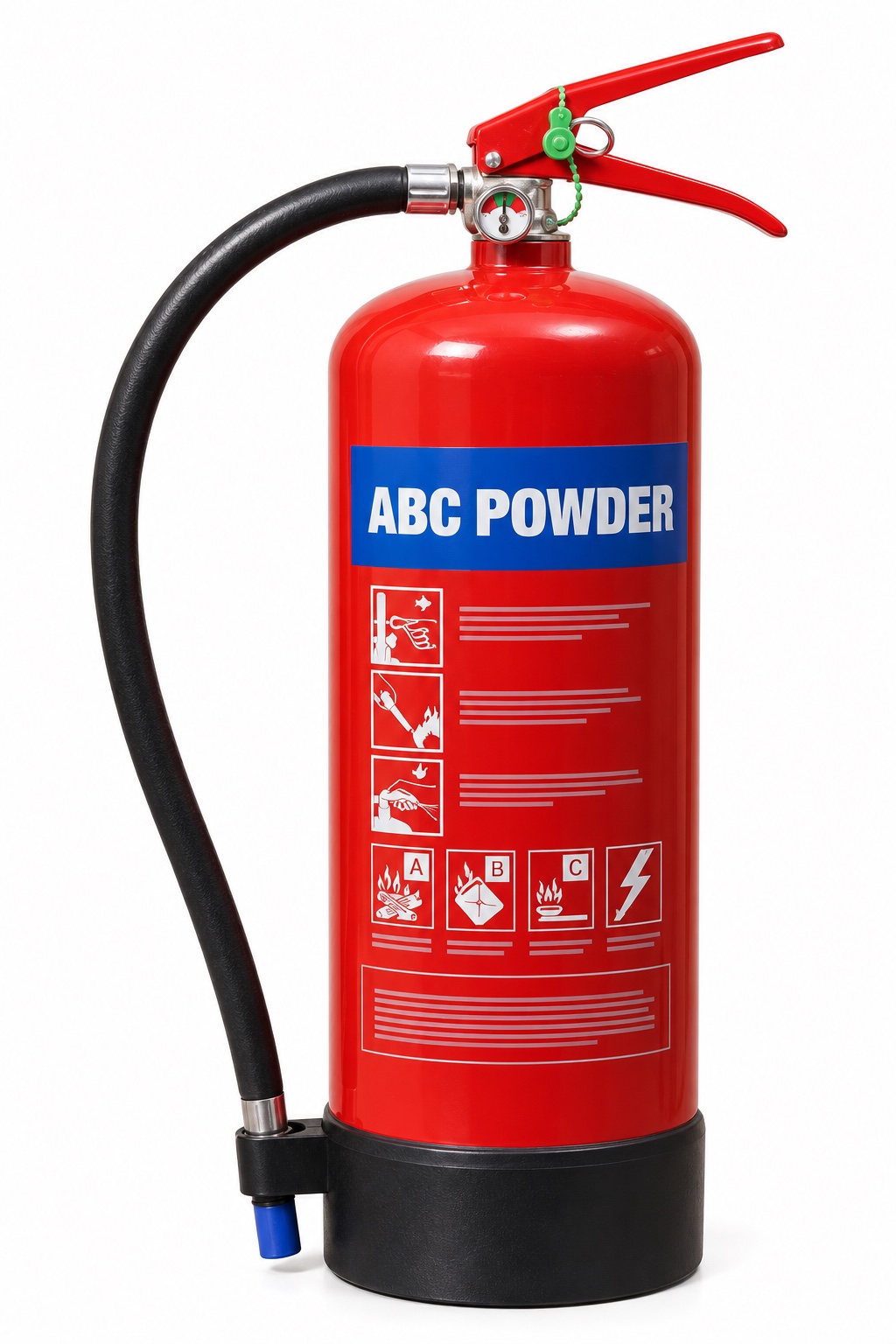 | A, B and C if marked Interrupts flame chemistry; multipurpose powder also acts on Class A material. A C marking does not authorise tackling a gas leak. | Check the limitation Powder can obscure escape and impair breathing; it is not generally recommended indoors. Limited cooling allows reignition. It is not metal-specific D powder or a substitute for F-rated cooking-oil equipment. |
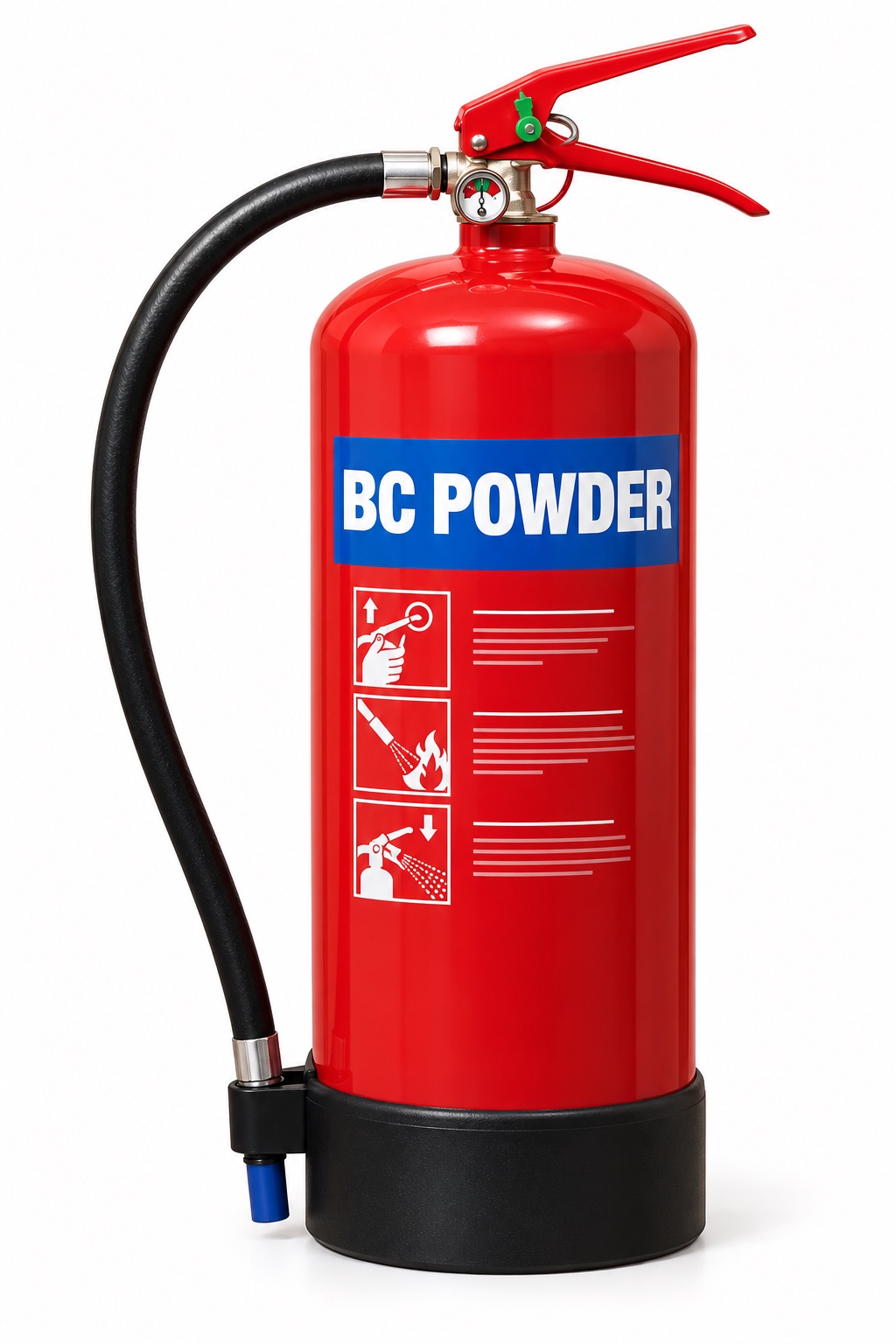 | B and C if marked; not A Selected for particular liquid or gas hazards under the assessed plan. Electrical use must follow the actual unit’s instructions. | Check the limitation Do not assume all blue powder extinguishers protect wood or paper. It has the visibility, breathing and reignition limitations of powder; it does not provide Class D or F protection. |
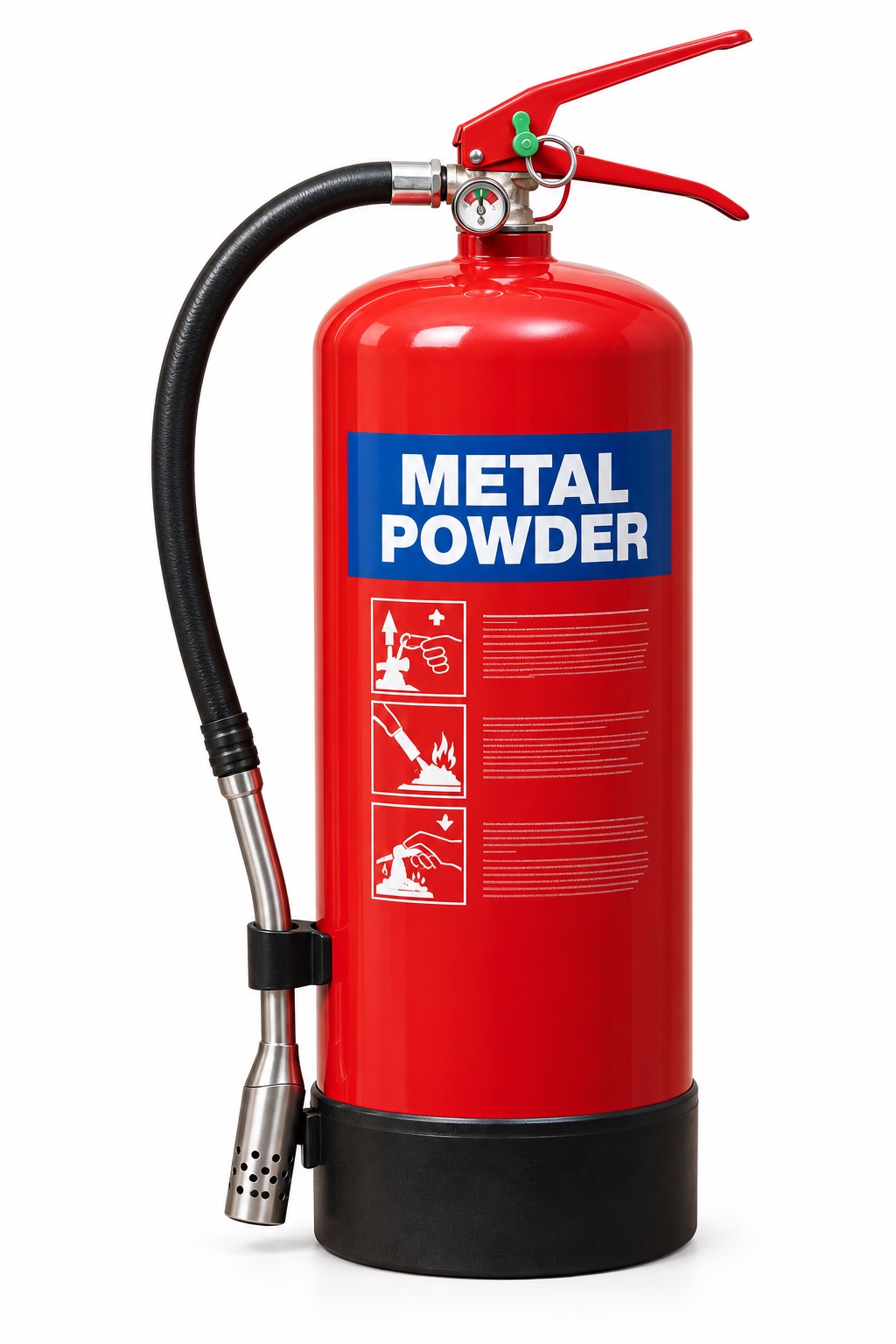 | D, for the specified metal A specialist powder can isolate or absorb heat from a compatible burning metal. Selection requires knowledge of the metal and its form. | Check the limitation The wrong powder can fail or react. Water, foam and CO₂ can be dangerous on certain burning metals. A powder suitable for magnesium is not automatically suitable for metallic lithium. |
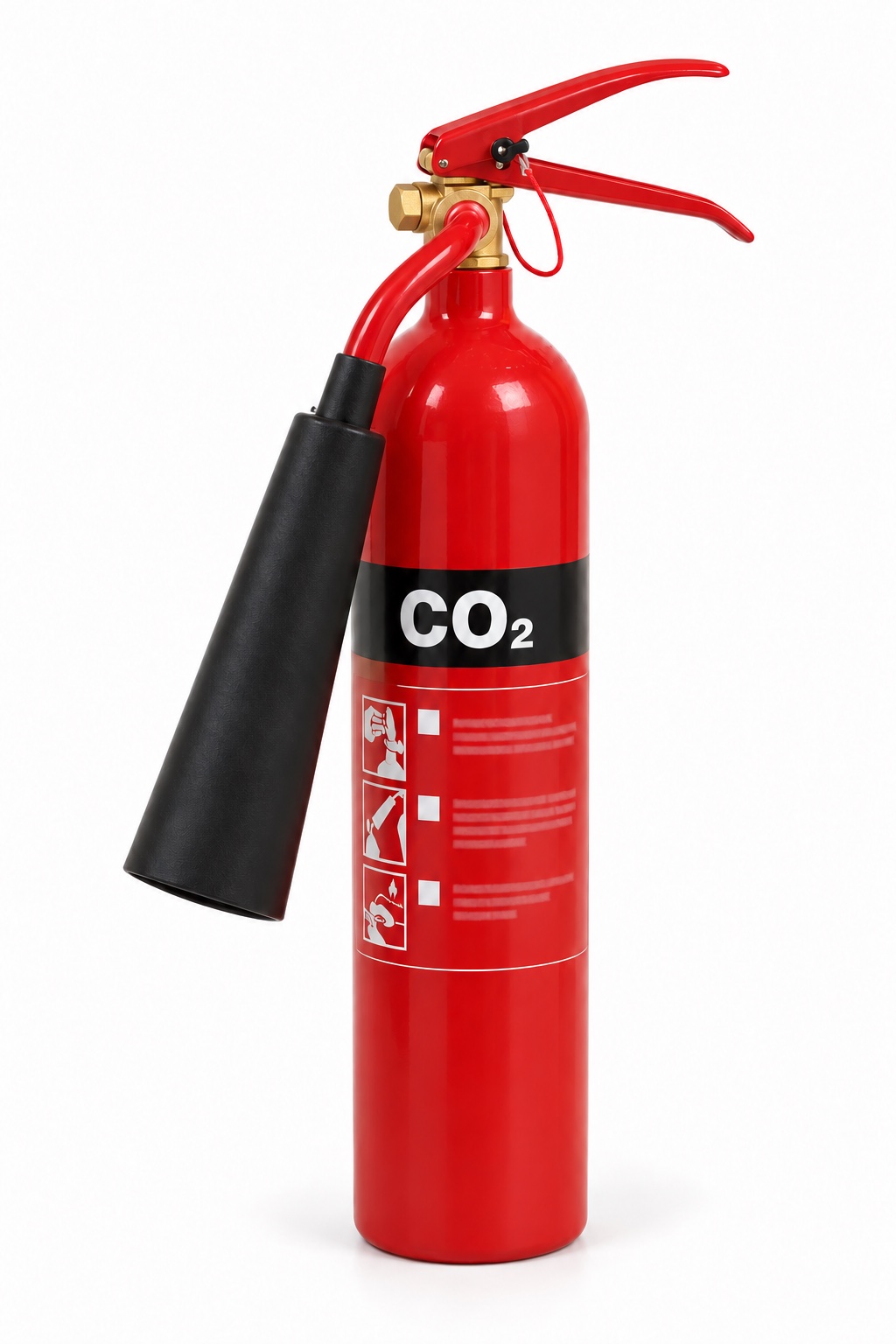 | B; electrical use as instructed Displaces the atmosphere around a small flame and leaves no powder residue. Often selected around electrical equipment. | Check the limitation Poor cooling means reignition is possible. CO₂ can create a dangerous atmosphere in enclosed spaces; discharge can cause frostbite. Hold only the designated insulated parts. Not a cooking-oil or metal-fire substitute. |
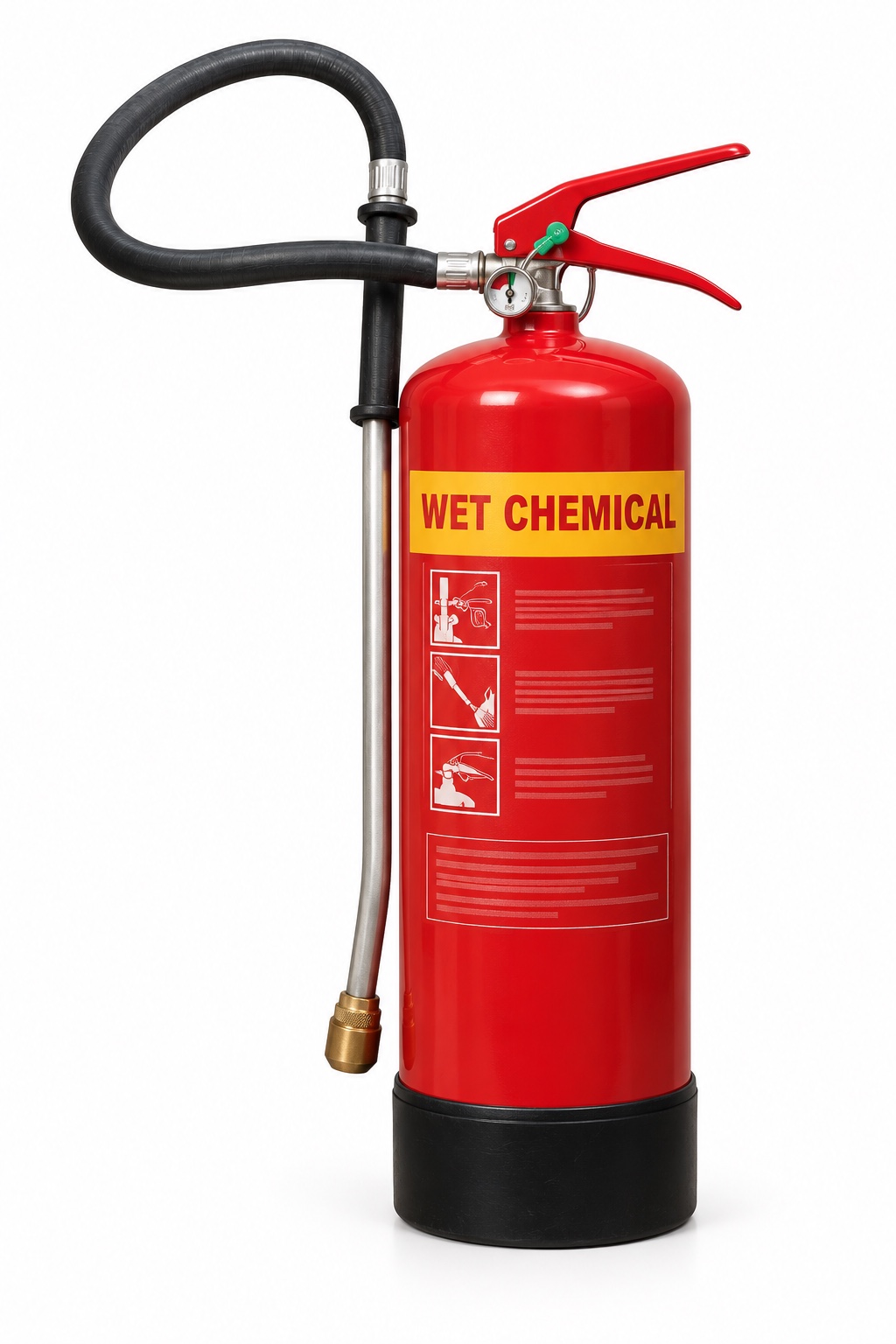 | F; often A if marked Cools cooking oil and creates a protective surface layer through reaction with the fat. Use only within the actual unit’s rating and instructions. | Check the limitation Do not mistake it for a general liquid-fire or electrical extinguisher. Incorrect application or moving the fryer can splash hot oil; apparent flame-out does not establish safe temperature. |
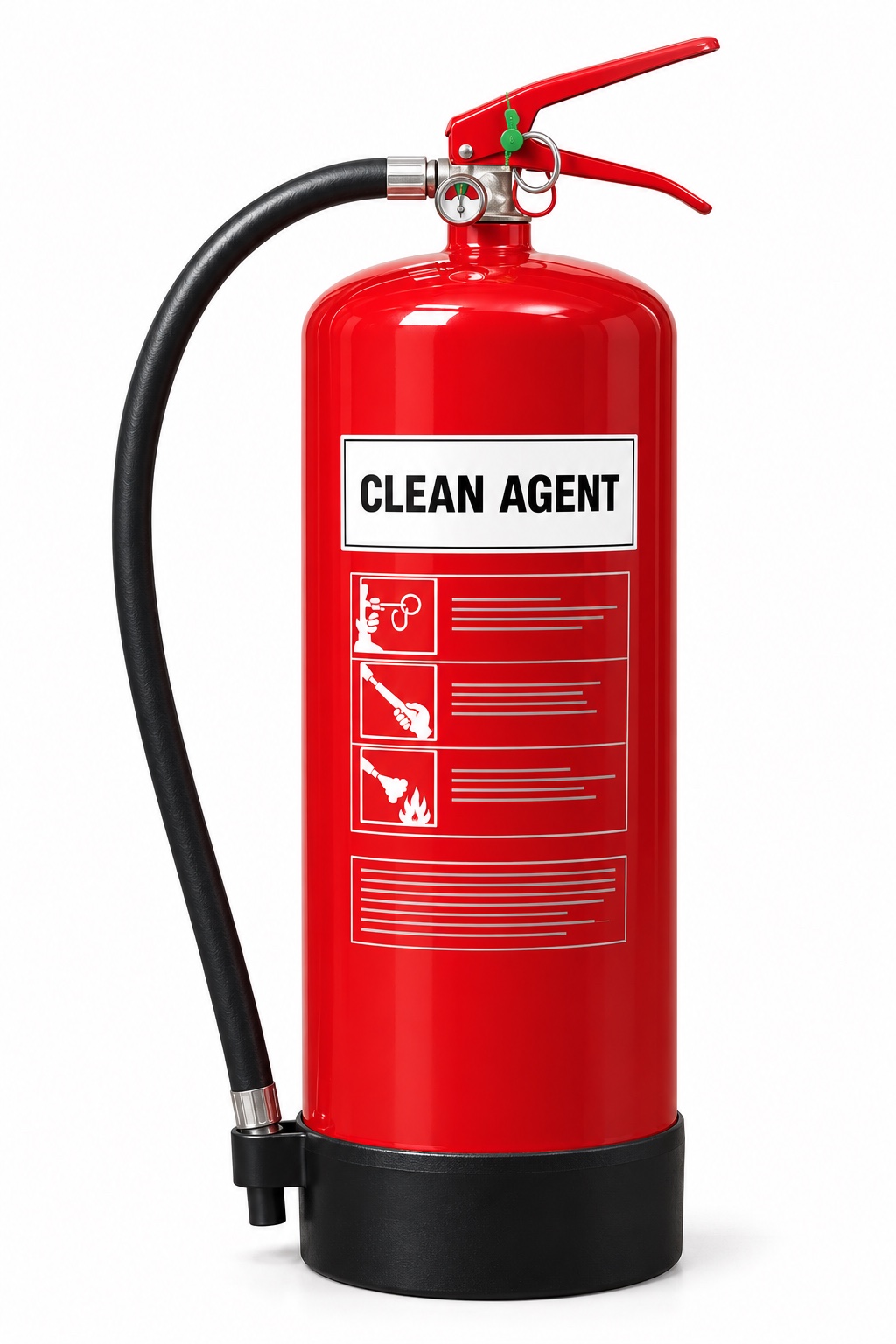 | Product- and jurisdiction-specific Specialist low-residue agents may protect sensitive equipment. Confirm the UK-approved application and the manufacturer’s limits. | Check the limitation Low residue does not mean safe to breathe. Do not copy a US A:B:C rating as UK gas-fire approval. Legacy halon is restricted to permitted critical uses and applicable deadlines. |
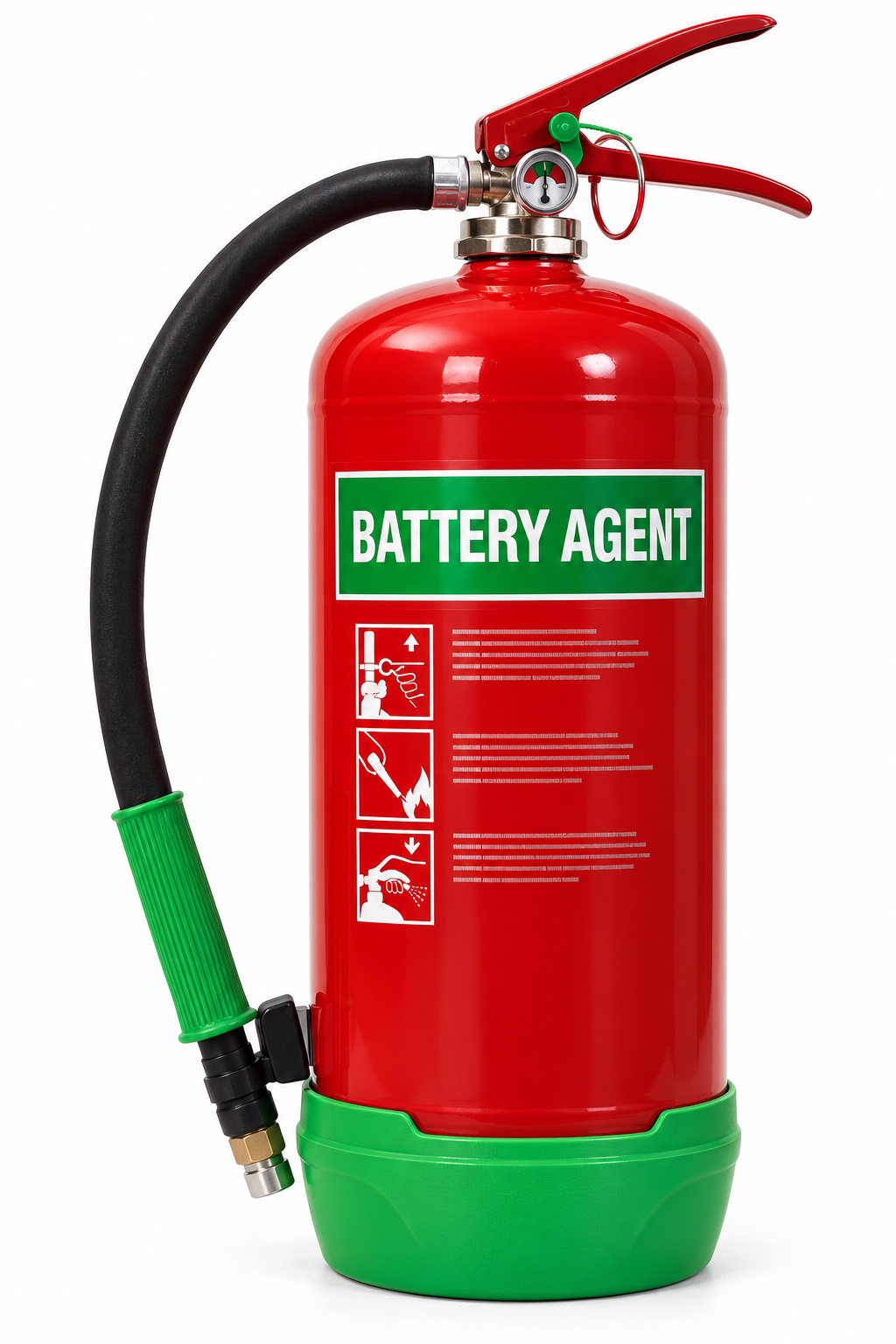 | Check independent scope and instructions Some products use water-based cooling or specialist media such as aqueous vermiculite for specified battery scenarios. Selection depends on chemistry, capacity and location. | Check the limitation A ‘lithium’ label is not proof it will stop thermal runaway in a large pack. Flame suppression may not prevent reignition or gas release. Do not approach, carry or submerge a failing battery as a learner exercise. |
Lithium-ion product example · Firechief 6 L Lith-Ex

A named product example helps connect the generic table to an actual unit. Confirm the exact product before using its claims.
- Agent and intended application
- The linked Seton example uses aqueous vermiculite dispersion (AVD) for specified lithium-ion battery fire applications. Water content cools; the dispersed mineral helps form a barrier. This is not generic Class D metal-fire powder.
- Read the actual rating
- Seton lists a 6 L product with a 13A rating. That A rating describes its solid-material test performance; it does not, by itself, certify a universal Class L battery capability.
- Match the exact model and generation
- The manufacturer’s current 6 L G2 page identifies FLE6X and different discharge details from the retailer’s older listing. Do not mix their time, range or pressure values. Match the delivered label, product sheet and manual.
- Check the battery scope
- Confirm the allowed battery chemistry, energy capacity, state and scenario with the current manufacturer information and competent fire assessment. A large EV or energy-storage pack cannot be treated as a small-device fire.
- Electrical conditions are product-specific
- The supplied product label includes a voltage and minimum-distance condition. Do not transfer that condition to another battery extinguisher or infer that it makes an unsafe electrical approach acceptable.
- After the flame disappears
- Heat, off-gas and reignition can remain. Follow the planned withdrawal, exclusion and fire-service response; do not pick up, submerge or return a failed battery to charging.
Seton · supplied 6 L Lith-Ex example ↗
Firechief · current 6 L G2 model information ↗
Read the actual label
Read the agent, fire-class letters, performance rating, electrical warnings, operating instructions and service condition. Numbers such as 13A or 55B describe standardised test performance, not a safe room size or permission to tackle that amount of fire. Colour is a clue; the actual label and assessed plan decide suitability.
Spot the dangerous assumption
Pause at each question, then open the explanation. These are unscored learning prompts alongside the course assessment.
Keep prevention, alarms, compartmentation and escape effective. Report a missing, obstructed, damaged or discharged extinguisher; do not return a partly used unit to service. Competent selection, maintenance and practical training belong in the fire arrangements.
Why do fire principles matter during workplace change?
Changes often add fuel, ignition sources, people, routes or building defects without anyone calling it a fire safety change.
Refurbishment, new stock, changed suppliers, temporary decorations, charging stations, new cooking equipment, compressed gas storage, changed cleaning products, production changes and contractor work can all change fire risk.
Good management asks a fire-principles question before the change is accepted: what new fuel, ignition, oxygen, spread route, person at risk or emergency limitation is being introduced?
| Change | Fire-principles concern | Evidence needed |
|---|---|---|
| New storage layout | Fuel load and route obstruction. | Updated plan and inspection. |
| Temporary works | Penetrations, hot work and route changes. | Permit, fire stopping and temporary fire plan. |
| New battery charging | Electrical, thermal and smoke risk. | Charging area standard and user checks. |
| More public occupancy | Longer evacuation and crowd movement. | Occupancy review and drill. |
| New flammable product | Vapour, ignition and DSEAR interface. | SDS review and dangerous substances assessment. |
What should a practical fire-principles risk register show?
Record the fuel, ignition and oxidiser in each task, affected people, spread route, prevention and protection controls, owner and field check.
For workshop hot work near stored solvents, name the substance and quantity, the permit and isolation, the person checking the area, the warning and escape route and the post-work monitoring. A signed permit without physical separation or a competent watch is weak evidence.
Review after a changed layout, new material, contractor activity, blocked route, near miss or equipment fault. A control failure should trigger a present work decision and documented hand-back.
How can the hierarchy of controls guide fire prevention and protection decisions?
Name the actual fuel, ignition and oxidiser, remove the pairing where feasible, then verify separation, safe method and escape. A fire-class label or PPE is not an extinguishing decision.
The control matrices are illustrations; premises-specific suitability, implementation and specialist design approval remain held for competent review.
The scenarios are reasoned task applications of the linked control principles, not a prescribed design or proof that each exact intervention appears in a source. A competent person must verify the method, local law and stop criteria.
A contractor proposes hot work near combustible cartons and a flammable cleaning fluid.
Linseed-oil-soaked rags may self-heat if piled in a workshop bin.
How can the ERICPD hierarchy of controls guide fire prevention and protection decisions?

| Hazard and harm route | ERICPD → five-level control | Task intervention and feasibility | Owner, test and evidence | Failure and stop decision |
|---|---|---|---|---|
| Workshop welding near solvent store | Eliminate → Elimination | Move welding or remove the combustible and flammable inventory. Source: official guidance. | Authorised hot-work supervisor documents the removed hazard and confirms the task no longer creates it. | If the work still creates flammable vapour at the ignition source, redesign before starting. |
| Same scenario | Reduce → Substitution | Use a cold cutting or prefabricated method if it achieves the work safely. Source: official guidance. | Authorised hot-work supervisor compares the substitute and its new risks before release. | If the new method is unassessed, hold the change. |
| Same scenario | Isolate → Engineering | Physically segregate the hot-work zone and control vapour release. Source: official guidance. | Authorised hot-work supervisor inspects or tests the installed physical control at the workface. | If the physical barrier is missing or impaired, stop affected work. |
| Same scenario | Control → Administrative | Confirm substance assessment, permit, fire watch and post-work checks. Source: official guidance. | Authorised hot-work supervisor observes the method and checks handover or permit evidence. | If the method or handover is unverified, pause and rebrief. |
| Same scenario | PPE → PPE | Provide hot-work PPE for the worker, not as a fire-prevention barrier. Source: official guidance. | Authorised hot-work supervisor checks compatibility, condition and user competence for residual work. | If PPE is the only credited barrier, revise the plan. |
| Same scenario | Discipline → Administrative assurance | Sample the permit against real fuel removal, watch and hand-back evidence. Source: official guidance. | Authorised hot-work supervisor samples defects, actions and rechecks after change. | If the defect recurs or remains open, restrict use and escalate. |
| Drying-oil cloth disposal | Eliminate → Elimination | Avoid the drying-oil task or single-use cloth where practicable. Source: official guidance. | Workshop manager documents the removed hazard and confirms the task no longer creates it. | If the work still creates uncontrolled drying-oil waste, redesign before starting. Support: London Fire Brigade fire-prevention guidance; HSE HSG140: safe use and handling of flammable liquids. |
| Same scenario | Reduce → Substitution | Use a lower-risk finish or application method after product review. Source: official guidance. | Workshop manager compares the substitute and its new risks before release. | If the new method is unassessed, hold the change. |
| Same scenario | Isolate → Engineering | Place used cloths in an appropriate controlled waste arrangement away from fuel. Source: official guidance. | Workshop manager inspects or tests the installed physical control at the workface. | If the physical barrier is missing or impaired, stop affected work. |
| Same scenario | Control → Administrative | Brief the specific drying-oil hazard and arrange prompt disposal. Source: official guidance. | Workshop manager observes the method and checks handover or permit evidence. | If the method or handover is unverified, pause and rebrief. Support: London Fire Brigade fire-prevention guidance; HSE HSG140: safe use and handling of flammable liquids. |
| Same scenario | PPE → PPE | Use product-compatible gloves for handling; PPE does not prevent self-heating. Source: official guidance. | Workshop manager checks compatibility, condition and user competence for residual work. | If PPE is the only credited barrier, revise the plan. |
| Same scenario | Discipline → Administrative assurance | Inspect disposal practice and investigate heat, odour or near misses. Source: official guidance. | Workshop manager samples defects, actions and rechecks after change. | If the defect recurs or remains open, restrict use and escalate. |
How can the ISO 45001 hierarchy of controls guide fire prevention and protection decisions?

| Hazard and harm route | ERICPD → five-level control | Task intervention and feasibility | Owner, test and evidence | Failure and stop decision |
|---|---|---|---|---|
| Workshop welding near solvent store | Eliminate → Elimination | Move welding or remove the combustible and flammable inventory. Source: official guidance. | Authorised hot-work supervisor documents the removed hazard and confirms the task no longer creates it. | If the work still creates flammable vapour at the ignition source, redesign before starting. |
| Same scenario | Reduce → Substitution | Use a cold cutting or prefabricated method if it achieves the work safely. Source: official guidance. | Authorised hot-work supervisor compares the substitute and its new risks before release. | If the new method is unassessed, hold the change. |
| Same scenario | Isolate → Engineering | Physically segregate the hot-work zone and control vapour release. Source: official guidance. | Authorised hot-work supervisor inspects or tests the installed physical control at the workface. | If the physical barrier is missing or impaired, stop affected work. |
| Same scenario | Control → Administrative | Confirm substance assessment, permit, fire watch and post-work checks. Source: official guidance. | Authorised hot-work supervisor observes the method and checks handover or permit evidence. | If the method or handover is unverified, pause and rebrief. |
| Same scenario | PPE → PPE | Provide hot-work PPE for the worker, not as a fire-prevention barrier. Source: official guidance. | Authorised hot-work supervisor checks compatibility, condition and user competence for residual work. | If PPE is the only credited barrier, revise the plan. |
| Same scenario | Discipline → Administrative assurance | Sample the permit against real fuel removal, watch and hand-back evidence. Source: official guidance. | Authorised hot-work supervisor samples defects, actions and rechecks after change. | If the defect recurs or remains open, restrict use and escalate. |
| Drying-oil cloth disposal | Eliminate → Elimination | Avoid the drying-oil task or single-use cloth where practicable. Source: official guidance. | Workshop manager documents the removed hazard and confirms the task no longer creates it. | If the work still creates uncontrolled drying-oil waste, redesign before starting. Support: London Fire Brigade fire-prevention guidance; HSE HSG140: safe use and handling of flammable liquids. |
| Same scenario | Reduce → Substitution | Use a lower-risk finish or application method after product review. Source: official guidance. | Workshop manager compares the substitute and its new risks before release. | If the new method is unassessed, hold the change. |
| Same scenario | Isolate → Engineering | Place used cloths in an appropriate controlled waste arrangement away from fuel. Source: official guidance. | Workshop manager inspects or tests the installed physical control at the workface. | If the physical barrier is missing or impaired, stop affected work. |
| Same scenario | Control → Administrative | Brief the specific drying-oil hazard and arrange prompt disposal. Source: official guidance. | Workshop manager observes the method and checks handover or permit evidence. | If the method or handover is unverified, pause and rebrief. Support: London Fire Brigade fire-prevention guidance; HSE HSG140: safe use and handling of flammable liquids. |
| Same scenario | PPE → PPE | Use product-compatible gloves for handling; PPE does not prevent self-heating. Source: official guidance. | Workshop manager checks compatibility, condition and user competence for residual work. | If PPE is the only credited barrier, revise the plan. |
| Same scenario | Discipline → Administrative assurance | Inspect disposal practice and investigate heat, odour or near misses. Source: official guidance. | Workshop manager samples defects, actions and rechecks after change. | If the defect recurs or remains open, restrict use and escalate. |
How does fire science become real workplace control?
The fire triangle, tetrahedron, fire classes, fuel load, ignition, oxygen and heat transfer each point to practical controls.
Fire principles become powerful when they help a person look at a real workplace and make better decisions. The fire triangle explains the need for fuel, oxygen and ignition. The fire tetrahedron adds the chemical chain reaction, which helps explain why some extinguishing media interrupt combustion rather than simply cooling fuel.
A competent fire risk assessment does not stop at the diagram. It asks where fuel is stored, how much fire load is present, what could ignite it, whether oxygen enrichment or oxidisers are present, how heat could transfer, what class of fire could occur and what evidence proves controls stay in place.
| Fire principle | Learning explanation | Workplace control example |
|---|---|---|
| Fire triangle | Fuel, oxygen and ignition must come together. | Separate combustibles from heaters, hot work, chargers and electrical faults. |
| Fire tetrahedron | Combustion can continue through chain reactions. | Use media suitable for the fuel and fire chemistry rather than guessing. |
| Fire class | Fuel type affects fire behaviour and extinguisher choice. | Class F cooking oil needs different controls from Class A cardboard or Class B solvent. |
| Fuel load | More combustible material can increase heat release and duration. | Limit pallets, packaging, waste, displays and temporary storage. |
| Ignition source | Heat, spark, flame, hot surface or electrical fault can start fire. | Control hot work, electrics, smoking, heaters, batteries and static. |
| Oxygen enrichment | Extra oxygen can make materials ignite more easily and burn intensely. | Segregate oxygen cylinders and control leaks, valves and storage. |
| Heat transfer | Conduction, convection and radiation spread heat. | Use separation, shielding, compartmentation and protected routes. |
How do fire principles appear in different premises?
Different premises expose the same fire principles in different ways, so the assessor must read the workplace rather than rely on generic wording.
A small shop may have displays, packaging, electrical equipment and public users. A factory may have process heat, dust, oils, conveyors and maintenance hot work. A school may have large numbers of young people, displays and assembly management. A mixed-use building may have shared escape, landlord interfaces and unknown changes by other occupiers.
The skill is to translate the basic science into the relevant local controls: remove ignition, reduce fuel, protect escape, warn people and keep evidence that the controls remain live.
| Premises | Fire principle in practice | Control focus |
|---|---|---|
| Office | Electrical equipment, chargers, waste and escape route discipline. | Inspections, PAT policy where relevant, waste control and drills. Context: official guidance. |
| Small shop | High display fire load and public evacuation. | Stock limits, rear exit checks and staff instruction. Context: Scottish existing non-residential fire guidance. |
| Factory | Process heat, oils, conveyors, dust and maintenance. | Isolation, hot work control, cleaning and fire detection. Context: Scottish existing non-residential fire guidance; official guidance. |
| Care home | People may need assistance before conditions deteriorate. | Compartmentation, staffing and progressive evacuation. Context: Home Office residential care fire-risk-assessment guide; Home Office disabled means-of-escape guide. |
| School | Displays, kitchens, science rooms and large-group movement. | Fire load control, supervision and drill quality. Context: Scottish existing non-residential fire guidance. |
| Construction/refurbishment | Temporary electrics, hot work, incomplete fire stopping and changing routes. | Temporary fire plan and daily review. Context: Scottish existing non-residential fire guidance. |
For the specific drying-oil rag example, London Fire Brigade fire-prevention guidance explains the linseed-oil and cloth self-heating risk. It does not mean that every oil-contaminated rag has the same hazard.
When should basic fire principles trigger management action?
Action is needed whenever fuel, ignition, oxygen, spread routes or people at risk change in a way that could defeat existing fire precautions.
A useful fire safety culture makes basic fire principles visible in everyday decisions. Workers and supervisors should be able to challenge combustible storage near heaters, blocked fire doors, unsafe charging, uncontrolled hot work or changes that introduce flammable substances.
Managers should connect those concerns to the fire risk assessment, not treat them as isolated housekeeping issues.
| Trigger or question | Immediate action | Evidence before normal operation |
|---|---|---|
| Has the building, process or occupancy changed? | Review the fire risk assessment and confirm whether controls still match the risk. | Updated assessment, action plan and communication record. |
| Is a key fire precaution impaired? | Apply temporary controls, inform relevant people and escalate to the responsible person. | Impairment log, compensatory measures and close-out evidence. |
| Could people be trapped, delayed or confused? | Review escape, warning, signage, assistance and drill findings. | Drill record, PEEP review, route inspection and action tracker. |
| Is specialist design or technical judgement needed? | Seek competent advice before relying on assumptions. | Competent report, design note, certificate or reviewed fire strategy. |
| Has a near miss, false alarm or drill failure occurred? | Investigate the learning point and update arrangements. | Investigation note, corrective action and communication record. |
Where do organisations misunderstand fire principles?
They often understand the theory but fail to apply it to storage, contractors, maintenance, charging, housekeeping and change.
The common weakness is treating fire safety as equipment provision rather than risk control. Extinguishers and signs cannot compensate for excessive fuel load, uncontrolled ignition sources, open fire doors, untrained workers or damaged escape routes.
Good fire management uses the fire triangle as a practical inspection lens: what could burn, what could ignite it, how would it spread and who would be affected?
| Failure or weak practice | How it develops | What good looks like |
|---|---|---|
| Assumption without evidence | The organisation assumes fire principles is adequate because it has existed for years. | Review the fire risk assessment, inspect the real condition and test the arrangement. |
| Unmanaged change | Refurbishment, new stock, changed hours, altered routes or different users undermine the original arrangement. | Add fire safety review to change control and contractor handover. |
| Open defects | Defects are recorded but not risk-ranked, resourced or closed. | Escalate overdue critical actions and use interim controls. |
| Poor communication | Workers, visitors, contractors or night staff do not understand what to do. | Update briefings, notices, inductions and drills. |
| Competence gap | A non-specialist makes design assumptions about complex premises, smoke spread, evacuation or fire resistance. | Use competent advice and record the decision basis. |
| Equipment-only thinking | Management points to extinguishers while ignoring fuel and ignition control. | Review prevention controls and not just response equipment. |
| Theory not briefed | Workers know fire drills but not what conditions to challenge. | Include fire triangle examples in briefings. |
What evidence shows fire principles is controlled?
Evidence should show that fire precautions are suitable, available, maintained, tested, understood and reviewed.
Fire evidence should connect the fire risk assessment to real controls. A log book alone is not enough if defects remain open, staff do not know the procedure or equipment cannot be reached during normal work.
Good records show what was checked, what failed, who owned the action, when it was closed and how the responsible person knows the arrangement still protects relevant persons.
| Evidence item | What it should show | Assurance question |
|---|---|---|
| Ignition-source register | Hot work, electrics, heaters, charging, smoking and process heat are identified and controlled. | Review during inspections and change. |
| Fuel-load controls | Storage, waste, stock, decorations and dangerous substances are controlled. | Photos, limits, inspection and action close-out. |
| Fire-principles briefing | Workers understand what conditions to report, not just where to assemble. | Induction, toolbox talk and supervisor observation. |
| Fire risk assessment | Current hazards, people at risk, existing controls, further actions and review triggers are recorded. | Check after change, incident, refurbishment, occupancy change or drill learning. |
| Action tracker | Actions show owner, due date, priority, interim control and close-out evidence. | High-risk defects should not drift without escalation. |
| Testing and inspection records | Alarms, emergency lighting, extinguishers, doors, escape routes and relevant systems are checked at suitable intervals. | Records should show defects and corrective action, not just ticks. |
| Training and drill records | Workers, wardens and relevant contractors know what to do and how to report defects. | Drill observations should lead to improvement. |
How should fire principles be assured?
Assurance should test whether the fire arrangement works in the building, at the time, with the people who may need it.
First-line assurance comes from daily checks, weekly tests, warden observations and immediate defect reporting. Second-line assurance reviews fire risk assessment actions, drills, maintenance, contractor records and repeat findings. Specialist assurance may include competent fire risk assessor review, fire alarm contractor reports, extinguisher servicing, emergency lighting testing and enforcement feedback.
The test is practical: if the alarm operates today, can everyone hear, understand, move, escape, account for vulnerable people and keep routes safe without relying on luck?
| Assurance layer | What to check | What good looks like |
|---|---|---|
| Frontline checks | Supervisors and wardens check that fire principles controls are available before and during normal work. | Defects are reported, prioritised and corrected before people rely on failed controls. |
| Manager review | Managers review fire risk assessment actions, contractor changes, drills, inspections and repeat defects. | Resources, ownership and close-out dates match the risk. |
| Competent review | A competent fire risk assessor, engineer or specialist reviews complex design, strategy or technical uncertainty. | Recommendations are understood, risk-ranked and turned into practical actions. |
| Leadership assurance | Senior leaders review overdue critical actions, enforcement feedback, recurring impairments and high-risk premises. | Important fire risks are visible in governance rather than buried in a log book. |
Which fire duties apply across the UK jurisdictions?
England and Wales, Scotland and Northern Ireland have separate non-domestic premises fire routes; work and dangerous-substance duties must also be checked for the actual location and activity.
The Fire Safety Order is the England and Wales premises route. Scottish and Northern Irish instruments are separate. GB work-health rules and DSEAR do not silently apply in NI; use the corresponding NI rules where in scope. This table identifies routes, not legal approval for a site-specific strategy.
| Jurisdiction | Duty or guidance | What it means | How to apply it |
|---|---|---|---|
| E&W | Regulatory Reform (Fire Safety) Order 2005 | Requires the responsible person to assess fire risk and maintain suitable fire precautions in non-domestic premises. | Use as the main fire safety legal framework for England and Wales. |
| GB | Health and Safety at Work etc. Act 1974 | Requires employers to protect employees and others affected by work so far as reasonably practicable. | Use for work activities that create fire, emergency or firefighting risk. |
| GB | Management of Health and Safety at Work Regulations 1999 | Requires suitable and sufficient risk assessment, preventive arrangements, competent help, emergency arrangements and review. | Use for management arrangements, competence and emergency procedures. |
| GB | Dangerous Substances and Explosive Atmospheres Regulations 2002 | Requires fire and explosion risk from dangerous substances to be assessed and controlled. | Use where flammable substances, gases, vapours, dusts or oxygen enrichment affect the fire arrangements. |
| Scotland | Fire (Scotland) Act 2005 | Scottish non-domestic premises fire framework. | Assess people and fire precautions in the actual premises. |
| Scotland | Fire Safety (Scotland) Regulations 2006 | Scottish detailed premises precautions. | Warning, escape, maintenance and coordination. |
| NI | Fire and Rescue Services (NI) Order 2006 | NI non-domestic premises fire framework. | Identify the appropriate person and affected premises. |
| NI | Fire Safety Regulations (NI) 2010 | NI detailed premises precautions. | Warning, escape, maintenance and review. |
| NI | Health and Safety at Work (NI) Order 1978 | NI general work-health and safety route. | Control work-created fire and emergency risks. |
| NI | Management Regulations (NI) 2000 | NI risk-assessment and emergency arrangements. | Coordinate workers, contractors, competence and emergency action. |
| NI | DSEAR (NI) 2003 | NI dangerous-substance work-risk route where relevant. | Plan release, ignition and emergency controls. |
In England and Wales, Article 14 of the Fire Safety Order addresses emergency routes and exits; Article 15 addresses procedures for serious and imminent danger, including appropriate drills. The Workplace Regulations 1992 address ordinary traffic routes, not emergency escape routes.
Where can a voluntary management standard help?
A voluntary occupational health and safety system can connect fuel, ignition and oxidiser control, hot-work competence, maintenance, drills and learning while fire risk and dangerous-substance duties remain separate.
Exact ISO clause mapping requires an authorised licensed copy and specialist review; no licensed clause text is reproduced. A competent reviewer should use an authorised copy if clause-level mapping is required.
Who needs competence, and how should it be demonstrated?
Test the decisions and actions each role must make in a realistic fire scenario, including faults, absent staff and hand-back.
| Role | Learning to test | Competence demonstration | Assessor and record | Reassessment trigger |
|---|---|---|---|---|
| All workers and contractors | Identify fuel, ignition, alarm and escape limits. | Spot unsafe storage or an ignition source on a site walk. | Supervisor observes induction. | New task or material. |
| Hot-work and maintenance teams | Use safe isolation, fuel removal and permit controls. | Demonstrate pre-work check and stop on unknown vapour. | Authorised supervisor records observation. | Change in substance or work area. |
| Supervisors and managers | Own risk decisions, people and barrier defects. | Decide whether a workshop may work with blocked escape or faulty alarm. | Competent fire lead samples decision. | Near miss or defect. |
| Fire assessors and specialists | Connect chemistry, building, people and controls. | Trace a mixed-fuel scenario to prevention and escape. | Technical reviewer checks reasoning. | New process or layout. |
| Dutyholders and assurance leads | Resource maintenance and action closure. | Review hot-work, charging and storage trends. | Leadership records effectiveness. | Incident or repeated finding. |
How could Riverside Leisure Ltd manage this in practice?

At Riverside Leisure Ltd, a maintenance contractor proposes welding near cartons and a cleaning-fluid store. The supervisor first moves combustibles and checks whether flammable vapour could be present; the hot-work permit alone is not the control. A trained fire watch, suitable isolation, warning and escape arrangements are confirmed. The job stops when ventilation and substance information are uncertain, and restarts only after competent assessment. The work area is checked and handed back before normal storage returns.
A workshop can manage fire principles by controlling fuel, ignition, oxygen, spread and emergency response as one joined system.
Riverside Leisure Ltd applies fire principles in maintenance workshops, cafe kitchens, stores, plant rooms, charging areas and temporary contractor works.
| Management element | How the business would manage it | Evidence to review |
|---|---|---|
| Fuel | Waste, stock and combustible storage are limited and separated. | Inspection and waste records. |
| Ignition | Hot work, electrics, heaters and chargers are controlled. | Permits, inspection and maintenance records. |
| Spread | Fire doors, ceilings and penetrations are maintained. | Defect log and contractor handback. |
| People | Staff and contractors know alarm, escape and reporting arrangements. | Training and drill evidence. |
How do petrol and diesel help explain workplace fire principles?
Compare how each fuel may form an ignitable atmosphere under the stated conditions, and identify why ignition prevention remains a separate consideration.
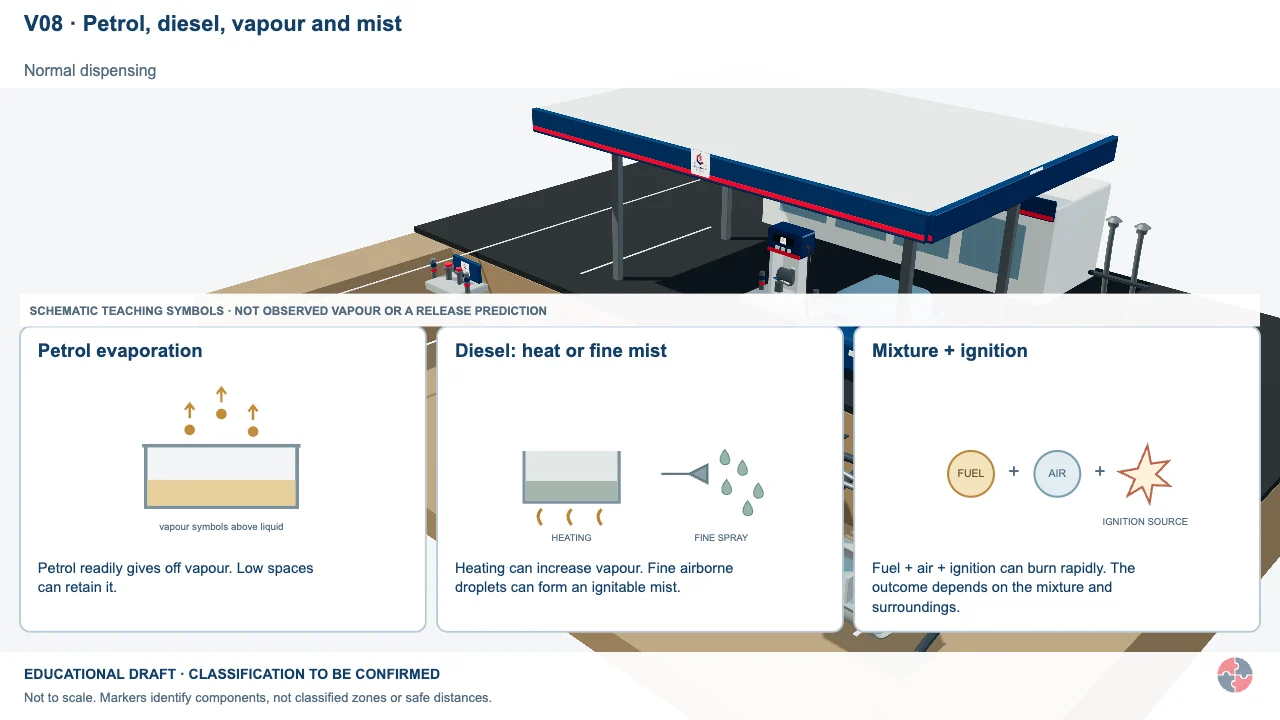

Petrol, diesel, vapour and mist
Compare petrol evaporation, diesel conditions and fine droplets. Petrol carried into a separator can remain a vapour source after the visible forecourt spill has passed.
Activity focus: Identify the actual product and release mechanism. For drainage, ask whether petrol could reach or remain in the separator; for refuelling, confirm the stated Stage II recovery arrangement.
Contextual illustration. The image alone does not establish equipment state, effective controls, individual health or authorisation; use the task-specific checks and competent evidence.
Educational illustration, not to scale. Coloured zones are teaching examples, not a site-specific hazardous-area classification.
What do the acronyms and key terms mean?
Acronyms should be understood before they are used in assessments, briefings, audits or learning answers.
Acronyms can exclude newer readers if they are not explained. This section keeps the main terms available at the end of the page so the article stays readable while still supporting learners and audit users.
| Acronym | Meaning | Plain-English use |
|---|---|---|
| ACOP | Approved Code of Practice | Practical guidance with special legal status; following it is not compulsory, but it can be used as evidence of compliance. |
| FRA | Fire Risk Assessment | A structured assessment of fire hazards, people at risk, controls, emergency arrangements and review needs. |
| FRS | Fire and Rescue Service | The emergency service and enforcing authority for many fire safety matters in England and Wales. |
| HSE | Health and Safety Executive | Great Britain workplace health and safety regulator. |
| HSWA | Health and Safety at Work etc. Act 1974 | Great Britain general work-health and safety statute; Northern Ireland has a separate 1978 Order. |
| MHSWR | Management of Health and Safety at Work Regulations 1999 | Regulations requiring suitable and sufficient risk assessment and management arrangements. |
| PEEP | Personal Emergency Evacuation Plan | A person-specific plan for someone who may need assistance to evacuate safely. |
Unlock another resource
You have used this month’s two free downloads. Publish a post in your own words to unlock one more resource, or choose SHARE Individual for 10 downloads per month.
You decide whether to share. If you do, use the relevant platform disclosure tools and do not make claims you do not genuinely hold.