SHARE Knowledge Hub
Fire Safety, Fire Risk Assessment and Emergency Controls
A fire risk assessment should connect credible ignition, fuel and smoke routes to prevention, warning, protected escape and emergency action that work in the actual premises. Each critical control needs an owner, a field check and a stop decision when impaired. England and Wales, Scotland and Northern Ireland have distinct premises duties; work-process fire risks also need their applicable route.
Understanding Fire Safety, Fire Risk Assessment and Emergency Controls
Fire safety fire risk assessment and emergency controls are the linked arrangements used to prevent fire and explosion, limit their development, warn people, enable a safe emergency response and recover without reintroducing uncontrolled risk.
Why this matters at work
Environmental emergency planning needs verified pathways and measures that remain available and safe in the fire scenario. Historic firewater guidance explains consequences but does not supply current national law or discharge approval. Emergency control, cleanup and restarting each require their own decisions. A map, exercise or general source link cannot establish containment capacity or safe reopening.
Restoration should establish the intended function after a defect or planned impairment. Common utilities, linked systems and concurrent losses can remain unresolved after a component repair. Keep restrictions and communication aligned with the tested state. Recurring or extended impairments need management attention to causes and resources rather than repeated administrative closeout.
How organisations manage this in practice
Passive features and active systems protect different parts of the fire scenario and depend on their interfaces. Smoke can bypass compromised construction before flames are visible to occupants. Device labels and individual certificates do not prove the installed combination. Competent assessment must explain any proposed trade-off rather than assume that adding one control repairs another. Identify which parts of the strategy depend on separation, doors, warning, suppression and smoke control, and check their interfaces. An additional active system should not be assumed to compensate for a damaged passive barrier without competent evidence. Review common failures, impairments and the effect on escape. Record the design and management assumptions together so that repairs to one system do not leave another unavailable. Controls should be judged as a working arrangement for the actual occupancy.
Assessment, daily controls and emergency response must describe the same actual protection. Work, stock, staffing and temporary changes can invalidate earlier assumptions while the report date remains current. Each finding should identify the people, barrier, gap and verification needed. A coherent control system connects those decisions to work restrictions, maintenance, information and management review. Translate findings into specific prevention, protection and response tasks with owners, resources and verification. Link maintenance and defect escalation to occupancy decisions and ensure workers know their immediate response. Include contractors, shared systems and unusual shifts. Test the complete chain rather than checking each document in isolation. A risk assessment, alarm log and emergency plan are mutually supporting records; their existence does not prove that warnings, escape and assistance work together.
Use verified drainage and receptor information, site-specific containment arrangements and liaison with responders and environmental authorities. Protect life first and avoid unsafe improvised actions. Check the applicable national environmental route and any discharge conditions with competent advice. Plan safe reoccupation and phased restart separately from business targets. Record uncertainties and decisions; no generic fire guide supplies an approved containment volume, firefighting tactic or permission to discharge contaminated water.
How can I practise this topic in 3D?
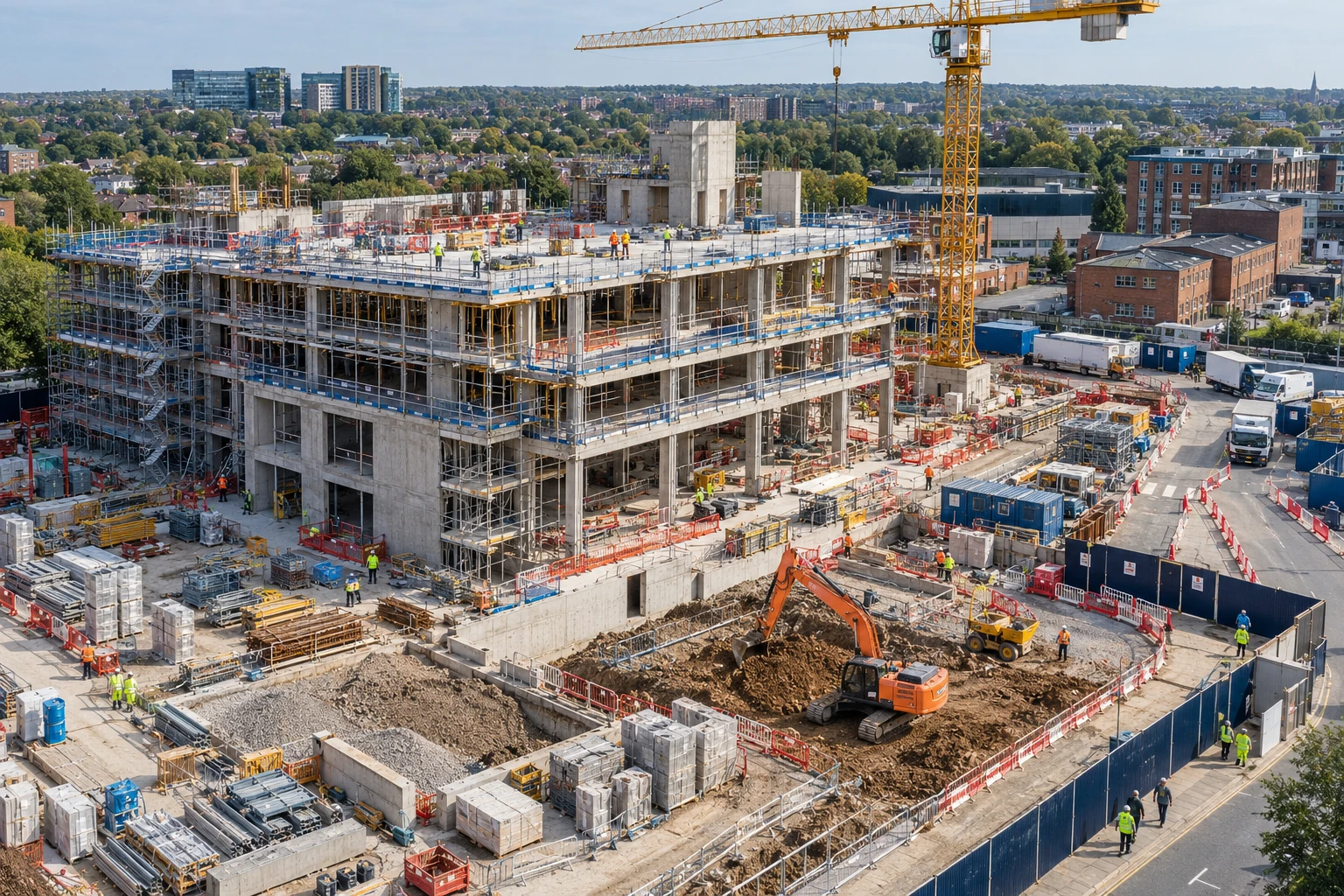

Stock blocks an emergency exit
All related inspection points 1 across 1 location
Warehouse walkabout 1 inspection point
Practice in the SHAREhub environment. Browser practice is separate from workplace competence and formal learning records.
Turn each assessment finding into a control that survives the next shift
Use this guide as the assessment-to-operation bridge. For each credible scenario, connect the finding to its prevention, warning, escape or emergency function; name the person who keeps it effective, the field evidence and the condition that stops work. Keep the practical assessment method and assessor appointment on their dedicated routes.
Best-practice guide: Fire Safety, Fire Risk Assessment and Emergency Controls

Turn each assessment finding into a control that survives the next shift
Use this guide as the assessment-to-operation bridge. For each credible scenario, connect the finding to its prevention, warning, escape or emergency function; name the person who keeps it effective, the field evidence and the condition that stops work. A fire risk assessment should connect credible ignition, fuel and smoke routes to prevention, warning, protected escape and emergency action that work in the actual premises.
Turn fire safety, fire risk assessment and emergency controls knowledge into a decision
A fire risk assessment should connect credible ignition, fuel and smoke routes to prevention, warning, protected escape and emergency action that work in the actual premises. Each critical control needs an owner, a field check and a stop decision when impaired. Permit record and supervisor sign-off.
Manufacturing fire controls scenario
Hot work possible: Permit, area clearance, fire watch and post-work check. Evidence / response: Permit record and supervisor sign-off. Rear route used for deliveries: Route kept clear and delivery rules briefed. Evidence / response: Daily route check and delivery instruction.
Where do fire risk assessment and emergency controls disconnect?
Observed defect: Stock obstructs an assessed route or a warning function is impaired. Possible consequence: Delayed warning or an unusable exit can prevent timely safe escape. Control failure: An action is marked complete without functional evidence, real-user checks or control of recurrence.
Choose controls for the actual task
Elimination: Remove stock from the required exit and cease the activity that blocks it; do not use an impairment procedure as permission to obstruct escape. Substitution: Use a separate stock area or smaller delivery lots to prevent recurrent escape-route loading; assess effects on other routes. Engineering: Repair and recommission the alarm zone, test warning at noisy positions and maintain the protected exit and fire doors. Administrative: Use a named impairment coordinator, temporary occupancy decision, shift briefing, alternative warning only if justified and a logged repair deadline. PPE: Ordinary PPE cannot compensate for a failed alarm or exit. Read the full control table for qualifications, ownership and verification. Use the actual task and applicable jurisdiction; existing technical approval remains unchanged.
Use the full fire safety, fire risk assessment and emergency controls lesson
Use the full topic for the decision points, practical examples, detailed control tables and source scope. HSE guidance applies to Great Britain; use HSENI for the Northern Ireland route and the source’s stated jurisdiction. A simplified guide does not change the page’s technical-review or approval status.

Read all six steps as text
1. Turn each assessment finding into a control that survives the next shift
Use this guide as the assessment-to-operation bridge.
- Avoid / redesign: Remove stock from the required exit and cease the activity that blocks it; do not use an impairment procedure as permission to obstruct escape.
- Control the task: Repair and recommission the alarm zone, test warning at noisy positions and maintain the protected exit and fire doors.
- Verify before release: Required exit remains blocked: stop affected operations until immediately clear.
Use this guide as the assessment-to-operation bridge. For each credible scenario, connect the finding to its prevention, warning, escape or emergency function; name the person who keeps it effective, the field evidence and the condition that stops work. A fire risk assessment should connect credible ignition, fuel and smoke routes to prevention, warning, protected escape and emergency action that work in the actual premises.
Apply it: Which part of this plan would you check at the workface before authorising the task?
2. Turn fire safety, fire risk assessment and emergency controls knowledge into a decision
Use the evidence to improve the actual work arrangement.
- Change at source: Remove stock from the required exit and cease the activity that blocks it; do not use an impairment procedure as permission to obstruct escape.
- Make it observable: Required exit remains blocked: stop affected operations until immediately clear.
- Keep useful evidence: Permit record and supervisor sign-off.
A fire risk assessment should connect credible ignition, fuel and smoke routes to prevention, warning, protected escape and emergency action that work in the actual premises. Each critical control needs an owner, a field check and a stop decision when impaired. Permit record and supervisor sign-off.
Apply it: What evidence would show that the change improves this task, rather than only completing a record?
3. Manufacturing fire controls scenario
Example: a practical application of the existing topic lesson.
- Hot work possible: Permit, area clearance, fire watch and post-work check.
- Rear route used for deliveries: Route kept clear and delivery rules briefed.
- Compressor room risk: Detection, isolation and no combustible storage.
Hot work possible: Permit, area clearance, fire watch and post-work check. Evidence / response: Permit record and supervisor sign-off. Rear route used for deliveries: Route kept clear and delivery rules briefed. Evidence / response: Daily route check and delivery instruction.
Apply it: At which point would you hold this example, and what evidence would allow it to proceed?
4. Where do fire risk assessment and emergency controls disconnect?
Connect the task, the route to the person and the control that can fail.
- Observed defect: Stock obstructs an assessed route or a warning function is impaired.
- Possible consequence: Delayed warning or an unusable exit can prevent timely safe escape.
- Control failure: An action is marked complete without functional evidence, real-user checks or control of recurrence.
Observed defect: Stock obstructs an assessed route or a warning function is impaired. Possible consequence: Delayed warning or an unusable exit can prevent timely safe escape. Control failure: An action is marked complete without functional evidence, real-user checks or control of recurrence.
Apply it: Who could be exposed, including other trades, cleaners, maintainers and people nearby?
5. Choose controls for the actual task
Control summary. Read the complete task-specific controls and checks in the linked topic.
- Elimination: Remove stock from the required exit and cease the activity that blocks it; do not use an impairment procedure as permission to obstruct escape.
- Substitution: Choose a suitable non-flammable cleaner and cold joining method only after compatibility and quality checks; minimise remaining dangerous inventory.
- Engineering controls: Manage stock location and quantities, delivery arrangements, occupancy restrictions, user briefing and assistance. Verify the actual route and warning with affected shifts before operating acceptance.
- Administrative controls: Manage stock location and quantities, delivery arrangements, occupancy restrictions, user briefing and assistance. Verify the actual route and warning with affected shifts before operating acceptance.
- PPE: Ordinary PPE cannot compensate for a failed alarm or exit.
Elimination: Remove stock from the required exit and cease the activity that blocks it; do not use an impairment procedure as permission to obstruct escape. Substitution: Use a separate stock area or smaller delivery lots to prevent recurrent escape-route loading; assess effects on other routes. Engineering: Repair and recommission the alarm zone, test warning at noisy positions and maintain the protected exit and fire doors. Administrative: Use a named impairment coordinator, temporary occupancy decision, shift briefing, alternative warning only if justified and a logged repair deadline. PPE: Ordinary PPE cannot compensate for a failed alarm or exit. Read the full control table for qualifications, ownership and verification. Use the actual task and applicable jurisdiction; existing technical approval remains unchanged.
Apply it: Which stronger option can be used here, and who will verify it before accepting the remaining risk?
6. Use the full fire safety, fire risk assessment and emergency controls lesson
Follow the official sources below and retain the task-specific evidence.
- Official guidance: official guidance
- Official guidance: the Home Office industrial-premises guide
- Task decision: Record technical evidence and operating acceptance separately; restrict affected use and escalate any unresolved warning or escape gap.
Use the full topic for the decision points, practical examples, detailed control tables and source scope. HSE guidance applies to Great Britain; use HSENI for the Northern Ireland route and the source’s stated jurisdiction. A simplified guide does not change the page’s technical-review or approval status.
Apply it: Which official source and full-topic section will you use to resolve the next decision?
At Calder, proposed hot work beside solvent cleaning and charging is first challenged by avoidance and separation of activities. The actual products, charger and ignition pathways determine the competent assessment. Before release, verify the agreed controls and brief the receiving shift; if ventilation, warning, separation or escape becomes impaired, stop the affected work and reassess. A permit, completed FRA or training record cannot replace a functioning barrier.
Calder: a finding becomes a shift-level stop rule
Illustrative example. A welding repair is proposed beside solvent cleaning, charging and packaging at the loading bay.
Decision. The project lead considers avoiding the weld, prevents incompatible simultaneous work and assigns verified controls to named owners.
Evidence to check. Known substances/equipment, field separation, suitable task method, working warning/escape and an understood shift handover.
Hold or escalation point. Hold the affected job if a credited control is unavailable or changed; paperwork alone cannot release it.
Follow-up. Inspect hand-back and test the receiving shift’s response to a simulated impairment before routine work returns.
Physical restoration and operating arrangements need separate proof
A fire-safety finding can need both a repaired physical safeguard and changed operating arrangements. Neither lane closes the other automatically.

Proposed work and changed deliveries must reach working precautions

Full written explanation
A new inactive metalworking scene marks the welding torch/closed container, the delivery trolley at the exit approach and inert action papers. It asks whether the proposed ignition source can be avoided, what the actual materials and people require, then how restored protection and shift arrangements will be verified. The container contents cannot be identified visually, and a visible disconnected connector does not prove safe isolation of all equipment. No active hot work, spillage, charger chemistry, safe separation distance or workable escape route is established.
Paused workshop review: a welding set, closed container and exit encroachment raise different questions; no work is authorised.
- Check work and materials. Consider avoiding hot work; establish actual substances, fuel, people and route effects.
- Correct the protection and the work. Remove route encroachment and resolve warning, separation and operating concerns.
- Verify both parts of the arrangement. Check competent restoration and the affected shift’s briefing, cover and practical response.
Change the pathway
- Do not guess the contents. The closed container is not a verified solvent identity or dangerous-substance assessment.
- A permit is not a repaired exit. A document or PPE cannot compensate for unavailable warning or escape.
- Technical repair is not user readiness. Resolve storage, assistance, shift roles and emergency understanding as well.
Evidence check: No substance identity, isolation, safe separation, alarm configuration, alternative exit, permit or permission to continue is established.
Read why physical restoration and operating acceptance need separate evidence
Primary references: HSE: dangerous substances and emergency planning · HSE: current construction fire guidance · HSE: planned emergency actions and people
Open the complete HD image (new tab)Download image

Read why physical restoration and operating acceptance need separate evidence
Primary references: HSE: dangerous substances and emergency planning · HSE: current construction fire guidance · HSE: planned emergency actions and people

Physical protection
Restore the relevant warning, route, door or other assessed protection through competent work and functional verification.
Operating arrangements
Resolve storage, occupancy, briefing, assistance and shift responsibilities for the affected area.
Test with real users
Check the system function and whether the warning and escape arrangements work for the people present.
Named acceptance
Record technical evidence and operating acceptance separately; restrict affected use and escalate any unresolved warning or escape gap.
Read the complete task-specific control examples
ERICPD is a planning cross-map: Discipline verifies and sustains every control. ESEAP compares effectiveness. A label does not authorise the task; retain the owner, evidence and stop or change decision.
Fire Safety, Fire Risk Assessment and Emergency Controls · ERICPD
- Eliminate
- Remove stock from the required exit and cease the activity that blocks it; do not use an impairment procedure as permission to obstruct escape.
- Reduce
- Manage stock location and quantities, delivery arrangements, occupancy restrictions, user briefing and assistance. Verify the actual route and warning with affected shifts before operating acceptance.
- Isolate
- Repair and recommission the alarm zone, test warning at noisy positions and maintain the protected exit and fire doors.
- Control
- Use a named impairment coordinator, temporary occupancy decision, shift briefing, alternative warning only if justified and a logged repair deadline.
- PPE
- Ordinary PPE cannot compensate for a failed alarm or exit.
- Discipline
- Retest after repair, review drill route choice and recurring stock encroachment, and update the FRA and emergency plan together.
Fire Safety, Fire Risk Assessment and Emergency Controls · ESEAP
- Elimination
- Remove stock from the required exit and cease the activity that blocks it; do not use an impairment procedure as permission to obstruct escape.
- Substitution
- Choose a suitable non-flammable cleaner and cold joining method only after compatibility and quality checks; minimise remaining dangerous inventory.
- Engineering controls
- Manage stock location and quantities, delivery arrangements, occupancy restrictions, user briefing and assistance. Verify the actual route and warning with affected shifts before operating acceptance.
- Administrative controls
- Manage stock location and quantities, delivery arrangements, occupancy restrictions, user briefing and assistance. Verify the actual route and warning with affected shifts before operating acceptance.
- PPE
- Ordinary PPE cannot compensate for a failed alarm or exit.
How do fire risk assessment and emergency controls connect?
The fire risk assessment identifies what could go wrong; emergency controls make sure people can respond and escape if prevention fails.
Trace a credible fire from its source through fuel, spread and smoke to the people who need warning and escape. The assessment must select controls that prevent the event, limit escalation and remain effective when a worker is absent or a system is impaired. An emergency plan then names the actions, interfaces and evidence for the residual scenario; it cannot compensate for an exit that is unusable now.
The Home Office five-step checklist helps structure the England assessment; Home Office Section 156 guide and Welsh Government companion explain the E&W full-record amendments. Use separate Scottish and NI routes at those sites.
Fire safety is a system. Prevention controls reduce the chance of fire. Protection controls slow spread and protect escape. Emergency controls warn people, guide them to safety, support vulnerable people, coordinate emergency response and control re-entry or restart.
This page sits between the detailed fire risk assessment pages and the operational control pages. It helps readers see the complete line from hazard identification to evidence: fuel, ignition, people at risk, control measures, training, testing, maintenance, drills, defects, action closure and review.
For learners, the key is to avoid treating controls as separate boxes. A clear exit sign is less useful if the route is blocked. A fire door is less useful if it is wedged open. A drill is less useful if no one acts on the findings. A fire risk assessment is less useful if actions are not closed.
| System layer | Purpose | Examples |
|---|---|---|
| Prevention | Stop fire starting or reduce likelihood. | Electrical safety, hot work control, housekeeping, smoking controls, safe storage and DSEAR controls. |
| Protection | Limit fire, smoke and heat spread. | Fire doors, compartmentation, fire stopping, suppression, protected routes and fire-resisting construction. |
| Detection and warning | Discover fire and warn people quickly. | Automatic detection, manual call points, sounders, visual alarms and voice messages. |
| Escape | Enable people to reach a place of safety. | Emergency routes, exits, lighting, signs, assembly, PEEPs and wardens. |
| Emergency response | Coordinate immediate actions and emergency services. | Incident controller, shutdowns, fire service information and first aid. |
| Recovery and review | Prevent re-entry into danger and improve controls. | Incident log, re-entry approval, action tracker and management review. |
What should a complete fire control suite include?
A complete suite should include prevention, protection, warning, escape, response, maintenance, training and review.
Treat each credited function as a chain. A detector must produce a warning that occupied positions can receive; the escape route must stay open and protected; staff must know their role; a defect must have an owner and a temporary occupancy decision. A log of equipment checks cannot prove protection where actual warning, doors or route choice fail. Dangerous-substance and work-process ignition controls have a separate GB or NI regulatory route, but their consequences must still feed the premises emergency plan.
See HSE work-process guidance for the GB process boundary and Fire Safety Order Article 15 for E&W serious/imminent-danger procedures.
A responsible person should be able to explain how the controls fit together. If ignition occurs, detection should warn people. If fire grows, compartmentation should slow spread. If people move, routes and lighting should support escape. If people need help, assistance should be planned. If controls fail, defects should be escalated.
This joined-up view is what turns fire safety into a management system rather than a collection of certificates.
| Control area | What good looks like | Evidence |
|---|---|---|
| Fire prevention | Ignition, fuel and dangerous substances are controlled. | Inspections, permits, DSEAR/COSHH interface and housekeeping checks. |
| Detection and alarm | Warning is suitable for premises, work and people. | Tests, maintenance, audibility/visual alarm checks and impairment records. |
| Means of escape | Routes are short, direct, marked, lit and available. | Route inspections, emergency lighting tests and drill observations. |
| Assisted evacuation | People needing help have practical arrangements. | PEEPs or generic plans, equipment and staff training. |
| Firefighting equipment | Equipment matches risk and is maintained. | Service records, visual checks at risk-assessed intervals and staff limits. |
| Emergency plan | Roles, shutdowns, communication and fire service information are clear. | Plan, drill learning, site pack and review records. |
| Review and assurance | Actions are closed and controls remain effective. | Action tracker, management review and audit findings. |
Which extinguisher matches the fire, and what parts should I recognise?
Identify the fuel and additional electrical hazard, read the actual extinguisher label and follow the site fire plan. Raise the alarm and protect escape first; only trained, authorised people should consider a small initial fire within their safe response limits.
Fire classes and fire extinguishersFire classes · agent types · dangerous mismatches
 Recognise the fuel. Read the extinguisher. Protect your escape.
UK awareness reference for common and specialist portable extinguisher families. Actual ratings, exclusions and manufacturer instructions govern each unit. Reading this guide is not practical training or permission to fight a fire. Fixed systems, hose reels and specialist industrial firefighting require their own assessed arrangements.
What is burning? Understand the fire classes
Class L is the 2026 addition to the classification standard. Existing extinguisher labels and product test claims vary; a new class name does not certify every battery product.
Extinguisher types: uses and dangers
These are typical applications, not universal permissions. Check the label on the actual unit. Images are AI-generated photorealistic teaching illustrations inspired by the referenced equipment; they are not photographs or certified product labels. Use Inspect the parts to explore the hardware. Band, nozzle and label details vary.
| Type and recognition | Typical rating and use | Wrong use: what can go wrong? |
|---|---|---|
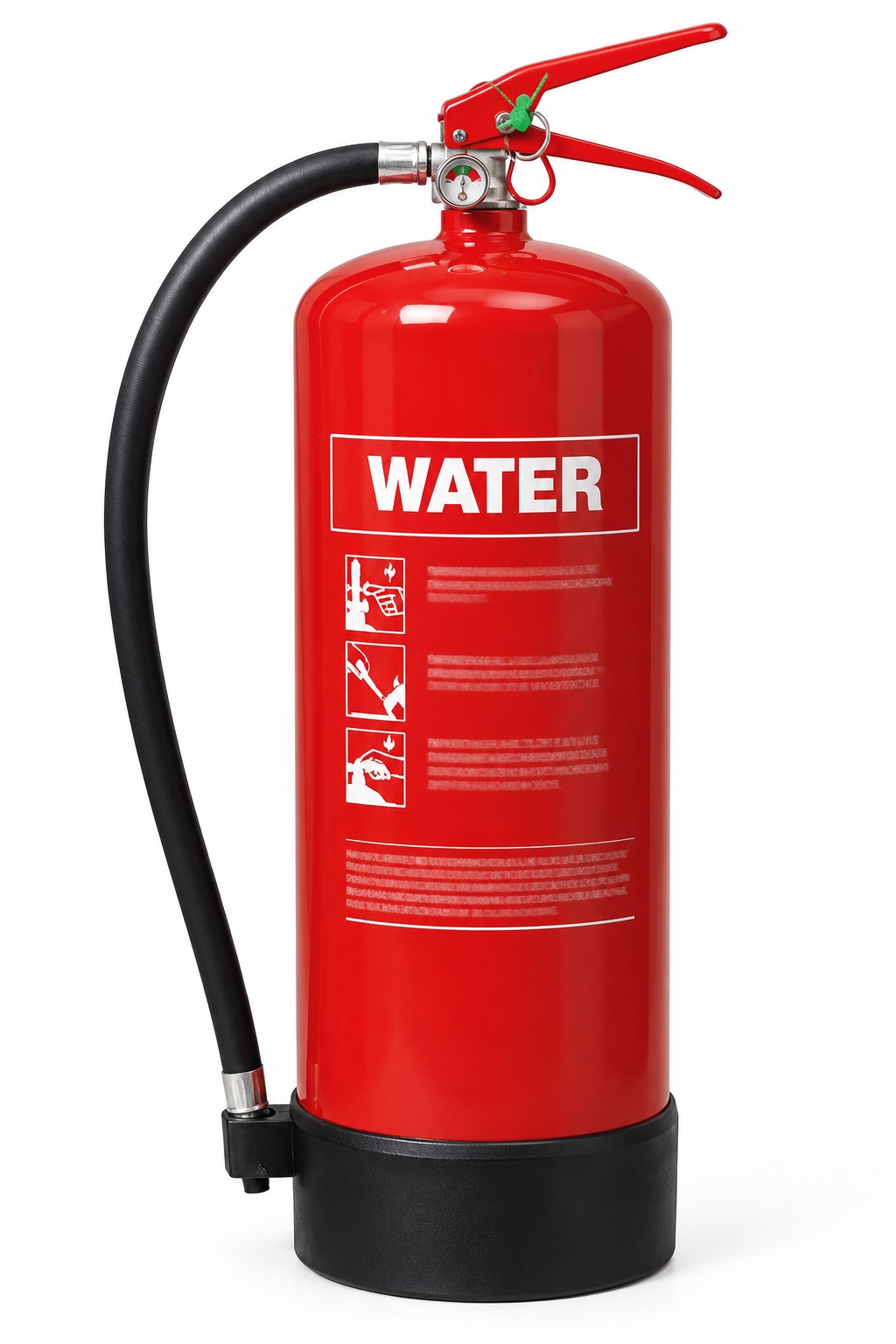  | Normally A Cools burning solid material such as paper, wood or fabric. | Check the limitation Ordinary water is unsuitable for live electrical equipment, flammable-liquid pools, cooking oil and reactive metals: shock, spreading fuel or violent reaction can result. |
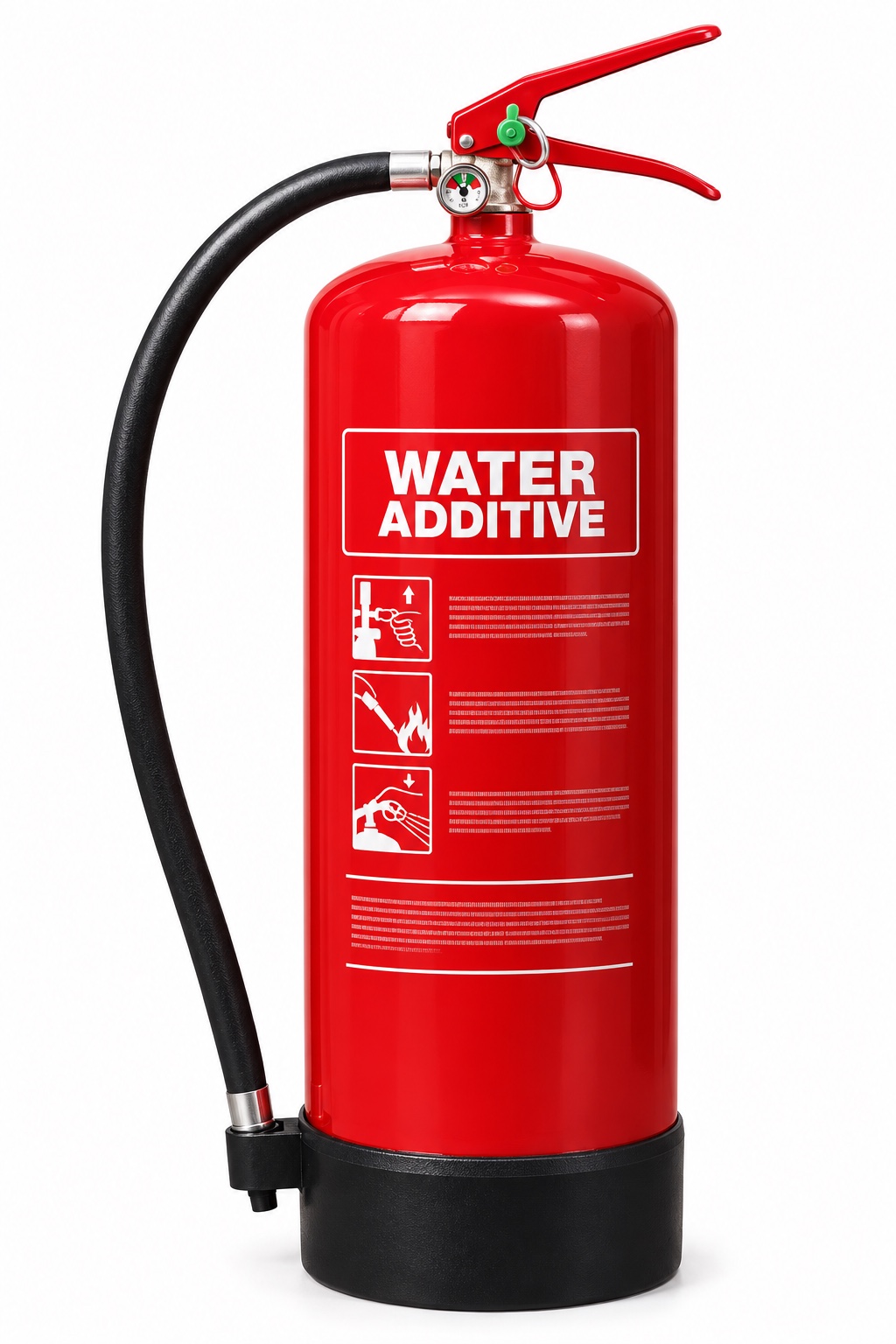 | A; B only if explicitly rated Improved wetting or spray performance can help on the hazards stated on that model’s label. | Check the limitation An additive does not make every water extinguisher safe for electricity, oils or reactive chemicals. Check the specific exclusions. |
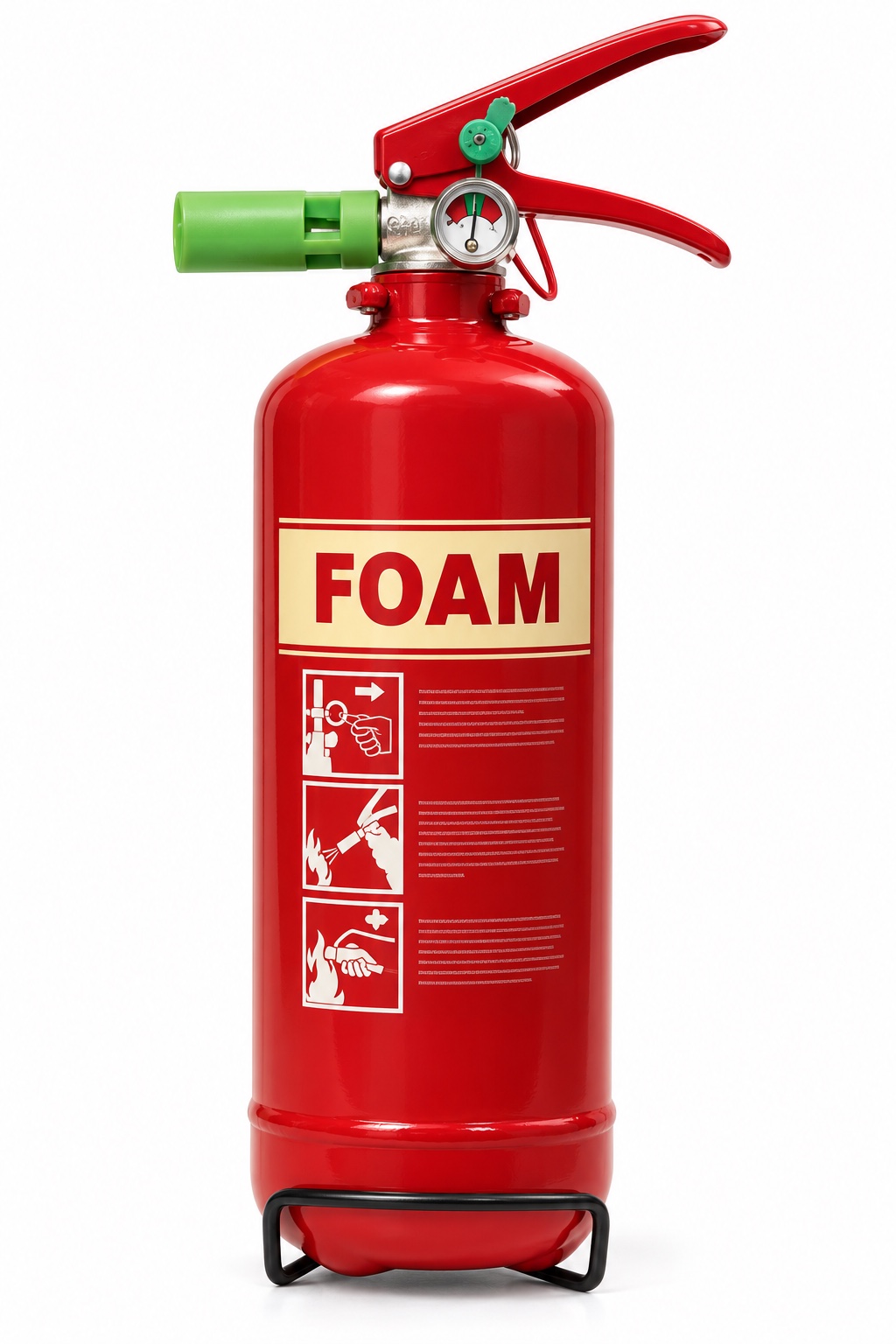 | Commonly A and B Cools and forms a surface blanket on suitable liquid fires. The agent must suit the actual fuel; some alcohols need alcohol-resistant foam. | Check the limitation Ordinary foam is not a general answer for live electricity, cooking oil or metal fires. Unsuitable foam may break down on a solvent; a jet can spread fuel. Free-flowing fuel needs specialist response. |
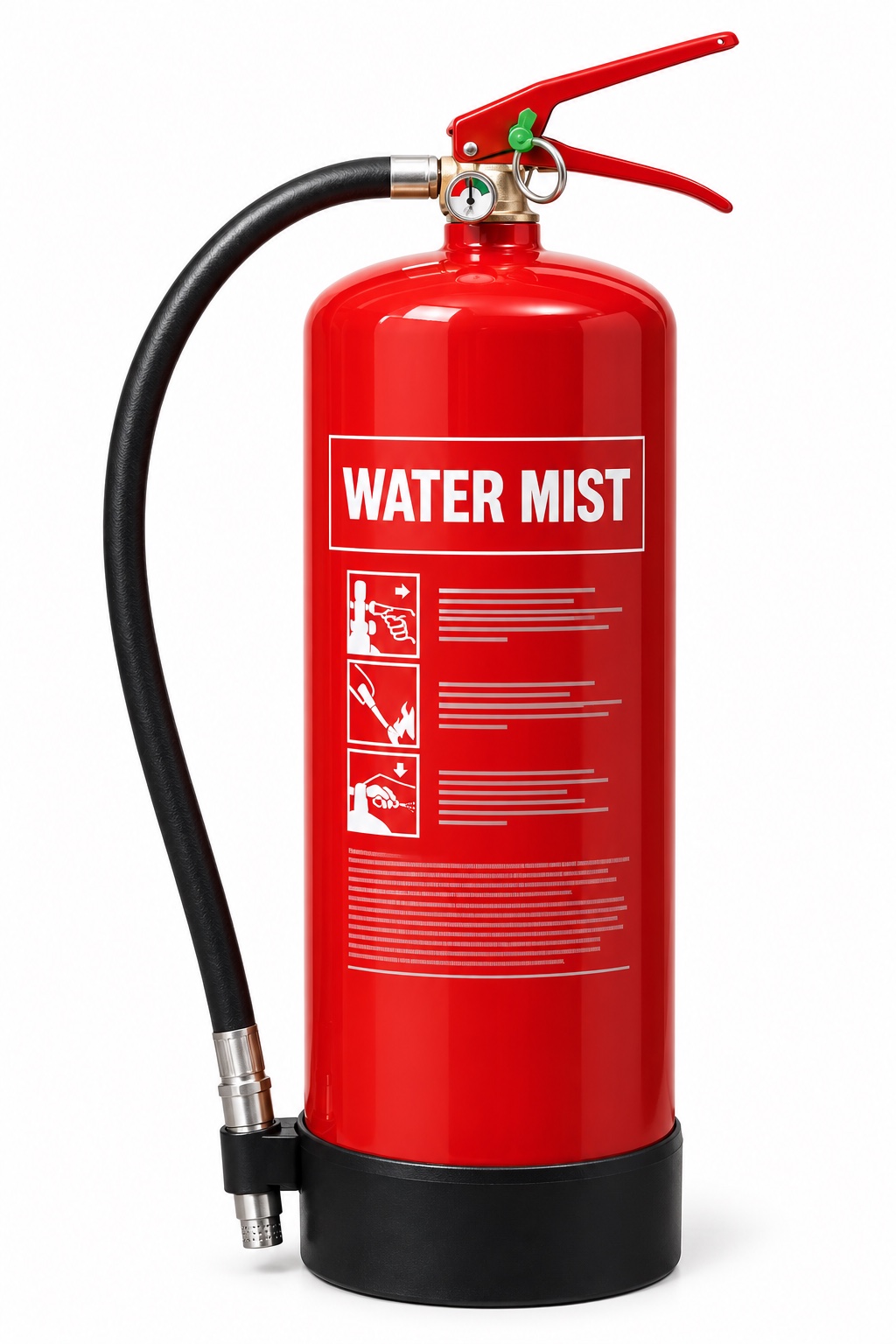 | Model-specific; commonly A, some F Fine droplets absorb heat. Some products have additional ratings or tested electrical suitability, with stated voltage and distance conditions. | Check the limitation ‘Mist’ is not universal approval. Use only the classes and electrical conditions actually declared for that model; do not assume it covers metals, liquids or batteries. |
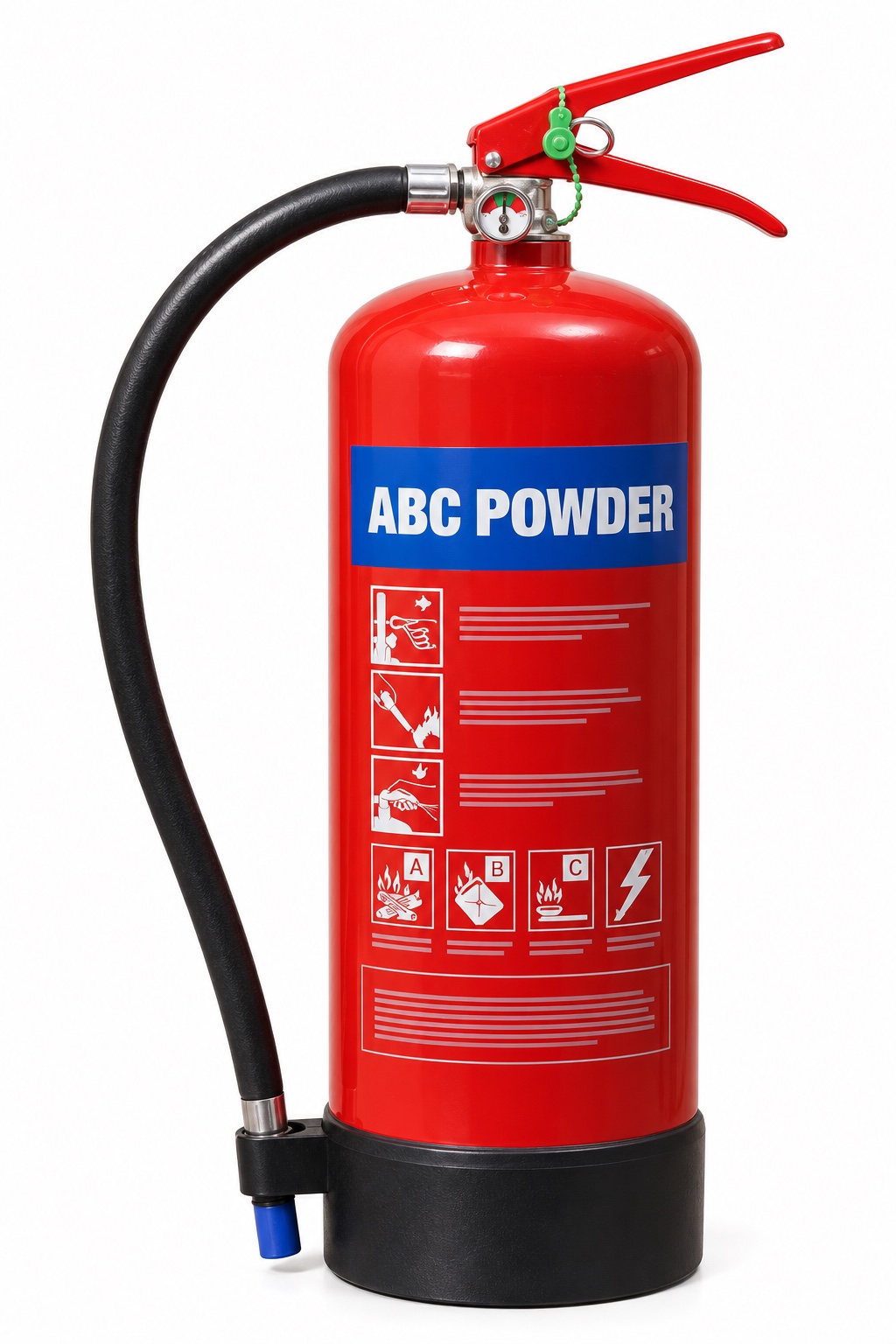 | A, B and C if marked Interrupts flame chemistry; multipurpose powder also acts on Class A material. A C marking does not authorise tackling a gas leak. | Check the limitation Powder can obscure escape and impair breathing; it is not generally recommended indoors. Limited cooling allows reignition. It is not metal-specific D powder or a substitute for F-rated cooking-oil equipment. |
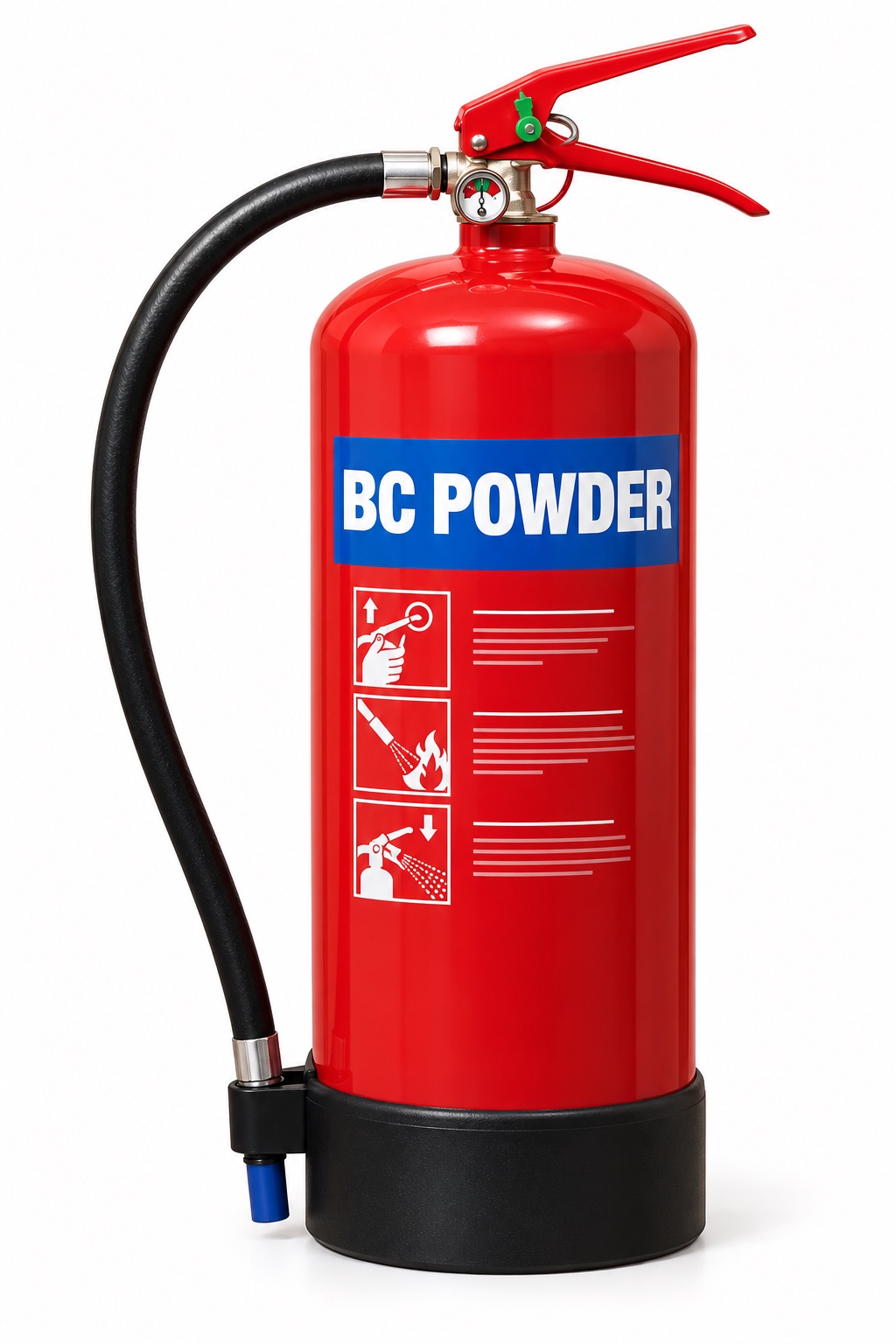 | B and C if marked; not A Selected for particular liquid or gas hazards under the assessed plan. Electrical use must follow the actual unit’s instructions. | Check the limitation Do not assume all blue powder extinguishers protect wood or paper. It has the visibility, breathing and reignition limitations of powder; it does not provide Class D or F protection. |
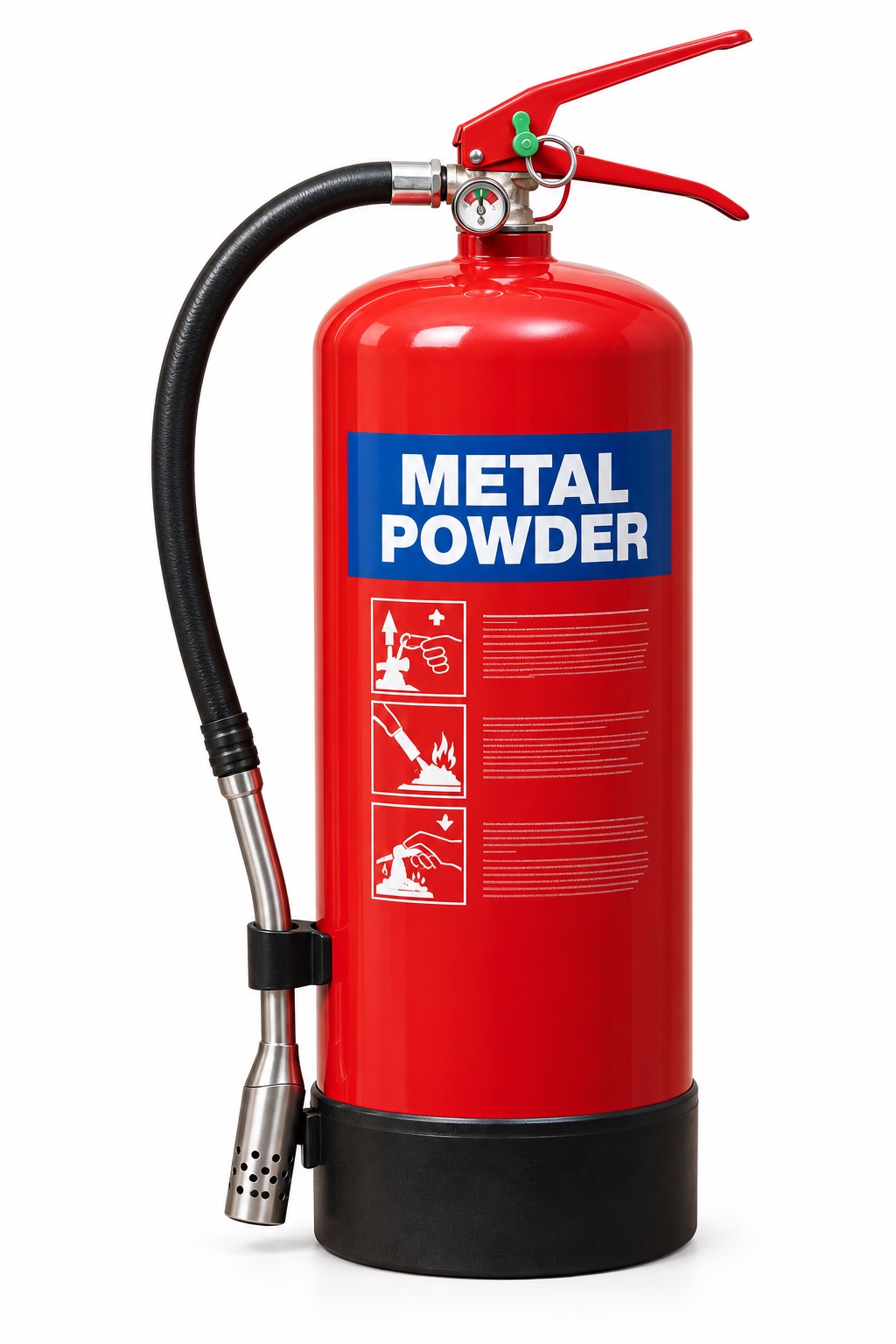 | D, for the specified metal A specialist powder can isolate or absorb heat from a compatible burning metal. Selection requires knowledge of the metal and its form. | Check the limitation The wrong powder can fail or react. Water, foam and CO₂ can be dangerous on certain burning metals. A powder suitable for magnesium is not automatically suitable for metallic lithium. |
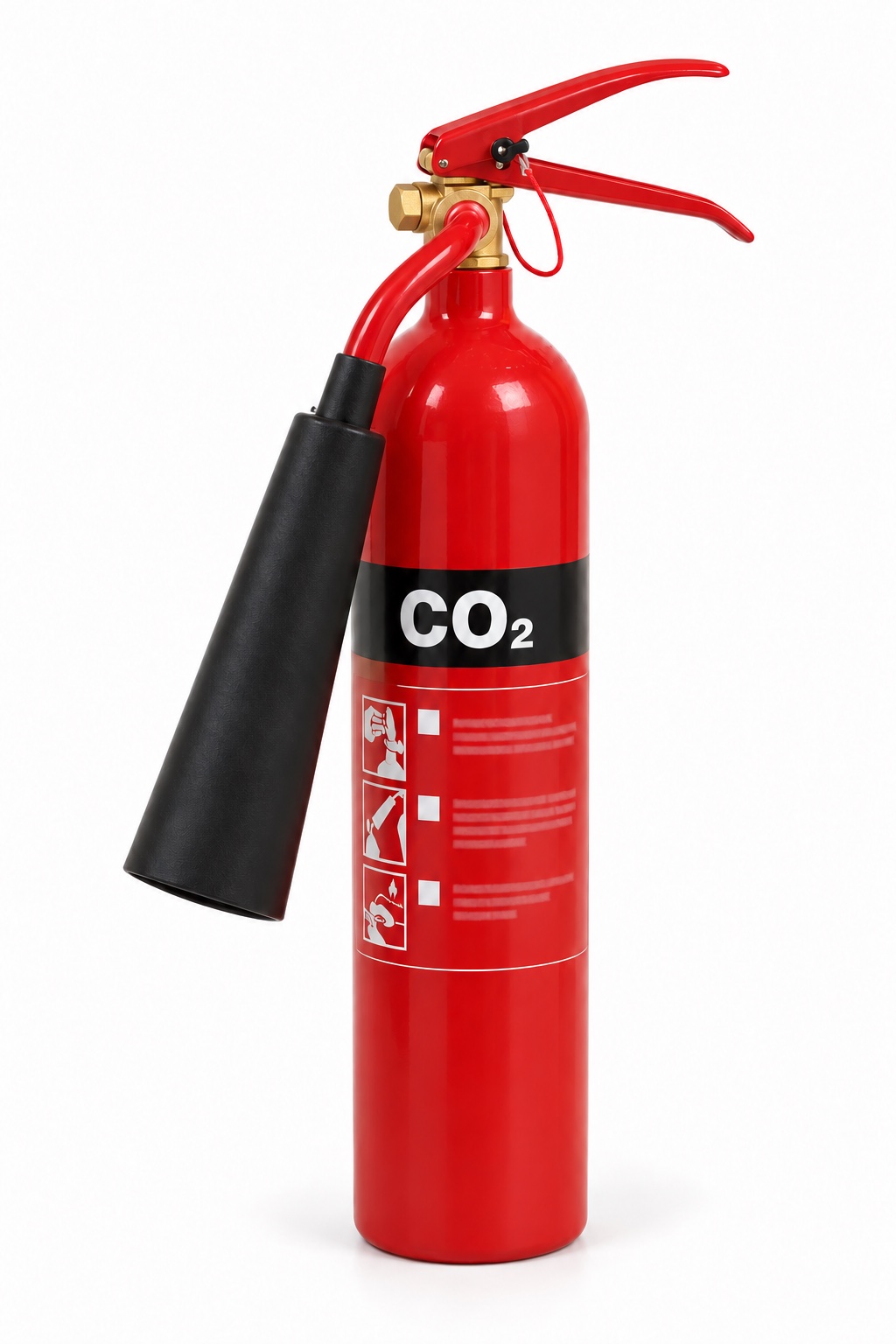 | B; electrical use as instructed Displaces the atmosphere around a small flame and leaves no powder residue. Often selected around electrical equipment. | Check the limitation Poor cooling means reignition is possible. CO₂ can create a dangerous atmosphere in enclosed spaces; discharge can cause frostbite. Hold only the designated insulated parts. Not a cooking-oil or metal-fire substitute. |
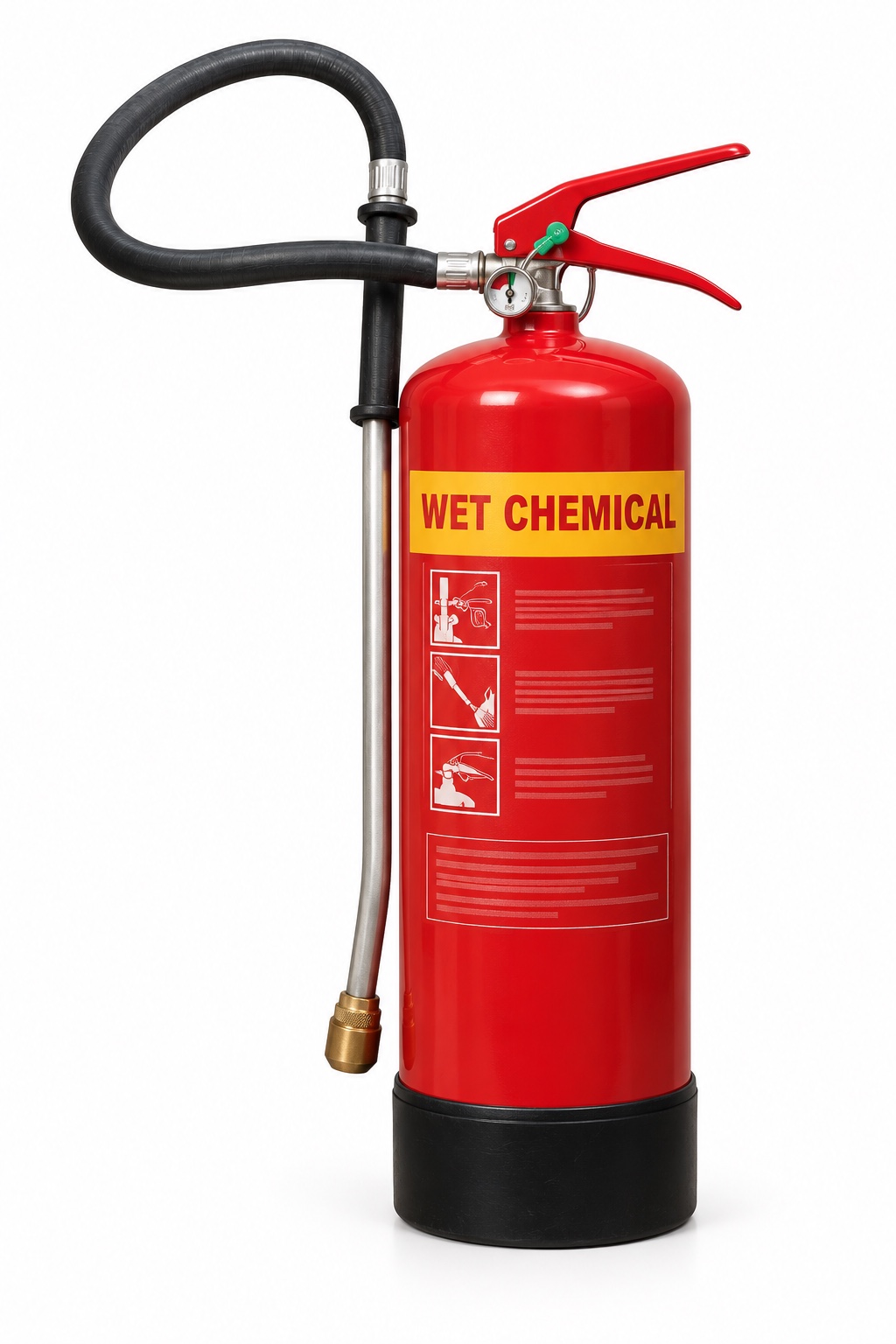 | F; often A if marked Cools cooking oil and creates a protective surface layer through reaction with the fat. Use only within the actual unit’s rating and instructions. | Check the limitation Do not mistake it for a general liquid-fire or electrical extinguisher. Incorrect application or moving the fryer can splash hot oil; apparent flame-out does not establish safe temperature. |
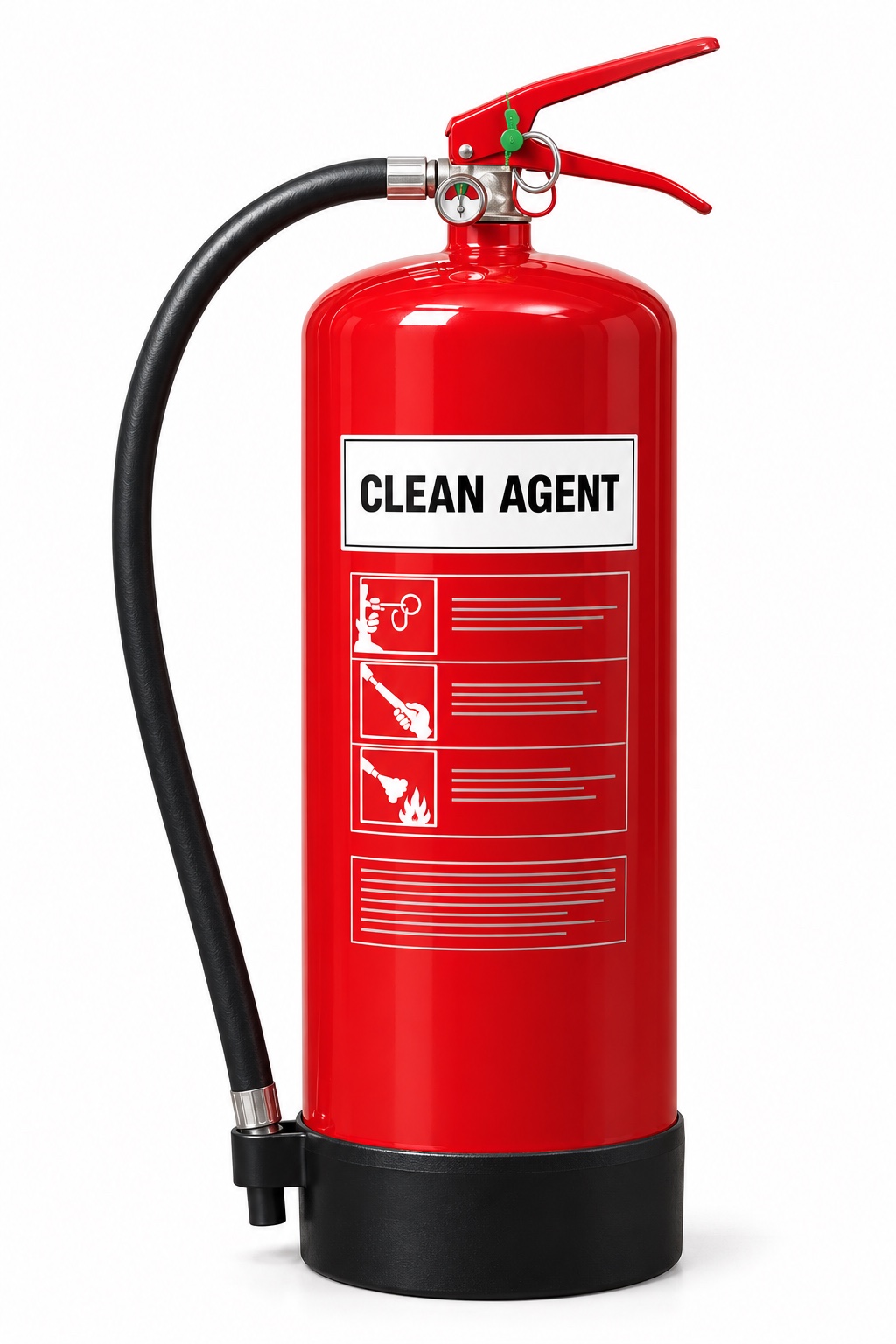 | Product- and jurisdiction-specific Specialist low-residue agents may protect sensitive equipment. Confirm the UK-approved application and the manufacturer’s limits. | Check the limitation Low residue does not mean safe to breathe. Do not copy a US A:B:C rating as UK gas-fire approval. Legacy halon is restricted to permitted critical uses and applicable deadlines. |
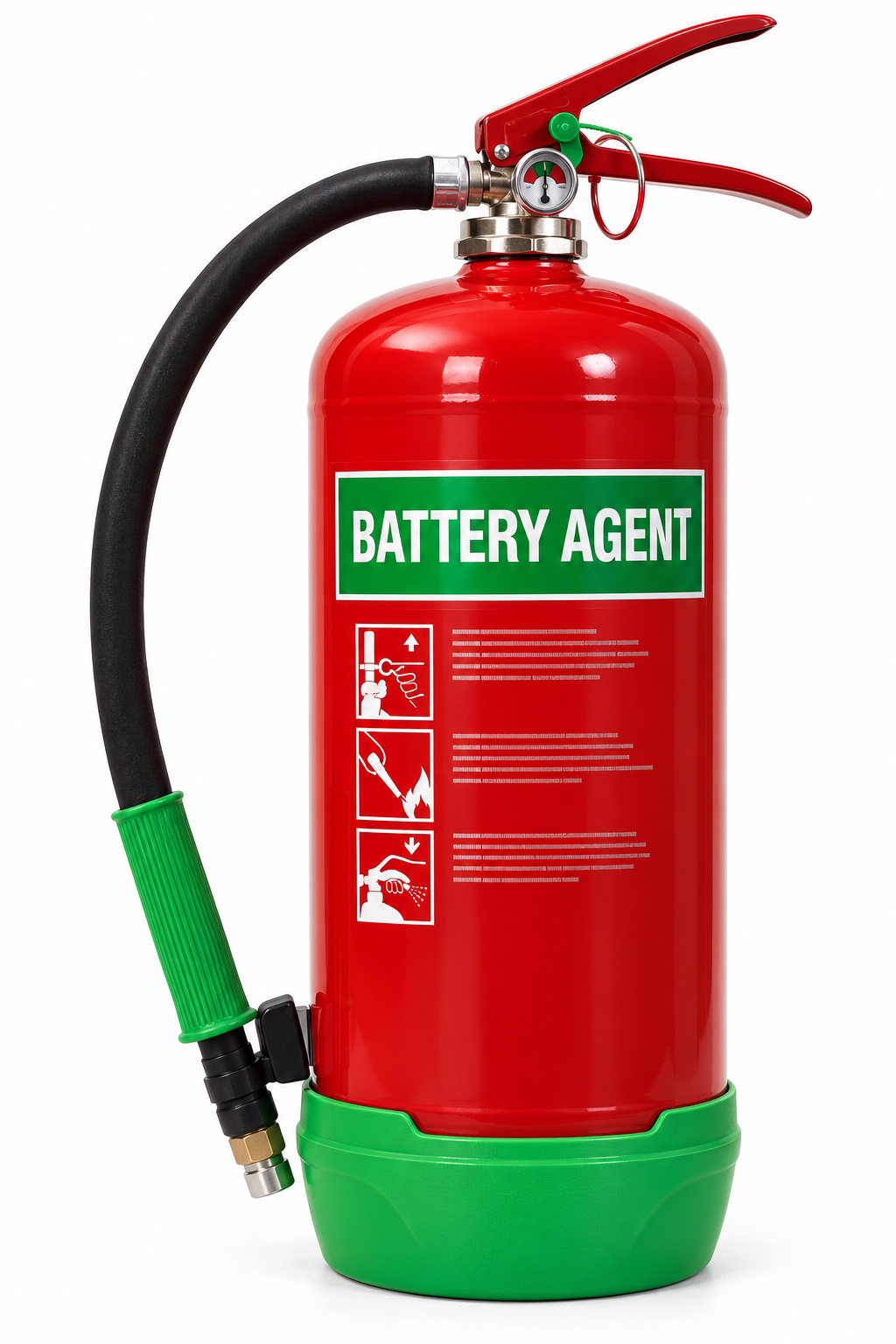 | Check independent scope and instructions Some products use water-based cooling or specialist media such as aqueous vermiculite for specified battery scenarios. Selection depends on chemistry, capacity and location. | Check the limitation A ‘lithium’ label is not proof it will stop thermal runaway in a large pack. Flame suppression may not prevent reignition or gas release. Do not approach, carry or submerge a failing battery as a learner exercise. |
Lithium-ion product example · Firechief 6 L Lith-Ex

A named product example helps connect the generic table to an actual unit. Confirm the exact product before using its claims.
- Agent and intended application
- The linked Seton example uses aqueous vermiculite dispersion (AVD) for specified lithium-ion battery fire applications. Water content cools; the dispersed mineral helps form a barrier. This is not generic Class D metal-fire powder.
- Read the actual rating
- Seton lists a 6 L product with a 13A rating. That A rating describes its solid-material test performance; it does not, by itself, certify a universal Class L battery capability.
- Match the exact model and generation
- The manufacturer’s current 6 L G2 page identifies FLE6X and different discharge details from the retailer’s older listing. Do not mix their time, range or pressure values. Match the delivered label, product sheet and manual.
- Check the battery scope
- Confirm the allowed battery chemistry, energy capacity, state and scenario with the current manufacturer information and competent fire assessment. A large EV or energy-storage pack cannot be treated as a small-device fire.
- Electrical conditions are product-specific
- The supplied product label includes a voltage and minimum-distance condition. Do not transfer that condition to another battery extinguisher or infer that it makes an unsafe electrical approach acceptable.
- After the flame disappears
- Heat, off-gas and reignition can remain. Follow the planned withdrawal, exclusion and fire-service response; do not pick up, submerge or return a failed battery to charging.
Seton · supplied 6 L Lith-Ex example ↗
Firechief · current 6 L G2 model information ↗
Read the actual label
Read the agent, fire-class letters, performance rating, electrical warnings, operating instructions and service condition. Numbers such as 13A or 55B describe standardised test performance, not a safe room size or permission to tackle that amount of fire. Colour is a clue; the actual label and assessed plan decide suitability.
Spot the dangerous assumption
Pause at each question, then open the explanation. These are unscored learning prompts alongside the course assessment.
Keep prevention, alarms, compartmentation and escape effective. Report a missing, obstructed, damaged or discharged extinguisher; do not return a partly used unit to service. Competent selection, maintenance and practical training belong in the fire arrangements.
How might a small manufacturing site build emergency controls from its FRA?
A manufacturing example shows how a fire assessment should create operational controls, not just recommendations.
Two evidence streams must meet before action closure

Full written explanation
An illustrative shared-office maintenance-review scene provides closed services-room door,shared corridor,blank plan and normal participant context beside two independent evidence streams. Picture key: 1 Closed services-room door · 2 Shared corridor · 3 Review plan · 4 Review participants. The PHYSICAL PROTECTION stream asks about repair / function of the door,route,warning or other assessed safeguard. The OPERATING ARRANGEMENT stream asks about stock / use / people and assistance,shifts,briefing and actual response. Two arrows join FIELD CHECK BOTH: Real function + real users + shared control + current evidence. Neither stream closes the other. Four checks locate the finding and changed use,keep affected people protected,implement both owned actions,then join field evidence and review. Separate process headings are unnumbered. An actual alarm follows the emergency plan first,independent of planned checks and records. The scene proves no repair,tested function,door rating,warning state,safe route,role,contract,duty,action closure or permission to continue or occupy. Manufacturing/workshop examples and current national,person-led,source and model limitations retain their own scope.
Shared-premises comparison: a restored safeguard and a workable operating arrangement need separate evidence.
- Locate the finding and changed use. Identify the actual system, work, people and shared responsibilities affected.
- Keep affected people protected. Resolve present safeguards or restrictions while actions and uncertainty remain open.
- Implement both owned actions. Verify physical work separately from stock, shift, assistance and briefing changes.
- Join field evidence and review. Check function and actual users, record limitations and revisit further change.
When the evidence does not fit: One stream cannot close the other. Keep unresolved warning, escape or user arrangements with the competent owner; an actual alarm follows the emergency plan first.
Who acts: Premises fire lead, relevant system/repair owner, operating supervisor and shared-premises dutyholders.
Changed workplace
Small workshop: Connect proposed ignition, actual materials and delivery/escape change to verified actions.
Shared commercial premises: Join physical protection and operating evidence across the people who actually control them.
Evidence check: No substance identity, isolation, safe separation, alarm configuration, alternative exit, permit or permission to continue is established.
Read why physical restoration and operating acceptance need separate evidence
Primary references: HSE: dangerous substances and emergency planning · HSE: current construction fire guidance · HSE: planned emergency actions and people
Open the complete HD image (new tab)Download image

Read why physical restoration and operating acceptance need separate evidence
Primary references: HSE: dangerous substances and emergency planning · HSE: current construction fire guidance · HSE: planned emergency actions and people
At Calder Manufacturing, a contractor proposes hot work near solvent cleaning while a charger and packaging share the loading bay. The project manager first checks whether the weld can be avoided and stops simultaneous solvent cleaning. The competent assessor identifies the actual solvent, charger chemistry and manufacturer instructions, tests escape, warning and smoke paths, and agrees a fuel-free work zone. The responsible person records the full E&W fire assessment and an impairment plan; the process owner controls DSEAR risks. Before hand-back, the fire lead verifies the route, alarm and compartment and the shift supervisor demonstrates the new emergency action.
The HSE DSEAR guidance supports dangerous-substance assessment and emergency training; HSE welding guidance supports hot-work ignition controls, and the Home Office industrial-premises guide supports the England premises route.
A small manufacturer uses packaging, oils, battery chargers, a compressor room and occasional contractor hot work. The FRA identifies ignition sources, fuel load, plant-room risk, workers on two shifts and a rear escape route used for deliveries.
The emergency controls are then built around those findings: hot work permit, waste control, charger inspection, alarm audibility on both shifts, clear rear route, emergency lighting, appointed wardens, contractor briefing, plant isolation instructions and drill scenarios that include the delivery route being blocked.
| FRA finding | Emergency control | Evidence |
|---|---|---|
| Hot work possible | Permit, area clearance, fire watch and post-work check. | Permit record and supervisor sign-off. |
| Rear route used for deliveries | Route kept clear and delivery rules briefed. | Daily route check and delivery instruction. |
| Compressor room risk | Detection, isolation and no combustible storage. | Inspection and maintenance records. |
| Two-shift operation | Training and drills cover both shifts. | Training matrix and drill schedule. |
| Contractors on site | Emergency briefing and host control. | Contractor induction and permit. |
What does weak versus strong fire control look like?
Strong controls are specific, tested and owned; weak controls exist only as broad statements.
The difference between a weak and strong fire system is often visible in evidence. Weak systems rely on assumptions such as 'staff know exits' or 'contractors manage their own work'. Strong systems test alarm response, check routes, control hot work, inspect doors, brief contractors and close defects.
Managers should be able to see these differences during routine assurance rather than waiting for an incident or enforcement inspection.
| Area | Weak control | Strong control |
|---|---|---|
| FRA | Generic checklist with vague actions. | Specific findings, competent judgement and tracked actions. |
| Training | Annual online module only. | Role-specific briefing, route knowledge and drill learning. |
| Emergency routes | Signs present but route used for storage. | Routes inspected, kept clear and defects escalated. |
| Maintenance | Certificates filed without review. | Defects risk-ranked and repaired with retest evidence. |
| Contractors | RAMS accepted without local controls. | Hot work, routes, alarms and fire stopping are controlled. |
| Review | Annual date in calendar. | Review after change, drill failure, incident or new risk. |
When must fire emergency controls be updated after change?
Emergency controls should change when the premises, people, routes, fire load or work activity changes.
A change may look operational rather than fire-related: new stock, temporary event, shift change, new contractor, route closure, refurbishment, new machinery, altered alarm zone, new tenant or a person needing evacuation support.
Managers should ask whether the change affects warning, escape, assistance, fire spread, ignition, fuel load, fire service access or emergency shutdown. If it does, the FRA and emergency plan need review.
| Change | Fire control affected | Action |
|---|---|---|
| Refurbishment | Routes, alarms, doors, penetrations and fire load. | Temporary fire plan and daily review. |
| New shift | Training, warden cover and alarm response. | Update rota cover and drill evidence. |
| New flammable substance | Ignition, storage, DSEAR and firefighting media. | Review SDS, storage and emergency response. |
| New tenant | Shared routes and responsible-person coordination. | Exchange fire safety information. |
| Known mobility need | Assisted escape and dignity. | Update PEEP or generic plan. |
How does an FRA finding become an emergency control?
A fire risk assessment should convert significant findings into clear prevention, protection or emergency controls with evidence.
A blocked exit is an immediate condition, not an action for the next inspection. Clear it now and restrict use if the required escape arrangement cannot be maintained. A temporary warning method for a failed alarm needs a competent, documented judgement for actual noise, staffing, visitors and shifts; a pager or local sweep is not automatically equivalent to a working system.
The most important test of a fire risk assessment is whether findings become controls that can be checked. A finding should not sit in isolation; it should change inspection routines, training, equipment, layouts, procedures, maintenance or emergency planning.
This table gives a practical bridge for learners and managers. It shows how common findings become operational controls and the evidence that should be available afterwards.
| FRA finding | Emergency or prevention control | Evidence to check |
|---|---|---|
| Blocked exit or route | Remove the obstruction immediately. Stop or restrict use if safe escape cannot be maintained; then redesign storage, brief workers and add route checks. | Inspection record, photo close-out and repeat-check trend. |
| Vulnerable person may need help | Create or review PEEP/generic evacuation arrangement and train helpers. | Private plan, equipment check and drill observation. |
| High fire load in store | Set storage limits, waste removal frequency and separation from ignition sources. | Storage-zone checks, waste records and supervisor review. |
| Poor alarm audibility | Escalate to the responsible person and competent alarm designer; restrict affected use until effective warning is restored or a risk-assessed temporary method covers every person and shift. | Audibility/visibility test and competent recommendation. |
| Damaged fire door | Repair, apply interim control and add to fire-door register. | Defect log, repair certificate/photo and retest. |
| Hot work near combustibles | Permit, area clearance, fire watch and post-work inspection. | Permit record and fire-watch close-out. |
| Contractor penetrations | Require fire-stopping handback and competent evidence. | Permit, product details, location and photo record. |
| Confusing assembly or roll call | Review assembly point, visitor control and missing-person reporting. | Drill record and revised emergency plan. |
How can the hierarchy of controls prioritise fire prevention, protection and emergency controls?
Use ERICPD and the five-level HSE hierarchy as related decision aids. Begin with removal and substitution, then verify engineered barriers before relying on procedures or PPE.
Task matrices are illustrations; premises-specific suitability, implementation and specialist design approval remain held for competent review.
Stock blocks an exit while one alarm zone is isolated; a packaging fire can outrun the assumed warning and escape pathway.
Vapour, sparks and changed doors create both a work-process fire and an escape/compartment problem.
How can the ERICPD hierarchy of controls prioritise fire prevention, protection and emergency controls?

| Hazard and harm route | ERICPD → five-level control | Task measure and feasibility | Owner, test and evidence | Failure and stop decision |
|---|---|---|---|---|
| Blocked exit and impaired alarm in a small factory | Eliminate → Elimination | Remove stock from the required exit and cease the activity that blocks it; do not use an impairment procedure as permission to obstruct escape. Source: official guidance. | Factory manager witnesses clear route and records stop; no operation in the affected area until safe escape is restored. | Required exit remains blocked: stop affected operations until immediately clear. |
| Same scenario | Reduce → Substitution | Manage stock location and quantities, delivery arrangements, occupancy restrictions, user briefing and assistance. Verify the actual route and warning with affected shifts before operating acceptance. Source: official guidance. | Operations lead verifies storage plan during peak delivery; reject displacement of the hazard. | Deliveries reoccupy a different exit: reject the storage change. |
| Same scenario | Isolate → Engineering | Repair and recommission the alarm zone, test warning at noisy positions and maintain the protected exit and fire doors. Source: official guidance. | Competent alarm maintainer records test and fire lead confirms route condition; restrict affected occupancy until functions work. | Alarm zone fails recommissioning or exit is unusable: restrict affected occupancy. |
| Same scenario | Control → Administrative | Use a named impairment coordinator, temporary occupancy decision, shift briefing, alternative warning only if justified and a logged repair deadline. Source: official guidance. | Responsible person compares plan to field conditions each shift; stop if staff cannot be warned and evacuated. | Temporary warning cannot reach every person and shift: stop use until effective warning returns. |
| Same scenario | PPE → PPE | Ordinary PPE cannot compensate for a failed alarm or exit. Task PPE for the alarm technician follows a separate work assessment. Source: official guidance. | Assessor records zero PPE credit for occupant life safety. | Occupant safety depends on PPE despite failed warning or escape: reject that occupancy decision. |
| Same scenario | Discipline → Administrative assurance | Retest after repair, review drill route choice and recurring stock encroachment, and update the FRA and emergency plan together. Source: official guidance. | Fire lead signs hand-back and samples next shift; reopen only on evidence. | Repair test or next-shift route check fails: keep the restriction and reopen the FRA. |
| Solvent cleaning and hot work during refurbishment | Eliminate → Elimination | Schedule prefabrication off site so no hot work occurs near solvent cleaning; remove solvent from the task where feasible. Source: official guidance. | Project engineer approves method before permit issue; halt the combined activity. | Hot work and solvent cleaning remain simultaneous: halt both and redesign schedule. |
| Same scenario | Reduce → Substitution | Choose a suitable non-flammable cleaner and cold joining method only after compatibility and quality checks; minimise remaining dangerous inventory. Source: official guidance. | Purchaser and engineer verify specification and safety data; unknown compatibility blocks substitution. | Cleaner or cold joint is incompatible or unverified: do not substitute or begin work. |
| Same scenario | Isolate → Engineering | Separate work physically, isolate fuel and services, maintain fire doors, provide suitable extraction and verify detection/escape during the change. Source: official guidance. | Competent lead checks isolation and warning; stop on unknown vapour or breached protected route. | Vapour, isolation or protected route is uncertain: stop hot work and evacuate as required. |
| Same scenario | Control → Administrative | Coordinate one work permit with DSEAR assessment, fire-impairment log, fire watch, emergency briefing and named hand-back authority. Source: official guidance. | Permit issuer witnesses before/during/after checks; a signature alone never proves fuel removal. | Fire watch or post-work monitoring is absent: suspend permit and work. |
| Same scenario | PPE → PPE | Select task-specific welding eye, hand and body protection for competent workers; it cannot protect bystanders from flash fire or replace vapour control. Source: official guidance. | Contractor supervisor inspects PPE and retreat route. | Bystanders need PPE against flash fire: reject the work-zone plan. |
| Same scenario | Discipline → Administrative assurance | Trend permit deviations and repeat smoke/door defects; update the FRA, process assessment and plan before restarting routine work. Source: official guidance. | Dutyholder signs field closeout and rechecks after change. | Repeat permit or door defect remains open: no routine restart until field closeout. |
How can the ISO 45001 hierarchy of controls prioritise fire prevention, protection and emergency controls?

| Hazard and harm route | ERICPD → five-level control | Task measure and feasibility | Owner, test and evidence | Failure and stop decision |
|---|---|---|---|---|
| Blocked exit and impaired alarm in a small factory | Eliminate → Elimination | Remove stock from the required exit and cease the activity that blocks it; do not use an impairment procedure as permission to obstruct escape. Source: official guidance. | Factory manager witnesses clear route and records stop; no operation in the affected area until safe escape is restored. | Required exit remains blocked: stop affected operations until immediately clear. |
| Same scenario | Reduce → Substitution | Manage stock location and quantities, delivery arrangements, occupancy restrictions, user briefing and assistance. Verify the actual route and warning with affected shifts before operating acceptance. Source: official guidance. | Operations lead verifies storage plan during peak delivery; reject displacement of the hazard. | Deliveries reoccupy a different exit: reject the storage change. |
| Same scenario | Isolate → Engineering | Repair and recommission the alarm zone, test warning at noisy positions and maintain the protected exit and fire doors. Source: official guidance. | Competent alarm maintainer records test and fire lead confirms route condition; restrict affected occupancy until functions work. | Alarm zone fails recommissioning or exit is unusable: restrict affected occupancy. |
| Same scenario | Control → Administrative | Use a named impairment coordinator, temporary occupancy decision, shift briefing, alternative warning only if justified and a logged repair deadline. Source: official guidance. | Responsible person compares plan to field conditions each shift; stop if staff cannot be warned and evacuated. | Temporary warning cannot reach every person and shift: stop use until effective warning returns. |
| Same scenario | PPE → PPE | Ordinary PPE cannot compensate for a failed alarm or exit. Task PPE for the alarm technician follows a separate work assessment. Source: official guidance. | Assessor records zero PPE credit for occupant life safety. | Occupant safety depends on PPE despite failed warning or escape: reject that occupancy decision. |
| Same scenario | Discipline → Administrative assurance | Retest after repair, review drill route choice and recurring stock encroachment, and update the FRA and emergency plan together. Source: official guidance. | Fire lead signs hand-back and samples next shift; reopen only on evidence. | Repair test or next-shift route check fails: keep the restriction and reopen the FRA. |
| Solvent cleaning and hot work during refurbishment | Eliminate → Elimination | Schedule prefabrication off site so no hot work occurs near solvent cleaning; remove solvent from the task where feasible. Source: official guidance. | Project engineer approves method before permit issue; halt the combined activity. | Hot work and solvent cleaning remain simultaneous: halt both and redesign schedule. |
| Same scenario | Reduce → Substitution | Choose a suitable non-flammable cleaner and cold joining method only after compatibility and quality checks; minimise remaining dangerous inventory. Source: official guidance. | Purchaser and engineer verify specification and safety data; unknown compatibility blocks substitution. | Cleaner or cold joint is incompatible or unverified: do not substitute or begin work. |
| Same scenario | Isolate → Engineering | Separate work physically, isolate fuel and services, maintain fire doors, provide suitable extraction and verify detection/escape during the change. Source: official guidance. | Competent lead checks isolation and warning; stop on unknown vapour or breached protected route. | Vapour, isolation or protected route is uncertain: stop hot work and evacuate as required. |
| Same scenario | Control → Administrative | Coordinate one work permit with DSEAR assessment, fire-impairment log, fire watch, emergency briefing and named hand-back authority. Source: official guidance. | Permit issuer witnesses before/during/after checks; a signature alone never proves fuel removal. | Fire watch or post-work monitoring is absent: suspend permit and work. |
| Same scenario | PPE → PPE | Select task-specific welding eye, hand and body protection for competent workers; it cannot protect bystanders from flash fire or replace vapour control. Source: official guidance. | Contractor supervisor inspects PPE and retreat route. | Bystanders need PPE against flash fire: reject the work-zone plan. |
| Same scenario | Discipline → Administrative assurance | Trend permit deviations and repeat smoke/door defects; update the FRA, process assessment and plan before restarting routine work. Source: official guidance. | Dutyholder signs field closeout and rechecks after change. | Repeat permit or door defect remains open: no routine restart until field closeout. |
In a care setting, staffing and protected movement change the emergency sequence; on a construction site, temporary compartments and contractor work change both process and premises risks. The dutyholder verifies the actual strategy and restricts use where a credited barrier is impaired.
How do emergency controls differ by premises?
The same control headings apply across premises, but the detail changes with people, layout, work activity and fire development.
Emergency controls should feel different in different premises. A care home depends on staff-assisted movement and compartmentation; a factory may depend on shutdowns and hot work control; a school depends on large-group supervision; a mixed-use building depends on cooperation between responsible persons.
This is why fire safety controls must be written and checked in local language. The reader should be able to picture the premises, the people and the decision.
| Premises | Control emphasis | Good evidence |
|---|---|---|
| Care home | Progressive horizontal evacuation, staffing, PEEPs/generic plans and compartment checks. | Night drill, door checks and staff allocation. Context: Home Office residential care fire-risk-assessment guide; Home Office disabled means-of-escape guide. |
| Warehouse | High fire load, alarm audibility, visiting drivers, forklifts and route discipline. | Route inspections and loading-bay alarm review. Context: the Home Office industrial-premises guide. |
| School | Pupil supervision, assembly control, visitors and specialist rooms. | Drill observations and class/accountability process. Context: Scottish existing non-residential fire guidance; GOV.UK fire safety equipment, drills and training. |
| Factory | Shutdowns, process heat, hot work, contractors and plant rooms. | Permit records and isolation instructions. Context: the Home Office industrial-premises guide; HSE DSEAR guidance. |
| Office | Shared stairs, hybrid occupancy, DSE/electrics and visitors. | Landlord/tenant cooperation and visitor procedure. Context: official guidance; Home Office Section 156 guide; Welsh Government companion. |
| Refurbishment site | Temporary alarms, changing routes, incomplete fire stopping and hot work. | Temporary fire plan and daily check. Context: HSG168 Fire safety in construction. |
When are fire emergency controls not good enough?
Controls are not good enough when they do not match the risk assessment, cannot be used in real conditions or lack evidence.
The responsible person should be cautious where controls depend on ideal behaviour: every door closed, every person trained, every route clear and every contractor compliant. Good controls include checks, supervision and fallback arrangements.
If a critical control is impaired, normal operation may need temporary restriction until protection is restored.
| Trigger or question | Immediate action | Evidence before normal operation |
|---|---|---|
| Has the premises, occupancy or work activity changed? | Review the fire risk assessment and decide whether the current controls still work. | Updated assessment, action tracker and briefing record. |
| Is a critical fire precaution impaired? | Stop or restrict affected use where warning, escape or assistance cannot be relied on; obtain a competent temporary strategy, verify its effectiveness for all affected people and shifts, and restore the control. | Impairment record, competent repair and retest evidence. |
| Is the finding outside internal competence? | Seek competent fire safety advice before making assumptions. | Scope of advice, report, decision record and action closure. |
| Did a drill, alarm, inspection or incident reveal weakness? | Investigate the cause and update the arrangement. | Learning record, corrective action and re-test. |
| Could delay expose people to smoke, heat or blocked escape? | Stop normal reliance on the weak arrangement until a safe interim control exists. | Temporary control approval and communication record. |
Where do fire risk assessment and emergency controls disconnect?
They disconnect when assessment findings are not converted into maintained, trained and tested controls.
A good FRA without action is weak. A detailed emergency plan that people do not know is weak. A certificate for a system with open defects is weak. The management task is to keep the chain connected.
Audits should test the whole route from finding to control to evidence to review.
| Failure or weak practice | How it develops | What good looks like |
|---|---|---|
| Paper compliance | fire emergency controls exist as a document but does not describe real conditions. | Walk the premises, talk to staff and compare records with the work as done. |
| Unowned actions | Findings are made but no one owns budget, deadline or close-out. | Assign accountable owner and escalate high-risk delay. |
| Poor coordination | Landlord, tenant, contractor or shared-premises controls do not join up. | Record responsibilities and information sharing. |
| Unmanaged change | Refurbishment, layout, stock, staffing, plant or contractor changes undermine controls. | Add fire review to change and handover. |
| Weak evidence | Certificates and tick sheets exist but do not prove the control works today. | Check defects, retests, drill learning and close-out quality. |
What evidence shows fire safety, fire risk assessment and emergency controls is controlled?
Evidence should show that fire precautions are suitable, available, maintained, tested, understood and reviewed.
Fire evidence should connect the fire risk assessment to real controls. A log book alone is not enough if defects remain open, staff do not know the procedure or equipment cannot be reached during normal work.
Good records show what was checked, what failed, who owned the action, when it was closed and how the responsible person knows the arrangement still protects relevant persons.
| Evidence item | What it should show | Assurance question |
|---|---|---|
| Fire control register | Critical controls are named, owned, checked and escalated. | Includes alarm, escape, doors, lighting, training and maintenance. |
| Emergency plan | Roles, evacuation, assistance, shutdowns, fire service information and re-entry are defined. | Plan is current and drilled. |
| Change review | Changes are checked for fire safety impact. | Review notes and updated controls. |
| Fire risk assessment | Hazards, people at risk, controls, significant findings, action plan and review triggers are current. | Assessment reflects real premises, not just a template. |
| Action tracker | Actions have owner, date, priority, interim control and close-out evidence. | High-risk actions are escalated when overdue. |
| Inspection and test records | Alarms, emergency lighting, doors, routes, extinguishers and relevant systems are checked. | Records show defects and repairs, not just completed ticks. |
| Training and drill evidence | People understand their role and drills produce learning. | Records include observations and improvements. |
| Management review | Trends, repeat defects, enforcement feedback and major changes are reviewed. | Resources and priorities follow the risk. |
How should fire safety, fire risk assessment and emergency controls be assured?
Assurance should test whether the fire arrangement works in the building, at the time, with the people who may need it.
First-line assurance comes from suitable routine checks, scheduled system tests, warden observations and immediate defect reporting; competent specifications and premises guidance determine the actual intervals. Second-line assurance reviews fire risk assessment actions, drills, maintenance, contractor records and repeat findings. Specialist assurance may include competent fire risk assessor review, fire alarm contractor reports, extinguisher servicing, emergency lighting testing and enforcement feedback.
The test is practical: if the alarm operates today, can everyone hear, understand, move, escape, account for vulnerable people and keep routes safe without relying on luck?
| Assurance layer | What to check | What good looks like |
|---|---|---|
| Frontline checks | Workers, supervisors and wardens check that fire emergency controls are present, usable and understood during normal work. | Defects are corrected or escalated before people rely on weak controls. |
| Manager review | Managers review assessment actions, drills, inspections, contractor effects, training, maintenance and repeat weak signals. | Action ownership, resources and deadlines match the fire risk. |
| Competent review | Competent fire safety support reviews complex premises, technical assumptions, enforcement concerns or uncertainty. | Advice is recorded, risk-ranked and converted into practical action. |
| Leadership review | Senior leaders review overdue high-risk actions, notices, significant impairments, insurance concerns and recurring failures. | Important fire risks are visible in governance and business planning. |
Which fire duties apply across the UK jurisdictions?
England and Wales, Scotland and Northern Ireland have separate non-domestic premises fire routes; work and dangerous-substance duties must also be checked for the actual location and activity.
The Fire Safety Order is the England and Wales premises route. Scottish and Northern Irish instruments are separate. GB work-health rules and DSEAR do not silently apply in NI; use the corresponding NI rules where in scope. This table identifies routes, not legal approval for a site-specific strategy.
For current record rules, Home Office England guidance explains that every E&W responsible person records the full assessment and arrangements; Welsh Government guidance is the Wales authority. The old significant-findings-only wording is no longer sufficient in E&W.
For the exact premises duties in England and Wales, Article 14 covers emergency routes and exits; Article 15 covers serious/imminent-danger procedures; Article 21 requires suitable employee fire-safety training. Scotland and Northern Ireland use different fire-law routes.
| Jurisdiction | Duty or guidance | What it means | How to apply it |
|---|---|---|---|
| E&W | Regulatory Reform (Fire Safety) Order 2005 | Requires the responsible person to assess fire risk and maintain suitable fire precautions in non-domestic premises. | Use as the main fire safety legal framework for England and Wales. |
| GB | Health and Safety at Work etc. Act 1974 | Requires employers to protect employees and others affected by work so far as reasonably practicable. | Use for work activities that create fire, emergency or firefighting risk. |
| GB | Management of Health and Safety at Work Regulations 1999 | Requires suitable and sufficient risk assessment, preventive arrangements, competent help, emergency arrangements and review. | Use for management arrangements, competence and emergency procedures. |
| GB | Dangerous Substances and Explosive Atmospheres Regulations 2002 | Requires fire and explosion risk from dangerous substances to be assessed and controlled. | Use where flammable substances, gases, vapours, dusts or oxygen enrichment affect the fire arrangements. |
| England | Building Safety Act Section 156 implementation guidance | England guidance on the Fire Safety Order amendments: full FRA record, information sharing and uncommenced appointed-assessor competence provision. | Record the full assessment and fire-safety arrangements; share relevant information. |
| Wales | Welsh Government Section 156 guidance | Wales guidance on the same Fire Safety Order amendments: full FRA record, information sharing and uncommenced appointed-assessor competence provision. | Record the full assessment and fire-safety arrangements under the Wales route. |
| Scotland | Fire (Scotland) Act 2005 | Scottish non-domestic premises fire framework. | Assess people and fire precautions in the actual premises. |
| Scotland | Fire Safety (Scotland) Regulations 2006 | Scottish detailed premises precautions. | Warning, escape, maintenance and coordination. |
| NI | Fire and Rescue Services (NI) Order 2006 | NI non-domestic premises fire framework. | Identify the appropriate person and affected premises. |
| NI | Fire Safety Regulations (NI) 2010 | NI detailed premises precautions. | Warning, escape, maintenance and review. |
| NI | Health and Safety at Work (NI) Order 1978 | NI general work-health and safety route. | Control work-created fire and emergency risks. |
| NI | Management Regulations (NI) 2000 | NI risk-assessment and emergency arrangements. | Coordinate workers, contractors, competence and emergency action. |
| NI | DSEAR (NI) 2003 | NI dangerous-substance work-risk route where relevant. | Plan release, ignition and emergency controls. |
In England and Wales, Article 14 of the Fire Safety Order addresses emergency routes and exits; Article 15 addresses procedures for serious and imminent danger, including appropriate drills. The Workplace Regulations 1992 address ordinary traffic routes, not emergency escape routes.
For the England and Wales Fire Safety Order amendments, Home Office Section 156 guidance explains the England implementation, full recorded assessment and uncommenced appointed-assessor provision; Welsh Government guidance gives the corresponding Wales implementation. Scotland and Northern Ireland have different recording tests.
Separate the premises and work-process routes: Fire Safety Order Article 4 defines general fire precautions in England and Wales; HSE work-process fire guidance explains that HSE or the local authority generally enforce process precautions such as flammable storage, ventilation and ignition control under work-health rules. The appropriate enforcing body can differ by premises or activity.
How can BS EN ISO 45001 support fire safety, fire risk assessment and emergency controls management?
A voluntary occupational health and safety system can help connect hazard identification, task controls, emergency arrangements, competence and verified corrective action.
HSE public guidance supports practical management themes. Exact ISO clause mapping requires authorised licensed text and specialist review; no clause-level compliance or certification is asserted.
Who needs competence, and how should it be demonstrated?
Test the decisions and actions each role must make in a realistic fire scenario, including faults, absent staff and hand-back.
| Role | Learning to test | Competence demonstration | Assessor and record | Reassessment trigger |
|---|---|---|---|---|
| Workers and visitors | Recognise warning, route and immediate defect action. | Show route and report a blocked exit in induction. | Supervisor samples understanding. | Layout or warning change. |
| Shift supervisors | Hold activity on failed route, alarm or hot-work boundary. | Demonstrate occupancy decision and contractor coordination. | Dutyholder reviews field record. | Shift or impairment. |
| Fire and process specialists | Integrate premises FRA, DSEAR assessment and emergency consequences. | Trace one solvent-release scenario through prevention and escape. | Competent peer checks design and assessment. | Substance or process change. |
| Maintainers and contractors | Protect and restore alarm, doors, penetrations and isolation. | Demonstrate fault log, permit, test and hand-back. | Fire lead witnesses commissioning. | Repair or bypass. |
| Dutyholders and leaders | Resource action, cross-party cooperation and verification. | Sample an FRA finding through repaired barrier and drill. | Leadership signs effectiveness review. | Repeated finding or incident. |
Plan exercises safely: represent an unavailable route or helper through a briefing or simulation while keeping real emergency exits usable. Agree participation and assistance with the person. Use trained operators and suitable manual-handling assessment; simulate carry-down where practice would create avoidable injury risk. Stop the exercise if it threatens anyone’s safety.
How could Riverside Leisure Ltd manage this in practice?

At Riverside Leisure Ltd, a café appliance fault can threaten the public route while pool users need extra time and staff direction to leave. The duty manager checks the alarm, pool-to-exit route and refuge assistance with the real staffing plan; the plant-room maintainer owns a separate ignition and compartment defect. The responsible person records the full England and Wales assessment, holds use of any area with an unusable exit, and signs off only after the repair and an observed staff exercise.
Riverside Leisure Ltd would link its fire risk assessment to maintained precautions, guest-assistance arrangements, capable staff on every shift and verified correction of defects.
Riverside Leisure Ltd · practical example
Keep escape arrangements effective during hotel maintenance
The key lesson A fire assessment must lead to precautions that work with the actual occupants, building condition and staffing; maintenance changes can invalidate assumptions about escape.
The situation: In the England-and-Wales example on this page, maintenance affects a hotel corridor used by guests and pool users, and a required fire door is found unable to close correctly. The responsible person needs a competent assessment of the affected precautions and continued use.
Why this matters: Sleeping guests and pool users may need different information and assistance, particularly at night. The faulty door and contractor work need to be judged together against the hotel’s current protection and evacuation arrangements.
How Riverside Leisure Ltd would manage it
- Understand the effect — Hotel Manager. Have the responsible person and appropriate competent fire-safety advisers review the defect and maintenance against the current assessment. Include sleeping guests, unfamiliar visitors, people needing assistance and the actual night staffing.
- Control the affected use — Duty Manager. Put the assessed restrictions into practice and tell reception, leisure staff and contractors which areas or routes are affected. Keep an area unavailable where the necessary escape or protective arrangements cannot be maintained.
- Coordinate the repair — Facilities Coordinator. Arrange competent repair and control the contractor's work so it does not introduce another blocked route, disabled precaution or uncommunicated restriction. Record the defect, temporary arrangements and outstanding work.
- Verify readiness — Hotel Manager. Obtain the required repair and functional-check evidence and confirm that the current emergency plan and staffing arrangements work. Brief affected shifts and check the practical assistance arrangements before accepting the affected area's return.
- Learn across hotels — Operations Director. Review how the defect was found, how quickly restrictions reached all shifts and whether similar issues exist elsewhere. Track improvements to maintenance, supervision and training, applying each hotel's own national legal and premises scope.
When the conditions change
- Recognise the trigger
- A required fire door or escape arrangement cannot perform its assessed role during maintenance.
- Make the immediate decision
- The Duty Manager applies the responsible person’s assessed restrictions and keeps affected use unavailable where the necessary precautions cannot be maintained.
- Verify the next step
- The responsible person’s arrangements establish the required repair checks, competent acceptance, staff readiness and communicated return for the affected area.
What good looks like
Staff can show usable routes and explain their roles for the guests actually present. The responsible person can trace each significant defect to an interim decision, repair, verification and communicated close-out.
Evidence to look for: Current fire assessment and action register, recorded restrictions, contractor controls, maintenance checks, staff briefings and exercise or observation findings.
Common mistake to avoid: Reopening on a repair job sheet without checking the door’s function, affected routes, staff understanding and guest-assistance arrangements.
Apply this to your work: Could the night team explain what has changed and how they would assist guests if an alarm sounded now?
Guidance behind the management approach: GOV.UK: fire safety equipment, drills and training. Use the topic's legal and technical guidance for the applicable work and location.
Riverside Leisure Ltd uses a single fire control register so duty managers can see the FRA actions, emergency plan, drills and defects together.
| Management element | How the business would manage it | Evidence to review |
|---|---|---|
| Control register | Lists critical fire controls and owners. | Monthly review. |
| Emergency plan | Sets roles, routes, assistance and shutdowns. | Drill and briefing evidence. |
| Defects | Alarm, door, route and lighting defects are escalated. | Defect log and close-out. |
| Learning | Drills and incidents update controls. | Action tracker and management review. |
How does this topic align with ISO 45001?
Use these examples to connect the relevant clauses to your own occupational health and safety management system. For each clause, identify the person responsible, the control in use and the evidence that it works.
Scroll across the table to read all four columns.
| ISO 45001 clause | How it applies | What to put in place | How to verify it works |
|---|---|---|---|
| 6.1.3 Identify legal and other requirements | The management system needs to identify the fire-safety duties that apply to the premises and reflect them in day-to-day arrangements. For a hotel in England or Wales, this includes identifying who holds the responsible-person duties under the Fire Safety Order. | Link the applicable duties to the fire risk assessment, maintenance responsibilities and review arrangements. Clarify who coordinates with landlords or contractors who also have control over relevant parts of the premises. | Trace one identified issue, such as a fire door that fails to close, to the assigned owner, immediate risk decision and verified resolution. |
| 8.1.3 Management of change | Refurbishment, a diverted corridor or a failed fire door can change the protection available while the hotel remains occupied. | Assess the effect of planned work before it starts and give duty managers an escalation route for unexpected loss of protection. Agree temporary arrangements, check they work and brief staff before affected areas are used. | Trace a corridor or door change through the fire-risk review, staff briefing and checks before the area was released. Ask the duty team to explain what guests should do while the arrangements are in place. |
| 8.2 Emergency preparedness and response | A hotel emergency plan needs to work for unfamiliar guests, people who need assistance and shifts with fewer staff. | Plan how staff raise the alarm, direct evacuation and provide agreed assistance. Practise representative scenarios with different shifts, including where guests may be in a pool or other space away from reception. | Review a drill and check whether the staff available at that time could carry out their roles. Verify that any gaps in guest communication or assistance were resolved and checked again. |
Selected applications of ISO 45001:2018 with Amendment 1:2024. Use the current standard for a full assessment and check the legal duties that apply to the work and location.
ISO 45001:2018 · 2024 climate action amendment · ISO 45002 implementation guidance · ISO technical committee clause FAQ
How does a fuel example connect fire-risk assessment and emergency controls?
Inspect the fuel and release source alongside ignition prevention, people and response interfaces. Keep these assessment topics separate from any unreviewed visual boundary.
Forecourt overview and underground cutaway
A familiar forecourt contains connected systems above and below ground. Locate each source before considering where an explosive atmosphere could form.
Activity focus: Switch to delivery to inspect the added connection and changed activity.
Contextual illustration. The image alone does not establish equipment state, effective controls, individual health or authorisation; use the task-specific checks and competent evidence.
Bulk depot overview and storage mode
Explore the bulk depot system and compare selectable Zone 0, Zone 1 and Zone 2 teaching volumes around its petrol example.
Activity focus: Use cutaway for the internal vapour spaces, then compare the rounded vent, pump and mode-dependent connection envelopes.
Contextual illustration. The image alone does not establish equipment state, effective controls, individual health or authorisation; use the task-specific checks and competent evidence.
Educational illustration, not to scale. Coloured zones are teaching examples, not a site-specific hazardous-area classification.
Riverside hotel fire safety examples
Use these fictional hotel policies and records to see how a manager documents local fire precautions, evacuation arrangements and decisions on shift. Adapt the examples to the premises and obtain local approval before use.
- England Word and PDF pack (ZIP) · England reading copy (PDF)
- Northern Ireland Word and PDF pack (ZIP) · Northern Ireland reading copy (PDF)
- Scotland Word and PDF pack (ZIP) · Scotland reading copy (PDF)
- Wales Word and PDF pack (ZIP) · Wales reading copy (PDF)
Browse all Riverside fire examples in the Policy Builder library
What do the acronyms and key terms mean?
These terms distinguish fire roles, people at risk and legal routes.
Acronyms can exclude newer readers if they are not explained. This section keeps the main terms available at the end of the page so the article stays readable while still supporting learners and audit users.
| Acronym | Meaning | Plain-English use |
|---|---|---|
| FRA | Fire Risk Assessment | A structured assessment of fire hazards, people at risk, controls, emergency arrangements and review needs. |
| FRS | Fire and Rescue Service | The emergency service and enforcing authority for many fire safety matters in England and Wales. |
| HSE | Health and Safety Executive | Great Britain workplace health and safety regulator. |
| HSWA | Health and Safety at Work etc. Act 1974 | Great Britain general work-health and safety statute; Northern Ireland has a separate 1978 Order. |
| MHSWR | Management of Health and Safety at Work Regulations 1999 | Regulations requiring suitable and sufficient risk assessment and management arrangements. |
| PEEP | Personal Emergency Evacuation Plan | A person-specific plan for someone who may need assistance to evacuate safely. |
| DSEAR | Dangerous Substances and Explosive Atmospheres Regulations | Great Britain work-process fire and explosion duties; NI has separate corresponding rules. |
| RP | Responsible person | Employer or person in control with E&W Fire Safety Order duties for the premises. |
| ERICPD | Eliminate, Reduce, Isolate, Control, PPE, Discipline | Decision aid for selecting and sustaining controls; not a statutory six-step duty. |
Unlock another resource
You have used this month’s two free downloads. Publish a post in your own words to unlock one more resource, or choose SHARE Individual for 10 downloads per month.
You decide whether to share. If you do, use the relevant platform disclosure tools and do not make claims you do not genuinely hold.