SHARE Knowledge Hub
Standard Operating Procedures
Standard operating procedures translate safe operating limits, risk assessments and operating philosophy into clear instructions for normal operation, abnormal conditions, start-up, shutdown, temporary operation, commissioning, loading, unloading and emergency response. A good SOP is usable at the workface, validated with workers, controlled through change management, trained, monitored and reviewed when plant, people, process, materials or risk changes.
Understanding Standard Operating Procedures
Standard operating procedures translate safe operating limits, risk assessments and operating philosophy into clear instructions for normal operation, abnormal conditions, start-up, shutdown, temporary operation, commissioning, loading, unloading and emergency response. A good SOP is usable at the workface, validated with workers, controlled through change management, trained, monitored and reviewed when plant, people, process, materials or risk changes.
Why this matters at work
Select the format and detail for the task, users and consequence of error. Some work needs a concise checklist, while a complex process may need branches, diagrams and different operating states. Identify ownership, technical review and how the instruction stays aligned with equipment and practice. A document titled SOP is not evidence of a safe system until the controls exist and users can apply it correctly at the point of work.
Walk and talk through the task with representative users and the appropriate technical reviewers. Check the real equipment, operating states, hazards and decision points, including failure and recovery where applicable. Ensure the trial itself is controlled; do not create a live hazardous condition merely to test a sentence. Confirm that instructions, labels, limits and records agree and can be used in the actual work environment.
How organisations manage this in practice
Use an SOP where people need reliable instructions to carry out an assessed task, while first considering whether the hazard can be removed or controlled by design. Procedures can explain prerequisites, sequence, limits, checks and response to abnormal conditions. They should support competent people, not substitute for competence, an effective guard or a necessary engineering safeguard. HSE warns against placing too much reliance on procedures alone.
Write unambiguous actions and decisions in a form people can use in the real environment, including lighting, gloves, language and accessibility. Keep warnings close to the action they affect and distinguish a mandatory limit from an example. Link records only where they serve a meaningful check. Do not invent a technical setpoint, authorisation role or emergency action to complete a template. Resolve gaps through competent review before release and test the procedure against the actual equipment.
Define the equipment and task, competent users, prerequisites, hazards, relevant safeguards and the sequence. State operating limits from the actual technical basis, verification or hold points, abnormal indications, stop conditions and escalation. Include start-up, shutdown, cleaning, maintenance or recovery where relevant, rather than assume the normal operating sequence covers every state. Identify required permits, isolations and handover interfaces.
Make each procedure step observable and usable
A useful procedure identifies its current version, prerequisites, actor, action, expected check and deviation route. The specimen uses a harmless equipment-identity check and cannot operate live plant.

Current identity and version
State the procedure’s scope, equipment identity, revision and applicable operating mode. Make superseded copies and relevant changes recognisable.
Before you start
Identify competence, permissions and required equipment/plant conditions. A procedure cannot establish a prerequisite that has not actually been verified.
Who acts?
Identify the responsible role for the step and interfaces, including another team’s required confirmation. Avoid ambiguous instructions such as someone checks it.
One clear action and result
Use a clear action followed by the expected observable check. In the specimen, compare a equipment label with the task record; no energisation or transfer instruction is supplied.
Warning before action
Put the relevant warning and hold condition before the action that could expose someone. A mismatch routes to stop and escalate, not an improvised alternative.
Walk-through and revise
Test usability with competent users in the appropriate controlled setting, capture feedback and update after change. A formally approved document can still be unusable at the task.
Read the complete controls: ERICPD planning prompts
Discipline verifies and sustains all the controls; it is not a separate substitute for them.
| Prompt or level | Complete task-specific example |
|---|---|
| Eliminate | Assess avoiding the hazardous transfer or solvent. |
| Reduce | Reduce remaining inventory through the assessed process. |
| Isolate | Use a suitable closed transfer with overfill protection. |
| Control | Coordinate people, ignition checks and safe shutdown through the SOP. |
| PPE | PPE and a signed checklist cannot replace physical safeguards. |
| Discipline | Verify safeguards and maintain the procedure after changes. Read the accompanying source table for the framework distinctions. |
Read the complete controls: ESEAP effectiveness order
Compare stronger feasible controls while preserving the actual task, checks and release requirements.
| Prompt or level | Complete task-specific example |
|---|---|
| Elimination | Assess avoiding the hazardous transfer or solvent. |
| Substitution | No separate measure is specified in this example. |
| Engineering controls | Use a suitable closed transfer with overfill protection. |
| Administrative controls | Reduce remaining inventory through the assessed process. Coordinate people, ignition checks and safe shutdown through the SOP. Verify safeguards and maintain the procedure after changes. |
| PPE | PPE and a signed checklist cannot replace physical safeguards. Read the accompanying source table for the framework distinctions. |
The specimen is a document-design aid, not a live operating, isolation, start-up or transfer procedure.
How can I practise this topic in 3D?
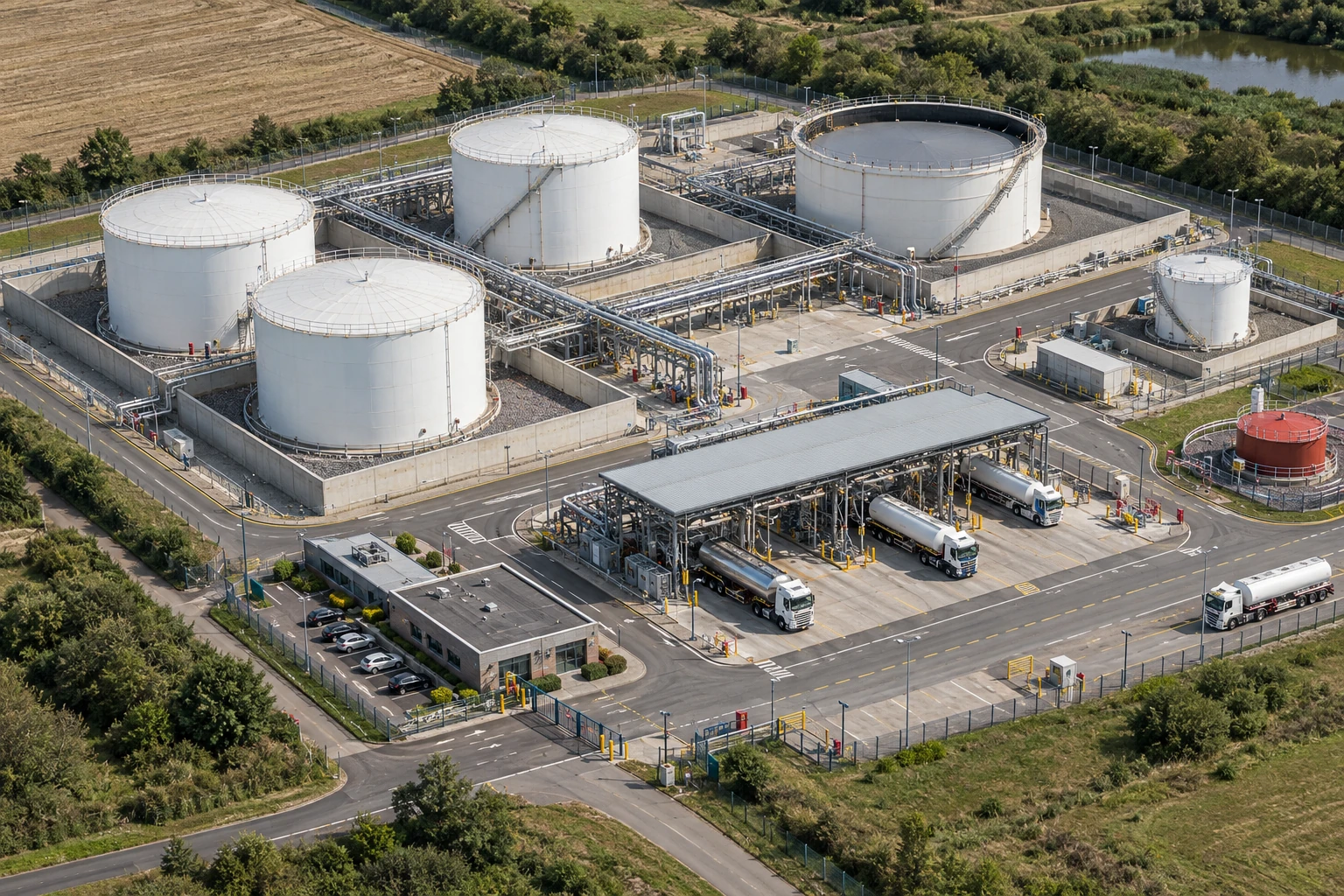

The pipeline receipt has no positively verified destination
All related inspection points 6 across 1 location
Crown Fuels terminal 6 inspection points
Practice in the SHAREhub environment. Browser practice is separate from workplace competence and formal learning records.
What makes a standard operating procedure safety-critical?
A safety-critical SOP must match the real plant, task and operating limits. It should state prerequisites, roles, critical steps, hold points, normal and abnormal conditions, stop triggers, emergency response and handback in language operators can use. Validate it with a walkthrough before issue, involve workers, control revisions and assess competence by demonstration. A procedure is one barrier among design, engineering, supervision and emergency controls; paperwork alone does not make the operation safe.
An SOP is not just an instruction sheet. It is the practical link between design intent, safe operating envelope, risk assessment, control measures, competence and supervision. In process safety, operating procedures are a major barrier because they guide how people start, stop, monitor, adjust, sample, clean, isolate and respond to abnormal conditions.
HSE's COMAH technical guidance emphasises that procedures should be clear, concise and accurate, reflect plant practice, cover normal and abnormal conditions and be validated before issue. That is a high bar. A procedure that looks tidy but does not match the control panel, plant layout, actual sequence or operator language can create error.
A flagship SOP system treats procedures as living controls. Operators help write and test them, supervisors observe use, MOC captures changes, training checks understanding and assurance tests whether the procedure works under time pressure, alarms, handover, fatigue and abnormal conditions.
For high-hazard operations, an SOP is part of the control system. It should make critical decisions visible, preserve the safe operating envelope and help people recognise when work must stop. A procedure that only describes normal success is weak because real risk usually appears during abnormal conditions, interruptions, handover, maintenance, temporary arrangements and restart.
An expert review also asks whether the SOP is usable under pressure: can the operator find the right step, read it in the work environment, match it to local labels, understand the hold point, and escalate without being criticised for slowing production?
| Procedure type | Purpose | Example |
|---|---|---|
| Normal operation | Defines routine safe operation inside operating limits. | Running a pump, filling a vessel or dosing a chemical. |
| Abnormal operation | Guides response to deviation, alarm or unstable condition. | High temperature, low flow or off-spec product. |
| Temporary operation | Controls short-term arrangements that differ from normal design. | Temporary bypass, manual monitoring or temporary hose route. |
| Start-up | Controls transition from shutdown to stable operation. | Line-up, permissives, purge, heat-up and initial feed. |
| Shutdown | Controls transition to safe stopped state. | Depressurise, drain, isolate, cool and handover. |
| Emergency operation | Guides immediate response to serious loss of control. | Leak, fire, runaway reaction, toxic release or trip failure. |
| Commissioning/trials | Tests new or modified plant under controlled conditions. | Water trial, chemical trial or alarm/trip verification. |
| Loading/unloading | Controls transfer interface, compatibility and emergency stop. | Tanker offload, drum charging or cylinder change. |
Start with HSE operating-procedure design and validation and assess the actual work and nation.
How should SOPs be built and controlled?
SOPs should move through task selection, preparing, operator review, validation, approval, training, use, monitoring and revision through MOC.
The procedure lifecycle matters because many failures occur when the written procedure and plant practice separate. A valve is renumbered, a pump is replaced, a control screen changes, an alarm response is altered, a raw material changes or an experienced operator develops an unofficial workaround. Unless the procedure is updated and retrained, the document becomes a trap.
A good SOP is written for the user under real conditions. It has prerequisites, limits, roles, critical steps, warnings immediately before relevant steps, expected readings, hold points, abnormal responses, stop conditions and handback requirements. It should also explain why critical steps matter, because understanding improves compliance and challenge.
| Lifecycle stage | What should happen | Evidence |
|---|---|---|
| Select task | Identify tasks where procedure quality affects risk. | Task inventory and criticality. |
| In progress | Use risk assessment, HAZOP, safe limits, SDS, plant drawings and operator input. | Proposed procedure and source references. |
| Validate | Walk through against plant, controls, displays, tools and conditions. | Validation record and corrections. |
| Approve | Competent owner authorises controlled issue. | Version control and approval. |
| Train | Operators practise and demonstrate understanding. | Training and competence record. |
| Use | Procedure is available, current and usable at point of work. | Observation and operator feedback. |
| Monitor | Supervisors sample compliance, deviations and practical usability. | Field verification and action tracker. |
| Revise | Changes go through MOC and retraining. | MOC record, new version and withdrawal of old copies. |
What does a strong SOP look like during a tanker unloading task?
A transfer example shows how procedure quality controls interface, compatibility, isolation, emergency response and evidence.
Flammable-liquid tanker unloading
Task material and setting: Flammable-liquid unloading at a designated bay with a revised valve line-up and high-level alarm.
People and prerequisites: Site operator, driver, supervisor and process engineer; validated site method and verified receiving capacity and safeguards.
Before: Verify product, capacity, valve path, bonding, hose, emergency stop and communication.
During: Follow the controlled transfer sequence and monitor limits with the assigned roles.
Hold or stop: Stop if identity, capacity, bonding, alarm or line-up cannot be proved; no informal bypass.
Completion and hand back: Use the verified site shutdown/disconnection sequence, including controlled draining or depressurisation where required; confirm safe plant state and hand back.
Evidence: Validated SOP revision, training sign-off, line-up check, transfer log and deviation closure.
Primary guidance: HSE operating-procedure design and validation
Crownway Fuels Ltd receives a tanker of flammable liquid. The SOP covers pre-arrival checks, authorised unloading bay, product verification, earthing/bonding, hose inspection, valve line-up, emergency stop, communication with driver, monitoring during transfer, disconnection, spill response and handback.
A weak SOP says 'connect tanker and unload safely'. A strong SOP states the exact checks, acceptable conditions, stop triggers, responsible roles, required records and what to do if the product, paperwork, weather, hose, bonding, tank level or emergency equipment is not right.
| SOP element | Weak instruction | Strong instruction |
|---|---|---|
| Prerequisites | Check area is safe. | Confirm authorised bay, product, tank capacity, spill kit, E-stop, bonding and no ignition sources. |
| Roles | Operator unloads tanker. | Site operator controls plant; driver controls vehicle; competent authority reviews any exception through the formal change process before work. |
| Critical step | Connect hose. | Inspect hose, gasket, coupling, route and support before connection. |
| Parameter | Monitor tank level. | Stop transfer at defined high level or alarm response point. |
| Abnormal condition | Report issues. | Stop transfer for leak, wrong product, bonding failure, alarm, storm or route obstruction. |
| Handback | Complete paperwork. | Follow the site isolation/draining/disconnection sequence; retain bonding while ignition-capable transfer remains, then hand back and record defects. |
What should a high-quality SOP contain?
A high-quality SOP should be accurate, usable, risk-based and clear about limits, roles and stop conditions.
The best procedure is not the longest procedure. It is the one a competent worker can use accurately in the conditions where the work occurs. It should show the task purpose, scope, prerequisites, equipment status, roles, PPE/RPE, hazards, key parameters, critical steps, hold points, alarm response, abnormal conditions, waste, handback and records.
Warnings should appear immediately before the step they relate to. Language should match local plant labels, control screens and operator vocabulary. If the procedure says 'open feed valve V-101' but the field label says 'A line feed', the procedure is already inviting error.
| Quality feature | Why it matters | Evidence |
|---|---|---|
| Clear scope | Prevents wrong procedure being used. | Task and equipment boundary. |
| Prerequisites | Confirms safe conditions before action. | Line-up, isolation and readiness checks. |
| Critical steps | Highlights actions where error could cause serious harm. | Bold/hold point or verification step. |
| Operating limits | Connects task to safe operating envelope. | Temperature, pressure, level or flow limits. |
| Abnormal response | Prevents improvisation during deviation. | Alarm/trip response and stop conditions. |
| Roles | Avoids gaps between operator, supervisor and maintainer. | Responsibility section. |
| Version control | Prevents use of outdated instructions. | Controlled document system. |
| Validation | Proves procedure matches real plant. | Walkdown and user testing record. |
What is the difference between a weak and strong SOP?
A strong SOP supports competent judgement; a weak SOP creates false confidence and workarounds.
Weak procedures often fail because they are written by someone distant from the task, copied from another plant, left unchanged after modifications or overloaded with generic warnings. Operators then rely on memory and informal workarounds.
Strong procedures make the important decisions visible. They help operators understand what normal looks like, what abnormal looks like, what must not be bypassed and who has authority to approve exceptions.
| Area | Weak SOP | Strong SOP |
|---|---|---|
| Task sequence | Long prose and ambiguous order. | Numbered steps with hold points. |
| Risk information | Generic warning page at start. | Specific warnings before relevant steps. |
| Controls | Says use PPE and follow permit. | States exact PPE, permit, isolation and verification. |
| Abnormal operation | Tells worker to inform supervisor. | States immediate safe action and escalation route. |
| Change control | Old copies remain in circulation. | Controlled version and old copies withdrawn. |
| Training | Read-and-sign only. | Observed competence and scenario practice. |
| Usability | Does not match labels or screen names. | Uses local nomenclature and diagrams where useful. |
How should SOP validation and walkdown be done?
Validation should test the procedure against the actual workplace before it is issued or relied on.
A desk review can find grammar mistakes. A walkdown finds operational traps: missing valve labels, unreachable gauges, poor lighting, steps in the wrong order, alarms with unclear response, PPE that makes a task impossible, or instructions that conflict with the permit or control screen.
The best validation involves operators, supervisors, engineering, HSE and technical authority where needed. It should check normal, abnormal and foreseeable upset conditions, then update training and records.
| Validation check | What to test | Common finding |
|---|---|---|
| Physical sequence | Can the steps be done in the order written? | Valve or sample point is not accessible. |
| Labels and nomenclature | Do procedure names match plant labels? | Different names used in field and control room. |
| Critical parameters | Are limits and readings visible? | Gauge not readable from task position. |
| Human factors | Can one person realistically do the step safely? | Task needs two people or better communication. |
| Abnormal states | Does the procedure say what to do if a reading is wrong? | Stop condition missing. |
| Interface | Does it align with permits, isolations and handover? | Procedure conflicts with permit requirement. |
| Records | Can the required evidence be captured? | Checklist misses critical control verification. |
A walkdown is not permission to operate unsafe plant or perform a hazardous step just to test the document. Use non-operational checks and safe simulation where appropriate; live trials need their own assessed, authorised commissioning arrangements and readiness checks. HSE COMAH operating procedures.
What should an excellent SOP contain?
An excellent SOP explains the task, the safety intent, the critical steps, the abnormal responses and the evidence required.
An SOP should be detailed enough to control the work but not so cluttered that critical information is lost. The strongest procedures separate prerequisites, normal steps, hold points, abnormal conditions, emergency actions and records. They show what must be true before the task starts and what must happen if it is not true.
For safety-critical operations, the procedure should connect to the risk assessment, safe operating envelope, permits, isolations, PPE/RPE, alarms, trips, emergency plan and management of change. The user should never have to guess whether an exception is allowed.
| SOP element | What it should say | Why it matters |
|---|---|---|
| Purpose | What risk or operation the procedure controls. | Keeps the procedure tied to safety intent, not admin. |
| Scope | Plant, equipment, product, task stage and exclusions. | Prevents the wrong procedure being used. |
| Hazards | Process, chemical, fire, pressure, mechanical, ergonomic and human-factor hazards. | Makes the risk visible at the right point. |
| Prerequisites | Isolation state, plant line-up, competence, permit, weather, communications and emergency equipment. | Stops the job starting from an unsafe condition. |
| PPE/RPE | Exact specification and any face-fit, air-fed or compatibility requirement. | Avoids vague 'wear PPE' instructions. |
| Tools and equipment | Approved tools, hoses, fittings, meters, lifting aids, spill kit and test equipment. | Prevents substitution with unsuitable equipment. |
| Step sequence | Numbered steps in the order work is actually done. | Reduces memory reliance and sequencing errors. |
| Hold points | Steps requiring pause, verification, second-person check or authorisation. | Controls critical transitions. |
| Operating limits | Acceptable pressure, temperature, level, flow, atmosphere or time limits. | Connects the task to the safe operating envelope. |
| Abnormal conditions | What to do if a reading, alarm, leak, blockage or uncertainty appears. | Prevents improvisation. |
| Emergency action | Immediate safe state, alarm, evacuation, shutdown, spill or medical route. | Supports fast response under stress. |
| Sign-off and records | What must be recorded, by whom and where. | Creates evidence and continuity. |
| Review trigger | Change, incident, deviation, audit, MOC, new product, plant modification or user feedback. | Keeps the SOP alive. |
After interruption, stopped transfer, loss of place or shift change: secure the system, record the last verified state and outstanding hazards, re-establish the prerequisites and obtain the defined restart authority. Do not simply repeat the last step; repeat dosing or line-up actions can create a new hazard.
What does a strong SOP look like in one task?
A strong SOP uses precise conditions, hold points and escalation wording rather than broad instruction.
The example below uses a tanker unloading task because it combines product identity, hose connection, level control, bonding, communication, emergency response and handback. The same anatomy can be applied to confined-space entry, start-up, shutdown, chemical transfer, maintenance isolation or laboratory work.
The learning value is the contrast between a sentence that sounds sensible and a control that actually guides behaviour.
| Task point | Weak wording | Stronger SOP wording |
|---|---|---|
| Product check | Check product before unloading. | Verify delivery note, tank number, product grade and ullage with supervisor before connecting hose. Stop if any detail conflicts. |
| Connection | Connect hose safely. | Inspect hose, gasket and coupling; connect only to labelled inlet; confirm dust cap removed and spill tray in place. |
| Static control | Earth tanker. | Connect bonding lead to approved point, verify indicator shows continuity before opening any valve and stop if indication is absent or intermittent. |
| Start transfer | Open valves slowly. | Follow the verified site valve line-up and approved transfer sequence; remain in attendance and confirm no leak, vibration or unexpected level movement. |
| Hold point | Monitor transfer. | At the hold point defined by the site-specific assessment and SOP, confirm level trend, leak check, assessed vapour controls and emergency-stop access (smell is not a gas test) before continuing. |
| Abnormal condition | Report any problems. | If leak, wrong tank, alarm, loss of bonding, storm lightning or unclear level occurs: use the planned safe shutdown from a safe location, raise the alarm as required and contact the supervisor; do not approach a release to operate a valve. |
| Handback | Complete paperwork. | Drain hose using approved method, cap connection, inspect area, record quantity, defects and any deviation before vehicle departure. |
This excerpt illustrates how to make decisions explicit. HSE COMAH operating procedures supports procedure design/validation; HSE HSG140 flammable-liquid handling supports transfer precautions. The actual engineering sets the sequence, ullage, bonding scheme and shutdown method.
This is an incomplete teaching excerpt, not a universal sequential unloading method. Establish assessed bonding/earthing prerequisites before connection or opening that could expose a flammable atmosphere; retain bonding until the site-defined safe transfer, draining and disconnection stage. The competent installation design and approved procedure determine the actual sequence.
How can learners judge whether an SOP is good enough?
A good answer explains usability, technical accuracy, abnormal conditions, competence and control evidence.
Learners often describe SOPs as documents. Professional answers describe them as risk controls. A procedure is only effective if it matches the plant, can be followed by competent people, manages abnormal conditions and is kept current through MOC and learning.
For assessment, auditing or qualification answers, always move from document existence to control reliability. Ask what failure the SOP prevents and what would show that it is used correctly at the point of work.
| Question | Weak answer | Stronger answer |
|---|---|---|
| Is the SOP current? | It has a review date. | It is version controlled, linked to MOC, validated in the field and old copies are withdrawn. |
| Is it usable? | Operators have read it. | Operators can follow it under real conditions, with local labels, lighting, PPE and workload considered. |
| Does it control risk? | It lists hazards. | It includes prerequisites, critical steps, hold points, safe limits and abnormal response. |
| Is competence proven? | Training records exist. | Operators are observed performing the task and tested on abnormal scenarios. |
| Is deviation managed? | People report issues. | Workarounds are captured and stopped where unsafe; any temporary method needs risk assessment, competent authorisation, time limit and permanent correction. |
| Is assurance meaningful? | Audits check procedure availability. | Audits sample work as done, interview operators and review incidents, deviations and MOC links. |
Transfer this learning to pump restart after maintenance: the old tanker checklist cannot prove restored isolations, trips or the new plant line-up. Establish the actual readiness and operating limits, validate the revised start-up procedure, check competence and hold start-up if a critical safeguard is uncertain. This is an illustration of procedure control, not a restart instruction. HSE COMAH operating procedures.
How can the hierarchy of controls reduce risk before relying on standard operating procedures?
Remove or reduce the hazard before relying on procedures or personal protection.
For standard operating procedures, assess the actual task and first look for a way to remove the hazard. Where that is not possible, consider a safer substitute, engineered separation and then clear work procedures. PPE protects against remaining exposure; it does not make an uncontrolled task safe. HSE hierarchy of controls
The selected measures need a named owner, a usable stop point and a check that they still work when the task or conditions change. In Northern Ireland, verify the separate legal route and site instructions.
For the tanker, first ask whether the hazardous transfer or solvent can be avoided. Reduce the remaining inventory and use an assessed closed transfer with suitable overfill protection and ignition controls; the SOP coordinates people, checks and safe shutdown around those safeguards. PPE and a signed checklist cannot replace them. ERICPD is an illustrative teaching prompt, not a separate legal method. HSE hierarchy of controls; HSE HSG140 flammable-liquid handling.
How can the ERICPD hierarchy of controls reduce risk before relying on standard operating procedures?

| ERICPD control level | Topic-specific example | Source and full task context |
|---|---|---|
| Eliminate | Assess avoiding the hazardous transfer or solvent. | Read the full task example, checks and stop points on this page. HSE hierarchy of controls · HSE HSG140 flammable-liquid handling |
| Reduce | Reduce remaining inventory through the assessed process. | Read the full task example, checks and stop points on this page. HSE hierarchy of controls · HSE HSG140 flammable-liquid handling |
| Isolate | Use a suitable closed transfer with overfill protection. | Read the full task example, checks and stop points on this page. HSE hierarchy of controls · HSE HSG140 flammable-liquid handling |
| Control | Coordinate people, ignition checks and safe shutdown through the SOP. | Read the full task example, checks and stop points on this page. HSE hierarchy of controls · HSE HSG140 flammable-liquid handling |
| PPE | PPE and a signed checklist cannot replace physical safeguards. | Read the full task example, checks and stop points on this page. HSE hierarchy of controls · HSE HSG140 flammable-liquid handling |
| Discipline | Verify safeguards and maintain the procedure after changes. | Read the full task example, checks and stop points on this page. HSE hierarchy of controls · HSE HSG140 flammable-liquid handling |
How can the ISO 45001 hierarchy of controls reduce risk before relying on standard operating procedures?

| Five-level control stage(s) | Topic-specific example | Source and full task context |
|---|---|---|
| Elimination | Assess avoiding the hazardous transfer or solvent. | Read the full task example, checks and stop points on this page. HSE hierarchy of controls · HSE HSG140 flammable-liquid handling |
| Administrative controls | Reduce remaining inventory through the assessed process. | Read the full task example, checks and stop points on this page. HSE hierarchy of controls · HSE HSG140 flammable-liquid handling |
| Engineering controls | Use a suitable closed transfer with overfill protection. | Read the full task example, checks and stop points on this page. HSE hierarchy of controls · HSE HSG140 flammable-liquid handling |
| Administrative controls | Coordinate people, ignition checks and safe shutdown through the SOP. | Read the full task example, checks and stop points on this page. HSE hierarchy of controls · HSE HSG140 flammable-liquid handling |
| PPE | PPE and a signed checklist cannot replace physical safeguards. | Read the full task example, checks and stop points on this page. HSE hierarchy of controls · HSE HSG140 flammable-liquid handling |
| Administrative controls | Verify safeguards and maintain the procedure after changes. | Read the full task example, checks and stop points on this page. HSE hierarchy of controls · HSE HSG140 flammable-liquid handling |
When should an SOP be stopped, challenged or revised?
An SOP should be stopped or revised when it no longer matches plant, task, materials, competence, risk assessment or operating limits.
Operators should be allowed to challenge an SOP that is wrong, unclear or unsafe. If work has to be improvised to complete the task, the procedure is not functioning as a control. The safe response is to stop, make the plant safe, escalate and revise through controlled change.
Revisions should follow MOC where risk, equipment, process, personnel, materials or controls change. Uncontrolled handwritten changes, local copies and verbal amendments create serious risk.
| Trigger | Immediate action | Review route |
|---|---|---|
| Plant no longer matches procedure | Stop and make safe if critical. | MOC and procedure revision. |
| Critical step unclear | Ask supervisor/technical authority before proceeding. | Validation and training update. |
| Alarm or abnormal state not covered | Follow emergency/abnormal procedure and escalate. | HAZOP/risk assessment review. |
| Temporary bypass or workaround | Do not normalise informal practice. | Temporary procedure and authorisation. |
| New chemical/material | Do not use old procedure automatically. | COSHH, compatibility and MOC review. |
| Operator cannot perform step safely | Stop or redesign task. | Human factors and work design review. |
Where do SOP systems commonly fail?
They fail when procedures become disconnected from plant practice, risk assessment, competence and management of change.
A procedure can be beautifully formatted and still dangerous. If it is not current, validated, trained, available, usable or followed, it is not a reliable control. In high-hazard work, that weakness can become a major accident contributor.
Common failures include outdated procedures, ambiguous steps, no abnormal guidance, over-reliance on memory, read-and-sign training, uncontrolled local copies, poor handover and procedures that conflict with permits or control-room displays.
| Failure or weak practice | How it develops | What good looks like |
|---|---|---|
| Procedure drift | Work as done differs from work as written. | Routine observation and operator feedback. |
| No validation | Procedure issued without walkdown. | Formal field validation before issue. |
| Over-prescriptive clutter | Important steps are buried in text. | Critical-step design and clear formatting. |
| No abnormal response | Operator improvises during deviation. | Abnormal and emergency procedures. |
| MOC bypass | Plant changed but SOP unchanged. | MOC trigger and document control. |
| Read-and-sign training | Worker signs but cannot apply procedure. | Observed competence and scenario practice. |
| Old copies | Printed uncontrolled versions remain in use. | Document control and withdrawal process. |
What evidence shows SOPs are controlled?
Good evidence shows that controls are planned, used, checked, corrected and reviewed.
Evidence should be proportionate to risk. Evidence should match the actual hazard, critical steps, operating conditions and reliability of controls.
| Evidence item | What it should show | Assurance question |
|---|---|---|
| Procedure register | Owner, scope, version, review date and criticality. | Are safety-critical procedures identified? |
| Validation record | Walkdown, operator review and corrections. | Does procedure match real plant? |
| MOC links | Changes to plant, materials, controls or staffing reflected in SOP. | Are procedures updated after change? |
| Training and competence | Operators trained, observed and refreshed. | Can people apply abnormal response? |
| Use monitoring | Supervisory observations and operator feedback. | Is work as done aligned? |
| Deviation records | Workarounds, temporary procedures and exception approvals. | Are deviations authorised and closed? |
| Incident learning | Procedural contribution reviewed after events. | Do actions improve design, not just remind people? |
These practical records and checks illustrate verifying the actual controls; they are not prescribed forms, technical approval or downloadable files.
How should standard operating procedures be assured?
Assurance should test whether controls work in practice, not whether the page or procedure exists.
Assurance should include frontline checks, manager review and periodic independent sampling where risk warrants it. The purpose is to find weak signals early, close actions properly and update the risk assessment when work changes.
| Assurance level | What to check | What good looks like |
|---|---|---|
| Frontline check | Operators have current SOP and understand critical steps. | Procedure is used correctly at point of work. |
| Supervisor review | Observe procedure use, deviations and handover. | Workarounds are captured and resolved. |
| Technical assurance | SOPs align with HAZOP, safe limits, alarms, trips and MOC. | Safety-critical tasks are technically accurate. |
| Audit | Sample procedure lifecycle and field validation. | Document control proves live control. |
| Leadership review | Overdue reviews, deviations, incidents and resources. | Procedure system weaknesses are acted on. |
These practical records and checks illustrate verifying the actual controls; they are not prescribed forms, technical approval or downloadable files.
Which UK duties and guidance apply?
GB and Northern Ireland have separate general health and safety and management duties. HSE COMAH operating-procedure guidance is a strong technical reference for major-hazard plant in Great Britain; it is not a universal requirement for every low-risk task and does not replace NI law. Use the actual risk, process and applicable duty to set how detailed and controlled an SOP must be.
| Jurisdiction | Route | Direct source | Decision supported |
|---|---|---|---|
| Great Britain | General work and risk-management duties | Health and Safety at Work etc. Act 1974; Management of Health and Safety at Work Regulations 1999 | Use safe systems, assessment and competent supervision. |
| Northern Ireland | Separate general duties | Health and Safety at Work (Northern Ireland) Order 1978; Management of Health and Safety at Work Regulations (Northern Ireland) 2000; Risk assessment | Apply NI work-risk arrangements. |
| Great Britain major-hazard guidance | Operating procedures | COMAH technical measures: operating procedures | Match plant practice and validate before issue. |
| Great Britain guidance | Isolation and permit interface | Safe isolation of plant and equipment (HSG253); Guidance on permit-to-work systems (HSG250) | Coordinate procedures with high-risk non-routine work. |
How should management check this work?
Use a defined plan, carry out the controls, check performance and correct what does not work.
For standard operating procedures, assign a competent owner to set the work controls, check their use and review them after change, failure or new evidence. HSE managing health and safety
A management-system label or certificate is not approval of a site limit, procedure or individual work decision. Apply GB and NI duties to the correct location.
What training and competence are needed?
Demonstrate the decision each role must make in its actual task, including when to stop and seek specialist advice.
These assessment methods are illustrative SHARE implementation choices; the linked guidance supports the subject matter, not a prescribed training format.
| Role | Practice to demonstrate | Assessor and method | Evidence | Reassess when |
|---|---|---|---|---|
| Operators | Execute the current SOP, identify hold points and stop on deviation. | Qualified trainer observes a simulation. | Practical sign-off. | Revision or long absence. HSE operating-procedure design and validation |
| Supervisors | Authorise only verified prerequisites and challenge workarounds. | Operations manager tests an abnormal scenario. | Decision record. | Deviation trend. HSE operating-procedure design and validation |
| Procedure authors | Walk down the plant with users and test readable steps. | Competent peer observes validation. | Walkthrough and revision trail. | Plant change. HSE operating-procedure design and validation |
| Permit / isolation leads | Coordinate SOP steps with isolation and permit controls. | Specialist reviews interface scenario. | Permit/isolation exercise. | New non-routine task. HSE HSG250 permits |
| Senior leaders | Sample whether procedures match plant practice and deviations close. | Independent assurance review. | Action and closure evidence. | Major change or incident. HSE plant modification/change guidance |
How could Crownway Fuels Ltd manage this in practice?

Crownway Fuels Ltd would validate an operating procedure against the actual plant, users and abnormal conditions before relying on it.
Crownway Fuels Ltd · practical example
Rewrite the instruction that experienced operators work around
The key lesson A procedure should support competent work with accurate, usable information; it is not a substitute for competence or engineered protection.
The situation: Operators report that a depot instruction uses outdated equipment names and leaves a key exception to experience. New starters cannot follow it confidently.
Why this matters: An unofficial workaround may become the real operating method while training and assurance continue checking the obsolete document.
How Crownway Fuels Ltd would manage it
- Identify the mismatch — Site Manager. Record the affected instruction, equipment and situations. Keep the task within a demonstrated safe method while the document gap is reviewed.
- Rebuild with users — Maintenance Coordinator. Bring together operators and the appropriate technical specialists to confirm the plant information, operating boundaries and decisions the instruction must support.
- Write for the task — Health and Safety Lead. Use clear identifiers, meaningful warnings and an accessible format. Separate normal operation from exceptions and specify when to stop and obtain authorised advice.
- Validate before issue — Site Manager. Arrange a controlled review against the equipment and foreseeable conditions. Test understanding with intended users without creating an uncontrolled plant trial.
- Control the change — HR and Training Manager. Update relevant familiarisation and assessment, remove superseded copies and check later use. Route further operator feedback into the next controlled revision.
When the conditions change
- Recognise the trigger
- The depot instruction names obsolete equipment or omits a critical exception decision.
- Make the immediate decision
- The Site Manager restricts the operation that depends on the unreliable instruction and obtains competent clarification.
- Verify the next step
- The authorised Site Manager accepts the technically validated instruction and checks that intended users understand the revised limits.
What good looks like
A new authorised operator can find the current instruction and explain its limits. Experienced workers do not need a separate unwritten version.
Evidence to look for: User comments, technical validation, revision record, briefing and competence evidence, plus observations of use.
Common mistake to avoid: Adding more pages and signatures without checking whether the instruction fits the real equipment.
Apply this to your work: Where does your procedure rely on “everyone knows what that means”?
Guidance behind the management approach: HSE: designing and managing procedures. Use the topic's legal and technical guidance for the applicable work and location.
In this fuel business, SOPs cover product transfer, tank changeover, pump start-up, line draining, abnormal alarms, emergency shutdown and contractor interface.
| Management element | How the business would manage it | Evidence to review |
|---|---|---|
| Procedure register | Critical procedures are identified and owned. | Register and review dates. |
| Validation | Operators walk down tanker unloading and pump start-up SOPs. | Validation records. |
| Training | Operators practise abnormal and emergency steps. | Competence evidence. |
| MOC | SOPs revised after pipework, product or control-system changes. | MOC pack. |
| Assurance | Supervisors observe task execution and close deviations. | Field verification record. |
These practical records and checks illustrate verifying the actual controls; they are not prescribed forms, technical approval or downloadable files.
What must a fuel-transfer procedure be based on?
Trace the intended product and vapour-management interfaces, then identify the confirmed equipment and responsibilities needed. This lesson deliberately omits an executable transfer sequence.
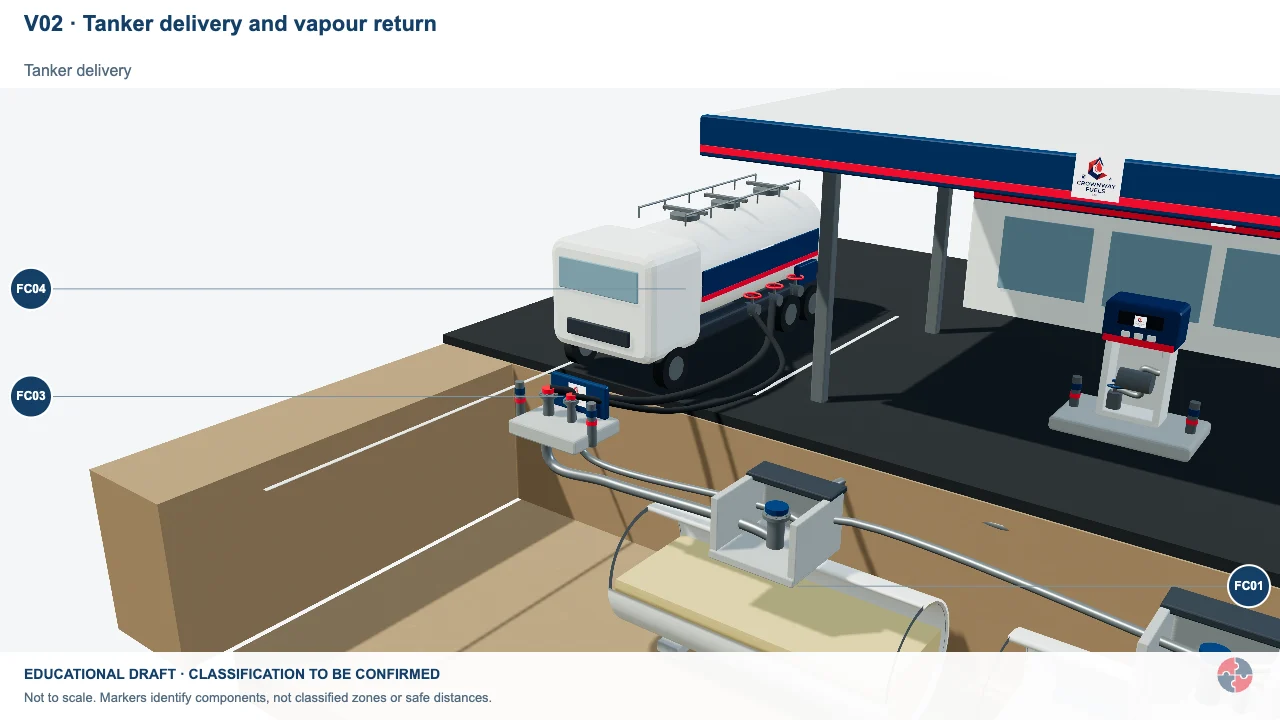
Tanker delivery and vapour return
During the proposed tanker delivery, product enters the receiving tank and displaced vapour returns to the tanker by a separate path. The delivery-hose teaching envelope follows the connected hose route.
Activity focus: Trace the tanker connection, product hose and receiving fill before following the Stage 1b vapour-return path. Inspect the whole delivery working area, including nearby traffic, dispensers and drainage.
Contextual workplace scene. Use the task, control and evidence checks in this section; appearance alone does not establish safe conditions, individual health or approval.
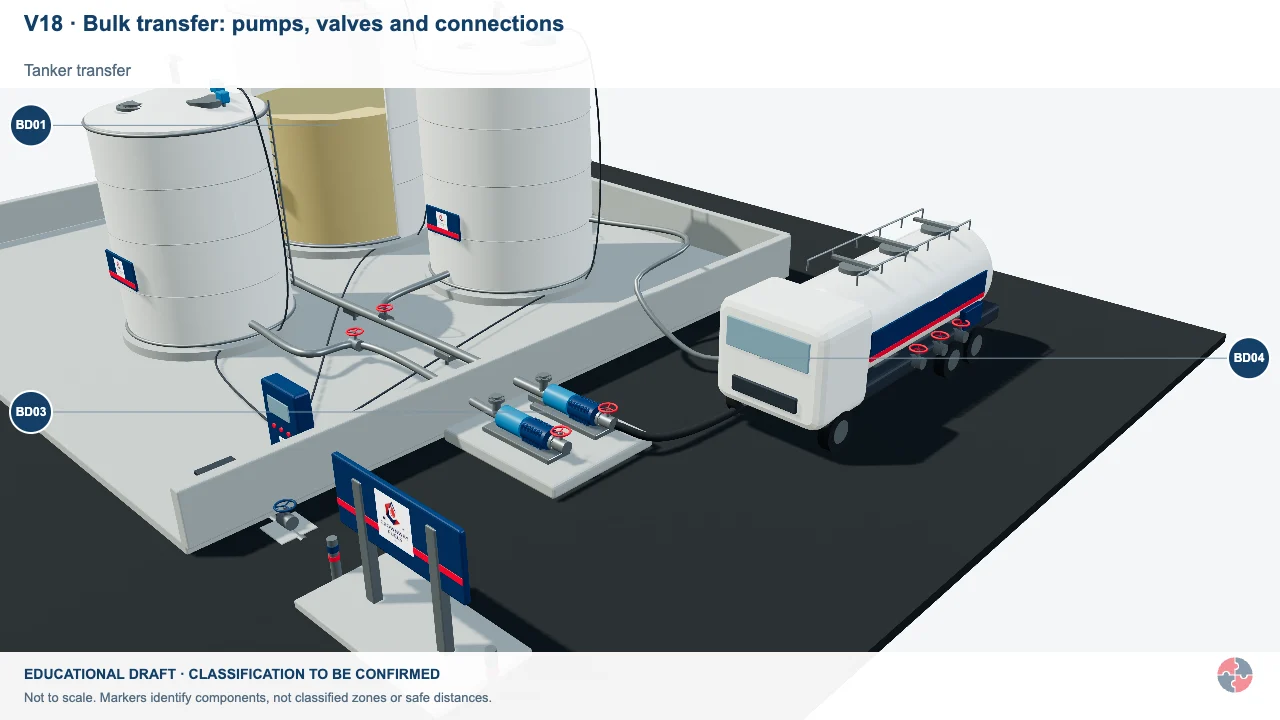
Tanker loading: liquid out, vapour back
Follow petrol from bulk storage into the tanker and the separate displaced-vapour route from the tanker to the terminal VRU.
Activity focus: Distinguish the product line, vapour collection line and tanker-loading protective controls.
Contextual workplace scene. Use the task, control and evidence checks in this section; appearance alone does not establish safe conditions, individual health or approval.
Educational illustration, not to scale. Coloured zones are teaching examples, not a site-specific hazardous-area classification.
What do the acronyms and key terms mean?
Acronyms should be understood before they are used in assessments, briefings, audits or learning answers.
Acronyms can exclude newer readers if they are not explained. This section keeps the main terms available at the end of the page so the article stays readable while still supporting learners and audit users.
| Acronym | Meaning | Plain-English use |
|---|---|---|
| ACOP | Approved Code of Practice | Practical guidance with special legal status. |
| ALARP | As Low As Reasonably Practicable | Risk reduction unless further control is grossly disproportionate to benefit. |
| BBV | Blood-Borne Virus | Virus that may be transmitted through blood or certain body fluids. |
| COMAH | Control of Major Accident Hazards Regulations | Regulations for major accident hazard sites involving dangerous substances. |
| COSHH | Control of Substances Hazardous to Health | Regulations for hazardous substances, including many chemicals and biological agents. |
| DSEAR | Dangerous Substances and Explosive Atmospheres Regulations | GB regulations; Northern Ireland has a separate DSEAR regime. |
| EMM | Enforcement Management Model | HSE decision framework for enforcement decisions. |
| EPS | Enforcement Policy Statement | HSE policy principles for enforcement. |
| FRA | Fire Risk Assessment | Assessment of fire hazards, people at risk, controls, emergency arrangements and review. |
| HSE | Health and Safety Executive | Great Britain regulator and official guidance source. |
| MOC | Management of Change | Formal review of changes that may affect risk controls. |
| OH | Occupational Health | Competent clinical and work-health advice route. |
| PPE | Personal Protective Equipment | Equipment worn to reduce exposure where higher-order controls do not fully remove risk. |
| RIDDOR | Reporting of Injuries, Diseases and Dangerous Occurrences Regulations | GB reporting regulations; Northern Ireland has a separate regime. |
| SDS | Safety Data Sheet | Supplier hazard, control, first-aid and emergency information for substances. |
| SOP | Standard Operating Procedure | Controlled instruction for carrying out a task or operation safely and consistently. |
| WEL | Workplace Exposure Limit | Airborne exposure limit averaged over a specified reference period. |
| HAZOP | Hazard and Operability Study | Structured process hazard study using guidewords. |
| SOE | Safe Operating Envelope | Defined limits within which the process is intended to operate safely. |
| ERICPD | Eliminate, Reduce, Isolate, Control, PPE, Discipline | Illustrative teaching prompt; Discipline means maintaining and checking controls. |
Which Crownway Fuels documents support this topic?
Open an editable document, read the preview, or find its place in the Crownway hierarchy. 8 resources relate to this page.
Fictional Crownway Fuels examples for English forecourts, with a separate illustrative bulk terminal. Check site applicability, permissions and actual controls before adapting any document for use.
Petrol tanker delivery and forecourt unloading policy (8)
- Petrol tanker delivery and forecourt unloading policy (CWF-POL-DEL · Completed fictional example)
Set company expectations, responsibilities and resources for petrol tanker delivery and forecourt unloading.
Read preview · Download DOCX · Show in hierarchy - Petrol tanker delivery and forecourt unloading procedure (CWF-PRO-DEL · Completed fictional example)
Explain who does what, in what sequence, the control rationale, evidence, escalation and safe restart conditions.
Read preview · Download DOCX · Show in hierarchy - Site specific tanker unloading assessment (CWF-RA-DEL-01 · Blank editable master)
Provide the site/task-specific site specific tanker unloading assessment and retain its controlled output.
Read preview · Download DOCX · Show in hierarchy - Tanker operator and site interface agreement (CWF-PLN-DEL-01 · Completed fictional example)
Provide the site/task-specific tanker operator and site interface agreement and retain its controlled output.
Read preview · Download DOCX · Show in hierarchy - Pre delivery tank product and ullage check (CWF-CHK-DEL-01 · Blank editable master)
Provide the site/task-specific pre delivery tank product and ullage check and retain its controlled output.
Read preview · Download DOCX · Download PDF · Show in hierarchy - Unloading connection monitoring and completion check (CWF-CHK-DEL-02 · Blank editable master)
Provide the site/task-specific unloading connection monitoring and completion check and retain its controlled output.
Read preview · Download DOCX · Download PDF · Show in hierarchy - Rejected or aborted delivery record (CWF-FRM-DEL-01 · Blank editable master)
Provide the site/task-specific rejected or aborted delivery record and retain its controlled output.
Read preview · Download DOCX · Show in hierarchy - Delivery discrepancy and overfill near miss report (CWF-FRM-DEL-02 · Blank editable master)
Provide the site/task-specific delivery discrepancy and overfill near miss report and retain its controlled output.
Read preview · Download DOCX · Show in hierarchy
Unlock another resource
You have used this month’s two free downloads. Publish a post in your own words to unlock one more resource, or choose SHARE Individual for 10 downloads per month.
You decide whether to share. If you do, use the relevant platform disclosure tools and do not make claims you do not genuinely hold.