SHARE Knowledge Hub
Hot Work Control in Process Areas
Before welding or grinding on process plant, ask whether hot work can be avoided. If it remains necessary, a competent issuer must verify positive isolation, cleaning, suitable gas testing, nearby drains and SIMOPS, an independent fire watch, stop conditions and formal handback at the actual site. A permit records and coordinates these controls; its colour or a single gas reading does not make the work safe.
Understanding Hot Work Control in Process Areas
Before welding or grinding on process plant, ask whether hot work can be avoided. If it remains necessary, a competent issuer must verify positive isolation, cleaning, suitable gas testing, nearby drains and SIMOPS, an independent fire watch, stop conditions and formal handback at the actual site. A permit records and coordinates these controls; its colour or a single gas reading does not make the work safe.
Why this matters at work
Isolate electrical, mechanical, hydraulic, pneumatic and thermal energy as well as process fluids. Control automatic starts, agitators, vehicles and nearby transfer systems. Physical blinds, disconnections or other positive isolation may be necessary for high-consequence work and entry. Cross-reference the isolation certificate and permit, identify who owns locks and keys, and keep active isolations visible through suspension and handover. Reinstatement is a separate safety-critical phase, not the automatic reversal of a checklist.
A substituted cold method still needs assessment. Cold cutting may create static, impact sparks, heat, dust or a release from the material cut. Adhesives can introduce solvent vapour and occupational exposure. Moving a component may require line-breaking and lifting. The selected method should reduce the whole task risk, not merely shift the hazard. Engineering and operations must confirm process compatibility and mechanical integrity before approval.
How organisations manage this in practice
If hot work remains necessary, state why and establish hold points. For a repeated task, collect evidence of how often the permit is needed and whether a design modification is reasonably practicable. For urgent work, production pressure is not a risk-control argument. A credible major-accident scenario calls for senior technical review, suitable isolation and possibly deferral or a larger shutdown. Record the decision so the next shift and future reviewers can understand the basis.
Specify when testing repeats: after cleaning, after a break, after ventilation or plant status changes, during work where release could recur, and at permit renewal. Continuous monitoring can help with a changing atmosphere but is not a substitute for secure isolation. Position monitors where they can detect the credible migration route and define who can act on an alarm. If a reading rises, instrument fails, oxygen is abnormal or unexpected odour/release occurs, stop ignition, make the area safe, alert the authority and re-assess before restarting.
A maintenance completion signature is not proof of safe operation. Conduct a pre-start review proportionate to the change, including inspection of weld quality, modification approval, isolation status, test records and operating instructions. A pressure test, leak check or first-fill may need a separate permit and exclusion arrangements. If the job exposed unexpected residues, undocumented connections or weak isolation, close the immediate hazard and feed the finding into drawings, maintenance strategy and future permit standards.
Who should use this hot work control page?
This page is for people who plan, authorise, carry out, supervise or audit hot work in hazardous process areas.
Who should use this hot work control page? — part 1 of 2

Read the complete visual as text
- This page is for people who plan, authorise, carry…: This page is for people who plan, authorise, carry out, supervise or audit hot work in hazardous process areas.
- Permit issuers and area authorities: People deciding whether hot work can be authorised and what evidence is needed.
- Maintenance and contractor teams: People welding, cutting, grinding, using heat or bringing ignition sources into process areas.
Who should use this hot work control page? — part 2 of 2

Read the complete visual as text
- Operators and supervisors: People who understand plant status, isolation, drains, vents, abnormal conditions and handback.
- Process safety and HSE advisers: People reviewing DSEAR, barriers, PTW audits, incident learning and major accident scenarios.
Permit issuers and area authorities
People deciding whether hot work can be authorised and what evidence is needed.
Maintenance and contractor teams
People welding, cutting, grinding, using heat or bringing ignition sources into process areas.
Operators and supervisors
People who understand plant status, isolation, drains, vents, abnormal conditions and handback.
Process safety and HSE advisers
People reviewing DSEAR, barriers, PTW audits, incident learning and major accident scenarios.
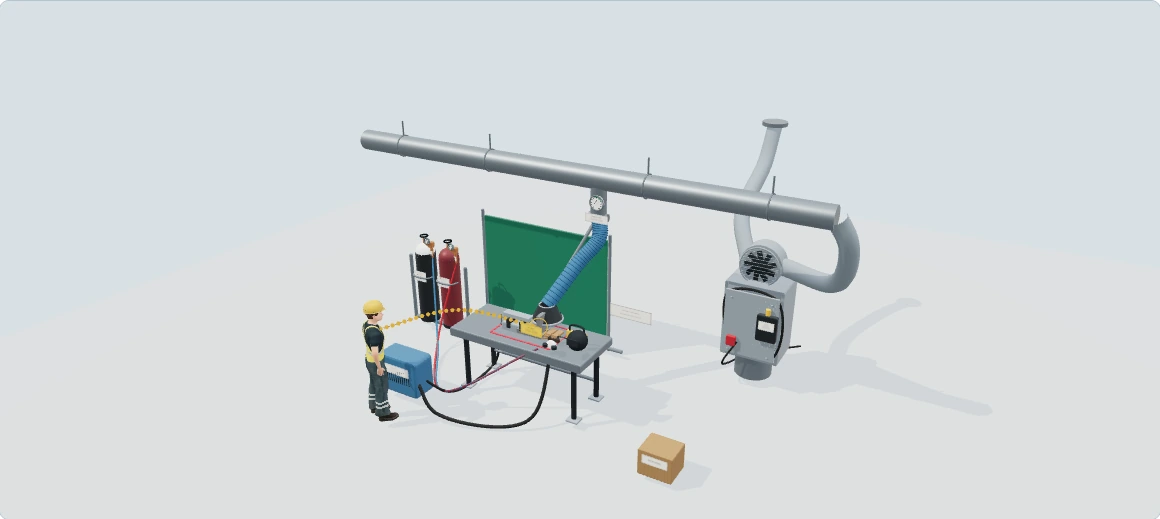

Welding and hot work: heat, fume and hidden ignition routes
Explore how this equipment can harm its users and other people, then follow the practical measures that interrupt each pathway. This is a hazards and good-practice lesson; the separate checklist remains the pre-use/safety-check activity.
Hazards and good practice: learn what can hurt people during use, change and maintenance. Pre-use and safety checks stay in the separate checklist.
Checksheets and risk assessments
Equipment checksheets
- Welding and gas cutting — 3D checks · Word · PDF
- Local exhaust ventilation: user and condition check — 3D checks · Word · PDF
- Fire extinguishers and fire points — 3D checks · Word · PDF
Risk assessment forms
- Task-specific COSHH assessment · Word
- Flammable substances and explosive-atmosphere assessment · Word
Risk assessment examples
Forms and tools
Full written walkthrough — all 8 steps
1. Consider a cold or off-site method
What is happening: The stationary bench represents a work decision, not an operating arc or a permit release.
How harm can occur: Heat, sparks and ignition can harm people and plant beyond the immediate welding point.
Best practice to apply: Consider avoiding hot work or moving it to a suitable designated area before developing the remaining controls.
Why this works: Removing ignition from the hazardous location is stronger than relying on a permit to justify it.
Hot Work Control in Process Areas · What major accident scenario should hot work control prevent?2. Identify the actual plant and boundaries
What is happening: The workpiece can be connected to equipment or spaces beyond what the operator sees.
How harm can occur: Residual product, pressure or a wrong boundary can lead to fire, explosion or loss of containment.
Best practice to apply: Verify the job, plant identity, connected equipment, residues and required isolations through the actual safe system.
Why this works: A clean-looking surface does not identify what is inside or connected to it.
Hot Work Control in Process Areas · How should isolation, draining and cleaning be proved?3. Follow heat and sparks beyond the bench
What is happening: Heat can conduct through material and particles can pass through openings or reach the far side.
How harm can occur: Hidden combustibles can ignite out of sight of the person doing the work.
Best practice to apply: Remove or suitably protect combustibles and inspect credible ignition routes, including adjacent spaces and other sides.
Why this works: Controlling the full route prevents a local task creating a remote fire.
Hot Work Control in Process Areas · What does hot work control mean in plain English?4. Keep the atmosphere decision current
What is happening: Testing and monitoring arrangements depend on the actual substances, location and change during work.
How harm can occur: A changed or untested atmosphere can create fire, explosion, poisoning or asphyxiation.
Best practice to apply: Use competent assessment and the required testing/monitoring and ventilation; suspend work when its conditions are no longer valid.
Why this works: A previous reading or permit does not freeze the atmosphere or remove process change.
Hot Work Control in Process Areas · How should gas testing be planned and interpreted?5. Control welding fume at the source
What is happening: The articulated hood sits over a clamped joint inside a red illustrative bench footprint. Use the comparison to move the vice and joint outside it: a nearby hood is useful only while the real source stays in its verified three-dimensional capture range.
How harm can occur: Inhaled fume and associated gases can cause serious harm; outdoor work is not automatically controlled.
Best practice to apply: Commission and test the actual tool, source position/height, hood setting and full working movement under representative conditions. Mark the verified footprint on the bench, record the arrangement and normal indicators, and keep every part of the source task within it. Reposition/reassess if the hood, process or draught changes; provide assessed RPE where needed.
Why this works: Marking the tested working position makes correct use repeatable. A running fan, a bench mark or a smoke test at an idle hood alone does not prove capture during the real task.
Hot Work Control in Process Areas · What would a good worked hot work permit example include? LEV Local Exhaust Ventilation · What are capture zones, working zones and breathing zones?6. Protect people from radiation and hot material
What is happening: Screens, the working position and suitable protection have separate functions.
How harm can occur: Arc radiation, hot metal and fragments can injure the welder, helpers or passers-by.
Best practice to apply: Control line of sight, access and hot-material handling and use protection selected for the actual process.
Why this works: Protecting the boundary stops other people being exposed to a task they are not performing.
Hot Work Control in Process Areas · BuildOut documents to download7. Provide a capable watch and emergency response
What is happening: A fire watch must cover credible ignition points and be able to stop work and raise the alarm.
How harm can occur: A developing or concealed fire can grow while attention remains on the workpiece.
Best practice to apply: Provide the required competent fire watch, suitable communication and emergency arrangements during and after the task.
Why this works: Independent observation can find ignition beyond the operator's view; a model supplies no universal watch duration.
Hot Work Control in Process Areas · What should a fire watch do during and after hot work?8. Complete hand-back after the controls are finished
What is happening: Residual heat, hidden spaces and temporary arrangements remain important after the tool stops.
How harm can occur: Premature permit closure or incorrect reinstatement can allow delayed fire or release when plant returns.
Best practice to apply: Complete specified post-work checks and watch, account for outstanding work and verify reinstatement before formal hand-back.
Why this works: Closure must reflect the actual condition and remaining risks, rather than only the end of welding.
Hot Work Control in Process Areas · What should happen before hot work is handed back?
Illustrative awareness learning. Geometry, colours and movement do not establish safe distances, capacity, exposure, isolation or work permission. Use the actual assessment, equipment information and competent arrangements.
The wider workplace has its own account and subscription access. Exploring this lesson does not grant access, record course completion or authorise work.
UK guidance for further reading
HSE: Welding and hot workHSE HSG258: verified and marked capture zonesHow can I practise this topic in 3D?
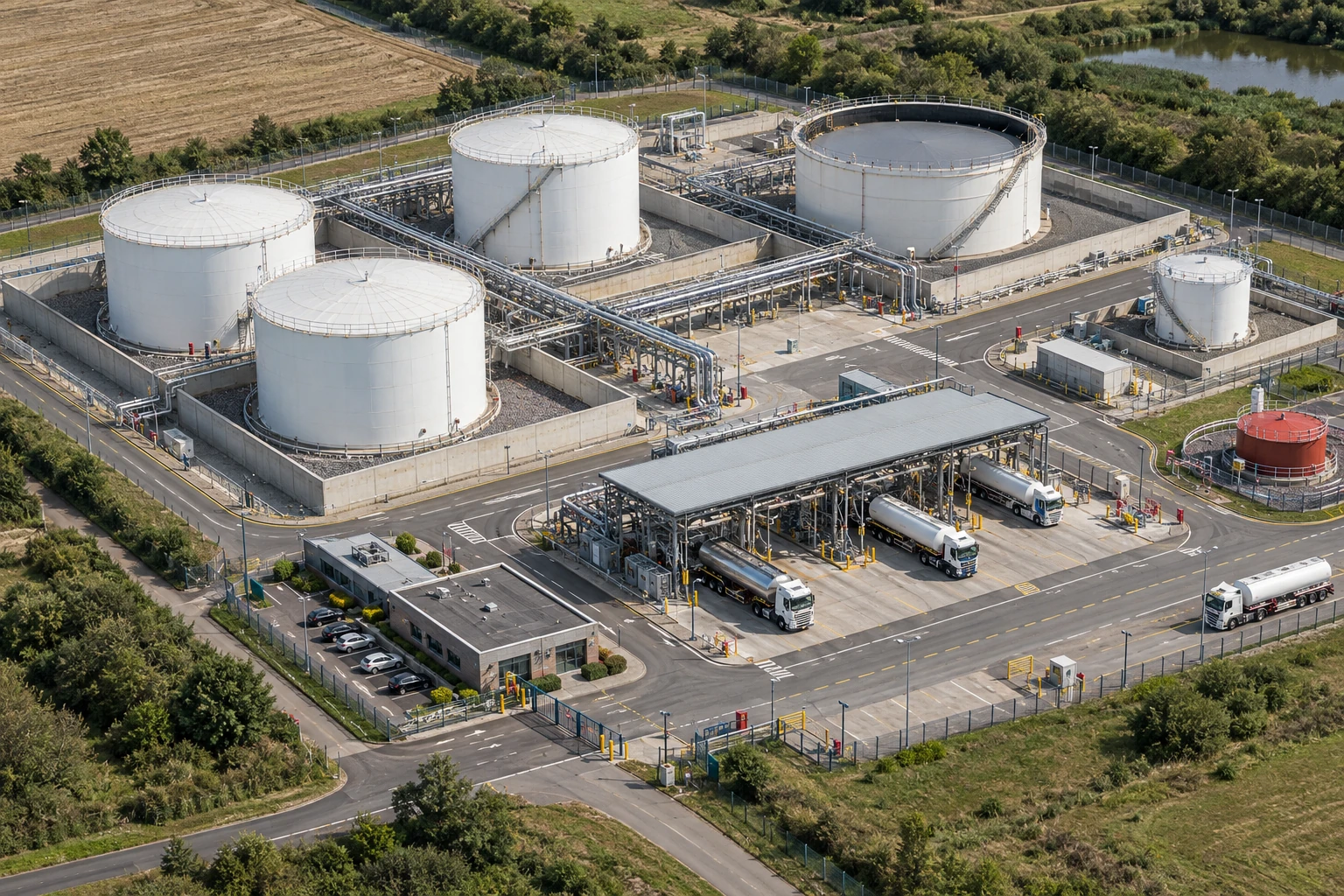
Hot work and a proposed transfer share an unresolved interface
All related inspection points 2 across 1 location
Crown Fuels terminal 2 inspection points
Practice in the SHAREhub environment. Browser practice is separate from workplace competence and formal learning records.
What major accident scenario should hot work control prevent?
The main scenario is ignition of a dangerous atmosphere or residue during non-routine work.
Hot work major accident pathway — part 1 of 2

Read the complete visual as text
- Hazard not recognised: Failure example: The task is described as bracket removal but involves grinding near a solvent line. Barrier to verify: Job walkdown and area authority review.
- Flammable material remains: Failure example: Residue is trapped in low points, sludge, seams or dead legs. Barrier to verify: Cleaning, draining, purging and isolation certificate.
- Atmosphere changes: Failure example: Vapour returns from a drain after the first gas test. Barrier to verify: Continuous or repeated testing and drain control.
Hot work major accident pathway — part 2 of 2

Read the complete visual as text
- Ignition introduced: Failure example: Non-rated grinder or welding set used in a zoned area. Barrier to verify: DSEAR check and authorised equipment list.
- Fire not detected early: Failure example: No fire watch after work, smouldering insulation ignites later. Barrier to verify: Fire-watch duration and post-work inspection.
- Handback weak: Failure example: Plant is returned with blinds, drains or alarms still impaired. Barrier to verify: Handback checklist and operations acceptance.
Best-practice guide: Hot Work Control in Process Areas
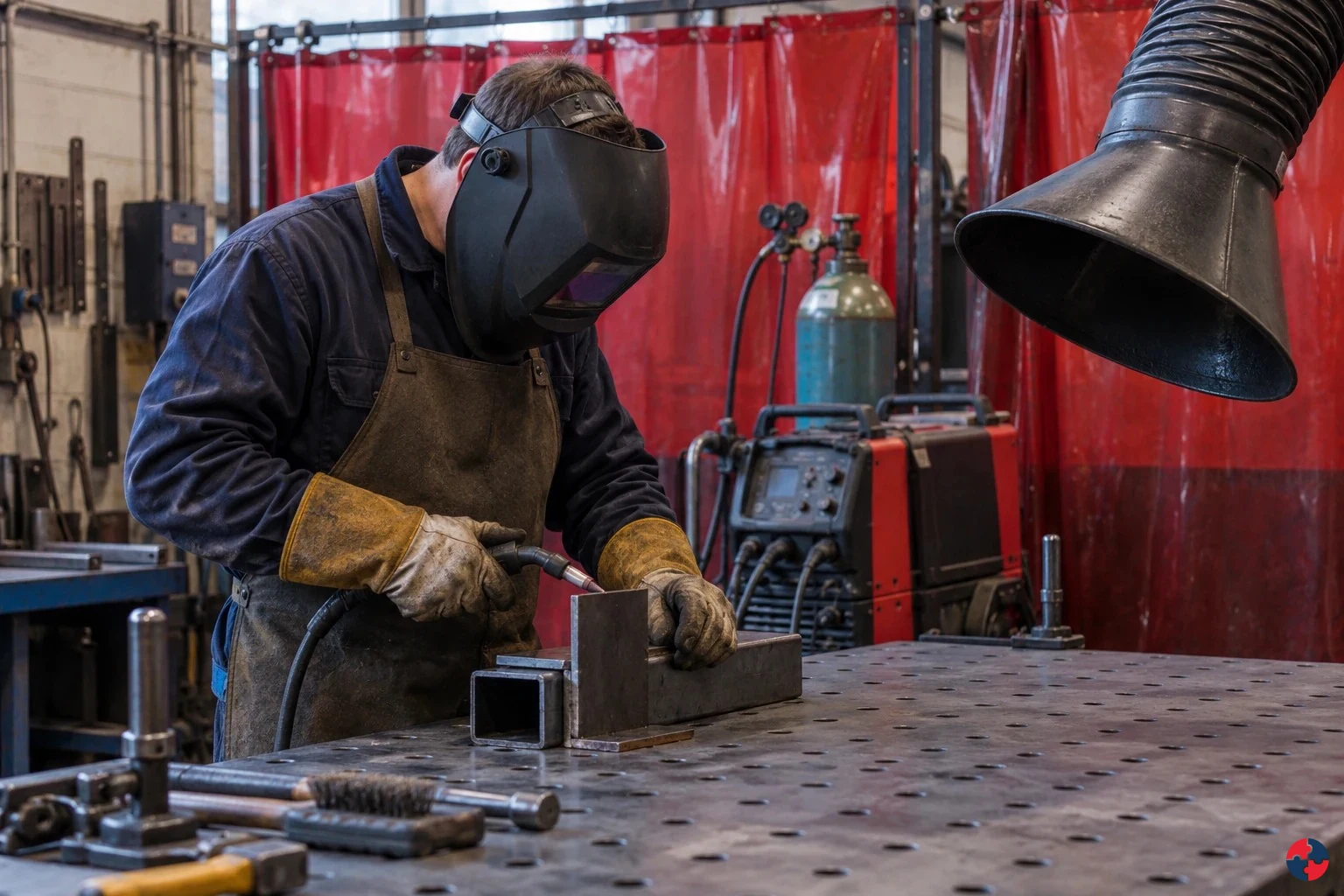
What major accident scenario should hot work control prevent?
The main scenario is ignition of a dangerous atmosphere or residue during non-routine work. Before welding or grinding on process plant, ask whether hot work can be avoided.
Turn hot work control in process areas knowledge into a decision
Before welding or grinding on process plant, ask whether hot work can be avoided. If it remains necessary, a competent issuer must verify positive isolation, cleaning, suitable gas testing, nearby drains and SIMOPS, an independent fire watch, stop conditions and formal handback at the actual site. Major accident hazard register and DSEAR assessment.
the process operator worked example
Risk register: The site risk register includes hot work near tank bunds, loading gantries, drains, pump seals, tanker bays, empty containers and maintenance workshops. Evidence / response: Major accident hazard register and DSEAR assessment. Permit standard: Hot work permits are red or red-edged in the site PTW system; lower-risk spark-potential work is defined separately in the local standard, but can be escalated to a red hot work permit by the area authority. Evidence / response: PTW procedure, colour-coding guide and completed permits.
Hot work hazard prompts
Flammable vapour: A cloud forms from residues, leaks, drains or vents. Combustible material: Packaging, insulation, dust or rags ignite from sparks. Hidden residue: Tank, pipe or drum appears empty but contains vapour or sludge.
Choose controls for hot work control in process areas
Eliminate: Fabricate or repair offsite or use a no-hot-work method that avoids ignition at the process area. Reduce: Choose a lower-energy joining or cutting method after engineering review. Isolate: Positively isolate, drain and clean equipment; segregate drains, vents and live operations. Control: Shield combustibles, provide ventilation and suitable gas monitoring at relevant points. Control: Issue permit with SIMOPS check, fire-watch coverage, change trigger and handback. Read the full control table for qualifications, ownership and verification. Use the actual task and applicable jurisdiction; existing technical approval remains unchanged.
Use the full hot work control in process areas lesson
Use the full topic for the decision points, practical examples, detailed control tables and source scope. HSE guidance applies to Great Britain; use HSENI for the Northern Ireland route and the source’s stated jurisdiction. A simplified guide does not change the page’s technical-review or approval status.
Read all six steps as text
1. What major accident scenario should hot work control prevent?
The main scenario is ignition of a dangerous atmosphere or residue during non-routine work.
- Avoid / redesign: Fabricate or repair offsite or use a no-hot-work method that avoids ignition at the process area.
- Control the task: Positively isolate, drain and clean equipment; segregate drains, vents and live operations.
- Verify before release: No credible alternative: justify hot work.
The main scenario is ignition of a dangerous atmosphere or residue during non-routine work. Before welding or grinding on process plant, ask whether hot work can be avoided.
Apply it: Which part of this plan would you check at the workface before authorising the task?
2. Turn hot work control in process areas knowledge into a decision
Use the evidence to improve the actual work arrangement.
- Change at source: Fabricate or repair offsite or use a no-hot-work method that avoids ignition at the process area.
- Make it observable: No credible alternative: justify hot work.
- Keep useful evidence: Major accident hazard register and DSEAR assessment.
Before welding or grinding on process plant, ask whether hot work can be avoided. If it remains necessary, a competent issuer must verify positive isolation, cleaning, suitable gas testing, nearby drains and SIMOPS, an independent fire watch, stop conditions and formal handback at the actual site. Major accident hazard register and DSEAR assessment.
Apply it: What evidence would show that the change improves this task, rather than only completing a record?
3. the process operator worked example
Example: a practical application of the existing topic lesson.
- Risk register: The site risk register includes hot work near tank bunds, loading gantries, drains, pump seals, tanker bays, empty containers and maintenance workshops.
- Permit standard: Hot work permits are red or red-edged in the site PTW system; lower-risk spark-potential work is defined separately in the local standard, but can be escalated to a red hot work permit by the area authority.
- Controls: Cold work is challenged first; where hot work remains, the area is cleaned, drained, gas tested, segregated and monitored with extinguishers and fire watch.
Risk register: The site risk register includes hot work near tank bunds, loading gantries, drains, pump seals, tanker bays, empty containers and maintenance workshops. Evidence / response: Major accident hazard register and DSEAR assessment. Permit standard: Hot work permits are red or red-edged in the site PTW system; lower-risk spark-potential work is defined separately in the local standard, but can be escalated to a red hot work permit by the area authority. Evidence / response: PTW procedure, colour-coding guide and completed permits.
Apply it: At which point would you hold this example, and what evidence would allow it to proceed?
4. Hot work hazard prompts
Connect the task, the route to the person and the control that can fail.
- Flammable vapour: A cloud forms from residues, leaks, drains or vents.
- Combustible material: Packaging, insulation, dust or rags ignite from sparks.
- Hidden residue: Tank, pipe or drum appears empty but contains vapour or sludge.
Flammable vapour: A cloud forms from residues, leaks, drains or vents. Combustible material: Packaging, insulation, dust or rags ignite from sparks. Hidden residue: Tank, pipe or drum appears empty but contains vapour or sludge.
Apply it: Who could be exposed, including other trades, cleaners, maintainers and people nearby?
5. Choose controls for hot work control in process areas
Start with the stronger practicable options and verify their effect.
- Eliminate: Fabricate or repair offsite or use a no-hot-work method that avoids ignition at the process area.
- Reduce: Choose a lower-energy joining or cutting method after engineering review.
- Isolate: Positively isolate, drain and clean equipment; segregate drains, vents and live operations.
- Control: Shield combustibles, provide ventilation and suitable gas monitoring at relevant points.
- Control: Issue permit with SIMOPS check, fire-watch coverage, change trigger and handback.
Eliminate: Fabricate or repair offsite or use a no-hot-work method that avoids ignition at the process area. Reduce: Choose a lower-energy joining or cutting method after engineering review. Isolate: Positively isolate, drain and clean equipment; segregate drains, vents and live operations. Control: Shield combustibles, provide ventilation and suitable gas monitoring at relevant points. Control: Issue permit with SIMOPS check, fire-watch coverage, change trigger and handback. Read the full control table for qualifications, ownership and verification. Use the actual task and applicable jurisdiction; existing technical approval remains unchanged.
Apply it: Which stronger option can be used here, and who will verify it before accepting the remaining risk?
6. Use the full hot work control in process areas lesson
Follow the official sources below and retain the task-specific evidence.
- Official guidance: HSE COMAH permit-to-work technical measure
- Official guidance: HSE HSG250 permit-to-work systems
- Task decision: Major accident hazard register and DSEAR assessment.
Use the full topic for the decision points, practical examples, detailed control tables and source scope. HSE guidance applies to Great Britain; use HSENI for the Northern Ireland route and the source’s stated jurisdiction. A simplified guide does not change the page’s technical-review or approval status.
Apply it: Which official source and full-topic section will you use to resolve the next decision?
A typical major accident pathway is simple but unforgiving: a plant item has contained flammable material, the job is described too narrowly, residues or vapours remain, isolation is assumed rather than proved, a drain or vent reintroduces vapour, a single gas test gives false confidence, grinding or welding starts, and ignition occurs. The result may be a flash fire, jet fire, explosion, toxic smoke, escalation to nearby equipment or loss of emergency control. HSE COMAH permit-to-work technical measure
Process safety thinking asks what barriers stop that pathway. Prevention barriers include substitution with cold work, shutdown or removal of the item, positive isolation, cleaning, purging and inerting. Detection barriers include gas testing and fire watch. Control barriers include ventilation, drain sealing, fire blankets and area segregation. Mitigation barriers include firefighting, emergency shutdown, alarms, muster and incident command. Assurance evidence proves those barriers were real on the day, not just listed on the permit.
| Pathway step | Failure example | Barrier to verify |
|---|---|---|
| Hazard not recognised | The task is described as bracket removal but involves grinding near a solvent line. | Job walkdown and area authority review. HSE COMAH permit-to-work technical measure |
| Flammable material remains | Residue is trapped in low points, sludge, seams or dead legs. | Cleaning, draining, purging and isolation certificate. HSE COMAH permit-to-work technical measure |
| Atmosphere changes | Vapour returns from a drain after the first gas test. | Continuous or repeated testing and drain control. HSE COMAH permit-to-work technical measure |
| Ignition introduced | Non-rated grinder or welding set used in a zoned area. | DSEAR check and authorised equipment list. HSE COMAH permit-to-work technical measure |
| Fire not detected early | No fire watch after work, smouldering insulation ignites later. | Fire-watch duration and post-work inspection. HSE COMAH permit-to-work technical measure |
| Handback weak | Plant is returned with blinds, drains or alarms still impaired. | Handback checklist and operations acceptance. HSE COMAH permit-to-work technical measure |
What are the key points for hot work in process areas?
The points that matter are hazard recognition, barrier verification and disciplined authorisation.
What are the key points for hot work in process areas? — part 1 of 2

Read the complete visual as text
- The points that matter are hazard recognition, barrier verification…: The points that matter are hazard recognition, barrier verification and disciplined authorisation.
- Hot work is an ignition decision: Do not issue hot work unless the flammable atmosphere and combustible material risk is understood.
- Cold work first: If the job can be done by a non-sparking, non-heat method, that option should be challenged first.
What are the key points for hot work in process areas? — part 2 of 2

Read the complete visual as text
- Permit plus proof: The permit should link to isolation, gas test, area preparation, fire watch and handback evidence.
- Conditions can change: Vapour can return from drains, residues, adjacent plant or SIMOPS after the first check.
- Stop work is a control: Anyone should be able to stop hot work if scope, plant status or conditions change.
Hot work is an ignition decision
Do not issue hot work unless the flammable atmosphere and combustible material risk is understood.
Cold work first
If the job can be done by a non-sparking, non-heat method, that option should be challenged first.
Permit plus proof
The permit should link to isolation, gas test, area preparation, fire watch and handback evidence.
Conditions can change
Vapour can return from drains, residues, adjacent plant or SIMOPS after the first check.
Stop work is a control
Anyone should be able to stop hot work if scope, plant status or conditions change.
What does hot work control mean in plain English?
Hot work control means preventing an ignition source from meeting fuel, vapour, gas, mist, dust, residue or combustible material.
Hot work is not dangerous simply because it is hot. It becomes dangerous when heat, sparks or flame are introduced into a place where something can burn or explode. In a process area, that fuel may be visible, such as rags, insulation or pooled liquid, or hidden, such as vapour in a drain, sludge in a vessel, residue in a seam or gas released from adjacent maintenance. HSE COMAH permit-to-work technical measure
A good system makes the safe decision visible. It forces the people who know the plant, the people doing the work and the people authorising the work to agree exactly what is being done, where, when, under what conditions, with what isolations, what testing, what fire protection and what handback standard.
| Element | Plain-English meaning | Good practice question |
|---|---|---|
| Hot work | Any task that can introduce heat, flame, spark or ignition energy. | Can the task be done cold? HSE COMAH permit-to-work technical measure |
| Process area | Area where dangerous substances or process equipment can create fire/explosion risk. | What could release or migrate into the work area? HSE COMAH permit-to-work technical measure |
| Permit | Formal authorisation and communication for controlled work. | Has every condition been verified? HSE COMAH permit-to-work technical measure |
| Gas test | Atmospheric check for flammable, toxic or oxygen hazards. | Is the test location, timing and frequency right? HSE COMAH permit-to-work technical measure |
| Handback | Formal return of plant and area to safe operational control. | Has operations accepted the plant as safe? HSE COMAH permit-to-work technical measure |
What types of work can count as hot work?
Hot work is broader than welding and flame cutting.
Grinding and disc cutting are common blind spots because they may look like everyday maintenance. In reality, abrasive wheels can throw sparks a long distance and can ignite dust, vapour, insulation, packaging, dry vegetation, rags or residue. Heat guns, soldering, portable electrical equipment, cameras, lighting and temporary generators can also be ignition sources where hazardous areas are present. HSE COMAH permit-to-work technical measure
A process-site hot work standard should define categories so people do not argue at the workface. It should also define when an activity is prohibited, when a permit is needed, when a higher authorisation is needed and when operations must be shut down or made gas-free before the job can proceed.
| Work type | Ignition risk | Control focus |
|---|---|---|
| Welding | Flame, arc, hot metal and radiant heat. | Area clearance, fire watch, gas testing and welding fume control. HSE COMAH permit-to-work technical measure |
| Flame cutting | Open flame, slag and hot work on metal. | Isolation, cleaning and hot-work exclusion zones. HSE COMAH permit-to-work technical measure |
| Grinding | High-energy sparks and hot surfaces. | Combustible material removal and spark control. HSE COMAH permit-to-work technical measure |
| Disc cutting | Sparks, friction heat and cutting into unknown material. | Material identification and area preparation. HSE COMAH permit-to-work technical measure |
| Soldering/brazing | Local heat and flame depending on method. | Control of nearby combustibles and gas cylinders. HSE COMAH permit-to-work technical measure |
| Non-rated electrical tools | Electrical ignition source in hazardous areas. | DSEAR zone check and equipment approval. HSE COMAH permit-to-work technical measure |
How should hot work, spark-potential work and permit colours be understood?
Colour coding should help people recognise risk quickly, but it must never replace hazard assessment and field verification.
HSG250 describes red or red-edged hot-work permits and blue or blue-edged cold-work permits as typical examples, not a legally mandatory colour system. A separate ignition-potential category is a local design choice and never reduces ignition assessment, gas testing or isolation. HSG250 uses yellow in an example of high-voltage isolation, so a site must explain its own code rather than borrow the colour without context. HSE HSG250 permit-to-work systems HSE HSG250 permit-to-work systems
HSG250 encourages clear, standardised permit types and suggests primary colour conventions. For hot work, the HSG250 convention is red or red-edged. That is useful because it makes ignition-source work stand out on a permit board, at shift handover and during SIMOPS review.
Some organisations also use a separate spark-potential or ignition-potential category, often shown as yellow in local permit systems. This is normally used for work that is not classic flame or welding work, but could still create a spark, static discharge, hot surface or non-rated electrical ignition source. The important point is local clarity: if the task can produce heat, flame or high-energy sparks in or near a flammable atmosphere, it should not be downgraded just because someone calls it spark-potential. The area authority must decide whether the higher red hot work control standard is required.
| Category | Typical colour convention | Examples and cautions |
|---|---|---|
| Hot work permit | Red or red-edged in line with HSG250 guidance. | Welding, flame cutting, burning, grinding, disc cutting, brazing, soldering and work that deliberately creates heat, flame or sparks. HSE HSG250 permit-to-work systems |
| Ignition-potential work (local category) | No universal HSG250 colour; the site may define a distinct code. | Use for lower-energy ignition risks such as non-rated portable equipment, camera/phone use in controlled areas, battery tools, generators, vehicle movements, impact tools or minor drilling where the local rules class them separately. Escalate to red hot work if the risk or location warrants it. HSE HSG250 permit-to-work systems |
| Cold work | Blue or blue-edged is suggested by HSG250 for cold work. | Work not intended to create ignition energy, but still needing controls because of process hazards, access, pressure, contamination or SIMOPS. HSE HSG250 permit-to-work systems |
| Confined space entry certificate | Green or green-edged is suggested by HSG250. | Entry controls may run alongside hot work, isolation and gas testing. A confined-space certificate does not authorise ignition sources by itself. HSE HSG250 permit-to-work systems |
| Isolation certificates | HSG250 shows isolation certificates separately, including yellow or yellow-edged for high-voltage electrical isolation. | Do not confuse colour-coded isolation evidence with permission to introduce ignition. The permit and isolation certificate must tell the same story. HSE HSG250 permit-to-work systems |
What hazards should be considered before hot work starts?
The hazard review should look for fuel, oxygen, ignition, confinement, escalation and changing conditions.
The job team should look beyond the immediate spark path. In process areas, hot work can affect adjacent pipework, cable trays, plastic bund linings, insulation, residues, drains, tanks, vents, pits, culverts and roof voids. Heat can travel by conduction through metal and ignite material on the other side of a wall, tank shell or deck. HSE COMAH permit-to-work technical measure
The best pre-job walkdowns include operations, maintenance, contractor supervisor and permit issuer. They physically look at the job, challenge line identity, identify low points and drains, check isolation drawings, check nearby SIMOPS and decide whether the job should be moved to a designated safe workshop instead.
| Hazard | How it can fail | Control question |
|---|---|---|
| Flammable vapour | A cloud forms from residues, leaks, drains or vents. | Has the atmosphere been tested in the right places? HSE COMAH permit-to-work technical measure |
| Combustible material | Packaging, insulation, dust or rags ignite from sparks. | Has the area been cleared or protected? HSE COMAH permit-to-work technical measure |
| Hidden residue | Tank, pipe or drum appears empty but contains vapour or sludge. | Has it been cleaned, purged and certified? HSE COMAH permit-to-work technical measure |
| Adjacent plant | Nearby transfer, venting or maintenance changes conditions. | Are SIMOPS controlled? HSE COMAH permit-to-work technical measure |
| Conduction | Heat travels through metal to hidden combustibles. | Has the other side been inspected? HSE COMAH permit-to-work technical measure |
| Impaired barriers | Gas detection, firewater or alarms are unavailable. | Is impairment authorised with compensating controls? HSE COMAH permit-to-work technical measure |
How should the hot work permit control the job?
The permit should be a live control document that defines scope, hazards, controls, authorisation and handback.
A strong permit is specific. It names the equipment, exact location, work method, people involved, isolations, gas-test standard, PPE, fire protection, environmental controls, rescue/emergency arrangements, shift handover and expiry. It should not contain copied text that could apply to any job on any day. HSE HSG250 permit-to-work systems
Permit quality should be audited at the workface. A perfect permit in the office is weak evidence if the workers do not understand the hazards, the area has changed, drains are open or the fire watch is missing.
| Permit element | Good content | Weak content |
|---|---|---|
| Scope | Exact task, tool and location. | General words such as maintenance works. HSE HSG250 permit-to-work systems |
| Hazards | Named flammable, toxic, oxygen and fire spread hazards. | Tick-box only. HSE HSG250 permit-to-work systems |
| Controls | Linked isolation, test, fire watch and area prep evidence. | Generic PPE list. HSE HSG250 permit-to-work systems |
| Authorisation | Area authority, issuer, receiver and specialist sign-off where needed. | Self-authorisation by contractor. HSE HSG250 permit-to-work systems |
| Handover | Shift and suspension arrangements. | No instruction if job overruns. HSE HSG250 permit-to-work systems |
| Handback | Inspection and operations acceptance. | Permit closed remotely. HSE HSG250 permit-to-work systems |
What would a good worked hot work permit example include?
Fume control is a separate release check
Verify welding-fume prevention/reduction and effective source capture for indoor work, with suitable RPE where capture is insufficient or impracticable; outdoor welding needs suitable RPE. Protect nearby people and check actual capture, equipment condition and wearer suitability/fit. A satisfactory flammable-atmosphere test cannot release work with uncontrolled fume. A change from bracket work to cutting process containment suspends this permit for reassessment.
A worked example helps learners and supervisors see how the permit, certificates and field checks should connect.
Worked permit hold point: before removing the external corroded support bracket on pump skid P-204, issuer and isolating authority physically confirm line identity, isolation proof, drain protection, atmosphere test at relevant points, live transfer conflict, fire-watch location and emergency route. If any cannot be proved, the permit remains unissued. HSE HSG250 permit-to-work systems HSE HSG253 safe isolation of plant HSE COMAH permit-to-work technical measure HSE HSG250 permit-to-work systems
Imagine Crownway Fuels Ltd needs to cut away and weld a corroded support bracket on a pump skid inside a bunded fuel-transfer area. The physical job looks small, but the location changes the risk. Nearby drains, pump seals, historical residues, tanker movements, ignition-source zoning, firewater status and emergency access all matter before anyone brings a grinder or welding set into the area.
The permit should show the whole decision trail. It should explain why cold work or removal to a workshop is not reasonably practicable, what has been isolated and cleaned, where gas tests were taken, how drains and low points were controlled, what SIMOPS were stopped, who authorised the work, who acted as fire watch, how long the post-work watch lasted, and how operations accepted the area back.
| Permit stage | Example detail | Evidence or decision point |
|---|---|---|
| Job scope | Cut away corroded bracket and weld replacement support on pump skid P-204 in bund B. | Exact plant item, method, drawing reference and workface walkdown. HSE HSG250 permit-to-work systems |
| Alternatives challenged | Cold bolted clamp or workshop removal considered but rejected because pipe support alignment would be unsafe. | Recorded cold-work challenge and engineering approval. HSE HSG250 permit-to-work systems |
| Isolation and cleaning | Pump stopped, locked off, drained, flushed, spaded where required and checked for trapped product. | Isolation certificate, drain record and operations sign-off. HSE HSG250 permit-to-work systems |
| Gas testing | Tests taken at breathing zone, drain points, bund low point, pump seal area and around nearby vents before work, then repeated at defined intervals. | Gas-test record with instrument checks and stop criteria. HSE HSG250 permit-to-work systems |
| Area preparation | Combustibles removed, drains covered, bund inspected, fire blanket fitted, extinguishers positioned and escape route kept clear. | Area preparation checklist and permit issuer field check. HSE HSG250 permit-to-work systems |
| SIMOPS check | No tanker loading, drain opening, solvent cleaning, painting, alarm impairment or fuel transfer during the permit window. | Permit board, shift manager review and SIMOPS hold point. HSE HSG250 permit-to-work systems |
| Authorisation | Area authority, permit issuer, receiver, gas tester and fire watch sign with time limits and conditions. | Signed red hot work permit and toolbox talk record. HSE HSG250 permit-to-work systems |
| Fire watch and handback | Dedicated fire watch monitors during work and for the risk-based period after completion, then operations inspect and accept handback. | Fire-watch log, post-work inspection and operations acceptance. HSE HSG250 permit-to-work systems |
| Close-out learning | Any gas reading, spark spread, scope change or delayed fire-watch finding is reviewed in the PTW learning meeting. | Near-miss log, action tracker and PTW audit sample. HSE HSG250 permit-to-work systems |
How should gas testing be planned and interpreted?
Gas testing is a warning and verification control; it is not a guarantee that conditions will remain safe.
The tester must know target gases and instrument limitations, verify calibration and pre-use function, test oxygen or toxic hazards where relevant, and sample low points, drains and connected spaces. A safe reading at one moment cannot prove future safety; specify retest or continuous monitoring and stop thresholds on the permit. HSE HSG250 permit-to-work systems HSE COMAH permit-to-work technical measure HSE HSG250 permit-to-work systems
Gas testing should be planned by someone competent to understand the substance, equipment, location, weather, ventilation, low points and work method. The tester should know where vapour might collect, what the instrument detects, whether oxygen or toxic gases matter, when repeat testing is required and what reading stops the job.
A single test at chest height before work may miss heavier-than-air vapour in drains or pits. A single pre-start test may also miss vapour that returns later because a flange is opened, a drain dries out, a pump starts, a wind direction changes or sludge is disturbed. For high-risk work, the permit should define repeated or continuous monitoring.
| Test issue | Good practice | Common failure |
|---|---|---|
| Tester competence | Trained in instrument use, limitations and site hazards. | Untrained person reads a number without context. HSE HSG250 permit-to-work systems |
| Instrument | Correct gas, calibration, bump test and battery status. | Instrument not suited to substance. HSE HSG250 permit-to-work systems |
| Test location | Low points, drains, inside plant, adjacent spaces and breathing zone. | One convenient test point. HSE HSG250 permit-to-work systems |
| Timing | Before work and repeated or continuous where conditions can change. | Only one test at permit issue. HSE HSG250 permit-to-work systems |
| Action level | Clear stop criteria and escalation. | No one knows what reading stops work. HSE HSG250 permit-to-work systems |
How should isolation, draining and cleaning be proved?
Inerted does not mean breathable
An atmosphere controlled against ignition may still be fatal to breathe. Inerting needs a competent engineered and managed method and never authorises entry. A zero flammable reading does not demonstrate adequate oxygen or absence of toxic residues. Select detectors for the actual substances, sensor limits (including oxygen dependence), sample line and response time; heating can release fresh vapour. Any entry needs its separate confined-space assessment and emergency arrangements.
Hot work should not rely on assumed isolation or memory of plant condition.
Process isolation needs a method that matches the stored energy and substance hazard. Locking a valve may not be enough if a valve can pass, a line can backfeed, or trapped material can heat and expand. High-risk hot work may need positive isolation, spading/blinding, disconnection, draining, flushing, purging or inerting, with verification before work starts. HSE HSG253 safe isolation of plant
The isolation certificate and permit should tell the same story. If the permit says the vessel is gas-free but the isolation record does not show how it was cleaned, vented and tested, the job should be challenged.
| Control | What good looks like | Evidence |
|---|---|---|
| Line identification | Plant item and line are physically identified by operations and maintenance. | Marked-up drawing and field verification. HSE HSG253 safe isolation of plant |
| Positive isolation | Spades, blinds, disconnection or other suitable isolation used where needed. | Isolation certificate. HSE HSG253 safe isolation of plant |
| Draining and flushing | Low points and dead legs considered. | Drain/flush record. HSE HSG253 safe isolation of plant |
| Purging or inerting | Atmosphere made safe and monitored where justified. | Purge/inerting certificate. HSE HSG253 safe isolation of plant |
| Cleaning | Residues, sludge, coatings and trapped material removed or assessed. | Cleaning certificate and inspection. HSE HSG253 safe isolation of plant |
| Proving | Isolation is checked before work and after changes. | Permit issuer walkdown. HSE HSG253 safe isolation of plant |
How should the hot work area be prepared?
Area preparation should remove fuel, control spark travel and protect nearby equipment before ignition sources arrive.
Good preparation is physical. Remove combustibles, isolate drains, cover unavoidable materials with suitable fire-resistant protection, check wall penetrations, protect cable trays, inspect the other side of metalwork, position extinguishers, confirm access and keep escape routes open. If the work is outside, wind can carry sparks or vapour; if it is inside, ventilation and confinement matter. HSE HSG253 safe isolation of plant
Area preparation should be rechecked if the job changes. A grinder brought in after the permit was issued, a cover removed to gain access, or a contractor starting nearby painting work can all invalidate the original decision.
| Preparation | Purpose | Verification |
|---|---|---|
| Remove combustibles | Reduce fuel available to ignite. | Pre-job inspection. HSE HSG253 safe isolation of plant |
| Seal drains and low points | Prevent vapour release or migration. | Drain map and field check. HSE HSG253 safe isolation of plant |
| Protect openings | Stop sparks reaching hidden voids. | Other-side inspection. HSE HSG253 safe isolation of plant |
| Position extinguishers | Enable early response to small incipient fires. | Extinguisher type and location check. HSE HSG253 safe isolation of plant |
| Control cylinders | Separate, secure and remove gas cylinders when not needed. | Gas set inspection. HSE HSG253 safe isolation of plant |
| Maintain escape | Keep workers and fire watch able to leave safely. | Route check. HSE HSG253 safe isolation of plant |
What should a fire watch do during and after hot work?
The fire watch is an active detection and early-response barrier, not a spare pair of hands.
Set a documented post-work watch and reinspection period from the actual fire risk, including concealed spaces. HSG168 specifies at least one hour continuous watch followed by a later check for construction work; do not present that construction guidance as a universal legal minimum for all process sites. HSE HSG168 fire safety in construction HSE HSG250 permit-to-work systems HSE HSG168 fire safety in construction
The fire watch should understand the job, the spark path, hidden voids, nearby combustibles, alarm route, extinguishers and emergency actions. They should be positioned so they can see relevant areas and should not be given other tasks that distract them from watching.
The post-work watch matters because fires can smoulder behind insulation, in packaging, under floorboards, in wall cavities, in dust layers or on the other side of metal. Duration should be based on the risk, not habit. HSE welding guidance refers to a fire watch during and after hot work, and notes that longer periods may be needed where ignition is hard to detect or slow to develop. HSE welding fire-watch guidance
| Expectation | Good practice | Failure to challenge |
|---|---|---|
| Competence | Trained in hazards, alarm, extinguishers and stop-work authority. | Unbriefed labourer assigned at the last minute. HSE HSG168 fire safety in construction |
| Independence | Focuses on watching, not doing the hot work. | Fire watch also fetching materials. HSE HSG168 fire safety in construction |
| Coverage | Watches both sides, below and adjacent areas where heat or sparks can travel. | Only watches the welder. HSE HSG168 fire safety in construction |
| Duration | Risk-based post-work watch and reinspection. | Leaves immediately when the permit ends. HSE safety risks from welding |
| Escalation | Stops work and raises alarm if conditions change. | Feels unable to challenge contractor or supervisor. HSE HSG168 fire safety in construction |
How should simultaneous operations be controlled?
SIMOPS control checks whether other work can change the hot work risk before or during the task.
Hot work may be safe in isolation and unsafe when combined with transfer, draining, sampling, tanker loading, cleaning, painting, confined space entry, scaffolding, excavation, venting, alarm maintenance or firewater impairment. The permit office should be able to see conflicts, but the area authority and operations team must also understand work as done in the field. HSE COMAH permit-to-work technical measure
The test is simple: could another task introduce fuel, vapour, oxygen, ignition, people, blocked escape, impaired detection or delayed emergency response? If yes, the work needs sequencing, separation, extra controls or cancellation.
| Concurrent activity | Why it matters | Control |
|---|---|---|
| Tanker loading | Release or vapour generation near ignition source. | Suspend transfer or move hot work. HSE COMAH permit-to-work technical measure |
| Drain opening | Vapour may return after gas test. | Sequence work and repeat testing. HSE COMAH permit-to-work technical measure |
| Painting/solvent cleaning | Flammable vapour or combustible material introduced. | Prohibit overlap or segregate. HSE COMAH permit-to-work technical measure |
| Alarm maintenance | Detection barrier impaired. | Compensating controls and senior authorisation. HSE COMAH permit-to-work technical measure |
| Confined space entry | Emergency response and atmosphere risks interact. | Integrated permit review. HSE COMAH permit-to-work technical measure |
| Scaffold erection | Escape or access may be affected. | Area coordination and route check. HSE COMAH permit-to-work technical measure |
What should happen before hot work is handed back?
Handback should prove the work area, equipment and plant are safe to return to operational control.
Handback is a common weak point because attention drops after the visible job is complete. A strong handback checks the work, fire watch, drains, covers, blinds, tools, temporary earths, alarms, gas detection, fire protection, removed guards, waste, housekeeping and operations readiness. HSE HSG250 permit-to-work systems
Operations should accept handback only when the plant condition is known. If work is incomplete, the permit should be suspended with a safe-state instruction and shift handover. If equipment has been changed, management of change or pre-start review may be needed before restart.
| Check | Reason | Evidence |
|---|---|---|
| Post-work inspection | Detect smouldering or damaged protection. | Fire-watch close-out. HSE HSG250 permit-to-work systems |
| Plant condition | Confirm isolation removal and reinstatement plan. | Operations acceptance. HSE HSG250 permit-to-work systems |
| Barrier reinstatement | Alarms, detection, firewater or isolations restored. | Impairment log close-out. HSE HSG250 permit-to-work systems |
| Housekeeping | Remove waste, rods, discs, cylinders and combustibles. | Area sign-off. HSE HSG250 permit-to-work systems |
| Incomplete work | Leave safe state and clear instructions. | Permit suspension note. HSE HSG250 permit-to-work systems |
| Restart readiness | Check MOC/PSSR where change occurred. | Restart checklist. HSE HSG250 permit-to-work systems |
How should electronic permit systems be used safely?
Electronic permits can improve visibility, but they can also hide poor field verification if the system becomes screen-based approval.
An electronic permit should support planning, clash detection, status visibility and audit trails. It should not replace worksite walkdown, face-to-face communication, equipment identification, physical isolation proof or worker understanding. HSE HSG250 permit-to-work systems
Good systems include mandatory fields only where they improve decisions, allow clear attachments, display active permits and impairments, force handover and handback, and are checked by audits. Poor systems reward clicking, copying and remote approval.
| System feature | Good use | Risk if weak |
|---|---|---|
| Field verification | Permit cannot be issued until walkdown is confirmed. | Office approval without seeing the job. HSE HSG250 permit-to-work systems |
| SIMOPS view | Shows nearby permits and impairments. | Conflicts missed across systems. HSE HSG250 permit-to-work systems |
| Isolation link | Links permit to isolation certificates. | Permit and isolation records disagree. HSE HSG250 permit-to-work systems |
| Handover | Requires shift transfer and acceptance. | Information lost between teams. HSE HSG250 permit-to-work systems |
| Audit trail | Shows changes, suspensions and close-out. | Copied permits hide drift. HSE HSG250 permit-to-work systems |
Which barriers should protect hot work in process safety?
Hot work barriers should be organised around prevention, detection, control, mitigation and assurance.
A barrier-led view helps avoid over-reliance on the permit. The permit is part of the management system barrier, but the physical barriers may include removal of fuel, positive isolation, gas freeing, ventilation, drain sealing, intrinsically safe equipment, fire protection, emergency shutdown, fixed detection and firefighting capability. HSE HSG253 safe isolation of plant
Each barrier needs evidence. If gas detection is impaired, firewater is out of service, the fire watch is not trained, the isolation certificate is missing or the DSEAR assessment is out of date, the permit should not be treated as enough.
| Barrier type | Examples | Assurance evidence |
|---|---|---|
| Prevention | Cold work, cleaning, draining, isolation, purging, removal of combustibles. | Risk assessment, method statement and certificates. HSE HSG253 safe isolation of plant |
| Detection | Gas testing, area patrol, fire watch, fixed gas/fire detection. | Test records, fire-watch log and detector status. HSE HSG253 safe isolation of plant |
| Control | Ventilation, drain covers, spark containment, extinguishers, blankets. | Inspection checklist and permit conditions. HSE HSG253 safe isolation of plant |
| Mitigation | Alarm, emergency shutdown, firefighting, muster, spill control. | Emergency plan and drill evidence. HSE HSG253 safe isolation of plant |
| Assurance | PTW audit, field verification, incident learning, action tracking. | Audit report and action closure. HSE HSG253 safe isolation of plant |
What should major accident learning teach about hot work?
Major accident learning shows that hot work failures are rarely only a worker error; they are usually failures of hazard recognition, isolation, permit discipline and management control.
HSE's Hickson and Welch case is a strong learning anchor because the event involved a cleaning task, misunderstood residues, failure to check the atmosphere for flammable vapour, missing permit coverage for the actual raking task, isolation weaknesses and ignition-related hazards. It shows why unusual maintenance, old residues and first-time cleaning tasks deserve real process safety challenge. HSE HSG250 permit-to-work systems
HSE's safety alert on hot work on tanks, drums and containers reinforces the same lesson at smaller scale: a container can look empty while residues in seams, folds or sludge still create explosive vapour. The practical message is cold work first, then cleaning, gas freeing and competent verification if heat cannot be avoided.
| Learning point | What it means | Workplace question |
|---|---|---|
| Empty does not mean safe | Residue and vapour can remain in drums, tanks and pipework. | How do we prove clean and gas-free? HSE HSG250 permit-to-work systems |
| Scope drift kills permits | The actual work may differ from the authorised task. | Who stops work when method changes? HSE HSG250 permit-to-work systems |
| Gas tests are snapshots | Atmospheres can change during work. | When do we retest or monitor continuously? HSE HSG250 permit-to-work systems |
| Handback matters | Incomplete restoration can create restart risk. | Who accepts plant back into service? HSE HSG250 permit-to-work systems |
| Learning must change standards | Incidents should update permit, isolation and training rules. | What changed after the last hot work near miss? HSE HSG250 permit-to-work systems |
What evidence proves hot work is being controlled?
Evidence should show that the job was planned, authorised, verified, monitored, handed back and reviewed.
The evidence set should tell a coherent story. The DSEAR assessment should identify flammable atmospheres and ignition controls. The permit should specify the task and controls. Isolation and gas-test records should match the equipment and location. Fire-watch logs should show the task was monitored. Handover and handback should show safe control of the job across time. HSE HSG250 permit-to-work systems
Assurance should sample the field, not only the permit archive. An auditor should be able to stand at the work location and see whether the permit reflects reality.
| Evidence | What it can evidence | What to challenge |
|---|---|---|
| DSEAR assessment | Dangerous substances and zones understood. | Is it current and task-specific? HSE HSG250 permit-to-work systems |
| Hot work permit | Task, controls and authorisation defined. | Is text copied or specific? HSE HSG250 permit-to-work systems |
| Isolation certificate | Plant made safe for work. | Does it match the plant item? HSE HSG250 permit-to-work systems |
| Gas test record | Atmosphere checked competently. | Were low points and repeat tests considered? HSE HSG250 permit-to-work systems |
| Fire-watch log | Detection and post-work inspection happened. | Was the watcher trained and independent? HSE HSG250 permit-to-work systems |
| PTW audit | System is checked and improved. | Are findings closed with field evidence? HSE HSG250 permit-to-work systems |
Which legal route applies to this task?
Select the instrument for the actual UK nation, activity, premises and threshold. Guidance supports decisions but does not itself create a universal duty.
Hot-work permits operationalise the applicable safe-work, dangerous-substance and process-safety duties; a permit colour is not a law. Management of Health and Safety at Work Regulations 1999 Management of Health and Safety at Work Regulations (NI) 2000
| Decision | Great Britain law | Northern Ireland law | Applicability |
|---|---|---|---|
| General safe work | Health and Safety at Work etc. Act 1974 Law / guidance | Health and Safety at Work (NI) Order 1978 Law / guidance | Confirm the site and task scope before applying. |
| Assessment and coordination | Management of Health and Safety at Work Regulations 1999 Law / guidance | Management of Health and Safety at Work Regulations (NI) 2000 Law / guidance | Confirm the site and task scope before applying. |
| Flammable substance/fire/explosion | Dangerous Substances and Explosive Atmospheres Regulations 2002 Law / guidance | Dangerous Substances and Explosive Atmospheres Regulations (NI) 2003 Law / guidance | Confirm the site and task scope before applying. |
| Major-accident establishment where threshold met | Control of Major Accident Hazards Regulations 2015 Law / guidance | Control of Major Accident Hazards Regulations (NI) 2015 Law / guidance | Only if establishment threshold is met. |
| Welding fume and hazardous exposure | COSHH Regulations 2002 Law / guidance | COSHH Regulations (NI) 2003 Law / guidance | Confirm the site and task scope before applying. |
| Work equipment | Provision and Use of Work Equipment Regulations 1998 Law / guidance | Provision and Use of Work Equipment Regulations (NI) 1999 Law / guidance | Confirm the site and task scope before applying. |
How can the hierarchy of controls prevent fire and explosion during hot work on process plant?
ERICPD is used here as a planning mnemonic. The linked HSE five-level hierarchy is the official source for the order and relative reliability of controls; the two labels are not identical.
Start at the physical hazard and prefer avoiding or redesigning the exposure before relying on instructions or PPE.
ERICPD is a planning mnemonic. Isolate usually maps to engineering, Discipline sustains controls, and the five-level hierarchy separately names substitution. These candidates require competent assessment of the actual task. HSE five-level hierarchy HSE five-level hierarchy
How can the ERICPD hierarchy of controls prevent fire and explosion during hot work on process plant?

| ERICPD stage | Five-level mapping | Task intervention | Owner and check | Failure / stop |
|---|---|---|---|---|
| Eliminate | Elimination | Fabricate or repair offsite or use a no-hot-work method that avoids ignition at the process area. | Planner confirms technical feasibility. | No credible alternative: justify hot work. HSE HSG250 permit-to-work systems |
| Reduce | Substitution | Choose a lower-energy joining or cutting method after engineering review. | Engineer confirms material and quality needs. | New ignition or integrity risk: stop. HSE HSG250 permit-to-work systems |
| Isolate | Engineering | Positively isolate, drain and clean equipment; segregate drains, vents and live operations. | Isolating authority proves boundaries in field. | Unproven boundary: no permit release. HSE HSG253 safe isolation of plant |
| Control: physical | Engineering | Shield combustibles, provide ventilation and suitable gas monitoring at relevant points. | Issuer and tester verify before and during work. | Atmosphere changes: stop and revalidate. HSE COMAH permit-to-work technical measure |
| Control: method | Administrative | Issue permit with SIMOPS check, fire-watch coverage, change trigger and handback. | Issuer briefs performer and fire watch. | Scope or nearby operation changes: suspend. HSE HSG250 permit-to-work systems |
| PPE | PPE | Use welding, eye, hand and respiratory protection for residual exposure. | Supervisor checks fit and task compatibility. | Missing protection: hold. HSE welding fume controls |
| Discipline | Sustains controls | Review permits, gas tests, watches and near misses; close design actions. | Manager samples records and field practice. | Repeated permit drift: redesign. HSE HSG250 permit-to-work systems |
How can the ISO 45001 hierarchy of controls prevent fire and explosion during hot work on process plant?

| ERICPD stage | Five-level mapping | Task intervention | Owner and check | Failure / stop |
|---|---|---|---|---|
| Eliminate | Elimination | Fabricate or repair offsite or use a no-hot-work method that avoids ignition at the process area. | Planner confirms technical feasibility. | No credible alternative: justify hot work. HSE HSG250 permit-to-work systems |
| Reduce | Substitution | Choose a lower-energy joining or cutting method after engineering review. | Engineer confirms material and quality needs. | New ignition or integrity risk: stop. HSE HSG250 permit-to-work systems |
| Isolate | Engineering | Positively isolate, drain and clean equipment; segregate drains, vents and live operations. | Isolating authority proves boundaries in field. | Unproven boundary: no permit release. HSE HSG253 safe isolation of plant |
| Control: physical | Engineering | Shield combustibles, provide ventilation and suitable gas monitoring at relevant points. | Issuer and tester verify before and during work. | Atmosphere changes: stop and revalidate. HSE COMAH permit-to-work technical measure |
| Control: method | Administrative | Issue permit with SIMOPS check, fire-watch coverage, change trigger and handback. | Issuer briefs performer and fire watch. | Scope or nearby operation changes: suspend. HSE HSG250 permit-to-work systems |
| PPE | PPE | Use welding, eye, hand and respiratory protection for residual exposure. | Supervisor checks fit and task compatibility. | Missing protection: hold. HSE welding fume controls |
| Discipline | Sustains controls | Review permits, gas tests, watches and near misses; close design actions. | Manager samples records and field practice. | Repeated permit drift: redesign. HSE HSG250 permit-to-work systems |
How should management verify controls for this task?
For welding on a previously flammable process line beside a live transfer area, the management check should start with a real control decision: Fabricate or repair offsite or use a no-hot-work method that avoids ignition at the process area. Name the person who will test it, keep evidence from the actual work, and reopen the assessment when the failure condition in the hierarchy table occurs. HSE management-system guidance.
A review should compare the planned control with what workers and supervisors can use in practice. Record the defect, owner, interim protection, verification and next review trigger so that a policy statement or certificate does not stand in for a working control.
How could Crownway Fuels Ltd manage this in practice?

Crownway Fuels Ltd would challenge the need for hot work, then control any necessary task through process-specific assessment, work coordination and verified precautions.
Crownway Fuels Ltd · practical example
Consider a cold method before authorising sparks near fuel
The key lesson A hot-work permit supports a risk assessment; it does not remove flammable material or establish a safe work environment by itself.
The situation: A bracket repair is requested near depot equipment while a delivery is planned. The contractor proposes grinding in place. Crownway would consider removing the component or using a suitable cold method before assessing an on-site ignition source.
Why this matters: Sparks and heat can affect connected equipment, nearby tasks and concealed spaces beyond the point of work.
How Crownway Fuels Ltd would manage it
- Challenge the proposed method — Maintenance Coordinator. Ask whether the repair can be completed away from the process area or by a suitable non-hot method. Obtain competent technical agreement that the alternative meets the repair need.
- Understand the process setting — Site Manager. Identify relevant substances, equipment, connections, releases and concurrent activities with the work party. Resolve how deliveries and other work could change the conditions.
- Define necessary precautions — Competent technical authority. Specify the task controls, isolation, testing and fire precautions required by the actual assessment and approved site system. Do not invent a generic distance or testing interval.
- Check and release the task — Authorised permit issuer and acceptor. Verify the defined precautions at the workface and brief the people carrying out the work. Confirm validity, communications, stop conditions and who controls adjacent operations.
- Check completion and aftercare — Shift Supervisor. Maintain the assessed fire-watch and post-work arrangements, hand over any continuing precautions and obtain the required completion and reinstatement acceptance before normal activities resume.
When the conditions change
- Recognise the trigger
- Hot work or adjacent operations change the assessed conditions.
- Make the immediate decision
- Suspend grinding while a delivery, release or other change invalidates the assessed hot-work conditions.
- Verify the next step
- The authorised permit issuer and acceptor recheck the affected process boundary, required test evidence and ignition and fire precautions, and confirm the delivery interface before permitting the defined repair.
What good looks like
Avoidable hot work is removed. Necessary hot work has a known boundary, verified controls and active coordination, and the period after the tools stop is managed as part of the job.
Evidence to look for: Alternative-method review, task assessment, linked work controls, test and verification records, completion and aftercare handover.
Common mistake to avoid: Believing a signed permit turns an unsuitable repair location into a safe one.
Apply this to your work: Could your repair be moved or changed to remove the ignition source?
Guidance behind the management approach: HSE: permit-to-work systems. Use the topic's legal and technical guidance for the applicable work and location.
Crownway Fuels Ltd is a fuel storage and distribution business with bulk tanks, tanker loading, pumps, pipework, vents, drains, hazardous areas, contractors, workshops and emergency-response duties. Hot work can turn a small loss of containment into a severe fire or explosion if controls are not verified. HSE COMAH permit-to-work technical measure
| Management element | How the business would manage it | Evidence to review |
|---|---|---|
| Risk register | The site risk register includes hot work near tank bunds, loading gantries, drains, pump seals, tanker bays, empty containers and maintenance workshops. | Major accident hazard register and DSEAR assessment. HSE COMAH permit-to-work technical measure |
| Permit standard | Hot work permits are red or red-edged in the site PTW system; lower-risk spark-potential work is defined separately in the local standard, but can be escalated to a red hot work permit by the area authority. | PTW procedure, colour-coding guide and completed permits. HSE COMAH permit-to-work technical measure |
| Controls | Cold work is challenged first; where hot work remains, the area is cleaned, drained, gas tested, segregated and monitored with extinguishers and fire watch. | Pre-job checklist and fire-watch log. HSE COMAH permit-to-work technical measure |
| Contractor management | Contractors are pre-qualified for hot work competence, briefed on Crownway rules and supervised by an area authority who understands plant hazards. | Contractor pre-assignment audit and induction. HSE COMAH permit-to-work technical measure |
| Barrier assurance | The shift manager checks active permits against tank transfers, drain work, alarm impairments and firewater status before authorising SIMOPS. | Daily permit coordination record. HSE COMAH permit-to-work technical measure |
| Learning | Any unexpected gas reading, fire-watch intervention, scope change or near miss is investigated and reviewed in the process safety meeting. | Incident learning log and action tracker. HSE COMAH permit-to-work technical measure |
| Competence | Permit issuers, gas testers, fire watchers and contractors have role-based competence standards and reassessment intervals. | Competence matrix and assessment records. HSE COMAH permit-to-work technical measure |
What should hot-work planning examine near a fuel system?
Use the maintenance context to identify connected systems, residual fuel and the changed activity. A gas-test result or an inactive-looking tank does not by itself establish clearance.
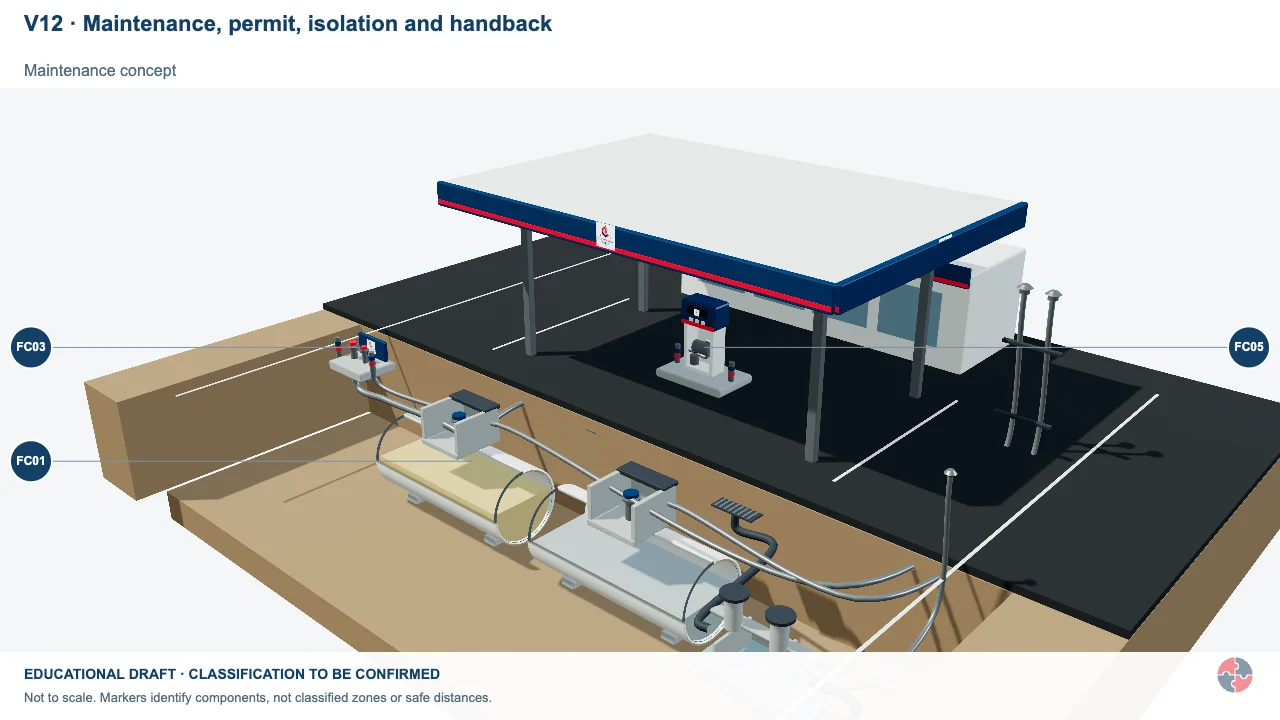
Maintenance, permit, isolation and handback
Maintenance changes the task and may open systems that are closed during normal use.
Activity focus: Inspect the work boundary, nearby live activities and responsibility for restoring the installation.
Educational illustration, not to scale. Coloured zones are teaching examples, not a site-specific hazardous-area classification.
What must each role demonstrate?
Observe a role-specific decision or simulation, record the assessor and evidence, and reassess after a relevant change.
Briefing attendance alone is insufficient evidence that a person can recognise a hold point or act in the field. HSE HSG250 permit-to-work systems
| Role | Demonstration | Assessor and record | Reassess when |
|---|---|---|---|
| Permit issuer | Walk the plant and verify isolation, cleaning, testing and SIMOPS before release. | Senior issuer observes and samples permit. | Scope, plant or shift changes. HSE HSG250 permit-to-work systems |
| Gas tester | Choose suitable instrument, test points and frequency; interpret abnormal readings. | Competent tester observes field setup. | Substance, weather or process changes. HSE HSG250 permit-to-work systems |
| Performer | Read permit boundaries and stop on changed conditions. | Issuer observes teach-back. | Task or crew changes. HSE permit-to-work systems |
| Fire watch | Watch adjacent/hidden areas, raise alarm and complete agreed post-work watch. | Issuer observes drill. | Watch coverage or risk changes. HSE HSG250 permit-to-work systems |
| Area authority | Coordinate nearby transfer and formal handback. | Manager samples live coordination. | SIMOPS or operating state changes. HSE COMAH permit-to-work technical measure |
How does this support NEBOSH process safety study?
For NEBOSH Process Safety learners, hot work is a practical example of how maintenance, ignition control, permit systems and major accident barriers interact.
A strong exam answer should not say only 'use a permit'. It should explain why hot work is hazardous, how flammable atmospheres form, why isolations and gas tests must be verified, how SIMOPS and handover can fail, and how controls are assured through audit and incident learning. HSE permit-to-work systems
Scenario questions often describe a maintenance contractor, flammable substance, poor communication, weak isolation or copied permit wording. The learner should identify the hazard pathway, controlling barriers, human factors and evidence needed before work can start.
| Prompt | Good answer should include | Weak answer |
|---|---|---|
| Explain why hot work needs a permit | Ignition source, hazardous atmosphere, planning, communication, controls and handback. | Because the rules say so. HSE permit-to-work systems |
| Describe gas testing limits | Snapshot, location, instrument, repeat testing and changing atmosphere. | Test once before work. HSE permit-to-work systems |
| Identify permit failures | Wrong scope, no isolation proof, no SIMOPS, poor handover and weak authorisation. | Worker forgot PPE. HSE permit-to-work systems |
| Explain barrier assurance | Field checks, audits, fire-watch logs, gas-test records and action close-out. | Permit filed in archive. HSE permit-to-work systems |
What are the warning signs that hot work is not controlled?
Hot work warning signs usually appear before the fire: vague permits, late scope changes, weak isolation, poor testing and normalised shortcuts.
Warning signs are included because failure usually appears before a serious event. Treat these points as prompts for inspection, audit, supervision and management review rather than as simple compliance statements. HSE HSG250 permit-to-work systems
| Warning sign | How it can cause harm | What to do |
|---|---|---|
| Copied permit wording | Specific hazards and controls may be missed. | Require job-specific permit review. HSE HSG250 permit-to-work systems |
| One gas test only | Changing vapour conditions can be missed. | Define repeat or continuous monitoring. HSE HSG250 permit-to-work systems |
| Open drains nearby | Vapour can return to the worksite. | Suspend hot work. Assess the drain and connected system; implement and verify the necessary source/pathway controls, then retest and obtain competent permit revalidation. Preserve required drainage and environmental functions. HSE HSG250 permit-to-work systems |
| Fire watch given other tasks | Smouldering fire or spark spread may go unnoticed. | Assign trained dedicated fire watch. HSE HSG250 permit-to-work systems |
| Contractor self-authorises | Plant hazards may not be understood. | Require area authority approval. HSE HSG250 permit-to-work systems |
| Permit closed without inspection | Hidden fire or unsafe plant condition may remain. | Make handback physical and recorded. HSE HSG250 permit-to-work systems |
How does portable-extinguisher recognition support this topic?
Identify the fuel and additional electrical hazard, read the actual extinguisher label and follow the site fire plan. Raise the alarm and protect escape first; only trained, authorised people should consider a small initial fire within their safe response limits.
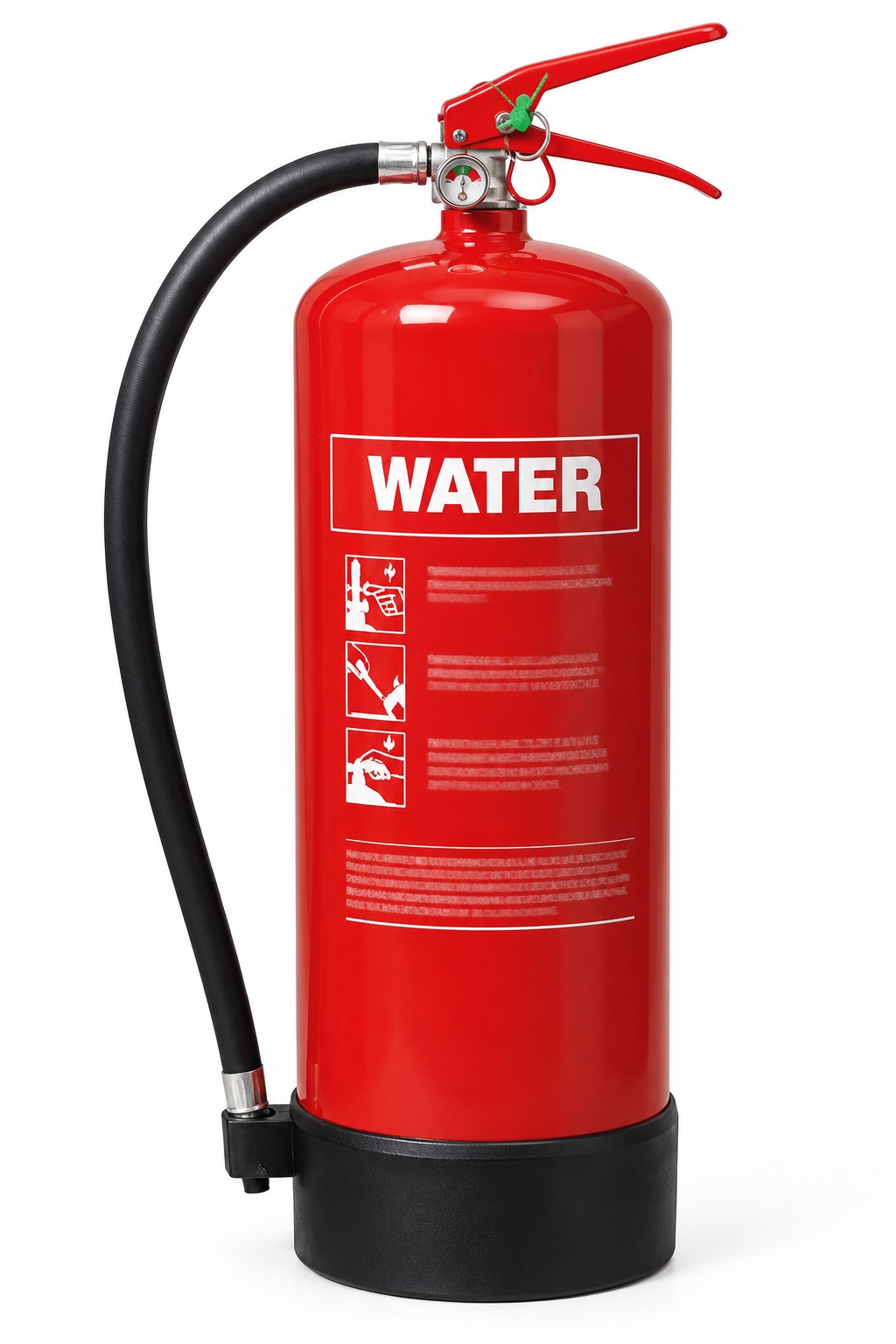

Recognise the pin, seal, pressure gauge and agent marking.
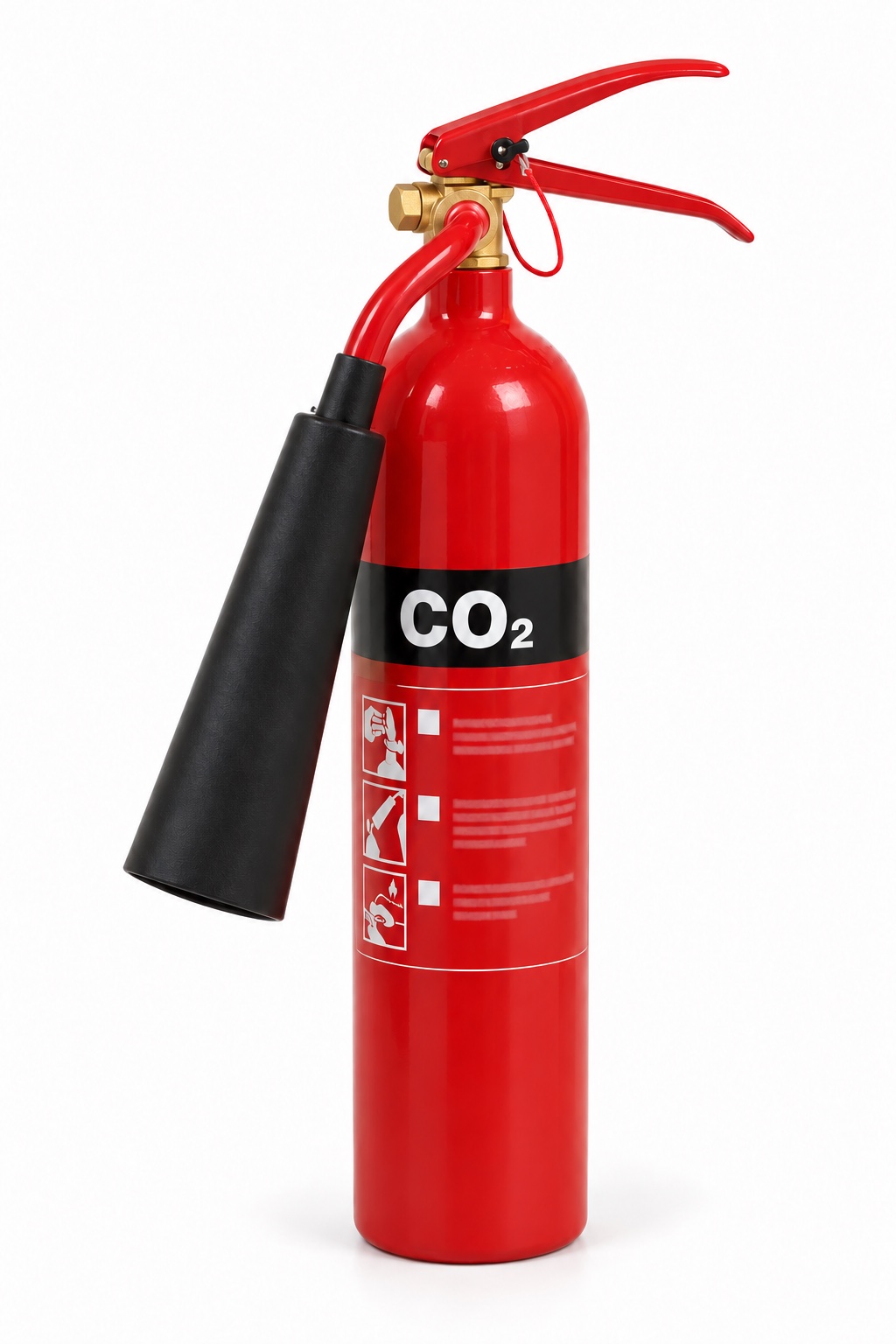
A different cylinder and discharge arrangement; cold and atmosphere hazards still matter.
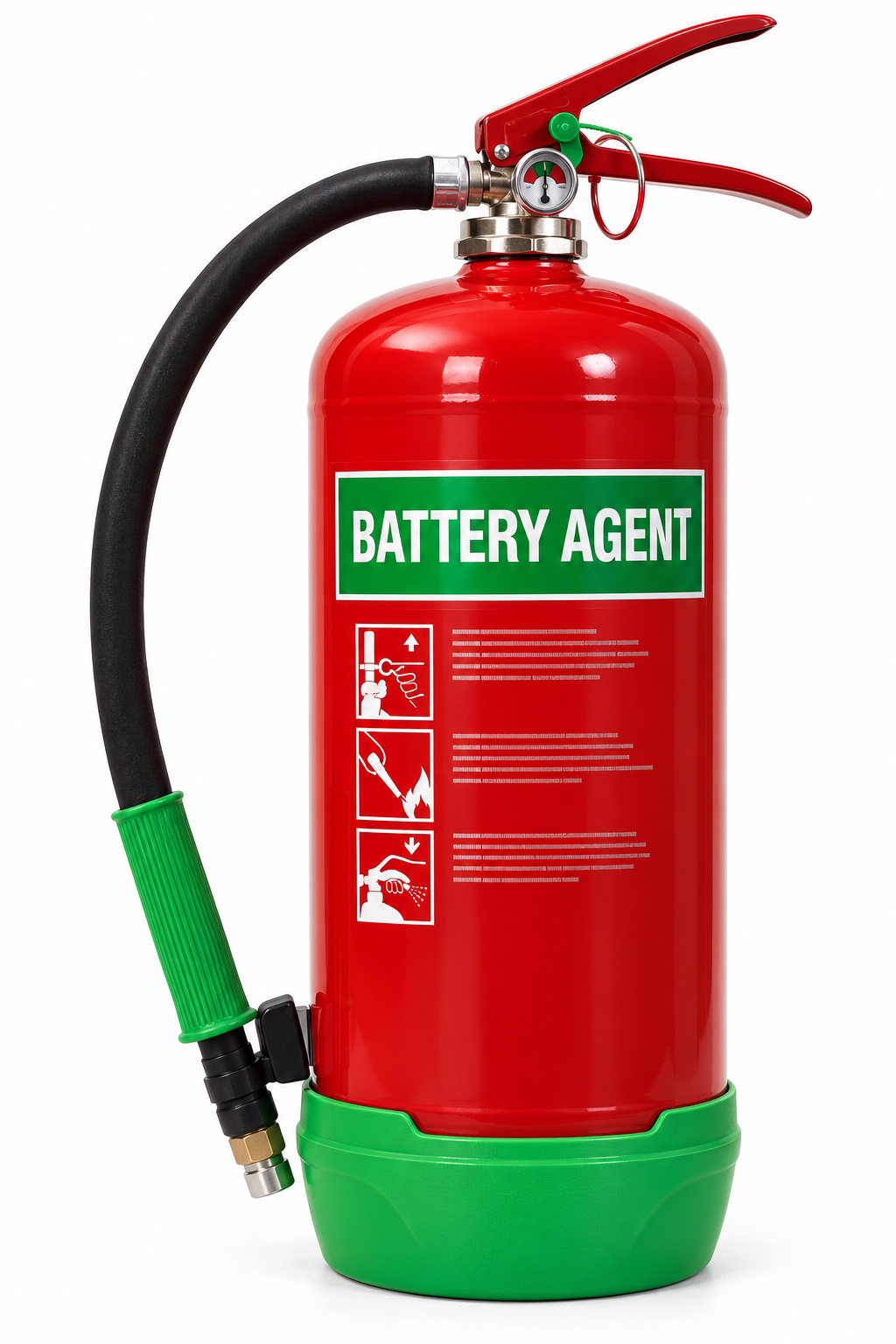
The named product and battery scope matter; green is not a universal Class L colour code.
Raise the alarm, follow the site’s evacuation plan and arrange the emergency call to 999. Only consider a small fire in its earliest stage if you are trained, authorised, have the correct equipment and a clear escape behind you. Smoke, spreading fire, uncertainty or an unsafe approach mean withdraw. Never delay escape to fetch an extinguisher.
What do the acronyms and key terms mean?
Acronyms should be understood before they are used in assessments, briefings, audits or learning answers.
Acronyms can exclude newer readers if they are not explained. This section keeps the main terms available at the end of the page so the article stays readable while still supporting learners and audit users.
| Acronym | Meaning | Plain-English use |
|---|---|---|
| COMAH | Control of Major Accident Hazards | Regulations for qualifying major accident hazard establishments. |
| DSEAR | Dangerous Substances and Explosive Atmospheres Regulations | UK regulations for fire and explosion risk from dangerous substances. |
| LEL | Lower explosive limit | Minimum concentration of vapour/gas in air that can ignite. |
| PTW | Permit to work | Formal authorisation and communication system for high-risk work. |
| SIMOPS | Simultaneous operations | Different activities happening at the same time that can interact and change risk. |
| UEL | Upper explosive limit | Maximum concentration of vapour/gas in air that can ignite. |
Which BuildOut documents support this topic?
Download individual editable BuildOut documents for this topic. Procedures and plans contain completed arrangements; forms, checklists, assessments, RAMS and permits are blank masters. Registers include separate worked examples.
| Document | Purpose and content | Editable download |
|---|---|---|
| Fire risk assessment, hot-work and fire-watch procedure BOUK-PRO-FIRE · Completed worked example · v1.0 | Assess ignition/fuel/occupants, coordinate occupied premises, authorise hot work and inspect fire precautions. | Download DOCX Read preview |
| Site and occupied-interface fire risk assessment BOUK-RA-FIRE-01 · Blank editable master · v1.0 | Assess ignition/fuel, people at risk, escape, alarms, response and coordinated arrangements. | Download DOCX Read preview |
| Hot-work permit and fire-watch record BOUK-PTW-FIRE-01 · Blank editable master · v1.0 | Control ignition, combustible removal, fire watch, checks and final handback. | Download DOCX Read preview |
| Fire precautions, escape routes and alarm checks BOUK-CHK-FIRE-01 · Blank editable master · v1.0 | Inspect escape/access, fire doors, alarms, extinguishers and housekeeping. | Download DOCX Read preview |
| Construction fire and evacuation plan BOUK-PLN-FIRE-01 · Completed worked example · v1.0 | Coordinate alarm, assembly, assistance, communication and emergency-service access. | Download DOCX Read preview |
| Flammable substances and explosive-atmosphere assessment BOUK-RA-FIRE-02 · Blank editable master · v1.0 | Assess dangerous substances, ventilation, ignition controls and hazardous-area needs. | Download DOCX Read preview |
| Occupied residential building fire-duty interface checklist BOUK-CHK-FIRE-02 · Blank editable master · v1.0 | Identify responsible persons, building scope and information/evacuation interfaces before refurbishment. | Download DOCX Read preview |
| Welding, brazing and thermal cutting RAMS BOUK-RAMS-FIRE-01 · Blank editable master · v1.0 | Fume capture, optical radiation, fire control, gas cylinders and permit interfaces. | Download DOCX Read preview |
Review and adapt the documents for your organisation, activities and jurisdiction before approval and issue. Open the SHAREms management-system hierarchy to find each document under its parent policy.
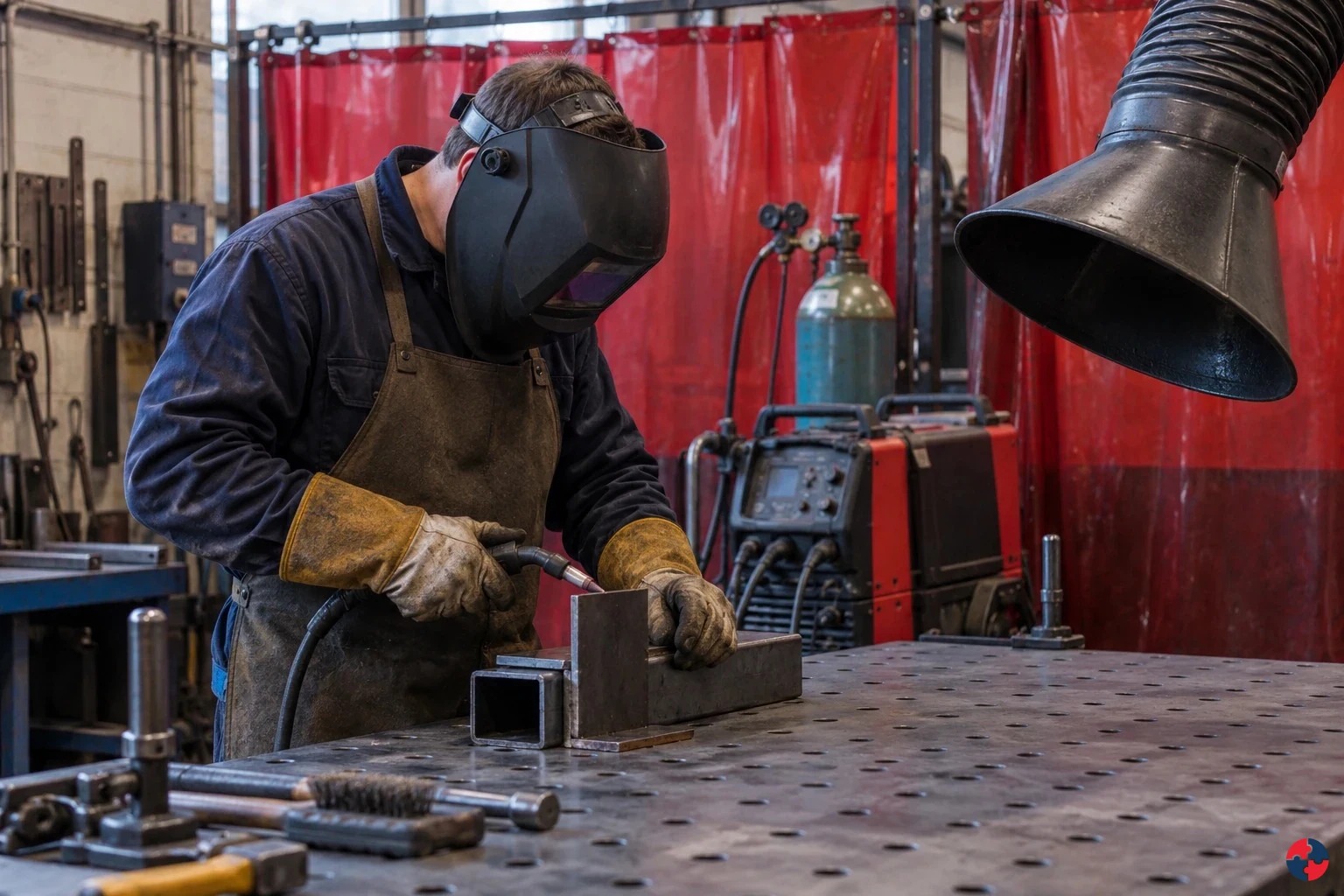


Unlock another resource
You have used this month’s two free downloads. Publish a post in your own words to unlock one more resource, or choose SHARE Individual for 10 downloads per month.
You decide whether to share. If you do, use the relevant platform disclosure tools and do not make claims you do not genuinely hold.