SHARE Knowledge Hub
Sources of Ignition in Workplaces
Sources of ignition in workplaces explains how heat, sparks, flames, hot surfaces, electrical faults, static electricity, smoking materials, cooking, heaters, batteries, vehicles, friction, machinery and contractor activities can start fires or ignite explosive atmospheres. It links fire risk assessment to practical ignition control, especially where ordinary fuels, flammable vapours, gases, mists, aerosols or combustible dusts are present.
Understanding Sources of Ignition in Workplaces
Sources of ignition in workplaces explains how heat, sparks, flames, hot surfaces, electrical faults, static electricity, smoking materials, cooking, heaters, batteries, vehicles, friction, machinery and contractor activities can start fires or ignite explosive atmospheres. It links fire risk assessment to practical ignition control, especially where ordinary fuels, flammable vapours, gases, mists, aerosols or combustible dusts are present.
Why this matters at work
Make the affected operation safe through its defined stop or isolation arrangements and assess the actual atmosphere and material. Do not repeatedly reproduce the event to see whether it will ignite, or assume a nuisance shock has no process consequence. Notify the appropriate supervisor or competent technical person and use the emergency response for any release, smoke or immediate danger.
Maintain containment and ventilation, manage non-electrical and electrostatic sources and control maintenance or abnormal work. Do not bring ordinary equipment into an area on the assumption that its low voltage or small battery makes it safe. Record specifications and restrictions and verify them at the point of use. Review after process, material or layout changes. A generic answer cannot assign a zone, temperature class or safe boundary for an unassessed installation.
How organisations manage this in practice
Keep the dangerous-substance and fire assessments linked to actual equipment, operating limits, maintenance and temporary-work controls. Record important ignition sources, required safeguards, responsible owners, checks and stop criteria. Include non-routine work and impaired protection such as ventilation or detection out of service. Select inspections and tests from the actual design, risk and manufacturer requirements rather than invent one interval for every device. Verify the controls at the workface and review after equipment, material, layout or process changes, incidents and unexplained defects. Keep permit and handback evidence where used, and coordinate national general-fire duties with the relevant premises controllers. Training should explain why the precautions matter and what changes invalidate them. The linked workplace resources can structure follow-through, but a completed checklist cannot establish hazardous-area suitability or authorise a conflicting task.
Prevent dangerous releases first, then remove unnecessary ignition sources, separate incompatible activities and select suitable equipment and safeguards. Include contractors and neighbouring operations. Record the conditions and controls, with clear stop triggers when the assumed atmosphere or equipment status changes. A zoning drawing is useful for equipment selection but does not identify every non-electrical source or authorise hot work. Complex process conditions require competent technical assessment.
Hazardous-area classification addresses the likelihood and extent of an explosive atmosphere for the relevant release conditions and informs equipment selection. It does not by itself prevent the release, control every activity or guarantee that a temporary tool, vehicle or human action is suitable. Check the actual gas, vapour, mist or dust, operating conditions and equipment characteristics through competent arrangements.
Trace the ignition source to the fuel and hidden route
Consider whether maintenance can use a cold method or be moved before planning hot work. A permit and an extinguisher do not remove fuel or establish that concealed and adjacent spaces are safe.

Cold method first
Ask whether the job can be avoided, redesigned or done by a suitable cold method. Assess the alternative’s risks.
Move the task
Consider a suitable controlled location away from the assessed fuel/release interfaces. Do not assume one universal distance makes any site safe.
Fuel and hidden routes
Identify packaging, voids, adjacent spaces, residues and routes by which sparks or heat could reach them. Include changing work around the task.
Verified precautions
Where hot work remains necessary, apply the actual authorised assessment, isolation, fuel removal/protection and other required controls with competent checks.
Uncertain means hold
Do not start where identity, residual material, isolation or a required safeguard is uncertain. Escalate through the designated authority rather than obtaining a signature to accept missing evidence.
After-work checks
Complete the required monitoring, inspection and handback arrangements for the assessed task. Keep the response to delayed ignition and changing conditions explicit.
Read the complete controls: ERICPD planning prompts
Discipline verifies and sustains all the controls; it is not a separate substitute for them.
| Prompt or level | Complete task-specific example |
|---|---|
| Eliminate | Assess cold fixing or move the bracket to a safe work area. |
| Reduce | Reduce remaining hot-work exposure through the assessed method. |
| Isolate | Remove fuel, screen the work and verify required isolation. |
| Control | Use competent fire watch, permits and post-work checks. |
| PPE | Task PPE does not stop sparks reaching packaging. |
| Discipline | Verify fire precautions and sustain checks after the work. Read the accompanying source table for the framework distinctions. |
Read the complete controls: ESEAP effectiveness order
Compare stronger feasible controls while preserving the actual task, checks and release requirements.
| Prompt or level | Complete task-specific example |
|---|---|
| Elimination | Assess cold fixing or move the bracket to a safe work area. |
| Substitution | No separate measure is specified in this example. |
| Engineering controls | Remove fuel, screen the work and verify required isolation. |
| Administrative controls | Reduce remaining hot-work exposure through the assessed method. Use competent fire watch, permits and post-work checks. Verify fire precautions and sustain checks after the work. |
| PPE | Task PPE does not stop sparks reaching packaging. Read the accompanying source table for the framework distinctions. |
The scene gives no exclusion radius, gas-test criterion or generic hot-work procedure.
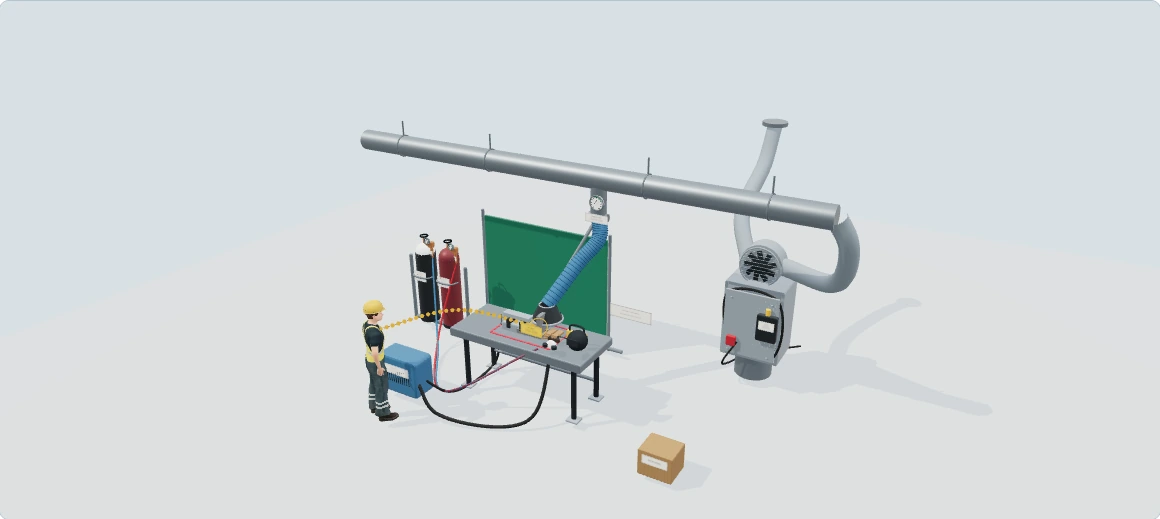

Welding and hot work: heat, fume and hidden ignition routes
Explore how this equipment can harm its users and other people, then follow the practical measures that interrupt each pathway. This is a hazards and good-practice lesson; the separate checklist remains the pre-use/safety-check activity.
Hazards and good practice: learn what can hurt people during use, change and maintenance. Pre-use and safety checks stay in the separate checklist.
Checksheets and risk assessments
Equipment checksheets
- Welding and gas cutting — 3D checks · Word · PDF
- Local exhaust ventilation: user and condition check — 3D checks · Word · PDF
- Fire extinguishers and fire points — 3D checks · Word · PDF
Risk assessment forms
- Task-specific COSHH assessment · Word
- Flammable substances and explosive-atmosphere assessment · Word
Risk assessment examples
Forms and tools
Full written walkthrough — all 8 steps
1. Consider a cold or off-site method
What is happening: The stationary bench represents a work decision, not an operating arc or a permit release.
How harm can occur: Heat, sparks and ignition can harm people and plant beyond the immediate welding point.
Best practice to apply: Consider avoiding hot work or moving it to a suitable designated area before developing the remaining controls.
Why this works: Removing ignition from the hazardous location is stronger than relying on a permit to justify it.
Hot Work Control in Process Areas · What major accident scenario should hot work control prevent?2. Identify the actual plant and boundaries
What is happening: The workpiece can be connected to equipment or spaces beyond what the operator sees.
How harm can occur: Residual product, pressure or a wrong boundary can lead to fire, explosion or loss of containment.
Best practice to apply: Verify the job, plant identity, connected equipment, residues and required isolations through the actual safe system.
Why this works: A clean-looking surface does not identify what is inside or connected to it.
Hot Work Control in Process Areas · How should isolation, draining and cleaning be proved?3. Follow heat and sparks beyond the bench
What is happening: Heat can conduct through material and particles can pass through openings or reach the far side.
How harm can occur: Hidden combustibles can ignite out of sight of the person doing the work.
Best practice to apply: Remove or suitably protect combustibles and inspect credible ignition routes, including adjacent spaces and other sides.
Why this works: Controlling the full route prevents a local task creating a remote fire.
Hot Work Control in Process Areas · What does hot work control mean in plain English?4. Keep the atmosphere decision current
What is happening: Testing and monitoring arrangements depend on the actual substances, location and change during work.
How harm can occur: A changed or untested atmosphere can create fire, explosion, poisoning or asphyxiation.
Best practice to apply: Use competent assessment and the required testing/monitoring and ventilation; suspend work when its conditions are no longer valid.
Why this works: A previous reading or permit does not freeze the atmosphere or remove process change.
Hot Work Control in Process Areas · How should gas testing be planned and interpreted?5. Control welding fume at the source
What is happening: The articulated hood sits over a clamped joint inside a red illustrative bench footprint. Use the comparison to move the vice and joint outside it: a nearby hood is useful only while the real source stays in its verified three-dimensional capture range.
How harm can occur: Inhaled fume and associated gases can cause serious harm; outdoor work is not automatically controlled.
Best practice to apply: Commission and test the actual tool, source position/height, hood setting and full working movement under representative conditions. Mark the verified footprint on the bench, record the arrangement and normal indicators, and keep every part of the source task within it. Reposition/reassess if the hood, process or draught changes; provide assessed RPE where needed.
Why this works: Marking the tested working position makes correct use repeatable. A running fan, a bench mark or a smoke test at an idle hood alone does not prove capture during the real task.
Hot Work Control in Process Areas · What would a good worked hot work permit example include? LEV Local Exhaust Ventilation · What are capture zones, working zones and breathing zones?6. Protect people from radiation and hot material
What is happening: Screens, the working position and suitable protection have separate functions.
How harm can occur: Arc radiation, hot metal and fragments can injure the welder, helpers or passers-by.
Best practice to apply: Control line of sight, access and hot-material handling and use protection selected for the actual process.
Why this works: Protecting the boundary stops other people being exposed to a task they are not performing.
Hot Work Control in Process Areas · BuildOut documents to download7. Provide a capable watch and emergency response
What is happening: A fire watch must cover credible ignition points and be able to stop work and raise the alarm.
How harm can occur: A developing or concealed fire can grow while attention remains on the workpiece.
Best practice to apply: Provide the required competent fire watch, suitable communication and emergency arrangements during and after the task.
Why this works: Independent observation can find ignition beyond the operator's view; a model supplies no universal watch duration.
Hot Work Control in Process Areas · What should a fire watch do during and after hot work?8. Complete hand-back after the controls are finished
What is happening: Residual heat, hidden spaces and temporary arrangements remain important after the tool stops.
How harm can occur: Premature permit closure or incorrect reinstatement can allow delayed fire or release when plant returns.
Best practice to apply: Complete specified post-work checks and watch, account for outstanding work and verify reinstatement before formal hand-back.
Why this works: Closure must reflect the actual condition and remaining risks, rather than only the end of welding.
Hot Work Control in Process Areas · What should happen before hot work is handed back?
Illustrative awareness learning. Geometry, colours and movement do not establish safe distances, capacity, exposure, isolation or work permission. Use the actual assessment, equipment information and competent arrangements.
The wider workplace has its own account and subscription access. Exploring this lesson does not grant access, record course completion or authorise work.
UK guidance for further reading
HSE: Welding and hot workHSE HSG258: verified and marked capture zonesWhat counts as a source of ignition?
Ignition control starts by finding where heat, sparks, flame, hot surfaces or static can meet fuel or a dangerous atmosphere. Check normal and non-routine work, including electrical faults, batteries, hot work, smoking, vehicles and self-heating waste. Remove or separate ignition and fuel, use suitable equipment and permits where needed, then verify controls before, during and after work. In GB dangerous-substance work, DSEAR adds specific assessment and control duties; Northern Ireland has its own regulations.
Best-practice guide: Sources of Ignition in Workplaces
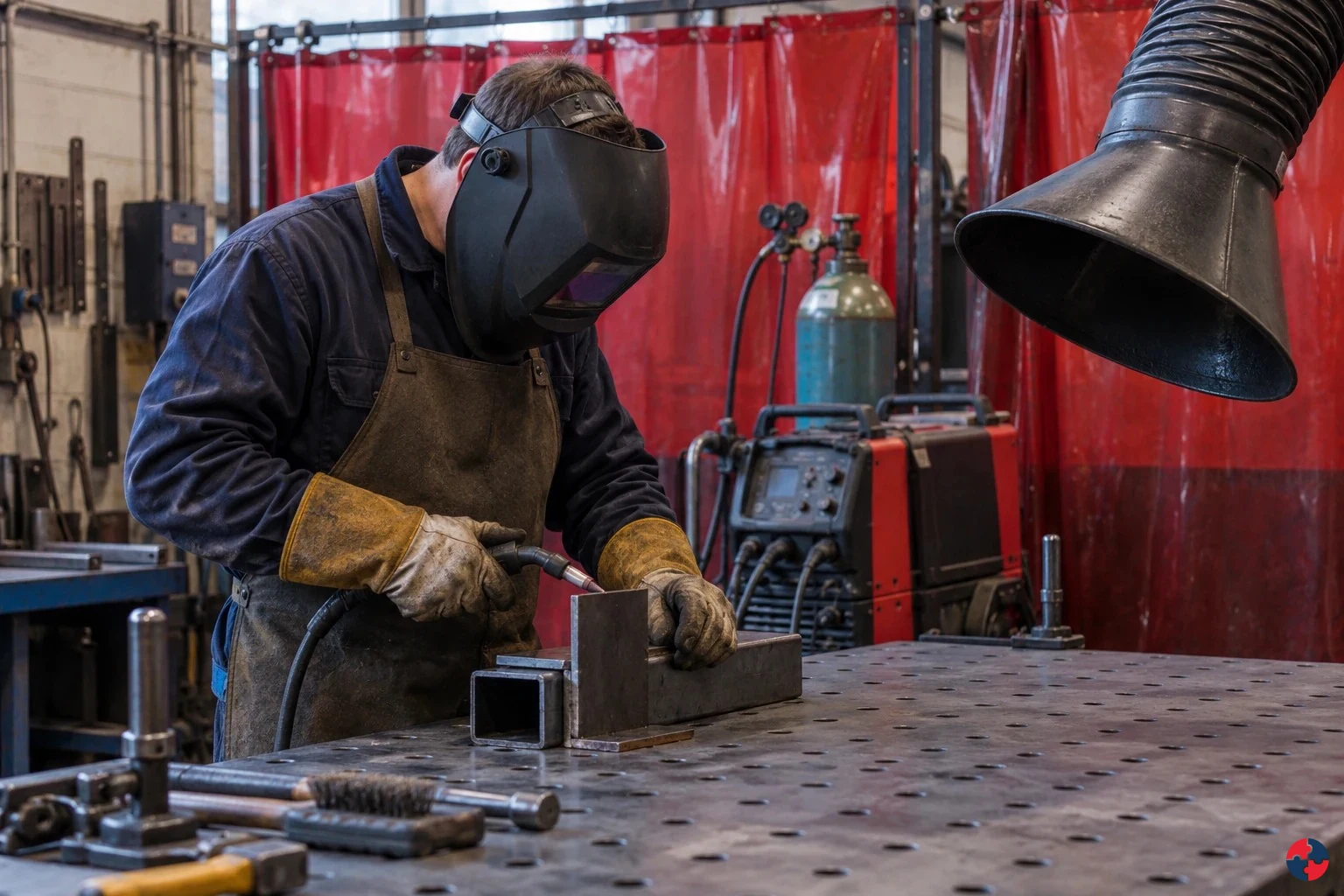
What counts as a source of ignition?
Ignition control starts by finding where heat, sparks, flame, hot surfaces or static can meet fuel or a dangerous atmosphere. Check normal and non-routine work, including electrical faults, batteries, hot work, smoking, vehicles and self-heating waste. Sources of ignition in workplaces explains how heat, sparks, flames, hot surfaces, electrical faults, static electricity, smoking materials, cooking, heaters, batteries, vehicles, friction, machinery and contractor activities can start fires or ignite explosive atmospheres.
Turn sources of ignition in workplaces knowledge into a decision
Sources of ignition in workplaces explains how heat, sparks, flames, hot surfaces, electrical faults, static electricity, smoking materials, cooking, heaters, batteries, vehicles, friction, machinery and contractor activities can start fires or ignite explosive atmospheres. It links fire risk assessment to practical ignition control, especially where ordinary fuels, flammable vapours, gases, mists, aerosols or combustible dusts are present. Permit, clearance check, fire-watch log and storage correction.
Warehouse bracket grinding
Clear or shield combustibles, isolate charging and use the agreed fire watch. Inspect hidden spaces for smouldering and hand the area back after the required watch.
Where do ignition-source controls commonly fail?
They fail when normal work, temporary work and contractor activity introduce ignition faster than the fire risk assessment is updated.
Choose controls for sources of ignition in workplaces
Eliminate: Assess cold fixing or move the bracket to a safe work area. Reduce: Reduce remaining hot-work exposure through the assessed method. Isolate: Remove fuel, screen the work and verify required isolation. Control: Use competent fire watch, permits and post-work checks. PPE: Task PPE does not stop sparks reaching packaging. Read the full control table for qualifications, ownership and verification. Use the actual task and applicable jurisdiction; existing technical approval remains unchanged.
Use the full sources of ignition in workplaces lesson
Use the full topic for the decision points, practical examples, detailed control tables and source scope. HSE guidance applies to Great Britain; use HSENI for the Northern Ireland route and the source’s stated jurisdiction. A simplified guide does not change the page’s technical-review or approval status.

Read all six steps as text
1. What counts as a source of ignition?
Ignition control starts by finding where heat, sparks, flame, hot surfaces or static can meet fuel or a dangerous atmosphere.
- Avoid / redesign: Assess cold fixing or move the bracket to a safe work area.
- Control the task: Remove fuel, screen the work and verify required isolation.
- Verify before release: Read the full task example, checks and stop points on this page.
Ignition control starts by finding where heat, sparks, flame, hot surfaces or static can meet fuel or a dangerous atmosphere. Check normal and non-routine work, including electrical faults, batteries, hot work, smoking, vehicles and self-heating waste. Sources of ignition in workplaces explains how heat, sparks, flames, hot surfaces, electrical faults, static electricity, smoking materials, cooking, heaters, batteries, vehicles, friction, machinery and contractor activities can start fires or ignite explosive atmospheres.
Apply it: Which part of this plan would you check at the workface before authorising the task?
2. Turn sources of ignition in workplaces knowledge into a decision
Use the evidence to improve the actual work arrangement.
- Change at source: Assess cold fixing or move the bracket to a safe work area.
- Make it observable: Read the full task example, checks and stop points on this page.
- Keep useful evidence: Permit, clearance check, fire-watch log and storage correction.
Sources of ignition in workplaces explains how heat, sparks, flames, hot surfaces, electrical faults, static electricity, smoking materials, cooking, heaters, batteries, vehicles, friction, machinery and contractor activities can start fires or ignite explosive atmospheres. It links fire risk assessment to practical ignition control, especially where ordinary fuels, flammable vapours, gases, mists, aerosols or combustible dusts are present. Permit, clearance check, fire-watch log and storage correction.
Apply it: What evidence would show that the change improves this task, rather than only completing a record?
3. Warehouse bracket grinding
Example: a practical application of the existing topic lesson.
- Setting: Bracket grinding near pallet racking, packaging, aerosols and charging equipment.
- Act: Inspect fuel, atmosphere, compartmentation and escape; agree work method and permit.
- Hold / review: Do not start if clearance, hazardous atmosphere, isolation or fire protection cannot be verified.
Clear or shield combustibles, isolate charging and use the agreed fire watch. Inspect hidden spaces for smouldering and hand the area back after the required watch.
Apply it: At which point would you hold this example, and what evidence would allow it to proceed?
4. Where do ignition-source controls commonly fail?
Connect the task, the route to the person and the control that can fail.
- Source / exposure: They fail when normal work, temporary work and contractor activity introduce ignition faster than the fire risk assessment is updated.
- Possible consequence: Ignition controls often look good during formal inspection and weak during real work.
- Control failure: A heater is moved, an extension lead is added, a contractor starts grinding, waste accumulates or a charging point appears in a store room.
They fail when normal work, temporary work and contractor activity introduce ignition faster than the fire risk assessment is updated.
Apply it: Who could be exposed, including other trades, cleaners, maintainers and people nearby?
5. Choose controls for sources of ignition in workplaces
Start with the stronger practicable options and verify their effect.
- Eliminate: Assess cold fixing or move the bracket to a safe work area.
- Reduce: Reduce remaining hot-work exposure through the assessed method.
- Isolate: Remove fuel, screen the work and verify required isolation.
- Control: Use competent fire watch, permits and post-work checks.
- PPE: Task PPE does not stop sparks reaching packaging.
Eliminate: Assess cold fixing or move the bracket to a safe work area. Reduce: Reduce remaining hot-work exposure through the assessed method. Isolate: Remove fuel, screen the work and verify required isolation. Control: Use competent fire watch, permits and post-work checks. PPE: Task PPE does not stop sparks reaching packaging. Read the full control table for qualifications, ownership and verification. Use the actual task and applicable jurisdiction; existing technical approval remains unchanged.
Apply it: Which stronger option can be used here, and who will verify it before accepting the remaining risk?
6. Use the full sources of ignition in workplaces lesson
Follow the official sources below and retain the task-specific evidence.
- Official guidance: HSE Introduction to fire safety
- Official guidance: HSE hierarchy of controls
- Task decision: Permit, clearance check, fire-watch log and storage correction.
Use the full topic for the decision points, practical examples, detailed control tables and source scope. HSE guidance applies to Great Britain; use HSENI for the Northern Ireland route and the source’s stated jurisdiction. A simplified guide does not change the page’s technical-review or approval status.
Apply it: Which official source and full-topic section will you use to resolve the next decision?
Ignition sources are not limited to obvious flames. In real workplaces they include portable heaters, cooking equipment, welding, grinding, smoking materials, overloaded sockets, damaged cables, hot bearings, vehicle exhausts, static discharge, batteries, lightning, friction, electrical equipment and spontaneous heating of contaminated materials.
The same ignition source can mean different things depending on the fuel and atmosphere. A small spark may be harmless in an empty office, but serious in a spray booth, fuel tank bund, solvent cleaning room, LPG cage, flour dust area, aerosol store or waste compound.
Good fire risk assessment therefore asks two linked questions: what could create ignition, and what fuel or explosive atmosphere could it reach? Ignition control only becomes meaningful when it is mapped against fuel, oxygen, work activity, people at risk, maintenance condition and evidence that controls remain alive.
For higher-level assessment, ignition should be treated as a control system rather than a list. A site can have a good smoking policy and still be weak if vehicle exhausts pass a solvent store, chargers sit on packaging, a bearing overheats, a contractor cuts steel near combustible lining, or oil-soaked wipes self-heat in a waste bin.
The strongest reviews connect ignition sources to credible escalation. They ask how a small event becomes a serious fire: what burns first, what spreads smoke, what disables escape, what exposes vulnerable people, and what evidence proves the ignition source was controlled before the job began.
| Ignition source | Common examples | Control focus |
|---|---|---|
| Naked flames | Burners, candles, matches, pilot lights and open flame work. | Remove, isolate or permit with strict controls. |
| Hot work | Welding, cutting, grinding, soldering, brazing and torch-applied roofing. | Permit, isolate fuel, fire watch and handback. |
| Electrical faults | Damaged cables, overloaded sockets, poor maintenance and unsuitable equipment. | Suitable equipment, inspection, maintenance, competent repair and loading control; RCD protection where appropriate does not by itself prevent ignition. |
| Hot surfaces | Heaters, exhausts, ovens, process plant, lamps and bearings. | Temperature control, separation and maintenance. |
| Static electricity | Powder transfer, flammable liquid pouring, spraying, clothing and plastic containers. | Bonding, earthing, antistatic materials and DSEAR controls. |
| Smoking materials | Cigarettes, matches and discarded ends. | Smoke-free controls, designated areas and waste control. |
| Friction and mechanical sparks | Seized bearings, rubbing belts, impact tools and rotating machinery. | Maintenance, guards, monitoring and defect reporting. |
| Batteries and charging | Lithium batteries, chargers, damaged cells and temporary charging areas. | Charging rules, separation, inspection and emergency plan. |
Start with HSE Introduction to fire safety and assess the actual work and nation.
How should ignition sources be assessed?
Assessment should follow the pathway from ignition energy to fuel or explosive atmosphere, affected people, control and evidence.
A strong ignition assessment does not simply tick a list of common sources. It looks at energy type, location, frequency, control condition and proximity to fuel. It asks whether ignition is present during normal work, maintenance, cleaning, charging, contractor activity, breakdown, start-up, shutdown or emergency response.
This is especially important in DSEAR settings. Where flammable vapours, gases, mists or dusts may form an explosive atmosphere, preventing ignition becomes a critical control. Equipment suitability, hazardous area classification, bonding, earthing, hot-work control and static management need evidence rather than assumption.
| Pathway step | Question to ask | Example evidence |
|---|---|---|
| Energy source | What heat, spark, flame, discharge or hot surface exists? | FRA inspection, equipment inventory and permit register. |
| Fuel or atmosphere | What combustible or explosive material could it reach? | Fire load survey, SDS, DSEAR assessment and storage map. |
| Proximity | How close are ignition and fuel during real work? | Layout plan, observation and photos. |
| Control | Is ignition removed, isolated, controlled or permitted? | Isolation, maintenance, permit and supervision records. |
| Change | Could contractors, temporary electrics, charging or maintenance add ignition? | MOC, contractor induction and temporary works review. |
| People at risk | Who could be affected by fire, smoke, explosion or escape impairment? | FRA and emergency plan. |
| Evidence | What proves the ignition control works today? | Inspection, test, defect close-out and audit sampling. |
This pathway is an assessment aid; source controls need evidence at the actual job, with separate DSEAR decisions where relevant.
How can a small ignition source become a major fire risk?
A routine maintenance scenario shows why ignition sources must be controlled with fuel, oxygen, layout and work sequencing.
Warehouse bracket grinding
Task material and setting: Bracket grinding near pallet racking, packaging, aerosols and charging equipment.
People and prerequisites: Contractor, site host and fire-risk lead; agreed method, area inspection and permit decision before work.
Before: Inspect fuel, atmosphere, compartmentation and escape; agree work method and permit.
During: Clear or shield combustibles, isolate charging and use the agreed fire watch.
Hold or stop: Do not start if clearance, hazardous atmosphere, isolation or fire protection cannot be verified.
Completion and hand back: Inspect hidden spaces for smouldering and hand the area back after the required watch.
Evidence: Permit, clearance check, fire-watch log and storage correction.
A contractor enters a warehouse stockroom to grind a bracket. The job is short and looks low risk, but the area contains cardboard packaging, aerosols, waste shrink-wrap and battery chargers. A fire door is propped open for access and no one has checked whether grinding sparks can travel under racking.
A competent response would move or shield combustibles, stop charging nearby, close or manage the fire door, issue a hot-work permit if needed, provide fire watch, check for smouldering after work and record handback. The ignition source is controlled because the surrounding fire load and escape protection are understood.
| Condition | Why it matters | Good control |
|---|---|---|
| Grinding sparks | Can travel and lodge in packaging or dust. | Permit, screen, clean and fire watch. |
| Aerosols nearby | Can escalate fire if heated. | Remove or segregate before work. |
| Battery charging | Adds electrical ignition and fire load. | Stop charging and move to controlled area. |
| Fire door propped | Compartmentation may fail. | Keep shut or control access differently. |
| No handback | Smouldering may continue after contractor leaves. | Post-work inspection and sign-off. |
The bracket-grinding case illustrates work coordination. HSE construction fuel and hot-work controls supports clearing fuel and maintaining a watch; HSE HSG250 permit-to-work guidance supports permit control. Hidden spaces and post-work watch/handback must be agreed for the actual risk.
Where do ignition sources appear across sectors?
Ignition controls need to match the workplace, not just the generic fire triangle.
Sector examples make the subject real. In offices, ignition may be overloaded sockets or kitchen appliances. In construction, it may be hot works, temporary electrics and heaters. In vehicle repair, it may be spray booth electrics, static, sanding sparks or solvent vapour.
The fire risk assessor should look for introduced ignition sources, not only fixed plant. Contractors, hired equipment, temporary lighting, mobile chargers, seasonal displays and maintenance tasks often change the ignition profile faster than formal fire risk assessment reviews.
| Sector | Typical ignition sources | Control focus |
|---|---|---|
| Office | Portable heaters, kitchen appliances, overloaded sockets and chargers. | Electrical inspection, appliance rules and housekeeping. |
| Warehouse | Forklift charging, conveyors, damaged cables, heaters and hot work. | Charging area, maintenance, permit controls and stock separation. |
| Construction | Hot works, temporary electrics, heaters, generators and smoking. | Fire plan, permits, daily checks and contractor briefing. |
| Hospitality | Cooking equipment, grease, gas, heaters and smoking materials. | Cleaning, gas safety, supervision and fire watch. |
| Vehicle repair | Spray booths, static, solvent vapours, welding and sanding sparks. | DSEAR, local exhaust ventilation (LEV), booth controls and hot-work segregation. |
| Care setting | Smoking materials, electrical beds and laundry equipment; oxygen can intensify combustion. | Oxygen controls, resident plans and maintenance. |
| Process site | Electrical equipment, hot surfaces, static, vehicles and maintenance work. | Hazardous areas, isolation, permits and barrier assurance. |
These sector examples illustrate different ignition/fuel interfaces. Oxygen in a care setting supports combustion; it is not itself an ignition source.
How should hot work and contractor ignition sources be controlled?
Contractors can introduce ignition sources into areas where they do not fully understand the fire load or process risk.
Relevant primary guidance: Guidance on permit-to-work systems (HSG250). Apply it to the task and applicable law.
The job may be small, but the interface can be large. A contractor cutting a bolt, drilling a wall, using a heat gun, charging tools or running temporary lighting may affect fire stopping, flammable storage, escape routes, alarms, detection, sprinklers or DSEAR zoning.
Permit systems should not become paperwork. They should coordinate isolation, fuel removal, gas testing where needed, emergency arrangements, fire watch, handback and the authority to stop if conditions change.
| Check | Question | Evidence |
|---|---|---|
| Scope | What heat, spark or electrical equipment will be introduced? | risk assessments and method statements (RAMS) and permit scope. |
| Area | What fuel, vapour, dust or fire load is nearby? | Area inspection and photos. |
| Isolation | What must be isolated, removed or protected? | Isolation record and permit controls. |
| Fire protection | Will alarms, sprinklers, doors or escape routes be affected? | Impairment and emergency plan check. |
| Fire watch | Who watches during and after work? | Fire-watch record and duration. |
| Handback | Who confirms the area is safe? | Close-out and post-work inspection. |
Prefer a cold method or relocation before accepting hot work. The permit issuer checks actual fuel, hidden spaces, isolation, protection and the named watch/handback arrangements. A signed permit or a short job duration is not evidence that these controls exist. HSE construction fuel and hot-work controls; HSE HSG250 permit-to-work guidance.
Plan the post-work watch and later inspection before authorising a late-day job: name the watchkeeper, completion time, hidden/adjacent spaces, later check, impairment restoration and release authority. Use the applicable sector/risk/insurer requirements; do not treat one example watch duration as a universal legal interval.
Scoped construction example from HSG168: plan a continuous watch for at least one hour after hot work and a further check two hours after completion. The actual risk, sector and insurer may require more. This is not a universal legal duration for all workplaces; name the watchkeeper and release authority before approving the job.HSE HSG168 construction hot-work watch example
How should chargers and batteries be treated as ignition sources?
Chargers, batteries and temporary electrical arrangements should be assessed as fire risks, especially near fuel or poor escape routes.
Battery and charger risks often grow informally. Workers charge radios, tools, e-bikes, cleaning equipment or phones wherever sockets are available. If charging happens near packaging, escape routes, soft furnishings or flammable substances, a small electrical fault can become a serious fire scenario.
A good control standard defines where charging is allowed, what equipment is permitted, how damaged chargers are removed, how areas are inspected and what emergency action is expected if overheating, swelling, smoke or smell occurs.
| Issue | Weak practice | Better control |
|---|---|---|
| Damaged charger | Still used because it works. | Remove from use and replace through controlled route. |
| Charging in store room | Charger placed on cardboard or fabric. | Dedicated clear charging area. |
| Overnight charging | Unattended charging in unmonitored area. | For e-cycles, charge only while awake and alert; do not leave charging while asleep or away. Other equipment needs manufacturer instructions and assessed site arrangements. |
| Hired equipment | Unknown chargers or batteries accepted without check. | Pre-use inspection and supplier requirements. |
| Escape route | E-bike or tool batteries charged in corridor. | Prohibit charging in escape routes. |
| Flammable area | Battery charger near solvents, fuels or aerosols. | Segregate and review DSEAR/fire risk. |
The table combines local workplace charging arrangements with product guidance. HSE electrical equipment maintenance supports equipment checks; DfT e-cycle battery safety applies specifically to e-cycles, rather than every radio/tool/phone. HSE DSEAR dangerous-substance controls governs dangerous-substance interfaces.
For an e-cycle, use the supplied or manufacturer-authorised charger. If smoking or burning, raise the alarm, get out, stay out and call 999; do not approach or move it. A detection system is not permission to disregard the charging advice. DfT e-cycle battery safety.
How should ignition sources be mapped in a mature fire risk assessment?
A mature assessment maps ignition source, fuel, work activity, escalation route, control owner and evidence.
The practical value of an ignition-source map is that it shows where ordinary premises fire safety meets operational risk. It helps a supervisor see that a charger, a heat gun, a vehicle exhaust, a hot bearing or a temporary light can become safety-critical when the surrounding fuel load changes.
The map should be reviewed after layout change, seasonal storage, contractor work, new equipment, increased waste, new battery charging, refurbishment, DSEAR assessment, fire incident or repeated inspection findings. It should not sit as a static appendix to the fire risk assessment.
| Ignition family | Typical sources | How the control should be evidenced |
|---|---|---|
| Hot work | Welding, cutting, grinding, brazing, soldering, heat guns and torch-applied works. | Hot-work or spark-potential permit, area check, fuel removal, fire watch and handback. |
| Electrical faults | Damaged cables, overloaded sockets, poor joints, unsuitable temporary supplies and faulty appliances. | Electrical inspection, defect quarantine, competent repair and loading review. |
| Static electricity | Flammable liquid transfer, powder handling, spray work, plastic liners and isolated metal parts. | DSEAR assessment, bonding/earthing checks, continuity records and operator verification. |
| Mechanical friction | Seized bearings, rubbing belts, misaligned rollers, stalled conveyors and impact sparks. | Maintenance regime, temperature/vibration monitoring, guarding and defect escalation. |
| Batteries and chargers | Lithium batteries, e-bikes, radios, tools, cleaning equipment, chargers and damaged cells. | Approved charging locations, separation, inspections and emergency response arrangements. |
| Smoking materials | Cigarettes, matches, discarded ends and informal smoking shelters. | Smoke-free controls, designated safe area, waste containers and supervision. |
| Heaters and cooking | Portable heaters, ovens, fryers, grills, boilers and welfare appliances. | Separation from combustibles, cleaning, gas/electrical maintenance and user rules. |
| Vehicles and mobile plant | Exhausts, hot brakes, sparks, fuel leaks and charging/fuelling activities. | Traffic plan, parking rules, maintenance and separation from flammable storage. |
| Process heat | Dryers, ovens, heated tanks, reactors, hot oil systems and trace heating. | Temperature control, alarms, trips, inspection and safe operating limits. |
| Chemical incompatibility | Oxidisers, peroxides, reactive chemicals, self-reactive substances and contaminated waste. | Segregation, compatibility checks, SDS review and waste controls. |
| Spontaneous heating | Oil-soaked rags, drying oils, damp powders, biological heating and waste piles. | Distinguish the material: flammable-liquid-contaminated rags need a suitable labelled metal receptacle with self-closing metal lid and planned emptying; bulk powders or waste piles need material-specific storage, temperature and emergency controls. A metal bin alone is not a complete self-heating control. |
The map illustrates sources and evidence. HSE electrical equipment maintenance supports ordinary electrical maintenance; explosive-atmosphere suitability requires the separately linked HSE electrical/DSEAR guidance.
Self-heating can develop from retained oxidation heat without an external spark. HSG140’s flammable-liquid-contaminated-rag example calls for planned emptying at least daily; bulk self-heating material requires a different material-specific assessment.
How can small ignition sources escalate in real workplaces?
Small ignition sources become major incidents when they meet fuel, delay detection, defeat escape or reach a dangerous substance.
The important teaching point is proportionality. A single spark does not always justify a permit, but a single spark in the wrong environment can overwhelm local controls. Supervisors should think in scenarios, not labels.
A good review asks: what is the first item ignited, how fast could fire or smoke spread, who would be exposed, what would fail next, and how would the alarm, compartmentation, extinguishing equipment and emergency plan respond?
| Workplace | Initial ignition | Escalation route |
|---|---|---|
| Workshop | Angle grinder sparks land in dust and oily waste beneath a bench. | Smouldering starts after the job, spreads to packaging, smoke blocks the exit and fire is discovered late. |
| Warehouse | Damaged charger overheats on a cardboard shelf in a stockroom. | Fire spreads through packaging, aerosols heat, detection is delayed by closed layout and sprinklers may be obstructed by storage height. |
| Process area | Static discharge occurs during solvent transfer into an unearthed container. | Vapour ignites, flame flashes back to the open container, nearby drains and bunded liquids create escalation potential. |
| Construction refurbishment | Hot works near an open riser ignite temporary sheeting. | Smoke spreads vertically, incomplete fire stopping allows spread, evacuation routes are affected and contractors are not accounted for quickly. |
| Hospitality kitchen | Grease build-up ignites behind cooking equipment. | Fire reaches ductwork, spreads beyond the kitchen and normal portable extinguishing is no longer enough. |
| Care premises | Smoking material contacts bedding in a room where oxygen equipment is present. | Fire growth is rapid, occupant vulnerability increases evacuation difficulty and staff need specific emergency arrangements. |
Transfer warehouse grinding to a live solvent process: relocation and cold work may remove the ignition entirely. If not, a competent process assessment must address releases, atmosphere, suitable equipment, isolation and permit conditions. Screening ordinary combustibles does not make a flammable atmosphere safe. HSE DSEAR dangerous-substance controls; HSE HSG250 permit-to-work guidance.
These are escalation scenarios for testing the actual fire and emergency controls, not claims that every small spark becomes a major fire.
What should supervisors ask before work introduces ignition?
Supervisors should test the real condition of the area before allowing heat, sparks, charging, temporary electrics or hot surfaces.
The supervisor role is practical: identify what has changed, check whether the job creates ignition, confirm fuels have been removed or protected, and make sure the emergency arrangement still works. This is where many fires are prevented.
A high-quality briefing is specific. It names the ignition source, the nearby fuel, the controls that must remain in place, the stop trigger and the person who can authorise restart after an unexpected condition.
| Prompt | Good answer | Stop or escalate if |
|---|---|---|
| What ignition is being introduced? | Heat, spark, flame, charger, temporary electrical supply or hot surface is named. | The team cannot describe the ignition source. |
| What fuel could it reach? | Combustibles, vapour, dust, aerosol or waste are identified; oxygen enrichment is assessed separately. | Fuel remains close to ignition or is hidden behind panels/voids. |
| What has changed today? | Storage, waste, weather, doors, contractors, alarms and charging are checked. | The work area differs from the plan. |
| What is the control standard? | Permit, isolation, screening, cleaning, fire watch and handback are clear. | Controls are generic or only verbal. |
| Who owns handback? | Named person checks for smouldering, restored protection and waste removal. | No one is responsible after the job finishes. |
| What evidence will remain? | Permit, photos, inspection record, defect close-out or briefing record. | The organisation cannot prove controls were checked. |
These are local field questions. HSE construction fuel and hot-work controls supports fuel clearance and watch; the site sets competent authorisation and handback for its assessed risk.
How can the hierarchy of controls remove or control workplace ignition sources?
Remove or reduce the hazard before relying on procedures or personal protection.
For sources of ignition in workplaces, assess the actual task and first look for a way to remove the hazard. Where that is not possible, consider a safer substitute, engineered separation and then clear work procedures. PPE protects against remaining exposure; it does not make an uncontrolled task safe. HSE hierarchy of controls
The selected measures need a named owner, a usable stop point and a check that they still work when the task or conditions change. In Northern Ireland, verify the separate legal route and site instructions.
For the bracket, first consider cold fixing or removing it to a safe work area. If hot work remains necessary, remove fuel, separate/screen the work and verify the required isolation and fire precautions, then use the permit, competent watch and post-work checks. Task PPE protects workers from residual hazards; it does not stop sparks reaching packaging. ERICPD is a teaching prompt, not a separate statutory method. HSE hierarchy of controls; HSE construction fuel and hot-work controls.
How can the ERICPD hierarchy of controls remove or control workplace ignition sources?

| ERICPD control level | Topic-specific example | Source and full task context |
|---|---|---|
| Eliminate | Assess cold fixing or move the bracket to a safe work area. | Read the full task example, checks and stop points on this page. HSE hierarchy of controls · HSE construction fuel and hot-work controls |
| Reduce | Reduce remaining hot-work exposure through the assessed method. | Read the full task example, checks and stop points on this page. HSE hierarchy of controls · HSE construction fuel and hot-work controls |
| Isolate | Remove fuel, screen the work and verify required isolation. | Read the full task example, checks and stop points on this page. HSE hierarchy of controls · HSE construction fuel and hot-work controls |
| Control | Use competent fire watch, permits and post-work checks. | Read the full task example, checks and stop points on this page. HSE hierarchy of controls · HSE construction fuel and hot-work controls |
| PPE | Task PPE does not stop sparks reaching packaging. | Read the full task example, checks and stop points on this page. HSE hierarchy of controls · HSE construction fuel and hot-work controls |
| Discipline | Verify fire precautions and sustain checks after the work. | Read the full task example, checks and stop points on this page. HSE hierarchy of controls · HSE construction fuel and hot-work controls |
How can the ISO 45001 hierarchy of controls remove or control workplace ignition sources?

| Five-level control stage(s) | Topic-specific example | Source and full task context |
|---|---|---|
| Elimination | Assess cold fixing or move the bracket to a safe work area. | Read the full task example, checks and stop points on this page. HSE hierarchy of controls · HSE construction fuel and hot-work controls |
| Administrative controls | Reduce remaining hot-work exposure through the assessed method. | Read the full task example, checks and stop points on this page. HSE hierarchy of controls · HSE construction fuel and hot-work controls |
| Engineering controls | Remove fuel, screen the work and verify required isolation. | Read the full task example, checks and stop points on this page. HSE hierarchy of controls · HSE construction fuel and hot-work controls |
| Administrative controls | Use competent fire watch, permits and post-work checks. | Read the full task example, checks and stop points on this page. HSE hierarchy of controls · HSE construction fuel and hot-work controls |
| PPE | Task PPE does not stop sparks reaching packaging. | Read the full task example, checks and stop points on this page. HSE hierarchy of controls · HSE construction fuel and hot-work controls |
| Administrative controls | Verify fire precautions and sustain checks after the work. | Read the full task example, checks and stop points on this page. HSE hierarchy of controls · HSE construction fuel and hot-work controls |
When should ignition-source work stop or escalate?
Stop or escalate when ignition could reach fuel, explosive atmosphere, escape routes, vulnerable people or impaired fire protection.
Relevant primary guidance: DSEAR in detail. Apply it to the task and applicable law.
A supervisor should stop work when the ignition source is not understood, the area has changed, combustibles have not been removed, DSEAR controls are uncertain, the fire alarm or sprinkler system is impaired, or a contractor is doing hot work outside the agreed scope.
Escalation should involve the responsible person, permit issuer, fire-risk assessor, DSEAR specialist, facilities manager or emergency response depending on severity.
| Trigger | Immediate action | Who to involve |
|---|---|---|
| Hot work near combustibles | Stop until fuel is removed, protected or permit controls are set. | Permit issuer and supervisor. |
| Ignition in DSEAR area | Stop and confirm zoning, equipment suitability and isolation. | DSEAR competent person. |
| Damaged electrical equipment | Remove from use. | Facilities/electrical competent person. |
| Smoking near fuel or oxygen | Remove ignition source and secure area. | Manager and fire lead. |
| Battery overheating or smoking | Raise the alarm and follow the emergency plan. If smoking or burning, get out, stay out and call 999; do not approach or move the battery. | Emergency response and facilities. |
| Fire protection impaired | Do not introduce ignition without impairment controls. | Responsible person and fire specialist. |
The smoking/burning battery response uses DfT e-cycle battery safety; safe isolation is a planned competent action, not a reason to approach a failing battery. Other stop triggers require the relevant premises or process emergency plan.
Where do ignition-source controls commonly fail?
They fail when normal work, temporary work and contractor activity introduce ignition faster than the fire risk assessment is updated.
Ignition controls often look good during formal inspection and weak during real work. A heater is moved, an extension lead is added, a contractor starts grinding, waste accumulates or a charging point appears in a store room.
The practical test is whether supervisors can recognise new ignition sources and have the authority to stop, isolate, permit or redesign work before the ignition source meets fuel.
| Failure or weak practice | How it develops | What good looks like |
|---|---|---|
| Generic FRA | Ignition list does not match actual work. | Observe tasks and update controls. |
| Hot-work drift | Small grinding or drilling treated as routine. | Clear spark-potential and permit triggers. |
| Temporary electrics unmanaged | Extension leads and chargers appear without review. | Temporary electrical standard and inspections. |
| Combustibles not removed | Fuel remains close to sparks or hot surfaces. | Fuel removal, screening and fire watch. |
| Static ignored | Powder or solvent work has no bonding/earthing check. | DSEAR and static controls verified. |
| Contractor blind spot | Contractor brings heat source without local knowledge. | Induction, permit and supervision. |
| No handback | Area not checked after hot work. | Post-work inspection and fire-watch record. |
These failures are practical inspection prompts. Repeat defects should lead to corrected methods, equipment or layout and verified closure.
What evidence shows ignition sources are controlled?
Good evidence shows that controls are planned, used, checked, corrected and reviewed.
Evidence should be proportionate to risk. Evidence should match the actual fire or exposure risk, including non-routine work and the reliability of critical controls.
| Evidence item | What it should show | Assurance question |
|---|---|---|
| Fire risk assessment | Ignition sources, fuel, oxygen, people at risk and fire precautions. | Does it reflect normal, temporary and contractor work? |
| Ignition-source inventory | Heaters, electrical equipment, chargers, hot surfaces, hot work and machinery. | Are high-risk sources mapped? |
| Hot-work permits | Scope, area check, fuel removal, fire watch and handback. | Were conditions verified before and after? |
| Electrical inspection records | Portable and fixed equipment checks, defects and repairs. | Are damaged items removed from use? |
| DSEAR assessment | Explosive atmospheres, ignition controls and equipment suitability. | Are ignition controls matched to zones? |
| Contractor induction | Ignition rules, smoking, chargers, hot work and emergency arrangements. | Do contractors understand stop triggers? |
| Inspection records | Storage, waste, chargers, heaters, fire doors and escape routes. | Are findings closed with evidence? |
These records illustrate verifying controls at the workface; keep information proportionate to the task and actual obligations.
How should sources of ignition in workplaces be assured?
Assurance should test whether controls work in practice, not whether the page or procedure exists.
Assurance should include frontline checks, manager review and periodic independent sampling where risk warrants it. The purpose is to find weak signals early, close actions properly and update the risk assessment when work changes.
| Assurance level | What to check | What good looks like |
|---|---|---|
| Frontline check | Supervisors inspect ignition sources before high-risk work. | Ignition and fuel are separated before work starts. |
| Facilities/fire review | Fire load, electrical defects, heaters, charging and fire protection. | Recurring issues are designed out. |
| Permit assurance | Hot-work permits and spark-potential work sampled. | Controls match work as done. |
| DSEAR assurance | Static, equipment suitability, zoning and ignition-source control. | Explosive atmosphere controls are current. |
| Leadership review | Repeat fire findings, impairments, contractor issues and overdue actions. | Resources target persistent ignition risk. |
The assurance levels are local management choices. Sample the physical controls, act on defects and verify closure.
Which UK duties and guidance apply?
Premises fire law differs in England and Wales, Scotland and Northern Ireland. Process fire and dangerous-substance duties add another layer: GB DSEAR must not be copied into NI without checking NI regulations. Match the assessment to the actual premises, fuel, ignition source and work activity.
| Jurisdiction | Route | Direct source | Decision supported |
|---|---|---|---|
| England and Wales | Premises fire assessment | Regulatory Reform (Fire Safety) Order 2005, article 9 | Assess ignition, fuel, people and precautions. |
| Scotland | Separate premises fire assessment | Fire (Scotland) Act 2005, section 54 | Apply both employer and relevant-premises duties where applicable. Fire (Scotland) Act 2005, section 53 |
| Northern Ireland | Separate premises fire assessment | Fire and Rescue Services (Northern Ireland) Order 2006, article 25 | Apply both employer and relevant-premises duties where applicable. Fire and Rescue Services (Northern Ireland) Order 2006, article 26 |
| Great Britain | Dangerous substances and explosive atmospheres | DSEAR in detail; Electricity in potentially explosive atmospheres | Avoid ignition sources after minimising releases and atmosphere formation. |
| Northern Ireland | Dangerous substances | Dangerous Substances and Explosive Atmospheres Regulations (Northern Ireland) 2003 | Apply NI DSEAR requirements. |
| Great Britain / Northern Ireland | General work-risk assessment | Health and Safety at Work etc. Act 1974; Management of Health and Safety at Work Regulations 1999; Health and Safety at Work (Northern Ireland) Order 1978; Management of Health and Safety at Work Regulations (Northern Ireland) 2000 | Use the applicable national health and safety law. |
How should management check this work?
Use a defined plan, carry out the controls, check performance and correct what does not work.
For sources of ignition in workplaces, assign a competent owner to set the work controls, check their use and review them after change, failure or new evidence. HSE managing health and safety
A management-system label or certificate is not approval of a site limit, procedure or individual work decision. Apply GB and NI duties to the correct location.
What training and competence are needed?
Demonstrate the decision each role must make in its actual task, including when to stop and seek specialist advice.
These assessment methods are illustrative SHARE implementation choices; the linked guidance supports the subject matter, not a prescribed training format.
| Role | Practice to demonstrate | Assessor and method | Evidence | Reassess when |
|---|---|---|---|---|
| All workers | Identify ignition–fuel contact and report unsafe storage. | Supervisor checks a route walk. | Observation and action record. | Layout or material change. HSE Introduction to fire safety |
| Maintenance workers | Demonstrate hot-work setup, isolation and post-work checks. | Permit issuer observes a mock job. | Permit exercise and field sign-off. | New task or permit change. HSE HSG250 permit-to-work guidance |
| Supervisors | Reject an unsafe permit and verify the fire watch. | Fire lead tests a case. | Stop/authorisation decision. | Repeated drift. HSE Fire safety in construction HSG168 |
| Electrical specialists | Select and inspect equipment for an assessed explosive atmosphere. | Competent engineer reviews classification. | Classification and equipment record. | Area or equipment change. HSE electrical equipment in explosive atmospheres |
| Fire-risk assessors | Trace ignition, fuel, people and escape under nation-specific law. | Peer reviews site scenario. | Assessment and review rationale. | Premises change. HSE Introduction to fire safety |
How could Crownway Fuels Ltd manage this in practice?

Crownway Fuels Ltd can manage ignition sources by separating ordinary premises fire controls from DSEAR-critical ignition prevention.
In this fuel business, ignition sources range from office appliances to vehicle exhausts, static discharge, hot work, electrical equipment and maintenance tools near flammable atmospheres.
| Management element | How the business would manage it | Evidence to review |
|---|---|---|
| Premises ignition | Offices and welfare areas control heaters, sockets and chargers. | FRA inspection. |
| Fuel operations | Hazardous areas control vehicles, static, electrical equipment and hot surfaces. | DSEAR evidence. |
| Maintenance | Hot work and spark-potential work need permit and gas-test decisions. | Permit pack. |
| Contractors | Introduced equipment is checked before work. | Induction and supervision. |
| Assurance | Ignition-source findings are tracked to closure. | Audit and action tracker. |
This example business table illustrates implementation; it does not approve an operating limit, technical method or exact record format.
Which ignition sources need consideration around fuel handling?
Inspect both fixed and temporary equipment and the selected activity. The document does not assign an equipment rating or establish that a particular device is suitable.
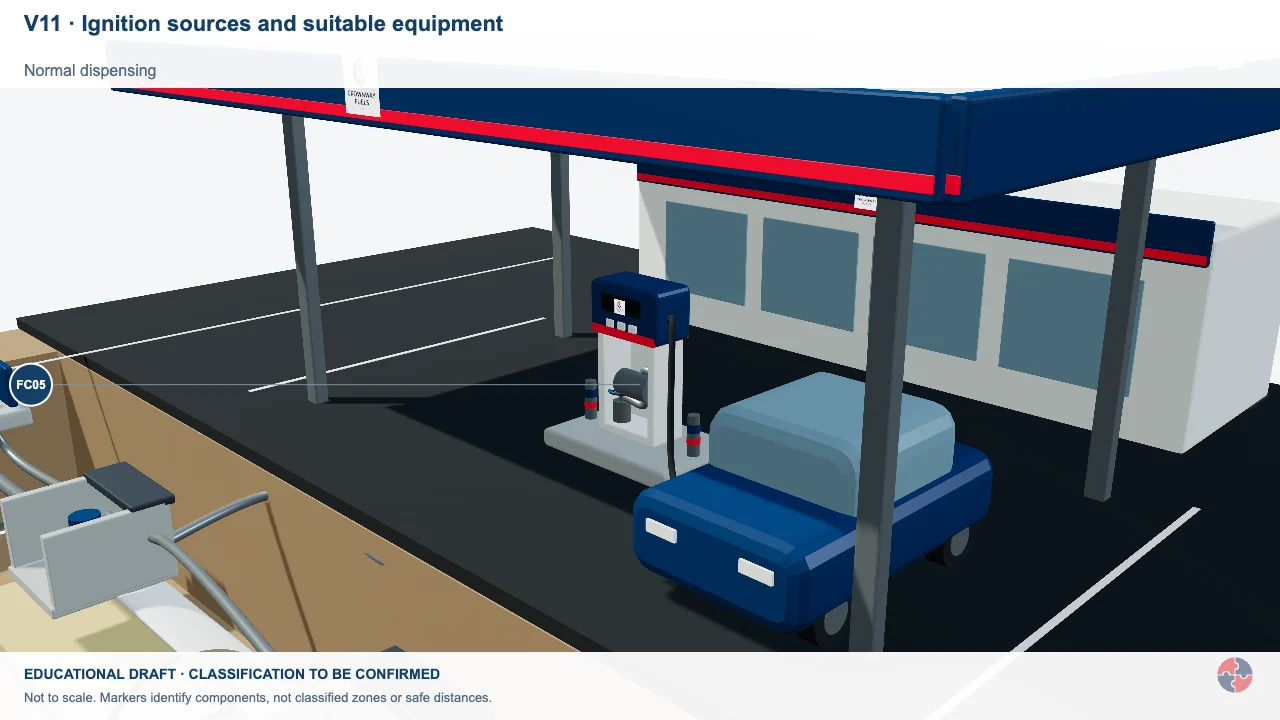
Ignition sources and suitable equipment
Electrical faults, hot work and other ignition sources matter where an explosive atmosphere could form.
Activity focus: Link equipment selection to the assessed atmosphere and actual dossier.
Contextual workplace scene. Use the task, control and evidence checks in this section; appearance alone does not establish safe conditions, individual health or approval.
Educational illustration, not to scale. Coloured zones are teaching examples, not a site-specific hazardous-area classification.
What do the acronyms and key terms mean?
Acronyms should be understood before they are used in assessments, briefings, audits or learning answers.
Acronyms can exclude newer readers if they are not explained. This section keeps the main terms available at the end of the page so the article stays readable while still supporting learners and audit users.
| Acronym | Meaning | Plain-English use |
|---|---|---|
| ACOP | Approved Code of Practice | Practical guidance with special legal status. |
| ALARP | As Low As Reasonably Practicable | Risk reduction unless further control is grossly disproportionate to benefit. |
| BBV | Blood-Borne Virus | Virus that may be transmitted through blood or certain body fluids. |
| COMAH | Control of Major Accident Hazards Regulations | Regulations for major accident hazard sites involving dangerous substances. |
| COSHH | Control of Substances Hazardous to Health | Regulations for hazardous substances, including many chemicals and biological agents. |
| DSEAR | Dangerous Substances and Explosive Atmospheres Regulations | GB regulations; Northern Ireland has its own DSEAR regime. |
| EMM | Enforcement Management Model | HSE decision framework for enforcement decisions. |
| EPS | Enforcement Policy Statement | HSE policy principles for enforcement. |
| FRA | Fire Risk Assessment | Assessment of fire hazards, people at risk, controls, emergency arrangements and review. |
| HSE | Health and Safety Executive | Great Britain regulator and official guidance source. |
| MOC | Management of Change | Formal review of changes that may affect risk controls. |
| OH | Occupational Health | Competent clinical and work-health advice route. |
| PPE | Personal Protective Equipment | Equipment worn to reduce exposure where higher-order controls do not fully remove risk. |
| RIDDOR | Reporting of Injuries, Diseases and Dangerous Occurrences Regulations | GB reporting regulations; Northern Ireland has a separate regime. |
| SDS | Safety Data Sheet | Supplier hazard, control, first-aid and emergency information for substances. |
| SOP | Standard Operating Procedure | Controlled instruction for carrying out a task or operation safely and consistently. |
| WEL | Workplace Exposure Limit | Airborne exposure limit averaged over a specified reference period. |
| Ex | Explosion protected | Equipment designed or selected for potentially explosive atmospheres. |
| RCD | Residual Current Device | Electrical protective device that disconnects a circuit under certain fault conditions. |
| ERICPD | Eliminate, Reduce, Isolate, Control, PPE, Discipline | Illustrative teaching prompt; Discipline means sustained controls, briefing and review. |
Which Crownway Fuels documents support this topic?
Open an editable document, read the preview, or find its place in the Crownway hierarchy. 7 resources relate to this page.
Fictional Crownway Fuels examples for English forecourts, with a separate illustrative bulk terminal. Check site applicability, permissions and actual controls before adapting any document for use.
Public dispensing and portable petrol containers policy (7)
- Public dispensing and portable petrol containers policy (CWF-POL-DISP · Completed fictional example)
Set company expectations, responsibilities and resources for public dispensing and portable petrol containers.
Read preview · Download DOCX · Show in hierarchy - Public dispensing and portable petrol containers procedure (CWF-PRO-DISP · Completed fictional example)
Explain who does what, in what sequence, the control rationale, evidence, escalation and safe restart conditions.
Read preview · Download DOCX · Show in hierarchy - Public dispensing and supervision assessment (CWF-RA-DISP-01 · Blank editable master)
Provide the site/task-specific public dispensing and supervision assessment and retain its controlled output.
Read preview · Download DOCX · Show in hierarchy - Dispenser nozzle hose and emergency stop check (CWF-CHK-DISP-01 · Blank editable master)
Provide the site/task-specific dispenser nozzle hose and emergency stop check and retain its controlled output.
Read preview · Download DOCX · Download PDF · Show in hierarchy - Portable petrol container and safe dispensing check (CWF-CHK-DISP-02 · Blank editable master)
Provide the site/task-specific portable petrol container and safe dispensing check and retain its controlled output.
Read preview · Download DOCX · Download PDF · Show in hierarchy - Unsafe dispensing refusal and intervention record (CWF-FRM-DISP-01 · Blank editable master)
Provide the site/task-specific unsafe dispensing refusal and intervention record and retain its controlled output.
Read preview · Download DOCX · Show in hierarchy - Unattended or alternative trading model change assessment (CWF-PLN-DISP-01 · Completed fictional example)
Provide the site/task-specific unattended or alternative trading model change assessment and retain its controlled output.
Read preview · Download DOCX · Show in hierarchy
Unlock another resource
You have used this month’s two free downloads. Publish a post in your own words to unlock one more resource, or choose SHARE Individual for 10 downloads per month.
You decide whether to share. If you do, use the relevant platform disclosure tools and do not make claims you do not genuinely hold.