SHARE Knowledge Hub
Struck-by and Caught-in Injuries
Struck-by and Caught-in Injuries explains how high-energy workplace incidents occur when people are hit by vehicles, moving plant, falling objects, ejected materials, swinging loads, tools, stored energy, moving machinery or collapsing/rolling items, or when they are trapped, crushed, drawn in or entangled. It covers energy-pathway thinking, exclusion zones, guarding, isolation, lifting control, vehicle movement, maintenance interventions, dropped-object prevention, stop-work triggers, incident learning and evidence for supervisors, construction teams, workshops and managers.
Understanding Struck-by and Caught-in Injuries
Struck-by and Caught-in Injuries explains how high-energy workplace incidents occur when people are hit by vehicles, moving plant, falling objects, ejected materials, swinging loads, tools, stored energy, moving machinery or collapsing/rolling items, or when they are trapped, crushed, drawn in or entangled. It covers energy-pathway thinking, exclusion zones, guarding, isolation, lifting control, vehicle movement, maintenance interventions, dropped-object prevention, stop-work triggers, incident learning and evidence for supervisors, construction teams, workshops and managers.
Why this matters at work
Reportable specified injuries include fractures other than fingers, thumbs and toes; amputations; injuries likely to cause permanent loss or reduction of sight; crush injuries to the head or torso causing brain or internal-organ damage; specified serious burns; scalping requiring hospital treatment; loss of consciousness caused by head injury or asphyxia; and the defined enclosed-space injury outcomes.
Hazard identification is not confined to observed harm. Long-latency respiratory disease, exposure to noise or vibration and low-frequency major accidents may have few warning injuries. If the work could plausibly produce serious harm, it needs a prevention decision even without a recent event.
How organisations manage this in practice
Risk assessment must lead to controls, owners and deadlines. Use elimination and physical design first, then systems and information for residual risk. Reassess after new vehicles, changed loads, construction phases, altered racking, resurfacing, automation, new contractors, an incident or evidence that controls are bypassed. Temporary deviations need an expiry, compensating controls and approval.
Hazard identification should use observation, worker knowledge, manufacturer information, near misses, ill-health records and non-routine-task review. Risk assessment considers severity, likelihood, exposure, existing controls and uncertainty. Control selection asks first whether the hazard can be removed or redesigned, then how access or exposure is prevented or reduced.
A useful audit follows one job from option appraisal through access equipment selection, erection or delivery, handover, use, alteration and removal. Compare the planned fall path and dropped-object zone with what workers actually encounter. Verify that each inspection finding has a named owner, a restriction during repair and a field check before release. Include a night or weekend shift where coverage differs. Recurrent short cuts may point to poor equipment access or unrealistic sequencing; correct the design and programme instead of recording another reminder to be careful.
A stopped control circuit is not secure isolation
Impact and trapping involve different energy paths. Remove people from those paths through the assessed controls, and establish secure all-energy isolation and stored-energy control before intrusive access.

Struck by
Identify vehicles, loads, tools and materials that could enter someone’s space. Assess exclusion, separation, load stability and the actual movement path.
Caught in
Identify nips, converging surfaces and stored movement that can trap or draw in a person. Keep guarding and safe access arrangements effective.
Emergency stop is not isolation
An emergency stop can stop a dangerous movement but does not establish secure isolation from every source. It is never the evidence that all energy is controlled.
Secure all relevant energy
Use the task-specific assessed isolation method to prevent unexpected energisation/reconnection, with competent control of ownership and boundaries.
Stored and gravitational energy
Dissipate or restrain relevant pressure, tension, raised loads or other stored energy as assessed, and verify the required safe state before access.
Restore and prove safeguards
After controlled completion and handback, restore guards and required safety functions and complete the specified tests before the authorised release.
Read the complete controls: ERICPD planning prompts
Discipline verifies and sustains all the controls; it is not a separate substitute for them.
| Prompt or level | Complete task-specific example |
|---|---|
| Eliminate | Redesign the conveyor transfer to avoid repeated jam intervention. |
| Reduce | Assess changes to the transfer or diagnostic task before exposure. |
| Isolate | Provide guarding and verified isolation or restraint. |
| Control | Plan safe access and verify vehicle immobilisation where relevant. |
| PPE | Helmets and high-vis cannot control moving-machine energy. |
| Discipline | Maintain safeguards and stop when isolation cannot be verified. Read the accompanying source table for the framework distinctions. |
Read the complete controls: ESEAP effectiveness order
Compare stronger feasible controls while preserving the actual task, checks and release requirements.
| Prompt or level | Complete task-specific example |
|---|---|
| Elimination | Redesign the conveyor transfer to avoid repeated jam intervention. |
| Substitution | Assess changes to the transfer or diagnostic task before exposure. |
| Engineering controls | Provide guarding and verified isolation or restraint. |
| Administrative controls | Plan safe access and verify vehicle immobilisation where relevant. Maintain safeguards and stop when isolation cannot be verified. |
| PPE | Helmets and high-vis cannot control moving-machine energy. Read the accompanying source table for the framework distinctions. |
The schematic shows no hands entering machinery and prescribes no universal lock position or isolation test. Use the competent task-specific method.
What are struck-by and caught-in injuries?
Struck-by injuries arise when vehicles, loads, tools or material enter a person’s space; caught-in injuries arise when moving parts or converging surfaces trap the body. The first control is to remove people from the energy path through segregation, guarding and planned lifting. Blockage clearing, cleaning, maintenance and vehicle reversing create different exposure than normal operation; stop, isolate, control stored energy and use a validated method before access. Do not treat an emergency stop as isolation.
Best-practice guide: Struck-by and Caught-in Injuries
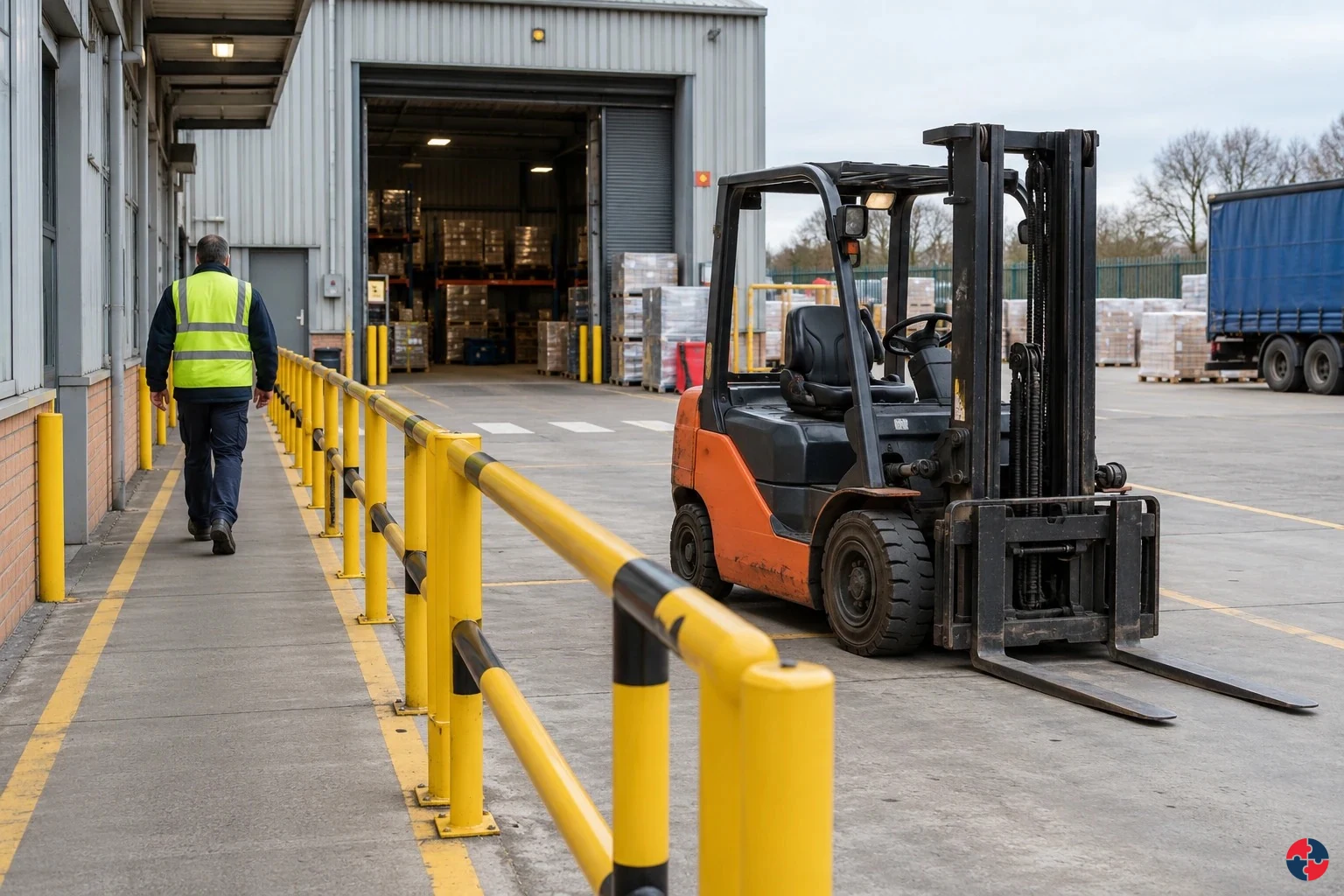
What are struck-by and caught-in injuries?
Struck-by injuries arise when vehicles, loads, tools or material enter a person’s space; caught-in injuries arise when moving parts or converging surfaces trap the body. The first control is to remove people from the energy path through segregation, guarding and planned lifting. Struck-by and Caught-in Injuries explains how high-energy workplace incidents occur when people are hit by vehicles, moving plant, falling objects, ejected materials, swinging loads, tools, stored energy, moving machinery or collapsing/rolling items, or when they are trapped, crushed, drawn in or entangled.
Turn struck-by and caught-in injuries knowledge into a decision
Struck-by and Caught-in Injuries explains how high-energy workplace incidents occur when people are hit by vehicles, moving plant, falling objects, ejected materials, swinging loads, tools, stored energy, moving machinery or collapsing/rolling items, or when they are trapped, crushed, drawn in or entangled. It covers energy-pathway thinking, exclusion zones, guarding, isolation, lifting control, vehicle movement, maintenance interventions, dropped-object prevention, stop-work triggers, incident learning and evidence for supervisors, construction teams, workshops and managers. Pre-start check, competent observation, vehicle/bay inspection and learning record.
Vehicle started from outside the cab
Start from the driver seat under approved conditions; control keys and communications. Shut down, secure vehicle, restore bay controls and review any near miss before handback.
Where do controls commonly fail?
Controls fail when people rely on awareness while allowing uncontrolled energy paths, poor separation or unsafe interventions.
Choose controls for struck-by and caught-in injuries
Stop and isolate: Supplies are isolated and locked; remaining stored/gravitational energy is safely dissipated or restrained and verified. Release stored energy: Gravity, pressure, hydraulic and tension energy are made safe by the competent assessed release/restraint method. Guarding: Access points interlocked or fixed where possible. Tools: Push sticks, hooks or remote methods avoid hand entry. Restart: Area checked, guards restored and people clear. Read the full control table for qualifications, ownership and verification. Use the actual task and applicable jurisdiction; existing technical approval remains unchanged.
Use the full struck-by and caught-in injuries lesson
Use the full topic for the decision points, practical examples, detailed control tables and source scope. HSE guidance applies to Great Britain; use HSENI for the Northern Ireland route and the source’s stated jurisdiction. A simplified guide does not change the page’s technical-review or approval status.

Read all six steps as text
1. What are struck-by and caught-in injuries?
Struck-by injuries arise when vehicles, loads, tools or material enter a person’s space; caught-in injuries arise when moving parts or converging surfaces trap the body.
- Avoid / redesign: Avoid unnecessary access to dangerous energy paths; use suitable segregation, task design and guarding.
- Control the task: Keep effective guards and safe access arrangements; an emergency stop is not isolation.
- Verify before release: For intrusive access, competent people secure and verify all relevant isolation and safely dissipate or restrain stored/gravitational energy using the assessed method.
Struck-by injuries arise when vehicles, loads, tools or material enter a person’s space; caught-in injuries arise when moving parts or converging surfaces trap the body. The first control is to remove people from the energy path through segregation, guarding and planned lifting. Struck-by and Caught-in Injuries explains how high-energy workplace incidents occur when people are hit by vehicles, moving plant, falling objects, ejected materials, swinging loads, tools, stored energy, moving machinery or collapsing/rolling items, or when they are trapped, crushed, drawn in or entangled.
Apply it: Which part of this plan would you check at the workface before authorising the task?
2. Turn struck-by and caught-in injuries knowledge into a decision
Use the evidence to improve the actual work arrangement.
- Change at source: Remove people from impact and trapping paths through suitable design, separation and safeguards.
- Make it observable: Verify the required secure isolated state and stored-energy controls before access; a stopped control circuit does not establish isolation.
- Keep useful evidence: Keep the actual isolation/test, task-completion, guard-restoration and authorised release evidence.
Struck-by and Caught-in Injuries explains how high-energy workplace incidents occur when people are hit by vehicles, moving plant, falling objects, ejected materials, swinging loads, tools, stored energy, moving machinery or collapsing/rolling items, or when they are trapped, crushed, drawn in or entangled. It covers energy-pathway thinking, exclusion zones, guarding, isolation, lifting control, vehicle movement, maintenance interventions, dropped-object prevention, stop-work triggers, incident learning and evidence for supervisors, construction teams, workshops and managers. Pre-start check, competent observation, vehicle/bay inspection and learning record.
Apply it: What evidence would show that the change improves this task, rather than only completing a record?
3. Vehicle started from outside the cab
Example: a practical application of the existing topic lesson.
- Setting: Motor vehicle repair bay; a vehicle is in gear with handbrake off and a mechanic stands by the open cab door.
- Act: Keep people out of the vehicle path; check gear, handbrake, chocks and safe seating before starting.
- Hold / review: Do not start from outside the cab or continue if immobilisation and clearance are unverified.
Start from the driver seat under approved conditions; control keys and communications. Shut down, secure vehicle, restore bay controls and review any near miss before handback.
Apply it: At which point would you hold this example, and what evidence would allow it to proceed?
4. Where do controls commonly fail?
Connect the task, the route to the person and the control that can fail.
- Source / exposure: Controls fail when people rely on awareness while allowing uncontrolled energy paths, poor separation or unsafe interventions.
- Possible consequence: High-vis clothing, helmets and briefings are weak if vehicles and pedestrians mix, loads pass overhead, machines can restart during intervention or materials are stored unstably.
- Control failure: The strongest systems use physical separation, engineered safeguarding, clear ownership of zones and routine field verification.
Controls fail when people rely on awareness while allowing uncontrolled energy paths, poor separation or unsafe interventions.
Apply it: Who could be exposed, including other trades, cleaners, maintainers and people nearby?
5. Choose controls for struck-by and caught-in injuries
Start with the stronger practicable options and verify their effect.
- Stop and isolate: Supplies are isolated and locked; remaining stored/gravitational energy is safely dissipated or restrained and verified.
- Release stored energy: Gravity, pressure, hydraulic and tension energy are made safe by the competent assessed release/restraint method.
- Guarding: Access points interlocked or fixed where possible.
- Tools: Push sticks, hooks or remote methods avoid hand entry.
- Restart: Area checked, guards restored and people clear.
Stop and isolate: Supplies are isolated and locked; remaining stored/gravitational energy is safely dissipated or restrained and verified. Release stored energy: Gravity, pressure, hydraulic and tension energy are made safe by the competent assessed release/restraint method. Guarding: Access points interlocked or fixed where possible. Tools: Push sticks, hooks or remote methods avoid hand entry. Restart: Area checked, guards restored and people clear. Read the full control table for qualifications, ownership and verification. Use the actual task and applicable jurisdiction; existing technical approval remains unchanged.
Apply it: Which stronger option can be used here, and who will verify it before accepting the remaining risk?
6. Use the full struck-by and caught-in injuries lesson
Follow the official sources below and retain the task-specific evidence.
- Official guidance: HSE workplace transport separation
- Official guidance: HSE lifting plans and load paths
- Task decision: Pre-start check, competent observation, vehicle/bay inspection and learning record.
Use the full topic for the decision points, practical examples, detailed control tables and source scope. HSE guidance applies to Great Britain; use HSENI for the Northern Ireland route and the source’s stated jurisdiction. A simplified guide does not change the page’s technical-review or approval status.
Apply it: Which official source and full-topic section will you use to resolve the next decision?
These injuries are high-consequence because the energy is often mechanical, gravitational, vehicle-related or stored. A small loss of control can cause fatal or life-changing harm: a reversing vehicle, falling scaffold board, swinging load, ejecting tool, rolling cylinder, moving conveyor, rotating shaft, closing tail lift or vehicle started while in gear.
The best way to teach the topic is through line-of-fire thinking. Where is the energy? Where could it move? Who is in the path? What keeps them out? What proves the barrier is still working? This turns the subject from a list of accident types into an operational decision model.
Controls should prioritise separation, engineering, guarding, isolation, load stability, exclusion zones, traffic design, lifting planning and supervision. PPE may reduce some injury severity, but it is not a reliable primary control against a moving vehicle, falling load or rotating machinery.
| Hazard family | Examples | Primary control focus |
|---|---|---|
| Vehicles and plant | Reversing vehicles, forklifts, excavators, dumpers, delivery vehicles and moving repaired vehicles. | Segregation, traffic routes, banksman control, visibility and immobilisation. HSE workplace transport separation |
| Falling objects | Tools, materials, racking stock, scaffold components, roof materials and dropped loads. | Toe boards, tethering, exclusion zones, storage stability and lifting control. HSE lifting plans and load paths |
| Flying/ejected objects | Grinding fragments, pressure release, broken cutting wheels, nail guns and failed hoses. | Guarding, screens, tool integrity, pressure control and PPE as backup. HSE machinery guarding and isolation |
| Swinging/suspended loads | Crane loads, excavator buckets, hoist hooks, telehandler loads and slung materials. | Lift planning, exclusion zones and competent signalling. HSE lifting plans and load paths |
| Caught-in machinery | Conveyors, rollers, belts, shafts, presses, mixers, balers and rotary valves. | Fixed/interlocked guards, isolation and safe intervention procedures. HSE machinery guarding and isolation |
| Crush/entrapment | MEWPs, tail lifts, vehicle ramps, shutters, doors, jacks and moving structures. | Safe positioning, anti-crush controls, maintenance and supervision. HSE workplace transport separation |
| Stored energy | Springs, hydraulics, pneumatics, gravity, tensioned cables and pressure systems. | Identify, isolate, release, restrain and verify a safe energy state. HSE machinery guarding and isolation |
Start with HSE machinery guarding and isolation and assess the actual work and nation.
How should struck-by and caught-in risk be assessed?
Assessment should follow the energy pathway from source to movement, line of fire, control, verification and emergency response.
A suitable assessment does not only ask whether people have high-vis or helmets. It asks where mechanical, vehicle, gravitational, hydraulic, pneumatic, tension, pressure or stored energy could move unexpectedly. It then designs separation or guarding so people cannot be in the danger zone.
The risk changes quickly during maintenance, breakdown, blockage clearing, loading, unloading, lifting, reversing, racking, refurbishment, weather, shift handover and contractor interface. That is why supervisor checks and stop triggers are crucial.
| Pathway step | Question | Control evidence |
|---|---|---|
| Energy source | What can move, fall, swing, roll, eject, rotate or trap? | Task risk assessment and site observation. |
| Release mechanism | What could cause loss of control? | Defect review, maintenance, weather, load stability and human factors. |
| Line of fire | Who could enter the path? | Exclusion-zone plan and pedestrian/vehicle segregation. |
| Primary barrier | What physically prevents contact? | Guarding, isolation, barriers, restraints or engineering control. |
| Work method | What does the worker do during normal and abnormal work? | RAMS, SOP, permit, lift plan or intervention method. |
| Verification | How is the control checked before work starts? | Pre-use checks, supervisor sign-off and inspection record. |
| Recovery | What if the barrier fails? | Emergency stop, rescue plan, first aid and communication. |
How can a routine task become a serious struck-by or caught-in incident?
A vehicle repair example shows how normalisation and weak immobilisation can create fatal line-of-fire exposure.
Vehicle started from outside the cab
Task material and setting: Motor vehicle repair bay; a vehicle is in gear with handbrake off and a mechanic stands by the open cab door.
People and prerequisites: Mechanic, supervisor and nearby workers; immobilisation check, bay clearance and approved diagnostic method.
Before: Keep people out of the vehicle path; check gear, handbrake, chocks and safe seating before starting.
During: Start from the driver seat under approved conditions; control keys and communications.
Hold or stop: Do not start from outside the cab or continue if immobilisation and clearance are unverified.
Completion and hand back: Shut down, secure vehicle, restore bay controls and review any near miss before handback.
Evidence: Pre-start check, competent observation, vehicle/bay inspection and learning record.
Primary source: HSE struck-by motor-vehicle incidents
A mechanic starts a vehicle from outside the cab to listen for a fault. The vehicle is in gear and the handbrake is not applied. It moves unexpectedly, the door strikes an obstruction and the mechanic is crushed. Similar incidents are well recognised in motor vehicle repair guidance.
The stronger control is not a reminder to be careful. Engines should be started only from the driver's seat, with handbrake on and vehicle in neutral. This page does not authorise an exception for remote starting or bypassing immobilisation. Wheels may need chocking, keys controlled, communication agreed and lone work restricted.
| Failure | Why it matters | Better control |
|---|---|---|
| Starting from outside cab | Person stands in line of vehicle movement. | Start only from driver's seat under safe conditions. HSE struck-by motor-vehicle incidents |
| Vehicle left in gear | Stored movement energy is released. | Neutral, handbrake, chocks and pre-start check. HSE struck-by motor-vehicle incidents |
| Poor bay layout | Door or vehicle can trap worker against obstruction. | Clearances and exclusion zone. HSE struck-by motor-vehicle incidents |
| Lone working | Delay in rescue and weak challenge. | Assess lone-work risk and set supervision or check-in controls where needed. |
| Informal practice | Unsafe shortcut becomes normal. | SOP, observation and supervisor challenge. HSE struck-by motor-vehicle incidents |
| No incident learning | Near misses are ignored. | Record, investigate and brief lessons. HSE struck-by motor-vehicle incidents |
How should supervisors identify the line of fire?
The line of fire is any position where a person could be hit, crushed, trapped, drawn in or struck if energy is released.
Supervisors should walk the job and physically point out the danger path: reversing arc, swing radius, drop zone, stored-energy direction, nip point, ejection path, rolling route or collapse zone. If the path cannot be described, the job is not understood.
A good pre-start brief names the energy source, the exclusion zone, the person controlling entry, the stop signal and the condition that requires work to pause.
| Prompt | Example answer | Stop if |
|---|---|---|
| What can move? | Forklift, load, conveyor, suspended beam, tail lift or vehicle. | The team cannot identify the moving energy. |
| Where could it go? | Reverse path, swing radius, fall zone or nip point. | People can stand in the path. |
| What keeps people out? | Barrier, guard, exclusion zone, isolation or physical separation. | Control is only verbal. |
| Who controls entry? | Named supervisor, banksman or area owner. | No one owns the zone. |
| What changes the risk? | Weather, load shift, blockage, poor visibility or plant defect. | Change is not reassessed. |
| What is the stop signal? | Hand signal, radio call or emergency stop. | People do not know how to stop the work. |
Where do struck-by and caught-in risks appear by sector?
Sector examples show how the same injury mechanism appears in different types of work.
The topic is not limited to construction. Warehouses, workshops, farms, food production, waste, logistics, retail back-of-house and leisure maintenance all create line-of-fire risk.
Competent assessment should focus on the mechanism: moving vehicle, falling object, ejected object, moving machinery, stored energy or entrapment.
| Sector | Scenario | Critical control |
|---|---|---|
| Construction | Telehandler load passes over a pedestrian route. | Segregated route and exclusion zone. |
| Warehouse | Pallet falls from damaged racking. | Racking inspection, load limits and storage rules. |
| Manufacturing | Worker reaches into conveyor to clear jam. | Isolation, guarding and intervention SOP. |
| Vehicle repair | Car moves off lift or is started in gear. | Immobilisation and lift controls. |
| Food production | Knife, trolley or falling stock strikes worker. | Tool control, storage stability and route design. |
| Agriculture | PTO shaft or auger entangles clothing. | Guarding, isolation and no loose clothing. |
| Waste/recycling | Ejected material or moving loader bucket. | Cab protection, exclusion and machine guarding. |
| MEWP work | Operator crushed against overhead obstruction. | Route planning, anti-crush controls and spotter where needed. |
Why are interventions and blockage clearing so dangerous?
Interventions are dangerous because people enter the danger zone when the machine, load or process is abnormal.
Many serious caught-in incidents happen during clearing, cleaning, adjustment, inspection or fault finding. The machine may be stopped, but stored energy, gravity, automatic restart, residual motion or another person restarting the equipment can still cause harm.
The safe method should define isolation, lock-off, stored-energy release, access, tools, communication, test restart and handback. If clearing a blockage is frequent, the organisation should redesign the process rather than rely on heroic intervention.
| Control | What good looks like | Common failure |
|---|---|---|
| Stop and isolate | Supplies are isolated and locked; remaining stored/gravitational energy is safely dissipated or restrained and verified. | Emergency stop used as if it were isolation. HSE maintenance isolation, energy release and supports. |
| Release stored energy | Gravity, pressure, hydraulic and tension energy are made safe by the competent assessed release/restraint method. | Load drops or rollers move after access. HSE maintenance isolation, energy release and supports. |
| Guarding | Access points interlocked or fixed where possible. | Hatch opens to danger zone. HSE machinery guarding and isolation |
| Tools | Push sticks, hooks or remote methods avoid hand entry. | Worker reaches in by hand. HSE paper-sector intervention controls |
| Restart | Area checked, guards restored and people clear. | Machine restarted without communication. HSE machinery guarding and isolation |
| Learning | Repeated blockage triggers engineering review. | Same blockage cleared informally every shift. HSE paper-sector intervention controls |
Use a competent task-specific isolation scheme: identify all supplies and possible motion, prevent restart, safely dissipate energy or restrain it using suitable designed supports, and verify before access. Do not loosen a fitting, release a spring or remove a load support just to demonstrate zero energy. Test equipment and any try-start must be suitable and performed with people clear; no generic test proves every energy source safe. HSE machinery guarding and isolation. HSE paper-sector intervention controls is paper-sector evidence, not approval of another machine’s method.
HSE maintenance isolation, energy release and supports covers isolating supplies, releasing compressed-air or hydraulic energy, and supporting parts that could fall. Springs, tensioned systems and verification need the competent method for that equipment.
How can a caught-in incident develop during conveyor blockage clearing?
A conveyor blockage incident usually develops when abnormal operation, production pressure and weak isolation put a person inside the danger zone.
A packing line conveyor repeatedly jams at a transfer point. The operator has learned that clearing the blockage by reaching through a side opening is faster than waiting for maintenance. One shift, the belt stops on the emergency stop, the worker reaches in to pull trapped material free, and another worker resets the line. The worker's glove is drawn into the roller nip.
The investigation should not stop at 'worker put hand in machine'. The deeper causes include poor access design, repeated blockage, emergency-stop misuse, lack of lock-off, inadequate supervision, production pressure, weak reporting and a failure to engineer out the frequent jam.
| Stage | What happened | Stronger control |
|---|---|---|
| Hazard | Roller nip and moving belt created a draw-in point. | Fixed/interlocked guarding and safe access design. |
| Control failure | Emergency stop was used as if it were isolation. | Lock-off, verification of isolated and safely restrained energy and restart control. |
| Immediate stop | Line should stop when anyone needs to enter or reach into danger zone. | Supervisor stop-work and maintenance call-out. |
| Investigation finding | Repeated jam had become normal and unreported. | Defect trend review and engineering modification. |
| Human factors | Production pressure made unsafe clearing feel sensible. | Targets and downtime rules support safe intervention. |
| Training | Workers did not distinguish emergency stop from isolation. | Task-specific isolation and intervention training. |
| Evidence | No record of previous jams or near misses. | Jam log, maintenance action and verification record. |
| Assurance | Supervisors had not observed blockage-clearing practice. | Planned field verification of interventions. |
This conveyor case illustrates foreseeable intervention failure. HSE paper-sector intervention controls supports isolation, guarding, worker involvement and checking workable procedures; it does not prescribe this jam log, investigation finding or exact guard design. The competent machinery assessment must also address stored/gravitational energy and a verified restart with guards restored and everyone clear.
The stage table explains this example’s control decisions; investigation records and review intervals are local choices.
Which line-of-fire examples should workers be able to recognise?
Workers and supervisors should be able to name the energy path before work starts and stop when that path is uncontrolled.
Line-of-fire thinking works because it is visual and practical. It asks: if this vehicle, load, pressure, tool, machine part or stored energy moved unexpectedly, where would it go and who would be in the path?
The most useful briefings use real site examples rather than generic warnings. A reversing vehicle, excavator slew, suspended load, conveyor nip point, rotating shaft, pressurised hose or trapped spring each has a different energy path and control standard.
| Example | Failure mode | Critical control |
|---|---|---|
| Reversing vehicle | Pedestrian enters blind spot or reversing route. | Segregated route, trained banksman where needed, reversing aid and stop rule. HSE workplace transport separation |
| Lifting operation | Load swings, shifts or falls into people below. | Lift plan, exclusion zone, tag lines where suitable and appointed supervision. HSE lifting plans and load paths |
| Suspended load | Person stands under or beside unstable load. | No access under suspended loads and clear drop zone. HSE lifting plans and load paths |
| Excavator slew zone | Worker is struck by counterweight or bucket. | Physical separation, plant-pedestrian plan and agreed stopped-plant access procedure; eye contact alone is not clearance. HSE workplace transport separation |
| Rotating machinery | Clothing, glove or hand is drawn into shaft or roller. | Fixed guarding, no loose clothing and isolation for adjustment. HSE machinery guarding and isolation |
| Conveyor blockage | Worker reaches into nip or trapping point. | Lock-off, stored-energy release and engineered access method. HSE paper-sector intervention controls |
| Pressure release | Hose, fitting or plug ejects under pressure. | Depressurise, verify zero pressure and use rated components. HSE maintenance isolation, energy release and supports. |
| Stored energy | Spring, hydraulic arm, raised load or tensioned cable releases. | Block, pin, vent, lower or restrain energy before access. HSE maintenance isolation, energy release and supports. |
Transfer the conveyor lesson to a suspended beam: locking an electrical isolator does not support the beam or control crane/load movement. The lift plan must establish suitable equipment, competent control, an exclusion zone and safe landing/support before anyone approaches. Tag lines can introduce entanglement and must be assessed for the actual load; do not stand under a load to attach or correct one. HSE lift planning and load paths.
How can the hierarchy of controls prevent struck-by and caught-in injuries?
Remove or reduce the hazard before relying on procedures or personal protection.
For struck-by and caught-in injuries, assess the actual task and first look for a way to remove the hazard. Where that is not possible, consider a safer substitute, engineered separation and then clear work procedures. PPE protects against remaining exposure; it does not make an uncontrolled task safe. HSE hierarchy of controls
The selected measures need a named owner, a usable stop point and a check that they still work when the task or conditions change. In Northern Ireland, verify the separate legal route and site instructions.
For the repeated conveyor jam, redesign the transfer to avoid the intervention, then provide suitable guarding and safe access and a verified isolation/restraint scheme for remaining abnormal work. For the repair vehicle, remove avoidable engine-running work and verify immobilisation and driver-seat start-up before a justified diagnostic task. Helmets, high-vis and briefing cannot control those energy paths. HSE machinery guarding and isolation; HSE motor-vehicle start-up precaution. ERICPD is a teaching aid, not an exception to guarding or site law.
How can the ERICPD hierarchy of controls prevent struck-by and caught-in injuries?

| ERICPD control level | Topic-specific example | Source and full task context |
|---|---|---|
| Eliminate | Redesign the conveyor transfer to avoid repeated jam intervention. | Read the full task example, checks and stop points on this page. HSE hierarchy of controls · HSE machinery guarding and isolation · HSE motor-vehicle start-up precaution |
| Reduce | Assess changes to the transfer or diagnostic task before exposure. | Read the full task example, checks and stop points on this page. HSE hierarchy of controls · HSE machinery guarding and isolation · HSE motor-vehicle start-up precaution |
| Isolate | Provide guarding and verified isolation or restraint. | Read the full task example, checks and stop points on this page. HSE hierarchy of controls · HSE machinery guarding and isolation · HSE motor-vehicle start-up precaution |
| Control | Plan safe access and verify vehicle immobilisation where relevant. | Read the full task example, checks and stop points on this page. HSE hierarchy of controls · HSE machinery guarding and isolation · HSE motor-vehicle start-up precaution |
| PPE | Helmets and high-vis cannot control moving-machine energy. | Read the full task example, checks and stop points on this page. HSE hierarchy of controls · HSE machinery guarding and isolation · HSE motor-vehicle start-up precaution |
| Discipline | Maintain safeguards and stop when isolation cannot be verified. | Read the full task example, checks and stop points on this page. HSE hierarchy of controls · HSE machinery guarding and isolation · HSE motor-vehicle start-up precaution |
How can the ISO 45001 hierarchy of controls prevent struck-by and caught-in injuries?

| Five-level control stage(s) | Topic-specific example | Source and full task context |
|---|---|---|
| Elimination | Redesign the conveyor transfer to avoid repeated jam intervention. | Read the full task example, checks and stop points on this page. HSE hierarchy of controls · HSE machinery guarding and isolation · HSE motor-vehicle start-up precaution |
| Substitution | Assess changes to the transfer or diagnostic task before exposure. | Read the full task example, checks and stop points on this page. HSE hierarchy of controls · HSE machinery guarding and isolation · HSE motor-vehicle start-up precaution |
| Engineering controls | Provide guarding and verified isolation or restraint. | Read the full task example, checks and stop points on this page. HSE hierarchy of controls · HSE machinery guarding and isolation · HSE motor-vehicle start-up precaution |
| Administrative controls | Plan safe access and verify vehicle immobilisation where relevant. | Read the full task example, checks and stop points on this page. HSE hierarchy of controls · HSE machinery guarding and isolation · HSE motor-vehicle start-up precaution |
| PPE | Helmets and high-vis cannot control moving-machine energy. | Read the full task example, checks and stop points on this page. HSE hierarchy of controls · HSE machinery guarding and isolation · HSE motor-vehicle start-up precaution |
| Administrative controls | Maintain safeguards and stop when isolation cannot be verified. | Read the full task example, checks and stop points on this page. HSE hierarchy of controls · HSE machinery guarding and isolation · HSE motor-vehicle start-up precaution |
Assessment is a planning step, not an implemented reduction. In the conveyor example, a competent redesign of the jam-prone transfer reduces intervention exposure, then the guarded access/isolation or restraint method is verified before release. No assessment document or emergency stop alone makes access safe.
When should struck-by or caught-in work stop?
Work should stop when people can enter the line of fire, guarding is missing, exclusion zones fail, loads are unstable or energy is not isolated.
Stop-work authority is essential because conditions change quickly. A route becomes blocked, lighting fails, a banksman is called away, a load shifts, a guard is removed, a machine jams or a vehicle arrives unplanned.
Supervisors should treat near misses and high-potential events seriously. A narrowly missed pedestrian, dropped tool, swinging load or defeated interlock is not lucky; it is evidence that a critical control is weak.
| Trigger | Immediate action | Who to involve |
|---|---|---|
| Pedestrian enters vehicle route | Stop vehicle movement and reset segregation. | Supervisor/site manager. |
| Suspended load over people | Stop lift and clear exclusion zone. | Lift supervisor/appointed person. |
| Guard missing or interlock defeated | Stop machine and isolate. | Maintenance and competent machinery person. |
| Unstable racking or load | Keep people away and make safe. | Warehouse manager/competent inspector. |
| Blockage clearing without isolation | Stop intervention. | Supervisor and maintenance. |
| Poor visibility or failed reversing aid | Stop reversing/plant movement. | Transport/site manager. |
| Dropped object near miss | Stop overhead work and review controls. | Supervisor/HSE adviser. |
An injury or trapped person needs the emergency plan and 999 as appropriate. Stop hazardous motion from a safe position and prevent restart; do not enter an uncontrolled zone or improvise release of a load, spring or pressure to attempt rescue. Competent rescue and trained first-aid response must control the secondary danger. HSE GB first-aid provision supports assessed workplace arrangements, not a crush-rescue procedure.
Where do controls commonly fail?
Controls fail when people rely on awareness while allowing uncontrolled energy paths, poor separation or unsafe interventions.
High-vis clothing, helmets and briefings are weak if vehicles and pedestrians mix, loads pass overhead, machines can restart during intervention or materials are stored unstably.
The strongest systems use physical separation, engineered safeguarding, clear ownership of zones and routine field verification.
| Failure or weak practice | How it develops | What good looks like |
|---|---|---|
| Verbal exclusion zone | People walk through because no barrier exists. | Physical barrier and controller. |
| Defeated guard | Machine runs with guard open. | Interlock integrity and disciplinary/just-culture review. |
| Poor storage | Heavy items stored high or unsecured. | Racking rules and inspection. |
| No lift plan | Load swings over people. | Planned lift and exclusion. |
| Unsafe vehicle repair | Engine started from outside cab. | Immobilisation SOP. |
| Emergency stop misuse | Used instead of lock-off. | Isolation and lockout training. |
| No learning | Near misses not investigated. | High-potential near-miss triage. |
What evidence shows struck-by and caught-in risks are controlled?
Good evidence shows that controls are planned, used, checked, corrected and reviewed.
Evidence should be proportionate to the harm and task. Check whether controls work in practice and trigger timely correction when conditions change.
| Evidence item | What it should show | Assurance question |
|---|---|---|
| Risk assessment | Energy source, line of fire, control and stop triggers. | Does it describe actual movement paths? |
| Traffic plan | Pedestrian/vehicle segregation, routes and visibility. | Are routes working on site? |
| Lift plan | Load, equipment, exclusion zone, roles and communication. | Is the lift controlled? |
| Guarding record | Fixed/interlocked guards, defects and maintenance. | Are guards intact and not defeated? |
| Isolation procedure | Lock-off, stored energy and restart control. | Can workers prove isolation and the safe restraint of remaining energy? |
| Inspection records | Racking, lifting equipment, plant, MEWPs and tools. | Are defects closed? |
| Incident learning | Near misses, dropped objects and high-potential events. | Are actions strong enough? |
Adapt the evidence items to the actual work and verify controls, not merely completed forms. Protect personal information and record corrections.
How should struck-by and caught-in injuries be assured?
Assurance should test whether controls work in practice, not whether the page or procedure exists.
Assurance should include frontline checks, manager review and periodic independent sampling where risk warrants it. The purpose is to find weak signals early, close actions properly and update the risk assessment when work changes.
| Assurance level | What to check | What good looks like |
|---|---|---|
| Frontline | Pre-start checks of line of fire and exclusion zones. | Work stops when people enter danger zone. |
| Supervisor | Observes vehicle, lifting, machinery and intervention work. | Controls match work as done. |
| Technical | Guarding, lifting and transport plans reviewed by competent people. | Engineering controls are reliable. |
| Audit | Samples high-potential near misses and action quality. | Repeat mechanisms are reduced. |
| Leadership | Reviews serious-risk controls and resources. | High-energy risk is visible. |
Sampling and review levels are local choices; check how safety and support work in practice and correct failed arrangements.
Which UK duties and guidance apply?
GB PUWER requires work equipment risks and dangerous machinery parts to be controlled; NI has separate PUWER regulations. GB LOLER adds lifting planning and load-control duties. HSE transport, machinery and lifting guidance is GB technical guidance; apply the actual site and NI law separately where needed.
| Jurisdiction | Route | Direct source | Decision supported |
|---|---|---|---|
| Great Britain | Work equipment and machinery | Provision and Use of Work Equipment Regulations 1998; Introduction to machinery safety | Guard, isolate and maintain dangerous parts. |
| Northern Ireland | Separate work-equipment duties | Provision and Use of Work Equipment Regulations (Northern Ireland) 1999; Health and Safety at Work (Northern Ireland) Order 1978 | Apply NI work-equipment law. |
| Great Britain | Lifting operations | Lifting Operations and Lifting Equipment Regulations 1998; Planning lifting operations | Plan lifts and exclude people from load path. |
| Great Britain | Workplace transport | Introduction to workplace transport safety | Separate vehicles and pedestrians. |
| Northern Ireland | Separate lifting-operations duties | NI lifting-operations regulations | Plan lifts and control load paths under NI LOLER. |
The NI LOLER link’s /made view is historical text. Use the correct NI instrument with its applicable amendments and competent current-version checking; do not silently treat an as-made publication as a complete amended-text verification. Preserve the separate NI route.
How should management check this work?
Use a defined plan, carry out the controls, check performance and correct what does not work.
For struck-by and caught-in injuries, assign a competent owner to set the work controls, check their use and review them after change, failure or new evidence. HSE managing health and safety
A management-system label or certificate is not approval of a site limit, procedure or individual work decision. Apply GB and NI duties to the correct location.
What training and competence are needed?
Demonstrate the decision each role must make in its actual task, including when to stop and seek specialist advice.
These assessment methods are illustrative SHARE implementation choices; the linked guidance supports the subject matter, not a prescribed training format.
| Role | Practice to demonstrate | Assessor and method | Evidence | Reassess when |
|---|---|---|---|---|
| Operators | Recognise line of fire and stop for missing guard. | Supervisor tests scenario. | Observed response. | Task change. HSE machinery guarding and isolation |
| Drivers | Use separated routes and stop for pedestrians. | Transport lead observes. | Route assessment. | Layout change. HSE workplace transport separation |
| Maintenance | Isolate and verify all energy before blockage clearing. | Competent engineer assesses. | Practical sign-off. | Plant modification. HSE paper-sector intervention controls |
| Lift teams | Plan load path and exclusion. | Appointed person tests plan. | Lift plan and briefing. | Unusual lift. HSE lifting plans and load paths |
| Leaders | Fund permanent segregation and guard reliability. | Peer audit. | Action and incident trend. | Repeat near miss. HSE workplace transport separation |
How could BuildOut Ltd manage this in practice?

BuildOut Ltd can manage struck-by and caught-in injuries by treating line-of-fire exposure as a serious-risk control across sites, workshops and logistics.
In this construction business, risks arise from telehandlers, cranes, scaffolds, delivery vehicles, racking, power tools, MEWPs, excavations and machinery in workshops.
| Management element | How the business would manage it | Evidence to review |
|---|---|---|
| Planning | Vehicle routes and lift zones designed before work starts. | Site logistics plan. |
| Supervision | Daily checks verify exclusion zones and access routes. | Supervisor inspection. |
| Machinery | Interventions require isolation and guard integrity. | PUWER checklist. |
| Dropped objects | Tools tethered and overhead work segregated. | Inspection record. |
| Learning | Near misses classified by high-potential energy. | Incident review. |
This example business illustrates local application; roles, records and controls must fit its actual work and jurisdiction.
What do the acronyms and key terms mean?
Acronyms should be understood before they are used in assessments, briefings, audits or learning answers.
Acronyms can exclude newer readers if they are not explained. This section keeps the main terms available at the end of the page so the article stays readable while still supporting learners and audit users.
| Acronym | Meaning | Plain-English use |
|---|---|---|
| HSE | Health and Safety Executive | Great Britain regulator and official guidance source. |
| HSWA | Health and Safety at Work etc. Act 1974 | Primary GB health and safety legislation; NI has a separate Order. |
| LOLER | Lifting Operations and Lifting Equipment Regulations 1998 | GB lifting-equipment regulations; NI has a separate regime. |
| MHSWR | Management of Health and Safety at Work Regulations 1999 | Regulations requiring risk assessment, arrangements, competent advice and cooperation. |
| PTW | Permit to Work | Formal authorisation and control system for higher-risk work. |
| PUWER | Provision and Use of Work Equipment Regulations 1998 | Regulations for safe work equipment selection, use, guarding, inspection and maintenance. |
| RIDDOR | Reporting of Injuries, Diseases and Dangerous Occurrences Regulations 2013 | GB reporting regulations; NI has a separate regime. |
| SSOW | Safe System of Work | Planned combination of people, equipment, method, supervision and emergency controls. |
| ERICPD | Eliminate, Reduce, Isolate, Control, PPE, Discipline | Teaching prompt; sustain and check controls. |
| MEWP | Mobile elevating work platform | Platform access equipment; route/entrapment assessment needed. |
| PTO | Power take-off | Rotating drive needs suitable guards and safe isolation. |
Unlock another resource
You have used this month’s two free downloads. Publish a post in your own words to unlock one more resource, or choose SHARE Individual for 10 downloads per month.
You decide whether to share. If you do, use the relevant platform disclosure tools and do not make claims you do not genuinely hold.