SHARE Knowledge Hub
Provision and Use of Work Equipment (PUWER)
PUWER is the Great Britain work-equipment use regime: choose suitable equipment, keep it safe and maintained, inspect it when the regulations require, protect people from dangerous parts and energy, and give users and supervisors suitable information and training. Northern Ireland has its own 1999 PUWER instrument. A conformity mark or annual checklist does not by itself show that a machine is safe for the actual task. The dutyholder must manage real operation, cleaning, breakdown and change.
Understanding Provision and Use of Work Equipment (PUWER)
PUWER is the Great Britain work-equipment use regime: choose suitable equipment, keep it safe and maintained, inspect it when the regulations require, protect people from dangerous parts and energy, and give users and supervisors suitable information and training. Northern Ireland has its own 1999 PUWER instrument. A conformity mark or annual checklist does not by itself show that a machine is safe for the actual task. The dutyholder must manage real operation, cleaning, breakdown and change.
Why this matters at work
Exceptional circumstances can include major modification, serious damage, accident, prolonged disuse, extreme exposure or a substantial change in use that could jeopardise safety. Reassembly at a new location can also trigger inspection where safety depends on installation. A routine calendar inspection may not address the new condition.
PUWER requires work equipment to be stabilised where necessary and suitable lighting where use creates risk. Assess overturning, sliding, vibration, dynamic loads, uneven ground, wind and forces from material or tools. Benches, small machines and temporary plant can cause serious harm when poorly secured.
How organisations manage this in practice
PUWER duties can apply to employers, relevant self-employed people and people who control work equipment or its use to the extent of their control. Ownership is not the only test. A hirer, host, contractor, facilities manager, maintenance provider or supplier may each control different decisions, but a contract label does not remove a duty created by actual control.
Begin with an equipment and task inventory. Decide the intended use and environment, who controls selection and maintenance, who may use it, which hazards and failure modes exist, and whether another regime adds requirements. Then select engineering protection, safe controls, inspection and maintenance arrangements, information, training and supervision that match the risk.
Start with jurisdiction, asset inventory, controller and intended-use definition. Prioritise equipment with dangerous movement, stored energy, deterioration, mobility, lifting or specialist requirements. Complete task and lifecycle assessment, close immediate defects, define safeguards, isolation, maintenance, inspection, competence and change control, then verify operation in the field.
Risk reduction should begin with eliminating or reducing the hazard through design, layout, process or equipment selection. Engineering safeguards then prevent access or stop danger, followed by safe controls and systems of work. Information, training and PPE address residual risk but cannot compensate for a practicable fixed guard or safer process.
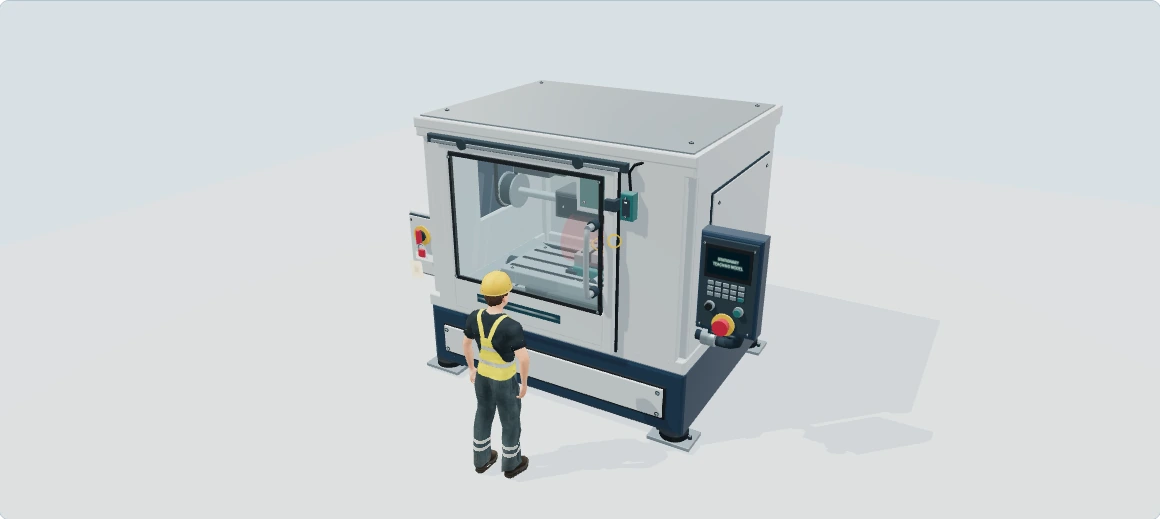

Machinery guarding: trace the energy to the harm
Explore the working zone, guards, interlock, transmission, controls and energy isolator. Compare production work, cleaning and maintenance without treating a stopped machine as safely isolated.
Checksheets and risk assessments
Risk assessment forms
Risk assessment examples
Forms and tools
Full written walkthrough — all 8 steps
1. Identify the dangerous movement
What is happening: The cutaway exposes the workholding and cutter so you can inspect where contact could occur. It does not open or enable the real machine.
How harm can occur: A cutter can sever tissue; rotating parts can wind in hair or clothing; moving workholding can crush a hand.
Best practice to apply: Identify the task, all exposed people and the machinery’s intended operating limits. Keep the actual danger zone inaccessible.
2. Inspect the enclosure and access
What is happening: Inspect the enclosure, viewing panel and access edges. The visual cutaway changes only the drawing.
How harm can occur: A missing, damaged or unsuitable guard may allow reach into dangerous movement or fail to contain an ejected item.
Best practice to apply: Check the actual guard, fixing, condition and suitability. Do not infer reach distances or containment performance from this model.
3. Understand an interlock’s role
What is happening: The access interlock is a separate protective function. Its presence does not establish the reliability or stopping performance of the actual system.
How harm can occur: Defeating an interlock can permit access while hazardous movement is possible. Run-down may continue after a stop request.
Best practice to apply: Verify required protective functions through competent assessment and maintenance. Do not bypass them or use the cutaway as a working configuration.
4. Find the transmission hazards
What is happening: Inspect the drive and the cover around it. Dangerous movement can exist beyond the obvious working point.
How harm can occur: Belts, pulleys and rotating shafts can entangle, draw in or trap people during production or servicing.
Best practice to apply: Keep appropriate transmission guarding in place. Plan access and maintenance with the equipment information and actual energy sources.
5. Separate control stops from isolation
What is happening: The control panel and emergency stop act through control functions. The energy isolator is physically separate.
How harm can occur: A stopped display may conceal live energy or allow an unexpected restart; an emergency stop does not remove every energy source.
Best practice to apply: Use the required stop arrangements for operation and the actual safe isolation procedure for intrusive access.
6. Control hazardous energy for access
What is happening: Locate the separate isolator and the points where electrical, pneumatic, hydraulic, gravitational or mechanical energy may remain.
How harm can occur: Unexpected energisation, stored pressure or a falling component can cause shock, crushing or impact.
Best practice to apply: Identify, isolate, secure and verify the relevant energies using competent task-specific arrangements. The pictured lock is not proof that a machine is safe.
7. Plan cleaning and material handling
What is happening: Consider how material is loaded, held, removed and cleaned without bringing a person into danger.
How harm can occur: An inadequately held item can be ejected; reaching to clear swarf or a blockage can expose hands and clothing.
Best practice to apply: Use suitable workholding and handling methods. Stop and follow the safe system when a blockage or abnormal condition occurs.
8. Protect the people around the machine
What is happening: The operator’s work position and surrounding access affect people other than the person at the controls.
How harm can occur: Visitors, cleaners and nearby trades may enter a danger area or be struck by an ejected item.
Best practice to apply: Check layout, access, instruction, competence and supervision. Review the machine after changes and before returning it to service.
Illustrative awareness learning. The model does not design equipment, authorise work, verify safe conditions or complete a real inspection.
The wider workplace has its own account and subscription access. Exploring this lesson does not grant access, record course completion or authorise work.
How can I practise this topic in 3D?
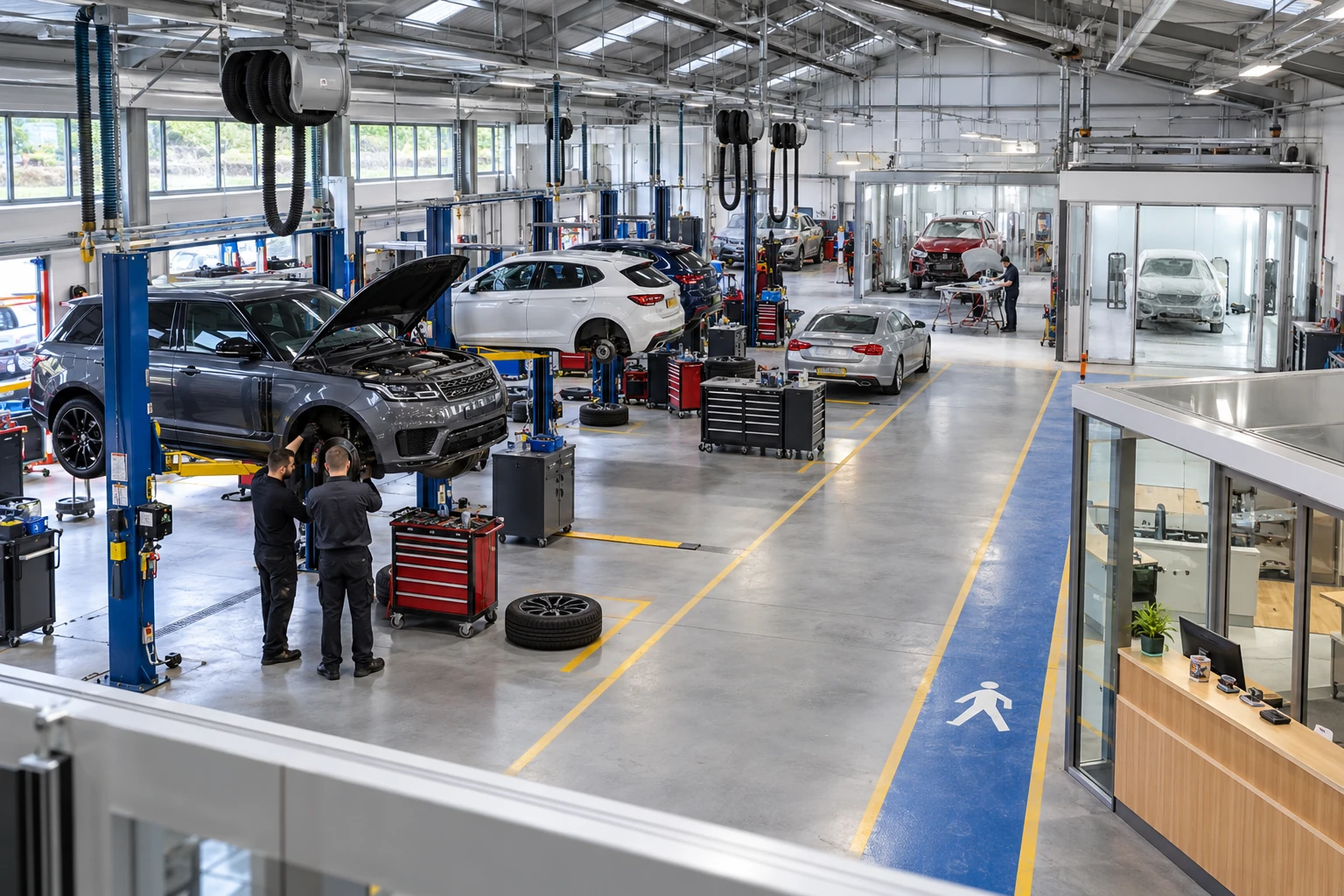
Powered impact use and final wheel torquing

An accessible conveyor nip point
All related inspection points 4 across 2 locations
Garage workshop 3 inspection points
Warehouse walkabout 1 inspection point
Practice in the SHAREhub environment. Browser practice is separate from workplace competence and formal learning records.
What does PUWER require in practical terms?
PUWER requires work equipment to be suitable, safe, maintained, inspected where needed and used by informed, trained people.
Best-practice guide: Provision and Use of Work Equipment (PUWER)
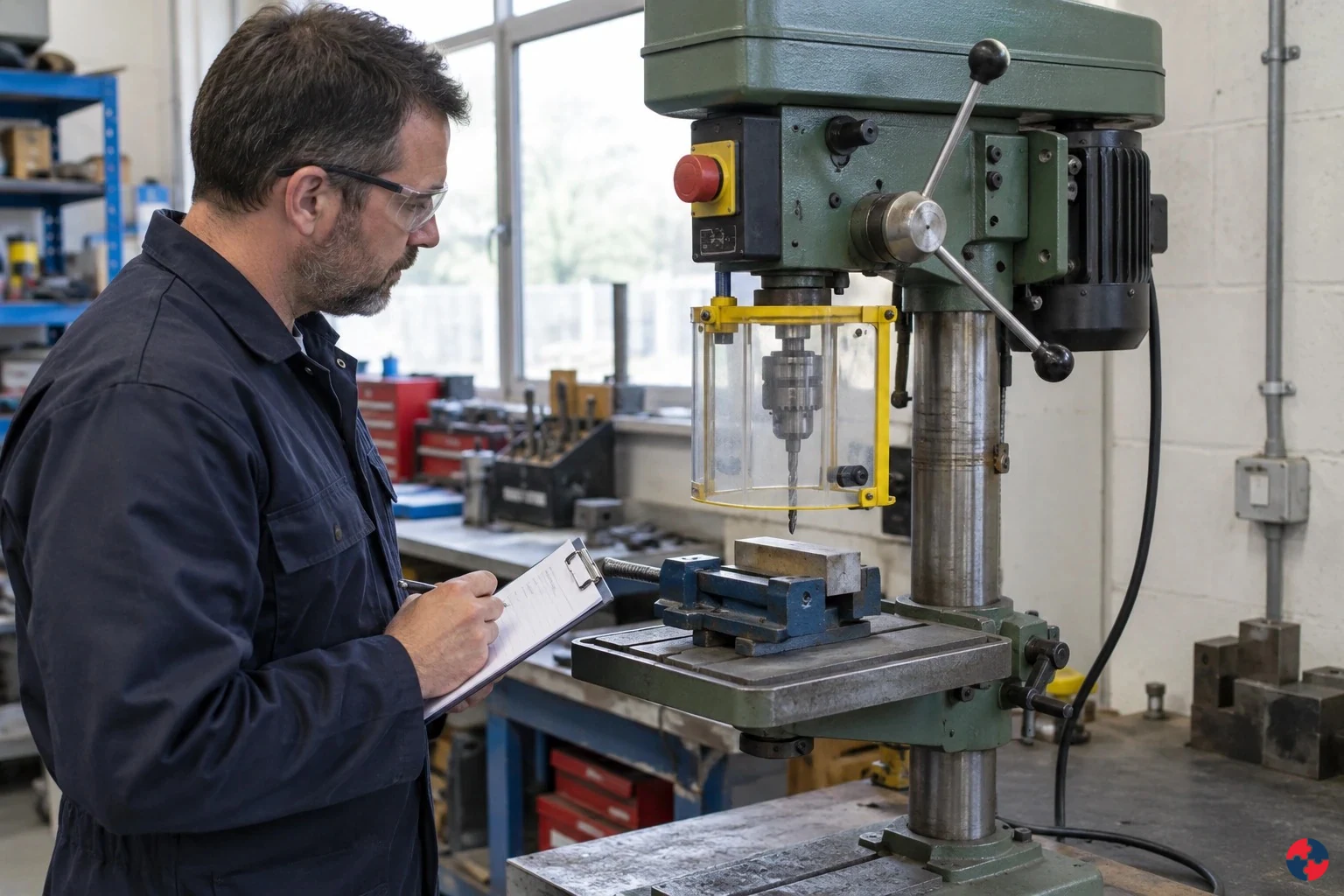
What does PUWER require in practical terms?
PUWER requires work equipment to be suitable, safe, maintained, inspected where needed and used by informed, trained people. PUWER is the Great Britain work-equipment use regime: choose suitable equipment, keep it safe and maintained, inspect it when the regulations require, protect people from dangerous parts and energy, and give users and supervisors suitable information and training.
Turn provision and use of work equipment (puwer) knowledge into a decision
PUWER is the Great Britain work-equipment use regime: choose suitable equipment, keep it safe and maintained, inspect it when the regulations require, protect people from dangerous parts and energy, and give users and supervisors suitable information and training. Northern Ireland has its own 1999 PUWER instrument. Purchase and suitability assessment, task risk assessment, guard and isolation checks, repair and inspection records, training, user feedback, defect closure and handback.
Operational example: decisions and evidence
Repair or redesign the guard and safety function, make isolation available, train and supervise users, then test the method with a real but controlled jam scenario. Competent engineer verifies safeguard function and maintenance repair; manager signs off the task, training and inspection schedule before use.
Where does PUWER commonly fail?
Common failures involve unsuitable equipment, missing guarding, weak isolation, poor maintenance and weak defect control.
Choose controls for provision and use of work equipment (puwer)
Is it suitable?: Task, material, speed, user, environment and compatibility. Can dangerous parts be reached?: Fixed guards, interlocks, distance guards, jigs and safe systems. Can it be stopped safely?: Stop controls, emergency stops and control reliability. Can it be isolated?: All energy sources including stored energy. Could it deteriorate dangerously?: Inspection and maintenance schedule. Read the full control table for qualifications, ownership and verification. Use the actual task and applicable jurisdiction; existing technical approval remains unchanged.
Use the full provision and use of work equipment (puwer) lesson
Use the full topic for the decision points, practical examples, detailed control tables and source scope. HSE guidance applies to Great Britain; use HSENI for the Northern Ireland route and the source’s stated jurisdiction. A simplified guide does not change the page’s technical-review or approval status.

Read all six steps as text
1. What does PUWER require in practical terms?
PUWER requires work equipment to be suitable, safe, maintained, inspected where needed and used by informed, trained people.
- Avoid / redesign: Task, material, speed, user, environment and compatibility.
- Control the task: Stop controls, emergency stops and control reliability.
- Verify before release: Do not use office-grade tool on wet construction site.
PUWER requires work equipment to be suitable, safe, maintained, inspected where needed and used by informed, trained people. PUWER is the Great Britain work-equipment use regime: choose suitable equipment, keep it safe and maintained, inspect it when the regulations require, protect people from dangerous parts and energy, and give users and supervisors suitable information and training.
Apply it: Which part of this plan would you check at the workface before authorising the task?
2. Turn provision and use of work equipment (puwer) knowledge into a decision
Use the evidence to improve the actual work arrangement.
- Change at source: Task, material, speed, user, environment and compatibility.
- Make it observable: Do not use office-grade tool on wet construction site.
- Keep useful evidence: Purchase and suitability assessment, task risk assessment, guard and isolation checks, repair and inspection records, training, user feedback, defect closure and handback.
PUWER is the Great Britain work-equipment use regime: choose suitable equipment, keep it safe and maintained, inspect it when the regulations require, protect people from dangerous parts and energy, and give users and supervisors suitable information and training. Northern Ireland has its own 1999 PUWER instrument. Purchase and suitability assessment, task risk assessment, guard and isolation checks, repair and inspection records, training, user feedback, defect closure and handback.
Apply it: What evidence would show that the change improves this task, rather than only completing a record?
3. Operational example: decisions and evidence
Example: a practical application of the existing topic lesson.
- Setting: A small manufacturer buys a used conveyor-fed trimming machine; frequent jams and awkward guard removal lead to clearing while the conveyor runs.
- Act: Stop exposed operation, preserve the fault and interlock history, assess cleaning and blockage tasks and specify a safe intervention method.
- Hold / review: Do not restart while an unreliable interlock, exposed dangerous part or uncontrolled energy remains; quarantine and label the machine.
Repair or redesign the guard and safety function, make isolation available, train and supervise users, then test the method with a real but controlled jam scenario. Competent engineer verifies safeguard function and maintenance repair; manager signs off the task, training and inspection schedule before use.
Apply it: At which point would you hold this example, and what evidence would allow it to proceed?
4. Where does PUWER commonly fail?
Connect the task, the route to the person and the control that can fail.
- Source / exposure: Common failures involve unsuitable equipment, missing guarding, weak isolation, poor maintenance and weak defect control.
- Possible consequence: PUWER failures often become visible only after an incident, but the signals are usually present earlier: guards removed for cleaning, nuisance trips bypassed, damaged leads, uncontrolled hired equipment, repeated jams, missing manuals, untrained users or maintenance overdue.
- Control failure: The strongest PUWER systems treat defects and modifications as management-of-change issues, not just maintenance tasks.
Common failures involve unsuitable equipment, missing guarding, weak isolation, poor maintenance and weak defect control.
Apply it: Who could be exposed, including other trades, cleaners, maintainers and people nearby?
5. Choose controls for provision and use of work equipment (puwer)
Start with the stronger practicable options and verify their effect.
- Is it suitable?: Task, material, speed, user, environment and compatibility.
- Can dangerous parts be reached?: Fixed guards, interlocks, distance guards, jigs and safe systems.
- Can it be stopped safely?: Stop controls, emergency stops and control reliability.
- Can it be isolated?: All energy sources including stored energy.
- Could it deteriorate dangerously?: Inspection and maintenance schedule.
Is it suitable?: Task, material, speed, user, environment and compatibility. Can dangerous parts be reached?: Fixed guards, interlocks, distance guards, jigs and safe systems. Can it be stopped safely?: Stop controls, emergency stops and control reliability. Can it be isolated?: All energy sources including stored energy. Could it deteriorate dangerously?: Inspection and maintenance schedule. Read the full control table for qualifications, ownership and verification. Use the actual task and applicable jurisdiction; existing technical approval remains unchanged.
Apply it: Which stronger option can be used here, and who will verify it before accepting the remaining risk?
6. Use the full provision and use of work equipment (puwer) lesson
Follow the official sources below and retain the task-specific evidence.
- Official guidance: HSE PUWER overview
- Official guidance: HSE inspection of work equipment
- Task decision: Purchase and suitability assessment, task risk assessment, guard and isolation checks, repair and inspection records, training, user feedback, defect closure and handback.
Use the full topic for the decision points, practical examples, detailed control tables and source scope. HSE guidance applies to Great Britain; use HSENI for the Northern Ireland route and the source’s stated jurisdiction. A simplified guide does not change the page’s technical-review or approval status.
Apply it: Which official source and full-topic section will you use to resolve the next decision?
PUWER applies to an extremely wide range of work equipment: fixed machinery, portable tools, workshop equipment, plant, mobile equipment, cleaning machines, laboratory equipment, powered doors, access equipment, kitchen machinery and equipment provided by workers for work use. The key question is not whether the item looks industrial; it is whether it is equipment used at work.
A good PUWER system manages equipment across its life. It starts before purchase, when the business decides what equipment is suitable. It continues through installation, commissioning, guarding, controls, information, training, maintenance, inspection, defect management, modification and disposal.
| PUWER requirement | What it means | Example |
|---|---|---|
| Suitability | Equipment must fit the task, users and environment. | A wet-area tool needs suitable electrical protection and grip. |
| Safe condition | Equipment must be maintained in efficient working order. | Guarding, brakes, controls and interlocks remain functional. |
| Inspection | Equipment needing inspection is checked after installation or where deterioration creates danger. | Powered-door or ordinary bench-machine inspection, with the applicable specialist regime selected first for lifting, height and press equipment. |
| Information and training | Users and supervisors understand risks, controls and safe use. | Operator training includes limits, defects and stop triggers. |
| Dangerous parts | Access to dangerous moving parts is prevented or controlled. | Fixed guards, interlocks and safe systems for residual risk. |
| Controls and stops | Start, stop and emergency controls are suitable and identifiable. | Emergency stop reachable and tested. |
| Isolation | Equipment can be isolated from energy sources for maintenance. | Electrical, pneumatic, hydraulic, gravity and stored energy isolation. |
Start with an inventory of equipment and the tasks it actually performs, including cleaning, jam clearing, maintenance, hired or worker-provided equipment and foreseeable misuse. Specify suitability for the environment; check installation, stability, guarding, controls and safe isolation. Reg 6 inspection is triggered after installation or reassembly where safety depends on installation, at suitable intervals where deterioration could create danger, and after exceptional circumstances liable to jeopardise safety; it is not a universal annual certificate. Train the right people, record defects, quarantine unsafe equipment and verify repair before handback. Lifting equipment may also need LOLER; product-supply conformity does not replace the user duty.
Source: HSE PUWER overview
Source: HSE inspection of work equipment
Select the inspection regime first. Lifting equipment remains subject to PUWER generally, but specialist lifting, height and press regimes and regulation 6 exceptions must be checked before assigning a generic inspection schedule. A lifting examination is not reduced to an ordinary PUWER checklist or an annual sticker.
How can the hierarchy of controls guide safe equipment selection and risk reduction under PUWER?
Eliminate, Reduce including substitution, Isolate, Control, personal protective equipment (PPE) and Discipline (ERICPD) is a prompt for decisions. HSE’s five-level hierarchy prioritises elimination, substitution, engineering controls, administrative controls and PPE. They are related frameworks, not identical laws; apply them to the actual task and check the resulting control.
Eliminate the dangerous intervention by redesigning the process or buying equipment that does not jam. Verify that cleaning and maintenance can be done without reaching dangerous parts.
Reduce or substitute equipment, material or task design to lower the risk. During purchasing, compare the intended use, environment, user and maintenance access, not only price or conformity marking.
Isolate dangerous motion with suitable fixed or interlocked guarding, safe controls and energy isolation; test the safeguards under real cleaning and jam-clearing conditions. Competent engineering review is needed when modifying safety functions.
Control, PPE and Discipline: inspection, maintenance, training, supervision and PPE support physical protection. They cannot make an exposed moving blade or nip point acceptable when guarding is feasible. ERICPD is a practical prompt; HSE’s five-level hierarchy is related but distinct.
Source: HSE hierarchy of controls
Source: HSE PUWER overview
How can the ERICPD hierarchy of controls guide safe equipment selection and risk reduction under PUWER?

| ERICPD control level | Topic-specific example | Source and full task context |
|---|---|---|
| Eliminate | Avoid the dangerous local task where feasible by redesign or pre-completed work. | Read the full task example, checks and stop points on this page. HSE hierarchy of controls · HSE PUWER overview |
| Reduce | Assess a suitable lower-hazard equipment/process replacement; simple exposure reduction is not substitution. | Read the full task example, checks and stop points on this page. HSE hierarchy of controls · HSE PUWER overview |
| Isolate | Apply the statutory guarding order and effective physical isolation/control of dangerous energy. | Read the full task example, checks and stop points on this page. HSE hierarchy of controls · HSE PUWER overview |
| Control | Plan inspection, maintenance, authorisation, training, supervision and safe handback under the actual regime. | Read the full task example, checks and stop points on this page. HSE hierarchy of controls · HSE PUWER overview |
| PPE | Select relevant residual protective equipment; no wearable item makes an exposed moving nip or blade acceptable. | Read the full task example, checks and stop points on this page. HSE hierarchy of controls · HSE PUWER overview |
| Discipline | Verify condition and competence, stop on unreliable interlocks and revalidate changes before release. | Read the full task example, checks and stop points on this page. HSE hierarchy of controls · HSE PUWER overview |
How can the ISO 45001 hierarchy of controls guide safe equipment selection and risk reduction under PUWER?

| ESEAP control level | Topic-specific example | Source and full task context |
|---|---|---|
| Elimination | Avoid the dangerous local task where feasible by redesign or pre-completed work. | Read the full task example, checks and stop points on this page. HSE hierarchy of controls · HSE PUWER overview |
| Substitution | Assess a suitable lower-hazard equipment/process replacement; simple exposure reduction is not substitution. | Read the full task example, checks and stop points on this page. HSE hierarchy of controls · HSE PUWER overview |
| Engineering controls | Apply the statutory guarding order and effective physical isolation/control of dangerous energy. | Read the full task example, checks and stop points on this page. HSE hierarchy of controls · HSE PUWER overview |
| Administrative controls | Plan inspection, maintenance, authorisation, training, supervision and safe handback under the actual regime. | Read the full task example, checks and stop points on this page. HSE hierarchy of controls · HSE PUWER overview |
| PPE | Select relevant residual protective equipment; no wearable item makes an exposed moving nip or blade acceptable. | Read the full task example, checks and stop points on this page. HSE hierarchy of controls · HSE PUWER overview |
How should PUWER be managed across the equipment lifecycle?
Manage equipment from specification to disposal, with hold points where risk can be introduced.
A lifecycle model prevents PUWER becoming a once-a-year inspection exercise. The practical route is: select -> purchase -> install -> risk assess -> guard -> inspect -> maintain -> modify -> train -> isolate -> defect/quarantine -> review.
Many equipment failures are introduced early. A cheap tool may not be suitable for the environment. A second-hand machine may arrive without adequate guarding. A hired machine may be delivered without instructions. A modification may improve productivity but defeat a safety function.
| Lifecycle stage | PUWER question | Evidence |
|---|---|---|
| Select | What task, material, environment, user group and harm mechanism must the equipment suit? | Needs assessment and equipment specification. |
| Purchase or hire | Does the supplier provide suitable equipment, instructions, conformity evidence and support? | Supplier check, hire acceptance and user manual. |
| Install | Could installation, location, stability, services or access affect safety? | Installation check, commissioning record and layout review. |
| Risk assess | What foreseeable use, cleaning, clearing, maintenance, misuse and environment could create harm? | PUWER assessment linked to work-as-done observation. |
| Guard | Are dangerous parts, ejection, hot surfaces, noise, dust, instability and stored energy controlled? | Guarding/control schedule and safety-function test. |
| Inspect | Does installation or deterioration create a need for formal inspection? | Inspection frequency, competent-person records and action closure. |
| Maintain | What must be maintained to keep the equipment safe and efficient? | Planned maintenance, defect trends and critical spares. |
| Modify | Could a change to speed, tooling, guarding, software, controls or use alter risk? | MOC or modification approval and revalidation. |
| Train | Who is allowed to use, clean, adjust, isolate or maintain it? | Training, authorisation, supervision and competence evidence. |
| Isolate | How are electrical, pneumatic, hydraulic, thermal, gravity and stored energy made safe? | Isolation standard, lock-off kit and prove-zero records. |
| Defect/quarantine | What happens when equipment, guards, controls or cables are damaged? | Quarantine tag, repair record, retest and handback. |
| Review | What do incidents, defects, inspections, worker feedback and change tell us? | Management review and equipment risk-profile update. |
Read the lifecycle as a gated loop: assess/specify before purchase → verify commissioning and competence before release → inspect/maintain → stop and safely quarantine on failure → revalidate change and hand back. These interacting activities are not a rule to assess only after installation or train only after modification; competent isolation and safe testing remain essential.
How does PUWER apply to a real machinery example?
A worked example shows how suitability, guarding, isolation and maintenance interact on one machine.
A small manufacturer buys a used conveyor-fed trimming machine. It arrives with a guard, but the guard is awkward to remove for cleaning. Jams are frequent, so operators start using a long-handled tool to clear blockages while the conveyor runs. Maintenance know the interlock is unreliable, but the machine is needed for a production run.
The PUWER issue is not just a missing inspection. The equipment may be unsuitable for the process, the guarding does not support real cleaning, isolation is not embedded, maintenance defects are not risk-ranked and supervisors have accepted an informal workaround.
| Issue | PUWER weakness | Competent response |
|---|---|---|
| Used machine purchase | Instructions, condition and suitability not checked; supply conformity route depends on whether the machinery-supply rules apply. | Pre-purchase acceptance and competent machinery review. |
| Frequent jams | Equipment/process mismatch creates foreseeable intervention. | Redesign feed, tooling or process to remove jam frequency. |
| Awkward guard | Guarding discourages safe cleaning. | Improve guarding/access without exposing danger. |
| Interlock unreliable | Protective device not maintained. | Stop/quarantine until repaired and tested. |
| Clearing while running | Dangerous parts accessible during intervention. | Isolation and safe blockage-removal procedure. |
| Supervisor acceptance | Unsafe workaround normalised. | Supervisor checks, retraining and engineering action. |
Operational example: decisions and evidence
Task material and setting: A small manufacturer buys a used conveyor-fed trimming machine; frequent jams and awkward guard removal lead to clearing while the conveyor runs.
People and prerequisites: The employer owns suitability and safe use; users describe real jams; a competent engineer assesses guarding, interlock and isolation; maintenance and supervisors implement controls.
Before: Stop exposed operation, preserve the fault and interlock history, assess cleaning and blockage tasks and specify a safe intervention method.
During: Repair or redesign the guard and safety function, make isolation available, train and supervise users, then test the method with a real but controlled jam scenario.
Hold or stop: Do not restart while an unreliable interlock, exposed dangerous part or uncontrolled energy remains; quarantine and label the machine.
Completion and hand back: Competent engineer verifies safeguard function and maintenance repair; manager signs off the task, training and inspection schedule before use.
Evidence: Purchase and suitability assessment, task risk assessment, guard and isolation checks, repair and inspection records, training, user feedback, defect closure and handback.
Source: HSE PUWER overview
Source: HSE inspection of work equipment
How should duty holders decide what PUWER controls are needed?
The decision should consider the equipment, task, environment, user, foreseeable misuse and maintenance needs.
PUWER control selection should not start with a checklist. Start with the harm mechanism: entanglement, crushing, cutting, shearing, drawing-in, ejection, rupture, instability, electricity, temperature, noise, vibration, dust, fumes, stored energy or vehicle movement. Then decide which controls remove or reduce the pathway.
Where equipment is used by contractors, hired in, modified, used outdoors, used by inexperienced people or used in harsh conditions, the control standard normally needs more active verification.
| Risk question | Control focus | Example decision |
|---|---|---|
| Is it suitable? | Task, material, speed, user, environment and compatibility. | Do not use office-grade tool on wet construction site. |
| Can dangerous parts be reached? | Fixed guards, interlocks, distance guards, jigs and safe systems. | Install fixed guard before training is relied on. |
| Can it be stopped safely? | Stop controls, emergency stops and control reliability. | Test emergency stop and reset logic. |
| Can it be isolated? | All energy sources including stored energy. | Lock-off electrical and release pneumatic pressure. |
| Could it deteriorate dangerously? | Inspection and maintenance schedule. | Inspect equipment exposed to vibration, weather or abrasive dust. |
| Who may use it? | Information, instruction, training, authorisation and supervision. | Restrict high-risk machinery to trained appointed users. |
| What if it is defective? | Quarantine, repair, retest and handback. | Tag out, remove key and update defect log. |
GB regulation 11(2) guarding decisions follow practicability: first fixed enclosing guards; where impracticable, other guards/protection devices; then protection appliances such as jigs/holders as appropriate, with necessary information, instruction, training and supervision across the selected arrangements. A convenient jig or training is not automatically equivalent to practicable enclosure. This statutory order is distinct from the general ERICPD/ESEAP mnemonic; use the separate NI instrument for NI work.
Where does PUWER commonly fail?
Common failures involve unsuitable equipment, missing guarding, weak isolation, poor maintenance and weak defect control.
PUWER failures often become visible only after an incident, but the signals are usually present earlier: guards removed for cleaning, nuisance trips bypassed, damaged leads, uncontrolled hired equipment, repeated jams, missing manuals, untrained users or maintenance overdue.
The strongest PUWER systems treat defects and modifications as management-of-change issues, not just maintenance tasks.
| Failure or weak practice | How it develops | What good looks like |
|---|---|---|
| Wrong equipment | Procurement focuses on cost or availability. | Specify task, environment, users and risk controls before purchase. |
| Guard removed | Production, cleaning or access pressure normalises removal. | Design safe access and enforce guard-control standard. |
| Interlock defeated | Nuisance trips or poor design frustrate users. | Investigate cause and repair before use continues. |
| Weak isolation | Maintenance relies on stop button or local custom. | Lock, tag, verify and control stored energy. |
| No inspection logic | All equipment treated the same regardless of risk. | Risk-based inspection schedule and competent checks. |
| Defects not quarantined | Equipment stays in use while repair is planned. | Remove from service until safe. |
| Poor handback | Maintenance finishes but safety functions not proved. | Functional test and user handback record. |
What evidence proves PUWER is being managed?
Evidence should show suitability, safeguards, maintenance, inspection, training, defects and change control.
A PUWER evidence pack should let a manager or auditor pick one item of equipment and trace how it is controlled: why it was selected, who can use it, what hazards it creates, what safeguards it has, how it is maintained, how defects are handled and when it is reviewed.
Evidence should match the risk. A simple office laminator does not need the same records as a power press, but both must be suitable and safe for use.
| Evidence item | What it should show | Assurance question |
|---|---|---|
| Equipment register | Item, location, owner, risk class, inspection need and user group. | Is high-risk equipment visible? |
| Suitability assessment | Task, environment, user and foreseeable misuse considered. | Was equipment selected deliberately? |
| Guarding/control record | Safeguards are identified, maintained and tested. | Can dangerous parts be reached? |
| Maintenance plan | Safety-critical components are maintained. | Are defects and overdue tasks risk-ranked? |
| Inspection records | Competent checks after installation or deterioration risk. | Is inspection frequency justified? |
| Training/authorisation | Users and supervisors know risks and controls. | Is training task-specific? |
| Defect quarantine | Unsafe equipment is removed, tagged, repaired and retested. | Can defective equipment creep back into use? |
| Modification review | Changes to speed, guarding, controls or use are assessed. | Has MOC captured PUWER impact? |
Keep required inspection results until the next inspection under the applicable regime. Equipment leaving the undertaking, or received from another, needs the required physical evidence of the last inspection where the duty applies. For hired equipment, identify the correct regime, current record and condition; do not infer suitability from a sticker alone.
How should PUWER be assured?
Assurance should sample real equipment and real work, not just registers.
PUWER assurance works best as a layered system. Frontline checks identify obvious defects. Supervisors verify safe use and stop unsafe work. Managers review maintenance and inspection backlog. Specialist audits test guarding, control systems, isolation and compliance for higher-risk equipment.
A good audit watches the equipment being used, asks users how they clear jams or report defects, and checks whether the records match the condition of the machine.
| Assurance level | What to check | Output |
|---|---|---|
| User pre-use check | Damage, guards, controls, leads, leaks, unusual noise and defects. | Daily/pre-use check or defect report. |
| Supervisor verification | Safe method, authorised users, guarding in place and no bypasses. | Supervisor check and action. |
| Maintenance review | Overdue work, recurring defects and safety-critical spares. | Maintenance dashboard. |
| Inspection sampling | Risk-based inspections completed and actions closed. | Inspection assurance report. |
| Specialist machinery audit | Guarding, interlocks, control reliability, isolation and MOC. | Technical audit and improvement plan. |
| Management review | Top equipment risks, incidents, defects and assurance confidence. | Management review action. |
Which UK legal duties and official guidance are relevant?
PUWER duties apply broadly to equipment used at work and should be read alongside more specific equipment, electrical, lifting, pressure, construction and product-supply duties.
| Duty or guidance | What it means | How to apply it |
|---|---|---|
| Provision and Use of Work Equipment Regulations 1998 | GB duties for equipment suitability, maintenance, inspection where triggered, information, training, guarding, controls and safe use. | Map the actual work, including cleaning and maintenance; inspection is condition-triggered, not a universal annual certificate. |
| Health and Safety at Work etc. Act 1974 | GB general employer duty to provide safe plant and systems of work. | Keep operational ownership of the equipment and corrective action. |
| Management of Health and Safety at Work Regulations 1999 | GB risk assessment and preventive arrangements apply to equipment tasks and change. | Assess foreseeable intervention, users and environmental conditions. |
| Electricity at Work Regulations 1989 | GB electrical danger duties apply to electrical work equipment and isolation. | Control shock, unexpected energisation and competent electrical work. |
| Supply of Machinery (Safety) Regulations 2008 | UK machinery-supply conformity instrument, with provisions and marking that apply differently in Northern Ireland and Great Britain; distinct from PUWER use duties. | Check the relevant GB or NI market route, then assess suitability and safe use under the applicable PUWER regime. |
| Provision and Use of Work Equipment Regulations (Northern Ireland) 1999 | Separate NI work-equipment regime covering suitability, maintenance, inspection where needed, information and safeguards. | Use NI instrument and HSENI guidance for an NI site; verify actual use and condition. |
The GB PUWER 1998 instrument and NI PUWER 1999 instrument are separate routes. HSE and HSENI guides explain application but are not themselves statutes. More specific duties can apply alongside PUWER, including LOLER for lifting operations and electrical rules for electrical danger. Product-supply conformity does not remove the duty to select, maintain and use equipment safely.
Source: HSE inspection of work equipment
The 2008 supply instrument applies UK-wide, but Northern Ireland has different provisions and marking under the Windsor Framework. It remains distinct from the NI 1999 PUWER user duties. Source: GOV.UK machinery supply rules for Northern Ireland
How should the control be managed and reviewed?
For a GB workplace, HSE guidance supports identifying the actual risk, taking practical protective steps and reviewing whether they work. Name the decision owner, check the control during the real task and correct a failed arrangement. Apply the separate Northern Ireland duties and guidance where the work is in NI.
GB management guidance: HSE managing health and safety
What training and competence are needed?
Training should cover equipment hazards, safe use, defects, isolation, guarding, emergency stops, supervision and task-specific competence.
Training should be role-based. General awareness creates a baseline, but supervisors, managers, advisers and senior leaders need different levels of decision-making, verification and escalation competence.
| Role | What to demonstrate | Who checks | Record and reassessment |
|---|---|---|---|
| Operators | Identify dangerous parts, use the safe method, report defects and stop unsafe use. | Competent supervisor observes the actual task. | Task sign-off and refresher after change. |
| Supervisors | Verify guard use, isolation, competence and defect quarantine. | Competent manager samples real work. | Shift checks and closure log. |
| Maintainers and inspectors | Apply role-specific technical competence, energy isolation and inspection criteria. | Qualified engineer or independent competent person verifies. | Maintenance, inspection and safeguard test records. |
| Purchasers and leaders | Specify suitability, resource safety-critical repair and review recurrent failures. | Independent technical adviser reviews high-risk purchases. | Specification, acceptance and assurance trace. |
Source context: HSE PUWER overview
How could BuildOut Ltd manage this in practice?

BuildOut Ltd would apply work-equipment controls to hired and owned equipment alike, checking suitability, installation, safeguarding, instructions and the people using it.
BuildOut Ltd · practical example
Accept hired equipment before putting it into service
The key lesson Hire transfers possession of equipment, not all responsibility for its safe selection and use.
The situation: A hired bench saw arrives for a fit-out. It has supplier paperwork, but the proposed position restricts handling space and a protective component is missing. BuildOut remains responsible for the equipment its workers use.
Why this matters: A safe machine can become unsuitable through poor installation, missing safeguards or a task beyond its intended capability.
How BuildOut Ltd would manage it
- Define the intended use — Project Manager. Tell the supplier the material, workload, environment and available space. Identify foreseeable setting, cleaning and maintenance activities as well as normal production.
- Check the delivered item — Plant and Procurement Coordinator. Match the actual machine and accessories to the order and instructions. Confirm the condition, required inspection evidence and protective arrangements before accepting it for the task.
- Prepare a suitable location — Site Manager. Arrange handling space, stable installation, supply and access controls. Coordinate dust and noise measures and keep other trades away from the working and material-handling areas.
- Allocate competent users — Trade Supervisor. Provide the necessary information, instruction, training and supervision. Explain safe intervention boundaries and defect reporting; a general site induction does not establish machine-specific ability.
- Maintain the acceptance decision — Site Manager. Keep defective equipment unavailable and arrange competent correction. Reassess after relocation, damage or changed use, and communicate any restriction to every shift and contractor sharing the equipment.
When the conditions change
- Recognise the trigger
- Equipment is damaged, incomplete or unsuitable for its installation or task.
- Make the immediate decision
- Do not accept the saw for use while a safeguard is missing or its installation restricts safe operation.
- Verify the next step
- The Site Manager confirms suitable handling space and installation; competent equipment checks address the missing protection, and the Trade Supervisor confirms authorised users understand the machine.
What good looks like
The acceptance check concerns the machine actually delivered and the use actually planned. Users have functioning safeguards, appropriate space and a clear route to stop and report problems.
Evidence to look for: Equipment specification, delivery acceptance, instructions, installation or inspection checks, competence evidence and defect log.
Common mistake to avoid: Assuming the supplier's documentation replaces the user's work-equipment duties.
Apply this to your work: What would you check besides the hire company's label before first use?
Guidance behind the management approach: HSE: PUWER overview. Use the topic's legal and technical guidance for the applicable work and location.
A construction and maintenance contractor uses abrasive wheels, MEWPs, compact plant, drills, breakers, generators, saws, temporary electrical equipment and hired tools. BuildOut would apply PUWER differently by risk, but every item would have suitability and defect control.
| Management element | How the business would manage it | Evidence to review |
|---|---|---|
| Register | Classify equipment by risk and inspection need. | Equipment register. |
| Assess | Review suitability, guarding, controls and isolation. | PUWER assessment. |
| Train | Authorise users and supervisors for specific equipment. | Competence record. |
| Maintain | Risk-rank maintenance and defects. | Maintenance dashboard. |
| Assure | Sample work as done and equipment condition. | PUWER audit. |
Source context: HSE PUWER overview
What do the acronyms and key terms mean?
Acronyms should be understood before they are used in assessments, briefings, audits or learning answers.
Acronyms can exclude newer readers if they are not explained. This section keeps the main terms available at the end of the page so the article stays readable while still supporting learners and audit users.
| Acronym | Meaning | Plain-English use |
|---|---|---|
| COSHH | Control of Substances Hazardous to Health | UK regulations for hazardous substances, including many biological agents and workplace contaminants. |
| HSE | Health and Safety Executive | Great Britain regulator and official guidance source. |
| HSWA | Health and Safety at Work etc. Act 1974 | Core UK health and safety statute for Great Britain. |
| ISO | International Organization for Standardization | Standards body relevant to management systems. |
| MOC | Management of Change | Controlled review before significant organisational, technical or work changes. |
| OH | Occupational Health | Qualified work-health advice and confidential health support. |
| LOLER | Lifting Operations and Lifting Equipment Regulations | Applies to lifting equipment and lifting operations alongside PUWER. |
| MHSWR | Management of Health and Safety at Work Regulations | Risk assessment and preventive arrangements regulations. |
| PUWER | Provision and Use of Work Equipment Regulations | Main UK work equipment safety regulations. |
Which BuildOut documents support this topic?
Download individual editable BuildOut documents for this topic. Procedures and plans contain completed arrangements; forms, checklists, assessments, RAMS and permits are blank masters. Registers include separate worked examples.
| Document | Purpose and content | Editable download |
|---|---|---|
| Contractor selection, onboarding and coordination procedure BOUK-PRO-SUB · Completed worked example · v1.0 | Evaluate capability, agree responsibilities and RAMS, monitor performance and change subcontractors safely. | Download DOCX Read preview |
| Contractor prequalification and capability review BOUK-CHK-SUB-01 · Blank editable master · v1.0 | Assess competence, resources, previous performance and scope-specific controls. | Download DOCX Read preview |
| Subcontractor scope and safety-interface agreement BOUK-FRM-SUB-01 · Blank editable master · v1.0 | Define supplied information, shared facilities, supervision and emergency responsibilities. | Download DOCX Read preview |
| Supplier and hired-equipment acceptance checklist BOUK-CHK-SUB-02 · Blank editable master · v1.0 | Verify specifications, operating instructions, inspection evidence and support. | Download DOCX Read preview |
| Contractor performance and escalation review BOUK-FRM-SUB-02 · Blank editable master · v1.0 | Record performance, recurring concerns and corrective actions. | Download DOCX Read preview |
| Material/product substitution safety review BOUK-CHK-SUB-03 · Blank editable master · v1.0 | Check changed hazards, installation method and compatibility before substitution. | Download DOCX Read preview |
| Plant acceptance, use, maintenance and isolation procedure BOUK-PRO-PLANT · Completed worked example · v1.0 | Check equipment before use, maintain protective devices and quarantine unsafe plant. | Download DOCX Read preview |
| Plant, tools and maintenance register BOUK-REG-PLANT-01 · Blank register with separate worked entries · v1.0 | Track asset ownership, suitability, inspections, servicing and defects. | Download XLSX Read preview |
| Plant and powered-tool pre-use inspection BOUK-CHK-PLANT-01 · Blank editable master · v1.0 | Identify damage, failed guards, interlocks, leaks and unsafe attachments. | Download DOCX Read preview |
| Machine guarding and entanglement assessment BOUK-RA-PLANT-01 · Blank editable master · v1.0 | Assess access to moving parts and select protective measures. | Download DOCX Read preview |
| Plant maintenance and stored-energy isolation RAMS BOUK-RAMS-PLANT-01 · Blank editable master · v1.0 | Control electrical, hydraulic, pneumatic, gravity and thermal energy. | Download DOCX Read preview |
| Defect, quarantine and return-to-service record BOUK-FRM-PLANT-01 · Blank editable master · v1.0 | Prevent unsafe reuse until competent repair and verification. | Download DOCX Read preview |
| Carpentry, joinery and timber-frame installation RAMS BOUK-RAMS-PLANT-02 · Blank editable master · v1.0 | Guarded cutting, wood dust, nail guns, handling, support and access. | Download DOCX Read preview |
| Pressure testing and commissioning RAMS BOUK-RAMS-PLANT-03 · Blank editable master · v1.0 | Stored energy, safe test boundaries, rated components and controlled depressurisation. | Download DOCX Read preview |
Review and adapt the documents for your organisation, activities and jurisdiction before approval and issue. Open the SHAREms management-system hierarchy to find each document under its parent policy.
Unlock another resource
You have used this month’s two free downloads. Publish a post in your own words to unlock one more resource, or choose SHARE Individual for 10 downloads per month.
You decide whether to share. If you do, use the relevant platform disclosure tools and do not make claims you do not genuinely hold.