
SHARE Knowledge Hub
Traffic Management
Traffic management keeps people and vehicles apart and controls the movements that remain. At a workplace, map real routes, remove unnecessary journeys and reversing, provide suitable separation, check the vehicle and driver, brief visitors and stop when a route or safeguard fails. Construction layouts need review as work changes. A scheme affecting a public road or footway is a different task: a competent designer and the relevant GB highway or NI roads authority must confirm the applicable approvals, signs, access and hand-back. No generic drawing, speed limit or marshal makes a site safe.
Understanding Traffic Management
Traffic management keeps people and vehicles apart and controls the movements that remain. At a workplace, map real routes, remove unnecessary journeys and reversing, provide suitable separation, check the vehicle and driver, brief visitors and stop when a route or safeguard fails. Construction layouts need review as work changes. A scheme affecting a public road or footway is a different task: a competent designer and the relevant GB highway or NI roads authority must confirm the applicable approvals, signs, access and hand-back. No generic drawing, speed limit or marshal makes a site safe.
Why this matters at work
Provide safe access to welfare and necessary work points. Drivers should not have to cross an uncontrolled yard, climb over loads or enter a warehouse route to find an office. If the driver remains in the cab or a waiting room, assess whether that is the safest arrangement for the task and emergency conditions; avoid a rigid rule that conflicts with the loading method.
Analyse each reversing task, including approach, blind zones, trailer swing, fixed hazards, gradients, ground and pedestrian access. Provide stop lines, dock protection or physical limits that do not create another hazard. A reversing alarm or camera supports the driver but does not clear the path. Pedestrians should not pass behind a vehicle because they believe an alarm makes them visible.
How organisations manage this in practice
Assess whether people can enter the vehicle path and what prevents contact. Use physical separation where needed and design safe crossings, sight lines and access points. Markings and high visibility clothing do not by themselves prevent a vehicle entering pedestrian space.
Protect doors and gates that open toward a route and provide sight lines before a person steps into vehicle space. Prevent parked vehicles, stock or waste from blocking the walkway. At loading and service areas, create a safe waiting location for drivers and prevent people unrelated to the task entering the operating zone.
The host and haulier should cooperate before the visit. Agree who loads or unloads, what equipment is used, how the vehicle is immobilised, where the driver waits, how restraints are removed and who releases departure. Confirm that the vehicle and ground are compatible. A driver's presence does not transfer the host's duty to provide a safe workplace.
What does traffic management mean in a workplace?
At a workplace, traffic management plans safe movement of people, visiting and site vehicles, mobile plant and loads. Public-road works need a separate competent scheme and authority route.
Best-practice guide: Traffic Management
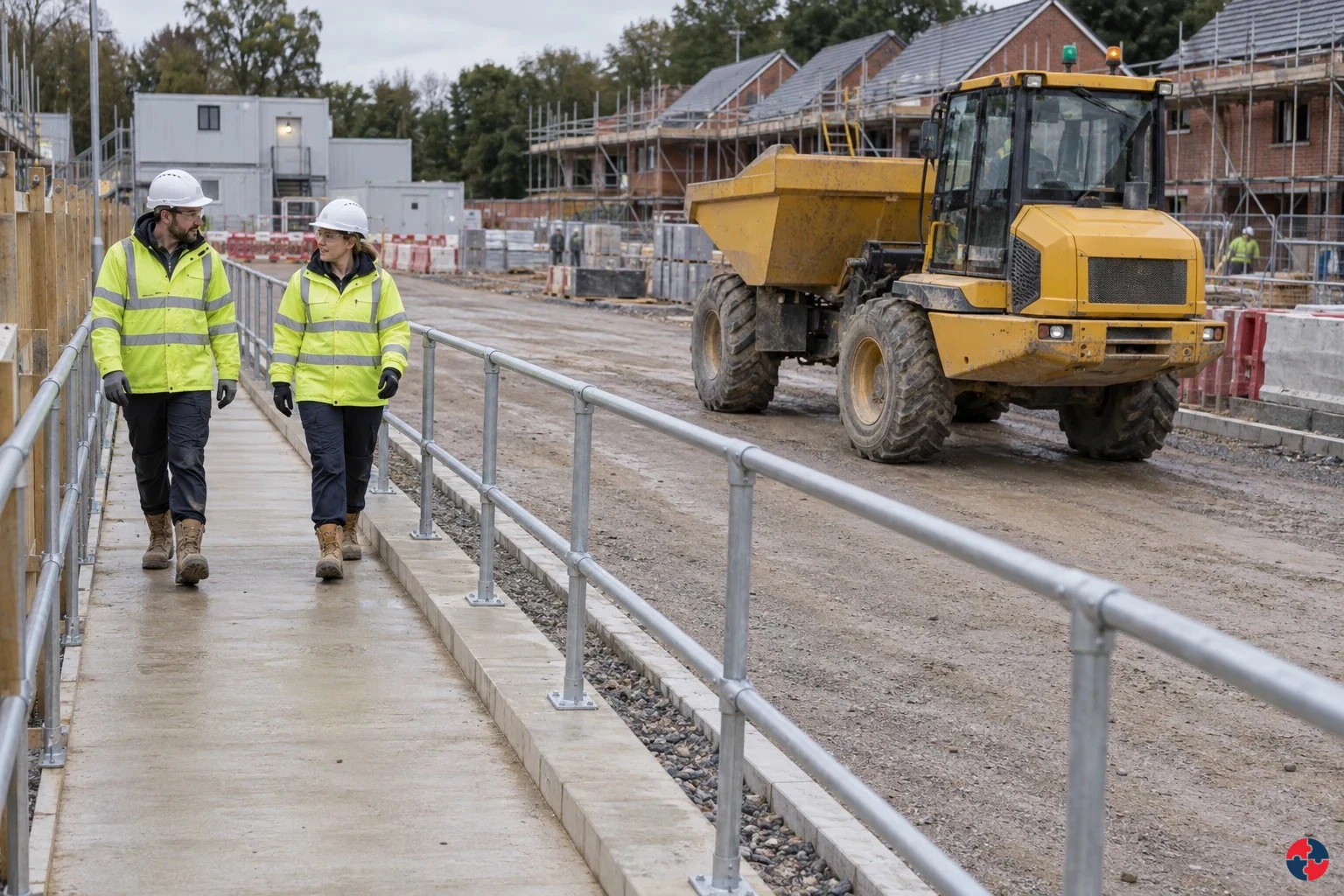
What does traffic management mean in a workplace?
At a workplace, traffic management plans safe movement of people, visiting and site vehicles, mobile plant and loads. Public-road works need a separate competent scheme and authority route. Traffic management keeps people and vehicles apart and controls the movements that remain.
Turn traffic management knowledge into a decision
Traffic management keeps people and vehicles apart and controls the movements that remain. At a workplace, map real routes, remove unnecessary journeys and reversing, provide suitable separation, check the vehicle and driver, brief visitors and stop when a route or safeguard fails. Check support and traction; hold until the route is suitable.
Normal delivery versus a changed route conflict
Rain and soft ground: verify support and traction. A moved barrier or blocked route requires a suitable protected route or redesigned delivery. Hold an unbriefed driver at a safe waiting point and brief the agreed stop point.
Where does traffic management fail?
Keep warning signs distinct from the resulting harm. A public-road scheme also needs its own current controls and authority arrangements.
Choose controls for traffic management
Elimination: Move the loading point or redesign circulation so vehicles enter and leave forwards without crossing a pedestrian route. Substitution: Use smaller vehicles, off-site consolidation or a timed remote drop where the load, road access and handling assessment permit it. Engineering controls: Install physical pedestrian barriers, protected crossings, suitable gates, lighting and a marked reversing bay with adequate clearance and ground capacity. Administrative controls: Book arrivals, brief drivers at entry, prohibit unscheduled reversing, use an agreed signaller only where needed and keep visitors out of manoeuvring zones. PPE: Provide high-visibility clothing suited to light and weather for authorised people who must enter the traffic area, while checking it does not snag or obscure other protection. Read the full control table for qualifications, ownership and verification. Use the actual task and applicable jurisdiction; existing technical approval remains unchanged.
Use the full traffic management lesson
Use the full topic for the decision points, practical examples, detailed control tables and source scope. HSE guidance applies to Great Britain; use HSENI for the Northern Ireland route and the source’s stated jurisdiction. A simplified guide does not change the page’s technical-review or approval status.

Read all six steps as text
1. What does traffic management mean in a workplace?
At a workplace, traffic management plans safe movement of people, visiting and site vehicles, mobile plant and loads.
- Avoid / redesign: Move the loading point or redesign circulation so vehicles enter and leave forwards without crossing a pedestrian route.
- Control the task: Install physical pedestrian barriers, protected crossings, suitable gates, lighting and a marked reversing bay with adequate clearance and ground capacity.
- Verify before release: Verify ground/support, sightlines, protected crossing, barriers, driver waiting point and the briefed route before movement.
At a workplace, traffic management plans safe movement of people, visiting and site vehicles, mobile plant and loads. Public-road works need a separate competent scheme and authority route. Traffic management keeps people and vehicles apart and controls the movements that remain.
Apply it: Which part of this plan would you check at the workface before authorising the task?
2. Turn traffic management knowledge into a decision
Use the evidence to improve the actual work arrangement.
- Change at source: Move the loading point or redesign circulation so vehicles enter and leave forwards without crossing a pedestrian route.
- Make it observable: Verify ground/support, sightlines, protected crossing, barriers, driver waiting point and the briefed route before movement.
- Keep useful evidence: Check support and traction; hold until the route is suitable.
Traffic management keeps people and vehicles apart and controls the movements that remain. At a workplace, map real routes, remove unnecessary journeys and reversing, provide suitable separation, check the vehicle and driver, brief visitors and stop when a route or safeguard fails. Check support and traction; hold until the route is suitable.
Apply it: What evidence would show that the change improves this task, rather than only completing a record?
3. Normal delivery versus a changed route conflict
The layout illustrates a hold/replan decision, not a dimensioned traffic design.
- Rain and soft ground: Check support and traction; hold until the route is suitable.
- Barrier moved for pallets: Restore a suitable protected route or redesign delivery.
- Unbriefed HGV driver: Hold at a safe waiting point and brief the route and stop point.
Rain and soft ground: verify support and traction. A moved barrier or blocked route requires a suitable protected route or redesigned delivery. Hold an unbriefed driver at a safe waiting point and brief the agreed stop point.
Apply it: At which point would you hold this example, and what evidence would allow it to proceed?
4. Where does traffic management fail?
Connect the task, the route to the person and the control that can fail.
- Failed separation: A blocked or displaced barrier puts people into the vehicle or load path.
- Possible consequence: Collision, crushing, trapping or injury from a moving load can follow.
- Warning signs and action: Damaged barriers, poor sightlines, soft ground, unbriefed deliveries or an unprotected shortcut require affected movements to be held and reviewed.
Keep warning signs distinct from the resulting harm. A public-road scheme also needs its own current controls and authority arrangements.
Apply it: What live change requires movement to stop, and what evidence would support a safe revised arrangement?
5. Choose controls for traffic management
Start with the stronger practicable options and verify their effect.
- Elimination: Move the loading point or redesign circulation so vehicles enter and leave forwards without crossing a pedestrian route.
- Substitution: Use smaller vehicles, off-site consolidation or a timed remote drop where the load, road access and handling assessment permit it.
- Engineering controls: Install physical pedestrian barriers, protected crossings, suitable gates, lighting and a marked reversing bay with adequate clearance and ground capacity.
- Administrative controls: Book arrivals, brief drivers at entry, prohibit unscheduled reversing, use an agreed signaller only where needed and keep visitors out of manoeuvring zones.
- PPE: Provide high-visibility clothing suited to light and weather for authorised people who must enter the traffic area, while checking it does not snag or obscure other protection.
Elimination: Move the loading point or redesign circulation so vehicles enter and leave forwards without crossing a pedestrian route. Substitution: Use smaller vehicles, off-site consolidation or a timed remote drop where the load, road access and handling assessment permit it. Engineering controls: Install physical pedestrian barriers, protected crossings, suitable gates, lighting and a marked reversing bay with adequate clearance and ground capacity. Administrative controls: Book arrivals, brief drivers at entry, prohibit unscheduled reversing, use an agreed signaller only where needed and keep visitors out of manoeuvring zones. PPE: Provide high-visibility clothing suited to light and weather for authorised people who must enter the traffic area, while checking it does not snag or obscure other protection. Read the full control table for qualifications, ownership and verification. Use the actual task and applicable jurisdiction; existing technical approval remains unchanged.
Apply it: Which stronger option can be used here, and who will verify it before accepting the remaining risk?
6. Use the full traffic management lesson
Follow the official sources below and retain the task-specific evidence.
- Official guidance: HSE HSG136 workplace transport safety
- Official guidance: HSE INDG199 workplace transport brief guide
- Task decision: Check support and traction; hold until the route is suitable.
Use the full topic for the decision points, practical examples, detailed control tables and source scope. HSE guidance applies to Great Britain; use HSENI for the Northern Ireland route and the source’s stated jurisdiction. A simplified guide does not change the page’s technical-review or approval status.
Apply it: Which official source and full-topic section will you use to resolve the next decision?
- Map every movement
Trace people, vehicles, reversing and changing delivery peaks.
- Design separation
Remove crossings where possible and protect those that remain.
- Check before release
Verify the live route, gates, sightlines and emergency access.
- Stop and replan
Hold movement when a barrier, route or driver briefing fails.
This is a reading route through the detailed decisions below, not a clearance to perform the task. Follow the linked sections, their official sources and the applicable local assessment.
HSG136 uses safe site, safe vehicle and safe driver. Begin with real journeys and interfaces: gates, parking, loading bays, crossings, doors, blind corners, reversing, slopes, overhead hazards and emergency access. Workers, visitors and the public may all be exposed.
Eliminate unnecessary movements and reversing where practicable, then separate pedestrians by route and time, with barriers where risk warrants. Marked lines, warning devices, high-visibility clothing and a marshal support but do not replace a suitable layout. A private yard plan cannot authorise a road closure, traffic signal or footway diversion.
Review the plan when construction phase, storage, weather, vehicle size, contractor activity or public access changes. A temporary change needs the same attention as a permanent one. Do not borrow a standard drawing without checking its scope, geometry, users and approvals.
| Principle | What good looks like | Common weak practice |
|---|---|---|
| Workplace site | Map actual pedestrians and vehicles, including visiting drivers and emergency access. | A site sketch alone is not a checked route. |
| Safe vehicle | Choose and maintain a vehicle suited to surface, load and visibility. | Cameras and alarms do not eliminate blind spots. |
| Safe driver and operator | Check task competence, site rules and clear communication. | A licence alone does not teach this site. |
| Construction site | Reassess phase changes, plant interfaces and public boundary. | A fixed plan can become wrong mid-project. |
| Public road or footway | Use a competent scheme, authority permissions and the relevant GB or NI code. | A workplace plan is not highway approval. |
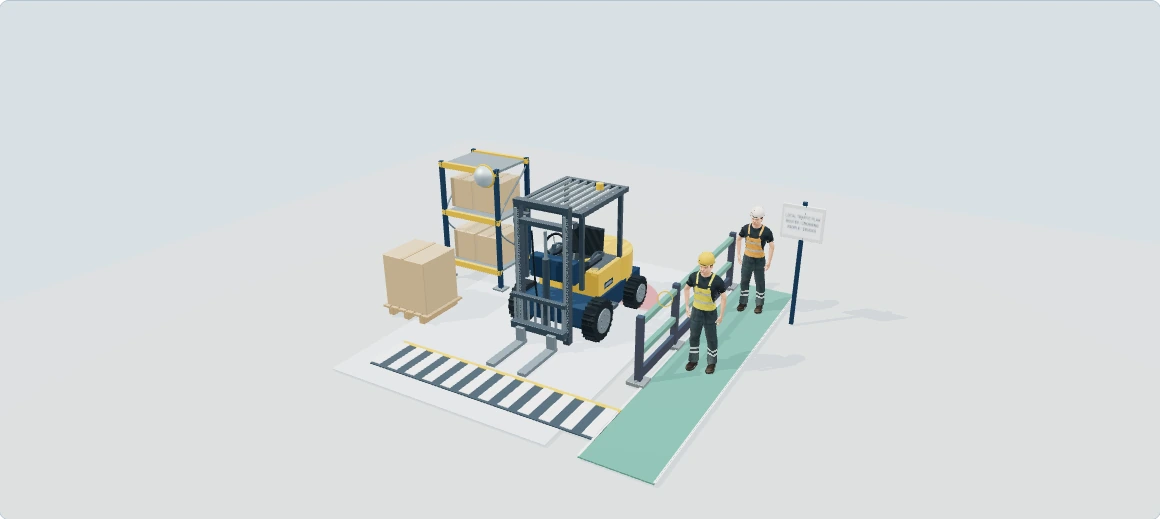

Workplace transport: see the person in the vehicle’s path
Inspect the forklift, stock, visibility, crossing and pedestrian route. Follow the different risks faced by drivers, people on foot, delivery workers and those maintaining the vehicle.
Checksheets and risk assessments
Equipment checksheets
- Larger trucks and HGVs: daily walkaround check — 3D checks · Word · PDF
- Dumpers — 3D checks · Word · PDF
- Vans: daily vehicle check — 3D checks · Word · PDF
- Pickup trucks: daily vehicle check — 3D checks · Word · PDF
Risk assessment forms
Risk assessment examples
Forms and tools
Full written walkthrough — all 8 steps
1. Separate people and vehicles
What is happening: The walkway, physical barrier and vehicle area let you compare separation with a line painted on the ground.
How harm can occur: A moving vehicle can strike, crush or run over a pedestrian; paint alone cannot physically prevent contact.
Best practice to apply: Plan safe routes and suitable separation wherever possible. Include visitors, cleaners and delivery workers in the arrangements.
2. Examine the crossing
What is happening: Inspect where a person would leave the protected route and meet the vehicle route. The stripes do not demonstrate a safe crossing.
How harm can occur: A pedestrian may enter a conflict area before the driver or pedestrian can see and respond to the other.
Best practice to apply: Assess actual sightlines, approaches, controls and behaviour. Keep the crossing clear and communicate the site arrangements.
3. Look for hidden people
What is happening: Stock and racking can obstruct a view. Look from both the driver’s and pedestrian’s positions to understand where someone could remain unseen.
How harm can occur: A person obscured by stock or a vehicle can be struck when either moves into the shared space.
Best practice to apply: Review real sightlines from the driver and pedestrian positions. The coloured overlay is a teaching cue, not a verified blind-spot measurement.
4. Consider steering and the rear area
What is happening: The stationary truck lets you inspect the counterweight, wheels and space behind it. The rear area matters during manoeuvring.
How harm can occur: Turning or reversing can sweep part of the vehicle into a person or trap them against a fixed object.
Best practice to apply: Reduce conflicting movements through suitable layout and operating controls. Do not infer a turning radius, swept path or stopping distance from this model.
5. Inspect load stability and visibility
What is happening: Forks, the load position and the surrounding stock connect handling decisions to the people around the truck.
How harm can occur: Falling goods, impaired visibility or overturning can strike or crush the operator and nearby people.
Best practice to apply: Use the real truck and attachment information, rated capacities and task assessment. Keep people out of the danger area.
6. Check the truck and driving position
What is happening: Inspect the seat, controls, overhead structure and restraints as relevant to the actual equipment.
How harm can occur: Unsuitable equipment, defects or an unprepared operator can allow loss of control or worsen the consequences of an incident.
Best practice to apply: Use suitable equipment, authorised trained operators and actual pre-use checks. A visual model cannot prove a truck fit for use.
7. Plan maintenance and defect action
What is happening: Maintenance needs access around the vehicle and control of energy and supported components. A parked truck is not automatically safe to work on.
How harm can occur: Unexpected movement, descent or stored-energy release can trap or crush a fitter or operator.
Best practice to apply: Follow the actual safe maintenance procedure, isolation and support requirements. Report defects and prevent unsafe use.
8. Keep the whole site organised
What is happening: The route and planning station connect the driver’s actions with the site manager’s layout, information and supervision.
How harm can occur: Conflicting deliveries, blocked routes and people unfamiliar with the site can create new collision risks.
Best practice to apply: Coordinate deliveries, visitors and work changes. Review the actual site arrangements and effectiveness with the people using them.
Illustrative awareness learning. The model does not design equipment, authorise work, verify safe conditions or complete a real inspection.
The wider workplace has its own account and subscription access. Exploring this lesson does not grant access, record course completion or authorise work.
UK guidance for further reading
HSE: separating pedestrians and vehiclesHSE: workplace transport safety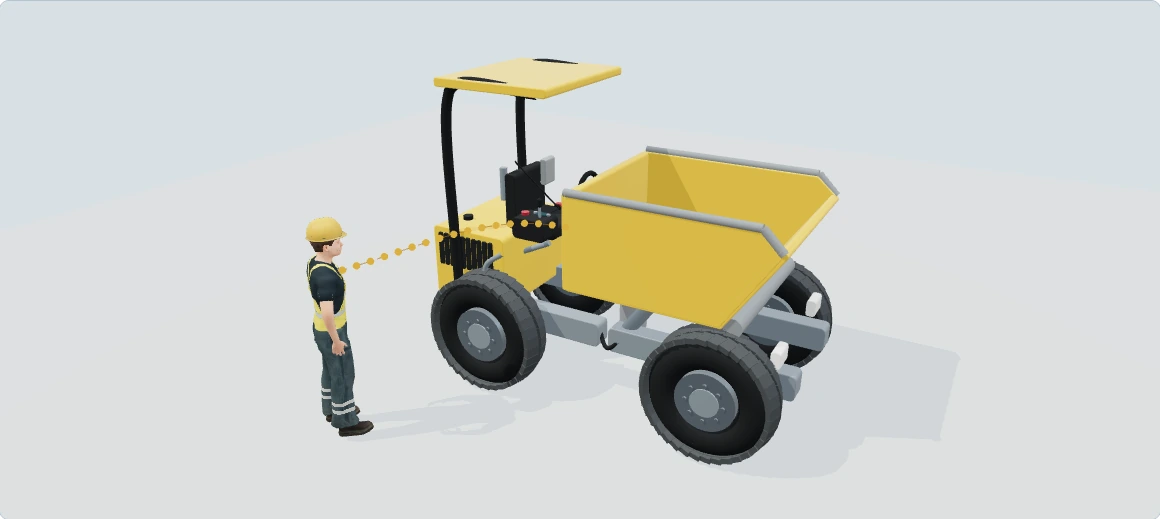
Site dumpers: stability, tipping edges and people on foot
Explore how this equipment can harm its users and other people, then follow the practical measures that interrupt each pathway. This is a hazards and good-practice lesson; the separate checklist remains the pre-use/safety-check activity.
Hazards and good practice: learn what can hurt people during use, change and maintenance. Pre-use and safety checks stay in the separate checklist.
Checksheets and risk assessments
Equipment checksheets
Risk assessment forms
- Vehicle-pedestrian and public-interface assessment · Word
- Whole-body vibration and plant-route assessment · Word
Risk assessment examples
Full written walkthrough — all 8 steps
1. Choose the complete transport method
What is happening: A dumper links loading, travel and discharge, each with a different exposure.
How harm can occur: A method unsuitable for the load, route or discharge can create collision and overturn risk.
Best practice to apply: Consider eliminating vehicle movements and select the actual dumper and method for all parts of the task.
Why this works: Solving only the travel stage can leave an unsafe loading or tipping interface.
Mobile plant and vehicles · What makes mobile work equipment hazardous?2. Prevent contact with people
What is happening: The skip and surrounding structures can restrict the view of people on foot.
How harm can occur: A pedestrian can be struck, run over or crushed against another object.
Best practice to apply: Separate routes and control loading, crossings and reversing; keep people away from vehicle danger areas.
Why this works: A clear route prevents a conflict that a horn or mirror may not resolve.
Mobile plant and vehicles · Control the route and the stored raised load separately3. Understand load and stability
What is happening: Load position changes the machine's behaviour and the operator's view.
How harm can occur: An uneven or unsuitable load, turn or slope can contribute to overturn or loss of control.
Best practice to apply: Use the actual load, travel and gradient limits and keep the planned travel configuration.
Why this works: Limits depend on the machine and conditions, not a generic animation or a short journey.
Mobile plant and vehicles · Control the route and the stored raised load separately4. Keep the operator within the intended protection
What is happening: The seat, restraint and protective structure form a combined protective arrangement.
How harm can occur: An unrestrained operator can be thrown from the protected area and crushed during overturn.
Best practice to apply: Use the actual required restraint and protective structure and prevent unsuitable passenger carrying.
Why this works: The structure cannot protect the person as intended if they are displaced outside its protective space.
Mobile plant and vehicles · How should a changing construction site manage a dumper?5. Plan the loading interface
What is happening: Excavators, loaders and the dumper may interact during loading.
How harm can occur: Falling material or plant movement can strike an exposed driver or other worker.
Best practice to apply: Provide the actual protected working/waiting arrangements and coordinate the loading activity.
Why this works: A designated safe place and controlled interface address falling material as well as moving vehicles.
Mobile plant and vehicles · How should a changing construction site manage a dumper?6. Treat tipping support as an engineering question
What is happening: The wheel load acts on the ground near an edge or discharge position.
How harm can occur: A collapsing edge or sinking support can overturn the machine; a stop placed on weak ground may fail with it.
Best practice to apply: Verify support, approach and suitable stop arrangements through the actual site/temporary-works assessment.
Why this works: A wheel stop does not create bearing capacity or a safe edge stand-off.
Mobile plant and vehicles · How should a changing construction site manage a dumper?7. Keep clear of articulation and a raised skip
What is happening: The articulated frame and tipping equipment create trapping and stored-energy points.
How harm can occur: Unexpected movement or descent can crush a fitter or someone reaching between sections.
Best practice to apply: Use specified secure parking, isolation, articulation locks/support and maintenance arrangements before access.
Why this works: A parked dumper can still release energy or move at an unprotected interface.
Mobile plant and vehicles · What evidence shows the controls work in practice?8. Respond to route and weather changes
What is happening: Ruts, rain, damaged edges and new traffic can change an established route.
How harm can occur: Grip, support or visibility may deteriorate and create a new collision or overturn route.
Best practice to apply: Pause unsafe use, correct the route/conditions and communicate revised arrangements and defects.
Why this works: Reassessment keeps a familiar route from being treated as permanently safe.
Mobile plant and vehicles · What if the construction route changes?
Illustrative awareness learning. Geometry, colours and movement do not establish safe distances, capacity, exposure, isolation or work permission. Use the actual assessment, equipment information and competent arrangements.
The wider workplace has its own account and subscription access. Exploring this lesson does not grant access, record course completion or authorise work.
UK guidance for further reading
HSE: Site dumpersHow can I practise this topic in 3D?
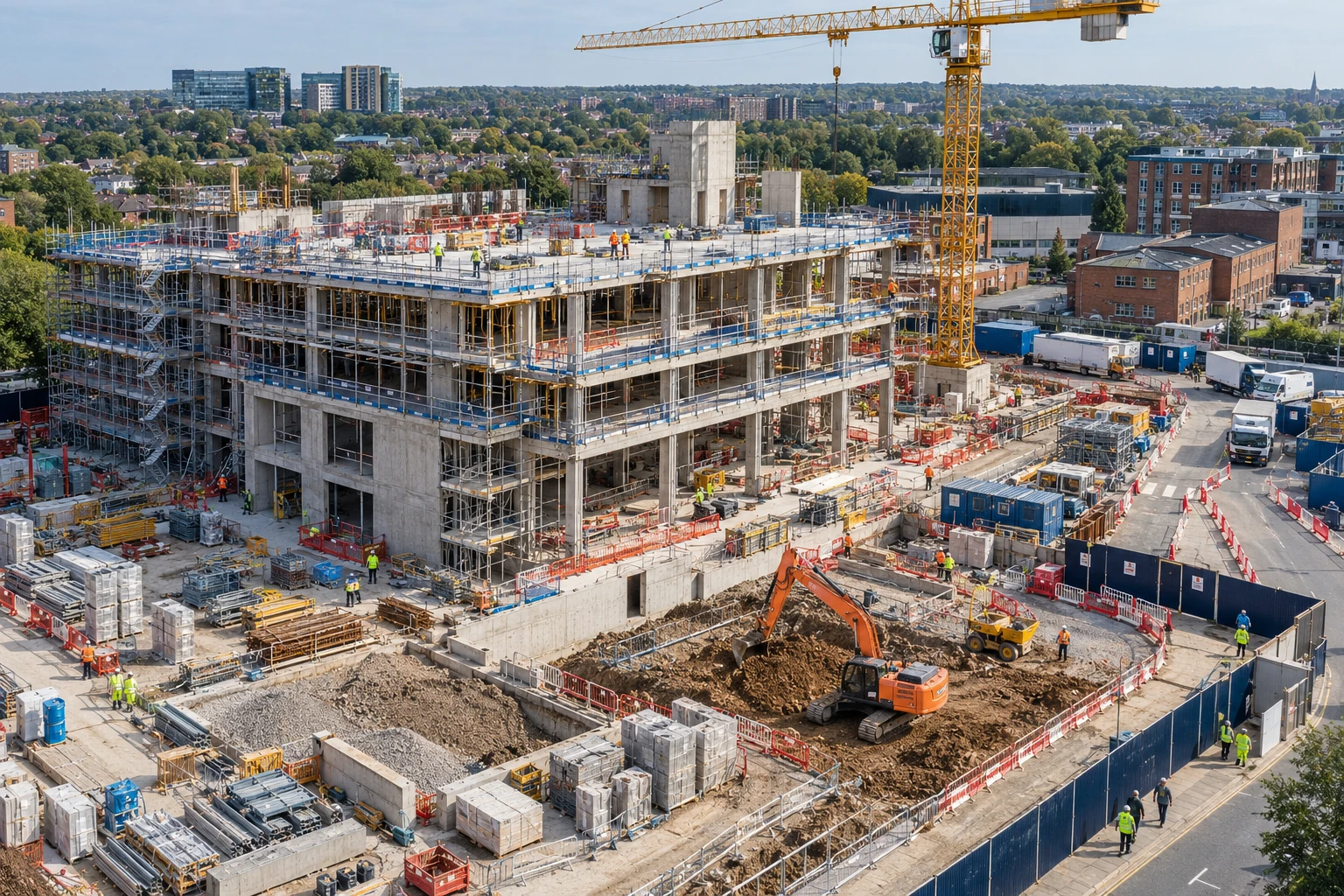
A delivery crosses the public pavement
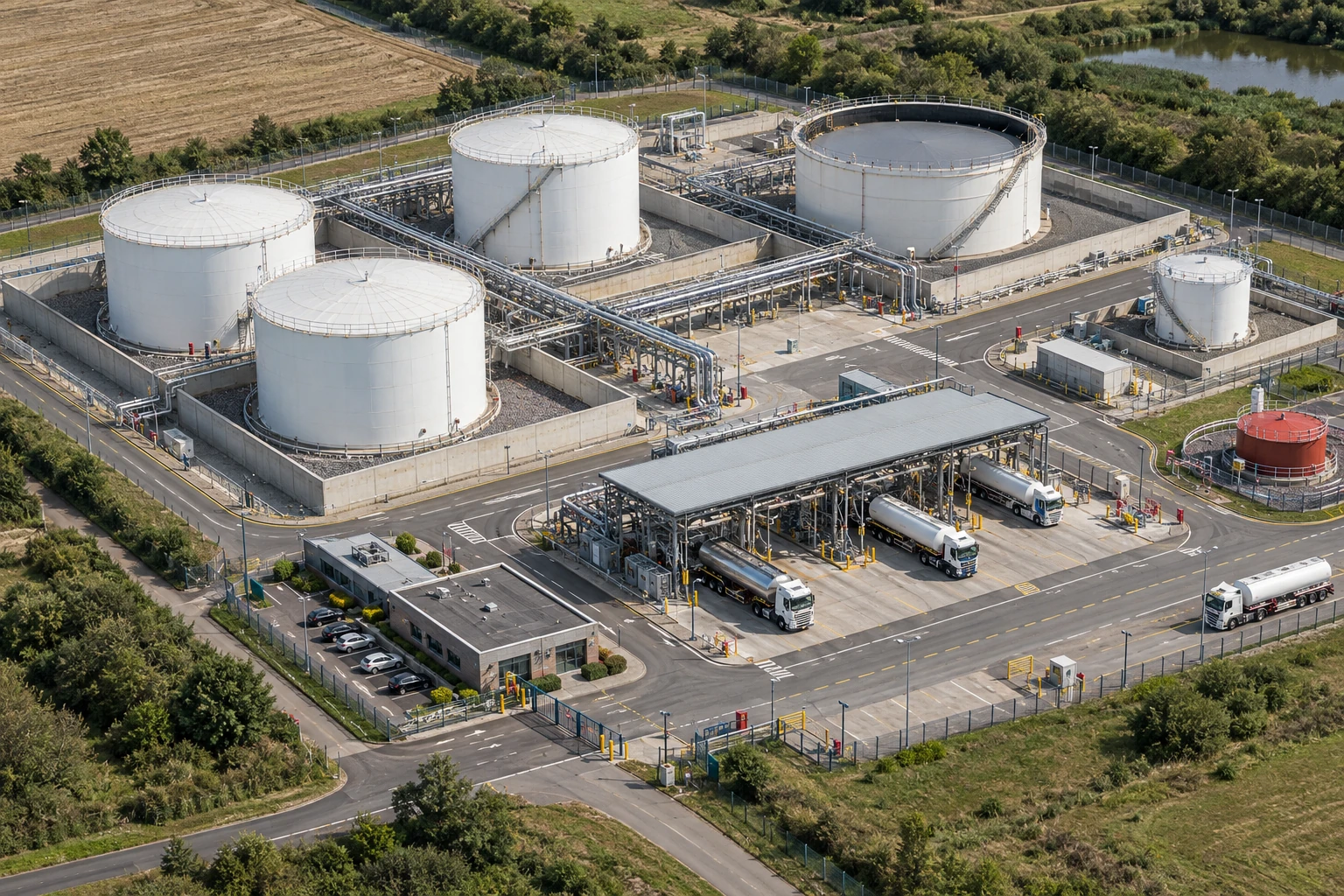
An arriving tanker crosses a pedestrian route
All related inspection points 10 across 2 locations
Construction site 6 inspection points
Crown Fuels terminal 4 inspection points
Practice in the SHAREhub environment. Browser practice is separate from workplace competence and formal learning records.
How should a traffic management plan be built?
Build a site-specific plan from observed routes, vehicle envelopes, people, activities, controls, owners and change triggers; check it in the field before movement.
Sketch arrival, parking, unloading, pedestrian desire lines, crossings, welfare, work zones and emergency access. Test the largest intended vehicle and load, including turning, swept path, clearance, visibility and surface. Use a competent designer where geometry or public interface is complex; no universal site speed or barrier specification is supplied here.
Agree who owns gates, bookings, barriers, driver briefings, vehicle checks, temporary changes and inspection. Keep the plan where users can act on it. Stop and revise when the real route differs from the drawing.
| Plan element | Questions to answer | Typical evidence |
|---|---|---|
| Movement and people | Who arrives, walks, cycles, loads, reverses or may cross? | Observed movement map and consultation. |
| Layout and plant | Can the intended vehicle, load and people move with separation and clearance? | Competent layout and vehicle check. |
| Operating controls | Who controls booking, gate, crossing, speed, unloading and emergencies? | Named owners and communicated rules. |
| Change and assurance | What triggers a hold, revision and authorised restart? | Field check, defect record and hand-back. |
| Road boundary | Could works affect a public road, footway, cycleway or sightline? | Authority consultation and approved competent scheme where required. |
What should teams check before, during and after each movement?
Check the route, vehicle, people and conditions; hold on a failed interface and verify the hand-back before movement resumes.
| Task and people | Before movement | During movement and hold | After and evidence |
|---|---|---|---|
| Routine HGV delivery at a yard; driver, loaders and walkers. | Book slot, check gate, route, loading bay, pedestrian separation, vehicle and driver briefing. | Keep people out of manoeuvre zone; hold for a blocked bay, unclear route or failed restraint. | Restore route, release vehicle safely, record defects and hand-back. |
| Forklift movement through warehouse; operator and nearby staff. | Check truck, load, aisle, crossings and barriers; confirm operator competence. | Use protected route; hold if pedestrian enters aisle or visibility is lost. | Park safely, report damage and reinstate barriers. |
| Non-routine scaffold delivery on construction phase change; contractors and visitors. | Coordinate revised access, ground and public boundary; brief driver and work team. | Hold when new storage blocks walkway or vehicle cannot turn as planned. | Inspect separation and update phase plan and briefing. |
| Failed reversing alarm or damaged barrier; driver and supervisor. | Know safe stop location and defect reporting route. | Stop affected movement; do not use a marshal to compensate for uncertain control. | Competent repair or alternative assessment, authorised restart and record. |
| Collision or blocked emergency access; everyone on site. | Know emergency route and who controls gates. | Stop traffic, summon help and protect responders; do not improvise a new route. | Preserve facts, investigate, restore access and verify hand-back. |
When does a public road or footway need a separate traffic scheme?
Before work occupies or changes a public road, footway or cycleway, use a competent design and the relevant GB highway or NI roads authority route.
| Road or footway task | Before installation | Live hold point | Completion and evidence |
|---|---|---|---|
| Works vehicle crosses a public footway at a site gate. | Assess pedestrians, cyclists, visibility and vehicle timing; agree any interface measures with the relevant authority. | Hold if sightline, accessible route or public protection is lost. | Restore public access and record inspection and hand-back. |
| Temporary footway occupation for construction delivery. | Competent person determines permissions, accessible alternative, barriers and signing under local authority conditions. | Do not occupy or divert without the applicable approval; inspect after changes. | Remove controls in planned order, reinstate and notify authority as required. |
| Street works or roadworks with traffic control. | Use applicable GB DfT or NI DfI code, Chapter 8 where relevant, road authority approval and competent team. | Stop if scheme differs from approved design, signs fail or public users cannot pass safely. | Inspect, remove, reinstate and retain scheme, approval and hand-back records. |
How does traffic risk change on a live construction site?
On a live construction project, stop a delivery when the temporary pedestrian route is blocked; restore separation and re-authorise the route before unloading.
BuildOut Ltd is a leisure-centre refurbishment. A telehandler and HGV deliver palletised material while workers use welfare and visitors use a temporary entrance. Rain, stored materials and a moved barrier narrow the pedestrian route. The supervisor checks the route, ground, load, visibility and public boundary before admitting the vehicle; the driver and operator need site-specific instructions.
If the walkway is blocked or the agreed unloading area is unavailable, hold the vehicle at a safe waiting point. Clear or redesign the route, coordinate contractors, brief everyone affected and verify separation before work resumes. After unloading, restore barriers and access, inspect the area and record the changed plan. This is an example, not a certified layout.
| Issue | Weak response | Stronger response |
|---|---|---|
| Rain and soft ground | Keep timetable and assume plant can use the original route. | Check support and traction; hold until the route is suitable. |
| Barrier moved for pallets | Ask pedestrians to take care. | Restore a suitable protected route or redesign delivery. |
| Unbriefed HGV driver | Wave driver through the gate. | Hold at a safe waiting point and brief the route and stop point. |
| Visitor entrance near plant | Rely on high-visibility clothing and warnings. | Physically protect visitor route and check public interface. |
What should a practical traffic layout model include?
A useful layout drawing shows both normal and changed routes, the people exposed and the clearance needed by the actual vehicle; it is checked on site.
Show separate pedestrian and vehicle entry, direct walkways, controlled crossings, loading and turning space, parking, visibility, lighting, gradients, overhead services and emergency access. Recheck the plan when scaffolds, hoarding, road plates, excavations or welfare routes change; temporary works can create new vehicle-pedestrian interfaces. Check the path people actually choose, including disabled access and visiting drivers. Barriers must suit the site risk rather than merely look robust.
A drawing is a communication tool, not proof of safety. The route must be walked and driven under representative conditions and changed after a near miss, altered phase, new vehicle or failed control.
| Layout element | What to examine | Good control |
|---|---|---|
| Pedestrian route | Does it remain direct, accessible and clear during deliveries? | Separate or protected route and crossing. |
| Vehicle route | Can the actual vehicle turn and stop with clearance? | Competent swept-path and field check. |
| Loading area | Can the driver and loaders work without entering moving traffic? | Controlled bay and vehicle restraint or other site-suitable controls. |
| Public boundary | Can a vehicle or load intrude into public space? | Secure boundary and authority interface where applicable. |
| Emergency access | Can responders reach the site if a delivery is waiting? | Unobstructed route and tested access plan. |
Trace each movement and hold a changed conflict
A traffic plan must match how people, deliveries, mobile plant and loads actually move. The existing forecourt model gives context; its component numbers and scale do not constitute a traffic design.

Map the whole journey
Identify gate entry, visitor parking, unloading, waiting and exit, including emergency access. Consider redesign that avoids unnecessary journeys, reversing and crossings.
Separate people physically
Provide the assessed routes, suitable fixed barriers and separate pedestrian entrances where practicable. High-visibility clothing and painted lines cannot physically stop a vehicle.
Crossing and waiting
Check protection, sightlines, ground capacity, clearances and a safe driver waiting point for the actual vehicle and load. A schematic provides no universal swept-path dimensions.
Live change: hold
A displaced barrier, blocked route, soft ground or failed visibility requires the affected movement to stop and be reassessed. Restore the protected route or redesign the delivery before release.
Brief and verify
Brief visiting drivers and people using the route. Check the actual arrival, agreed stop point and communication; a signaller cannot compensate for an unassessed layout or stand in a danger area.
Public highway is separate
Work affecting a public road or footway needs its own competent temporary-traffic design and authority arrangements. A private-yard drawing or permission does not authorise a road closure.
Read the complete controls: ERICPD planning prompts
Discipline verifies and sustains all the controls; it is not a separate substitute for them.
| Prompt or level | Complete task-specific example |
|---|---|
| Eliminate | Move the loading point or redesign circulation so vehicles enter and leave forwards without crossing a pedestrian route. |
| Reduce | Use smaller vehicles, off-site consolidation or a timed remote drop where the load, road access and handling assessment permit it. |
| Isolate | Install physical pedestrian barriers, protected crossings, suitable gates, lighting and a marked reversing bay with adequate clearance and ground capacity. |
| Control | Book arrivals, brief drivers at entry, prohibit unscheduled reversing, use an agreed signaller only where needed and keep visitors out of manoeuvring zones. |
| PPE | Provide high-visibility clothing suited to light and weather for authorised people who must enter the traffic area, while checking it does not snag or obscure other protection. |
| Discipline | Book arrivals, brief drivers at entry, prohibit unscheduled reversing, use an agreed signaller only where needed and keep visitors out of manoeuvring zones. The yard lead observes the route and records near misses and changes. A signaller cannot compensate for a route that cannot safely accommodate the vehicle. Discipline sustains every control level: verify elimination and substitution decisions, inspect and maintain physical controls, check operating arrangements and residual PPE, investigate defects and worker feedback, and verify corrective action before closure. |
Read the complete controls: ESEAP effectiveness order
Compare stronger feasible controls while preserving the actual task, checks and release requirements.
| Prompt or level | Complete task-specific example |
|---|---|
| Elimination | Move the loading point or redesign circulation so vehicles enter and leave forwards without crossing a pedestrian route. |
| Substitution | Use smaller vehicles, off-site consolidation or a timed remote drop where the load, road access and handling assessment permit it. |
| Engineering controls | Install physical pedestrian barriers, protected crossings, suitable gates, lighting and a marked reversing bay with adequate clearance and ground capacity. |
| Administrative controls | Book arrivals, brief drivers at entry, prohibit unscheduled reversing, use an agreed signaller only where needed and keep visitors out of manoeuvring zones. |
| PPE | Provide high-visibility clothing suited to light and weather for authorised people who must enter the traffic area, while checking it does not snag or obscure other protection. |
The plan is not to scale. Competent transport assessment must establish actual geometry, barrier performance, load/ground capacity and reversing arrangements.
How do traffic controls differ by vehicle and activity?
Select controls for the actual vehicle, load, driver, surface and people; the same plan cannot be copied between a warehouse, yard and roadworks site.
Forklift aisles, HGV deliveries, telehandlers, tippers, skip exchanges, moving MEWPs, waste collection and event parking have different blind spots, pedestrian peaks, turning and load risks. The operator checks the equipment and route; a supervisor coordinates the people and other tasks. Road-going vehicles on public roads also face a separate road-traffic regime.
Use manufacturer instructions and task-specific assessment for vehicle limits, restraint, lifting and tipping. This page provides no universal speed, turning radius, clearance or stopping distance.
| Vehicle or activity | Typical failure mode | Main control |
|---|---|---|
| HGV delivery | Reverses across a walkway or waits on a public road. | Booked arrival, safe waiting point, separated route and unloading bay. |
| Forklift in warehouse | Pedestrian enters aisle or blind corner. | Physical separation, controlled crossings, suitable vehicle and trained operator. |
| Telehandler on construction site | Load obscures view or ground cannot support movement. | Suitable route, exclusion zone, load control and competent operator. |
| Tipper or skip exchange | Overturn, overhead strike or people near moving container. | Ground and overhead checks, controlled zone and task-specific method. |
| Public-road works | Road user meets unprotected work area or inaccessible footway. | Competent temporary traffic scheme, authority approval and live inspection. |
| MEWP repositioning | Strikes a person or structure during movement. | Check the actual travel path, stability and exclusion zone; use a signaller only if suitable. |
| Waste collection | Collection vehicle reverses near workers or the public. | Design collection point and timing to minimise reversing; separate people and brief the driver. |
| Event parking | Peak pedestrian flows mix with arriving or departing vehicles. | Plan separated flows, suitable marshal positions, lighting and clear emergency access. |
When should traffic movements stop immediately?
Stop the affected movement when separation, visibility, route condition, vehicle control, emergency access or an applicable road approval is missing or uncertain. A driver who loses sight of a signaller stops immediately, even if the radio still works.
Drivers and workers should have a clear stop signal and safe waiting place. Do not ask a marshal to rescue a defective layout. Make the area safe, report the defect, reassess and restart only when an authorised person has verified the changed controls.
For a collision, summon emergency help, prevent further movement and protect responders without moving an injured person unnecessarily. Follow local emergency and reporting arrangements; investigate before returning the route to service.
| Stop trigger | Why it matters | Action |
|---|---|---|
| Pedestrian barrier or crossing failed | People can enter the vehicle path. | Hold movement, restore separation and verify. |
| Unknown or obstructed route | Driver may improvise through an exposed area. | Hold at a safe point; clear or redesign and brief. |
| Failed safety-critical vehicle aid | Visibility or warning may be inadequate. | Quarantine or restrict the vehicle pending competent assessment. |
| Poor light, weather or ground | The assessed manoeuvre no longer matches conditions. | Suspend affected movement and reassess. |
| Emergency route blocked | Response and evacuation could fail. | Stop the obstruction and restore access. |
| Public-road control unapproved or damaged | Road users may enter a work area. | Do not install or continue an unsafe scheme; escalate to scheme owner and authority. |
| Driver loses sight of signaller, even with radio contact | The signaller is no longer continuously visible in a safe guiding position. | Stop immediately; do not reverse again until the visible arrangement is safely reset. |
Why is a banksman not a substitute for good layout?
Remove or minimise reversing and exclude pedestrians first. A trained signaller is not required for every reverse; where suitable and used, the driver stops immediately on losing sight of the signaller, even with radio contact.
Only where reversing cannot be removed and a signaller is suitable for the vehicle and industry, use a trained, authorised person with agreed signals in a safe position outside the vehicle path and continuously visible to the driver. The driver must stop immediately if sight of the signaller is lost, even when radio contact remains; radio is an additional aid, not a substitute for visibility. Exclude other people and control conflicting movements. Some vehicle or industry situations prohibit or make signallers unsuitable.
The employer should first ask whether a one-way or drive-through arrangement could remove the manoeuvre. A roadworks traffic operative is not automatically a workplace reversing signaller, or vice versa; competence must match the task.
| Weak use | Better approach | Evidence |
|---|---|---|
| Used instead of layout | Remove reversing or separate the route first. | Revised plan and field check. |
| Stands in blind spot | Use an agreed safe position outside the vehicle path, continuously visible to the driver. | Task observation. |
| Driver loses sight of signaller but radio still works | Stop immediately; radio cannot replace sight. Reset the safe visible position and signals before movement. | Driver and signaller briefing, observation and stop rule. |
| Conflicting movements | Control one movement and exclude other users. | Gate or bay coordination record. |
How should supervisors decide what traffic controls are needed?
Choose controls by asking who and what could meet, then remove the encounter, separate routes, control the residual movement and verify the result.
A supervisor asks whether the movement is necessary, whether the route suits the real vehicle and whether workers, visitors or the public can enter it. If the work reaches a public road or footway, hand design and approval to the competent roadworks route rather than adapting a private-site sketch.
Where the answer is unknown, hold the affected movement. A local plan, a person in high-visibility clothing or a green inspection score cannot substitute for a verified route and required authority decision.
| Question | If yes | If no or uncertain |
|---|---|---|
| Can the journey or reverse be avoided? | Remove it or use one-way or drive-through layout. | Plan the smallest residual manoeuvre. |
| Can people and vehicles be separated? | Provide direct protected routes and controlled crossings. | Hold and redesign or time-separate with competent assessment. |
| Does the actual vehicle fit and remain stable? | Confirm with vehicle and route evidence. | Hold for ground, clearance or load assessment. |
| Are visitors and drivers briefed? | Admit to the agreed route. | Wait safely and provide instructions. |
| Does work affect a public road or footway? | Use competent scheme and authority route. | Keep the work wholly inside the controlled site. |
| Has anything changed or failed? | Reassess, brief and verify before restart. | Continue with live checks. |
Where does traffic management fail?
Plans fail when a safe route on paper becomes blocked, unfamiliar, poorly lit or mixed with people and plant in real work.
Watch for damaged barriers, worn markings, repeated reversing, unbriefed deliveries, a marshal in a danger area, vehicle defects, contractor changes and workers taking a shorter unprotected path. A public-road arrangement can fail when signs, pedestrian access or approval no longer match the live scheme.
Treat near misses and workarounds as evidence for redesign. Assign an owner and verify the fix where the movement occurs; a plan revision alone is not a hand-back.
| Failure or weak practice | How it develops | What good looks like |
|---|---|---|
| Painted line only | People and vehicles cross it during pressure. | Assess stronger separation and observe the crossing. |
| Routine reverse | Convenience outweighs layout redesign. | One-way or drive-through route where practicable. |
| Unbriefed driver | Gate is open without a safe waiting process. | Booking, hold and concise route instruction. |
| Blocked walkway | Stock or temporary work displaces pedestrians. | Clear route, protected alternative and recheck. |
| Roadworks scheme drift | Cones or signs move and footway access changes. | Competent live inspection and authority escalation. |
What evidence shows traffic management is controlled?
Keep an accurate route plan, delivery interface, vehicle and driver checks, pedestrian crossings, signaller authorisation, defect holds and change records. Record what the site looked like when the movement occurred.
| Evidence item | What it should show | Assurance question |
|---|---|---|
| Site traffic plan | Actual pedestrian, vehicle, loading, crossing and emergency routes. | Does it match today’s layout? |
| Vehicle and driver | Suitability, maintenance, task competence and induction. | Can this person and vehicle use this route? |
| Field inspection | Barriers, sightlines, signs, ground, lighting and obstructions. | Were defects held and closed? |
| Change and near miss | Why route changed and whether corrective action worked. | Was the plan tested in real work? |
| Roadworks file | Approved competent scheme and authority interface. | Does the installed scheme match approval and stay safe? |
How should traffic management be assured?
Walk routes at busy times and after changes. Check separation, visibility, reversing need, visiting-driver knowledge and whether stopped movements restart only after correction and hand-back.
| Assurance level | What to check | What good looks like |
|---|---|---|
| Point of work | Route, people, driver, vehicle and barriers before movement. | A stop is used when the plan fails. |
| Management | Repeat defects, changes, near misses and action closure. | Control changes are tested, not just filed. |
| Competent review | Geometry, public interface or complex plant risk. | Assumptions and approvals are verified. |
| Leadership | Resource and risk decisions after unfavourable evidence. | Known conflicts do not remain normalised. |
Which GB and NI traffic duties apply at a workplace or public road?
GB and NI have separate workplace and construction traffic-route duties; public-road works add a distinct road-authority and street-works regime.
For ordinary workplaces, check GB 1992 or NI 1993 workplace regulations. Construction sites instead need the applicable GB CDM 2015 or NI CDM 2016 rules. General health and safety duties also apply. A site manager cannot approve a public-road closure, signal or footway diversion by writing a workplace traffic plan: consult the relevant authority, competent designer and applicable GB or NI code. Check amended text and local permission conditions before work.
The four-nation replacement street-works safety code published for consultation on 21 September 2026 is a proposal. The 2013 code remains the current signing, lighting and guarding reference pending a final adopted update; verify the applicable national issue and road-authority conditions before a live scheme.
| Duty or guidance | What it means | How to apply it |
|---|---|---|
| Great Britain | HSWA 1974 and Workplace Regulations 1992 | General safety and suitable workplace traffic routes. | Assess and maintain safe movement at applicable workplaces. Direct sources: GB Health and Safety at Work etc. Act 1974; GB Workplace Health Safety and Welfare Regulations 1992 |
| Northern Ireland | 1978 Order and Workplace Regulations 1993 | Separate NI duties and traffic-route provisions. | Use NI law and HSENI route for the workplace. Direct sources: NI Health and Safety at Work Order 1978; NI Workplace Health Safety and Welfare Regulations 1993 |
| GB construction | CDM 2015 | Construction site traffic routes and vehicles. | Plan separation, suitability and ongoing checks during phases. Direct sources: GB Construction Design and Management Regulations 2015 |
| NI construction | CDM 2016 | Separate NI construction site traffic and vehicle duties. | Use NI project arrangements and current text. Direct sources: NI Construction Design and Management Regulations 2016 |
| GB public road or footway | DfT Red Book and Chapter 8 guide applicable street and road works. | Confirm road authority permissions, competent design and live scheme requirements. Direct sources: DfT Safety at Street Works and Road Works Code; DfT Traffic Signs Manual Chapter 8 |
| NI public road or footway | NI Street Works Order and DfI code form a separate regime. | Confirm DfI Roads interface, approvals and competent scheme. Direct sources: DfI NI Safety at Street Works and Road Works Code |
How can the hierarchy of controls prevent workplace vehicle and pedestrian collisions?
For this example, remove or redesign the exposure first; use lower-order controls only for the risk that remains. The example is a planning aid, not approval of a live task.
For Northern Ireland work, use this five-level framework to plan controls, then verify the applicable NI duties and HSENI guidance; HSE sources cited here state GB guidance.
Worked scenario: HGV deliveries reverse towards a warehouse door across a pedestrian access route. The HSE five-level hierarchy order elimination, substitution, engineering, administrative controls and PPE. HSE workplace traffic management supplies the topic context. ERICPD maps elimination to elimination, Reduce to substitution and source reduction, Isolate to engineered separation, Control to engineering and administrative arrangements, and PPE to residual personal protection. Discipline is the continuing check, maintenance, supervision and learning that keeps every chosen level effective; it is not blame or a replacement for design controls. For each row, the owner must show why any stronger feasible measure was not chosen, check the residual risk and hold work when the stated control fails. Feasibility test: An existing dock may not permit immediate forward-only circulation; a dated redesign decision is needed before relying on a controlled reverse.
How can the ERICPD hierarchy of controls prevent workplace vehicle and pedestrian collisions?

| HSE hierarchy level | ERICPD counterpart | Specific action, owner, check and stop point | Official basis |
|---|---|---|---|
| Elimination | Eliminate | Move the loading point or redesign circulation so vehicles enter and leave forwards without crossing a pedestrian route. The transport planner checks the swept path for the largest real vehicle and observes peak movements; a vehicle forced to reverse into people shows the design has failed. | HSE control order; HSE workplace traffic management |
| Substitution | Reduce, including substitution | Use smaller vehicles, off-site consolidation or a timed remote drop where the load, road access and handling assessment permit it. The logistics manager checks new manual-handling, public-road and delivery risks; do not exchange one collision risk for an unsafe unloading task. | HSE control order; HSE workplace traffic management |
| Engineering controls | Isolate or physical Control | Install physical pedestrian barriers, protected crossings, suitable gates, lighting and a marked reversing bay with adequate clearance and ground capacity. A competent designer checks visibility and emergency access; the supervisor stops movement if a barrier is moved or a crossing cannot be controlled. | HSE control order; HSE workplace traffic management |
| Administrative controls | Administrative Control and Discipline | Book arrivals, brief drivers at entry, prohibit unscheduled reversing, use an agreed signaller only where needed and keep visitors out of manoeuvring zones. The yard lead observes the route and records near misses and changes. A signaller cannot compensate for a route that cannot safely accommodate the vehicle. Discipline sustains every control level: verify elimination and substitution decisions, inspect and maintain physical controls, check operating arrangements and residual PPE, investigate defects and worker feedback, and verify corrective action before closure. | HSE control order; HSE workplace traffic management |
| PPE | PPE | Provide high-visibility clothing suited to light and weather for authorised people who must enter the traffic area, while checking it does not snag or obscure other protection. It improves conspicuity but cannot prevent impact. Missing segregation or uncontrolled reversing is a stop point even when PPE is worn. | HSE control order; HSE workplace traffic management |
How can the ISO 45001 hierarchy of controls prevent workplace vehicle and pedestrian collisions?

| HSE hierarchy level | ERICPD counterpart | Specific action, owner, check and stop point | Official basis |
|---|---|---|---|
| Elimination | Eliminate | Move the loading point or redesign circulation so vehicles enter and leave forwards without crossing a pedestrian route. The transport planner checks the swept path for the largest real vehicle and observes peak movements; a vehicle forced to reverse into people shows the design has failed. | HSE control order; HSE workplace traffic management |
| Substitution | Reduce, including substitution | Use smaller vehicles, off-site consolidation or a timed remote drop where the load, road access and handling assessment permit it. The logistics manager checks new manual-handling, public-road and delivery risks; do not exchange one collision risk for an unsafe unloading task. | HSE control order; HSE workplace traffic management |
| Engineering controls | Isolate or physical Control | Install physical pedestrian barriers, protected crossings, suitable gates, lighting and a marked reversing bay with adequate clearance and ground capacity. A competent designer checks visibility and emergency access; the supervisor stops movement if a barrier is moved or a crossing cannot be controlled. | HSE control order; HSE workplace traffic management |
| Administrative controls | Administrative Control and Discipline | Book arrivals, brief drivers at entry, prohibit unscheduled reversing, use an agreed signaller only where needed and keep visitors out of manoeuvring zones. The yard lead observes the route and records near misses and changes. A signaller cannot compensate for a route that cannot safely accommodate the vehicle. Discipline sustains every control level: verify elimination and substitution decisions, inspect and maintain physical controls, check operating arrangements and residual PPE, investigate defects and worker feedback, and verify corrective action before closure. | HSE control order; HSE workplace traffic management |
| PPE | PPE | Provide high-visibility clothing suited to light and weather for authorised people who must enter the traffic area, while checking it does not snag or obscure other protection. It improves conspicuity but cannot prevent impact. Missing segregation or uncontrolled reversing is a stop point even when PPE is worn. | HSE control order; HSE workplace traffic management |
ERICPD Discipline in this example: The yard lead reviews swept paths and near misses, maintains barriers and crossings, and withdraws movement authority after a pedestrian enters the reversing zone. After a change, the supervisor verifies the strongest installed control at the workface and records any remaining exposure. If elimination or substitution was rejected, record the task-specific reason and revisit it when the process, equipment or site changes.
What can a voluntary management system add?
A management system can help assign owners, check live controls and correct failures, but it cannot certify that this particular task is lawful or safe. HSE explains the voluntary ISO 45001 context and the real task evidence remains decisive.
For this topic, check vehicle and pedestrian separation, crossings, delivery changes, observations and failed-barrier response. The direct HSE topic guidance supplies the control context. Check the applicable GB or NI duty and the actual work before deciding that a control is effective. This is a SHARE management application, not an interpretation of an ISO clause.
What training and competence are needed?
Competence is a sound decision demonstrated in the real task, assessed by an appropriate person and revisited when conditions change.
Use a delivery at a changing site entrance. Drivers demonstrate the approved route and stop if sight is lost; pedestrians use segregated access; signallers work only within their authorised task; planners verify the layout and hand-back. Reassess after changed traffic, layout or near miss.
| Role | Learning to test | Demonstration | Assessor and evidence | Reassess when |
|---|---|---|---|---|
| Pedestrians and visitors | Recognise designated routes, crossings and movement stop signals. | Find safe access and report a blocked walkway. | Host/supervisor: observed induction check. | Layout or access change. |
| Drivers and operators | Use the actual route, vehicle checks, exclusion and reversing stop rule. | Practical manoeuvre and loss-of-sight response. | Authorising supervisor: task observation and vehicle record. | New vehicle, route or near miss. |
| Signallers and banksmen | Work only where needed, competent and visible, with agreed signals. | Demonstrate safe position and immediate stop when sight is lost. | Competent assessor: practical authorisation record. | Task change or failed signal. |
| Planners and supervisors | Separate people and vehicles, coordinate deliveries, hold unsafe movement and inspect hand-back. | Walk a changed layout and resolve conflicting movements. | Manager: route plan, inspection and action record. | Contractor change or altered site. |
| Senior managers and roadworks specialists | Resource site design; use separate competent public-road approval where applicable. | Challenge unsafe route and verify authority/inspection requirements. | Technical lead: approved scheme and assurance sample. | Road occupation or major change. |
How could BuildOut Ltd manage this in practice?

BuildOut Ltd treats each construction phase, delivery and public-boundary change as a fresh traffic interface decision.
The contractor books HGVs, protects visitor and worker routes, checks telehandler ground and visibility, keeps emergency access clear and stops a delivery when separation fails. If the temporary entrance affects a public footway, it seeks competent roadworks design and the relevant authority decision before occupying the highway.
| Management element | How the business would manage it | Evidence to review |
|---|---|---|
| Phase plan | Traffic plan updated before each change in access, storage or workface. | Marked-up plan and briefing record. |
| Segregation | Physical barriers separate public, workers and vehicles. | Inspection and defect record. |
| Deliveries | Booked slots and waiting points prevent uncontrolled arrivals. | Delivery booking log. |
| Plant | Telehandlers and dumpers have route and exclusion controls. | Plant plan and operator briefing. |
| Assurance | Near misses and stop triggers are reviewed weekly. | Site review minutes and action tracker. |
What should traffic management consider at a fuel-delivery interface?
Identify the tanker position, people and other vehicles in the selected delivery mode. The composition does not establish that routine customer movement can continue during delivery.
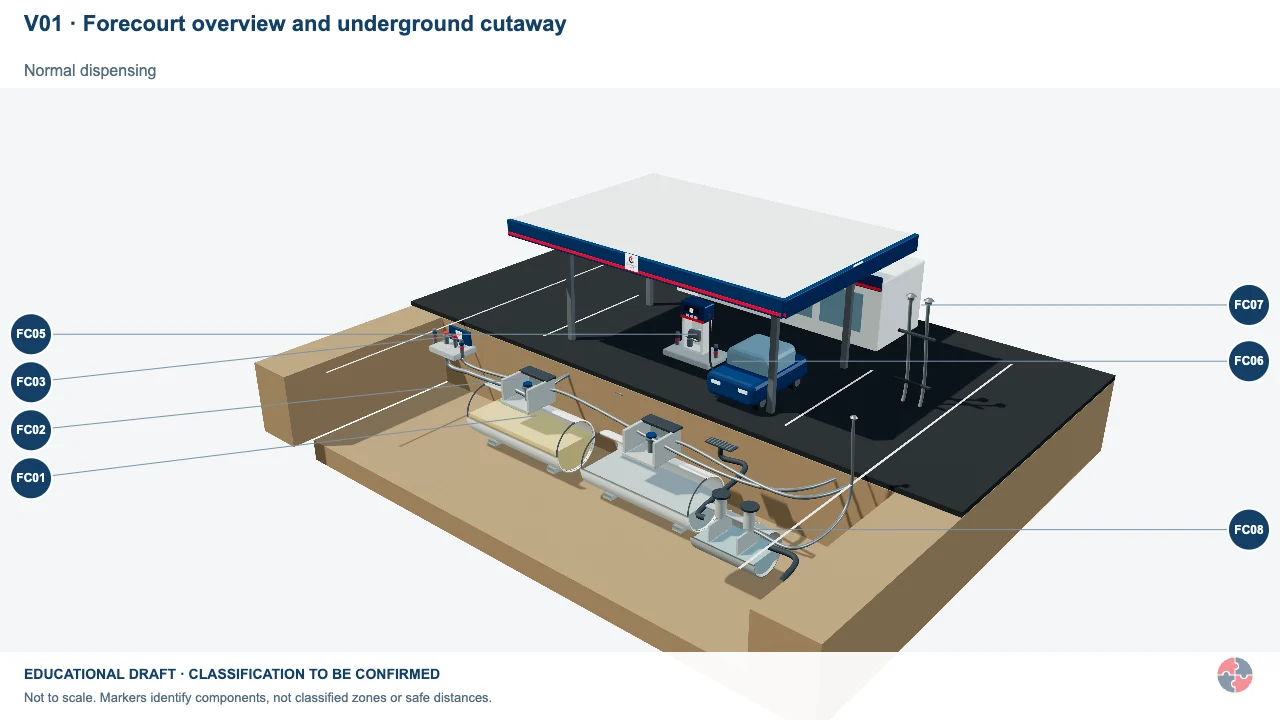
Forecourt overview and underground cutaway
A familiar forecourt contains connected systems above and below ground. Locate each source before considering where an explosive atmosphere could form.
Activity focus: Switch to delivery to inspect the added connection and changed activity.
Contextual site or forecourt image. Component labels and visible barriers do not establish swept paths, visibility, ground capacity or a compliant traffic scheme.
Educational illustration, not to scale. Coloured zones are teaching examples, not a site-specific hazardous-area classification.
Which acronyms and terms are useful for traffic management?
These are the traffic-management terms used on this page.
| Acronym | Meaning | Plain-English use |
|---|---|---|
| HSE | Health and Safety Executive | Great Britain regulator and official guidance source. |
| HSWA | Health and Safety at Work etc. Act 1974 | Primary GB law; NI has a separate 1978 Order. |
| OH | Occupational Health | Competent clinical advice route focused on work and health. |
| FLT | Forklift Truck | Workplace transport equipment commonly used in warehouses and yards. |
| HGV | Heavy Goods Vehicle | Large goods vehicle used for deliveries and transport. |
| MEWP | Mobile Elevating Work Platform | Mobile plant used for work at height and repositioning tasks. |
| Segregation | A practical barrier or route arrangement that keeps pedestrians away from vehicle movement. | Check crossings, gates and deliveries in real use. |
| Banksman | A trained signaller guiding a movement only when safer design cannot remove the need. | Driver stops if the signaller is no longer visible. |
Unlock another resource
You have used this month’s two free downloads. Publish a post in your own words to unlock one more resource, or choose SHARE Individual for 10 downloads per month.
You decide whether to share. If you do, use the relevant platform disclosure tools and do not make claims you do not genuinely hold.